
L6W Ingredients & Drug Interactions
by Pure Herbs
What is this page for?
First and foremost: checking L6W against your medications. The heart of this page is the interaction checker and the full interaction report — how this product’s ingredients may interact with prescription and over-the-counter medicines you may be taking.
Around that, we add a pharmacist’s high-level view of the product as a whole — what’s inside, the evidence for its stated use, how transparent the label is, and what safety data exists — so you can see the full picture in one place. It’s educational information from our licensed clinical databases and the clinical staff at HelloPharmacist — not medical advice — and we don’t sell or endorse products. Our editorial policy
L6W is a dietary supplement by Pure Herbs with 7 active ingredients. Its ingredients are commonly taken for general wellness and longevity, antioxidant support, heart and cholesterol health.Based on those ingredients, 535 medications have a known interaction with it, the most serious rated moderate. The ingredients most likely to interact are Blue Cohosh Root Extract, Angelica Root Extract, Raspberry Leaf Extract. Use the checker below to test your specific medication, or read the full HelloPharmacist Interaction Report.
Check Your Meds Against L6W by Pure Herbs
Ask about any prescription or over-the-counter medication and we check it for interactions with L6W by Pure Herbs — and tell you which ingredient is responsible.
AI summaries are generated from our interaction database for education only — always confirm with your pharmacist. How we use AI
Ask the Pharmacist
A licensed pharmacist will answer your question by email — free, usually within 24 hours.
Got it — thank you!
A licensed pharmacist will answer within 24 hours. Keep an eye on your email (worth checking spam, just in case).
HelloPharmacist Scorecard of L6W by Pure Herbs
Our pharmacy team’s full take, with four database checks built into the cards below — a summary of what is known, not a grade of the product itself.
What’s inside
Low disclosure
Pure Herbs L6W Liquid contains 7 ingredients, with 5 active ones: blue vervain aerial parts extract, angelica root extract, blue cohosh root extract, raspberry leaf extract, spikenard root extract, and partridgeberry aerial parts extract. The product also contains a proprietary blend.
The inactive ingredients listed are none.
Does it work?
No specific claim
The evidence we hold doesn't establish that any of the active ingredients in this product are effective for specific health conditions. Angelica root extract, blue cohosh root extract, and spikenard root extract all carry ratings of insufficient reliable evidence for their traditional uses.
Raspberry leaf extract is also rated insufficient reliable evidence for the conditions it's traditionally used for, including diabetes and cardiovascular health.
How safe is it?
Well-documented data
Blue cohosh is flagged as likely unsafe and carries serious warnings: it can cause chest pain, high blood pressure, and stomach upset, and has been linked to heart damage and shock in newborns when used during pregnancy. Angelica root extract is likely safe as a food but poorly studied in concentrated supplement form.
Raspberry leaf extract is generally well tolerated, though gastrointestinal upset can occur. Spikenard root extract has little modern safety data available.
We hold no pregnancy or breastfeeding data for partridgeberry aerial parts extract. Given blue cohosh's safety profile and the limited data on most ingredients, this product should be approached cautiously and discussed with your doctor or pharmacist before use, especially if you're pregnant, breastfeeding, or taking medications.
Meds to double-check
Moderate interaction found
Before taking this product, check with your doctor or pharmacist if you take blood pressure medications (especially ACE inhibitors, angiotensin receptor blockers, or calcium channel blockers), diabetes medications or insulin, blood thinners or antiplatelet drugs, diuretics (water pills), or nicotine products. The interactions span moderate to minor severity depending on the drug class.
The bottom line
Scorecard at a glanceFormula with limited ingredient disclosure marketed for general wellness rather than one specific gradeable purpose. Moderate medication interactions have been identified, and safety information is well characterized.
This product contains several ingredients with moderate to serious drug interactions and limited effectiveness evidence. Blue cohosh in particular raises safety concerns and can interfere with blood pressure and diabetes medications.
If you're considering this supplement, talk it over with your doctor or pharmacist first—especially if you take heart, blood sugar, blood thinner, or water pill medications.
Educational only — not medical advice; always confirm with your pharmacist. Our editorial policy · How we use AI
Assessment coverage: 5 of 7 active ingredients matched to our full ingredient reviews (monographs). Based on the product label dated Jan 23, 2023.
This Scorecard evaluates available label information, ingredient evidence, and known medication-safety considerations. It does not independently verify product identity, purity, potency, contamination, or manufacturing quality. How these ratings are computed
General information
Key facts about L6W, straight from the product label.
| Brand | Pure Herbs |
|---|---|
| Net contents | 4 Fluid Ounce(s); 120 mL |
| Market status | On market |
| Date entered into DSLD | Jan 23, 2023 |
| DSLD ID | 281357 |
| Product type | Botanical |
| Supplement form | Liquid |
| Dietary claims / uses | All Other, Structure/Function |
| Intended target group(s) | Adult (18 - 50 Years), Women (not pregnant or lactating) |
Everything in this section is reproduced from the manufacturer’s own product label — it’s the label speaking, not HelloPharmacist. We show it so you can see exactly what the maker states; we don’t verify or endorse those statements.
Supplement Facts
The label details for L6W by Pure Herbs, sourced from the NIH Dietary Supplement Label Database.
Supplement Facts
| Ingredient | Amount | % DV |
|---|---|---|
| Proprietary Blend | 1921 mg | -- |
| Blue Vervain Aerial Parts Extract | 0 NP | -- |
| Angelica Root Extract | 0 NP | -- |
| Blue Cohosh Root Extract | 0 NP | -- |
| Raspberry Leaf Extract | 0 NP | -- |
| Spikenard Root Extract | 0 NP | -- |
| European Pennyroyal Aerial Parts Extract | 0 NP | -- |
| Partridgeberry Aerial Parts Extract | 0 NP | -- |
Other ingredients: None
Tap any ingredient to jump to its full detail below.
These statements are the manufacturer’s wording, reproduced from the product label — the label is saying it, not HelloPharmacist. We don’t verify or endorse them.
Suggested/Recommended/Usage/Directions
Directions: For adults, mix 2 mL (abt. 1/2 tsp) of extract in 2 fl. oz (60 mL) water one time daily preferably with a meal.
Shake well before use
Formulation
Beneficial to aid digestion.
FDA Disclaimer Statement
This statement has not been evaluated by the Food and Drug Administration. This product is not intended to diagnose, treat, cure or prevent any disease.
Precautions
Warning: Not intended for use by pregnant or nursing women. If you have a medical condition or are taking medication, consult your doctor prior to use.
Discontinue use and consult with your doctor if any adverse reactions occur.
Keep out of reach of children
Brand IP Statement(s)
Pure Herbs, Ltd. Natural Herbal Extracts
FDA Statement of Identity
Dietary Supplement
General Statements
"No expense has been spared to provide the finest nature has to offer."
Is this label outdated? Report a formula or label change and our pharmacy team will review it.
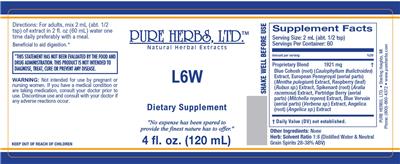
L6W by Pure Herbs label
The label scan from the NIH Dietary Supplement Label Database. Tap to enlarge.
Label images are published by the NIH Dietary Supplement Label Database for the version of this product on file. Always read your actual product label.
View the full label (PDF)The Ingredients in L6W by Pure Herbs
These are the 7 active ingredients this product is made of. Select any to open its full monograph.
Serving size2 mL Dosage formLiquid Servings per container60 Amounts shown are per serving.
Most supplement products combine several ingredients, and a medication can interact with the product through any one of them. Each ingredient below shows whether it has known drug interactions.
Proprietary Blend
- › Blue Vervain Aerial Parts Extract
- › Angelica Root Extract
- › Blue Cohosh Root Extract
- › Raspberry Leaf Extract
- › Spikenard Root Extract
- › European Pennyroyal Aerial Parts Extract
- › Partridgeberry Aerial Parts Extract
Other (inactive) ingredients: None. These complete the product’s ingredient list but are not active constituents.
L6W by Pure Herbs Drug Interactions
HelloPharmacist Interaction Report
Pure Herbs L6W Liquid has documented interactions with 535 individual medications across its active ingredients.
The most serious concern is blue cohosh root extract, which can decrease how well blood pressure medications work by potentially raising your blood pressure through effects on blood vessels—a moderate-severity interaction that could undermine your treatment.
Read the full breakdown — every affected drug type, severity by severity
Blue cohosh also interacts moderately with diabetes medications by potentially raising blood sugar levels, which might reduce how well those drugs control your glucose. Additionally, it can amplify the effects of nicotine.
Angelica root extract moderately inhibits a liver enzyme (cytochrome P450 1A2) that clears certain medications, potentially causing them to build up in your system—though this hasn't been reported in humans yet. Raspberry leaf extract moderately interacts with blood thinners (anticoagulants/antiplatelets) by raising bleeding risk, and with insulin by potentially lowering blood sugar too much.
Spikenard root extract has a minor interaction with diuretic drugs (water pills) by potentially enhancing fluid loss. We could not check Blue Vervain Aerial Parts Extract and European Pennyroyal Aerial Parts Extract—no data is on file for them.
Use the medication checker below to search your exact drugs before starting this product.
Check your own medications below · Editorial policy · How we use AI
Want to check YOUR meds against L6W?
Ask about interactions with your drugs in plain English — “Can I take it with lisinopril?” — and we find you the answer in seconds, ingredient by ingredient.
Go to the checkerIngredients driving the most interactions
Individual Drug Interactions
The ingredients in L6W interact with 535 drugs. Click any drug to see the details.
4 of the 7 ingredients in L6W interact with drugs. Each result below shows which ingredient is responsible. Blue Cohosh Root Extract Angelica Root Extract Raspberry Leaf Extract Spikenard Root Extract
Acetaminophen, Phenylephrine, ChlorpheniramineSuper Cold Tabs
How Acetaminophen, Phenylephrine, Chlorpheniramine interacts with L6W — through 1 ingredient. Tap an ingredient for the detail:
Angelica Root ExtractCytochrome P450 1a2 (cyp1a2) Substrates Moderate
Interaction Summary
In vitro research shows that ashitaba extract inhibits cytochrome P450 (CYP) 1A2.
Read the full Angelica Root Extract + Acetaminophen, Phenylephrine, Chlorpheniramine interactionAcetaminophen, PhenylpropanolamineTetra Caps
How Acetaminophen, Phenylpropanolamine interacts with L6W — through 1 ingredient. Tap an ingredient for the detail:
Angelica Root ExtractCytochrome P450 1a2 (cyp1a2) Substrates Moderate
Interaction Summary
In vitro research shows that ashitaba extract inhibits cytochrome P450 (CYP) 1A2.
Read the full Angelica Root Extract + Acetaminophen, Phenylpropanolamine interactionAcetaminophen, Phenylpropanolamine, PhenyltoloxamineSinubid
How Acetaminophen, Phenylpropanolamine, Phenyltoloxamine interacts with L6W — through 1 ingredient. Tap an ingredient for the detail:
Angelica Root ExtractCytochrome P450 1a2 (cyp1a2) Substrates Moderate
Interaction Summary
In vitro research shows that ashitaba extract inhibits cytochrome P450 (CYP) 1A2.
Read the full Angelica Root Extract + Acetaminophen, Phenylpropanolamine, Phenyltoloxamine interactionAcetaminophen, PhenyltoloxaminePercogesic, Relagesic
How Acetaminophen, Phenyltoloxamine interacts with L6W — through 1 ingredient. Tap an ingredient for the detail:
Angelica Root ExtractCytochrome P450 1a2 (cyp1a2) Substrates Moderate
Interaction Summary
In vitro research shows that ashitaba extract inhibits cytochrome P450 (CYP) 1A2.
Read the full Angelica Root Extract + Acetaminophen, Phenyltoloxamine interactionAcetaminophen, Phenyltoloxamine, SalicylamideLobac
How Acetaminophen, Phenyltoloxamine, Salicylamide interacts with L6W — through 1 ingredient. Tap an ingredient for the detail:
Angelica Root ExtractCytochrome P450 1a2 (cyp1a2) Substrates Moderate
Interaction Summary
In vitro research shows that ashitaba extract inhibits cytochrome P450 (CYP) 1A2.
Read the full Angelica Root Extract + Acetaminophen, Phenyltoloxamine, Salicylamide interactionAcetaminophen, PropoxypheneDarvocet-N 100, Darvocet-N 50, E-Lor, Wygesic
How Acetaminophen, Propoxyphene interacts with L6W — through 1 ingredient. Tap an ingredient for the detail:
Angelica Root ExtractCytochrome P450 1a2 (cyp1a2) Substrates Moderate
Interaction Summary
In vitro research shows that ashitaba extract inhibits cytochrome P450 (CYP) 1A2.
Read the full Angelica Root Extract + Acetaminophen, Propoxyphene interactionAcetaminophen, PseudoephedrineChildren's Tylenol Sinus, Dristan N.D., Non-Aspirin Sinus, Ornex, Ornex-Max, Sinutab +5 more
How Acetaminophen, Pseudoephedrine interacts with L6W — through 1 ingredient. Tap an ingredient for the detail:
Angelica Root ExtractCytochrome P450 1a2 (cyp1a2) Substrates Moderate
Interaction Summary
In vitro research shows that ashitaba extract inhibits cytochrome P450 (CYP) 1A2.
Read the full Angelica Root Extract + Acetaminophen, Pseudoephedrine interactionAcetaminophen, Pseudoephedrine, TriprolidineActifed Plus ES
How Acetaminophen, Pseudoephedrine, Triprolidine interacts with L6W — through 1 ingredient. Tap an ingredient for the detail:
Angelica Root ExtractCytochrome P450 1a2 (cyp1a2) Substrates Moderate
Interaction Summary
In vitro research shows that ashitaba extract inhibits cytochrome P450 (CYP) 1A2.
Read the full Angelica Root Extract + Acetaminophen, Pseudoephedrine, Triprolidine interactionAcetazolamideAk-Zol, Diamox
How Acetazolamide interacts with L6W — through 2 ingredients. Tap an ingredient for the detail:
Blue Cohosh Root ExtractAntihypertensive Drugs Moderate
Interaction Summary
Constituents in blue cohosh might increase blood pressure by causing coronary vasoconstriction.
Read the full Blue Cohosh Root Extract + Acetazolamide interactionSpikenard Root ExtractDiuretic Drugs Minor
Interaction Summary
American spikenard is purported to have diaphoretic properties.
Read the full Spikenard Root Extract + Acetazolamide interactionAcetohexamideDymelor
How Acetohexamide interacts with L6W — through 1 ingredient. Tap an ingredient for the detail:
Blue Cohosh Root ExtractAntidiabetes Drugs Moderate
Interaction Summary
There is some concern that blue cohosh might increase blood glucose levels.
Read the full Blue Cohosh Root Extract + Acetohexamide interactionAcetylsalicylic AcidEntrophen
How Acetylsalicylic Acid interacts with L6W — through 1 ingredient. Tap an ingredient for the detail:
Raspberry Leaf ExtractAnticoagulant/antiplatelet Drugs Moderate
Interaction Summary
Theoretically, taking red raspberry leaf with anticoagulant/antiplatelet drugs might increase the risk of bleeding.
Read the full Raspberry Leaf Extract + Acetylsalicylic Acid interactionAgomelatineValdoxan
How Agomelatine interacts with L6W — through 1 ingredient. Tap an ingredient for the detail:
Angelica Root ExtractCytochrome P450 1a2 (cyp1a2) Substrates Moderate
Interaction Summary
In vitro research shows that ashitaba extract inhibits cytochrome P450 (CYP) 1A2.
Read the full Angelica Root Extract + Agomelatine interactionAlbiglutideTanzeum
How Albiglutide interacts with L6W — through 1 ingredient. Tap an ingredient for the detail:
Blue Cohosh Root ExtractAntidiabetes Drugs Moderate
Interaction Summary
There is some concern that blue cohosh might increase blood glucose levels.
Read the full Blue Cohosh Root Extract + Albiglutide interactionAliskirenTekturna
How Aliskiren interacts with L6W — through 1 ingredient. Tap an ingredient for the detail:
Blue Cohosh Root ExtractAntihypertensive Drugs Moderate
Interaction Summary
Constituents in blue cohosh might increase blood pressure by causing coronary vasoconstriction.
Read the full Blue Cohosh Root Extract + Aliskiren interactionAlogliptinNesina
How Alogliptin interacts with L6W — through 1 ingredient. Tap an ingredient for the detail:
Blue Cohosh Root ExtractAntidiabetes Drugs Moderate
Interaction Summary
There is some concern that blue cohosh might increase blood glucose levels.
Read the full Blue Cohosh Root Extract + Alogliptin interactionAlogliptin, MetforminKazano
How Alogliptin, Metformin interacts with L6W — through 1 ingredient. Tap an ingredient for the detail:
Blue Cohosh Root ExtractAntidiabetes Drugs Moderate
Interaction Summary
There is some concern that blue cohosh might increase blood glucose levels.
Read the full Blue Cohosh Root Extract + Alogliptin, Metformin interactionAlogliptin, PioglitazoneOseni
How Alogliptin, Pioglitazone interacts with L6W — through 1 ingredient. Tap an ingredient for the detail:
Blue Cohosh Root ExtractAntidiabetes Drugs Moderate
Interaction Summary
There is some concern that blue cohosh might increase blood glucose levels.
Read the full Blue Cohosh Root Extract + Alogliptin, Pioglitazone interactionAlteplase, TpaActilyse, Activase
How Alteplase, Tpa interacts with L6W — through 1 ingredient. Tap an ingredient for the detail:
Raspberry Leaf ExtractAnticoagulant/antiplatelet Drugs Moderate
Interaction Summary
Theoretically, taking red raspberry leaf with anticoagulant/antiplatelet drugs might increase the risk of bleeding.
Read the full Raspberry Leaf Extract + Alteplase, Tpa interactionAluminum Hydroxide, Aspirin, Codeine Phosphate, Magnesium HydroxideAscriptin Codeine #2
How Aluminum Hydroxide, Aspirin, Codeine Phosphate, Magnesium Hydroxide interacts with L6W — through 1 ingredient. Tap an ingredient for the detail:
Raspberry Leaf ExtractAnticoagulant/antiplatelet Drugs Moderate
Interaction Summary
Theoretically, taking red raspberry leaf with anticoagulant/antiplatelet drugs might increase the risk of bleeding.
Read the full Raspberry Leaf Extract + Aluminum Hydroxide, Aspirin, Codeine Phosphate, Magnesium Hydroxide interactionAluminum Hydroxide, Aspirin, Magnesium HydroxideAscriptin
How Aluminum Hydroxide, Aspirin, Magnesium Hydroxide interacts with L6W — through 1 ingredient. Tap an ingredient for the detail:
Raspberry Leaf ExtractAnticoagulant/antiplatelet Drugs Moderate
Interaction Summary
Theoretically, taking red raspberry leaf with anticoagulant/antiplatelet drugs might increase the risk of bleeding.
Read the full Raspberry Leaf Extract + Aluminum Hydroxide, Aspirin, Magnesium Hydroxide interactionAmbrisentanLetairis, Volibris
How Ambrisentan interacts with L6W — through 1 ingredient. Tap an ingredient for the detail:
Blue Cohosh Root ExtractAntihypertensive Drugs Moderate
Interaction Summary
Constituents in blue cohosh might increase blood pressure by causing coronary vasoconstriction.
Read the full Blue Cohosh Root Extract + Ambrisentan interactionAmilorideAmilamont, Midamor
How Amiloride interacts with L6W — through 1 ingredient. Tap an ingredient for the detail:
Blue Cohosh Root ExtractAntihypertensive Drugs Moderate
Interaction Summary
Constituents in blue cohosh might increase blood pressure by causing coronary vasoconstriction.
Read the full Blue Cohosh Root Extract + Amiloride interactionAmiloride, HydrochlorothiazideAmil-Co, Amilzide, Moduret 25, Moduretic
How Amiloride, Hydrochlorothiazide interacts with L6W — through 2 ingredients. Tap an ingredient for the detail:
Blue Cohosh Root ExtractAntihypertensive Drugs Moderate
Interaction Summary
Constituents in blue cohosh might increase blood pressure by causing coronary vasoconstriction.
Read the full Blue Cohosh Root Extract + Amiloride, Hydrochlorothiazide interactionSpikenard Root ExtractDiuretic Drugs Minor
Interaction Summary
American spikenard is purported to have diaphoretic properties.
Read the full Spikenard Root Extract + Amiloride, Hydrochlorothiazide interactionAmitriptylineElavil
How Amitriptyline interacts with L6W — through 1 ingredient. Tap an ingredient for the detail:
Angelica Root ExtractCytochrome P450 1a2 (cyp1a2) Substrates Moderate
Interaction Summary
In vitro research shows that ashitaba extract inhibits cytochrome P450 (CYP) 1A2.
Read the full Angelica Root Extract + Amitriptyline interactionAmitriptyline, ChlordiazepoxideLimbitrol DS
How Amitriptyline, Chlordiazepoxide interacts with L6W — through 1 ingredient. Tap an ingredient for the detail:
Angelica Root ExtractCytochrome P450 1a2 (cyp1a2) Substrates Moderate
Interaction Summary
In vitro research shows that ashitaba extract inhibits cytochrome P450 (CYP) 1A2.
Read the full Angelica Root Extract + Amitriptyline, Chlordiazepoxide interactionAmitriptyline, PerphenazineEtrafon, Etrafon-A, Etrafon-Forte, Triavil
How Amitriptyline, Perphenazine interacts with L6W — through 1 ingredient. Tap an ingredient for the detail:
Angelica Root ExtractCytochrome P450 1a2 (cyp1a2) Substrates Moderate
Interaction Summary
In vitro research shows that ashitaba extract inhibits cytochrome P450 (CYP) 1A2.
Read the full Angelica Root Extract + Amitriptyline, Perphenazine interactionAmlodipineNorliqva
How Amlodipine interacts with L6W — through 1 ingredient. Tap an ingredient for the detail:
Blue Cohosh Root ExtractAntihypertensive Drugs Moderate
Interaction Summary
Constituents in blue cohosh might increase blood pressure by causing coronary vasoconstriction.
Read the full Blue Cohosh Root Extract + Amlodipine interactionAmlodipine BenzoateKaterzia
How Amlodipine Benzoate interacts with L6W — through 1 ingredient. Tap an ingredient for the detail:
Blue Cohosh Root ExtractAntihypertensive Drugs Moderate
Interaction Summary
Constituents in blue cohosh might increase blood pressure by causing coronary vasoconstriction.
Read the full Blue Cohosh Root Extract + Amlodipine Benzoate interactionAmlodipine BesilateIstin
How Amlodipine Besilate interacts with L6W — through 1 ingredient. Tap an ingredient for the detail:
Blue Cohosh Root ExtractAntihypertensive Drugs Moderate
Interaction Summary
Constituents in blue cohosh might increase blood pressure by causing coronary vasoconstriction.
Read the full Blue Cohosh Root Extract + Amlodipine Besilate interactionAmlodipine BesylateNorvasc
How Amlodipine Besylate interacts with L6W — through 1 ingredient. Tap an ingredient for the detail:
Blue Cohosh Root ExtractAntihypertensive Drugs Moderate
Interaction Summary
Constituents in blue cohosh might increase blood pressure by causing coronary vasoconstriction.
Read the full Blue Cohosh Root Extract + Amlodipine Besylate interactionEach ingredient & the kinds of drugs it affects
For each ingredient in L6W with known interactions, here are the types of medications they can affect. Open any type for the detail — or search your exact drug in the checker above.
Blue Cohosh Root Extract
Antidiabetes Drugs
There is some concern that blue cohosh might increase blood glucose levels. Theoretically, it might decrease the effectiveness of medicines used for diabetes. Some antidiabetes drugs include glimepiride (Amaryl), glyburide (DiaBeta, Glynase PresTab, Micronase), insulin, pioglitazone (Actos), rosiglitazone (Avandia), chlorpropamide (Diabinese), glipizide (Glucotrol), tolbutamide (Orinase), and others.
Antihypertensive Drugs
Constituents in blue cohosh might increase blood pressure by causing coronary vasoconstriction. Theoretically, concomitant use might decrease the effectiveness of drugs used for angina and high blood pressure; use with caution. Some antihypertensive drugs include captopril (Capoten), enalapril (Vasotec), losartan (Cozaar), valsartan (Diovan), diltiazem (Cardizem), Amlodipine (Norvasc), hydrochlorothiazide (HydroDiuril), furosemide (Lasix), and many others.
Nicotine
Blue cohosh can increase the effects of nicotine.
Angelica Root Extract
Cytochrome P450 1A2 (Cyp1A2) Substrates
In vitro research shows that ashitaba extract inhibits cytochrome P450 (CYP) 1A2. Theoretically, concomitant use of ashitaba with CYP1A2 substrates might decrease the clearance of these substrates and increase the risk for adverse effects. However, this interaction has yet to be reported in humans. Until more is known, use with caution.
Raspberry Leaf Extract
Anticoagulant/Antiplatelet Drugs
Theoretically, taking red raspberry leaf with anticoagulant/antiplatelet drugs might increase the risk of bleeding.
In vitro research suggests that red raspberry leaf extract has antiplatelet activity and enhances the in vitro effects of the antiplatelet medication cangrelor. This interaction has not been reported in humans.
Insulin
Red raspberry leaf might reduce glucose levels in patients being treated with insulin.
In one case report, a 38-year-old patient with gestational diabetes, whose blood glucose was being controlled with medical nutrition therapy and insulin, developed hypoglycemia after consuming two servings of raspberry leaf tea daily for 3 days beginning at 32 weeks' gestation. The patient required an insulin dose reduction. The hypoglycemia was considered to be probably related to use of red raspberry leaf tea.
Spikenard Root Extract
Diuretic Drugs
American spikenard is purported to have diaphoretic properties. Diaphoretic substances can increase sweating and fluid loss from the body, which may enhance the effects of diuretics. This interaction could potentially lead to excessive fluid loss and electrolyte imbalance, especially in individuals taking diuretic medications. Healthcare providers need to monitor patients closely for signs of dehydration or electrolyte disturbances if they are using both Aralia racemosa and diuretic drugs concurrently.
Brand information
Manufacturer and brand details for L6W, from the product label.
Pure Herbs
See all Pure Herbs products- Name
- Pure Herbs, Ltd.
- City
- Sterling Heights
- State
- MI
- Phone Number
- (800) 860-4372
- Web Address
- www.pureherbs.com
L6W by Pure Herbs: Common Questions
Does L6W by Pure Herbs interact with any medications?
How can one product interact with so many drugs?
Where does this information come from?
Is this safe to use during pregnancy?
Can I take this while breastfeeding?
What does blue cohosh do?
Does raspberry leaf actually work for anything?
What are the most common side effects?
Can I take this with my blood pressure medication?
Written and reviewed by the HelloPharmacist editorial staff. Our editorial policy
Not sure if L6W is safe with your meds?
Our pharmacists answer your medication & supplement questions — free.
Label information is sourced from the NIH Dietary Supplement Label Database and reflects the product version on file; always read your actual product label. This page is for education only and is not a substitute for professional medical advice. Confirm with your pharmacist or doctor before combining supplements and medications.
The Full Monographs Behind L6W’s Ingredients
Every ingredient we hold a full HelloPharmacist monograph for — uses, evidence, safety, and the complete interaction list.
Ashitaba
Interacts with 186 drugsAshitaba is a leafy plant from Japan that is eaten as a vegetable and taken as a supplement for general health, antioxidant, and heart benefits. Most of the supporting research comes from la...
Read the full Ashitaba monograph → Herb & supplement monographBlue Cohosh
Interacts with 259 drugsBlue cohosh is a traditional herb historically used by Native Americans and midwives to bring on labor or menstruation, but it carries serious safety concerns, especially for the heart and d...
Read the full Blue Cohosh monograph → Herb & supplement monographRed Raspberry
Interacts with 135 drugsRed raspberry leaf is a traditional herbal remedy most often used as a tea in late pregnancy and for menstrual discomfort, but solid scientific evidence for these uses is limited. It is gene...
Read the full Red Raspberry monograph → Herb & supplement monographAmerican Spikenard
Interacts with 75 drugsAmerican spikenard is a traditional North American herb used mainly as an expectorant and to ease coughs and colds, but there is no reliable human research to confirm it works. If you choose...
Read the full American Spikenard monograph → Herb & supplement monographPartridgeberry
Partridgeberry (Mitchella repens) is a traditional North American herb most often used as a so-called 'uterine tonic' near the end of pregnancy and for menstrual discomfort. There is very li...
Read the full Partridgeberry monograph →Sources & How We Checked
L6W's label data comes from the NIH Dietary Supplement Label Database; the ingredient interaction data is from the Natural Medicines database, reviewed by our pharmacists.
- NIH Dietary Supplement Label Database (DSLD) — The official product label on file for this supplement.
- Natural Medicines (Therapeutic Research Center) — Evidence-graded clinical reference behind the ingredient interaction data.
Content is written and reviewed by licensed HelloPharmacist pharmacists. See our data sources and editorial standards for how this information is built and checked.
The 29 references behind this product’s interaction data
Every citation that drives the interaction findings for this product’s ingredients, from the evidence-graded Natural Medicines (TRC Healthcare) database. Open an ingredient to browse its citations — links open the study on PubMed or the publisher’s site.
Ashitaba 2 references
- Kwon D, Yoon S, Carter O, Bailey GS, Dashwood RH. Antioxidant and antigenotoxic activities of Angelica keiskei, Oenanthe javanica and Brassica oleracea in the Salmonella mutagenicity assay and in HCT116 human colon cancer cells. Biofactors. 2006;26(4):231
- Noh HM, Ahn EM, Yun JM, Cho BL, Paek YJ. Angelica keiskei Koidzumi extracts improve some markers of liver function in habitual alcohol drinkers: a randomized double-blind clinical trial. J Med Food. 2015;18(2):166-72.
Blue Cohosh 16 references
- Jones TK, Lawson BM. Profound neonatal congestive heart failure caused by maternal consumption of blue cohosh herbal medication. J Pediatr 1998;132:550-2. PubMed
- McFarlin BL, Gibson MH, O'Rear J, Harman P. A national survey of herbal preparation use by nurse-midwives for labor stimulation. Review of the literature and recommendations for practice. J Nurse Midwifery 1999;44:205-16. PubMed
- Wright IM. Neonatal effects of maternal consumption of blue cohosh. J Pediatr 1999;134:384-5. DOI
- Edmunds J. Blue cohosh and newborn myocardial infarction? Midwifery Today Int Midwife 1999;52:34-5.
- Fetrow CW, Avila JR. Professional's Handbook of Complementary & Alternative Medicines. 1st ed. Springhouse, PA: Springhouse Corp., 1999.
- Irikura B, Kennelly E. American Health Consultants. Blue Cohosh: a word of caution. 1999. Available at: http://www.ahcmedia.com/articles/50424-blue-cohosh-a-word-of-caution.
- Gunn TR, Wright IM. The use of black and blue cohosh in labour. N Z Med J 1996;109:410-1.
- Baillie N, Rasmussen P. Black and blue cohosh in labour. N Z Med J 1997;110:20-1.
- Finkel RS, Zarlengo KM. Blue cohosh and perinatal stroke. N Engl J Med 2004;351:302-3. PubMed
- Kennelly, E. J., Flynn, T. J., Mazzola, E. P., Roach, J. A., McCloud, T. G., Danford, D. E., and Betz, J. M. Detecting potential teratogenic alkaloids from blue cohosh rhizomes using an in vitro rat embryo culture. J.Nat.Prod. 1999;62(10):1385-1389. PubMed
- Rao, R. B. and Hoffman, R. S. Nicotinic toxicity from tincture of blue cohosh (Caulophyllum thalictroides) used as an abortifacient. Vet.Hum.Toxicol. 2002;44(4):221-222.
- Gunn, T. R. and Wright, I. M. The use of black and blue cohosh in labour. N.Z Med J 10-25-1996;109(1032):410-411.
- Scott, C. C. and Chen, K. K. The pharmacological action of N-methylcytisine. The Journal of Pharmacology and Experimental Therapuetics 1943;79:334-339. DOI
- Low, D. T. Blue cohosh and neonatal myocardial toxicity. Journal of the American Herbalists Guild 2001;2(2):9-10.
- Dugoua JJ, Perri D, Seely D, et al. Safety and efficacy of blue cohosh (Caulophyllum thalictroides) during pregnancy and lactation. Can J Clin Pharmacol. 2008;15(1):e66-73.
- Sirtori CR, Triolo M, Bosisio R, et al. Hypocholesterolaemic effects of lupin protein and pea protein/fibre combinations in moderately hypercholesterolaemic individuals. Br J Nutr 2012;107:1176-83. PubMed
Red Raspberry 8 references
- Eagon PK, Elm MS, Hunter DS, et al. Medicinal herbs: modulation of estrogen action. Era of Hope Mtg, Dept Defense; Breast Cancer Res Prog, Atlanta, GA 2000;Jun 8-11.
- Parsons M, Simpson M, Ponton T. Raspberry leaf and its effects on labour: safety and efficacy. Aust Coll Midwives Inc J 1999;12:20-5.
- Simpson M, Parsons M, Greenwood J, Wade K. Raspberry leaf in pregnancy: its safety and efficacy in labor. J Midwifery Womens Health 2001;46:51-9.. PubMed
- Mullen W, McGinn J, Lean ME, et al. Ellagitannins, flavonoids, and other phenolics in red raspberries and their contribution to antioxidant capacity and vasorelaxation properties. J Agric Food Chem 2002;50:5191-6.. PubMed
- Sherson, D., Andersen, B., Hansen, I., and Kjoller, H. Occupational asthma due to freeze-dried raspberry. Ann Allergy Asthma Immunol. 2003;90(6):660-663. PubMed
- Cheang KI, Nguyen TT, Karjane NW, Salley KE. Raspberry Leaf and Hypoglycemia in Gestational Diabetes Mellitus. Obstet Gynecol. 2016;128(6):1421-4. PubMed
- Dudzinska D, Bednarska K, Boncler M, Luzak B, Watala C. The influence of Rubus idaeus and Rubus caesius leaf extracts on platelet aggregation in whole blood. Cross-talk of platelets and neutrophils. Platelets. 2016;27(5):433-9.
- Henrotin Y, Cozannet RL, Fança-Berthon P, et al. Rubus idaeus extract improves symptoms in knee osteoarthritis patients: results from a phase II double-blind randomized controlled trial. BMC Musculoskelet Disord 2022;23(1):650. PubMed
American Spikenard 1 reference
- McGuffin M, Hobbs C, Upton R, Goldberg A, eds. American Herbal Products Association's Botanical Safety Handbook. Boca Raton, FL: CRC Press, LLC 1997.
Parts of this content are provided by the Therapeutic Research Center, LLC.
DISCLAIMER: Currently this does not check for drug-drug interactions. This is not an all-inclusive comprehensive list of potential interactions and is for informational purposes only. Not all interactions are known or well-reported in the scientific literature, and new interactions are continually being reported. Input is needed from a qualified healthcare provider including a pharmacist before starting any therapy. Application of clinical judgment is necessary.
© 2021 Therapeutic Research Center, LLC