
Lime Ingredients & Drug Interactions
What is this page for?
First and foremost: checking Lime against your medications. The heart of this page is the interaction checker and the full interaction report — how this product’s ingredients may interact with prescription and over-the-counter medicines you may be taking.
Around that, we add a pharmacist’s high-level view of the product as a whole — what’s inside, the evidence for its stated use, how transparent the label is, and what safety data exists — so you can see the full picture in one place. It’s educational information from our licensed clinical databases and the clinical staff at HelloPharmacist — not medical advice — and we don’t sell or endorse products. Our editorial policy
Lime is a dietary supplement by Zongle Therapeutics with 1 active ingredient. Its ingredients are commonly taken for source of vitamin c, digestive upset, skin care.Based on those ingredients, 888 medications have a known interaction with it, the most serious rated moderate. The ingredients most likely to interact are Lime. Use the checker below to test your specific medication, or read the full HelloPharmacist Interaction Report.
Check Your Meds Against Lime by Zongle Therapeutics
Ask about any prescription or over-the-counter medication and we check it for interactions with Lime by Zongle Therapeutics — and tell you which ingredient is responsible.
AI summaries are generated from our interaction database for education only — always confirm with your pharmacist. How we use AI
Ask the Pharmacist
A licensed pharmacist will answer your question by email — free, usually within 24 hours.
Got it — thank you!
A licensed pharmacist will answer within 24 hours. Keep an eye on your email (worth checking spam, just in case).
HelloPharmacist Scorecard of Lime by Zongle Therapeutics
Our pharmacy team’s full take, with four database checks built into the cards below — a summary of what is known, not a grade of the product itself.
What’s inside
Full disclosure
This product contains one active ingredient: lime. The liquid form also includes lime oil as an inactive ingredient.
Lime is a citrus fruit used in traditional practice for various purposes, though in this product form it's concentrated beyond what you'd get from eating the fruit itself.
Does it work?
Couldn't assess
The evidence we hold doesn't establish that lime works for iron deficiency anemia, malaria, sickle cell disease, or smoking cessation — the data shows insufficient reliable evidence to rate it for any of these uses. If you're considering lime for a specific health reason, talk it over with your doctor or pharmacist about whether the research supports it.
How safe is it?
Well-documented data
Lime as a normal food or drink is safe for most people. However, concentrated extracts or essential oil — like this liquid product — should be avoided unless your doctor clears it first, because the safety of concentrated forms isn't well studied.
Orally, lime juice may rarely cause diarrhea or tooth sensitivity and wear. Topically, lime oil and juice can cause allergic contact dermatitis and phytophotodermatitis (a skin reaction that happens when your skin is exposed to lime and then sunlight).
Meds to double-check
Moderate interaction found
Check with your doctor or pharmacist before taking this product if you use photosensitizing drugs (medications that make your skin more sensitive to sun) or any medication processed by the liver enzyme CYP3A4. Both carry Moderate interaction risk with lime.
The search tool on this page can help you identify your specific drugs.
The bottom line
Scorecard at a glanceFully disclosed formula with no assessable stated purpose. Moderate medication interactions have been identified, and safety information is well characterized.
Zongle Therapeutics Lime is a concentrated liquid form, not everyday lime juice, so it carries more caution than the fruit itself. Before you start it — especially if you take medications for sun sensitivity or those processed through the liver — clear it with your own doctor or pharmacist.
They can check your exact medications against the interaction list on this page and advise whether it's right for you.
Educational only — not medical advice; always confirm with your pharmacist. Our editorial policy · How we use AI
Assessment coverage: 1 of 1 active ingredient matched to our full ingredient reviews (monographs). Based on the product label dated Oct 24, 2022.
This Scorecard evaluates available label information, ingredient evidence, and known medication-safety considerations. It does not independently verify product identity, purity, potency, contamination, or manufacturing quality. How these ratings are computed
General information
Key facts about Lime, straight from the product label.
| Brand | Zongle Therapeutics |
|---|---|
| Net contents | 0.5 Fluid Ounce(s); 15 mL |
| Market status | On market |
| Date entered into DSLD | Oct 24, 2022 |
| DSLD ID | 277113 |
| Product type | Botanical |
| Supplement form | Liquid |
| Dietary claims / uses | All Other, Structure/Function |
| Intended target group(s) | Vegan, Vegetarian, Adult (18 - 50 Years), Gluten Free |
Everything in this section is reproduced from the manufacturer’s own product label — it’s the label speaking, not HelloPharmacist. We show it so you can see exactly what the maker states; we don’t verify or endorse those statements.
Supplement Facts
The label details for Lime by Zongle Therapeutics, sourced from the NIH Dietary Supplement Label Database.
Tap any ingredient to jump to its full detail below.
These statements are the manufacturer’s wording, reproduced from the product label — the label is saying it, not HelloPharmacist. We don’t verify or endorse them.
Suggested/Recommended/Usage/Directions
For aromatic, topical or internal use.
For internal use dilute one drop in 4 fl. oz. of liquid. Dilute for kids or sensitive skin.
Formulation
Fresh and energizing Supports a healthy immune system Helps in relieving stress Purifying and cleaning
100% pure therapeutic Grade
Origin: Mexico Bottled in USA
Artificial ingredients free GMO free Gluten free Preservatives free Paraben free
Vegan
Formula
Adds a fresh citrus flavor
Citrus aurantifolia
FDA Disclaimer Statement
These statements have not been evaluated by the Food and Drug Administration. This product is not intended to diagnose, treat, cure, or prevent any disease.
Precautions
Caution: Possible skin sensitivity.
Keep out of reach of children.
If you are pregnant, nursing, or under a doctor's care, consult your physician.
Avoid contact with eyes, inner ears, and sensitive areas. Avoid sunlight or UV rays for up to 12 hours after applying product.
FDA Statement of Identity
Essential Oil Supplement
Is this label outdated? Report a formula or label change and our pharmacy team will review it.
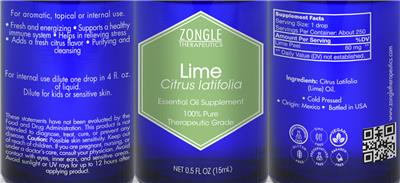
Lime by Zongle Therapeutics label
The label scan from the NIH Dietary Supplement Label Database. Tap to enlarge.
Label images are published by the NIH Dietary Supplement Label Database for the version of this product on file. Always read your actual product label.
View the full label (PDF)The Ingredients in Lime by Zongle Therapeutics
This is the 1 active ingredient this product is made of. Select it to open its full monograph.
Serving size1 Drop(s) Dosage formLiquid Servings per container250 Amounts shown are per serving.
Lime
Interacts with888 drugs
Lime is a common citrus fruit and a good natural source of vitamin C and plant antioxidants. As a food it is generally safe and enjoyed by most people...
Lime monograph & interactionsOther (inactive) ingredients: Lime Oil. These complete the product’s ingredient list but are not active constituents.
Lime by Zongle Therapeutics Drug Interactions
HelloPharmacist Interaction Report
Zongle Therapeutics Lime may interact with medications through its effects on two drug categories.
The most serious concern is with photosensitizing drugs (medications that make your skin more sun-sensitive) — lime can theoretically increase the risk of phototoxicity, a severe sun-related skin reaction, when used together.
Read the full breakdown — every affected drug type, severity by severity
Additionally, lime contains compounds that may slow how your body breaks down certain medications processed by the liver enzyme CYP3A4. This means drugs in that category could build up to higher levels in your blood, potentially making their effects stronger.
The effect has been seen in animal studies with high doses of lime juice.
Additionally, you should check your exact medications with the search tool on this page to see if any fall into these categories. Altogether, these interactions span 887 individual medications.
Check your own medications below · Editorial policy · How we use AI
Want to check YOUR meds against Lime?
Ask about interactions with your drugs in plain English — “Can I take it with lisinopril?” — and we find you the answer in seconds, ingredient by ingredient.
Go to the checkerIngredients driving the most interactions
Individual Drug Interactions
The ingredients in Lime interact with 888 drugs. Click any drug to see the details.
1 of the 1 ingredient in Lime interact with drugs. Each result below shows which ingredient is responsible. Lime
Ado-trastuzumab EmtansineKadcyla
How Ado-trastuzumab Emtansine interacts with Lime — through 1 ingredient. Tap an ingredient for the detail:
LimeCytochrome P450 3a4 (cyp3a4) Substrates Moderate
Interaction Summary
Animal research shows that phenolics in lime juice inhibit cytochrome P450 3A4.
Read the full Lime + Ado-trastuzumab Emtansine interactionAbemaciclibVerzenio
How Abemaciclib interacts with Lime — through 1 ingredient. Tap an ingredient for the detail:
LimeCytochrome P450 3a4 (cyp3a4) Substrates Moderate
Interaction Summary
Animal research shows that phenolics in lime juice inhibit cytochrome P450 3A4.
Read the full Lime + Abemaciclib interactionAbiraterone
How Abiraterone interacts with Lime — through 1 ingredient. Tap an ingredient for the detail:
LimeCytochrome P450 3a4 (cyp3a4) Substrates Moderate
Interaction Summary
Animal research shows that phenolics in lime juice inhibit cytochrome P450 3A4.
Read the full Lime + Abiraterone interactionAbiraterone AcetateYonsa, Zytiga
How Abiraterone Acetate interacts with Lime — through 1 ingredient. Tap an ingredient for the detail:
LimeCytochrome P450 3a4 (cyp3a4) Substrates Moderate
Interaction Summary
Animal research shows that phenolics in lime juice inhibit cytochrome P450 3A4.
Read the full Lime + Abiraterone Acetate interactionAcalabrutinibCalquence
How Acalabrutinib interacts with Lime — through 1 ingredient. Tap an ingredient for the detail:
LimeCytochrome P450 3a4 (cyp3a4) Substrates Moderate
Interaction Summary
Animal research shows that phenolics in lime juice inhibit cytochrome P450 3A4.
Read the full Lime + Acalabrutinib interactionAcepromazineAtravet
How Acepromazine interacts with Lime — through 1 ingredient. Tap an ingredient for the detail:
LimePhotosensitizing Drugs Moderate
Interaction Summary
Theoretically, concomitant use of lime oil with photosensitizing drugs may increase the risk of phototoxicity.
Read the full Lime + Acepromazine interactionAcetaminophen, Aspirin, CaffeineExcedrin, Excedrin Extra Strength, Excedrin Migraine
How Acetaminophen, Aspirin, Caffeine interacts with Lime — through 1 ingredient. Tap an ingredient for the detail:
LimeCytochrome P450 3a4 (cyp3a4) Substrates Moderate
Interaction Summary
Animal research shows that phenolics in lime juice inhibit cytochrome P450 3A4.
Read the full Lime + Acetaminophen, Aspirin, Caffeine interactionAcetaminophen, Brompheniramine, PhenylpropanolamineDimetapp Cold and Flu
How Acetaminophen, Brompheniramine, Phenylpropanolamine interacts with Lime — through 1 ingredient. Tap an ingredient for the detail:
LimePhotosensitizing Drugs Moderate
Interaction Summary
Theoretically, concomitant use of lime oil with photosensitizing drugs may increase the risk of phototoxicity.
Read the full Lime + Acetaminophen, Brompheniramine, Phenylpropanolamine interactionAcetaminophen, Butalbital, CaffeineEsgic, Esgic Plus, Fiogesic, Fioricet, Repan, Tecnal +1 more
How Acetaminophen, Butalbital, Caffeine interacts with Lime — through 1 ingredient. Tap an ingredient for the detail:
LimeCytochrome P450 3a4 (cyp3a4) Substrates Moderate
Interaction Summary
Animal research shows that phenolics in lime juice inhibit cytochrome P450 3A4.
Read the full Lime + Acetaminophen, Butalbital, Caffeine interactionAcetaminophen, Butalbital, Caffeine, CodeineEsgic with Codeine, Fioricet w/ Codeine
How Acetaminophen, Butalbital, Caffeine, Codeine interacts with Lime — through 1 ingredient. Tap an ingredient for the detail:
LimeCytochrome P450 3a4 (cyp3a4) Substrates Moderate
Interaction Summary
Animal research shows that phenolics in lime juice inhibit cytochrome P450 3A4.
Read the full Lime + Acetaminophen, Butalbital, Caffeine, Codeine interactionAcetaminophen, Caffeine, Chlorpheniramine, Hydrocodone, PhenylephrineHycomine Compound
How Acetaminophen, Caffeine, Chlorpheniramine, Hydrocodone, Phenylephrine interacts with Lime — through 1 ingredient. Tap an ingredient for the detail:
LimeCytochrome P450 3a4 (cyp3a4) Substrates, Photosensitizing Drugs Moderate
Interaction Summary
Animal research shows that phenolics in lime juice inhibit cytochrome P450 3A4.
Read the full Lime + Acetaminophen, Caffeine, Chlorpheniramine, Hydrocodone, Phenylephrine interactionAcetaminophen, Caffeine, CodeineGesic C15, Gesic C30, Gesic C8, Lenoltec 1, Lenoltec 2, Lenoltec 3 +1 more
How Acetaminophen, Caffeine, Codeine interacts with Lime — through 1 ingredient. Tap an ingredient for the detail:
LimeCytochrome P450 3a4 (cyp3a4) Substrates Moderate
Interaction Summary
Animal research shows that phenolics in lime juice inhibit cytochrome P450 3A4.
Read the full Lime + Acetaminophen, Caffeine, Codeine interactionAcetaminophen, Caffeine, Codeine, SalicylamideCodalan No.1, Codalan No.2, Codalan No.3
How Acetaminophen, Caffeine, Codeine, Salicylamide interacts with Lime — through 1 ingredient. Tap an ingredient for the detail:
LimeCytochrome P450 3a4 (cyp3a4) Substrates Moderate
Interaction Summary
Animal research shows that phenolics in lime juice inhibit cytochrome P450 3A4.
Read the full Lime + Acetaminophen, Caffeine, Codeine, Salicylamide interactionAcetaminophen, Caffeine, DihydrocodeineDHC Plus, Panlor DC, Panlor SS
How Acetaminophen, Caffeine, Dihydrocodeine interacts with Lime — through 1 ingredient. Tap an ingredient for the detail:
LimeCytochrome P450 3a4 (cyp3a4) Substrates Moderate
Interaction Summary
Animal research shows that phenolics in lime juice inhibit cytochrome P450 3A4.
Read the full Lime + Acetaminophen, Caffeine, Dihydrocodeine interactionAcetaminophen, Caffeine, IsomethepteneMigralam
How Acetaminophen, Caffeine, Isometheptene interacts with Lime — through 1 ingredient. Tap an ingredient for the detail:
LimeCytochrome P450 3a4 (cyp3a4) Substrates Moderate
Interaction Summary
Animal research shows that phenolics in lime juice inhibit cytochrome P450 3A4.
Read the full Lime + Acetaminophen, Caffeine, Isometheptene interactionAcetaminophen, Caffeine, PyrilamineMidol Max Strength Menstrual
How Acetaminophen, Caffeine, Pyrilamine interacts with Lime — through 1 ingredient. Tap an ingredient for the detail:
LimeCytochrome P450 3a4 (cyp3a4) Substrates Moderate
Interaction Summary
Animal research shows that phenolics in lime juice inhibit cytochrome P450 3A4.
Read the full Lime + Acetaminophen, Caffeine, Pyrilamine interactionAcetaminophen, Chlorpheniramine Maleate, Dextromethorphan HbrVicks Formula 44M Cough, Cold & Flu Relief
How Acetaminophen, Chlorpheniramine Maleate, Dextromethorphan Hbr interacts with Lime — through 1 ingredient. Tap an ingredient for the detail:
LimePhotosensitizing Drugs, Cytochrome P450 3a4 (cyp3a4) Substrates Moderate
Interaction Summary
Theoretically, concomitant use of lime oil with photosensitizing drugs may increase the risk of phototoxicity.
Read the full Lime + Acetaminophen, Chlorpheniramine Maleate, Dextromethorphan Hbr interactionAcetaminophen, Chlorpheniramine, Codeine, PhenylephrineColrex
How Acetaminophen, Chlorpheniramine, Codeine, Phenylephrine interacts with Lime — through 1 ingredient. Tap an ingredient for the detail:
LimePhotosensitizing Drugs, Cytochrome P450 3a4 (cyp3a4) Substrates Moderate
Interaction Summary
Theoretically, concomitant use of lime oil with photosensitizing drugs may increase the risk of phototoxicity.
Read the full Lime + Acetaminophen, Chlorpheniramine, Codeine, Phenylephrine interactionAcetaminophen, Chlorpheniramine, DextromethorphanCoricidin II Extra Strength Cold and Flu
How Acetaminophen, Chlorpheniramine, Dextromethorphan interacts with Lime — through 1 ingredient. Tap an ingredient for the detail:
LimePhotosensitizing Drugs, Cytochrome P450 3a4 (cyp3a4) Substrates Moderate
Interaction Summary
Theoretically, concomitant use of lime oil with photosensitizing drugs may increase the risk of phototoxicity.
Read the full Lime + Acetaminophen, Chlorpheniramine, Dextromethorphan interactionAcetaminophen, Chlorpheniramine, Dextromethorphan HydrobromideCoricidin HBP Maximum Strength Flu
How Acetaminophen, Chlorpheniramine, Dextromethorphan Hydrobromide interacts with Lime — through 1 ingredient. Tap an ingredient for the detail:
LimeCytochrome P450 3a4 (cyp3a4) Substrates, Photosensitizing Drugs Moderate
Interaction Summary
Animal research shows that phenolics in lime juice inhibit cytochrome P450 3A4.
Read the full Lime + Acetaminophen, Chlorpheniramine, Dextromethorphan Hydrobromide interactionAcetaminophen, Chlorpheniramine, Dextromethorphan, PhenylpropanolamineMulti Symptom Cold Relief
How Acetaminophen, Chlorpheniramine, Dextromethorphan, Phenylpropanolamine interacts with Lime — through 1 ingredient. Tap an ingredient for the detail:
LimeCytochrome P450 3a4 (cyp3a4) Substrates, Photosensitizing Drugs Moderate
Interaction Summary
Animal research shows that phenolics in lime juice inhibit cytochrome P450 3A4.
Read the full Lime + Acetaminophen, Chlorpheniramine, Dextromethorphan, Phenylpropanolamine interactionAcetaminophen, Chlorpheniramine, Dextromethorphan, PseudoephedrineChildren's Tylenol Cold Plus Cough, Tylenol Cold Ex Strength
How Acetaminophen, Chlorpheniramine, Dextromethorphan, Pseudoephedrine interacts with Lime — through 1 ingredient. Tap an ingredient for the detail:
LimePhotosensitizing Drugs, Cytochrome P450 3a4 (cyp3a4) Substrates Moderate
Interaction Summary
Theoretically, concomitant use of lime oil with photosensitizing drugs may increase the risk of phototoxicity.
Read the full Lime + Acetaminophen, Chlorpheniramine, Dextromethorphan, Pseudoephedrine interactionAcetaminophen, Chlorpheniramine, Guaifenesin, Phenylephrine, SalicylamideRhinogesic GG
How Acetaminophen, Chlorpheniramine, Guaifenesin, Phenylephrine, Salicylamide interacts with Lime — through 1 ingredient. Tap an ingredient for the detail:
LimeCytochrome P450 3a4 (cyp3a4) Substrates, Photosensitizing Drugs Moderate
Interaction Summary
Animal research shows that phenolics in lime juice inhibit cytochrome P450 3A4.
Read the full Lime + Acetaminophen, Chlorpheniramine, Guaifenesin, Phenylephrine, Salicylamide interactionAcetaminophen, Chlorpheniramine, PhenylephrineAlka-Seltzer PLUS, Histex SR, Protid
How Acetaminophen, Chlorpheniramine, Phenylephrine interacts with Lime — through 1 ingredient. Tap an ingredient for the detail:
LimePhotosensitizing Drugs, Cytochrome P450 3a4 (cyp3a4) Substrates Moderate
Interaction Summary
Theoretically, concomitant use of lime oil with photosensitizing drugs may increase the risk of phototoxicity.
Read the full Lime + Acetaminophen, Chlorpheniramine, Phenylephrine interactionAcetaminophen, Chlorpheniramine, Phenylephrine, SalicylamideRhinogesic, Rhinogesic JR
How Acetaminophen, Chlorpheniramine, Phenylephrine, Salicylamide interacts with Lime — through 1 ingredient. Tap an ingredient for the detail:
LimePhotosensitizing Drugs, Cytochrome P450 3a4 (cyp3a4) Substrates Moderate
Interaction Summary
Theoretically, concomitant use of lime oil with photosensitizing drugs may increase the risk of phototoxicity.
Read the full Lime + Acetaminophen, Chlorpheniramine, Phenylephrine, Salicylamide interactionAcetaminophen, Chlorpheniramine, PhenylpropanolamineAlumadrine, Conex, Sinadrin Max Strength, Sinulin
How Acetaminophen, Chlorpheniramine, Phenylpropanolamine interacts with Lime — through 1 ingredient. Tap an ingredient for the detail:
LimeCytochrome P450 3a4 (cyp3a4) Substrates, Photosensitizing Drugs Moderate
Interaction Summary
Animal research shows that phenolics in lime juice inhibit cytochrome P450 3A4.
Read the full Lime + Acetaminophen, Chlorpheniramine, Phenylpropanolamine interactionAcetaminophen, Chlorpheniramine, Phenylpropanolamine, OpiumHista-Derfule
How Acetaminophen, Chlorpheniramine, Phenylpropanolamine, Opium interacts with Lime — through 1 ingredient. Tap an ingredient for the detail:
LimePhotosensitizing Drugs, Cytochrome P450 3a4 (cyp3a4) Substrates Moderate
Interaction Summary
Theoretically, concomitant use of lime oil with photosensitizing drugs may increase the risk of phototoxicity.
Read the full Lime + Acetaminophen, Chlorpheniramine, Phenylpropanolamine, Opium interactionAcetaminophen, Chlorpheniramine, Phenylpropanolamine, PhenyltoloxamineNorel Plus
How Acetaminophen, Chlorpheniramine, Phenylpropanolamine, Phenyltoloxamine interacts with Lime — through 1 ingredient. Tap an ingredient for the detail:
LimeCytochrome P450 3a4 (cyp3a4) Substrates, Photosensitizing Drugs Moderate
Interaction Summary
Animal research shows that phenolics in lime juice inhibit cytochrome P450 3A4.
Read the full Lime + Acetaminophen, Chlorpheniramine, Phenylpropanolamine, Phenyltoloxamine interactionAcetaminophen, Chlorpheniramine, PseudoephedrineAlka-Seltzer PLUS Liquid Gels, Children's Tylenol Cold, Codimal, Comtrex, Extra Strength Tylenol Allergy Sinus, Lorsin +3 more
How Acetaminophen, Chlorpheniramine, Pseudoephedrine interacts with Lime — through 1 ingredient. Tap an ingredient for the detail:
LimePhotosensitizing Drugs, Cytochrome P450 3a4 (cyp3a4) Substrates Moderate
Interaction Summary
Theoretically, concomitant use of lime oil with photosensitizing drugs may increase the risk of phototoxicity.
Read the full Lime + Acetaminophen, Chlorpheniramine, Pseudoephedrine interactionAcetaminophen, Dexbrompheniramine, PseudoephedrineSinadrin Plus
How Acetaminophen, Dexbrompheniramine, Pseudoephedrine interacts with Lime — through 1 ingredient. Tap an ingredient for the detail:
LimePhotosensitizing Drugs Moderate
Interaction Summary
Theoretically, concomitant use of lime oil with photosensitizing drugs may increase the risk of phototoxicity.
Read the full Lime + Acetaminophen, Dexbrompheniramine, Pseudoephedrine interactionEach ingredient & the kinds of drugs it affects
For each ingredient in Lime with known interactions, here are the types of medications it can affect. Open any type for the detail — or search your exact drug in the checker above.
Lime
Cytochrome P450 3A4 (Cyp3A4) Substrates
Animal research shows that phenolics in lime juice inhibit cytochrome P450 3A4. This has been demonstrated in rats treated with sildenafil, a CYP3A4 substrate, and high doses of lime juice.
Photosensitizing Drugs
Theoretically, concomitant use of lime oil with photosensitizing drugs may increase the risk of phototoxicity.
Brand information
Manufacturer and brand details for Lime, from the product label.
Zongle Therapeutics
See all Zongle Therapeutics products- Name
- Zongle Therapeutics LLC
- Web Address
- www.zongletherapeutics.com
Lime by Zongle Therapeutics: Common Questions
Does Lime by Zongle Therapeutics interact with any medications?
How can one product interact with so many drugs?
Where does this information come from?
Is lime safe to take every day?
Will lime help with anemia or malaria?
What are the main side effects?
Is it safe in pregnancy or while breastfeeding?
Why does it interact with so many medications?
Written and reviewed by the HelloPharmacist editorial staff. Our editorial policy
Not sure if Lime is safe with your meds?
Our pharmacists answer your medication & supplement questions — free.
Label information is sourced from the NIH Dietary Supplement Label Database and reflects the product version on file; always read your actual product label. This page is for education only and is not a substitute for professional medical advice. Confirm with your pharmacist or doctor before combining supplements and medications.
The Full Monographs Behind Lime’s Ingredients
Every ingredient we hold a full HelloPharmacist monograph for — uses, evidence, safety, and the complete interaction list.
Sources & How We Checked
Lime's label data comes from the NIH Dietary Supplement Label Database; the ingredient interaction data is from the Natural Medicines database, reviewed by our pharmacists.
- NIH Dietary Supplement Label Database (DSLD) — The official product label on file for this supplement.
- Natural Medicines (Therapeutic Research Center) — Evidence-graded clinical reference behind the ingredient interaction data.
Content is written and reviewed by licensed HelloPharmacist pharmacists. See our data sources and editorial standards for how this information is built and checked.
The 20 references behind this product’s interaction data
Every citation that drives the interaction findings for this product’s ingredients, from the evidence-graded Natural Medicines (TRC Healthcare) database. Open an ingredient to browse its citations — links open the study on PubMed or the publisher’s site.
Lime 20 references
- McGuffin M, Hobbs C, Upton R, Goldberg A, eds. American Herbal Products Association's Botanical Safety Handbook. Boca Raton, FL: CRC Press, LLC 1997.
- Roesyanto-Mahadi ID, Geursen-Reitsma AM, van Joost T, et al. Sensitization to fragrance materials in Indonesian cosmetics. Contact Dermatitis 1990;22:212-7. PubMed
- Naganuma M, Hirose S, Nakayama Y, et al. A study of the phototoxicity of lemon oil. Arch Dermatol Res 1985;278:31-6. . PubMed
- Bailey DG, Dresser GK, Bend JR. Bergamottin, lime juice, and red wine as inhibitors of cytochrome P450 3A4 activity: comparison with grapefruit juice. Clin Pharmacol Ther 2003;73:529-37. PubMed
- Weber, I. C., Davis, C. P., and Greeson, D. M. Phytophotodermatitis: the other "lime" disease. J Emerg.Med 1999;17(2):235-237. PubMed
- Wagner, A. M., Wu, J. J., Hansen, R. C., Nigg, H. N., and Beiere, R. C. Bullous phytophotodermatitis associated with high natural concentrations of furanocoumarins in limes. Am.J Contact Dermat. 2002;13(1):10-14. PubMed
- Garcia, O. P., Diaz, M., Rosado, J. L., and Allen, L. H. Ascorbic acid from lime juice does not improve the iron status of iron-deficient women in rural Mexico. Am.J.Clin.Nutr. 2003;78(2):267-273. PubMed
- Coffman, K., Boyce, W. T., and Hansen, R. C. Phytophotodermatitis simulating child abuse. Am.J Dis.Child 1985;139(3):239-240. PubMed
- Adegoke SA, Oyelami OA, Olatunya OS, Adeyemi LA. Effects of lime juice on malaria parasite clearance. Phytother Res. 2011;25(10):1547-50. PubMed
- Adegoke SA, Shehu UA, Mohammed LO, Sanusi Y, Oyelami OA. Influence of lime juice on the severity of sickle cell anemia. J Altern Complement Med. 2013;19(6):588-92. PubMed
- Assarian Z, Nixon RL. Protein contact dermatitis caused by lime in a pastry chef. Contact Dermatitis. 2015;73(1):54-6. PubMed
- Bamise CT, Dinyain VE, Kolawole KA. Dental erosion due to lime consumption; review of literature and case report. East Afr J Public Health. 2009;6(2):141-3. PubMed
- Flugman SL. Mexican beer dermatitis: a unique variant of lime phytophotodermatitis attributable to contemporary beer-drinking practices. Arch Dermatol. 2010;146(10):1194-5. PubMed
- Galvañ-Pérez Del Pulgar JI, Linares-Barrios M, Galvañ-Pozo JI Jr. Acropigmentation of the dorsum of the hands from preparing mojitos: A lime-induced phytophotodermatosis. Actas Dermosifiliogr. 2016;107(3):253-5. DOI
- Hemmerling A, Potts M, Walsh J, Young-Holt B, Whaley K, Stefanski DA. Lime juice as a candidate microbicide? An open-label safety trial of 10% and 20% lime juice used vaginally. J Womens Health (Larchmt). 2007;16(7):1041-51. PubMed
- Mauck CK, Ballagh SA, Creinin MD, et al. Six-day randomized safety trial of intravaginal lime juice. J Acquir Immune Defic Syndr. 2008;49(3):243-50. PubMed
- Mioduszewski M, Beecker J. Phytophotodermatitis from making sangria: a phototoxic reaction to lime and lemon juice. CMAJ. 2015;187(10):756. PubMed
- Rungruanghiranya S, Ekpanyaskul C, Sakulisariyaporn C, Watcharanat P, Akkalakulawas K. Efficacy of fresh lime for smoking cessation. J Med Assoc Thai. 2012;95 Suppl 12:S76-82.
- Swerdlin A, Rainey D, Storrs FJ. Fragrance mix reactions and lime allergic contact dermatitis. Dermatitis. 2010;21(4):214-6. DOI
- Ademosun AO, Mohammed A, Oboh G, Ajeigbe OF. Influence of lemon (Citrus limon) and lime (Citrus aurantifolia) juices on the erectogenic properties of sildenafil in rats with L-NAME-induced erectile dysfunction. J Food Biochem 2022;46(2):e14074.
Parts of this content are provided by the Therapeutic Research Center, LLC.
DISCLAIMER: Currently this does not check for drug-drug interactions. This is not an all-inclusive comprehensive list of potential interactions and is for informational purposes only. Not all interactions are known or well-reported in the scientific literature, and new interactions are continually being reported. Input is needed from a qualified healthcare provider including a pharmacist before starting any therapy. Application of clinical judgment is necessary.
© 2021 Therapeutic Research Center, LLC