
Maitake Mushroom Supplement Ingredients & Drug Interactions
What is this page for?
First and foremost: checking Maitake Mushroom Supplement against your medications. The heart of this page is the interaction checker and the full interaction report — how this product’s ingredients may interact with prescription and over-the-counter medicines you may be taking.
Around that, we add a pharmacist’s high-level view of the product as a whole — what’s inside, the evidence for its stated use, how transparent the label is, and what safety data exists — so you can see the full picture in one place. It’s educational information from our licensed clinical databases and the clinical staff at HelloPharmacist — not medical advice — and we don’t sell or endorse products. Our editorial policy
Maitake Mushroom Supplement is a dietary supplement by Activa Naturals with 1 active ingredient. Its ingredients are commonly taken for immune support, blood sugar support in diabetes, high blood pressure.Based on those ingredients, 260 medications have a known interaction with it, the most serious rated moderate. The ingredients most likely to interact are Maitake Mushroom, Powder. Use the checker below to test your specific medication, or read the full HelloPharmacist Interaction Report.
Check Your Meds Against Maitake Mushroom Supplement by Activa Naturals
Ask about any prescription or over-the-counter medication and we check it for interactions with Maitake Mushroom Supplement by Activa Naturals — and tell you which ingredient is responsible.
AI summaries are generated from our interaction database for education only — always confirm with your pharmacist. How we use AI
Ask the Pharmacist
A licensed pharmacist will answer your question by email — free, usually within 24 hours.
Got it — thank you!
A licensed pharmacist will answer within 24 hours. Keep an eye on your email (worth checking spam, just in case).
HelloPharmacist Scorecard of Maitake Mushroom Supplement by Activa Naturals
Our pharmacy team’s full take, with four database checks built into the cards below — a summary of what is known, not a grade of the product itself.
What’s inside
Full disclosure
Activa Naturals Maitake Mushroom contains one active ingredient: maitake mushroom powder. Maitake is a medicinal fungus traditionally used in Asian medicine and studied for immune and metabolic support.
The supplement also contains two inactive ingredients — cellulose and rice flour — which are fillers and binders that help form the capsule.
Does it work?
Couldn't assess
The data we hold does not establish reliable evidence for maitake mushroom in hay fever, chemotherapy-related anemia, laryngeal cancer, or chemotherapy-related diarrhea. Research on these uses is either lacking or insufficient to rate its effectiveness.
If you're considering maitake for any of these reasons, talk with your doctor or pharmacist about what the current science actually supports for your situation.
How safe is it?
Well-documented data
Maitake mushroom is generally well tolerated when taken by mouth. The most common side effects reported in clinical trials were mild gastrointestinal symptoms — diarrhea and epigastric pain (upper abdominal discomfort) — affecting a small number of participants.
One patient reported a rash and itching that cleared on its own without treatment. There is not enough safety data to recommend concentrated maitake supplements during pregnancy or while breastfeeding.
If you are pregnant or nursing and interested in maitake, talk with your doctor or pharmacist for personalized advice.
Meds to double-check
Moderate interaction found
Before taking this supplement, double-check with your doctor or pharmacist if you take warfarin or other blood thinners, blood pressure medications, or diabetes medications. Maitake mushroom may increase the effect of all three, and the interaction with warfarin is particularly important to discuss since even a one-week course changed one patient's drug levels significantly.
The bottom line
Scorecard at a glanceFully disclosed formula with no assessable stated purpose. Moderate medication interactions have been identified, and safety information is well characterized.
Maitake mushroom may help with certain health goals, but the evidence in our data is not yet strong enough to rate it. If you take blood pressure medications, diabetes medications, or warfarin, you'll want to check with your doctor or pharmacist before adding this supplement — it could affect how those drugs work.
For most people, it's generally well tolerated, though some experience mild stomach upset.
Educational only — not medical advice; always confirm with your pharmacist. Our editorial policy · How we use AI
Assessment coverage: 1 of 1 active ingredient matched to our full ingredient reviews (monographs). Based on the product label dated Jul 25, 2024.
This Scorecard evaluates available label information, ingredient evidence, and known medication-safety considerations. It does not independently verify product identity, purity, potency, contamination, or manufacturing quality. How these ratings are computed
General information
Key facts about Maitake Mushroom Supplement, straight from the product label.
| Brand | Activa Naturals |
|---|---|
| Net contents | 120 Vegetarian Capsule(s) |
| Market status | On market |
| Date entered into DSLD | Jul 25, 2024 |
| DSLD ID | 308082 |
| Product type | Botanical |
| Supplement form | Capsule |
| Dietary claims / uses | All Other, Structure/Function |
| Intended target group(s) | Adult (18 - 50 Years) |
Everything in this section is reproduced from the manufacturer’s own product label — it’s the label speaking, not HelloPharmacist. We show it so you can see exactly what the maker states; we don’t verify or endorse those statements.
Supplement Facts
The label details for Maitake Mushroom Supplement by Activa Naturals, sourced from the NIH Dietary Supplement Label Database.
Supplement Facts
| Ingredient | Amount | % DV |
|---|---|---|
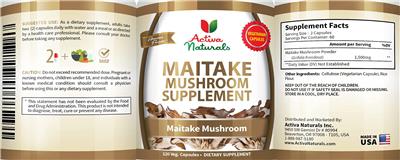
| Maitake Mushroom, Powder | 1500 mg | -- |
Other ingredients: Cellulose, Rice Flour
Tap any ingredient to jump to its full detail below.
These statements are the manufacturer’s wording, reproduced from the product label — the label is saying it, not HelloPharmacist. We don’t verify or endorse them.
Suggested/Recommended/Usage/Directions
Suggested use: As a dietary supplement, adults take two (2) capsules daily with water and a meal or as directed by a health care professional. Please consult your doctor before taking any supplement.
Precautions
Caution: Do not exceed recommended dose.
Pregnant or nursing mothers, children under 18, and individuals with a known medical condition should consult a physician before using this or any dietary supplement.
Pregnant or nursing mothers, children under 18, and individuals with a known medical condition should consult a physician before using this or any dietary supplement.
Keep out of the reach of children.
Do not use it if safety seal is damaged or missing.
FDA Disclaimer Statement
This statement has not been evaluated by the Food and Drug Administration. This product is not intended to diagnose, treat, cure or prevent any disease.
General Statements
America's favorite
Formula
Maitake mushroom
FDA Statement of Identity
Dietary Supplement
Storage
Store in a cool, dry place.
Seals/Symbols
Made in USA
Is this label outdated? Report a formula or label change and our pharmacy team will review it.
Maitake Mushroom Supplement by Activa Naturals label
The label scan from the NIH Dietary Supplement Label Database. Tap to enlarge.
Label images are published by the NIH Dietary Supplement Label Database for the version of this product on file. Always read your actual product label.
View the full label (PDF)The Ingredients in Maitake Mushroom Supplement by Activa Naturals
This is the 1 active ingredient this product is made of. Select it to open its full monograph.
Serving size2 Capsule(s) Dosage formCapsule Servings per container60 Amounts shown are per serving.
Maitake Mushroom, Powder
Interacts with260 drugs
Maitake is an edible mushroom long used as food and in traditional Japanese medicine, and it is being studied for possible immune, blood sugar, and bl...
Maitake Mushroom, Powder monograph & interactionsOther (inactive) ingredients: Cellulose, Rice Flour. These complete the product’s ingredient list but are not active constituents.
Maitake Mushroom Supplement by Activa Naturals Drug Interactions
HelloPharmacist Interaction Report
Activa Naturals Maitake Mushroom Supplement interacts with three medication types through its maitake mushroom powder content.
The most serious concern is with warfarin (Coumadin), a blood thinner — maitake may increase its anticoagulant effects, raising your bleeding risk. A case report documented a patient on stable warfarin who developed significantly elevated blood levels after taking a maitake extract for just one week.
Read the full breakdown — every affected drug type, severity by severity
Maitake also has Moderate interactions with blood pressure medications (antihypertensive drugs). Animal research shows maitake can lower blood pressure on its own, so combining it with your pressure medication might drop your numbers too far.
You should also be cautious if you take diabetes medications (antidiabetes drugs). Clinical research shows maitake can lower blood glucose levels, which means adding it to your diabetes medication could increase the risk of low blood sugar (hypoglycemia).
Additionally, there are other ingredient combinations we could not check. Altogether, these interactions span 260 individual medications.
Use the search tool on this page to enter your exact medications and see whether any are affected.
Check your own medications below · Editorial policy · How we use AI
Want to check YOUR meds against Maitake Mushroom Supplement?
Ask about interactions with your drugs in plain English — “Can I take it with lisinopril?” — and we find you the answer in seconds, ingredient by ingredient.
Go to the checkerIngredients driving the most interactions
Individual Drug Interactions
The ingredients in Maitake Mushroom Supplement interact with 260 drugs. Click any drug to see the details.
1 of the 1 ingredient in Maitake Mushroom Supplement interact with drugs. Each result below shows which ingredient is responsible. Maitake Mushroom, Powder
AcarboseGlucobay, Prandase, Precose
How Acarbose interacts with Maitake Mushroom Supplement — through 1 ingredient. Tap an ingredient for the detail:
Maitake Mushroom, PowderAntidiabetes Drugs Moderate
Interaction Summary
Theoretically, combining maitake mushroom with antidiabetes drugs might increase the risk of hypoglycemia.
Read the full Maitake Mushroom, Powder + Acarbose interactionAcebutololRhotral, Sectral
How Acebutolol interacts with Maitake Mushroom Supplement — through 1 ingredient. Tap an ingredient for the detail:
Maitake Mushroom, PowderAntihypertensive Drugs Moderate
Interaction Summary
Theoretically, combining maitake mushroom with antihypertensive drugs might increase the risk of hypotension.
Read the full Maitake Mushroom, Powder + Acebutolol interactionAcetazolamideAk-Zol, Diamox
How Acetazolamide interacts with Maitake Mushroom Supplement — through 1 ingredient. Tap an ingredient for the detail:
Maitake Mushroom, PowderAntihypertensive Drugs Moderate
Interaction Summary
Theoretically, combining maitake mushroom with antihypertensive drugs might increase the risk of hypotension.
Read the full Maitake Mushroom, Powder + Acetazolamide interactionAcetohexamideDymelor
How Acetohexamide interacts with Maitake Mushroom Supplement — through 1 ingredient. Tap an ingredient for the detail:
Maitake Mushroom, PowderAntidiabetes Drugs Moderate
Interaction Summary
Theoretically, combining maitake mushroom with antidiabetes drugs might increase the risk of hypoglycemia.
Read the full Maitake Mushroom, Powder + Acetohexamide interactionAlbiglutideTanzeum
How Albiglutide interacts with Maitake Mushroom Supplement — through 1 ingredient. Tap an ingredient for the detail:
Maitake Mushroom, PowderAntidiabetes Drugs Moderate
Interaction Summary
Theoretically, combining maitake mushroom with antidiabetes drugs might increase the risk of hypoglycemia.
Read the full Maitake Mushroom, Powder + Albiglutide interactionAliskirenTekturna
How Aliskiren interacts with Maitake Mushroom Supplement — through 1 ingredient. Tap an ingredient for the detail:
Maitake Mushroom, PowderAntihypertensive Drugs Moderate
Interaction Summary
Theoretically, combining maitake mushroom with antihypertensive drugs might increase the risk of hypotension.
Read the full Maitake Mushroom, Powder + Aliskiren interactionAlogliptinNesina
How Alogliptin interacts with Maitake Mushroom Supplement — through 1 ingredient. Tap an ingredient for the detail:
Maitake Mushroom, PowderAntidiabetes Drugs Moderate
Interaction Summary
Theoretically, combining maitake mushroom with antidiabetes drugs might increase the risk of hypoglycemia.
Read the full Maitake Mushroom, Powder + Alogliptin interactionAlogliptin, MetforminKazano
How Alogliptin, Metformin interacts with Maitake Mushroom Supplement — through 1 ingredient. Tap an ingredient for the detail:
Maitake Mushroom, PowderAntidiabetes Drugs Moderate
Interaction Summary
Theoretically, combining maitake mushroom with antidiabetes drugs might increase the risk of hypoglycemia.
Read the full Maitake Mushroom, Powder + Alogliptin, Metformin interactionAlogliptin, PioglitazoneOseni
How Alogliptin, Pioglitazone interacts with Maitake Mushroom Supplement — through 1 ingredient. Tap an ingredient for the detail:
Maitake Mushroom, PowderAntidiabetes Drugs Moderate
Interaction Summary
Theoretically, combining maitake mushroom with antidiabetes drugs might increase the risk of hypoglycemia.
Read the full Maitake Mushroom, Powder + Alogliptin, Pioglitazone interactionAmbrisentanLetairis, Volibris
How Ambrisentan interacts with Maitake Mushroom Supplement — through 1 ingredient. Tap an ingredient for the detail:
Maitake Mushroom, PowderAntihypertensive Drugs Moderate
Interaction Summary
Theoretically, combining maitake mushroom with antihypertensive drugs might increase the risk of hypotension.
Read the full Maitake Mushroom, Powder + Ambrisentan interactionAmilorideAmilamont, Midamor
How Amiloride interacts with Maitake Mushroom Supplement — through 1 ingredient. Tap an ingredient for the detail:
Maitake Mushroom, PowderAntihypertensive Drugs Moderate
Interaction Summary
Theoretically, combining maitake mushroom with antihypertensive drugs might increase the risk of hypotension.
Read the full Maitake Mushroom, Powder + Amiloride interactionAmiloride, HydrochlorothiazideAmil-Co, Amilzide, Moduret 25, Moduretic
How Amiloride, Hydrochlorothiazide interacts with Maitake Mushroom Supplement — through 1 ingredient. Tap an ingredient for the detail:
Maitake Mushroom, PowderAntihypertensive Drugs Moderate
Interaction Summary
Theoretically, combining maitake mushroom with antihypertensive drugs might increase the risk of hypotension.
Read the full Maitake Mushroom, Powder + Amiloride, Hydrochlorothiazide interactionAmlodipineNorliqva
How Amlodipine interacts with Maitake Mushroom Supplement — through 1 ingredient. Tap an ingredient for the detail:
Maitake Mushroom, PowderAntihypertensive Drugs Moderate
Interaction Summary
Theoretically, combining maitake mushroom with antihypertensive drugs might increase the risk of hypotension.
Read the full Maitake Mushroom, Powder + Amlodipine interactionAmlodipine BenzoateKaterzia
How Amlodipine Benzoate interacts with Maitake Mushroom Supplement — through 1 ingredient. Tap an ingredient for the detail:
Maitake Mushroom, PowderAntihypertensive Drugs Moderate
Interaction Summary
Theoretically, combining maitake mushroom with antihypertensive drugs might increase the risk of hypotension.
Read the full Maitake Mushroom, Powder + Amlodipine Benzoate interactionAmlodipine BesilateIstin
How Amlodipine Besilate interacts with Maitake Mushroom Supplement — through 1 ingredient. Tap an ingredient for the detail:
Maitake Mushroom, PowderAntihypertensive Drugs Moderate
Interaction Summary
Theoretically, combining maitake mushroom with antihypertensive drugs might increase the risk of hypotension.
Read the full Maitake Mushroom, Powder + Amlodipine Besilate interactionAmlodipine BesylateNorvasc
How Amlodipine Besylate interacts with Maitake Mushroom Supplement — through 1 ingredient. Tap an ingredient for the detail:
Maitake Mushroom, PowderAntihypertensive Drugs Moderate
Interaction Summary
Theoretically, combining maitake mushroom with antihypertensive drugs might increase the risk of hypotension.
Read the full Maitake Mushroom, Powder + Amlodipine Besylate interactionAmlodipine Besylate, BenazeprilLotrel
How Amlodipine Besylate, Benazepril interacts with Maitake Mushroom Supplement — through 1 ingredient. Tap an ingredient for the detail:
Maitake Mushroom, PowderAntihypertensive Drugs Moderate
Interaction Summary
Theoretically, combining maitake mushroom with antihypertensive drugs might increase the risk of hypotension.
Read the full Maitake Mushroom, Powder + Amlodipine Besylate, Benazepril interactionAmlodipine, CelecoxibConsensi
How Amlodipine, Celecoxib interacts with Maitake Mushroom Supplement — through 1 ingredient. Tap an ingredient for the detail:
Maitake Mushroom, PowderAntihypertensive Drugs Moderate
Interaction Summary
Theoretically, combining maitake mushroom with antihypertensive drugs might increase the risk of hypotension.
Read the full Maitake Mushroom, Powder + Amlodipine, Celecoxib interactionAmmonium ChlorideAmmonium Chloride
How Ammonium Chloride interacts with Maitake Mushroom Supplement — through 1 ingredient. Tap an ingredient for the detail:
Maitake Mushroom, PowderAntihypertensive Drugs Moderate
Interaction Summary
Theoretically, combining maitake mushroom with antihypertensive drugs might increase the risk of hypotension.
Read the full Maitake Mushroom, Powder + Ammonium Chloride interactionAntidiabetes, Dipeptidyl Peptidase-4 (dpp-iv) InhibitorGlyxambi
How Antidiabetes, Dipeptidyl Peptidase-4 (dpp-iv) Inhibitor interacts with Maitake Mushroom Supplement — through 1 ingredient. Tap an ingredient for the detail:
Maitake Mushroom, PowderAntidiabetes Drugs Moderate
Interaction Summary
Theoretically, combining maitake mushroom with antidiabetes drugs might increase the risk of hypoglycemia.
Read the full Maitake Mushroom, Powder + Antidiabetes, Dipeptidyl Peptidase-4 (dpp-iv) Inhibitor interactionAprocitentanTryvio
How Aprocitentan interacts with Maitake Mushroom Supplement — through 1 ingredient. Tap an ingredient for the detail:
Maitake Mushroom, PowderAntihypertensive Drugs Moderate
Interaction Summary
Theoretically, combining maitake mushroom with antihypertensive drugs might increase the risk of hypotension.
Read the full Maitake Mushroom, Powder + Aprocitentan interactionAtenololAtenix, Tenormin
How Atenolol interacts with Maitake Mushroom Supplement — through 1 ingredient. Tap an ingredient for the detail:
Maitake Mushroom, PowderAntihypertensive Drugs Moderate
Interaction Summary
Theoretically, combining maitake mushroom with antihypertensive drugs might increase the risk of hypotension.
Read the full Maitake Mushroom, Powder + Atenolol interactionAtenolol, ChlortalidoneAtenixCo, Tenoret 50, Totaretic
How Atenolol, Chlortalidone interacts with Maitake Mushroom Supplement — through 1 ingredient. Tap an ingredient for the detail:
Maitake Mushroom, PowderAntihypertensive Drugs Moderate
Interaction Summary
Theoretically, combining maitake mushroom with antihypertensive drugs might increase the risk of hypotension.
Read the full Maitake Mushroom, Powder + Atenolol, Chlortalidone interactionAtenolol, ChlorthalidoneTenoretic
How Atenolol, Chlorthalidone interacts with Maitake Mushroom Supplement — through 1 ingredient. Tap an ingredient for the detail:
Maitake Mushroom, PowderAntihypertensive Drugs Moderate
Interaction Summary
Theoretically, combining maitake mushroom with antihypertensive drugs might increase the risk of hypotension.
Read the full Maitake Mushroom, Powder + Atenolol, Chlorthalidone interactionAzilsartanEdarbi
How Azilsartan interacts with Maitake Mushroom Supplement — through 1 ingredient. Tap an ingredient for the detail:
Maitake Mushroom, PowderAntihypertensive Drugs Moderate
Interaction Summary
Theoretically, combining maitake mushroom with antihypertensive drugs might increase the risk of hypotension.
Read the full Maitake Mushroom, Powder + Azilsartan interactionAzilsartan, ChlorthalidoneEdarbyclor
How Azilsartan, Chlorthalidone interacts with Maitake Mushroom Supplement — through 1 ingredient. Tap an ingredient for the detail:
Maitake Mushroom, PowderAntihypertensive Drugs Moderate
Interaction Summary
Theoretically, combining maitake mushroom with antihypertensive drugs might increase the risk of hypotension.
Read the full Maitake Mushroom, Powder + Azilsartan, Chlorthalidone interactionBenazeprilLotensin
How Benazepril interacts with Maitake Mushroom Supplement — through 1 ingredient. Tap an ingredient for the detail:
Maitake Mushroom, PowderAntihypertensive Drugs Moderate
Interaction Summary
Theoretically, combining maitake mushroom with antihypertensive drugs might increase the risk of hypotension.
Read the full Maitake Mushroom, Powder + Benazepril interactionBenazepril, HydrochlorothiazideLotensin HCT
How Benazepril, Hydrochlorothiazide interacts with Maitake Mushroom Supplement — through 1 ingredient. Tap an ingredient for the detail:
Maitake Mushroom, PowderAntihypertensive Drugs Moderate
Interaction Summary
Theoretically, combining maitake mushroom with antihypertensive drugs might increase the risk of hypotension.
Read the full Maitake Mushroom, Powder + Benazepril, Hydrochlorothiazide interactionBendroflumethiazideAprinox, Naturetin, Neo-NaClex
How Bendroflumethiazide interacts with Maitake Mushroom Supplement — through 1 ingredient. Tap an ingredient for the detail:
Maitake Mushroom, PowderAntihypertensive Drugs Moderate
Interaction Summary
Theoretically, combining maitake mushroom with antihypertensive drugs might increase the risk of hypotension.
Read the full Maitake Mushroom, Powder + Bendroflumethiazide interactionBendroflumethiazide, NadololCorzide
How Bendroflumethiazide, Nadolol interacts with Maitake Mushroom Supplement — through 1 ingredient. Tap an ingredient for the detail:
Maitake Mushroom, PowderAntihypertensive Drugs Moderate
Interaction Summary
Theoretically, combining maitake mushroom with antihypertensive drugs might increase the risk of hypotension.
Read the full Maitake Mushroom, Powder + Bendroflumethiazide, Nadolol interactionEach ingredient & the kinds of drugs it affects
For each ingredient in Maitake Mushroom Supplement with known interactions, here are the types of medications it can affect. Open any type for the detail — or search your exact drug in the checker above.
Maitake Mushroom, Powder
Antidiabetes Drugs
Theoretically, combining maitake mushroom with antidiabetes drugs might increase the risk of hypoglycemia.
Clinical research shows that taking maitake mushroom polysaccharide (MMP) can lower blood glucose levels in patients with types 2 diabetes.
Antihypertensive Drugs
Theoretically, combining maitake mushroom with antihypertensive drugs might increase the risk of hypotension.
Animal research shows that maitake mushroom can lower blood pressure.
Warfarin (Coumadin)
There is limited evidence that maitake mushroom may increase the anticoagulant effects of warfarin.
In a case report, a patient previously stabilized on warfarin developed an elevated international normalized ratio (INR) of 5.1 after taking maitake mushroom (Grifron-Pro Maitake D-Fraction) 1 drop/kg daily in three divided doses for one week. The elevated INR resolved after holding warfarin for two days, then reducing the dose by 11%. It is thought that the beta-glucan constituent of maitake mushroom might cause warfarin dissociation from proteins, resulting in increased free warfarin levels and increased warfarin effects.
Brand information
Manufacturer and brand details for Maitake Mushroom Supplement, from the product label.
Activa Naturals
See all Activa Naturals products- Name
- Activa Naturals Inc.
- Street Address
- 9450 SW Gemini Dr #80994
- City
- Beaverton
- State
- OR
- ZipCode
- 97008-7105
- Phone Number
- 1-888-987-5180
- Web Address
- www.ActivaNaturals.com
Maitake Mushroom Supplement by Activa Naturals: Common Questions
Does Maitake Mushroom Supplement by Activa Naturals interact with any medications?
How can one product interact with so many drugs?
Where does this information come from?
Can I take this if I'm on blood pressure or diabetes medication?
What are the side effects?
Is maitake mushroom proven to work?
Is it safe during pregnancy or breastfeeding?
What is maitake mushroom?
Written and reviewed by the HelloPharmacist editorial staff. Our editorial policy
Not sure if Maitake Mushroom Supplement is safe with your meds?
Our pharmacists answer your medication & supplement questions — free.
Label information is sourced from the NIH Dietary Supplement Label Database and reflects the product version on file; always read your actual product label. This page is for education only and is not a substitute for professional medical advice. Confirm with your pharmacist or doctor before combining supplements and medications.
The Full Monographs Behind Maitake Mushroom Supplement’s Ingredients
Every ingredient we hold a full HelloPharmacist monograph for — uses, evidence, safety, and the complete interaction list.
Sources & How We Checked
Maitake Mushroom Supplement's label data comes from the NIH Dietary Supplement Label Database; the ingredient interaction data is from the Natural Medicines database, reviewed by our pharmacists.
- NIH Dietary Supplement Label Database (DSLD) — The official product label on file for this supplement.
- Natural Medicines (Therapeutic Research Center) — Evidence-graded clinical reference behind the ingredient interaction data.
Content is written and reviewed by licensed HelloPharmacist pharmacists. See our data sources and editorial standards for how this information is built and checked.
The 8 references behind this product’s interaction data
Every citation that drives the interaction findings for this product’s ingredients, from the evidence-graded Natural Medicines (TRC Healthcare) database. Open an ingredient to browse its citations — links open the study on PubMed or the publisher’s site.
Maitake Mushroom 8 references
- Kabir Y, Kimura S. Dietary mushrooms reduce blood pressure in spontaneously hypertensive rats (SHR). J Nutr Sci Vitaminol (Tokyo) 1989;35:91-4. PubMed
- Kabir Y, Yamaguchi M, Kimura S. Effect of shiitake (Lentinus edodes) and maitake (Grifola frondosa) mushrooms on blood pressure and plasma lipids of spontaneously hypertensive rats. J Nutr Sci Vitaminol (Tokyo) 1987;33:341-6. PubMed
- Konno S, Tortorelis DG, Fullerton SA, et al. A possible hypoglycaemic effect of maitake mushroom on Type 2 diabetic patients. Diabet Med 2001;18:1010. PubMed
- Chen JT, Tominaga K, Sato Y, et al. Maitake mushroom (Grifola frondosa) extract induces ovulation in patients with polycystic ovary syndrome: a possible monotherapy and a combination therapy after failure with first-line clomiphene citrate. J Altern Compl
- Hanselin MR, Vande Griend JP, Linnebur SA. INR elevation with maitake extract in combination with warfarin. Ann Pharmacother 2010;44:223-4. PubMed
- Talpur, N. A., Echard, B. W., Fan, A. Y., Jaffari, O., Bagchi, D., and Preuss, H. G. Antihypertensive and metabolic effects of whole Maitake mushroom powder and its fractions in two rat strains. Mol.Cell Biochem. 2002;237(1-2):129-136. PubMed
- Deng, G., Lin, H., Seidman, A., Fornier, M., D'Andrea, G., Wesa, K., Yeung, S., Cunningham-Rundles, S., Vickers, A. J., and Cassileth, B. A phase I/II trial of a polysaccharide extract from Grifola frondosa (Maitake mushroom) in breast cancer patients: i
- Wesa KM, Cunningham-Rundles S, Klimek VM, et al. Maitake mushroom extract in myelodysplastic syndromes (MDS): a phase II study. Cancer Immunol Immunother 2015;64(2):237-47. PubMed
Parts of this content are provided by the Therapeutic Research Center, LLC.
DISCLAIMER: Currently this does not check for drug-drug interactions. This is not an all-inclusive comprehensive list of potential interactions and is for informational purposes only. Not all interactions are known or well-reported in the scientific literature, and new interactions are continually being reported. Input is needed from a qualified healthcare provider including a pharmacist before starting any therapy. Application of clinical judgment is necessary.
© 2021 Therapeutic Research Center, LLC