
Matrix Plus 3000 Ingredients & Drug Interactions
by Elon
What is this page for?
First and foremost: checking Matrix Plus 3000 against your medications. The heart of this page is the interaction checker and the full interaction report — how this product’s ingredients may interact with prescription and over-the-counter medicines you may be taking.
Around that, we add a pharmacist’s high-level view of the product as a whole — what’s inside, the evidence for its stated use, how transparent the label is, and what safety data exists — so you can see the full picture in one place. It’s educational information from our licensed clinical databases and the clinical staff at HelloPharmacist — not medical advice — and we don’t sell or endorse products. Our editorial policy
Matrix Plus 3000 is a dietary supplement by Elon with 3 active ingredients. Its ingredients are commonly taken for hair, skin, and nail health, bone health and osteoporosis, joint and connective tissue support.Based on those ingredients, 86 medications have a known interaction with it, the most serious rated moderate. The ingredients most likely to interact are L-Cysteine. Use the checker below to test your specific medication, or read the full HelloPharmacist Interaction Report.
Check Your Meds Against Matrix Plus 3000 by Elon
Ask about any prescription or over-the-counter medication and we check it for interactions with Matrix Plus 3000 by Elon — and tell you which ingredient is responsible.
AI summaries are generated from our interaction database for education only — always confirm with your pharmacist. How we use AI
Ask the Pharmacist
A licensed pharmacist will answer your question by email — free, usually within 24 hours.
Got it — thank you!
A licensed pharmacist will answer within 24 hours. Keep an eye on your email (worth checking spam, just in case).
HelloPharmacist Scorecard of Matrix Plus 3000 by Elon
Our pharmacy team’s full take, with four database checks built into the cards below — a summary of what is known, not a grade of the product itself.
What’s inside
Full disclosure
Matrix Plus 3000 contains 3 active ingredients. Silicon Dioxide is included for bone health (rated possibly effective for osteoporosis), though evidence for hair and dental health is too limited to rate.
Biotin is a B vitamin that's likely effective for biotin deficiency but hasn't proven helpful for the other conditions listed on this product. L-Cysteine is an amino acid; evidence for its claimed uses—hair health, ulcer healing, and hangover relief—is currently too limited to rate.
The tablet also contains inactive ingredients such as dicalcium phosphate, microcrystalline cellulose, and magnesium stearate as binders and fillers.
Does it work?
Insufficient evidence
Evidence for this product's uses is mixed. Silicon Dioxide is possibly effective for osteoporosis, but its value for hair loss and dental issues isn't established.
Biotin works for biotin deficiency itself but showed no benefit in trials for the other conditions listed. L-Cysteine's effectiveness for any of its claimed uses—hair, ulcers, hangovers, stroke, or stomach inflammation—is too limited to rate.
If you're taking this specifically for bone health, Silicon Dioxide may help; for the other claims, the evidence we hold isn't strong enough to support them.
How safe is it?
Well-documented data
Silicon Dioxide and Biotin are both likely safe in pregnancy and lactation. L-Cysteine is also rated likely safe in pregnancy and lactation.
However, Silicon Dioxide's long-term safety at high doses hasn't been well studied, and the same caution applies to high-dose L-Cysteine supplements. Biotin is generally well tolerated even at higher doses and is removed through the urine, though very high-dose supplements warrant a check-in with your doctor first.
The main adverse effect reported is mild diarrhea with high-dose biotin, which has been rare. Important: the adverse effect data for Silicon Dioxide notes that *inhaled* crystalline silicon dioxide in occupational settings (like industrial dust) is linked to serious lung and autoimmune diseases—this doesn't apply to oral supplements in tablet form.
Meds to double-check
Moderate interaction found
If you take antidiabetes drugs—insulin, metformin, sulfonylureas, or others—check this product with your pharmacist first. L-cysteine may increase the risk of low blood sugar (hypoglycemia).
No other interactions are documented for the ingredients we could check.
The bottom line
Scorecard at a glanceFully disclosed formula with insufficient evidence for its stated purpose. Moderate medication interactions have been identified, and safety information is well characterized.
This product may help with bone health if Silicon Dioxide's possible benefit for osteoporosis applies to you. If you take antidiabetes medication, you'll need to check with your pharmacist before starting it, since L-cysteine may lower blood sugar further.
Evidence for hair, dental, or other uses is too limited to rely on. Talk to your pharmacist about whether this product fits your health goals.
Educational only — not medical advice; always confirm with your pharmacist. Our editorial policy · How we use AI
Assessment coverage: 3 of 3 active ingredients matched to our full ingredient reviews (monographs). Based on the product label dated Oct 24, 2024.
This Scorecard evaluates available label information, ingredient evidence, and known medication-safety considerations. It does not independently verify product identity, purity, potency, contamination, or manufacturing quality. How these ratings are computed
General information
Key facts about Matrix Plus 3000, straight from the product label.
| Brand | Elon |
|---|---|
| Barcode (UPC) | 058869121015 |
| Net contents | 60 Tablet(s) |
| Market status | On market |
| Date entered into DSLD | Oct 24, 2024 |
| DSLD ID | 319977 |
| Product type | Other Combinations |
| Supplement form | Tablet Or Pill |
| Dietary claims / uses | Nutrient, All Other, Structure/Function |
| Intended target group(s) | Adult (18 - 50 Years) |
Everything in this section is reproduced from the manufacturer’s own product label — it’s the label speaking, not HelloPharmacist. We show it so you can see exactly what the maker states; we don’t verify or endorse those statements.
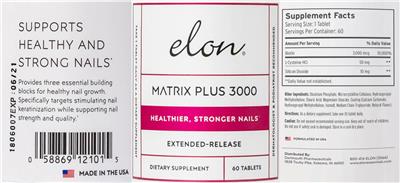
Supplement Facts
The label details for Matrix Plus 3000 by Elon, sourced from the NIH Dietary Supplement Label Database.
Supplement Facts
| Ingredient | Amount | % DV |
|---|---|---|
| Silicon Dioxide | 10 mg | -- |
| Biotin | 3000 mcg | 10000% |
| L-Cysteine | 50 mg | -- |
Other ingredients: Dicalcium Phosphate, Microcrystalline Cellulose, Hydroxypropyl Methylcellulose, Stearic Acid, Magnesium Stearate, Calcium Carbonate, Hydroxypropyl Methylcellulose, Isomalt, Medium Chain Triglyceride, Natural Flavors
Tap any ingredient to jump to its full detail below.
These statements are the manufacturer’s wording, reproduced from the product label — the label is saying it, not HelloPharmacist. We don’t verify or endorse them.
Formulation
Supports healthy and strong nails Provides three essential building blocks for healthy nail growth. Specifically targets stimulating nail keratinization while supporting nail strength and quality.
Healthier, stronger nails Extened-release
Formulated in USA
Seals/Symbols
Made in the USA
Suggested/Recommended/Usage/Directions
Take 1 tablet daily as a dietary supplement
Directions: As a dietary supplement, take one (1) tablet daily.
FDA Statement of Identity
Dietary Supplement
General Statements
Dermatologist & Podiatrist recommended
Precautions
Caution: Do not exceed recommended serving size.
Keep out of reach of children.
Do not use if safety seal is damaged.
Storage
Store in a cool dry place.
Is this label outdated? Report a formula or label change and our pharmacy team will review it.
Matrix Plus 3000 by Elon label
The label scan from the NIH Dietary Supplement Label Database. Tap to enlarge.
Label images are published by the NIH Dietary Supplement Label Database for the version of this product on file. Always read your actual product label.
View the full label (PDF)The Ingredients in Matrix Plus 3000 by Elon
These are the 3 active ingredients this product is made of. Select any to open its full monograph.
Serving size1 Tablet(s) Dosage formTablet Or Pill Servings per container60 Amounts shown are per serving.
Most supplement products combine several ingredients, and a medication can interact with the product through any one of them. Each ingredient below shows whether it has known drug interactions.
Silicon Dioxide
No knowninteractions
Silicon is a trace mineral found in the body and in foods like oats, barley, and certain fruits and vegetables, and it is popular in supplements for h...
Silicon Dioxide monograph & interactionsBiotin
No knowninteractions
Biotin (vitamin B7) is a water-soluble vitamin your body needs to turn food into energy and to support healthy hair, skin, and nails. Most people get...
Biotin monograph & interactionsL-Cysteine
Interacts with86 drugs
L-cysteine is a sulfur-containing amino acid your body uses to make proteins and the antioxidant glutathione. Most people get enough from food, and su...
L-Cysteine monograph & interactionsOther (inactive) ingredients: Dicalcium Phosphate, Microcrystalline Cellulose, Hydroxypropyl Methylcellulose, Stearic Acid, Magnesium Stearate, Calcium Carbonate, Hydroxypropyl Methylcellulose, Isomalt, Medium Chain Triglyceride, Natural Flavors. These complete the product’s ingredient list but are not active constituents.
Matrix Plus 3000 by Elon Drug Interactions
HelloPharmacist Interaction Report
Matrix Plus 3000 by Elon contains one ingredient with documented interactions: L-cysteine may increase the risk of low blood sugar (hypoglycemia) when taken with antidiabetes drugs.
This is a Moderate interaction based on animal research suggesting L-cysteine can lower blood glucose levels.
Read the full breakdown — every affected drug type, severity by severity
Silicon Dioxide and Biotin have no known interactions documented in our data, though we hold no guarantee that interactions don't exist elsewhere.
Altogether, these interactions span 85 individual medications. If you take any antidiabetes medication—whether insulin, sulfonylureas, metformin, or another class—run this product through the interaction checker below before you start it.
Check your own medications below · Editorial policy · How we use AI
Want to check YOUR meds against Matrix Plus 3000?
Ask about interactions with your drugs in plain English — “Can I take it with lisinopril?” — and we find you the answer in seconds, ingredient by ingredient.
Go to the checkerIngredients driving the most interactions
Individual Drug Interactions
The ingredients in Matrix Plus 3000 interact with 86 drugs. Click any drug to see the details.
1 of the 3 ingredients in Matrix Plus 3000 interact with drugs. Each result below shows which ingredient is responsible. L-Cysteine
AcarboseGlucobay, Prandase, Precose
How Acarbose interacts with Matrix Plus 3000 — through 1 ingredient. Tap an ingredient for the detail:
L-cysteineAntidiabetes Drugs Moderate
Interaction Summary
Theoretically, taking L-cysteine supplements with antidiabetes drugs might increase the risk of hypoglycemia.
Read the full L-cysteine + Acarbose interactionAcetohexamideDymelor
How Acetohexamide interacts with Matrix Plus 3000 — through 1 ingredient. Tap an ingredient for the detail:
L-cysteineAntidiabetes Drugs Moderate
Interaction Summary
Theoretically, taking L-cysteine supplements with antidiabetes drugs might increase the risk of hypoglycemia.
Read the full L-cysteine + Acetohexamide interactionAlbiglutideTanzeum
How Albiglutide interacts with Matrix Plus 3000 — through 1 ingredient. Tap an ingredient for the detail:
L-cysteineAntidiabetes Drugs Moderate
Interaction Summary
Theoretically, taking L-cysteine supplements with antidiabetes drugs might increase the risk of hypoglycemia.
Read the full L-cysteine + Albiglutide interactionAlogliptinNesina
How Alogliptin interacts with Matrix Plus 3000 — through 1 ingredient. Tap an ingredient for the detail:
L-cysteineAntidiabetes Drugs Moderate
Interaction Summary
Theoretically, taking L-cysteine supplements with antidiabetes drugs might increase the risk of hypoglycemia.
Read the full L-cysteine + Alogliptin interactionAlogliptin, MetforminKazano
How Alogliptin, Metformin interacts with Matrix Plus 3000 — through 1 ingredient. Tap an ingredient for the detail:
L-cysteineAntidiabetes Drugs Moderate
Interaction Summary
Theoretically, taking L-cysteine supplements with antidiabetes drugs might increase the risk of hypoglycemia.
Read the full L-cysteine + Alogliptin, Metformin interactionAlogliptin, PioglitazoneOseni
How Alogliptin, Pioglitazone interacts with Matrix Plus 3000 — through 1 ingredient. Tap an ingredient for the detail:
L-cysteineAntidiabetes Drugs Moderate
Interaction Summary
Theoretically, taking L-cysteine supplements with antidiabetes drugs might increase the risk of hypoglycemia.
Read the full L-cysteine + Alogliptin, Pioglitazone interactionAntidiabetes, Dipeptidyl Peptidase-4 (dpp-iv) InhibitorGlyxambi
How Antidiabetes, Dipeptidyl Peptidase-4 (dpp-iv) Inhibitor interacts with Matrix Plus 3000 — through 1 ingredient. Tap an ingredient for the detail:
L-cysteineAntidiabetes Drugs Moderate
Interaction Summary
Theoretically, taking L-cysteine supplements with antidiabetes drugs might increase the risk of hypoglycemia.
Read the full L-cysteine + Antidiabetes, Dipeptidyl Peptidase-4 (dpp-iv) Inhibitor interactionCanagliflozinInvokana
How Canagliflozin interacts with Matrix Plus 3000 — through 1 ingredient. Tap an ingredient for the detail:
L-cysteineAntidiabetes Drugs Moderate
Interaction Summary
Theoretically, taking L-cysteine supplements with antidiabetes drugs might increase the risk of hypoglycemia.
Read the full L-cysteine + Canagliflozin interactionCanagliflozin, MetforminInvokamet
How Canagliflozin, Metformin interacts with Matrix Plus 3000 — through 1 ingredient. Tap an ingredient for the detail:
L-cysteineAntidiabetes Drugs Moderate
Interaction Summary
Theoretically, taking L-cysteine supplements with antidiabetes drugs might increase the risk of hypoglycemia.
Read the full L-cysteine + Canagliflozin, Metformin interactionCanagliflozin, Metformin HydrochlorideInvokamet XR
How Canagliflozin, Metformin Hydrochloride interacts with Matrix Plus 3000 — through 1 ingredient. Tap an ingredient for the detail:
L-cysteineAntidiabetes Drugs Moderate
Interaction Summary
Theoretically, taking L-cysteine supplements with antidiabetes drugs might increase the risk of hypoglycemia.
Read the full L-cysteine + Canagliflozin, Metformin Hydrochloride interactionChlorpropamideChlorpropam, Diabinese
How Chlorpropamide interacts with Matrix Plus 3000 — through 1 ingredient. Tap an ingredient for the detail:
L-cysteineAntidiabetes Drugs Moderate
Interaction Summary
Theoretically, taking L-cysteine supplements with antidiabetes drugs might increase the risk of hypoglycemia.
Read the full L-cysteine + Chlorpropamide interactionDapagliflozinFarxiga
How Dapagliflozin interacts with Matrix Plus 3000 — through 1 ingredient. Tap an ingredient for the detail:
L-cysteineAntidiabetes Drugs Moderate
Interaction Summary
Theoretically, taking L-cysteine supplements with antidiabetes drugs might increase the risk of hypoglycemia.
Read the full L-cysteine + Dapagliflozin interactionDapagliflozin Propanediol, MetforminXigduo XR
How Dapagliflozin Propanediol, Metformin interacts with Matrix Plus 3000 — through 1 ingredient. Tap an ingredient for the detail:
L-cysteineAntidiabetes Drugs Moderate
Interaction Summary
Theoretically, taking L-cysteine supplements with antidiabetes drugs might increase the risk of hypoglycemia.
Read the full L-cysteine + Dapagliflozin Propanediol, Metformin interactionDapagliflozin Propanediol, Saxagliptin HydrochlorideQtern
How Dapagliflozin Propanediol, Saxagliptin Hydrochloride interacts with Matrix Plus 3000 — through 1 ingredient. Tap an ingredient for the detail:
L-cysteineAntidiabetes Drugs Moderate
Interaction Summary
Theoretically, taking L-cysteine supplements with antidiabetes drugs might increase the risk of hypoglycemia.
Read the full L-cysteine + Dapagliflozin Propanediol, Saxagliptin Hydrochloride interactionDapagliflozin, Metformin Hydrochloride, Saxagliptin HydrochlorideQternmet XR
How Dapagliflozin, Metformin Hydrochloride, Saxagliptin Hydrochloride interacts with Matrix Plus 3000 — through 1 ingredient. Tap an ingredient for the detail:
L-cysteineAntidiabetes Drugs Moderate
Interaction Summary
Theoretically, taking L-cysteine supplements with antidiabetes drugs might increase the risk of hypoglycemia.
Read the full L-cysteine + Dapagliflozin, Metformin Hydrochloride, Saxagliptin Hydrochloride interactionDasiglucagon HydrochlorideZegalogue
How Dasiglucagon Hydrochloride interacts with Matrix Plus 3000 — through 1 ingredient. Tap an ingredient for the detail:
L-cysteineAntidiabetes Drugs Moderate
Interaction Summary
Theoretically, taking L-cysteine supplements with antidiabetes drugs might increase the risk of hypoglycemia.
Read the full L-cysteine + Dasiglucagon Hydrochloride interactionDulaglutideTrulicity
How Dulaglutide interacts with Matrix Plus 3000 — through 1 ingredient. Tap an ingredient for the detail:
L-cysteineAntidiabetes Drugs Moderate
Interaction Summary
Theoretically, taking L-cysteine supplements with antidiabetes drugs might increase the risk of hypoglycemia.
Read the full L-cysteine + Dulaglutide interactionEmpagliflozinJardiance
How Empagliflozin interacts with Matrix Plus 3000 — through 1 ingredient. Tap an ingredient for the detail:
L-cysteineAntidiabetes Drugs Moderate
Interaction Summary
Theoretically, taking L-cysteine supplements with antidiabetes drugs might increase the risk of hypoglycemia.
Read the full L-cysteine + Empagliflozin interactionEmpagliflozin, Linagliptin, Metformin HydrochlorideTrijardy XR
How Empagliflozin, Linagliptin, Metformin Hydrochloride interacts with Matrix Plus 3000 — through 1 ingredient. Tap an ingredient for the detail:
L-cysteineAntidiabetes Drugs Moderate
Interaction Summary
Theoretically, taking L-cysteine supplements with antidiabetes drugs might increase the risk of hypoglycemia.
Read the full L-cysteine + Empagliflozin, Linagliptin, Metformin Hydrochloride interactionEmpagliflozin, MetforminSynjardy
How Empagliflozin, Metformin interacts with Matrix Plus 3000 — through 1 ingredient. Tap an ingredient for the detail:
L-cysteineAntidiabetes Drugs Moderate
Interaction Summary
Theoretically, taking L-cysteine supplements with antidiabetes drugs might increase the risk of hypoglycemia.
Read the full L-cysteine + Empagliflozin, Metformin interactionEmpagliflozin, Metformin HydrochlorideSynjardy XR
How Empagliflozin, Metformin Hydrochloride interacts with Matrix Plus 3000 — through 1 ingredient. Tap an ingredient for the detail:
L-cysteineAntidiabetes Drugs Moderate
Interaction Summary
Theoretically, taking L-cysteine supplements with antidiabetes drugs might increase the risk of hypoglycemia.
Read the full L-cysteine + Empagliflozin, Metformin Hydrochloride interactionErtugliflozinSteglatro
How Ertugliflozin interacts with Matrix Plus 3000 — through 1 ingredient. Tap an ingredient for the detail:
L-cysteineAntidiabetes Drugs Moderate
Interaction Summary
Theoretically, taking L-cysteine supplements with antidiabetes drugs might increase the risk of hypoglycemia.
Read the full L-cysteine + Ertugliflozin interactionErtugliflozin, Metformin HydrochlorideSegluromet
How Ertugliflozin, Metformin Hydrochloride interacts with Matrix Plus 3000 — through 1 ingredient. Tap an ingredient for the detail:
L-cysteineAntidiabetes Drugs Moderate
Interaction Summary
Theoretically, taking L-cysteine supplements with antidiabetes drugs might increase the risk of hypoglycemia.
Read the full L-cysteine + Ertugliflozin, Metformin Hydrochloride interactionExenatideBydureon, Byetta
How Exenatide interacts with Matrix Plus 3000 — through 1 ingredient. Tap an ingredient for the detail:
L-cysteineAntidiabetes Drugs Moderate
Interaction Summary
Theoretically, taking L-cysteine supplements with antidiabetes drugs might increase the risk of hypoglycemia.
Read the full L-cysteine + Exenatide interactionExenatide SyntheticBydureon BCISE
How Exenatide Synthetic interacts with Matrix Plus 3000 — through 1 ingredient. Tap an ingredient for the detail:
L-cysteineAntidiabetes Drugs Moderate
Interaction Summary
Theoretically, taking L-cysteine supplements with antidiabetes drugs might increase the risk of hypoglycemia.
Read the full L-cysteine + Exenatide Synthetic interactionGliclazideDiamicron
How Gliclazide interacts with Matrix Plus 3000 — through 1 ingredient. Tap an ingredient for the detail:
L-cysteineAntidiabetes Drugs Moderate
Interaction Summary
Theoretically, taking L-cysteine supplements with antidiabetes drugs might increase the risk of hypoglycemia.
Read the full L-cysteine + Gliclazide interactionGlimepirideAmaryl
How Glimepiride interacts with Matrix Plus 3000 — through 1 ingredient. Tap an ingredient for the detail:
L-cysteineAntidiabetes Drugs Moderate
Interaction Summary
Theoretically, taking L-cysteine supplements with antidiabetes drugs might increase the risk of hypoglycemia.
Read the full L-cysteine + Glimepiride interactionGlipizideGlucotrol, Glucotrol XL
How Glipizide interacts with Matrix Plus 3000 — through 1 ingredient. Tap an ingredient for the detail:
L-cysteineAntidiabetes Drugs Moderate
Interaction Summary
Theoretically, taking L-cysteine supplements with antidiabetes drugs might increase the risk of hypoglycemia.
Read the full L-cysteine + Glipizide interactionGlipizide, MetforminMetaglip
How Glipizide, Metformin interacts with Matrix Plus 3000 — through 1 ingredient. Tap an ingredient for the detail:
L-cysteineAntidiabetes Drugs Moderate
Interaction Summary
Theoretically, taking L-cysteine supplements with antidiabetes drugs might increase the risk of hypoglycemia.
Read the full L-cysteine + Glipizide, Metformin interactionGlucagonBaqsimi, Glucagon
How Glucagon interacts with Matrix Plus 3000 — through 1 ingredient. Tap an ingredient for the detail:
L-cysteineAntidiabetes Drugs Moderate
Interaction Summary
Theoretically, taking L-cysteine supplements with antidiabetes drugs might increase the risk of hypoglycemia.
Read the full L-cysteine + Glucagon interactionEach ingredient & the kinds of drugs it affects
For each ingredient in Matrix Plus 3000 with known interactions, here are the types of medications it can affect. Open any type for the detail — or search your exact drug in the checker above.
L-Cysteine
Antidiabetes Drugs
Theoretically, taking L-cysteine supplements with antidiabetes drugs might increase the risk of hypoglycemia.
Animal research suggests that L-cysteine can have hypoglycemic effects.
Brand information
Manufacturer and brand details for Matrix Plus 3000, from the product label.
Elon
- Name
- Dartmouth Pharmaceuticals
- Street Address
- 1828 Touby Pike
- City
- Kokomo
- State
- IN
- ZipCode
- 46901
- Phone Number
- 800-414-3566
- Web Address
- www.elonessentials.com
Matrix Plus 3000 by Elon: Common Questions
Does Matrix Plus 3000 by Elon interact with any medications?
How can one product interact with so many drugs?
Where does this information come from?
Is this safe during pregnancy or while breastfeeding?
Can this help my hair grow back?
What's the biotin in this for?
Are there any side effects I should know about?
Does this contain fillers?
Can I take this with my diabetes medication?
Written and reviewed by the HelloPharmacist editorial staff. Our editorial policy
Not sure if Matrix Plus 3000 is safe with your meds?
Our pharmacists answer your medication & supplement questions — free.
Label information is sourced from the NIH Dietary Supplement Label Database and reflects the product version on file; always read your actual product label. This page is for education only and is not a substitute for professional medical advice. Confirm with your pharmacist or doctor before combining supplements and medications.
The Full Monographs Behind Matrix Plus 3000’s Ingredients
Every ingredient we hold a full HelloPharmacist monograph for — uses, evidence, safety, and the complete interaction list.
Silicon
Silicon is a trace mineral found in the body and in foods like oats, barley, and certain fruits and vegetables, and it is popular in supplements for hair, skin, nail, and bone health. Some s...
Read the full Silicon monograph → Herb & supplement monographBiotin
Biotin (vitamin B7) is a water-soluble vitamin your body needs to turn food into energy and to support healthy hair, skin, and nails. Most people get plenty from a normal diet, and true defi...
Read the full Biotin monograph → Herb & supplement monographL-cysteine
Interacts with 86 drugsL-cysteine is a sulfur-containing amino acid your body uses to make proteins and the antioxidant glutathione. Most people get enough from food, and supplements are usually well tolerated, bu...
Read the full L-cysteine monograph →Sources & How We Checked
Matrix Plus 3000's label data comes from the NIH Dietary Supplement Label Database; the ingredient interaction data is from the Natural Medicines database, reviewed by our pharmacists.
- NIH Dietary Supplement Label Database (DSLD) — The official product label on file for this supplement.
- Natural Medicines (Therapeutic Research Center) — Evidence-graded clinical reference behind the ingredient interaction data.
Content is written and reviewed by licensed HelloPharmacist pharmacists. See our data sources and editorial standards for how this information is built and checked.
The 25 references behind this product’s interaction data
Every citation that drives the interaction findings for this product’s ingredients, from the evidence-graded Natural Medicines (TRC Healthcare) database. Open an ingredient to browse its citations — links open the study on PubMed or the publisher’s site.
Silicon 19 references
- Food and Nutrition Board, Institute of Medicine. Dietary Reference Intakes for Vitamin A, Vitamin K, Arsenic, Boron, Chromium, Copper, Iodine, Iron, Manganese, Molybdenum, Nickel, Silicon, Vanadium, and Zinc. Washington, DC: National Academy Press, 2002.
- Jugdaohsingh R, Anderson SH, Tucker KL, et al. Dietary silicon intake and absorption. Am J Clin Nutr 2002;75:887-93. PubMed
- Ichiyanagi O, Sasagawa I, Adachi Y, et al. Silica urolithiasis without magnesium trisilicate intake. Urol Int 1998;61:39-42. PubMed
- Levison DA, Crocker PR, Banim S, Wallace DM. Silica stones in the urinary bladder. Lancet 1982;1:704-5. PubMed
- Lee MH, Lee YH, Hsu TH, et al. Silica stone--development due to long time oral trisilicate intake. Scand J Urol Nephrol 1993;27:267-9. PubMed
- Cruz Guerra, N. A., Gomez Garcia, M. A., Lovaco, Castellano F., Saez Garrido, J. C., Garcia, Cuerpo E., and Escudero, Barrilero A. [Silica urolithiasis: report of a new case]. Actas Urol.Esp 2000;24(2):202-204.
- Merget, R., Bauer, T., Kupper, H. U., Philippou, S., Bauer, H. D., Breitstadt, R., and Bruening, T. Health hazards due to the inhalation of amorphous silica. Arch Toxicol. 2002;75(11-12):625-634. PubMed
- Khuder, S. A., Peshimam, A. Z., and Agraharam, S. Environmental risk factors for rheumatoid arthritis. Rev Environ Health 2002;17(4):307-315. PubMed
- McLaughlin, J. K., Chow, W. H., and Levy, L. S. Amorphous silica: a review of health effects from inhalation exposure with particular reference to cancer. J Toxicol.Environ Health 4-25-1997;50(6):553-566. DOI
- Pelucchi, C., Pira, E., Piolatto, G., Coggiola, M., Carta, P., and La, Vecchia C. Occupational silica exposure and lung cancer risk: a review of epidemiological studies 1996-2005. Ann.Oncol. 2006;17(7):1039-1050. PubMed
- Gillissen, A., Gessner, C., Hammerschmidt, S., Hoheisel, G., and Wirtz, H. [Health significance of inhaled particles]. Dtsch.Med Wochenschr. 3-24-2006;131(12):639-644.
- Hu, J. F., Qu, H., and Wang, J. Z. [Meta analysis for relationship between exposure of free silicon dioxide and lung tumor]. Zhonghua Lao.Dong.Wei Sheng Zhi.Ye.Bing.Za Zhi. 2006;24(7):415-417.
- Jugdaohsingh, R. Silicon and bone health. J Nutr Health Aging 2007;11(2):99-110.
- Lacasse, Y., Martin, S., Gagne, D., and Lakhal, L. Dose-response meta-analysis of silica and lung cancer. Cancer Causes Control 2009;20(6):925-933. PubMed
- McCormic, Z. D., Khuder, S. S., Aryal, B. K., Ames, A. L., and Khuder, S. A. Occupational silica exposure as a risk factor for scleroderma: a meta-analysis. Int Arch Occup.Environ Health 2010;83(7):763-769. PubMed
- Haddad, F. S. and Kouyoumdjian, A. Silica stones in humans. Urol.Int 1986;41(1):70-76. PubMed
- Tervaert, J. W., Stegeman, C. A., and Kallenberg, C. G. Silicon exposure and vasculitis. Curr Opin.Rheumatol 1998;10(1):12-17. PubMed
- Steenland, K. and Stayner, L. Silica, asbestos, man-made mineral fibers, and cancer. Cancer Causes Control 1997;8(3):491-503. PubMed
- Boqué N, Valls RM, Pedret A, Puiggrós F, Arola L, Solà R. Relative absorption of silicon from different formulations of dietary supplements: a pilot randomized, double-blind, crossover post-prandial study. Sci Rep 2021;11(1):16479. PubMed
Biotin 4 references
- Debourdeau PM, Djezzar S, Estival JL, et al. Life-threatening eosinophilic pleuropericardial effusion related to vitamins B5 and H. Ann Pharmacother 2001;35:424-6. DOI
- Food and Nutrition Board, Institute of Medicine. Dietary Reference Intakes for Thiamin, Riboflavin, Niacin, Vitamin B6, Folate, Vitamin B12, Pantothenic Acid, Biotin, and Choline (2000). Washington, DC: National Academy Press, 2000. Available at: http://b
- Mock DM, Quirk JG, Mock NI. Marginal biotin deficiency during normal pregnancy. Am J Clin Nutr 2002;75:295-9. PubMed
- Sedel F, Papeix C, Bellanger A, Touitou V, Lebrun-Frenay C, Galanaud D, et al. High doses of biotin in chronic progressive multiple sclerosis: a pilot study.Mult Scler Relat Disord. 2015;4(2):159-69. doi: 10.1016/j.msard.2015.01.005. PubMed
L-cysteine 2 references
- Dowlati Y, Maheux M, Meyer JH. The effect of oral L-cysteine on breast milk and plasma cysteine concentrations. Neuropsychiatr Dis Treat 2020;16:3163-3172.
- Lee S, Han KH, Nakamura Y, et al. Dietary L-cysteine improves the antioxidative potential and lipid metabolism in rats fed a normal diet. Biosci Biotechnol Biochem 2013;77(7):1430-4.
Parts of this content are provided by the Therapeutic Research Center, LLC.
DISCLAIMER: Currently this does not check for drug-drug interactions. This is not an all-inclusive comprehensive list of potential interactions and is for informational purposes only. Not all interactions are known or well-reported in the scientific literature, and new interactions are continually being reported. Input is needed from a qualified healthcare provider including a pharmacist before starting any therapy. Application of clinical judgment is necessary.
© 2021 Therapeutic Research Center, LLC