
Neuro-PS Phosphatidylserine 100 mg Ingredients & Drug Interactions
What is this page for?
First and foremost: checking Neuro-PS Phosphatidylserine 100 mg against your medications. The heart of this page is the interaction checker and the full interaction report — how this product’s ingredients may interact with prescription and over-the-counter medicines you may be taking.
Around that, we add a pharmacist’s high-level view of the product as a whole — what’s inside, the evidence for its stated use, how transparent the label is, and what safety data exists — so you can see the full picture in one place. It’s educational information from our licensed clinical databases and the clinical staff at HelloPharmacist — not medical advice — and we don’t sell or endorse products. Our editorial policy
Neuro-PS Phosphatidylserine 100 mg is a dietary supplement by Puritan's Pride with 1 active ingredient. Its ingredients are commonly taken for memory and cognitive support, age-related cognitive decline, attention and focus (adhd).Based on those ingredients, 219 medications have a known interaction with it, the most serious rated moderate. The ingredients most likely to interact are Neuro-PS. Use the checker below to test your specific medication, or read the full HelloPharmacist Interaction Report.
Check Your Meds Against Neuro-PS Phosphatidylserine 100 mg by Puritan's Pride
Ask about any prescription or over-the-counter medication and we check it for interactions with Neuro-PS Phosphatidylserine 100 mg by Puritan's Pride — and tell you which ingredient is responsible.
AI summaries are generated from our interaction database for education only — always confirm with your pharmacist. How we use AI
Ask the Pharmacist
A licensed pharmacist will answer your question by email — free, usually within 24 hours.
Got it — thank you!
A licensed pharmacist will answer within 24 hours. Keep an eye on your email (worth checking spam, just in case).
HelloPharmacist Scorecard of Neuro-PS Phosphatidylserine 100 mg by Puritan's Pride
Our pharmacy team’s full take, with four database checks built into the cards below — a summary of what is known, not a grade of the product itself.
What’s inside
Full disclosure
This product contains a single active ingredient: phosphatidylserine, a naturally occurring fat compound found in cell membranes. The 100 mg softgel also includes gelatin, glycerin, and paprika as inactive ingredients (the capsule shell and fill components).
Does it work?
Moderate evidence
The evidence supports phosphatidylserine for age-related cognitive decline and Alzheimer's disease, where it's rated possibly effective. For other uses — athletic performance, ADHD, general cognitive function, and dementia — the evidence isn't strong enough to establish whether it works.
If cognitive aging or Alzheimer's concerns are on your mind, talk with your doctor about whether this supplement fits your plan.
How safe is it?
Well-documented data
Phosphatidylserine is generally well tolerated in studies, though long-term safety hasn't been fully proven. The most common side effects are flatulence, stomach upset, headache, insomnia, and nausea — stomach issues tend to show up at doses around 200–300 mg daily, and insomnia is more likely at higher doses (600 mg).
The safety data advises against use during pregnancy and while breastfeeding, so if you're pregnant or nursing, skip this one and talk to your doctor or pharmacist about alternatives.
Meds to double-check
Moderate interaction found
Check your medications against this product if you take anticholinergic drugs (for bladder or movement issues) or cholinergic drugs (which boost acetylcholine activity). Moderate interactions are documented for both types.
The bottom line
Scorecard at a glanceFully disclosed formula with some supporting evidence for its stated purpose. Moderate medication interactions have been identified, and safety information is well characterized.
Phosphatidylserine may be worth considering if you're dealing with age-related memory loss or early Alzheimer's — the evidence is modest but real. If you take anticholinergic or cholinergic medications, check your exact drugs with the tool on this page before you start.
Long-term safety isn't fully known, so this is a conversation-with-your-pharmacist supplement.
Educational only — not medical advice; always confirm with your pharmacist. Our editorial policy · How we use AI
Assessment coverage: 1 of 1 active ingredient matched to our full ingredient reviews (monographs). Based on the product label dated Aug 22, 2024.
This Scorecard evaluates available label information, ingredient evidence, and known medication-safety considerations. It does not independently verify product identity, purity, potency, contamination, or manufacturing quality. How these ratings are computed
General information
Key facts about Neuro-PS Phosphatidylserine 100 mg, straight from the product label.
| Brand | Puritan's Pride |
|---|---|
| Barcode (UPC) | 025077100071 |
| Net contents | 120 Rapid Release Softgel(s) |
| Market status | On market |
| Date entered into DSLD | Aug 22, 2024 |
| DSLD ID | 318225 |
| Product type | Fat/fatty Acid |
| Supplement form | Softgel Capsule |
| Dietary claims / uses | All Other, Structure/Function |
| Intended target group(s) | Adult (18 - 50 Years), Gluten Free, Dairy Free, Sugar Free |
Everything in this section is reproduced from the manufacturer’s own product label — it’s the label speaking, not HelloPharmacist. We show it so you can see exactly what the maker states; we don’t verify or endorse those statements.
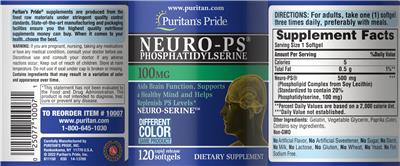
Supplement Facts
The label details for Neuro-PS Phosphatidylserine 100 mg by Puritan's Pride, sourced from the NIH Dietary Supplement Label Database.
Supplement Facts
| Ingredient | Amount | % DV |
|---|---|---|
| Calories | 5 Calorie(s) | -- |
| Total Fat | 0.5 Gram(s) | 1% |
| Phosphatidylserine | 100 mg | -- |
| Neuro-PS | 500 mg | -- |
Other ingredients: Gelatin, Glycerin, Paprika
Tap any ingredient to jump to its full detail below.
These statements are the manufacturer’s wording, reproduced from the product label — the label is saying it, not HelloPharmacist. We don’t verify or endorse them.
General Statements
Puritan's Pride supplements are produced from the finest raw materials under stringent quality control standards. State-of-the-art manufacturing and packaging facilities ensure you the highest quality nutritional supplements money can buy. When it comes to your health...choose the best.
To reorder Item # 10007 www.puritan.com 1-800-645-1030
Precautions
Warning: If you are pregnant, nursing, taking any medications or have any medical condition, consult your doctor before use.
Discontinue use and consult your doctor if any adverse reactions occur. Do not use if seal under cap is broken or missing.
Keep out of reach of children.
Contains soy ingredients.
Storage
Store at room temperature.
Formulation
Contains ingredients that may result in a variation of color and appearance over time.
Aids brain function, supports a healthy mind and helps replenish PS levels Different color same product
Non-GMO No artificial flavor, no artificial sweetener, no sugar, no starch, no milk, no lactose, no gluten, no wheat, no yeast, no fish. Sodium free.
FDA Disclaimer Statement
This statement has not been evaluated by the Food and Drug Administration. This product is not intended to diagnose, treat, cure or prevent any disease.
Brand IP Statement(s)
Copyright 2022 Puritan's Pride, Inc.
Seals/Symbols
QA Quality Assured
Formula
Neuro-serine
FDA Statement of Identity
Dietary Supplement
Suggested/Recommended/Usage/Directions
Directions: For adults, take one (1) softgel three times daily, preferably with meals
Is this label outdated? Report a formula or label change and our pharmacy team will review it.
Neuro-PS Phosphatidylserine 100 mg by Puritan's Pride label
The label scan from the NIH Dietary Supplement Label Database. Tap to enlarge.
Label images are published by the NIH Dietary Supplement Label Database for the version of this product on file. Always read your actual product label.
View the full label (PDF)The Ingredients in Neuro-PS Phosphatidylserine 100 mg by Puritan's Pride
This is the 1 active ingredient this product is made of. Select it to open its full monograph.
Serving size1 Softgel(s) Dosage formSoftgel Capsule Servings per container120 Amounts shown are per serving.
Neuro-PS
Interacts with219 drugs
Phosphatidylserine is a natural fat-like compound found in cell membranes, especially in the brain, and it is sold mainly to support memory and thinki...
Neuro-PS monograph & interactionsOther (inactive) ingredients: Gelatin, Glycerin, Paprika. These complete the product’s ingredient list but are not active constituents.
Neuro-PS Phosphatidylserine 100 mg by Puritan's Pride Drug Interactions
HelloPharmacist Interaction Report
Neuro-PS Phosphatidylserine by Puritan's Pride contains one active ingredient — phosphatidylserine — which has documented moderate interactions with two drug types.
Phosphatidylserine is thought to increase acetylcholine, a brain chemical, which can interfere with anticholinergic drugs (used for conditions like overactive bladder and certain types of tremor). It may reduce how well these medications work.
Read the full breakdown — every affected drug type, severity by severity
On the flip side, phosphatidylserine may have additive effects when combined with cholinergic drugs (medications that boost acetylcholine activity). This could potentially strengthen cholinergic effects beyond what either drug alone would produce.
Altogether, these interactions span 218 individual medications.
Before you start this supplement, use the interaction checker on this page to look up your exact medications — especially if you take anything for bladder control, tremor, or memory and cognitive conditions.
Check your own medications below · Editorial policy · How we use AI
Want to check YOUR meds against Neuro-PS Phosphatidylserine 100 mg?
Ask about interactions with your drugs in plain English — “Can I take it with lisinopril?” — and we find you the answer in seconds, ingredient by ingredient.
Go to the checkerIngredients driving the most interactions
Individual Drug Interactions
The ingredients in Neuro-PS Phosphatidylserine 100 mg interact with 219 drugs. Click any drug to see the details.
1 of the 1 ingredient in Neuro-PS Phosphatidylserine 100 mg interact with drugs. Each result below shows which ingredient is responsible. Neuro-PS
AcepromazineAtravet
How Acepromazine interacts with Neuro-PS Phosphatidylserine 100 mg — through 1 ingredient. Tap an ingredient for the detail:
Neuro-psAnticholinergic Drugs Moderate
Interaction Summary
Theoretically, phosphatidylserine might decrease the effectiveness anticholinergic drugs.
Read the full Neuro-ps + Acepromazine interactionAcetaminophen, Caffeine, Chlorpheniramine, Hydrocodone, PhenylephrineHycomine Compound
How Acetaminophen, Caffeine, Chlorpheniramine, Hydrocodone, Phenylephrine interacts with Neuro-PS Phosphatidylserine 100 mg — through 1 ingredient. Tap an ingredient for the detail:
Neuro-psAnticholinergic Drugs Moderate
Interaction Summary
Theoretically, phosphatidylserine might decrease the effectiveness anticholinergic drugs.
Read the full Neuro-ps + Acetaminophen, Caffeine, Chlorpheniramine, Hydrocodone, Phenylephrine interactionAcetaminophen, Caffeine, PyrilamineMidol Max Strength Menstrual
How Acetaminophen, Caffeine, Pyrilamine interacts with Neuro-PS Phosphatidylserine 100 mg — through 1 ingredient. Tap an ingredient for the detail:
Neuro-psAnticholinergic Drugs Moderate
Interaction Summary
Theoretically, phosphatidylserine might decrease the effectiveness anticholinergic drugs.
Read the full Neuro-ps + Acetaminophen, Caffeine, Pyrilamine interactionAcetaminophen, Chlorpheniramine Maleate, Dextromethorphan HbrVicks Formula 44M Cough, Cold & Flu Relief
How Acetaminophen, Chlorpheniramine Maleate, Dextromethorphan Hbr interacts with Neuro-PS Phosphatidylserine 100 mg — through 1 ingredient. Tap an ingredient for the detail:
Neuro-psAnticholinergic Drugs Moderate
Interaction Summary
Theoretically, phosphatidylserine might decrease the effectiveness anticholinergic drugs.
Read the full Neuro-ps + Acetaminophen, Chlorpheniramine Maleate, Dextromethorphan Hbr interactionAcetaminophen, Chlorpheniramine, Codeine, PhenylephrineColrex
How Acetaminophen, Chlorpheniramine, Codeine, Phenylephrine interacts with Neuro-PS Phosphatidylserine 100 mg — through 1 ingredient. Tap an ingredient for the detail:
Neuro-psAnticholinergic Drugs Moderate
Interaction Summary
Theoretically, phosphatidylserine might decrease the effectiveness anticholinergic drugs.
Read the full Neuro-ps + Acetaminophen, Chlorpheniramine, Codeine, Phenylephrine interactionAcetaminophen, Chlorpheniramine, DextromethorphanCoricidin II Extra Strength Cold and Flu
How Acetaminophen, Chlorpheniramine, Dextromethorphan interacts with Neuro-PS Phosphatidylserine 100 mg — through 1 ingredient. Tap an ingredient for the detail:
Neuro-psAnticholinergic Drugs Moderate
Interaction Summary
Theoretically, phosphatidylserine might decrease the effectiveness anticholinergic drugs.
Read the full Neuro-ps + Acetaminophen, Chlorpheniramine, Dextromethorphan interactionAcetaminophen, Chlorpheniramine, Dextromethorphan HydrobromideCoricidin HBP Maximum Strength Flu
How Acetaminophen, Chlorpheniramine, Dextromethorphan Hydrobromide interacts with Neuro-PS Phosphatidylserine 100 mg — through 1 ingredient. Tap an ingredient for the detail:
Neuro-psAnticholinergic Drugs Moderate
Interaction Summary
Theoretically, phosphatidylserine might decrease the effectiveness anticholinergic drugs.
Read the full Neuro-ps + Acetaminophen, Chlorpheniramine, Dextromethorphan Hydrobromide interactionAcetaminophen, Chlorpheniramine, Dextromethorphan, PhenylpropanolamineMulti Symptom Cold Relief
How Acetaminophen, Chlorpheniramine, Dextromethorphan, Phenylpropanolamine interacts with Neuro-PS Phosphatidylserine 100 mg — through 1 ingredient. Tap an ingredient for the detail:
Neuro-psAnticholinergic Drugs Moderate
Interaction Summary
Theoretically, phosphatidylserine might decrease the effectiveness anticholinergic drugs.
Read the full Neuro-ps + Acetaminophen, Chlorpheniramine, Dextromethorphan, Phenylpropanolamine interactionAcetaminophen, Chlorpheniramine, Dextromethorphan, PseudoephedrineChildren's Tylenol Cold Plus Cough, Tylenol Cold Ex Strength
How Acetaminophen, Chlorpheniramine, Dextromethorphan, Pseudoephedrine interacts with Neuro-PS Phosphatidylserine 100 mg — through 1 ingredient. Tap an ingredient for the detail:
Neuro-psAnticholinergic Drugs Moderate
Interaction Summary
Theoretically, phosphatidylserine might decrease the effectiveness anticholinergic drugs.
Read the full Neuro-ps + Acetaminophen, Chlorpheniramine, Dextromethorphan, Pseudoephedrine interactionAcetaminophen, Chlorpheniramine, Guaifenesin, Phenylephrine, SalicylamideRhinogesic GG
How Acetaminophen, Chlorpheniramine, Guaifenesin, Phenylephrine, Salicylamide interacts with Neuro-PS Phosphatidylserine 100 mg — through 1 ingredient. Tap an ingredient for the detail:
Neuro-psAnticholinergic Drugs Moderate
Interaction Summary
Theoretically, phosphatidylserine might decrease the effectiveness anticholinergic drugs.
Read the full Neuro-ps + Acetaminophen, Chlorpheniramine, Guaifenesin, Phenylephrine, Salicylamide interactionAcetaminophen, Chlorpheniramine, PhenylephrineAlka-Seltzer PLUS, Histex SR, Protid
How Acetaminophen, Chlorpheniramine, Phenylephrine interacts with Neuro-PS Phosphatidylserine 100 mg — through 1 ingredient. Tap an ingredient for the detail:
Neuro-psAnticholinergic Drugs Moderate
Interaction Summary
Theoretically, phosphatidylserine might decrease the effectiveness anticholinergic drugs.
Read the full Neuro-ps + Acetaminophen, Chlorpheniramine, Phenylephrine interactionAcetaminophen, Chlorpheniramine, Phenylephrine, SalicylamideRhinogesic, Rhinogesic JR
How Acetaminophen, Chlorpheniramine, Phenylephrine, Salicylamide interacts with Neuro-PS Phosphatidylserine 100 mg — through 1 ingredient. Tap an ingredient for the detail:
Neuro-psAnticholinergic Drugs Moderate
Interaction Summary
Theoretically, phosphatidylserine might decrease the effectiveness anticholinergic drugs.
Read the full Neuro-ps + Acetaminophen, Chlorpheniramine, Phenylephrine, Salicylamide interactionAcetaminophen, Chlorpheniramine, PhenylpropanolamineAlumadrine, Conex, Sinadrin Max Strength, Sinulin
How Acetaminophen, Chlorpheniramine, Phenylpropanolamine interacts with Neuro-PS Phosphatidylserine 100 mg — through 1 ingredient. Tap an ingredient for the detail:
Neuro-psAnticholinergic Drugs Moderate
Interaction Summary
Theoretically, phosphatidylserine might decrease the effectiveness anticholinergic drugs.
Read the full Neuro-ps + Acetaminophen, Chlorpheniramine, Phenylpropanolamine interactionAcetaminophen, Chlorpheniramine, Phenylpropanolamine, OpiumHista-Derfule
How Acetaminophen, Chlorpheniramine, Phenylpropanolamine, Opium interacts with Neuro-PS Phosphatidylserine 100 mg — through 1 ingredient. Tap an ingredient for the detail:
Neuro-psAnticholinergic Drugs Moderate
Interaction Summary
Theoretically, phosphatidylserine might decrease the effectiveness anticholinergic drugs.
Read the full Neuro-ps + Acetaminophen, Chlorpheniramine, Phenylpropanolamine, Opium interactionAcetaminophen, Chlorpheniramine, Phenylpropanolamine, PhenyltoloxamineNorel Plus
How Acetaminophen, Chlorpheniramine, Phenylpropanolamine, Phenyltoloxamine interacts with Neuro-PS Phosphatidylserine 100 mg — through 1 ingredient. Tap an ingredient for the detail:
Neuro-psAnticholinergic Drugs Moderate
Interaction Summary
Theoretically, phosphatidylserine might decrease the effectiveness anticholinergic drugs.
Read the full Neuro-ps + Acetaminophen, Chlorpheniramine, Phenylpropanolamine, Phenyltoloxamine interactionAcetaminophen, Chlorpheniramine, PseudoephedrineAlka-Seltzer PLUS Liquid Gels, Children's Tylenol Cold, Codimal, Comtrex, Extra Strength Tylenol Allergy Sinus, Lorsin +3 more
How Acetaminophen, Chlorpheniramine, Pseudoephedrine interacts with Neuro-PS Phosphatidylserine 100 mg — through 1 ingredient. Tap an ingredient for the detail:
Neuro-psAnticholinergic Drugs Moderate
Interaction Summary
Theoretically, phosphatidylserine might decrease the effectiveness anticholinergic drugs.
Read the full Neuro-ps + Acetaminophen, Chlorpheniramine, Pseudoephedrine interactionAcetaminophen, Codeine, DoxylamineMersyndol
How Acetaminophen, Codeine, Doxylamine interacts with Neuro-PS Phosphatidylserine 100 mg — through 1 ingredient. Tap an ingredient for the detail:
Neuro-psAnticholinergic Drugs Moderate
Interaction Summary
Theoretically, phosphatidylserine might decrease the effectiveness anticholinergic drugs.
Read the full Neuro-ps + Acetaminophen, Codeine, Doxylamine interactionAcetaminophen, Dextromethorphan, Doxylamine, PseudoephedrineVicks NyQuil
How Acetaminophen, Dextromethorphan, Doxylamine, Pseudoephedrine interacts with Neuro-PS Phosphatidylserine 100 mg — through 1 ingredient. Tap an ingredient for the detail:
Neuro-psAnticholinergic Drugs Moderate
Interaction Summary
Theoretically, phosphatidylserine might decrease the effectiveness anticholinergic drugs.
Read the full Neuro-ps + Acetaminophen, Dextromethorphan, Doxylamine, Pseudoephedrine interactionAcetaminophen, Dextromethorphan, Phenylpropanolamine, PyrilamineTheracaps
How Acetaminophen, Dextromethorphan, Phenylpropanolamine, Pyrilamine interacts with Neuro-PS Phosphatidylserine 100 mg — through 1 ingredient. Tap an ingredient for the detail:
Neuro-psAnticholinergic Drugs Moderate
Interaction Summary
Theoretically, phosphatidylserine might decrease the effectiveness anticholinergic drugs.
Read the full Neuro-ps + Acetaminophen, Dextromethorphan, Phenylpropanolamine, Pyrilamine interactionAcetaminophen, DiphenhydramineTylenol PM, Tylenol PM Ex Strength
How Acetaminophen, Diphenhydramine interacts with Neuro-PS Phosphatidylserine 100 mg — through 1 ingredient. Tap an ingredient for the detail:
Neuro-psAnticholinergic Drugs Moderate
Interaction Summary
Theoretically, phosphatidylserine might decrease the effectiveness anticholinergic drugs.
Read the full Neuro-ps + Acetaminophen, Diphenhydramine interactionAcetaminophen, Diphenhydramine, PseudoephedrineChildren's Tylenol Allergy, Cold Control, Contac Night Allergy Relief
How Acetaminophen, Diphenhydramine, Pseudoephedrine interacts with Neuro-PS Phosphatidylserine 100 mg — through 1 ingredient. Tap an ingredient for the detail:
Neuro-psAnticholinergic Drugs Moderate
Interaction Summary
Theoretically, phosphatidylserine might decrease the effectiveness anticholinergic drugs.
Read the full Neuro-ps + Acetaminophen, Diphenhydramine, Pseudoephedrine interactionAcetaminophen, Doxylamine, PseudoephedrineEx Strength Tylenol Sinus Nighttime
How Acetaminophen, Doxylamine, Pseudoephedrine interacts with Neuro-PS Phosphatidylserine 100 mg — through 1 ingredient. Tap an ingredient for the detail:
Neuro-psAnticholinergic Drugs Moderate
Interaction Summary
Theoretically, phosphatidylserine might decrease the effectiveness anticholinergic drugs.
Read the full Neuro-ps + Acetaminophen, Doxylamine, Pseudoephedrine interactionAcetaminophen, Pamabrom, PyrilamineMidol Max Strength PMS, Pamprin, Pamprin ES
How Acetaminophen, Pamabrom, Pyrilamine interacts with Neuro-PS Phosphatidylserine 100 mg — through 1 ingredient. Tap an ingredient for the detail:
Neuro-psAnticholinergic Drugs Moderate
Interaction Summary
Theoretically, phosphatidylserine might decrease the effectiveness anticholinergic drugs.
Read the full Neuro-ps + Acetaminophen, Pamabrom, Pyrilamine interactionAcetaminophen, Phenylephrine, ChlorpheniramineSuper Cold Tabs
How Acetaminophen, Phenylephrine, Chlorpheniramine interacts with Neuro-PS Phosphatidylserine 100 mg — through 1 ingredient. Tap an ingredient for the detail:
Neuro-psAnticholinergic Drugs Moderate
Interaction Summary
Theoretically, phosphatidylserine might decrease the effectiveness anticholinergic drugs.
Read the full Neuro-ps + Acetaminophen, Phenylephrine, Chlorpheniramine interactionAcetylcholineMiochol-E
How Acetylcholine interacts with Neuro-PS Phosphatidylserine 100 mg — through 1 ingredient. Tap an ingredient for the detail:
Neuro-psCholinergic Drugs Moderate
Interaction Summary
Theoretically, phosphatidylserine might have additive effects with cholinergic drugs.
Read the full Neuro-ps + Acetylcholine interactionAclidinium BromideTudorza Pressair
How Aclidinium Bromide interacts with Neuro-PS Phosphatidylserine 100 mg — through 1 ingredient. Tap an ingredient for the detail:
Neuro-psAnticholinergic Drugs Moderate
Interaction Summary
Theoretically, phosphatidylserine might decrease the effectiveness anticholinergic drugs.
Read the full Neuro-ps + Aclidinium Bromide interactionAclidinium Bromide, Formoterol Fumarate DihydrateDuaklir Pressair
How Aclidinium Bromide, Formoterol Fumarate Dihydrate interacts with Neuro-PS Phosphatidylserine 100 mg — through 1 ingredient. Tap an ingredient for the detail:
Neuro-psAnticholinergic Drugs Moderate
Interaction Summary
Theoretically, phosphatidylserine might decrease the effectiveness anticholinergic drugs.
Read the full Neuro-ps + Aclidinium Bromide, Formoterol Fumarate Dihydrate interactionAerosphere Budesonide, Formoterol Fumarate, GlycopyrrolateBreztri
How Aerosphere Budesonide, Formoterol Fumarate, Glycopyrrolate interacts with Neuro-PS Phosphatidylserine 100 mg — through 1 ingredient. Tap an ingredient for the detail:
Neuro-psAnticholinergic Drugs Moderate
Interaction Summary
Theoretically, phosphatidylserine might decrease the effectiveness anticholinergic drugs.
Read the full Neuro-ps + Aerosphere Budesonide, Formoterol Fumarate, Glycopyrrolate interactionAmantadineGocovri, Osmolex ER, Symmetrel
How Amantadine interacts with Neuro-PS Phosphatidylserine 100 mg — through 1 ingredient. Tap an ingredient for the detail:
Neuro-psAnticholinergic Drugs Moderate
Interaction Summary
Theoretically, phosphatidylserine might decrease the effectiveness anticholinergic drugs.
Read the full Neuro-ps + Amantadine interactionAmbenonium ChlorideMytelase
How Ambenonium Chloride interacts with Neuro-PS Phosphatidylserine 100 mg — through 1 ingredient. Tap an ingredient for the detail:
Neuro-psCholinergic Drugs Moderate
Interaction Summary
Theoretically, phosphatidylserine might have additive effects with cholinergic drugs.
Read the full Neuro-ps + Ambenonium Chloride interactionEach ingredient & the kinds of drugs it affects
For each ingredient in Neuro-PS Phosphatidylserine 100 mg with known interactions, here are the types of medications it can affect. Open any type for the detail — or search your exact drug in the checker above.
Neuro-PS
Anticholinergic Drugs
Theoretically, phosphatidylserine might decrease the effectiveness anticholinergic drugs.
Phosphatidylserine is thought to increase acetylcholine levels, which could theoretically interfere with the activity of anticholinergic agents.
Cholinergic Drugs
Theoretically, phosphatidylserine might have additive effects with cholinergic drugs.
Phosphatidylserine is thought to increase acetylcholine levels, which could theoretically lead to additive cholinergic effects when used with cholinergic drugs.
Brand information
Manufacturer and brand details for Neuro-PS Phosphatidylserine 100 mg, from the product label.
Puritan's Pride
See all Puritan's Pride products- Name
- Puritan's Pride, Inc.
- City
- Ronkonkoma
- State
- NY
- ZipCode
- 11779
- Phone Number
- 1-800-645-1030
- Web Address
- www.puritan.com
Neuro-PS Phosphatidylserine 100 mg by Puritan's Pride: Common Questions
Does Neuro-PS Phosphatidylserine 100 mg by Puritan's Pride interact with any medications?
How can one product interact with so many drugs?
Where does this information come from?
What is phosphatidylserine, and what's it supposed to do?
Can I take this if I'm pregnant or breastfeeding?
What side effects should I watch for?
Does this supplement have any fillers?
Is phosphatidylserine proven to work for memory?
Written and reviewed by the HelloPharmacist editorial staff. Our editorial policy
Not sure if Neuro-PS Phosphatidylserine 100 mg is safe with your meds?
Our pharmacists answer your medication & supplement questions — free.
Label information is sourced from the NIH Dietary Supplement Label Database and reflects the product version on file; always read your actual product label. This page is for education only and is not a substitute for professional medical advice. Confirm with your pharmacist or doctor before combining supplements and medications.
The Full Monographs Behind Neuro-PS Phosphatidylserine 100 mg’s Ingredients
Every ingredient we hold a full HelloPharmacist monograph for — uses, evidence, safety, and the complete interaction list.
Sources & How We Checked
Neuro-PS Phosphatidylserine 100 mg's label data comes from the NIH Dietary Supplement Label Database; the ingredient interaction data is from the Natural Medicines database, reviewed by our pharmacists.
- NIH Dietary Supplement Label Database (DSLD) — The official product label on file for this supplement.
- Natural Medicines (Therapeutic Research Center) — Evidence-graded clinical reference behind the ingredient interaction data.
Content is written and reviewed by licensed HelloPharmacist pharmacists. See our data sources and editorial standards for how this information is built and checked.
The 9 references behind this product’s interaction data
Every citation that drives the interaction findings for this product’s ingredients, from the evidence-graded Natural Medicines (TRC Healthcare) database. Open an ingredient to browse its citations — links open the study on PubMed or the publisher’s site.
Phosphatidylserine 9 references
- Crook T, Petrie W, Wells C, Massari DC. Effects of phosphatidylserine in Alzheimer's disease. Psychopharmacol Bull 1992;28:61-6.
- Pepping J. Phosphatidylserine. Am J Health-Syst Pharm 1999;56:2038,2043-4.
- Kidd PM. Phosphatidylserine; Membrane nutrient for memory. A clinical and mechanistic assessment. Altern Med Rev 1996;1:70-84.
- Kim HY, Akbar M, Lau A, et al. Inhibition of neuronal apoptosis by docosahexaenoic acid (22:6n-3). Role of phosphatidylserine in antiapoptotic effect. J Biol Chem 2000;275:35215-23.. PubMed
- Zanotti A, Valzelli L, Toffano G. Chronic phosphatidylserine treatment improves spatial memory and passive avoidance in aged rats. Psychopharmacology (Berl) 1989;99:316-21.. PubMed
- Schreiber S, Kampf-Sherf O, Gorfine M, et al. An open trial of plant-source derived phosphatydilserine for treatment of age-related cognitive decline. Isr J Psychiatry Relat Sci 2000;37:302-7.
- Pepping, J. Phosphatidylserine. Am J Health Syst.Pharm. 10-15-1999;56(20):2038, 2043-2038, 2044.
- Monteverde, A., Gnemmi, P., Rossi, F., Monteverde, A., and Finali, G. C. Selegiline in the treatment of mild to moderate Alzheimer-type dementia. Clin.Ther 1990;12(4):315-322.
- Vakhapova V, Cohen T, Richter Y, Herzog Y, Kam Y, Korczyn AD. Phosphatidylserine containing omega-3 Fatty acids may improve memory abilities in nondemented elderly individuals with memory complaints: results from an open-label extension study. Dement Geri PubMed
Parts of this content are provided by the Therapeutic Research Center, LLC.
DISCLAIMER: Currently this does not check for drug-drug interactions. This is not an all-inclusive comprehensive list of potential interactions and is for informational purposes only. Not all interactions are known or well-reported in the scientific literature, and new interactions are continually being reported. Input is needed from a qualified healthcare provider including a pharmacist before starting any therapy. Application of clinical judgment is necessary.
© 2021 Therapeutic Research Center, LLC