
Oregano Oil Ingredients & Drug Interactions
What is this page for?
First and foremost: checking Oregano Oil against your medications. The heart of this page is the interaction checker and the full interaction report — how this product’s ingredients may interact with prescription and over-the-counter medicines you may be taking.
Around that, we add a pharmacist’s high-level view of the product as a whole — what’s inside, the evidence for its stated use, how transparent the label is, and what safety data exists — so you can see the full picture in one place. It’s educational information from our licensed clinical databases and the clinical staff at HelloPharmacist — not medical advice — and we don’t sell or endorse products. Our editorial policy
Oregano Oil is a dietary supplement by Higher Nature with 1 active ingredient. Its ingredients are commonly taken for digestive upset, respiratory and cold symptoms, antimicrobial support.Based on those ingredients, 208 medications have a known interaction with it, the most serious rated moderate. The ingredients most likely to interact are Oregano Oil. Use the checker below to test your specific medication, or read the full HelloPharmacist Interaction Report.
Check Your Meds Against Oregano Oil by Higher Nature
Ask about any prescription or over-the-counter medication and we check it for interactions with Oregano Oil by Higher Nature — and tell you which ingredient is responsible.
AI summaries are generated from our interaction database for education only — always confirm with your pharmacist. How we use AI
Ask the Pharmacist
A licensed pharmacist will answer your question by email — free, usually within 24 hours.
Got it — thank you!
A licensed pharmacist will answer within 24 hours. Keep an eye on your email (worth checking spam, just in case).
HelloPharmacist Scorecard of Oregano Oil by Higher Nature
Our pharmacy team’s full take, with four database checks built into the cards below — a summary of what is known, not a grade of the product itself.
What’s inside
Full disclosure
This product contains one active ingredient: oregano oil from the oregano plant (Origanum vulgare). The oregano oil is a concentrated extract of the plant's essential compounds.
The capsule also holds inactive ingredients—soya bean lecithin (a binder) and the vegetarian capsule shell itself. Additional oregano flower essential oil is listed in the inactive section, which may refer to components of the formulation.
Does it work?
Not established
The evidence we hold doesn't establish that oregano oil works for the conditions listed on this product—acne, bronchitis, asthma, headache, or upper respiratory tract infections. All of these carry a rating of insufficient reliable evidence to rate.
That means the research either hasn't been done or isn't strong enough to know whether it helps. If you're considering this for one of those uses, talk with your doctor about whether it makes sense for your situation.
How safe is it?
Well-documented data
Oregano as a food is generally well tolerated. As a concentrated supplement, it's stronger and less studied than the amounts you'd get from cooking with it.
The most common side effect is gastrointestinal upset. Rarely, oregano can trigger systemic allergic reactions, including severe ones like anaphylaxis, in sensitive people—especially those allergic to other plants in the mint family (Lamiaceae).
Avoid medicinal or supplement doses during pregnancy; food amounts are likely fine. Safety during breastfeeding isn't established, so stick to normal food amounts if you're nursing.
Talk with your doctor or pharmacist before taking this if you have a history of allergies to oregano, thyme, basil, or other mint-family plants.
Meds to double-check
Moderate interaction found
Before taking this oregano oil, double-check with your doctor or pharmacist if you take any blood thinners or antiplatelet drugs—the risk of increased bleeding is Moderate. Also confirm if you're on diabetes medications, as oregano may lower blood sugar.
Altogether, these interactions span 208 individual medications.
The bottom line
Scorecard at a glanceFully disclosed formula with no established evidence rating for its marketed use. Moderate medication interactions have been identified, and safety information is well characterized.
This product is for people interested in oregano oil as a supplement, but the evidence doesn't yet show it works for acne, bronchitis, asthma, headache, or respiratory infections. It does carry Moderate interaction risks with blood thinners, antiplatelet drugs, and diabetes medications.
If you take any of those, check with your doctor or pharmacist before starting. Pregnant women should avoid supplement doses, and those nursing should stick to food amounts.
Educational only — not medical advice; always confirm with your pharmacist. Our editorial policy · How we use AI
Assessment coverage: 1 of 1 active ingredient matched to our full ingredient reviews (monographs). Based on the product label dated Mar 25, 2021.
This Scorecard evaluates available label information, ingredient evidence, and known medication-safety considerations. It does not independently verify product identity, purity, potency, contamination, or manufacturing quality. How these ratings are computed
General information
Key facts about Oregano Oil, straight from the product label.
| Brand | Higher Nature |
|---|---|
| Barcode (UPC) | 5031013105838 |
| Net contents | 30 Capsule(s) |
| Market status | On market |
| Date entered into DSLD | Mar 25, 2021 |
| DSLD ID | 245747 |
| Product type | Botanical |
| Supplement form | Capsule |
| Dietary claims / uses | All Other, Structure/Function |
| Intended target group(s) | Children 4 or More Years of Age, Vegan, Vegetarian, Adult (18 - 50 Years), Women (not pregnant or lactating), Gluten Free |
Everything in this section is reproduced from the manufacturer’s own product label — it’s the label speaking, not HelloPharmacist. We show it so you can see exactly what the maker states; we don’t verify or endorse those statements.
Supplement Facts
The label details for Oregano Oil by Higher Nature, sourced from the NIH Dietary Supplement Label Database.
Supplement Facts
| Ingredient | Amount | % DV |
|---|---|---|
| Oregano Oil | 50 mg | -- |
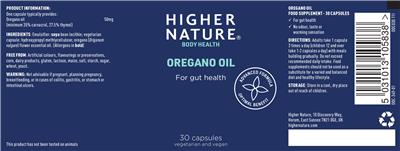
Other ingredients: Soya bean Lecithin, Vegetarian Capsule, Oregano (Origanum vulgare) flower essential oil
Tap any ingredient to jump to its full detail below.
These statements are the manufacturer’s wording, reproduced from the product label — the label is saying it, not HelloPharmacist. We don’t verify or endorse them.
Formulation
Free from: Artificial colours, flavourings or preservatives, corn, dairy products, gluten, lactose, maize, salt, starch, sugar, wheat, yeast.
For gut health
Advanced formula Optimal benefit
No odour, taste or warming sensation
Precautions
Warning: Not advisable if pregnant, planning pregnancy, breastfeeding, or in cases of colitis, gastritis, or stomach or intestinal ulcers.
Do not exceed recommended daily intake. Food supplements should not be used as a substitute for a varied and balanced diet and healthy lifestyle.
Storage: Store in a cool, dry place out of reach of children.
General Statements
This product has not been tested on animals
Body Health
FDA Statement of Identity
Food Supplement
Suggested/Recommended/Usage/Directions
Adults take 1 capsule 3 times a day (children 12 and over take 1-2 capsules a day) with meals building gradually.
Storage
Storage: Store in a cool, dry place out of reach of children.
Is this label outdated? Report a formula or label change and our pharmacy team will review it.
Oregano Oil by Higher Nature label
The label scan from the NIH Dietary Supplement Label Database. Tap to enlarge.
Label images are published by the NIH Dietary Supplement Label Database for the version of this product on file. Always read your actual product label.
View the full label (PDF)The Ingredients in Oregano Oil by Higher Nature
This is the 1 active ingredient this product is made of. Select it to open its full monograph.
Serving size1 Capsule(s) Dosage formCapsule Amounts shown are per serving.
Oregano Oil
Interacts with208 drugs
Oregano is a common Mediterranean cooking herb that is also sold as a concentrated oil or supplement, often standardized for a compound called carvacr...
Oregano Oil monograph & interactionsOther (inactive) ingredients: Soya bean Lecithin, Vegetarian Capsule, Oregano (Origanum vulgare) flower essential oil. These complete the product’s ingredient list but are not active constituents.
Oregano Oil by Higher Nature Drug Interactions
HelloPharmacist Interaction Report
Higher Nature Oregano Oil does interact with medications.
Its oregano oil content may increase bleeding risk when taken with blood thinners or antiplatelet drugs (like warfarin, aspirin, or clopidogrel). This is a Moderate severity concern based on lab research showing oregano can thin the blood slightly.
Read the full breakdown — every affected drug type, severity by severity
Oregano oil may also raise the risk of low blood sugar (hypoglycemia) if you're taking diabetes medications. This is also Moderate severity—animal and lab studies suggest oregano extracts can lower blood glucose levels.
Additionally, we hold no interaction data for the soya bean lecithin or vegetarian capsule ingredients in this product. Before you start this supplement, check your exact medications with the tool on this page, and talk with your doctor or pharmacist if you take any blood thinners, antiplatelet drugs, or diabetes medications.
Check your own medications below · Editorial policy · How we use AI
Want to check YOUR meds against Oregano Oil?
Ask about interactions with your drugs in plain English — “Can I take it with lisinopril?” — and we find you the answer in seconds, ingredient by ingredient.
Go to the checkerIngredients driving the most interactions
Individual Drug Interactions
The ingredients in Oregano Oil interact with 208 drugs. Click any drug to see the details.
1 of the 1 ingredient in Oregano Oil interact with drugs. Each result below shows which ingredient is responsible. Oregano Oil
AbciximabReoPro
How Abciximab interacts with Oregano Oil — through 1 ingredient. Tap an ingredient for the detail:
Oregano OilAnticoagulant/antiplatelet Drugs Moderate
Interaction Summary
Theoretically, oregano might increase the risk of bleeding when taken with anticoagulant or antiplatelet drugs.
Read the full Oregano Oil + Abciximab interactionAbrocitinibCibinqo
How Abrocitinib interacts with Oregano Oil — through 1 ingredient. Tap an ingredient for the detail:
Oregano OilAnticoagulant/antiplatelet Drugs Moderate
Interaction Summary
Theoretically, oregano might increase the risk of bleeding when taken with anticoagulant or antiplatelet drugs.
Read the full Oregano Oil + Abrocitinib interactionAcarboseGlucobay, Prandase, Precose
How Acarbose interacts with Oregano Oil — through 1 ingredient. Tap an ingredient for the detail:
Oregano OilAntidiabetes Drugs Moderate
Interaction Summary
Theoretically, oregano might increase the risk for hypoglycemia when taken with antidiabetes drugs.
Read the full Oregano Oil + Acarbose interactionAcenocoumarolSintrom
How Acenocoumarol interacts with Oregano Oil — through 1 ingredient. Tap an ingredient for the detail:
Oregano OilAnticoagulant/antiplatelet Drugs Moderate
Interaction Summary
Theoretically, oregano might increase the risk of bleeding when taken with anticoagulant or antiplatelet drugs.
Read the full Oregano Oil + Acenocoumarol interactionAcetaminophen, AspirinGemnisyn
How Acetaminophen, Aspirin interacts with Oregano Oil — through 1 ingredient. Tap an ingredient for the detail:
Oregano OilAnticoagulant/antiplatelet Drugs Moderate
Interaction Summary
Theoretically, oregano might increase the risk of bleeding when taken with anticoagulant or antiplatelet drugs.
Read the full Oregano Oil + Acetaminophen, Aspirin interactionAcetaminophen, Aspirin, CaffeineExcedrin, Excedrin Extra Strength, Excedrin Migraine
How Acetaminophen, Aspirin, Caffeine interacts with Oregano Oil — through 1 ingredient. Tap an ingredient for the detail:
Oregano OilAnticoagulant/antiplatelet Drugs Moderate
Interaction Summary
Theoretically, oregano might increase the risk of bleeding when taken with anticoagulant or antiplatelet drugs.
Read the full Oregano Oil + Acetaminophen, Aspirin, Caffeine interactionAcetaminophen, IbuprofenCombogesic
How Acetaminophen, Ibuprofen interacts with Oregano Oil — through 1 ingredient. Tap an ingredient for the detail:
Oregano OilAnticoagulant/antiplatelet Drugs Moderate
Interaction Summary
Theoretically, oregano might increase the risk of bleeding when taken with anticoagulant or antiplatelet drugs.
Read the full Oregano Oil + Acetaminophen, Ibuprofen interactionAcetohexamideDymelor
How Acetohexamide interacts with Oregano Oil — through 1 ingredient. Tap an ingredient for the detail:
Oregano OilAntidiabetes Drugs Moderate
Interaction Summary
Theoretically, oregano might increase the risk for hypoglycemia when taken with antidiabetes drugs.
Read the full Oregano Oil + Acetohexamide interactionAcetylsalicylic AcidEntrophen
How Acetylsalicylic Acid interacts with Oregano Oil — through 1 ingredient. Tap an ingredient for the detail:
Oregano OilAnticoagulant/antiplatelet Drugs Moderate
Interaction Summary
Theoretically, oregano might increase the risk of bleeding when taken with anticoagulant or antiplatelet drugs.
Read the full Oregano Oil + Acetylsalicylic Acid interactionAlbiglutideTanzeum
How Albiglutide interacts with Oregano Oil — through 1 ingredient. Tap an ingredient for the detail:
Oregano OilAntidiabetes Drugs Moderate
Interaction Summary
Theoretically, oregano might increase the risk for hypoglycemia when taken with antidiabetes drugs.
Read the full Oregano Oil + Albiglutide interactionAlogliptinNesina
How Alogliptin interacts with Oregano Oil — through 1 ingredient. Tap an ingredient for the detail:
Oregano OilAntidiabetes Drugs Moderate
Interaction Summary
Theoretically, oregano might increase the risk for hypoglycemia when taken with antidiabetes drugs.
Read the full Oregano Oil + Alogliptin interactionAlogliptin, MetforminKazano
How Alogliptin, Metformin interacts with Oregano Oil — through 1 ingredient. Tap an ingredient for the detail:
Oregano OilAntidiabetes Drugs Moderate
Interaction Summary
Theoretically, oregano might increase the risk for hypoglycemia when taken with antidiabetes drugs.
Read the full Oregano Oil + Alogliptin, Metformin interactionAlogliptin, PioglitazoneOseni
How Alogliptin, Pioglitazone interacts with Oregano Oil — through 1 ingredient. Tap an ingredient for the detail:
Oregano OilAntidiabetes Drugs Moderate
Interaction Summary
Theoretically, oregano might increase the risk for hypoglycemia when taken with antidiabetes drugs.
Read the full Oregano Oil + Alogliptin, Pioglitazone interactionAlteplase, TpaActilyse, Activase
How Alteplase, Tpa interacts with Oregano Oil — through 1 ingredient. Tap an ingredient for the detail:
Oregano OilAnticoagulant/antiplatelet Drugs Moderate
Interaction Summary
Theoretically, oregano might increase the risk of bleeding when taken with anticoagulant or antiplatelet drugs.
Read the full Oregano Oil + Alteplase, Tpa interactionAluminum Hydroxide, Aspirin, Codeine Phosphate, Magnesium HydroxideAscriptin Codeine #2
How Aluminum Hydroxide, Aspirin, Codeine Phosphate, Magnesium Hydroxide interacts with Oregano Oil — through 1 ingredient. Tap an ingredient for the detail:
Oregano OilAnticoagulant/antiplatelet Drugs Moderate
Interaction Summary
Theoretically, oregano might increase the risk of bleeding when taken with anticoagulant or antiplatelet drugs.
Read the full Oregano Oil + Aluminum Hydroxide, Aspirin, Codeine Phosphate, Magnesium Hydroxide interactionAluminum Hydroxide, Aspirin, Magnesium HydroxideAscriptin
How Aluminum Hydroxide, Aspirin, Magnesium Hydroxide interacts with Oregano Oil — through 1 ingredient. Tap an ingredient for the detail:
Oregano OilAnticoagulant/antiplatelet Drugs Moderate
Interaction Summary
Theoretically, oregano might increase the risk of bleeding when taken with anticoagulant or antiplatelet drugs.
Read the full Oregano Oil + Aluminum Hydroxide, Aspirin, Magnesium Hydroxide interactionAnacaulase-bcdbNexoBrid
How Anacaulase-bcdb interacts with Oregano Oil — through 1 ingredient. Tap an ingredient for the detail:
Oregano OilAnticoagulant/antiplatelet Drugs Moderate
Interaction Summary
Theoretically, oregano might increase the risk of bleeding when taken with anticoagulant or antiplatelet drugs.
Read the full Oregano Oil + Anacaulase-bcdb interactionAnagrelideAgrylin
How Anagrelide interacts with Oregano Oil — through 1 ingredient. Tap an ingredient for the detail:
Oregano OilAnticoagulant/antiplatelet Drugs Moderate
Interaction Summary
Theoretically, oregano might increase the risk of bleeding when taken with anticoagulant or antiplatelet drugs.
Read the full Oregano Oil + Anagrelide interactionAnisindioneMiradon
How Anisindione interacts with Oregano Oil — through 1 ingredient. Tap an ingredient for the detail:
Oregano OilAnticoagulant/antiplatelet Drugs Moderate
Interaction Summary
Theoretically, oregano might increase the risk of bleeding when taken with anticoagulant or antiplatelet drugs.
Read the full Oregano Oil + Anisindione interactionAntidiabetes, Dipeptidyl Peptidase-4 (dpp-iv) InhibitorGlyxambi
How Antidiabetes, Dipeptidyl Peptidase-4 (dpp-iv) Inhibitor interacts with Oregano Oil — through 1 ingredient. Tap an ingredient for the detail:
Oregano OilAntidiabetes Drugs Moderate
Interaction Summary
Theoretically, oregano might increase the risk for hypoglycemia when taken with antidiabetes drugs.
Read the full Oregano Oil + Antidiabetes, Dipeptidyl Peptidase-4 (dpp-iv) Inhibitor interactionAntithrombin IiiThrombate III
How Antithrombin Iii interacts with Oregano Oil — through 1 ingredient. Tap an ingredient for the detail:
Oregano OilAnticoagulant/antiplatelet Drugs Moderate
Interaction Summary
Theoretically, oregano might increase the risk of bleeding when taken with anticoagulant or antiplatelet drugs.
Read the full Oregano Oil + Antithrombin Iii interactionApixabanEliquis
How Apixaban interacts with Oregano Oil — through 1 ingredient. Tap an ingredient for the detail:
Oregano OilAnticoagulant/antiplatelet Drugs Moderate
Interaction Summary
Theoretically, oregano might increase the risk of bleeding when taken with anticoagulant or antiplatelet drugs.
Read the full Oregano Oil + Apixaban interactionArgatrobanArgatroban
How Argatroban interacts with Oregano Oil — through 1 ingredient. Tap an ingredient for the detail:
Oregano OilAnticoagulant/antiplatelet Drugs Moderate
Interaction Summary
Theoretically, oregano might increase the risk of bleeding when taken with anticoagulant or antiplatelet drugs.
Read the full Oregano Oil + Argatroban interactionAspirinAngettes 75, ASA, Asaphen, Aspirin, Caprin, Cartia +8 more
How Aspirin interacts with Oregano Oil — through 1 ingredient. Tap an ingredient for the detail:
Oregano OilAnticoagulant/antiplatelet Drugs Moderate
Interaction Summary
Theoretically, oregano might increase the risk of bleeding when taken with anticoagulant or antiplatelet drugs.
Read the full Oregano Oil + Aspirin interactionAspirin, Aluminum Hydroxide, Codeine Phosphate, Magnesium HydroxideAscriptin Codeine #3
How Aspirin, Aluminum Hydroxide, Codeine Phosphate, Magnesium Hydroxide interacts with Oregano Oil — through 1 ingredient. Tap an ingredient for the detail:
Oregano OilAnticoagulant/antiplatelet Drugs Moderate
Interaction Summary
Theoretically, oregano might increase the risk of bleeding when taken with anticoagulant or antiplatelet drugs.
Read the full Oregano Oil + Aspirin, Aluminum Hydroxide, Codeine Phosphate, Magnesium Hydroxide interactionAspirin, ButalbitalAxotal
How Aspirin, Butalbital interacts with Oregano Oil — through 1 ingredient. Tap an ingredient for the detail:
Oregano OilAnticoagulant/antiplatelet Drugs Moderate
Interaction Summary
Theoretically, oregano might increase the risk of bleeding when taken with anticoagulant or antiplatelet drugs.
Read the full Oregano Oil + Aspirin, Butalbital interactionAspirin, Butalbital, CaffeineFiorinal
How Aspirin, Butalbital, Caffeine interacts with Oregano Oil — through 1 ingredient. Tap an ingredient for the detail:
Oregano OilAnticoagulant/antiplatelet Drugs Moderate
Interaction Summary
Theoretically, oregano might increase the risk of bleeding when taken with anticoagulant or antiplatelet drugs.
Read the full Oregano Oil + Aspirin, Butalbital, Caffeine interactionAspirin, Butalbital, Caffeine, Codeine PhosphateFiorinal w/ Codeine
How Aspirin, Butalbital, Caffeine, Codeine Phosphate interacts with Oregano Oil — through 1 ingredient. Tap an ingredient for the detail:
Oregano OilAnticoagulant/antiplatelet Drugs Moderate
Interaction Summary
Theoretically, oregano might increase the risk of bleeding when taken with anticoagulant or antiplatelet drugs.
Read the full Oregano Oil + Aspirin, Butalbital, Caffeine, Codeine Phosphate interactionAspirin, Butalbital, Caffeine, PhenacetinMarnal
How Aspirin, Butalbital, Caffeine, Phenacetin interacts with Oregano Oil — through 1 ingredient. Tap an ingredient for the detail:
Oregano OilAnticoagulant/antiplatelet Drugs Moderate
Interaction Summary
Theoretically, oregano might increase the risk of bleeding when taken with anticoagulant or antiplatelet drugs.
Read the full Oregano Oil + Aspirin, Butalbital, Caffeine, Phenacetin interactionAspirin, CaffeineAnacin
How Aspirin, Caffeine interacts with Oregano Oil — through 1 ingredient. Tap an ingredient for the detail:
Oregano OilAnticoagulant/antiplatelet Drugs Moderate
Interaction Summary
Theoretically, oregano might increase the risk of bleeding when taken with anticoagulant or antiplatelet drugs.
Read the full Oregano Oil + Aspirin, Caffeine interactionEach ingredient & the kinds of drugs it affects
For each ingredient in Oregano Oil with known interactions, here are the types of medications it can affect. Open any type for the detail — or search your exact drug in the checker above.
Oregano Oil
Anticoagulant/Antiplatelet Drugs
Theoretically, oregano might increase the risk of bleeding when taken with anticoagulant or antiplatelet drugs.
In vitro research shows that aristolochic acid isolated from oregano leaves has antithrombin activity. It has also been reported that oregano oil inhibits arachidonic acid-induced, and ADP-induced, platelet aggregation.
Antidiabetes Drugs
Theoretically, oregano might increase the risk for hypoglycemia when taken with antidiabetes drugs.
In vitro and animal research shows that oregano extracts might lower blood glucose levels.
Brand information
Manufacturer and brand details for Oregano Oil, from the product label.
Higher Nature
See all Higher Nature products- Name
- Higher Nature Ltd
- Street Address
- 10 Discovery Way
- City
- Horam, East Sussex
- ZipCode
- TN21 0GE
- Web Address
- highernature.com
Oregano Oil by Higher Nature: Common Questions
Does Oregano Oil by Higher Nature interact with any medications?
How can one product interact with so many drugs?
Where does this information come from?
Can I take this oregano oil if I'm pregnant?
What's the most common side effect?
Can oregano oil cause allergies?
Is there proof oregano oil works for acne or colds?
Is it safe to breastfeed while taking this?
Written and reviewed by the HelloPharmacist editorial staff. Our editorial policy
Not sure if Oregano Oil is safe with your meds?
Our pharmacists answer your medication & supplement questions — free.
Label information is sourced from the NIH Dietary Supplement Label Database and reflects the product version on file; always read your actual product label. This page is for education only and is not a substitute for professional medical advice. Confirm with your pharmacist or doctor before combining supplements and medications.
The Full Monographs Behind Oregano Oil’s Ingredients
Every ingredient we hold a full HelloPharmacist monograph for — uses, evidence, safety, and the complete interaction list.
Sources & How We Checked
Oregano Oil's label data comes from the NIH Dietary Supplement Label Database; the ingredient interaction data is from the Natural Medicines database, reviewed by our pharmacists.
- NIH Dietary Supplement Label Database (DSLD) — The official product label on file for this supplement.
- Natural Medicines (Therapeutic Research Center) — Evidence-graded clinical reference behind the ingredient interaction data.
Content is written and reviewed by licensed HelloPharmacist pharmacists. See our data sources and editorial standards for how this information is built and checked.
The 12 references behind this product’s interaction data
Every citation that drives the interaction findings for this product’s ingredients, from the evidence-graded Natural Medicines (TRC Healthcare) database. Open an ingredient to browse its citations — links open the study on PubMed or the publisher’s site.
Oregano 12 references
- Brinker F. Herb Contraindications and Drug Interactions. 2nd ed. Sandy, OR: Eclectic Medical Publications, 1998.
- Benito M, Jorro G, Morales C, et al. Labiatae allergy: systemic reactions due to ingestion of oregano and thyme. Ann Allergy Asthma Immunol 1996;76:416-8. PubMed
- Chevallier A. Encyclopedia of Herbal Medicine. 2nd ed. New York, NY: DK Publ, Inc., 2000.
- Ciganda C, and Laborde A. Herbal infusions used for induced abortion. J Toxicol.Clin Toxicol. 2003;41:235-239. PubMed
- Futrell, J. M. and Rietschel, R. L. Spice allergy evaluated by results of patch tests. Cutis 1993;52(5):288-290.
- Tognolini, M., Barocelli, E., Ballabeni, V., Bruni, R., Bianchi, A., Chiavarini, M., and Impicciatore, M. Comparative screening of plant essential oils: phenylpropanoid moiety as basic core for antiplatelet activity. Life Sci. 2-23-2006;78(13):1419-1432. PubMed
- Goun, E., Cunningham, G., Solodnikov, S., Krasnykch, O., and Miles, H. Antithrombin activity of some constituents from Origanum vulgare. Fitoterapia 2002;73(7-8):692-694. PubMed
- Lemhadri, A., Zeggwagh, N. A., Maghrani, M., Jouad, H., and Eddouks, M. Anti-hyperglycaemic activity of the aqueous extract of Origanum vulgare growing wild in Tafilalet region. J Ethnopharmacol. 2004;92(2-3):251-256. PubMed
- McCue, P., Vattem, D., and Shetty, K. Inhibitory effect of clonal oregano extracts against porcine pancreatic amylase in vitro. Asia Pac.J Clin.Nutr. 2004;13(4):401-408.
- Ragi, J., Pappert, A., Rao, B., Havkin-Frenkel, D., and Milgraum, S. Oregano extract ointment for wound healing: a randomized, double-blind, petrolatum-controlled study evaluating efficacy. J.Drugs Dermatol. 2011;10(10):1168-1172.
- Singletary K. Oregano: overview of the literature on health benefits. Nutrition Today 2010;45(3):129-38.
- Silva MLAE, Lucarini R, Dos Santos FF, et al. Hypoglycemic effect of rosmarinic acid-rich infusion (RosCE) from Origanum vulgare in alloxan-induced diabetic rats. Nat Prod Res 2022;36(17):4525-4531.
Parts of this content are provided by the Therapeutic Research Center, LLC.
DISCLAIMER: Currently this does not check for drug-drug interactions. This is not an all-inclusive comprehensive list of potential interactions and is for informational purposes only. Not all interactions are known or well-reported in the scientific literature, and new interactions are continually being reported. Input is needed from a qualified healthcare provider including a pharmacist before starting any therapy. Application of clinical judgment is necessary.
© 2021 Therapeutic Research Center, LLC