
Organic Coconut Oil 1000 mg Ingredients & Drug Interactions
What is this page for?
First and foremost: checking Organic Coconut Oil 1000 mg against your medications. The heart of this page is the interaction checker and the full interaction report — how this product’s ingredients may interact with prescription and over-the-counter medicines you may be taking.
Around that, we add a pharmacist’s high-level view of the product as a whole — what’s inside, the evidence for its stated use, how transparent the label is, and what safety data exists — so you can see the full picture in one place. It’s educational information from our licensed clinical databases and the clinical staff at HelloPharmacist — not medical advice — and we don’t sell or endorse products. Our editorial policy
Organic Coconut Oil 1000 mg is a dietary supplement by Wonder Laboratories with 2 active ingredients. Its ingredients are commonly taken for skin and hair care, source of dietary fats (mcts), hydration with coconut water.Based on those ingredients, 348 medications have a known interaction with it, the most serious rated moderate. The ingredients most likely to interact are Coconut Oil. Use the checker below to test your specific medication, or read the full HelloPharmacist Interaction Report.
Check Your Meds Against Organic Coconut Oil 1000 mg by Wonder Laboratories
Ask about any prescription or over-the-counter medication and we check it for interactions with Organic Coconut Oil 1000 mg by Wonder Laboratories — and tell you which ingredient is responsible.
AI summaries are generated from our interaction database for education only — always confirm with your pharmacist. How we use AI
Ask the Pharmacist
A licensed pharmacist will answer your question by email — free, usually within 24 hours.
Got it — thank you!
A licensed pharmacist will answer within 24 hours. Keep an eye on your email (worth checking spam, just in case).
HelloPharmacist Scorecard of Organic Coconut Oil 1000 mg by Wonder Laboratories
Our pharmacy team’s full take, with four database checks built into the cards below — a summary of what is known, not a grade of the product itself.
What’s inside
Full disclosure
This product is made from coconut oil and contains eight ingredients — four with documented profiles and four we couldn't check. The main players are caprylic acid, capric acid, lauric acid, and oleic acid, all medium- or long-chain fatty acids that give coconut oil its composition.
It also contains stearic acid, linoleic acid, palmitic acid, and myristic acid. The three inactive ingredients are gelatin (the capsule), medium chain triglyceride (a carrier), and glycerin.
Does it work?
Moderate evidence
The evidence for this product's effectiveness isn't strong. Caprylic acid is listed with insufficient reliable evidence for epilepsy and essential tremor.
Lauric acid similarly shows insufficient evidence for bronchitis, vaginal candidiasis, common cold, and genital herpes. Oleic acid, however, is possibly effective for high cholesterol and coronary heart disease — that's based on research showing oleic acid from olive oil can help lower cholesterol and heart disease risk.
Since this product contains oleic acid as part of its coconut oil, there may be some benefit there, but the overall evidence for coconut oil as a supplement for any single condition isn't clearly established in our data.
How safe is it?
Well-documented data
Caprylic acid is generally well tolerated short-term when taken by mouth. The most common side effects are mild stomach discomfort and changes in taste; rarely, people report mild dizziness, headache, or fatigue.
Lauric acid may cause nausea, though this has mainly been studied when infused directly into the small intestine — the rate with regular oral use isn't known. As a saturated fat, lauric acid does raise cholesterol levels, both the "bad" kind (LDL) and the "good" kind (HDL), but not triglycerides.
For pregnancy and breastfeeding: Lauric acid is rated likely safe in pregnancy. Caprylic acid occurs naturally in breast milk, but the safety of concentrated supplement doses while nursing isn't known.
Oleic acid safety in pregnancy has not been established from the data we hold. Because supplement-level doses of these ingredients haven't been well studied in pregnancy or while breastfeeding, talk with your doctor or pharmacist before taking this if you're pregnant or nursing.
Meds to double-check
Moderate interaction found
Before taking this product, double-check with your doctor or pharmacist if you take blood pressure medications, diabetes drugs (oral hypoglycemic agents), nonsteroidal anti-inflammatory drugs (NSAIDs) like ibuprofen or naproxen, or warfarin. Altogether, these interactions span 348 individual medications.
The bottom line
Scorecard at a glanceFully disclosed formula with some supporting evidence behind its ingredients' uses. Moderate medication interactions have been identified, and safety information is well characterized.
This coconut oil supplement is generally well tolerated for short-term use, though it hasn't been extensively studied at supplement doses. If you take blood pressure medications, diabetes drugs, NSAIDs, or warfarin, you'll want to check with your doctor or pharmacist before starting it — caprylic acid could theoretically increase the effect of those drugs.
Oleic acid's possible benefit for cholesterol and heart disease may make it worth considering if you fit that profile, but talk it over with your doctor.
Educational only — not medical advice; always confirm with your pharmacist. Our editorial policy · How we use AI
Assessment coverage: 3 of 8 active ingredients matched to our full ingredient reviews (monographs). Based on the product label dated Aug 22, 2024.
This Scorecard evaluates available label information, ingredient evidence, and known medication-safety considerations. It does not independently verify product identity, purity, potency, contamination, or manufacturing quality. How these ratings are computed
General information
Key facts about Organic Coconut Oil 1000 mg, straight from the product label.
| Brand | Wonder Laboratories |
|---|---|
| Barcode (UPC) | 099528629244 |
| Net contents | 240 Softgel(s) |
| Market status | On market |
| Date entered into DSLD | Aug 22, 2024 |
| DSLD ID | 315420 |
| Product type | Fat/fatty Acid |
| Supplement form | Softgel Capsule |
| Dietary claims / uses | All Other, Structure/Function |
| Intended target group(s) | Adult (18 - 50 Years), Gluten Free, Dairy Free, Sugar Free |
Everything in this section is reproduced from the manufacturer’s own product label — it’s the label speaking, not HelloPharmacist. We show it so you can see exactly what the maker states; we don’t verify or endorse those statements.
Supplement Facts
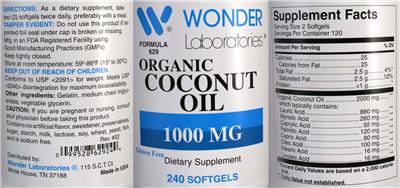
The label details for Organic Coconut Oil 1000 mg by Wonder Laboratories, sourced from the NIH Dietary Supplement Label Database.
Supplement Facts
| Ingredient | Amount | % DV |
|---|---|---|
| Calories | 25 Calorie(s) | -- |
| Calories from Fat | 25 Calorie(s) | -- |
| Caprylic Acid | 92 mg | -- |
| Capric Acid | 80 mg | -- |
| Lauric Acid | 880 mg | -- |
| Total Fat | 2.5 Gram(s) | 4% |
| Saturated Fat | 2.5 Gram(s) | 12% |
| Protein | 1 Gram(s) | -- |
| Stearic Acid | 16 mg | -- |
| Linoleic Acid | 16 mg | -- |
| Coconut Oil | 2000 mg | -- |
| Palmitic Acid | 120 mg | -- |
| Myristic Acid | 260 mg | -- |
| Oleic Acid | 100 mg | -- |
Other ingredients: Gelatin, Medium Chain Triglyceride, Glycerin
Tap any ingredient to jump to its full detail below.
These statements are the manufacturer’s wording, reproduced from the product label — the label is saying it, not HelloPharmacist. We don’t verify or endorse them.
Suggested/Recommended/Usage/Directions
Directions: As a dietary supplement, take two (2) softgels twice daily, preferably with a meal.
Precautions
Tamper evident: Do not use this product if imprinted foil seal under cap is broken or missing.
Keep out of reach of children.
Caution: If you are pregnant or nursing, consult your physician before taking this product.
Formulation
Mfg. in an FDA Registered Facility using Good Manufacturing Practices (GMPs)
Conforms to USP <2091> for weight. Meets USP <2040> disintegration for maximum bioavailability.
Contains no artificial flavor, sweetener, preservatives, sugar, starch, milk, lactose, soy, wheat, yeast, fish, and is sodium free.
Made in USA
Gluten free
Storage
Keep tightly closed. Store at room temperature: 59 Degrees - 86 Degrees F (15 Degrees to 30 Degrees C).
General Statements
Formula 629
FDA Statement of Identity
Dietary Supplement
Is this label outdated? Report a formula or label change and our pharmacy team will review it.
Organic Coconut Oil 1000 mg by Wonder Laboratories label
The label scan from the NIH Dietary Supplement Label Database. Tap to enlarge.
Label images are published by the NIH Dietary Supplement Label Database for the version of this product on file. Always read your actual product label.
View the full label (PDF)The Ingredients in Organic Coconut Oil 1000 mg by Wonder Laboratories
These are the 2 active ingredients this product is made of. Select any to open its full monograph.
Serving size2 Softgel(s) Dosage formSoftgel Capsule Servings per container120 Amounts shown are per serving.
Most supplement products combine several ingredients, and a medication can interact with the product through any one of them. Each ingredient below shows whether it has known drug interactions.
Protein
Coconut Oil
Interacts with86 drugs
Coconut is a nutritious tropical food enjoyed as oil, water, milk, and flesh, and it is generally safe to eat in normal food amounts. While some uses...
Coconut Oil monograph & interactions- › Caprylic Acid
- › Capric Acid
- › Lauric Acid
- › Stearic Acid
- › Linoleic Acid
- › Palmitic Acid
- › Myristic Acid
- › Oleic Acid
Other (inactive) ingredients: Gelatin, Medium Chain Triglyceride, Glycerin. These complete the product’s ingredient list but are not active constituents.
Organic Coconut Oil 1000 mg by Wonder Laboratories Drug Interactions
HelloPharmacist Interaction Report
Wonder Laboratories' Organic Coconut Oil 1000 mg contains caprylic acid and oleic acid, both of which have documented interactions with certain medications.
The most serious concern is caprylic acid's potential to increase the effect of blood pressure medications (antihypertensives), which could theoretically lower your blood pressure too much. This is based on animal research suggesting caprylic acid may reduce blood pressure; it hasn't been seen in humans, but it's worth knowing about.
Read the full breakdown — every affected drug type, severity by severity
Caprylic acid may also increase blood levels of nonsteroidal anti-inflammatory drugs like ibuprofen and naproxen, and of warfarin (a blood thinner). These are moderate-level concerns from test-tube studies showing caprylic acid might displace these drugs from their binding sites in your blood — again, not yet reported in people, but something to discuss with your doctor if you take any of these.
Oleic acid, another component of coconut oil, has a moderate interaction with diabetes medications. Research suggests that a diet rich in oleic acid (like olive oil) may improve blood sugar control in people with type 2 diabetes, which means if you're taking diabetes drugs, this supplement could theoretically add to their effect.
Several other ingredients in this product — capric acid, stearic acid, linoleic acid, palmitic acid, and myristic acid — we could not check for interactions. Use the medication checker on this page to search your exact drugs, and talk with your doctor or pharmacist before starting this supplement if you take any blood pressure, diabetes, or anti-inflammatory medications, or warfarin.
Check your own medications below · Editorial policy · How we use AI
Want to check YOUR meds against Organic Coconut Oil 1000 mg?
Ask about interactions with your drugs in plain English — “Can I take it with lisinopril?” — and we find you the answer in seconds, ingredient by ingredient.
Go to the checkerIngredients driving the most interactions
Individual Drug Interactions
The ingredients in Organic Coconut Oil 1000 mg interact with 348 drugs. Click any drug to see the details.
1 of the 2 ingredients in Organic Coconut Oil 1000 mg interact with drugs. Each result below shows which ingredient is responsible. Coconut Oil
AcarboseGlucobay, Prandase, Precose
How Acarbose interacts with Organic Coconut Oil 1000 mg — through 2 ingredients. Tap an ingredient for the detail:
Oleic AcidAntidiabetes Drugs Moderate
Interaction Summary
Theoretically, oleic acid might increase the effects of antidiabetes drugs.
Read the full Oleic Acid + Acarbose interactionCoconut OilAntidiabetes Drugs Minor
Interaction Summary
Theoretically, taking coconut with antidiabetes drugs might increase the risk of hypoglycemia.
Read the full Coconut Oil + Acarbose interactionAcebutololRhotral, Sectral
How Acebutolol interacts with Organic Coconut Oil 1000 mg — through 1 ingredient. Tap an ingredient for the detail:
Caprylic AcidAntihypertensive Drugs Moderate
Interaction Summary
Theoretically, caprylic acid might increase the risk of hypotension when used with antihypertensive drugs.
Read the full Caprylic Acid + Acebutolol interactionAcetaminophen, AspirinGemnisyn
How Acetaminophen, Aspirin interacts with Organic Coconut Oil 1000 mg — through 1 ingredient. Tap an ingredient for the detail:
Caprylic AcidNonsteroidal Anti-inflammatory Drugs (nsaids) Moderate
Interaction Summary
Theoretically, caprylic acid might increase plasma concentrations of NSAIDs.
Read the full Caprylic Acid + Acetaminophen, Aspirin interactionAcetaminophen, Aspirin, CaffeineExcedrin, Excedrin Extra Strength, Excedrin Migraine
How Acetaminophen, Aspirin, Caffeine interacts with Organic Coconut Oil 1000 mg — through 1 ingredient. Tap an ingredient for the detail:
Caprylic AcidNonsteroidal Anti-inflammatory Drugs (nsaids) Moderate
Interaction Summary
Theoretically, caprylic acid might increase plasma concentrations of NSAIDs.
Read the full Caprylic Acid + Acetaminophen, Aspirin, Caffeine interactionAcetaminophen, IbuprofenCombogesic
How Acetaminophen, Ibuprofen interacts with Organic Coconut Oil 1000 mg — through 1 ingredient. Tap an ingredient for the detail:
Caprylic AcidNonsteroidal Anti-inflammatory Drugs (nsaids) Moderate
Interaction Summary
Theoretically, caprylic acid might increase plasma concentrations of NSAIDs.
Read the full Caprylic Acid + Acetaminophen, Ibuprofen interactionAcetazolamideAk-Zol, Diamox
How Acetazolamide interacts with Organic Coconut Oil 1000 mg — through 1 ingredient. Tap an ingredient for the detail:
Caprylic AcidAntihypertensive Drugs Moderate
Interaction Summary
Theoretically, caprylic acid might increase the risk of hypotension when used with antihypertensive drugs.
Read the full Caprylic Acid + Acetazolamide interactionAcetohexamideDymelor
How Acetohexamide interacts with Organic Coconut Oil 1000 mg — through 2 ingredients. Tap an ingredient for the detail:
Oleic AcidAntidiabetes Drugs Moderate
Interaction Summary
Theoretically, oleic acid might increase the effects of antidiabetes drugs.
Read the full Oleic Acid + Acetohexamide interactionCoconut OilAntidiabetes Drugs Minor
Interaction Summary
Theoretically, taking coconut with antidiabetes drugs might increase the risk of hypoglycemia.
Read the full Coconut Oil + Acetohexamide interactionAcetylsalicylic AcidEntrophen
How Acetylsalicylic Acid interacts with Organic Coconut Oil 1000 mg — through 1 ingredient. Tap an ingredient for the detail:
Caprylic AcidNonsteroidal Anti-inflammatory Drugs (nsaids) Moderate
Interaction Summary
Theoretically, caprylic acid might increase plasma concentrations of NSAIDs.
Read the full Caprylic Acid + Acetylsalicylic Acid interactionAlbiglutideTanzeum
How Albiglutide interacts with Organic Coconut Oil 1000 mg — through 2 ingredients. Tap an ingredient for the detail:
Oleic AcidAntidiabetes Drugs Moderate
Interaction Summary
Theoretically, oleic acid might increase the effects of antidiabetes drugs.
Read the full Oleic Acid + Albiglutide interactionCoconut OilAntidiabetes Drugs Minor
Interaction Summary
Theoretically, taking coconut with antidiabetes drugs might increase the risk of hypoglycemia.
Read the full Coconut Oil + Albiglutide interactionAliskirenTekturna
How Aliskiren interacts with Organic Coconut Oil 1000 mg — through 1 ingredient. Tap an ingredient for the detail:
Caprylic AcidAntihypertensive Drugs Moderate
Interaction Summary
Theoretically, caprylic acid might increase the risk of hypotension when used with antihypertensive drugs.
Read the full Caprylic Acid + Aliskiren interactionAlogliptinNesina
How Alogliptin interacts with Organic Coconut Oil 1000 mg — through 2 ingredients. Tap an ingredient for the detail:
Oleic AcidAntidiabetes Drugs Moderate
Interaction Summary
Theoretically, oleic acid might increase the effects of antidiabetes drugs.
Read the full Oleic Acid + Alogliptin interactionCoconut OilAntidiabetes Drugs Minor
Interaction Summary
Theoretically, taking coconut with antidiabetes drugs might increase the risk of hypoglycemia.
Read the full Coconut Oil + Alogliptin interactionAlogliptin, MetforminKazano
How Alogliptin, Metformin interacts with Organic Coconut Oil 1000 mg — through 2 ingredients. Tap an ingredient for the detail:
Oleic AcidAntidiabetes Drugs Moderate
Interaction Summary
Theoretically, oleic acid might increase the effects of antidiabetes drugs.
Read the full Oleic Acid + Alogliptin, Metformin interactionCoconut OilAntidiabetes Drugs Minor
Interaction Summary
Theoretically, taking coconut with antidiabetes drugs might increase the risk of hypoglycemia.
Read the full Coconut Oil + Alogliptin, Metformin interactionAlogliptin, PioglitazoneOseni
How Alogliptin, Pioglitazone interacts with Organic Coconut Oil 1000 mg — through 2 ingredients. Tap an ingredient for the detail:
Oleic AcidAntidiabetes Drugs Moderate
Interaction Summary
Theoretically, oleic acid might increase the effects of antidiabetes drugs.
Read the full Oleic Acid + Alogliptin, Pioglitazone interactionCoconut OilAntidiabetes Drugs Minor
Interaction Summary
Theoretically, taking coconut with antidiabetes drugs might increase the risk of hypoglycemia.
Read the full Coconut Oil + Alogliptin, Pioglitazone interactionAluminum Hydroxide, Aspirin, Codeine Phosphate, Magnesium HydroxideAscriptin Codeine #2
How Aluminum Hydroxide, Aspirin, Codeine Phosphate, Magnesium Hydroxide interacts with Organic Coconut Oil 1000 mg — through 1 ingredient. Tap an ingredient for the detail:
Caprylic AcidNonsteroidal Anti-inflammatory Drugs (nsaids) Moderate
Interaction Summary
Theoretically, caprylic acid might increase plasma concentrations of NSAIDs.
Read the full Caprylic Acid + Aluminum Hydroxide, Aspirin, Codeine Phosphate, Magnesium Hydroxide interactionAluminum Hydroxide, Aspirin, Magnesium HydroxideAscriptin
How Aluminum Hydroxide, Aspirin, Magnesium Hydroxide interacts with Organic Coconut Oil 1000 mg — through 1 ingredient. Tap an ingredient for the detail:
Caprylic AcidNonsteroidal Anti-inflammatory Drugs (nsaids) Moderate
Interaction Summary
Theoretically, caprylic acid might increase plasma concentrations of NSAIDs.
Read the full Caprylic Acid + Aluminum Hydroxide, Aspirin, Magnesium Hydroxide interactionAmbrisentanLetairis, Volibris
How Ambrisentan interacts with Organic Coconut Oil 1000 mg — through 1 ingredient. Tap an ingredient for the detail:
Caprylic AcidAntihypertensive Drugs Moderate
Interaction Summary
Theoretically, caprylic acid might increase the risk of hypotension when used with antihypertensive drugs.
Read the full Caprylic Acid + Ambrisentan interactionAmilorideAmilamont, Midamor
How Amiloride interacts with Organic Coconut Oil 1000 mg — through 1 ingredient. Tap an ingredient for the detail:
Caprylic AcidAntihypertensive Drugs Moderate
Interaction Summary
Theoretically, caprylic acid might increase the risk of hypotension when used with antihypertensive drugs.
Read the full Caprylic Acid + Amiloride interactionAmiloride, HydrochlorothiazideAmil-Co, Amilzide, Moduret 25, Moduretic
How Amiloride, Hydrochlorothiazide interacts with Organic Coconut Oil 1000 mg — through 1 ingredient. Tap an ingredient for the detail:
Caprylic AcidAntihypertensive Drugs Moderate
Interaction Summary
Theoretically, caprylic acid might increase the risk of hypotension when used with antihypertensive drugs.
Read the full Caprylic Acid + Amiloride, Hydrochlorothiazide interactionAmlodipineNorliqva
How Amlodipine interacts with Organic Coconut Oil 1000 mg — through 1 ingredient. Tap an ingredient for the detail:
Caprylic AcidAntihypertensive Drugs Moderate
Interaction Summary
Theoretically, caprylic acid might increase the risk of hypotension when used with antihypertensive drugs.
Read the full Caprylic Acid + Amlodipine interactionAmlodipine BenzoateKaterzia
How Amlodipine Benzoate interacts with Organic Coconut Oil 1000 mg — through 1 ingredient. Tap an ingredient for the detail:
Caprylic AcidAntihypertensive Drugs Moderate
Interaction Summary
Theoretically, caprylic acid might increase the risk of hypotension when used with antihypertensive drugs.
Read the full Caprylic Acid + Amlodipine Benzoate interactionAmlodipine BesilateIstin
How Amlodipine Besilate interacts with Organic Coconut Oil 1000 mg — through 1 ingredient. Tap an ingredient for the detail:
Caprylic AcidAntihypertensive Drugs Moderate
Interaction Summary
Theoretically, caprylic acid might increase the risk of hypotension when used with antihypertensive drugs.
Read the full Caprylic Acid + Amlodipine Besilate interactionAmlodipine BesylateNorvasc
How Amlodipine Besylate interacts with Organic Coconut Oil 1000 mg — through 1 ingredient. Tap an ingredient for the detail:
Caprylic AcidAntihypertensive Drugs Moderate
Interaction Summary
Theoretically, caprylic acid might increase the risk of hypotension when used with antihypertensive drugs.
Read the full Caprylic Acid + Amlodipine Besylate interactionAmlodipine Besylate, BenazeprilLotrel
How Amlodipine Besylate, Benazepril interacts with Organic Coconut Oil 1000 mg — through 1 ingredient. Tap an ingredient for the detail:
Caprylic AcidAntihypertensive Drugs Moderate
Interaction Summary
Theoretically, caprylic acid might increase the risk of hypotension when used with antihypertensive drugs.
Read the full Caprylic Acid + Amlodipine Besylate, Benazepril interactionAmlodipine, CelecoxibConsensi
How Amlodipine, Celecoxib interacts with Organic Coconut Oil 1000 mg — through 1 ingredient. Tap an ingredient for the detail:
Caprylic AcidAntihypertensive Drugs, Nonsteroidal Anti-inflammatory Drugs (nsaids) Moderate
Interaction Summary
Theoretically, caprylic acid might increase the risk of hypotension when used with antihypertensive drugs.
Read the full Caprylic Acid + Amlodipine, Celecoxib interactionAmmonium ChlorideAmmonium Chloride
How Ammonium Chloride interacts with Organic Coconut Oil 1000 mg — through 1 ingredient. Tap an ingredient for the detail:
Caprylic AcidAntihypertensive Drugs Moderate
Interaction Summary
Theoretically, caprylic acid might increase the risk of hypotension when used with antihypertensive drugs.
Read the full Caprylic Acid + Ammonium Chloride interactionAntidiabetes, Dipeptidyl Peptidase-4 (dpp-iv) InhibitorGlyxambi
How Antidiabetes, Dipeptidyl Peptidase-4 (dpp-iv) Inhibitor interacts with Organic Coconut Oil 1000 mg — through 2 ingredients. Tap an ingredient for the detail:
Oleic AcidAntidiabetes Drugs Moderate
Interaction Summary
Theoretically, oleic acid might increase the effects of antidiabetes drugs.
Read the full Oleic Acid + Antidiabetes, Dipeptidyl Peptidase-4 (dpp-iv) Inhibitor interactionCoconut OilAntidiabetes Drugs Minor
Interaction Summary
Theoretically, taking coconut with antidiabetes drugs might increase the risk of hypoglycemia.
Read the full Coconut Oil + Antidiabetes, Dipeptidyl Peptidase-4 (dpp-iv) Inhibitor interactionAprocitentanTryvio
How Aprocitentan interacts with Organic Coconut Oil 1000 mg — through 1 ingredient. Tap an ingredient for the detail:
Caprylic AcidAntihypertensive Drugs Moderate
Interaction Summary
Theoretically, caprylic acid might increase the risk of hypotension when used with antihypertensive drugs.
Read the full Caprylic Acid + Aprocitentan interactionAspirinAngettes 75, ASA, Asaphen, Aspirin, Caprin, Cartia +8 more
How Aspirin interacts with Organic Coconut Oil 1000 mg — through 1 ingredient. Tap an ingredient for the detail:
Caprylic AcidNonsteroidal Anti-inflammatory Drugs (nsaids) Moderate
Interaction Summary
Theoretically, caprylic acid might increase plasma concentrations of NSAIDs.
Read the full Caprylic Acid + Aspirin interactionAspirin, Aluminum Hydroxide, Codeine Phosphate, Magnesium HydroxideAscriptin Codeine #3
How Aspirin, Aluminum Hydroxide, Codeine Phosphate, Magnesium Hydroxide interacts with Organic Coconut Oil 1000 mg — through 1 ingredient. Tap an ingredient for the detail:
Caprylic AcidNonsteroidal Anti-inflammatory Drugs (nsaids) Moderate
Interaction Summary
Theoretically, caprylic acid might increase plasma concentrations of NSAIDs.
Read the full Caprylic Acid + Aspirin, Aluminum Hydroxide, Codeine Phosphate, Magnesium Hydroxide interactionAspirin, ButalbitalAxotal
How Aspirin, Butalbital interacts with Organic Coconut Oil 1000 mg — through 1 ingredient. Tap an ingredient for the detail:
Caprylic AcidNonsteroidal Anti-inflammatory Drugs (nsaids) Moderate
Interaction Summary
Theoretically, caprylic acid might increase plasma concentrations of NSAIDs.
Read the full Caprylic Acid + Aspirin, Butalbital interactionEach ingredient & the kinds of drugs it affects
For each ingredient in Organic Coconut Oil 1000 mg with known interactions, here are the types of medications it can affect. Open any type for the detail — or search your exact drug in the checker above.
Coconut Oil
Antidiabetes Drugs
Theoretically, taking coconut with antidiabetes drugs might increase the risk of hypoglycemia.
Animal research suggests that coconut milk might increase insulin levels and/or decrease blood glucose levels.
Brand information
Manufacturer and brand details for Organic Coconut Oil 1000 mg, from the product label.
Wonder Laboratories
See all Wonder Laboratories products- Name
- Wonder Laboratories
- Street Address
- 115 S.C.T. Ct.
- City
- White House
- State
- TN
- ZipCode
- 37188
Organic Coconut Oil 1000 mg by Wonder Laboratories: Common Questions
Does Organic Coconut Oil 1000 mg by Wonder Laboratories interact with any medications?
How can one product interact with so many drugs?
Where does this information come from?
Can I take this if I'm pregnant?
Is it safe to breastfeed while taking this?
What are the most common side effects?
Does this product actually help with anything?
Will this raise my cholesterol?
Written and reviewed by the HelloPharmacist editorial staff. Our editorial policy
Not sure if Organic Coconut Oil 1000 mg is safe with your meds?
Our pharmacists answer your medication & supplement questions — free.
Label information is sourced from the NIH Dietary Supplement Label Database and reflects the product version on file; always read your actual product label. This page is for education only and is not a substitute for professional medical advice. Confirm with your pharmacist or doctor before combining supplements and medications.
The Full Monographs Behind Organic Coconut Oil 1000 mg’s Ingredients
Every ingredient we hold a full HelloPharmacist monograph for — uses, evidence, safety, and the complete interaction list.
Coconut
Interacts with 86 drugsCoconut is a nutritious tropical food enjoyed as oil, water, milk, and flesh, and it is generally safe to eat in normal food amounts. While some uses (like skin moisturizing and hydration) h...
Read the full Coconut monograph → Herb & supplement monographCaprylic Acid
Interacts with 262 drugsCaprylic acid is a medium-chain fatty acid found in coconut oil and palm kernel oil that is popularly used for yeast overgrowth and gut health. While laboratory studies show it has antimicro...
Read the full Caprylic Acid monograph → Herb & supplement monographLauric Acid
Lauric acid is a medium-to-long-chain saturated fatty acid found in coconut oil, palm kernel oil, and breast milk. It is studied for possible antimicrobial and skin benefits, but solid human...
Read the full Lauric Acid monograph → Herb & supplement monographOleic Acid
Interacts with 86 drugsOleic acid is a heart-healthy monounsaturated fat found mainly in olive oil, canola oil, avocados, and nuts. As part of a Mediterranean-style diet, it is widely viewed as a healthier replace...
Read the full Oleic Acid monograph →Sources & How We Checked
Organic Coconut Oil 1000 mg's label data comes from the NIH Dietary Supplement Label Database; the ingredient interaction data is from the Natural Medicines database, reviewed by our pharmacists.
- NIH Dietary Supplement Label Database (DSLD) — The official product label on file for this supplement.
- Natural Medicines (Therapeutic Research Center) — Evidence-graded clinical reference behind the ingredient interaction data.
Content is written and reviewed by licensed HelloPharmacist pharmacists. See our data sources and editorial standards for how this information is built and checked.
The 24 references behind this product’s interaction data
Every citation that drives the interaction findings for this product’s ingredients, from the evidence-graded Natural Medicines (TRC Healthcare) database. Open an ingredient to browse its citations — links open the study on PubMed or the publisher’s site.
Caprylic Acid 5 references
- Massolini G, Aubry AF, McGann A, Wainer IW. Determination of the magnitude and enantioselectivity of ligand binding to rat and rabbit serum albumins using immobilized-protein high performance liquid chromatography stationary phases. Biochem Pharmacol 1993 PubMed
- Kristev A, Mitkov D, Lukanov Y, Chapkynov P. The effect of octanoic fatty acid on the cardiovascular system of the guinea pig. Cor Vasa 1989;31(4):321-7.
- Hayball PF, Holman JW, Nation RL. Influence of octanoic acid on the reversible protein binding of ketorolac enantiomers to human serum albumin (HSA): comparative liquid chromatographic studies using a HSA chiral stationary phase. J Chromatogr B Biomed App PubMed
- Noctor TA, Wainer IW, Hage DS. Allosteric and competitive displacement of drugs from human serum albumin by octanoic acid, as revealed by high-performance liquid affinity chromatography, on a human serum albumin-based stationary phase. J Chromatogr 1992;5 PubMed
- Voller B, Lines E, McCrossin G, et al. Dose-escalation study of octanoic acid in patients with essential tremor. J Clin Invest. 2016;126(4):1451-7. PubMed
Lauric Acid 8 references
- Brown KE, Leong K, Huang CH, et al. Gelatin/chondroitin 6-sulfate microspheres for the delivery of therapeutic proteins to the joint. Arthritis Rheum 1998;41:2185-95. PubMed
- de Roos N, Schouten E, Katan M. Consumption of a solid fat rich in lauric acid results in a more favorable serum lipid profile in healthy men and women than consumption of a solid fat rich in trans-fatty acids. J Nutr 2001;131;242-5. PubMed
- Temme EH, Mensink RP, Hornstra G. Comparison of the effects of diets enriched in lauric, palmitic, or oleic acids on serum lipids and lipoproteins in healthy women and men. Am J Clin Nutr 1996;63:897-903. PubMed
- Denke MA, Grundy SM. Comparison of effects of lauric acid and palmitic acid on plasma lipids and lipoproteins. Am J Clin Nutr 1992;56:895-8. PubMed
- Tholstrup T, Marckmann P, Vessby B, Sandstrom B. Effect of fats high in individual saturated fatty acids on plasma lipoprotein[a] levels in young healthy men. J Lipid Res 1995;36;1447-52. DOI
- Francois CA, Connor SL, Wander RC, Connor WE. Acute effects of dietary fatty acids on the fatty acids of human milk. Am J Clin Nutr 1998;67:301-8. PubMed
- Tholstrup T, Marckmann P, Jespersen J, Sandstrom B. Fat high in stearic acid favorably affects blood lipids and factor VII coagulant activity in comparison with fats high in palmitic acid or high in myristic and lauric acids. Am J Clin Nutr 1994;59:371-7. PubMed
- McVeay C, Fitzgerald PCE, Ullrich SS, Steinert RE, Horowitz M, Feinle-Bisset C. Effects of intraduodenal administration of lauric acid and L-tryptophan, alone and combined, on gut hormones, pyloric pressures, and energy intake in healthy men. Am J Clin Nu PubMed
Coconut 10 references
- Teuber SS, Peterson WR. Systemic allergic reaction to coconut (Cocos nucifera) in 2 subjects with hypersensitivity to tree nut and demonstration of cross-reactivity to legumin-like seed storage proteins: new coconut and walnut food allergens. J Allergy Cl PubMed
- Rosado A, Fernandez-Rivas M, Gonzalez-Mancebo E, et al. Anaphylaxis to coconut. Allergy 2002;57(2):182-3. PubMed
- Karmakar PR, Das A, Chatterjee BP. Placebo-controlled immunotherapy with Cocos nucifera pollen extract. Int Arch Allergy Immunol 1994;103(2):194-201. PubMed
- Anagnostou K. Coconut Allergy Revisited. Children (Basel). 2017;4(10). pii: E85. PubMed
- Cifuentes L, Mistrello G, Amato S, et al. Identification of cross-reactivity between buckwheat and coconut. Ann Allergy Asthma Immunol. 2015;115(6):530-2. PubMed
- Michavila Gomez A, Amat Bou M, Gonzalez Cortés MV, Segura Navas L, Moreno Palanques MA, Bartolomé B. Coconut anaphylaxis: Case report and review. Allergol Immunopathol (Madr). 2015;43(2):219-20. PubMed
- 21CFR170.3. U.S. Food and Drug Administration Department of Health and Human Services. Updated April 1, 2017. https://www.accessdata.fda.gov/scripts/cdrh/cfdocs/cfcfr/CFRSearch.cfm?fr=170.3
- Alatawi KA, Alshubaily FA. Coconut products alleviate hyperglycaemic, hyperlipidimic and nephropathy indices in streptozotocin-induced diabetic wistar rats. Saudi J Biol Sci. 2021;28(8):4224-4231. PubMed
- Kruse L, Lor J, Yousif R, Pongracic JA, Fishbein AB. Coconut allergy: Characteristics of reactions and diagnostic predictors in a pediatric tertiary care center. Ann Allergy Asthma Immunol 2021;126(5):562-568.
- Pathmanandavel K, Kaur N, Joshi P, Ford LS. Anaphylaxis and allergy to coconut: An Australian pediatric case series. J Allergy Clin Immunol Pract 2020;8(10):3657-3659. PubMed
Oleic Acid 1 reference
- Madigan C, Ryan M, Owens D, et al. Dietary unsaturated fatty acids in type 2 diabetes: higher levels of postprandial lipoprotein on a linoleic acid-rich sunflower oil diet compared with an oleic acid-rich olive oil diet. Diabetes Care 2000;23:1472-7. PubMed
Parts of this content are provided by the Therapeutic Research Center, LLC.
DISCLAIMER: Currently this does not check for drug-drug interactions. This is not an all-inclusive comprehensive list of potential interactions and is for informational purposes only. Not all interactions are known or well-reported in the scientific literature, and new interactions are continually being reported. Input is needed from a qualified healthcare provider including a pharmacist before starting any therapy. Application of clinical judgment is necessary.
© 2021 Therapeutic Research Center, LLC