
Organic Sleep Support Liquid Ingredients & Drug Interactions
What is this page for?
First and foremost: checking Organic Sleep Support Liquid against your medications. The heart of this page is the interaction checker and the full interaction report — how this product’s ingredients may interact with prescription and over-the-counter medicines you may be taking.
Around that, we add a pharmacist’s high-level view of the product as a whole — what’s inside, the evidence for its stated use, how transparent the label is, and what safety data exists — so you can see the full picture in one place. It’s educational information from our licensed clinical databases and the clinical staff at HelloPharmacist — not medical advice — and we don’t sell or endorse products. Our editorial policy
Organic Sleep Support Liquid is a dietary supplement by Herbal Goodness Kids with 5 active ingredients. Its ingredients are commonly taken for nausea and vomiting, motion sickness, morning sickness in pregnancy.Based on those ingredients, 1,165 medications have a known interaction with it, the most serious rated moderate. The ingredients most likely to interact are Ginger, Chamomile, Valerian. Use the checker below to test your specific medication, or read the full HelloPharmacist Interaction Report.
Check Your Meds Against Organic Sleep Support Liquid by Herbal Goodness Kids
Ask about any prescription or over-the-counter medication and we check it for interactions with Organic Sleep Support Liquid by Herbal Goodness Kids — and tell you which ingredient is responsible.
AI summaries are generated from our interaction database for education only — always confirm with your pharmacist. How we use AI
Ask the Pharmacist
A licensed pharmacist will answer your question by email — free, usually within 24 hours.
Got it — thank you!
A licensed pharmacist will answer within 24 hours. Keep an eye on your email (worth checking spam, just in case).
HelloPharmacist Scorecard of Organic Sleep Support Liquid by Herbal Goodness Kids
Our pharmacy team’s full take, with four database checks built into the cards below — a summary of what is known, not a grade of the product itself.
What’s inside
Low disclosure
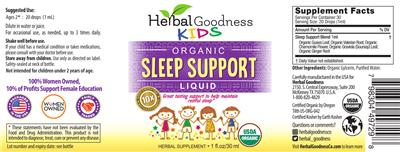
This liquid contains 5 active ingredients: Ginger, Valerian, Chamomile, Guava, and Graviola, along with a proprietary Sleep Support Blend. Ginger and Valerian are the main sleep-supporting herbs here — Valerian is traditionally used for sleep and relaxation, while Ginger may aid digestion and comfort.
Chamomile is a well-known calming herb, Guava adds antioxidant support, and Graviola rounds out the blend, though human evidence for most of these is limited. The product also contains glycerin and purified water as inactive ingredients.
Does it work?
Moderate evidence
The evidence for sleep support in this product is modest. Valerian is rated Possibly Effective for insomnia, which is the main target here.
Ginger's effectiveness ratings don't directly address sleep — it's Possibly Effective for pregnancy-related nausea and dysmenorrhea, but data suggest it's Possibly Ineffective for exercise-related muscle soreness and chemotherapy-related nausea. For Chamomile, Guava, and Graviola, the facts don't include effectiveness ratings for sleep; the evidence we hold on file rates them Insufficient Reliable Evidence for their other traditional uses (Guava for diarrhea and high blood pressure, Graviola for headache and other conditions).
In short, if you're looking for help with sleep, Valerian is your best bet here based on available data.
How safe is it?
Well-documented data
Ginger is generally well tolerated at typical food and supplement amounts for healthy adults. However, doses above 5 grams per day raise the risk of side effects — mainly stomach discomfort, diarrhea, heartburn, burping, and a peppery irritant feeling in the mouth and throat.
Valerian is generally well tolerated short-term but can cause dizziness, drowsiness, mental slowness, headache, or vivid dreams; it's not well studied long-term. If you stop valerian after extended use, taper slowly to avoid withdrawal symptoms like increased heart rate, anxiety, or insomnia.
Safety data for Guava leaf supplements are limited — the fruit as food is fine, but concentrated leaf extracts aren't well studied. Graviola raises concerns: regular consumption may cause nausea and stomach pain, and lab studies suggest possible nerve damage with long-term use.
The facts advise against Graviola in pregnancy and breastfeeding, and against Valerian in both pregnancy and breastfeeding due to insufficient safety data.
Meds to double-check
Moderate interaction found
Check with your pharmacist before using this product if you take blood thinners or antiplatelet drugs (warfarin, Coumadin, or others), blood sugar medications (antidiabetes drugs), blood pressure drugs (especially nifedipine/Procardia), seizure medications (carbamazepine/Tegretol), sedatives or sleep aids, or alcohol. Ginger may also affect how your liver processes certain cancer medications and other enzyme-metabolized drugs, and Graviola may lower seizure medication levels.
The interaction data we hold is most robust for these categories — other interactions may exist that we haven't documented.
The bottom line
Scorecard at a glanceFormula with limited ingredient disclosure with some supporting evidence for its stated purpose. Moderate medication interactions have been identified, and safety information is well characterized.
If you're considering this product for sleep, know that Valerian has the best evidence, but the formula as a whole comes with notable interactions — especially with blood thinners, blood sugar meds, and sedative drugs. Ginger and Graviola each bring their own cautions.
Talk to your pharmacist or doctor before starting this, particularly if you take any prescription medications, are pregnant or nursing, or have plans to combine it with other sleep aids or depressants.
Educational only — not medical advice; always confirm with your pharmacist. Our editorial policy · How we use AI
Assessment coverage: 5 of 5 active ingredients matched to our full ingredient reviews (monographs). Based on the product label dated Oct 24, 2024.
This Scorecard evaluates available label information, ingredient evidence, and known medication-safety considerations. It does not independently verify product identity, purity, potency, contamination, or manufacturing quality. How these ratings are computed
General information
Key facts about Organic Sleep Support Liquid, straight from the product label.
| Brand | Herbal Goodness Kids |
|---|---|
| Barcode (UPC) | 798304497298 |
| Net contents | 1 Fluid Ounce(s); 30 mL |
| Market status | On market |
| Date entered into DSLD | Oct 24, 2024 |
| DSLD ID | 303511 |
| Product type | Botanical |
| Supplement form | Liquid |
| Dietary claims / uses | All Other, Structure/Function |
| Intended target group(s) | Children 4 or More Years of Age, Kosher, Organic, Children more than 1 but less than 4 |
Everything in this section is reproduced from the manufacturer’s own product label — it’s the label speaking, not HelloPharmacist. We show it so you can see exactly what the maker states; we don’t verify or endorse those statements.
Supplement Facts
The label details for Organic Sleep Support Liquid by Herbal Goodness Kids, sourced from the NIH Dietary Supplement Label Database.
Supplement Facts
| Ingredient | Amount | % DV |
|---|---|---|
| Ginger | 0 NP | -- |
| Valerian | 0 NP | -- |
| Chamomile | 0 NP | -- |
| Guava | 0 NP | -- |
| Graviola | 0 NP | -- |
| Sleep Support Blend | 1 mL | -- |
Other ingredients: Glycerin, Water, Purified
Tap any ingredient to jump to its full detail below.
These statements are the manufacturer’s wording, reproduced from the product label — the label is saying it, not HelloPharmacist. We don’t verify or endorse them.
Suggested/Recommended/Usage/Directions
Suggested Use: Ages 2+: 20 drops (1 mL) Dilute in water or juice. For occasional use, as needed, up to 3 times daily. Shake well before use.
Precautions
If your child has a medical condition or takes medications, please consult with your doctor before use.
Store away from children.
Use only as directed on label. Safety-sealed at neck of bottle.
Not intended for children under 2 years of age.
Storage
Store away from children.
General Statements
100% Women Owned, 10% of Profits Support Female Education
Questions or comments? Instagram herbalgoodnessco Twitter herbal_goodness
Seals/Symbols
Packaged in the USA Fairly traded
USDA Organic
EarthKosher
FDA Disclaimer Statement
These statements have not been evaluated by the Food and Drug Administration. This product is not intended to diagnose, treat, cure or prevent any disease.
Formulation
10X concentrated - Extra strength
Great tasting support to help maintain restful sleep
Certified Organic by Oregon Tilth US-ORG-042
FDA Statement of Identity
Herbal Supplement
Formula
Certified Kosher by Earth Kosher
Is this label outdated? Report a formula or label change and our pharmacy team will review it.
Organic Sleep Support Liquid by Herbal Goodness Kids label
The label scan from the NIH Dietary Supplement Label Database. Tap to enlarge.
Label images are published by the NIH Dietary Supplement Label Database for the version of this product on file. Always read your actual product label.
View the full label (PDF)The Ingredients in Organic Sleep Support Liquid by Herbal Goodness Kids
These are the 5 active ingredients this product is made of. Select any to open its full monograph.
Serving size1 mL Dosage formLiquid Servings per container30 Amounts shown are per serving.
Most supplement products combine several ingredients, and a medication can interact with the product through any one of them. Each ingredient below shows whether it has known drug interactions.
Other (inactive) ingredients: Glycerin, Water, Purified. These complete the product’s ingredient list but are not active constituents.
Organic Sleep Support Liquid by Herbal Goodness Kids Drug Interactions
HelloPharmacist Interaction Report
Organic Sleep Support Liquid by Herbal Goodness Kids contains five ingredients, four of which we could check for drug interactions.
Altogether, these interactions span 1,143 individual medications.
Read the full breakdown — every affected drug type, severity by severity
Ginger is the ingredient with the most interactions here. It has Moderate-severity effects with blood thinners (anticoagulants) and antiplatelet drugs — ginger may increase bleeding risk, though research in humans is mixed.
It can also interact with blood sugar medications (antidiabetes drugs), raising the theoretical risk of low blood sugar (hypoglycemia), and with the blood pressure drug nifedipine and the blood thinner warfarin for similar bleeding concerns. Ginger may also affect how your liver and intestines process certain medications, including some cancer drugs and P-glycoprotein substrates — potentially raising their levels in your blood.
Valerian, another key ingredient, can add to the drowsiness caused by sedative medications and alcohol. It may also weakly affect how your body breaks down certain drugs (glucuronidated drugs), though it appears unlikely to cause problems with most enzyme-metabolized medications at typical doses.
Guava in this product may add to the effects of blood sugar medications, increasing hypoglycemia risk. Graviola is documented to theoretically lower levels of the seizure medication carbamazepine.
We could not check Chamomile — we hold no interaction data for it. Before you start this product, run your current medications through the tool below to see if any of these ingredients affect what you're taking.
Check your own medications below · Editorial policy · How we use AI
Want to check YOUR meds against Organic Sleep Support Liquid?
Ask about interactions with your drugs in plain English — “Can I take it with lisinopril?” — and we find you the answer in seconds, ingredient by ingredient.
Go to the checkerIngredients driving the most interactions
Individual Drug Interactions
The ingredients in Organic Sleep Support Liquid interact with 1,165 drugs. Click any drug to see the details.
5 of the 5 ingredients in Organic Sleep Support Liquid interact with drugs. Each result below shows which ingredient is responsible. Ginger Chamomile Valerian Guava Graviola
Ado-trastuzumab EmtansineKadcyla
How Ado-trastuzumab Emtansine interacts with Organic Sleep Support Liquid — through 3 ingredients. Tap an ingredient for the detail:
GingerCytochrome P450 3a4 (cyp3a4) Substrates Moderate
Interaction Summary
Ginger might increase or decrease the levels of CYP3A4 substrates.
Read the full Ginger + Ado-trastuzumab Emtansine interactionChamomileCytochrome P450 3a4 (cyp3a4) Substrates Moderate
Interaction Summary
Theoretically, German chamomile might inhibit CYP3A4 and increase levels of drugs metabolized by these enzymes.
Read the full Chamomile + Ado-trastuzumab Emtansine interactionValerianCytochrome P450 3a4 (cyp3a4) Substrates Minor
Interaction Summary
Valerian does not seem to have a clinically relevant effect on levels of drugs metabolized by CYP3A4.
Read the full Valerian + Ado-trastuzumab Emtansine interactionAbciximabReoPro
How Abciximab interacts with Organic Sleep Support Liquid — through 1 ingredient. Tap an ingredient for the detail:
GingerAnticoagulant/antiplatelet Drugs Moderate
Interaction Summary
Ginger may have antiplatelet effects and may increase the risk of bleeding if used with anticoagulant or antiplatelet drugs.
Read the full Ginger + Abciximab interactionAbemaciclibVerzenio
How Abemaciclib interacts with Organic Sleep Support Liquid — through 3 ingredients. Tap an ingredient for the detail:
ChamomileCytochrome P450 3a4 (cyp3a4) Substrates Moderate
Interaction Summary
Theoretically, German chamomile might inhibit CYP3A4 and increase levels of drugs metabolized by these enzymes.
Read the full Chamomile + Abemaciclib interactionGingerCytochrome P450 3a4 (cyp3a4) Substrates Moderate
Interaction Summary
Ginger might increase or decrease the levels of CYP3A4 substrates.
Read the full Ginger + Abemaciclib interactionValerianCytochrome P450 3a4 (cyp3a4) Substrates Minor
Interaction Summary
Valerian does not seem to have a clinically relevant effect on levels of drugs metabolized by CYP3A4.
Read the full Valerian + Abemaciclib interactionAbiraterone
How Abiraterone interacts with Organic Sleep Support Liquid — through 3 ingredients. Tap an ingredient for the detail:
GingerCytochrome P450 3a4 (cyp3a4) Substrates Moderate
Interaction Summary
Ginger might increase or decrease the levels of CYP3A4 substrates.
Read the full Ginger + Abiraterone interactionChamomileCytochrome P450 3a4 (cyp3a4) Substrates Moderate
Interaction Summary
Theoretically, German chamomile might inhibit CYP3A4 and increase levels of drugs metabolized by these enzymes.
Read the full Chamomile + Abiraterone interactionValerianCytochrome P450 3a4 (cyp3a4) Substrates Minor
Interaction Summary
Valerian does not seem to have a clinically relevant effect on levels of drugs metabolized by CYP3A4.
Read the full Valerian + Abiraterone interactionAbiraterone AcetateYonsa, Zytiga
How Abiraterone Acetate interacts with Organic Sleep Support Liquid — through 3 ingredients. Tap an ingredient for the detail:
GingerCytochrome P450 3a4 (cyp3a4) Substrates Moderate
Interaction Summary
Ginger might increase or decrease the levels of CYP3A4 substrates.
Read the full Ginger + Abiraterone Acetate interactionChamomileCytochrome P450 3a4 (cyp3a4) Substrates Moderate
Interaction Summary
Theoretically, German chamomile might inhibit CYP3A4 and increase levels of drugs metabolized by these enzymes.
Read the full Chamomile + Abiraterone Acetate interactionValerianCytochrome P450 3a4 (cyp3a4) Substrates Minor
Interaction Summary
Valerian does not seem to have a clinically relevant effect on levels of drugs metabolized by CYP3A4.
Read the full Valerian + Abiraterone Acetate interactionAbrocitinibCibinqo
How Abrocitinib interacts with Organic Sleep Support Liquid — through 2 ingredients. Tap an ingredient for the detail:
ChamomileCytochrome P450 2c9 (cyp2c9) Substrates Moderate
Interaction Summary
Theoretically, German chamomile might inhibit CYP2C9 and increase levels of drugs metabolized by these enzymes.
Read the full Chamomile + Abrocitinib interactionGingerAnticoagulant/antiplatelet Drugs, Cytochrome P450 2c9 (cyp2c9) Substrates Moderate
Interaction Summary
Ginger may have antiplatelet effects and may increase the risk of bleeding if used with anticoagulant or antiplatelet drugs.
Read the full Ginger + Abrocitinib interactionAcalabrutinibCalquence
How Acalabrutinib interacts with Organic Sleep Support Liquid — through 3 ingredients. Tap an ingredient for the detail:
GingerP-glycoprotein Substrates, Cytochrome P450 3a4 (cyp3a4) Substrates Moderate
Interaction Summary
Ginger might increase the absorption and blood levels of P-glycoprotein (P-gp) substrates.
Read the full Ginger + Acalabrutinib interactionChamomileCytochrome P450 3a4 (cyp3a4) Substrates Moderate
Interaction Summary
Theoretically, German chamomile might inhibit CYP3A4 and increase levels of drugs metabolized by these enzymes.
Read the full Chamomile + Acalabrutinib interactionValerianCytochrome P450 3a4 (cyp3a4) Substrates Minor
Interaction Summary
Valerian does not seem to have a clinically relevant effect on levels of drugs metabolized by CYP3A4.
Read the full Valerian + Acalabrutinib interactionAcarboseGlucobay, Prandase, Precose
How Acarbose interacts with Organic Sleep Support Liquid — through 2 ingredients. Tap an ingredient for the detail:
GingerAntidiabetes Drugs Moderate
Interaction Summary
Theoretically, taking ginger with antidiabetes drugs might increase the risk of hypoglycemia.
Read the full Ginger + Acarbose interactionGuavaAntidiabetes Drugs Moderate
Interaction Summary
Theoretically, concomitant use with antidiabetes drugs might have additive effects and increase the risk of hypoglycemia.
Read the full Guava + Acarbose interactionAcenocoumarolSintrom
How Acenocoumarol interacts with Organic Sleep Support Liquid — through 1 ingredient. Tap an ingredient for the detail:
GingerAnticoagulant/antiplatelet Drugs Moderate
Interaction Summary
Ginger may have antiplatelet effects and may increase the risk of bleeding if used with anticoagulant or antiplatelet drugs.
Read the full Ginger + Acenocoumarol interactionAcepromazineAtravet
How Acepromazine interacts with Organic Sleep Support Liquid — through 2 ingredients. Tap an ingredient for the detail:
ValerianCns Depressants Moderate
Interaction Summary
Valerian can have additive sedative effects when used concomitantly with CNS depressant drugs.
Read the full Valerian + Acepromazine interactionChamomileCns Depressants Moderate
Interaction Summary
Theoretically, German chamomile might have additive effects when used with CNS depressants.
Read the full Chamomile + Acepromazine interactionAcetaminophenChildren's Tylenol, Children's Tylenol Meltaways, Tylenol, Tylenol Ex Strength
How Acetaminophen interacts with Organic Sleep Support Liquid — through 3 ingredients. Tap an ingredient for the detail:
ValerianGlucuronidated Drugs Moderate
Interaction Summary
Valerian might weakly inhibit glucuronidation and increase concentrations of drugs metabolized by UGT1A1 and UGT2B7.
Read the full Valerian + Acetaminophen interactionChamomileCytochrome P450 1a2 (cyp1a2) Substrates Minor
Interaction Summary
Theoretically, German chamomile might inhibit CYP1A2 and increase levels of drugs metabolized by these enzymes.
Read the full Chamomile + Acetaminophen interactionGingerCytochrome P450 1a2 (cyp1a2) Substrates Minor
Interaction Summary
Theoretically, ginger might increase the levels of CYP1A2 substrates.
Read the full Ginger + Acetaminophen interactionAcetaminophen, AspirinGemnisyn
How Acetaminophen, Aspirin interacts with Organic Sleep Support Liquid — through 3 ingredients. Tap an ingredient for the detail:
GingerCytochrome P450 1a2 (cyp1a2) Substrates, Anticoagulant/antiplatelet Drugs Moderate
Interaction Summary
Theoretically, ginger might increase the levels of CYP1A2 substrates.
Read the full Ginger + Acetaminophen, Aspirin interactionValerianGlucuronidated Drugs Moderate
Interaction Summary
Valerian might weakly inhibit glucuronidation and increase concentrations of drugs metabolized by UGT1A1 and UGT2B7.
Read the full Valerian + Acetaminophen, Aspirin interactionChamomileCytochrome P450 1a2 (cyp1a2) Substrates Minor
Interaction Summary
Theoretically, German chamomile might inhibit CYP1A2 and increase levels of drugs metabolized by these enzymes.
Read the full Chamomile + Acetaminophen, Aspirin interactionAcetaminophen, Aspirin, CaffeineExcedrin, Excedrin Extra Strength, Excedrin Migraine
How Acetaminophen, Aspirin, Caffeine interacts with Organic Sleep Support Liquid — through 3 ingredients. Tap an ingredient for the detail:
ValerianGlucuronidated Drugs, Cytochrome P450 3a4 (cyp3a4) Substrates Moderate
Interaction Summary
Valerian might weakly inhibit glucuronidation and increase concentrations of drugs metabolized by UGT1A1 and UGT2B7.
Read the full Valerian + Acetaminophen, Aspirin, Caffeine interactionGingerCytochrome P450 3a4 (cyp3a4) Substrates, Cytochrome P450 1a2 (cyp1a2) Substrates +1 Moderate
Interaction Summary
Ginger might increase or decrease the levels of CYP3A4 substrates.
Read the full Ginger + Acetaminophen, Aspirin, Caffeine interactionChamomileCytochrome P450 1a2 (cyp1a2) Substrates, Cytochrome P450 3a4 (cyp3a4) Substrates Moderate
Interaction Summary
Theoretically, German chamomile might inhibit CYP1A2 and increase levels of drugs metabolized by these enzymes.
Read the full Chamomile + Acetaminophen, Aspirin, Caffeine interactionAcetaminophen, Brompheniramine, PhenylpropanolamineDimetapp Cold and Flu
How Acetaminophen, Brompheniramine, Phenylpropanolamine interacts with Organic Sleep Support Liquid — through 3 ingredients. Tap an ingredient for the detail:
ValerianGlucuronidated Drugs Moderate
Interaction Summary
Valerian might weakly inhibit glucuronidation and increase concentrations of drugs metabolized by UGT1A1 and UGT2B7.
Read the full Valerian + Acetaminophen, Brompheniramine, Phenylpropanolamine interactionChamomileCytochrome P450 1a2 (cyp1a2) Substrates Minor
Interaction Summary
Theoretically, German chamomile might inhibit CYP1A2 and increase levels of drugs metabolized by these enzymes.
Read the full Chamomile + Acetaminophen, Brompheniramine, Phenylpropanolamine interactionGingerCytochrome P450 1a2 (cyp1a2) Substrates Minor
Interaction Summary
Theoretically, ginger might increase the levels of CYP1A2 substrates.
Read the full Ginger + Acetaminophen, Brompheniramine, Phenylpropanolamine interactionAcetaminophen, ButalbitalAxocet, Bancap, Bucet, Butex Forte, Esgic CF, Orbivan CF +5 more
How Acetaminophen, Butalbital interacts with Organic Sleep Support Liquid — through 3 ingredients. Tap an ingredient for the detail:
ValerianGlucuronidated Drugs Moderate
Interaction Summary
Valerian might weakly inhibit glucuronidation and increase concentrations of drugs metabolized by UGT1A1 and UGT2B7.
Read the full Valerian + Acetaminophen, Butalbital interactionGingerCytochrome P450 1a2 (cyp1a2) Substrates Minor
Interaction Summary
Theoretically, ginger might increase the levels of CYP1A2 substrates.
Read the full Ginger + Acetaminophen, Butalbital interactionChamomileCytochrome P450 1a2 (cyp1a2) Substrates Minor
Interaction Summary
Theoretically, German chamomile might inhibit CYP1A2 and increase levels of drugs metabolized by these enzymes.
Read the full Chamomile + Acetaminophen, Butalbital interactionAcetaminophen, Butalbital, CaffeineEsgic, Esgic Plus, Fiogesic, Fioricet, Repan, Tecnal +1 more
How Acetaminophen, Butalbital, Caffeine interacts with Organic Sleep Support Liquid — through 3 ingredients. Tap an ingredient for the detail:
ChamomileCytochrome P450 1a2 (cyp1a2) Substrates, Cytochrome P450 3a4 (cyp3a4) Substrates Moderate
Interaction Summary
Theoretically, German chamomile might inhibit CYP1A2 and increase levels of drugs metabolized by these enzymes.
Read the full Chamomile + Acetaminophen, Butalbital, Caffeine interactionGingerCytochrome P450 1a2 (cyp1a2) Substrates, Cytochrome P450 3a4 (cyp3a4) Substrates Moderate
Interaction Summary
Theoretically, ginger might increase the levels of CYP1A2 substrates.
Read the full Ginger + Acetaminophen, Butalbital, Caffeine interactionValerianCytochrome P450 3a4 (cyp3a4) Substrates, Glucuronidated Drugs Moderate
Interaction Summary
Valerian does not seem to have a clinically relevant effect on levels of drugs metabolized by CYP3A4.
Read the full Valerian + Acetaminophen, Butalbital, Caffeine interactionAcetaminophen, Butalbital, Caffeine, CodeineEsgic with Codeine, Fioricet w/ Codeine
How Acetaminophen, Butalbital, Caffeine, Codeine interacts with Organic Sleep Support Liquid — through 3 ingredients. Tap an ingredient for the detail:
GingerCytochrome P450 3a4 (cyp3a4) Substrates, Cytochrome P450 1a2 (cyp1a2) Substrates Moderate
Interaction Summary
Ginger might increase or decrease the levels of CYP3A4 substrates.
Read the full Ginger + Acetaminophen, Butalbital, Caffeine, Codeine interactionChamomileCytochrome P450 1a2 (cyp1a2) Substrates, Cytochrome P450 3a4 (cyp3a4) Substrates +2 Moderate
Interaction Summary
Theoretically, German chamomile might inhibit CYP1A2 and increase levels of drugs metabolized by these enzymes.
Read the full Chamomile + Acetaminophen, Butalbital, Caffeine, Codeine interactionValerianGlucuronidated Drugs, Cytochrome P450 2d6 (cyp2d6) Substrates +2 Moderate
Interaction Summary
Valerian might weakly inhibit glucuronidation and increase concentrations of drugs metabolized by UGT1A1 and UGT2B7.
Read the full Valerian + Acetaminophen, Butalbital, Caffeine, Codeine interactionAcetaminophen, Butalbital, CodeineBancap w/ Codeine
How Acetaminophen, Butalbital, Codeine interacts with Organic Sleep Support Liquid — through 3 ingredients. Tap an ingredient for the detail:
ChamomileCytochrome P450 2d6 (cyp2d6) Substrates, Cns Depressants +1 Moderate
Interaction Summary
Theoretically, German chamomile might inhibit CYP2D6 and increase levels of drugs metabolized by these enzymes.
Read the full Chamomile + Acetaminophen, Butalbital, Codeine interactionValerianGlucuronidated Drugs, Cns Depressants +1 Moderate
Interaction Summary
Valerian might weakly inhibit glucuronidation and increase concentrations of drugs metabolized by UGT1A1 and UGT2B7.
Read the full Valerian + Acetaminophen, Butalbital, Codeine interactionGingerCytochrome P450 1a2 (cyp1a2) Substrates Minor
Interaction Summary
Theoretically, ginger might increase the levels of CYP1A2 substrates.
Read the full Ginger + Acetaminophen, Butalbital, Codeine interactionAcetaminophen, Butalbital, Codeine PhosphatePhrenilin #3
How Acetaminophen, Butalbital, Codeine Phosphate interacts with Organic Sleep Support Liquid — through 3 ingredients. Tap an ingredient for the detail:
ChamomileCytochrome P450 1a2 (cyp1a2) Substrates, Cns Depressants +1 Moderate
Interaction Summary
Theoretically, German chamomile might inhibit CYP1A2 and increase levels of drugs metabolized by these enzymes.
Read the full Chamomile + Acetaminophen, Butalbital, Codeine Phosphate interactionValerianCytochrome P450 2d6 (cyp2d6) Substrates, Glucuronidated Drugs +1 Moderate
Interaction Summary
Valerian does not seem to have a clinically relevant effect on levels of drugs metabolized by CYP2D6.
Read the full Valerian + Acetaminophen, Butalbital, Codeine Phosphate interactionGingerCytochrome P450 1a2 (cyp1a2) Substrates Minor
Interaction Summary
Theoretically, ginger might increase the levels of CYP1A2 substrates.
Read the full Ginger + Acetaminophen, Butalbital, Codeine Phosphate interactionAcetaminophen, Caffeine, Chlorpheniramine, Hydrocodone, PhenylephrineHycomine Compound
How Acetaminophen, Caffeine, Chlorpheniramine, Hydrocodone, Phenylephrine interacts with Organic Sleep Support Liquid — through 3 ingredients. Tap an ingredient for the detail:
ValerianCns Depressants, Cytochrome P450 2d6 (cyp2d6) Substrates +2 Moderate
Interaction Summary
Valerian can have additive sedative effects when used concomitantly with CNS depressant drugs.
Read the full Valerian + Acetaminophen, Caffeine, Chlorpheniramine, Hydrocodone, Phenylephrine interactionChamomileCns Depressants, Cytochrome P450 2d6 (cyp2d6) Substrates +2 Moderate
Interaction Summary
Theoretically, German chamomile might have additive effects when used with CNS depressants.
Read the full Chamomile + Acetaminophen, Caffeine, Chlorpheniramine, Hydrocodone, Phenylephrine interactionGingerCytochrome P450 3a4 (cyp3a4) Substrates, Cytochrome P450 1a2 (cyp1a2) Substrates Moderate
Interaction Summary
Ginger might increase or decrease the levels of CYP3A4 substrates.
Read the full Ginger + Acetaminophen, Caffeine, Chlorpheniramine, Hydrocodone, Phenylephrine interactionAcetaminophen, Caffeine, CodeineGesic C15, Gesic C30, Gesic C8, Lenoltec 1, Lenoltec 2, Lenoltec 3 +1 more
How Acetaminophen, Caffeine, Codeine interacts with Organic Sleep Support Liquid — through 3 ingredients. Tap an ingredient for the detail:
ChamomileCytochrome P450 3a4 (cyp3a4) Substrates, Cytochrome P450 1a2 (cyp1a2) Substrates +2 Moderate
Interaction Summary
Theoretically, German chamomile might inhibit CYP3A4 and increase levels of drugs metabolized by these enzymes.
Read the full Chamomile + Acetaminophen, Caffeine, Codeine interactionGingerCytochrome P450 1a2 (cyp1a2) Substrates, Cytochrome P450 3a4 (cyp3a4) Substrates Moderate
Interaction Summary
Theoretically, ginger might increase the levels of CYP1A2 substrates.
Read the full Ginger + Acetaminophen, Caffeine, Codeine interactionValerianCytochrome P450 3a4 (cyp3a4) Substrates, Cns Depressants +2 Moderate
Interaction Summary
Valerian does not seem to have a clinically relevant effect on levels of drugs metabolized by CYP3A4.
Read the full Valerian + Acetaminophen, Caffeine, Codeine interactionAcetaminophen, Caffeine, Codeine, SalicylamideCodalan No.1, Codalan No.2, Codalan No.3
How Acetaminophen, Caffeine, Codeine, Salicylamide interacts with Organic Sleep Support Liquid — through 3 ingredients. Tap an ingredient for the detail:
GingerCytochrome P450 3a4 (cyp3a4) Substrates, Cytochrome P450 1a2 (cyp1a2) Substrates Moderate
Interaction Summary
Ginger might increase or decrease the levels of CYP3A4 substrates.
Read the full Ginger + Acetaminophen, Caffeine, Codeine, Salicylamide interactionChamomileCytochrome P450 3a4 (cyp3a4) Substrates, Cytochrome P450 1a2 (cyp1a2) Substrates +2 Moderate
Interaction Summary
Theoretically, German chamomile might inhibit CYP3A4 and increase levels of drugs metabolized by these enzymes.
Read the full Chamomile + Acetaminophen, Caffeine, Codeine, Salicylamide interactionValerianGlucuronidated Drugs, Cytochrome P450 3a4 (cyp3a4) Substrates +2 Moderate
Interaction Summary
Valerian might weakly inhibit glucuronidation and increase concentrations of drugs metabolized by UGT1A1 and UGT2B7.
Read the full Valerian + Acetaminophen, Caffeine, Codeine, Salicylamide interactionAcetaminophen, Caffeine, DihydrocodeineDHC Plus, Panlor DC, Panlor SS
How Acetaminophen, Caffeine, Dihydrocodeine interacts with Organic Sleep Support Liquid — through 3 ingredients. Tap an ingredient for the detail:
ValerianCns Depressants, Glucuronidated Drugs +2 Moderate
Interaction Summary
Valerian can have additive sedative effects when used concomitantly with CNS depressant drugs.
Read the full Valerian + Acetaminophen, Caffeine, Dihydrocodeine interactionChamomileCns Depressants, Cytochrome P450 2d6 (cyp2d6) Substrates +2 Moderate
Interaction Summary
Theoretically, German chamomile might have additive effects when used with CNS depressants.
Read the full Chamomile + Acetaminophen, Caffeine, Dihydrocodeine interactionGingerCytochrome P450 3a4 (cyp3a4) Substrates, Cytochrome P450 1a2 (cyp1a2) Substrates Moderate
Interaction Summary
Ginger might increase or decrease the levels of CYP3A4 substrates.
Read the full Ginger + Acetaminophen, Caffeine, Dihydrocodeine interactionAcetaminophen, Caffeine, IsomethepteneMigralam
How Acetaminophen, Caffeine, Isometheptene interacts with Organic Sleep Support Liquid — through 3 ingredients. Tap an ingredient for the detail:
ChamomileCytochrome P450 3a4 (cyp3a4) Substrates, Cytochrome P450 1a2 (cyp1a2) Substrates Moderate
Interaction Summary
Theoretically, German chamomile might inhibit CYP3A4 and increase levels of drugs metabolized by these enzymes.
Read the full Chamomile + Acetaminophen, Caffeine, Isometheptene interactionGingerCytochrome P450 1a2 (cyp1a2) Substrates, Cytochrome P450 3a4 (cyp3a4) Substrates Moderate
Interaction Summary
Theoretically, ginger might increase the levels of CYP1A2 substrates.
Read the full Ginger + Acetaminophen, Caffeine, Isometheptene interactionValerianCytochrome P450 3a4 (cyp3a4) Substrates, Glucuronidated Drugs Moderate
Interaction Summary
Valerian does not seem to have a clinically relevant effect on levels of drugs metabolized by CYP3A4.
Read the full Valerian + Acetaminophen, Caffeine, Isometheptene interactionAcetaminophen, Caffeine, PyrilamineMidol Max Strength Menstrual
How Acetaminophen, Caffeine, Pyrilamine interacts with Organic Sleep Support Liquid — through 3 ingredients. Tap an ingredient for the detail:
GingerCytochrome P450 3a4 (cyp3a4) Substrates, Cytochrome P450 1a2 (cyp1a2) Substrates Moderate
Interaction Summary
Ginger might increase or decrease the levels of CYP3A4 substrates.
Read the full Ginger + Acetaminophen, Caffeine, Pyrilamine interactionChamomileCytochrome P450 3a4 (cyp3a4) Substrates, Cytochrome P450 1a2 (cyp1a2) Substrates Moderate
Interaction Summary
Theoretically, German chamomile might inhibit CYP3A4 and increase levels of drugs metabolized by these enzymes.
Read the full Chamomile + Acetaminophen, Caffeine, Pyrilamine interactionValerianGlucuronidated Drugs, Cytochrome P450 3a4 (cyp3a4) Substrates Moderate
Interaction Summary
Valerian might weakly inhibit glucuronidation and increase concentrations of drugs metabolized by UGT1A1 and UGT2B7.
Read the full Valerian + Acetaminophen, Caffeine, Pyrilamine interactionAcetaminophen, Chlorpheniramine Maleate, Dextromethorphan HbrVicks Formula 44M Cough, Cold & Flu Relief
How Acetaminophen, Chlorpheniramine Maleate, Dextromethorphan Hbr interacts with Organic Sleep Support Liquid — through 3 ingredients. Tap an ingredient for the detail:
ValerianCytochrome P450 3a4 (cyp3a4) Substrates, Glucuronidated Drugs +1 Moderate
Interaction Summary
Valerian does not seem to have a clinically relevant effect on levels of drugs metabolized by CYP3A4.
Read the full Valerian + Acetaminophen, Chlorpheniramine Maleate, Dextromethorphan Hbr interactionGingerCytochrome P450 3a4 (cyp3a4) Substrates, Cytochrome P450 1a2 (cyp1a2) Substrates Moderate
Interaction Summary
Ginger might increase or decrease the levels of CYP3A4 substrates.
Read the full Ginger + Acetaminophen, Chlorpheniramine Maleate, Dextromethorphan Hbr interactionChamomileCytochrome P450 2d6 (cyp2d6) Substrates, Cytochrome P450 3a4 (cyp3a4) Substrates +1 Moderate
Interaction Summary
Theoretically, German chamomile might inhibit CYP2D6 and increase levels of drugs metabolized by these enzymes.
Read the full Chamomile + Acetaminophen, Chlorpheniramine Maleate, Dextromethorphan Hbr interactionAcetaminophen, Chlorpheniramine, Codeine, PhenylephrineColrex
How Acetaminophen, Chlorpheniramine, Codeine, Phenylephrine interacts with Organic Sleep Support Liquid — through 3 ingredients. Tap an ingredient for the detail:
ChamomileCytochrome P450 3a4 (cyp3a4) Substrates, Cytochrome P450 1a2 (cyp1a2) Substrates +2 Moderate
Interaction Summary
Theoretically, German chamomile might inhibit CYP3A4 and increase levels of drugs metabolized by these enzymes.
Read the full Chamomile + Acetaminophen, Chlorpheniramine, Codeine, Phenylephrine interactionGingerCytochrome P450 1a2 (cyp1a2) Substrates, Cytochrome P450 3a4 (cyp3a4) Substrates Moderate
Interaction Summary
Theoretically, ginger might increase the levels of CYP1A2 substrates.
Read the full Ginger + Acetaminophen, Chlorpheniramine, Codeine, Phenylephrine interactionValerianCytochrome P450 2d6 (cyp2d6) Substrates, Cytochrome P450 3a4 (cyp3a4) Substrates +2 Moderate
Interaction Summary
Valerian does not seem to have a clinically relevant effect on levels of drugs metabolized by CYP2D6.
Read the full Valerian + Acetaminophen, Chlorpheniramine, Codeine, Phenylephrine interactionAcetaminophen, Chlorpheniramine, DextromethorphanCoricidin II Extra Strength Cold and Flu
How Acetaminophen, Chlorpheniramine, Dextromethorphan interacts with Organic Sleep Support Liquid — through 3 ingredients. Tap an ingredient for the detail:
GingerCytochrome P450 3a4 (cyp3a4) Substrates, Cytochrome P450 1a2 (cyp1a2) Substrates Moderate
Interaction Summary
Ginger might increase or decrease the levels of CYP3A4 substrates.
Read the full Ginger + Acetaminophen, Chlorpheniramine, Dextromethorphan interactionChamomileCytochrome P450 2d6 (cyp2d6) Substrates, Cytochrome P450 1a2 (cyp1a2) Substrates +1 Moderate
Interaction Summary
Theoretically, German chamomile might inhibit CYP2D6 and increase levels of drugs metabolized by these enzymes.
Read the full Chamomile + Acetaminophen, Chlorpheniramine, Dextromethorphan interactionValerianCytochrome P450 2d6 (cyp2d6) Substrates, Glucuronidated Drugs +1 Moderate
Interaction Summary
Valerian does not seem to have a clinically relevant effect on levels of drugs metabolized by CYP2D6.
Read the full Valerian + Acetaminophen, Chlorpheniramine, Dextromethorphan interactionAcetaminophen, Chlorpheniramine, Dextromethorphan HydrobromideCoricidin HBP Maximum Strength Flu
How Acetaminophen, Chlorpheniramine, Dextromethorphan Hydrobromide interacts with Organic Sleep Support Liquid — through 3 ingredients. Tap an ingredient for the detail:
ValerianCytochrome P450 3a4 (cyp3a4) Substrates, Glucuronidated Drugs +1 Moderate
Interaction Summary
Valerian does not seem to have a clinically relevant effect on levels of drugs metabolized by CYP3A4.
Read the full Valerian + Acetaminophen, Chlorpheniramine, Dextromethorphan Hydrobromide interactionGingerCytochrome P450 3a4 (cyp3a4) Substrates, Cytochrome P450 1a2 (cyp1a2) Substrates Moderate
Interaction Summary
Ginger might increase or decrease the levels of CYP3A4 substrates.
Read the full Ginger + Acetaminophen, Chlorpheniramine, Dextromethorphan Hydrobromide interactionChamomileCytochrome P450 3a4 (cyp3a4) Substrates, Cytochrome P450 2d6 (cyp2d6) Substrates +1 Moderate
Interaction Summary
Theoretically, German chamomile might inhibit CYP3A4 and increase levels of drugs metabolized by these enzymes.
Read the full Chamomile + Acetaminophen, Chlorpheniramine, Dextromethorphan Hydrobromide interactionAcetaminophen, Chlorpheniramine, Dextromethorphan, PhenylpropanolamineMulti Symptom Cold Relief
How Acetaminophen, Chlorpheniramine, Dextromethorphan, Phenylpropanolamine interacts with Organic Sleep Support Liquid — through 3 ingredients. Tap an ingredient for the detail:
ChamomileCytochrome P450 3a4 (cyp3a4) Substrates, Cytochrome P450 1a2 (cyp1a2) Substrates +1 Moderate
Interaction Summary
Theoretically, German chamomile might inhibit CYP3A4 and increase levels of drugs metabolized by these enzymes.
Read the full Chamomile + Acetaminophen, Chlorpheniramine, Dextromethorphan, Phenylpropanolamine interactionGingerCytochrome P450 1a2 (cyp1a2) Substrates, Cytochrome P450 3a4 (cyp3a4) Substrates Moderate
Interaction Summary
Theoretically, ginger might increase the levels of CYP1A2 substrates.
Read the full Ginger + Acetaminophen, Chlorpheniramine, Dextromethorphan, Phenylpropanolamine interactionValerianCytochrome P450 2d6 (cyp2d6) Substrates, Glucuronidated Drugs +1 Moderate
Interaction Summary
Valerian does not seem to have a clinically relevant effect on levels of drugs metabolized by CYP2D6.
Read the full Valerian + Acetaminophen, Chlorpheniramine, Dextromethorphan, Phenylpropanolamine interactionEach ingredient & the kinds of drugs it affects
For each ingredient in Organic Sleep Support Liquid with known interactions, here are the types of medications they can affect. Open any type for the detail — or search your exact drug in the checker above.
Ginger
Anticoagulant/Antiplatelet Drugs
Ginger may have antiplatelet effects and may increase the risk of bleeding if used with anticoagulant or antiplatelet drugs. However, research is conflicting.
Laboratory research suggests that ginger inhibits thromboxane synthetase and decreases platelet aggregation. However, this has not been demonstrated unequivocally in humans, with mixed results from clinical trials. Theoretically, excessive amounts of ginger might increase the risk of bleeding when used with anticoagulant/antiplatelet drugs.
Antidiabetes Drugs
Theoretically, taking ginger with antidiabetes drugs might increase the risk of hypoglycemia.
Animal and human research suggests that ginger might increase insulin levels and/or decrease blood glucose levels.
Cytochrome P450 3A4 (Cyp3A4) Substrates
Ginger might increase or decrease the levels of CYP3A4 substrates.
In vitro research and some case reports suggest that ginger inhibits CYP3A4 activity. Three case reports from the World Health Organization (WHO) adverse drug reaction database describe increased toxicity in patients taking ginger and cancer medications that are CYP3A4 substrates (imatinib, dabrafenib, and crizotinib). However, the causality of this interaction is unclear due to the presence of multiple interacting drugs and routes of administration.
Conversely, other in vitro research suggests that ginger induces CYP3A4 activity, leading to reduced levels of CYP3A4 substrates. However, this interaction has not been reported in humans.
Losartan (Cozaar)
Theoretically, ginger might increase levels of losartan and the risk of hypotension.
In animal research, ginger increased the levels and hypotensive effects of a single dose of losartan. It is not clear if ginger alters the concentration or effects of losartan when taken continuously. Additionally, this interaction has not been shown in humans.
Nifedipine (Procardia)
Ginger may have antiplatelet effects and increase the risk of bleeding if used with nifedipine.
Clinical research shows that combined treatment with ginger 1 gram plus nifedipine 10 mg significantly inhibits platelet aggregation when compared to nifedipine or ginger alone.
P-Glycoprotein Substrates
Ginger might increase the absorption and blood levels of P-glycoprotein (P-gp) substrates.
In vitro research and case reports suggest that ginger inhibits drug efflux by P-gp, potentially increasing absorption and serum levels of P-gp substrates. Two case reports from the World Health Organization (WHO) adverse drug reaction database describe increased toxicity in patients taking ginger and cancer medications that are P-gp substrates (trametinib, crizotinib). However, the causality of this interaction is unclear due to the presence of multiple interacting drugs and routes of administration.
Phenprocoumon (Marcoumar, Others)
Ginger might increase the risk of bleeding with phenprocoumon.
Phenprocoumon, a warfarin-related anticoagulant, might increase the international normalized ratio (INR) when taken with ginger. There is one case report of a 76-year-old woman with a stable INR on phenprocoumon that increased to greater than 10 when she began consuming dried ginger and ginger tea.
Warfarin (Coumadin)
Ginger might increase the risk of bleeding with warfarin.
Laboratory research suggests that ginger might inhibit thromboxane synthetase and decrease platelet aggregation. In one case report, ginger increased the INR when taken with phenprocoumon, which has similar pharmacological effects as warfarin. In another case report, ginger increased the INR when taken with a combination of warfarin, hydrochlorothiazide, and acetaminophen. A longitudinal analysis suggests that taking ginger increases the risk of bleeding in patients taking warfarin for at least 4 months. However, research in healthy people suggests that ginger has no effect on INR, or the pharmacokinetics or pharmacodynamics of warfarin. Until more is known, monitor INRs closely in patients taking large amounts of ginger.
Calcium Channel Blockers
Theoretically, taking ginger with calcium channel blockers might increase the risk of hypotension.
Some animal and in vitro research suggests that ginger has hypotensive and calcium channel-blocking effects. Another animal study shows that concomitant administration of ginger and the calcium channel blocker amlodipine leads to greater reductions in blood pressure when compared with amlodipine alone.
Cyclosporine (Neoral, Sandimmune)
Theoretically, when taken prior to cyclosporine, ginger might decrease cyclosporine levels.
In an animal model, ginger juice taken 2 hours prior to cyclosporine administration reduced the maximum concentration and area under the curve of cyclosporine by 51% and 40%, respectively. This effect was not observed when ginger juice and cyclosporine were administered at the same time.
Cytochrome P450 1A2 (Cyp1A2) Substrates
Theoretically, ginger might increase the levels of CYP1A2 substrates.
In vitro research shows that ginger inhibits CYP1A2 activity. However, this interaction has not been reported in humans.
Cytochrome P450 2B6 (Cyp2B6) Substrates
Theoretically, ginger might increase the levels of CYP2B6 substrates.
In vitro research shows that ginger inhibits CYP2B6 activity. However, this interaction has not been reported in humans.
Cytochrome P450 2C9 (Cyp2C9) Substrates
Theoretically, ginger might increase the levels of CYP2C9 substrates.
In vitro research shows that ginger inhibits CYP2C9 activity. However, this interaction has not been reported in humans.
Metronidazole (Flagyl)
Theoretically, ginger might increase levels of metronidazole.
In an animal model, ginger increased the absorption and plasma half-life of metronidazole. In addition, the elimination rate and clearance of metronidazole was significantly reduced.
Chamomile
Cns Depressants
Theoretically, German chamomile might have additive effects when used with CNS depressants.
German chamomile has mild sedative effects. Theoretically, concomitant use with drugs with sedative properties can cause additive effects and side effects.
Contraceptive Drugs
Theoretically, large amounts of German chamomile might reduce the effectiveness of oral contraceptives.
In vitro, German chamomile has demonstrated antiestrogenic activity. Theoretically, concomitant use of large amounts of German chamomile might interfere with contraceptive drugs through competition for estrogen receptors.
Cytochrome P450 2C9 (Cyp2C9) Substrates
Theoretically, German chamomile might inhibit CYP2C9 and increase levels of drugs metabolized by these enzymes.
In vitro evidence shows that German chamomile might inhibit CYP2C9. So far, this interaction has not been reported in humans. However, there might be an increase in the levels of drugs metabolized by CYP2C9 in patients taking German chamomile.
Cytochrome P450 2D6 (Cyp2D6) Substrates
Theoretically, German chamomile might inhibit CYP2D6 and increase levels of drugs metabolized by these enzymes.
In vitro evidence shows that German chamomile might inhibit CYP2D6. So far, this interaction has not been reported in humans. However, there might be an increase in the levels of drugs metabolized by CYP2D6 in patients taking German chamomile.
Cytochrome P450 3A4 (Cyp3A4) Substrates
Theoretically, German chamomile might inhibit CYP3A4 and increase levels of drugs metabolized by these enzymes.
In vitro evidence shows that German chamomile might inhibit CYP3A4. So far, this interaction has not been reported in humans. However, there might be an increase in the levels of drugs metabolized by CYP3A4 in patients taking German chamomile.
Estrogens
Theoretically, large amounts of German chamomile might reduce the effectiveness of estrogens.
In vitro, German chamomile has demonstrated antiestrogenic activity. Theoretically, large amounts of German chamomile might interfere with hormone replacement therapy through competition for estrogen receptors.
Tamoxifen (Nolvadex)
Theoretically, large amounts of German chamomile might interfere with the activity of tamoxifen.
In vitro, German chamomile has demonstrated antiestrogenic activity.
Warfarin (Coumadin)
German chamomile might increase the effects of warfarin and increase the risk of bleeding.
In one case, a 70-year-old female taking warfarin developed retroperitoneal hematoma and bilateral recti muscle bleeding along with an INR of 7.9 following ingestion of German chamomile tea 4-5 cups daily and use of a topical chamomile-based lotion applied 4-5 times daily.
Cytochrome P450 1A2 (Cyp1A2) Substrates
Theoretically, German chamomile might inhibit CYP1A2 and increase levels of drugs metabolized by these enzymes.
In vitro and animal research shows that German chamomile might inhibit CYP1A2. So far, this interaction has not been reported in humans. However, there might be an increase in the levels of drugs metabolized by CYP1A2 in patients taking German chamomile.
Valerian
Alcohol (Ethanol)
Valerian can have additive sedative effects when used concomitantly with alcohol.
Valerian has sedative effects. Theoretically, valerian might have an additive sedative effect when combined with alcohol. Excessive sedation has been reported in an alcohol-abusing individual who took valerian and Gingko biloba. However, the potential interaction between valerian and alcohol has been disputed in other research. Limited evidence suggests that a combination of valerian 160 mg and lemon balm 80 mg (Euvegal) does not cause further deterioration in reaction ability and reaction rate when taken with alcohol as compared to the effects of alcohol alone.
Alprazolam (Xanax)
Valerian can have additive sedative effects when used with alprazolam. Also, valerian in high doses might modestly increase alprazolam levels, though this is not likely to be clinically significant.
Valerian has sedative effects. Theoretically, valerian might cause additive sedation when combined with alprazolam. Also, a small pharmacokinetic study shows that taking valerian extract 1000 mg daily (providing 11 mg valerenic acid) might increase alprazolam levels by about 19%. This might be due to valerian's mild inhibition of cytochrome P450 3A4 (CYP3A4). Despite being statistically significant, this increase is not likely to be clinically significant.
Cns Depressants
Valerian can have additive sedative effects when used concomitantly with CNS depressant drugs.
Theoretically, concomitant use of valerian and drugs with sedative and anesthetic properties may cause additive therapeutic and adverse effects.
Glucuronidated Drugs
Valerian might weakly inhibit glucuronidation and increase concentrations of drugs metabolized by UGT1A1 and UGT2B7.
In vitro research shows that methanolic valerian extract and valerenic acid might competitively inhibit UDP-glucuronosyltransferase (UGT) 1A1 (UGT1A1) and UGT2B7.
Cytochrome P450 2D6 (Cyp2D6) Substrates
Valerian does not seem to have a clinically relevant effect on levels of drugs metabolized by CYP2D6.
Although some in vitro evidence suggests that valerian affects CYP2D6, clinical pharmacokinetic (PK) studies show that valerian is unlikely to affect the CYP2D6 enzyme. In one PK study, taking valerian 1000 mg (providing about 11 mg valerenic acid) nightly for 14 days did not affect the metabolism of dextromethorphan, a CYP2D6 substrate. In another PK study, taking valerian 125 mg three times daily for 28 days did not affect metabolism of debrisoquine, an accepted CYP2D6 probe-substrate.
Cytochrome P450 3A4 (Cyp3A4) Substrates
Valerian does not seem to have a clinically relevant effect on levels of drugs metabolized by CYP3A4.
Although some in vitro evidence suggests that valerian extract might inhibit or induce CYP3A4, clinical pharmacokinetic (PK) studies show that valerian does not have a clinically significant effect on the CYP3A4 enzyme. In one PK study, taking valerian 125 mg three times daily for 28 days did not affect metabolism of midazolam, an accepted CYP3A4 probe-substrate. In another PK study, taking valerian 1000 mg (providing about 11 mg valerenic acid) nightly for 14 days modestly increases levels of alprazolam, a CYP3A4 substrate, suggesting mild inhibition of CYP3A4. However, this mild inhibition is unlikely to be clinically relevant.
Guava
Antidiabetes Drugs
Theoretically, concomitant use with antidiabetes drugs might have additive effects and increase the risk of hypoglycemia. Animal research shows that guava leaf extract or guava fruit can have hypoglycemic effects. Monitor blood glucose levels closely. Medication dose adjustments may be necessary. Some antidiabetes drugs include glimepiride (Amaryl), glyburide (Diabeta, Glynase PresTab, Micronase), insulin, metformin, pioglitazone (Actos), rosiglitazone (Avandia), and others.
Graviola
Carbamazepine (Tegretol)
Theoretically, graviola might decrease concentrations of carbamazepine when used concomitantly.
A study in rats shows that graviola extract reduces the area under the curve of carbamazepine by 46% and maximum concentration by 35% when compared with carbamazepine alone.
Brand information
Manufacturer and brand details for Organic Sleep Support Liquid, from the product label.
Herbal Goodness Kids
See all Herbal Goodness Kids products- Name
- Herbal Goodness
- Street Address
- 2150 S. Central Expressway Suite 200
- City
- McKinney
- State
- TX
- ZipCode
- 75070
- Phone Number
- 1-800-820-4829
- Web Address
- www.herbalgoodnessco.com
Organic Sleep Support Liquid by Herbal Goodness Kids: Common Questions
Does Organic Sleep Support Liquid by Herbal Goodness Kids interact with any medications?
How can one product interact with so many drugs?
Where does this information come from?
Can I take this if I'm on a blood thinner?
Is this safe during pregnancy?
Will this make me drowsy the next day?
Can I take this with my other sleep aid?
What if I take diabetes medication?
What are the most common side effects?
Written and reviewed by the HelloPharmacist editorial staff. Our editorial policy
Not sure if Organic Sleep Support Liquid is safe with your meds?
Our pharmacists answer your medication & supplement questions — free.
Label information is sourced from the NIH Dietary Supplement Label Database and reflects the product version on file; always read your actual product label. This page is for education only and is not a substitute for professional medical advice. Confirm with your pharmacist or doctor before combining supplements and medications.
The Full Monographs Behind Organic Sleep Support Liquid’s Ingredients
Every ingredient we hold a full HelloPharmacist monograph for — uses, evidence, safety, and the complete interaction list.
Ginger
Interacts with 1,008 drugsGinger is a widely used culinary spice with a long history in traditional medicine, and it has the strongest evidence for helping with nausea and vomiting, including from motion sickness, pr...
Read the full Ginger monograph → Herb & supplement monographValerian
Interacts with 904 drugsValerian is an herb whose root is widely used as a natural sleep aid and for calming nerves. The evidence is mixed and often weak, so it may help some people sleep but does not work reliably...
Read the full Valerian monograph → Herb & supplement monographGerman Chamomile
Interacts with 962 drugsGerman chamomile is a widely used herbal remedy taken mainly as a tea for calming, sleep, and digestive complaints. Early research suggests possible benefits for mild anxiety and some skin o...
Read the full German Chamomile monograph → Herb & supplement monographGuava
Interacts with 86 drugsGuava is a tropical fruit tree whose leaves and fruit have a long history of folk use for diarrhea, blood sugar, and general wellness. The fruit is a nutritious food rich in vitamin C, but e...
Read the full Guava monograph → Herb & supplement monographGraviola
Interacts with 1 drugGraviola (soursop) is a tropical fruit tree whose leaves, fruit, and bark are used in traditional medicine, especially in parts of South America, Africa, and Asia. Despite popular online cla...
Read the full Graviola monograph →Sources & How We Checked
Organic Sleep Support Liquid's label data comes from the NIH Dietary Supplement Label Database; the ingredient interaction data is from the Natural Medicines database, reviewed by our pharmacists.
- NIH Dietary Supplement Label Database (DSLD) — The official product label on file for this supplement.
- Natural Medicines (Therapeutic Research Center) — Evidence-graded clinical reference behind the ingredient interaction data.
Content is written and reviewed by licensed HelloPharmacist pharmacists. See our data sources and editorial standards for how this information is built and checked.
The 123 references behind this product’s interaction data
Every citation that drives the interaction findings for this product’s ingredients, from the evidence-graded Natural Medicines (TRC Healthcare) database. Open an ingredient to browse its citations — links open the study on PubMed or the publisher’s site.
Ginger 64 references
- Fischer-Rasmussen W, Kjaer SK, Dahl C, Asping U. Ginger treatment of hyperemesis gravidarum. Eur J Obstet Gynecol Reprod Biol 1991;38:19-24. PubMed
- Jewell D, Young G. Interventions for nausea and vomiting in early pregnancy. Cochrane Database Syst Rev 2000;(2):CD000145. PubMed
- Vutyavanich T, Kraisarin T, Ruangsri R. Ginger for nausea and vomiting in pregnancy: randomized, double-masked, placebo-controlled trial. Obstet Gynecol 2001;97:577-82. DOI
- Backon J. Ginger in preventing nausea and vomiting of pregnancy; a caveat due to its thromboxane synthetase activity and effect on testosterone binding. Eur J Obstet Gynecol Reprod Biol 1991;42:163-4. PubMed
- Srivastava KC. Effect of onion and ginger consumption on platelet thromboxane production in humans. Prostaglandins Leukot Essent Fatty Acids 1989;35:183-5. PubMed
- Stewart JJ, Wood MJ, Wood CD, Mims ME. Effects of ginger on motion sickness susceptibility and gastric function. Pharmacology 1991;42:111-20. PubMed
- Smith C, Crowther C, Willson K, et al. A randomized controlled trial of ginger to treat nausea and vomiting in pregnancy. Obstet Gynecol 2004;103:639-45. PubMed
- Portnoi G, Chng LA, Karimi-Tabesh L, et al. Prospective comparative study of the safety and effectiveness of ginger for the treatment of nausea and vomiting in pregnancy. Am J Obstet Gynecol 2003;189:1374-7.. PubMed
- Wigler I, Grotto I, Caspi D, Yaron M. The effects of Zintona EC (a ginger extract) on symptomatic gonarthritis. Osteoarthritis Cartilage 2003;11:783-9. PubMed
- Ghayur MN, Gilani AH. Ginger lowers blood pressure through blockade of voltage-dependent calcium channels. J Cardiovasc Pharmacol 2005;45:74-80. PubMed
- Thomson M, Al-Qattan KK, Al-Sawan SM, et al. The use of ginger (Zingiber officinale Rosc.) as a potential anti-inflammatory and antithrombotic agent. Prostaglandins Leukot Essent Fatty Acids 2002;67:475-8. PubMed
- Kanerva L, Estlander T, Jolanki R. Occupational allergic contact dermatitis from spices. Contact Dermatitis 1996;35:157-62. PubMed
- Akhani SP, Vishwakarma SL, Goyal RK. Anti-diabetic activity of Zingiber officinale in streptozotocin-induced type I diabetic rats. J Pharm Pharmacol 2004;56:101-5.
- Kruth P, Brosi E, Fux R, et al. Ginger-associated overanticoagulation by phenprocoumon. Ann Pharmacother 2004;38:257-60. PubMed
- Jiang X, Williams KM, Liauw WS, et al. Effect of ginkgo and ginger on the pharmacokinetics and pharmacodynamics of warfarin in healthy subjects. Br J Clin Pharmacol 2005;59:425-32. PubMed
- Borrelli F, Capasso R, Aviello G, et al. Effectiveness and safety of ginger in the treatment of pregnancy-induced nausea and vomiting. Obstet Gynecol 2005;105:849-56. PubMed
- Smith C, Crowther C, Wilson K et al. A randomized controlled trial of ginger to treat nausea and vomiting in pregnancy. Obstet Gynecol 2004;103:639-45. PubMed
- Jiang X, Blair EY, McLachlan AJ. Investigation of the effects of herbal medicines on warfarin response in healthy subjects: a population pharmacokinetic-pharmacodynamic modeling approach. J Clin Pharmacol 2006;46:1370-8. PubMed
- Chittumma P, Kaewkiattikun K, Wiriyasiriwach B. Comparison of the effectiveness of ginger and vitamin B6 for treatment of nausea and vomiting in early pregnancy: a randomized double-blind controlled trial. J Med Assoc Thai 2007;90:15-20.
- Ozgoli G, Goli M, Moattar F. Comparison of effects of ginger, mefenamic acid, and ibuprofen on pain in women with primary dysmenorrhea. J Altern Complement Med 2009;15:129-32. PubMed
- Black CD, Herring MP, Hurley DJ, O'Connor PJ. Ginger (Zingiber officinale) reduces muscle pain caused by eccentric exercise. J Pain 2010;11:894-903. PubMed
- Heitmann K, Nordeng H, Holst L. Safety of ginger use in pregnancy: results from a large population-based cohort study. Eur J Clin Pharmacol 2012 Jun 17. PubMed
- Ryan JL, Heckler CE, Roscoe JA, et al. Ginger (Zingiber officinale) reduces acute chemotherapy-induced nausea: a URCC CCOP study of 576 patients. Support Care Cancer. 2012;20:1479-89. PubMed
- Backon J. Ginger as an antiemetic: possible side effects due to its thromboxane synthetase activity. Anaesthesia. 1991;46(8):705-6.. PubMed
- Abebe W. Herbal medication: potential for adverse interactions with analgesic drugs. J Clin Pharm Ther. 2002;27:391-401. PubMed
- Argento A, Tiraferri E, Marzaloni M. [Oral anticoagulants and medicinal plants. An emerging interaction]. Ann Ital Med Int. 2000;15:139-43.
- Young HY, Liao JC, Chang YS, et al. Synergistic effect of ginger and nifedipine on human platelet aggregation: a study in hypertensive patients and normal volunteers. Am J Chin Med. 2006;34:545-51. PubMed
- Greenway FL, Liu Z, Martin CK, et al. Safety and efficacy of NT, an herbal supplement, in treating human obesity. Int J Obes (Lond). 2006;30:1737-41. PubMed
- Shalansky S, Lynd L, Richardson K, et al. Risk of warfarin-related bleeding events and supratherapeutic international normalized ratios associated with complementary and alternative medicine: a longitudinal analysis. Pharmacotherapy. 2007;27:1237-47. PubMed
- Lesho EP, Saullo L, Udvari-Nagy S. A 76-year-old woman with erratic anticoagulation. Cleve Clin J Med. 2004;71:651-6. PubMed
- Okonta JM, Uboh M, Obonga WO. Herb-Drug Interaction: A Case Study of Effect of Ginger on the Pharmacokinetic of Metronidazole in Rabbit. Indian Journal of Pharmaceutical Sciences (India) 2008;70(230):232. PubMed
- Chiang HM, Chao PD, Hsiu SL, et al. Ginger significantly decreased the oral bioavailability of cyclosporine in rats. Am J Chin Med. 2006;34:845-55. PubMed
- Bhandari U, Kanojia R, Pillai KK. Effect of ethanolic extract of Zingiber officinale on dyslipidaemia in diabetic rats. J Ethnopharmacol. 2005;97:227-30. PubMed
- Ojewole JA. Analgesic, antiinflammatory and hypoglycaemic effects of ethanol extract of Zingiber officinale (Roscoe) rhizomes (Zingiberaceae) in mice and rats. Phytother Res. 2006;20:764-72.
- Al-Amin ZM, Thomson M, Al-Qattan KK, et al. Anti-diabetic and hypolipidaemic properties of ginger (Zingiber officinale) in streptozotocin-induced diabetic rats. Br J Nutr. 2006;96:660-6.
- Islam MS, Choi H. Comparative effects of dietary ginger (Zingiber officinale) and garlic (Allium sativum) investigated in a type 2 diabetes model of rats. J Med Food. 2008;11:152-9.
- Cady RK, Goldstein J, Nett R, et al. A double-blind placebo-controlled pilot study of sublingual feverfew and ginger (LipiGesic M) in the treatment of migraine. Headache 2011;51:1078-86.
- Futrell, J. M. and Rietschel, R. L. Spice allergy evaluated by results of patch tests. Cutis 1993;52(5):288-290.
- Sripramote, M. and Lekhyananda, N. A randomized comparison of ginger and vitamin B6 in the treatment of nausea and vomiting of pregnancy. J Med Assoc.Thai. 2003;86(9):846-853.
- Lohsiriwat, S., Rukkiat, M., Chaikomin, R., and Leelakusolvong, S. Effect of ginger on lower esophageal sphincter pressure. J.Med.Assoc.Thai. 2010;93(3):366-372.
- Liu, P. H. and Ho, H. L. Ginger and drug bezoar induced small bowel obstruction. J R.Coll.Surg.Edinb. 1983;28(6):397-398.
- Maghbooli M, Golipour F, Moghimi Esfandabadi A, Yousefi M. Comparison between the efficacy of ginger and sumatriptan in the ablative treatment of the common migraine. Phytother Res 2014;28(3):412-5. PubMed
- Mahluji S, Attari VE, Mobasseri M, Payahoo L, Ostadrahimi A, Golzari SE. Effects of ginger (Zingiber officinale) on plasma glucose level, HbA1c and insulin sensitivity in type 2 diabetic patients. Int J Food Sci Nutr 2013;64(6):682-6.
- Mozaffari-Khosravi H, Talaei B, Jalali BA, Najarzadeh A, Mozayan MR. The effect of ginger powder supplementation on insulin resistance and glycemic indices in patients with type 2 diabetes: a randomized, double-blind, placebo-controlled trial. Complement PubMed
- Paramdeep G. Efficacy and tolerability of ginger (Zingiber officinale) in patients of osteoarthritis of knee. Indian J Physiol Pharmacol 2013;57(2):177-83.
- Rahnama P, Montazeri A, Huseini HF, Kianbakht S, Naseri M. Effect of Zingiber officinale R. rhizomes (ginger) on pain relief in primary dysmenorrhea: a placebo randomized trial. BMC Complement Altern Med 2012;12:92. PubMed
- Viljoen E, Visser J, Koen N, Musekiwa A. A systematic review and meta-analysis of the effect and safety of ginger in the treatment of pregnancy-associated nausea and vomiting. Nutr J 2014;13:20. PubMed
- Bartels EM, Folmer VN, Bliddal H, et al. Efficacy and safety of ginger in osteoarthritis patients: a meta-analysis of randomized placebo-controlled trials. Osteoarthritis Cartilage. 2015;23(1):13-21. PubMed
- Choi JS, Han JY, Ahn HK, et al. Assessment of fetal and neonatal outcomes in the offspring of women who had been treated with dried ginger (Zingiberis rhizoma siccus) for a variety of illnesses during pregnancy. J Obstet Gynaecol. 2015;35(2):125-30.
- Marx W, McKavanagh D, McCarthy AL, Bird R, Ried K, Chan A, Isenring L. The effect of ginger (Zingiber officinale) on platelet aggregation: A systematic literature review. PLoS One. 2015;10(10):e0141119. PubMed
- Crichton M, Marshall S, Marx W, McCarthy AL, Isenring E. Efficacy of ginger (Zingiber officinale) in ameliorating chemotherapy-induced nausea and vomiting and chemotherapy-related outcomes: A systematic review update and meta-analysis. J Acad Nutr Diet. 2 PubMed
- Martins LB, Rodrigues AMDS, Monteze NM, et al. Double-blind placebo-controlled randomized clinical trial of ginger (Zingiber officinale Rosc.) in the prophylactic treatment of migraine. Cephalalgia. 2020;40(1):88-95.
- Martins LB, Rodrigues AMDS, Rodrigues DF, Dos Santos LC, Teixeira AL, Ferreira AVM. Double-blind placebo-controlled randomized clinical trial of ginger (Zingiber officinale Rosc.) addition in migraine acute treatment. Cephalalgia. 2019;39(1):68-76.
- Ahad A, Raish M, Bin Jardan YA, Alam MA, Al-Mohizea AM, Al-Jenoobi FI. Effect of Hibiscus sabdariffa and Zingiber officinale on the antihypertensive activity and pharmacokinetic of losartan in hypertensive rats. Xenobiotica. 2020:1-11.
- Okuhira H, Nakatani Y, Furukawa F, Kanazawa N. Anaphylaxis to ginger induced by herbal medicine. Allergol Int. 2020;69(1):159-160. PubMed
- Yamprasert R, Chanvimalueng W, Mukkasombut N, Itharat A. Ginger extract versus Loratadine in the treatment of allergic rhinitis: a randomized controlled trial. BMC Complement Med Ther. 2020;20(1):116. PubMed
- Ebrahimzadeh A, Ebrahimzadeh A, Mirghazanfari SM, Hazrati E, Hadi S, Milajerdi A. The effect of ginger supplementation on metabolic profiles in patients with type 2 diabetes mellitus: a systematic review and meta-analysis of randomized controlled trials. PubMed
- Alam MA, Bin Jardan YA, Alzenaidy B, et al. Effect of Hibiscus sabdariffa and Zingiber officinale on pharmacokinetics and pharmacodynamics of amlodipine. J Pharm Pharmacol 2021;73(9):1151-60.
- Akbarzadeh E, Heydari M, Atarzadeh F, Jaladat AM. Chronic dysuria following ginger (Zingiber officinale) use: a case report. Galen Med J 2018;7:e1086. DOI
- Haron MH, Dale O, Martin K, et al. Evaluation of the Herb-Drug Interaction Potential of Commonly Used Botanicals on the US Market with Regard to PXR- and AhR-Mediated Influences on CYP3A4 and CYP1A2. J Diet Suppl 2022. PubMed
- Rostamkhani H, Veisi P, Niknafs B, Jafarabadi MA, Ghoreishi Z. The effect of zingiber officinale on prooxidant-antioxidant balance and glycemic control in diabetic patients with ESRD undergoing hemodialysis: a double-blind randomized control trial. BMC Co PubMed
- Husain I, Dale OR, Idrisi M, et al. Evaluation of the Herb-Drug Interaction (HDI) Potential of Zingiber officinale and Its Major Phytoconstituents. J Agric Food Chem. 2023;71(19):7521-7534.
- Committee on Practice Bulletins-Obstetrics. ACOG Practice Bulletin No. 189: Nausea And Vomiting Of Pregnancy. Obstet Gynecol. 2018;131(1):e15-e30. PubMed
- Pochet S, Lechon AS, Lescrainier C, et al. Herb-anticancer drug interactions in real life based on VigiBase, the WHO global database. Sci Rep 2022;12(1):14178. PubMed
Valerian 37 references
- Willey LB, Mady SP, Cobaugh DJ, Wax PM. Valerian overdose: a case report. Vet Hum Toxicol 1995;37:364-5.
- Kuhlmann J, Berger W, Podzuweit H, Schmidt U. The influence of valerian treatment on "reaction time, alertness and concentration" in volunteers. Pharmacopsychiatry 1999;32:235-41. PubMed
- Klepser TB, Klepser ME. Unsafe and potentially safe herbal therapies. Am J Health Syst Pharm 1999;56:125-38. PubMed
- Houghton PJ. The scientific basis for the reputed activity of Valerian. J Pharm Pharmacol 1999;51:505-12. PubMed
- Garges HP, Varia I, Doraiswamy PM. Cardiac complications and delirium associated with Valerian root withdrawal. [Letter to the Editor]. JAMA 1998;280:1566-7. PubMed
- Budzinski JW, Foster BC, Vandenhoek S, Arnason JT. An in vitro evaluation of human cytochrome P450 3A4 inhibition by selected commercial herbal extracts and tinctures. Phytomedicine 2000;7:273-82. PubMed
- MacGregor FB, Abernethy VE, Dahabra S, et al. Hepatotoxicity of herbal remedies. BMJ 1989;299:1156-7. PubMed
- Leathwood PD, Chauffard F. Aqueous extract of valerian reduces latency to fall asleep in man. Planta Med 1985;2:144-8. PubMed
- Hadley S, Petry JJ. Valerian. Am Fam Physician 2003;67:1755-8..
- Glass JR, Sproule BA, Herrmann N, et al. Acute pharmacological effects of temazepam, diphenhydramine, and valerian in healthy elderly subjects. J Clin Psychopharmacol 2003;23:260-8. PubMed
- Lefebvre T, Foster BC, Drouin CE, et al. In vitro activity of commercial valerian root extracts against human cytochrome P450 3A4. J Pharm Pharmaceut Sci 2004;7:265-73.
- Yuan CS, Mehendale S, Xiao Y, et al. The gamma-aminobutyric acidergic effects of valerian and valerenic acid on rat brainstem neuronal activity. Anesth Analg 2004;98:353-8. PubMed
- Donovan JL, DeVane CL, Chavin KD, et al. Multiple night-time doses of valerian (Valeriana officinalis) had minimal effects on CYP3A4 activity and no effect on CYP2D6 activity in healthy volunteers. Drug Metab Dispos 2004;32:1333-6. PubMed
- Gurley BJ, Gardner SF, Hubbard MA, et al. In vivo effects of goldenseal, kava kava, black cohosh, and valerian on human cytochrome P450 1A2, 2D6, 2E1, and 3A4/5 phenotypes. Clin Pharmacol Ther 2005;77:415-26. PubMed
- Gutierrez S, Ang-Lee MK, Walker DJ, Zacny JP. Assessing subjective and psychomotor effects of the herbal medication valerian in healthy volunteers. Pharmacol Biochem Behav 2004;78:57-64. PubMed
- Jacobs BP, Bent S, Tice JA, et al. An internet-based randomized, placebo-controlled trial of kava and valerian for anxiety and insomnia. Medicine (Baltimore) 2005;84:197-207. PubMed
- National Toxicology Program, US Department of Health and Human Services. Chemical Information Review Document for Valerian (Valeriana officinalis L.) [CAS No. 8057-49-6] and Oils [CAS No. 8008-88-6]. Supporting Nomination for Toxicological Evaluation by t
- Fernández-San-Martín MI, Masa-Font R, Palacios-Soler L, et al. Effectiveness of Valerian on insomnia: a meta-analysis of randomized placebo-controlled trials. Sleep Med. 2010 Jun;11:505-11. PubMed
- Coxeter PD, Schluter PJ, Eastwood HL, et al. Valerian does not appear to reduce symptoms for patients with chronic insomnia in general practice using a series of randomised n-of-1 trials. Complement Ther Med. 2003 Dec;11:215-22. PubMed
- Diaper A, Hindmarch I. A double-blind, placebo-controlled investigation of the effects of two doses of a valerian preparation on the sleep, cognitive and psychomotor function of sleep-disturbed older adults. Phytother Res. 2004 Oct;18:831-6. PubMed
- Cuellar NG, Ratcliffe SJ. Does valerian improve sleepiness and symptom severity in people with restless legs syndrome? Altern Ther Health Med 2009;15:22-8.
- Chen D, Klesmer J, Giovanniello A, et al. Mental status changes in an alcohol abuser taking valerian and gingko biloba. Am J Addict. 2002 Winter;11:75-7. PubMed
- Albrecht M, Berger W, Laux P, Schmidt U, et al. Psychopharmaka und Verkehrssicherheit. Der Einfluß von Euvegal® - Dragees forte auf die Fahrtüchtigkeit und Kombinationswirkungen mit Alkohol Z Allg Med 1995;71:1215-25.
- Carrasco MC, Vallejo JR, Pardo-de-Santayana M, et al. Interactions of Valeriana officinalis L. and Passiflora incarnata L. in a patient treated with lorazepam. Phytother Res. 2009 Dec;23:1795-6.
- Hellum BH, Nilsen OG. The in vitro inhibitory potential of trade herbal products on human CYP2D6-mediated metabolism and the influence of ethanol. Basic Clin Pharmacol Toxicol. 2007 Nov;101:350-8.
- Hellum BH, Hu Z, Nilsen OG. The induction of CYP1A2, CYP2D6 and CYP3A4 by six trade herbal products in cultured primary human hepatocytes. Basic Clin Pharmacol Toxicol. 2007 Jan;100:23-30. PubMed
- Alkharfy, K. M. and Frye, R. F. Effect of valerian, valerian/hops extracts, and valerenic acid on glucuronidation in vitro. Xenobiotica 2007;37(2):113-123.
- Vassiliadis, T., Anagnostis, P., Patsiaoura, K., Giouleme, O., Katsinelos, P., Mpoumponaris, A., and Eugenidis, N. Valeriana hepatotoxicity. Sleep Med 2009;10(8):935. PubMed
- Muller, Z., Sarkany, A., Altorjay, A., Szilagyi, A., Tura, T., and Ozsvar, Z. [Liver failure a la Eastern Europe]. Orv.Hetil. 3-22-2009;150(12):555-557. PubMed
- National Toxicology Program, US Department of Health and Human Services. Chemical Information Review Document for Valerian (Valeriana officinalis L.) [CAS No. 8057-49-6] and Oils [CAS No. 8008-88-6]. 2009;
- Wells SR. International intravenous administration of a crude valerian root extract. NACCT 1995;33:542.
- Aydinoglu U, Özcan H, Yücel A, Yücel N, Mutlu M. Valerian induced hypomania: a case report. Bull Clin Psychopharma 2012;22(Suppl. 1):S63.
- Mirabi P, Mojab F. The effects of valerian root on hot flashes in menopausal women. Iran J Pharm Res 2013;12(1):217-22.
- Thomas K, Canedo J, Perry PJ, et al. Effects of valerian on subjective sedation, field sobriety testing and driving simulator performance. Accid Anal Prev. 2016 Jul;92:240-4. PubMed
- Kia YH, Alexander S, Dowling D, Standish R. A case of steroid-responsive valerian-associated hepatitis. Intern Med J. 2016 Jan;46(1):118-9. PubMed
- Burke H, Jiang S, Chatham P, Stern TA. Delirium After Withdrawal From Valerian Root: A Case Report. Psychosomatics. 2020;61(6):787-790. PubMed
- Hajizadeh I, Jamshidi M, Kazemi M, Kargar H, Sadeghi T. Comparison the effect of valerian and gabapentin on RLS and sleep quality in hemodialysis patients: A randomized clinical trial. Ther Apher Dial 2023.
German Chamomile 15 references
- Subiza J, Subiza JL, Hinojosa M, et al. Anaphylactic reaction after the ingestion of chamomile tea; a study of cross-reactivity with other composite pollens. J Allergy Clin Immunol 1989;84:353-8. PubMed
- Budzinski JW, Foster BC, Vandenhoek S, Arnason JT. An in vitro evaluation of human cytochrome P450 3A4 inhibition by selected commercial herbal extracts and tinctures. Phytomedicine 2000;7:273-82. PubMed
- Viola H, Wasowski C, Levi de Stein M, et al. Apigenin, a component of Matricaria recutita flowers, is a central benzodiazepine receptors-ligand with anxiolytic effects. Planta Med 1995;61:213-6.
- van Ketel WG. Allergy to Matricaria chamomilla. Contact Dermatitis 1982;8:143. PubMed
- van Ketel WG. Allergy to Matricaria chamomilla. Contact Dermatitis 1987;16:50-1. PubMed
- Hormann HP, Korting HC. Evidence for the efficacy and safety of topical herbal drugs in dermatology: part I: anti-inflammatory agents. Phytomedicine 1994;1:161-71. PubMed
- Avallone R, Zanoli P, Puia G, et al. Pharmacological profile of apigenin, a flavonoid isolated from Matricaria chamomilla. Biochem Pharmacol 2000;59:1387-94. PubMed
- Kassi E, Papoutsi Z, Fokialakis N, et al. Greek plant extracts exhibit selective estrogen receptor modulator (SERM)-like properties. J Agric Food Chem 2004;52:6956-61. PubMed
- Maliakal PP, Wanwimolruk S. Effect of herbal teas on hepatic drug metabolizing enzymes in rats. J Pharm Pharmacol 2001;53:1323-9. PubMed
- Segal R, Pilote L. Warfarin interaction with Matricaria chamomilla. CMAJ 2006;174:1281-2. PubMed
- Loggia RD, Traversa U, Scarcia V, et al. Depressive effects of Chamomilla recutita (L.) Rausch, tubular flowers, on central nervous system in mice. Pharmacol Res Commun 1982;14(2):153-162. PubMed
- Ganzera M, Schneider P, Stuppner H. Inhibitory effects of the essential oil of chamomile (Matricaria recutita L.) and its major constituents on human cytochrome P450 enzymes. Life Sci 2006;78(8):856-861. PubMed
- Benito P, Rodríguez-Perez R, García F, Juste S, Moneo I, Caballero ML. Occupational allergic rhinoconjunctivitis induced by Matricaria chamomilla with tolerance of chamomile tea. J Investig Allergol Clin Immunol. 2014;24(5):369-70. No abstract available.
- Braga FT, Santos AC, Bueno PC, et al. Use of Chamomilla recutita in the prevention and treatment of oral mucositis in patients undergoing hematopoietic stem cell transplantation: a randomized, controlled, phase II clinical trial. Cancer Nurs 2015;38(4):32 PubMed
- Sarris J, Ravindran A, Yatham LN, et al. Clinician guidelines for the treatment of psychiatric disorders with nutraceuticals and phytoceuticals: The World Federation of Societies of Biological Psychiatry (WFSBP) and Canadian Network for Mood and Anxiety T
Guava 3 references
- Obi M, Miyazaki Y, Yokozeki H, Nishioka K. Allergic contact dermatitis due to guava tea. Contact Dermatitis. 2001;44(2):116-7. PubMed
- Gutiérrez RM, Mitchell S, Solis RV. Psidium guajava: a review of its traditional uses, phytochemistry and pharmacology. J Ethnopharmacol. 2008;117(1):1-27. PubMed
- Doubova SV, Morales HR, Hernández SF, et al. Effect of a Psidii guajavae folium extract in the treatment of primary dysmenorrhea: a randomized clinical trial. J Ethnopharmacol. 2007;110(2):305-10. PubMed
Graviola 4 references
- Caparros-Lefebvre D, Elbaz A. Possible relation of atypical parkinsonism in the French West Indies with consumption of tropical plants: a case-control study. Caribbean Parkinsonism Study Group. Lancet 1999;354:281-6. PubMed
- Gavamukulya Y, Wamunyokoli F, El-Shemy HA. Annona muricata: Is the natural therapy to most disease conditions including cancer growing in our backyard? A systematic review of its research history and future prospects. Asian Pac J Trop Med. 2017;10(9):835- PubMed
- Abu Soukhon AA, Abu-Qatouseh L, Mansoor K, et al. Cytotoxicity Activity of Graviola Fruit Extract with Carbamazepine and Valproic Acid Show Antagonistic and Indifferent Effects. Asian Pac J Cancer Prev 2023;24(6):1869-1875. PubMed
- Cleret de Langavant L, Roze E, Petit A, et al. Annonaceae Consumption Worsens Disease Severity and Cognitive Deficits in Degenerative Parkinsonism. Mov Disord 2022;37(12):2355-2366. PubMed
Parts of this content are provided by the Therapeutic Research Center, LLC.
DISCLAIMER: Currently this does not check for drug-drug interactions. This is not an all-inclusive comprehensive list of potential interactions and is for informational purposes only. Not all interactions are known or well-reported in the scientific literature, and new interactions are continually being reported. Input is needed from a qualified healthcare provider including a pharmacist before starting any therapy. Application of clinical judgment is necessary.
© 2021 Therapeutic Research Center, LLC