
Probiotic Sugar Free Berry Flavor Ingredients & Drug Interactions
What is this page for?
First and foremost: checking Probiotic Sugar Free Berry Flavor against your medications. The heart of this page is the interaction checker and the full interaction report — how this product’s ingredients may interact with prescription and over-the-counter medicines you may be taking.
Around that, we add a pharmacist’s high-level view of the product as a whole — what’s inside, the evidence for its stated use, how transparent the label is, and what safety data exists — so you can see the full picture in one place. It’s educational information from our licensed clinical databases and the clinical staff at HelloPharmacist — not medical advice — and we don’t sell or endorse products. Our editorial policy
Probiotic Sugar Free Berry Flavor is a dietary supplement by Lifeable Kids with 2 active ingredients. Its ingredients are commonly taken for constipation, irritable bowel syndrome (ibs), diarrhea.Based on those ingredients, 268 medications have a known interaction with it, the most serious rated moderate. The ingredients most likely to interact are Bacillus coagulans, Inulin. Use the checker below to test your specific medication, or read the full HelloPharmacist Interaction Report.
Check Your Meds Against Probiotic Sugar Free Berry Flavor by Lifeable Kids
Ask about any prescription or over-the-counter medication and we check it for interactions with Probiotic Sugar Free Berry Flavor by Lifeable Kids — and tell you which ingredient is responsible.
AI summaries are generated from our interaction database for education only — always confirm with your pharmacist. How we use AI
Ask the Pharmacist
A licensed pharmacist will answer your question by email — free, usually within 24 hours.
Got it — thank you!
A licensed pharmacist will answer within 24 hours. Keep an eye on your email (worth checking spam, just in case).
HelloPharmacist Scorecard of Probiotic Sugar Free Berry Flavor by Lifeable Kids
Our pharmacy team’s full take, with four database checks built into the cards below — a summary of what is known, not a grade of the product itself.
What’s inside
Full disclosure
This product has two active ingredients: Bacillus coagulans, a probiotic bacterium (a live beneficial microorganism), and inulin, a type of dietary fiber that acts as a prebiotic (food for beneficial gut bacteria). The product also contains inactive ingredients — pectin, black carrot extract, hibiscus extract, and several others that serve as sweeteners, colors, binders, and flavoring.
Does it work?
Moderate evidence
Bacillus coagulans is possibly effective for constipation and irritable bowel syndrome (IBS). Evidence for antibiotic-associated diarrhea, athletic performance, cancer, and fatty liver disease is insufficient to rate.
Inulin is possibly effective for obesity, constipation, and diabetes. Evidence for fatty liver disease and iron deficiency anemia is insufficient to rate.
So this product may help with gut regularity and IBS symptoms, though the strength of that evidence varies.
How safe is it?
Well-documented data
Both ingredients are generally well tolerated in healthy adults, though the evidence and quality of probiotic products vary, so talk to your doctor before starting if you have any health concerns. Inulin commonly causes gas, bloating, diarrhea, constipation, and stomach cramps, especially at higher doses — these are usually mild.
Bacillus coagulans carries a rare risk: in patients with central lines, severe illness, or weakened immune systems (including preterm infants), live probiotics have occasionally caused serious blood infections. Healthy people with intact immune systems are at much lower risk, but this is a consideration if you or your child has any of those risk factors.
There isn't enough data on inulin in pregnancy or lactation, so talk to your doctor or pharmacist if you are pregnant or breastfeeding before using.
Meds to double-check
Moderate interaction found
Double-check before starting if you or your child take antibiotics — separate the timing to keep the probiotic working. If anyone takes diabetes medication, a quick chat with your pharmacist about the small risk of low blood sugar is worth it.
The bottom line
Scorecard at a glanceFully disclosed formula with some supporting evidence for its stated purpose. Moderate medication interactions have been identified, and safety information is well characterized.
This product may help with constipation, IBS, and blood sugar control in kids and adults who are generally healthy. If anyone in your household takes antibiotics or diabetes medication, check with your pharmacist first — timing and interactions matter.
Stomach upset (gas, bloating) is common, especially when you start it. Talk to your doctor before use if there's any serious illness or immune system concern.
Educational only — not medical advice; always confirm with your pharmacist. Our editorial policy · How we use AI
Assessment coverage: 2 of 2 active ingredients matched to our full ingredient reviews (monographs). Based on the product label dated Jul 24, 2025.
This Scorecard evaluates available label information, ingredient evidence, and known medication-safety considerations. It does not independently verify product identity, purity, potency, contamination, or manufacturing quality. How these ratings are computed
General information
Key facts about Probiotic Sugar Free Berry Flavor, straight from the product label.
| Brand | Lifeable Kids |
|---|---|
| Barcode (UPC) | 850023062512 |
| Net contents | 60 Gummy(ies) |
| Market status | On market |
| Date entered into DSLD | Jul 24, 2025 |
| DSLD ID | 333159 |
| Product type | Other Combinations |
| Supplement form | Gummy Or Jelly |
| Dietary claims / uses | Nutrient, All Other, Structure/Function |
| Intended target group(s) | Children 4 or More Years of Age, Vegan, Vegetarian, Kosher, Gluten Free, Dairy Free |
Everything in this section is reproduced from the manufacturer’s own product label — it’s the label speaking, not HelloPharmacist. We show it so you can see exactly what the maker states; we don’t verify or endorse those statements.
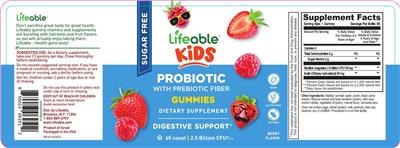
Supplement Facts
The label details for Probiotic Sugar Free Berry Flavor by Lifeable Kids, sourced from the NIH Dietary Supplement Label Database.
Supplement Facts
| Ingredient | Amount | % DV |
|---|---|---|
| Calories | 5 Calorie(s) | -- |
| Total Carbohydrates | 2 Gram(s) | 1%, 1% |
| Bacillus coagulans | 25 mg | -- |
| Sugar Alcohol | 2 Gram(s) | -- |
| Inulin | 50 mg | -- |
Other ingredients: Malitol, Isomalt, Water, Pectin, Black Carrot Extract, Hibiscus Extract, Beta-Carotene, Citric Acid, Sodium Citrate, Palm Oil, Natural Flavors, Carnauba Wax
Tap any ingredient to jump to its full detail below.
These statements are the manufacturer’s wording, reproduced from the product label — the label is saying it, not HelloPharmacist. We don’t verify or endorse them.
General Statements
Don't sacrifice great taste for great health. Lifeable gummy vitamins and supplements are bursting with nutrients and fruit flavors so you will actually enjoy taking them. Lifeable - Health gone tasty!
60 Count
Suggested/Recommended/Usage/Directions
Suggested use: As a dietary supplement, take one (1) gummy per day. Chew thoroughly before swallowing.
Precautions
Do not exceed suggested serving size. Do not use this product if safety seal under cap is torn or missing.
If you have a medical condition, are taking medication, or are pregnant or nursing, ask a doctor before using.
Not for children under 2 years of age due to risk of choking. Keep out of reach of children.
Storage
Store at room temperature. Avoid excessive heat.
Formulation
Product of Israel Packaged in the USA
Vegan
Gluten free Nut free
Does not contain eggs, wheat (gluten), milk, peanuts, tree nuts, sesame, soy or shellfish. Processed in a nut free facility.
Formula
Probiotic Sugar Free Berry Flavor With prebiotic fiber 2.5 billion CFU per serving
OU (Kosher)
Probiotic with prebiotic fiber 2.5 Billion CFU Per Serving
FDA Statement of Identity
Dietary Supplement
Seals/Symbols
OU (Kosher)
FDA Disclaimer Statement
This statement has not been evaluated by the Food and Drug Administration. This product is not intended to diagnose, treat, cure, or prevent any disease.
Is this label outdated? Report a formula or label change and our pharmacy team will review it.
Probiotic Sugar Free Berry Flavor by Lifeable Kids label
The label scan from the NIH Dietary Supplement Label Database. Tap to enlarge.
Label images are published by the NIH Dietary Supplement Label Database for the version of this product on file. Always read your actual product label.
View the full label (PDF)The Ingredients in Probiotic Sugar Free Berry Flavor by Lifeable Kids
These are the 2 active ingredients this product is made of. Select any to open its full monograph.
Serving size1 Gummy(ies) Dosage formGummy Or Jelly Servings per container60 Amounts shown are per serving.
Most supplement products combine several ingredients, and a medication can interact with the product through any one of them. Each ingredient below shows whether it has known drug interactions.
Bacillus coagulans
Interacts with182 drugs
Bacillus coagulans is a spore-forming probiotic that survives stomach acid well and may help with some digestive problems such as IBS, constipation, a...
Bacillus coagulans monograph & interactionsInulin
Interacts with86 drugs
Inulin is a type of plant fiber (a prebiotic) found naturally in foods like chicory root, onions, and garlic, and it is widely added to supplements an...
Inulin monograph & interactionsOther (inactive) ingredients: Malitol, Isomalt, Water, Pectin, Black Carrot Extract, Hibiscus Extract, Beta-Carotene, Citric Acid, Sodium Citrate, Palm Oil, Natural Flavors, Carnauba Wax. These complete the product’s ingredient list but are not active constituents.
Probiotic Sugar Free Berry Flavor by Lifeable Kids Drug Interactions
HelloPharmacist Interaction Report
Lifeable Kids Probiotic Sugar Free Berry Flavor contains two active ingredients, and together they interact with medications used to manage blood sugar and certain infections.
Read the full breakdown — every affected drug type, severity by severity
Bacillus coagulans, a live probiotic organism, has a moderate interaction with antibiotics. Since the bacteria in this product are living and active, taking antibiotics at the same time can kill off a significant number of them, which means the probiotic may not work as intended.
It's best to separate when you take antibiotics and this product — ask your pharmacist for the right timing.
Inulin, a prebiotic fiber, has a minor interaction with diabetes medications (antidiabetes drugs). In theory, inulin might lower blood sugar further when combined with these medications, raising the risk of low blood sugar (hypoglycemia).
The effect isn't certain, but if someone takes diabetes medication, this is worth a quick check with their pharmacist.
Altogether, these interactions span 267 individual medications. Use the medication checker below to see if any of yours are affected before you start this product.
Check your own medications below · Editorial policy · How we use AI
Want to check YOUR meds against Probiotic Sugar Free Berry Flavor?
Ask about interactions with your drugs in plain English — “Can I take it with lisinopril?” — and we find you the answer in seconds, ingredient by ingredient.
Go to the checkerIngredients driving the most interactions
Individual Drug Interactions
The ingredients in Probiotic Sugar Free Berry Flavor interact with 268 drugs. Click any drug to see the details.
2 of the 2 ingredients in Probiotic Sugar Free Berry Flavor interact with drugs. Each result below shows which ingredient is responsible. Bacillus coagulans Inulin
AmikacinAmikin, Arikayce
How Amikacin interacts with Probiotic Sugar Free Berry Flavor — through 1 ingredient. Tap an ingredient for the detail:
Bacillus CoagulansAntibiotic Drugs Moderate
Interaction Summary
Theoretically, taking antibiotics with Bacillus coagulans might decrease the effectiveness of B.
Read the full Bacillus Coagulans + Amikacin interactionAmoxicillinAmix, Amoram, Amoxident, Amoxil Capsules, Amoxil Injection, Galenamox +3 more
How Amoxicillin interacts with Probiotic Sugar Free Berry Flavor — through 1 ingredient. Tap an ingredient for the detail:
Bacillus CoagulansAntibiotic Drugs Moderate
Interaction Summary
Theoretically, taking antibiotics with Bacillus coagulans might decrease the effectiveness of B.
Read the full Bacillus Coagulans + Amoxicillin interactionAmoxicillin VeterinaryBiomox
How Amoxicillin Veterinary interacts with Probiotic Sugar Free Berry Flavor — through 1 ingredient. Tap an ingredient for the detail:
Bacillus CoagulansAntibiotic Drugs Moderate
Interaction Summary
Theoretically, taking antibiotics with Bacillus coagulans might decrease the effectiveness of B.
Read the full Bacillus Coagulans + Amoxicillin Veterinary interactionAmoxicillin, Clavulanate PotassiumAugmentin, Augmentin '125/31 SF', Augmentin '250/62 SF', Augmentin XR, Augmentin-Duo 400/57, Clavulin
How Amoxicillin, Clavulanate Potassium interacts with Probiotic Sugar Free Berry Flavor — through 1 ingredient. Tap an ingredient for the detail:
Bacillus CoagulansAntibiotic Drugs Moderate
Interaction Summary
Theoretically, taking antibiotics with Bacillus coagulans might decrease the effectiveness of B.
Read the full Bacillus Coagulans + Amoxicillin, Clavulanate Potassium interactionAmoxicillin, Omeprazole Magnesium, RifabutinTalicia
How Amoxicillin, Omeprazole Magnesium, Rifabutin interacts with Probiotic Sugar Free Berry Flavor — through 1 ingredient. Tap an ingredient for the detail:
Bacillus CoagulansAntibiotic Drugs Moderate
Interaction Summary
Theoretically, taking antibiotics with Bacillus coagulans might decrease the effectiveness of B.
Read the full Bacillus Coagulans + Amoxicillin, Omeprazole Magnesium, Rifabutin interactionAmphotericin, TetracyclineMysteclin-F
How Amphotericin, Tetracycline interacts with Probiotic Sugar Free Berry Flavor — through 1 ingredient. Tap an ingredient for the detail:
Bacillus CoagulansAntibiotic Drugs Moderate
Interaction Summary
Theoretically, taking antibiotics with Bacillus coagulans might decrease the effectiveness of B.
Read the full Bacillus Coagulans + Amphotericin, Tetracycline interactionAmpicillinOmnipen, Omnipen-N, Penbritin, Principen, Rimacillin
How Ampicillin interacts with Probiotic Sugar Free Berry Flavor — through 1 ingredient. Tap an ingredient for the detail:
Bacillus CoagulansAntibiotic Drugs Moderate
Interaction Summary
Theoretically, taking antibiotics with Bacillus coagulans might decrease the effectiveness of B.
Read the full Bacillus Coagulans + Ampicillin interactionAmpicillin, SulbactamUnasyn
How Ampicillin, Sulbactam interacts with Probiotic Sugar Free Berry Flavor — through 1 ingredient. Tap an ingredient for the detail:
Bacillus CoagulansAntibiotic Drugs Moderate
Interaction Summary
Theoretically, taking antibiotics with Bacillus coagulans might decrease the effectiveness of B.
Read the full Bacillus Coagulans + Ampicillin, Sulbactam interactionAvibactam Sodium, CeftazidimeAvycaz
How Avibactam Sodium, Ceftazidime interacts with Probiotic Sugar Free Berry Flavor — through 1 ingredient. Tap an ingredient for the detail:
Bacillus CoagulansAntibiotic Drugs Moderate
Interaction Summary
Theoretically, taking antibiotics with Bacillus coagulans might decrease the effectiveness of B.
Read the full Bacillus Coagulans + Avibactam Sodium, Ceftazidime interactionAzithromycinAzasite, Zithromax, Zmax
How Azithromycin interacts with Probiotic Sugar Free Berry Flavor — through 1 ingredient. Tap an ingredient for the detail:
Bacillus CoagulansAntibiotic Drugs Moderate
Interaction Summary
Theoretically, taking antibiotics with Bacillus coagulans might decrease the effectiveness of B.
Read the full Bacillus Coagulans + Azithromycin interactionAztreonamAzactam
How Aztreonam interacts with Probiotic Sugar Free Berry Flavor — through 1 ingredient. Tap an ingredient for the detail:
Bacillus CoagulansAntibiotic Drugs Moderate
Interaction Summary
Theoretically, taking antibiotics with Bacillus coagulans might decrease the effectiveness of B.
Read the full Bacillus Coagulans + Aztreonam interactionBacampicillinPenglobe
How Bacampicillin interacts with Probiotic Sugar Free Berry Flavor — through 1 ingredient. Tap an ingredient for the detail:
Bacillus CoagulansAntibiotic Drugs Moderate
Interaction Summary
Theoretically, taking antibiotics with Bacillus coagulans might decrease the effectiveness of B.
Read the full Bacillus Coagulans + Bacampicillin interactionBacitracinBaci-IM, Baciguent, Bacitracin Ointment
How Bacitracin interacts with Probiotic Sugar Free Berry Flavor — through 1 ingredient. Tap an ingredient for the detail:
Bacillus CoagulansAntibiotic Drugs Moderate
Interaction Summary
Theoretically, taking antibiotics with Bacillus coagulans might decrease the effectiveness of B.
Read the full Bacillus Coagulans + Bacitracin interactionBenznidazoleBenznidazole
How Benznidazole interacts with Probiotic Sugar Free Berry Flavor — through 1 ingredient. Tap an ingredient for the detail:
Bacillus CoagulansAntibiotic Drugs Moderate
Interaction Summary
Theoretically, taking antibiotics with Bacillus coagulans might decrease the effectiveness of B.
Read the full Bacillus Coagulans + Benznidazole interactionBismuth Subsalicylate, Metronidazole, TetracyclineHelidac
How Bismuth Subsalicylate, Metronidazole, Tetracycline interacts with Probiotic Sugar Free Berry Flavor — through 1 ingredient. Tap an ingredient for the detail:
Bacillus CoagulansAntibiotic Drugs Moderate
Interaction Summary
Theoretically, taking antibiotics with Bacillus coagulans might decrease the effectiveness of B.
Read the full Bacillus Coagulans + Bismuth Subsalicylate, Metronidazole, Tetracycline interactionCapreomycinCapastat
How Capreomycin interacts with Probiotic Sugar Free Berry Flavor — through 1 ingredient. Tap an ingredient for the detail:
Bacillus CoagulansAntibiotic Drugs Moderate
Interaction Summary
Theoretically, taking antibiotics with Bacillus coagulans might decrease the effectiveness of B.
Read the full Bacillus Coagulans + Capreomycin interactionCarbenicillin Indanyl SodiumGeocillin
How Carbenicillin Indanyl Sodium interacts with Probiotic Sugar Free Berry Flavor — through 1 ingredient. Tap an ingredient for the detail:
Bacillus CoagulansAntibiotic Drugs Moderate
Interaction Summary
Theoretically, taking antibiotics with Bacillus coagulans might decrease the effectiveness of B.
Read the full Bacillus Coagulans + Carbenicillin Indanyl Sodium interactionCefaclorCeclor, Ceclor CD
How Cefaclor interacts with Probiotic Sugar Free Berry Flavor — through 1 ingredient. Tap an ingredient for the detail:
Bacillus CoagulansAntibiotic Drugs Moderate
Interaction Summary
Theoretically, taking antibiotics with Bacillus coagulans might decrease the effectiveness of B.
Read the full Bacillus Coagulans + Cefaclor interactionCefadroxilCef-Tab, Duricef, Ultracef
How Cefadroxil interacts with Probiotic Sugar Free Berry Flavor — through 1 ingredient. Tap an ingredient for the detail:
Bacillus CoagulansAntibiotic Drugs Moderate
Interaction Summary
Theoretically, taking antibiotics with Bacillus coagulans might decrease the effectiveness of B.
Read the full Bacillus Coagulans + Cefadroxil interactionCefamandoleMandol
How Cefamandole interacts with Probiotic Sugar Free Berry Flavor — through 1 ingredient. Tap an ingredient for the detail:
Bacillus CoagulansAntibiotic Drugs Moderate
Interaction Summary
Theoretically, taking antibiotics with Bacillus coagulans might decrease the effectiveness of B.
Read the full Bacillus Coagulans + Cefamandole interactionCefazolinAncef
How Cefazolin interacts with Probiotic Sugar Free Berry Flavor — through 1 ingredient. Tap an ingredient for the detail:
Bacillus CoagulansAntibiotic Drugs Moderate
Interaction Summary
Theoretically, taking antibiotics with Bacillus coagulans might decrease the effectiveness of B.
Read the full Bacillus Coagulans + Cefazolin interactionCefdinirOmnicef
How Cefdinir interacts with Probiotic Sugar Free Berry Flavor — through 1 ingredient. Tap an ingredient for the detail:
Bacillus CoagulansAntibiotic Drugs Moderate
Interaction Summary
Theoretically, taking antibiotics with Bacillus coagulans might decrease the effectiveness of B.
Read the full Bacillus Coagulans + Cefdinir interactionCefditoren PivoxilSpectracef
How Cefditoren Pivoxil interacts with Probiotic Sugar Free Berry Flavor — through 1 ingredient. Tap an ingredient for the detail:
Bacillus CoagulansAntibiotic Drugs Moderate
Interaction Summary
Theoretically, taking antibiotics with Bacillus coagulans might decrease the effectiveness of B.
Read the full Bacillus Coagulans + Cefditoren Pivoxil interactionCefepimeMaxipime
How Cefepime interacts with Probiotic Sugar Free Berry Flavor — through 1 ingredient. Tap an ingredient for the detail:
Bacillus CoagulansAntibiotic Drugs Moderate
Interaction Summary
Theoretically, taking antibiotics with Bacillus coagulans might decrease the effectiveness of B.
Read the full Bacillus Coagulans + Cefepime interactionCefiderocol Sulfate TosylateFetroja
How Cefiderocol Sulfate Tosylate interacts with Probiotic Sugar Free Berry Flavor — through 1 ingredient. Tap an ingredient for the detail:
Bacillus CoagulansAntibiotic Drugs Moderate
Interaction Summary
Theoretically, taking antibiotics with Bacillus coagulans might decrease the effectiveness of B.
Read the full Bacillus Coagulans + Cefiderocol Sulfate Tosylate interactionCefiximeSuprax
How Cefixime interacts with Probiotic Sugar Free Berry Flavor — through 1 ingredient. Tap an ingredient for the detail:
Bacillus CoagulansAntibiotic Drugs Moderate
Interaction Summary
Theoretically, taking antibiotics with Bacillus coagulans might decrease the effectiveness of B.
Read the full Bacillus Coagulans + Cefixime interactionCefmetazoleZefazone
How Cefmetazole interacts with Probiotic Sugar Free Berry Flavor — through 1 ingredient. Tap an ingredient for the detail:
Bacillus CoagulansAntibiotic Drugs Moderate
Interaction Summary
Theoretically, taking antibiotics with Bacillus coagulans might decrease the effectiveness of B.
Read the full Bacillus Coagulans + Cefmetazole interactionCefonicidMonocid
How Cefonicid interacts with Probiotic Sugar Free Berry Flavor — through 1 ingredient. Tap an ingredient for the detail:
Bacillus CoagulansAntibiotic Drugs Moderate
Interaction Summary
Theoretically, taking antibiotics with Bacillus coagulans might decrease the effectiveness of B.
Read the full Bacillus Coagulans + Cefonicid interactionCefoperazoneCefobid
How Cefoperazone interacts with Probiotic Sugar Free Berry Flavor — through 1 ingredient. Tap an ingredient for the detail:
Bacillus CoagulansAntibiotic Drugs Moderate
Interaction Summary
Theoretically, taking antibiotics with Bacillus coagulans might decrease the effectiveness of B.
Read the full Bacillus Coagulans + Cefoperazone interactionCefotaximeClaforan
How Cefotaxime interacts with Probiotic Sugar Free Berry Flavor — through 1 ingredient. Tap an ingredient for the detail:
Bacillus CoagulansAntibiotic Drugs Moderate
Interaction Summary
Theoretically, taking antibiotics with Bacillus coagulans might decrease the effectiveness of B.
Read the full Bacillus Coagulans + Cefotaxime interactionEach ingredient & the kinds of drugs it affects
For each ingredient in Probiotic Sugar Free Berry Flavor with known interactions, here are the types of medications they can affect. Open any type for the detail — or search your exact drug in the checker above.
Bacillus coagulans
Antibiotic Drugs
Theoretically, taking antibiotics with Bacillus coagulans might decrease the effectiveness of B. coagulans.
B. coagulans preparations usually contain live and active organisms. Therefore, simultaneously taking antibiotics might kill a significant number of the organisms. Tell patients to separate administration of antibiotics and B. coagulans preparations by at least two hours.
Inulin
Antidiabetes Drugs
Theoretically, inulin might increase the risk of hypoglycemia with antidiabetes drugs.
Some clinical research shows that inulin improves glycemic control in patients with diabetes; however, it is unclear if it has hypoglycemic effects.
Brand information
Manufacturer and brand details for Probiotic Sugar Free Berry Flavor, from the product label.
Lifeable Kids
See all Lifeable Kids products- Name
- Lifeable
- City
- Brooklyn
- State
- NY
- ZipCode
- 11204
- Phone Number
- 1-855-889-6757
- Web Address
- www.lifeable.com
Probiotic Sugar Free Berry Flavor by Lifeable Kids: Common Questions
Does Probiotic Sugar Free Berry Flavor by Lifeable Kids interact with any medications?
How can one product interact with so many drugs?
Where does this information come from?
Will this product work if we're taking antibiotics?
Is this safe for kids?
What side effects should we expect?
Can I give this to my child if they're on diabetes medication?
Is it safe during pregnancy or breastfeeding?
Written and reviewed by the HelloPharmacist editorial staff. Our editorial policy
Not sure if Probiotic Sugar Free Berry Flavor is safe with your meds?
Our pharmacists answer your medication & supplement questions — free.
Label information is sourced from the NIH Dietary Supplement Label Database and reflects the product version on file; always read your actual product label. This page is for education only and is not a substitute for professional medical advice. Confirm with your pharmacist or doctor before combining supplements and medications.
The Full Monographs Behind Probiotic Sugar Free Berry Flavor’s Ingredients
Every ingredient we hold a full HelloPharmacist monograph for — uses, evidence, safety, and the complete interaction list.
Bacillus Coagulans
Interacts with 182 drugsBacillus coagulans is a spore-forming probiotic that survives stomach acid well and may help with some digestive problems such as IBS, constipation, and certain types of diarrhea. The eviden...
Read the full Bacillus Coagulans monograph → Herb & supplement monographInulin
Interacts with 86 drugsInulin is a type of plant fiber (a prebiotic) found naturally in foods like chicory root, onions, and garlic, and it is widely added to supplements and processed foods. It may help with regu...
Read the full Inulin monograph →Sources & How We Checked
Probiotic Sugar Free Berry Flavor's label data comes from the NIH Dietary Supplement Label Database; the ingredient interaction data is from the Natural Medicines database, reviewed by our pharmacists.
- NIH Dietary Supplement Label Database (DSLD) — The official product label on file for this supplement.
- Natural Medicines (Therapeutic Research Center) — Evidence-graded clinical reference behind the ingredient interaction data.
Content is written and reviewed by licensed HelloPharmacist pharmacists. See our data sources and editorial standards for how this information is built and checked.
The 37 references behind this product’s interaction data
Every citation that drives the interaction findings for this product’s ingredients, from the evidence-graded Natural Medicines (TRC Healthcare) database. Open an ingredient to browse its citations — links open the study on PubMed or the publisher’s site.
Bacillus Coagulans 20 references
- Saxelin M, Chuang NH, Chassy B, et al. Lactobacilli and bacteremia in southern Finland 1989-1992. Clin Infect Dis 1996;22:564-6. PubMed
- Tynkkynen S, Singh KV, Varmanen P. Vancomycin resistance factor of Lactobacillus rhamnosus GG in relation to enterococcal vancomycin resistance (van) genes. Int J Food Microbiol 1998;41:195-204. PubMed
- Klein G, Zill E, Schindler R, et al. Peritonitis associated with vancomycin-resistant Lactobacillus rhamnosus in a continuous ambulatory peritoneal dialysis patient; organism identification, antibiotic therapy, and case report. J Clin Microbiol 1998;36:
- Kalima P, Masterton RG, Roddie PH, et al. Lactobacillus rhamnosus infection in a child following bone marrow transplant. J Infect 1996;32:165-7. PubMed
- Goldin BR. Health Benefits of probiotics. Br J Nutr 1998;80:S203-7. DOI
- Rautio M, Jousimies-Somer H, Kauma H, et al. Liver abscess due to Lactobacillus rhamnosus strain indistinguishable from L. rhamnosus strain GG. Clin Infect Dis 1999;28:1159-60.
- MacGregor G, Smith AJ, Thakker B, Kinsella J. Yoghurt biotherapy: contraindicated in immunosuppressed patients? Postgrad Med J 2002;78:366-7. PubMed
- Land MH, Rouster-Stevens K, Woods CR, et al. Lactobacillus sepsis associated with probiotic therapy. Pediatrics 2005;115:178-81.
- De Groote MA, Frank DN, Dowell E, et al. Lactobacillus rhamnosus GG bacteremia associated with probiotic use in a child with short gut syndrome. Pediatr Infect Dis J 2005;24:278-80. PubMed
- Vahabnezhad E, Mochon AB, Wozniak LJ, Ziring DA. Lactobacillus bacteremia associated with probiotic use in a pediatric patient with ulcerative colitis. J Clin Gastroenterol. 2013;47(5):437-9. PubMed
- Pruccoli G, Silvestro E, Pace Napoleone C, Aidala E, Garazzino S, Scolfaro C. Are probiotics safe? Bifidobacterium bacteremia in a child with severe heart failure. Infez Med. 2019;27(2):175-178.
- Sendil S, Shrimanker I, Mansoora Q, Goldman J, Nookala VK. Lactobacillus rhamnosus bacteremia in an immunocompromised renal transplant patient. Cureus. 2020;12(2):e6887. PubMed
- Albarillo FS, Shah U, Joyce C, Slade D. Lactobacillus rhamnosus Infection: A single-center 4-year descriptive analysis. J Glob Infect Dis. 2020;12(3):119-123. PubMed
- Pasala S, Singer L, Arshad T, Roach K. Lactobacillus endocarditis in a healthy patient with probiotic use. IDCases. 2020;22:e00915. PubMed
- Agrawal S, Tuchman ES, Bruce MJ, Theodorou ME. Fatal Lactobacillus endocarditis in a patient with transcatheter aortic valve replacement. BMJ Case Rep. 2020;13(11):e236835.
- Antoun M, Hattab Y, Akhrass FA, Hamilton LD. Uncommon pathogen, Lactobacillus, causing infective endocarditis: Case report and review. Case Rep Infect Dis. 2020;2020:8833948. PubMed
- Rossi F, Amadoro C, Gasperi M, Colavita G. Lactobacilli infection case reports in the last three years and safety implications. Nutrients. 2022;14(6):1178. PubMed
- Franko B, Vaillant M, Recule C, Vautrin E, et al. Lactobacillus paracasei endocarditis in a consumer of probiotics. Med Mal Infect. 2013;43(4):171-3. PubMed
- Campbell RE, Miller A, Afroze A. Native valve endocarditis secondary to Lactobacillus paracasei bacteremia. Consultant. 2020;60(9):27-8. DOI
- Kato K, Funabashi N, Takaoka H, et al. Lactobacillus paracasei endocarditis in a consumer of probiotics with advanced and severe bicuspid aortic valve stenosis complicated with diffuse left ventricular mid-layer fibrosis. Int J Cardiol. 2016;224:157-161. PubMed
Inulin 17 references
- Williams CM. Effects of inulin on lipid parameters in humans. J Nutr 1999 Jul;129(7 Suppl):1471S-3S. PubMed
- Pedersen A, Sandstrom B, Van Amelsvoort JM. The effect of ingestion of inulin on blood lipids and gastrointestinal symptoms in healthy females. Br J Nutr 1997;78:215-22. PubMed
- Cummings JH, Macfarlane GT, Englyst HN. Prebiotic digestion and fermentation. Am J Clin Nutr 2001;73:415S-420S. PubMed
- Bonnema AL, Kolberg LW, Thomas W, Slavin JL. Gastrointestinal tolerance of chicory inulin products. J Am Diet Assoc 2010;110(6):865-8. PubMed
- Dehghan P, Gargari BP, Jafar-Abadi MA, Aliasgharzadeh A. Inulin controls inflammation and metabolic endotoxemia in women with type 2 diabetes mellitus: a randomized-controlled clinical trial. Int J Food Sci Nutr 2014;65(1):117-23. PubMed
- Guess ND, Dornhorst A, Oliver N, Frost GS. A randomised crossover trial: the effect of inulin on glucose homeostasis in subtypes of prediabetes. Ann Nutr Metab 2016;68(1):26-34. PubMed
- Marteau P, Jacobs H, Cazaubiel M, Signoret C, Prevel JM, Housez B. Effects of chicory inulin in constipated elderly people: a double-blind controlled trial. Int J Food Sci Nutr 2011;62(2):164-70. PubMed
- Mensink MA, Frijlink HW, van der Voort Maarschalk K, Hinrichs WL. Inulin, a flexible oligosaccharide I: review of its physicochemical characteristics. Carbohydr Polym 2015;130:405-19. PubMed
- Slavin J, Feirtag J. Chicory inulin does not increase stool weight or speed up intestinal transit time in healthy male subjects. Food Funct. 2011;2(1):72-7. PubMed
- Micka A, Siepelmeyer A, Holz A, Theis S, Schön C. Effect of consumption of chicory inulin on bowel function in healthy subjects with constipation: a randomized, double-blind, placebo-controlled trial. Int J Food Sci Nutr. 2017;68(1):82-89. PubMed
- Smiljanec K, Mitchell CM, Privitera OF, Neilson AP, Davy KP, Davy BM. Pre-meal inulin consumption does not affect acute energy intake in overweight and obese middle-aged and older adults: A randomized controlled crossover pilot trial. Nutr Health. 2017;23 PubMed
- Cai X, Yu H, Liu L, et al. Milk powder co-supplemented with inulin and resistant dextrin improves glycemic control and insulin resistance in elderly type 2 diabetes mellitus: a 12-week randomized, double-blind, placebo-controlled trial. Mol Nutr Food Res PubMed
- Rao M, Gao C, Xu L, et al. Effect of inulin-type carbohydrates on insulin resistance in patients with type 2 diabetes and obesity: a systematic review and meta-analysis. J Diabetes Res. 2019;2019:5101423. PubMed
- Mitchell CM, Davy BM, Ponder MA, et al. Prebiotic Inulin Supplementation and Peripheral Insulin Sensitivity in adults at Elevated Risk for Type 2 Diabetes: A Pilot Randomized Controlled Trial. Nutrients 2021;13(9):3235. PubMed
- Li L, Li P, Xu L. Assessing the effects of inulin-type fructan intake on body weight, blood glucose, and lipid profile: A systematic review and meta-analysis of randomized controlled trials. Food Sci Nutr 2021;9(8):4598-4616. PubMed
- Ziaei R, Shahshahan Z, Ghasemi-Tehrani H, Heidari Z, Ghiasvand R. Effects of inulin-type fructans with different degrees of polymerization on inflammation, oxidative stress and endothelial dysfunction in women with polycystic ovary syndrome: A randomized,
- Risso D, Kaczmarczyk M, Laurie I, et al. Moderate intakes of soluble corn fibre or inulin do not cause gastrointestinal discomfort and are well tolerated in healthy children. Int J Food Sci Nutr 2022;73(8):1104-1115. PubMed
Parts of this content are provided by the Therapeutic Research Center, LLC.
DISCLAIMER: Currently this does not check for drug-drug interactions. This is not an all-inclusive comprehensive list of potential interactions and is for informational purposes only. Not all interactions are known or well-reported in the scientific literature, and new interactions are continually being reported. Input is needed from a qualified healthcare provider including a pharmacist before starting any therapy. Application of clinical judgment is necessary.
© 2021 Therapeutic Research Center, LLC