
Quick Melt Vitamin B-12 3000 mcg Ingredients & Drug Interactions
by Foods Plus
What is this page for?
First and foremost: checking Quick Melt Vitamin B-12 3000 mcg against your medications. The heart of this page is the interaction checker and the full interaction report — how this product’s ingredients may interact with prescription and over-the-counter medicines you may be taking.
Around that, we add a pharmacist’s high-level view of the product as a whole — what’s inside, the evidence for its stated use, how transparent the label is, and what safety data exists — so you can see the full picture in one place. It’s educational information from our licensed clinical databases and the clinical staff at HelloPharmacist — not medical advice — and we don’t sell or endorse products. Our editorial policy
Quick Melt Vitamin B-12 3000 mcg is a dietary supplement by Foods Plus with 2 active ingredients. Its ingredients are commonly taken for treating or preventing b12 deficiency, pernicious anemia, low energy and fatigue.Based on those ingredients, 259 medications have a known interaction with it, the most serious rated moderate. The ingredients most likely to interact are Stevia extract, Vitamin B12. Use the checker below to test your specific medication, or read the full HelloPharmacist Interaction Report.
Check Your Meds Against Quick Melt Vitamin B-12 3000 mcg by Foods Plus
Ask about any prescription or over-the-counter medication and we check it for interactions with Quick Melt Vitamin B-12 3000 mcg by Foods Plus — and tell you which ingredient is responsible.
AI summaries are generated from our interaction database for education only — always confirm with your pharmacist. How we use AI
Ask the Pharmacist
A licensed pharmacist will answer your question by email — free, usually within 24 hours.
Got it — thank you!
A licensed pharmacist will answer within 24 hours. Keep an eye on your email (worth checking spam, just in case).
HelloPharmacist Scorecard of Quick Melt Vitamin B-12 3000 mcg by Foods Plus
Our pharmacy team’s full take, with four database checks built into the cards below — a summary of what is known, not a grade of the product itself.
What’s inside
Full disclosure
This product contains 2 active ingredients. Vitamin B12 is the primary ingredient at 3000 mcg per serving — a B vitamin your body needs to make red blood cells, support your nervous system, and process energy from food.
Stevia extract is a sweetener derived from the stevia plant that's added to give the product its flavor without sugar. The product also contains several inactive ingredients — sorbitol, croscarmellose sodium, medium chain triglycerides, citric acid, natural flavor, magnesium stearate, and silica — which are fillers, binders, and flavor enhancers typical in tablet or dissolvable formulations.
Does it work?
Strong evidence
Vitamin B12 in this product is effective for treating B12 deficiency and Imerslund-Grasbeck disease (a rare genetic condition affecting B12 absorption). It's also likely effective for cyanide poisoning and possibly effective for canker sores and postherpetic neuralgia (nerve pain after shingles).
Stevia extract, the sweetener in this product, has insufficient reliable evidence to support claims about managing diabetes, high blood pressure, or obesity. While some preliminary research suggests it may lower blood sugar or blood pressure, other studies show mixed or no significant results.
How safe is it?
Well-documented data
Vitamin B12 is generally very well tolerated — your body removes excess B12 in your urine, and there's no established upper limit for it. It's considered safe at recommended amounts during pregnancy and breastfeeding, where it's actually needed.
Taken by mouth, it causes injection site reactions only when given as a shot, not with oral supplements. Allergic reactions like rash or itching are rare but have been reported.
In very rare cases, correcting a severe B12 deficiency (megaloblastic anemia) can theoretically cause a dangerous drop in potassium, though this is uncommon. Stevia extract in purified food amounts is generally recognized as safe.
However, whole-leaf stevia or high-dose supplements are not well studied, so caution is warranted at larger doses. Most minor side effects — bloating, dizziness, headache, muscle aches, nausea, numbness — typically resolve within the first week.
Muscle aches may persist longer but usually fade. Allergic reactions are rare.
Meds to double-check
Moderate interaction found
Before taking this product, double-check with your doctor or pharmacist if you take lithium (Moderate severity concern with the stevia extract), metformin (Minor concern with B12), any blood pressure medications (Minor concern with stevia), or any diabetes medications (Minor concern with stevia). No interactions are documented for the other ingredients we could not check.
The bottom line
Scorecard at a glanceFully disclosed formula with clinical evidence supporting its stated purpose. Moderate medication interactions have been identified, and safety information is well characterized.
This product is a straightforward B12 supplement useful if you have a B12 deficiency or one of the conditions it's proven effective for. If you take metformin, lithium, blood pressure medications, or diabetes medications, check with your doctor or pharmacist before starting — the stevia and B12 can interact with these drugs.
B12 itself is very safe and well tolerated in this dose, though anyone with a severe anemia should discuss supplementation with their provider beforehand.
Educational only — not medical advice; always confirm with your pharmacist. Our editorial policy · How we use AI
Assessment coverage: 2 of 2 active ingredients matched to our full ingredient reviews (monographs). Based on the product label dated Dec 22, 2019.
This Scorecard evaluates available label information, ingredient evidence, and known medication-safety considerations. It does not independently verify product identity, purity, potency, contamination, or manufacturing quality. How these ratings are computed
General information
Key facts about Quick Melt Vitamin B-12 3000 mcg, straight from the product label.
| Brand | Foods Plus |
|---|---|
| Barcode (UPC) | 717284006306 |
| Net contents | 60 Melt(s) |
| Market status | On market |
| Date entered into DSLD | Dec 22, 2019 |
| DSLD ID | 211785 |
| Product type | Botanical With Nutrients |
| Supplement form | Other (e.g. Tea Bag) |
| Dietary claims / uses | Nutrient, All Other, Structure/Function |
| Intended target group(s) | Adult (18 - 50 Years), Gluten Free, Sugar Free |
Everything in this section is reproduced from the manufacturer’s own product label — it’s the label speaking, not HelloPharmacist. We show it so you can see exactly what the maker states; we don’t verify or endorse those statements.
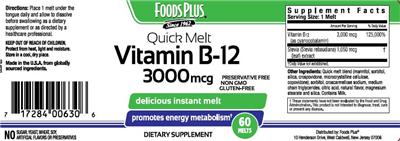
Supplement Facts
The label details for Quick Melt Vitamin B-12 3000 mcg by Foods Plus, sourced from the NIH Dietary Supplement Label Database.
Supplement Facts
| Ingredient | Amount | % DV |
|---|---|---|
| Vitamin B12 | 3000 mg | 125000% |
| Stevia extract | 1050 mcg | -- |
Other ingredients: Quick Melt Blend, Sorbitol, Croscarmellose Sodium, Medium Chain Triglycerides, Citric Acid, Natural flavor, Magnesium Stearate, Silica
Tap any ingredient to jump to its full detail below.
These statements are the manufacturer’s wording, reproduced from the product label — the label is saying it, not HelloPharmacist. We don’t verify or endorse them.
Suggested/Recommended/Usage/Directions
Directions: Place 1 melt under the tongue daily and allow to dissolve before swallowing as a dietary supplement or as directed by a healthcare professional.
Precautions
Keep out of reach of children.
Contains Milk.
Storage
Protect from heat, light and moisture. Store in a cool, dry place.
General Statements
Made in the U.S.A. from globally sourced ingredients.
Since 1962
Formulation
No sugar, yeast, wheat, soy, artificial flavors or preservatives
Preservative free Non GMO Gluten-free
Delicious instant melt Promotes energy metabolism
FDA Statement of Identity
Dietary Supplement
FDA Disclaimer Statement
These statements have not been evaluated by the Food and Drug Administration. This product is not intended to diagnose, treat, cure or prevent any disease.
Is this label outdated? Report a formula or label change and our pharmacy team will review it.
Quick Melt Vitamin B-12 3000 mcg by Foods Plus label
The label scan from the NIH Dietary Supplement Label Database. Tap to enlarge.
Label images are published by the NIH Dietary Supplement Label Database for the version of this product on file. Always read your actual product label.
View the full label (PDF)The Ingredients in Quick Melt Vitamin B-12 3000 mcg by Foods Plus
These are the 2 active ingredients this product is made of. Select any to open its full monograph.
Serving size1 Melt(s) Dosage formOther (e.g. Tea Bag) Amounts shown are per serving.
Most supplement products combine several ingredients, and a medication can interact with the product through any one of them. Each ingredient below shows whether it has known drug interactions.
Vitamin B12
Interacts with20 drugs
Vitamin B12 (cobalamin) is an essential nutrient your body needs to make red blood cells, keep nerves healthy, and support DNA. Supplements are very h...
Vitamin B12 monograph & interactionsStevia extract
Interacts with259 drugs
Stevia is a plant-based, calorie-free sweetener that is widely used as a sugar alternative and is considered safe in normal food amounts by major regu...
Stevia extract monograph & interactionsOther (inactive) ingredients: Quick Melt Blend, Sorbitol, Croscarmellose Sodium, Medium Chain Triglycerides, Citric Acid, Natural flavor, Magnesium Stearate, Silica. These complete the product’s ingredient list but are not active constituents.
Quick Melt Vitamin B-12 3000 mcg by Foods Plus Drug Interactions
HelloPharmacist Interaction Report
Quick Melt Vitamin B-12 3000 mcg by Foods Plus does interact with some medications, through its vitamin B12 and stevia extract content.
The most serious documented interaction is between stevia and lithium (a mood stabilizer), where stevia may theoretically reduce how your body clears lithium and raise its levels in your blood — a Moderate-severity concern.
Read the full breakdown — every affected drug type, severity by severity
Vitamin B12 has a Minor interaction with metformin (Glucophage), a common diabetes medication. Metformin can interfere with how your digestive system absorbs B12, potentially leading to low B12 levels over time with prolonged use.
Stevia extract also carries Minor interactions with antihypertensive drugs (blood pressure medications) and antidiabetes drugs. In theory, combining stevia with blood pressure medications could increase the risk of low blood pressure, and combining it with diabetes medications could raise the risk of low blood sugar.
The evidence for stevia's blood pressure and blood sugar effects is mixed in clinical studies.
Altogether, these interactions span 259 individual medications. Before you start this product, especially if you take lithium, metformin, blood pressure drugs, or diabetes medications, run your exact prescriptions through the checker below.
Check your own medications below · Editorial policy · How we use AI
Want to check YOUR meds against Quick Melt Vitamin B-12 3000 mcg?
Ask about interactions with your drugs in plain English — “Can I take it with lisinopril?” — and we find you the answer in seconds, ingredient by ingredient.
Go to the checkerIngredients driving the most interactions
Individual Drug Interactions
The ingredients in Quick Melt Vitamin B-12 3000 mcg interact with 259 drugs. Click any drug to see the details.
2 of the 2 ingredients in Quick Melt Vitamin B-12 3000 mcg interact with drugs. Each result below shows which ingredient is responsible. Stevia extract Vitamin B12
Lithium Carbonate (prescription Drug)Eskalith, Lithium Carbonate
How Lithium Carbonate (prescription Drug) interacts with Quick Melt Vitamin B-12 3000 mcg — through 1 ingredient. Tap an ingredient for the detail:
Stevia ExtractLithium Moderate
Interaction Summary
Theoretically, stevia might decrease clearance and increase levels of lithium.
Read the full Stevia Extract + Lithium Carbonate (prescription Drug) interactionAcarboseGlucobay, Prandase, Precose
How Acarbose interacts with Quick Melt Vitamin B-12 3000 mcg — through 1 ingredient. Tap an ingredient for the detail:
Stevia ExtractAntidiabetes Drugs Minor
Interaction Summary
Theoretically, stevia might increase the risk for hypoglycemia when combined with antidiabetes drugs.
Read the full Stevia Extract + Acarbose interactionAcebutololRhotral, Sectral
How Acebutolol interacts with Quick Melt Vitamin B-12 3000 mcg — through 1 ingredient. Tap an ingredient for the detail:
Stevia ExtractAntihypertensive Drugs Minor
Interaction Summary
Theoretically, combining stevia or stevia constituents with antihypertensive agents might increase the risk of hypotension.
Read the full Stevia Extract + Acebutolol interactionAcetazolamideAk-Zol, Diamox
How Acetazolamide interacts with Quick Melt Vitamin B-12 3000 mcg — through 1 ingredient. Tap an ingredient for the detail:
Stevia ExtractAntihypertensive Drugs Minor
Interaction Summary
Theoretically, combining stevia or stevia constituents with antihypertensive agents might increase the risk of hypotension.
Read the full Stevia Extract + Acetazolamide interactionAcetohexamideDymelor
How Acetohexamide interacts with Quick Melt Vitamin B-12 3000 mcg — through 1 ingredient. Tap an ingredient for the detail:
Stevia ExtractAntidiabetes Drugs Minor
Interaction Summary
Theoretically, stevia might increase the risk for hypoglycemia when combined with antidiabetes drugs.
Read the full Stevia Extract + Acetohexamide interactionAlbiglutideTanzeum
How Albiglutide interacts with Quick Melt Vitamin B-12 3000 mcg — through 1 ingredient. Tap an ingredient for the detail:
Stevia ExtractAntidiabetes Drugs Minor
Interaction Summary
Theoretically, stevia might increase the risk for hypoglycemia when combined with antidiabetes drugs.
Read the full Stevia Extract + Albiglutide interactionAliskirenTekturna
How Aliskiren interacts with Quick Melt Vitamin B-12 3000 mcg — through 1 ingredient. Tap an ingredient for the detail:
Stevia ExtractAntihypertensive Drugs Minor
Interaction Summary
Theoretically, combining stevia or stevia constituents with antihypertensive agents might increase the risk of hypotension.
Read the full Stevia Extract + Aliskiren interactionAlogliptinNesina
How Alogliptin interacts with Quick Melt Vitamin B-12 3000 mcg — through 1 ingredient. Tap an ingredient for the detail:
Stevia ExtractAntidiabetes Drugs Minor
Interaction Summary
Theoretically, stevia might increase the risk for hypoglycemia when combined with antidiabetes drugs.
Read the full Stevia Extract + Alogliptin interactionAlogliptin, MetforminKazano
How Alogliptin, Metformin interacts with Quick Melt Vitamin B-12 3000 mcg — through 2 ingredients. Tap an ingredient for the detail:
Stevia ExtractAntidiabetes Drugs Minor
Interaction Summary
Theoretically, stevia might increase the risk for hypoglycemia when combined with antidiabetes drugs.
Read the full Stevia Extract + Alogliptin, Metformin interactionVitamin B12Metformin (glucophage) Minor
Interaction Summary
Metformin, a common medication used to manage type 2 diabetes, has been associated with lower vitamin B12 levels in some individuals.
Read the full Vitamin B12 + Alogliptin, Metformin interactionAlogliptin, PioglitazoneOseni
How Alogliptin, Pioglitazone interacts with Quick Melt Vitamin B-12 3000 mcg — through 1 ingredient. Tap an ingredient for the detail:
Stevia ExtractAntidiabetes Drugs Minor
Interaction Summary
Theoretically, stevia might increase the risk for hypoglycemia when combined with antidiabetes drugs.
Read the full Stevia Extract + Alogliptin, Pioglitazone interactionAmbrisentanLetairis, Volibris
How Ambrisentan interacts with Quick Melt Vitamin B-12 3000 mcg — through 1 ingredient. Tap an ingredient for the detail:
Stevia ExtractAntihypertensive Drugs Minor
Interaction Summary
Theoretically, combining stevia or stevia constituents with antihypertensive agents might increase the risk of hypotension.
Read the full Stevia Extract + Ambrisentan interactionAmilorideAmilamont, Midamor
How Amiloride interacts with Quick Melt Vitamin B-12 3000 mcg — through 1 ingredient. Tap an ingredient for the detail:
Stevia ExtractAntihypertensive Drugs Minor
Interaction Summary
Theoretically, combining stevia or stevia constituents with antihypertensive agents might increase the risk of hypotension.
Read the full Stevia Extract + Amiloride interactionAmiloride, HydrochlorothiazideAmil-Co, Amilzide, Moduret 25, Moduretic
How Amiloride, Hydrochlorothiazide interacts with Quick Melt Vitamin B-12 3000 mcg — through 1 ingredient. Tap an ingredient for the detail:
Stevia ExtractAntihypertensive Drugs Minor
Interaction Summary
Theoretically, combining stevia or stevia constituents with antihypertensive agents might increase the risk of hypotension.
Read the full Stevia Extract + Amiloride, Hydrochlorothiazide interactionAmlodipineNorliqva
How Amlodipine interacts with Quick Melt Vitamin B-12 3000 mcg — through 1 ingredient. Tap an ingredient for the detail:
Stevia ExtractAntihypertensive Drugs Minor
Interaction Summary
Theoretically, combining stevia or stevia constituents with antihypertensive agents might increase the risk of hypotension.
Read the full Stevia Extract + Amlodipine interactionAmlodipine BenzoateKaterzia
How Amlodipine Benzoate interacts with Quick Melt Vitamin B-12 3000 mcg — through 1 ingredient. Tap an ingredient for the detail:
Stevia ExtractAntihypertensive Drugs Minor
Interaction Summary
Theoretically, combining stevia or stevia constituents with antihypertensive agents might increase the risk of hypotension.
Read the full Stevia Extract + Amlodipine Benzoate interactionAmlodipine BesilateIstin
How Amlodipine Besilate interacts with Quick Melt Vitamin B-12 3000 mcg — through 1 ingredient. Tap an ingredient for the detail:
Stevia ExtractAntihypertensive Drugs Minor
Interaction Summary
Theoretically, combining stevia or stevia constituents with antihypertensive agents might increase the risk of hypotension.
Read the full Stevia Extract + Amlodipine Besilate interactionAmlodipine BesylateNorvasc
How Amlodipine Besylate interacts with Quick Melt Vitamin B-12 3000 mcg — through 1 ingredient. Tap an ingredient for the detail:
Stevia ExtractAntihypertensive Drugs Minor
Interaction Summary
Theoretically, combining stevia or stevia constituents with antihypertensive agents might increase the risk of hypotension.
Read the full Stevia Extract + Amlodipine Besylate interactionAmlodipine Besylate, BenazeprilLotrel
How Amlodipine Besylate, Benazepril interacts with Quick Melt Vitamin B-12 3000 mcg — through 1 ingredient. Tap an ingredient for the detail:
Stevia ExtractAntihypertensive Drugs Minor
Interaction Summary
Theoretically, combining stevia or stevia constituents with antihypertensive agents might increase the risk of hypotension.
Read the full Stevia Extract + Amlodipine Besylate, Benazepril interactionAmlodipine, CelecoxibConsensi
How Amlodipine, Celecoxib interacts with Quick Melt Vitamin B-12 3000 mcg — through 1 ingredient. Tap an ingredient for the detail:
Stevia ExtractAntihypertensive Drugs Minor
Interaction Summary
Theoretically, combining stevia or stevia constituents with antihypertensive agents might increase the risk of hypotension.
Read the full Stevia Extract + Amlodipine, Celecoxib interactionAmmonium ChlorideAmmonium Chloride
How Ammonium Chloride interacts with Quick Melt Vitamin B-12 3000 mcg — through 1 ingredient. Tap an ingredient for the detail:
Stevia ExtractAntihypertensive Drugs Minor
Interaction Summary
Theoretically, combining stevia or stevia constituents with antihypertensive agents might increase the risk of hypotension.
Read the full Stevia Extract + Ammonium Chloride interactionAntidiabetes, Dipeptidyl Peptidase-4 (dpp-iv) InhibitorGlyxambi
How Antidiabetes, Dipeptidyl Peptidase-4 (dpp-iv) Inhibitor interacts with Quick Melt Vitamin B-12 3000 mcg — through 1 ingredient. Tap an ingredient for the detail:
Stevia ExtractAntidiabetes Drugs Minor
Interaction Summary
Theoretically, stevia might increase the risk for hypoglycemia when combined with antidiabetes drugs.
Read the full Stevia Extract + Antidiabetes, Dipeptidyl Peptidase-4 (dpp-iv) Inhibitor interactionAprocitentanTryvio
How Aprocitentan interacts with Quick Melt Vitamin B-12 3000 mcg — through 1 ingredient. Tap an ingredient for the detail:
Stevia ExtractAntihypertensive Drugs Minor
Interaction Summary
Theoretically, combining stevia or stevia constituents with antihypertensive agents might increase the risk of hypotension.
Read the full Stevia Extract + Aprocitentan interactionAtenololAtenix, Tenormin
How Atenolol interacts with Quick Melt Vitamin B-12 3000 mcg — through 1 ingredient. Tap an ingredient for the detail:
Stevia ExtractAntihypertensive Drugs Minor
Interaction Summary
Theoretically, combining stevia or stevia constituents with antihypertensive agents might increase the risk of hypotension.
Read the full Stevia Extract + Atenolol interactionAtenolol, ChlortalidoneAtenixCo, Tenoret 50, Totaretic
How Atenolol, Chlortalidone interacts with Quick Melt Vitamin B-12 3000 mcg — through 1 ingredient. Tap an ingredient for the detail:
Stevia ExtractAntihypertensive Drugs Minor
Interaction Summary
Theoretically, combining stevia or stevia constituents with antihypertensive agents might increase the risk of hypotension.
Read the full Stevia Extract + Atenolol, Chlortalidone interactionAtenolol, ChlorthalidoneTenoretic
How Atenolol, Chlorthalidone interacts with Quick Melt Vitamin B-12 3000 mcg — through 1 ingredient. Tap an ingredient for the detail:
Stevia ExtractAntihypertensive Drugs Minor
Interaction Summary
Theoretically, combining stevia or stevia constituents with antihypertensive agents might increase the risk of hypotension.
Read the full Stevia Extract + Atenolol, Chlorthalidone interactionAzilsartanEdarbi
How Azilsartan interacts with Quick Melt Vitamin B-12 3000 mcg — through 1 ingredient. Tap an ingredient for the detail:
Stevia ExtractAntihypertensive Drugs Minor
Interaction Summary
Theoretically, combining stevia or stevia constituents with antihypertensive agents might increase the risk of hypotension.
Read the full Stevia Extract + Azilsartan interactionAzilsartan, ChlorthalidoneEdarbyclor
How Azilsartan, Chlorthalidone interacts with Quick Melt Vitamin B-12 3000 mcg — through 1 ingredient. Tap an ingredient for the detail:
Stevia ExtractAntihypertensive Drugs Minor
Interaction Summary
Theoretically, combining stevia or stevia constituents with antihypertensive agents might increase the risk of hypotension.
Read the full Stevia Extract + Azilsartan, Chlorthalidone interactionBenazeprilLotensin
How Benazepril interacts with Quick Melt Vitamin B-12 3000 mcg — through 1 ingredient. Tap an ingredient for the detail:
Stevia ExtractAntihypertensive Drugs Minor
Interaction Summary
Theoretically, combining stevia or stevia constituents with antihypertensive agents might increase the risk of hypotension.
Read the full Stevia Extract + Benazepril interactionBenazepril, HydrochlorothiazideLotensin HCT
How Benazepril, Hydrochlorothiazide interacts with Quick Melt Vitamin B-12 3000 mcg — through 1 ingredient. Tap an ingredient for the detail:
Stevia ExtractAntihypertensive Drugs Minor
Interaction Summary
Theoretically, combining stevia or stevia constituents with antihypertensive agents might increase the risk of hypotension.
Read the full Stevia Extract + Benazepril, Hydrochlorothiazide interactionBendroflumethiazideAprinox, Naturetin, Neo-NaClex
How Bendroflumethiazide interacts with Quick Melt Vitamin B-12 3000 mcg — through 1 ingredient. Tap an ingredient for the detail:
Stevia ExtractAntihypertensive Drugs Minor
Interaction Summary
Theoretically, combining stevia or stevia constituents with antihypertensive agents might increase the risk of hypotension.
Read the full Stevia Extract + Bendroflumethiazide interactionEach ingredient & the kinds of drugs it affects
For each ingredient in Quick Melt Vitamin B-12 3000 mcg with known interactions, here are the types of medications they can affect. Open any type for the detail — or search your exact drug in the checker above.
Stevia extract
Lithium
Theoretically, stevia might decrease clearance and increase levels of lithium.
Animal research suggests that stevia extracts might have diuretic activity. Theoretically, increased reabsorption of lithium along with sodium might reduce excretion and increase levels of lithium.
Antidiabetes Drugs
Theoretically, stevia might increase the risk for hypoglycemia when combined with antidiabetes drugs.
Preliminary clinical research in patients with type 2 diabetes suggests that taking a single dose of stevia extract 1000 mg reduces postprandial blood glucose levels when taken with a meal. However, other clinical research in patients with type 1 or type 2 diabetes suggests that taking stevioside 250 mg three times daily does not significantly affect blood glucose levels or glycated hemoglobin (HbA1C) after three months of treatment.
Antihypertensive Drugs
Theoretically, combining stevia or stevia constituents with antihypertensive agents might increase the risk of hypotension.
Stevia extract and stevioside might lower blood pressure in patients with hypertension. However, other clinical research suggests that stevioside does not significantly lower blood pressure in patients with hypertension.
Vitamin B12
Metformin (Glucophage)
Metformin, a common medication used to manage type 2 diabetes, has been associated with lower vitamin B12 levels in some individuals. Prolonged use of metformin can interfere with the absorption of B12 in the digestive system, potentially leading to a deficiency in this essential vitamin.
Brand information
Manufacturer and brand details for Quick Melt Vitamin B-12 3000 mcg, from the product label.
Foods Plus
See all Foods Plus products- Name
- Foods Plus
- Street Address
- 10 Henderson Drive
- City
- West Caldwell
- State
- New Jersey
- ZipCode
- 07006
Quick Melt Vitamin B-12 3000 mcg by Foods Plus: Common Questions
Does Quick Melt Vitamin B-12 3000 mcg by Foods Plus interact with any medications?
How can one product interact with so many drugs?
Where does this information come from?
Will this help if I'm low in B12?
Is it safe to take if I'm pregnant or breastfeeding?
What's the stevia extract for?
What side effects might I notice?
I take metformin for diabetes — is this supplement okay?
Does this product have any fillers?
Written and reviewed by the HelloPharmacist editorial staff. Our editorial policy
Not sure if Quick Melt Vitamin B-12 3000 mcg is safe with your meds?
Our pharmacists answer your medication & supplement questions — free.
Label information is sourced from the NIH Dietary Supplement Label Database and reflects the product version on file; always read your actual product label. This page is for education only and is not a substitute for professional medical advice. Confirm with your pharmacist or doctor before combining supplements and medications.
The Full Monographs Behind Quick Melt Vitamin B-12 3000 mcg’s Ingredients
Every ingredient we hold a full HelloPharmacist monograph for — uses, evidence, safety, and the complete interaction list.
Vitamin B12
Interacts with 20 drugsVitamin B12 (cobalamin) is an essential nutrient your body needs to make red blood cells, keep nerves healthy, and support DNA. Supplements are very helpful for people who are deficient — su...
Read the full Vitamin B12 monograph → Herb & supplement monographStevia
Interacts with 259 drugsStevia is a plant-based, calorie-free sweetener that is widely used as a sugar alternative and is considered safe in normal food amounts by major regulators. Purified stevia extracts have a...
Read the full Stevia monograph →Sources & How We Checked
Quick Melt Vitamin B-12 3000 mcg's label data comes from the NIH Dietary Supplement Label Database; the ingredient interaction data is from the Natural Medicines database, reviewed by our pharmacists.
- NIH Dietary Supplement Label Database (DSLD) — The official product label on file for this supplement.
- Natural Medicines (Therapeutic Research Center) — Evidence-graded clinical reference behind the ingredient interaction data.
Content is written and reviewed by licensed HelloPharmacist pharmacists. See our data sources and editorial standards for how this information is built and checked.
The 40 references behind this product’s interaction data
Every citation that drives the interaction findings for this product’s ingredients, from the evidence-graded Natural Medicines (TRC Healthcare) database. Open an ingredient to browse its citations — links open the study on PubMed or the publisher’s site.
Vitamin B12 30 references
- Food and Nutrition Board, Institute of Medicine. Dietary Reference Intakes for Thiamin, Riboflavin, Niacin, Vitamin B6, Folate, Vitamin B12, Pantothenic Acid, Biotin, and Choline (2000). Washington, DC: National Academy Press, 2000. Available at: http://b
- Hartman TJ, Woodson K, Stolzenberg-Solomon R, et al. Association of the B-vitamins pyridoxal 5'-phosphate (B6), B12, and folate with lung cancer risk in older men. Am J Epidemiol 2001;153:688-94.. DOI
- Jansen T, Romiti R, Kreuter A, Altmeyer P. Rosacea fulminans triggered by high-dose vitamins B6 and B12. J Eur Acad Dermatol Venereol 2001;15:484-5..
- Lange H, Suryapranata H, De Luca G, et al. Folate therapy and in-stent restenosis after coronary stenting. N Engl J Med 2004;350:2673-81. PubMed
- Collin, S. M., Metcalfe, C., Refsum, H., Lewis, S. J., Zuccolo, L., Smith, G. D., Chen, L., Harris, R., Davis, M., Marsden, G., Johnston, C., Lane, J. A., Ebbing, M., Bonaa, K. H., Nygard, O., Ueland, P. M., Grau, M. V., Baron, J. A., Donovan, J. L., Nea
- Geissbuhler, P., Mermillod, B., and Rapin, C. H. Elevated serum vitamin B12 levels associated with CRP as a predictive factor of mortality in palliative care cancer patients: a prospective study over five years. J.Pain Symptom.Manage. 2000;20(2):93-103. PubMed
- Salles, N., Herrmann, F., Sakbani, K., Rapin, C. H., and Sieber, C. High vitamin B12 level: a strong predictor of mortality in elderly inpatients. J Am Geriatr.Soc 2005;53(5):917-918.
- Looker, H. C., Fagot-Campagna, A., Gunter, E. W., Pfeiffer, C. M., Sievers, M. L., Bennett, P. H., Nelson, R. G., Hanson, R. L., and Knowler, W. C. Homocysteine and vitamin B(12) concentrations and mortality rates in type 2 diabetes. Diabetes Metab Res R
- Uhl, W., Nolting, A., Golor, G., Rost, K. L., and Kovar, A. Safety of hydroxocobalamin in healthy volunteers in a randomized, placebo-controlled study. Clin Toxicol (Phila) 2006;44 Suppl 1:17-28. PubMed
- Borron, S. W., Baud, F. J., Barriot, P., Imbert, M., and Bismuth, C. Prospective study of hydroxocobalamin for acute cyanide poisoning in smoke inhalation. Ann Emerg.Med 2007;49(6):794-801, 801. PubMed
- Borron, S. W., Baud, F. J., Megarbane, B., and Bismuth, C. Hydroxocobalamin for severe acute cyanide poisoning by ingestion or inhalation. Am J Emerg.Med 2007;25(5):551-558. PubMed
- Lewis, J. G. Gout, Steatorrhoea, and Megaloblastic Anaemia. Ann Rheum.Dis 1962;21(3):284-286. PubMed
- Tal, S., Shavit, Y., Stern, F., and Malnick, S. Association between vitamin B12 levels and mortality in hospitalized older adults. J Am Geriatr.Soc 2010;58(3):523-526. PubMed
- Baztan, J. J., Gavidia, J. J., Gomez-Pavon, J., Esteve, A., and Ruiperez, I. High vitamin B12 levels and in-hospital mortality. J Am Geriatr.Soc 2010;58(11):2237-2238. PubMed
- Omboni, E., Checchini, M., and Longoni, F. [Hypopotassemia and megaloblastic anemia. Presentation of a case]. Minerva Med 8-31-1987;78(16):1255-1257.
- Aalfs As, Scholvinck LH, Horvath B. Acneiform eruption in a 5-year old due to vitamin B12 supplementation. Eur J Dermatol 2013;23(5):726-7. PubMed
- Balta I, Ozuguz P. Vitamin B12-induced acneiform eruption. Cutan Ocul Toxicol 2014;33(2):94-5. PubMed
- Carman KB, Belgemen T, Yis U. Involuntary movements misdiagnosed as seizure during vitamin B12 treatment. Pediatr Emerg Care 2013;29(11):1223-4. PubMed
- Djuric V, Bogic M, Popadic AP, et al. Anaphylactic reaction to hydroxycobalamin with tolerance to cyanocobalamin. Ann Allergy Asthma Immunol 2012;108(3):207-8. PubMed
- Kartel O, Gulec M, Demirel F, et al. Vitamin B12 allergy and successful desensitization with cyanocobalamin: A case report. Allergol Immunopath (Madr) 2012;40(5):324-5.
- Patiroglu T, Unal E, Yildirim S. Infantile tremor syndrome associated with cobalamin therapy: A case report. Clin Neurol Neurosurg 2013;115(9):1903-5. PubMed
- Schulte S, Barkema LW, Kardaun SH. Long-lasting atypical acneiform eruption with prominent comedones induced by hydroxocobalamin (vitamin B12). J Dtsch Dermatol Ges 2014;12(6):502-3.
- Zanus C, Alberini E, Costa P, et al. Involuntary movements after correction of vitamin B12 deficiency: A video-case report. Epileptic Disord 2012;14(2):174-80. PubMed
- Fanidi A, Carreras-Torres R, Larose TL, et al. Is high vitamin B12 status a cause of lung cancer? Int J Cancer. 2019 Sep 15;145(6):1499-1503. PubMed
- Fujita Y, Mizukami T, Maya Y, et al. Vitamin B12 allergy manifesting as lymphomatoid contact dermatitis. Eur J Dermatol. 2020;30(3):304-305. PubMed
- Dépret F, Hoffmann C, Daoud L, et al. Association between hydroxocobalamin administration and acute kidney injury after smoke inhalation: a multicenter retrospective study. Crit Care. 2019;23(1):421. PubMed
- Khairan P, Sobue T, Eshak ES, et al. Association of dietary intakes of vitamin B12, vitamin B6, folate, and methionine with the risk of esophageal cancer: the Japan Public Health Center-based (JPHC) prospective study. BMC Cancer 2021;21(1):982. PubMed
- Evans J, Pandya A, Ding Y, Qunibi WY. Hydroxocobalamin-Induced Oxalate Nephropathy in a Patient With Smoke Inhalation. Kidney Int Rep 2021;6(8):2228-2231. PubMed
- Lacombe V, Chabrun F, Lacout C, et al. Persistent elevation of plasma vitamin B12 is strongly associated with solid cancer. Sci Rep 2021;11(1):13361. PubMed
- Pegalajar-García MD, Cebolla-Verdugo M, Prados-Carmona Á, Llamas-Segura C, Navarro-Triviño FJ. Systemic allergic dermatitis to cobalt present in cyanocobalamin supplementation. Contact Dermatitis 2023;89(3):203-205. PubMed
Stevia 10 references
- Chan P, Xu DY, Liu JC, et al. The effect of stevioside on blood pressure and plasma catecholamines in spontaneously hypertensive rats. Life Sci 1998;63:1679-84. PubMed
- Melis MS. A crude extract of Stevia rebaudiana increases the renal plasma flow of normal and hypertensive rats. Braz J Med Biol Res 1996;29:669-75.
- Melis MS. Chronic administration of aqueous extract of Stevia rebaudiana in rats: renal effects. J Ethnopharmacol 1995;47:129-34. PubMed
- Melis MS, Sainati AR. Effect of calcium and verapamil on renal function of rats during treatment with stevioside. J Ethnopharmacol 1991;33:257-622. PubMed
- Hsieh MH, Chan P, Sue YM, et al. Efficacy and tolerability of oral stevioside in patients with mild essential hypertension: a two-year, randomized, placebo-controlled study. Clin Ther 2003;25:2797-808. PubMed
- Chan P, Tomlinson B, Chen YJ, et al. A double-blind placebo-controlled study of the effectiveness and tolerability of oral stevioside in human hypertension. Br J Clin Pharmacol 2000;50:215-20. PubMed
- Gregersen S, Jeppesen PB, Holst JJ, Hermansen K. Antihyperglycemic effects of stevioside in type 2 diabetic subjects. Metabolism 2004;53:73-6. PubMed
- Barriocanal LA, Palacios M, Benitez G, et al. Apparent lack of pharmacological effect of steviol glycosides used as sweeteners in humans. A pilot study of repeated exposures in some normotensive and hypotensive individuals and in Type 1 and Type 2 diabeti
- Ferri LA, Alves-Do-Prado W, Yamada SS, et al. Investigation of the antihypertensive effect of oral crude stevioside in patients with mild essential hypertension. Phytother Res 2006;20:732-6. PubMed
- Almiron-Roig E, Navas-Carretero S, Castelnuovo G, et al. Impact of acute consumption of beverages containing plant-based or alternative sweetener blends on postprandial appetite, food intake, metabolism, and gastro-intestinal symptoms: Results of the SWEE
Parts of this content are provided by the Therapeutic Research Center, LLC.
DISCLAIMER: Currently this does not check for drug-drug interactions. This is not an all-inclusive comprehensive list of potential interactions and is for informational purposes only. Not all interactions are known or well-reported in the scientific literature, and new interactions are continually being reported. Input is needed from a qualified healthcare provider including a pharmacist before starting any therapy. Application of clinical judgment is necessary.
© 2021 Therapeutic Research Center, LLC