
Sea Moss Gummies Ingredients & Drug Interactions
What is this page for?
First and foremost: checking Sea Moss Gummies against your medications. The heart of this page is the interaction checker and the full interaction report — how this product’s ingredients may interact with prescription and over-the-counter medicines you may be taking.
Around that, we add a pharmacist’s high-level view of the product as a whole — what’s inside, the evidence for its stated use, how transparent the label is, and what safety data exists — so you can see the full picture in one place. It’s educational information from our licensed clinical databases and the clinical staff at HelloPharmacist — not medical advice — and we don’t sell or endorse products. Our editorial policy
Sea Moss Gummies is a dietary supplement by Double Wood Supplements with 5 active ingredients. Its ingredients are commonly taken for replacing fluids and electrolytes, preventing dehydration during exercise or illness, treating low blood sodium (under medical care).Based on those ingredients, 1,023 medications have a known interaction with it, the most serious rated moderate. The ingredients most likely to interact are Bladderwrack, Sodium, Burdock. Use the checker below to test your specific medication, or read the full HelloPharmacist Interaction Report.
Check Your Meds Against Sea Moss Gummies by Double Wood Supplements
Ask about any prescription or over-the-counter medication and we check it for interactions with Sea Moss Gummies by Double Wood Supplements — and tell you which ingredient is responsible.
AI summaries are generated from our interaction database for education only — always confirm with your pharmacist. How we use AI
Ask the Pharmacist
A licensed pharmacist will answer your question by email — free, usually within 24 hours.
Got it — thank you!
A licensed pharmacist will answer within 24 hours. Keep an eye on your email (worth checking spam, just in case).
HelloPharmacist Scorecard of Sea Moss Gummies by Double Wood Supplements
Our pharmacy team’s full take, with four database checks built into the cards below — a summary of what is known, not a grade of the product itself.
What’s inside
Full disclosure
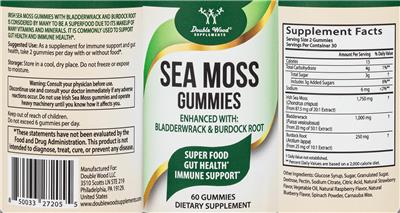
This product has 4 active ingredients: sodium, burdock root extract, bladderwrack extract (also called Fucus vesiculosus), and Irish sea moss. The gummies also contain inactive ingredients — glucose syrup, sugar, pectin, flavoring, spinach powder, citric acid, and others that serve as sweeteners, thickeners, and binders.
The sea moss and bladderwrack are traditional sources of minerals and iodine; burdock root has been used in herbal medicine for centuries; and sodium is an electrolyte your body needs in small amounts.
Does it work?
Not established
The facts we hold don't establish that Sea Moss Gummies work for any condition. Sodium has reliable evidence for cystic fibrosis and possibly effective evidence for amphotericin B nephrotoxicity (kidney damage from a certain antibiotic), but not for general health.
Burdock root, bladderwrack, and Irish sea moss all have insufficient evidence in the data we hold for the uses they're sometimes marketed for — acne, skin aging, cold prevention, eczema, and digestive or heart health. If you're considering this product for a specific reason, talk with your doctor or pharmacist about whether the evidence supports it.
How safe is it?
Well-documented data
Sodium is well tolerated at normal dietary levels, but the facts advise caution against excess — high intake is linked to high blood pressure and heart strain, and you should avoid sodium supplements or very high intake without medical guidance. Rare serious side effects from excess sodium include worsened heart disease, high blood pressure, and kidney problems.
High sodium intake is also associated with increased risk of gastric cancer in population studies. Burdock root is likely safe as a food and for short-term use in healthy adults, but human safety data are limited; allergic reactions including contact dermatitis and rare anaphylaxis have been reported, and a rare case of liver injury has been documented.
Bladderwrack extract may be unsafe orally due to its iodine content — it can cause goiter, overactive thyroid (hyperthyroidism), underactive thyroid (hypothyroidism), and rarely thyroid cancer. For pregnancy and breastfeeding, sodium is rated likely safe but possibly unsafe (the data are inconsistent); burdock should be avoided in medicinal amounts during pregnancy and breastfeeding due to lack of safety data and possible effects on the uterus; bladderwrack is possibly unsafe in pregnancy due to excess iodine and possible heavy metal content, and should be avoided while breastfeeding because iodine passes into breast milk and may affect the baby's thyroid.
Meds to double-check
Moderate interaction found
Before taking this product, double-check with your doctor or pharmacist if you take lithium (a mood stabilizer) — the sodium and bladderwrack can both significantly alter lithium levels and cause toxicity. Check if you're on blood pressure medications, corticosteroids, antithyroid drugs, thyroid hormone, amiodarone, or blood thinners (anticoagulants or antiplatelets).
These Moderate-severity interactions span sodium's effect on blood pressure control and electrolyte balance, and bladderwrack's iodine content and its effect on thyroid drugs. Burdock root also carries a theoretical Moderate risk with blood thinners.
No interactions are documented for Irish Sea Moss Extract; we hold no data for it.
The bottom line
Scorecard at a glanceFully disclosed formula with no established evidence rating for its marketed use. Moderate medication interactions have been identified, and safety information is well characterized.
This product is a blend of sea vegetables and herbal extracts, but the evidence for its effectiveness for any health condition is not established in the data we hold. Because it contains sodium and iodine-rich bladderwrack, it carries real risks if you take medications for blood pressure, heart rhythm, thyroid conditions, bipolar disorder (lithium), or blood thinning.
If you're pregnant, breastfeeding, or take any prescription medications, talk with your doctor or pharmacist before starting.
Educational only — not medical advice; always confirm with your pharmacist. Our editorial policy · How we use AI
Assessment coverage: 3 of 4 active ingredients matched to our full ingredient reviews (monographs). Based on the product label dated Jul 25, 2024.
This Scorecard evaluates available label information, ingredient evidence, and known medication-safety considerations. It does not independently verify product identity, purity, potency, contamination, or manufacturing quality. How these ratings are computed
General information
Key facts about Sea Moss Gummies, straight from the product label.
| Brand | Double Wood Supplements |
|---|---|
| Barcode (UPC) | 850033272055 |
| Net contents | 60 Gummy(ies) |
| Market status | On market |
| Date entered into DSLD | Jul 25, 2024 |
| DSLD ID | 315694 |
| Product type | Other Combinations |
| Supplement form | Gummy Or Jelly |
| Dietary claims / uses | Nutrient, All Other, Structure/Function |
| Intended target group(s) | Adult (18 - 50 Years) |
Everything in this section is reproduced from the manufacturer’s own product label — it’s the label speaking, not HelloPharmacist. We show it so you can see exactly what the maker states; we don’t verify or endorse those statements.
Supplement Facts
The label details for Sea Moss Gummies by Double Wood Supplements, sourced from the NIH Dietary Supplement Label Database.
Supplement Facts
| Ingredient | Amount | % DV |
|---|---|---|
| Calories | 15 Calorie(s) | -- |
| Sodium | 6 mg | 2% |
| Total Sugars | 3 Gram(s) | -- |
| Total Carbohydrate | 4 Gram(s) | 1% |
| added Sugar | 3 Gram(s) | 6% |
| Burdock root extract | 25 mg | -- |
| Burdock | 250 mg | -- |
| Bladderwrack | 1000 mg | -- |
| Irish Sea Moss | 1750 mg | -- |
| Irish Sea Moss Extract | 87.5 mg | -- |
| Bladderwrack extract | 20 mg | -- |
Other ingredients: Glucose Syrup, Sugar, Sugar, Granulated, Dextrose, Pectin, Sodium Citrate, Citric Acid, Strawberry Flavor, Natural, Vegetable Oil, Raspberry Flavor, Natural, Blueberry Flavor, Natural, Spinach, Powder, Carnauba Wax
Tap any ingredient to jump to its full detail below.
These statements are the manufacturer’s wording, reproduced from the product label — the label is saying it, not HelloPharmacist. We don’t verify or endorse them.
Formula
Irish Sea Moss gummies with bladderwrack and burdock root is considered by many to be a superfood due to its makeup of many vitamins and minerals.
Sea Moss Gummies Enhanced with: Bladderwrack & Burdock Root
Formulation
It is commonly used to support gut health and immune health.
Super Food Gut Health Immune Support
Suggested/Recommended/Usage/Directions
Suggested Use: As a supplement for immune support and gut health, take 2 gummies per day with or without food.
Storage
Storage: Store in a cool, dark place. Do not freeze or expose to moisture.
Precautions
Warning: Consult your physician before use. Discontinue use and consult your doctor immediately if any adverse reactions occur. Do not use Irish Sea Moss gummies and operate heavy machinery until you know how it affects you.
Keep out of reach of children.
Do not exceed 6 gummies per day.
FDA Disclaimer Statement
These statements have not been evaluated by the Food and Drug Administration. This product is not intended to diagnose, treat, cure, or prevent any disease.
FDA Statement of Identity
Dietary Supplement
Is this label outdated? Report a formula or label change and our pharmacy team will review it.
Sea Moss Gummies by Double Wood Supplements label
The label scan from the NIH Dietary Supplement Label Database. Tap to enlarge.
Label images are published by the NIH Dietary Supplement Label Database for the version of this product on file. Always read your actual product label.
View the full label (PDF)The Ingredients in Sea Moss Gummies by Double Wood Supplements
These are the 5 active ingredients this product is made of. Select any to open its full monograph.
Serving size2 Gummy(ies) Dosage formGummy Or Jelly Servings per container30 Amounts shown are per serving.
Most supplement products combine several ingredients, and a medication can interact with the product through any one of them. Each ingredient below shows whether it has known drug interactions.
Sodium
Interacts with205 drugs
Sodium is an essential mineral and electrolyte your body needs to balance fluids, support nerves, and help muscles work. Most people in modern diets g...
Sodium monograph & interactionsAdded Sugar
Burdock
Interacts with122 drugs
Burdock is a traditional herb most often used for skin problems and as a so-called 'blood purifier,' but high-quality human studies are lacking and mo...
Burdock monograph & interactionsBladderwrack
Interacts with891 drugs
Fucus vesiculosus (bladderwrack) is a brown seaweed rich in iodine that has been used traditionally for thyroid concerns, weight, and skin. There is l...
Bladderwrack monograph & interactionsIrish Sea Moss
- › Irish Sea Moss Extract
Other (inactive) ingredients: Glucose Syrup, Sugar, Sugar, Granulated, Dextrose, Pectin, Sodium Citrate, Citric Acid, Strawberry Flavor, Natural, Vegetable Oil, Raspberry Flavor, Natural, Blueberry Flavor, Natural, Spinach, Powder, Carnauba Wax. These complete the product’s ingredient list but are not active constituents.
Sea Moss Gummies by Double Wood Supplements Drug Interactions
HelloPharmacist Interaction Report
Sea Moss Gummies by Double Wood Supplements contains sodium, burdock root extract, and bladderwrack extract — three ingredients with documented interactions.
The most serious concern is sodium's Moderate-severity interaction with lithium, a mood stabilizer: high sodium intake can reduce lithium levels in your blood, while low sodium can raise them to toxic levels, so you'd need careful monitoring if you take both.
Read the full breakdown — every affected drug type, severity by severity
Sodium also has Moderate interactions with blood pressure drugs (antihypertensives), corticosteroids, the HIV medication didanosine, sodium phosphate bowel prep, the blood sodium regulator tolvaptan, and any other sodium-containing drugs — primarily through the risk of too much sodium in your blood (hypernatremia) or reduced drug effectiveness. Burdock root extract carries a Moderate interaction with blood thinners (anticoagulants) and antiplatelet drugs like aspirin, though this is theoretical and hasn't been reported in humans.
Bladderwrack extract has several Moderate interactions: with lithium (similar thyroid risk as sodium), antithyroid drugs, amiodarone (a heart rhythm medication), and thyroid hormone replacement — all tied to its high iodine content, which can disrupt thyroid function. It also has Minor interactions with drugs broken down by your liver (CYP2D6, CYP2C9, and CYP3A4 substrates) and blood thinners.
We could not check Irish Sea Moss Extract; the facts hold no data for it. Altogether, these interactions span 1,024 individual medications.
Check your exact medications with the search tool below before you start.
Check your own medications below · Editorial policy · How we use AI
Want to check YOUR meds against Sea Moss Gummies?
Ask about interactions with your drugs in plain English — “Can I take it with lisinopril?” — and we find you the answer in seconds, ingredient by ingredient.
Go to the checkerIngredients driving the most interactions
Individual Drug Interactions
The ingredients in Sea Moss Gummies interact with 1,023 drugs. Click any drug to see the details.
3 of the 5 ingredients in Sea Moss Gummies interact with drugs. Each result below shows which ingredient is responsible. Bladderwrack Sodium Burdock
DaridorexantQuviviq
How Daridorexant interacts with Sea Moss Gummies — through 1 ingredient. Tap an ingredient for the detail:
Bladderwrack ExtractCytochrome P450 3a4 (cyp3a4) Substrates Minor
Interaction Summary
Theoretically, concomitant use of Fucus vesiculosus with CYP3A4 substrates might increase the risk for adverse effects.
Read the full Bladderwrack Extract + Daridorexant interactionDarolutamideNubeqa
How Darolutamide interacts with Sea Moss Gummies — through 1 ingredient. Tap an ingredient for the detail:
Bladderwrack ExtractCytochrome P450 3a4 (cyp3a4) Substrates Minor
Interaction Summary
Theoretically, concomitant use of Fucus vesiculosus with CYP3A4 substrates might increase the risk for adverse effects.
Read the full Bladderwrack Extract + Darolutamide interactionDarunavirPrezista
How Darunavir interacts with Sea Moss Gummies — through 1 ingredient. Tap an ingredient for the detail:
Bladderwrack ExtractCytochrome P450 3a4 (cyp3a4) Substrates Minor
Interaction Summary
Theoretically, concomitant use of Fucus vesiculosus with CYP3A4 substrates might increase the risk for adverse effects.
Read the full Bladderwrack Extract + Darunavir interactionDarunavir, CobicistatPrezcobix
How Darunavir, Cobicistat interacts with Sea Moss Gummies — through 1 ingredient. Tap an ingredient for the detail:
Bladderwrack ExtractCytochrome P450 3a4 (cyp3a4) Substrates Minor
Interaction Summary
Theoretically, concomitant use of Fucus vesiculosus with CYP3A4 substrates might increase the risk for adverse effects.
Read the full Bladderwrack Extract + Darunavir, Cobicistat interactionDarunavir, Cobicistat, Emtricitabine, Tenofovir AlafenamideSymtuza
How Darunavir, Cobicistat, Emtricitabine, Tenofovir Alafenamide interacts with Sea Moss Gummies — through 1 ingredient. Tap an ingredient for the detail:
Bladderwrack ExtractCytochrome P450 3a4 (cyp3a4) Substrates Minor
Interaction Summary
Theoretically, concomitant use of Fucus vesiculosus with CYP3A4 substrates might increase the risk for adverse effects.
Read the full Bladderwrack Extract + Darunavir, Cobicistat, Emtricitabine, Tenofovir Alafenamide interactionDarunavir, RitonavirDarunavir, Ritonavir
How Darunavir, Ritonavir interacts with Sea Moss Gummies — through 1 ingredient. Tap an ingredient for the detail:
Bladderwrack ExtractCytochrome P450 3a4 (cyp3a4) Substrates Minor
Interaction Summary
Theoretically, concomitant use of Fucus vesiculosus with CYP3A4 substrates might increase the risk for adverse effects.
Read the full Bladderwrack Extract + Darunavir, Ritonavir interactionDasabuvir Sodium, Ombitasvir, Paritaprevir, RitonavirViekira XR
How Dasabuvir Sodium, Ombitasvir, Paritaprevir, Ritonavir interacts with Sea Moss Gummies — through 1 ingredient. Tap an ingredient for the detail:
Bladderwrack ExtractCytochrome P450 3a4 (cyp3a4) Substrates, Cytochrome P450 2c8 (cyp2c8) Substrates Minor
Interaction Summary
Theoretically, concomitant use of Fucus vesiculosus with CYP3A4 substrates might increase the risk for adverse effects.
Read the full Bladderwrack Extract + Dasabuvir Sodium, Ombitasvir, Paritaprevir, Ritonavir interactionDasatinibPhyrago, Sprycel
How Dasatinib interacts with Sea Moss Gummies — through 1 ingredient. Tap an ingredient for the detail:
Bladderwrack ExtractCytochrome P450 3a4 (cyp3a4) Substrates Minor
Interaction Summary
Theoretically, concomitant use of Fucus vesiculosus with CYP3A4 substrates might increase the risk for adverse effects.
Read the full Bladderwrack Extract + Dasatinib interactionDeflazacortEmflaza
How Deflazacort interacts with Sea Moss Gummies — through 1 ingredient. Tap an ingredient for the detail:
Bladderwrack ExtractCytochrome P450 3a4 (cyp3a4) Substrates Minor
Interaction Summary
Theoretically, concomitant use of Fucus vesiculosus with CYP3A4 substrates might increase the risk for adverse effects.
Read the full Bladderwrack Extract + Deflazacort interactionDelavirdine MesylateRescriptor
How Delavirdine Mesylate interacts with Sea Moss Gummies — through 1 ingredient. Tap an ingredient for the detail:
Bladderwrack ExtractCytochrome P450 3a4 (cyp3a4) Substrates Minor
Interaction Summary
Theoretically, concomitant use of Fucus vesiculosus with CYP3A4 substrates might increase the risk for adverse effects.
Read the full Bladderwrack Extract + Delavirdine Mesylate interactionDesipramineDesipramine, Norpramin, Pertofrane
How Desipramine interacts with Sea Moss Gummies — through 1 ingredient. Tap an ingredient for the detail:
Bladderwrack ExtractCytochrome P450 2d6 (cyp2d6) Substrates Minor
Interaction Summary
Theoretically, concomitant use of Fucus vesiculosus with CYP2D6 substrates might alter the effects of these substrates.
Read the full Bladderwrack Extract + Desipramine interactionDesogestrelCerazette
How Desogestrel interacts with Sea Moss Gummies — through 1 ingredient. Tap an ingredient for the detail:
Bladderwrack ExtractCytochrome P450 3a4 (cyp3a4) Substrates Minor
Interaction Summary
Theoretically, concomitant use of Fucus vesiculosus with CYP3A4 substrates might increase the risk for adverse effects.
Read the full Bladderwrack Extract + Desogestrel interactionDesogestrel, Ethinyl EstradiolDesogen, Marvelon, Marvelon 21, Marvelon 28, Mircette, Ortho-Cept +2 more
How Desogestrel, Ethinyl Estradiol interacts with Sea Moss Gummies — through 1 ingredient. Tap an ingredient for the detail:
Bladderwrack ExtractCytochrome P450 2c9 (cyp2c9) Substrates, Cytochrome P450 3a4 (cyp3a4) Substrates Minor
Interaction Summary
Theoretically, concomitant use of Fucus vesiculosus with CYP2C9 substrates might increase the risk for adverse effects.
Read the full Bladderwrack Extract + Desogestrel, Ethinyl Estradiol interactionDesvenlafaxineKhedezla, Pristiq
How Desvenlafaxine interacts with Sea Moss Gummies — through 1 ingredient. Tap an ingredient for the detail:
Bladderwrack ExtractCytochrome P450 2d6 (cyp2d6) Substrates Minor
Interaction Summary
Theoretically, concomitant use of Fucus vesiculosus with CYP2D6 substrates might alter the effects of these substrates.
Read the full Bladderwrack Extract + Desvenlafaxine interactionDeutetrabenazineAustedo
How Deutetrabenazine interacts with Sea Moss Gummies — through 1 ingredient. Tap an ingredient for the detail:
Bladderwrack ExtractCytochrome P450 2d6 (cyp2d6) Substrates Minor
Interaction Summary
Theoretically, concomitant use of Fucus vesiculosus with CYP2D6 substrates might alter the effects of these substrates.
Read the full Bladderwrack Extract + Deutetrabenazine interactionDexchlorpheniraminePolaramine, Polaramine Repetabs
How Dexchlorpheniramine interacts with Sea Moss Gummies — through 1 ingredient. Tap an ingredient for the detail:
Bladderwrack ExtractCytochrome P450 3a4 (cyp3a4) Substrates Minor
Interaction Summary
Theoretically, concomitant use of Fucus vesiculosus with CYP3A4 substrates might increase the risk for adverse effects.
Read the full Bladderwrack Extract + Dexchlorpheniramine interactionDexfenfluramineRedux
How Dexfenfluramine interacts with Sea Moss Gummies — through 1 ingredient. Tap an ingredient for the detail:
Bladderwrack ExtractCytochrome P450 2d6 (cyp2d6) Substrates Minor
Interaction Summary
Theoretically, concomitant use of Fucus vesiculosus with CYP2D6 substrates might alter the effects of these substrates.
Read the full Bladderwrack Extract + Dexfenfluramine interactionDexlansoprazoleDexilant Solutab
How Dexlansoprazole interacts with Sea Moss Gummies — through 1 ingredient. Tap an ingredient for the detail:
Bladderwrack ExtractCytochrome P450 3a4 (cyp3a4) Substrates Minor
Interaction Summary
Theoretically, concomitant use of Fucus vesiculosus with CYP3A4 substrates might increase the risk for adverse effects.
Read the full Bladderwrack Extract + Dexlansoprazole interactionDextroamphetamineDexedrine
How Dextroamphetamine interacts with Sea Moss Gummies — through 1 ingredient. Tap an ingredient for the detail:
Bladderwrack ExtractCytochrome P450 2d6 (cyp2d6) Substrates Minor
Interaction Summary
Theoretically, concomitant use of Fucus vesiculosus with CYP2D6 substrates might alter the effects of these substrates.
Read the full Bladderwrack Extract + Dextroamphetamine interactionDextroamphetamine (patch)Xelstrym
How Dextroamphetamine (patch) interacts with Sea Moss Gummies — through 1 ingredient. Tap an ingredient for the detail:
Bladderwrack ExtractCytochrome P450 2d6 (cyp2d6) Substrates Minor
Interaction Summary
Theoretically, concomitant use of Fucus vesiculosus with CYP2D6 substrates might alter the effects of these substrates.
Read the full Bladderwrack Extract + Dextroamphetamine (patch) interactionDextroamphetamine SulphateDexedrine Spansule
How Dextroamphetamine Sulphate interacts with Sea Moss Gummies — through 1 ingredient. Tap an ingredient for the detail:
Bladderwrack ExtractCytochrome P450 2d6 (cyp2d6) Substrates Minor
Interaction Summary
Theoretically, concomitant use of Fucus vesiculosus with CYP2D6 substrates might alter the effects of these substrates.
Read the full Bladderwrack Extract + Dextroamphetamine Sulphate interactionDextromethorphanBenylin Adult, Benylin Pediatric, Hold, Neo Citran Thin Strips Cough, Theraflu Thin Strips Long Acting Cough
How Dextromethorphan interacts with Sea Moss Gummies — through 1 ingredient. Tap an ingredient for the detail:
Bladderwrack ExtractCytochrome P450 2d6 (cyp2d6) Substrates, Cytochrome P450 3a4 (cyp3a4) Substrates Minor
Interaction Summary
Theoretically, concomitant use of Fucus vesiculosus with CYP2D6 substrates might alter the effects of these substrates.
Read the full Bladderwrack Extract + Dextromethorphan interactionDextromethorphan HbrVicks Formula 44 Cough Relief
How Dextromethorphan Hbr interacts with Sea Moss Gummies — through 1 ingredient. Tap an ingredient for the detail:
Bladderwrack ExtractCytochrome P450 2d6 (cyp2d6) Substrates, Cytochrome P450 3a4 (cyp3a4) Substrates Minor
Interaction Summary
Theoretically, concomitant use of Fucus vesiculosus with CYP2D6 substrates might alter the effects of these substrates.
Read the full Bladderwrack Extract + Dextromethorphan Hbr interactionDextromethorphan Hbr, GuaifenesinPediatric Vicks Formula 44e Cough & Chest Congesti, Vicks Formula 44E Cough & Chest Congestion Relief
How Dextromethorphan Hbr, Guaifenesin interacts with Sea Moss Gummies — through 1 ingredient. Tap an ingredient for the detail:
Bladderwrack ExtractCytochrome P450 3a4 (cyp3a4) Substrates, Cytochrome P450 2d6 (cyp2d6) Substrates Minor
Interaction Summary
Theoretically, concomitant use of Fucus vesiculosus with CYP3A4 substrates might increase the risk for adverse effects.
Read the full Bladderwrack Extract + Dextromethorphan Hbr, Guaifenesin interactionDextromethorphan Hbr, Phenylephrine HclVicks Formula 44D Cough & Head Congestion Relief
How Dextromethorphan Hbr, Phenylephrine Hcl interacts with Sea Moss Gummies — through 1 ingredient. Tap an ingredient for the detail:
Bladderwrack ExtractCytochrome P450 2d6 (cyp2d6) Substrates, Cytochrome P450 3a4 (cyp3a4) Substrates Minor
Interaction Summary
Theoretically, concomitant use of Fucus vesiculosus with CYP2D6 substrates might alter the effects of these substrates.
Read the full Bladderwrack Extract + Dextromethorphan Hbr, Phenylephrine Hcl interactionDextromethorphan, GuaifenesinAmibid DM, Aquatab DM, Benylin Expectorant, Bidex DM, Fenesin DM, GFN 500 DTMH 30 +17 more
How Dextromethorphan, Guaifenesin interacts with Sea Moss Gummies — through 1 ingredient. Tap an ingredient for the detail:
Bladderwrack ExtractCytochrome P450 3a4 (cyp3a4) Substrates, Cytochrome P450 2d6 (cyp2d6) Substrates Minor
Interaction Summary
Theoretically, concomitant use of Fucus vesiculosus with CYP3A4 substrates might increase the risk for adverse effects.
Read the full Bladderwrack Extract + Dextromethorphan, Guaifenesin interactionDextromethorphan, Guaifenesin, PhenylephrineAlbatussin Sr, Giltuss
How Dextromethorphan, Guaifenesin, Phenylephrine interacts with Sea Moss Gummies — through 1 ingredient. Tap an ingredient for the detail:
Bladderwrack ExtractCytochrome P450 2d6 (cyp2d6) Substrates, Cytochrome P450 3a4 (cyp3a4) Substrates Minor
Interaction Summary
Theoretically, concomitant use of Fucus vesiculosus with CYP2D6 substrates might alter the effects of these substrates.
Read the full Bladderwrack Extract + Dextromethorphan, Guaifenesin, Phenylephrine interactionDextromethorphan, Guaifenesin, PhenylpropanolamineProfen LA
How Dextromethorphan, Guaifenesin, Phenylpropanolamine interacts with Sea Moss Gummies — through 1 ingredient. Tap an ingredient for the detail:
Bladderwrack ExtractCytochrome P450 3a4 (cyp3a4) Substrates, Cytochrome P450 2d6 (cyp2d6) Substrates Minor
Interaction Summary
Theoretically, concomitant use of Fucus vesiculosus with CYP3A4 substrates might increase the risk for adverse effects.
Read the full Bladderwrack Extract + Dextromethorphan, Guaifenesin, Phenylpropanolamine interactionDextromethorphan, Guaifenesin, PseudoephedrineMaxifed DM, Med Rx DM, Medent DM, Panmist DM, Profen Forte DM, Profen II DM +4 more
How Dextromethorphan, Guaifenesin, Pseudoephedrine interacts with Sea Moss Gummies — through 1 ingredient. Tap an ingredient for the detail:
Bladderwrack ExtractCytochrome P450 2d6 (cyp2d6) Substrates, Cytochrome P450 3a4 (cyp3a4) Substrates Minor
Interaction Summary
Theoretically, concomitant use of Fucus vesiculosus with CYP2D6 substrates might alter the effects of these substrates.
Read the full Bladderwrack Extract + Dextromethorphan, Guaifenesin, Pseudoephedrine interactionDextromethorphan, Guaifenesin, PseudophedrineAnatuss DM, Organidin NR
How Dextromethorphan, Guaifenesin, Pseudophedrine interacts with Sea Moss Gummies — through 1 ingredient. Tap an ingredient for the detail:
Bladderwrack ExtractCytochrome P450 3a4 (cyp3a4) Substrates, Cytochrome P450 2d6 (cyp2d6) Substrates Minor
Interaction Summary
Theoretically, concomitant use of Fucus vesiculosus with CYP3A4 substrates might increase the risk for adverse effects.
Read the full Bladderwrack Extract + Dextromethorphan, Guaifenesin, Pseudophedrine interactionEach ingredient & the kinds of drugs it affects
For each ingredient in Sea Moss Gummies with known interactions, here are the types of medications they can affect. Open any type for the detail — or search your exact drug in the checker above.
Bladderwrack
Amiodarone (Cordarone)
Theoretically, combining Fucus vesiculosus with amiodarone might cause excessively high iodine levels.
Fucus vesiculosus contains high concentrations of iodine. Amiodarone contains 37.3% iodine and can increase iodine levels. Concomitant use might increase the risk of having excessive iodine levels and adversely affecting thyroid function. Monitor thyroid function.
Antithyroid Drugs
Due to its iodine content, Fucus vesiculosus might alter the effects of antithyroid drugs.
Fucus vesiculosus contains high concentrations of iodine. Iodine in high doses has been reported to cause both hyperthyroidism and hypothyroidism, depending on the individual's past medical history. Taking Fucus vesiculosus while using antithyroid drugs could alter the effects of the antithyroid drugs.
Lithium
Concomitant use of Fucus vesiculosus and lithium has resulted in hyperthyroidism.
There is a case of hyperthyroidism occurring in a patient taking Fucus vesiculosus and lithium. Monitor thyroid hormones closely in patients taking lithium and Fucus vesiculosus concomitantly.
Thyroid Hormone
Due to its iodine content, Fucus vesiculosus might alter the effects of thyroid hormone.
Fucus vesiculosus contains high concentrations of iodine. Iodine in high doses has been reported to cause both hyperthyroidism and hypothyroidism, depending on the individual's past medical history. Taking Fucus vesiculosus while using thyroid hormone could alter the effects of thyroid hormone.
Anticoagulant/Antiplatelet Drugs
Theoretically, taking Fucus vesiculosus with antiplatelet or anticoagulant drugs might increase the risk of bruising and bleeding.
In vitro evidence suggests that a constituent of Fucus vesiculosus, known as fucoidan, has anticoagulant effects. However, in clinical research, fucoidan does not seem to have significant anticoagulant activity when taken orally, possibly due to poor absorption.
Cytochrome P450 2C8 (Cyp2C8) Substrates
Theoretically, concomitant use of Fucus vesiculosus with CYP2C8 substrates might increase the risk for adverse effects.
In vitro research shows that fucoidan, a constituent of Fucus vesiculosus, inhibits CYP2C8. This interaction has not been reported in humans.
Cytochrome P450 2C9 (Cyp2C9) Substrates
Theoretically, concomitant use of Fucus vesiculosus with CYP2C9 substrates might increase the risk for adverse effects.
In vitro research shows that fucoidan, a constituent of Fucus vesiculosus, inhibits CYP2C9. This interaction has not been reported in humans.
Cytochrome P450 2D6 (Cyp2D6) Substrates
Theoretically, concomitant use of Fucus vesiculosus with CYP2D6 substrates might alter the effects of these substrates.
In vitro research shows that fucoidan, a constituent of Fucus vesiculosus, both inhibits and induces CYP2D6. This interaction has not been reported in humans.
Cytochrome P450 3A4 (Cyp3A4) Substrates
Theoretically, concomitant use of Fucus vesiculosus with CYP3A4 substrates might increase the risk for adverse effects.
In vitro research shows that fucoidan, a constituent of Fucus vesiculosus, inhibits CYP3A4. This interaction has not been reported in humans.
Sodium
Antihypertensive Drugs
Theoretically, a high intake of dietary sodium might reduce the effectiveness of antihypertensive drugs.
High intake of dietary sodium can increase systolic and diastolic blood pressure. Also, high intake of sodium may necessitate increased use of antihypertensive medications to achieve blood pressure control in some patients, such as those with chronic kidney disease.
Corticosteroids
Concomitant use of mineralocorticoids and some glucocorticoids with sodium supplements might increase the risk of hypernatremia.
Mineralocorticoids and some glucocorticoids (corticosteroids) cause sodium retention. This effect is dose-related and depends on mineralocorticoid potency. It is most common with hydrocortisone, cortisone, and fludrocortisone, followed by prednisone and prednisolone.
Didanosine (Videx)
Concomitant use of didanosine with additional sodium from dietary or supplemental sources may increase the risk of hypernatremia.
Didanosine formulations contain a significant amount of sodium.
Lithium
Altering dietary intake of sodium might alter the levels and clinical effects of lithium.
High sodium intake can reduce plasma concentrations of lithium by increasing lithium excretion. Reducing sodium intake can significantly increase plasma concentrations of lithium and cause lithium toxicity in patients being treated with lithium carbonate. Stabilizing sodium intake is shown to reduce the percentage of patients with lithium level fluctuations above 0.8 mEq/L. Patients taking lithium should avoid significant alterations in their dietary intake of sodium.
Sodium Phosphates
Theoretically, concomitant use of sodium phosphate with sodium supplements might increase the risk of hypernatremia.
Use of high doses (> 45 mL in 24 hours) of sodium phosphate, such as those used for bowel cleansing before surgery, can lead to serious electrolyte disturbances, including hypernatremia. The risk of hypernatremia is highest in the elderly and people with other risk factors for electrolyte disturbances.
Sodium-Containing Drugs
Concomitant use of sodium-containing drugs with additional sodium from dietary or supplemental sources may increase the risk of hypernatremia and long-term sodium-related complications.
The Chronic Disease Risk Reduction (CDRR) intake level of 2.3 grams of sodium daily indicates the intake at which it is believed that chronic disease risk increases for the apparently healthy population. Some medications contain high quantities of sodium. When used in conjunction with sodium supplements or high-sodium diets, the CDRR may be exceeded. Additionally, concomitant use may increase the risk for hypernatremia; this risk is highest in the elderly and people with other risk factors for electrolyte disturbances.
Tolvaptan (Samsca)
Theoretically, concomitant use of tolvaptan with sodium might increase the risk of hypernatremia.
Tolvaptan is a vasopressin receptor 2 antagonist that is used to increase sodium levels in patients with hyponatremia. Patients taking tolvaptan should use caution with the use of sodium salts such as sodium chloride.
Burdock
Anticoagulant/Antiplatelet Drugs
Theoretically, taking burdock with anticoagulant or antiplatelet drugs might increase the risk of bleeding.
In vitro research shows that lignans from burdock reduce rabbit platelet aggregation by inhibiting platelet activating factor. This interaction has not been reported in humans.
Brand information
Manufacturer and brand details for Sea Moss Gummies, from the product label.
Double Wood Supplements
See all Double Wood Supplements products- Name
- Double Wood LLC
- Street Address
- 3510 Scotts Ln Ste 219
- City
- Philadelphia
- State
- PA
- ZipCode
- 19129
- Web Address
- www.doublewoodsupplements.com
Sea Moss Gummies by Double Wood Supplements: Common Questions
Does Sea Moss Gummies by Double Wood Supplements interact with any medications?
How can one product interact with so many drugs?
Where does this information come from?
Does this have any side effects?
Is this safe during pregnancy?
Can I take this while breastfeeding?
What does burdock root do?
Why is there so much iodine in this product?
What's the sodium content per gummy?
Written and reviewed by the HelloPharmacist editorial staff. Our editorial policy
Not sure if Sea Moss Gummies is safe with your meds?
Our pharmacists answer your medication & supplement questions — free.
Label information is sourced from the NIH Dietary Supplement Label Database and reflects the product version on file; always read your actual product label. This page is for education only and is not a substitute for professional medical advice. Confirm with your pharmacist or doctor before combining supplements and medications.
The Full Monographs Behind Sea Moss Gummies’s Ingredients
Every ingredient we hold a full HelloPharmacist monograph for — uses, evidence, safety, and the complete interaction list.
Sodium
Interacts with 205 drugsSodium is an essential mineral and electrolyte your body needs to balance fluids, support nerves, and help muscles work. Most people in modern diets get more than enough—often too much—from...
Read the full Sodium monograph → Herb & supplement monographBurdock
Interacts with 122 drugsBurdock is a traditional herb most often used for skin problems and as a so-called 'blood purifier,' but high-quality human studies are lacking and most claims are not well proven. It is wid...
Read the full Burdock monograph → Herb & supplement monographFucus Vesiculosus
Interacts with 891 drugsFucus vesiculosus (bladderwrack) is a brown seaweed rich in iodine that has been used traditionally for thyroid concerns, weight, and skin. There is little solid human evidence to support mo...
Read the full Fucus Vesiculosus monograph →Sources & How We Checked
Sea Moss Gummies's label data comes from the NIH Dietary Supplement Label Database; the ingredient interaction data is from the Natural Medicines database, reviewed by our pharmacists.
- NIH Dietary Supplement Label Database (DSLD) — The official product label on file for this supplement.
- Natural Medicines (Therapeutic Research Center) — Evidence-graded clinical reference behind the ingredient interaction data.
Content is written and reviewed by licensed HelloPharmacist pharmacists. See our data sources and editorial standards for how this information is built and checked.
The 64 references behind this product’s interaction data
Every citation that drives the interaction findings for this product’s ingredients, from the evidence-graded Natural Medicines (TRC Healthcare) database. Open an ingredient to browse its citations — links open the study on PubMed or the publisher’s site.
Sodium 38 references
- Garabedian-Ruffalo SM, Ruffalo RL. Drug and nutrient interactions. Am Fam Physician 1986;33:165-74.
- Food and Drug Administration Science Background: Safety of Sodium Phosphates Oral Solution. September 17, 2001. Available at: http://www.fda.gov/cder/drug/safety/sodiumphospate.htm
- Coton T, Mallaret C, Coilliot C, Carre D, Guisset M. Severe acute ulcerated gastritis induced by salt. Presse Med 2009;38(3):499-500. PubMed
- Frings-Meuthen P, Buehlmeier J, Baecker N, et al. High sodium chloride intake exacerbates immobilization-induced bone resorption and protein losses. J Appl Physiol 2011;111(2):537-542. PubMed
- Frings-Meuthen P, Baecker N, Heer M. Low-grade metabolic acidosis may be the cause of sodium chloride-induced exaggerated bone resorption. J Bone Miner Res 2008;23(4):517-524. PubMed
- Alam S, Johnson AG. A meta-analysis of randomised controlled trials (RCT) among healthy normotensive and essential hypertensive elderly patients to determine the effect of high salt (NaCl) diet of blood pressure. J Hum Hypertens 1999;13(6):367-74.
- Boudville N, Ward S, Benaroia M, House AA. Increased sodium intake correlates with greater use of antihypertensive agents by subjects with chronic kidney disease. Am J Hypertens 2005;18(10):1300-5. PubMed
- Bennett WM. Drug interactions and consequences of sodium restriction. Am J Clin Nutr 1997;65(2 Suppl):678S-681S. PubMed
- Okusa MD, Crystal LJ. Clinical manifestations and management of acute lithium intoxication. Am J Med 1994;97(4):383-9. PubMed
- Food and Nutrition Board, Institute of Medicine. Dietary reference intakes for water, potassium, sodium, chloride, and sulfate. Washington, DC: National Academy Press, 2005. Available at: http://www.nap.edu/openbook.php?record_id=10925. DOI
- D'Elia L, Rossi G, Ippolito R, Cappuccio FP, Strazzullo P. Habitual salt intake and risk of gastric cancer: a meta-analysis of prospective studies. Clin Nutr 2012;31(4):489-98. PubMed
- Goldsmith SR. Hyponatremia in heart failure: time for a trial. J Card Fail 2013;19(6):398-400. PubMed
- Willocks L, Brettle R, Keen J, Valentine C, Pinching AJ. Formulations of didanosine (ddI) and salt overload. Lancet 1992;339(8786):190.
- Chen L, Zhang Z, Chen W, Whelton PK, Appel LJ. Lower Sodium Intake and Risk of Headaches: Results From the Trial of Nonpharmacologic Interventions in the Elderly. Am J Public Health. 2016;106(7):1270-5. PubMed
- Cook NR, Appel LJ, Whelton PK. Lower levels of sodium intake and reduced cardiovascular risk. Circulation. 2014;129(9):981-9. PubMed
- Cook NR, Appel LJ, Whelton PK. Sodium Intake and All-Cause Mortality Over 20 Years in the Trials of Hypertension Prevention. J Am Coll Cardiol. 2016;68(15):1609-1617. PubMed
- Mente A, O'Donnell M, Rangarajan S, et al. Associations of urinary sodium excretion with cardiovascular events in individuals with and without hypertension: a pooled analysis of data from four studies. Lancet. 2016;388(10043):465-75. PubMed
- Moosavian SP, Haghighatdoost F, Surkan PJ, Azadbakht L. Salt and obesity: a systematic review and meta-analysis of observational studies. Int J Food Sci Nutr. 2017;68(3):265-277. PubMed
- O'Donnell M, Mente A, Rangarajan S, et al. Urinary sodium and potassium excretion, mortality, and cardiovascular events. N Engl J Med. 2014;371(7):612-23. DOI
- Poggio R, Gutierrez L, Matta MG, Elorriaga N, Irazola V, Rubinstein A. Daily sodium consumption and CVD mortality in the general population: systematic review and meta-analysis of prospective studies. Public Health Nutr. 2015;18(4):695-704. PubMed
- Stallings VA, Harrison M, Oria M; Committee to Review the Dietary Reference Intakes for Sodium and Potassium, Food and Nutrition Board, Health and Medicine Division, National Academies of Sciences, Engineering, and Medicine. Washington (DC): National Acad
- Mahtani KR, Heneghan C, Onakpoya I, et al. Reduced Salt Intake for Heart Failure: A Systematic Review. JAMA Intern Med. 2018 Dec 1;178(12):1693-1700. PubMed
- Yancy CW. Sodium Restriction in Heart Failure: Too Much Uncertainty-Do the Trials. JAMA Intern Med. 2018 Dec 1;178(12):1700-1701. PubMed
- He FJ, Campbell NRC, Ma Y, MacGregor GA, Cogswell ME, Cook NR. Errors in estimating usual sodium intake by the Kawasaki formula alter its relationship with mortality: implications for public health. Int J Epidemiol. 2018;47(6):1784-1795. PubMed
- Murthy K, Ondrey GJ, Malkani N, et al. THE EFFECTS OF HYPONATREMIA ON BONE DENSITY AND FRACTURES: A SYSTEMATIC REVIEW AND META-ANALYSIS. Endocr Pract. 2019;25(4):366-378. PubMed
- Messerli FH, Hofstetter L, Syrogiannouli L, et al. Sodium intake, life expectancy, and all-cause mortality. Eur Heart J 2021;42(21):2103-2112. PubMed
- Graudal NA, Hubeck-Graudal T, Jurgens G. Effects of low sodium diet versus high sodium diet on blood pressure, renin, aldosterone, catecholamines, cholesterol, and triglyceride. Cochrane Database Syst Rev 2020;12(12):CD004022. PubMed
- Giatti S, Santos RB, Aielo AN, et al. Association of sodium with obstructive sleep apnea. The ELSA-Brasil study. Ann Am Thorac Soc 2021;18(3):502-510. PubMed
- Nan X, Lu H, Wu J, et al. The interactive association between sodium intake, alcohol consumption and hypertension among elderly in northern China: a cross-sectional study. BMC Geriatr 2021;21(1):135. PubMed
- Kyozuka H, Fukusda T, Murata T, et al. Impact of preconception sodium intake on hypertensive disorders of pregnancy: The Japan Environment and Children's study. Pregnancy Hypertens 2021;23:66-72. PubMed
- Zhao L, Ogden CL, Yang Q, et al. Association of usual sodium intake with obesity among US children and adolescents, NHANES 2009-2016. Obesity (Silver Spring) 2021;29(3):587-594. PubMed
- Ma Y, He FJ, Sun Q, et al. 24-Hour urinary sodium and potassium excretion and cardiovascular risk. N Engl J Med 2022;386(3):252-263. PubMed
- Liu J, Yang X, Zhang P, et al. Association of urinary sodium excretion and left ventricular hypertrophy in people with type 2 diabetes mellitus: A cross-sectional study. Front Endocrinol (Lausanne) 2021;12:728493. PubMed
- Filippini T, Malavolti M, Whelton PK, Vinceti M. Sodium intake and risk of hypertension: A systematic review and dose-response meta-analysis of observational cohort studies. Curr Hypertens Rep 2022;24(5):133-144. PubMed
- Wang DD, Li Y, Nguyen XT, et al. Dietary sodium and potassium intake and risk of non-fatal cardiovascular diseases: The million veteran program. Nutrients 2022;14(5):1121. PubMed
- Kwak JH, Park CH, Eun CS, et al. The associations of dietary intake of high sodium and low zinc with gastric cancer mortality: A prospective cohort study in Korea. Nutr Cancer 2022;74(10):3501-3508. PubMed
- George S, Maiti R, Mishra BR, Jena M, Mohapatra D. Effect of regulated add-on sodium chloride intake on stabilization of serum lithium concentration in bipolar disorder: A randomized controlled trial. Bipolar Disord 2023;25(1):66-75. PubMed
- Zhou TL, Schütten MTJ, Kroon AA, et al. Urinary Sodium Excretion and Salt Intake Are Not Associated With Blood Pressure Variability in a White General Population. J Am Heart Assoc 2023;12(1):e026578. PubMed
Burdock 11 references
- Iwakami S, Wu JB, Ebizuka Y, Sankawa U. Platelet activating factor (PAF) antagonists contained in medicinal plants: lignans and sesquiterpenes. Chem Pharm Bull (Tokyo) 1992;40:1196-8. PubMed
- Sasaki Y, Kimura Y, Tsunoda T, Tagami H. Anaphylaxis due to burdock. Int J Dermatol 2003;42:472-3. PubMed
- Rhoads PM, Tong TG, Banner W Jr, Anderson R. Anticholinergic poisonings associated with commercial burdock root tea. J Toxicol Clin Toxicol 1984-85;22:581-4. PubMed
- Rodriguez P, Blanco J, Juste S, et al. Allergic contact dermatitis due to burdock (Arctium lappa). Contact Dermatitis 1995;33:134-5.
- Kassler, W. J., Blanc, P., and Greenblatt, R. The use of medicinal herbs by human immunodeficiency virus-infected patients. Arch Intern Med 1991;151(11):2281-2288. DOI
- Chan, Y. S., Cheng, L. N., Wu, J. H., Chan, E., Kwan, Y. W., Lee, S. M., Leung, G. P., Yu, P. H., and Chan, S. W. A review of the pharmacological effects of Arctium lappa (burdock). Inflammopharmacology. 2011;19(5):245-254. PubMed
- Breed, F. B. and Kuwabara, T. Burdock ophthalmia. Arch Ophthalmol 1966;75(1):16-20.
- Bryson, P. D., Watanabe, A. S., Rumack, B. H., and Murphy, R. C. Burdock root tea poisoning. Case report involving a commercial preparation. JAMA 5-19-1978;239(20):2157. DOI
- <p>Fletcher GF<span>, </span>Cantwell JD. Burdock root tea poisoning. JAMA <span>1978 Oct 6;240(15):1586.</span></p> DOI
- Latif A, Fichadiya H, Abid F, Capo G. Herbal Teas and Thrombocytopenia: A Curious Case of Yellow Dock and Burdock-Induced Thrombocytopenia. Eur J Case Rep Intern Med 2022;9(3):003247. PubMed
- Niazi B, Ahmed K, Ahmed M, Ali S, Song K, Elias S. Drug-Induced Liver Injury from Herbal Liver Detoxification Tea. Case Rep Gastroenterol 2022;16(3):612-617. PubMed
Fucus Vesiculosus 15 references
- Goodman GA, Rall TW, Nies AS, Taylor P. The Pharmacological Basis of Therapeutics, 9th ed.
- Food and Nutrition Board, Institute of Medicine. Dietary Reference Intakes for Vitamin A, Vitamin K, Arsenic, Boron, Chromium, Copper, Iodine, Iron, Manganese, Molybdenum, Nickel, Silicon, Vanadium, and Zinc. Washington, DC: National Academy Press, 2002.
- Phaneuf D, Cote I, Dumas P, et al. Evaluation of the contamination of marine algae (Seaweed) from the St. Lawrence River and likely to be consumed by humans. Environ Res 1999;80:S175-S182. PubMed
- Durig J, Bruhn T, Zurborn KH, et al. Anticoagulant fucoidan fractions from Fucus vesiculosus induce platelet activation in vitro. Thromb Res 1997;85:479-91. PubMed
- Conz PA, La Greca G, Benedetti P, et al. Fucus vesiculosus: a nephrotoxic alga? Nephrol Dial Transplant 1998;13:526-7.
- Ohye H, Fukata S, Kanoh M, et al. Thyrotoxicosis caused by weight-reducing herbal medicines. Arch Intern Med 2005;165:831-4. PubMed
- Okamura K, Inoue K, Omae T. A case of Hashimoto's thyroiditis with thyroid immunological abnormality manifested after habitual ingestion of seaweed. Acta Endocrinol (Copenh) 1978;88:703-12. PubMed
- Agarwal SC, Crook JR, Pepper CB. Herbal remedies -- how safe are they? A case report of polymorphic ventricular tachycardia/ventricular fibrillation induced by herbal medication used for obesity. Int J Cardiol 2006;106:260-1. PubMed
- Sterling JB, Heymann WR. Potassium iodide in dermatology: a 19th century drug for the 21st century-uses, pharmacology, adverse effects, and contraindications. J Am Acad Dermatol 2000;43:691-7. PubMed
- Catania, M. A., Oteri, A., Caiello, P., Russo, A., Salvo, F., Giustini, E. S., Caputi, A. P., and Polimeni, G. Hemorrhagic cystitis induced by an herbal mixture. South.Med.J. 2010;103(1):90-92. PubMed
- Cumashi, A., Ushakova, N. A., Preobrazhenskaya, M. E., D'Incecco, A., Piccoli, A., Totani, L., Tinari, N., Morozevich, G. E., Berman, A. E., Bilan, M. I., Usov, A. I., Ustyuzhanina, N. E., Grachev, A. A., Sanderson, C. J., Kelly, M., Rabinovich, G. A., I
- Irhimeh, M. R., Fitton, J. H., and Lowenthal, R. M. Pilot clinical study to evaluate the anticoagulant activity of fucoidan. Blood Coagul.Fibrinolysis 2009;20(7):607-610. PubMed
- Arbaizar, B. and Llorca, J. [Fucus vesiculosus induced hyperthyroidism in a patient undergoing concomitant treatment with lithium]. Actas Esp.Psiquiatr. 2011;39(6):401-403.
- Church FC, Meade JB, Treanor RE, and et al. Antithrombin activity of fucoidan. The interaction of fucoidan with heparin cofactor II, antithrombin III, and thrombin. J Biol Chem 2-25-1989;264(6):3618-3623. DOI
- Mathew L, Burney M, Gaikwad A, et al. Preclinical evaluation of safety of fucoidan extracts from Undaria pinnatifida and Fucus vesiculosus for use in cancer treatment. Integr Cancer Ther 2017;16(4):572-84.
Parts of this content are provided by the Therapeutic Research Center, LLC.
DISCLAIMER: Currently this does not check for drug-drug interactions. This is not an all-inclusive comprehensive list of potential interactions and is for informational purposes only. Not all interactions are known or well-reported in the scientific literature, and new interactions are continually being reported. Input is needed from a qualified healthcare provider including a pharmacist before starting any therapy. Application of clinical judgment is necessary.
© 2021 Therapeutic Research Center, LLC