
Senna Leaf 500 mg Ingredients & Drug Interactions
by Swanson
What is this page for?
First and foremost: checking Senna Leaf 500 mg against your medications. The heart of this page is the interaction checker and the full interaction report — how this product’s ingredients may interact with prescription and over-the-counter medicines you may be taking.
Around that, we add a pharmacist’s high-level view of the product as a whole — what’s inside, the evidence for its stated use, how transparent the label is, and what safety data exists — so you can see the full picture in one place. It’s educational information from our licensed clinical databases and the clinical staff at HelloPharmacist — not medical advice — and we don’t sell or endorse products. Our editorial policy
Senna Leaf 500 mg is a dietary supplement by Swanson with 1 active ingredient. Its ingredients are commonly taken for short-term constipation relief, bowel cleansing before procedures, occasional irregularity.Based on those ingredients, 140 medications have a known interaction with it, the most serious rated moderate. The ingredients most likely to interact are Senna. Use the checker below to test your specific medication, or read the full HelloPharmacist Interaction Report.
Check Your Meds Against Senna Leaf 500 mg by Swanson
Ask about any prescription or over-the-counter medication and we check it for interactions with Senna Leaf 500 mg by Swanson — and tell you which ingredient is responsible.
AI summaries are generated from our interaction database for education only — always confirm with your pharmacist. How we use AI
Ask the Pharmacist
A licensed pharmacist will answer your question by email — free, usually within 24 hours.
Got it — thank you!
A licensed pharmacist will answer within 24 hours. Keep an eye on your email (worth checking spam, just in case).
HelloPharmacist Scorecard of Senna Leaf 500 mg by Swanson
Our pharmacy team’s full take, with four database checks built into the cards below — a summary of what is known, not a grade of the product itself.
What’s inside
Full disclosure
This product contains one active ingredient: senna leaf at 500 mg per capsule. Senna is a plant-based stimulant laxative that works by speeding up bowel contractions to help move stool through your intestines.
The inactive ingredients are gelatin (capsule), microcrystalline cellulose, magnesium stearate, and silica.
Does it work?
Strong evidence
Senna is likely effective for short-term constipation relief and possibly effective for bowel preparation (like before a colonoscopy). The evidence for using it to lower high potassium (hyperkalemia) isn't established in the data we hold.
It's meant for occasional use, not daily long-term relief.
How safe is it?
Well-documented data
Senna is generally well tolerated when you use it short-term in the right dose — most people experience only mild cramping, diarrhea, abdominal discomfort, nausea, or gas. Rare serious side effects include skin reactions (ranging from rashes to severe blistering).
Don't use senna long-term without your doctor's okay; overuse can lead to serious problems like severe muscle weakness (tetany) and muscle wasting (cachexia). The safety data in pregnancy and lactation is rated as possibly safe, but there isn't enough information to know either way — talk with your doctor or pharmacist for personalized advice if you're pregnant or breastfeeding.
Meds to double-check
Moderate interaction found
Before taking this product, check with your own doctor or pharmacist if you take a blood thinner like warfarin (Coumadin) — senna can increase bleeding risk through diarrhea. Also double-check if you take estrogens (birth control, hormone therapy), diuretics (water pills), other stimulant laxatives, or digoxin (a heart medication); senna may reduce how well they work or raise your risk of side effects.
The bottom line
Scorecard at a glanceFully disclosed formula with clinical evidence supporting its stated purpose. Moderate medication interactions have been identified, and safety information is well characterized.
Senna works well for short-term occasional constipation relief, but it's not meant for daily long-term use. If you take a blood thinner, heart medication, water pill, or hormone therapy, you need to check with your own doctor or pharmacist before starting it.
Even at standard doses, overuse can deplete potassium and cause serious side effects, so follow the label directions and don't stretch it out longer than a few days without medical guidance.
Educational only — not medical advice; always confirm with your pharmacist. Our editorial policy · How we use AI
Assessment coverage: 1 of 1 active ingredient matched to our full ingredient reviews (monographs). Based on the product label dated Jun 20, 2024.
This Scorecard evaluates available label information, ingredient evidence, and known medication-safety considerations. It does not independently verify product identity, purity, potency, contamination, or manufacturing quality. How these ratings are computed
General information
Key facts about Senna Leaf 500 mg, straight from the product label.
Everything in this section is reproduced from the manufacturer’s own product label — it’s the label speaking, not HelloPharmacist. We show it so you can see exactly what the maker states; we don’t verify or endorse those statements.
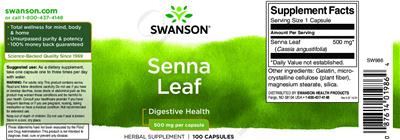
Supplement Facts
The label details for Senna Leaf 500 mg by Swanson, sourced from the NIH Dietary Supplement Label Database.
Supplement Facts
| Ingredient | Amount | % DV |
|---|---|---|
| Senna | 500 mg | -- |
Other ingredients: Gelatin, Microcrystalline Cellulose, Magnesium Stearate, Silica
Tap any ingredient to jump to its full detail below.
These statements are the manufacturer’s wording, reproduced from the product label — the label is saying it, not HelloPharmacist. We don’t verify or endorse them.
General Statements
Swanson.com or call 1-800-437-4148 100% Money back guaranteed
Formulation
Total wellness for mind, body & home Unsurpassed purity & potency
Digestive health
Brand IP Statement(s)
Swanson Science-Backed Quality Since 1969
Suggested/Recommended/Usage/Directions
Suggested Use: As a dietary supplement, take one capsule one to three times per day with water.
Precautions
Warning: For adults only. Keep out of reach of children.
This product contains senna. Read and follow directions carefully. Do not use if you have or develop diarrhea, loose stools or abdominal pain as this product may worsen these conditions and be harmful to your health. Not recommended for extended use. Do not use if seal is broken.
Consult your healthcare provider if you have frequent diarrhea or if you are pregnant, nursing, taking medication or have a medical condition.
Storage
Store in a cool, dry place.
FDA Disclaimer Statement
These statements have not been evaluated by the Food and Drug Administration. This product is not intended to diagnose, treat, cure or prevent any disease.
Formula
Senna Leaf 500mg per capsule
FDA Statement of Identity
Herbal Supplement
Is this label outdated? Report a formula or label change and our pharmacy team will review it.
Senna Leaf 500 mg by Swanson label
The label scan from the NIH Dietary Supplement Label Database. Tap to enlarge.
Label images are published by the NIH Dietary Supplement Label Database for the version of this product on file. Always read your actual product label.
View the full label (PDF)The Ingredients in Senna Leaf 500 mg by Swanson
This is the 1 active ingredient this product is made of. Select it to open its full monograph.
Serving size1 Capsule(s) Dosage formCapsule Servings per container100 Amounts shown are per serving.
Senna
Interacts with140 drugs
Senna is a plant-based stimulant laxative that is widely used and generally effective for short-term relief of constipation. It is best used occasiona...
Senna monograph & interactionsOther (inactive) ingredients: Gelatin, Microcrystalline Cellulose, Magnesium Stearate, Silica. These complete the product’s ingredient list but are not active constituents.
Senna Leaf 500 mg by Swanson Drug Interactions
HelloPharmacist Interaction Report
Swanson's Senna Leaf can interact with several medication types, most seriously through its potential to affect how your blood thinner warfarin (Coumadin) works.
Senna is a stimulant laxative that can cause diarrhea, and diarrhea increases warfarin's effects and bleeding risk — in one case report, overuse for three weeks led to dangerous bleeding.
Read the full breakdown — every affected drug type, severity by severity
Senna also has Moderate interactions with estrogens (like birth control and hormone therapy), diuretic drugs (water pills), other stimulant laxatives, and digoxin (a heart medication). With estrogens, senna may reduce how much your body absorbs them.
With diuretics and other laxatives, it can compound potassium loss and electrolyte imbalance. With digoxin, overuse raises the risk of heart-related side effects because senna depletes potassium.
Additionally, the data we hold covers senna only — we could not check inactive ingredients for interactions. Altogether, these interactions span 140 individual medications.
Before you start senna, check your exact medications with the tool on this page and confirm with your own doctor or pharmacist, especially if you take a blood thinner, heart medication, water pill, or hormone therapy.
Check your own medications below · Editorial policy · How we use AI
Want to check YOUR meds against Senna Leaf 500 mg?
Ask about interactions with your drugs in plain English — “Can I take it with lisinopril?” — and we find you the answer in seconds, ingredient by ingredient.
Go to the checkerIngredients driving the most interactions
Individual Drug Interactions
The ingredients in Senna Leaf 500 mg interact with 140 drugs. Click any drug to see the details.
1 of the 1 ingredient in Senna Leaf 500 mg interact with drugs. Each result below shows which ingredient is responsible. Senna
Acetaminophen, Caffeine, PyrilamineMidol Max Strength Menstrual
How Acetaminophen, Caffeine, Pyrilamine interacts with Senna Leaf 500 mg — through 1 ingredient. Tap an ingredient for the detail:
SennaDiuretic Drugs Moderate
Interaction Summary
Theoretically, senna might increase the risk of hypokalemia when taken with diuretic drugs.
Read the full Senna + Acetaminophen, Caffeine, Pyrilamine interactionAcetaminophen, Pamabrom, PyrilamineMidol Max Strength PMS, Pamprin, Pamprin ES
How Acetaminophen, Pamabrom, Pyrilamine interacts with Senna Leaf 500 mg — through 1 ingredient. Tap an ingredient for the detail:
SennaDiuretic Drugs Moderate
Interaction Summary
Theoretically, senna might increase the risk of hypokalemia when taken with diuretic drugs.
Read the full Senna + Acetaminophen, Pamabrom, Pyrilamine interactionAcetazolamideAk-Zol, Diamox
How Acetazolamide interacts with Senna Leaf 500 mg — through 1 ingredient. Tap an ingredient for the detail:
SennaDiuretic Drugs Moderate
Interaction Summary
Theoretically, senna might increase the risk of hypokalemia when taken with diuretic drugs.
Read the full Senna + Acetazolamide interactionAmiloride, HydrochlorothiazideAmil-Co, Amilzide, Moduret 25, Moduretic
How Amiloride, Hydrochlorothiazide interacts with Senna Leaf 500 mg — through 1 ingredient. Tap an ingredient for the detail:
SennaDiuretic Drugs Moderate
Interaction Summary
Theoretically, senna might increase the risk of hypokalemia when taken with diuretic drugs.
Read the full Senna + Amiloride, Hydrochlorothiazide interactionAmmonium ChlorideAmmonium Chloride
How Ammonium Chloride interacts with Senna Leaf 500 mg — through 1 ingredient. Tap an ingredient for the detail:
SennaDiuretic Drugs Moderate
Interaction Summary
Theoretically, senna might increase the risk of hypokalemia when taken with diuretic drugs.
Read the full Senna + Ammonium Chloride interactionArmodafinilNuvigil
How Armodafinil interacts with Senna Leaf 500 mg — through 1 ingredient. Tap an ingredient for the detail:
SennaStimulant Laxatives Moderate
Interaction Summary
Theoretically, senna might increase the risk for fluid and electrolyte loss when taken with other stimulant laxatives.
Read the full Senna + Armodafinil interactionAtenolol, ChlortalidoneAtenixCo, Tenoret 50, Totaretic
How Atenolol, Chlortalidone interacts with Senna Leaf 500 mg — through 1 ingredient. Tap an ingredient for the detail:
SennaDiuretic Drugs Moderate
Interaction Summary
Theoretically, senna might increase the risk of hypokalemia when taken with diuretic drugs.
Read the full Senna + Atenolol, Chlortalidone interactionAtenolol, ChlorthalidoneTenoretic
How Atenolol, Chlorthalidone interacts with Senna Leaf 500 mg — through 1 ingredient. Tap an ingredient for the detail:
SennaDiuretic Drugs Moderate
Interaction Summary
Theoretically, senna might increase the risk of hypokalemia when taken with diuretic drugs.
Read the full Senna + Atenolol, Chlorthalidone interactionAzilsartan, ChlorthalidoneEdarbyclor
How Azilsartan, Chlorthalidone interacts with Senna Leaf 500 mg — through 1 ingredient. Tap an ingredient for the detail:
SennaDiuretic Drugs Moderate
Interaction Summary
Theoretically, senna might increase the risk of hypokalemia when taken with diuretic drugs.
Read the full Senna + Azilsartan, Chlorthalidone interactionBazedoxifene Acetate, Conjugated EstrogensDuavee
How Bazedoxifene Acetate, Conjugated Estrogens interacts with Senna Leaf 500 mg — through 1 ingredient. Tap an ingredient for the detail:
SennaEstrogens Moderate
Interaction Summary
Theoretically, taking senna may interfere with the absorption of exogenous estrogens.
Read the full Senna + Bazedoxifene Acetate, Conjugated Estrogens interactionBenazepril, HydrochlorothiazideLotensin HCT
How Benazepril, Hydrochlorothiazide interacts with Senna Leaf 500 mg — through 1 ingredient. Tap an ingredient for the detail:
SennaDiuretic Drugs Moderate
Interaction Summary
Theoretically, senna might increase the risk of hypokalemia when taken with diuretic drugs.
Read the full Senna + Benazepril, Hydrochlorothiazide interactionBendroflumethiazideAprinox, Naturetin, Neo-NaClex
How Bendroflumethiazide interacts with Senna Leaf 500 mg — through 1 ingredient. Tap an ingredient for the detail:
SennaDiuretic Drugs Moderate
Interaction Summary
Theoretically, senna might increase the risk of hypokalemia when taken with diuretic drugs.
Read the full Senna + Bendroflumethiazide interactionBendroflumethiazide, NadololCorzide
How Bendroflumethiazide, Nadolol interacts with Senna Leaf 500 mg — through 1 ingredient. Tap an ingredient for the detail:
SennaDiuretic Drugs Moderate
Interaction Summary
Theoretically, senna might increase the risk of hypokalemia when taken with diuretic drugs.
Read the full Senna + Bendroflumethiazide, Nadolol interactionBendroflumethiazide, PotassiumCentyl K, Neo-NaClex-K
How Bendroflumethiazide, Potassium interacts with Senna Leaf 500 mg — through 1 ingredient. Tap an ingredient for the detail:
SennaDiuretic Drugs Moderate
Interaction Summary
Theoretically, senna might increase the risk of hypokalemia when taken with diuretic drugs.
Read the full Senna + Bendroflumethiazide, Potassium interactionBendroflumethiazide, Rauwolfia SerpentinaRauzide
How Bendroflumethiazide, Rauwolfia Serpentina interacts with Senna Leaf 500 mg — through 1 ingredient. Tap an ingredient for the detail:
SennaDiuretic Drugs Moderate
Interaction Summary
Theoretically, senna might increase the risk of hypokalemia when taken with diuretic drugs.
Read the full Senna + Bendroflumethiazide, Rauwolfia Serpentina interactionBenzthiazideExna
How Benzthiazide interacts with Senna Leaf 500 mg — through 1 ingredient. Tap an ingredient for the detail:
SennaDiuretic Drugs Moderate
Interaction Summary
Theoretically, senna might increase the risk of hypokalemia when taken with diuretic drugs.
Read the full Senna + Benzthiazide interactionBisacodylDulcolax, Gentlax
How Bisacodyl interacts with Senna Leaf 500 mg — through 1 ingredient. Tap an ingredient for the detail:
SennaStimulant Laxatives Moderate
Interaction Summary
Theoretically, senna might increase the risk for fluid and electrolyte loss when taken with other stimulant laxatives.
Read the full Senna + Bisacodyl interactionBisacodyl, DocusateDulcolax Laxative Tabs
How Bisacodyl, Docusate interacts with Senna Leaf 500 mg — through 1 ingredient. Tap an ingredient for the detail:
SennaStimulant Laxatives Moderate
Interaction Summary
Theoretically, senna might increase the risk for fluid and electrolyte loss when taken with other stimulant laxatives.
Read the full Senna + Bisacodyl, Docusate interactionBisoprolol, HydrochlorothiazideZiac
How Bisoprolol, Hydrochlorothiazide interacts with Senna Leaf 500 mg — through 1 ingredient. Tap an ingredient for the detail:
SennaDiuretic Drugs Moderate
Interaction Summary
Theoretically, senna might increase the risk of hypokalemia when taken with diuretic drugs.
Read the full Senna + Bisoprolol, Hydrochlorothiazide interactionBumetanideBurinex
How Bumetanide interacts with Senna Leaf 500 mg — through 1 ingredient. Tap an ingredient for the detail:
SennaDiuretic Drugs Moderate
Interaction Summary
Theoretically, senna might increase the risk of hypokalemia when taken with diuretic drugs.
Read the full Senna + Bumetanide interactionBumetanide, PotassiumBurinex K
How Bumetanide, Potassium interacts with Senna Leaf 500 mg — through 1 ingredient. Tap an ingredient for the detail:
SennaDiuretic Drugs Moderate
Interaction Summary
Theoretically, senna might increase the risk of hypokalemia when taken with diuretic drugs.
Read the full Senna + Bumetanide, Potassium interactionCaffeine, Potassium Salicylate, SalicylamideTrim-Elim
How Caffeine, Potassium Salicylate, Salicylamide interacts with Senna Leaf 500 mg — through 1 ingredient. Tap an ingredient for the detail:
SennaDiuretic Drugs Moderate
Interaction Summary
Theoretically, senna might increase the risk of hypokalemia when taken with diuretic drugs.
Read the full Senna + Caffeine, Potassium Salicylate, Salicylamide interactionCandesartan Cilexetil, HydrochlorothiazideAtacand HCT
How Candesartan Cilexetil, Hydrochlorothiazide interacts with Senna Leaf 500 mg — through 1 ingredient. Tap an ingredient for the detail:
SennaDiuretic Drugs Moderate
Interaction Summary
Theoretically, senna might increase the risk of hypokalemia when taken with diuretic drugs.
Read the full Senna + Candesartan Cilexetil, Hydrochlorothiazide interactionCaptopril, HydrochlorothiazideAcezide, Capozide
How Captopril, Hydrochlorothiazide interacts with Senna Leaf 500 mg — through 1 ingredient. Tap an ingredient for the detail:
SennaDiuretic Drugs Moderate
Interaction Summary
Theoretically, senna might increase the risk of hypokalemia when taken with diuretic drugs.
Read the full Senna + Captopril, Hydrochlorothiazide interactionCasanthranolDoxidan Liquid Gels
How Casanthranol interacts with Senna Leaf 500 mg — through 1 ingredient. Tap an ingredient for the detail:
SennaStimulant Laxatives Moderate
Interaction Summary
Theoretically, senna might increase the risk for fluid and electrolyte loss when taken with other stimulant laxatives.
Read the full Senna + Casanthranol interactionCasanthranol, DocusateDoxidan
How Casanthranol, Docusate interacts with Senna Leaf 500 mg — through 1 ingredient. Tap an ingredient for the detail:
SennaStimulant Laxatives Moderate
Interaction Summary
Theoretically, senna might increase the risk for fluid and electrolyte loss when taken with other stimulant laxatives.
Read the full Senna + Casanthranol, Docusate interactionCasanthranol, Docusate PotassiumDialose Plus
How Casanthranol, Docusate Potassium interacts with Senna Leaf 500 mg — through 1 ingredient. Tap an ingredient for the detail:
SennaStimulant Laxatives Moderate
Interaction Summary
Theoretically, senna might increase the risk for fluid and electrolyte loss when taken with other stimulant laxatives.
Read the full Senna + Casanthranol, Docusate Potassium interactionCasanthranol, Docusate SodiumPeri-Colace
How Casanthranol, Docusate Sodium interacts with Senna Leaf 500 mg — through 1 ingredient. Tap an ingredient for the detail:
SennaStimulant Laxatives Moderate
Interaction Summary
Theoretically, senna might increase the risk for fluid and electrolyte loss when taken with other stimulant laxatives.
Read the full Senna + Casanthranol, Docusate Sodium interactionCastor Oil (otc Drug)Purge
How Castor Oil (otc Drug) interacts with Senna Leaf 500 mg — through 1 ingredient. Tap an ingredient for the detail:
SennaStimulant Laxatives Moderate
Interaction Summary
Theoretically, senna might increase the risk for fluid and electrolyte loss when taken with other stimulant laxatives.
Read the full Senna + Castor Oil (otc Drug) interactionChlorothiazideDiuril
How Chlorothiazide interacts with Senna Leaf 500 mg — through 1 ingredient. Tap an ingredient for the detail:
SennaDiuretic Drugs Moderate
Interaction Summary
Theoretically, senna might increase the risk of hypokalemia when taken with diuretic drugs.
Read the full Senna + Chlorothiazide interactionEach ingredient & the kinds of drugs it affects
For each ingredient in Senna Leaf 500 mg with known interactions, here are the types of medications it can affect. Open any type for the detail — or search your exact drug in the checker above.
Senna
Digoxin (Lanoxin)
Theoretically, senna might increase the risk of adverse effects when taken with digoxin.
Overuse/abuse of senna increases the risk of adverse effects from cardiac glycosides, such as digoxin, due to potassium depletion.
Diuretic Drugs
Theoretically, senna might increase the risk of hypokalemia when taken with diuretic drugs.
Overuse of senna might compound diuretic-induced potassium loss and increase the risk for hypokalemia.
Estrogens
Theoretically, taking senna may interfere with the absorption of exogenous estrogens.
Some preliminary clinical evidence suggests that senna reduces the absorption of estradiol and decreases serum concentrations of estrone and estrone sulfate by decreasing intestinal transit time.
Stimulant Laxatives
Theoretically, senna might increase the risk for fluid and electrolyte loss when taken with other stimulant laxatives.
Senna is a stimulant laxative; concomitant use with other stimulant laxatives might compound fluid and electrolyte loss.
Warfarin (Coumadin)
Theoretically, excessive use of senna might increase the effects of warfarin.
Senna has stimulant laxative effects and can cause diarrhea. Diarrhea can increase the effects of warfarin, increase international normalized ratio (INR), and increase the risk of bleeding. In one case report, excessive use of senna for 3 weeks resulted in diarrhea, bloody stools, and an elevated INR of 11.9.
Brand information
Manufacturer and brand details for Senna Leaf 500 mg, from the product label.
Swanson
See all Swanson products- Name
- Swanson Health Products
- City
- Fargo
- State
- ND
- ZipCode
- 58104
- Phone Number
- 1-800-437-4148
- Web Address
- swanson.com
Senna Leaf 500 mg by Swanson: Common Questions
Does Senna Leaf 500 mg by Swanson interact with any medications?
How can one product interact with so many drugs?
Where does this information come from?
Does senna actually work for constipation?
What side effects should I expect?
Is it safe to take senna every day?
Can I take senna if I'm pregnant or breastfeeding?
Why can't I take senna with diuretics or digoxin?
Will senna interfere with my birth control?
Written and reviewed by the HelloPharmacist editorial staff. Our editorial policy
Not sure if Senna Leaf 500 mg is safe with your meds?
Our pharmacists answer your medication & supplement questions — free.
Label information is sourced from the NIH Dietary Supplement Label Database and reflects the product version on file; always read your actual product label. This page is for education only and is not a substitute for professional medical advice. Confirm with your pharmacist or doctor before combining supplements and medications.
The Full Monographs Behind Senna Leaf 500 mg’s Ingredients
Every ingredient we hold a full HelloPharmacist monograph for — uses, evidence, safety, and the complete interaction list.
Sources & How We Checked
Senna Leaf 500 mg's label data comes from the NIH Dietary Supplement Label Database; the ingredient interaction data is from the Natural Medicines database, reviewed by our pharmacists.
- NIH Dietary Supplement Label Database (DSLD) — The official product label on file for this supplement.
- Natural Medicines (Therapeutic Research Center) — Evidence-graded clinical reference behind the ingredient interaction data.
Content is written and reviewed by licensed HelloPharmacist pharmacists. See our data sources and editorial standards for how this information is built and checked.
The 42 references behind this product’s interaction data
Every citation that drives the interaction findings for this product’s ingredients, from the evidence-graded Natural Medicines (TRC Healthcare) database. Open an ingredient to browse its citations — links open the study on PubMed or the publisher’s site.
Senna 42 references
- McGuffin M, Hobbs C, Upton R, Goldberg A, eds. American Herbal Products Association's Botanical Safety Handbook. Boca Raton, FL: CRC Press, LLC 1997.
- Brinker F. Herb Contraindications and Drug Interactions. 2nd ed. Sandy, OR: Eclectic Medical Publications, 1998.
- American Academy of Pediatrics. The transfer of drugs and other chemicals into human milk. Pediatrics 2001;108:776-89. PubMed
- Nusko G, Schneider B, Schneider I, et al. Anthranoid laxative use is not a risk factor for colorectal neoplasia: results of a prospective case control study. Gut 2000;46:651-5. PubMed
- Seybold U, Landauer N, Hillebrand S, Goebel FD. Senna-induced hepatitis in a poor metabolizer. Ann Intern Med 2004;141:650-1. PubMed
- Vanderperren B, Rizzo M, Angenot L, et al. Acute liver failure with renal impairment related to the abuse of senna anthraquinone glycosides. Ann Pharmacother 2005;39:1353-7. PubMed
- Xing JH, Soffer EE. Adverse effects of laxatives. Dis Colon Rectum 2001;44:1201-9. PubMed
- Prior J, White I. Tetany and clubbing in patient who ingested large quantities of senna. Lancet 1978;2:947. PubMed
- Langmead L, Rampton DS. Review article: herbal treatment in gastrointestinal and liver disease--benefits and dangers. Aliment Pharmacol Ther 2001;15:1239-52. PubMed
- Joo JS, Ehrenpreis ED, Gonzalez L, et al. Alterations in colonic anatomy induced by chronic stimulant laxatives: the cathartic colon revisited. J Clin Gastroenterol 1998;26:283-6. PubMed
- Godding EW. Laxatives and the special role of senna. Pharmacology 1988;36:230-6. PubMed
- van Os FH. Anthraquinone derivatives in vegetable laxatives. Pharmacology 1976;14:7-17. PubMed
- Sondheimer JM, Gervaise EP. Lubricant versus laxative in the treatment of chronic functional constipation of children: a comparative study. J Pediatr Gastroenterol Nutr 1982;1:223-6. DOI
- Perkin JM. Constipation in childhood: a controlled comparison between lactulose and standardized senna. Curr Med Res Opin 1977;4:540-3. PubMed
- Shelton MG. Standardized senna in the management of constipation in the puerperium: A clinical trial. S Afr Med J 1980;57:78-80.
- [No authors listed] Senna in the puerperium. Pharmacology 1992;44:23-5. PubMed
- Passmore AP, Davies KW, Flanagan PG, et al. A comparison of Agiolax and lactulose in elderly patients with chronic constipation. Pharmacology 1993;47:249-52. PubMed
- Passmore AP, Wilson-Davies K, Stoker C, Scott ME. Chronic constipation in long stay elderly patients: a comparison of lactulose and a senna-fibre combination. BMJ 1993;307:769-71. PubMed
- MacLennan WJ, Pooler AFWM. A comparison of sodium picosulphate ("Laxoberal") with standardised senna ("Senokot") in geriatric patients. Curr Med Res Opin. 1974;2:641-7. PubMed
- Kittisupamongkol W, Nilaratanakul V, Kulwichit W. Near-fatal bleeding, senna, and the opposite of lettuce. Lancet 2008;371:784. PubMed
- Prather CM. Pregnancy-related constipation. Curr Gastroenterol Rep 2004;6:402-4. PubMed
- Werthmann WM Jr, Krees SV. Quantitative excretion of Senokot in human breast milk. Med Ann Dist Columbia 1973;42:4-5.
- Hagemann TM. Gastrointestinal medications and breastfeeding. J Hum Lact 1998;14:259-62. PubMed
- Faber P, Strenge-Hesse A. Senna-containing laxatives: excretion in the breast milk? Geburtshilfe Frauenheilkd 1989;49:958-62.
- Faber P, Strenge-Hesse A. Relevance of rhein excretion into breast milk. Pharmacology 1988;36 Suppl 1:212-20. PubMed
- Duncan AS. Standardized senna as a laxative in the puerperium; a clinical assessment. Br Med J 1957;1:439-41. PubMed
- Stickel, F. and Schuppan, D. Herbal medicine in the treatment of liver diseases. Dig.Liver Dis. 2007;39(4):293-304. PubMed
- BALDWIN, W. F. CLINICAL STUDY OF SENNA ADMINISTRATION TO NURSING MOTHERS: ASSESSMENT OF EFFECTS ON INFANT BOWEL HABITS. Can.Med Assoc.J 9-14-1963;89:566-568. DOI
- Sonmez, A., Yilmaz, M. I., Mas, R., Ozcan, A., Celasun, B., Dogru, T., Taslipinar, A., and Kocar, I. H. Subacute cholestatic hepatitis likely related to the use of senna for chronic constipation. Acta Gastroenterol.Belg. 2005;68(3):385-387.
- Beuers, U., Spengler, U., and Pape, G. R. Hepatitis after chronic abuse of senna. Lancet 2-9-1991;337(8737):372-373. PubMed
- Lim, A. K., Hooke, D. H., and Kerr, P. G. Anorexia nervosa and senna misuse: nephrocalcinosis, digital clubbing and hypertrophic osteoarthropathy. Med J Aust. 1-21-2008;188(2):121-122. PubMed
- McLaughlin, A. F. Anorexia nervosa and senna misuse: nephrocalcinosis, digital clubbing and hypertrophic osteoarthropathy. Med J Aust. 9-15-2008;189(6):348. PubMed
- Soyuncu, S., Cete, Y., and Nokay, A. E. Portal vein thrombosis related to Cassia angustifolia. Clin.Toxicol.(Phila) 2008;46(8):774-777.
- Levine, D., Goode, A. W., and Wingate, D. L. Purgative abuse associated with reversible cachexia, hypogammaglobulinaemia, and finger clubbing. Lancet 4-25-1981;1(8226):919-920. PubMed
- Malmquist, J., Ericsson, B., Hulten-Nosslin, M. B., Jeppsson, J. O., and Ljungberg, O. Finger clubbing and aspartylglucosamine excretion in a laxative-abusing patient. Postgrad.Med J 1980;56(662):862-864. PubMed
- Lewis, S. J., Heaton, K. W., Oakey, R. E., and McGarrigle, H. H. Lower serum oestrogen concentrations associated with faster intestinal transit. Br.J Cancer 1997;76(3):395-400. PubMed
- Lewis, S. J., Oakey, R. E., and Heaton, K. W. Intestinal absorption of oestrogen: the effect of altering transit-time. Eur.J Gastroenterol.Hepatol. 1998;10(1):33-39. PubMed
- Vilanova-Sanchez A, Gasior AC, Toocheck N, et al. Are Senna based laxatives safe when used as long term treatment for constipation in children? J Pediatr Surg 2018;53(4):722-7. PubMed
- Cogley K, Echevarria A, Correa C, De la Torre-Mondragón L. Contact Burn with Blister Formation in Children Treated with Sennosides. Pediatr Dermatol 2017;34(2):e85-e88. PubMed
- Coskun Y, Yuksel I. Polyethylene glycol versus split high-dose senna for bowel preparation: A comparative prospective randomized study. J Gastroenterol Hepatol 2020;35(11):1923-1929.
- Haoudar A, Chekhlabi N, El Kettani C, Dini N. Acute Hepatitis and Pancytopenia in a Child With Chronic Abuse of Senna. Cureus 2021;13(1):e12436. PubMed
- Irazábal B, Sánchez de Vicente J, Galán C, et al. Anaphylaxis Due to Senna (Cassia angustifolia). J Investig Allergol Clin Immunol 2021;31(1):71-73. PubMed
Parts of this content are provided by the Therapeutic Research Center, LLC.
DISCLAIMER: Currently this does not check for drug-drug interactions. This is not an all-inclusive comprehensive list of potential interactions and is for informational purposes only. Not all interactions are known or well-reported in the scientific literature, and new interactions are continually being reported. Input is needed from a qualified healthcare provider including a pharmacist before starting any therapy. Application of clinical judgment is necessary.
© 2021 Therapeutic Research Center, LLC