
SuperFlex-H Ingredients & Drug Interactions
What is this page for?
First and foremost: checking SuperFlex-H against your medications. The heart of this page is the interaction checker and the full interaction report — how this product’s ingredients may interact with prescription and over-the-counter medicines you may be taking.
Around that, we add a pharmacist’s high-level view of the product as a whole — what’s inside, the evidence for its stated use, how transparent the label is, and what safety data exists — so you can see the full picture in one place. It’s educational information from our licensed clinical databases and the clinical staff at HelloPharmacist — not medical advice — and we don’t sell or endorse products. Our editorial policy
SuperFlex-H is a dietary supplement by NewtonEverett with 16 active ingredients. Its ingredients are commonly taken for hair, skin, and nail health, bone health and osteoporosis, joint and connective tissue support.Based on those ingredients, 1,214 medications have a known interaction with it, the most serious rated moderate. The ingredients most likely to interact are Berberis vulgaris, Belladonna, Solidago. Use the checker below to test your specific medication, or read the full HelloPharmacist Interaction Report.
Check Your Meds Against SuperFlex-H by NewtonEverett
Ask about any prescription or over-the-counter medication and we check it for interactions with SuperFlex-H by NewtonEverett — and tell you which ingredient is responsible.
AI summaries are generated from our interaction database for education only — always confirm with your pharmacist. How we use AI
Ask the Pharmacist
A licensed pharmacist will answer your question by email — free, usually within 24 hours.
Got it — thank you!
A licensed pharmacist will answer within 24 hours. Keep an eye on your email (worth checking spam, just in case).
HelloPharmacist Scorecard of SuperFlex-H by NewtonEverett
Our pharmacy team’s full take, with four database checks built into the cards below — a summary of what is known, not a grade of the product itself.
What’s inside
Low disclosure
SuperFlex-H contains 16 ingredients, most in highly diluted homeopathic form (Rhus toxicodendron, Bryonia, Apis mellifica, Natrum sulphuricum, Ledum palustre, Kalmia latifolia, Ranunculus bulbosus, Belladonna, Aurum Metallicum, and Nat. Phos).
The formula also includes Silica (silicon), Goldenrod (for urinary-tract support), Hpus Uricum Acidum, Berberis vulgaris, and Glycerin (8%), which is a common sweetener and gentle laxative. The product contains no inactive fillers—everything listed is an active or functionally present ingredient.
Does it work?
Not established
The evidence for most ingredients in this product isn't established in our data. Silica is possibly effective for osteoporosis but has insufficient evidence for hair loss or dental concerns.
Glycerin is likely effective for constipation and possibly effective for dry skin (ichthyosis), but likely ineffective for stroke and meningitis. Goldenrod, Rhus toxicodendron, Bryonia, Belladonna, and the other homeopathic ingredients all lack reliable evidence of effectiveness for their traditional uses—their claims haven't been proven in well-designed trials.
How safe is it?
Well-documented data
Several ingredients in SuperFlex-H raise serious safety concerns. Belladonna and Kalmia latifolia (mountain laurel) are poisonous plants; only the highly diluted forms sold here are considered lower-risk, but belladonna can still cause anticholinergic side effects like blurred vision, dry mouth, constipation, and confusion even at low doses.
Bryonia root and Ranunculus bulbosus (bulbous buttercup) are toxic in their raw form and can cause severe gastrointestinal and skin reactions. Silica from food and water is generally well tolerated, but long-term high-dose safety hasn't been well studied.
Goldenrod is often well tolerated short-term but may trigger allergic reactions in sensitive people. Glycerin can cause bloating, diarrhea, nausea, and dizziness at larger doses.
During pregnancy, Silica's safety data are insufficient, while Rhus toxicodendron, Bryonia, Kalmia latifolia, Ranunculus bulbosus, and Belladonna are unsafe or have inadequate data—avoid them. During breastfeeding, the same caution applies; Belladonna's alkaloids can pass into milk and harm a nursing infant.
Meds to double-check
Moderate interaction found
Check your medications against this product if you take anticholinergic drugs (Moderate severity)—medications used for overactive bladder, Parkinson's disease, and certain poisonings—or if you take cisapride (Propulsid), a stomach-motility medication (Moderate severity). Also double-check if you're on diuretic drugs (water pills for blood pressure or fluid retention; Moderate severity).
No interactions are documented for the other ingredients we could check.
The bottom line
Scorecard at a glanceFormula with limited ingredient disclosure with no established evidence rating for its marketed use. Moderate medication interactions have been identified, and safety information is well characterized.
SuperFlex-H is a complex homeopathic formula with limited proven effectiveness and several ingredients whose safety is not well established, especially during pregnancy and breastfeeding. If you take anticholinergic drugs or diuretics, you must check with your pharmacist before starting this product.
Talk to your pharmacist or doctor about whether this product is right for you, particularly if you're pregnant, nursing, or take any regular medications.
Educational only — not medical advice; always confirm with your pharmacist. Our editorial policy · How we use AI
Assessment coverage: 9 of 16 active ingredients matched to our full ingredient reviews (monographs). Based on the product label dated Dec 22, 2017.
This Scorecard evaluates available label information, ingredient evidence, and known medication-safety considerations. It does not independently verify product identity, purity, potency, contamination, or manufacturing quality. How these ratings are computed
General information
Key facts about SuperFlex-H, straight from the product label.
| Brand | NewtonEverett |
|---|---|
| Barcode (UPC) | 689076018036 |
| Net contents | 1 fl. Oz.; 30 mL |
| Market status | Off market |
| Date entered into DSLD | Dec 22, 2017 |
| DSLD ID | 81228 |
| Product type | Other Combinations |
| Supplement form | Liquid |
| Dietary claims / uses | All Other, Structure/Function |
| Intended target group(s) | Adult (18 - 50 Years) |
Everything in this section is reproduced from the manufacturer’s own product label — it’s the label speaking, not HelloPharmacist. We show it so you can see exactly what the maker states; we don’t verify or endorse those statements.
Supplement Facts
The label details for SuperFlex-H by NewtonEverett, sourced from the NIH Dietary Supplement Label Database.
Supplement Facts
| Ingredient | Amount | % DV |
|---|---|---|
| Silica | 0 NP | -- |
| Hpus Uricum Acidum | 0 NP | -- |
| Solidago | 0 NP | -- |
| Rhus toxicodendron | 0 NP | -- |
| Bryonia | 0 NP | -- |
| Apis mellifica | 0 NP | -- |
| Natrum sulphuricum | 0 NP | -- |
| Ledum palustre | 0 NP | -- |
| Kalmia latifolia | 0 NP | -- |
| Ranunculus bulbosus | 0 NP | -- |
| Berberis vulgaris | 0 NP | -- |
| Belladonna | 0 NP | -- |
| Aurum Metallicum | 0 NP | -- |
| Nat. Phos | 0 NP | -- |
| Alcohol | 0 NP | -- |
| 8% Glycerin | 0 NP | -- |
Tap any ingredient to jump to its full detail below.
These statements are the manufacturer’s wording, reproduced from the product label — the label is saying it, not HelloPharmacist. We don’t verify or endorse them.
General Statements
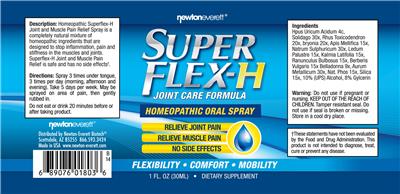
Description: Homeopathic Superflex-H joint and muscle pain relief spray is a completely natural mixture of homeopathic ingredients that are designed to stop inflammation, pain and stiffness in the muscles and joints.
Superflex-H joint and muscle pain relief is safe and has no side effects.
Made in USA
Joint care formula
Homeopathic oral spray
Relieve joint pain Relieve muscle pain No side effects
Flexibility Comfort Mobility
Suggested/Recommended/Usage/Directions
Directions: Spray 3 times under tongue, 3 times per day (morning, afternoon and evening). Take 5 days per week. May be sprayed on area of pain, then gently rubbed in.
Precautions
Do not eat or drink 20 minutes before or after taking product.
Warning: Do not use if pregnant or nursing.
Keep out of the reach of children.
Tamper resistant seal. Do not use if seal is broken or missing.
General
B14
FDA Statement of Identity
Dietary Supplement
Storage
Store in a cool dry place.
FDA Disclaimer Statement
These statements have not been evaluated by the Food and Drug Administration. This product is not intended to diagnose, treat, cure or prevent any disease.
Is this label outdated? Report a formula or label change and our pharmacy team will review it.
SuperFlex-H by NewtonEverett label
The label scan from the NIH Dietary Supplement Label Database. Tap to enlarge.
Label images are published by the NIH Dietary Supplement Label Database for the version of this product on file. Always read your actual product label.
View the full label (PDF)The Ingredients in SuperFlex-H by NewtonEverett
These are the 16 active ingredients this product is made of. Select any to open its full monograph.
Serving size3 Not Present Dosage formLiquid Amounts shown are per serving.
Most supplement products combine several ingredients, and a medication can interact with the product through any one of them. Each ingredient below shows whether it has known drug interactions.
Silica
No knowninteractions
Silicon is a trace mineral found in the body and in foods like oats, barley, and certain fruits and vegetables, and it is popular in supplements for h...
Silica monograph & interactionsHpus Uricum Acidum
Solidago
Interacts with75 drugs
Goldenrod is a flowering plant traditionally used as an herbal diuretic and for urinary tract health. Human evidence is limited, and while it is gener...
Solidago monograph & interactionsRhus toxicodendron
No knowninteractions
Poison ivy is a toxic plant best known for causing an itchy, blistering allergic rash on contact. In supplement form it is sold almost exclusively as...
Rhus toxicodendron monograph & interactionsBryonia
No knowninteractions
Bryonia is a toxic climbing vine that is mainly used today in homeopathic dilutions for coughs, pain, and inflammation, but solid scientific evidence...
Bryonia monograph & interactionsApis mellifica
Natrum sulphuricum
Ledum palustre
Kalmia latifolia
No knowninteractions
Mountain Laurel is a flowering shrub native to North America that contains toxic compounds called grayanotoxins, making it dangerous to eat or use int...
Kalmia latifolia monograph & interactionsRanunculus bulbosus
No knowninteractions
Bulbous buttercup is a wild flowering plant that is toxic and irritating when fresh, and it is used today mainly in heavily diluted homeopathic remedi...
Ranunculus bulbosus monograph & interactionsBerberis vulgaris
Interacts with1,210 drugs
European barberry is a shrub whose root, bark, and berries contain berberine, a bitter plant alkaloid that has been studied mostly in isolated form. S...
Berberis vulgaris monograph & interactionsBelladonna
Interacts with196 drugs
Belladonna is a highly toxic plant whose alkaloids (like atropine and scopolamine) are powerful medicines used only in carefully controlled, regulated...
Belladonna monograph & interactionsAurum Metallicum
Nat. Phos
Alcohol
8% Glycerin
No knowninteractions
Glycerol (glycerin) is a sweet, syrupy compound made naturally in the body and widely used in foods, skin products, and medicines. It is well establis...
8% Glycerin monograph & interactionsSuperFlex-H by NewtonEverett Drug Interactions
HelloPharmacist Interaction Report
SuperFlex-H by NewtonEverett is a 16-ingredient liquid that includes several plant extracts and homeopathic compounds.
Two of its ingredients have documented interactions with medications, affecting a total of 268 individual medications. The most serious interaction involves belladonna, which can increase adverse effects when combined with anticholinergic drugs—medications that block certain nerve signals and are used for conditions like overactive bladder, Parkinson's disease, and some types of poisoning.
Belladonna may also reduce how well cisapride (Propulsid), a stomach-motility medication, works.
Read the full breakdown — every affected drug type, severity by severity
Goldenrod, another ingredient in this product, has a Moderate interaction with diuretic drugs (water pills). It may theoretically amplify both the desired and unwanted effects of these medications, which are commonly used for high blood pressure and fluid retention.
We could not check the following ingredients because we hold no interaction data for them: Hpus Uricum Acidum, Apis mellifica, Natrum sulphuricum, Ledum palustre, Berberis vulgaris, Aurum Metallicum, Nat. Phos, and Alcohol.
Silica, Rhus toxicodendron, Bryonia, Kalmia latifolia, Ranunculus bulbosus, and Glycerin have no interactions documented in our data, though that is not a guarantee none exist.
Before you start SuperFlex-H, run your exact medications through the interaction checker on this page.
Check your own medications below · Editorial policy · How we use AI
Want to check YOUR meds against SuperFlex-H?
Ask about interactions with your drugs in plain English — “Can I take it with lisinopril?” — and we find you the answer in seconds, ingredient by ingredient.
Go to the checkerIngredients driving the most interactions
Individual Drug Interactions
The ingredients in SuperFlex-H interact with 1,214 drugs. Click any drug to see the details.
3 of the 16 ingredients in SuperFlex-H interact with drugs. Each result below shows which ingredient is responsible. Berberis vulgaris Belladonna Solidago
Ado-trastuzumab EmtansineKadcyla
How Ado-trastuzumab Emtansine interacts with SuperFlex-H — through 1 ingredient. Tap an ingredient for the detail:
Berberis VulgarisCytochrome P450 3a4 (cyp3a4) Substrates Moderate
Interaction Summary
Theoretically, European barberry might increase the levels and clinical effects of CYP3A4 substrates.
Read the full Berberis Vulgaris + Ado-trastuzumab Emtansine interactionAbciximabReoPro
How Abciximab interacts with SuperFlex-H — through 1 ingredient. Tap an ingredient for the detail:
Berberis VulgarisAnticoagulant/antiplatelet Drugs Moderate
Interaction Summary
Theoretically, European barberry may increase the risk of bleeding if used with anticoagulant or antiplatelet drugs.
Read the full Berberis Vulgaris + Abciximab interactionAbemaciclibVerzenio
How Abemaciclib interacts with SuperFlex-H — through 1 ingredient. Tap an ingredient for the detail:
Berberis VulgarisCytochrome P450 3a4 (cyp3a4) Substrates Moderate
Interaction Summary
Theoretically, European barberry might increase the levels and clinical effects of CYP3A4 substrates.
Read the full Berberis Vulgaris + Abemaciclib interactionAbiraterone
How Abiraterone interacts with SuperFlex-H — through 1 ingredient. Tap an ingredient for the detail:
Berberis VulgarisCytochrome P450 3a4 (cyp3a4) Substrates Moderate
Interaction Summary
Theoretically, European barberry might increase the levels and clinical effects of CYP3A4 substrates.
Read the full Berberis Vulgaris + Abiraterone interactionAbiraterone AcetateYonsa, Zytiga
How Abiraterone Acetate interacts with SuperFlex-H — through 1 ingredient. Tap an ingredient for the detail:
Berberis VulgarisCytochrome P450 3a4 (cyp3a4) Substrates Moderate
Interaction Summary
Theoretically, European barberry might increase the levels and clinical effects of CYP3A4 substrates.
Read the full Berberis Vulgaris + Abiraterone Acetate interactionAbrocitinibCibinqo
How Abrocitinib interacts with SuperFlex-H — through 1 ingredient. Tap an ingredient for the detail:
Berberis VulgarisAnticoagulant/antiplatelet Drugs Moderate
Interaction Summary
Theoretically, European barberry may increase the risk of bleeding if used with anticoagulant or antiplatelet drugs.
Read the full Berberis Vulgaris + Abrocitinib interactionAcalabrutinibCalquence
How Acalabrutinib interacts with SuperFlex-H — through 1 ingredient. Tap an ingredient for the detail:
Berberis VulgarisCytochrome P450 3a4 (cyp3a4) Substrates Moderate
Interaction Summary
Theoretically, European barberry might increase the levels and clinical effects of CYP3A4 substrates.
Read the full Berberis Vulgaris + Acalabrutinib interactionAcarboseGlucobay, Prandase, Precose
How Acarbose interacts with SuperFlex-H — through 1 ingredient. Tap an ingredient for the detail:
Berberis VulgarisAntidiabetes Drugs Moderate
Interaction Summary
Theoretically, taking European barberry with antidiabetes drugs might increase the risk of hypoglycemia.
Read the full Berberis Vulgaris + Acarbose interactionAcebutololRhotral, Sectral
How Acebutolol interacts with SuperFlex-H — through 1 ingredient. Tap an ingredient for the detail:
Berberis VulgarisAntihypertensive Drugs Moderate
Interaction Summary
Theoretically, taking European barberry with antihypertensive drugs might increase the risk of hypotension.
Read the full Berberis Vulgaris + Acebutolol interactionAcenocoumarolSintrom
How Acenocoumarol interacts with SuperFlex-H — through 1 ingredient. Tap an ingredient for the detail:
Berberis VulgarisAnticoagulant/antiplatelet Drugs Moderate
Interaction Summary
Theoretically, European barberry may increase the risk of bleeding if used with anticoagulant or antiplatelet drugs.
Read the full Berberis Vulgaris + Acenocoumarol interactionAcepromazineAtravet
How Acepromazine interacts with SuperFlex-H — through 2 ingredients. Tap an ingredient for the detail:
BelladonnaAnticholinergic Drugs Moderate
Interaction Summary
Belladonna may increase the risk of adverse effects when used concomitantly with anticholinergic drugs.
Read the full Belladonna + Acepromazine interactionBerberis VulgarisCns Depressants, Anticholinergic Drugs Moderate
Interaction Summary
Theoretically, concomitant use with drugs that have sedative properties may cause additive effects.
Read the full Berberis Vulgaris + Acepromazine interactionAcetaminophen, AspirinGemnisyn
How Acetaminophen, Aspirin interacts with SuperFlex-H — through 1 ingredient. Tap an ingredient for the detail:
Berberis VulgarisAnticoagulant/antiplatelet Drugs Moderate
Interaction Summary
Theoretically, European barberry may increase the risk of bleeding if used with anticoagulant or antiplatelet drugs.
Read the full Berberis Vulgaris + Acetaminophen, Aspirin interactionAcetaminophen, Aspirin, CaffeineExcedrin, Excedrin Extra Strength, Excedrin Migraine
How Acetaminophen, Aspirin, Caffeine interacts with SuperFlex-H — through 1 ingredient. Tap an ingredient for the detail:
Berberis VulgarisAnticoagulant/antiplatelet Drugs, Cytochrome P450 3a4 (cyp3a4) Substrates Moderate
Interaction Summary
Theoretically, European barberry may increase the risk of bleeding if used with anticoagulant or antiplatelet drugs.
Read the full Berberis Vulgaris + Acetaminophen, Aspirin, Caffeine interactionAcetaminophen, Butalbital, CaffeineEsgic, Esgic Plus, Fiogesic, Fioricet, Repan, Tecnal +1 more
How Acetaminophen, Butalbital, Caffeine interacts with SuperFlex-H — through 1 ingredient. Tap an ingredient for the detail:
Berberis VulgarisCytochrome P450 3a4 (cyp3a4) Substrates Moderate
Interaction Summary
Theoretically, European barberry might increase the levels and clinical effects of CYP3A4 substrates.
Read the full Berberis Vulgaris + Acetaminophen, Butalbital, Caffeine interactionAcetaminophen, Butalbital, Caffeine, CodeineEsgic with Codeine, Fioricet w/ Codeine
How Acetaminophen, Butalbital, Caffeine, Codeine interacts with SuperFlex-H — through 1 ingredient. Tap an ingredient for the detail:
Berberis VulgarisCytochrome P450 3a4 (cyp3a4) Substrates, Cns Depressants Moderate
Interaction Summary
Theoretically, European barberry might increase the levels and clinical effects of CYP3A4 substrates.
Read the full Berberis Vulgaris + Acetaminophen, Butalbital, Caffeine, Codeine interactionAcetaminophen, Butalbital, CodeineBancap w/ Codeine
How Acetaminophen, Butalbital, Codeine interacts with SuperFlex-H — through 1 ingredient. Tap an ingredient for the detail:
Berberis VulgarisCns Depressants Moderate
Interaction Summary
Theoretically, concomitant use with drugs that have sedative properties may cause additive effects.
Read the full Berberis Vulgaris + Acetaminophen, Butalbital, Codeine interactionAcetaminophen, Butalbital, Codeine PhosphatePhrenilin #3
How Acetaminophen, Butalbital, Codeine Phosphate interacts with SuperFlex-H — through 1 ingredient. Tap an ingredient for the detail:
Berberis VulgarisCns Depressants Moderate
Interaction Summary
Theoretically, concomitant use with drugs that have sedative properties may cause additive effects.
Read the full Berberis Vulgaris + Acetaminophen, Butalbital, Codeine Phosphate interactionAcetaminophen, Caffeine, Chlorpheniramine, Hydrocodone, PhenylephrineHycomine Compound
How Acetaminophen, Caffeine, Chlorpheniramine, Hydrocodone, Phenylephrine interacts with SuperFlex-H — through 2 ingredients. Tap an ingredient for the detail:
Berberis VulgarisCns Depressants, Anticholinergic Drugs +1 Moderate
Interaction Summary
Theoretically, concomitant use with drugs that have sedative properties may cause additive effects.
Read the full Berberis Vulgaris + Acetaminophen, Caffeine, Chlorpheniramine, Hydrocodone, Phenylephrine interactionBelladonnaAnticholinergic Drugs Moderate
Interaction Summary
Belladonna may increase the risk of adverse effects when used concomitantly with anticholinergic drugs.
Read the full Belladonna + Acetaminophen, Caffeine, Chlorpheniramine, Hydrocodone, Phenylephrine interactionAcetaminophen, Caffeine, CodeineGesic C15, Gesic C30, Gesic C8, Lenoltec 1, Lenoltec 2, Lenoltec 3 +1 more
How Acetaminophen, Caffeine, Codeine interacts with SuperFlex-H — through 1 ingredient. Tap an ingredient for the detail:
Berberis VulgarisCytochrome P450 3a4 (cyp3a4) Substrates, Cns Depressants Moderate
Interaction Summary
Theoretically, European barberry might increase the levels and clinical effects of CYP3A4 substrates.
Read the full Berberis Vulgaris + Acetaminophen, Caffeine, Codeine interactionAcetaminophen, Caffeine, Codeine, SalicylamideCodalan No.1, Codalan No.2, Codalan No.3
How Acetaminophen, Caffeine, Codeine, Salicylamide interacts with SuperFlex-H — through 1 ingredient. Tap an ingredient for the detail:
Berberis VulgarisCns Depressants, Cytochrome P450 3a4 (cyp3a4) Substrates Moderate
Interaction Summary
Theoretically, concomitant use with drugs that have sedative properties may cause additive effects.
Read the full Berberis Vulgaris + Acetaminophen, Caffeine, Codeine, Salicylamide interactionAcetaminophen, Caffeine, DihydrocodeineDHC Plus, Panlor DC, Panlor SS
How Acetaminophen, Caffeine, Dihydrocodeine interacts with SuperFlex-H — through 1 ingredient. Tap an ingredient for the detail:
Berberis VulgarisCytochrome P450 3a4 (cyp3a4) Substrates, Cns Depressants Moderate
Interaction Summary
Theoretically, European barberry might increase the levels and clinical effects of CYP3A4 substrates.
Read the full Berberis Vulgaris + Acetaminophen, Caffeine, Dihydrocodeine interactionAcetaminophen, Caffeine, IsomethepteneMigralam
How Acetaminophen, Caffeine, Isometheptene interacts with SuperFlex-H — through 1 ingredient. Tap an ingredient for the detail:
Berberis VulgarisCytochrome P450 3a4 (cyp3a4) Substrates Moderate
Interaction Summary
Theoretically, European barberry might increase the levels and clinical effects of CYP3A4 substrates.
Read the full Berberis Vulgaris + Acetaminophen, Caffeine, Isometheptene interactionAcetaminophen, Caffeine, PyrilamineMidol Max Strength Menstrual
How Acetaminophen, Caffeine, Pyrilamine interacts with SuperFlex-H — through 3 ingredients. Tap an ingredient for the detail:
Berberis VulgarisCytochrome P450 3a4 (cyp3a4) Substrates, Anticholinergic Drugs Moderate
Interaction Summary
Theoretically, European barberry might increase the levels and clinical effects of CYP3A4 substrates.
Read the full Berberis Vulgaris + Acetaminophen, Caffeine, Pyrilamine interactionSolidagoDiuretic Drugs Moderate
Interaction Summary
Theoretically, goldenrod might increase the effects and adverse effects of diuretic drugs.
Read the full Solidago + Acetaminophen, Caffeine, Pyrilamine interactionBelladonnaAnticholinergic Drugs Moderate
Interaction Summary
Belladonna may increase the risk of adverse effects when used concomitantly with anticholinergic drugs.
Read the full Belladonna + Acetaminophen, Caffeine, Pyrilamine interactionAcetaminophen, Chlorpheniramine Maleate, Dextromethorphan HbrVicks Formula 44M Cough, Cold & Flu Relief
How Acetaminophen, Chlorpheniramine Maleate, Dextromethorphan Hbr interacts with SuperFlex-H — through 2 ingredients. Tap an ingredient for the detail:
BelladonnaAnticholinergic Drugs Moderate
Interaction Summary
Belladonna may increase the risk of adverse effects when used concomitantly with anticholinergic drugs.
Read the full Belladonna + Acetaminophen, Chlorpheniramine Maleate, Dextromethorphan Hbr interactionBerberis VulgarisCytochrome P450 3a4 (cyp3a4) Substrates, Anticholinergic Drugs Moderate
Interaction Summary
Theoretically, European barberry might increase the levels and clinical effects of CYP3A4 substrates.
Read the full Berberis Vulgaris + Acetaminophen, Chlorpheniramine Maleate, Dextromethorphan Hbr interactionAcetaminophen, Chlorpheniramine, Codeine, PhenylephrineColrex
How Acetaminophen, Chlorpheniramine, Codeine, Phenylephrine interacts with SuperFlex-H — through 2 ingredients. Tap an ingredient for the detail:
Berberis VulgarisAnticholinergic Drugs, Cns Depressants +1 Moderate
Interaction Summary
Theoretically, taking European barberry with anticholinergic drugs might cause additive effects.
Read the full Berberis Vulgaris + Acetaminophen, Chlorpheniramine, Codeine, Phenylephrine interactionBelladonnaAnticholinergic Drugs Moderate
Interaction Summary
Belladonna may increase the risk of adverse effects when used concomitantly with anticholinergic drugs.
Read the full Belladonna + Acetaminophen, Chlorpheniramine, Codeine, Phenylephrine interactionAcetaminophen, Chlorpheniramine, DextromethorphanCoricidin II Extra Strength Cold and Flu
How Acetaminophen, Chlorpheniramine, Dextromethorphan interacts with SuperFlex-H — through 2 ingredients. Tap an ingredient for the detail:
Berberis VulgarisAnticholinergic Drugs, Cytochrome P450 3a4 (cyp3a4) Substrates Moderate
Interaction Summary
Theoretically, taking European barberry with anticholinergic drugs might cause additive effects.
Read the full Berberis Vulgaris + Acetaminophen, Chlorpheniramine, Dextromethorphan interactionBelladonnaAnticholinergic Drugs Moderate
Interaction Summary
Belladonna may increase the risk of adverse effects when used concomitantly with anticholinergic drugs.
Read the full Belladonna + Acetaminophen, Chlorpheniramine, Dextromethorphan interactionAcetaminophen, Chlorpheniramine, Dextromethorphan HydrobromideCoricidin HBP Maximum Strength Flu
How Acetaminophen, Chlorpheniramine, Dextromethorphan Hydrobromide interacts with SuperFlex-H — through 2 ingredients. Tap an ingredient for the detail:
Berberis VulgarisCytochrome P450 3a4 (cyp3a4) Substrates, Anticholinergic Drugs Moderate
Interaction Summary
Theoretically, European barberry might increase the levels and clinical effects of CYP3A4 substrates.
Read the full Berberis Vulgaris + Acetaminophen, Chlorpheniramine, Dextromethorphan Hydrobromide interactionBelladonnaAnticholinergic Drugs Moderate
Interaction Summary
Belladonna may increase the risk of adverse effects when used concomitantly with anticholinergic drugs.
Read the full Belladonna + Acetaminophen, Chlorpheniramine, Dextromethorphan Hydrobromide interactionAcetaminophen, Chlorpheniramine, Dextromethorphan, PhenylpropanolamineMulti Symptom Cold Relief
How Acetaminophen, Chlorpheniramine, Dextromethorphan, Phenylpropanolamine interacts with SuperFlex-H — through 2 ingredients. Tap an ingredient for the detail:
BelladonnaAnticholinergic Drugs Moderate
Interaction Summary
Belladonna may increase the risk of adverse effects when used concomitantly with anticholinergic drugs.
Read the full Belladonna + Acetaminophen, Chlorpheniramine, Dextromethorphan, Phenylpropanolamine interactionBerberis VulgarisCytochrome P450 3a4 (cyp3a4) Substrates, Anticholinergic Drugs Moderate
Interaction Summary
Theoretically, European barberry might increase the levels and clinical effects of CYP3A4 substrates.
Read the full Berberis Vulgaris + Acetaminophen, Chlorpheniramine, Dextromethorphan, Phenylpropanolamine interactionAcetaminophen, Chlorpheniramine, Dextromethorphan, PseudoephedrineChildren's Tylenol Cold Plus Cough, Tylenol Cold Ex Strength
How Acetaminophen, Chlorpheniramine, Dextromethorphan, Pseudoephedrine interacts with SuperFlex-H — through 2 ingredients. Tap an ingredient for the detail:
Berberis VulgarisAnticholinergic Drugs, Cytochrome P450 3a4 (cyp3a4) Substrates Moderate
Interaction Summary
Theoretically, taking European barberry with anticholinergic drugs might cause additive effects.
Read the full Berberis Vulgaris + Acetaminophen, Chlorpheniramine, Dextromethorphan, Pseudoephedrine interactionBelladonnaAnticholinergic Drugs Moderate
Interaction Summary
Belladonna may increase the risk of adverse effects when used concomitantly with anticholinergic drugs.
Read the full Belladonna + Acetaminophen, Chlorpheniramine, Dextromethorphan, Pseudoephedrine interactionAcetaminophen, Chlorpheniramine, Guaifenesin, Phenylephrine, SalicylamideRhinogesic GG
How Acetaminophen, Chlorpheniramine, Guaifenesin, Phenylephrine, Salicylamide interacts with SuperFlex-H — through 2 ingredients. Tap an ingredient for the detail:
Berberis VulgarisAnticholinergic Drugs, Cytochrome P450 3a4 (cyp3a4) Substrates Moderate
Interaction Summary
Theoretically, taking European barberry with anticholinergic drugs might cause additive effects.
Read the full Berberis Vulgaris + Acetaminophen, Chlorpheniramine, Guaifenesin, Phenylephrine, Salicylamide interactionBelladonnaAnticholinergic Drugs Moderate
Interaction Summary
Belladonna may increase the risk of adverse effects when used concomitantly with anticholinergic drugs.
Read the full Belladonna + Acetaminophen, Chlorpheniramine, Guaifenesin, Phenylephrine, Salicylamide interactionEach ingredient & the kinds of drugs it affects
For each ingredient in SuperFlex-H with known interactions, here are the types of medications they can affect. Open any type for the detail — or search your exact drug in the checker above.
Berberis vulgaris
Anticholinergic Drugs
Theoretically, taking European barberry with anticholinergic drugs might cause additive effects.
In vitro evidence suggests that European barberry might have anticholinergic properties.
Anticoagulant/Antiplatelet Drugs
Theoretically, European barberry may increase the risk of bleeding if used with anticoagulant or antiplatelet drugs.
In vitro and animal evidence suggest that berberine, a constituent of European barberry, might inhibit platelet aggregation. Theoretically, European barberry might have a similar effect.
Antidiabetes Drugs
Theoretically, taking European barberry with antidiabetes drugs might increase the risk of hypoglycemia.
Preliminary clinical evidence suggests that European barberry juice reduces fasting glucose levels in patients with type 2 diabetes who are also taking antidiabetes drugs. Additionally, some animal studies show that berberine, a constituent of European barberry, has antiglycemic potential. Monitor blood glucose levels closely.
Antihypertensive Drugs
Theoretically, taking European barberry with antihypertensive drugs might increase the risk of hypotension.
Animal and human research suggests that European barberry extracts can have hypotensive effects.
Cholinergic Drugs
Theoretically, taking European barberry with cholinergic drugs might decrease the effects of cholinergic drugs.
In vitro evidence suggests that European barberry might have anticholinergic properties.
Cns Depressants
Theoretically, concomitant use with drugs that have sedative properties may cause additive effects.
Animal research suggests that berberine, a constituent of European barberry, might have sedative effects. Theoretically, European barberry might have a similar effect.
Cyclosporine (Neoral, Sandimmune)
Theoretically, concomitant use with cyclosporine may cause additive effects.
Berberine, a constituent of European barberry, can reduce the metabolism and increase serum levels of cyclosporine. This effect is attributed to the ability of berberine to inhibit cytochrome P450 3A4 (CYP3A4), which metabolizes cyclosporine. Theoretically, European barberry might have a similar effect.
Cytochrome P450 3A4 (Cyp3A4) Substrates
Theoretically, European barberry might increase the levels and clinical effects of CYP3A4 substrates.
There is very preliminary evidence suggesting that berberine, a constituent of European barberry, might inhibit the CYP3A4 enzyme. Theoretically, European barberry might have a similar effect.
Belladonna
Anticholinergic Drugs
Belladonna may increase the risk of adverse effects when used concomitantly with anticholinergic drugs.
Belladonna has anticholinergic activity and increases the activity of anticholinergic drugs.
Cisapride (Propulsid)
Theoretically, belladonna might reduce the effects of cisapride.
Belladonna contains atropine. In vivo evidence suggests that atropine can prevent cisapride from increasing motility in the gastrointestinal tract.
Solidago
Diuretic Drugs
Theoretically, goldenrod might increase the effects and adverse effects of diuretic drugs.
In vitro and animal research suggests that goldenrod has diuretic effects.
Brand information
Manufacturer and brand details for SuperFlex-H, from the product label.
NewtonEverett
See all NewtonEverett products- Name
- Newton-Everett Biotech
- City
- Scottsdale
- State
- AZ
- ZipCode
- 85255
- Phone Number
- 866.593.3424
- Web Address
- www.newton-everett.com
SuperFlex-H by NewtonEverett: Common Questions
Does SuperFlex-H by NewtonEverett interact with any medications?
How can one product interact with so many drugs?
Where does this information come from?
Is this safe to take during pregnancy?
What is Belladonna, and why is it in here?
Can this help with joint pain or arthritis?
What does Silica do?
Why does this product contain Alcohol?
Is Glycerin safe?
Written and reviewed by the HelloPharmacist editorial staff. Our editorial policy
Not sure if SuperFlex-H is safe with your meds?
Our pharmacists answer your medication & supplement questions — free.
Label information is sourced from the NIH Dietary Supplement Label Database and reflects the product version on file; always read your actual product label. This page is for education only and is not a substitute for professional medical advice. Confirm with your pharmacist or doctor before combining supplements and medications.
The Full Monographs Behind SuperFlex-H’s Ingredients
Every ingredient we hold a full HelloPharmacist monograph for — uses, evidence, safety, and the complete interaction list.
Silicon
Silicon is a trace mineral found in the body and in foods like oats, barley, and certain fruits and vegetables, and it is popular in supplements for hair, skin, nail, and bone health. Some s...
Read the full Silicon monograph → Herb & supplement monographGoldenrod
Interacts with 75 drugsGoldenrod is a flowering plant traditionally used as an herbal diuretic and for urinary tract health. Human evidence is limited, and while it is generally well tolerated, people with certain...
Read the full Goldenrod monograph → Herb & supplement monographPoison Ivy
Poison ivy is a toxic plant best known for causing an itchy, blistering allergic rash on contact. In supplement form it is sold almost exclusively as an extremely dilute homeopathic remedy (...
Read the full Poison Ivy monograph → Herb & supplement monographBryonia
Bryonia is a toxic climbing vine that is mainly used today in homeopathic dilutions for coughs, pain, and inflammation, but solid scientific evidence that it works is lacking. The raw plant...
Read the full Bryonia monograph → Herb & supplement monographMountain Laurel
Mountain Laurel is a flowering shrub native to North America that contains toxic compounds called grayanotoxins, making it dangerous to eat or use internally. There is no reliable evidence t...
Read the full Mountain Laurel monograph → Herb & supplement monographBulbous Buttercup
Bulbous buttercup is a wild flowering plant that is toxic and irritating when fresh, and it is used today mainly in heavily diluted homeopathic remedies. There is no solid scientific evidenc...
Read the full Bulbous Buttercup monograph → Herb & supplement monographEuropean Barberry
Interacts with 1,210 drugsEuropean barberry is a shrub whose root, bark, and berries contain berberine, a bitter plant alkaloid that has been studied mostly in isolated form. Some early research on berberine is promi...
Read the full European Barberry monograph → Herb & supplement monographBelladonna
Interacts with 196 drugsBelladonna is a highly toxic plant whose alkaloids (like atropine and scopolamine) are powerful medicines used only in carefully controlled, regulated forms. The raw plant and unregulated pr...
Read the full Belladonna monograph → Herb & supplement monographGlycerol
Glycerol (glycerin) is a sweet, syrupy compound made naturally in the body and widely used in foods, skin products, and medicines. It is well established as a laxative and a skin and eye moi...
Read the full Glycerol monograph →Sources & How We Checked
SuperFlex-H's label data comes from the NIH Dietary Supplement Label Database; the ingredient interaction data is from the Natural Medicines database, reviewed by our pharmacists.
- NIH Dietary Supplement Label Database (DSLD) — The official product label on file for this supplement.
- Natural Medicines (Therapeutic Research Center) — Evidence-graded clinical reference behind the ingredient interaction data.
Content is written and reviewed by licensed HelloPharmacist pharmacists. See our data sources and editorial standards for how this information is built and checked.
The 94 references behind this product’s interaction data
Every citation that drives the interaction findings for this product’s ingredients, from the evidence-graded Natural Medicines (TRC Healthcare) database. Open an ingredient to browse its citations — links open the study on PubMed or the publisher’s site.
Silicon 19 references
- Food and Nutrition Board, Institute of Medicine. Dietary Reference Intakes for Vitamin A, Vitamin K, Arsenic, Boron, Chromium, Copper, Iodine, Iron, Manganese, Molybdenum, Nickel, Silicon, Vanadium, and Zinc. Washington, DC: National Academy Press, 2002.
- Jugdaohsingh R, Anderson SH, Tucker KL, et al. Dietary silicon intake and absorption. Am J Clin Nutr 2002;75:887-93. PubMed
- Ichiyanagi O, Sasagawa I, Adachi Y, et al. Silica urolithiasis without magnesium trisilicate intake. Urol Int 1998;61:39-42. PubMed
- Levison DA, Crocker PR, Banim S, Wallace DM. Silica stones in the urinary bladder. Lancet 1982;1:704-5. PubMed
- Lee MH, Lee YH, Hsu TH, et al. Silica stone--development due to long time oral trisilicate intake. Scand J Urol Nephrol 1993;27:267-9. PubMed
- Cruz Guerra, N. A., Gomez Garcia, M. A., Lovaco, Castellano F., Saez Garrido, J. C., Garcia, Cuerpo E., and Escudero, Barrilero A. [Silica urolithiasis: report of a new case]. Actas Urol.Esp 2000;24(2):202-204.
- Merget, R., Bauer, T., Kupper, H. U., Philippou, S., Bauer, H. D., Breitstadt, R., and Bruening, T. Health hazards due to the inhalation of amorphous silica. Arch Toxicol. 2002;75(11-12):625-634. PubMed
- Khuder, S. A., Peshimam, A. Z., and Agraharam, S. Environmental risk factors for rheumatoid arthritis. Rev Environ Health 2002;17(4):307-315. PubMed
- McLaughlin, J. K., Chow, W. H., and Levy, L. S. Amorphous silica: a review of health effects from inhalation exposure with particular reference to cancer. J Toxicol.Environ Health 4-25-1997;50(6):553-566. DOI
- Pelucchi, C., Pira, E., Piolatto, G., Coggiola, M., Carta, P., and La, Vecchia C. Occupational silica exposure and lung cancer risk: a review of epidemiological studies 1996-2005. Ann.Oncol. 2006;17(7):1039-1050. PubMed
- Gillissen, A., Gessner, C., Hammerschmidt, S., Hoheisel, G., and Wirtz, H. [Health significance of inhaled particles]. Dtsch.Med Wochenschr. 3-24-2006;131(12):639-644.
- Hu, J. F., Qu, H., and Wang, J. Z. [Meta analysis for relationship between exposure of free silicon dioxide and lung tumor]. Zhonghua Lao.Dong.Wei Sheng Zhi.Ye.Bing.Za Zhi. 2006;24(7):415-417.
- Jugdaohsingh, R. Silicon and bone health. J Nutr Health Aging 2007;11(2):99-110.
- Lacasse, Y., Martin, S., Gagne, D., and Lakhal, L. Dose-response meta-analysis of silica and lung cancer. Cancer Causes Control 2009;20(6):925-933. PubMed
- McCormic, Z. D., Khuder, S. S., Aryal, B. K., Ames, A. L., and Khuder, S. A. Occupational silica exposure as a risk factor for scleroderma: a meta-analysis. Int Arch Occup.Environ Health 2010;83(7):763-769. PubMed
- Haddad, F. S. and Kouyoumdjian, A. Silica stones in humans. Urol.Int 1986;41(1):70-76. PubMed
- Tervaert, J. W., Stegeman, C. A., and Kallenberg, C. G. Silicon exposure and vasculitis. Curr Opin.Rheumatol 1998;10(1):12-17. PubMed
- Steenland, K. and Stayner, L. Silica, asbestos, man-made mineral fibers, and cancer. Cancer Causes Control 1997;8(3):491-503. PubMed
- Boqué N, Valls RM, Pedret A, Puiggrós F, Arola L, Solà R. Relative absorption of silicon from different formulations of dietary supplements: a pilot randomized, double-blind, crossover post-prandial study. Sci Rep 2021;11(1):16479. PubMed
Goldenrod 6 references
- Robbers JE, Tyler VE. Tyler's Herbs of Choice: The Therapeutic Use of Phytomedicinals. New York, NY: The Haworth Herbal Press, 1999.
- Uter, W., Nohle, M., Randerath, B., and Schwanitz, H. J. Occupational contact urticaria and late-phase bronchial asthma caused by compositae pollen in a florist. Am J Contact Dermat. 2001;12(3):182-184. DOI
- Chodera, A., Dabrowska, K., Sloderbach, A., Skrzypczak, L., and Budzianowski, J. [Effect of flavonoid fractions of Solidago virgaurea L on diuresis and levels of electrolytes]. Acta Pol.Pharm 1991;48(5-6):35-37.
- Chodera, A., Dabrowska, K., Bobkiewicz-Kozlowska, T., Tkaczyk, J., Skrzypczak, L., and Budzianowski, J. [Effect of leiocarposide on experimental urinary calculi in rats]. Acta Pol.Pharm 1988;45(2):181-186.
- Chodera, A., Dabrowska, K., Skrzypczak, L., and Budzianowski, J. [Further studies on the diuretic effect of leiocarposide]. Acta Pol.Pharm 1986;43(5):499-503.
- Chodera, A., Dabrowska, K., Senczuk, M., Wasik-Olejnik, A., Skrzypczak, L., Budzianowski, J., and Ellnain-Wojtaszek, M. [Diuretic effect of the glycoside from a plant of the Solidago L. genus]. Acta Pol.Pharm 1985;42(2):199-204.
Poison Ivy 21 references
- The Review of Natural Products by Facts and Comparisons. St. Louis, MO: Wolters Kluwer Co., 1999.
- Gruenwald J, Brendler T, Jaenicke C. PDR for Herbal Medicines. 1st ed. Montvale, NJ: Medical Economics Company, Inc., 1998.
- Cohen LM, Cohen JL. Erythema multiforme associated with contact dermatitis to poison ivy: three cases and a review of the literature. Cutis 1998;62:139-42.
- Lee, N. P. and Arriola, E. R. Poison ivy, oak, and sumac dermatitis. West J.Med. 1999;171(5-6):354-355.
- Kurlan, J. G. and Lucky, A. W. Black spot poison ivy: A report of 5 cases and a review of the literature. J.Am.Acad.Dermatol. 2001;45(2):246-249. PubMed
- CASPERS, A. P. Poison ivy (Rhus toxicodendron); a survey of the poison ivy problem in Canada and some independent observations on the value of zirconium products in prophylaxis and treatment. Can.Med Assoc.J 5-15-1957;76(10):852-860.
- Cardinali, C., Francalanci, S., Giomi, B., Caproni, M., Sertoli, A., and Fabbri, P. Contact dermatitis from Rhus toxicodendron in a homeopathic remedy. J Am Acad.Dermatol. 2004;50(1):150-151. PubMed
- Werchniak, A. E. and Schwarzenberger, K. Poison ivy: an underreported cause of erythema multiforme. J Am Acad.Dermatol. 2004;51(5 Suppl):S159-S160. PubMed
- Schram, S. E., Willey, A., Lee, P. K., Bohjanen, K. A., and Warshaw, E. M. Black-spot poison ivy. Dermatitis 2008;19(1):48-51. DOI
- Resnick, S. D. Poison-ivy and poison-oak dermatitis. Clin.Dermatol. 1986;4(2):208-212. PubMed
- Baer, R. L. Poison ivy dermatitis. Cutis 1986;37(6):434-436.
- Hurwitz, R. M., Rivera, H. P., and Guin, J. D. Black-spot poison ivy dermatitis. An acute irritant contact dermatitis superimposed upon an allergic contact dermatitis. Am.J.Dermatopathol. 1984;6(4):319-322. PubMed
- Schwartz, R. S. and Downham, T. F. Erythema multiforme associated with Rhus contact dermatitis. Cutis 1981;27(1):85-86.
- Mallory, S. B., Miller, O. F., III, and Tyler, W. B. Toxicodendron radicans dermatitis with black lacquer deposit on the skin. J.Am.Acad.Dermatol. 1982;6(3):363-368. PubMed
- Kollef, M. H. Adult respiratory distress syndrome after smoke inhalation from burning poison ivy. JAMA 7-26-1995;274(4):358-359. DOI
- Sasseville, D. and Nguyen, K. H. Allergic contact dermatitis from Rhus toxicodendron in a phytotherapeutic preparation. Contact Dermatitis 1995;32(3):182-183.
- Epstein, W. L. Occupational poison ivy and oak dermatitis. Dermatol.Clin. 1994;12(3):511-516. DOI
- Berk DR, Hurt MA, Reese LT, Wagner L, Bayliss SJ. Milia after allergic contact dermatitis from poison ivy: two cases. Dermatitis 2010;21(3):E16-8. DOI
- Woolery S, Willner J, Prahlow JA, Douglas E. Death After Poison Ivy Smoke Inhalation. Am J Forensic Med Pathol 2022;43(4):359-362. PubMed
- Rabinovich EP, Barquin JN, Abernathy RE, Koester RJ. Black-Spot Toxicodendron Dermatitis With Varied Presentation. Wilderness Environ Med 2022;33(3):351-354. PubMed
- Smith HD, Williams B, Beck LA, De Benedetto A. Erythema Multiforme Secondary to Poison Ivy Contact Dermatitis. Dermatitis 2023. PubMed
Bryonia 3 references
- Blumenthal M, ed. The Complete German Commission E Monographs: Therapeutic Guide to Herbal Medicines. Trans. S. Klein. Boston, MA: American Botanical Council, 1998.
- Gruenwald J, Brendler T, Jaenicke C. PDR for Herbal Medicines. 1st ed. Montvale, NJ: Medical Economics Company, Inc., 1998.
- Brinker F. Herb Contraindications and Drug Interactions. 2nd ed. Sandy, OR: Eclectic Medical Publications, 1998.
Mountain Laurel 1 reference
- Gruenwald J, Brendler T, Jaenicke C. PDR for Herbal Medicines. 1st ed. Montvale, NJ: Medical Economics Company, Inc., 1998.
Bulbous Buttercup 1 reference
- Gruenwald J, Brendler T, Jaenicke C. PDR for Herbal Medicines. 1st ed. Montvale, NJ: Medical Economics Company, Inc., 1998.
European Barberry 15 references
- Chan E. Displacement of bilirubin from albumin by berberine. Biol Neonate 1993;63:201-8. PubMed
- Wu X, Li Q, Xin H, Yu A, Zhong M. Effects of berberine on the blood concentration of cyclosporin A in renal transplanted recipients: clinical and pharmacokinetic study. Eur J Clin Pharmacol 2005;61:567-72. PubMed
- Shamsa F, Ahmadiani A, Khosrokhavar R. Antihistaminic and anticholinergic activity of barberry fruit (Berberis vulgaris) in the guinea-pig ileum. J Ethnopharmacol 1999;64:161-6. PubMed
- Fatehi M, Saleh TM, Fatehi-Hassanabad Z, et al. A pharmacological study on Berberis vulgaris fruit extract. J Ethnopharmacol 2005;102:46-52. PubMed
- Kostalova, D., Bukovsky, M., Koscova, H., and Kardosova, A. [Anticomplement activity of Mahonia aquifolium bisbenzylisoquinoline alkaloids and berberine extract]. Ceska.Slov.Farm 2001;50(6):286-289.
- Fatehi-Hassanabad, Z., Jafarzadeh, M., Tarhini, A., and Fatehi, M. The antihypertensive and vasodilator effects of aqueous extract from Berberis vulgaris fruit on hypertensive rats. Phytother Res 2005;19(3):222-225.
- Singh, J. and Kakkar, P. Antihyperglycemic and antioxidant effect of Berberis aristata root extract and its role in regulating carbohydrate metabolism in diabetic rats. J Ethnopharmacol. 5-4-2009;123(1):22-26. PubMed
- Shanbhag, S. M., Kulkarni, H. J., and Gaitonde, B. B. Pharmacological actions of berberine on the central nervous system. Jpn.J Pharmacol 1970;20(4):482-487. PubMed
- Wu, J. F. and Liu, T. P. [Effects of berberine on platelet aggregation and plasma levels of TXB2 and 6-keto-PGF1 alpha in rats with reversible middle cerebral artery occlusion]. Yao Xue.Xue.Bao. 1995;30(2):98-102.
- Xuan, B., Wang, W., and Li, D. X. Inhibitory effect of tetrahydroberberine on platelet aggregation and thrombosis. Zhongguo Yao Li Xue.Bao. 1994;15(2):133-135.
- Gao, C. R., Zhang, J. Q., and Huang, Q. L. [Experimental study on berberin raised insulin sensitivity in insulin resistance rat models]. Zhongguo Zhong.Xi.Yi.Jie.He.Za Zhi. 1997;17(3):162-164. DOI
- Sabir M and Bhide NK. Study of some pharmacological actions of berberine. Ind J Physiol & Pharmac 1971;15(3):111-132.
- Tripathi YB and Shukla SD. Berberis artistata inhibits PAF induced aggregation of rabbit platelets. Phytotherapy Research 1996;10:628-630.
- Lazavi F, Mirmiran P, Sohrab G, Nikpayam O, Angoorani P, Hedayati M. The barberry juice effects on metabolic factors and oxidative stress in patients with type 2 diabetes: A randomized clinical trial. Complement Ther Clin Pract. 2018;31:170-174. PubMed
- Philips CA, Theruvath AH, Ravindran R. Toxic hepatitis-associated aplastic anaemia after dual homeopathic remedies and Gymnema sylvestre use. BMJ Case Rep 2022;15(3):e247867. PubMed
Belladonna 20 references
- Blumenthal M, ed. The Complete German Commission E Monographs: Therapeutic Guide to Herbal Medicines. Trans. S. Klein. Boston, MA: American Botanical Council, 1998.
- McGuffin M, Hobbs C, Upton R, Goldberg A, eds. American Herbal Products Association's Botanical Safety Handbook. Boca Raton, FL: CRC Press, LLC 1997.
- McEvoy GK, ed. AHFS Drug Information. Bethesda, MD: American Society of Health-System Pharmacists, 1998.
- Jaspersen-Schib R, Theus L, Guirguis-Oeschger M, et al. [Serious plant poisonings in Switzerland 1966-1994. Case analysis from the Swiss Toxicology Information Center]. Schweiz Med Wochenschr 1996;126:1085-98.
- Corazziari, E., Bontempo, I., and Anzini, F. Effects of cisapride on distal esophageal motility in humans. Dig Dis Sci 1989;34(10):1600-1605. PubMed
- Heindl, S., Binder, C., Desel, H., Matthies, U., Lojewski, I., Bandelow, B., Kahl, G. F., and Chemnitius, J. M. [Etiology of initially unexplained confusion of excitability in deadly nightshade poisoning with suicidal intent. Symptoms, differential diagn
- Walach, H., Koster, H., Hennig, T., and Haag, G. The effects of homeopathic belladonna 30CH in healthy volunteers -- a randomized, double-blind experiment. J.Psychosom.Res. 2001;50(3):155-160. PubMed
- Davidov, M. I. [Factors predisposing to acute urine retention in patients with prostatic adenoma]. Urologiia. 2007;(2):25-31.
- Williams HC and du Vivier A. Belladonna plaster--not as bella as it seems. Contact Dermatitis 1990;23(2):119-120.
- Stieg, R. L. Double-blind study of belladonna-ergotamine-phenobarbital for interval treatment of recurrent throbbing headache. Headache 1977;17(3):120-124. PubMed
- Shader RI and Greenblatt DJ. Uses and toxicity of belladonna alkaloids and synthetic anticholinergics. Seminars in Psychiatry 1971;3(4):449-476.
- Gabel MC. Purposeful ingestion of belladonna for hallucinatory effects. J.Pediatr. 1968;72(6):864-866. PubMed
- Goldsmith SR, Frank I, and Ungerleider JT. Poisoning from ingestion of a stramonium-belladonna mixture: flower power gone sour. J.A.M.A 4-8-1968;204(2):169-170. DOI
- Schneider, F., Lutun, P., Kintz, P., Astruc, D., Flesch, F., and Tempe, J. D. Plasma and urine concentrations of atropine after the ingestion of cooked deadly nightshade berries. J Toxicol Clin Toxicol 1996;34(1):113-117. PubMed
- Ceha LJ, Presperin C, Young E, and et al. Anticholinergic toxicity from nightshade berry poisoning responsive to physostigmine. The Journal of Emergency Medicine 1997;15(1):65-69. PubMed
- Firth D and Bentley JR. Belladonna poisoning from eating rabbit. Lancet 1921;2:901. DOI
- Cummins BM, Obetz SW, Wilson MR, and et al. Belladonna poisoning as a facet of psychodelia. Jama 1968;204(11):153. DOI
- Hamilton M and Sclare AB. Belladonna poisoning. Br Med J 1947;611-612. PubMed
- Huff ML, Fikse D, Surmaitis RM, Greenberg MR. Acute angle closure glaucoma precipitated by homeopathic eyedrops containing Atropa belladonna. Am J Emerg Med. 2021 Nov 3:S0735-6757(21)00902-5. PubMed
- Chen L, Yeung JC, Anderson DR. Anisocoria secondary to anticholinergic mydriasis from homeopathic pink eye relief drops. Clin Med Res. 2017;15(3-4):93-5. PubMed
Glycerol 8 references
- McEvoy GK, ed. AHFS Drug Information. Bethesda, MD: American Society of Health-System Pharmacists, 1998.
- Wagner DR. Hyperhydrating with glycerol: implications for athletic performance. J Am Diet Assoc 1999;99:207-12. PubMed
- Yu YL, Kumana CR, Lauder IJ, et al. Treatment of acute cortical infarct with intravenous glycerol. A double-blind, placebo-controlled randomized trial. Stroke 1993;24:1119-24. PubMed
- Frei A, Cottier C, Wunderlich P, Ludin E. Glycerol and dextran combined in the therapy of acute stroke. A placebo-controlled, double-blind trial with a planned interim analysis. Stroke 1987;18:373-9. PubMed
- Balaskas E, Szepietowski JC, Bessis D, Ioannides D, Ponticelli C, Ghienne C, Taberly A, Dupuy P. Randomized, double-blind study with glycerol and paraffin in uremic xerosis. Clin J Am Soc Nephrol. 2011 Apr;6(4):748-52. PubMed
- Blanchet-Bardon C, Tadini G, Machado Matos M, Delarue A. Association of glycerol and paraffin in the treatment of ichthyosis in children: an international, multicentric, randomized, controlled, double-blind study. J Eur Acad Dermatol Venereol. 2012 Aug;26 PubMed
- Kajita N, Kanamori K, Yamamoto S, Yoshida K. Generalized Urticaria Caused by a Glycerin Enema in an Infant. J Investig Allergol Clin Immunol 2022;32(4):318-319. PubMed
- Suzuki R, Fukuyama K, Miyazaki Y, Namiki T. Contact urticaria syndrome and protein contact dermatitis caused by glycerin enema. JAAD Case Reports. 2016;2:108-10. PubMed
Parts of this content are provided by the Therapeutic Research Center, LLC.
DISCLAIMER: Currently this does not check for drug-drug interactions. This is not an all-inclusive comprehensive list of potential interactions and is for informational purposes only. Not all interactions are known or well-reported in the scientific literature, and new interactions are continually being reported. Input is needed from a qualified healthcare provider including a pharmacist before starting any therapy. Application of clinical judgment is necessary.
© 2021 Therapeutic Research Center, LLC