
Swedish Bitters Ingredients & Drug Interactions
by Flora
What is this page for?
First and foremost: checking Swedish Bitters against your medications. The heart of this page is the interaction checker and the full interaction report — how this product’s ingredients may interact with prescription and over-the-counter medicines you may be taking.
Around that, we add a pharmacist’s high-level view of the product as a whole — what’s inside, the evidence for its stated use, how transparent the label is, and what safety data exists — so you can see the full picture in one place. It’s educational information from our licensed clinical databases and the clinical staff at HelloPharmacist — not medical advice — and we don’t sell or endorse products. Our editorial policy
Swedish Bitters is a dietary supplement by Flora with 13 active ingredients. Its ingredients are commonly taken for general wellness and longevity, antioxidant support, heart and cholesterol health.Based on those ingredients, 1,463 medications have a known interaction with it, the most serious rated major. The ingredients most likely to interact are Valerian Root Extract, Aqueous, Rhubarb Root Extract, Aqueous, Zedoary Root Extract, Aqueous. Use the checker below to test your specific medication, or read the full HelloPharmacist Interaction Report.
Check Your Meds Against Swedish Bitters by Flora
Ask about any prescription or over-the-counter medication and we check it for interactions with Swedish Bitters by Flora — and tell you which ingredient is responsible.
AI summaries are generated from our interaction database for education only — always confirm with your pharmacist. How we use AI
Ask the Pharmacist
A licensed pharmacist will answer your question by email — free, usually within 24 hours.
Got it — thank you!
A licensed pharmacist will answer within 24 hours. Keep an eye on your email (worth checking spam, just in case).
HelloPharmacist Scorecard of Swedish Bitters by Flora
Our pharmacy team’s full take, with four database checks built into the cards below — a summary of what is known, not a grade of the product itself.
What’s inside
Low disclosure
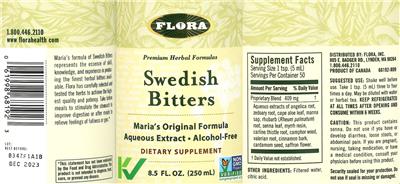
Swedish Bitters contains 13 active herbal ingredients, blended in a proprietary formula with water and citric acid. The main components are aqueous extracts of angelica root, zedoary root, aloe leaf, manna sap, rhubarb root, senna leaf, myrrh resin, carline thistle root, camphor wood, valerian root, cinnamon bark, cardamom seed, and saffron flower.
These are traditional digestive bitters, historically used to support stomach comfort and bowel function—most contain compounds that either stimulate digestive secretions or act as mild laxatives.
Does it work?
Strong evidence
Evidence for effectiveness varies by ingredient and use. Aloe is possibly effective for acne, obesity, diabetes, psoriasis, burns, and constipation.
Senna is likely effective for constipation and possibly effective for bowel prep. Camphor is likely effective for cough, acute pain, and itching.
Saffron is possibly effective for chemotherapy-related nerve damage and Alzheimer disease. For most other ingredients and uses in this blend—zedoary for diarrhea and high cholesterol, rhubarb for pancreatitis and menopausal symptoms, myrrh for various conditions, valerian for insomnia, and cinnamon for diabetes—the evidence we hold is insufficient to rate or absent.
Cardamom's evidence is insufficient across all listed uses. This is a traditional formula with limited modern clinical validation for its specific combination.
How safe is it?
Well-documented data
Most ingredients in this blend are generally well tolerated in food amounts, but several carry cautions at supplement doses. Aloe latex (the active compound in Cape Aloe here) can cause abdominal pain, cramps, and diarrhea orally; long-term overuse risks serious electrolyte loss and kidney damage.
Rhubarb and senna also cause cramping and diarrhea, and chronic overuse can deplete potassium and stress the kidneys. Valerian is generally well tolerated short-term but may cause drowsiness, dizziness, and headache; abrupt stopping after long use can trigger withdrawal symptoms like anxiety and insomnia.
Saffron may cause gastrointestinal upset, nausea, and sedation, and rarely anaphylaxis. Camphor is unsafe if swallowed in significant amounts and can cause serious neurological and heart effects.
Myrrh's oral safety at supplement doses is not well studied. Zedoary, manna, carline thistle, cinnamon, and cardamom have limited human safety data at medicinal doses.
Pregnancy: Aloe, zedoary, myrrh, camphor, and saffron are rated likely or possibly unsafe in pregnancy. Rhubarb and senna are possibly unsafe.
Valerian and cinnamon have insufficient data. Breastfeeding: Most ingredients lack adequate safety data; aloe, zedoary, myrrh, carline thistle, valerian, and saffron are best avoided.
Meds to double-check
Major interaction found
Before taking this product, check with your pharmacist if you take digoxin (Lanoxin) or heart medications—aloe carries a Major interaction risk. Also double-check blood thinners and antiplatelet drugs (warfarin, aspirin, clopidogrel), diabetes medications, water pills, other laxatives, birth control pills, sleep aids or alcohol, CNS depressants (like benzodiazepines), and cancer drugs like lapatinib or sorafenib.
Tell your pharmacist if you take any kidney-stressing or liver-stressing drugs.
The bottom line
Scorecard at a glanceFormula with limited ingredient disclosure with clinical evidence supporting its stated purpose. Major medication interactions have been identified, and safety information is well characterized.
Swedish Bitters is a traditional herbal blend with limited modern evidence for digestive support. If you take any prescription medications—especially blood thinners, diabetes drugs, heart medications, birth control, or CNS depressants—check each of your medications on this page before starting.
Avoid this product during pregnancy and breastfeeding. If you have kidney or liver disease, a heart condition, or are on water pills, talk to your pharmacist first.
Educational only — not medical advice; always confirm with your pharmacist. Our editorial policy · How we use AI
Assessment coverage: 13 of 13 active ingredients matched to our full ingredient reviews (monographs). Based on the product label dated Jan 23, 2025.
This Scorecard evaluates available label information, ingredient evidence, and known medication-safety considerations. It does not independently verify product identity, purity, potency, contamination, or manufacturing quality. How these ratings are computed
General information
Key facts about Swedish Bitters, straight from the product label.
| Brand | Flora |
|---|---|
| Barcode (UPC) | 061998681923 |
| Net contents | 8.5 Fluid Ounce(s); 250 mL |
| Market status | On market |
| Date entered into DSLD | Jan 23, 2025 |
| DSLD ID | 323244 |
| Product type | Botanical |
| Supplement form | Liquid |
| Dietary claims / uses | All Other, Structure/Function |
| Intended target group(s) | Adult (18 - 50 Years), Kosher |
Everything in this section is reproduced from the manufacturer’s own product label — it’s the label speaking, not HelloPharmacist. We show it so you can see exactly what the maker states; we don’t verify or endorse those statements.
Supplement Facts
The label details for Swedish Bitters by Flora, sourced from the NIH Dietary Supplement Label Database.
Supplement Facts
| Ingredient | Amount | % DV |
|---|---|---|
| Proprietary Blend | 409 mg | -- |
| Angelica Root Extract, Aqueous | 0 NP | -- |
| Zedoary Root Extract, Aqueous | 0 NP | -- |
| Cape Aloe Leaf Extract, Aqueous | 0 NP | -- |
| Manna Sap Extract, Aqueous | 0 NP | -- |
| Rhubarb Root Extract, Aqueous | 0 NP | -- |
| Senna Leaf Extract, Aqueous | 0 NP | -- |
| Myrrh Resin Extract, Aqueous | 0 NP | -- |
| Carline Thistle Root Extract, Aqueous | 0 NP | -- |
| Camphor Wood Extract, Aqueous | 0 NP | -- |
| Valerian Root Extract, Aqueous | 0 NP | -- |
| Cinnamon Bark Extract, Aqueous | 0 NP | -- |
| Cardamom Seed Extract, Aqueous | 0 NP | -- |
| Saffron Flower Extract, Aqueous | 0 NP | -- |
Other ingredients: Water, Filtered, Citric Acid
Tap any ingredient to jump to its full detail below.
These statements are the manufacturer’s wording, reproduced from the product label — the label is saying it, not HelloPharmacist. We don’t verify or endorse them.
Formulation
Maria's formula of Swedish Bitters represents the essence of skill, knowledge, and experience in producing the finest herbal bitters available. Flora has carefully selected and tested the herbs to achieve the highest quality and potency. Take before meals to stimulate the stomach to improve digestion of after meals to relieve feelings of fullness or gas.
Maria's original formula Aqueous extract
Alcohol-free
Non GMO Project Verified nongmoproject.org
FDA Disclaimer Statement
This statement has not been evaluated by the Food and Drug Administration. This product is not intended to diagnose, treat, cure, or prevent any disease.
General Statements
Flora Premium Herbal Formulas
FDA Statement of Identity
Dietary Supplement
Seals/Symbols
Non GMO Project Verified nongmoproject.org Kosher Check
Suggested/Recommended/Usage/Directions
Suggested use: Shake well before use. Take 1 tsp. (5 mL) three to four times a day. May be diluted with water or herbal tea.
Storage
Keep refrigerated at all times after opening and consume within 6 weeks.
Precautions
Caution: This product contains senna. Do not use if you have or develop diarrhea, loose stools, or abdominal pain. Security sealed for your protection. Do not use if seal is missing or damaged.
If you are pregnant, nursing, taking medication, or have a medical condition, consult your physician before using this product.
Formula
Kosher Check
Is this label outdated? Report a formula or label change and our pharmacy team will review it.
Swedish Bitters by Flora label
The label scan from the NIH Dietary Supplement Label Database. Tap to enlarge.
Label images are published by the NIH Dietary Supplement Label Database for the version of this product on file. Always read your actual product label.
View the full label (PDF)The Ingredients in Swedish Bitters by Flora
These are the 13 active ingredients this product is made of. Select any to open its full monograph.
Serving size5 mL Dosage formLiquid Servings per container50 Amounts shown are per serving.
Most supplement products combine several ingredients, and a medication can interact with the product through any one of them. Each ingredient below shows whether it has known drug interactions.
Proprietary Blend
- › Angelica Root Extract, Aqueous
- › Zedoary Root Extract, Aqueous
- › Cape Aloe Leaf Extract, Aqueous
- › Manna Sap Extract, Aqueous
- › Rhubarb Root Extract, Aqueous
- › Senna Leaf Extract, Aqueous
- › Myrrh Resin Extract, Aqueous
- › Carline Thistle Root Extract, Aqueous
- › Camphor Wood Extract, Aqueous
- › Valerian Root Extract, Aqueous
- › Cinnamon Bark Extract, Aqueous
- › Cardamom Seed Extract, Aqueous
- › Saffron Flower Extract, Aqueous
Other (inactive) ingredients: Water, Filtered, Citric Acid. These complete the product’s ingredient list but are not active constituents.
Swedish Bitters by Flora Drug Interactions
HelloPharmacist Interaction Report
Swedish Bitters by Flora is a 13-ingredient liquid blend with documented interactions affecting a large number of medications.
The most serious interaction we hold is Major severity: Cape Aloe can compound the risk of digoxin (Lanoxin) toxicity through potassium depletion, especially with overuse.
Read the full breakdown — every affected drug type, severity by severity
Moderate interactions span multiple drug types. Aloe also interacts with blood thinners (anticoagulants and antiplatelet drugs), diabetes medications, water pills (diuretics), other laxatives, and warfarin specifically.
Zedoary may raise levels of certain cancer drugs (CYP3A4 substrates like lapatinib, sorafenib, and gefitinib). Rhubarb, senna, and manna all carry similar risks with water pills, other laxatives, warfarin, and digoxin—chiefly through potassium loss or laxative effects that alter drug absorption.
Rhubarb also interacts with drugs that stress the kidneys (nephrotoxic drugs), the liver (hepatotoxic drugs), and cyclosporine (an immunosuppressant). Senna may reduce the effectiveness of birth control pills (estrogens).
Myrrh may lower blood sugar with diabetes drugs and may decrease warfarin effectiveness. Camphor and cinnamon carry hepatotoxic risks.
Valerian has additive sedation with CNS depressants (including alcohol and alprazolam), affects certain drug-metabolizing pathways (glucuronidated drugs), and has minor effects on other enzyme-metabolized medications. Saffron adds sedative effects with CNS depressants, may lower blood pressure additively, raises low-blood-sugar risk, and may slow caffeine clearance.
We could not check Angelica Root Extract or Carline Thistle Root Extract—we hold no interaction data for either. Cardamom showed no interactions in our data.
Altogether, these interactions span 1,443 individual medications. Use the search tool on this page to check your exact prescriptions before starting.
Check your own medications below · Editorial policy · How we use AI
Want to check YOUR meds against Swedish Bitters?
Ask about interactions with your drugs in plain English — “Can I take it with lisinopril?” — and we find you the answer in seconds, ingredient by ingredient.
Go to the checkerIngredients driving the most interactions
Individual Drug Interactions
The ingredients in Swedish Bitters interact with 1,463 drugs. Click any drug to see the details.
11 of the 13 ingredients in Swedish Bitters interact with drugs. Each result below shows which ingredient is responsible. Valerian Root Extract, Aqueous Rhubarb Root Extract, Aqueous Zedoary Root Extract, Aqueous Saffron Flower Extract, Aqueous Cape Aloe Leaf Extract, Aqueous Cinnamon Bark Extract, Aqueous Camphor Wood Extract, Aqueous Angelica Root Extract, Aqueous Senna Leaf Extract, Aqueous Manna Sap Extract, Aqueous Myrrh Resin Extract, Aqueous
DigoxinDigitek, Lanoxicaps, Lanoxin
How Digoxin interacts with Swedish Bitters — through 5 ingredients. Tap an ingredient for the detail:
Cape Aloe Leaf Extract, AqueousDigoxin (lanoxin) Major
Interaction Summary
Theoretically, aloe latex might increase the risk of adverse effects when taken with cardiac glycosides.
Read the full Cape Aloe Leaf Extract, Aqueous + Digoxin interactionManna Sap Extract, Aqueous Digoxin (lanoxin) Moderate
Interaction Summary
Theoretically, manna might increase the risk of adverse effects when taken with cardiac glycosides.
Read the full Manna Sap Extract, Aqueous + Digoxin interactionRhubarb Root Extract, AqueousDigoxin (lanoxin) Moderate
Interaction Summary
Theoretically, overuse of rhubarb might increase the risk of adverse effects when taken with digoxin.
Read the full Rhubarb Root Extract, Aqueous + Digoxin interactionValerian Root Extract, AqueousGlucuronidated Drugs Moderate
Interaction Summary
Valerian might weakly inhibit glucuronidation and increase concentrations of drugs metabolized by UGT1A1 and UGT2B7.
Read the full Valerian Root Extract, Aqueous + Digoxin interactionSenna Leaf Extract, AqueousDigoxin (lanoxin) Moderate
Interaction Summary
Theoretically, senna might increase the risk of adverse effects when taken with digoxin.
Read the full Senna Leaf Extract, Aqueous + Digoxin interaction6-mercaptopurinePurinethol
How 6-mercaptopurine interacts with Swedish Bitters — through 3 ingredients. Tap an ingredient for the detail:
Cinnamon Bark Extract, AqueousHepatotoxic Drugs Moderate
Interaction Summary
Theoretically, large doses of cassia cinnamon might cause additive effects when used with hepatotoxic drugs.
Read the full Cinnamon Bark Extract, Aqueous + 6-mercaptopurine interactionRhubarb Root Extract, AqueousHepatotoxic Drugs Moderate
Interaction Summary
Theoretically, concomitant use of rhubarb with potentially hepatotoxic drugs might increase the risk of developing liver damage.
Read the full Rhubarb Root Extract, Aqueous + 6-mercaptopurine interactionCamphor Wood Extract, AqueousHepatotoxic Drugs Moderate
Interaction Summary
Theoretically, concomitant use of camphor with other hepatotoxic drugs might increase the risk of liver damage.
Read the full Camphor Wood Extract, Aqueous + 6-mercaptopurine interactionAdo-trastuzumab EmtansineKadcyla
How Ado-trastuzumab Emtansine interacts with Swedish Bitters — through 2 ingredients. Tap an ingredient for the detail:
Zedoary Root Extract, AqueousCytochrome P450 3a4 (cyp3a4) Substrates Moderate
Interaction Summary
Theoretically, zedoary might increase levels of drugs metabolized by CYP3A4.
Read the full Zedoary Root Extract, Aqueous + Ado-trastuzumab Emtansine interactionValerian Root Extract, AqueousCytochrome P450 3a4 (cyp3a4) Substrates Minor
Interaction Summary
Valerian does not seem to have a clinically relevant effect on levels of drugs metabolized by CYP3A4.
Read the full Valerian Root Extract, Aqueous + Ado-trastuzumab Emtansine interactionAbacavir Sulfate, Dolutegravir, LamivudineTriumeq
How Abacavir Sulfate, Dolutegravir, Lamivudine interacts with Swedish Bitters — through 3 ingredients. Tap an ingredient for the detail:
Camphor Wood Extract, AqueousHepatotoxic Drugs Moderate
Interaction Summary
Theoretically, concomitant use of camphor with other hepatotoxic drugs might increase the risk of liver damage.
Read the full Camphor Wood Extract, Aqueous + Abacavir Sulfate, Dolutegravir, Lamivudine interactionCinnamon Bark Extract, AqueousHepatotoxic Drugs Moderate
Interaction Summary
Theoretically, large doses of cassia cinnamon might cause additive effects when used with hepatotoxic drugs.
Read the full Cinnamon Bark Extract, Aqueous + Abacavir Sulfate, Dolutegravir, Lamivudine interactionRhubarb Root Extract, AqueousHepatotoxic Drugs Moderate
Interaction Summary
Theoretically, concomitant use of rhubarb with potentially hepatotoxic drugs might increase the risk of developing liver damage.
Read the full Rhubarb Root Extract, Aqueous + Abacavir Sulfate, Dolutegravir, Lamivudine interactionAbacavir, LamivudineEpzicom
How Abacavir, Lamivudine interacts with Swedish Bitters — through 3 ingredients. Tap an ingredient for the detail:
Rhubarb Root Extract, AqueousHepatotoxic Drugs Moderate
Interaction Summary
Theoretically, concomitant use of rhubarb with potentially hepatotoxic drugs might increase the risk of developing liver damage.
Read the full Rhubarb Root Extract, Aqueous + Abacavir, Lamivudine interactionCamphor Wood Extract, AqueousHepatotoxic Drugs Moderate
Interaction Summary
Theoretically, concomitant use of camphor with other hepatotoxic drugs might increase the risk of liver damage.
Read the full Camphor Wood Extract, Aqueous + Abacavir, Lamivudine interactionCinnamon Bark Extract, AqueousHepatotoxic Drugs Moderate
Interaction Summary
Theoretically, large doses of cassia cinnamon might cause additive effects when used with hepatotoxic drugs.
Read the full Cinnamon Bark Extract, Aqueous + Abacavir, Lamivudine interactionAbciximabReoPro
How Abciximab interacts with Swedish Bitters — through 1 ingredient. Tap an ingredient for the detail:
Cape Aloe Leaf Extract, AqueousAnticoagulant/antiplatelet Drugs Moderate
Interaction Summary
Theoretically, aloe gel might increase the risk of bleeding when taken with anticoagulant or antiplatelet drugs.
Read the full Cape Aloe Leaf Extract, Aqueous + Abciximab interactionAbemaciclibVerzenio
How Abemaciclib interacts with Swedish Bitters — through 2 ingredients. Tap an ingredient for the detail:
Zedoary Root Extract, AqueousCytochrome P450 3a4 (cyp3a4) Substrates Moderate
Interaction Summary
Theoretically, zedoary might increase levels of drugs metabolized by CYP3A4.
Read the full Zedoary Root Extract, Aqueous + Abemaciclib interactionValerian Root Extract, AqueousCytochrome P450 3a4 (cyp3a4) Substrates Minor
Interaction Summary
Valerian does not seem to have a clinically relevant effect on levels of drugs metabolized by CYP3A4.
Read the full Valerian Root Extract, Aqueous + Abemaciclib interactionAbiraterone
How Abiraterone interacts with Swedish Bitters — through 5 ingredients. Tap an ingredient for the detail:
Cinnamon Bark Extract, AqueousHepatotoxic Drugs Moderate
Interaction Summary
Theoretically, large doses of cassia cinnamon might cause additive effects when used with hepatotoxic drugs.
Read the full Cinnamon Bark Extract, Aqueous + Abiraterone interactionCamphor Wood Extract, AqueousHepatotoxic Drugs Moderate
Interaction Summary
Theoretically, concomitant use of camphor with other hepatotoxic drugs might increase the risk of liver damage.
Read the full Camphor Wood Extract, Aqueous + Abiraterone interactionZedoary Root Extract, AqueousCytochrome P450 3a4 (cyp3a4) Substrates Moderate
Interaction Summary
Theoretically, zedoary might increase levels of drugs metabolized by CYP3A4.
Read the full Zedoary Root Extract, Aqueous + Abiraterone interactionRhubarb Root Extract, AqueousHepatotoxic Drugs Moderate
Interaction Summary
Theoretically, concomitant use of rhubarb with potentially hepatotoxic drugs might increase the risk of developing liver damage.
Read the full Rhubarb Root Extract, Aqueous + Abiraterone interactionValerian Root Extract, AqueousCytochrome P450 3a4 (cyp3a4) Substrates Minor
Interaction Summary
Valerian does not seem to have a clinically relevant effect on levels of drugs metabolized by CYP3A4.
Read the full Valerian Root Extract, Aqueous + Abiraterone interactionAbiraterone AcetateYonsa, Zytiga
How Abiraterone Acetate interacts with Swedish Bitters — through 5 ingredients. Tap an ingredient for the detail:
Rhubarb Root Extract, AqueousHepatotoxic Drugs Moderate
Interaction Summary
Theoretically, concomitant use of rhubarb with potentially hepatotoxic drugs might increase the risk of developing liver damage.
Read the full Rhubarb Root Extract, Aqueous + Abiraterone Acetate interactionZedoary Root Extract, AqueousCytochrome P450 3a4 (cyp3a4) Substrates Moderate
Interaction Summary
Theoretically, zedoary might increase levels of drugs metabolized by CYP3A4.
Read the full Zedoary Root Extract, Aqueous + Abiraterone Acetate interactionCinnamon Bark Extract, AqueousHepatotoxic Drugs Moderate
Interaction Summary
Theoretically, large doses of cassia cinnamon might cause additive effects when used with hepatotoxic drugs.
Read the full Cinnamon Bark Extract, Aqueous + Abiraterone Acetate interactionCamphor Wood Extract, AqueousHepatotoxic Drugs Moderate
Interaction Summary
Theoretically, concomitant use of camphor with other hepatotoxic drugs might increase the risk of liver damage.
Read the full Camphor Wood Extract, Aqueous + Abiraterone Acetate interactionValerian Root Extract, AqueousCytochrome P450 3a4 (cyp3a4) Substrates Minor
Interaction Summary
Valerian does not seem to have a clinically relevant effect on levels of drugs metabolized by CYP3A4.
Read the full Valerian Root Extract, Aqueous + Abiraterone Acetate interactionAbrocitinibCibinqo
How Abrocitinib interacts with Swedish Bitters — through 1 ingredient. Tap an ingredient for the detail:
Cape Aloe Leaf Extract, AqueousAnticoagulant/antiplatelet Drugs Moderate
Interaction Summary
Theoretically, aloe gel might increase the risk of bleeding when taken with anticoagulant or antiplatelet drugs.
Read the full Cape Aloe Leaf Extract, Aqueous + Abrocitinib interactionAcalabrutinibCalquence
How Acalabrutinib interacts with Swedish Bitters — through 2 ingredients. Tap an ingredient for the detail:
Zedoary Root Extract, AqueousCytochrome P450 3a4 (cyp3a4) Substrates Moderate
Interaction Summary
Theoretically, zedoary might increase levels of drugs metabolized by CYP3A4.
Read the full Zedoary Root Extract, Aqueous + Acalabrutinib interactionValerian Root Extract, AqueousCytochrome P450 3a4 (cyp3a4) Substrates Minor
Interaction Summary
Valerian does not seem to have a clinically relevant effect on levels of drugs metabolized by CYP3A4.
Read the full Valerian Root Extract, Aqueous + Acalabrutinib interactionAcarboseGlucobay, Prandase, Precose
How Acarbose interacts with Swedish Bitters — through 6 ingredients. Tap an ingredient for the detail:
Cinnamon Bark Extract, AqueousAntidiabetes Drugs, Hepatotoxic Drugs Moderate
Interaction Summary
Theoretically, cassia cinnamon may have additive effects with antidiabetes drugs.
Read the full Cinnamon Bark Extract, Aqueous + Acarbose interactionMyrrh Resin Extract, AqueousAntidiabetes Drugs Moderate
Interaction Summary
Theoretically, myrrh might increase the risk of hypoglycemia when taken with antidiabetes drugs.
Read the full Myrrh Resin Extract, Aqueous + Acarbose interactionCape Aloe Leaf Extract, AqueousAntidiabetes Drugs Moderate
Interaction Summary
Aloe might increase the risk of hypoglycemia when taken with antidiabetes drugs.
Read the full Cape Aloe Leaf Extract, Aqueous + Acarbose interactionCamphor Wood Extract, AqueousHepatotoxic Drugs Moderate
Interaction Summary
Theoretically, concomitant use of camphor with other hepatotoxic drugs might increase the risk of liver damage.
Read the full Camphor Wood Extract, Aqueous + Acarbose interactionSaffron Flower Extract, AqueousAntidiabetes Drugs Moderate
Interaction Summary
Theoretically, concomitant use of saffron with antidiabetes drugs might increase the risk of hypoglycemia.
Read the full Saffron Flower Extract, Aqueous + Acarbose interactionRhubarb Root Extract, AqueousHepatotoxic Drugs Moderate
Interaction Summary
Theoretically, concomitant use of rhubarb with potentially hepatotoxic drugs might increase the risk of developing liver damage.
Read the full Rhubarb Root Extract, Aqueous + Acarbose interactionAcebutololRhotral, Sectral
How Acebutolol interacts with Swedish Bitters — through 4 ingredients. Tap an ingredient for the detail:
Rhubarb Root Extract, AqueousHepatotoxic Drugs Moderate
Interaction Summary
Theoretically, concomitant use of rhubarb with potentially hepatotoxic drugs might increase the risk of developing liver damage.
Read the full Rhubarb Root Extract, Aqueous + Acebutolol interactionCinnamon Bark Extract, AqueousHepatotoxic Drugs Moderate
Interaction Summary
Theoretically, large doses of cassia cinnamon might cause additive effects when used with hepatotoxic drugs.
Read the full Cinnamon Bark Extract, Aqueous + Acebutolol interactionCamphor Wood Extract, AqueousHepatotoxic Drugs Moderate
Interaction Summary
Theoretically, concomitant use of camphor with other hepatotoxic drugs might increase the risk of liver damage.
Read the full Camphor Wood Extract, Aqueous + Acebutolol interactionSaffron Flower Extract, AqueousAntihypertensive Drugs Moderate
Interaction Summary
Theoretically, concomitant use of saffron with antihypertensive drugs might have additive effects.
Read the full Saffron Flower Extract, Aqueous + Acebutolol interactionAcenocoumarolSintrom
How Acenocoumarol interacts with Swedish Bitters — through 1 ingredient. Tap an ingredient for the detail:
Cape Aloe Leaf Extract, AqueousAnticoagulant/antiplatelet Drugs Moderate
Interaction Summary
Theoretically, aloe gel might increase the risk of bleeding when taken with anticoagulant or antiplatelet drugs.
Read the full Cape Aloe Leaf Extract, Aqueous + Acenocoumarol interactionAcepromazineAtravet
How Acepromazine interacts with Swedish Bitters — through 2 ingredients. Tap an ingredient for the detail:
Saffron Flower Extract, AqueousCns Depressants Moderate
Interaction Summary
Theoretically, concomitant use of saffron and CNS depressants might have additive sedative effects.
Read the full Saffron Flower Extract, Aqueous + Acepromazine interactionValerian Root Extract, AqueousCns Depressants Moderate
Interaction Summary
Valerian can have additive sedative effects when used concomitantly with CNS depressant drugs.
Read the full Valerian Root Extract, Aqueous + Acepromazine interactionAcetaminophenChildren's Tylenol, Children's Tylenol Meltaways, Tylenol, Tylenol Ex Strength
How Acetaminophen interacts with Swedish Bitters — through 6 ingredients. Tap an ingredient for the detail:
Valerian Root Extract, AqueousGlucuronidated Drugs Moderate
Interaction Summary
Valerian might weakly inhibit glucuronidation and increase concentrations of drugs metabolized by UGT1A1 and UGT2B7.
Read the full Valerian Root Extract, Aqueous + Acetaminophen interactionCinnamon Bark Extract, AqueousHepatotoxic Drugs Moderate
Interaction Summary
Theoretically, large doses of cassia cinnamon might cause additive effects when used with hepatotoxic drugs.
Read the full Cinnamon Bark Extract, Aqueous + Acetaminophen interactionAngelica Root Extract, AqueousCytochrome P450 1a2 (cyp1a2) Substrates Moderate
Interaction Summary
In vitro research shows that ashitaba extract inhibits cytochrome P450 (CYP) 1A2.
Read the full Angelica Root Extract, Aqueous + Acetaminophen interactionRhubarb Root Extract, AqueousHepatotoxic Drugs, Nephrotoxic Drugs Moderate
Interaction Summary
Theoretically, concomitant use of rhubarb with potentially hepatotoxic drugs might increase the risk of developing liver damage.
Read the full Rhubarb Root Extract, Aqueous + Acetaminophen interactionCamphor Wood Extract, AqueousHepatotoxic Drugs Moderate
Interaction Summary
Theoretically, concomitant use of camphor with other hepatotoxic drugs might increase the risk of liver damage.
Read the full Camphor Wood Extract, Aqueous + Acetaminophen interactionCape Aloe Leaf Extract, AqueousCytochrome P450 1a2 (cyp1a2) Substrates Minor
Interaction Summary
Theoretically, aloe might decrease the levels and clinical effects of CYP1A2 substrates.
Read the full Cape Aloe Leaf Extract, Aqueous + Acetaminophen interactionAcetaminophen, AspirinGemnisyn
How Acetaminophen, Aspirin interacts with Swedish Bitters — through 6 ingredients. Tap an ingredient for the detail:
Camphor Wood Extract, AqueousHepatotoxic Drugs Moderate
Interaction Summary
Theoretically, concomitant use of camphor with other hepatotoxic drugs might increase the risk of liver damage.
Read the full Camphor Wood Extract, Aqueous + Acetaminophen, Aspirin interactionCape Aloe Leaf Extract, AqueousAnticoagulant/antiplatelet Drugs, Cytochrome P450 1a2 (cyp1a2) Substrates Moderate
Interaction Summary
Theoretically, aloe gel might increase the risk of bleeding when taken with anticoagulant or antiplatelet drugs.
Read the full Cape Aloe Leaf Extract, Aqueous + Acetaminophen, Aspirin interactionAngelica Root Extract, AqueousCytochrome P450 1a2 (cyp1a2) Substrates Moderate
Interaction Summary
In vitro research shows that ashitaba extract inhibits cytochrome P450 (CYP) 1A2.
Read the full Angelica Root Extract, Aqueous + Acetaminophen, Aspirin interactionValerian Root Extract, AqueousGlucuronidated Drugs Moderate
Interaction Summary
Valerian might weakly inhibit glucuronidation and increase concentrations of drugs metabolized by UGT1A1 and UGT2B7.
Read the full Valerian Root Extract, Aqueous + Acetaminophen, Aspirin interactionCinnamon Bark Extract, AqueousHepatotoxic Drugs Moderate
Interaction Summary
Theoretically, large doses of cassia cinnamon might cause additive effects when used with hepatotoxic drugs.
Read the full Cinnamon Bark Extract, Aqueous + Acetaminophen, Aspirin interactionRhubarb Root Extract, AqueousNephrotoxic Drugs, Hepatotoxic Drugs Moderate
Interaction Summary
Theoretically, long-term use of anthraquinones from rhubarb might increase the risk of nephrotoxicity when used with nephrotoxic drugs.
Read the full Rhubarb Root Extract, Aqueous + Acetaminophen, Aspirin interactionAcetaminophen, Aspirin, CaffeineExcedrin, Excedrin Extra Strength, Excedrin Migraine
How Acetaminophen, Aspirin, Caffeine interacts with Swedish Bitters — through 8 ingredients. Tap an ingredient for the detail:
Rhubarb Root Extract, AqueousHepatotoxic Drugs, Nephrotoxic Drugs Moderate
Interaction Summary
Theoretically, concomitant use of rhubarb with potentially hepatotoxic drugs might increase the risk of developing liver damage.
Read the full Rhubarb Root Extract, Aqueous + Acetaminophen, Aspirin, Caffeine interactionZedoary Root Extract, AqueousCytochrome P450 3a4 (cyp3a4) Substrates Moderate
Interaction Summary
Theoretically, zedoary might increase levels of drugs metabolized by CYP3A4.
Read the full Zedoary Root Extract, Aqueous + Acetaminophen, Aspirin, Caffeine interactionCamphor Wood Extract, AqueousHepatotoxic Drugs Moderate
Interaction Summary
Theoretically, concomitant use of camphor with other hepatotoxic drugs might increase the risk of liver damage.
Read the full Camphor Wood Extract, Aqueous + Acetaminophen, Aspirin, Caffeine interactionCape Aloe Leaf Extract, AqueousAnticoagulant/antiplatelet Drugs, Cytochrome P450 1a2 (cyp1a2) Substrates Moderate
Interaction Summary
Theoretically, aloe gel might increase the risk of bleeding when taken with anticoagulant or antiplatelet drugs.
Read the full Cape Aloe Leaf Extract, Aqueous + Acetaminophen, Aspirin, Caffeine interactionValerian Root Extract, AqueousGlucuronidated Drugs, Cytochrome P450 3a4 (cyp3a4) Substrates Moderate
Interaction Summary
Valerian might weakly inhibit glucuronidation and increase concentrations of drugs metabolized by UGT1A1 and UGT2B7.
Read the full Valerian Root Extract, Aqueous + Acetaminophen, Aspirin, Caffeine interactionCinnamon Bark Extract, AqueousHepatotoxic Drugs Moderate
Interaction Summary
Theoretically, large doses of cassia cinnamon might cause additive effects when used with hepatotoxic drugs.
Read the full Cinnamon Bark Extract, Aqueous + Acetaminophen, Aspirin, Caffeine interactionSaffron Flower Extract, AqueousCaffeine Moderate
Interaction Summary
Theoretically, saffron might inhibit the metabolism of caffeine.
Read the full Saffron Flower Extract, Aqueous + Acetaminophen, Aspirin, Caffeine interactionAngelica Root Extract, AqueousCytochrome P450 1a2 (cyp1a2) Substrates Moderate
Interaction Summary
In vitro research shows that ashitaba extract inhibits cytochrome P450 (CYP) 1A2.
Read the full Angelica Root Extract, Aqueous + Acetaminophen, Aspirin, Caffeine interactionAcetaminophen, Brompheniramine, PhenylpropanolamineDimetapp Cold and Flu
How Acetaminophen, Brompheniramine, Phenylpropanolamine interacts with Swedish Bitters — through 6 ingredients. Tap an ingredient for the detail:
Valerian Root Extract, AqueousGlucuronidated Drugs Moderate
Interaction Summary
Valerian might weakly inhibit glucuronidation and increase concentrations of drugs metabolized by UGT1A1 and UGT2B7.
Read the full Valerian Root Extract, Aqueous + Acetaminophen, Brompheniramine, Phenylpropanolamine interactionCinnamon Bark Extract, AqueousHepatotoxic Drugs Moderate
Interaction Summary
Theoretically, large doses of cassia cinnamon might cause additive effects when used with hepatotoxic drugs.
Read the full Cinnamon Bark Extract, Aqueous + Acetaminophen, Brompheniramine, Phenylpropanolamine interactionAngelica Root Extract, AqueousCytochrome P450 1a2 (cyp1a2) Substrates Moderate
Interaction Summary
In vitro research shows that ashitaba extract inhibits cytochrome P450 (CYP) 1A2.
Read the full Angelica Root Extract, Aqueous + Acetaminophen, Brompheniramine, Phenylpropanolamine interactionRhubarb Root Extract, AqueousNephrotoxic Drugs, Hepatotoxic Drugs Moderate
Interaction Summary
Theoretically, long-term use of anthraquinones from rhubarb might increase the risk of nephrotoxicity when used with nephrotoxic drugs.
Read the full Rhubarb Root Extract, Aqueous + Acetaminophen, Brompheniramine, Phenylpropanolamine interactionCamphor Wood Extract, AqueousHepatotoxic Drugs Moderate
Interaction Summary
Theoretically, concomitant use of camphor with other hepatotoxic drugs might increase the risk of liver damage.
Read the full Camphor Wood Extract, Aqueous + Acetaminophen, Brompheniramine, Phenylpropanolamine interactionCape Aloe Leaf Extract, AqueousCytochrome P450 1a2 (cyp1a2) Substrates Minor
Interaction Summary
Theoretically, aloe might decrease the levels and clinical effects of CYP1A2 substrates.
Read the full Cape Aloe Leaf Extract, Aqueous + Acetaminophen, Brompheniramine, Phenylpropanolamine interactionAcetaminophen, ButalbitalAxocet, Bancap, Bucet, Butex Forte, Esgic CF, Orbivan CF +5 more
How Acetaminophen, Butalbital interacts with Swedish Bitters — through 6 ingredients. Tap an ingredient for the detail:
Camphor Wood Extract, AqueousHepatotoxic Drugs Moderate
Interaction Summary
Theoretically, concomitant use of camphor with other hepatotoxic drugs might increase the risk of liver damage.
Read the full Camphor Wood Extract, Aqueous + Acetaminophen, Butalbital interactionAngelica Root Extract, AqueousCytochrome P450 1a2 (cyp1a2) Substrates Moderate
Interaction Summary
In vitro research shows that ashitaba extract inhibits cytochrome P450 (CYP) 1A2.
Read the full Angelica Root Extract, Aqueous + Acetaminophen, Butalbital interactionValerian Root Extract, AqueousGlucuronidated Drugs Moderate
Interaction Summary
Valerian might weakly inhibit glucuronidation and increase concentrations of drugs metabolized by UGT1A1 and UGT2B7.
Read the full Valerian Root Extract, Aqueous + Acetaminophen, Butalbital interactionCinnamon Bark Extract, AqueousHepatotoxic Drugs Moderate
Interaction Summary
Theoretically, large doses of cassia cinnamon might cause additive effects when used with hepatotoxic drugs.
Read the full Cinnamon Bark Extract, Aqueous + Acetaminophen, Butalbital interactionRhubarb Root Extract, AqueousHepatotoxic Drugs, Nephrotoxic Drugs Moderate
Interaction Summary
Theoretically, concomitant use of rhubarb with potentially hepatotoxic drugs might increase the risk of developing liver damage.
Read the full Rhubarb Root Extract, Aqueous + Acetaminophen, Butalbital interactionCape Aloe Leaf Extract, AqueousCytochrome P450 1a2 (cyp1a2) Substrates Minor
Interaction Summary
Theoretically, aloe might decrease the levels and clinical effects of CYP1A2 substrates.
Read the full Cape Aloe Leaf Extract, Aqueous + Acetaminophen, Butalbital interactionAcetaminophen, Butalbital, CaffeineEsgic, Esgic Plus, Fiogesic, Fioricet, Repan, Tecnal +1 more
How Acetaminophen, Butalbital, Caffeine interacts with Swedish Bitters — through 8 ingredients. Tap an ingredient for the detail:
Rhubarb Root Extract, AqueousNephrotoxic Drugs, Hepatotoxic Drugs Moderate
Interaction Summary
Theoretically, long-term use of anthraquinones from rhubarb might increase the risk of nephrotoxicity when used with nephrotoxic drugs.
Read the full Rhubarb Root Extract, Aqueous + Acetaminophen, Butalbital, Caffeine interactionZedoary Root Extract, AqueousCytochrome P450 3a4 (cyp3a4) Substrates Moderate
Interaction Summary
Theoretically, zedoary might increase levels of drugs metabolized by CYP3A4.
Read the full Zedoary Root Extract, Aqueous + Acetaminophen, Butalbital, Caffeine interactionCamphor Wood Extract, AqueousHepatotoxic Drugs Moderate
Interaction Summary
Theoretically, concomitant use of camphor with other hepatotoxic drugs might increase the risk of liver damage.
Read the full Camphor Wood Extract, Aqueous + Acetaminophen, Butalbital, Caffeine interactionValerian Root Extract, AqueousGlucuronidated Drugs, Cytochrome P450 3a4 (cyp3a4) Substrates Moderate
Interaction Summary
Valerian might weakly inhibit glucuronidation and increase concentrations of drugs metabolized by UGT1A1 and UGT2B7.
Read the full Valerian Root Extract, Aqueous + Acetaminophen, Butalbital, Caffeine interactionCinnamon Bark Extract, AqueousHepatotoxic Drugs Moderate
Interaction Summary
Theoretically, large doses of cassia cinnamon might cause additive effects when used with hepatotoxic drugs.
Read the full Cinnamon Bark Extract, Aqueous + Acetaminophen, Butalbital, Caffeine interactionAngelica Root Extract, AqueousCytochrome P450 1a2 (cyp1a2) Substrates Moderate
Interaction Summary
In vitro research shows that ashitaba extract inhibits cytochrome P450 (CYP) 1A2.
Read the full Angelica Root Extract, Aqueous + Acetaminophen, Butalbital, Caffeine interactionSaffron Flower Extract, AqueousCaffeine Moderate
Interaction Summary
Theoretically, saffron might inhibit the metabolism of caffeine.
Read the full Saffron Flower Extract, Aqueous + Acetaminophen, Butalbital, Caffeine interactionCape Aloe Leaf Extract, AqueousCytochrome P450 1a2 (cyp1a2) Substrates Minor
Interaction Summary
Theoretically, aloe might decrease the levels and clinical effects of CYP1A2 substrates.
Read the full Cape Aloe Leaf Extract, Aqueous + Acetaminophen, Butalbital, Caffeine interactionAcetaminophen, Butalbital, Caffeine, CodeineEsgic with Codeine, Fioricet w/ Codeine
How Acetaminophen, Butalbital, Caffeine, Codeine interacts with Swedish Bitters — through 8 ingredients. Tap an ingredient for the detail:
Saffron Flower Extract, AqueousCaffeine, Cns Depressants Moderate
Interaction Summary
Theoretically, saffron might inhibit the metabolism of caffeine.
Read the full Saffron Flower Extract, Aqueous + Acetaminophen, Butalbital, Caffeine, Codeine interactionValerian Root Extract, AqueousCns Depressants, Glucuronidated Drugs +2 Moderate
Interaction Summary
Valerian can have additive sedative effects when used concomitantly with CNS depressant drugs.
Read the full Valerian Root Extract, Aqueous + Acetaminophen, Butalbital, Caffeine, Codeine interactionCinnamon Bark Extract, AqueousHepatotoxic Drugs Moderate
Interaction Summary
Theoretically, large doses of cassia cinnamon might cause additive effects when used with hepatotoxic drugs.
Read the full Cinnamon Bark Extract, Aqueous + Acetaminophen, Butalbital, Caffeine, Codeine interactionAngelica Root Extract, AqueousCytochrome P450 1a2 (cyp1a2) Substrates Moderate
Interaction Summary
In vitro research shows that ashitaba extract inhibits cytochrome P450 (CYP) 1A2.
Read the full Angelica Root Extract, Aqueous + Acetaminophen, Butalbital, Caffeine, Codeine interactionZedoary Root Extract, AqueousCytochrome P450 3a4 (cyp3a4) Substrates Moderate
Interaction Summary
Theoretically, zedoary might increase levels of drugs metabolized by CYP3A4.
Read the full Zedoary Root Extract, Aqueous + Acetaminophen, Butalbital, Caffeine, Codeine interactionRhubarb Root Extract, AqueousNephrotoxic Drugs, Hepatotoxic Drugs Moderate
Interaction Summary
Theoretically, long-term use of anthraquinones from rhubarb might increase the risk of nephrotoxicity when used with nephrotoxic drugs.
Read the full Rhubarb Root Extract, Aqueous + Acetaminophen, Butalbital, Caffeine, Codeine interactionCamphor Wood Extract, AqueousHepatotoxic Drugs Moderate
Interaction Summary
Theoretically, concomitant use of camphor with other hepatotoxic drugs might increase the risk of liver damage.
Read the full Camphor Wood Extract, Aqueous + Acetaminophen, Butalbital, Caffeine, Codeine interactionCape Aloe Leaf Extract, AqueousCytochrome P450 1a2 (cyp1a2) Substrates Minor
Interaction Summary
Theoretically, aloe might decrease the levels and clinical effects of CYP1A2 substrates.
Read the full Cape Aloe Leaf Extract, Aqueous + Acetaminophen, Butalbital, Caffeine, Codeine interactionAcetaminophen, Butalbital, CodeineBancap w/ Codeine
How Acetaminophen, Butalbital, Codeine interacts with Swedish Bitters — through 7 ingredients. Tap an ingredient for the detail:
Saffron Flower Extract, AqueousCns Depressants Moderate
Interaction Summary
Theoretically, concomitant use of saffron and CNS depressants might have additive sedative effects.
Read the full Saffron Flower Extract, Aqueous + Acetaminophen, Butalbital, Codeine interactionCamphor Wood Extract, AqueousHepatotoxic Drugs Moderate
Interaction Summary
Theoretically, concomitant use of camphor with other hepatotoxic drugs might increase the risk of liver damage.
Read the full Camphor Wood Extract, Aqueous + Acetaminophen, Butalbital, Codeine interactionValerian Root Extract, AqueousGlucuronidated Drugs, Cns Depressants +1 Moderate
Interaction Summary
Valerian might weakly inhibit glucuronidation and increase concentrations of drugs metabolized by UGT1A1 and UGT2B7.
Read the full Valerian Root Extract, Aqueous + Acetaminophen, Butalbital, Codeine interactionCinnamon Bark Extract, AqueousHepatotoxic Drugs Moderate
Interaction Summary
Theoretically, large doses of cassia cinnamon might cause additive effects when used with hepatotoxic drugs.
Read the full Cinnamon Bark Extract, Aqueous + Acetaminophen, Butalbital, Codeine interactionAngelica Root Extract, AqueousCytochrome P450 1a2 (cyp1a2) Substrates Moderate
Interaction Summary
In vitro research shows that ashitaba extract inhibits cytochrome P450 (CYP) 1A2.
Read the full Angelica Root Extract, Aqueous + Acetaminophen, Butalbital, Codeine interactionRhubarb Root Extract, AqueousHepatotoxic Drugs, Nephrotoxic Drugs Moderate
Interaction Summary
Theoretically, concomitant use of rhubarb with potentially hepatotoxic drugs might increase the risk of developing liver damage.
Read the full Rhubarb Root Extract, Aqueous + Acetaminophen, Butalbital, Codeine interactionCape Aloe Leaf Extract, AqueousCytochrome P450 1a2 (cyp1a2) Substrates Minor
Interaction Summary
Theoretically, aloe might decrease the levels and clinical effects of CYP1A2 substrates.
Read the full Cape Aloe Leaf Extract, Aqueous + Acetaminophen, Butalbital, Codeine interactionAcetaminophen, Butalbital, Codeine PhosphatePhrenilin #3
How Acetaminophen, Butalbital, Codeine Phosphate interacts with Swedish Bitters — through 7 ingredients. Tap an ingredient for the detail:
Rhubarb Root Extract, AqueousNephrotoxic Drugs, Hepatotoxic Drugs Moderate
Interaction Summary
Theoretically, long-term use of anthraquinones from rhubarb might increase the risk of nephrotoxicity when used with nephrotoxic drugs.
Read the full Rhubarb Root Extract, Aqueous + Acetaminophen, Butalbital, Codeine Phosphate interactionSaffron Flower Extract, AqueousCns Depressants Moderate
Interaction Summary
Theoretically, concomitant use of saffron and CNS depressants might have additive sedative effects.
Read the full Saffron Flower Extract, Aqueous + Acetaminophen, Butalbital, Codeine Phosphate interactionCamphor Wood Extract, AqueousHepatotoxic Drugs Moderate
Interaction Summary
Theoretically, concomitant use of camphor with other hepatotoxic drugs might increase the risk of liver damage.
Read the full Camphor Wood Extract, Aqueous + Acetaminophen, Butalbital, Codeine Phosphate interactionValerian Root Extract, AqueousCytochrome P450 2d6 (cyp2d6) Substrates, Glucuronidated Drugs +1 Moderate
Interaction Summary
Valerian does not seem to have a clinically relevant effect on levels of drugs metabolized by CYP2D6.
Read the full Valerian Root Extract, Aqueous + Acetaminophen, Butalbital, Codeine Phosphate interactionCinnamon Bark Extract, AqueousHepatotoxic Drugs Moderate
Interaction Summary
Theoretically, large doses of cassia cinnamon might cause additive effects when used with hepatotoxic drugs.
Read the full Cinnamon Bark Extract, Aqueous + Acetaminophen, Butalbital, Codeine Phosphate interactionAngelica Root Extract, AqueousCytochrome P450 1a2 (cyp1a2) Substrates Moderate
Interaction Summary
In vitro research shows that ashitaba extract inhibits cytochrome P450 (CYP) 1A2.
Read the full Angelica Root Extract, Aqueous + Acetaminophen, Butalbital, Codeine Phosphate interactionCape Aloe Leaf Extract, AqueousCytochrome P450 1a2 (cyp1a2) Substrates Minor
Interaction Summary
Theoretically, aloe might decrease the levels and clinical effects of CYP1A2 substrates.
Read the full Cape Aloe Leaf Extract, Aqueous + Acetaminophen, Butalbital, Codeine Phosphate interactionAcetaminophen, Caffeine, Chlorpheniramine, Hydrocodone, PhenylephrineHycomine Compound
How Acetaminophen, Caffeine, Chlorpheniramine, Hydrocodone, Phenylephrine interacts with Swedish Bitters — through 8 ingredients. Tap an ingredient for the detail:
Saffron Flower Extract, AqueousCaffeine, Cns Depressants Moderate
Interaction Summary
Theoretically, saffron might inhibit the metabolism of caffeine.
Read the full Saffron Flower Extract, Aqueous + Acetaminophen, Caffeine, Chlorpheniramine, Hydrocodone, Phenylephrine interactionValerian Root Extract, AqueousCns Depressants, Cytochrome P450 2d6 (cyp2d6) Substrates +2 Moderate
Interaction Summary
Valerian can have additive sedative effects when used concomitantly with CNS depressant drugs.
Read the full Valerian Root Extract, Aqueous + Acetaminophen, Caffeine, Chlorpheniramine, Hydrocodone, Phenylephrine interactionAngelica Root Extract, AqueousCytochrome P450 1a2 (cyp1a2) Substrates Moderate
Interaction Summary
In vitro research shows that ashitaba extract inhibits cytochrome P450 (CYP) 1A2.
Read the full Angelica Root Extract, Aqueous + Acetaminophen, Caffeine, Chlorpheniramine, Hydrocodone, Phenylephrine interactionCinnamon Bark Extract, AqueousHepatotoxic Drugs Moderate
Interaction Summary
Theoretically, large doses of cassia cinnamon might cause additive effects when used with hepatotoxic drugs.
Read the full Cinnamon Bark Extract, Aqueous + Acetaminophen, Caffeine, Chlorpheniramine, Hydrocodone, Phenylephrine interactionRhubarb Root Extract, AqueousHepatotoxic Drugs, Nephrotoxic Drugs Moderate
Interaction Summary
Theoretically, concomitant use of rhubarb with potentially hepatotoxic drugs might increase the risk of developing liver damage.
Read the full Rhubarb Root Extract, Aqueous + Acetaminophen, Caffeine, Chlorpheniramine, Hydrocodone, Phenylephrine interactionZedoary Root Extract, AqueousCytochrome P450 3a4 (cyp3a4) Substrates Moderate
Interaction Summary
Theoretically, zedoary might increase levels of drugs metabolized by CYP3A4.
Read the full Zedoary Root Extract, Aqueous + Acetaminophen, Caffeine, Chlorpheniramine, Hydrocodone, Phenylephrine interactionCamphor Wood Extract, AqueousHepatotoxic Drugs Moderate
Interaction Summary
Theoretically, concomitant use of camphor with other hepatotoxic drugs might increase the risk of liver damage.
Read the full Camphor Wood Extract, Aqueous + Acetaminophen, Caffeine, Chlorpheniramine, Hydrocodone, Phenylephrine interactionCape Aloe Leaf Extract, AqueousCytochrome P450 1a2 (cyp1a2) Substrates Minor
Interaction Summary
Theoretically, aloe might decrease the levels and clinical effects of CYP1A2 substrates.
Read the full Cape Aloe Leaf Extract, Aqueous + Acetaminophen, Caffeine, Chlorpheniramine, Hydrocodone, Phenylephrine interactionAcetaminophen, Caffeine, CodeineGesic C15, Gesic C30, Gesic C8, Lenoltec 1, Lenoltec 2, Lenoltec 3 +1 more
How Acetaminophen, Caffeine, Codeine interacts with Swedish Bitters — through 8 ingredients. Tap an ingredient for the detail:
Saffron Flower Extract, AqueousCns Depressants, Caffeine Moderate
Interaction Summary
Theoretically, concomitant use of saffron and CNS depressants might have additive sedative effects.
Read the full Saffron Flower Extract, Aqueous + Acetaminophen, Caffeine, Codeine interactionCamphor Wood Extract, AqueousHepatotoxic Drugs Moderate
Interaction Summary
Theoretically, concomitant use of camphor with other hepatotoxic drugs might increase the risk of liver damage.
Read the full Camphor Wood Extract, Aqueous + Acetaminophen, Caffeine, Codeine interactionValerian Root Extract, AqueousGlucuronidated Drugs, Cytochrome P450 2d6 (cyp2d6) Substrates +2 Moderate
Interaction Summary
Valerian might weakly inhibit glucuronidation and increase concentrations of drugs metabolized by UGT1A1 and UGT2B7.
Read the full Valerian Root Extract, Aqueous + Acetaminophen, Caffeine, Codeine interactionCinnamon Bark Extract, AqueousHepatotoxic Drugs Moderate
Interaction Summary
Theoretically, large doses of cassia cinnamon might cause additive effects when used with hepatotoxic drugs.
Read the full Cinnamon Bark Extract, Aqueous + Acetaminophen, Caffeine, Codeine interactionAngelica Root Extract, AqueousCytochrome P450 1a2 (cyp1a2) Substrates Moderate
Interaction Summary
In vitro research shows that ashitaba extract inhibits cytochrome P450 (CYP) 1A2.
Read the full Angelica Root Extract, Aqueous + Acetaminophen, Caffeine, Codeine interactionRhubarb Root Extract, AqueousNephrotoxic Drugs, Hepatotoxic Drugs Moderate
Interaction Summary
Theoretically, long-term use of anthraquinones from rhubarb might increase the risk of nephrotoxicity when used with nephrotoxic drugs.
Read the full Rhubarb Root Extract, Aqueous + Acetaminophen, Caffeine, Codeine interactionZedoary Root Extract, AqueousCytochrome P450 3a4 (cyp3a4) Substrates Moderate
Interaction Summary
Theoretically, zedoary might increase levels of drugs metabolized by CYP3A4.
Read the full Zedoary Root Extract, Aqueous + Acetaminophen, Caffeine, Codeine interactionCape Aloe Leaf Extract, AqueousCytochrome P450 1a2 (cyp1a2) Substrates Minor
Interaction Summary
Theoretically, aloe might decrease the levels and clinical effects of CYP1A2 substrates.
Read the full Cape Aloe Leaf Extract, Aqueous + Acetaminophen, Caffeine, Codeine interactionAcetaminophen, Caffeine, Codeine, SalicylamideCodalan No.1, Codalan No.2, Codalan No.3
How Acetaminophen, Caffeine, Codeine, Salicylamide interacts with Swedish Bitters — through 8 ingredients. Tap an ingredient for the detail:
Zedoary Root Extract, AqueousCytochrome P450 3a4 (cyp3a4) Substrates Moderate
Interaction Summary
Theoretically, zedoary might increase levels of drugs metabolized by CYP3A4.
Read the full Zedoary Root Extract, Aqueous + Acetaminophen, Caffeine, Codeine, Salicylamide interactionRhubarb Root Extract, AqueousNephrotoxic Drugs, Hepatotoxic Drugs Moderate
Interaction Summary
Theoretically, long-term use of anthraquinones from rhubarb might increase the risk of nephrotoxicity when used with nephrotoxic drugs.
Read the full Rhubarb Root Extract, Aqueous + Acetaminophen, Caffeine, Codeine, Salicylamide interactionCamphor Wood Extract, AqueousHepatotoxic Drugs Moderate
Interaction Summary
Theoretically, concomitant use of camphor with other hepatotoxic drugs might increase the risk of liver damage.
Read the full Camphor Wood Extract, Aqueous + Acetaminophen, Caffeine, Codeine, Salicylamide interactionSaffron Flower Extract, AqueousCns Depressants, Caffeine Moderate
Interaction Summary
Theoretically, concomitant use of saffron and CNS depressants might have additive sedative effects.
Read the full Saffron Flower Extract, Aqueous + Acetaminophen, Caffeine, Codeine, Salicylamide interactionValerian Root Extract, AqueousCytochrome P450 3a4 (cyp3a4) Substrates, Cytochrome P450 2d6 (cyp2d6) Substrates +2 Moderate
Interaction Summary
Valerian does not seem to have a clinically relevant effect on levels of drugs metabolized by CYP3A4.
Read the full Valerian Root Extract, Aqueous + Acetaminophen, Caffeine, Codeine, Salicylamide interactionCinnamon Bark Extract, AqueousHepatotoxic Drugs Moderate
Interaction Summary
Theoretically, large doses of cassia cinnamon might cause additive effects when used with hepatotoxic drugs.
Read the full Cinnamon Bark Extract, Aqueous + Acetaminophen, Caffeine, Codeine, Salicylamide interactionAngelica Root Extract, AqueousCytochrome P450 1a2 (cyp1a2) Substrates Moderate
Interaction Summary
In vitro research shows that ashitaba extract inhibits cytochrome P450 (CYP) 1A2.
Read the full Angelica Root Extract, Aqueous + Acetaminophen, Caffeine, Codeine, Salicylamide interactionCape Aloe Leaf Extract, AqueousCytochrome P450 1a2 (cyp1a2) Substrates Minor
Interaction Summary
Theoretically, aloe might decrease the levels and clinical effects of CYP1A2 substrates.
Read the full Cape Aloe Leaf Extract, Aqueous + Acetaminophen, Caffeine, Codeine, Salicylamide interactionAcetaminophen, Caffeine, DihydrocodeineDHC Plus, Panlor DC, Panlor SS
How Acetaminophen, Caffeine, Dihydrocodeine interacts with Swedish Bitters — through 8 ingredients. Tap an ingredient for the detail:
Saffron Flower Extract, AqueousCaffeine, Cns Depressants Moderate
Interaction Summary
Theoretically, saffron might inhibit the metabolism of caffeine.
Read the full Saffron Flower Extract, Aqueous + Acetaminophen, Caffeine, Dihydrocodeine interactionValerian Root Extract, AqueousCns Depressants, Cytochrome P450 2d6 (cyp2d6) Substrates +2 Moderate
Interaction Summary
Valerian can have additive sedative effects when used concomitantly with CNS depressant drugs.
Read the full Valerian Root Extract, Aqueous + Acetaminophen, Caffeine, Dihydrocodeine interactionAngelica Root Extract, AqueousCytochrome P450 1a2 (cyp1a2) Substrates Moderate
Interaction Summary
In vitro research shows that ashitaba extract inhibits cytochrome P450 (CYP) 1A2.
Read the full Angelica Root Extract, Aqueous + Acetaminophen, Caffeine, Dihydrocodeine interactionCinnamon Bark Extract, AqueousHepatotoxic Drugs Moderate
Interaction Summary
Theoretically, large doses of cassia cinnamon might cause additive effects when used with hepatotoxic drugs.
Read the full Cinnamon Bark Extract, Aqueous + Acetaminophen, Caffeine, Dihydrocodeine interactionRhubarb Root Extract, AqueousHepatotoxic Drugs, Nephrotoxic Drugs Moderate
Interaction Summary
Theoretically, concomitant use of rhubarb with potentially hepatotoxic drugs might increase the risk of developing liver damage.
Read the full Rhubarb Root Extract, Aqueous + Acetaminophen, Caffeine, Dihydrocodeine interactionZedoary Root Extract, AqueousCytochrome P450 3a4 (cyp3a4) Substrates Moderate
Interaction Summary
Theoretically, zedoary might increase levels of drugs metabolized by CYP3A4.
Read the full Zedoary Root Extract, Aqueous + Acetaminophen, Caffeine, Dihydrocodeine interactionCamphor Wood Extract, AqueousHepatotoxic Drugs Moderate
Interaction Summary
Theoretically, concomitant use of camphor with other hepatotoxic drugs might increase the risk of liver damage.
Read the full Camphor Wood Extract, Aqueous + Acetaminophen, Caffeine, Dihydrocodeine interactionCape Aloe Leaf Extract, AqueousCytochrome P450 1a2 (cyp1a2) Substrates Minor
Interaction Summary
Theoretically, aloe might decrease the levels and clinical effects of CYP1A2 substrates.
Read the full Cape Aloe Leaf Extract, Aqueous + Acetaminophen, Caffeine, Dihydrocodeine interactionAcetaminophen, Caffeine, IsomethepteneMigralam
How Acetaminophen, Caffeine, Isometheptene interacts with Swedish Bitters — through 8 ingredients. Tap an ingredient for the detail:
Camphor Wood Extract, AqueousHepatotoxic Drugs Moderate
Interaction Summary
Theoretically, concomitant use of camphor with other hepatotoxic drugs might increase the risk of liver damage.
Read the full Camphor Wood Extract, Aqueous + Acetaminophen, Caffeine, Isometheptene interactionValerian Root Extract, AqueousGlucuronidated Drugs, Cytochrome P450 3a4 (cyp3a4) Substrates Moderate
Interaction Summary
Valerian might weakly inhibit glucuronidation and increase concentrations of drugs metabolized by UGT1A1 and UGT2B7.
Read the full Valerian Root Extract, Aqueous + Acetaminophen, Caffeine, Isometheptene interactionCinnamon Bark Extract, AqueousHepatotoxic Drugs Moderate
Interaction Summary
Theoretically, large doses of cassia cinnamon might cause additive effects when used with hepatotoxic drugs.
Read the full Cinnamon Bark Extract, Aqueous + Acetaminophen, Caffeine, Isometheptene interactionSaffron Flower Extract, AqueousCaffeine Moderate
Interaction Summary
Theoretically, saffron might inhibit the metabolism of caffeine.
Read the full Saffron Flower Extract, Aqueous + Acetaminophen, Caffeine, Isometheptene interactionAngelica Root Extract, AqueousCytochrome P450 1a2 (cyp1a2) Substrates Moderate
Interaction Summary
In vitro research shows that ashitaba extract inhibits cytochrome P450 (CYP) 1A2.
Read the full Angelica Root Extract, Aqueous + Acetaminophen, Caffeine, Isometheptene interactionRhubarb Root Extract, AqueousNephrotoxic Drugs, Hepatotoxic Drugs Moderate
Interaction Summary
Theoretically, long-term use of anthraquinones from rhubarb might increase the risk of nephrotoxicity when used with nephrotoxic drugs.
Read the full Rhubarb Root Extract, Aqueous + Acetaminophen, Caffeine, Isometheptene interactionZedoary Root Extract, AqueousCytochrome P450 3a4 (cyp3a4) Substrates Moderate
Interaction Summary
Theoretically, zedoary might increase levels of drugs metabolized by CYP3A4.
Read the full Zedoary Root Extract, Aqueous + Acetaminophen, Caffeine, Isometheptene interactionCape Aloe Leaf Extract, AqueousCytochrome P450 1a2 (cyp1a2) Substrates Minor
Interaction Summary
Theoretically, aloe might decrease the levels and clinical effects of CYP1A2 substrates.
Read the full Cape Aloe Leaf Extract, Aqueous + Acetaminophen, Caffeine, Isometheptene interactionAcetaminophen, Caffeine, PyrilamineMidol Max Strength Menstrual
How Acetaminophen, Caffeine, Pyrilamine interacts with Swedish Bitters — through 10 ingredients. Tap an ingredient for the detail:
Zedoary Root Extract, AqueousCytochrome P450 3a4 (cyp3a4) Substrates Moderate
Interaction Summary
Theoretically, zedoary might increase levels of drugs metabolized by CYP3A4.
Read the full Zedoary Root Extract, Aqueous + Acetaminophen, Caffeine, Pyrilamine interactionManna Sap Extract, Aqueous Diuretic Drugs Moderate
Interaction Summary
Theoretically, manna might increase the risk of hypokalemia when taken with diuretic drugs.
Read the full Manna Sap Extract, Aqueous + Acetaminophen, Caffeine, Pyrilamine interactionRhubarb Root Extract, AqueousNephrotoxic Drugs, Diuretic Drugs +1 Moderate
Interaction Summary
Theoretically, long-term use of anthraquinones from rhubarb might increase the risk of nephrotoxicity when used with nephrotoxic drugs.
Read the full Rhubarb Root Extract, Aqueous + Acetaminophen, Caffeine, Pyrilamine interactionCamphor Wood Extract, AqueousHepatotoxic Drugs Moderate
Interaction Summary
Theoretically, concomitant use of camphor with other hepatotoxic drugs might increase the risk of liver damage.
Read the full Camphor Wood Extract, Aqueous + Acetaminophen, Caffeine, Pyrilamine interactionCape Aloe Leaf Extract, AqueousDiuretic Drugs, Cytochrome P450 1a2 (cyp1a2) Substrates Moderate
Interaction Summary
Theoretically, aloe latex might increase the risk of hypokalemia when taken with diuretic drugs.
Read the full Cape Aloe Leaf Extract, Aqueous + Acetaminophen, Caffeine, Pyrilamine interactionSenna Leaf Extract, AqueousDiuretic Drugs Moderate
Interaction Summary
Theoretically, senna might increase the risk of hypokalemia when taken with diuretic drugs.
Read the full Senna Leaf Extract, Aqueous + Acetaminophen, Caffeine, Pyrilamine interactionValerian Root Extract, AqueousCytochrome P450 3a4 (cyp3a4) Substrates, Glucuronidated Drugs Moderate
Interaction Summary
Valerian does not seem to have a clinically relevant effect on levels of drugs metabolized by CYP3A4.
Read the full Valerian Root Extract, Aqueous + Acetaminophen, Caffeine, Pyrilamine interactionCinnamon Bark Extract, AqueousHepatotoxic Drugs Moderate
Interaction Summary
Theoretically, large doses of cassia cinnamon might cause additive effects when used with hepatotoxic drugs.
Read the full Cinnamon Bark Extract, Aqueous + Acetaminophen, Caffeine, Pyrilamine interactionAngelica Root Extract, AqueousCytochrome P450 1a2 (cyp1a2) Substrates Moderate
Interaction Summary
In vitro research shows that ashitaba extract inhibits cytochrome P450 (CYP) 1A2.
Read the full Angelica Root Extract, Aqueous + Acetaminophen, Caffeine, Pyrilamine interactionSaffron Flower Extract, AqueousCaffeine Moderate
Interaction Summary
Theoretically, saffron might inhibit the metabolism of caffeine.
Read the full Saffron Flower Extract, Aqueous + Acetaminophen, Caffeine, Pyrilamine interactionEach ingredient & the kinds of drugs it affects
For each ingredient in Swedish Bitters with known interactions, here are the types of medications they can affect. Open any type for the detail — or search your exact drug in the checker above.
Valerian Root Extract, Aqueous
Alcohol (Ethanol)
Valerian can have additive sedative effects when used concomitantly with alcohol.
Valerian has sedative effects. Theoretically, valerian might have an additive sedative effect when combined with alcohol. Excessive sedation has been reported in an alcohol-abusing individual who took valerian and Gingko biloba. However, the potential interaction between valerian and alcohol has been disputed in other research. Limited evidence suggests that a combination of valerian 160 mg and lemon balm 80 mg (Euvegal) does not cause further deterioration in reaction ability and reaction rate when taken with alcohol as compared to the effects of alcohol alone.
Alprazolam (Xanax)
Valerian can have additive sedative effects when used with alprazolam. Also, valerian in high doses might modestly increase alprazolam levels, though this is not likely to be clinically significant.
Valerian has sedative effects. Theoretically, valerian might cause additive sedation when combined with alprazolam. Also, a small pharmacokinetic study shows that taking valerian extract 1000 mg daily (providing 11 mg valerenic acid) might increase alprazolam levels by about 19%. This might be due to valerian's mild inhibition of cytochrome P450 3A4 (CYP3A4). Despite being statistically significant, this increase is not likely to be clinically significant.
Cns Depressants
Valerian can have additive sedative effects when used concomitantly with CNS depressant drugs.
Theoretically, concomitant use of valerian and drugs with sedative and anesthetic properties may cause additive therapeutic and adverse effects.
Glucuronidated Drugs
Valerian might weakly inhibit glucuronidation and increase concentrations of drugs metabolized by UGT1A1 and UGT2B7.
In vitro research shows that methanolic valerian extract and valerenic acid might competitively inhibit UDP-glucuronosyltransferase (UGT) 1A1 (UGT1A1) and UGT2B7.
Cytochrome P450 2D6 (Cyp2D6) Substrates
Valerian does not seem to have a clinically relevant effect on levels of drugs metabolized by CYP2D6.
Although some in vitro evidence suggests that valerian affects CYP2D6, clinical pharmacokinetic (PK) studies show that valerian is unlikely to affect the CYP2D6 enzyme. In one PK study, taking valerian 1000 mg (providing about 11 mg valerenic acid) nightly for 14 days did not affect the metabolism of dextromethorphan, a CYP2D6 substrate. In another PK study, taking valerian 125 mg three times daily for 28 days did not affect metabolism of debrisoquine, an accepted CYP2D6 probe-substrate.
Cytochrome P450 3A4 (Cyp3A4) Substrates
Valerian does not seem to have a clinically relevant effect on levels of drugs metabolized by CYP3A4.
Although some in vitro evidence suggests that valerian extract might inhibit or induce CYP3A4, clinical pharmacokinetic (PK) studies show that valerian does not have a clinically significant effect on the CYP3A4 enzyme. In one PK study, taking valerian 125 mg three times daily for 28 days did not affect metabolism of midazolam, an accepted CYP3A4 probe-substrate. In another PK study, taking valerian 1000 mg (providing about 11 mg valerenic acid) nightly for 14 days modestly increases levels of alprazolam, a CYP3A4 substrate, suggesting mild inhibition of CYP3A4. However, this mild inhibition is unlikely to be clinically relevant.
Rhubarb Root Extract, Aqueous
Corticosteroids
Theoretically, frequent and high doses of rhubarb might increase the risk of hypokalemia when taken with corticosteroids.
Rhubarb has stimulant laxative effects. Overuse of rhubarb might compound corticosteroid-induced potassium loss.
Cyclosporine (Neoral, Sandimmune)
Theoretically, taking rhubarb with cyclosporine might reduce cyclosporine levels.
Animal research shows that co-administration of rhubarb decoction 0.25 or 1 gram/kg with cyclosporine 2.5 mg/kg, decreases cyclosporine maximum plasma concentration and overall exposure levels when compared with taking cyclosporine alone. The authors theorize that rhubarb might reduce cyclosporine bioavailability by inducing of P-glycoprotein and/or cytochrome P450 3A4. However, since rhubarb was administered as a single oral dose and enzyme induction usually occurs after multiple doses, it is possible that cyclosporine absorption was actually reduced via rhubarb's stimulant laxative effects. Also, the composition of the rhubarb decoction was not described.
Digoxin (Lanoxin)
Theoretically, overuse of rhubarb might increase the risk of adverse effects when taken with digoxin.
Rhubarb has stimulant laxative effects. Overuse of rhubarb might cause potassium depletion, increasing the risk of digoxin toxicity.
Diuretic Drugs
Theoretically, frequent and high doses of rhubarb might increase the risk of hypokalemia.
Rhubarb has stimulant laxative effects. Overuse of rhubarb might cause potassium depletion and compound diuretic-induced potassium loss.
Hepatotoxic Drugs
Theoretically, concomitant use of rhubarb with potentially hepatotoxic drugs might increase the risk of developing liver damage.
Some animal research suggests that anthraquinones in rhubarb might have hepatotoxic effects. Also, rhubarb use has been linked to at least 24 cases of liver injury, although details on the dose of rhubarb and duration of use in these cases is unclear.
Nephrotoxic Drugs
Theoretically, long-term use of anthraquinones from rhubarb might increase the risk of nephrotoxicity when used with nephrotoxic drugs.
The anthraquinone constituents of rhubarb have been shown to induce nephrotoxicity in animal research. Additionally, in a case report, a 23-year old female presented with kidney failure after taking 6 tablets of a proprietary slimming agent (found to contain the anthraquinones emodin and aloe-emodin from rhubarb) daily for 6 weeks and then adding diclofenac 25 mg 4 times daily for 2 days. The authors postulate that the anthraquinone constituents of rhubarb contributed to the renal dysfunction, and the addition of diclofenac, a nephrotoxic drug, led to renal failure. Until more is known, advise patients to avoid taking rhubarb if they are taking other potentially nephrotoxic drugs.
Stimulant Laxatives
Theoretically, rhubarb might increase the risk for fluid and electrolyte loss when taken with other stimulant laxatives.
Rhubarb has stimulant laxative effects. Concomitant use with stimulant laxatives might compound fluid and electrolyte loss.
Warfarin (Coumadin)
Theoretically, excessive use of rhubarb might increase the risk of bleeding when taken with warfarin.
Rhubarb has stimulant laxative effects and can cause diarrhea. Diarrhea can increase the effects of warfarin, increase international normalized ratio (INR), and increase the risk of bleeding. Advise patients who take warfarin not to take excessive amounts of rhubarb.
Zedoary Root Extract, Aqueous
Cytochrome P450 3A4 (Cyp3A4) Substrates
Theoretically, zedoary might increase levels of drugs metabolized by CYP3A4.
In-vitro research shows that a methanol extract of zedoary strongly inhibits the CYP3A4 metabolism of the tyrosine kinase inhibitors lapatinib and sorafenib, and to a lesser extent, gefitinib.
Saffron Flower Extract, Aqueous
Antidiabetes Drugs
Theoretically, concomitant use of saffron with antidiabetes drugs might increase the risk of hypoglycemia.
Some clinical research shows that taking saffron extract reduces fasting levels of glucose when used in addition to hypoglycemic agents. However, saffron powder itself has not been shown to reduce fasting glucose levels.
Antihypertensive Drugs
Theoretically, concomitant use of saffron with antihypertensive drugs might have additive effects.
Animal and human research suggests that saffron extract can decrease blood pressure.
Caffeine
Theoretically, saffron might inhibit the metabolism of caffeine.
A small clinical study suggests that taking saffron powder 300 mg in 150 mL water daily for 5 days and then taking caffeine 200 mg seems to reduce caffeine metabolite levels in the saliva and urine in males, but not females. Theoretically, this may be due to the inhibition of cytochrome P450 1A2 by saffron.
Cns Depressants
Theoretically, concomitant use of saffron and CNS depressants might have additive sedative effects.
Clinical research shows that taking saffron extract 60 mg orally daily for 26 weeks can cause drowsiness and sedation. Animal research suggests that adding saffron to hexobarbital further increases sleeping and slows motor activity.
Cape Aloe Leaf Extract, Aqueous
Digoxin (Lanoxin)
Theoretically, aloe latex might increase the risk of adverse effects when taken with cardiac glycosides.
Overuse of aloe latex can increase the risk of adverse effects from cardiac glycoside drugs, such as digoxin, due to potassium depletion. Overuse of aloe, along with cardiac glycoside drugs, can increase the risk of toxicity.
Anticoagulant/Antiplatelet Drugs
Theoretically, aloe gel might increase the risk of bleeding when taken with anticoagulant or antiplatelet drugs.
In vitro research shows that aloe gel can inhibit platelet aggregation. This inhibition was greater than that seen with celecoxib, but less than that seen with aspirin.
Antidiabetes Drugs
Aloe might increase the risk of hypoglycemia when taken with antidiabetes drugs.
Preliminary clinical research suggests aloe gel might lower blood glucose levels and have additive effects when used with antidiabetes drugs. Monitor blood glucose levels closely.
Diuretic Drugs
Theoretically, aloe latex might increase the risk of hypokalemia when taken with diuretic drugs.
Overuse of aloe latex might compound diuretic-induced potassium loss, increasing the risk of hypokalemia.
Stimulant Laxatives
Theoretically, aloe latex might increase the risk for fluid and electrolyte loss when taken with stimulant laxatives.
Due to cathartic laxative effects of aloe latex, concomitant use with other stimulant laxatives might compound fluid and electrolyte loss.
Warfarin (Coumadin)
Theoretically, aloe latex might increase the risk of bleeding when taken with warfarin.
Aloe latex has stimulant laxative effects. In some people aloe latex can cause diarrhea. Diarrhea can increase the effects of warfarin, increase international normalized ratio (INR), and increase the risk of bleeding. Advise patients who take warfarin not to take excessive amounts of aloe vera.
Cytochrome P450 1A2 (Cyp1A2) Substrates
Theoretically, aloe might decrease the levels and clinical effects of CYP1A2 substrates.
In vitro research shows that aloe extract induces CYP1A2 enzymes.
Cinnamon Bark Extract, Aqueous
Antidiabetes Drugs
Theoretically, cassia cinnamon may have additive effects with antidiabetes drugs.
Cassia cinnamon may lower blood glucose levels, and have additive effects in patients treated with antidiabetic agents. Dose adjustments to diabetes medications might be necessary.
Hepatotoxic Drugs
Theoretically, large doses of cassia cinnamon might cause additive effects when used with hepatotoxic drugs.
There is some concern that ingesting large amounts of cassia cinnamon for an extended duration might cause hepatotoxicity in some people. Cassia cinnamon contains coumarin, which can cause hepatotoxicity in animal models. In humans, very high doses of coumarin from 50-7000 mg/day can result in hepatotoxicity that resolves when coumarin use is discontinued. Lower amounts might also cause liver problems in sensitive people, such as those with liver disease or those taking potentially hepatotoxic agents.
Camphor Wood Extract, Aqueous
Hepatotoxic Drugs
Theoretically, concomitant use of camphor with other hepatotoxic drugs might increase the risk of liver damage.
There have been a few case reports of transient elevations in liver enzymes in adults after oral or topical use of camphor. There has also been one case of hepatotoxicity in an infant after topical camphor use.
Angelica Root Extract, Aqueous
Cytochrome P450 1A2 (Cyp1A2) Substrates
In vitro research shows that ashitaba extract inhibits cytochrome P450 (CYP) 1A2. Theoretically, concomitant use of ashitaba with CYP1A2 substrates might decrease the clearance of these substrates and increase the risk for adverse effects. However, this interaction has yet to be reported in humans. Until more is known, use with caution.
Senna Leaf Extract, Aqueous
Digoxin (Lanoxin)
Theoretically, senna might increase the risk of adverse effects when taken with digoxin.
Overuse/abuse of senna increases the risk of adverse effects from cardiac glycosides, such as digoxin, due to potassium depletion.
Diuretic Drugs
Theoretically, senna might increase the risk of hypokalemia when taken with diuretic drugs.
Overuse of senna might compound diuretic-induced potassium loss and increase the risk for hypokalemia.
Estrogens
Theoretically, taking senna may interfere with the absorption of exogenous estrogens.
Some preliminary clinical evidence suggests that senna reduces the absorption of estradiol and decreases serum concentrations of estrone and estrone sulfate by decreasing intestinal transit time.
Stimulant Laxatives
Theoretically, senna might increase the risk for fluid and electrolyte loss when taken with other stimulant laxatives.
Senna is a stimulant laxative; concomitant use with other stimulant laxatives might compound fluid and electrolyte loss.
Warfarin (Coumadin)
Theoretically, excessive use of senna might increase the effects of warfarin.
Senna has stimulant laxative effects and can cause diarrhea. Diarrhea can increase the effects of warfarin, increase international normalized ratio (INR), and increase the risk of bleeding. In one case report, excessive use of senna for 3 weeks resulted in diarrhea, bloody stools, and an elevated INR of 11.9.
Manna Sap Extract, Aqueous
Digoxin (Lanoxin)
Theoretically, manna might increase the risk of adverse effects when taken with cardiac glycosides.
Manna contains mannitol, which acts as an osmotic laxative. Overuse or abuse of manna might increase the risk of adverse effects from cardiac glycoside drugs.
Diuretic Drugs
Theoretically, manna might increase the risk of hypokalemia when taken with diuretic drugs.
Manna contains mannitol, which acts as an osmotic laxative. Overuse of manna might compound diuretic-induced potassium loss, increasing the risk of hypokalemia.
Stimulant Laxatives
Theoretically, manna might increase the risk for fluid and electrolyte loss when taken with stimulant laxatives.
Due to the osmotic laxative effects of manna, concomitant use with stimulant laxatives might compound fluid and electrolyte loss.
Warfarin (Coumadin)
Theoretically, manna might increase the risk of bleeding when taken with warfarin.
Manna has osmotic laxative effects. In some people manna can cause diarrhea. Diarrhea can increase the effects of warfarin, increase international normalized ratio (INR), and increase the risk of bleeding.
Myrrh Resin Extract, Aqueous
Antidiabetes Drugs
Theoretically, myrrh might increase the risk of hypoglycemia when taken with antidiabetes drugs.
In vitro and animal research suggests that myrrh has hypoglycemic effects.
Warfarin (Coumadin)
Theoretically, myrrh might decrease the effectiveness of warfarin.
In one case, a patient who was previously stable on warfarin had a significant decline in international normalized ratio (INR) following consumption of an aqueous extract of myrrh.
Brand information
Manufacturer and brand details for Swedish Bitters, from the product label.
Flora
See all Flora products- Name
- Flora, Inc.
- Street Address
- 805 E. Badger Rd.
- City
- Lynden
- State
- WA
- ZipCode
- 98264
- Phone Number
- 1.800.446.2110
- Web Address
- www.florahealth.com
Swedish Bitters by Flora: Common Questions
Does Swedish Bitters by Flora interact with any medications?
How can one product interact with so many drugs?
Where does this information come from?
Is Swedish Bitters safe to take if I'm pregnant or breastfeeding?
What's the most serious interaction I should know about?
Can I take this with my blood thinner or birth control?
Does this help with constipation?
Will this make me drowsy?
Can I take this if I have kidney or liver disease?
Written and reviewed by the HelloPharmacist editorial staff. Our editorial policy
Not sure if Swedish Bitters is safe with your meds?
Our pharmacists answer your medication & supplement questions — free.
Label information is sourced from the NIH Dietary Supplement Label Database and reflects the product version on file; always read your actual product label. This page is for education only and is not a substitute for professional medical advice. Confirm with your pharmacist or doctor before combining supplements and medications.
The Full Monographs Behind Swedish Bitters’s Ingredients
Every ingredient we hold a full HelloPharmacist monograph for — uses, evidence, safety, and the complete interaction list.
Ashitaba
Interacts with 186 drugsAshitaba is a leafy plant from Japan that is eaten as a vegetable and taken as a supplement for general health, antioxidant, and heart benefits. Most of the supporting research comes from la...
Read the full Ashitaba monograph → Herb & supplement monographZedoary
Interacts with 643 drugsZedoary is a ginger-family root used in traditional Asian and Indian medicine, mostly for digestion and as a spice. Scientific evidence in humans is very limited, so its benefits are not wel...
Read the full Zedoary monograph → Herb & supplement monographAloe
Interacts with 461 drugsAloe vera gel is widely used on the skin for minor burns and irritation, and some research suggests it may help. Aloe latex (the yellow part) is a strong laxative that can cause cramping and...
Read the full Aloe monograph → Herb & supplement monographManna
Interacts with 99 drugsManna is the dried, sweet sap of the flowering ash tree (Fraxinus ornus) and is best known as a gentle, mild laxative because it contains a sugar alcohol called mannitol. It is generally con...
Read the full Manna monograph → Herb & supplement monographRhubarb
Interacts with 658 drugsRhubarb root has a long history of use as a laxative and in traditional Chinese medicine, and its edible stalks are a common food. Most medicinal claims are backed by limited or low-quality...
Read the full Rhubarb monograph → Herb & supplement monographSenna
Interacts with 140 drugsSenna is a plant-based stimulant laxative that is widely used and generally effective for short-term relief of constipation. It is best used occasionally and for only a few days at a time, s...
Read the full Senna monograph → Herb & supplement monographMyrrh
Interacts with 88 drugsMyrrh is a fragrant gum resin from Commiphora trees that has long been used in mouthwashes, throat remedies, and skin care. Modern evidence for most of its uses is limited and comes mostly f...
Read the full Myrrh monograph → Herb & supplement monographCarlina
Carlina (Carlina acaulis) is a thistle-like plant whose root has long been used in European folk medicine for digestive and skin complaints. Modern scientific evidence in humans is very limi...
Read the full Carlina monograph → Herb & supplement monographCamphor
Interacts with 370 drugsCamphor is a strong-smelling compound from the camphor tree (or made synthetically) that is used in many topical rub-on products for muscle aches, itching, and chest congestion. It can be he...
Read the full Camphor monograph → Herb & supplement monographValerian
Interacts with 902 drugsValerian is an herb whose root is widely used as a natural sleep aid and for calming nerves. The evidence is mixed and often weak, so it may help some people sleep but does not work reliably...
Read the full Valerian monograph → Herb & supplement monographCassia Cinnamon
Interacts with 442 drugsCassia cinnamon is the common, inexpensive cinnamon used in cooking, and it is also taken as a supplement, most often for blood sugar support. The evidence for its health benefits is mixed a...
Read the full Cassia Cinnamon monograph → Herb & supplement monographCardamom
Cardamom is a popular cooking spice that has long been used in traditional medicine for digestion and fresh breath. As a food, it is generally safe for most people, but high-dose supplements...
Read the full Cardamom monograph → Herb & supplement monographSaffron
Interacts with 521 drugsSaffron is a costly spice that has shown promise in early studies for mild-to-moderate depression and some mood and PMS symptoms, but most research uses small trials, so results are not defi...
Read the full Saffron monograph →Sources & How We Checked
Swedish Bitters's label data comes from the NIH Dietary Supplement Label Database; the ingredient interaction data is from the Natural Medicines database, reviewed by our pharmacists.
- NIH Dietary Supplement Label Database (DSLD) — The official product label on file for this supplement.
- Natural Medicines (Therapeutic Research Center) — Evidence-graded clinical reference behind the ingredient interaction data.
Content is written and reviewed by licensed HelloPharmacist pharmacists. See our data sources and editorial standards for how this information is built and checked.
The 224 references behind this product’s interaction data
Every citation that drives the interaction findings for this product’s ingredients, from the evidence-graded Natural Medicines (TRC Healthcare) database. Open an ingredient to browse its citations — links open the study on PubMed or the publisher’s site.
Ashitaba 2 references
- Kwon D, Yoon S, Carter O, Bailey GS, Dashwood RH. Antioxidant and antigenotoxic activities of Angelica keiskei, Oenanthe javanica and Brassica oleracea in the Salmonella mutagenicity assay and in HCT116 human colon cancer cells. Biofactors. 2006;26(4):231
- Noh HM, Ahn EM, Yun JM, Cho BL, Paek YJ. Angelica keiskei Koidzumi extracts improve some markers of liver function in habitual alcohol drinkers: a randomized double-blind clinical trial. J Med Food. 2015;18(2):166-72.
Zedoary 5 references
- McGuffin M, Hobbs C, Upton R, Goldberg A, eds. American Herbal Products Association's Botanical Safety Handbook. Boca Raton, FL: CRC Press, LLC 1997.
- Brinker F. Herb Contraindications and Drug Interactions. 2nd ed. Sandy, OR: Eclectic Medical Publications, 1998.
- Tariq S, Imran M, Mushtaq Z, Asghar N. Phytopreventive antihypercholesterolemic and antilipidemic perspectives of zedoary (Curcuma Zedoaria Roscoe) herbal tea. Lipids Health Dis 2016;15:39. doi: 10.1186/s12944-016-0210-y.
- Rodseeda C, Yamanont P, Pinthong D, Korprasertthaworn P. Inhibitory effects of Thai herbal extracts on the cytochrome P450 3A-mediated the metabolism of gefitinib, lapatinib and sorafenib. Toxicol Rep 2022;9:1846-1852. PubMed
- Niu LQ, Xiao L, Cai QH, et al. Comparative effectiveness of Chinese herbal injections treating for rotavirus enteritis in children: A systematic review and Bayesian network meta-analysis. Integr Med Res 2023;12(2):100944. PubMed
Aloe 41 references
- Newall CA, Anderson LA, Philpson JD. Herbal Medicine: A Guide for Healthcare Professionals. London, UK: The Pharmaceutical Press, 1996.
- Wichtl MW. Herbal Drugs and Phytopharmaceuticals. Ed. N.M. Bisset. Stuttgart: Medpharm GmbH Scientific Publishers, 1994.
- Brinker F. Herb Contraindications and Drug Interactions. 2nd ed. Sandy, OR: Eclectic Medical Publications, 1998.
- Nusko G, Schneider B, Schneider I, et al. Anthranoid laxative use is not a risk factor for colorectal neoplasia: results of a prospective case control study. Gut 2000;46:651-5. PubMed
- Luyckx VA, Ballantine R, Claeys M, et al. Herbal remedy-associated acute renal failure secondary to Cape aloes. Am J Kidney Dis 2002;39:E13. PubMed
- Rajasekaran S, Sivagnanam K, Ravi K, Subramanian S. Hypoglycemic effect of Aloe vera gel on streptozotocin-induced diabetes in experimental rats. J Med Food 2004;7:61-6.
- Williams MS, Burk M, Loprinzi CL, et al. Phase III double-blind evaluation of an aloe vera gel as a prophylactic agent for radiation-induced skin toxicity. Int J Radiat Oncol Biol Phys 1996;36:345-9. PubMed
- Vogler BK, Ernst E. Aloe vera: a systematic review of its clinical effectiveness. Br J Gen Pract 1999;49:823-8.
- Bottenberg MM, Wall GC, Harvey RL, Habib S. Oral aloe vera-induced hepatitis. Ann Pharmacother 2007;41:1740-3. PubMed
- Rabe C, Musch A, Schirmacher P, et al. Acute hepatitis induced by an Aloe vera preparation: a case report. World J Gastroenterol 2005;11:303-4. PubMed
- Kanat O, Ozet A, Ataergin S. Aloe vera-induced acute toxic hepatitis in a healthy young man. Eur J Int Med 2006;17:589. PubMed
- Mueller SO, Stopper H. Characterization of the genotoxicity of anthraquinones in mammalian cells. Biochim Biophys Acta 1999;1428:406-14. PubMed
- Schorkhuber M, Richter M, Dutter A, et al. Effect of anthraquinone laxatives on the proliferation and urokinase secretion of normal, premalignant and malignant colonic epithelial cells. Eur J Cancer 1998;34:1091-8. PubMed
- Yang HN, Kim DJ, Kim YM, et al. Aloe-induced toxic hepatitis. J Korean Med Sci 2010;25:492-5. PubMed
- Choonhakarn C, Busaracome P, Sripanidkulchai B, et al. A prospective, randomized clinical trial comparing topical aloe vera with 0.1% triamcinolone acetonide in mild to moderate plaque psoriasis. J.Eur.Acad.Dermatol.Venereol. 2010;24:168-72. PubMed
- Ishii Y, Tanizawa H, Takino Y. Studies of aloe. IV. Mechanism of cathartic effect. (3). Biol Pharm Bull. 1994;17:495-7. PubMed
- Ishii Y, Tanizawa H, Takino Y. Studies of aloe. V. Mechanism of cathartic effect. (4). Biol Pharm Bull. 1994;17:651-3. PubMed
- Nelemans FA. Clinical and toxicological aspects of anthraquinone laxatives. Pharmacology. 1976;14 Suppl 1:73-7. PubMed
- Paulsen E, Korsholm L, Brandrup F. A double-blind, placebo-controlled study of a commercial Aloe vera gel in the treatment of slight to moderate psoriasis vulgaris. J Eur Acad Dermatol Venereol. 2005;19:326-31.
- Huseini HF, Kianbakht S, Hajiaghaee R, et al. Anti-hyperglycemic and anti-hypercholesterolemic effects of Aloe vera leaf gel in hyperlipidemic type 2 diabetic patients: a randomized double-blind placebo-controlled clinical trial. Planta Med. 2012;78:311-6
- Ferreira, M., Teixeira, M., Silva, E., and Selores, M. Allergic contact dermatitis to Aloe vera. Contact Dermatitis 2007;57(4):278-279.
- Choonhakarn, C., Busaracome, P., Sripanidkulchai, B., and Sarakarn, P. The efficacy of aloe vera gel in the treatment of oral lichen planus: a randomized controlled trial. Br J Dermatol 2008;158(3):573-577. PubMed
- Baretta, Z., Ghiotto, C., Marino, D., and Jirillo, A. Aloe-induced hypokalemia in a patient with breast cancer during chemotherapy. Ann.Oncol. 2009;20(8):1445-1446. PubMed
- Hunter, D. and Frumkin, A. Adverse reactions to vitamin E and aloe vera preparations after dermabrasion and chemical peel. Cutis 1991;47(3):193-196.
- Alvarez-Perea, A., Garcia, A. P., Hernandez, A. L., de, Barrio M., and Baeza, M. L. Urticaria due to aloe vera: a new sensitizer? Ann.Allergy Asthma Immunol. 2010;105(5):404-405. PubMed
- Hogan, D. J. Widespread dermatitis after topical treatment of chronic leg ulcers and stasis dermatitis. CMAJ. 2-15-1988;138(4):336-338.
- Savchak VI. Acute bullous allergic dermatitis due to local application of aloe leaves. Vestnik Dermatologii i Venerologii 1977;12:44-45.
- Nakamura, T. and Kotajima, S. Contact dermatitis from aloe arborescens. Contact Dermatitis 1984;11(1):51. PubMed
- Shoji, A. Contact dermatitis to Aloe arborescens. Contact Dermatitis 1982;8(3):164-167. PubMed
- Morrow, D. M., Rapaport, M. J., and Strick, R. A. Hypersensitivity to aloe. Arch Dermatol. 1980;116(9):1064-1065. DOI
- Cosmetic Ingredient Review Expert Panel. Final report on the safety assessment of AloeAndongensis Extract, Aloe Andongensis Leaf Juice,aloe Arborescens Leaf Extract, Aloe Arborescens Leaf Juice, Aloe Arborescens Leaf Protoplasts, Aloe Barbadensis Flower E
- Bhalang K, Thunyakitpisal P, Rungsirisatean N. Acemannan, a polysaccharide extracted from Aloe vera, is effective in the treatment of oral aphthous ulceration. J Altern Complement Med 2013;19(5):429-34.
- Hajheydari Z, Saeedi M, Morteza-Semnani K, Soltani A. Effect of Aloe vera topical gel combined with tretinoin in treatment of mild and moderate acne vulgaris: a randomized, double-blind, prospective trial. J Dermatolog Treat 2014;25(2):123-9.
- Jiménez-Encarnación E, Ríos G, Muñoz-Mirabal A, Vilá LM. Euforia-induced acute hepatitis in a patient with scleroderma. BMJ Case Rep 2012;2012. PubMed
- Lee J, Lee MS, Nam KW. Acute toxic hepatitis caused by an aloe vera preparation in a young patient: a case report with a literature review. Korean J Gastroenterol 2014;64(1):54-8. PubMed
- Guo X, Mei N. Aloe Vera - A Review of Toxicity and Adverse Clinical Effects. J Environ Sci Health C Environ Carcinog Ecotoxicol Rev 2016;34(2):77-96.
- Hoogenboom TCH, Patel N, Cook NA, Williams R, Taylor-Robinson SD, Lim AKP. The effect of Aloe vera juice on liver enzymes and hepatic structure in a healthy population. Integr Med (Encinitas) 2020;19(3):30-4.
- Mushtaq S, Mushtaq Z, Sarfraz J, et al. Comparison of effect of aloe vera gel with aspirin and celecoxib on platelet aggregation. Professional Med J. 2020; 27(5):973-978. DOI
- Haron MH, Dale O, Martin K, et al. Evaluation of the Herb-Drug Interaction Potential of Commonly Used Botanicals on the US Market with Regard to PXR- and AhR-Mediated Influences on CYP3A4 and CYP1A2. J Diet Suppl 2022. PubMed
- Sabbaghzadegan S, Soltani MH, Kamalinejad M, Bahrami M, Kabir A, Dadmehr M. The effect of a standardized capsule of Aloe vera gel on the quality of life in patients with systolic heart failure: A randomized double-blind placebo-controlled clinical trial.
- Lewis ED, Crowley DC, Guthrie N, Evans M. Healthy adults supplemented with a nutraceutical formulation containing Aloe vera gel, rosemary and Poria cocos enhances the effect of influenza vaccination in a randomized, triple-blind, placebo-controlled trial. PubMed
Manna 3 references
- Blumenthal M, ed. The Complete German Commission E Monographs: Therapeutic Guide to Herbal Medicines. Trans. S. Klein. Boston, MA: American Botanical Council, 1998.
- Gruenwald J, Brendler T, Jaenicke C. PDR for Herbal Medicines. 1st ed. Montvale, NJ: Medical Economics Company, Inc., 1998.
- Brinker F. Herb Contraindications and Drug Interactions. 2nd ed. Sandy, OR: Eclectic Medical Publications, 1998.
Rhubarb 20 references
- Blumenthal M, ed. The Complete German Commission E Monographs: Therapeutic Guide to Herbal Medicines. Trans. S. Klein. Boston, MA: American Botanical Council, 1998.
- McGuffin M, Hobbs C, Upton R, Goldberg A, eds. American Herbal Products Association's Botanical Safety Handbook. Boca Raton, FL: CRC Press, LLC 1997.
- Gruenwald J, Brendler T, Jaenicke C. PDR for Herbal Medicines. 1st ed. Montvale, NJ: Medical Economics Company, Inc., 1998.
- Brinker F. Herb Contraindications and Drug Interactions. 2nd ed. Sandy, OR: Eclectic Medical Publications, 1998.
- Nusko G, Schneider B, Schneider I, et al. Anthranoid laxative use is not a risk factor for colorectal neoplasia: results of a prospective case control study. Gut 2000;46:651-5. PubMed
- Kwan TH, Tong MK, Leung KT, et al. Acute renal failure associated with prolonged intake of slimming pills containing anthraquinones. Hong Kong Med J 2006;12:394-7.
- Fairbairn JW. The anthraquinone laxatives. Biological assay and its relation to chemical structure. Pharmacology 1976;14:48-61. PubMed
- Siegers, C. P., Hertzberg-Lottin, E., Otte, M., and Schneider, B. Anthranoid laxative abuse--a risk for colorectal cancer? Gut 1993;34(8):1099-1101. PubMed
- Fan, J. G. Evaluating the efficacy and safety of Danning Pian in the short-term treatment of patients with non-alcoholic fatty liver disease: a multicenter clinical trial. Hepatobiliary.Pancreat.Dis.Int 2004;3(3):375-380.
- Yan, M., Zhang, L. Y., Sun, L. X., Jiang, Z. Z., and Xiao, X. H. Nephrotoxicity study of total rhubarb anthraquinones on Sprague Dawley rats using DNA microarrays. J Ethnopharmacol. 4-15-2006; PubMed
- Zhang, J. H., Li, L. S., and Zhang, M. Clinical effects of rheum and captopril on preventing progression of chronic renal failure. Chin Med J (Engl.) 1990;103(10):788-793.
- Mitsuma, T., Yokozawa, T., Oura, H., and Terasawa, K. [Rhubarb therapy in patients with chronic renal failure (Part 2)]. Nippon Jinzo Gakkai Shi 1987;29(2):195-207.
- Wu, C. X. [A preliminary study on the effect of a single Rheum officinale in heavy doses in the treatment of acute icteric hepatitis]. Zhong.Xi.Yi.Jie.He.Za Zhi.(Chinese Journal of Modern Developments in Traditional Medicine) 1984;4(2):88-89.
- Jiao, D. H. [Clinical research on the hemostatic effect of rhubarb on peptic ulcer with acute bleeding]. Zhong.Xi.Yi.Jie.He.Za Zhi.(Chinese Journal of Modern Developments in Traditional Medicine) 1984;4(10):597-600, 579.
- Jiao, D. H., Ma, Y. H., Chen, S. J., Liu, C. T., Shu, H. N., and Chu, C. M. Resume of 400 cases of acute upper digestive tract bleeding treated by rhubarb alone. Pharmacology 1980;20 Suppl 1:128-130.
- Zhang, JH, Yao, XD, Song, Y, and et al. [Long-term treating effects of rhubarb and captopril in delaying the progression of renal failure]. Chinese Kidney Disease Journal 1993;9(4):197-201.
- Rehman H, Begum W, Anjum F, Tabasum H, Zahid S. Effect of rhubarb (Rheum emodi) in primary dysmenorrhoea: a single-blind randomized controlled trial. J Complement Integr Med. 2015 Mar;12(1):61-9.
- Yu CP, Lin HJ, Lin SP, Shia CS, Chang PH, Hou YC, Hsieh YW. Rhubarb decreased the systemic exposure of cyclosporine, a probe substrate of P-glycoprotein and CYP 3A. Xenobiotica. 2016 Aug;46(8):677-82. PubMed
- Byeon JH, Kil JH, Ahn YC, Son CG. Systematic review of published data on herb induced liver injury. J Ethnopharmacol 2019;233:190-6. PubMed
- Zhao D, Feng SX, Zhang HJ, et al. Pharmacokinetics, tissue distribution and excretion of five rhubarb anthraquinones in rats after oral administration of effective fraction of anthraquinones from rheum officinale. Xenobiotica. 2021;51(8):916-925. PubMed
Senna 42 references
- McGuffin M, Hobbs C, Upton R, Goldberg A, eds. American Herbal Products Association's Botanical Safety Handbook. Boca Raton, FL: CRC Press, LLC 1997.
- Brinker F. Herb Contraindications and Drug Interactions. 2nd ed. Sandy, OR: Eclectic Medical Publications, 1998.
- American Academy of Pediatrics. The transfer of drugs and other chemicals into human milk. Pediatrics 2001;108:776-89. PubMed
- Nusko G, Schneider B, Schneider I, et al. Anthranoid laxative use is not a risk factor for colorectal neoplasia: results of a prospective case control study. Gut 2000;46:651-5. PubMed
- Seybold U, Landauer N, Hillebrand S, Goebel FD. Senna-induced hepatitis in a poor metabolizer. Ann Intern Med 2004;141:650-1. PubMed
- Vanderperren B, Rizzo M, Angenot L, et al. Acute liver failure with renal impairment related to the abuse of senna anthraquinone glycosides. Ann Pharmacother 2005;39:1353-7. PubMed
- Xing JH, Soffer EE. Adverse effects of laxatives. Dis Colon Rectum 2001;44:1201-9. PubMed
- Prior J, White I. Tetany and clubbing in patient who ingested large quantities of senna. Lancet 1978;2:947. PubMed
- Langmead L, Rampton DS. Review article: herbal treatment in gastrointestinal and liver disease--benefits and dangers. Aliment Pharmacol Ther 2001;15:1239-52. PubMed
- Joo JS, Ehrenpreis ED, Gonzalez L, et al. Alterations in colonic anatomy induced by chronic stimulant laxatives: the cathartic colon revisited. J Clin Gastroenterol 1998;26:283-6. PubMed
- Godding EW. Laxatives and the special role of senna. Pharmacology 1988;36:230-6. PubMed
- van Os FH. Anthraquinone derivatives in vegetable laxatives. Pharmacology 1976;14:7-17. PubMed
- Sondheimer JM, Gervaise EP. Lubricant versus laxative in the treatment of chronic functional constipation of children: a comparative study. J Pediatr Gastroenterol Nutr 1982;1:223-6. DOI
- Perkin JM. Constipation in childhood: a controlled comparison between lactulose and standardized senna. Curr Med Res Opin 1977;4:540-3. PubMed
- Shelton MG. Standardized senna in the management of constipation in the puerperium: A clinical trial. S Afr Med J 1980;57:78-80.
- [No authors listed] Senna in the puerperium. Pharmacology 1992;44:23-5. PubMed
- Passmore AP, Davies KW, Flanagan PG, et al. A comparison of Agiolax and lactulose in elderly patients with chronic constipation. Pharmacology 1993;47:249-52. PubMed
- Passmore AP, Wilson-Davies K, Stoker C, Scott ME. Chronic constipation in long stay elderly patients: a comparison of lactulose and a senna-fibre combination. BMJ 1993;307:769-71. PubMed
- MacLennan WJ, Pooler AFWM. A comparison of sodium picosulphate ("Laxoberal") with standardised senna ("Senokot") in geriatric patients. Curr Med Res Opin. 1974;2:641-7. PubMed
- Kittisupamongkol W, Nilaratanakul V, Kulwichit W. Near-fatal bleeding, senna, and the opposite of lettuce. Lancet 2008;371:784. PubMed
- Prather CM. Pregnancy-related constipation. Curr Gastroenterol Rep 2004;6:402-4. PubMed
- Werthmann WM Jr, Krees SV. Quantitative excretion of Senokot in human breast milk. Med Ann Dist Columbia 1973;42:4-5.
- Hagemann TM. Gastrointestinal medications and breastfeeding. J Hum Lact 1998;14:259-62. PubMed
- Faber P, Strenge-Hesse A. Senna-containing laxatives: excretion in the breast milk? Geburtshilfe Frauenheilkd 1989;49:958-62.
- Faber P, Strenge-Hesse A. Relevance of rhein excretion into breast milk. Pharmacology 1988;36 Suppl 1:212-20. PubMed
- Duncan AS. Standardized senna as a laxative in the puerperium; a clinical assessment. Br Med J 1957;1:439-41. PubMed
- Stickel, F. and Schuppan, D. Herbal medicine in the treatment of liver diseases. Dig.Liver Dis. 2007;39(4):293-304. PubMed
- BALDWIN, W. F. CLINICAL STUDY OF SENNA ADMINISTRATION TO NURSING MOTHERS: ASSESSMENT OF EFFECTS ON INFANT BOWEL HABITS. Can.Med Assoc.J 9-14-1963;89:566-568. DOI
- Sonmez, A., Yilmaz, M. I., Mas, R., Ozcan, A., Celasun, B., Dogru, T., Taslipinar, A., and Kocar, I. H. Subacute cholestatic hepatitis likely related to the use of senna for chronic constipation. Acta Gastroenterol.Belg. 2005;68(3):385-387.
- Beuers, U., Spengler, U., and Pape, G. R. Hepatitis after chronic abuse of senna. Lancet 2-9-1991;337(8737):372-373. PubMed
- Lim, A. K., Hooke, D. H., and Kerr, P. G. Anorexia nervosa and senna misuse: nephrocalcinosis, digital clubbing and hypertrophic osteoarthropathy. Med J Aust. 1-21-2008;188(2):121-122. PubMed
- McLaughlin, A. F. Anorexia nervosa and senna misuse: nephrocalcinosis, digital clubbing and hypertrophic osteoarthropathy. Med J Aust. 9-15-2008;189(6):348. PubMed
- Soyuncu, S., Cete, Y., and Nokay, A. E. Portal vein thrombosis related to Cassia angustifolia. Clin.Toxicol.(Phila) 2008;46(8):774-777.
- Levine, D., Goode, A. W., and Wingate, D. L. Purgative abuse associated with reversible cachexia, hypogammaglobulinaemia, and finger clubbing. Lancet 4-25-1981;1(8226):919-920. PubMed
- Malmquist, J., Ericsson, B., Hulten-Nosslin, M. B., Jeppsson, J. O., and Ljungberg, O. Finger clubbing and aspartylglucosamine excretion in a laxative-abusing patient. Postgrad.Med J 1980;56(662):862-864. PubMed
- Lewis, S. J., Heaton, K. W., Oakey, R. E., and McGarrigle, H. H. Lower serum oestrogen concentrations associated with faster intestinal transit. Br.J Cancer 1997;76(3):395-400. PubMed
- Lewis, S. J., Oakey, R. E., and Heaton, K. W. Intestinal absorption of oestrogen: the effect of altering transit-time. Eur.J Gastroenterol.Hepatol. 1998;10(1):33-39. PubMed
- Vilanova-Sanchez A, Gasior AC, Toocheck N, et al. Are Senna based laxatives safe when used as long term treatment for constipation in children? J Pediatr Surg 2018;53(4):722-7. PubMed
- Cogley K, Echevarria A, Correa C, De la Torre-Mondragón L. Contact Burn with Blister Formation in Children Treated with Sennosides. Pediatr Dermatol 2017;34(2):e85-e88. PubMed
- Coskun Y, Yuksel I. Polyethylene glycol versus split high-dose senna for bowel preparation: A comparative prospective randomized study. J Gastroenterol Hepatol 2020;35(11):1923-1929.
- Haoudar A, Chekhlabi N, El Kettani C, Dini N. Acute Hepatitis and Pancytopenia in a Child With Chronic Abuse of Senna. Cureus 2021;13(1):e12436. PubMed
- Irazábal B, Sánchez de Vicente J, Galán C, et al. Anaphylaxis Due to Senna (Cassia angustifolia). J Investig Allergol Clin Immunol 2021;31(1):71-73. PubMed
Myrrh 8 references
- Newall CA, Anderson LA, Philpson JD. Herbal Medicine: A Guide for Healthcare Professionals. London, UK: The Pharmaceutical Press, 1996.
- The Review of Natural Products by Facts and Comparisons. St. Louis, MO: Wolters Kluwer Co., 1999.
- McGuffin M, Hobbs C, Upton R, Goldberg A, eds. American Herbal Products Association's Botanical Safety Handbook. Boca Raton, FL: CRC Press, LLC 1997.
- Brinker F. Herb Contraindications and Drug Interactions. 2nd ed. Sandy, OR: Eclectic Medical Publications, 1998.
- Al Faraj S. Antagonism of the anticoagulant effect of warfarin caused by the use of Commiphora molmol as a herbal medication: a case report. Ann Trop Med Parasitol 2005;99:219-20.
- Al-Jaroudi D, Kaddour O, Al-Amin N. Risks of myrrh use in pregnancy. JBRA Assist Reprod 2016;20(4):257-8.
- Xu YY, Li L, Xuan L, Guan K. Patch test diagnosis of non-immediate cutaneous reaction to myrrh following oral intake of a traditional Chinese medicine decoction. Contact Dermatitis. 2019;80(2):135-136. PubMed
- Al-Romaiyan A, Huang GC, Jones P, Persaud S. Commiphora myrrha stimulates insulin secretion from mouse and human islets of Langerhans. J Ethnopharmacol. 2021 Jan 10;264:113075. PubMed
Carlina 2 references
Camphor 20 references
- Uc A, Bishop WP, Sanders KD. Camphor hepatotoxicity. South Med J 2000;93:596-8. DOI
- Love JN, Sammon M, Smereck J. Are one or two dangerous? Camphor exposure in toddlers. J Emerg Med 2004;27:49-54.. PubMed
- Ruha AM, Graeme KA, Field A. Late seizure following ingestion of Vicks VapoRub. Acad Emerg Med 2003;10:691. . PubMed
- Gouin S, Patel H. Unusual cause of seizure. Pediatr Emerg Care 1996;12:298-300. DOI
- Ernst E. Adverse effects of herbal drugs in dermatology. Br J Dermatol 2000;143:923-9. PubMed
- Fung AE, Oxford KW. Microwave-superheated Vics Vapo Rub: an ocular public health danger. Am J Ophthalmol 2004;137:379-80. PubMed
- Emery, D. P. and Corban, J. G. Camphor toxicity. J.Paediatr.Child Health 1999;35(1):105-106.
- Rampini, S. K., Schneemann, M., Rentsch, K., and Bachli, E. B. Camphor intoxication after cao gio (coin rubbing). JAMA 7-3-2002;288(1):45.
- SMITH, A. G. and MARGOLIS, G. Camphor poisoning; anatomical and pharmacologic study; report of a fatal case; experimental investigation of protective action of barbiturate. Am.J.Pathol. 1954;30(5):857-869.
- Ragucci, K. R., Trangmar, P. R., Bigby, J. G., and Detar, T. D. Camphor ingestion in a 10-year-old male. South.Med.J. 2007;100(2):204-207. PubMed
- Agarwal, A. and Malhotra, H. S. Camphor ingestion: an unusual cause of seizure. J.Assoc.Physicians India 2008;56:123-124.
- Weiss, J. and Catalano, P. Camphorated oil intoxication during pregnancy. Pediatrics 1973;52(5):713-714. DOI
- Vasey, R. H. and Karayannopoulos, S. J. Camphorated oil. Br.Med.J. 1-8-1972;1(5792):112.
- Mascie-Taylor, B. H., Widdop, B., and Davison, A. M. Camphor intoxication treated by charcoal haemoperfusion. Postgrad.Med.J. 1981;57(673):725-726. PubMed
- Theis, J. G. and Koren, G. Camphorated oil: still endangering the lives of Canadian children. CMAJ. 6-1-1995;152(11):1821-1824.
- Skoglund, R. R., Ware, L. L., Jr., and Schanberger, J. E. Prolonged seizures due to contact and inhalation exposure to camphor. A case report. Clin.Pediatr.(Phila) 1977;16(10):901-902. PubMed
- Cordoba Torres IT, Marino-Nieto J, Barkin HB, Fort AC, Cobas M. Vicks VapoRub intoxication: an unusual presentation of multiorgan failure. J Clin Anesth 2018;48:46-7. PubMed
- Rahimi M, Shokri F, Hassanian-Moghaddam H, et al. Severe camphor poisoning, a seven-year observational study. Environ Toxicol Pharmacol 2017;52:8-13. PubMed
- Mathew T, John SK, Kamath V, et al. Essential oil related seizures (EORS): A multi-center prospective study on essential oils and seizures in adults. Epilepsy Res. 2021;173:106626. PubMed
- Camphor (synthetic): Immediately Dangerous to Life or Health Concentrations (IDLH). National Institute for Occupational Safety and Health. 1994. https://www.cdc.gov/niosh/idlh/76222.html. Assessed 5/6/2021.
Valerian 37 references
- Willey LB, Mady SP, Cobaugh DJ, Wax PM. Valerian overdose: a case report. Vet Hum Toxicol 1995;37:364-5.
- Kuhlmann J, Berger W, Podzuweit H, Schmidt U. The influence of valerian treatment on "reaction time, alertness and concentration" in volunteers. Pharmacopsychiatry 1999;32:235-41. PubMed
- Klepser TB, Klepser ME. Unsafe and potentially safe herbal therapies. Am J Health Syst Pharm 1999;56:125-38. PubMed
- Houghton PJ. The scientific basis for the reputed activity of Valerian. J Pharm Pharmacol 1999;51:505-12. PubMed
- Garges HP, Varia I, Doraiswamy PM. Cardiac complications and delirium associated with Valerian root withdrawal. [Letter to the Editor]. JAMA 1998;280:1566-7. PubMed
- Budzinski JW, Foster BC, Vandenhoek S, Arnason JT. An in vitro evaluation of human cytochrome P450 3A4 inhibition by selected commercial herbal extracts and tinctures. Phytomedicine 2000;7:273-82. PubMed
- MacGregor FB, Abernethy VE, Dahabra S, et al. Hepatotoxicity of herbal remedies. BMJ 1989;299:1156-7. PubMed
- Leathwood PD, Chauffard F. Aqueous extract of valerian reduces latency to fall asleep in man. Planta Med 1985;2:144-8. PubMed
- Hadley S, Petry JJ. Valerian. Am Fam Physician 2003;67:1755-8..
- Glass JR, Sproule BA, Herrmann N, et al. Acute pharmacological effects of temazepam, diphenhydramine, and valerian in healthy elderly subjects. J Clin Psychopharmacol 2003;23:260-8. PubMed
- Lefebvre T, Foster BC, Drouin CE, et al. In vitro activity of commercial valerian root extracts against human cytochrome P450 3A4. J Pharm Pharmaceut Sci 2004;7:265-73.
- Yuan CS, Mehendale S, Xiao Y, et al. The gamma-aminobutyric acidergic effects of valerian and valerenic acid on rat brainstem neuronal activity. Anesth Analg 2004;98:353-8. PubMed
- Donovan JL, DeVane CL, Chavin KD, et al. Multiple night-time doses of valerian (Valeriana officinalis) had minimal effects on CYP3A4 activity and no effect on CYP2D6 activity in healthy volunteers. Drug Metab Dispos 2004;32:1333-6. PubMed
- Gurley BJ, Gardner SF, Hubbard MA, et al. In vivo effects of goldenseal, kava kava, black cohosh, and valerian on human cytochrome P450 1A2, 2D6, 2E1, and 3A4/5 phenotypes. Clin Pharmacol Ther 2005;77:415-26. PubMed
- Gutierrez S, Ang-Lee MK, Walker DJ, Zacny JP. Assessing subjective and psychomotor effects of the herbal medication valerian in healthy volunteers. Pharmacol Biochem Behav 2004;78:57-64. PubMed
- Jacobs BP, Bent S, Tice JA, et al. An internet-based randomized, placebo-controlled trial of kava and valerian for anxiety and insomnia. Medicine (Baltimore) 2005;84:197-207. PubMed
- National Toxicology Program, US Department of Health and Human Services. Chemical Information Review Document for Valerian (Valeriana officinalis L.) [CAS No. 8057-49-6] and Oils [CAS No. 8008-88-6]. Supporting Nomination for Toxicological Evaluation by t
- Fernández-San-Martín MI, Masa-Font R, Palacios-Soler L, et al. Effectiveness of Valerian on insomnia: a meta-analysis of randomized placebo-controlled trials. Sleep Med. 2010 Jun;11:505-11. PubMed
- Coxeter PD, Schluter PJ, Eastwood HL, et al. Valerian does not appear to reduce symptoms for patients with chronic insomnia in general practice using a series of randomised n-of-1 trials. Complement Ther Med. 2003 Dec;11:215-22. PubMed
- Diaper A, Hindmarch I. A double-blind, placebo-controlled investigation of the effects of two doses of a valerian preparation on the sleep, cognitive and psychomotor function of sleep-disturbed older adults. Phytother Res. 2004 Oct;18:831-6. PubMed
- Cuellar NG, Ratcliffe SJ. Does valerian improve sleepiness and symptom severity in people with restless legs syndrome? Altern Ther Health Med 2009;15:22-8.
- Chen D, Klesmer J, Giovanniello A, et al. Mental status changes in an alcohol abuser taking valerian and gingko biloba. Am J Addict. 2002 Winter;11:75-7. PubMed
- Albrecht M, Berger W, Laux P, Schmidt U, et al. Psychopharmaka und Verkehrssicherheit. Der Einfluß von Euvegal® - Dragees forte auf die Fahrtüchtigkeit und Kombinationswirkungen mit Alkohol Z Allg Med 1995;71:1215-25.
- Carrasco MC, Vallejo JR, Pardo-de-Santayana M, et al. Interactions of Valeriana officinalis L. and Passiflora incarnata L. in a patient treated with lorazepam. Phytother Res. 2009 Dec;23:1795-6.
- Hellum BH, Nilsen OG. The in vitro inhibitory potential of trade herbal products on human CYP2D6-mediated metabolism and the influence of ethanol. Basic Clin Pharmacol Toxicol. 2007 Nov;101:350-8.
- Hellum BH, Hu Z, Nilsen OG. The induction of CYP1A2, CYP2D6 and CYP3A4 by six trade herbal products in cultured primary human hepatocytes. Basic Clin Pharmacol Toxicol. 2007 Jan;100:23-30. PubMed
- Alkharfy, K. M. and Frye, R. F. Effect of valerian, valerian/hops extracts, and valerenic acid on glucuronidation in vitro. Xenobiotica 2007;37(2):113-123.
- Vassiliadis, T., Anagnostis, P., Patsiaoura, K., Giouleme, O., Katsinelos, P., Mpoumponaris, A., and Eugenidis, N. Valeriana hepatotoxicity. Sleep Med 2009;10(8):935. PubMed
- Muller, Z., Sarkany, A., Altorjay, A., Szilagyi, A., Tura, T., and Ozsvar, Z. [Liver failure a la Eastern Europe]. Orv.Hetil. 3-22-2009;150(12):555-557. PubMed
- National Toxicology Program, US Department of Health and Human Services. Chemical Information Review Document for Valerian (Valeriana officinalis L.) [CAS No. 8057-49-6] and Oils [CAS No. 8008-88-6]. 2009;
- Wells SR. International intravenous administration of a crude valerian root extract. NACCT 1995;33:542.
- Aydinoglu U, Özcan H, Yücel A, Yücel N, Mutlu M. Valerian induced hypomania: a case report. Bull Clin Psychopharma 2012;22(Suppl. 1):S63.
- Mirabi P, Mojab F. The effects of valerian root on hot flashes in menopausal women. Iran J Pharm Res 2013;12(1):217-22.
- Thomas K, Canedo J, Perry PJ, et al. Effects of valerian on subjective sedation, field sobriety testing and driving simulator performance. Accid Anal Prev. 2016 Jul;92:240-4. PubMed
- Kia YH, Alexander S, Dowling D, Standish R. A case of steroid-responsive valerian-associated hepatitis. Intern Med J. 2016 Jan;46(1):118-9. PubMed
- Burke H, Jiang S, Chatham P, Stern TA. Delirium After Withdrawal From Valerian Root: A Case Report. Psychosomatics. 2020;61(6):787-790. PubMed
- Hajizadeh I, Jamshidi M, Kazemi M, Kargar H, Sadeghi T. Comparison the effect of valerian and gabapentin on RLS and sleep quality in hemodialysis patients: A randomized clinical trial. Ther Apher Dial 2023.
Cassia Cinnamon 20 references
- Electronic Code of Federal Regulations. Title 21. Part 182 -- Substances Generally Recognized As Safe. Available at: https://www.accessdata.fda.gov/scripts/cdrh/cfdocs/cfcfr/CFRSearch.cfm?CFRPart=182
- Khan A, Safdar M, Ali Khan M, et al. Cinnamon improves glucose and lipids of people with type 2 diabetes. Diabetes Care 2003;26:3215-8. PubMed
- De Benito V, Alzaga R. Occupational allergic contact dermatitis from cassia (Chinese cinnamon) as a flavouring agent in coffee. Contact Dermatitis 1999;40:165. PubMed
- Drake TE, Maibach HI. Allergic contact dermatitis and stomatitis caused by a cinnamic aldehyde-flavored toothpaste. Arch Dermatol 1976;112:202-3.
- Press release. Cinnamon capsules to reduce blood sugar are medicinal products! Efficacy has not been scientifically proven - some products contain high levels of coumarin. Federal Institute of Risk Assessment (BfM), Germany, November 11, 2006. Available a
- Felter SP, Vassallo JD, Carlton BD, Daston GP. A safety assessment of coumarin taking into account species-specificity of toxicokinetics. Food Chem Toxicol 2006;44:462-75. PubMed
- Crawford P. Effectiveness of cinnamon for lowering hemoglobin A1C in patients with type 2 diabetes: a randomized, controlled trial. J Am Board Fam Med 2009;22:507-12. PubMed
- Akilen, R., Tsiami, A., Devendra, D., and Robinson, N. Glycated haemoglobin and blood pressure-lowering effect of cinnamon in multi-ethnic Type 2 diabetic patients in the UK: a randomized, placebo-controlled, double-blind clinical trial. Diabet.Med. 2010; PubMed
- Lu T, Sheng H Wu J Cheng Y Zhu J Chen Y. Cinnamon extract improves fasting blood glucose and glycosylated hemoglobin level in Chinese patients with type 2 diabetes. Nutr Res. 2012;32(6):408-412. PubMed
- Choi, J., Lee, K. T., Ka, H., Jung, W. T., Jung, H. J., and Park, H. J. Constituents of the essential oil of the Cinnamomum cassia stem bark and the biological properties. Arch Pharm Res 2001;24(5):418-423.
- Altschuler JA, Casella SJ, MacKenzie TA, Curtis KM. The effect of cinnamon on A1C among adolescents with type 1 diabetes. Diabetes Care 2007;30(4):813-6. PubMed
- Stoecker BR, Zhan Z, Luo R, et al. Cinnamon extract lowers blood glucose in hyperglycemic subjects. FASEB J. 2010;22:722.1 (Abstract only). DOI
- Admani S, Hill H, Jacob SE. Cinnamon Sugar Scrub Dermatitis: "Natural" Is Not Always Best. Pediatr Dermatol. 2017;34(1):e42-e43. PubMed
- Isaac-Renton M, Li MK, Parsons LM. Cinnamon spice and everything not nice: many features of intraoral allergy to cinnamic aldehyde. Dermatitis. 2015;26(3):116-21. PubMed
- Vandersall A, Katta R. Eyelid dermatitis as a manifestation of systemic contact dermatitis to cinnamon. Dermatitis. 2015 Jul-Aug;26(4):189. PubMed
- Wickenberg J, Lindstedt S, Nilsson J, Hlebowicz J. Cassia cinnamon does not change the insulin sensitivity or the liver enzymes in subjects with impaired glucose tolerance. Nutr J 2014 Sep 24;13:96. PubMed
- Brancheau D, Patel B, Zughaib M. Do cinnamon supplements cause acute hepatitis? Am J Case Rep 2015;16:250-4. PubMed
- Shekarchizadeh-Esfahani P, Heydarpour F, Izadi F, Jalili C. The effect of cinnamon supplementation on liver enzymes in adults: A systematic review and meta-analysis of randomized controlled trials. Complement Ther Med 2021;58:102699. PubMed
- Bernaola J, Valverde-Monge M, Otal-Buesa M, Cullen D, Heras-Mendaza F. Cinnamon allergic contact cheilitis. Contact Dermatitis 2023;88(5):418-419. PubMed
- Patel K, Howard M, Tate B. Cheilitis caused by allergic contact dermatitis to cinnamon in chai tea: A case report. Contact Dermatitis 2023;88(3):239-240. PubMed
Cardamom 2 references
- Mobacken, H. and Fregert, S. Allergic contact dermatitis from cardamom. Contact Dermatitis 1975;1(3):175-176. PubMed
- Aghasi M, Koohdani F, Qorbani M, et al. Beneficial effects of green cardamom on serum SIRT1, glycemic indices and triglyceride levels in patients with type 2 diabetes mellitus: a randomized double-blind placebo controlled clinical trial. J Sci Food Agri PubMed
Saffron 22 references
- Blumenthal M, ed. The Complete German Commission E Monographs: Therapeutic Guide to Herbal Medicines. Trans. S. Klein. Boston, MA: American Botanical Council, 1998.
- Leung AY, Foster S. Encyclopedia of Common Natural Ingredients Used in Food, Drugs and Cosmetics. 2nd ed. New York, NY: John Wiley & Sons, 1996.
- Gruenwald J, Brendler T, Jaenicke C. PDR for Herbal Medicines. 1st ed. Montvale, NJ: Medical Economics Company, Inc., 1998.
- Feo F, Martinez J, Martinez A, et al. Occupational allergy in saffron workers. Allergy 1997;52:633-41. PubMed
- Wuthrich B, Schmid-Grendelmeyer P, Lundberg M. Anaphylaxis to saffron. Allergy 1997;52:476-7. PubMed
- Akhondzadeh S, Tahmacebi-Pour N, Noorbala AA, et al. Crocus sativus L. in the treatment of mild to moderate depression: a double-blind, randomized and placebo-controlled trial. Phytother Res 2005;19:148-51.
- Safarinejad MR, Shafiei N, Safarinejad S. A prospective double-blind randomized placebo-controlled study of the effect of saffron (Crocus sativus Linn.) on semen parameters and seminal plasma antioxidant capacity in infertile men with idiopathic oligoasth
- Fatehi, M., Rashidabady, T., and Fatehi-Hassanabad, Z. Effects of Crocus sativus petals' extract on rat blood pressure and on responses induced by electrical field stimulation in the rat isolated vas deferens and guinea-pig ileum. J Ethnopharmacol. 2003; PubMed
- Modaghegh, M. H., Shahabian, M., Esmaeili, H. A., Rajbai, O., and Hosseinzadeh, H. Safety evaluation of saffron (Crocus sativus) tablets in healthy volunteers. Phytomedicine. 2008;15(12):1032-1037. PubMed
- Imenshahidi, M., Hosseinzadeh, H., and Javadpour, Y. Hypotensive effect of aqueous saffron extract (Crocus sativus L.) and its constituents, safranal and crocin, in normotensive and hypertensive rats. Phytother.Res 12-9-2009;
- Zhang, Y., Shoyama, Y., Sugiura, M., and Saito, H. Effects of Crocus sativus L. on the ethanol-induced impairment of passive avoidance performances in mice. Biol.Pharm Bull. 1994;17(2):217-221. PubMed
- Wuthrich, B., Schmid-Grendelmeyer, P., and Lundberg, M. Anaphylaxis to saffron. Allergy 1997;52(4):476-477. PubMed
- Akhondzadeh S, Sabet MS, Harirchian MH, Togha M, Cheraghmakani H, Razeghi S, Hejazi SSh, Yousefi MH, Alimardani R, Jamshidi A, Zare F, Moradi A. Saffron in the treatment of patients with mild to moderate Alzheimer's disease: a 16-week, randomized and plac
- Kashani L, Eslatmanesh S, Saedi N, Niroomand N, Ebrahimi M, Hosseinian M, Foroughifar T, Salimi S, Akhondzadeh S. Comparison of Saffron versus Fluoxetine in Treatment of Mild to Moderate Postpartum Depression: A Double-Blind, Randomized Clinical Trial. Ph PubMed
- Kianbakht S, Ghazavi A. Immunomodulatory effects of saffron: a randomized double-blind placebo-controlled clinical trial. Phytother Res. 2011 Dec;25(12):1801-5. PubMed
- Mazidi M, Shemshian M, Mousavi SH, Norouzy A, Kermani T, Moghiman T, Sadeghi A, Mokhber N, Ghayour-Mobarhan M, Ferns GA. A double-blind, randomized and placebo-controlled trial of Saffron (Crocus sativus L.) in the treatment of anxiety and depression. J C
- Safarinejad MR, Shafiei N, Safarinejad S. An open label, randomized, fixed-dose, crossover study comparing efficacy and safety of sildenafil citrate and saffron (Crocus sativus Linn.) for treating erectile dysfunction in men naïve to treatment. Int J Impo PubMed
- Talaei A, Hassanpour Moghadam M, Sajadi Tabassi SA, Mohajeri SA. Crocin, the main active saffron constituent, as an adjunctive treatment in major depressive disorder: a randomized, double-blind, placebo-controlled, pilot clinical trial. J Affect Disord. 2 PubMed
- Azimi P, Ghiasvand R Feizi A, Hariri M, Abbasi B. Effects of cinnamon, cardamom, saffron, and ginger consumption on markers of glycemic control, lipid profile, oxidative stress, and inflammation in type 2 diabetes. Rev Diabet Stud. 2014 Fall-Winter;11(3-4
- Begas E, Bounitsi M, Kilindris T, et al. Effects of short-term saffron (Crocus sativus L.) intake on the in vivo activities of xenobiotic metabolizing enzymes in healthy volunteers. Food Chem Toxicol. 2019;130:32-43. PubMed
- Moravej Aleali A, Amani R, Shahbazian H, Namjooyan F, Latifi SM, Cheraghian B. The effect of hydroalcoholic Saffron (Crocus sativus L.) extract on fasting plasma glucose, HbA1c, lipid profile, liver, and renal function tests in patients with type 2 diabet
- Abbaszadeh-Mashkani S, Hoque SS, Banafshe HR, Ghaderi A. The effect of crocin (the main active saffron constituent) on the cognitive functions, craving, and withdrawal syndrome in opioid patients under methadone maintenance treatment. Phytother Res. 2021; PubMed
Parts of this content are provided by the Therapeutic Research Center, LLC.
DISCLAIMER: Currently this does not check for drug-drug interactions. This is not an all-inclusive comprehensive list of potential interactions and is for informational purposes only. Not all interactions are known or well-reported in the scientific literature, and new interactions are continually being reported. Input is needed from a qualified healthcare provider including a pharmacist before starting any therapy. Application of clinical judgment is necessary.
© 2021 Therapeutic Research Center, LLC