
XymoZyme HCl Ingredients & Drug Interactions
by XYMOGEN
What is this page for?
First and foremost: checking XymoZyme HCl against your medications. The heart of this page is the interaction checker and the full interaction report — how this product’s ingredients may interact with prescription and over-the-counter medicines you may be taking.
Around that, we add a pharmacist’s high-level view of the product as a whole — what’s inside, the evidence for its stated use, how transparent the label is, and what safety data exists — so you can see the full picture in one place. It’s educational information from our licensed clinical databases and the clinical staff at HelloPharmacist — not medical advice — and we don’t sell or endorse products. Our editorial policy
XymoZyme HCl is a dietary supplement by XYMOGEN with 8 active ingredients. Its ingredients are commonly taken for low stomach acid (hypochlorhydria), bloating and gas, indigestion.Based on those ingredients, 208 medications have a known interaction with it, the most serious rated moderate. The ingredients most likely to interact are Gentian Root Extract, Betaine Hydrochloride. Use the checker below to test your specific medication, or read the full HelloPharmacist Interaction Report.
Check Your Meds Against XymoZyme HCl by XYMOGEN
Ask about any prescription or over-the-counter medication and we check it for interactions with XymoZyme HCl by XYMOGEN — and tell you which ingredient is responsible.
AI summaries are generated from our interaction database for education only — always confirm with your pharmacist. How we use AI
Ask the Pharmacist
A licensed pharmacist will answer your question by email — free, usually within 24 hours.
Got it — thank you!
A licensed pharmacist will answer within 24 hours. Keep an eye on your email (worth checking spam, just in case).
HelloPharmacist Scorecard of XymoZyme HCl by XYMOGEN
Our pharmacy team’s full take, with four database checks built into the cards below — a summary of what is known, not a grade of the product itself.
What’s inside
Low disclosure
XymoZyme HCl contains 8 active ingredients, most of them digestive enzymes. Amylase, Protease, Lipase, Chymotrypsin, and Trypsin are all enzymes that help break down food — they're designed to support your digestive process.
Betaine Hydrochloride is a compound that increases stomach acid to aid digestion. Gentian Root Extract is an herbal ingredient traditionally used to support digestive function.
Pancreatin 10X is a blend of pancreatic enzymes listed separately as its component ingredients above. The capsule also contains inactive ingredients like Hypromellose, water, ascorbyl palmitate, hydroxypropyl cellulose, and silica — these are binders and fillers that make the capsule work.
This is a comprehensive enzyme formula aimed at supporting the full digestive process from start to finish.
Does it work?
Not established
The evidence on these ingredients is limited. Chymotrypsin is rated Effective for cataracts, though this product is a digestive supplement, not an eye product.
For the digestive purposes this supplement appears intended for — like dyspepsia (indigestion) and general digestive support — the ingredients Lipase, Betaine Hydrochloride, Trypsin, and Gentian Root Extract all carry an Insufficient Reliable Evidence To Rate rating. That means we don't hold enough quality data to say whether they work for those uses.
Protease and Chymotrypsin also lack evidence for most digestive conditions. In short, the evidence backing this product's digestive benefit hasn't been established in our data.
How safe is it?
Well-documented data
Most of these enzymes are generally well tolerated in supplement form, though a few cautions stand out. Betaine Hydrochloride can irritate your stomach and is not safe if you have ulcers, gastritis, or true acid reflux.
Protease is generally well tolerated but rarely people have shown allergic reactions, including hypersensitivity to airborne proteolytic enzymes. Chymotrypsin, an animal-derived enzyme, can rarely cause anaphylaxis (a severe allergic reaction).
Trypsin when combined with other enzymes may cause mild-to-moderate gastrointestinal symptoms like nausea, heartburn, and stomach pain. For pregnancy: Betaine Hydrochloride, Chymotrypsin, and Trypsin should be avoided — there isn't enough safety information.
Protease, Lipase, and Gentian Root Extract also should be avoided unless prescribed by your doctor because safety data is limited or absent. For breastfeeding, the same caution applies — there is little to no reliable safety data, so talk with your healthcare provider before using this product.
Meds to double-check
Moderate interaction found
Before you start XymoZyme HCl, double-check if you take blood pressure medications (antihypertensive drugs) — Gentian Root Extract in this product may lower your pressure further, and Betaine Hydrochloride's stomach-acid boost could reduce their effect. Also check if you take acid-suppressing medications: H2-blockers like famotidine, antacids, or PPIs like omeprazole — Betaine Hydrochloride may work against them.
Use the medication checker on this page to verify your prescriptions.
The bottom line
Scorecard at a glanceFormula with limited ingredient disclosure with no established evidence rating for its marketed use. Moderate medication interactions have been identified, and safety information is well characterized.
XymoZyme HCl is a multi-enzyme digestive formula that works best for adults without ulcers or acid reflux. If you take blood pressure medications, antacids, H2-blockers, or PPIs, check your exact medications with our tool before starting.
Pregnant or breastfeeding? Talk with your pharmacist first — the safety data isn't there yet.
For most healthy adults looking to support digestion, your pharmacist can help you figure out if this is the right fit.
Educational only — not medical advice; always confirm with your pharmacist. Our editorial policy · How we use AI
Assessment coverage: 6 of 8 active ingredients matched to our full ingredient reviews (monographs). Based on the product label dated Oct 24, 2024.
This Scorecard evaluates available label information, ingredient evidence, and known medication-safety considerations. It does not independently verify product identity, purity, potency, contamination, or manufacturing quality. How these ratings are computed
General information
Key facts about XymoZyme HCl, straight from the product label.
| Brand | XYMOGEN |
|---|---|
| Barcode (UPC) | 722537512565 |
| Net contents | 90 Vegetarian Capsule(s) |
| Market status | On market |
| Date entered into DSLD | Oct 24, 2024 |
| DSLD ID | 303620 |
| Product type | Other Combinations |
| Supplement form | Capsule |
| Dietary claims / uses | All Other, Structure/Function |
| Intended target group(s) | Adult (18 - 50 Years), No Allergies, Gluten Free, Dairy Free |
Everything in this section is reproduced from the manufacturer’s own product label — it’s the label speaking, not HelloPharmacist. We show it so you can see exactly what the maker states; we don’t verify or endorse those statements.
Supplement Facts
The label details for XymoZyme HCl by XYMOGEN, sourced from the NIH Dietary Supplement Label Database.
Supplement Facts
| Ingredient | Amount | % DV |
|---|---|---|
| Amylase | 0 NP | -- |
| Protease | 0 NP | -- |
| Lipase | 0 NP | -- |
| Betaine Hydrochloride | 300 mg | -- |
| Chymotrypsin | 0 NP | -- |
| Trypsin | 0 NP | -- |
| Gentian Root Extract | 20 mg | -- |
| Ox Bile | 150 mg | -- |
| Pancreatin 10X | 100 mg | -- |
Other ingredients: Hypromellose, Water, Ascorbyl Palmitate, Hydroxypropyl Cellulose, Silica
Tap any ingredient to jump to its full detail below.
These statements are the manufacturer’s wording, reproduced from the product label — the label is saying it, not HelloPharmacist. We don’t verify or endorse them.
Suggested/Recommended/Usage/Directions
Directions: Take one capsule with meals, or use as directed by your healthcare professional.
Precautions
Consult your healthcare professional before use.
Individuals taking medication should discuss potential interactions with their healthcare professional.
Do not use if tamper seal is damaged.
Storage: Keep closed in a cool, dry place out of reach of children.
Formulation
XymoZyme HCI combines key ingredients to aid each phase of digestion. This formula is designed for individuals who can benefit from comprehensive digestive support or who experience unpleasant after-meal symptoms associated with digestion.
Formulated to exclude: Wheat, gluten, corn, yeast, soy, dairy products, fish, shellfish, peanuts, tree nuts, egg, sesame, ingredients derived from genetically modified organisms (GMOs), artificial colors, and artificial sweeteners.
Broad-Spectrum Digestive Support
Vegetarian Caps
FDA Disclaimer Statement
These statements have not been evaluated by the Food and Drug Administration. This product is not intended to diagnose, treat, cure, or prevent any disease.
Storage
Storage: Keep closed in a cool, dry place out of reach of children.
Seals/Symbols
Vegetarian Caps
ePV (ePedigree Verification) Third-Party Verified GMP Compliant
Brand IP Statement(s)
Copyright 2023 Xymogen
Xymogen Exclusive Professional Formulas
FDA Statement of Identity
Dietary Supplement
General Statements
Scan to Learn more! This package is completely recyclable
Is this label outdated? Report a formula or label change and our pharmacy team will review it.
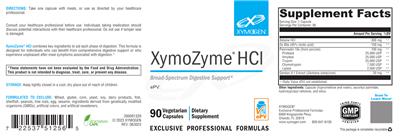
XymoZyme HCl by XYMOGEN label
The label scan from the NIH Dietary Supplement Label Database. Tap to enlarge.
Label images are published by the NIH Dietary Supplement Label Database for the version of this product on file. Always read your actual product label.
View the full label (PDF)The Ingredients in XymoZyme HCl by XYMOGEN
These are the 8 active ingredients this product is made of. Select any to open its full monograph.
Serving size1 Capsule(s) Dosage formCapsule Servings per container90 Amounts shown are per serving.
Most supplement products combine several ingredients, and a medication can interact with the product through any one of them. Each ingredient below shows whether it has known drug interactions.
Betaine Hydrochloride
Interacts with36 drugs
Betaine hydrochloride is a supplement used to temporarily increase stomach acid in people who may have low acid levels. Evidence for its benefits is l...
Betaine Hydrochloride monograph & interactionsGentian Root Extract
Interacts with172 drugs
Gentian is a very bitter root traditionally used to stimulate appetite and ease mild digestive complaints, often as part of "bitters" before meals. Th...
Gentian Root Extract monograph & interactionsOx Bile
Pancreatin 10X
- › Amylase
- › Protease
- › Lipase
- › Chymotrypsin
- › Trypsin
Other (inactive) ingredients: Hypromellose, Water, Ascorbyl Palmitate, Hydroxypropyl Cellulose, Silica. These complete the product’s ingredient list but are not active constituents.
XymoZyme HCl by XYMOGEN Drug Interactions
HelloPharmacist Interaction Report
XymoZyme HCl by XYMOGEN is a digestive enzyme supplement that does interact with certain medications.
The most serious concern is Betaine Hydrochloride, one of its active ingredients, which increases stomach acid and can reduce how well antihypertensive drugs (blood pressure medications) work — though gentian root extract in this product is the one documented to interact with them at Moderate severity by potentially lowering blood pressure further.
Read the full breakdown — every affected drug type, severity by severity
Betaine Hydrochloride interacts with three drug types: H2-blockers (acid-suppressing medications like famotidine), antacids, and proton pump inhibitors or PPIs (stronger acid-suppressors like omeprazole). All three interactions are Minor in severity — the issue is that Betaine Hydrochloride raises stomach acid while these medications lower it, so they may work against each other.
Gentian Root Extract carries a Moderate interaction with antihypertensive drugs; in lab studies it can lower blood pressure, so combining it with blood pressure medications might push your pressure too low.
We could not check Amylase or Ox Bile — we hold no interaction data for them. Altogether, these interactions span 206 individual medications.
Use the search tool below to check your exact prescriptions before you start.
Check your own medications below · Editorial policy · How we use AI
Want to check YOUR meds against XymoZyme HCl?
Ask about interactions with your drugs in plain English — “Can I take it with lisinopril?” — and we find you the answer in seconds, ingredient by ingredient.
Go to the checkerIngredients driving the most interactions
Individual Drug Interactions
The ingredients in XymoZyme HCl interact with 208 drugs. Click any drug to see the details.
2 of the 8 ingredients in XymoZyme HCl interact with drugs. Each result below shows which ingredient is responsible. Gentian Root Extract Betaine Hydrochloride
AcebutololRhotral, Sectral
How Acebutolol interacts with XymoZyme HCl — through 1 ingredient. Tap an ingredient for the detail:
Gentian Root ExtractAntihypertensive Drugs Moderate
Interaction Summary
Theoretically, taking gentian with antihypertensive drugs might increase the risk of hypotension.
Read the full Gentian Root Extract + Acebutolol interactionAcetazolamideAk-Zol, Diamox
How Acetazolamide interacts with XymoZyme HCl — through 1 ingredient. Tap an ingredient for the detail:
Gentian Root ExtractAntihypertensive Drugs Moderate
Interaction Summary
Theoretically, taking gentian with antihypertensive drugs might increase the risk of hypotension.
Read the full Gentian Root Extract + Acetazolamide interactionAliskirenTekturna
How Aliskiren interacts with XymoZyme HCl — through 1 ingredient. Tap an ingredient for the detail:
Gentian Root ExtractAntihypertensive Drugs Moderate
Interaction Summary
Theoretically, taking gentian with antihypertensive drugs might increase the risk of hypotension.
Read the full Gentian Root Extract + Aliskiren interactionAmbrisentanLetairis, Volibris
How Ambrisentan interacts with XymoZyme HCl — through 1 ingredient. Tap an ingredient for the detail:
Gentian Root ExtractAntihypertensive Drugs Moderate
Interaction Summary
Theoretically, taking gentian with antihypertensive drugs might increase the risk of hypotension.
Read the full Gentian Root Extract + Ambrisentan interactionAmilorideAmilamont, Midamor
How Amiloride interacts with XymoZyme HCl — through 1 ingredient. Tap an ingredient for the detail:
Gentian Root ExtractAntihypertensive Drugs Moderate
Interaction Summary
Theoretically, taking gentian with antihypertensive drugs might increase the risk of hypotension.
Read the full Gentian Root Extract + Amiloride interactionAmiloride, HydrochlorothiazideAmil-Co, Amilzide, Moduret 25, Moduretic
How Amiloride, Hydrochlorothiazide interacts with XymoZyme HCl — through 1 ingredient. Tap an ingredient for the detail:
Gentian Root ExtractAntihypertensive Drugs Moderate
Interaction Summary
Theoretically, taking gentian with antihypertensive drugs might increase the risk of hypotension.
Read the full Gentian Root Extract + Amiloride, Hydrochlorothiazide interactionAmlodipineNorliqva
How Amlodipine interacts with XymoZyme HCl — through 1 ingredient. Tap an ingredient for the detail:
Gentian Root ExtractAntihypertensive Drugs Moderate
Interaction Summary
Theoretically, taking gentian with antihypertensive drugs might increase the risk of hypotension.
Read the full Gentian Root Extract + Amlodipine interactionAmlodipine BenzoateKaterzia
How Amlodipine Benzoate interacts with XymoZyme HCl — through 1 ingredient. Tap an ingredient for the detail:
Gentian Root ExtractAntihypertensive Drugs Moderate
Interaction Summary
Theoretically, taking gentian with antihypertensive drugs might increase the risk of hypotension.
Read the full Gentian Root Extract + Amlodipine Benzoate interactionAmlodipine BesilateIstin
How Amlodipine Besilate interacts with XymoZyme HCl — through 1 ingredient. Tap an ingredient for the detail:
Gentian Root ExtractAntihypertensive Drugs Moderate
Interaction Summary
Theoretically, taking gentian with antihypertensive drugs might increase the risk of hypotension.
Read the full Gentian Root Extract + Amlodipine Besilate interactionAmlodipine BesylateNorvasc
How Amlodipine Besylate interacts with XymoZyme HCl — through 1 ingredient. Tap an ingredient for the detail:
Gentian Root ExtractAntihypertensive Drugs Moderate
Interaction Summary
Theoretically, taking gentian with antihypertensive drugs might increase the risk of hypotension.
Read the full Gentian Root Extract + Amlodipine Besylate interactionAmlodipine Besylate, BenazeprilLotrel
How Amlodipine Besylate, Benazepril interacts with XymoZyme HCl — through 1 ingredient. Tap an ingredient for the detail:
Gentian Root ExtractAntihypertensive Drugs Moderate
Interaction Summary
Theoretically, taking gentian with antihypertensive drugs might increase the risk of hypotension.
Read the full Gentian Root Extract + Amlodipine Besylate, Benazepril interactionAmlodipine, CelecoxibConsensi
How Amlodipine, Celecoxib interacts with XymoZyme HCl — through 1 ingredient. Tap an ingredient for the detail:
Gentian Root ExtractAntihypertensive Drugs Moderate
Interaction Summary
Theoretically, taking gentian with antihypertensive drugs might increase the risk of hypotension.
Read the full Gentian Root Extract + Amlodipine, Celecoxib interactionAmmonium ChlorideAmmonium Chloride
How Ammonium Chloride interacts with XymoZyme HCl — through 1 ingredient. Tap an ingredient for the detail:
Gentian Root ExtractAntihypertensive Drugs Moderate
Interaction Summary
Theoretically, taking gentian with antihypertensive drugs might increase the risk of hypotension.
Read the full Gentian Root Extract + Ammonium Chloride interactionAprocitentanTryvio
How Aprocitentan interacts with XymoZyme HCl — through 1 ingredient. Tap an ingredient for the detail:
Gentian Root ExtractAntihypertensive Drugs Moderate
Interaction Summary
Theoretically, taking gentian with antihypertensive drugs might increase the risk of hypotension.
Read the full Gentian Root Extract + Aprocitentan interactionAtenololAtenix, Tenormin
How Atenolol interacts with XymoZyme HCl — through 1 ingredient. Tap an ingredient for the detail:
Gentian Root ExtractAntihypertensive Drugs Moderate
Interaction Summary
Theoretically, taking gentian with antihypertensive drugs might increase the risk of hypotension.
Read the full Gentian Root Extract + Atenolol interactionAtenolol, ChlortalidoneAtenixCo, Tenoret 50, Totaretic
How Atenolol, Chlortalidone interacts with XymoZyme HCl — through 1 ingredient. Tap an ingredient for the detail:
Gentian Root ExtractAntihypertensive Drugs Moderate
Interaction Summary
Theoretically, taking gentian with antihypertensive drugs might increase the risk of hypotension.
Read the full Gentian Root Extract + Atenolol, Chlortalidone interactionAtenolol, ChlorthalidoneTenoretic
How Atenolol, Chlorthalidone interacts with XymoZyme HCl — through 1 ingredient. Tap an ingredient for the detail:
Gentian Root ExtractAntihypertensive Drugs Moderate
Interaction Summary
Theoretically, taking gentian with antihypertensive drugs might increase the risk of hypotension.
Read the full Gentian Root Extract + Atenolol, Chlorthalidone interactionAzilsartanEdarbi
How Azilsartan interacts with XymoZyme HCl — through 1 ingredient. Tap an ingredient for the detail:
Gentian Root ExtractAntihypertensive Drugs Moderate
Interaction Summary
Theoretically, taking gentian with antihypertensive drugs might increase the risk of hypotension.
Read the full Gentian Root Extract + Azilsartan interactionAzilsartan, ChlorthalidoneEdarbyclor
How Azilsartan, Chlorthalidone interacts with XymoZyme HCl — through 1 ingredient. Tap an ingredient for the detail:
Gentian Root ExtractAntihypertensive Drugs Moderate
Interaction Summary
Theoretically, taking gentian with antihypertensive drugs might increase the risk of hypotension.
Read the full Gentian Root Extract + Azilsartan, Chlorthalidone interactionBenazeprilLotensin
How Benazepril interacts with XymoZyme HCl — through 1 ingredient. Tap an ingredient for the detail:
Gentian Root ExtractAntihypertensive Drugs Moderate
Interaction Summary
Theoretically, taking gentian with antihypertensive drugs might increase the risk of hypotension.
Read the full Gentian Root Extract + Benazepril interactionBenazepril, HydrochlorothiazideLotensin HCT
How Benazepril, Hydrochlorothiazide interacts with XymoZyme HCl — through 1 ingredient. Tap an ingredient for the detail:
Gentian Root ExtractAntihypertensive Drugs Moderate
Interaction Summary
Theoretically, taking gentian with antihypertensive drugs might increase the risk of hypotension.
Read the full Gentian Root Extract + Benazepril, Hydrochlorothiazide interactionBendroflumethiazideAprinox, Naturetin, Neo-NaClex
How Bendroflumethiazide interacts with XymoZyme HCl — through 1 ingredient. Tap an ingredient for the detail:
Gentian Root ExtractAntihypertensive Drugs Moderate
Interaction Summary
Theoretically, taking gentian with antihypertensive drugs might increase the risk of hypotension.
Read the full Gentian Root Extract + Bendroflumethiazide interactionBendroflumethiazide, NadololCorzide
How Bendroflumethiazide, Nadolol interacts with XymoZyme HCl — through 1 ingredient. Tap an ingredient for the detail:
Gentian Root ExtractAntihypertensive Drugs Moderate
Interaction Summary
Theoretically, taking gentian with antihypertensive drugs might increase the risk of hypotension.
Read the full Gentian Root Extract + Bendroflumethiazide, Nadolol interactionBendroflumethiazide, Rauwolfia SerpentinaRauzide
How Bendroflumethiazide, Rauwolfia Serpentina interacts with XymoZyme HCl — through 1 ingredient. Tap an ingredient for the detail:
Gentian Root ExtractAntihypertensive Drugs Moderate
Interaction Summary
Theoretically, taking gentian with antihypertensive drugs might increase the risk of hypotension.
Read the full Gentian Root Extract + Bendroflumethiazide, Rauwolfia Serpentina interactionBenzthiazideExna
How Benzthiazide interacts with XymoZyme HCl — through 1 ingredient. Tap an ingredient for the detail:
Gentian Root ExtractAntihypertensive Drugs Moderate
Interaction Summary
Theoretically, taking gentian with antihypertensive drugs might increase the risk of hypotension.
Read the full Gentian Root Extract + Benzthiazide interactionBetaxololBetoptic, Kerlone
How Betaxolol interacts with XymoZyme HCl — through 1 ingredient. Tap an ingredient for the detail:
Gentian Root ExtractAntihypertensive Drugs Moderate
Interaction Summary
Theoretically, taking gentian with antihypertensive drugs might increase the risk of hypotension.
Read the full Gentian Root Extract + Betaxolol interactionBisoprololZebeta
How Bisoprolol interacts with XymoZyme HCl — through 1 ingredient. Tap an ingredient for the detail:
Gentian Root ExtractAntihypertensive Drugs Moderate
Interaction Summary
Theoretically, taking gentian with antihypertensive drugs might increase the risk of hypotension.
Read the full Gentian Root Extract + Bisoprolol interactionBisoprolol, HydrochlorothiazideZiac
How Bisoprolol, Hydrochlorothiazide interacts with XymoZyme HCl — through 1 ingredient. Tap an ingredient for the detail:
Gentian Root ExtractAntihypertensive Drugs Moderate
Interaction Summary
Theoretically, taking gentian with antihypertensive drugs might increase the risk of hypotension.
Read the full Gentian Root Extract + Bisoprolol, Hydrochlorothiazide interactionBosentanTracleer
How Bosentan interacts with XymoZyme HCl — through 1 ingredient. Tap an ingredient for the detail:
Gentian Root ExtractAntihypertensive Drugs Moderate
Interaction Summary
Theoretically, taking gentian with antihypertensive drugs might increase the risk of hypotension.
Read the full Gentian Root Extract + Bosentan interactionBumetanideBurinex
How Bumetanide interacts with XymoZyme HCl — through 1 ingredient. Tap an ingredient for the detail:
Gentian Root ExtractAntihypertensive Drugs Moderate
Interaction Summary
Theoretically, taking gentian with antihypertensive drugs might increase the risk of hypotension.
Read the full Gentian Root Extract + Bumetanide interactionEach ingredient & the kinds of drugs it affects
For each ingredient in XymoZyme HCl with known interactions, here are the types of medications they can affect. Open any type for the detail — or search your exact drug in the checker above.
Gentian Root Extract
Antihypertensive Drugs
Theoretically, taking gentian with antihypertensive drugs might increase the risk of hypotension.
In vitro research shows that gentian can cause vasodilation and lower blood pressure.
Betaine Hydrochloride
Antacids
Betaine hydrochloride increases stomach acidity and could decrease the effects of antacids.
In human research, betaine hydrochloride increases stomach acidity. Antacids are taken to decrease stomach acidity. Theoretically, taking betaine hydrochloride along with antacids might decrease the effects of the antacids.
H2-Blockers
Betaine hydrochloride increases stomach acidity and could decrease the effects of H2-blockers.
In human research, betaine hydrochloride increases stomach acidity. H2-blockers are used to decrease stomach acidity. Theoretically, taking betaine hydrochloride along with H2-blockers might decrease the effects of H2-blockers.
Proton Pump Inhibitors (Ppis)
Betaine hydrochloride increases stomach acidity and could decrease the effects of PPIs.
In human research, betaine hydrochloride increases stomach acidity. PPIs are used to decrease stomach acidity. Theoretically, taking betaine hydrochloride along with PPIs might decrease the effects of PPIs
Brand information
Manufacturer and brand details for XymoZyme HCl, from the product label.
XYMOGEN
See all XYMOGEN products- Name
- XYMOGEN Exclusive Professional Formulas
- Street Address
- 6900 Kingspointe Pkwy.
- City
- Orlando
- State
- FL
- ZipCode
- 32819
- Phone Number
- 800-647-6100
- Web Address
- www.xymogen.com
XymoZyme HCl by XYMOGEN: Common Questions
Does XymoZyme HCl by XYMOGEN interact with any medications?
How can one product interact with so many drugs?
Where does this information come from?
What are the digestive enzymes in this supplement doing?
Is this safe if I have a sensitive stomach or reflux?
Can I take this while pregnant?
What side effects might I notice?
Does this actually work for indigestion or poor digestion?
Written and reviewed by the HelloPharmacist editorial staff. Our editorial policy
Not sure if XymoZyme HCl is safe with your meds?
Our pharmacists answer your medication & supplement questions — free.
Label information is sourced from the NIH Dietary Supplement Label Database and reflects the product version on file; always read your actual product label. This page is for education only and is not a substitute for professional medical advice. Confirm with your pharmacist or doctor before combining supplements and medications.
The Full Monographs Behind XymoZyme HCl’s Ingredients
Every ingredient we hold a full HelloPharmacist monograph for — uses, evidence, safety, and the complete interaction list.
Betaine Hydrochloride
Interacts with 36 drugsBetaine hydrochloride is a supplement used to temporarily increase stomach acid in people who may have low acid levels. Evidence for its benefits is limited and mostly based on tradition rat...
Read the full Betaine Hydrochloride monograph → Herb & supplement monographGentian
Interacts with 172 drugsGentian is a very bitter root traditionally used to stimulate appetite and ease mild digestive complaints, often as part of "bitters" before meals. The evidence is mostly traditional and pre...
Read the full Gentian monograph → Herb & supplement monographProteolytic Enzymes (proteases)
Proteolytic enzymes are proteins that help break down other proteins, and common examples include bromelain (from pineapple), papain (from papaya), trypsin, chymotrypsin, and pancreatin. Peo...
Read the full Proteolytic Enzymes (proteases) monograph → Herb & supplement monographLipase
Lipase is a digestive enzyme that helps your body break down dietary fats. It is well established as part of prescription pancreatic enzyme therapy for people who cannot make enough of their...
Read the full Lipase monograph → Herb & supplement monographChymotrypsin
Chymotrypsin is a protein-digesting (proteolytic) enzyme, usually taken from the pancreas of cattle or pigs, that is mainly used to help reduce swelling and support healing after injury or s...
Read the full Chymotrypsin monograph → Herb & supplement monographTrypsin
Trypsin is a protein-digesting enzyme usually taken from the pancreas of animals and used either by mouth (often combined with other enzymes like chymotrypsin and bromelain) for swelling and...
Read the full Trypsin monograph →Sources & How We Checked
XymoZyme HCl's label data comes from the NIH Dietary Supplement Label Database; the ingredient interaction data is from the Natural Medicines database, reviewed by our pharmacists.
- NIH Dietary Supplement Label Database (DSLD) — The official product label on file for this supplement.
- Natural Medicines (Therapeutic Research Center) — Evidence-graded clinical reference behind the ingredient interaction data.
Content is written and reviewed by licensed HelloPharmacist pharmacists. See our data sources and editorial standards for how this information is built and checked.
The 34 references behind this product’s interaction data
Every citation that drives the interaction findings for this product’s ingredients, from the evidence-graded Natural Medicines (TRC Healthcare) database. Open an ingredient to browse its citations — links open the study on PubMed or the publisher’s site.
Proteolytic Enzymes (proteases) 3 references
- Weeks JA, Harper RA, Simon RA, Burdick JD. Assessment of sensitization risk of a laundry pre-spotter containing protease. Cutan Ocul Toxicol. 2011;30(4):272-9. PubMed
- Marquès LI, Lara S, Abós T, Bartolomé B. Occupational rhinitis due to pepsin. J Investig Allergol Clin Immunol. 2006;16(2):136-7. DOI
- Cartier A, Malo JL, Pineau L, Dolovich J. Occupational asthma due to pepsin. J Allergy Clin Immunol. 1984;73(5 Pt 1):574-7. PubMed
See these in context on the Proteolytic Enzymes (proteases) monograph →
Lipase 1 reference
- Casper C, Hascoet JM, Ertl T, et al. Recombinant bile salt-stimulated lipase in preterm infant feeding: A randomized phase 3 study. PLoS One. 2016;11(5):e0156071. PubMed
Betaine Hydrochloride 2 references
- Yago MR, Frymoyer A, Benet LZ, Smelick GS, Frassetto LA, Ding X, Dean B, Salphati L, Budha N, Jin JY, Dresser MJ, Ware JA. The use of betaine HCl to enhance dasatinib absorption in healthy volunteers with rabeprazole-induced hypochlorhydria. AAPS J. 2014 PubMed
- Yago MR, Frymoyer AR, Smelick GS, Frassetto LA, Budha NR, Dresser MJ, Ware JA, Benet LZ. Gastric reacidification with betaine HCl in healthy volunteers with rabeprazole-induced hypochlorhydria. Mol Pharm. 2013 Nov 4;10(11):4032-7. PubMed
See these in context on the Betaine Hydrochloride monograph →
Chymotrypsin 6 references
- Martindale W. Martindale the Extra Pharmacopoeia. Pharmaceutical Press, 1999.
- Dukes, MNG. Meyler's Side Effects of Drugs. 13th ed. Elsevier: Amsterdam, 1997.
- Latha B, Ramakrishnan M, Jayaraman V, Babu M. Serum enzymatic changes modulated using trypsin: chymotrypsin preparation during burn wounds in humans. Burns 1997;23:560-4. PubMed
- Shaw PC. The use of a trypsin-chymotrypsin formulation in fractures of the hand. Br J Clin Pract 1969;23:25-6. DOI
- McCue FC, Webster TM, Gieck J. Clinical effects of proteolytic enzymes after reconstructive hand surgery. Int Surg 1972;57:479-82.
- Sun HJ, Xiao JQ, Qiao QH, et al. Chymotrypsin with sialendoscopy-assisted surgery for the treatment of chronic obstructive parotitis. Int J Oral Maxillofac Surg 2017;46(7):877-82. doi: 10.1016/j.ijom.2017.02.1267. PubMed
Trypsin 17 references
- Burnham TH, ed. Drug Facts and Comparisons, Updated Monthly. Facts and Comparisons, St. Louis, MO.
- Latha B, Ramakrishnan M, Jayaraman V, Babu M. The efficacy of trypsin: chymotrypsin preparation in the reduction of oxidative damage during burn injury. Burns 1998;24:532-8. PubMed
- Latha B, Ramakrishnan M, Jayaraman V, Babu M. Serum enzymatic changes modulated using trypsin: chymotrypsin preparation during burn wounds in humans. Burns 1997;23:560-4. PubMed
- Klein, G., Kullich, W., Schnitker, J., and Schwann, H. Efficacy and tolerance of an oral enzyme combination in painful osteoarthritis of the hip. A double-blind, randomised study comparing oral enzymes with non-steroidal anti-inflammatory drugs. Clin Exp
- Dale, P. S., Tamhankar, C. P., George, D., and Daftary, G. V. Co-medication with hydrolytic enzymes in radiation therapy of uterine cervix: evidence of the reduction of acute side effects. Cancer Chemother.Pharmacol 2001;47 Suppl:S29-S34. PubMed
- Martin, T., Uhder, K., Kurek, R., Roeddiger, S., Schneider, L., Vogt, H. G., Heyd, R., and Zamboglou, N. Does prophylactic treatment with proteolytic enzymes reduce acute toxicity of adjuvant pelvic irradiation? Results of a double-blind randomized trial PubMed
- Miller, P. C., Bailey, S. P., Barnes, M. E., Derr, S. J., and Hall, E. E. The effects of protease supplementation on skeletal muscle function and DOMS following downhill running. J Sports Sci 2004;22(4):365-372. PubMed
- Bolten WW, Glade MJ, Raum S, Ritz BW. The safety and efficacy of an enzyme combination in managing knee osteoarthritis pain in adults: a randomized, double-blind, placebo-controlled trial. Arthritis 2015;2015:251521. PubMed
- US Department of Justice. U.S. Files Complaint Against Texas-Based Healthpoint Ltd. Under the False Claims Act. https://www.justice.gov/opa/pr/us-files-complaint-against-texas-based-healthpoint-ltd-under-false-claims-act. (Accessed June 19, 2019).
- Grabs V, Kersten A, Haller B, et al. Rutoside and hydrolytic enzymes do not attenuate marathon-induced inflammation. Med Sci Sports Exerc. 2017;49(3):387-395. PubMed
- Baumhackl U, Kappos L, Radue EW, et al. A randomized, double-blind, placebo-controlled study of oral hydrolytic enzymes in relapsing multiple sclerosis. Mult Scler. 2005;11(2):166-8. PubMed
- Gujral MS, Patnaik PM, Kaul R, et al. Efficacy of hydrolytic enzymes in preventing radiation therapy-induced side effects in patients with head and neck cancers. Cancer Chemother Pharmacol. 2001;47 Suppl:S23-8. PubMed
- Kempf K, Manzo G, Hanifi-Moghaddam P, et al. Effect of combined oral proteases and flavonoid treatment in subjects at risk of Type 1 diabetes. Diabet Med. 2009;26(12):1309-10. PubMed
- Kerkhoffs GM, Struijs PA, de Wit C, Rahlfs VW, Zwipp H, van Dijk CN. A double blind, randomised, parallel group study on the efficacy and safety of treating acute lateral ankle sprain with oral hydrolytic enzymes. Br J Sports Med. 2004;38(4):431-5. PubMed
- Popiela T, Kulig J, Klek S, Wachol D, Bock PR, Hanisch J. Double-blind pilot-study on the efficacy of enzyme therapy in advanced colorectal cancer. Przegl Lek. 2000;57 Suppl 5:142.
- Shetty V, Mohan A. A prospective, randomized, double-blind, placebo-controlled clinical trial comparing the efficacy of systemic enzyme therapy for edema control in orthognathic surgery using ultrasound scan to measure facial swelling. J Oral Maxillofac S PubMed
- Comparison of Chronic Wound Care Products. Pharmacist's Letter/Prescriber's Letter 2008;12(3):1203.
Gentian 5 references
- Neubauer N, Marz RW. Placebo-controlled, randomized, double-blind, clincal trial with Sinupret sugar coated tablets on the basis of a therapy with antibiotics and decongestant nasal drops in acute sinusitis. Phytomedicine 1994;1:177-81.
- Marz RW, Ismail C, Popp MA. Action profile and efficacy of a herbal combination preparation for the treatment of sinusitis. Wien Med Wochenschr 1999;149:202-8.
- Uncini Manganelli RE, Chericoni S, Baragatti B. Ethnopharmacobotany in Tuscany: plants used as antihypertensives. Fitoterapia 2000;71:S95-100. PubMed
- Baragatti B, Calderone V, Testai L, et al. Vasodilator activity of crude methanolic extract of Gentiana kokiana Perr. et Song. (Gentianaceae). J Ethnopharmacol 2002;79:369-72. PubMed
- Sanatani M, Younus J, Stitt L, et al. Tolerability of the combination of ginger (Zingiber officinalis), gentian (Gentiana lutea) and turmeric (Curcuma longa) in patients with cancer-associated anorexia. J Complement Integr Med. 2015;12(1):57-60.
Parts of this content are provided by the Therapeutic Research Center, LLC.
DISCLAIMER: Currently this does not check for drug-drug interactions. This is not an all-inclusive comprehensive list of potential interactions and is for informational purposes only. Not all interactions are known or well-reported in the scientific literature, and new interactions are continually being reported. Input is needed from a qualified healthcare provider including a pharmacist before starting any therapy. Application of clinical judgment is necessary.
© 2021 Therapeutic Research Center, LLC