
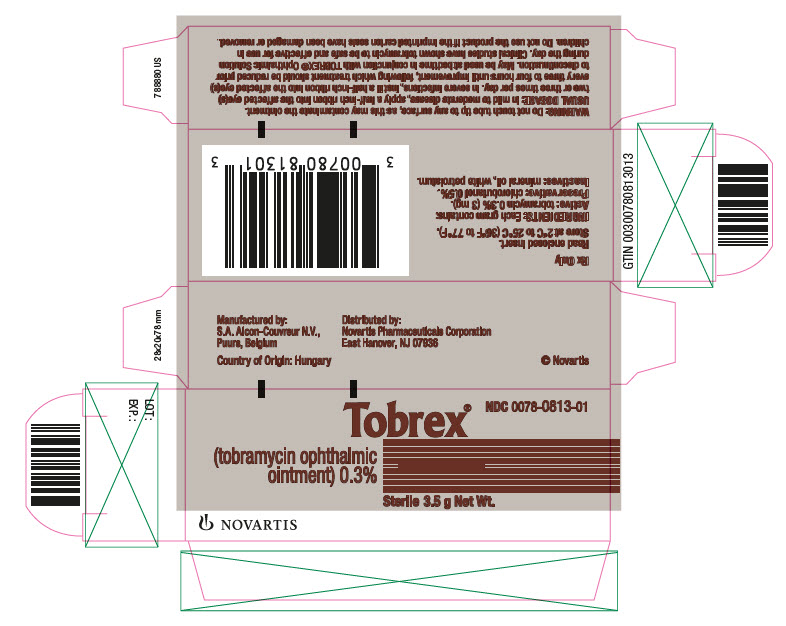
TOBREX tobramycin 3 mg/g Ointment, 3.5 g
🆔 Identity & classification
Where does this data come from?
🏷️ RxNorm drug class
This medicine belongs to the Aminoglycoside Antibacterial class.
Where does this data come from?
🏭 Manufacturer & labeler
Where does this data come from?
🩺 Clinical
Ophthalmic tobramycin is used to treat eye infections. Tobramycin is in a class of medications called antibiotics. It works by killing bacteria that cause infections.
Read the full MedlinePlus article ↗- Tobrex ointment treats bacterial infections of the eye and the skin and tissue right around it — like bacterial conjunctivitis (pink eye caused by bacteria) or eyelid infections. I...
- What kind of eye infection does this treat?
- It's easier than it sounds. Tilt your head back, then gently pull your lower eyelid down with a finger to create a small pocket. Squeeze a ribbon of ointment — about half an inch —...
- How do I actually apply the eye ointment without making a mess?
Patient education
Supplement & herbal interactions
Some supplements/herbs that may interact with Tobramycin — tap one for details:
Tobramycin may be associated with lower levels of 8 nutrients — worth a chat with your pharmacist, not a cause for alarm.
Where does this data come from?
Ask a licensed pharmacist directly — free, answered by our team.
🧪 Inactive Ingredients / Excipients
Inactive ingredients, also called excipients, are components of the drug product other than the active ingredient. They may include fillers, dyes, coatings, preservatives, flavors, or other formulation ingredients.
💡 Tap an ingredient (hover on desktop) to see what it is and why it’s used.
-
UNII HM4YQM8WRC
Chlorobutanol is a colorless crystalline chemical used as a preservative in medicines. It prevents bacterial and fungal growth to maintain product safety and shelf life.
-
UNII T5L8T28FGP
Mineral oil is a clear, odorless liquid derived from crude oil. It acts as a lubricant and emollient in medications, helping pills slide smoothly during manufacturing and aiding moisture retention in topical products.
-
UNII 4T6H12BN9U
Petrolatum is a purified mineral oil-based jelly derived from petroleum. In medicines, it acts as an emollient, lubricant, and moisture barrier to soften skin, reduce friction, and help prevent water loss from formulations.
3 inactive ingredients listed in the exact product block matched to this NDC.
Where does this data come from?
ingredient classCode="IACT" elements from the exact product block matched by this NDC. Label-section narrative from DailyMed / the openFDA label index is shown separately when available.Inactive ingredient FAQ
Are inactive ingredients the same for every manufacturer?
Why might an inactive ingredient be missing?
Can inactive ingredients matter?
💲 Pricing
A drug doesn't have one price. Each row is a different public payment system, and none is what you'd pay at the counter — that depends on your insurance. The ⓘ on each row explains what it measures.
| Price system | Per g | Per package |
|---|---|---|
| Retail pharmacies payNADAC · weekly | $84.516 | $295.81 / 3.5 g |
| Medicaid paysCMS SDUD · 12 mo | $78.47 | $274.65 / 3.5 g |
| Medicare drug plans payPart D · Q2 2026 | $83.53 | $292.36 / 3.5 g |
Where does this data come from?
🔁 Therapeutic equivalents
| Product | Labeler | Pack | NADAC/unit | TE | Status | Price vs. this |
|---|---|---|---|---|---|---|
| Tobrex 3 mg/gthis 00078-0813-01 | Novartis | 3.5 g | $84.516 | — | Availability likely | — |
Where does this data come from?
⏳ Availability & generic status
We did not find an FDA-approved generic match for this exact strength, form and route.
Where does this data come from?
🗺️ Medicaid utilization & spend
📊 Medicare Part D spend CMS · PART D · 2026 (Q1)
🔬 Reported adverse events (FAERS)
Top reported reactions
Age at onset
Reporter sex
Serious outcomes
Where does this data come from?
📦 Packaging — all sizes for this product
| Package NDC | Description | Marketing start | Status |
|---|---|---|---|
| 00078-0813-01 You're viewing this | 3.5 g in 1 TUBE (0078-0813-01) | 2022-03-08 | Active |
📄 Full prescribing information FDA SPL
🎯 Indications and Usage ▾
INDICATIONS AND USAGE TOBREX ® (tobramycin ophthalmic ointment) 0.3 % is a topical antibiotic indicated in the treatment of external infections of the eye and its adnexa caused by susceptible bacteria. Appropriate monitoring of bacterial response to topical antibiotic therapy should accompany the use of TOBREX (tobramycin ophthalmic ointment) 0.3%. Clinical studies have shown tobramycin to be safe and effective for use in children.
⏱️ Dosage and Administration ▾
DOSAGE AND ADMINISTRATION In mild to moderate disease, apply a half-inch ribbon into the affected eye(s) 2 or 3 times per day. In severe infections, instill a half-inch ribbon into the affected eye(s) every 3 to 4 hours until improvement, following which treatment should be reduced prior to discontinuation. How to Apply TOBREX (tobramycin ophthalmic ointment) 0.3%: 1.
Tilt your head back. 2. Place a finger on your cheek just under your eye and gently pull down until a ''V'' pocket is formed between your eyeball and your lower lid.
3. Place a small amount (about ½ inch) of TOBREX ® (tobramycin ophthalmic ointment) 0.3% in the ''V'' pocket. Do not let the tip of the tube touch your eye.
4. Look downward before closing your eye.
⛔ Contraindications ▾
CONTRAINDICATIONS TOBREX (tobramycin ophthalmic ointment) 0.3 % is contraindicated in patients with known hypersensitivity to any of its components.
⚠️ Warnings ▾
WARNINGS NOT FOR INJECTION INTO THE EYE. Sensitivity to topically applied aminoglycosides may occur in some patients. Severity of hypersensitivity reactions may vary from local effects to generalized reactions such as erythema, itching, urticaria, skin rash, anaphylaxis, anaphylactoid reactions, or bullous reactions. If a sensitivity reaction to TOBREX (tobramycin ophthalmic ointment) 0.3% occurs, discontinue use.
🤒 Adverse Reactions ▾
ADVERSE REACTIONS: The most frequent adverse reactions to TOBREX (tobramycin ophthalmic ointment) 0.3% are hypersensitivity and localized ocular toxicity, including lid itching and swelling, and conjunctival erythema. These reactions occur in less than three of 100 patients treated with TOBREX ® (tobramycin ophthalmic ointment) 0.3%. Postmarketing Experience: Additional adverse reactions identified from postmarketing use include anaphylactic reaction, Stevens-Johnson syndrome, and erythema multiforme.
The following additional adverse reactions have been reported with systemic aminoglycosides: Neurotoxicity, ototoxicity and nephrotoxicity have occurred in patients receiving systemic aminoglycoside therapy. Aminoglycosides may aggravate muscle weakness in patients with known or suspected neuromuscular disorders, such as myasthenia gravis or Parkinson’s disease, because of their potential effect on neuromuscular function.
🤰 Pregnancy ▾
Pregnancy: Reproduction studies in three types of animals at doses up to thirty-three times the normal human systemic dose have revealed no evidence of impaired fertility or harm to the fetus due to tobramycin. There are, however, no adequate and well-controlled studies in pregnant women. Because animal studies are not always predictive of human response, this drug should be used during pregnancy only if clearly needed.
🧒 Pediatric Use ▾
Pediatric Use: Safety and effectiveness in pediatric patients below the age of 2 months has not been established.
🧓 Geriatric Use ▾
Geriatric Use: No overall clinical differences in safety or effectiveness have been observed between the elderly and other adult patients.
🧬 Clinical Pharmacology ▾
CLINICAL PHARMACOLOGY In Vitro Data: In vitro studies have demonstrated tobramycin is active against susceptible strains of the following microorganisms: Staphylococci , including S. aureus and S. epidermidis (coagulase-positive and coagulase-negative), including penicillin-resistant strains. Streptococci , including some of the Group A-beta-hemolytic species, some nonhemolytic species, and some Streptococcus pneumoniae . Pseudomonas aeruginosa , Escherichia coli, Klebsiella pneumoniae , Enterobacter aerogenes , Proteus mirabilis , Morganella morganii , most Proteus vulgaris strains, Haemophilus influenzae and H. aegyptius , Moraxella lacunata , Acinetobacter calcoaceticus and some Neisseria species .
Bacterial susceptibility studies demonstrate that in some cases, microorganisms resistant to gentamicin retain susceptibility to tobramycin.
📦 How Supplied / Storage and Handling ▾
HOW SUPPLIED TOBREX (tobramycin ophthalmic ointment) 0.3% is supplied as a 3.5 g sterile ointment in an aluminum tube with a white polyethylene tip and white polyethylene cap as follows: 3.5 g containing tobramycin 0.3% (3 mg/g).................................................. NDC 0078-0813-01 Storage: Store at 2°C to 25°C (36°F to 77°F). After opening, TOBREX (tobramycin ophthalmic ointment) 0.3% can be used until the expiration date on the tube.
Distributed by: Novartis Pharmaceuticals Corporation East Hanover, New Jersey 07936 © Novartis Revised: June 2021 T2021-76
📋 Description ▾
DESCRIPTION TOBREX ® (tobramycin ophthalmic ointment) 0.3% is a sterile topical ophthalmic antibiotic formulation prepared specifically for topical therapy of external ophthalmic infections. Each gram of TOBREX (tobramycin ophthalmic ointment) 0.3% contains: Active: tobramycin 0.3% (3 mg). Preservative: chlorobutanol 0.5%.
Inactives: mineral oil, white petrolatum. Tobramycin is a water-soluble aminoglycoside antibiotic active against a wide variety of gram-negative and gram-positive ophthalmic pathogens. The chemical structure of tobramycin is: Molecular Formula: C 18 H 37 N 5 O 9 Molecular Weight: 467.52 g/mol Chemical Name: 0-{3-amino-3-deoxy-α-D-gluco-pyranosyl-(1→4) }-0-{2,6-diamino-2,3,6-trideoxy-α-D-ribohexo-pyranosyl-(1→6) }-2-deoxystreptamine. chemical structure of tobramycin
💬 Information for Patients ▾
Information for Patients: Do not touch tube tip to any surface, as this may contaminate the ointment. Do not use the product if the imprinted carton seals have been damaged, or removed.