
Home › NDC Lookup › Ingredients › Fluorouracil › 00187-3204-47
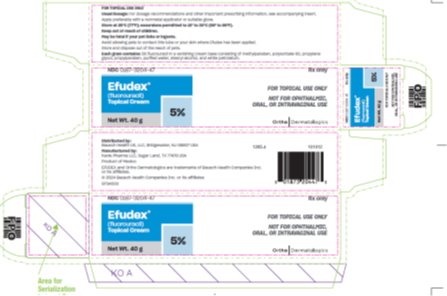
Efudex Fluorouracil 2 g/40g Cream — NDC 00187-3204-47 package photo
Label image from the product's FDA listing (DailyMed) — may show a different pack size or an older label revision.

Efudex Fluorouracil 2 g/40g Cream — NDC 0187-3204-47 (Billing 00187-3204-47)

by Bausch Health US, LLC · 1 TUBE in 1 CARTON / 40 g in 1 TUBE

This is a package of Efudex Fluorouracil 2 g/40g Cream from Bausch Health US, LLC, no longer marketed (first marketed Jul 1970), no longer in the FDA NDC Directory; retail pharmacies pay about $1.44 per g (NADAC). It is this product's only package size.

NDC 00187-3204-47
🏷️ FDA NDC (as labeled) 0187-3204-47 billing pads the labeler segment with a zero
Rx only Brand Discontinued Non-controlled ⚠ Discontinued by firm ⇄ Compare with another NDC
🗂️ FDA directory synced Oct 1, 2026 · this listing last changed Jul 24, 2026 · sources: openFDA · FDA label (DailyMed) · FDA Orange & Purple Book · First Databank · CMS NADAC, ASP, Medicare & Medicaid · RxNorm
📋 All sources & update times →
⚠️
Excluded from the active FDA NDC Directory. The labeler reported this product as discontinued, so it is excluded from the active NDC Directory. A label may still appear on DailyMed, but the NDC is no longer in the current FDA NDC Directory. Search the FDA NDC Directory ↗

Identity & classification

Regulatory identifiers FDA, NLM and CMS codes for this package

FDA NDC (as labeled) 0187-3204-47
Product NDC 0187-3204
11-digit billing NDC 00187320447
NCPDP billing unit GM — per gram (weight)
RxCUI 105583, 213045
UNII U3P01618RT
Application # NDA016831
SPL Set ID 35de1c1c-bef5-46c5-b6f8-ea032147411c
Established class (EPC) Nucleoside Metabolic Inhibitor
Mechanism of action Nucleic Acid Synthesis Inhibitors
DEA schedule Non-controlled
Marketing category NDA
Marketing status Discontinued
FDA listing status Discontinued by firm
Marketing start 1970-07-29
Route TOPICAL
Dosage form CREAM
Substance FLUOROURACIL
TE code (Orange Book) AB · RLD · RS

Drug-database identifiers Medi-Span GPI and First Databank GCN / HICL / AHFS classification

GPI-14 90372030003730
GPI class Efudex
GCN Seq No 007502
GCN 30781
HICL code 003907
Ingredient (HICL) Fluorouracil
HIC1 code Q
Therapeutic class — broad (HIC1) Ear/Eye/Nose/Rectum/Topical/Vagina/Other
HIC2 code Q5
Therapeutic class — intermediate (HIC2) Agents Acting Principally On The Skin
HIC3 code Q5N
Therapeutic class — specific (HIC3) Topical Antineoplastic Premalignant Lesion Agents
AHFS code 10:00.00.00
AHFS class Antineoplastic Agents
FDB label name EFUDEX 5% CREAM
FDB brand name Efudex
Legend status F — Federal legend — prescription drug or device
Quick answers
  • GSN (GCN sequence number): 007502
  • GCN: 30781
  • GPI-14 (Medi-Span): 90372030003730
  • HICL (First Databank): 003907
  • AHFS class code: 10:00.00.00
  • RxCUI (RxNorm): 105583
Why two NDCs? The FDA registers this code as 0187-3204-47 — a 4-4-2 layout, and that's what's printed on the package and shown on DailyMed. For insurance claims, every NDC is standardized to a uniform 11-digit 5-4-2 format by adding a zero to the labeler segment → 00187-3204-47. Same drug, same package — only the format differs.
Where does this data come from?
Identifiers from the FDA openFDA NDC Directory and Structured Product Labeling; RxCUI from RxNorm (NLM); GPI from Medi-Span; GCN / HIC / AHFS / legend from First Databank.

RxNorm drug class

This medicine belongs to the Nucleoside Metabolic Inhibitor class.

Pharmacologic class Nucleoside Metabolic Inhibitor
Drug family (ATC) Pyrimidine analogues
How it works Nucleic Acid Synthesis Inhibitors
Where does this data come from?
Therapeutic classes from RxNorm RxClass (U.S. National Library of Medicine) — Established Pharmacologic Class (FDA), ATC drug family (WHO) and mechanism of action, matched by this product’s RxCUI.

Clinical

Label name EFUDEX 5% CREAM Ingredient Fluorouracil
📖 What it is MedlinePlus · NLM

Fluorouracil cream and topical solution are used to treat actinic or solar keratoses (scaly or crusted lesions [skin areas] caused by years of too much exposure to sunlight). Fluorouracil cream and topical solution are also used to treat a type of skin cancer called superficial basal cell carcinoma if usual types of treatment cannot be used. Fluorouracil is in a class of medications called antimetabolites. It works by killing fast-growing cells such as the abnormal cells in actinic keratoses and basal cell carcinoma.

Read the full MedlinePlus article ↗
📗 Our plain-language guide HelloPharmacist
  • It depends on the form. By IV, it treats colon, rectal, breast, stomach and pancreatic cancers. As a skin cream or solution, it treats actinic keratosis (sun-damaged patches) and,...
  • Follow your label and prescriber. Tolak is applied once daily after washing and drying the area. The 5% cream and solution are applied twice daily. Use a nonmetal applicator or glo...
  • How do I use the skin cream or solution?
  • Redness, dryness, scaling, crusting, itching, stinging or burning, swelling and raw spots are very common. They usually peak at the end of treatment and fade within about 4 weeks a...
📖 Read our full Fluorouracil guide →
2
Nutrient depletion considerations

Fluorouracil may be associated with lower levels of 2 nutrients — worth a chat with your pharmacist, not a cause for alarm.

An association is not a deficiency. Educational only — don't start or stop anything without professional guidance.
Where does this data come from?
Plain-language summary from MedlinePlus (U.S. National Library of Medicine); supplement & herbal interactions and nutrient depletion data from the Natural Medicines database; our full guide is HelloPharmacist editorial content.

Pricing

A drug doesn't have one price. Each row is a different public payment system, and none is what you'd pay at the counter — that depends on your insurance. The ⓘ on each row explains what it measures.

Price systemPer gPer package
Retail pharmacies payNADAC · weekly $1.438 $57.52 / 40 g
Medicaid paysCMS SDUD · 12 mo $1.59 $63.64 / 40 g
Medicare drug plans payPart D · quarterly No Part D plan price is available for this NDC in our data.
NADAC price history (per g) — tap or hover for the price & month
Mar 2023 $1.438 $1.438
Where does this data come from?
NADAC (National Average Drug Acquisition Cost) is the CMS weekly pharmacy-acquisition-cost survey — what pharmacies pay. ASP (Average Sales Price) is the CMS Medicare Part B drug-payment file, published quarterly. Medicaid pays is computed by us from CMS State Drug Utilization Data (total reimbursed ÷ units, trailing 12 months) — gross of rebates and inclusive of dispensing fees, so it reflects what Medicaid paid, not an acquisition cost. Medicare drug plans pay is the median negotiated point-of-sale unit cost across plans listing this NDC in the CMS quarterly Prescription Drug Plan pricing files, before rebates. The VA pays is the federal contract price (FSS, and the statutory Big 4 ceiling where listed) from the VA National Acquisition Center pharmaceutical price file. All are free public government data; each measures a different payer, so the figures are not directly comparable.

Packaging — all sizes for this product

Package NDCDescription Marketing startMarketing endStatus
00187-3204-47 You're viewing this Main listing 1 TUBE in 1 CARTON / 40 g in 1 TUBE 1970-07-29 — Active

Therapeutic equivalents

ProductLabelerPackNADAC/unitTEStatusPrice vs. this
Fluorouracil 50 mg/g 16729-0542-35 Accord 1 tube $0.592 AB Availability likely save 59%
Fluorouracil 5 mg/g 00378-4791-06 Mylan 1 tube $0.616 AB Availability likely save 57%
Fluorouracil 50 mg/g 16714-0178-01 NORTHSTAR 1 tube $0.616 AB Availability likely save 57%
Fluorouracil 2 g/40g 21922-0049-17 Encube 1 tube $0.616 AB Availability likely save 57%
Fluorouracil 50 mg/g 51862-0362-40 Mayne 1 tube $0.616 AB Availability likely save 57%
Fluorouracil 50 mg/g 75907-0095-40 Dr. 1 tube $0.616 AB Availability likely save 57%
Efudex 2 g/40gthis 00187-3204-47 Bausch 1 tube $1.438 AB FDA listed —
Fluorouracil 50 mg/g 51672-4118-02 Sun 1 tube — AB FDA listed —
About this product: this is the brand-name version. FDA-approved generic versions are listed, and recent pricing/market data suggests they may be available.
Where does this data come from?
Equivalents are other NDCs of the same ingredient, form and route from the openFDA NDC Directory, ranked least-expensive-first by NADAC. Therapeutic-equivalence (AB) ratings come from the FDA Orange Book; biologics use the FDA Purple Book for biosimilar & interchangeable status.

Availability & generic status

🏛️
1970
On the market since
Jul 1970
📍
2026
Currently FDA-listed
56 years listed
🔓
·
Generic versions listed
see equivalents
✅Generic appears available

FDA-approved generic versions are listed, and recent pricing/market data suggests they may be available — see Therapeutic equivalents.

Where does this data come from?
Patents and exclusivity from the FDA Orange Book (small-molecule drugs), refreshed from public FDA data. Generic launch timing is an estimate, not a guarantee.

Inactive Ingredients / Excipients

Inactive ingredients, also called excipients, are components of the drug product other than the active ingredient. They may include fillers, dyes, coatings, preservatives, flavors, or other formulation ingredients.

💡 Tap an ingredient (hover on desktop) to see what it is and why it’s used.

  • UNII A2I8C7HI9T
    Methylparaben is a preservative derived from benzoic acid that prevents growth of bacteria, fungi, and mold in medicines. It extends the product's shelf life and maintains safety during storage.
  • UNII 4T6H12BN9U
    Petrolatum is a purified mineral oil-based jelly derived from petroleum. In medicines, it acts as an emollient, lubricant, and moisture barrier to soften skin, reduce friction, and help prevent water loss from formulations.
  • UNII CAL22UVI4M
    A synthetic emulsifier derived from sorbitol and fatty acids. It helps mix oil and water-based ingredients together and improves the texture and stability of the medicine.
  • UNII 6DC9Q167V3
    Propylene glycol is a clear liquid derived from petroleum or vegetable sources. It acts as a solvent, humectant, and preservative in medicines, helping dissolve active ingredients and maintain product stability.
  • UNII Z8IX2SC1OH
    Propylparaben is a chemical preservative used to prevent bacterial and fungal growth in medicines and personal care products. It helps extend shelf life and maintain product safety during storage.
  • UNII 2KR89I4H1Y
    Stearyl alcohol is a waxy, fatty substance derived from natural oils or made synthetically. It acts as an emulsifier and thickener in medicines, helping mix ingredients together and give the product the right texture.
  • UNII 059QF0KO0R
    Water is a liquid solvent that dissolves and mixes ingredients together in liquid medicines, syrups, and injections. It helps distribute the active drug evenly throughout the product.

7 inactive ingredients listed in the exact product block matched to this NDC.

Where does this data come from?
Data sourced from official FDA Structured Product Labeling (SPL) via DailyMed — ingredient classCode="IACT" elements from the exact product block matched by this NDC. Label-section narrative from DailyMed / the openFDA label index is shown separately when available.

Inactive ingredient FAQ

Are inactive ingredients the same for every manufacturer?
No. Inactive ingredients can differ by manufacturer, dosage form, strength, and package / product version.
Why might an inactive ingredient be missing?
Some SPLs do not provide a complete structured inactive-ingredient list, and older or unusual labels may only include the information in narrative text.
Can inactive ingredients matter?
Yes. They can matter for allergies, intolerances, dyes, gluten / lactose concerns, preservatives, and formulation differences — but confirm with a pharmacist or the manufacturer when it’s clinically important.

Manufacturer & labeler

LabelerBausch Health US, LLC
Application holderEXTROVIS AG
FDA applicationNDA016831 (NDA)
Labeler code00187
First marketedJul 1970
Product typeHuman Prescription Drug
Portfolio51 products on file
The labeler markets the product; the application holder owns the FDA approval. They’re often the same company but can differ (e.g. a repackager or an authorized generic). A mailing address / phone appears here when the manufacturer includes it in the product’s FDA label (not all do).
Where does this data come from?
Labeler, application holder and registered establishment from the FDA openFDA NDC Directory and Drugs@FDA; address/contact from the product’s FDA label.

Full prescribing information FDA SPL

The complete FDA label for this product — the official prescribing information, verbatim, section by section. Jump with a chip, search within the label, or expand everything.
📄 FDA label 9 words ▾

No readable label sections were found for this product.

Source: FDA Structured Product Labeling, mirrored from DailyMed / openFDA. Prefer the government’s original formatting? View this label on DailyMed ↗

Medicaid utilization & spend

📍 This exact package only: Medicaid data is reported per full 11-digit NDC — labeler, product and pack size — so every number here is for this package alone, not the drug overall. Other pack sizes report separately.
💊 Pharmacy benefit only: These are Medicaid outpatient pharmacy claims, billed by NDC. They exclude the medical benefit — clinic- or hospital-administered drugs billed under HCPCS J-codes — so drugs used mostly that way (e.g. Avastin, Lucentis, Keytruda) can look low or missing here. That’s expected, not an error.
📅 Q1 2025 – Q4 2025 · 4 quarters of data
ⓘ The newest quarter is usually incomplete when first published; states restate recent quarters in later CMS releases, so the latest figures typically revise upward. State coverage-policy changes can also shift quarter-to-quarter totals.
Prescriptions last 4 qtrs
90
Units reimbursed last 4 qtrs
3.6K
Gross reimbursed last 4 qtrs
$5.7K
Avg / prescription
$63.63
Avg / unit
$1.5909
Latest quarter Q4 2025
0Rx
Medicaid pays / g
$1.5909
gross reimbursed
vs
NADAC / g
$1.4381
acquisition cost
=
Spread
+$0.1528
+11% vs cost
What Medicaid paid per g (before rebates; includes the pharmacy’s dispensing fee) compared with NADAC — the average price pharmacies pay to buy the drug. A positive spread means Medicaid reimbursed more than the purchase price, before manufacturer rebates.
Fee-for-service vs managed care ⓘ
70% FFS 30% MCO
Fee-for-service · 63 Rx Managed care · 27 Rx
State Medicaid map
Alaska: no data reported AK Maine: no data reported ME Washington: no data reported WA Idaho: no data reported ID Montana: no data reported MT North Dakota: no data reported ND Minnesota: no data reported MN Wisconsin: no data reported WI Michigan: no data reported MI New York: no data reported NY Vermont: no data reported VT New Hampshire: no data reported NH Oregon: no data reported OR Nevada: no data reported NV Wyoming: no data reported WY South Dakota: no data reported SD Iowa: no data reported IA Illinois: no data reported IL Indiana: no data reported IN Ohio: no data reported OH Pennsylvania: no data reported PA New Jersey: no data reported NJ Massachusetts: 1,080 units · 15.4 per 100k residents MA California: no data reported CA Utah: no data reported UT Colorado: no data reported CO Nebraska: no data reported NE Missouri: no data reported MO Kentucky: no data reported KY West Virginia: 2,520 units · 142 per 100k residents WV Virginia: no data reported VA Maryland: no data reported MD Connecticut: no data reported CT Rhode Island: no data reported RI Arizona: no data reported AZ New Mexico: no data reported NM Kansas: no data reported KS Arkansas: no data reported AR Tennessee: no data reported TN North Carolina: no data reported NC South Carolina: no data reported SC Delaware: no data reported DE Oklahoma: no data reported OK Louisiana: no data reported LA Mississippi: no data reported MS Alabama: no data reported AL Georgia: no data reported GA D.C.: no data reported DC Hawaii: no data reported HI Texas: no data reported TX Florida: no data reported FL
Units reimbursed · per 100k residents
15.4142
gray = no data reported ⓘ
Colors are per 100,000 residents, so big states don’t automatically dominate. Tap or hover a state for its actual totals.
Tap or hover a state
…for its Medicaid breakdown
🏆 Top states by units · per 100k residents
1 West Virginia 142 /100k
2 Massachusetts 15.4 /100k
National units — by quarter
💵 About the dollar figures: “reimbursed” is what Medicaid paid pharmacies before confidential manufacturer rebates, so the program’s real net cost is lower than these numbers. Fee-for-service and managed-care claims are combined unless split above. Source: CMS State Drug Utilization Data; per-100k rates use 2023 Census population estimates.

Medicare Part D spend CMS · PART D · 2026 (Q1)

Medicare Part D (outpatient prescription) spending for Efudex — the program that covers self-administered drugs. 1 manufacturer.
⚠️ Drug-level data: CMS publishes Part D spending by drug, not by NDC — these figures combine every manufacturer, strength and package size sold under the name Efudex. That’s a different level of aggregation than the Medicaid card above, which is specific to this exact 11-digit NDC (pack size included), so the two aren’t directly comparable.
Period
Total Part D spend
$634.91
Claims incl. refills
11
Beneficiaries
11
Spend / beneficiary
$57.72
Spend / claim
$57.72
Trend by period
💵 About the dollar figures: spending is what Part D plans paid before confidential manufacturer rebates, so the program’s real net cost is lower. A blank patient count means fewer than 11 people — CMS hides counts that small to protect privacy. Source: CMS Medicare Quarterly Part D Spending by Drug (data.cms.gov), updated quarterly.

Reported adverse events (FAERS)

Read carefully: FAERS reports are voluntary and unverified. Counts are not incidence, do not establish causation, are subject to reporting bias, and cannot be used to compare one drug to another. Shown for signal context only. Reports for Efudex (this brand).

Top reported reactions

Diarrhoea6,983
Neutropenia5,173
Nausea4,994
Vomiting3,991
Neuropathy Peripheral3,378
Disease Progression3,255
Fatigue3,222

Age at onset

Neonate55
Infant47
Child45
Adolescent37
Adult8,160
Elderly7,283

Reporter sex

76,748 reports
Male · 54%
Female · 44%
Unknown · 1%
Reports over time (by year) — tap or hover for the count & year
2020 2022 2024 2026 6,728 3,319
Most recent year is provisional (FAERS lags ~3 months).
Where does this data come from?
Adverse-event reports from the FDA Adverse Event Reporting System (FAERS) via openFDA. FAERS reports are voluntary and unverified — counts are not incidence and don’t establish causation.

About this NDC listing & data coverage

Finished prescription product No longer marketed (per FDA listing data)
What data is (and isn’t) available for this NDC — tap to expand
NDC identity (package / product / labeler codes) ✓ Available
Labeler ✓ Available
Product & package description ✓ Available
Marketing category & status ✓ Available
Active ingredient / dosage form / route ✓ Available
FDA label (SPL via DailyMed) ✓ Available
Package photos ✓ Available
Inactive ingredients (structured) ✓ Available
NADAC pharmacy acquisition price (CMS) ✓ Available
Orange Book / therapeutic-equivalence data ✓ Available
HCPCS J-code billing crosswalk — Not published for this NDC Most self-administered / retail products have no J-code — that is normal.
Medicaid utilization (CMS SDUD) ✓ Available
“Not published” reflects what the public FDA / CMS / NLM sources provide for this exact package code — it is a property of the data feeds, not a judgment about the product.

Questions about this listing

What does the discontinued status mean for this NDC?
The labeler reported a marketing end date (or the listing was delisted), so this specific package is no longer actively marketed. Remaining stock may still be dispensed for a time, and the NDC stays valid for historical records and claims — but data feeds (pricing, labeling) typically stop updating for it. Other package sizes or other manufacturers' versions of the same medication may still be marketed — see the equivalents section where available.
Is the NDC printed on the package the same as the 11-digit billing NDC?
Yes, they identify this exact package in different formats. The form printed on the packaging and shown on DailyMed is the one the FDA registered. Insurance claims use a fixed 11-digit 5-4-2 format, so the short segment is padded with a leading zero and the dashes are dropped. The Identity section at the top of this page lists each form of this code.
Who lists this product with the FDA?
Bausch Health US, LLC is the labeler of record for this NDC — the company under whose FDA-assigned code the package is listed. The labeler may be the manufacturer itself or a distributor marketing the product under its own code.
Do I need a prescription for this product?
This NDC is listed with FDA as a prescription product, so it is dispensed under a prescriber's order. Your pharmacist can tell you whether any over-the-counter forms of the same medication exist.
This page identifies an FDA-listed package (the NDC) and reports public regulatory and pricing data about the listing. It is reference information, not a medical recommendation — talk to your pharmacist or prescriber about your own medication.
Where does this data come from?
Listing facts (marketing category, packager status, marketing dates) from the FDA openFDA NDC Directory; label availability from DailyMed; pricing coverage from CMS NADAC; equivalence scope from the FDA Orange Book.
For educational and professional reference only — not medical advice. Pricing reflects published NADAC and CMS ASP (free public data) and may differ from your acquisition cost; always verify before billing or dispensing.