
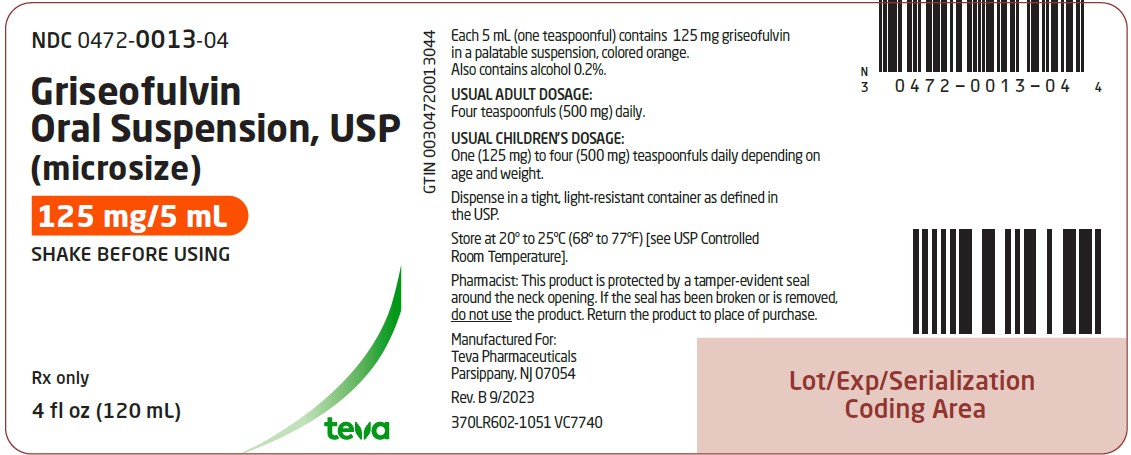
Griseofulvin 125 mg/5mL Suspension, 120 mL
🆔 Identity & classification
Where does this data come from?
🏷️ RxNorm drug class
This medicine belongs to the Tubulin Inhibiting Agent class.
Where does this data come from?
🏭 Manufacturer & labeler
Where does this data come from?
🩺 Clinical
Griseofulvin is used to treat skin infections such as jock itch, athlete's foot, and ringworm; and fungal infections of the scalp, fingernails, and toenails. This medication is sometimes prescribed for other uses; ask your doctor or pharmacist for more information.
Read the full MedlinePlus article ↗- It really can be — and that's one of the most important things to understand about this medication. Fungal infections of the nails especially can take at least 4 to 6 months to cle...
- How long do I have to take griseofulvin? It seems like a really long time.
- Yes, and specifically with a fatty meal if you can. Studies show that eating something high in fat — like a full meal with dairy or meat — dramatically increases how much of the me...
- It's best to avoid alcohol entirely during treatment. The combination of griseofulvin and alcohol has been reported to cause an unpleasant and potentially dangerous reaction — naus...
Patient education
Supplement & herbal interactions
Some supplements/herbs that may interact with Griseofulvin — tap one for details:
Where does this data come from?
Ask a licensed pharmacist directly — free, answered by our team.
💊 What it looks like
Where does this data come from?
🧪 Inactive Ingredients / Excipients
Inactive ingredients, also called excipients, are components of the drug product other than the active ingredient. They may include fillers, dyes, coatings, preservatives, flavors, or other formulation ingredients.
💡 Tap an ingredient (hover on desktop) to see what it is and why it’s used.
-
UNII 3K9958V90M
A liquid solvent derived from fermentation or chemical synthesis. In medicines, alcohol dissolves active ingredients, helps preserve the product, and improves how the body absorbs certain drugs.
-
UNII F05Q2T2JA0
Docusate sodium is a stool softener compound that helps medicines dissolve and move through the digestive tract. It acts as a surfactant, reducing surface tension in the intestines, and also serves as a wetting agent in tablet formulations.
-
UNII WZB9127XOA
A synthetic red dye used to color medications and make them easier to identify. It serves as a colorant in tablets, capsules, and liquid formulations.
-
UNII H77VEI93A8
A synthetic yellow dye used to color medications. It helps identify the drug and make it visually distinctive, with no effect on how the medicine works.
-
UNII 6M3P64V0NC
A fine powder made from magnesium, aluminum, and silicon compounds. It absorbs moisture and helps keep medicine ingredients from clumping or separating, so the product stays stable and flows smoothly during manufacturing.
-
UNII L7T10EIP3A
A cooling compound from mint plants used as a flavoring agent and to create a fresh sensation in medicines. It helps mask bitter tastes and improve how the product feels in the mouth.
-
UNII A2I8C7HI9T
Methylparaben is a preservative derived from benzoic acid that prevents growth of bacteria, fungi, and mold in medicines. It extends the product's shelf life and maintains safety during storage.
-
UNII 6DC9Q167V3
Propylene glycol is a clear liquid derived from petroleum or vegetable sources. It acts as a solvent, humectant, and preservative in medicines, helping dissolve active ingredients and maintain product stability.
-
UNII Z8IX2SC1OH
Propylparaben is a chemical preservative used to prevent bacterial and fungal growth in medicines and personal care products. It helps extend shelf life and maintain product safety during storage.
-
UNII SB8ZUX40TY
Saccharin sodium is an artificial sweetener made from saccharin salt. It's added to medicines to improve taste, especially in liquid formulations for children or bitter drugs.
-
UNII C269C4G2ZQ
Sodium alginate is a natural thickener and gelling agent derived from seaweed. In medicines, it acts as a binder to hold ingredients together, a thickener to adjust texture, and a disintegrant to help the tablet or capsule break apart for absorption.
-
UNII C151H8M554
A natural sugar derived from sugar cane or sugar beets. It's used as a sweetener, filler, and binder to improve taste, add bulk, and help hold tablet or capsule ingredients together.
-
UNII 059QF0KO0R
Water is a liquid solvent that dissolves and mixes ingredients together in liquid medicines, syrups, and injections. It helps distribute the active drug evenly throughout the product.
13 inactive ingredients listed in the exact product block matched to this NDC.
Where does this data come from?
ingredient classCode="IACT" elements from the exact product block matched by this NDC. Label-section narrative from DailyMed / the openFDA label index is shown separately when available.Inactive ingredient FAQ
Are inactive ingredients the same for every manufacturer?
Why might an inactive ingredient be missing?
Can inactive ingredients matter?
💲 Pricing
A drug doesn't have one price. Each row is a different public payment system, and none is what you'd pay at the counter — that depends on your insurance. The ⓘ on each row explains what it measures.
| Price system | Per mL | Per package |
|---|---|---|
| Retail pharmacies payNADAC · weekly | $0.252 | $30.23 / 120 ml |
| Medicaid paysCMS SDUD · 12 mo | $0.3297 | $39.56 / 120 ml |
| Medicare drug plans payPart D · Q2 2026 | $0.4660 | $55.92 / 120 ml |
Where does this data come from?
🔁 Therapeutic equivalents
| Product | Labeler | Pack | NADAC/unit | TE | Status | Price vs. this |
|---|---|---|---|---|---|---|
| Griseofulvin 125 mg/5mLthis 00472-0013-04 | Actavis | 120 ml | $0.252 | AB | Availability likely | — |
| Griseofulvin 125 mg/5mL 62135-0968-41 | Chartwell | 120 ml | $0.252 | AB | Availability likely | — |
| grisofulvin 125 mg/5mL 69097-0361-08 | Cipla | 120 ml | $0.252 | AB | Availability likely | — |
| Griseofulvin 125 mg/5mL 00713-0850-04 | Cosette | 118 ml | $0.395 | AB | Availability likely | +57% |
Where does this data come from?
⏳ Availability & generic status
This product is an FDA-approved generic. Other versions of the same drug are listed under Therapeutic equivalents, least expensive first.
Where does this data come from?
🗺️ Medicaid utilization & spend
📊 Medicare Part D spend CMS · PART D · 2026 (Q1)
📦 Packaging — all sizes for this product
| Package NDC | Description | Marketing start | Status |
|---|---|---|---|
| 00472-0013-04 You're viewing this | 120 mL in 1 BOTTLE (0472-0013-04) | 2007-07-26 | Active |
📄 Full prescribing information FDA SPL
🎯 Indications and Usage ▾
INDICATIONS AND USAGE Griseofulvin oral suspension, USP is indicated for the treatment of dermatophyte infections of the skin not adequately treated by topical therapy, hair and nails, namely: Tinea corporis Tinea pedis Tinea cruris Tinea barbae Tinea capitis Tinea unguium when caused by one or more of the following species of fungi: Epidermophyton floccosum Microsporum audouinii Microsporum canis Microsporum gypseum Trichophyton crateriform Trichophyton gallinae Trichophyton interdigitalis Trichophyton megnini Trichophyton mentagrophytes Trichophyton rubrum Trichophyton schoenleini Trichophyton sulphureum Trichophyton tonsurans Trichophyton verrucosum Note: Prior to therapy, a dermatophyte should be identified as responsible for the infection.
Prior to initiating treatment, appropriate specimens for laboratory testing (KOH preparation, fungal culture, or nail biopsy) should be obtained to confirm the diagnosis. Griseofulvin is not effective in the following: Bacterial infections Candidiasis (Moniliasis) Histoplasmosis Actinomycosis Sporotrichosis Chromoblastomycosis Coccidioidomycosis North American Blastomycosis Cryptococcosis (Torulosis) Tinea versicolor Nocardiosis The use of this drug is not justified in minor or trivial dermatophyte infections which will respond to topical agents alone.
⏱️ Dosage and Administration ▾
DOSAGE AND ADMINISTRATION Accurate diagnosis of the infecting organism is essential. Identification should be made either by direct microscopic examination of a mounting of infected tissue in a solution of potassium hydroxide or by culture on an appropriate medium. Medication must be continued until the infecting organism is completely eradicated as indicated by appropriate clinical or laboratory examination.
Representative treatment periods are tinea capitis, 4 to 6 weeks; tinea corporis, 2 to 4 weeks; tinea pedis, 4 to 8 weeks; tinea unguium-depending on rate of growth-fingernails, at least 4 months; toenails, at least 6 months. General measures in regard to hygiene should be observed to control sources of infection or reinfection. Concomitant use of appropriate topical agents is usually required, particularly in treatment of tinea pedis.
In some forms of tinea pedis, yeasts and bacteria may be involved as well as dermatophytes. Griseofulvin will not eradicate these associated bacterial or yeast infections. Adults: 0.5 g daily (125 mg four times a day, 250 mg twice a day, or 500 mg/day).
Patients with less severe or 300 extensive infections may require less, whereas those with widespread lesions may require a starting dose of 0.75 g to 1.0 g/day. This may be reduced gradually to 0.5 g or less after a response has been noted. In all cases, the dosage should be individualized.
Pediatric patients (older than 2 years): A dosage of 10 mg/kg daily is usually adequate (pediatric patients from 30 to 50 lbs, 125 mg to 250 mg daily; pediatric patients over 50 lbs, 250 mg to 500 mg daily, in divided doses). Dosage should be individualized, as with adults. Clinical relapse will occur if the medication is not continued until the infecting organism is eradicated.
Safety is not established at higher doses than recommended.
⛔ Contraindications ▾
CONTRAINDICATIONS Griseofulvin is contraindicated in patients with porphyria or hepatocellular failure, and in individuals with a history of hypersensitivity to griseofulvin. Griseofulvin may cause fetal harm when administered to a pregnant woman. Two published cases of conjoined twins have been reported in patients taking griseofulvin during the first trimester of pregnancy, therefore, griseofulvin is contraindicated in women who are or may become pregnant during treatment.
Women taking estrogen-containing oral contraceptives may be at increased risk of becoming pregnant while on griseofulvin (see also PRECAUTIONS , Drug Interactions ). If this drug is used during pregnancy, or if the patient becomes pregnant while taking this drug, the patient should be apprised of the potential hazard to the fetus. Although no direct causal relationship has been established, spontaneous abortion has been reported rarely coincident with the use of griseofulvin.
Note: The Maximum Recommend Human Dose (MRHD) was set at 500 mg/day for the multiple of human exposure calculations performed in this label. If higher doses than 500 mg/day were used clinically, then the multiple of human exposure would be correspondingly reduced for that dose. For example, if a 1,000 mg/day dose was administered to an individual, then the multiple of human exposure would be reduced by a factor of 2.
Griseofulvin has been shown to be embryotoxic and teratogenic in pregnant rats when given at a daily oral dose of 250 mg/kg/day [4X the Maximum Recommended Human Dose (MRHD) based on Body Surface Area (BSA)]. Griseofulvin also has been shown to be embryotoxic and teratogenic in pregnant cats treated weekly with griseofulvin at doses of 500 to 1,000 mg/week. There are reports of teratogenicity in a Golden Retriever when doses of 750 mg/day [1.2X the MRHD based on BSA] were administered for four weeks prior to and throughout the pregnancy, and in a study in which beagles were administered 35 mg/kg/day [1.9X the MRHD based on BSA] for intervals from one week up to the entire gestation period.
Teratogenicity was also seen in mice when griseofulvin was administered in doses equivalent to 5g/kg/day [40X the MRHD based on BSA] for 2 consecutive days at various stages of the pregnancy.
⚠️ Warnings ▾
WARNINGS Prophylactic Usage: Safety and efficacy of griseofulvin for prophylaxis of fungal infections have not been established. Serious Skin Reactions: Severe skin reactions (e.g. Stevens-Johnson syndrome, toxic epidermal necrolysis) and erythema multiforme have been reported with griseofulvin use.
These reactions may be serious and may result in hospitalization or death. If severe skin reactions occur, griseofulvin should be discontinued (see ADVERSE REACTIONS section). Hepatotoxicity: Elevations in AST, ALT, bilirubin, and jaundice have been reported with griseofulvin use.
These reactions may be serious and may result in hospitalization or death. Patients should be monitored for hepatic adverse events and discontinuation of griseofulvin considered if warranted (see ADVERSE REACTIONS section).
🤒 Adverse Reactions ▾
ADVERSE REACTIONS There have been postmarketing reports of severe skin and hepatic adverse events associated with griseofulvin use (see WARNINGS section). When adverse reactions occur, they are most commonly of the hypersensitivity type, such as skin rashes, urticaria, and rarely, angioneurotic edema, and erythema multiforme. These may necessitate withdrawal of therapy and appropriate countermeasures.
Peripheral neuropathy and paresthesias of the hands and feet have been reported and may be related to treatment duration. Most patients treated with griseofulvin for less than six months experienced improvement or resolution of their neuropathy upon withdrawal of the griseofulvin. Other side effects reported occasionally are oral thrush, nausea, vomiting, epigastric distress, diarrhea, headache, fatigue, dizziness, insomnia, mental confusion and impairment of performance of routine activities.
Proteinuria, nephrosis (sometimes associated with existing systemic lupus erythematosus), leukopenia, coagulopathy, hepatitis, elevated liver enzymes, hyperbilirubinemia, and GI bleeding have been reported rarely. Administration of the drug should be discontinued if granulocytopenia occurs. To report SUSPECTED ADVERSE REACTIONS, contact Teva at 1-888-838-2872 or FDA at 1-800-FDA-1088 or www.fda.gov/medwatch.
🧬 Clinical Pharmacology ▾
CLINICAL PHARMACOLOGY Griseofulvin absorption from the gastrointestinal tract varies considerably among individuals mainly because of insolubility of the drug in aqueous media of the upper GI tract. Drug absorption has been estimated to range between 27 and 72%. After an oral dose, griseofulvin is primarily absorbed from the duodenum with some absorption occurring from the jejunum and ileum.
The peak serum level in fasting adults given 0.5 g of griseofulvin microsize occurs at about four hours and ranges between 0.5 to 2.0 mcg/mL. The serum level may be increased by giving the drug with a meal with a high fat content. In one study in pediatric patients 19 months to 11 years of age, 10 mg/kg of griseofulvin microsize given with milk resulted in mean peak serum concentrations approximately four-fold greater than the same griseofulvin dose given alone (1.29 mcg/mL versus 0.34 mcg/mL, respectively).
Also, the area under the curve value was ten-fold larger when 10 mg/kg griseofulvin and milk were administered simultaneously as compared to the same dosage given to fasting patients. In addition, griseofulvin administered with milk resulted in more consistently detected serum levels across subjects. Following oral administration, griseofulvin is deposited in the keratin precursor cells and has a greater affinity for diseased tissue.
The drug is tightly bound to the new keratin which becomes highly resistant to fungal invasions. When the drug is discontinued, griseofulvin concentrations in the skin decline less rapidly than those in plasma. Griseofulvin is metabolized by the liver to 6-desmethylgriseofulvin and its glucuronide conjugate.
Griseofulvin has a variable elimination half-life in plasma (9 to 24 hours). Approximately 30% of a single oral dose of griseofulvin is excreted in the urine within 24 hours and about 50% of the dose is excreted in the urine within 5 days, mostly in the form of metabolites. Unchanged griseofulvin in the urine accounts for less than 1% of the administered dose.
In addition, approximately one-third of a single dose of griseofulvin is excreted in feces within 5 days. Griseofulvin is also excreted in perspiration. Microbiology: Mechanism of Action: The mechanism of griseofulvin consists of binding microtubular proteins, which are required for mitosis.
Activity In Vivo: Griseofulvin may be active against most strains of the following dermatophytes as described in the INDICATIONS AND USAGE section: Epidermophyton floccosum, Microsporum audouinii, Microsporum canis, Microsporum gypseum, Trichophyton crateriformis, Trichophyton gallinae, Trichophyton interdigitalis, Trichophyton megnini, Trichophyton mentagrophytes, Trichophyton rubrum, Trichophyton sulphureum, Trichophyton schoenleini, Trichophyton tonsurans, and Trichophyton verrucosum. It has no effect on bacteria or on other genera of fungi.
Activity In Vitro: In vitro , griseofulvin has been shown to have activity against many dermatophytes, but the clinical significance is unknown. Susceptibility Testing For specific information regarding susceptibility test interpretive criteria and associated test methods and quality control standards recognized by FDA for this drug, please see: https://www.fda.gov/STIC. Drug Resistance: Although there have been reports of dermatophyte resistance to griseofulvin, the clinical significance is unknown.
📦 How Supplied / Storage and Handling ▾
HOW SUPPLIED Griseofulvin oral suspension, USP (microsize), 125 mg per 5 mL is an orange-vanilla flavored suspension available in bottles of 4 fl oz (120 mL) NDC 0472-0013-04. Dispense griseofulvin oral suspension, USP in a tight, light-resistant container as defined in the USP. Store at 20° to 25°C (68° to 77°F) [see USP Controlled Room Temperature]. Manufactured For: Teva Pharmaceuticals Parsippany, NJ 07054 Rev. A 9/2023
📋 Description ▾
DESCRIPTION Griseofulvin microsize contains griseofulvin microsize for oral administration. The active ingredient, griseofulvin, USP is a fungistatic antibiotic, derived from a species of Penicillium . The chemical name of griseofulvin, USP is 7-chloro-2’,4,6-trimethoxy-6’β-methylspiro[benzofuran - 2(3H),1’-[2]cyclohexane]-3-4’-dione.
Its structural formula is: C 17 H 17 ClO 6 M.W. 352.77 Griseofulvin, USP occurs as a white to creamy white, bitter tasting powder which is very slightly soluble in water and sparingly soluble in alcohol. Griseofulvin microsize contains particles of approximately 2 to 4 μm in diameter.
Griseofulvin oral suspension, USP is an orange colored suspension. Each 5 mL of griseofulvin oral suspension, USP contains 125 mg of griseofulvin microsize and also contains alcohol 0.2%, artificial orange vanilla flavor, docusate sodium, FD&C Red No. 40, FD&C Yellow No.
6, magnesium aluminum silicate, menthol, methylparaben, propylene glycol, propylparaben, saccharin sodium, simethicone emulsion, sodium alginate, sucrose, and purified water. structure