
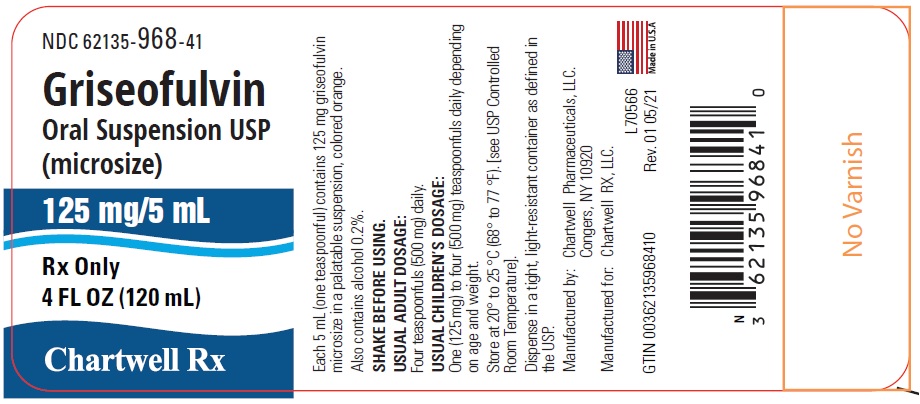
Griseofulvin 125 mg/5mL Suspension, 120 mL — NDC 62135-968-41 (Billing 62135-0968-41)
This is a package of 120 mL of Griseofulvin 125 mg/5mL Suspension from Chartwell RX, LLC., marketed since Mar 2005 and currently FDA-listed; retail pharmacies pay about $0.2522 per mL (NADAC). It is this product's only package size.
NDC database record
One package, one record: these facts belong to NDC 62135-968-41 alone.
- Record
- FDA NDC Directory package listing · Human prescription drug
- Code segments
- 62135 labeler · 968 product · 41 package
- Package marketed since
- Aug 26, 2021
- Sample package
- No — commercial package
- Listing certified through
- Dec 31, 2026
- Billing quantity
- 120 mL per package
- Barcode (UPC)
- 0362135968410
- Medicaid fills, this package
- 23 prescriptions in the last four reported quarters
- FDA record last changed
- Jul 24, 2026
Identity & classification
Regulatory identifiers FDA, NLM and CMS codes for this package
Drug-database identifiers Medi-Span GPI and First Databank GCN / HICL / AHFS classification
- GSN (GCN sequence number): 009517
- GCN: 42390
- GPI-14 (Medi-Span): 11000030101805
- HICL (First Databank): 004126
- AHFS class code: 08:14.92.00
- RxCUI (RxNorm): 239238
Where does this data come from?
- FDA openFDA NDC Directory · synced Oct 8, 2026
- FDA label on DailyMed · label index refreshed Oct 6, 2026
- RxNorm (NLM RxNav) · catalog refreshed Oct 1, 2026
- Medi-Span GPI (licensed)
- First Databank (licensed) · refreshed Oct 8, 2026
RxNorm drug class
This medicine belongs to the Tubulin Inhibiting Agent class.
Where does this data come from?
- RxClass (NLM) · catalog refreshed Oct 1, 2026
Clinical
- It treats fungal infections of the skin, hair and nails, such as ringworm, athlete’s foot, scalp ringworm and nail fungus. It is used when creams alone are not enough. It will not...
- Take it by mouth exactly as your prescriber directs. A meal with some fat can help your body absorb it. If you take Ultramicrosize Griseofulvin tablets, they can be crushed into ap...
- It depends on the infection. Skin infections may take a few weeks, while fingernails take at least 4 months and toenails at least 6. Keep going until the fungus is gone, or the inf...
- Headache, nausea, upset stomach, diarrhea, rash and tiredness are among the more common ones. Call your doctor for a severe rash or blistering, yellow skin or eyes, or numbness and...
Patient education
Supplement & herbal interactions
Where does this data come from?
- MedlinePlus (NLM) · refreshed Oct 1, 2026
- FDA label on DailyMed · label index refreshed Oct 6, 2026
Ask a licensed pharmacist directly — free, answered by our team.
Pricing
A drug doesn't have one price. Each row is a different public payment system, and none is what you'd pay at the counter — that depends on your insurance. The ⓘ on each row explains what it measures.
| Price system | Per mL | Per package |
|---|---|---|
| Retail pharmacies payNADAC · weekly | $0.252 | $30.26 / 120 ml |
| Medicaid paysCMS SDUD · 12 mo | $0.3748 | $44.98 / 120 ml |
| Medicare drug plans payPart D · Q2 2026 | $0.4660 | $55.92 / 120 ml |
Where does this data come from?
- CMS NADAC weekly file · file of Oct 7, 2026
- CMS ASP pricing files · refreshed Sep 20, 2026
- CMS Medicaid State Drug Utilization Data · through Q1 2026
- CMS Part D plan pricing files · refreshed Sep 24, 2026
- VA National Acquisition Center price file
Packaging — all sizes for this product
| Package NDC | Description | Marketing start | Marketing end | Status |
|---|---|---|---|---|
| 62135-0968-41 You're viewing this Main listing | 120 mL in 1 BOTTLE | 2021-08-26 | — | Active |
Therapeutic equivalents
| Product | Labeler | Pack | NADAC/unit | TE | Status | Price vs. this |
|---|---|---|---|---|---|---|
| Griseofulvin 125 mg/5mL 00472-0013-04 | Actavis | 120 ml | $0.252 | AB | Availability likely | — |
| Griseofulvin 125 mg/5mLthis 62135-0968-41 | Chartwell | 120 ml | $0.252 | AB | Availability likely | — |
| grisofulvin 125 mg/5mL 69097-0361-08 | Cipla | 120 ml | $0.252 | AB | Availability likely | — |
| Griseofulvin 125 mg/5mL 00713-0850-04 | Cosette | 118 ml | $0.391 | AB | Availability likely | +55% |
Where does this data come from?
- FDA openFDA NDC Directory · synced Oct 8, 2026
- FDA Orange Book · refreshed Oct 3, 2026
- CMS NADAC weekly file · file of Oct 7, 2026
Availability & generic status
This product is an FDA-approved generic. Other versions of the same drug are listed under Therapeutic equivalents, least expensive first.
Where does this data come from?
- FDA Orange Book · refreshed Oct 3, 2026
Inactive Ingredients / Excipients
Inactive ingredients, also called excipients, are components of the drug product other than the active ingredient. They may include fillers, dyes, coatings, preservatives, flavors, or other formulation ingredients.
🧪 Avoiding an ingredient? See Griseofulvin inactive ingredients by manufacturer: every current product's list side by side, so you can ask your pharmacy for the version that does not list it.
💡 Tap an ingredient (hover on desktop) to see what it is and why it’s used.
-
UNII 3K9958V90M
A liquid solvent derived from fermentation or chemical synthesis. In medicines, alcohol dissolves active ingredients, helps preserve the product, and improves how the body absorbs certain drugs.
-
UNII F05Q2T2JA0
Docusate sodium is a stool softener compound that helps medicines dissolve and move through the digestive tract. It acts as a surfactant, reducing surface tension in the intestines, and also serves as a wetting agent in tablet formulations.
-
UNII WZB9127XOA
A synthetic red dye used to color medications and make them easier to identify. It serves as a colorant in tablets, capsules, and liquid formulations.
-
UNII H77VEI93A8
A synthetic yellow dye used to color medications. It helps identify the drug and make it visually distinctive, with no effect on how the medicine works.
-
UNII 6M3P64V0NC
A fine powder made from magnesium, aluminum, and silicon compounds. It absorbs moisture and helps keep medicine ingredients from clumping or separating, so the product stays stable and flows smoothly during manufacturing.
-
UNII L7T10EIP3A
A cooling compound from mint plants used as a flavoring agent and to create a fresh sensation in medicines. It helps mask bitter tastes and improve how the product feels in the mouth.
-
UNII A2I8C7HI9T
Methylparaben is a preservative derived from benzoic acid that prevents growth of bacteria, fungi, and mold in medicines. It extends the product's shelf life and maintains safety during storage.
-
UNII 6DC9Q167V3
Propylene glycol is a clear liquid derived from petroleum or vegetable sources. It acts as a solvent, humectant, and preservative in medicines, helping dissolve active ingredients and maintain product stability.
-
UNII Z8IX2SC1OH
Propylparaben is a chemical preservative used to prevent bacterial and fungal growth in medicines and personal care products. It helps extend shelf life and maintain product safety during storage.
-
UNII SB8ZUX40TY
Saccharin sodium is an artificial sweetener made from saccharin salt. It's added to medicines to improve taste, especially in liquid formulations for children or bitter drugs.
-
UNII C269C4G2ZQ
Sodium alginate is a natural thickener and gelling agent derived from seaweed. In medicines, it acts as a binder to hold ingredients together, a thickener to adjust texture, and a disintegrant to help the tablet or capsule break apart for absorption.
-
UNII C151H8M554
A natural sugar derived from sugar cane or sugar beets. It's used as a sweetener, filler, and binder to improve taste, add bulk, and help hold tablet or capsule ingredients together.
-
UNII 059QF0KO0R
Water is a liquid solvent that dissolves and mixes ingredients together in liquid medicines, syrups, and injections. It helps distribute the active drug evenly throughout the product.
13 inactive ingredients listed in the exact product block matched to this NDC.
Where does this data come from?
ingredient classCode="IACT" elements from the exact product block matched by this NDC. Label-section narrative from DailyMed / the openFDA label index is shown separately when available.- FDA label on DailyMed · label index refreshed Oct 6, 2026
- FDA openFDA NDC Directory · synced Oct 8, 2026
Inactive ingredient FAQ
Are inactive ingredients the same for every manufacturer?
Why might an inactive ingredient be missing?
Can inactive ingredients matter?
Manufacturer & labeler
More NDCs from Chartwell RX, LLC. labeler code 62135
- Sulfasalazine 500 mg Tablet NDC 62135-960-01
- Glycopyrrolate 1 mg/5mL Solution NDC 62135-961-47
- Phenobarbital 20 mg/5mL Solution NDC 62135-962-22
- Dapsone 25 mg Tablet NDC 62135-965-30
- Dapsone 100 mg Tablet NDC 62135-966-30
- Moexipril Hydrochloride 7.5 mg Tablet, Film Coated NDC 62135-967-90
- Moexipril Hydrochloride 15 mg Tablet, Film Coated NDC 62135-969-90
- Mefloquine Hydrochloride 250 mg Tablet NDC 62135-973-11
- Doxycycline Hyclate 75 mg Capsule NDC 62135-975-20
- Irbesartan 75 mg Tablet NDC 62135-976-30
- Irbesartan 150 mg Tablet NDC 62135-977-30
- Irbesartan 300 mg Tablet NDC 62135-978-30
Where does this data come from?
- FDA openFDA NDC Directory · synced Oct 8, 2026
- Drugs@FDA
Full prescribing information FDA SPL
🎯 Indications and Usage ▾
Indications and Usage Major indications for Griseofulvin Oral Suspension, USP are: Tinea capitis (ringworm of the scalp) Tinea corporis (ringworm of the body) Tinea pedis (athlete's foot) Tinea unguium (onychomycosis; ringworm of the nails) Tinea cruris (ringworm of the thigh) Tinea barbae (barber’s itch) Griseofulvin Oral Suspension, USP inhibits the growth of those genera of fungi that commonly cause ringworm infections of the hair, skin, and nails, such as: Trichophyton rubrum Trichophyton tonsurans Trichophyton mentagrophytes Trichophyton interdigitalis Trichophyton verrucosum Trichophyton sulphureum Trichophyton schoenleini Microsporum audouini Microsporum canis Microsporum gypseum Epidermophyton floccosum Trichophyton megnini Trichophyton gallinae Trichophyton crateriform Note: Prior to therapy, the type of fungi responsible for the infection should be identified.
The use of the drug is not justified in minor or trivial infections which will respond to topical antifungal agents alone. It is not effective in: Bacterial infections Candidiasis (Moniliasis) Histoplasmosis Actinomycosis Sporotrichosis Chromoblastomycosis Coccidioidomycosis North American Blastomycosis Cryptococcosis (Torulosis) Tinea versicolor Nocardiosis
⏱️ Dosage and Administration ▾
Dosage and Administration Accurate diagnosis of the infecting organism is essential. Identification should be made either by direct microscopic examination of a mounting of infected tissue in a solution of potassium hydroxide or by culture on an appropriate medium. Medication must be continued until the infecting organism is completely eradicated as indicated by appropriate clinical or laboratory examination.
Representative treatment periods are tinea capitis, 4 to 6 weeks; tinea corporis, 2 to 4 weeks; tinea pedis, 4 to 8 weeks; tinea unguium – depending on rate of growth – fingernails, at least 4 months; toenails, at least 6 months. General measures in regard to hygiene should be observed to control sources of infection or reinfection. Concomitant use of appropriate topical agents is usually required, particularly in treatment of tinea pedis since in some forms of athlete's foot, yeasts and bacteria may be involved.
Griseofulvin will not eradicate the bacterial or monilial infection. Adults: A daily dose of 500 mg will give a satisfactory response in most patients with tinea corporis, tinea cruris, and tinea capitis. For those fungus infections more difficult to eradicate such as tinea pedis and tinea unguium, a daily dose of 1 gram is recommended.
Children: Approximately 5 mg per pound of body weight per day is an effective dose for most children. On this basis the following dosage schedule for children is suggested: Children weighing 30 to 50 pounds - 125 mg to 250 mg daily. Children weighing over 50 pounds - 250 mg to 500 mg daily.
⛔ Contraindications ▾
Contraindications This drug is contraindicated in patients with porphyria, hepatocellular failure, and in individuals with a history of hypersensitivity to griseofulvin. Two cases of conjoined twins have been reported in patients taking griseofulvin during the first trimester of pregnancy. Griseofulvin should not be prescribed to pregnant patients.
⚠️ Warnings ▾
Warnings Prophylactic Usage: Safety and efficacy of prophylactic use of this drug has not been established. Chronic feeding of griseofulvin, at levels ranging from 0.5-2.5% of the diet, resulted in the development of liver tumors in several strains of mice, particularly in males. Smaller particle sizes result in an enhanced effect.
Lower oral dosage levels have not been tested. Subcutaneous administration of relatively small doses of griseofulvin once a week during the first three weeks of life has also been reported to induce hepatomata in mice. Although studies in other animal species have not yielded evidence of tumorigenicity, these studies were not of adequate design to form a basis for conclusions in this regard.
In subacute toxicity studies, orally administered griseofulvin produced hepatocellular necrosis in mice, but this has not been seen in other species. Disturbances in porphyrin metabolism have been reported in griseofulvin-treated laboratory animals. Griseofulvin has been reported to have a colchicine-like effect on mitosis and cocarcinogenicity with methylcholanthrene in cutaneous tumor induction in laboratory animals.
Reports of animal studies in the Soviet literature state that a griseofulvin preparation was found to be embryotoxic and teratogenic on oral administration to pregnant Wistar rats. Rat reproduction studies done in the United States and Great Britain were inconclusive in this regard. Pups with abnormalities have been reported in the litters of a few bitches treated with griseofulvin.
Because the potential for adverse effects on the human fetus cannot be ruled out, additional contraceptive precautions should be taken during treatment with griseofulvin and for a month after termination of treatment. Griseofulvin Oral Suspension, USP should not be prescribed to women intending to become pregnant within one month following cessation of therapy. Suppression of spermatogenesis has been reported to occur in rats but investigation in man failed to confirm this.
Griseofulvin interferes with chromosomal distribution during cell division, causing aneuploidy in plant and mammalian cells. These effects have been demonstrated in vitro at concentrations that may be achieved in the serum with the recommended therapeutic dosage. Since griseofulvin has demonstrated harmful effects in vitro on the genotype in bacteria, plants, and fungi, males should wait at least six months after completing griseofulvin therapy before fathering a child.
🤒 Adverse Reactions ▾
Adverse Reactions When adverse reactions occur, they are most commonly of the hypersensitivity type such as skin rashes, urticaria and rarely, angioneurotic edema or erythema multiforme-like drug reaction, and may necessitate withdrawal of therapy and appropriate countermeasures. Paresthesias of the hands and feet have been reported rarely after extended therapy. Other side effects reported occasionally are oral thrush, nausea, vomiting, epigastric distress, diarrhea, headache, fatigue, dizziness, insomnia, mental confusion and impairment of performance of routine activities.
Proteinuria and leukopenia have been reported rarely. Administration of the drug should be discontinued if granulocytopenia occurs. When rare, serious reactions occur with griseofulvin, they are usually associated with high dosages, long periods of therapy, or both.
🧬 Clinical Pharmacology ▾
Clinical Pharmacology Griseofulvin Oral Suspension, USP acts systemically to inhibit the growth of Trichophyton, Microsporum, and Epidermophyton genera of fungi. Fungistatic amounts are deposited in the keratin, which is gradually exfoliated and replaced by noninfected tissue. Griseofulvin absorption from the gastrointestinal tract varies considerably among individuals, mainly because of insolubility of the drug in aqueous media of the upper G.I. tract.
The peak serum level found in fasting adults given 0.5 gm occurs at about four hours and ranges between 0.5 and 2.0 mcg/mL. It should be noted that some individuals are consistently "poor absorbers" and tend to attain lower blood levels at all times. This may explain unsatisfactory therapeutic results in some patients.
Better blood levels can probably be attained in most patients if griseofulvin is administered after a meal with a high fat content.
📦 How Supplied / Storage and Handling ▾
How Supplied Griseofulvin Oral Suspension, USP (microsize) 125 mg per 5 mL is available as follows: 4 fl oz (120 mL) bottle (NDC 62135-968-41) Dispense Griseofulvin Oral Suspension, USP in a tight, light-resistant container as defined in the USP. STORAGE Store at 20° to 25°C (68° to 77°F) [see USP Controlled Room Temperature]. Manufactured by: Chartwell Pharmaceuticals, LLC.
Congers, NY 10920 Manufactured for: Chartwell RX, LLC. Congers, NY 10920 L70567 Rev: 08/2021
📋 Description ▾
Description Griseofulvin is an antibiotic derived from a species of Penicillium. Each 5 mL of Griseofulvin Oral Suspension, USP contains 125 mg of griseofulvin (microsize) and also contains alcohol (0.2%), docusate sodium, FD&C Red No. 40, FD&C Yellow No. 6, magnesium aluminum silicate, menthol, methylparaben, orange cream flavors, propylene glycol, propylparaben, purified water, saccharin sodium, simethicone emulsion, sodium alginate and sucrose.
⚠️ Precautions ▾
Precautions Patients on prolonged therapy with any potent medication should be under close observation. Periodic monitoring of organ system function, including renal, hepatic and hemopoietic, should be done. Since griseofulvin is derived from species of penicillin, the possibility of cross sensitivity with penicillin exists; however, known penicillin-sensitive patients have been treated without difficulty.
Since a photosensitivity reaction is occasionally associated with griseofulvin therapy, patients should be warned to avoid exposure to intense natural or artificial sunlight. Should a photosensitivity reaction occur, lupus erythematosus may be aggravated. Drug Interactions: Patients on warfarin-type anticoagulant therapy may require dosage adjustment of the anticoagulant during and after griseofulvin therapy.
Concomitant use of barbiturates usually depresses griseofulvin activity and may necessitate raising the dosage. The concomitant administration of griseofulvin has been reported to reduce the efficacy of oral contraceptives and to increase the incidence of breakthrough bleeding.
📄 Package Label / Principal Display Panel ▾
PRINCIPAL DISPLAY PANEL Griseofulvin Oral Suspension, USP (microsize) 125 mg/5 mL - NDC 62135-968-41 - Label Griseofulvin Oral Suspension, USP 25 mg/5 ml - NDC 62135-968-41 - Label