
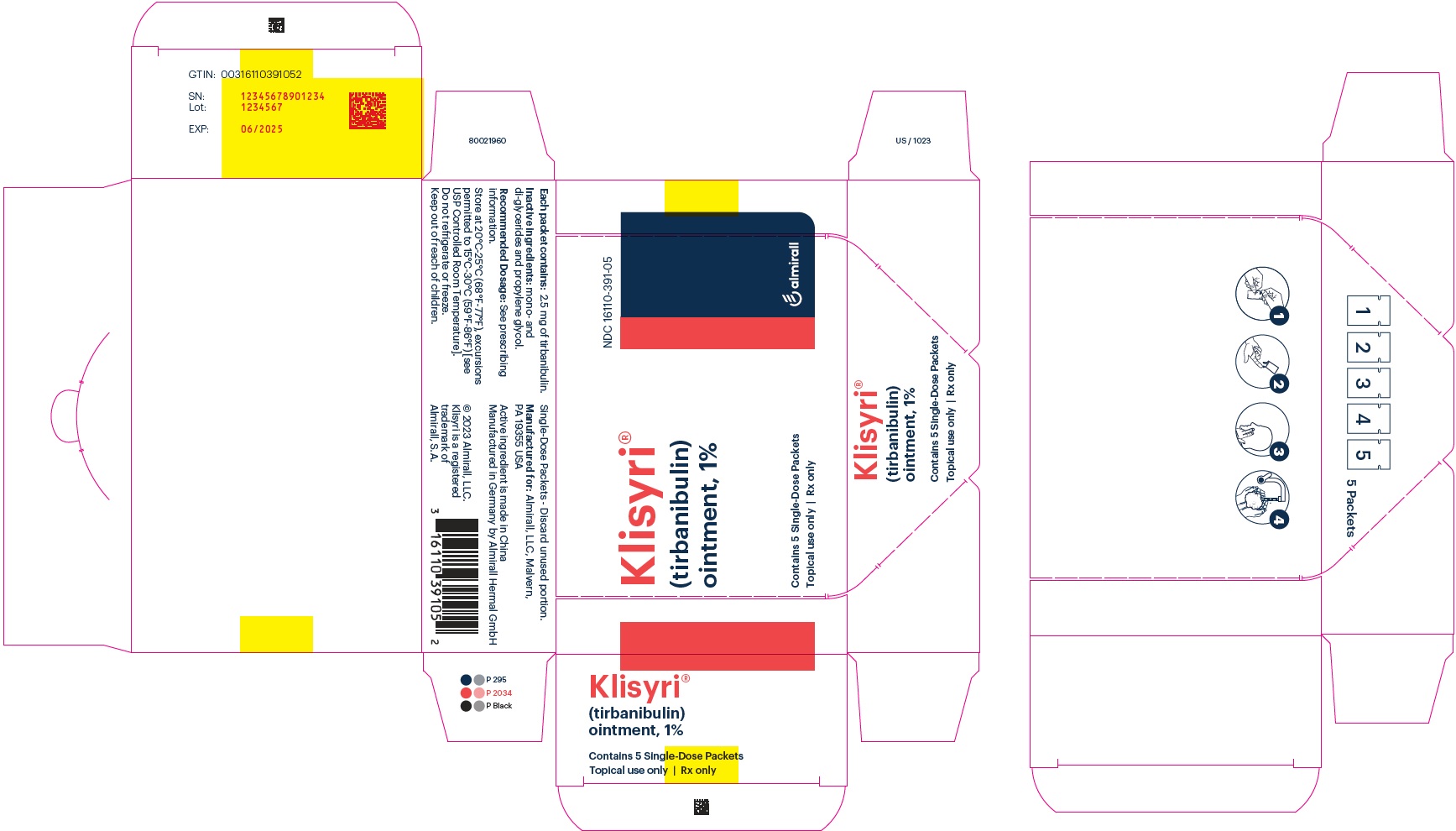
Klisyri tirbanibulin 10 mg/g Ointment, 5 packets — NDC 16110-391-55 (Billing 16110-0391-55)
This is a package of 5 packets of Klisyri tirbanibulin 10 mg/g Ointment from Almirall, LLC, marketed since Dec 2020 and currently FDA-listed.
NDC database record
One package, one record: these facts belong to NDC 16110-391-55 alone.
- Record
- FDA NDC Directory package listing · Human prescription drug
- Code segments
- 16110 labeler · 391 product · 55 package
- Package marketed since
- Jun 7, 2024
- Sample package
- No — commercial package
- Listing certified through
- Dec 31, 2027
- Billing quantity
- 5 EA per package
- Barcode (UPC)
- 0316110391052, 0316110391557
- FDA record last changed
- Sep 17, 2026
Identity & classification
Regulatory identifiers FDA, NLM and CMS codes for this package
Drug-database identifiers Medi-Span GPI and First Databank GCN / HICL / AHFS classification
- GSN (GCN sequence number): 081776
- GCN: 48994
- HICL (First Databank): 047031
- AHFS class code: 84:18.00.00
- RxCUI (RxNorm): 2471095
Where does this data come from?
- FDA openFDA NDC Directory · synced Oct 8, 2026
- FDA label on DailyMed · label index refreshed Oct 8, 2026
- RxNorm (NLM RxNav) · catalog refreshed Oct 1, 2026
- Medi-Span GPI (licensed)
- First Databank (licensed) · refreshed Oct 8, 2026
RxNorm drug class
This medicine belongs to the Microtubule Inhibitor class.
Where does this data come from?
- RxClass (NLM) · catalog refreshed Oct 1, 2026
Clinical
Tirbanibulin is used to treat actinic keratosis (flat, scaly growths on the skin caused by too much sun exposure) on the face or scalp. Tirbanibulin is in a class of medications called microtubule inhibitors. It works by killing fast-growing cells such as the abnormal cells associated with actinic keratoses.
Read the full MedlinePlus article ↗- Klisyri is used to treat actinic keratosis, rough sun-damaged patches of skin, on the face or scalp. You put it on as a field treatment over the whole area, not just single spots.
- Apply one packet to the treatment area once a day for 5 days in a row, then wash your hands right away. Try not to wash or touch the area for about 8 hours. After that, you can was...
- Skin reactions at the treated spot are the most common. These include redness, flaking, crusting, swelling, itching and pain. Most are mild to moderate. Call your doctor if you get...
- Flush your eyes with water right away and get medical care as soon as possible. It can irritate the eyes, so keep it away from the skin around them, too. Also avoid your mouth and...
Patient education
Supplement & herbal interactions
Some supplements/herbs that may interact with Tirbanibulin — tap one for details:
Where does this data come from?
- MedlinePlus (NLM) · refreshed Oct 8, 2026
- FDA label on DailyMed · label index refreshed Oct 8, 2026
Ask a licensed pharmacist directly — free, answered by our team.
Pricing
A drug doesn't have one price. Each row is a different public payment system, and none is what you'd pay at the counter — that depends on your insurance. The ⓘ on each row explains what it measures.
| Price system | Per g | Per package |
|---|---|---|
| Retail pharmacies payNADAC · weekly | Not in the retail survey — common for institutional, discontinued, or low-volume packs. | |
| Medicaid paysCMS SDUD · 12 mo | No recent Medicaid claims on file for this NDC — rare and low-volume NDCs are suppressed in the public data. | |
| Medicare drug plans payPart D · Q2 2026 | $225.06 | $393.85 / 1.75 g |
Where does this data come from?
- CMS NADAC weekly file
- CMS ASP pricing files · refreshed Sep 20, 2026
- CMS Medicaid State Drug Utilization Data · refreshed Oct 8, 2026
- CMS Part D plan pricing files · refreshed Sep 24, 2026
- VA National Acquisition Center price file
Packaging — all sizes for this product
| Package NDC | Description | Marketing start | Marketing end | Status |
|---|---|---|---|---|
| 16110-0391-05 16110-391-05 Main listing | 5 PACKET in 1 CARTON / .25 g in 1 PACKET | 2020-12-14 | — | Active |
| 16110-0391-55 You're viewing this | 5 PACKET in 1 CARTON / .35 g in 1 PACKET | 2024-06-07 | — | Active |
Pack size FAQ
What quantity is in this package?
How does this package differ from NDC 16110-0391-05?
What NDC number is used to bill for this package of Klisyri tirbanibulin 10 mg/g Ointment?
Therapeutic equivalents
| Product | Labeler | Pack | NADAC/unit | TE | Status | Price vs. this |
|---|---|---|---|---|---|---|
| Klisyri 10 mg/gthis 16110-0391-55 | Almirall, | 5 packets | — | — | FDA listed | — |
Where does this data come from?
- FDA openFDA NDC Directory · synced Oct 8, 2026
- FDA Orange Book · refreshed Oct 3, 2026
- CMS NADAC weekly file
Availability & generic status
We did not find an FDA-approved generic match for this exact strength, form and route. Patent/protection dates below may affect future generic timing.
Why the date isn’t exact: Generic timing can change because patents may be challenged, settled, licensed, added, removed, or worked around with a narrower label — and FDA approval does not always mean a pharmacy can get the generic today.
🛈 What do these terms mean?
- Patent
- Legal protection listed in the Orange Book that may delay generic approval or launch. Issued by the U.S. Patent & Trademark Office.
- Substance patent
- Covers the active drug molecule itself — the hardest to design around. A generic generally can’t launch until it expires.
- Formulation (product) patent
- Covers a specific formulation or dosage form. A generic can sometimes work around it with a different formulation.
- Method-of-use patent
- A patent covering one specific approved use of the drug — not necessarily the whole molecule. A generic can sometimes launch with a “skinny label” that carves out the protected use and keeps the others.
- Skinny label
- A generic label that omits a still-patented use when the FDA allows it — letting a generic reach the market for the unprotected uses.
- Exclusivity
- FDA-granted marketing protection, separate from patents — e.g. 5-yr new chemical entity, 7-yr orphan drug, or a +6-month pediatric extension.
- Paragraph IV
- A generic applicant’s formal challenge to a listed patent. It can potentially lead to earlier generic entry, but often involves litigation or a settlement.
- RLD / RS
- Reference Listed Drug — the brand product the FDA uses as the reference for generic applications. Reference Standard — the product the FDA expects generics to compare against in bioequivalence testing.
- TE / AB rating
- FDA therapeutic-equivalence rating. An AB rating generally means the FDA considers a generic therapeutically equivalent to — and substitutable for — the brand.
- LOE (loss of exclusivity)
- The latest patent or exclusivity currently listed — the loss-of-exclusivity / latest-listed-protection date shown on this page. Paragraph-IV challenges and settlements can move the real date earlier; FDA approval and a manufacturer’s decision to market can move it later.
Built from the FDA Orange Book. The bars above are scaled to each protection’s expiry; the red LOE marker is the last one to lapse.
| Patent | Type | Use code | Expires |
|---|---|---|---|
| US 7851470 ↗ | Drug substance | U-3015 | Feb 2, 2029 |
| US 10617693 ↗ | Method of use | U-3015 | Mar 12, 2038 |
| US 11497750 ↗ | Method of use | U-3015 | Mar 12, 2038 |
| US 12667576 ↗ | Method of use | U-4577 | Mar 12, 2038 |
| US 7300931 ↗ | Drug substance | — | Dec 28, 2030 |
| US 10669236 ↗ | Drug substance | — | Sep 7, 2038 |
| US 10323001 ↗ | Drug product | — | Dec 28, 2027 |
| Code | What it grants | Expires |
|---|---|---|
| D-192 | Other change requiring clinical data (3-year) | Jun 7, 2027 |
Is there a generic version of KLISYRI 1% (350 MG) OINT PKT?
The FDA approved a generic — why can’t I get it at my pharmacy yet?
Why do different websites show different generic release dates?
What does “FDA listed” mean?
What does a patent or protection date mean here?
What does “current Orange Book estimate” mean?
Can a generic come out before the last patent expires?
Can a generic come out after the listed dates?
What is the difference between patents and exclusivity?
Why are there multiple patent dates?
Where does this data come from?
- FDA Orange Book · refreshed Oct 3, 2026
What it looks like
Where does this data come from?
- FDA label on DailyMed · label index refreshed Oct 8, 2026
Inactive Ingredients / Excipients
Inactive ingredients, also called excipients, are components of the drug product other than the active ingredient. They may include fillers, dyes, coatings, preservatives, flavors, or other formulation ingredients.
🧪 Avoiding an ingredient? See Tirbanibulin Topical inactive ingredients by manufacturer: every current product's list side by side, so you can ask your pharmacy for the version that does not list it.
💡 Tap an ingredient (hover on desktop) to see what it is and why it’s used.
-
UNII KC98RO82HJ
A waxy substance made from glycerin and fatty acids. It acts as an emulsifier to help mix oil and water components, and as a thickener to give the medicine proper texture and consistency.
-
UNII 6DC9Q167V3
Propylene glycol is a clear liquid derived from petroleum or vegetable sources. It acts as a solvent, humectant, and preservative in medicines, helping dissolve active ingredients and maintain product stability.
2 inactive ingredients listed in the exact product block matched to this NDC.
Where does this data come from?
ingredient classCode="IACT" elements from the exact product block matched by this NDC. Label-section narrative from DailyMed / the openFDA label index is shown separately when available.- FDA label on DailyMed · label index refreshed Oct 8, 2026
- FDA openFDA NDC Directory · synced Oct 8, 2026
Inactive ingredient FAQ
Are inactive ingredients the same for every manufacturer?
Why might an inactive ingredient be missing?
Can inactive ingredients matter?
Manufacturer & labeler
More NDCs from Almirall, LLC labeler code 16110
- Tazorac tazarotene 1 mg/g Gel NDC 16110-042-10
- Seysara sarecycline hydrochloride 60 mg Tablet, Coated NDC 16110-245-00
- Seysara sarecycline hydrochloride 100 mg Tablet, Coated NDC 16110-246-00
- sarecycline hydrochloride 150 mg Tablet, Coated NDC 16110-247-00
- Aczone dapsone 75 mg/g Gel NDC 16110-526-30
- Cordran flurandrenolide 4 ug/cm2 Tape NDC 16110-587-24
- Acticlate CAP doxycycline hyclate 75 mg Capsule NDC 16110-601-01
- Tazorac tazarotene .5 mg/g Gel NDC 16110-833-10
- Azelex azelaic acid .2 g/g Cream NDC 16110-869-30
- Tazorac tazarotene .05 mg/g Cream NDC 16110-915-30
Where does this data come from?
- FDA openFDA NDC Directory · synced Oct 8, 2026
- Drugs@FDA
Full prescribing information FDA SPL
🎯 Indications and Usage ▾
1 INDICATIONS AND USAGE KLISYRI is indicated for the topical field treatment of actinic keratosis on the face or scalp. KLISYRI is a microtubule inhibitor indicated for the topical treatment of actinic keratosis of the face or scalp. ( 1 )
⏱️ Dosage and Administration ▾
2 DOSAGE AND ADMINISTRATION For topical use only; not for oral or ophthalmic use. Apply KLISYRI evenly to cover up to 100 cm 2 treatment field on the face or balding scalp once daily for 5 consecutive days using 1 unit-dose packet per application. Wash hands immediately with soap and water after application.
Avoid washing and touching the treated area for approximately 8 hours after application of KLISYRI. Following this time, the area may be washed with a mild soap. Avoid transfer of KLISYRI to the periocular area [see Warnings and Precautions ( 5.1 )] .
Avoid application near and around the mouth and lips. For topical use; not for oral or ophthalmic use. ( 2 ) Apply KLISYRI to the treatment field on the face or scalp once daily for 5 consecutive days using 1 unit-dose packet per application.
( 2 )
💊 Dosage Forms and Strengths ▾
3 DOSAGE FORMS AND STRENGTHS Ointment: 1% white to off-white ointment supplied in a unit-dose packet (2.5 mg tirbanibulin in 250 mg or 3.5 mg tirbanibulin in 350 mg). Ointment: 1% tirbanibulin supplied in unit-dose packets. ( 3 )
⛔ Contraindications ▾
4 CONTRAINDICATIONS None. None. ( 4 )
⚠️ Warnings and Cautions ▾
5 WARNINGS AND PRECAUTIONS Ophthalmic Adverse Reactions: May cause eye irritation upon ocular exposure. Avoid transfer of the drug into the eyes and to the periocular area. If accidental exposure occurs, flush eyes with water and seek medical care.
( 5.1 ) Local Skin Reactions: Local skin reactions can occur including severe reactions (e.g., vesiculation/pustulation, erosion/ulceration) in the treated area. Avoid use until skin is healed from any previous drug or surgical treatment. ( 5.2 )
5.1Ophthalmic Adverse Reactions KLISYRI may cause eye irritation. Avoid transfer of the drug into the eyes and to the periocular area during and after application. Wash hands immediately after application. If accidental exposure occurs, instruct patient to flush eyes with water and seek medical care as soon as possible.
5.2Local Skin Reactions Local skin reactions, including severe reactions (erythema, flaking/scaling, crusting, swelling, vesiculation/pustulation and erosion/ulceration) in the treated area can occur after topical application of KLISYRI [see Adverse Reactions ( 6.1 )] . Occlusion after topical application of KLISYRI is more likely to result in irritation. Avoid use until skin is healed from any previous drug, procedure, or surgical treatment.
🤒 Adverse Reactions ▾
6 ADVERSE REACTIONS Most common adverse reactions (incidence ≥2%) are local skin reactions, application site pruritus, and application site pain. ( 6.1 ) To report SUSPECTED ADVERSE REACTIONS, contact Almirall, at 1-866-665-2782 or FDA at 1-800-FDA-1088 or www.fda.gov/medwatch .
6.1Clinical Trials Experience Because clinical trials are conducted under widely varying conditions, adverse reaction rates observed in the clinical trials of a drug cannot be directly compared to rates in the clinical trials of another drug and may not reflect the rates observed in clinical practice. Two double-blind, vehicle-controlled clinical trials were conducted in 702 adult subjects with actinic keratosis on the face or scalp. Subjects were randomized 1:1 to KLISYRI or vehicle.
Subjects enrolled in the trials had 4 to 8 clinically typical, visible, and discrete AK lesions in a contiguous area of 25 cm 2 on the face or scalp. Subjects’ average age was 70 years (range 45 to 96 years) and they were predominantly White (99%), male (87%), with Fitzpatrick skin types I or II (72%) and actinic keratosis on the face (68%) or scalp (32%). Treatment groups were comparable across all demographics and baseline characteristics, including AK lesion count and distribution on the face or scalp.
In the controlled trials, local skin reactions (LSRs) were collected independent of adverse events. Local skin reactions including erythema, flaking/scaling, crusting, swelling, vesiculation/pustulation, erosions/ulcerations were assessed by the investigators using a grading scale of 0 = absent, 1 = mild (slightly, barely perceptible), 2 = moderate (distinct presence), and 3 = severe (marked, intense). The percentages of subjects with the maximal post-baseline grades for each local skin reaction (LSR) greater than baseline by treatment group are provided in Table 1 .
LSRs were mostly mild to moderate in severity ( Table 1 ). Table 1 Post-Baseline Local Skin Reactions in the Treatment Area (face or scalp) - Pooled Data from 2 Controlled Clinical Phase 3 Trials KLISYRI N = 353 Vehicle N = 349 Local Skin Reactions Mild n (%) Moderate n (%) Severe n (%) Mild n (%) Moderate n (%) Severe n (%) Erythema 76 (22%) 223 (63%) 22 (6%) 98 (28%) 20 (6%) 0 Flaking/ Scaling 92 (26%) 166 (47%) 31 (9%) 86 (25%) 33 (9%) 1 (<1%) Crusting 107 (30%) 50 (14%) 7 (2%) 31 (9%) 8 (2%) 0 Swelling 102 (29%) 32 (9%) 2 (<1%) 15 (4%) 1 (<1%) 0 Vesiculation/ Pustulation 25 (7%) 2 (<1%) 2 (<1%) 3 (<1%) 0 0 Erosion/ Ulceration 32 (9%) 9 (3%) 0 10 (3%) 0 0 Table 2 presents the adverse reactions experienced in ≥2% of subjects participating in the controlled clinical trials with KLISYRI.
No subject withdrew from the trials due to adverse reactions. Table 2 Adverse Reactions Occurring in ≥2% of Subjects in 2 Controlled Clinical Trials– Pooled Safety Population a Application site pain includes pain, tenderness, stinging, and burning sensation at the application site. Adverse Reaction System Organ Class KLISYRI N = 353 Vehicle N = 349 Number of Subjects (%) with any adverse reaction (possibly related to treatment) 56 (16%) 35 (10%) Application site pruritus 32 (9%) 21 (6%) Application site paina 35 (10%) 11 (3%) For the 51 subjects (45 KLISYRI, 6 vehicle) who maintained complete clearance through the 12-month follow-up period, no additional local adverse reactions were reported.
In a multicenter, open-label safety trial of 105 subjects where KLISYRI was applied to a treatment field of 100 cm 2 on the face or balding scalp, the results were comparable to the safety profile established by the controlled trials in subjects with a 25 cm 2 treatment area. Dermal Safety Studies Clinical studies in healthy subjects demonstrated KLISYRI did not cause contact sensitization (261 subjects), phototoxic skin reactions (31 subjects), or photoallergic skin reactions (64 subjects).
👥 Use in Specific Populations ▾
8 USE IN SPECIFIC POPULATIONS
8.1Pregnancy Risk Summary There are no available data with KLISYRI use in pregnant women to evaluate for a drug-associated risk of major birth defects, miscarriage or adverse maternal or fetal outcomes. In animal reproduction studies, oral administration of tirbanibulin to pregnant rats during the period of organogenesis resulted in an increased incidence of fetal deaths and malformations at a systemic exposure that was at least 19 times the exposure associated with the maximum recommended human dose (MRHD). Oral administration of tirbanibulin to pregnant rabbits during the period of organogenesis resulted in reduced mean fetal weight and size at a systemic exposure that was 41 times the exposure associated with the MRHD ( see Data ).
The background risk of major birth defects and miscarriage for the indicated population is unknown. All pregnancies have a background risk of birth defect, loss, or other adverse outcomes. In the U.S. general population, the estimated risk of major birth defects and miscarriage in clinically recognized pregnancies is 2 to 4% and 15 to 20%, respectively.
Data Animal Data Tirbanibulin induced fetal deaths and external, visceral, and skeletal malformations when administered orally to pregnant rats during the period of organogenesis at doses greater than or equal to 1.25 mg/kg/day, which resulted in systemic exposures at least 19 times the exposure associated with the MRHD on an Area Under the Curve (AUC) comparison basis. Tirbanibulin had no apparent effects on fetal development in rats at a dose of 0.5 mg/kg/day, which resulted in systemic exposures 5 times the exposure associated with the MRHD.
Tirbanibulin reduced mean fetal weight and size (crown-rump length) when administered orally to pregnant rabbits during the period of organogenesis at a dose of 3 mg/kg/day, which resulted in a systemic exposure 41 times the exposure associated with the MRHD on an AUC comparison basis. Tirbanibulin had no apparent effects on fetal development in rabbits at a dose of 1 mg/kg/day, which resulted in systemic exposures 14 times the exposure associated with the MRHD. Tirbanibulin was assessed for effects on peri- and post-natal development of rats in a study that involved oral administration to pregnant rats during the period of organogenesis through lactation at dosages up to 1.25 mg/kg/day.
These dosages resulted in systemic exposures up to 19 times the exposure associated with the MRHD on an AUC comparison basis. No adverse effects on maternal function or developmental, neurobehavioral, or reproductive performance of offspring were observed.
8.2Lactation Risk Summary There are no data on lactational transfer of KLISYRI to human or animal milk. The effects of KLISYRI on the breastfed infant, or its effects on milk production, are unknown. The developmental and health benefits of breastfeeding should be considered along with the mother’s clinical need for KLISYRI and any potential adverse effects on the breastfed child from tirbanibulin or from the underlying maternal condition.
8.4Pediatric Use The safety and effectiveness of KLISYRI for actinic keratosis in subjects less than 18 years of age have not been established. Actinic keratosis is not a condition generally seen within the pediatric population.
8.5Geriatric Use Of the 353 subjects with AK treated with KLISYRI in the 2 controlled Phase 3 trials, 246 (70%) were 65 years of age or older. No overall differences in safety or effectiveness were observed between these subjects and younger subjects, and other reported clinical experience has not identified differences in responses between the elderly and younger patients, but greater sensitivity of some older individuals cannot be ruled out.
🤰 Pregnancy ▾
8.1Pregnancy Risk Summary There are no available data with KLISYRI use in pregnant women to evaluate for a drug-associated risk of major birth defects, miscarriage or adverse maternal or fetal outcomes. In animal reproduction studies, oral administration of tirbanibulin to pregnant rats during the period of organogenesis resulted in an increased incidence of fetal deaths and malformations at a systemic exposure that was at least 19 times the exposure associated with the maximum recommended human dose (MRHD). Oral administration of tirbanibulin to pregnant rabbits during the period of organogenesis resulted in reduced mean fetal weight and size at a systemic exposure that was 41 times the exposure associated with the MRHD ( see Data ).
The background risk of major birth defects and miscarriage for the indicated population is unknown. All pregnancies have a background risk of birth defect, loss, or other adverse outcomes. In the U.S. general population, the estimated risk of major birth defects and miscarriage in clinically recognized pregnancies is 2 to 4% and 15 to 20%, respectively.
Data Animal Data Tirbanibulin induced fetal deaths and external, visceral, and skeletal malformations when administered orally to pregnant rats during the period of organogenesis at doses greater than or equal to 1.25 mg/kg/day, which resulted in systemic exposures at least 19 times the exposure associated with the MRHD on an Area Under the Curve (AUC) comparison basis. Tirbanibulin had no apparent effects on fetal development in rats at a dose of 0.5 mg/kg/day, which resulted in systemic exposures 5 times the exposure associated with the MRHD.
Tirbanibulin reduced mean fetal weight and size (crown-rump length) when administered orally to pregnant rabbits during the period of organogenesis at a dose of 3 mg/kg/day, which resulted in a systemic exposure 41 times the exposure associated with the MRHD on an AUC comparison basis. Tirbanibulin had no apparent effects on fetal development in rabbits at a dose of 1 mg/kg/day, which resulted in systemic exposures 14 times the exposure associated with the MRHD. Tirbanibulin was assessed for effects on peri- and post-natal development of rats in a study that involved oral administration to pregnant rats during the period of organogenesis through lactation at dosages up to 1.25 mg/kg/day.
These dosages resulted in systemic exposures up to 19 times the exposure associated with the MRHD on an AUC comparison basis. No adverse effects on maternal function or developmental, neurobehavioral, or reproductive performance of offspring were observed.
🧒 Pediatric Use ▾
8.4Pediatric Use The safety and effectiveness of KLISYRI for actinic keratosis in subjects less than 18 years of age have not been established. Actinic keratosis is not a condition generally seen within the pediatric population.
🧓 Geriatric Use ▾
8.5Geriatric Use Of the 353 subjects with AK treated with KLISYRI in the 2 controlled Phase 3 trials, 246 (70%) were 65 years of age or older. No overall differences in safety or effectiveness were observed between these subjects and younger subjects, and other reported clinical experience has not identified differences in responses between the elderly and younger patients, but greater sensitivity of some older individuals cannot be ruled out.
🧬 Clinical Pharmacology ▾
12 CLINICAL PHARMACOLOGY
12.1Mechanism of Action Tirbanibulin is a microtubule inhibitor. The mechanism of action of KLISYRI for the topical treatment of actinic keratosis is unknown.
12.2Pharmacodynamics The pharmacodynamics of tirbanibulin in the treatment of actinic keratosis is unknown.
12.3Pharmacokinetics Absorption Following topical treatment of a mean daily dose of 348 mg (range: 224 to 435 mg) of KLISYRI to a 100 cm 2 contiguous area of the face or balding scalp, once daily for 5 consecutive days. On Day 5, systemic exposure to tirbanibulin had a mean±SD maximum plasma concentration (C max ) of 1.32±0.74 ng/mL and 0.71±0.31 ng/mL, and a mean±SD area under the plasma concentration from time zero to 24 hours (AUC 24 ) of 19.6±8.1 h∗ng/mL and 11.7±4.4 h∗ng/mL, in subjects who received the face and scalp topical treatment, respectively.
The median time to reach C max (T max ) was ~6 hours. Distribution Plasma protein binding of tirbanibulin is 88% and is independent of concentrations in the range of 0.01 to 10 µg/mL. Elimination Metabolism Following topical treatment with KLISYRI to adult subjects with actinic keratosis, the plasma concentrations of KX2-5036, KX2-5163, and KX2-5180, three pharmacologically inactive metabolites, were detectable with the highest plasma concentrations of 0.36 ng/mL, 0.42 ng/mL, and 1.70 ng/mL, respectively.
The in vitro study indicated that incubation of 1 or 10 µM tirbanibulin with human hepatocytes generated KX2-5036, KX2-5162 and other unidentified metabolites. In vitro, tirbanibulin is mainly metabolized by CYP3A4, and to a lesser extent, CYP2C8. Excretion Excretion of tirbanibulin has not been fully characterized in humans.
Drug Interactions Clinical Studies No clinical studies evaluating the drug interaction potential of KLISYRI have been conducted. In Vitro Studies CYP Enzymes: Tirbanibulin and the metabolite KX2-5036 directly or time-dependently inhibited CYP 1A2, 2B6, 2C8, 2C9, 2C19, 2D6, or 3A4 with an IC 50 value of >17 µM. Tirbanibulin up to 1 µM (431.5 ng/mL) and the metabolite KX2-5036 up to 3 µM (1024 ng/mL) did not induce CYP 1A2, 2B6, or 3A4.
The metabolite KX2-5180 was neither an inhibitor of CYP1A2, 2B6, 2C8, 2C9, 2C19, 2D6 or 3A4 with an IC 50 value of > 225 nM (85 ng/mL) nor an inducer of CYP1A2, 2B6, and 3A4 at a concentration of 225 nM (85 ng/mL). These findings suggest that KLISYRI has no clinically meaningful effect on the PK of drugs metabolized by CYP 1A2, 2B6, 2C8, 2C9, 2C19, 2D6, or 3A4. Drug Transporters: Neither tirbanibulin nor the metabolite KX2-5036 was a substrate of MDR1, BCRP, BSEP, MRP2, MATE1, MATE2-K, OAT1, OAT3, OATP1B1, OATP1B3, OCT1 or OCT2.
The metabolite KX2-5180 was a substrate of BCRP, but not a substrate for other transporters. Tirbanibulin and the metabolites of KX2-5036 and KX2-5180 inhibited MDR1, BCRP, MRP2, BSEP, MATE1, MATE2-K, OAT1, OTA3, OATP1B1, OATP1B3, OCT1 and/or OCT2 with an IC 50 50 value of >1 µM. The results suggest that KLISYRI has no clinically meaningful effect on the PK of drugs mediated by MDR1, BCRP, MRP2, BSEP, MATE1, MATE2-K, OAT1, OTA3, OATP1B1, OATP1B3, OCT1 and OCT2.
🧬 Mechanism of Action ▾
12.1Mechanism of Action Tirbanibulin is a microtubule inhibitor. The mechanism of action of KLISYRI for the topical treatment of actinic keratosis is unknown.
📦 How Supplied / Storage and Handling ▾
16 HOW SUPPLIED/STORAGE AND HANDLING KLISYRI is a white to off-white ointment and is supplied in unit-dose packets containing either 250 mg or 350 mg of tirbanibulin ointment 1%. Discard each unit-dose packet after use. NDC 16110-391-05 (5 unit-dose packets each containing 250 mg of ointment) NDC 16110-391-55 (5 unit-dose packets each containing 350 mg of ointment) Store at 20°C-25°C (68°F-77°F), excursions permitted to 15°C-30°C (59°F-86°F) [see USP Controlled Room Temperature].
Do not refrigerate or freeze.
📦 Storage and Handling ▾
Store at 20°C-25°C (68°F-77°F), excursions permitted to 15°C-30°C (59°F-86°F) [see USP Controlled Room Temperature]. Do not refrigerate or freeze.
📋 Description ▾
11 DESCRIPTION KLISYRI (tirbanibulin) ointment is a microtubule inhibitor for topical use. The chemical name of tirbanibulin is N -benzyl-2-(5-(4-(2-morpholinoethoxy)phenyl)pyridin-2-yl) acetamide. The molecular weight is 431.4 and the molecular formula is C 26 H 29 N 3 O 3 .
Tirbanibulin’s structural formula is: Tirbanibulin ointment 1% contains 10 mg tirbanibulin per gram of white to off-white ointment containing mono- and di-glycerides and propylene glycol. Chemical Structure
💬 Information for Patients ▾
17 PATIENT COUNSELING INFORMATION Advise the patient to read the FDA-approved patient labeling ( Patient Information and Instructions for Use). Ophthalmic Adverse Reactions Advise patients that KLISYRI is not for ophthalmic use. Advise patients to avoid application around the eyes, and transfer of the drug into the eyes and to the periocular area.
If accidental exposure occurs, advise patients to flush eyes with water and seek medical care [see Warnings and Precautions ( 5.1 )] . Local Skin Reactions Inform patients that treatment with KLISYRI may lead to local skin reactions [see Warnings and Precautions ( 5.2 )] . Important Administration Instructions Advise patients that KLISYRI is for topical use only.
Advise patients to avoid application near and around the eyes, mouth and lips. Instruct patients to: Wash hands well after applying KLISYRI to avoid transfer of the drug into the eyes and to the periocular area after application. Avoid washing and touching the treated area for 8 hours after treatment.
Following this time, patients may wash the area with a mild soap and water [see Dosage and Administration ( 2 )]. Avoid inadvertent transfer of KLISYRI to other areas, or to another person. Manufactured for: Almirall, LLC Malvern, PA.
19355, USA
🧬 Pharmacokinetics ▾
12.3Pharmacokinetics Absorption Following topical treatment of a mean daily dose of 348 mg (range: 224 to 435 mg) of KLISYRI to a 100 cm 2 contiguous area of the face or balding scalp, once daily for 5 consecutive days. On Day 5, systemic exposure to tirbanibulin had a mean±SD maximum plasma concentration (C max ) of 1.32±0.74 ng/mL and 0.71±0.31 ng/mL, and a mean±SD area under the plasma concentration from time zero to 24 hours (AUC 24 ) of 19.6±8.1 h∗ng/mL and 11.7±4.4 h∗ng/mL, in subjects who received the face and scalp topical treatment, respectively.
The median time to reach C max (T max ) was ~6 hours. Distribution Plasma protein binding of tirbanibulin is 88% and is independent of concentrations in the range of 0.01 to 10 µg/mL. Elimination Metabolism Following topical treatment with KLISYRI to adult subjects with actinic keratosis, the plasma concentrations of KX2-5036, KX2-5163, and KX2-5180, three pharmacologically inactive metabolites, were detectable with the highest plasma concentrations of 0.36 ng/mL, 0.42 ng/mL, and 1.70 ng/mL, respectively.
The in vitro study indicated that incubation of 1 or 10 µM tirbanibulin with human hepatocytes generated KX2-5036, KX2-5162 and other unidentified metabolites. In vitro, tirbanibulin is mainly metabolized by CYP3A4, and to a lesser extent, CYP2C8. Excretion Excretion of tirbanibulin has not been fully characterized in humans.
Drug Interactions Clinical Studies No clinical studies evaluating the drug interaction potential of KLISYRI have been conducted. In Vitro Studies CYP Enzymes: Tirbanibulin and the metabolite KX2-5036 directly or time-dependently inhibited CYP 1A2, 2B6, 2C8, 2C9, 2C19, 2D6, or 3A4 with an IC 50 value of >17 µM. Tirbanibulin up to 1 µM (431.5 ng/mL) and the metabolite KX2-5036 up to 3 µM (1024 ng/mL) did not induce CYP 1A2, 2B6, or 3A4.
The metabolite KX2-5180 was neither an inhibitor of CYP1A2, 2B6, 2C8, 2C9, 2C19, 2D6 or 3A4 with an IC 50 value of > 225 nM (85 ng/mL) nor an inducer of CYP1A2, 2B6, and 3A4 at a concentration of 225 nM (85 ng/mL). These findings suggest that KLISYRI has no clinically meaningful effect on the PK of drugs metabolized by CYP 1A2, 2B6, 2C8, 2C9, 2C19, 2D6, or 3A4. Drug Transporters: Neither tirbanibulin nor the metabolite KX2-5036 was a substrate of MDR1, BCRP, BSEP, MRP2, MATE1, MATE2-K, OAT1, OAT3, OATP1B1, OATP1B3, OCT1 or OCT2.
The metabolite KX2-5180 was a substrate of BCRP, but not a substrate for other transporters. Tirbanibulin and the metabolites of KX2-5036 and KX2-5180 inhibited MDR1, BCRP, MRP2, BSEP, MATE1, MATE2-K, OAT1, OTA3, OATP1B1, OATP1B3, OCT1 and/or OCT2 with an IC 50 50 value of >1 µM. The results suggest that KLISYRI has no clinically meaningful effect on the PK of drugs mediated by MDR1, BCRP, MRP2, BSEP, MATE1, MATE2-K, OAT1, OTA3, OATP1B1, OATP1B3, OCT1 and OCT2.
🧬 Pharmacodynamics ▾
12.2Pharmacodynamics The pharmacodynamics of tirbanibulin in the treatment of actinic keratosis is unknown.
🔬 Clinical Studies ▾
14 CLINICAL STUDIES Actinic Keratosis of the Face or Scalp Two double-blind, vehicle-controlled clinical trials (NCT03285477 and NCT03285490) were conducted with 702 adult subjects with actinic keratosis on the face or scalp. Subjects were randomized 1:1 to KLISYRI or vehicle. Subjects enrolled had 4 to 8 clinically typical, visible, and discrete AK lesions in a contiguous area of 25 cm 2 on the face or scalp.
Subjects had an average age of 70 years (range 45 to 96 years), were predominantly White (99%), male (87%), with Fitzpatrick skin types I or II (72%) and actinic keratosis on the face (68%) or scalp (32%). Treatment groups were comparable across all demographics and baseline characteristics, including AK lesion count and distribution on the face or scalp. Subjects received 5 consecutive days of once daily treatment with either KLISYRI (353) or vehicle control (349) to the treatment field.
Subjects with complete (100%) clearance of AK lesions in the treatment area at Day 57 returned to the clinic for recurrence assessment every 3 months for a total of 12 months post-Day 57. The primary efficacy endpoint was complete (100%) clearance of AK lesions in the treatment area, defined as the proportion of subjects at Day 57 with no clinically visible AK lesions in the treatment area and the secondary endpoint was partial (≥75%) clearance of AK lesions in the treatment area. Results from both trials are presented below.
Table 3 Complete (100%) AK Clearance Rates on Day 57 in Adults with AK on the Face or Scalp for the Two Phase 3 Trials (Intent to Treat [ITT] Population) a. Based on Mantel-Haenszel method Study 1 Study 2 KLISYRI N = 175 n/N (%) Vehicle N = 176 n/N (%) Treatment difference (KLISYRI-Vehicle) 95% Confidence Interval for the Treatment difference KLISYRI N = 178 n/N (%) Vehicle N = 173 n/N (%) Treatment difference (KLISYRI-Vehicle) 95% Confidence Interval for the Treatment difference All subjects 77/175 (44%) 8/176 (5%) 40% a (31.6%, 47.5%) a 97/178 (54%) 22/173 (13%) 42% a (33.1%, 50.7%) a Face 60/119 (50%) 7/121 (6%) 45% -- 73/119 (61%) 16/118 (14%) 48% -- Scalp 17/56 (30%) 1/55 (2%) 29% -- 24/59 (41%) 6/55 (11%) 30% -- Table 4 Partial (≥ 75%) AK Clearance Rates on Day 57 in Adults with AK on the Face or Scalp for the Two Phase 3 Trials (Intent to Treat [ITT] Population) a.
Based on Mantel-Haenszel method Study 1 Study 2 KLISYRI N = 175 n/N (%) Vehicle N = 176 n/N (%) Treatment difference (KLISYRI-Vehicle) 95% Confidence Interval for the Treatment difference KLISYRI N = 178 n/N (%) Vehicle N = 173 n/N (%) Treatment difference (KLISYRI-Vehicle) 95% Confidence Interval for the Treatment difference All subjects 119/175 (68%) 29/176 (16%) 52% a (42.9%, 60.3%) a 136/178 (76%) 34/173 (20%) 57% a (48.3%, 65.4%) a Face 90/119 (76%) 23/121 (19%) 57% -- 95/119 (80%) 26/118 (22%) 58% -- Scalp 29/56 (52%) 6/55 (11%) 41% -- 41/59 (69%) 8/55 (15%) 55% -- Efficacy was consistent across sex and age (<65 and ≥65 years) subgroups.
Subjects who achieved 100% clearance of AK lesions in the treatment area at Day 57 continued to be followed for up to 12 months following Day 57 to determine the recurrence rate. Recurrence was defined as the proportion of subjects with any identified AK lesion (new or previous lesion) in the previously treated area who achieved 100% clearance at Day 57. Of the 174 subjects treated with KLISYRI who were followed, the recurrence rate at 12 months post-Day 57 was 73%.
🧪 Nonclinical Toxicology ▾
13 NONCLINICAL TOXICOLOGY
13.1Carcinogenesis, Mutagenesis, Impairment of Fertility No studies have been performed to evaluate the potential of tirbanibulin to induce carcinogenesis. Tirbanibulin was negative in an in vitro bacterial reverse mutation (Ames) assay. Tirbanibulin was positive in an in vitro chromosomal aberration assay with Chinese hamster ovary (CHO) cells, an in vitro mouse lymphoma assay with L5178/TK +/- cells, and an in vivo micronucleus assay in rats.
Tirbanibulin was assessed for effects on fertility or reproductive function in rats. Reproductive performance of rats was unaffected by oral doses of tirbanibulin up to 4 mg/kg/day (24 times the MRHD on an AUC comparison basis) in males and 1 mg/kg/day (15 times the MRHD on an AUC comparison basis) in females. However, oral administration of 4 mg/kg/day of tirbanibulin to male rats adversely affected spermatogenesis, including reduced sperm count and motility, and increased observations of morphologically abnormal sperm.
No effects on sperm were observed in males treated at 2 mg/kg/day (12 times the MRHD on an AUC comparison basis).
📄 Carcinogenesis, Mutagenesis, Impairment of Fertility ▾
13.1Carcinogenesis, Mutagenesis, Impairment of Fertility No studies have been performed to evaluate the potential of tirbanibulin to induce carcinogenesis. Tirbanibulin was negative in an in vitro bacterial reverse mutation (Ames) assay. Tirbanibulin was positive in an in vitro chromosomal aberration assay with Chinese hamster ovary (CHO) cells, an in vitro mouse lymphoma assay with L5178/TK +/- cells, and an in vivo micronucleus assay in rats.
Tirbanibulin was assessed for effects on fertility or reproductive function in rats. Reproductive performance of rats was unaffected by oral doses of tirbanibulin up to 4 mg/kg/day (24 times the MRHD on an AUC comparison basis) in males and 1 mg/kg/day (15 times the MRHD on an AUC comparison basis) in females. However, oral administration of 4 mg/kg/day of tirbanibulin to male rats adversely affected spermatogenesis, including reduced sperm count and motility, and increased observations of morphologically abnormal sperm.
No effects on sperm were observed in males treated at 2 mg/kg/day (12 times the MRHD on an AUC comparison basis).
📄 Patient Package Insert ▾
This Patient Information has been approved by the U.S. Food and Drug Administration. Issued: 08/2021 Patient Information KLISYRI (klye si' ree) (tirbanibulin) ointment Important: KLISYRI is for use on the skin only (topical).
Do not use KLISYRI in, around, or near your eyes, mouth or lips. What is KLISYRI? KLISYRI is a prescription medicine used on the skin to treat actinic keratosis on the face or scalp.
It is not known if KLISYRI is safe and effective in children less than 18 years of age. Before using KLISYRI, tell your healthcare provider about all of your medical conditions, including if you: are being treated or have been treated for actinic keratosis with any other medicine, procedure, or surgery. You should not use KLISYRI until your skin has healed from other treatments. have other skin problems in the treatment area. are pregnant or plan to become pregnant.
It is not known if KLISYRI can harm your unborn baby. are breastfeeding or plan to breastfeed. It is not known if KLISYRI passes into your breast milk. Talk to your healthcare provider about the best way to feed your baby during treatment with KLISYRI.
Tell your healthcare provider about all the medicines you take, including prescription and over-the-counter medicines, vitamins and herbal supplements. How should I use KLISYRI? Use KLISYRI as your healthcare provider tells you to.
KLISYRI is for skin use only. Apply KLISYRI to evenly cover the treatment area(s) on the face or scalp 1 time a day for 5 days in a row (consecutive) using 1 single dose packet with each application. Do not apply KLISYRI to other areas.
Do not use more KLISYRI than you need to cover the treatment area. Using too much KLISYRI, or using it too often, or for too long can increase your chances of having a severe skin reaction or other side effects. Do not cover the treatment area with a dressing after application of KLISYRI.
Irritation of the skin may happen if a dressing is applied to the treatment area. Do not get KLISYRI in, around, or near your eyes. Do not touch your eyes while you are applying KLISYRI.
Wash your hands right away with water and soap after applying KLISYRI. After applying KLISYRI, be careful to keep KLISYRI on the treated area from coming into contact with your eyes. Irritation may happen if you get KLISYRI in your eyes.
If you accidently get KLISYRI in your eyes, flush them with water and get medical care as soon as possible. See, “ What are the possible side effects of KLISYRI? ” Do not get KLISYRI in, around, or near your mouth or lips. Avoid washing and touching the treated area for approximately 8 hours after application of KLISYRI.
After 8 hours, you may wash the area with a mild soap and water. Avoid transferring the product to other areas after application. Throw away any open packet of KLISYRI after use even if there is medicine still left in it.
What are the possible side effects of KLISYRI? KLISYRI may cause serious side effects, including: Eye irritation can happen if KLISYRI gets into your eyes. If you accidently get KLISYRI into your eyes, flush them with water and get medical care as soon as possible.
Local skin reactions are common but can also be severe during treatment with KLISYRI. Call your healthcare provider if you develop any local skin reactions including redness, flaking or scaling, crusting, or swelling that is more severe, or if you get blisters, peeling, pus, ulcers, or breakdown of your skin. The most common side effects of KLISYRI include: itching or pain in the treatment area.
These are not all of the possible side effects of KLISYRI. Call your doctor for medical advice about side effects. You may report side effects to FDA at 1-800-FDA-1088.
How should I store KLISYRI? Store at room temperature between 68°F to 77°F (20°C to 25°C) . Do not refrigerate or freeze.
Safely throw away used KLISYRI packets in household trash. Keep KLISYRI and all medicines out of the reach of children. General Information about the safe and effective use of KLISYR… [Excerpted — this section continues on DailyMed.]
📄 Package Label / Principal Display Panel ▾
PRINCIPAL DISPLAY PANEL - NDC: 16110-391-05 - Carton Label Carton Label
PRINCIPAL DISPLAY PANEL - NDC: 16110-391-55 - Carton Label Carton Label
Medicare Part D spend CMS · PART D · 2026 (Q1)
About this NDC listing & data coverage
What data is (and isn’t) available for this NDC — tap to expand
| NDC identity (package / product / labeler codes) | ✓ Available |
| Labeler | ✓ Available |
| Product & package description | ✓ Available |
| Marketing category & status | ✓ Available |
| Active ingredient / dosage form / route | ✓ Available |
| FDA label (SPL via DailyMed) | ✓ Available |
| Package photos | ✓ Available |
| Inactive ingredients (structured) | ✓ Available |
| NADAC pharmacy acquisition price (CMS) | — Not published for this NDC CMS publishes NADAC only for NDCs reported in its retail-pharmacy survey. |
| Orange Book / therapeutic-equivalence data | ✓ Available |
| HCPCS J-code billing crosswalk | — Not published for this NDC Most self-administered / retail products have no J-code — that is normal. |
| Medicaid utilization (CMS SDUD) | — Not published for this NDC CMS reports utilization only for NDCs with Medicaid claims above its privacy threshold. |