
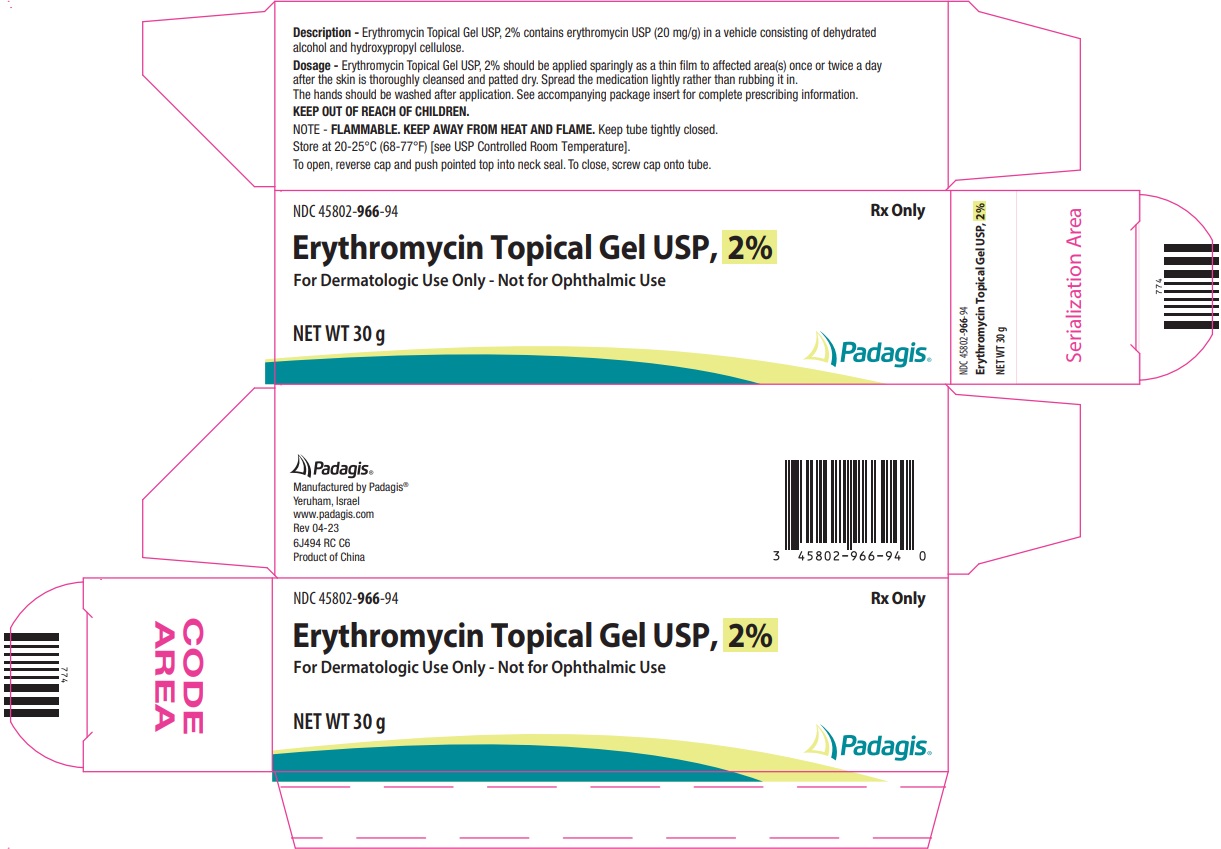
Erythromycin 20 mg/g Gel
Other active recalls for Erythromycin (different manufacturers) — 2 · tap to view
🆔 Identity & classification
Where does this data come from?
🏷️ RxNorm drug class
This medicine belongs to the Macrolide class.
Where does this data come from?
🏭 Manufacturer & labeler
Where does this data come from?
🩺 Clinical
- Erythromycin treats a pretty wide range of bacterial infections. That includes respiratory infections like bronchitis and pneumonia, skin infections, whooping cough, Legionnaires'...
- What kinds of infections does erythromycin treat?
- It depends on the form you have. If you're taking ERY-TAB delayed-release tablets, they work best on an empty stomach — ideally about 2 hours before a meal, though taking them with...
- Can I take this on an empty stomach, or do I need food?
Patient education
Supplement & herbal interactions
Some supplements/herbs that may interact with Erythromycin — tap one for details:
Erythromycin may be associated with lower levels of 7 nutrients — worth a chat with your pharmacist, not a cause for alarm.
Where does this data come from?
Ask a licensed pharmacist directly — free, answered by our team.
🧪 Inactive Ingredients / Excipients
Inactive ingredients, also called excipients, are components of the drug product other than the active ingredient. They may include fillers, dyes, coatings, preservatives, flavors, or other formulation ingredients.
💡 Tap an ingredient (hover on desktop) to see what it is and why it’s used.
-
UNII 3K9958V90M
A liquid solvent derived from fermentation or chemical synthesis. In medicines, alcohol dissolves active ingredients, helps preserve the product, and improves how the body absorbs certain drugs.
-
UNII 9XZ8H6N6OH
A plant-based cellulose derivative used as a binder to hold tablet ingredients together, a thickener in liquids, and a coating agent to control how fast the medicine dissolves.
2 inactive ingredients listed in the exact product block matched to this NDC.
Where does this data come from?
ingredient classCode="IACT" elements from the exact product block matched by this NDC. Label-section narrative from DailyMed / the openFDA label index is shown separately when available.Inactive ingredient FAQ
Are inactive ingredients the same for every manufacturer?
Why might an inactive ingredient be missing?
Can inactive ingredients matter?
💲 Pricing
A drug doesn't have one price. Each row is a different public payment system, and none is what you'd pay at the counter — that depends on your insurance. The ⓘ on each row explains what it measures.
| Price system | Per g | Per package |
|---|---|---|
| Retail pharmacies payNADAC · weekly | $0.683 | $40.96 / 60 g |
| Medicaid paysCMS SDUD · 12 mo | $0.8370 | $50.22 / 60 g |
| Medicare drug plans payPart D · Q2 2026 | $0.9953 | $59.72 / 60 g |
Where does this data come from?
🔁 Therapeutic equivalents
| Product | Labeler | Pack | NADAC/unit | TE | Status | Price vs. this |
|---|---|---|---|---|---|---|
| Erythromycin 20 mg/gthis 45802-0966-96 | Padagis | 1 tube | $0.683 | AT | Availability likely | — |
| Erythromycin 20 mg/g 63629-8652-01 | Bryant | 1 tube | — | AT | FDA listed | — |
| Erythromycin 20 mg/g 63629-8653-01 | Bryant | 1 tube | — | AT | FDA listed | — |
| Erythromycin 20 mg/g 72162-1444-03 | Bryant | 1 tube | — | AT | FDA listed | — |
Where does this data come from?
⏳ Availability & generic status
This product is an FDA-approved generic. Other versions of the same drug are listed under Therapeutic equivalents, least expensive first.
Where does this data come from?
🗺️ Medicaid utilization & spend
💊 Medicaid utilization by pack size
📊 Medicare Part D spend CMS · PART D · 2026 (Q1)
📦 Packaging — all sizes for this product
| Package NDC | Description | Per unit | Per pack | Marketing start | Status |
|---|---|---|---|---|---|
| 45802-0966-94 | 1 TUBE in 1 CARTON (45802-966-94) / 30 g in 1 TUBE | $0.6726 / g | $20.18 | 2008-09-08 | Active |
| 45802-0966-96 You're viewing this | 1 TUBE in 1 CARTON (45802-966-96) / 60 g in 1 TUBE | $0.6827 / g | $40.96 | 2008-06-12 | Active |
This pack accounts for about 45% of this product's recent Medicaid fills; most go to a different pack size. See all packs ↓
Pack size FAQ
What quantity is in NDC 45802-0966-96?
What NDC number is used to bill for this package of Erythromycin 20 mg/g Gel?
Prices are the latest CMS NADAC pharmacy acquisition cost per NDC; per-pack figures are per-unit × pack quantity, shown only when the pack is denominated in the same measure NADAC prices.
📄 Full prescribing information FDA SPL
🎯 Indications and Usage ▾
INDICATIONS AND USAGE Erythromycin Topical Gel USP, 2% is indicated for the topical treatment of acne vulgaris.
⏱️ Dosage and Administration ▾
DOSAGE AND ADMINISTRATION Erythromycin Topical Gel USP, 2% should be applied sparingly as a thin film to affected area(s) once or twice a day after the skin is thoroughly cleansed and patted dry. If there has been no improvement after 6 to 8 weeks, or if the condition becomes worse, treatment should be discontinued, and the physician should be reconsulted. Spread the medication lightly rather than rubbing it in.
There are no data directly comparing the safety and efficacy of b.i.d. versus q.d. dosing.
⛔ Contraindications ▾
CONTRAINDICATIONS Erythromycin Topical Gel USP, 2% is contraindicated in those individuals who have shown hypersensitivity to any of its components.
⚠️ Warnings ▾
WARNINGS Pseudomembranous colitis has been reported with nearly all antibacterial agents, including erythromycin, and may range in severity from mild to life-threatening. Therefore, it is important to consider this diagnosis in patients who present with diarrhea subsequent to the administration of antibacterial agents. Treatment with antibacterial agents alters the normal flora of the colon and may permit overgrowth of clostridia.
Studies indicate that a toxin produced by Clostridium difficile is one primary cause of “antibiotic-associated colitis”. After the diagnosis of pseudomembranous colitis has been established, therapeutic measures should be initiated. Mild cases of pseudomembranous colitis usually respond to drug discontinuation alone.
In moderate to severe cases, consideration should be given to management with fluids and electrolytes, protein supplementation and treatment with an antibacterial drug clinically effective against C. difficile colitis.
🤒 Adverse Reactions ▾
ADVERSE REACTIONS In controlled clinical trials, the incidence of burning associated with erythromycin topical gel USP, 2% was approximately 25%. The following additional local adverse reactions have been reported occasionally: peeling, dryness, itching, erythema, and oiliness. Irritation of the eyes and tenderness of the skin have also been reported with the topical use of erythromycin.
A generalized urticarial reaction, possibly related to the use of erythromycin, which required systemic steroid therapy has been reported.
🤰 Pregnancy ▾
Pregnancy: Teratogenic Effects: Pregnancy Category B - There was no evidence of teratogenicity or any other adverse effect on reproduction in female rats fed erythromycin base (up to 0.25% of diet) prior to and during mating, during gestation and through weaning of two successive litters. There are, however, no adequate and well-controlled studies in pregnant women. Because animal reproduction studies are not always predictive of human response, this drug should be used in pregnancy only if clearly needed.
Erythromycin has been reported to cross the placental barrier in humans, but fetal plasma levels are generally low.
🧒 Pediatric Use ▾
Pediatric Use - Safety and effectiveness in pediatric patients have not been established. KEEP OUT OF REACH OF CHILDREN.
🧬 Clinical Pharmacology ▾
CLINICAL PHARMACOLOGY The exact mechanism by which erythromycin reduces lesions of acne vulgaris is not fully known; however, the effect appears to be due in part to the antibacterial activity of the drug. MICROBIOLOGY Erythromycin acts by inhibition of protein synthesis in susceptible organisms by reversibly binding to 50S ribosomal subunits, thereby inhibiting translocation of aminoacyl transfer-RNA and inhibiting polypeptide synthesis. Antagonism has been demonstrated in vitro between erythromycin, lincomycin, chloramphenicol, and clindamycin.
📦 How Supplied / Storage and Handling ▾
HOW SUPPLIED Erythromycin Topical Gel USP, 2% is available as follows: 30 g sealed metal tube (NDC 45802- 966 -94) 60 g sealed metal tube (NDC 45802- 966 -96)
📦 Storage and Handling ▾
STORAGE Note - FLAMMABLE. Keep away from heat and flame. Store and dispense in original container. Keep tube tightly closed. Store at 20-25°C (68-77°F) [see USP Controlled Room Temperature].
📋 Description ▾
DESCRIPTION Erythromycin Topical Gel USP, 2% contains erythromycin (3R*, 4S*, 5S*, 6R*, 7R*, 9R*, 11R*, 12R*, 13S*, 14R*)-4-[(2,6-Dideoxy-3- C -methyl-3- O -methyl-α-L- ribo -hexopyranosyl)oxy]-14-ethyl-7, 12, 13-trihydroxy-3, 5, 7, 9, 11, 13-hexamethyl-6-[[3, 4, 6,-trideoxy-3-(dimethylamino)-β-D- xylo -hexopyranosyl]oxy]oxacyclotetradecane-2,10-dione), for topical dermatological use. Erythromycin is a macrolide antibiotic produced from a strain of Saccaropolyspora erythraea (formerly Streptomyces erythreus ). It is a base and readily forms salts with acids.
Chemically, erythromycin is C 37 H 67 NO 13 . It has the following structural formula: Erythromycin has a molecular weight of 733.94. It is a white or slightly yellow, odorless or practically odorless, bitter crystalline powder.
Erythromycin is very soluble in very polar organic solvents such as alcohols, acetone, chloroform, acetonitrile and ethyl acetate. It is moderately soluble in less polar solvents such as ether, dichloroethylene and amyl acetate. It is slightly soluble in nonpolar solvents such as hexane.
It is very poorly soluble in water. Each gram of Erythromycin Topical Gel USP, 2% contains 20 mg of erythromycin USP in a vehicle consisting of dehydrated alcohol and hydroxypropyl cellulose. structure
💬 Information for Patients ▾
Information For Patients - Patients using Erythromycin Topical Gel USP, 2% should receive the following information and instructions: 1. This medication is to be used as directed by the physician. It is for external use only.
Avoid contact with the eyes, nose, mouth, and all mucous membranes. 2. This medication should not be used for any disorder other than that for which it was prescribed.
3. Patients should not use any other topical acne medication unless otherwise directed by their physician. 4.
Patients should report to their physician any signs of local adverse reactions.