
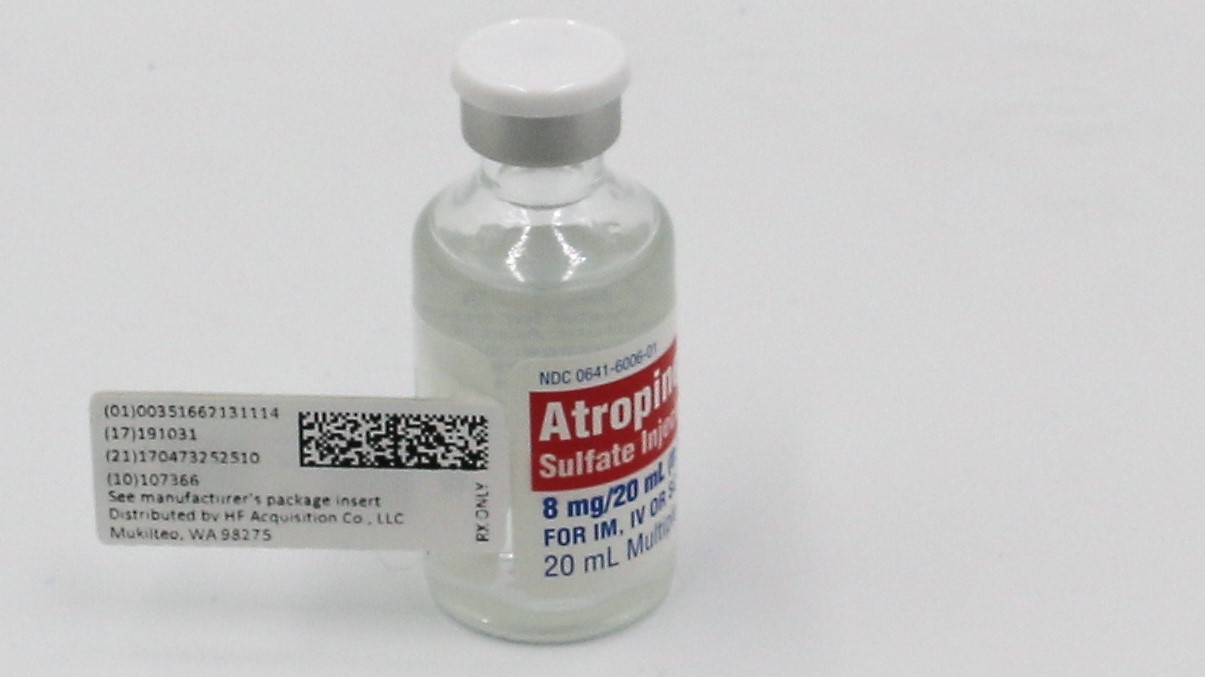
ATROPINE SULFATE .4 mg/mL Injection, 20 mL — NDC 51662-1311-1 (Billing 51662-1311-01)
This is a package of 20 mL of ATROPINE SULFATE .4 mg/mL Injection from HF Acquisition Co LLC, DBA HealthFirst, marketed since Oct 2018 and currently FDA-listed. It is the main listing for this product, which comes in 2 package sizes.
NDC database record
One package, one record: these facts belong to NDC 51662-1311-1 alone.
- Record
- FDA NDC Directory package listing · Human prescription drug
- Code segments
- 51662 labeler · 1311 product · 1 package
- Package marketed since
- Oct 6, 2018
- Sample package
- No — commercial package
- Listing certified through
- Dec 31, 2026
- Barcode (UPC-A, from the NDC)
- 3 5166213111 4
- FDA record last changed
- Jul 24, 2026
Other active recalls for Atropine Sulfate (different manufacturers) — 2 · tap to view
Identity & classification
Regulatory identifiers FDA, NLM and CMS codes for this package
- RxCUI (RxNorm): 1190776
Where does this data come from?
- FDA openFDA NDC Directory · synced Oct 1, 2026
- FDA label on DailyMed · label index refreshed Oct 6, 2026
- RxNorm (NLM RxNav) · catalog refreshed Oct 1, 2026
- Medi-Span GPI (licensed)
- First Databank (licensed) · refreshed Oct 1, 2026
RxNorm drug class
This medicine belongs to the Anticholinergic class.
Where does this data come from?
- RxClass (NLM) · catalog refreshed Oct 1, 2026
Clinical
- It depends on the form. The injection is used in emergencies like poisonings and slow heart rhythms, and around surgery to reduce secretions. The eye drops and ointment dilate the...
- Injections are given by a healthcare professional, usually into a vein. ATROPEN is injected into the outer thigh in an emergency, and you should seek medical care right away. Eye p...
- Dry mouth, blurred vision, light sensitivity, a faster heartbeat, flushing, dizziness, and constipation are common. These come from atropine's drying effects. Injection site pain c...
- Seek emergency help for trouble breathing, swelling or a spreading rash, chest pain, a racing or irregular heartbeat, hallucinations, or a high fever with no sweating. Eye pain wit...
Patient education
Supplement & herbal interactions
Some supplements/herbs that may interact with Atropine Sulfate — tap one for details:
Where does this data come from?
- MedlinePlus (NLM) · refreshed Oct 1, 2026
- FDA label on DailyMed · label index refreshed Oct 6, 2026
Ask a licensed pharmacist directly — free, answered by our team.
Pricing
A drug doesn't have one price. Each row is a different public payment system, and none is what you'd pay at the counter — that depends on your insurance. The ⓘ on each row explains what it measures.
| Price system | Per each | Per package |
|---|---|---|
| Retail pharmacies payNADAC · weekly | Not in the retail survey — common for institutional, discontinued, or low-volume packs. | |
| Medicaid paysCMS SDUD · 12 mo | No recent Medicaid claims on file for this NDC — rare and low-volume NDCs are suppressed in the public data. | |
| Medicare drug plans payPart D · quarterly | No Part D plan price is available for this NDC in our data. | |
Where does this data come from?
- CMS NADAC weekly file
- CMS ASP pricing files · refreshed Sep 20, 2026
- CMS Medicaid State Drug Utilization Data · refreshed Oct 6, 2026
- CMS Part D plan pricing files · refreshed Sep 24, 2026
- VA National Acquisition Center price file
Packaging — all sizes for this product
| Package NDC | Description | Marketing start | Marketing end | Status |
|---|---|---|---|---|
| 51662-1311-01 You're viewing this Main listing | 20 mL in 1 VIAL, MULTI-DOSE | 2018-10-06 | — | Active |
| 51662-1311-03 51662-1311-3 | 25 POUCH in 1 CASE / 1 mL in 1 POUCH | 2020-09-04 | — | Active |
Pack size FAQ
What quantity is in this package?
How does this package differ from NDC 51662-1311-03?
What NDC number is used to bill for this package of ATROPINE SULFATE .4 mg/mL Injection?
Therapeutic equivalents
| Product | Labeler | Pack | NADAC/unit | TE | Status | Price vs. this |
|---|---|---|---|---|---|---|
| Atropine Sulfate .4 mg/mL 00404-9804-20 | Henry | 1 vial | — | AP | FDA listed | — |
| Atropine Sulfate .4 mg/mL 00641-6251-10 | Hikma | 10 vials | — | AP | FDA listed | — |
| Atropine Sulfate .4 mg/mL 16729-0512-43 | Accord | 1 vial | — | AP | FDA listed | — |
| Atropine Sulfate .4 mg/mLthis 51662-1311-01 | HF | 20 ml | — | — | FDA listed | — |
| Atropine Sulfate .4 mg/mL 51662-1619-01 | HF | 20 ml | — | AP | FDA listed | — |
| Atropine Sulfate .4 mg/mL 63323-0580-20 | Fresenius | 10 vials | — | AP | FDA listed | — |
| Atropine Sulfate .4 mg/mL 70069-0481-10 | Somerset | 10 vials | — | AP | FDA listed | — |
| Atropine Sulfate .4 mg/mL 70518-4188-00 | REMEDYREPACK | 10 vials | — | AP | FDA listed | — |
| Atropine Sulfate .4 mg/mL 70518-4329-00 | REMEDYREPACK | 10 vials | — | AP | FDA listed | — |
| Atropine Sulfate .4 mg/mL 71872-7037-01 | Medical | 1 vial | — | — | FDA listed | — |
| Atropine Sulfate .4 mg/mL 71872-7316-01 | Medical | 1 vial | — | AP | FDA listed | — |
| Atropine Sulfate .4 mg/mL 71872-7355-01 | Medical | 1 vial | — | AP | FDA listed | — |
| Atropine Sulfate .4 mg/mL 84549-0580-20 | ProPharma | 20 ml | — | AP | FDA listed | — |
Where does this data come from?
- FDA openFDA NDC Directory · synced Oct 1, 2026
- FDA Orange Book · refreshed Oct 3, 2026
- CMS NADAC weekly file
Availability & generic status
We did not find an FDA-approved generic match for this exact strength, form and route.
Where does this data come from?
- FDA Orange Book · refreshed Oct 3, 2026
Inactive Ingredients / Excipients
Inactive ingredients, also called excipients, are components of the drug product other than the active ingredient. They may include fillers, dyes, coatings, preservatives, flavors, or other formulation ingredients.
🧪 Avoiding an ingredient? See Atropine inactive ingredients by manufacturer: every current product's list side by side, so you can ask your pharmacy for the version that does not list it.
💡 Tap an ingredient (hover on desktop) to see what it is and why it’s used.
-
9 mg / 1 mL
UNII LKG8494WBH
Benzyl alcohol is a clear liquid used as a preservative and solvent in medicines. It helps prevent bacterial and fungal growth and dissolves other ingredients to create uniform liquid formulations.
-
9 mg / 1 mL
UNII 451W47IQ8X
Sodium chloride is common table salt. It's used in medicines as a buffer to maintain proper pH, as a filler to add bulk, or to adjust the osmotic balance in liquid formulations.
-
UNII O40UQP6WCF
A strong acid used in small amounts to adjust and maintain the pH balance of a medicine, helping ensure stability and proper dissolution of the active ingredients.
-
UNII 059QF0KO0R
Water is a liquid solvent that dissolves and mixes ingredients together in liquid medicines, syrups, and injections. It helps distribute the active drug evenly throughout the product.
4 inactive ingredients listed in the exact product block matched to this NDC.
Where does this data come from?
ingredient classCode="IACT" elements from the exact product block matched by this NDC. Label-section narrative from DailyMed / the openFDA label index is shown separately when available.- FDA label on DailyMed · label index refreshed Oct 6, 2026
- FDA openFDA NDC Directory · synced Oct 1, 2026
Inactive ingredient FAQ
Are inactive ingredients the same for every manufacturer?
Why might an inactive ingredient be missing?
Can inactive ingredients matter?
Manufacturer & labeler
More NDCs from HF Acquisition Co LLC, DBA HealthFirst labeler code 51662
- KETOROLAC TROMETHAMINE 30 mg/mL Injection, Solution NDC 51662-1292-1
- PROPOFOL 10 mg/mL Injection, Emulsion NDC 51662-1293-1
- KETOROLAC TROMETHAMINE 60 mg/2mL Injection, Solution NDC 51662-1295-1
- DEXAMETHASONE SODIUM PHOSPHATE 4 mg/mL Injection NDC 51662-1297-1
- ADRENALIN(R) 1 mg/mL Injection NDC 51662-1307-1
- INFANT 4.2% SODIUM BICARBONATE 42 mg/mL Injection, Solution NDC 51662-1310-1
- CALCIUM GLUCONATE 98 mg/mL Injection, Solution NDC 51662-1312-1
- VASOPRESSIN 20 [USP'U]/mL Injection NDC 51662-1314-1
- LEVOPHED(R) NOREPINEPHRINE BITARTRATE 1 mg/mL Injection, Solution, Concentrate NDC 51662-1315-1
- DOPAMINE HYDROCHLORIDE 1.6 mg/mL Injection, Solution NDC 51662-1316-1
- 6% HETASTARCH IN 0.9% SODIUM CHLORIDE 6 g/100mL Injection, Solution NDC 51662-1317-1
- EPINEPHRINE .3 mg/.3mL Injection, Solution NDC 51662-1320-1
Where does this data come from?
- FDA openFDA NDC Directory · synced Oct 1, 2026
- Drugs@FDA
Full prescribing information FDA SPL
🎯 Indications and Usage ▾
INDICATIONS & USAGE Atropine sulfate is given parenterally as a preanesthetic medication to decrease salivation and bronchial secretions. It is useful in pylorospasm and other spastic conditions of the gastrointestinal tract. For ureteral and biliary colic, atropine sulfate given with morphine may be indicated.
Atropine sulfate is indicated for relaxation of the upper gastrointestinal tract and colon during hypotonic radiography. Atropine is used as an antidote for pilocarpine, physostigmine, isoflurophate, choline esters, certain species of aminata and in poisoning by the organic phosphate cholinesterase inhibitors found in certain insecticides and by chemical warfare “nerve gases”. Large doses relieve the muscarine-like symptoms and some of the central nervous system manifestations.
⏱️ Dosage and Administration ▾
DOSAGE & ADMINISTRATION The usual dose of atropine sulfate is 0.4 to 0.6 mg. Suggested dosages for pediatric patients are as follows: 7 - 16 lbs. – 0.1 mg 40 - 65 lbs. – 0.3 mg 17 - 24 lbs. – 0.15 mg 65 - 90 lbs. – 0.4 mg 24 - 40 lbs. – 0.2 mg Over 90 lbs. – 0.4 to 0.6 mg Table of Dosage Equivalents These doses may be exceeded in certain cases. For hypotonic radiography of the gastrointestinal tract, the usual adult dose is 1 mg intramuscularly.
Adults suspected of contact with organic phosporous insecticides of the parathion type should be given atropine sulfate 0.8 mg intramuscularly. If an atropine effect is not apparent within 30 minutes or if definite symptoms of the poisoning occur (nausea, vomiting, diarrhea, pupillary constriction, pulmonary edema, fasciculations of eyelids and tongue, jerky ocular movements and excessive sweating, salivation and bronchial secretion), atropine sulfate 2 mg should be given intramuscularly at hourly intervals until signs of atropinization are observed.
Up to 2 or 3 times of this dose (4 to 6 mg) may be required in severe cases. Parenteral drug products should be inspected visually for particulate matter and discoloration prior to administration, whenever solution and container permit. DOSAGE
⛔ Contraindications ▾
CONTRAINDICATIONS Conditions at which inhibition of postganglionic cholinergic nerves are undesirable, such as glaucoma and tachycardia. Also contraindicated in asthma, because the parenteral dose which might relieve asthma would have an excessive drying effect upon mucous plugs in the bronchi. Prostatic hypertrophy, while not a contraindication, requires special attention to signs of urinary retention.
⚠️ Warnings ▾
WARNINGS Atropine is a highly potent drug and due care is essential to avoid overdosage, especially with intravenous administration. Pediatric populations are more susceptible than adults to the toxic effects of anticholinergic agents. Atropine I.V. decreased the rate of mexiletine absorption without altering the relative oral bioavailability; this delay in mexiletine absorption was reversed by the combination of atropine and intravenous metoclopramide during pretreatment for anesthesia.
Atropine is not removed by dialysis. This drug is effective in very low dosage and overdose may cause permanent damage or death, especially in children. This product contains Benzyl Alcohol which has been associated with a fatal gasping syndrome in infants and neonates.
🤒 Adverse Reactions ▾
ADVERSE REACTIONS Individual tolerance varies greatly, but these systemic doses are likely to produce the following effects: A scarlatiniform rash may occur. Atropine may produce fever, particularly in children, through inhibition of heat loss by evaporation. Although large doses of atropine may cause an alarming condition, recovery is usual. ADVERSE EVENT TABEL
🆘 Overdosage ▾
OVERDOSAGE Toxic doses from atropine are not uncommon, especially in children. Symptoms The principle manifestations of poisoning with atropine are delirium, tachycardia and fever. Treatment In the treatment of atropine poisoning, respiratory assistance and symptomatic support are indicated.
Physostigmine salicylate, 1 to 5 mL of a dilution containing 1 mg per 5 mL of saline, should be administered intravenously. Administer the smaller dose in children and administer in not less than 2 minutes. Monitor with ECG.
Medication can be repeated every 5 minutes for a total dose of 2 mg in children and every 30 minutes for a total dose of 6 mg in adults. The fatal dose of atropine in children may be as low as 10 mg. In an adult, recovery after 1,000 mg of atropine sulfate has been reported.
Death is usually due to paralysis of the medullary centers. The fatality rate is less than 1%. If the patient survives 24 hours, they will probably recover.
🧬 Clinical Pharmacology ▾
CLINICAL PHARMACOLOGY The most important therapeutic action of atropine is the inhibition of smooth muscle and glands innervated by postganglionic cholinergic nerves. It also has central nervous system activity, which may be stimulating or depressing depending upon the dose. Following the administration of usual clinical doses, atropine produces stimulation of the medulla and higher cerebral centers.
This effect is manifested by mild central vagal excitation and moderate respiratory stimulation. Atropine sulfate also acts peripherally as a competitive antagonist of the muscarinic actions of acetylcholine. It does not prevent the release of acetylcholine but antagonizes the effect of acetylcholine on the effector cells.
These actions include vasodilation, drying of the mouth, an increase in the pulse rate, inhibition of contractions of the gastrointestinal tract, ureter, and bladder, and reduction of salivary, bronchial, gastric and sweat gland secretions. Following clinical and larger doses, atropine sulfate causes dilation of the pupils and paralysis of accommodation and, in narrow-angle glaucoma, can increase intraocular pressure.
📦 How Supplied / Storage and Handling ▾
HOW SUPPLIED ATROPINE SULFATE INJECTION, USP is supplied in the following dosage forms: NDC 51662-1311-1 ATROPINE SULFATE INJECTION, USP 8mg/20mL (0.4mg/mL) 20mL VIAL NDC 51662-1311-2 - 1 Pouch of ATROPINE SULFATE INJECTION, USP 8mg/20mL (0.4mg/mL) 20mL VIAL NDC 51662-1311-3 - Case of 25 pouches of ATROPINE SULFATE INJECTION, USP 8mg/20mL (0.4mg/mL) 20mL VIAL HF Acquisition Co LLC, DBA HealthFirst Mukilteo, WA 98275 Also supplied in the following manufacture supplied dosage forms Atropine Sulfate Injection, USP is available in the following: 0.4 mg/mL 20 mL multiple dose vial packaged in 10s (NDC 0641-6006-10) Use only if solution is clear and seal intact.
Store at 20°-25°C (68°-77°F), excursions permitted to 15°-30°C (59°-86°F) [See USP Controlled Room Temperature]. To report SUSPECTED ADVERSE REACTIONS, contact West-Ward Pharmaceutical Corp. at 1-877-845-0689, or the FDA at 1-800-FDA-1088 or www.fda.gov/medwatch. For Product Inquiry call 1-877-845-0689.
Manufactured by: WEST-WARD PHARMACEUTICALS Eatontown, NJ 07724 USA Revised June 2011 462-416-01 LOGO
📋 Description ▾
DESCRIPTION Atropine Sulfate Injection, USP is a sterile solution of atropine sulfate in Water for Injection. Each mL contains Atropine Sulfate 0.4 mg; Sodium Chloride 9 mg; Benzyl Alcohol 9 mg; Water for Injection qs; pH may be adjusted with Sulfuric Acid if necessary. pH 3.0-6.5. Atropine Sulfate Injection, USP may be given intramuscularly, intravenously or subcutaneously.
Atropine is a white crystalline alkaloid which may be extracted from belladonna root or may be produced synthetically. It is used as atropine sulfate because this compound has much greater solubility. Atropine sulfate is an anticholinergic drug.
The empirical formula of atropine sulfate is (C17H23NO3)2•H2SO4•H2O. The structural formula is: STRUCTURE
⚠️ Precautions ▾
PRECAUTIONS General Doses of 0.5 to 1 mg atropine are mildly stimulating to the CNS. Larger doses may produce mental disturbances; still larger doses are depressing. Death from atropine poisoning, though rare, is usually due to paralysis of the medullary centers.
Information for Patients Atropine causes dryness of the mouth, and when used with other drugs that can cause dryness of the mouth, the effect is additive. Patients receiving chronic treatment can develop blurred vision, and they should not be involved in activities that require good and clear vision. Drug Interactions Atropine, by slowing gastric emptying and gastrointestinal mobility, may interfere with the absorption of other medications.
The effect of atropine on dryness of the mouth may be increased if it is given with other drugs that have anticholinergic action. Pregnancy Category C Animal reproduction studies have not been conducted with atropine sulfate. It is also not known whether atropine sulfate can cause fetal harm when administered to a pregnant woman or can affect reproduction capacity.
Atropine sulfate should be given to a pregnant woman only if clearly needed. Nursing Mothers Caution should be exercised when atropine sulfate is administered to a nursing mother.
📄 Package Label / Principal Display Panel ▾
PRINCIPAL DISPLAY PANEL, VIAL NDC 0641-6006-01 Atropine Sulfate Injection, USP 8 mg/20 mL (0.4 mg/mL) 20 mL Multiple Dose Vial NDC 0641-6006-01 VIAL
PRINCIPAL DISPLAY PANEL, NDC 51662-1311-1 SERIALIZED VIAL SERIALIZED VIAL
PRINCIPAL DISPLAY LABEL - NDC 51662-1311-2 SERIALIZED POUCH LABEL SERIALIZED POUCH LABEL
PRINCIPAL DISPLAY LABEL - NDC 51662-1311-3 SERIALIZED CASE LABEL case
PRINCIPAL DISPLAY LABEL - NDC 51662-1311-3 SERIALIZED RFID LABEL Serialized RFID
Medicare Part D spend CMS · PART D · 2026 (Q1)
About this NDC listing & data coverage
Listed without an FDA application
This product's marketing category indicates it is marketed without an approved FDA application (no NDA, ANDA, or BLA on file). Having an NDC does not by itself establish FDA approval — the NDC Directory is a listing system, not an approval decision. Approval-linked data such as Orange Book therapeutic-equivalence ratings therefore does not apply.
What data is (and isn’t) available for this NDC — tap to expand
| NDC identity (package / product / labeler codes) | ✓ Available |
| Labeler | ✓ Available |
| Product & package description | ✓ Available |
| Marketing category & status | ✓ Available |
| Active ingredient / dosage form / route | ✓ Available |
| FDA label (SPL via DailyMed) | ✓ Available |
| Package photos | ✓ Available |
| Inactive ingredients (structured) | ✓ Available |
| NADAC pharmacy acquisition price (CMS) | — Not published for this NDC CMS publishes NADAC only for NDCs reported in its retail-pharmacy survey. |
| Orange Book / therapeutic-equivalence data | — Not published for this NDC Applies only to products approved under an NDA/ANDA; many listings are out of scope. |
| HCPCS J-code billing crosswalk | — Not published for this NDC Most self-administered / retail products have no J-code — that is normal. |
| Medicaid utilization (CMS SDUD) | — Not published for this NDC CMS reports utilization only for NDCs with Medicaid claims above its privacy threshold. |