
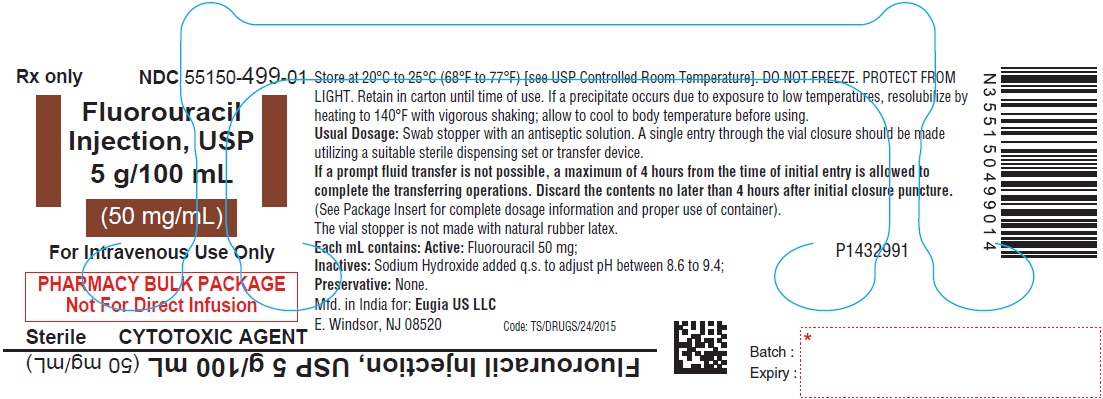
FLUOROURACIL 50 mg/mL Injection, Solution — NDC 55150-499-01 (Billing 55150-0499-01)
This is a package of FLUOROURACIL 50 mg/mL Injection, Solution from Eugia US LLC, marketed since Apr 2022 and currently FDA-listed. It is this product's only package size.
NDC database record
One package, one record: these facts belong to NDC 55150-499-01 alone.
- Record
- FDA NDC Directory package listing · Human prescription drug
- Code segments
- 55150 labeler · 499 product · 01 package
- Package marketed since
- Apr 8, 2022
- Sample package
- No — commercial package
- Listing certified through
- Dec 31, 2027
- Barcode (UPC)
- 0355150499014, 0355150498017
- FDA record last changed
- Jul 24, 2026
Identity & classification
Regulatory identifiers FDA, NLM and CMS codes for this package
Drug-database identifiers Medi-Span GPI and First Databank GCN / HICL / AHFS classification
- GSN (GCN sequence number): 061672
- GCN: 97458
- GPI-14 (Medi-Span): 21300030002035
- HICL (First Databank): 003907
- AHFS class code: 10:00.00.00
- RxCUI (RxNorm): 239177
Where does this data come from?
- FDA openFDA NDC Directory · synced Oct 8, 2026
- FDA label on DailyMed · label index refreshed Oct 8, 2026
- RxNorm (NLM RxNav) · catalog refreshed Oct 1, 2026
- Medi-Span GPI (licensed)
- First Databank (licensed) · refreshed Oct 8, 2026
RxNorm drug class
This medicine belongs to the Nucleoside Metabolic Inhibitor class.
Where does this data come from?
- RxClass (NLM) · catalog refreshed Oct 1, 2026
Clinical
- It depends on the form. By IV, it treats colon, rectal, breast, stomach and pancreatic cancers. As a skin cream or solution, it treats actinic keratosis (sun-damaged patches) and,...
- Follow your label and prescriber. Tolak is applied once daily after washing and drying the area. The 5% cream and solution are applied twice daily. Use a nonmetal applicator or glo...
- How do I use the skin cream or solution?
- Redness, dryness, scaling, crusting, itching, stinging or burning, swelling and raw spots are very common. They usually peak at the end of treatment and fade within about 4 weeks a...
Patient education
Supplement & herbal interactions
Some supplements/herbs that may interact with Fluorouracil — tap one for details:
Fluorouracil may be associated with lower levels of 2 nutrients — worth a chat with your pharmacist, not a cause for alarm.
Where does this data come from?
- MedlinePlus (NLM) · refreshed Oct 8, 2026
- FDA label on DailyMed · label index refreshed Oct 8, 2026
Ask a licensed pharmacist directly — free, answered by our team.
Pricing
A drug doesn't have one price. Each row is a different public payment system, and none is what you'd pay at the counter — that depends on your insurance. The ⓘ on each row explains what it measures.
| Price system | Per mL | Per package |
|---|---|---|
| Retail pharmacies payNADAC · weekly | Not in the retail survey — common for institutional, discontinued, or low-volume packs. | |
| Medicaid paysCMS SDUD · 12 mo | No recent Medicaid claims on file for this NDC — rare and low-volume NDCs are suppressed in the public data. | |
| Medicare drug plans payPart D · quarterly | No Part D plan price is available for this NDC in our data. | |
| Medicare Part B allowsASP · J9190 | $2.024 / J9190 unit | — |
Where does this data come from?
- CMS NADAC weekly file
- CMS ASP pricing files · refreshed Sep 20, 2026
- CMS Medicaid State Drug Utilization Data · refreshed Oct 8, 2026
- CMS Part D plan pricing files · refreshed Sep 24, 2026
- VA National Acquisition Center price file
Billing & reimbursement
Where does this data come from?
- CMS ASP NDC-HCPCS crosswalk · refreshed Sep 22, 2026
- DMEPDAC NDC-HCPCS crosswalk
- openFDA NSDE billing units · refreshed Oct 7, 2026
Packaging — all sizes for this product
| Package NDC | Description | Marketing start | Marketing end | Status |
|---|---|---|---|---|
| 55150-0499-01 You're viewing this Main listing | 1 VIAL, PHARMACY BULK PACKAGE in 1 CARTON / 100 mL in 1 VIAL, PHARMACY BULK PACKAGE | 2022-04-08 | — | Active |
Therapeutic equivalents
| Product | Labeler | Pack | NADAC/unit | TE | Status | Price vs. this |
|---|---|---|---|---|---|---|
| Fluorouracil 50 mg/mL 16729-0276-11 | Accord | 1 vial | — | — | FDA listed | — |
| fluorouracil 50 mg/mL 25021-0215-98 | Sagent | 1 bottle | — | AP | FDA listed | — |
| Fluorouracil 50 mg/mL 46708-0751-50 | Alembic | 1 vial | — | AP | FDA listed | — |
| Fluorouracil 50 mg/mL 46708-0779-31 | Alembic | 1 vial | — | AP | FDA listed | — |
| Fluorouracil 50 mg/mL 55150-0498-01 | Eugia | 1 vial | — | AP | FDA listed | — |
| Fluorouracil 50 mg/mLthis 55150-0499-01 | Eugia | 1 vial | — | AP | FDA listed | — |
| Fluorouracil 50 mg/mL 62332-0751-50 | Alembic | 1 vial | — | AP | FDA listed | — |
| Fluorouracil 50 mg/mL 62332-0779-31 | Alembic | 1 vial | — | AP | FDA listed | — |
| Fluorouracil 50 mg/mL 63323-0117-59 | Fresenius | 1 vial | — | AP | FDA listed | — |
| Fluorouracil 50 mg/mL 68001-0525-27 | BluePoint | 1 vial | — | AP | FDA listed | — |
| Fluorouracil 50 mg/mL 68001-0627-27 | BluePoint | 1 vial | — | AP | FDA listed | — |
| Fluorouracil 50 mg/mL 68001-0628-32 | BluePoint | 1 vial | — | AP | FDA listed | — |
| Fluorouracil 50 mg/mL 68083-0292-01 | Gland | 1 vial | — | AP | FDA listed | — |
| Fluorouracil 50 mg/mL 68083-0293-01 | Gland | 1 vial | — | AP | FDA listed | — |
| Fluorouracil 50 mg/mL 70700-0188-22 | Xiromed | 1 vial | — | AP | FDA listed | — |
| Fluorouracil 50 mg/mL 70700-0189-22 | Xiromed | 1 vial | — | AP | FDA listed | — |
| Fluorouracil 50 mg/mL 71288-0154-76 | Meitheal | 1 vial | — | AP | FDA listed | — |
| Fluorouracil 50 mg/mL 71288-0170-75 | Meitheal | 1 vial | — | AP | FDA listed | — |
| Fluorouracil 50 mg/mL 68083-0269-10 | Gland | 10 vials | — | AP | FDA listed | — |
| Fluorouracil 50 mg/mL 55150-0497-10 | Eugia | 10 vials | — | AP | FDA listed | — |
| Fluorouracil 50 mg/mL 70700-0186-23 | Xiromed | 10 vials | — | AP | FDA listed | — |
| Fluorouracil 50 mg/mL 70700-0187-23 | Xiromed | 10 vials | — | AP | FDA listed | — |
| Fluorouracil 50 mg/mL 55150-0496-10 | Eugia | 10 vials | — | AP | FDA listed | — |
| Fluorouracil 50 mg/mL 68001-0524-30 | BluePoint | 10 vials | — | AP | FDA listed | — |
| Fluorouracil 50 mg/mL 84549-0117-10 | ProPharma | 10 ml | — | AP | FDA listed | — |
| Fluorouracil 50 mg/mL 68083-0270-10 | Gland | 10 vials | — | AP | FDA listed | — |
| Fluorouracil 50 mg/mL 23155-0972-41 | Heritage | 10 vials | — | AP | FDA listed | — |
| Fluorouracil 50 mg/mL 23155-0975-31 | Heritage | 1 vial | — | AP | FDA listed | — |
| Fluorouracil 50 mg/mL 23155-0973-41 | Heritage | 10 vials | — | AP | FDA listed | — |
| Fluorouracil 50 mg/mL 23155-0974-31 | Heritage | 1 vial | — | AP | FDA listed | — |
Where does this data come from?
- FDA openFDA NDC Directory · synced Oct 8, 2026
- FDA Orange Book · refreshed Oct 3, 2026
- CMS NADAC weekly file
Availability & generic status
This product is an FDA-approved generic. Other versions of the same drug are listed under Therapeutic equivalents, least expensive first.
Where does this data come from?
- FDA Orange Book · refreshed Oct 3, 2026
Inactive Ingredients / Excipients
Inactive ingredients, also called excipients, are components of the drug product other than the active ingredient. They may include fillers, dyes, coatings, preservatives, flavors, or other formulation ingredients.
🧪 Avoiding an ingredient? See Fluorouracil inactive ingredients by manufacturer: every current product's list side by side, so you can ask your pharmacy for the version that does not list it.
💡 Tap an ingredient (hover on desktop) to see what it is and why it’s used.
-
UNII 55X04QC32I
A strong alkaline chemical used to adjust and maintain the pH balance of liquid medicines. It helps keep the medicine stable and ensures it stays effective during storage.
-
UNII 059QF0KO0R
Water is a liquid solvent that dissolves and mixes ingredients together in liquid medicines, syrups, and injections. It helps distribute the active drug evenly throughout the product.
2 inactive ingredients listed in the exact product block matched to this NDC.
Where does this data come from?
ingredient classCode="IACT" elements from the exact product block matched by this NDC. Label-section narrative from DailyMed / the openFDA label index is shown separately when available.- FDA label on DailyMed · label index refreshed Oct 8, 2026
- FDA openFDA NDC Directory · synced Oct 8, 2026
Inactive ingredient FAQ
Are inactive ingredients the same for every manufacturer?
Why might an inactive ingredient be missing?
Can inactive ingredients matter?
Manufacturer & labeler
More NDCs from Eugia US LLC labeler code 55150
- Piperacillin and Tazobactam 36 g/250mL; 4.5 g/250mL Injection, Powder, Lyophilized, For Solution NDC 55150-473-01
- Piperacillin and Tazobactam 12 g/100mL; 1.5 g/100mL Injection, Powder, Lyophilized, For Solution NDC 55150-474-01
- Leuprolide Acetate Kit NDC 55150-478-01
- FLUOROURACIL 50 mg/mL Injection, Solution NDC 55150-496-10
- FLUOROURACIL 50 mg/mL Injection, Solution NDC 55150-497-10
- FLUOROURACIL 50 mg/mL Injection, Solution NDC 55150-498-01
- METHOTREXATE 50 mg/2mL Injection, Solution NDC 55150-510-01
- METHOTREXATE 100 mg/4mL Injection, Solution NDC 55150-511-01
- METHOTREXATE 200 mg/8mL Injection, Solution NDC 55150-512-01
- METHOTREXATE 250 mg/10mL Injection, Solution NDC 55150-513-01
- MESNA 100 mg/mL Injection, Solution NDC 55150-520-01
- DACTINOMYCIN .5 mg/mL Injection, Powder, Lyophilized, For Solution NDC 55150-928-02
Where does this data come from?
- FDA openFDA NDC Directory · synced Oct 8, 2026
- Drugs@FDA
Full prescribing information FDA SPL
🚨 Boxed Warning ▾
WARNING: SERIOUS ADVERSE REACTIONS OR DEATH IN PATIENTS WITH COMPLETE DPD DEFICIENCY Increased Risk of Serious Adverse Reactions or Death in Patients with Complete DPD Deficiency Test patients for genetic variants of DPYD prior to initiating fluorouracil unless immediate treatment is necessary. Avoid use of fluorouracil in patients with certain homozygous or compound heterozygous DPYD variants that result in complete DPD deficiency [see Warnings and Precautions (5.1) ]. WARNING: SERIOUS ADVERSE REACTIONS OR DEATH IN PATIENTS WITH COMPLETE DPD DEFICIENCY See full prescribing information for complete boxed warning Serious adverse reactions or death may occur in patients with complete DPD deficiency.
Test patients for genetic variants of DPYD prior to initiating fluorouracil unless immediate treatment is necessary. Avoid use of fluorouracil in patients with certain homozygous or compound heterozygous DPYD variants that result in complete DPD deficiency. ( 2.1 , 5.1 )
🎯 Indications and Usage ▾
1 INDICATIONS AND USAGE Fluorouracil injection is indicated for the treatment of patients with: Fluorouracil injection is a nucleoside metabolic inhibitor indicated for the treatment of patients with Adenocarcinoma of the Colon and Rectum ( 1.1 ) Adenocarcinoma of the Breast ( 1.2 ) Gastric Adenocarcinoma ( 1.3 ) Pancreatic Adenocarcinoma ( 1.4 )
1.1Adenocarcinoma of the Colon and Rectum .
1.2Adenocarcinoma of the Breast .
1.3Gastric Adenocarcinoma .
1.4Pancreatic Adenocarcinoma .
⏱️ Dosage and Administration ▾
2 DOSAGE AND ADMINISTRATION Fluorouracil injection is recommended for administration either as an intravenous bolus or as an intravenous infusion. ( 2.2 ) See Full Prescribing Information for dose individualization (2.2) and dose modifications due to adverse reactions ( 2.7 ) See Full Prescribing Information for recommended doses of fluorouracil injection for adenocarcinoma of the colon and rectum ( 2.3 ) and for recommended doses of fluorouracil injection as a component of a chemotherapy regimen for adenocarcinoma of the breast ( 2.4 ), gastric adenocarcinoma ( 2.5 ), pancreatic adenocarcinoma ( 2.6 ) Pharmacy Bulk Package: Prepare doses for more than one patient in a Pharmacy Admixture Service under appropriate conditions for cytotoxic drugs.
Do not inject entire contents of vial directly into patients. Use within 4 hours of puncture ( 2.8 , 2.9 )
2.1Evaluation and Testing for DPD Deficiency Before Initiating Fluorouracil Prior to initiating fluorouracil, test patients for genetic variants of the DPYD gene unless immediate treatment is necessary. An FDA-authorized test for the detection of the DPYD gene to identify patients at risk of serious adverse reactions with fluorouracil is not currently available. Currently available tests used to identify DPYD variants may vary in accuracy and design (e.g., which DPYD variant(s) they identify).
Avoid use of fluorouracil in patients known to have certain homozygous or compound heterozygous DPYD variants that result in complete DPD deficiency. No fluorouracil dose has been proven safe for patients with complete DPD deficiency. For patients with partial DPD deficiency, individualize the dosage and modify based on tolerability and intent of treatment [see Warnings and Precautions (5.1) ].
2.2General Dosage Information Fluorouracil injection is recommended for administration either as an intravenous bolus or as an intravenous infusion. Do not inject the entire contents of the vial directly into patients. Individualize the dose and dosing schedule of fluorouracil injection based on tumor type, the specific regimen administered, disease state, response to treatment, and patient risk factors.
2.3Recommended Dosage for Adenocarcinoma of the Colon and Rectum The recommended dose of fluorouracil injection, administered in an infusional regimen in combination with leucovorin alone, or in combination with leucovorin and oxaliplatin or irinotecan, is 400 mg/m 2 by intravenous bolus on Day 1, followed by 2400 mg/m 2 to 3000 mg/m 2 intravenously as a continuous infusion over 46 hours every two weeks. The recommended dose of fluorouracil injection, if administered in a bolus dosing regimen in combination with leucovorin, is 500 mg/m 2 by intravenous bolus on Days 1, 8, 15, 22, 29, and 36 in 8 week cycles.
2.4Recommended Dosage for Adenocarcinoma of the Breast The recommended dose of fluorouracil injection, administered as a component of a cyclophosphamide-based multidrug regimen, is 500 mg/m 2 or 600 mg/m 2 intravenously on Days 1 and 8 every 28 days for 6 cycles.
2.5Recommended Dosage for Gastric Adenocarcinoma The recommended dose of fluorouracil injection, administered as a component of a platinum-containing multidrug chemotherapy regimen, is 200 mg/m 2 to 1000 mg/m 2 intravenously as a continuous infusion over 24 hours. The frequency of dosing in each cycle and the length of each cycle will depend on the dose of fluorouracil injection and the specific regimen administered.
2.6Recommended Dosage for Pancreatic Adenocarcinoma The recommended dose of fluorouracil injection, administered as an infusional regimen in combination with leucovorin or as a component of a multidrug chemotherapy regimen that includes leucovorin, is 400 mg/m 2 intravenous bolus on Day 1, followed by 2400 mg/m 2 intravenously as a continuous infusion over 46 hours every two weeks.
2.7Dose Modifications Withhold fluorouracil injection for any of the following: Development of angina, myocardial infarction/ischemia, arrhy… [Excerpted — this section continues on DailyMed.]
💊 Dosage Forms and Strengths ▾
3 DOSAGE FORMS AND STRENGTHS Fluorouracil Injection, USP is supplied as a pharmacy bulk package as a vial containing 2.5 g/50 mL or 5 g/100 mL (50 mg/mL) fluorouracil. Injection: 2.5 g and 5 g in a 50 mL and 100 mL vial, respectively, in a pharmacy bulk package ( 3 )
⛔ Contraindications ▾
4 CONTRAINDICATIONS None. None ( 4 )
⚠️ Warnings and Cautions ▾
5 WARNINGS AND PRECAUTIONS Cardiotoxicity: Fluorouracil can cause cardiotoxicity, including angina, myocardial infarction/ischemia, arrhythmia, and heart failure. Withhold fluorouracil for cardiac toxicity. ( 5.2 ) Hyperammonemic Encephalopathy: Altered mental status, confusion, disorientation, coma, or ataxia with elevated serum ammonia level can occur within 72 hours of initiation of fluorouracil.
Withhold fluorouracil and initiate ammonia-lowering therapy. ( 5.3 ) Neurologic Toxicity: Fluorouracil can cause acute cerebellar syndrome, confusion, disorientation, ataxia, or visual disturbances. Withhold fluorouracil for neurologic toxicity.
( 5.4 ) Diarrhea: Fluorouracil can cause severe diarrhea. Withhold fluorouracil for severe diarrhea until resolved. ( 5.5 ) Palmar-Plantar Erythrodysesthesia (Hand-Foot Syndrome): Fluorouracil can cause hand-foot syndrome.
If severe, discontinue fluorouracil until resolved or decreased to Grade 1, then resume at a reduced dose. ( 5.6 ) Myelosuppression: Fluorouracil can cause severe and fatal myelosuppression. Withhold fluorouracil until severe myelosuppression resolves, then resume at a reduced dose.
( 5.7 ) Mucositis: Fluorouracil can cause severe mucositis. Discontinue fluorouracil until resolved or decreased to Grade 1, then resume at a reduced dose. ( 5.8 ) Increased Risk of Elevated INR with Warfarin: Concurrent administration with warfarin can result in clinically significant increases in coagulation parameters: Closely monitor INR and prothrombin time.
( 5.9 ) Embryofetal Toxicity: Fluorouracil can cause fetal harm. Advise females and males of reproductive potential of the potential risk to a fetus. ( 5.10 , 8.1 , 8.6 )
5.1Serious Adverse Reactions or Death from Dihydropyrimidine Dehydrogenase (DPD) Deficiency Patients with certain homozygous or compound heterozygous variants in the DPYD gene known to result in complete or near complete absence of DPD activity (complete DPD deficiency) are at increased risk for acute early-onset toxicity and serious, including fatal, adverse reactions due to fluorouracil (e.g., mucositis, diarrhea, neutropenia, and neurotoxicity). Patients with partial DPD activity (partial DPD deficiency) may also have increased risk of serious, or fatal, adverse reactions.
Prior to initiating fluorouracil, test patients for genetic variants of the DPYD gene unless immediate treatment is necessary [see Clinical Pharmacology (12.5) ]. Serious adverse reactions may still occur even if no DPYD variants are identified. Avoid use of fluorouracil in patients with certain homozygous or compound heterozygous DPYD variants that result in complete DPD deficiency.
Withhold or permanently discontinue fluorouracil based on clinical assessment of the onset, duration, and severity of adverse reactions in patients with evidence of acute early-onset or unusually severe reactions. No fluorouracil dose has been proven safe for patients with complete DPD deficiency. For patients with partial DPD deficiency, individualize the dosage and modify based on tolerability and intent of treatment.
An FDA-authorized test for the detection of genetic variants of the DPYD gene to identify patients at risk of serious adverse reactions with fluorouracil treatment is not currently available. Currently available tests used to identify DPYD variants may vary in accuracy and design (e.g., which DPYD variant(s) they identify).
5.2Cardiotoxicity Fluorouracil can cause cardiotoxicity, including angina, myocardial infarction/ischemia, arrhythmia, and heart failure, based on postmarketing reports. Reported risk factors for cardiotoxicity are administration by continuous infusion rather than intravenous bolus and presence of coronary artery disease. Withhold fluorouracil for cardiotoxicity.
The risks of resumption of fluorouracil in patients with cardiotoxicity that has resolved have not been established.
5.3Hyperammonemic Encephalopathy Fluorouracil can cause hyperammonemic encephalopathy in the absence… [Excerpted — this section continues on DailyMed.]
🤒 Adverse Reactions ▾
6 ADVERSE REACTIONS The following adverse reactions are discussed in more detail in other sections of the labeling: Serious Adverse Reactions or Death from Dihydropyrimidine Dehydrogenase (DPD) Deficiency [see Warnings and Precautions (5.1) ] Cardiotoxicity [see Warnings and Precautions (5.2) ] Hyperammonemic encephalopathy [see Warnings and Precautions (5.3) ] Neurologic toxicity [see Warnings and Precautions (5.4) ] Diarrhea [see Warnings and Precautions (5.5) ] Palmar-plantar erythrodysesthesia (hand-foot syndrome) [see Warnings and Precautions (5.6) ] Myelosuppression [see Warnings and Precautions (5.7) ] Mucositis [see Warnings and Precautions (5.8) ] Increased risk of elevated INR when administrated with warfarin [see Warnings and Precautions (5.9) ] To report SUSPECTED ADVERSE REACTIONS, contact Eugia US LLC at 1-866-850-2876 or FDA at 1-800-FDA-1088 or www.fda.gov/medwatch .
6.2Postmarketing Experience The following adverse reactions have been identified during postapproval use of fluorouracil. Because these reactions are reported voluntarily from a population of uncertain size, it is not always possible to reliably estimate their frequency or establish a causal relationship to drug exposure. Hematologic: pancytopenia [see Warnings and Precautions (5.7) ] Gastrointestinal: gastrointestinal ulceration, nausea, vomiting Allergic Reactions: anaphylaxis and generalized allergic reactions Neurologic: nystagmus, headache Dermatologic: dry skin; fissuring; photosensitivity, as manifested by erythema or increased pigmentation of the skin; vein pigmentation Ophthalmic: lacrimal duct stenosis, visual changes, lacrimation, photophobia Psychiatric: euphoria Miscellaneous: thrombophlebitis, epistaxis, nail changes (including loss of nails)
🔄 Drug Interactions ▾
7 DRUG INTERACTIONS
7.1Anticoagulants and CYP 2C9 Substrates Elevated coagulation times have been reported in patients taking fluorouracil concomitantly with warfarin. While pharmacokinetic data are not available to assess the effect of fluorouracil administration on warfarin pharmacokinetics, the elevation of coagulation times that occurs with the fluorouracil prodrug capecitabine is accompanied by an increase in warfarin concentrations. Thus, the interaction may be due to inhibition of cytochrome P450 2C9 by fluorouracil or its metabolites.
👥 Use in Specific Populations ▾
8 USE IN SPECIFIC POPULATIONS Nursing Mothers: Discontinue drug or discontinue nursing. ( 8.3 ) Females and Males of Reproductive Potential: Provide pregnancy planning and prevention counseling. ( 5.10 , 8.1 , 8.6 )
8.1Pregnancy Pregnancy Category D Risk Summary There are no adequate and well-controlled studies with fluorouracil in pregnant women. Based on its mechanism of action, fluorouracil can cause fetal harm when administered to a pregnant woman. Administration of fluorouracil to rats and mice during selected periods of organogenesis, at doses lower than a human dose of 12 mg/kg, caused embryolethality and teratogenicity.
Malformations included cleft palate and skeletal defects. In monkeys, maternal doses of fluorouracil higher than an approximate human dose of 12 mg/kg resulted in abortion. If this drug is used during pregnancy, or if the patient becomes pregnant while taking this drug, apprise the patient of the potential hazard to a fetus [see Clinical Pharmacology (12.1) ] .
Animal Data Malformations including cleft palate, skeletal defects and deformed appendages (paws and tails) were observed when fluorouracil was administered by intraperitoneal injection to mice at doses at or above 10 mg/kg (approximately 0.06 times a human dose of 12 mg/kg on a mg/m 2 basis) for 4 days during the period of organogenesis. Similar results were observed in hamsters administered fluorouracil intramuscularly at doses lower than those administered in commonly used clinical treatment regimens. In rats, administration of fluorouracil by intraperitoneal injection at doses greater than 15 mg/kg (approximately 0.2 times a human dose of 12 mg/kg on a mg/m 2 basis) for a single day during organogenesis resulted in delays in growth and malformations including microanophthalmos.
In monkeys, administration of fluorouracil during organogenesis at doses approximately equal to a human dose of 12 mg/kg on a mg/m 2 basis resulted in abortion; at a 50% lower dose, resorptions and decreased fetal body weights were reported.
8.3Nursing Mothers It is not known whether fluorouracil or its metabolites are present in human milk. Because many drugs are present in human milk and because of the potential for serious adverse reactions in nursing infants from fluorouracil, a decision should be made whether to discontinue nursing or to discontinue the drug, taking into account the importance of the drug to the mother.
8.4Pediatric Use The safety and effectiveness in pediatric patients have not been established.
8.5Geriatric Use Reported clinical experience has not identified differences in safety or effectiveness between the elderly and younger patients.
8.6Females and Males of Reproductive Potential Contraception Females Based on its mechanism of action, fluorouracil can cause fetal harm when administered to a pregnant woman. Advise females of reproductive potential to use effective contraception during treatment with fluorouracil and for up to 3 months following cessation of therapy [see Use in Specific Populations (8.1) ] . Males Fluorouracil may damage spermatozoa.
Advise males with female partners of reproductive potential to use effective contraception during and for 3 months following cessation of therapy with fluorouracil [see Nonclinical Toxicology (13.1) ] . Infertility Females Advise females of reproductive potential that, based on animal data, fertility may be impaired while receiving fluorouracil [see Nonclinical Toxicology (13.1) ] . Males Advise males of reproductive potential that, based on animal data, fertility may be impaired while receiving fluorouracil [see Nonclinical Toxicology (13.1) ] .
🤰 Pregnancy ▾
8.1Pregnancy Pregnancy Category D Risk Summary There are no adequate and well-controlled studies with fluorouracil in pregnant women. Based on its mechanism of action, fluorouracil can cause fetal harm when administered to a pregnant woman. Administration of fluorouracil to rats and mice during selected periods of organogenesis, at doses lower than a human dose of 12 mg/kg, caused embryolethality and teratogenicity.
Malformations included cleft palate and skeletal defects. In monkeys, maternal doses of fluorouracil higher than an approximate human dose of 12 mg/kg resulted in abortion. If this drug is used during pregnancy, or if the patient becomes pregnant while taking this drug, apprise the patient of the potential hazard to a fetus [see Clinical Pharmacology (12.1) ] .
Animal Data Malformations including cleft palate, skeletal defects and deformed appendages (paws and tails) were observed when fluorouracil was administered by intraperitoneal injection to mice at doses at or above 10 mg/kg (approximately 0.06 times a human dose of 12 mg/kg on a mg/m 2 basis) for 4 days during the period of organogenesis. Similar results were observed in hamsters administered fluorouracil intramuscularly at doses lower than those administered in commonly used clinical treatment regimens. In rats, administration of fluorouracil by intraperitoneal injection at doses greater than 15 mg/kg (approximately 0.2 times a human dose of 12 mg/kg on a mg/m 2 basis) for a single day during organogenesis resulted in delays in growth and malformations including microanophthalmos.
In monkeys, administration of fluorouracil during organogenesis at doses approximately equal to a human dose of 12 mg/kg on a mg/m 2 basis resulted in abortion; at a 50% lower dose, resorptions and decreased fetal body weights were reported.
🧒 Pediatric Use ▾
8.4Pediatric Use The safety and effectiveness in pediatric patients have not been established.
🧓 Geriatric Use ▾
8.5Geriatric Use Reported clinical experience has not identified differences in safety or effectiveness between the elderly and younger patients.
🆘 Overdosage ▾
10 OVERDOSAGE Administer uridine triacetate within 96 hours following the end of fluorouracil infusion for management of fluorouracil overdose.
🧬 Clinical Pharmacology ▾
12 CLINICAL PHARMACOLOGY
12.1Mechanism of Action Fluorouracil is a nucleoside metabolic inhibitor that interferes with the synthesis of deoxyribonucleic acid (DNA) and to a lesser extent inhibits the formation of ribonucleic acid (RNA); these affect rapidly growing cells and may lead to cell death. Fluorouracil is converted to three main active metabolites: 5-fluoro-2’-deoxyuridine-5’-monophosphate (FdUMP), 5-fluorouridine-5’triphosphate (FUTP) and 5-fluoro-2’-deoxyuridine-5’-triphosphate (FdUTP). These metabolites have several effects including the inhibition of thymidylate synthase by FdUMP, incorporation of FUTP into RNA and incorporation of FdUTP into DNA.
12.3Pharmacokinetics Distribution Following bolus intravenous injection, fluorouracil distributes throughout the body including the intestinal mucosa, bone marrow, liver, cerebrospinal fluid and brain tissue. Elimination Following bolus intravenous injection, 5 to 20% of the parent drug is excreted unchanged in the urine in six hours. The remaining percentage of the administered dose is metabolized, primarily in the liver.
The metabolites of fluorouracil (e.g., urea and α-fluoro-ß-alanine) are excreted in the urine over 3 to 4 hours. Following bolus intravenous injection of fluorouracil, as a single agent, the elimination half-life increased with dose from 8 to 20 minutes.
12.5Pharmacogenomics The DPYD gene encodes the enzyme DPD, which is responsible for the catabolism of >80% of fluorouracil. Approximately 3 to 5% of White populations have partial DPD deficiency and 0.2% of White populations have complete DPD deficiency, which may be due to certain genetic no function or decreased function variants in DPYD resulting in partial to complete or near complete absence of enzyme activity. DPD deficiency is estimated to be more prevalent in Black or African American populations compared to White populations.
Insufficient information is available to estimate the prevalence of DPD deficiency in other populations. Patients who are homozygous or compound heterozygous for no function DPYD variants (i.e., carry two DPYD variants that result in no DPD enzyme activity) or are compound heterozygous for a no function DPYD variant plus a decreased function DPYD variant have complete DPD deficiency and are at increased risk for acute early-onset of toxicity and serious life-threatening, or fatal adverse reactions with fluorouracil.
Partial DPD deficiency can result from the presence of either two decreased function DPYD variants or one normal function plus either a decreased function or a no function DPYD variant. Patients with partial DPD deficiency may also be at an increased risk for toxicity from fluorouracil. Several DPYD variants observed with variable frequency across populations have been associated with reduced or no DPD activity, especially when present as homozygous or compound heterozygous variants.
These include c.1905+1G>A ( DPYD *2A), c.1679T>G ( DPYD *13), c.2846A>T, c.1129- 5923C>G (Haplotype B3), and c557A>G. DPYD *2A and DPYD *13 are no function variants, and c.2846A>T, c.1129- 5923C>G, and c557A>G are decreased function variants. This is not a complete listing of all DPYD variants that may result in DPD deficiency [see Warnings and Precautions (5.1 )].
🧬 Mechanism of Action ▾
12.1Mechanism of Action Fluorouracil is a nucleoside metabolic inhibitor that interferes with the synthesis of deoxyribonucleic acid (DNA) and to a lesser extent inhibits the formation of ribonucleic acid (RNA); these affect rapidly growing cells and may lead to cell death. Fluorouracil is converted to three main active metabolites: 5-fluoro-2’-deoxyuridine-5’-monophosphate (FdUMP), 5-fluorouridine-5’triphosphate (FUTP) and 5-fluoro-2’-deoxyuridine-5’-triphosphate (FdUTP). These metabolites have several effects including the inhibition of thymidylate synthase by FdUMP, incorporation of FUTP into RNA and incorporation of FdUTP into DNA.
📦 How Supplied / Storage and Handling ▾
16 HOW SUPPLIED/STORAGE AND HANDLING
16.1How Supplied Fluorouracil Injection, USP is supplied in a pharmacy bulk package available in a box containing one vial, as listed below: NDC 55150-498-01: one box with one vial, containing 2.5 g/50 mL (50 mg/mL) fluorouracil NDC 55150-499-01: one box with one vial, containing 5 g/100 mL (50 mg/mL) fluorouracil
16.2Storage Store at 20° to 25°C (68° to 77°F) [see USP Controlled Room Temperature]. Protect from light. Retain in carton until time of use.
DO NOT FREEZE. Fluorouracil is a cytotoxic drug. Follow applicable special handling and disposable procedures [see References (15) ] .
Also available as Single-Dose Vials: NDC 55150-496-01 50 mg/mL in 10 mL single-dose, flip-top vials individually boxed. NDC 55150-496-10 50 mg/mL in 10 individually boxed vials in an outer carton. NDC 55150-497-01 50 mg/mL in 20 mL single-dose, flip-top vials individually boxed.
NDC 55150-497-10 50 mg/mL in 10 individually boxed vials in an outer carton. The vial stopper is not made with natural rubber latex.
📋 Description ▾
11 DESCRIPTION Fluorouracil Injection, USP a nucleoside metabolic inhibitor, is a colorless to yellow, aqueous, sterile, nonpyrogenic injectable solution available in a pharmacy bulk package, a sterile preparation that contains doses for multiple patients for intravenous administration. Each mL contains 50 mg fluorouracil in water for injection, USP. The pH is adjusted to 8.6 to 9.4 with sodium hydroxide.
Chemically, fluorouracil, a fluorinated pyrimidine, is 5-fluoro-2,4 ( 1H,3H ) - pyrimidinedione. Its structural formula is: Molecular formula: C 4 H 3 FN 2 O 2 Molecular weight: 130.08 g/mole fluorouracil-structure
💬 Information for Patients ▾
17 PATIENT COUNSELING INFORMATION Advise: Prior to initiating fluorouracil treatment, inform patients of the potential for serious or fatal adverse reactions due to DPD deficiency and testing for genetic variants of DPYD . Advise patients to immediately contact their healthcare provider if symptoms of severe mucositis, diarrhea, neutropenia, and neurotoxicity occur [see Warnings and Precautions (5.1) and Clinical Pharmacology (12.5) ]. Patients of the risk of cardiotoxicity.
Advise patients to immediately contact their healthcare provider or to go to an emergency room for new onset of chest pain, shortness of breath, dizziness, or lightheadedness [see Warnings and Precautions (5.2) ] . Patients to immediately contact their healthcare provider or go to an emergency room for new onset of confusion, disorientation, or otherwise altered mental status; difficulty with balance or coordination; or visual disturbances [see Warnings and Precautions (5.3 , 5.4) ] . Patients to contact their healthcare provider for severe diarrhea or for painful mouth sores with decreased oral intake of food or fluids [see Warnings and Precautions (5.5 , 5.8) ] .
Patients to contact their healthcare provider for tingling or burning, redness, flaking, swelling, blisters, or sores on the palms of their hands or soles of their feet [see Warnings and Precautions (5.6) ] . Patients of the importance of keeping appointments for blood tests. Instruct patients to monitor their temperature on a daily basis and to immediately contact their healthcare provider for fever or other signs of infection [see Warnings and Precautions (5.7) ] .
Patients to notify their healthcare provider of all drugs they are taking, including warfarin or other coumarin-derivative anticoagulants. Advise patients of the importance of keeping appointments for blood tests [see Warnings and Precautions (5.9) ] . Females of reproductive potential and males with female partners of reproductive potential to use effective contraception during treatment with fluorouracil and for up to 3 months after the last dose of fluorouracil.
Instruct female patients to contact their healthcare provider if they become pregnant, if pregnancy occurs during fluorouracil treatment or during the 3 months following the last dose [see Warnings and Precautions (5.10) , Use in Specific Populations (8.1 and 8.6) , and Nonclinical Toxicology (13.1) ] . Females and males of reproductive potential may have impaired fertility while receiving fluorouracil, based on animal data [see Use in Specific Populations (8.6) and Nonclinical Toxicology (13.1) ] . Nursing mothers to discontinue nursing [see Use in Specific Populations (8.3) ] .
Distributed by: Eugia US LLC 279 Princeton-Hightstown Rd. E. Windsor, NJ 08520 Manufactured by: Eugia Pharma Specialities Limited Hyderabad – 500032 India
🍼 Nursing Mothers ▾
8.3Nursing Mothers It is not known whether fluorouracil or its metabolites are present in human milk. Because many drugs are present in human milk and because of the potential for serious adverse reactions in nursing infants from fluorouracil, a decision should be made whether to discontinue nursing or to discontinue the drug, taking into account the importance of the drug to the mother.
🧬 Pharmacokinetics ▾
12.3Pharmacokinetics Distribution Following bolus intravenous injection, fluorouracil distributes throughout the body including the intestinal mucosa, bone marrow, liver, cerebrospinal fluid and brain tissue. Elimination Following bolus intravenous injection, 5 to 20% of the parent drug is excreted unchanged in the urine in six hours. The remaining percentage of the administered dose is metabolized, primarily in the liver.
The metabolites of fluorouracil (e.g., urea and α-fluoro-ß-alanine) are excreted in the urine over 3 to 4 hours. Following bolus intravenous injection of fluorouracil, as a single agent, the elimination half-life increased with dose from 8 to 20 minutes.
🧪 Nonclinical Toxicology ▾
13 NONCLINICAL TOXICOLOGY
13.1Carcinogenesis, Mutagenesis, Impairment of Fertility Carcinogenicity studies have not been performed with fluorouracil. Fluorouracil was mutagenic in vitro in the bacterial reverse mutation (Ames) assay and induced chromosomal aberrations in hamster fibroblasts in vitro and in mouse bone marrow in the in vivo mouse micronucleus assay. Administration of fluorouracil intraperitoneally to male rats at dose levels equal to or greater than 1.7-fold the human dose of 12 mg/kg induced chromosomal aberrations in spermatogonia and inhibition of spermatogonia differentiation resulting in transient infertility.
In female rats, intraperitoneal administration of fluorouracil during the pre-ovulatory phases of oogenesis at dose levels equal to or greater than 0.33 times a human dose of 12 mg/kg resulted in decreased incidence of fertile matings, increased preimplantation loss, and fetotoxicity.
📄 Carcinogenesis, Mutagenesis, Impairment of Fertility ▾
13.1Carcinogenesis, Mutagenesis, Impairment of Fertility Carcinogenicity studies have not been performed with fluorouracil. Fluorouracil was mutagenic in vitro in the bacterial reverse mutation (Ames) assay and induced chromosomal aberrations in hamster fibroblasts in vitro and in mouse bone marrow in the in vivo mouse micronucleus assay. Administration of fluorouracil intraperitoneally to male rats at dose levels equal to or greater than 1.7-fold the human dose of 12 mg/kg induced chromosomal aberrations in spermatogonia and inhibition of spermatogonia differentiation resulting in transient infertility.
In female rats, intraperitoneal administration of fluorouracil during the pre-ovulatory phases of oogenesis at dose levels equal to or greater than 0.33 times a human dose of 12 mg/kg resulted in decreased incidence of fertile matings, increased preimplantation loss, and fetotoxicity.
📚 References ▾
15 REFERENCES “OSHA Hazardous Drugs.” OSHA . http://www.osha.gov/SLTC/hazardousdrugs/index.html
📄 Recent Major Changes ▾
Boxed Warning 11/2025 Dosage and Administration, Evaluation and Testing for DPD Deficiency Before Initiating Fluorouracil (2.1) 11/2025 Warnings and Precautions, Serious Adverse Reactions or Death from Dihydropyrimidine Dehydrogenase (DPD) Deficiency (5.1) 11/2025
📄 Package Label / Principal Display Panel ▾
PACKAGE LABEL-PRINCIPAL DISPLAY PANEL - 2.5 g/50 mL (50 mg/mL) - Container Label Rx only NDC 55150-498-01 Fluorouracil Injection, USP 2.5 g/50 mL (50 mg/mL) For Intravenous Use Only PHARMACY BULK PACKAGE Not For Direct Infusion Sterile CYTOTOXIC AGENT PACKAGE LABEL-PRINCIPAL DISPLAY PANEL - 2.5 g/50 mL (50 mg/mL) - Container Label
PACKAGE LABEL-PRINCIPAL DISPLAY PANEL - 2.5 g/50 mL (50 mg/mL) - Container-Carton Rx only NDC 55150-498-01 Fluorouracil Injection, USP 2.5 g/50 mL (50 mg/mL) PHARMACY BULK PACKAGE Not For Direct Infusion CYTOTOXIC AGENT For Intravenous Use Only Sterile eugia PACKAGE LABEL-PRINCIPAL DISPLAY PANEL - 2.5 g/50 mL (50 mg/mL) - Container-Carton
PACKAGE LABEL-PRINCIPAL DISPLAY PANEL - 5 g/100 mL (50 mg/mL) - Container Label Rx only NDC 55150-499-01 Fluorouracil Injection, USP 5 g/100 mL (50 mg/mL) For Intravenous Use Only PHARMACY BULK PACKAGE Not For Direct Infusion Sterile CYTOTOXIC AGENT PACKAGE LABEL-PRINCIPAL DISPLAY PANEL - 5 g/100 mL (50 mg/mL) - Container Label
PACKAGE LABEL-PRINCIPAL DISPLAY PANEL - 5 g/100 mL (50 mg/mL) - Container-Carton Rx only NDC 55150-499-01 Fluorouracil Injection, USP 5 g/100 mL (50 mg/mL) PHARMACY BULK PACKAGE Not For Direct Infusion CYTOTOXIC AGENT For Intravenous Use Only Sterile eugia PACKAGE LABEL-PRINCIPAL DISPLAY PANEL - 5 g/100 mL (50 mg/mL) - Container-Carton
Medicare Part D spend CMS · PART D · 2026 (Q1)
About this NDC listing & data coverage
What data is (and isn’t) available for this NDC — tap to expand
| NDC identity (package / product / labeler codes) | ✓ Available |
| Labeler | ✓ Available |
| Product & package description | ✓ Available |
| Marketing category & status | ✓ Available |
| Active ingredient / dosage form / route | ✓ Available |
| FDA label (SPL via DailyMed) | ✓ Available |
| Package photos | ✓ Available |
| Inactive ingredients (structured) | ✓ Available |
| NADAC pharmacy acquisition price (CMS) | — Not published for this NDC CMS publishes NADAC only for NDCs reported in its retail-pharmacy survey. |
| Orange Book / therapeutic-equivalence data | ✓ Available |
| HCPCS J-code billing crosswalk | ✓ Available |
| Medicaid utilization (CMS SDUD) | — Not published for this NDC CMS reports utilization only for NDCs with Medicaid claims above its privacy threshold. |