
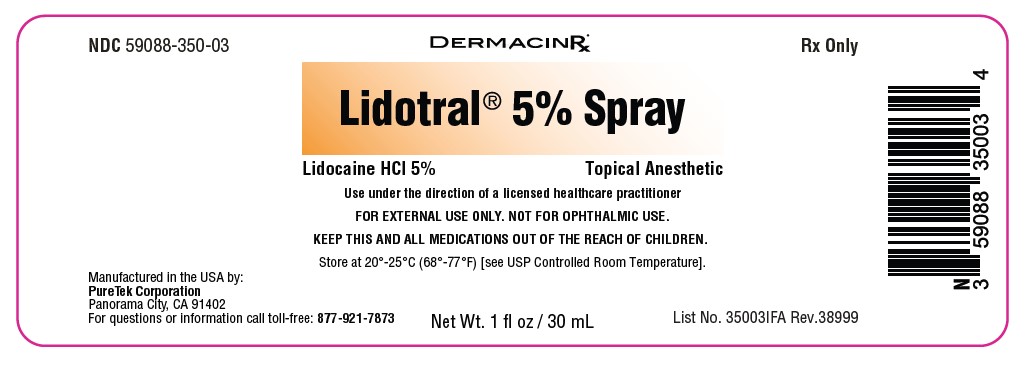
Lidotral Five Percent Lidocaine Hydrochloride 50 mg/mL Spray, 30 mL
Other active recalls for Lidocaine Hydrochloride (different manufacturers) — 6 · tap to view
🆔 Identity & classification
Where does this data come from?
🏷️ RxNorm drug class
This medicine belongs to the Antiarrhythmic class.
Where does this data come from?
🏭 Manufacturer & labeler
Where does this data come from?
🩺 Clinical
- It's best to avoid using two lidocaine products at the same time unless your doctor says it's okay. When you use multiple products containing a local anesthetic, the total amount a...
- Can I use a lidocaine patch and a lidocaine cream at the same time?
- No — please don't do this. Heat significantly increases how much lidocaine is absorbed through your skin, which can push drug levels in your blood higher than they should be. Stick...
- Can I put a heating pad on the area where I applied a lidocaine patch?
Patient education
Supplement & herbal interactions
Where does this data come from?
Ask a licensed pharmacist directly — free, answered by our team.
🧪 Inactive Ingredients / Excipients
Inactive ingredients, also called excipients, are components of the drug product other than the active ingredient. They may include fillers, dyes, coatings, preservatives, flavors, or other formulation ingredients.
💡 Tap an ingredient (hover on desktop) to see what it is and why it’s used.
-
UNII 3K9958V90M
A liquid solvent derived from fermentation or chemical synthesis. In medicines, alcohol dissolves active ingredients, helps preserve the product, and improves how the body absorbs certain drugs.
-
UNII LU49E6626Q
A synthetic organic compound used as a pH buffer and neutralizing agent in medicines. It helps maintain the proper acidity level in liquid formulations to improve stability and comfort.
-
UNII LKG8494WBH
Benzyl alcohol is a clear liquid used as a preservative and solvent in medicines. It helps prevent bacterial and fungal growth and dissolves other ingredients to create uniform liquid formulations.
-
UNII WV9CM0O67Z
Panthenol is a humectant and skin-conditioning agent derived from pantothenic acid. It's added to medicines to help retain moisture and soothe skin irritation.
-
UNII B697894SGQ
Polyethylene glycol 400 is a clear, thick liquid made from petroleum-derived polymers. It acts as a solvent and humectant in medicines, helping dissolve active ingredients and retain moisture in the formulation.
-
UNII 8LGU7VM393
Rosemary leaf oil is a natural aromatic oil extracted from rosemary plants. It's used in medicines as a flavoring agent and preservative to help protect the product from spoilage.
-
UNII 059QF0KO0R
Water is a liquid solvent that dissolves and mixes ingredients together in liquid medicines, syrups, and injections. It helps distribute the active drug evenly throughout the product.
7 inactive ingredients listed in the exact product block matched to this NDC.
Where does this data come from?
ingredient classCode="IACT" elements from the exact product block matched by this NDC. Label-section narrative from DailyMed / the openFDA label index is shown separately when available.Inactive ingredient FAQ
Are inactive ingredients the same for every manufacturer?
Why might an inactive ingredient be missing?
Can inactive ingredients matter?
💲 Pricing
A drug doesn't have one price. Each row is a different public payment system, and none is what you'd pay at the counter — that depends on your insurance. The ⓘ on each row explains what it measures.
| Price system | Per mL | Per package |
|---|---|---|
| Retail pharmacies payNADAC · weekly | Not in the retail survey — common for institutional, discontinued, or low-volume packs. | |
| Medicaid paysCMS SDUD · 12 mo | No recent Medicaid claims on file for this NDC — rare and low-volume NDCs are suppressed in the public data. | |
| Medicare drug plans payPart D · quarterly | No Part D plan price is available for this NDC in our data. | |
Where does this data come from?
🔁 Therapeutic equivalents
| Product | Labeler | Pack | NADAC/unit | TE | Status | Price vs. this |
|---|---|---|---|---|---|---|
| Lidotral Five Percent 50 mg/mLthis 59088-0350-03 | PureTek | 30 ml | — | — | FDA listed | — |
| Bravado Labs Numbing 5 g/100g 70171-0400-01 | Prodigy | 1 bottle | — | — | FDA listed | — |
| Uber Numb 50 mg/mL 71131-0050-04 | UBERScientific, | 118.29 ml | — | — | FDA listed | — |
| RECOVERY Numbing 5.9 g/118mL 76348-0980-04 | Renu | 118 ml | — | — | FDA listed | — |
| The Solution 2.0 5 g/100mL 82617-0102-12 | SCALP | 60 ml | — | — | FDA listed | — |
Where does this data come from?
⏳ Availability & generic status
We did not find an FDA-approved generic match for this exact strength, form and route.
Where does this data come from?
📦 Packaging — all sizes for this product
| Package NDC | Description | Marketing start | Status |
|---|---|---|---|
| 59088-0350-03 You're viewing this | 30 mL in 1 BOTTLE, SPRAY (59088-350-03) | 2024-06-04 | Active |
🧭 About this NDC listing & data coverage
Listed without an FDA application
This product's marketing category indicates it is marketed without an approved FDA application (no NDA, ANDA, or BLA on file). Having an NDC does not by itself establish FDA approval — the NDC Directory is a listing system, not an approval decision. Approval-linked data such as Orange Book therapeutic-equivalence ratings therefore does not apply.
What data is (and isn’t) available for this NDC — tap to expand
| NDC identity (package / product / labeler codes) | ✓ Available |
| Labeler | ✓ Available |
| Product & package description | ✓ Available |
| Marketing category & status | ✓ Available |
| Active ingredient / dosage form / route | ✓ Available |
| FDA label (SPL via DailyMed) | ✓ Available |
| Package photos | ✓ Available |
| Inactive ingredients (structured) | ✓ Available |
| NADAC pharmacy acquisition price (CMS) | — Not published for this NDC CMS publishes NADAC only for NDCs reported in its retail-pharmacy survey. |
| Orange Book / therapeutic-equivalence data | — Not published for this NDC Applies only to products approved under an NDA/ANDA; many listings are out of scope. |
| HCPCS J-code billing crosswalk | — Not published for this NDC Most self-administered / retail products have no J-code — that is normal. |
| Medicaid utilization (CMS SDUD) | — Not published for this NDC CMS reports utilization only for NDCs with Medicaid claims above its privacy threshold. |
Questions about this listing
Is this NDC FDA-approved?
Why is there no price listed?
Is the NDC printed on the package the same as the 11-digit billing NDC?
What do the three segments of this NDC mean?
Is this package still being marketed?
Who lists this product with the FDA?
Do I need a prescription for this product?
Where does this data come from?
📄 Full prescribing information FDA SPL
🎯 Indications and Usage ▾
INDICATIONS For the temporary relief of pain and itching associated with minor burns, sunburn, minor cuts, scrapes, insect bites, and minor skin irritation.
⏱️ Dosage and Administration ▾
DOSAGE AND ADMINISTRATION Spray to the affected area(s) two or three times daily or as directed by a licensed healthcare practitioner. Apply Lidotral® 5% Spray to intact skin to cover the most painful area. Smaller areas of treatment are recommended in a debilitated patient, or a patient with impaired elimination.
When Lidotral® 5% Spray is used concomitantly with other products containing local anesthetic agents, the amount absorbed from all formulations must be considered.
⛔ Contraindications ▾
CONTRAINDICATIONS Tuberculosis or fungal lesions of the skin vaccinia, varicella and acute herpes simplex and in persons who have shown hypersensitivity to any of its components. Lidocaine is contraindicated in patients with a known history of hypersensitivity to local anesthetics of the amide type.
⚠️ Warnings ▾
WARNINGS For external use only. Not for ophthalmic use. EXCESSIVE DOSING Excessive dosing by applying Lidotral® 5% Spray to larger areas or for longer than the recommended wearing time could result in increased absorption of lidocaine and high blood concentrations, leading to serious adverse effects (see ADVERSE REACTIONS, Systemic Reactions).
Lidocaine toxicity could be expected at lidocaine blood concentrations above 5 mcg/mL. The blood concentration of lidocaine is determined by the rate of systemic absorption and elimination. Longer duration of application, application of more than the recommended number of patches, smaller patients, or impaired elimination may all contribute to increasing the blood concentration of lidocaine.
With recommended dosing, the average peak blood concentration is about 0.13 mcg/ mL, but concentrations higher than 0.25 mcg/mL have been observed in some individuals.
🤒 Adverse Reactions ▾
ADVERSE REACTIONS ADVERSE REACTIONS Application Site Reactions Even though adverse reactions are rare, a very small percentage of patients experience an unpleasant burning sensation, redness, warmth, or stinging. It is advisable to apply a small amount on the forearm prior to first use. If any of these effects persists or worsens, contact your physician or pharmacist immediately.
This medication is not absorbed systemically but if any serious side effects (i.e. rash, itching/swelling, severe dizziness) are experienced, discontinue use immediately and contact your pharmacist or physician. This is not a complete list of all side effects that may occur. You may report side effects to the FDA at 800-FDA-1088 or at http://www.fda.gov/medwatch.
Allergic Reactions Allergic and anaphylactoid reactions associated with lidocaine, although rare, can occur. They are characterized by angioedema, bronchospasm, dermatitis, dyspnea, hypersensitivity, laryngospasm, pruritus, shock, and urticaria. If they occur, they should be managed by conventional means.
The detection of sensitivity by skin testing is of doubtful value. Other Adverse Events Due to the nature and limitation of spontaneous reports in post marketing surveillance, causality has not been established for additional reported adverse events including: Asthenia, confusion, disorientation, dizziness, headache, hyperesthesia, hypoesthesia, lightheadedness, metallic taste, nausea, nervousness, pain exacerbated, paresthesia, somnolence, taste alteration, vomiting, visual disturbances such as blurred vision, flushing, tinnitus, and tremor.
Systemic (Dose-Related) Reactions Systemic adverse reactions following appropriate use of lidocaine is unlikely, due to the small dose absorbed (see CLINICAL PHARMACOLOGY, Pharmacokinetics). Systemic adverse effects of lidocaine are similar in nature to those observed with other amide local anesthetic agents, including CNS excitation and/or depression (light-headedness, nervousness, apprehension, euphoria, confusion, dizziness, drowsiness, tinnitus, blurred or double vision, vomiting, sensations of heat, cold or numbness, twitching, tremors, convulsions, unconsciousness, respiratory depression and arrest).
Excitatory CNS reactions may be brief or not occur at all, in which case the first manifestation may be drowsiness merging into unconsciousness. Cardiovascular manifestations may include bradycardia, hypotension and cardiovascular collapse leading to arrest.
🔄 Drug Interactions ▾
Drug Interactions Antiarrhythmic Drugs: Lidotral® 5% Spray should be used with caution in patients receiving Class I antiarrhythmic drugs (such as tocainide and mexiletine) since the toxic effects are additive and potentially synergistic. Local Anesthetics: When Lidotral® 5% Spray is used concomitantly with other products containing local anesthetic agents, the amount absorbed from all formulations must be considered.
🤰 Pregnancy ▾
Pregnancy Teratogenic Effects: Pregnancy Category B. Lidocaine has not been studied in pregnancy. Reproduction studies with lidocaine have been performed in rats at doses up to 30 mg/kg subcutaneously and have revealed no evidence of harm to the fetus due to lidocaine.
There are, however, no adequate and well- controlled studies in pregnant women. Because animal reproduction studies are not always predictive of human response, lidocaine should be used during pregnancy only if clearly needed. Labor and Delivery Lidocaine has not been studied in labor and delivery.
Lidocaine is not contraindicated in labor and delivery. Should lidocaine be used concomitantly with other products containing lidocaine, total doses contributed by all formulations must be considered.
🧒 Pediatric Use ▾
Pediatric Use Safety and effectiveness in pediatric patients have not been established.
🆘 Overdosage ▾
OVERDOSAGE Lidocaine overdose from cutaneous absorption is rare, but could occur. If there is any suspicion of lidocaine overdose (see ADVERSE REACTIONS, Systemic Reactions), drug blood concentration should be checked. The management of overdose includes close monitoring, supportive care, and symptomatic treatment.
Dialysis is of negligible value in the treatment of acute overdose with lidocaine. In the absence of massive topical overdose or oral ingestion, evaluation of symptoms of toxicity should include consideration of other etiologies for the clinical effects, or over dosage from other sources of lidocaine or other local anesthetics. The oral LD50 of lidocaine HCl is 459 (346 to 773) mg/kg (as the salt) in non-fasted female rats and 214 (159 to 324) mg/kg (as the salt) in fasted female rats, which are equivalent to roughly 4000 mg and 2000 mg, respectively, in a 60 to 70 kg man based on the equivalent surface area dosage conversion factors between species.
🧬 Clinical Pharmacology ▾
CLINICAL PHARMACOLOGY Pharmacodynamics Lidocaine is a common local anesthetic that relieves itching, burning, and pain. Topically, it blocks both initiation and conduction or nerve impulses by decreasing ionic flux through the neuronal membrane. Since it penetrates the skin, it creates an anesthetic effect by not just preventing pain signals from propagating to the brain out by stopping them before they begin.
Pharmacokinetics Absorption: Lidocaine- Lidocaine may be absorbed following topical administration to mucous membranes, its rate and extent of absorption depending upon the specific site of application, duration of exposure, concentration and total dosage. In general, the rate of absorption of local anesthetic agents following topical application occurs most rapidly after intratracheal administration. Lidocaine is also well-absorbed from the gastrointestinal tract, but little intact drug appears in the circulation because of biotransformation in the liver.
Lidocaine is metabolized rapidly by the liver and metabolites and unchanged drug are excreted by the kidneys. Biotransformation includes oxidative N-dealkylation, ring hydroxylation, cleavage of the amide linkage and conjugation. N-dealkylation, a major pathway of biotransformation, yields the metabolites monoethylglycinexylidide and glycinexylidide.
The pharmacological/ toxicological actions of these metabolites are similar to, but less potent than, those of lidocaine. Approximately 90% of lidocaine administered is excreted in the form of various metabolites and less than 10% is excreted unchanged. The primary metabolite in urine is a conjugate of 4-hydroxy-2, 6-dimethylaniline.
The plasma binding of lidocaine is dependent on drug concentration and the fraction bound decreases with increasing concentration. At concentrations of 1 to 4 g of free base per mL, 60 to 80 percent of lidocaine is protein bound. Binding is also dependent on the plasma concentration of the alpha-1-acid glycoprotein.
Lidocaine crosses the blood-brain and placental barriers, presumably by passive diffusion. Studies of lidocaine metabolism following intravenous bolus injections have shown that the elimination half-life of this agent is typically 1.5 to 2 hours. Because of the rapid rate at which lidocaine is metabolized, any condition that affects liver function may alter lidocaine kinetics.
The half-life may be prolonged two-fold or more in patients with liver dysfunction. Renal dysfunction does not affect lidocaine kinetics, but may increase the accumulation of metabolites. Factors such as acidosis and the use of CNS stimulants and depressants affect the CNS levels of lidocaine required to produce overt systemic effects.
Objective adverse manifestations become increasingly apparent with increasing venous plasma levels above 6 g free base per mL. In the rhesus monkey, arterial blood levels of 18-21 g/mL have been shown to be threshold for convulsive activity. Excretion: Lidocaine- Lidocaine and its metabolites are excreted by the kidneys.
Less than 10% of lidocaine is excreted unchanged. The half-life of lidocaine elimination from the plasma following IV administration is 81 to 149 minutes (mean 107 ± 22 SD, n = 15). The systemic clearance is 0.33 to
0.90L/min (mean 0.64 ±
0.18SD, n = 15).
📦 How Supplied / Storage and Handling ▾
HOW SUPPLIED Lidotral® 5% Spray (Lidocaine HCl 5%) is supplied in a 1 fl. oz. (30 mL) amber PET bottle with a screw cap sprayer (NDC 59088-350-03) Store at 20° to 25°C (68° to 77°F) [See USP Controlled Room Temperature].
📋 Description ▾
DESCRIPTION Lidotral® 5% Spray contains 50 mg of Lidocaine HCl per gram in a vehicle of Aminomethyl Propanol, Aqua (Purified Water), Benzyl Alcohol, Ethyl Alcohol, DL-Panthenol, PEG-8, Rosmarinus Officinalis (Rosemary) Leaf Oil, Fragrance. Lidocaine HCI is chemically designated as acetamide, 2-(diethylamino)-N-(2,6-dimethylphenyl), and has the following structure: Lidotral® 5% Spray is a combination of ingredients with analgesics and anesthetic properties used in a unique way to maximize its pain-relieving effects to aid in addition to other therapies.
This offers long lasting relief for a variety of pain conditions. Drug