
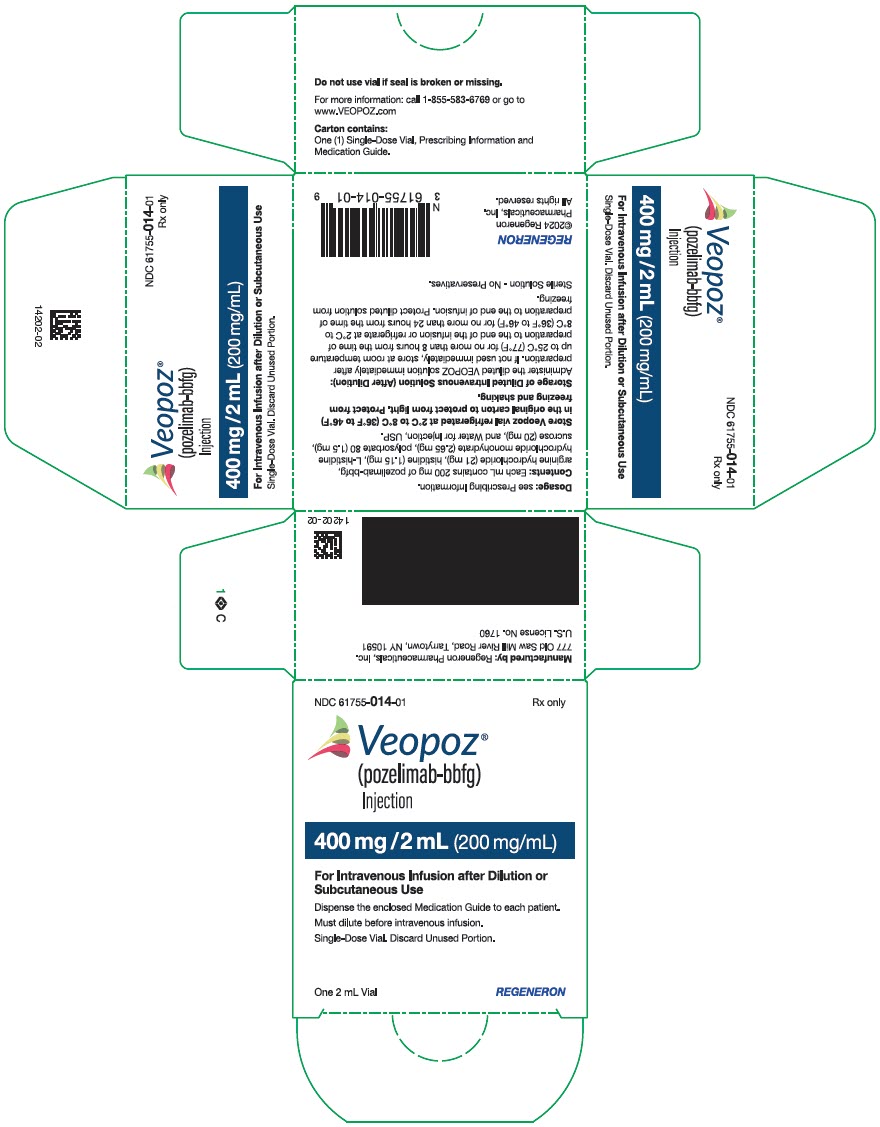
VEOPOZ Pozelimab 200 mg/mL Injection, Solution — NDC 61755-014-01 (Billing 61755-0014-01)
This is a package of VEOPOZ Pozelimab 200 mg/mL Injection, Solution from Regeneron Pharmaceuticals, Inc., marketed since Aug 2023 and currently FDA-listed. It is this product's only package size.
NDC database record
One package, one record: these facts belong to NDC 61755-014-01 alone.
- Record
- FDA NDC Directory package listing · Human prescription drug
- Code segments
- 61755 labeler · 014 product · 01 package
- Package marketed since
- Aug 18, 2023
- Sample package
- No — commercial package
- Listing certified through
- Dec 31, 2026
- Barcode (UPC-A, from the NDC)
- 3 6175501401 9
- FDA record last changed
- Jul 24, 2026
Identity & classification
Regulatory identifiers FDA, NLM and CMS codes for this package
Drug-database identifiers Medi-Span GPI and First Databank GCN / HICL / AHFS classification
- GSN (GCN sequence number): 085187
- GCN: 54605
- GPI-14 (Medi-Span): 85805070152020
- HICL (First Databank): 049162
- AHFS class code: 92:32.00.00
- RxCUI (RxNorm): 2663945
Where does this data come from?
- FDA openFDA NDC Directory · synced Oct 8, 2026
- FDA label on DailyMed · label index refreshed Oct 6, 2026
- RxNorm (NLM RxNav) · catalog refreshed Oct 1, 2026
- Medi-Span GPI (licensed)
- First Databank (licensed) · refreshed Oct 8, 2026
RxNorm drug class
This medicine belongs to the Complement Inhibitor class.
Where does this data come from?
- RxClass (NLM) · catalog refreshed Oct 1, 2026
Clinical
Pozelimab-bbfg injection is used in adults and children 1 year of age and older to treat CD55-deficient protein-losing enteropathy (PLE; CHAPLE disease; an inherited condition in which the immune system mistakenly attacks and destroys healthy cells in the digestive tract). Pozelimab-bbfg is in a class of medications called complement inhibitors. It works by blocking the activity of the part of the immune system that may damage cells in the digestive tract.
Read the full MedlinePlus article ↗Patient education
Supplement & herbal interactions
Where does this data come from?
- MedlinePlus (NLM) · refreshed Oct 1, 2026
- FDA label on DailyMed · label index refreshed Oct 6, 2026
Ask a licensed pharmacist directly — free, answered by our team.
Pricing
A drug doesn't have one price. Each row is a different public payment system, and none is what you'd pay at the counter — that depends on your insurance. The ⓘ on each row explains what it measures.
| Price system | Per mL | Per package |
|---|---|---|
| Retail pharmacies payNADAC · weekly | Not in the retail survey — common for institutional, discontinued, or low-volume packs. | |
| Medicaid paysCMS SDUD · 12 mo | No recent Medicaid claims on file for this NDC — rare and low-volume NDCs are suppressed in the public data. | |
| Medicare drug plans payPart D · quarterly | No Part D plan price is available for this NDC in our data. | |
| Medicare Part B allowsASP · J9376 | No ASP payment limit on file for J9376 this quarter. | |
Where does this data come from?
- CMS NADAC weekly file
- CMS ASP pricing files · refreshed Sep 20, 2026
- CMS Medicaid State Drug Utilization Data · refreshed Oct 8, 2026
- CMS Part D plan pricing files · refreshed Sep 24, 2026
- VA National Acquisition Center price file
Billing & reimbursement
Where does this data come from?
- CMS ASP NDC-HCPCS crosswalk · refreshed Sep 22, 2026
- DMEPDAC NDC-HCPCS crosswalk
- openFDA NSDE billing units · refreshed Oct 7, 2026
Packaging — all sizes for this product
| Package NDC | Description | Marketing start | Marketing end | Status |
|---|---|---|---|---|
| 61755-0014-01 You're viewing this Main listing | 1 VIAL, SINGLE-DOSE in 1 CARTON / 2 mL in 1 VIAL, SINGLE-DOSE | 2023-08-18 | — | Active |
Therapeutic equivalents
| Product | Labeler | Pack | NADAC/unit | TE | Status | Price vs. this |
|---|---|---|---|---|---|---|
| Veopoz 200 mg/mLthis 61755-0014-01 | Regeneron | 1 vial | — | — | FDA listed | — |
Where does this data come from?
- FDA openFDA NDC Directory · synced Oct 8, 2026
- FDA Purple Book · refreshed Oct 5, 2026
- CMS NADAC weekly file
Availability & biosimilar status
Biologics have no small-molecule generics; biosimilar competition is tracked in the FDA Purple Book.
Why the date isn’t exact: Biosimilar timing can change because patents may be challenged, settled, licensed, added or removed, and litigation can move the real date earlier or later.
🛈 What do these terms mean?
- Biologic patent
- A patent the reference product’s maker has publicly listed. A biosimilar generally can’t launch until these expire — unless they’re invalidated or resolved in a settlement.
- Reference-product exclusivity
- A flat 12 years of FDA market protection from the biologic’s first licensure (the BPCIA). No biosimilar can be licensed before it ends, regardless of patents.
- Interchangeable exclusivity
- The first interchangeable biosimilar can earn a period as the only interchangeable version (pharmacists can substitute it without the prescriber).
- Earliest biosimilar (LOE)
- The latest of all the dates above — the soonest a biosimilar can realistically reach the market. Litigation and settlements can move it earlier.
Biologics have no small-molecule “generics” — competition comes from FDA-licensed biosimilars, tracked in the FDA Purple Book.
| Code | What it grants | Expires |
|---|---|---|
| RefProduct | Reference-product exclusivity (12-year, BPCIA) — no biosimilar can be licensed before this date | Aug 18, 2035 |
Is there a biosimilar for VEOPOZ 400 MG/2 ML VIAL?
Why do different websites show different biosimilar dates?
Can a biosimilar launch before the last patent expires?
What does “current Purple Book estimate” mean?
What does “FDA listed” mean?
What does a patent or protection date mean here?
Where does this data come from?
- FDA Purple Book · refreshed Oct 5, 2026
Inactive Ingredients / Excipients
Inactive ingredients, also called excipients, are components of the drug product other than the active ingredient. They may include fillers, dyes, coatings, preservatives, flavors, or other formulation ingredients.
💡 Tap an ingredient (hover on desktop) to see what it is and why it’s used.
-
UNII F7LTH1E20Y
Arginine hydrochloride is an amino acid salt used as a buffer and pH adjuster in medicines. It helps maintain the correct acidity level to keep the drug stable and effective.
-
UNII 4QD397987E
An amino acid used as a buffer and stabilizer in medications. It helps maintain the pH balance and protects the active drug from breaking down during storage and use.
-
UNII X573657P6P
Histidine monohydrochloride monohydrate is an amino acid salt used as a buffer in medicines. It helps maintain the proper acidity level of liquid formulations to keep the drug stable and effective.
-
UNII 6OZP39ZG8H
Polysorbate 80 is a synthetic emulsifier derived from sorbitol and oleic acid. It helps mix oil and water-based ingredients together in medications and improves how the product disperses in the body.
-
UNII C151H8M554
A natural sugar derived from sugar cane or sugar beets. It's used as a sweetener, filler, and binder to improve taste, add bulk, and help hold tablet or capsule ingredients together.
-
UNII 059QF0KO0R
Water is a liquid solvent that dissolves and mixes ingredients together in liquid medicines, syrups, and injections. It helps distribute the active drug evenly throughout the product.
6 inactive ingredients listed in the exact product block matched to this NDC.
Where does this data come from?
ingredient classCode="IACT" elements from the exact product block matched by this NDC. Label-section narrative from DailyMed / the openFDA label index is shown separately when available.- FDA label on DailyMed · label index refreshed Oct 6, 2026
- FDA openFDA NDC Directory · synced Oct 8, 2026
Inactive ingredient FAQ
Are inactive ingredients the same for every manufacturer?
Why might an inactive ingredient be missing?
Can inactive ingredients matter?
Manufacturer & labeler
More NDCs from Regeneron Pharmaceuticals, Inc. labeler code 61755
- EYLEA aflibercept 40 mg/mL Injection, Solution NDC 61755-005-01
- LIBTAYO cemiplimab-rwlc 50 mg/mL Injection NDC 61755-008-01
- Evkeeza evinacumab 150 mg/mL Injection, Solution, Concentrate NDC 61755-010-01
- Pasatru garetosmab-grts 300 mg/5mL Injection, Solution, Concentrate NDC 61755-012-01
- Evkeeza evinacumab 150 mg/mL Injection, Solution, Concentrate NDC 61755-013-01
- Inmazeb atoltivimab, maftivimab, and odesivimab-ebgn 241.7 mg/14.5mL; 241.7 mg/14.5mL; 241.7 mg/14.5mL Injection, Solution NDC 61755-018-01
- Inmazeb atoltivimab, maftivimab, and odesivimab-ebgn 483.3 mg/14.5mL; 483.3 mg/14.5mL; 483.3 mg/14.5mL Injection, Solution NDC 61755-019-01
- Praluent alirocumab 75 mg/mL Injection, Solution NDC 61755-020-01
- Praluent alirocumab 150 mg/mL Injection, Solution NDC 61755-021-01
- EYLEA HD aflibercept 8 mg/.07mL Injection, Solution NDC 61755-050-01
- EYLEA HD aflibercept 8 mg/.07mL Injection, Solution NDC 61755-051-01
Where does this data come from?
- FDA openFDA NDC Directory · synced Oct 8, 2026
- Drugs@FDA
Full prescribing information FDA SPL
🚨 Boxed Warning ▾
WARNING: SERIOUS MENINGOCOCCAL INFECTIONS Life-threatening and fatal meningococcal infections have occurred in patients treated with complement inhibitors. Meningococcal infection may become rapidly life-threatening or fatal if not recognized and treated early. Complete or update meningococcal vaccination (for serogroups A, C, W and Y, and serogroup B) at least 2 weeks prior to administering the first dose of VEOPOZ, unless the risks of delaying therapy outweigh the risk of developing a meningococcal infection.
Follow the most current Advisory Committee on Immunization Practices (ACIP) recommendations for meningococcal vaccination in patients receiving a complement inhibitor. Patients receiving VEOPOZ are at increased risk for invasive disease caused by N. meningitidis , even if they develop antibodies following vaccination. Monitor patients for early signs of meningococcal infections and evaluate immediately if infection is suspected [see Warnings and Precautions (5.1) ] .
WARNING: SERIOUS MENINGOCOCCAL INFECTIONS See full prescribing information for complete boxed warning Life-threatening and fatal meningococcal infections have occurred in patients treated with complement inhibitors. Meningococcal infection may become rapidly life-threatening or fatal if not recognized and treated early. ( 5.1 ) Complete or update meningococcal vaccination at least 2 weeks prior to administering the first dose of VEOPOZ, unless the risks of delaying therapy outweigh the risks of developing meningococcal infection.
Follow the most current Advisory Committee on Immunization Practices (ACIP) recommendations for meningococcal vaccination in patients receiving a complement inhibitor. ( 5.1 ) Patients receiving VEOPOZ are at increased risk for invasive disease caused by N. meningitidis , even if they develop antibodies following vaccination. Monitor patients for early signs of meningococcal infections and evaluate immediately if infection is suspected.
( 5.1 )
🎯 Indications and Usage ▾
1 INDICATIONS AND USAGE VEOPOZ is indicated for the treatment of adult and pediatric patients 1 year of age and older with CD55-deficient protein-losing enteropathy (PLE), also known as CHAPLE disease. VEOPOZ is a complement inhibitor indicated for the treatment of adult and pediatric patients 1 year of age and older with CD55-deficient protein-losing enteropathy (PLE), also known as CHAPLE disease. ( 1 )
⏱️ Dosage and Administration ▾
2 DOSAGE AND ADMINISTRATION See the full prescribing information for meningococcal vaccine and prophylaxis recommendations prior to the first dose of VEOPOZ. ( 2.1 ) Recommended Dosage: Day 1 (loading dose): Administer a single 30 mg/kg dose by intravenous infusion after dilution. ( 2.2 ) Day 8 and thereafter (maintenance dosage): Inject 10 mg/kg as a subcutaneous injection once weekly starting on Day 8.
The maintenance dosage may be increased to 12 mg/kg once weekly if there is inadequate clinical response after at least 3 weekly doses (i.e., starting from Week 4). The maximum maintenance dosage is 800 mg once weekly. ( 2.2 ) See full prescribing information for instructions on preparation and administration.
( 2.2 , 2.3 , 2.4 )
2.1Recommended Vaccination and Prophylaxis for Meningococcal Infection Prior to First Dose of VEOPOZ Vaccinate patients for meningococcal infection (serogroups A, C, W, and Y [MenACWY] and serogroup B [MenB]) according to current ACIP recommendations for patients receiving a complement inhibitor at least 2 weeks prior to administering the first dose of VEOPOZ [see Warnings and Precautions (5.1) ] . If urgent VEOPOZ therapy is indicated in a patient who is not up-to-date with vaccines for both MenACWY and MenB according to ACIP recommendations, administer meningococcal vaccine(s) as soon as possible and provide the patient with antibacterial drug prophylaxis.
The efficacy, duration, and drug regimens for antibacterial drug prophylaxis have not been studied in patients receiving complement inhibitors, including VEOPOZ.
2.2Recommended Dosage and Administration The recommended dosage of VEOPOZ is as follows: Day 1 (Loading Dose) : Administer a single 30 mg/kg dose by intravenous infusion after dilution [see Dosage and Administration (2.3) ] . Day 8 and Thereafter (Maintenance Dosage) : Inject 10 mg/kg as a subcutaneous injection once weekly starting on Day 8 [see Dosage and Administration (2.4) ] . The maintenance dosage may be increased to 12 mg/kg once weekly if there is inadequate clinical response after at least 3 weekly doses (i.e., starting from Week 4).
The maximum maintenance dosage is 800 mg once weekly. Doses greater than 400 mg require 2 injections.
2.3Intravenous Infusion Loading Dose: Preparation and Administration Instructions VEOPOZ for intravenous use must be prepared and administered by a healthcare provider. Preparation Instructions for Intravenous Infusion Loading Dose Remove VEOPOZ vial(s) from refrigeration and allow the vial(s) to sit for at least 45 minutes at room temperature 20ºC to 25ºC (68ºF to 77ºF) before use. Parenteral drug products should be inspected visually for particulate matter and discoloration prior to administration, whenever solution and container permit.
VEOPOZ should be a clear to slightly opalescent, colorless to pale yellow solution that is free from visible particulates. Discard the vial(s) if the solution is cloudy, discolored or contains particulate matter. Gently swirl the vial(s) in an upright position.
Do not shake the vial(s) as this may result in foaming. Use a 21G stainless steel needle with Luer-Lok to withdraw the calculated volume of VEOPOZ from the vial(s). Discard any unused VEOPOZ remaining in the vial(s).
Dilute VEOPOZ in an intravenous infusion bag of 25 mL to 250 mL of either 0.9% Sodium Chloride Injection or 5% Dextrose Injection to a final concentration of 6.7 mg/mL to 20 mg/mL. Mix the diluted solution by gentle inversion. Do not shake.
Administration Instructions for Intravenous Infusion Loading Dose Infuse through an intravenous line containing a sterile, in-line or add-on 0.2-micron to 5-micron filter. Infusion rate: infuse over a minimum of 1 hour; do not exceed maximum rate of 1000 mg/hour Do not co-administer other medications through the same intravenous line Observe the patient for 30 minutes following completion of the infusion [see Warnings and Precautions (5.3) ]. Storage of Diluted Intravenous Solution Administer the diluted… [Excerpted — this section continues on DailyMed.]
💊 Dosage Forms and Strengths ▾
3 DOSAGE FORMS AND STRENGTHS Injection: 400 mg/2 mL (200 mg/mL) as a clear to slightly opalescent, colorless to pale yellow solution in a single-dose vial. Injection: 400 mg/2 mL (200 mg/mL) in a single-dose vial. ( 3 )
⛔ Contraindications ▾
4 CONTRAINDICATIONS VEOPOZ is contraindicated in: Patients with unresolved Neisseria meningitidis infection [see Warnings and Precautions (5.1) ] . VEOPOZ is contraindicated in patients with unresolved Neisseria meningitidis infection. ( 4 )
⚠️ Warnings and Cautions ▾
5 WARNINGS AND PRECAUTIONS Other Bacterial Infections : Interrupt treatment with VEOPOZ in patients who are undergoing treatment for a serious encapsulated bacterial infection until the infection is resolved. ( 5.2 ) Systemic Hypersensitivity Reactions : Interrupt infusion and institute appropriate supportive measures if signs of cardiovascular instability or respiratory compromise occur. ( 5.3 ) Immune Complex Formation : Transition between other complement inhibitors has resulted in decreased drug concentrations and possible hypersensitivity reactions.
Consider this potential if switching complement inhibitors to VEOPOZ. ( 5.4 )
5.1Serious Meningococcal Infections Life-threatening and fatal meningococcal infections have occurred in both vaccinated and unvaccinated patients treated with complement inhibitors. The use of VEOPOZ increases a patient's susceptibility to serious and life-threatening meningococcal infections (septicemia and/or meningitis) caused by any serogroup, including nongroupable strains. Complete or update meningococcal vaccination (for serogroups A, C, W, and Y [MenACWY] and serogroup B [MenB]) at least 2 weeks prior to administering the first dose of VEOPOZ, according to the most current Advisory Committee on Immunization Practices (ACIP) recommendations for patients receiving a complement inhibitor.
Revaccinate patients in accordance with ACIP recommendations considering the duration of VEOPOZ therapy. If urgent VEOPOZ therapy is indicated in a patient who is not up-to-date with both MenACWY and MenB vaccines according to ACIP recommendations, administer meningococcal vaccine(s) as soon as possible and provide the patient with antibacterial drug prophylaxis. The efficacy, duration, and drug regimens for antibacterial drug prophylaxis have not been studied in patients receiving complement inhibitors.
Because of inhibition of complement activity by VEOPOZ, as well as risk of infection caused by nongroupable strains of N. meningitidis , vaccination does not eliminate the risk of meningococcal infections, despite development of antibodies following vaccination. Closely monitor patients for early signs and symptoms of meningococcal infection and evaluate patients immediately if infection is suspected. Inform patients and caregivers of these signs and symptoms and instruct patients to seek immediate medical care if these signs and symptoms occur.
Meningococcal infection may become rapidly life-threatening or fatal if not recognized and treated early. Interrupt treatment with VEOPOZ in patients who are undergoing treatment for serious meningococcal infection until the infection is resolved [see Contraindications (4) ] .
5.2Other Bacterial Infections VEOPOZ blocks terminal complement activation; therefore, patients may have increased susceptibility to encapsulated bacterial infections, especially infections caused by Neisseria meningitidis but also Streptococcus pneumoniae, Haemophilus influenzae , and to a lesser extent, Neisseria gonorrhoeae . Patients treated with VEOPOZ may be at increased risk of developing serious infections due to Streptococcus pneumoniae and Haemophilus influenzae type b (Hib). Administer vaccinations for the prevention of Streptococcus pneumoniae and Haemophilus influenzae type b (Hib) infections according to ACIP guidelines.
Patients receiving VEOPOZ are at increased risk for infections due to these organisms, even if they develop antibodies following vaccination. Interrupt treatment with VEOPOZ in patients who are undergoing treatment for a serious encapsulated bacterial infection until the infection is resolved. Counsel patients about gonorrhea prevention and advise regular testing for patients at risk.
5.3Systemic Hypersensitivity Reactions Hypersensitivity reactions, including anaphylaxis, have been reported with administration of complement inhibitors. Interrupt VEOPOZ and institute appropriate supportive measures if signs of cardiovascular instability or respiratory compromise… [Excerpted — this section continues on DailyMed.]
🤒 Adverse Reactions ▾
6 ADVERSE REACTIONS The following clinically significant adverse reactions are described elsewhere in the labeling: Serious Meningococcal Infections [see Warnings and Precautions (5.1) ] Other Bacterial Infections [see Warnings and Precautions (5.2) ] Systemic Hypersensitivity Reactions [see Warnings and Precautions (5.3) ] Immune Complex Formation [see Warnings and Precautions (5.4) ] Most common adverse reactions (in two or more patients) are: upper respiratory tract infection, fracture, urticaria, and alopecia. ( 6.1 ) To report SUSPECTED ADVERSE REACTIONS, contact Regeneron at 1-855-583-6769 or FDA at 1-800-FDA-1088 or www.fda.gov/medwatch.
6.1Clinical Trials Experience Because clinical trials are conducted under widely varying conditions, adverse reaction rates observed in the clinical trials of a drug cannot be directly compared to rates in the clinical trials of another drug and may not reflect the rates observed in practice. The safety of VEOPOZ was evaluated in 10 patients with CD55-deficient PLE (ranging from 3 to 19 years of age) in a single-arm study [see Clinical Studies (14) ] . The median duration of exposure was 104 weeks (range: 75 to 140 weeks).
Adverse reactions reported in two or more patients are summarized in Table 1. Table 1: Adverse Reactions Reported in Two or More VEOPOZ-Treated Patients with CD55-deficient PLE in a Clinical Trial Adverse Reactions VEOPOZ N=10 n (%) Upper respiratory tract infection Composed of similar terms 3 (30) Fracture 3 (30) Urticaria 2 (20) Alopecia 2 (20) Additionally, injection site reactions (including dermatitis and erythema), metabolic acidosis, gingival bleeding, increased blood uric acid, increased liver enzymes, hematuria and proteinuria were reported in one patient each.
Vital Signs: Four patients reported elevated systolic and/or diastolic blood pressure readings above the normal range for age at multiple study visits.
🔄 Drug Interactions ▾
7 DRUG INTERACTIONS Intravenous Immunoglobulin : May decrease pozelimab concentrations; avoid concomitant use. If concomitant use cannot be avoided, monitor patients for worsening of clinical signs and symptoms of disease. ( 7.1 )
7.1Intravenous Immunoglobulin VEOPOZ has not been studied in combination with intravenous immunoglobulin. Intravenous immunoglobulin may interfere with the endosomal neonatal Fc receptor (FcRn) recycling mechanism of monoclonal antibodies such as pozelimab thereby decreasing serum pozelimab concentrations. Avoid concomitant use of intravenous immunoglobulin with VEOPOZ.
If concomitant use cannot be avoided, monitor patients for worsening of clinical signs and symptoms of CD55-deficient PLE [see Clinical Pharmacology (12.3) ] .
👥 Use in Specific Populations ▾
8 USE IN SPECIFIC POPULATIONS
8.1Pregnancy Risk Summary Although there are no data on VEOPOZ use in pregnant women to inform a drug-associated risk of major birth defects, miscarriage, or adverse maternal or fetal outcomes, monoclonal antibodies can be actively transported across the placenta . In an animal reproduction study in monkeys, pozelimab-bbfg did not adversely affect embryofetal or postnatal development when administered from pregnancy confirmation through parturition at doses that produced exposure up to 3.3 to 3.8 times the predicted clinical exposures (on an AUC basis; see Data ).
The estimated background risk of major birth defects and miscarriage for the indicated population is unknown. All pregnancies have a background risk of birth defect, loss, or other outcome. In the U.S. general population, the estimated background risk of major birth defects and miscarriage in clinically recognized pregnancies is 2 to 4% and 15 to 20%, respectively.
Data Animal Data In an enhanced pre- and postnatal development study, pregnant female monkeys were subcutaneously administered pozelimab-bbfg at doses of 5 or 50 mg/kg once weekly from confirmation of pregnancy (gestation day 20) through parturition (approximately gestation day 160). No adverse effects were observed on maintenance of pregnancy, pregnancy outcome, or on the development of offspring through postnatal day 90 at doses up to 3.3-3.8 times the predicted clinical exposures.
8.2Lactation Risk Summary There are no data on the presence of pozelimab-bbfg in either human or animal milk, the effects on the breastfed infant, or the effects on milk production. Endogenous maternal IgG and monoclonal antibodies are transferred into human milk. The effects of local gastrointestinal exposure and the extent of systemic exposure in the breastfed infant to pozelimab are unknown.
The development and health benefits of breastfeeding should be considered along with the mother's clinical need for VEOPOZ and any potential adverse effects on the breastfed infant from VEOPOZ or from the underlying maternal condition.
8.4Pediatric Use The safety and effectiveness of VEOPOZ for the treatment of CD55-deficient PLE have been established in pediatric patients 1 year of age and older. Use of VEOPOZ for this indication is supported by a single-arm study in 10 patients with active CD55-deficient PLE [see Adverse Reactions (6.1) and Clinical Studies (14) ]. The safety and effectiveness of VEOPOZ have not been established in pediatric patients less than 1 year of age.
8.5Geriatric Use CD55-deficient PLE is largely a disease of pediatric patients. VEOPOZ has not been studied in the geriatric population.
🤰 Pregnancy ▾
8.1Pregnancy Risk Summary Although there are no data on VEOPOZ use in pregnant women to inform a drug-associated risk of major birth defects, miscarriage, or adverse maternal or fetal outcomes, monoclonal antibodies can be actively transported across the placenta . In an animal reproduction study in monkeys, pozelimab-bbfg did not adversely affect embryofetal or postnatal development when administered from pregnancy confirmation through parturition at doses that produced exposure up to 3.3 to 3.8 times the predicted clinical exposures (on an AUC basis; see Data ).
The estimated background risk of major birth defects and miscarriage for the indicated population is unknown. All pregnancies have a background risk of birth defect, loss, or other outcome. In the U.S. general population, the estimated background risk of major birth defects and miscarriage in clinically recognized pregnancies is 2 to 4% and 15 to 20%, respectively.
Data Animal Data In an enhanced pre- and postnatal development study, pregnant female monkeys were subcutaneously administered pozelimab-bbfg at doses of 5 or 50 mg/kg once weekly from confirmation of pregnancy (gestation day 20) through parturition (approximately gestation day 160). No adverse effects were observed on maintenance of pregnancy, pregnancy outcome, or on the development of offspring through postnatal day 90 at doses up to 3.3-3.8 times the predicted clinical exposures.
🧒 Pediatric Use ▾
8.4Pediatric Use The safety and effectiveness of VEOPOZ for the treatment of CD55-deficient PLE have been established in pediatric patients 1 year of age and older. Use of VEOPOZ for this indication is supported by a single-arm study in 10 patients with active CD55-deficient PLE [see Adverse Reactions (6.1) and Clinical Studies (14) ]. The safety and effectiveness of VEOPOZ have not been established in pediatric patients less than 1 year of age.
🧓 Geriatric Use ▾
8.5Geriatric Use CD55-deficient PLE is largely a disease of pediatric patients. VEOPOZ has not been studied in the geriatric population.
🧬 Clinical Pharmacology ▾
12 CLINICAL PHARMACOLOGY
12.1Mechanism of Action Pozelimab-bbfg is a human, monoclonal immunoglobulin G4 P (IgG4 P ) antibody directed against the terminal complement protein C5 that inhibits terminal complement activation by blocking cleavage of C5 into C5a (anaphylatoxin) and C5b, thereby blocking the formation of the membrane-attack complex (C5b-C9, a structure mediating cell lysis).
12.2Pharmacodynamics The effect of pozelimab-bbfg on complement activity was measured by total complement hemolytic activity test (CH50). The magnitude and duration of reduction from baseline in CH50 by pozelimab-bbfg was dose dependent. In healthy subjects receiving a single dose of VEOPOZ 30 mg/kg administered as an intravenous infusion over approximately one hour, the complete inhibition of CH50 was achieved at the end of infusion in all subjects, was maintained for 28 days, and returned to baseline 84 days post-dose.
After a single dose of VEOPOZ administered as a 600 mg subcutaneous injection, the maximum reduction from baseline in CH50 was achieved 7 days post-dose in most subjects (range: 3 to 14 days), corresponding to T max , and returned to baseline 56 days post-dose. In patients with CD55-deficient PLE receiving a single 30 mg/kg dose administered as an intravenous infusion over approximately one hour followed by a weight-tiered subcutaneous injection once weekly starting at Week 1, CH50 was completely inhibited by Week 1 for most subjects and by Week 12 for all patients.
In the same study of patients with CD55-deficient PLE, serum albumin concentrations increased as early as Week 1 and reached the normal range (≥3.5 g/dL) by Week 4 for most subjects and by Week 12 for all subjects. The serum albumin concentrations were maintained within the normal range for the duration of treatment. Endogenous serum IgG concentrations were also increased from baseline at Week 1 in all patients with CD55-deficient PLE and reached a stable concentration around Week 16 [see Clinical Studies (14) ].
12.3Pharmacokinetics In healthy subjects, single intravenous infusions of VEOPOZ over approximately one hour resulted in dose proportional increases in mean C max , but greater than proportional increases in mean AUC inf (>16-fold) for total pozelimab concentrations in serum between 3 mg/kg and 30 mg/kg. The mean AUC inf increased by 3.5-fold between 10 mg/kg and 30 mg/kg. In healthy subjects, single subcutaneous injections of VEOPOZ resulted in approximately 1.5-fold increase in mean C max and 2.2-fold increase in mean AUC inf between 300 mg and 600 mg.
In patients with CD55-deficient PLE, a single dose of VEOPOZ 30 mg/kg administered as an intravenous infusion over approximately one hour resulted in median (range) total pozelimab trough concentration of 180 (52.8, 268) mg/L at Week 1. The predicted mean (SD) trough concentrations of total pozelimab at steady state are 330 (94.2) mg/L and 385 (112) mg/L for VEOPOZ 10 mg/kg or 12 mg/kg (up to a maximum 800 mg) once weekly via subcutaneous injection(s), respectively, following the intravenous loading dose. Absorption In healthy subjects, following subcutaneous injection of 600 mg, the bioavailability of pozelimab-bbfg is estimated as 51%.
The median (range) time to reach peak concentration was 7 (3 to 7) days following a single subcutaneous injection of 300 mg or 600 mg in healthy subjects. Distribution In healthy adult subjects with a mean body weight of 70 kg, the mean (SD) volume of distribution following a single intravenous dose of 30 mg/kg was 3.3 (0.4) L. The mean (SD) apparent volume of distribution following a single subcutaneous injection of 300 mg and 600 mg was 6.0 (0.9) L and 8.6 (2.7) L, respectively.
Elimination Pozelimab-bbfg is expected to be degraded into small peptides and amino acids via catabolic pathways in the same manner as endogenous IgG. Pozelimab-bbfg elimination is mediated via linear and non-linear pathways. At higher concentrations, pozelimab-bbfg elimination is primarily thr… [Excerpted — this section continues on DailyMed.]
🧬 Mechanism of Action ▾
12.1Mechanism of Action Pozelimab-bbfg is a human, monoclonal immunoglobulin G4 P (IgG4 P ) antibody directed against the terminal complement protein C5 that inhibits terminal complement activation by blocking cleavage of C5 into C5a (anaphylatoxin) and C5b, thereby blocking the formation of the membrane-attack complex (C5b-C9, a structure mediating cell lysis).
📦 How Supplied / Storage and Handling ▾
16 HOW SUPPLIED/STORAGE AND HANDLING VEOPOZ (pozelimab-bbfg) injection is a clear to slightly opalescent, colorless to pale yellow solution. It is supplied in a carton containing one single-dose glass vial of: 400 mg/2 mL (200 mg/mL) (NDC 61755-014-01). Store VEOPOZ vial refrigerated at 2°C to 8°C (36°F to 46°F) in the original carton to protect from light. Do not freeze. Do not shake. Discard unused portion.
📦 Storage and Handling ▾
Store VEOPOZ vial refrigerated at 2°C to 8°C (36°F to 46°F) in the original carton to protect from light. Do not freeze. Do not shake. Discard unused portion.
📋 Description ▾
11 DESCRIPTION Pozelimab-bbfg, a complement inhibitor, is a recombinant monoclonal antibody (IgG4 isotype). Pozelimab-bbfg is produced by recombinant DNA technology in Chinese Hamster Ovary (CHO) cell suspension culture and has an approximate molecular weight of 145 kDa. VEOPOZ (pozelimab-bbfg) injection is a sterile, preservative-free, clear to slightly opalescent, colorless to pale yellow solution supplied in a single-dose glass vial, free from visible particulates, for intravenous or subcutaneous use.
Each vial contains 400 mg pozelimab-bbfg in 2 mL of solution with a pH of 5.8. Each mL contains 200 mg pozelimab-bbfg, arginine hydrochloride (21 mg), histidine (1.15 mg), L-histidine hydrochloride monohydrate (2.65 mg), polysorbate 80 (1.5 mg), sucrose (20 mg), and Water for Injection, USP.
💬 Information for Patients ▾
17 PATIENT COUNSELING INFORMATION Advise the patient to read the FDA-approved patient labeling (Medication Guide). Inform patients that they will be given a Patient Safety Card for VEOPOZ that they should carry with them at all times. This card describes symptoms of meningococcal, or other infection, which, if experienced, should prompt the patient to seek immediate medical evaluation.
Meningococcal Infection Advise patients of the risk of meningococcal, and other bacterial infections. Inform patients of the need to complete or update meningococcal vaccination for both MenACWY and MenB at least 2 weeks prior to receiving the first dose of VEOPOZ and to be revaccinated according to current ACIP recommendations for meningococcal vaccines while on VEOPOZ therapy. Inform patients that vaccination may not prevent meningococcal infection.
Inform patients of the signs and symptoms of meningococcal infection and advise patients to seek immediate medical attention if any signs or symptoms of infection occur [see Warnings and Precautions (5.1) ] . Other Bacterial Infections, Including Gonococcal Infection Inform patients of the increased risk of other bacterial infections, particularly those due to encapsulated bacteria. Inform patients of the need to receive vaccinations according to the ACIP recommendations.
Advise patients to report any new signs and symptoms of infection. Counsel patients about gonorrhea prevention and advise patients at risk (e.g., sexually active) to seek regular testing [see Warnings and Precautions (5.2) ] . Systemic Hypersensitivity Reactions Advise patients to notify the healthcare provider and seek immediate medical attention if they experience any symptoms of systemic hypersensitivity reactions [see Warnings and Precautions (5.3) ].
💬 Medication Guide ▾
This Medication Guide has been approved by the U.S. Food and Drug Administration. Revised: March 2024 MEDICATION GUIDE VEOPOZ ® (VEE-oh-poz) (pozelimab-bbfg) injection, for intravenous or subcutaneous use What is the most important information I should know about VEOPOZ?
VEOPOZ is a medicine that affects your immune system. VEOPOZ can lower the ability of your immune system to fight infections. VEOPOZ increases your chance of getting serious and life-threatening meningococcal infections.
Meningococcal infections may quickly become life-threatening and cause death if not recognized and treated early. You must receive meningococcal vaccines at least 2 weeks before your first dose of VEOPOZ if you have not already had these vaccines. If you had a meningococcal vaccine in the past, you might need additional vaccination before starting VEOPOZ.
Your healthcare provider will decide if you need additional meningococcal vaccination. If your healthcare provider decided that urgent treatment with VEOPOZ is needed, and your meningococcal vaccines are not up-to-date, you should receive meningococcal vaccination as soon as possible. You should also receive antibiotics.
Meningococcal vaccines reduce the risk of meningococcal infection but do not prevent all meningococcal infections. Call your healthcare provider or get emergency medical care right away if you get any of these signs and symptoms of a meningococcal infection: headache with nausea or vomiting headache with a stiff neck or stiff back fever and a rash muscle aches with flu-like symptoms headache and fever fever confusion eyes sensitive to light Your healthcare provider will give you a Patient Safety Card about the symptoms of meningococcal, or other infection.
Carry it with you at all times during treatment and for 3 months after your last VEOPOZ dose. Your risk of meningococcal infection may continue for several weeks after your last dose of VEOPOZ. It is important to show this card to any healthcare provider who treats you.
This will help them diagnose and treat you quickly. VEOPOZ may also increase the risk of other types of serious bacterial infections. People who take VEOPOZ may have an increased risk of getting infections caused by Streptococcus pneumoniae and Haemophilus influenzae .
Certain people may also have an increased risk of bacterial infections including gonorrhea infection. Talk to your healthcare provider to find out if you are at risk of gonorrhea infection, about gonorrhea prevention, and regular testing. Call your healthcare provider right away if you have any new signs or symptoms of infection.
What is VEOPOZ? VEOPOZ is a prescription medicine called a monoclonal antibody. VEOPOZ is used to treat adults and children 1 year of age and older with a disease called CD55-deficient protein-losing enteropathy (PLE), also known as CHAPLE disease.
It is not known if VEOPOZ is safe and effective in children younger than 1 year of age. Do not receive VEOPOZ if you : have a meningococcal infection. Before you receive VEOPOZ, tell your healthcare provider about all of your medical conditions, including if you: have an infection or fever. are pregnant or plan to become pregnant.
It is not known if VEOPOZ will harm your unborn baby. are breastfeeding or plan to breastfeed. It is not known if VEOPOZ passes into your breast milk. Talk to your healthcare provider about the best way to feed your baby during treatment with VEOPOZ.
Tell your healthcare provider about all the medicines you take , including prescription and over-the-counter medicines, vitamins, and herbal supplements. It is important that you: have all recommended vaccinations before you start VEOPOZ. receive antibiotics if you start VEOPOZ within 2 weeks of receiving meningococcal vaccination. stay up to date with all recommended vaccinations during treatment with VEOPOZ. VEOPOZ and other medicines may affect each other causing side effects.
VEOPOZ may affect the way other medicines work, and other medicines may… [Excerpted — this section continues on DailyMed.]
🧬 Pharmacokinetics ▾
12.3Pharmacokinetics In healthy subjects, single intravenous infusions of VEOPOZ over approximately one hour resulted in dose proportional increases in mean C max , but greater than proportional increases in mean AUC inf (>16-fold) for total pozelimab concentrations in serum between 3 mg/kg and 30 mg/kg. The mean AUC inf increased by 3.5-fold between 10 mg/kg and 30 mg/kg. In healthy subjects, single subcutaneous injections of VEOPOZ resulted in approximately 1.5-fold increase in mean C max and 2.2-fold increase in mean AUC inf between 300 mg and 600 mg.
In patients with CD55-deficient PLE, a single dose of VEOPOZ 30 mg/kg administered as an intravenous infusion over approximately one hour resulted in median (range) total pozelimab trough concentration of 180 (52.8, 268) mg/L at Week 1. The predicted mean (SD) trough concentrations of total pozelimab at steady state are 330 (94.2) mg/L and 385 (112) mg/L for VEOPOZ 10 mg/kg or 12 mg/kg (up to a maximum 800 mg) once weekly via subcutaneous injection(s), respectively, following the intravenous loading dose. Absorption In healthy subjects, following subcutaneous injection of 600 mg, the bioavailability of pozelimab-bbfg is estimated as 51%.
The median (range) time to reach peak concentration was 7 (3 to 7) days following a single subcutaneous injection of 300 mg or 600 mg in healthy subjects. Distribution In healthy adult subjects with a mean body weight of 70 kg, the mean (SD) volume of distribution following a single intravenous dose of 30 mg/kg was 3.3 (0.4) L. The mean (SD) apparent volume of distribution following a single subcutaneous injection of 300 mg and 600 mg was 6.0 (0.9) L and 8.6 (2.7) L, respectively.
Elimination Pozelimab-bbfg is expected to be degraded into small peptides and amino acids via catabolic pathways in the same manner as endogenous IgG. Pozelimab-bbfg elimination is mediated via linear and non-linear pathways. At higher concentrations, pozelimab-bbfg elimination is primarily through the linear non-saturable proteolytic pathway, whereas at lower concentrations, the non-linear, saturable C5 target-mediated elimination predominates.
In healthy adult subjects, the median (range) terminal half-life of total pozelimab in serum was 13.5 (10.0, 17.2) days following a single 30 mg/kg dose administered as an intravenous infusion. The median (range) terminal half-life was 14.1 (8.6, 17.3) days following a single 600 mg subcutaneous injection. In patients with CD55-deficient PLE, steady-state total pozelimab concentrations were reached at approximately 20 weeks following subcutaneous injection once weekly.
Specific Populations Body Weight Body weight was a significant covariate on the pharmacokinetics of pozelimab-bbfg. Renal and Hepatic Impairment Pozelimab-bbfg, a monoclonal antibody, is not likely to undergo renal or hepatic excretion. Drug Interaction Studies Drug interaction studies have not been conducted.
Intravenous Immunoglobulin (IVIg) may interfere with the endosomal neonatal Fc receptor (FcRn) recycling mechanism of monoclonal antibodies such as pozelimab-bbfg, which may decrease serum pozelimab concentrations [see Drug Interactions (7.1) ] .
🧬 Pharmacodynamics ▾
12.2Pharmacodynamics The effect of pozelimab-bbfg on complement activity was measured by total complement hemolytic activity test (CH50). The magnitude and duration of reduction from baseline in CH50 by pozelimab-bbfg was dose dependent. In healthy subjects receiving a single dose of VEOPOZ 30 mg/kg administered as an intravenous infusion over approximately one hour, the complete inhibition of CH50 was achieved at the end of infusion in all subjects, was maintained for 28 days, and returned to baseline 84 days post-dose.
After a single dose of VEOPOZ administered as a 600 mg subcutaneous injection, the maximum reduction from baseline in CH50 was achieved 7 days post-dose in most subjects (range: 3 to 14 days), corresponding to T max , and returned to baseline 56 days post-dose. In patients with CD55-deficient PLE receiving a single 30 mg/kg dose administered as an intravenous infusion over approximately one hour followed by a weight-tiered subcutaneous injection once weekly starting at Week 1, CH50 was completely inhibited by Week 1 for most subjects and by Week 12 for all patients.
In the same study of patients with CD55-deficient PLE, serum albumin concentrations increased as early as Week 1 and reached the normal range (≥3.5 g/dL) by Week 4 for most subjects and by Week 12 for all subjects. The serum albumin concentrations were maintained within the normal range for the duration of treatment. Endogenous serum IgG concentrations were also increased from baseline at Week 1 in all patients with CD55-deficient PLE and reached a stable concentration around Week 16 [see Clinical Studies (14) ].
🔬 Clinical Studies ▾
14 CLINICAL STUDIES The efficacy and safety of VEOPOZ were evaluated in a single-arm study (NCT04209634) where outcomes were compared to pre-treatment data in patients with active CD55-deficient protein-losing enteropathy (PLE) who had hypoalbuminemia. Diagnosis was based on a clinical history of PLE and with a confirmed genotype of biallelic CD55 loss-of-function mutation. Active CD55-deficient PLE was defined as hypoalbuminemia (serum albumin concentration of ≤3.2 g/dL) with one or more of the following signs or symptoms within the last six months: abdominal pain, diarrhea, peripheral edema, or facial edema.
Patients received a single 30 mg/kg loading dose of VEOPOZ administered by intravenous infusion over approximately one hour, followed by a once weekly weight-tiered maintenance dosage, administered as a subcutaneous injection starting one week after the loading dose. All patients received meningococcal vaccination prior to treatment with VEOPOZ and antibacterials for prophylaxis of meningococcal infection. Patients were permitted to receive additional therapies as part of standard of care.
Use of other complement inhibitors was prohibited. Ten patients ranging from 3 to 19 years of age (median of 8.5 years) were assessed for efficacy. Six patients identified as female; seven patients as White, two patients as Asian, and one patient reported race as other.
The mean baseline serum albumin concentration was 2.2 g/dL with a range of 1.1 to 2.9 g/dL. Serum Albumin Concentrations The median time for serum albumin to reach at least 3.5 g/dL was 15.5 days (N=10; 95% CI: 8 to 28). All 10 patients achieved normalization by Week 12 and maintained serum albumin concentrations within the normal range through at least 72 weeks of treatment (Figure 1).
Figure 1: Serum Albumin Concentrations from 48 Weeks Pre-Treatment Through 72 Weeks on VEOPOZ in Ten Patients with CD55-Deficient PLE Figure 1 Albumin Transfusions Five of the 10 patients received a total of 60 transfusions in the 48 weeks prior to treatment. In the 48 weeks after starting treatment, one patient received one albumin transfusion. Hospitalizations Nine of the 10 patients were hospitalized for a total of 268 days in the 48 weeks prior to treatment.
In the 48 weeks after starting treatment, two patients were hospitalized for a total of 7 days. Additional Efficacy Results Serum IgG concentrations reached normal values for age in all patients within the first 12 weeks of treatment; improvement was maintained through at least 72 weeks of treatment.
🧪 Nonclinical Toxicology ▾
13 NONCLINICAL TOXICOLOGY
13.1Carcinogenesis, Mutagenesis, Impairment of Fertility Carcinogenesis and Mutagenesis Carcinogenicity studies have not been conducted with pozelimab-bbfg. The mutagenic potential of pozelimab-bbfg has not been evaluated; however, monoclonal antibodies are not expected to alter DNA or chromosomes. Impairment of Fertility Fertility studies have not been conducted with pozelimab-bbfg.
In a 6-month toxicity study in sexually-mature male and female monkeys, pozelimab-bbfg had no adverse effects on histological or functional markers of reproductive function (e.g., estrous cyclicity, testicular volume, ejaculate amount, total sperm count per ejaculate, sperm motility and morphology, and histology of reproductive organs) at doses up to 100 mg/kg/week (11.9 to 13.9-fold the predicted exposures at the recommended clinical doses, on an AUC basis).
📄 Carcinogenesis, Mutagenesis, Impairment of Fertility ▾
13.1Carcinogenesis, Mutagenesis, Impairment of Fertility Carcinogenesis and Mutagenesis Carcinogenicity studies have not been conducted with pozelimab-bbfg. The mutagenic potential of pozelimab-bbfg has not been evaluated; however, monoclonal antibodies are not expected to alter DNA or chromosomes. Impairment of Fertility Fertility studies have not been conducted with pozelimab-bbfg.
In a 6-month toxicity study in sexually-mature male and female monkeys, pozelimab-bbfg had no adverse effects on histological or functional markers of reproductive function (e.g., estrous cyclicity, testicular volume, ejaculate amount, total sperm count per ejaculate, sperm motility and morphology, and histology of reproductive organs) at doses up to 100 mg/kg/week (11.9 to 13.9-fold the predicted exposures at the recommended clinical doses, on an AUC basis).
📄 Package Label / Principal Display Panel ▾
PRINCIPAL DISPLAY PANEL - 2 mL Vial Carton NDC 61755-014-01 Rx only Veopoz ® (pozelimab-bbfg) Injection 400 mg/2 mL (200 mg/mL) For Intravenous Infusion after Dilution or Subcutaneous Use Dispense the enclosed Medication Guide to each patient. Must dilute before intravenous infusion. Single-Dose Vial. Discard Unused Portion. One 2 mL Vial REGENERON PRINCIPAL DISPLAY PANEL - 2 mL Vial Carton
About this NDC listing & data coverage
What data is (and isn’t) available for this NDC — tap to expand
| NDC identity (package / product / labeler codes) | ✓ Available |
| Labeler | ✓ Available |
| Product & package description | ✓ Available |
| Marketing category & status | ✓ Available |
| Active ingredient / dosage form / route | ✓ Available |
| FDA label (SPL via DailyMed) | ✓ Available |
| Package photos | ✓ Available |
| Inactive ingredients (structured) | ✓ Available |
| NADAC pharmacy acquisition price (CMS) | — Not published for this NDC CMS publishes NADAC only for NDCs reported in its retail-pharmacy survey. |
| Orange Book / therapeutic-equivalence data | ✓ Available |
| HCPCS J-code billing crosswalk | ✓ Available |
| Medicaid utilization (CMS SDUD) | — Not published for this NDC CMS reports utilization only for NDCs with Medicaid claims above its privacy threshold. |