
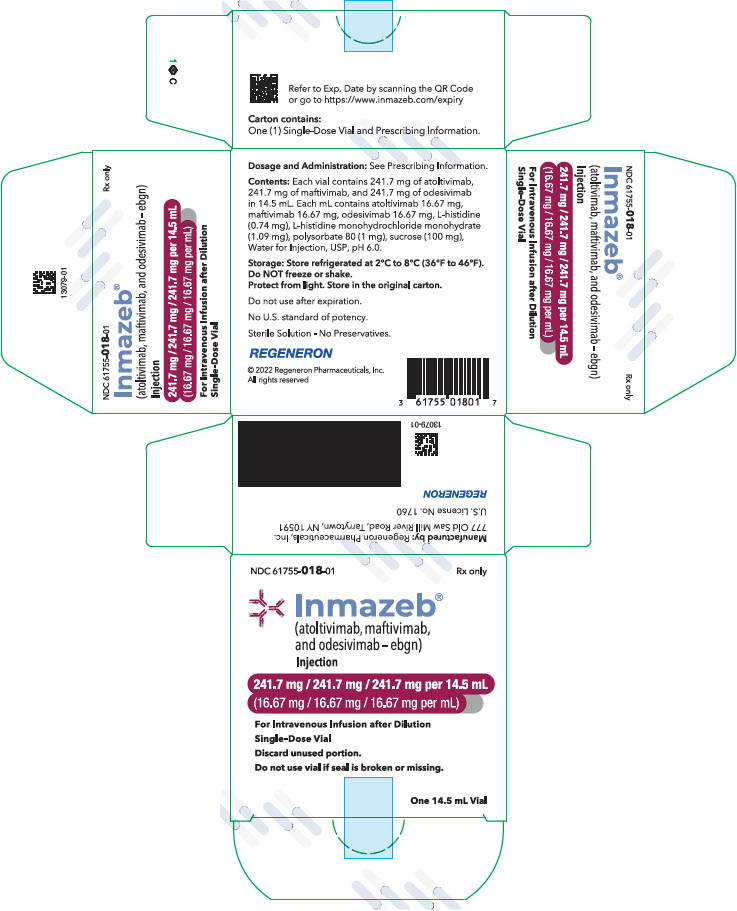
Inmazeb atoltivimab, maftivimab, and odesivimab-ebgn 241.7 mg/14.5mL; 241.7 mg/14.5mL; 241.7 mg/14.5mL Injection, Solution, 1 vial — NDC 61755-018-01 (Billing 61755-0018-01)
This is a package of 1 vial of Inmazeb atoltivimab, maftivimab, and odesivimab-ebgn 241.7 mg/14.5mL; 241.7 mg/14.5mL; 241.7 mg/14.5mL Injection, Solution from Regeneron Pharmaceuticals, Inc., marketed since Oct 2020 and currently FDA-listed. It is this product's only package size.
NDC database record
One package, one record: these facts belong to NDC 61755-018-01 alone.
- Record
- FDA NDC Directory package listing · Human prescription drug
- Code segments
- 61755 labeler · 018 product · 01 package
- Package marketed since
- Oct 14, 2020
- Sample package
- No — commercial package
- Listing certified through
- Dec 31, 2026
- Barcode (UPC-A, from the NDC)
- 3 6175501801 7
- FDA record last changed
- Oct 8, 2026
Identity & classification
Regulatory identifiers FDA, NLM and CMS codes for this package
Drug-database identifiers Medi-Span GPI and First Databank GCN / HICL / AHFS classification
- GSN (GCN sequence number): 081624
- GCN: 48803
- HICL (First Databank): 046926
- AHFS class code: 08:18.24.00
- RxCUI (RxNorm): 2461536
Where does this data come from?
- FDA openFDA NDC Directory · synced Oct 8, 2026
- FDA label on DailyMed · label index refreshed Oct 8, 2026
- RxNorm (NLM RxNav) · catalog refreshed Oct 1, 2026
- Medi-Span GPI (licensed)
- First Databank (licensed) · refreshed Oct 8, 2026
Clinical
Patient education
Supplement & herbal interactions
Where does this data come from?
- MedlinePlus (NLM) · refreshed Oct 8, 2026
- FDA label on DailyMed · label index refreshed Oct 8, 2026
Ask a licensed pharmacist directly — free, answered by our team.
Pricing
A drug doesn't have one price. Each row is a different public payment system, and none is what you'd pay at the counter — that depends on your insurance. The ⓘ on each row explains what it measures.
| Price system | Per mL | Per package |
|---|---|---|
| Retail pharmacies payNADAC · weekly | Not in the retail survey — common for institutional, discontinued, or low-volume packs. | |
| Medicaid paysCMS SDUD · 12 mo | No recent Medicaid claims on file for this NDC — rare and low-volume NDCs are suppressed in the public data. | |
| Medicare drug plans payPart D · quarterly | No Part D plan price is available for this NDC in our data. | |
Where does this data come from?
- CMS NADAC weekly file
- CMS ASP pricing files · refreshed Sep 20, 2026
- CMS Medicaid State Drug Utilization Data · refreshed Oct 8, 2026
- CMS Part D plan pricing files · refreshed Sep 24, 2026
- VA National Acquisition Center price file
Packaging — all sizes for this product
| Package NDC | Description | Marketing start | Marketing end | Status |
|---|---|---|---|---|
| 61755-0018-01 You're viewing this Main listing | 1 VIAL, SINGLE-DOSE in 1 CARTON / 14.5 mL in 1 VIAL, SINGLE-DOSE | 2020-10-14 | — | Active |
Therapeutic equivalents
| Product | Labeler | Pack | NADAC/unit | TE | Status | Price vs. this |
|---|---|---|---|---|---|---|
| Inmazeb 241.7 mg/14.5mL; 241.7 mg/14.5mL; 241.7 mg/14.5mLthis 61755-0018-01 | Regeneron | 1 vial | — | — | FDA listed | — |
Where does this data come from?
- FDA openFDA NDC Directory · synced Oct 8, 2026
- FDA Purple Book · refreshed Oct 5, 2026
- CMS NADAC weekly file
Availability & biosimilar status
Biologics have no small-molecule generics; biosimilar competition is tracked in the FDA Purple Book.
Why the date isn’t exact: Biosimilar timing can change because patents may be challenged, settled, licensed, added or removed, and litigation can move the real date earlier or later.
🛈 What do these terms mean?
- Biologic patent
- A patent the reference product’s maker has publicly listed. A biosimilar generally can’t launch until these expire — unless they’re invalidated or resolved in a settlement.
- Reference-product exclusivity
- A flat 12 years of FDA market protection from the biologic’s first licensure (the BPCIA). No biosimilar can be licensed before it ends, regardless of patents.
- Interchangeable exclusivity
- The first interchangeable biosimilar can earn a period as the only interchangeable version (pharmacists can substitute it without the prescriber).
- Earliest biosimilar (LOE)
- The latest of all the dates above — the soonest a biosimilar can realistically reach the market. Litigation and settlements can move it earlier.
Biologics have no small-molecule “generics” — competition comes from FDA-licensed biosimilars, tracked in the FDA Purple Book.
| Code | What it grants | Expires |
|---|---|---|
| RefProduct | Reference-product exclusivity (12-year, BPCIA) — no biosimilar can be licensed before this date | Oct 14, 2032 |
Is there a biosimilar for INMAZEB 241.7 MG VL(STOCKPILE)?
Why do different websites show different biosimilar dates?
Can a biosimilar launch before the last patent expires?
What does “current Purple Book estimate” mean?
What does “FDA listed” mean?
What does a patent or protection date mean here?
Where does this data come from?
- FDA Purple Book · refreshed Oct 5, 2026
Inactive Ingredients / Excipients
Inactive ingredients, also called excipients, are components of the drug product other than the active ingredient. They may include fillers, dyes, coatings, preservatives, flavors, or other formulation ingredients.
💡 Tap an ingredient (hover on desktop) to see what it is and why it’s used.
-
UNII 4QD397987E
An amino acid used as a buffer and stabilizer in medications. It helps maintain the pH balance and protects the active drug from breaking down during storage and use.
-
UNII X573657P6P
Histidine monohydrochloride monohydrate is an amino acid salt used as a buffer in medicines. It helps maintain the proper acidity level of liquid formulations to keep the drug stable and effective.
-
UNII 6OZP39ZG8H
Polysorbate 80 is a synthetic emulsifier derived from sorbitol and oleic acid. It helps mix oil and water-based ingredients together in medications and improves how the product disperses in the body.
-
UNII C151H8M554
A natural sugar derived from sugar cane or sugar beets. It's used as a sweetener, filler, and binder to improve taste, add bulk, and help hold tablet or capsule ingredients together.
-
UNII 059QF0KO0R
Water is a liquid solvent that dissolves and mixes ingredients together in liquid medicines, syrups, and injections. It helps distribute the active drug evenly throughout the product.
5 inactive ingredients listed in the exact product block matched to this NDC.
Where does this data come from?
ingredient classCode="IACT" elements from the exact product block matched by this NDC. Label-section narrative from DailyMed / the openFDA label index is shown separately when available.- FDA label on DailyMed · label index refreshed Oct 8, 2026
- FDA openFDA NDC Directory · synced Oct 8, 2026
Inactive ingredient FAQ
Are inactive ingredients the same for every manufacturer?
Why might an inactive ingredient be missing?
Can inactive ingredients matter?
Manufacturer & labeler
More NDCs from Regeneron Pharmaceuticals, Inc. labeler code 61755
- EYLEA aflibercept 40 mg/mL Injection, Solution NDC 61755-005-01
- LIBTAYO cemiplimab-rwlc 50 mg/mL Injection NDC 61755-008-01
- Evkeeza evinacumab 150 mg/mL Injection, Solution, Concentrate NDC 61755-010-01
- Pasatru garetosmab-grts 300 mg/5mL Injection, Solution, Concentrate NDC 61755-012-01
- Evkeeza evinacumab 150 mg/mL Injection, Solution, Concentrate NDC 61755-013-01
- VEOPOZ Pozelimab 200 mg/mL Injection, Solution NDC 61755-014-01
- Inmazeb atoltivimab, maftivimab, and odesivimab-ebgn 483.3 mg/14.5mL; 483.3 mg/14.5mL; 483.3 mg/14.5mL Injection, Solution NDC 61755-019-01
- Praluent alirocumab 75 mg/mL Injection, Solution NDC 61755-020-01
- Praluent alirocumab 150 mg/mL Injection, Solution NDC 61755-021-01
- EYLEA HD aflibercept 8 mg/.07mL Injection, Solution NDC 61755-050-01
- EYLEA HD aflibercept 8 mg/.07mL Injection, Solution NDC 61755-051-01
- LYNOZYFIC linvoseltamab-gcpt 5 mg/2.5mL Injection, Solution, Concentrate NDC 61755-054-01
Where does this data come from?
- FDA openFDA NDC Directory · synced Oct 8, 2026
- Drugs@FDA
Full prescribing information FDA SPL
🎯 Indications and Usage ▾
1 INDICATIONS AND USAGE INMAZEB is indicated for the treatment of infection caused by Orthoebolavirus zairense in adult and pediatric patients, including neonates born to a mother who is RT-PCR positive for Orthoebolavirus zairense infection [see Dosage and Administration (2.2) , and Clinical Studies (14) ] . INMAZEB is a combination of Orthoebolavirus zairense glycoprotein-directed human monoclonal antibodies (atoltivimab, maftivimab, and odesivimab), indicated for the treatment of infection caused by Orthoebolavirus zairense in adult and pediatric patients, including neonates born to a mother who is RT-PCR positive for Orthoebolavirus zairense infection.
( 1 ) Limitation of Use The efficacy of INMAZEB has not been established for other species of the Orthoebolavirus and Orthomarburgvirus genera . Orthoebolavirus zairense can change over time, and factors such as emergence of resistance, or changes in viral virulence could diminish the clinical benefit of antiviral drugs. Consider available information on drug susceptibility patterns for circulating Orthoebolavirus zairense strains when deciding whether to use INMAZEB.
Limitations of Use The efficacy of INMAZEB has not been established for other species of the Orthoebolavirus and Orthomarburgvirus genera. Orthoebolavirus zairense can change over time, and factors such as emergence of resistance, or changes in viral virulence could diminish the clinical benefit of antiviral drugs. Consider available information on drug susceptibility patterns for circulating Orthoebolavirus zairense strains when deciding whether to use INMAZEB.
⏱️ Dosage and Administration ▾
2 DOSAGE AND ADMINISTRATION The recommended dosage of INMAZEB is 50 mg of atoltivimab, 50 mg of maftivimab, and 50 mg of odesivimab per kg diluted and administered as a single intravenous infusion. ( 2.1 ) Refer to the Full Prescribing Information for information on preparation and administration. ( 2.2 )
2.1Recommended Dosage INMAZEB is a combination of three human monoclonal antibodies co-formulated in a 1:1:1 ratio of atoltivimab, maftivimab, and odesivimab. INMAZEB is available as two different strength presentations, containing either 16.67 mg of each antibody per mL or 33.33 mg of each antibody per mL [see Dosage Forms and Strengths (3) ] . The recommended dosage of INMAZEB is 50 mg of atoltivimab, 50 mg of maftivimab, and 50 mg of odesivimab per kg diluted and administered as a single intravenous infusion as shown in Table 1 [see Dosage and Administration (2.2) ] .
2.2Preparation and Administration INMAZEB must be prepared and administered under the supervision of a healthcare provider. Parenteral drug products should be inspected visually for particulate matter and discoloration prior to administration, whenever solution and container permit. INMAZEB should be clear to slightly opalescent, colorless to pale yellow solution that is free from visible particulates.
Discard the vial if the solution is cloudy, discolored or contains particulate matter. Preparation for Intravenous Infusion The recommended dosage is based on 50 mg of atoltivimab, 50 mg of maftivimab, and 50 mg of odesivimab per kg. For example, a patient weighing 50 kg the recommended dosage is 2,500 mg of atoltivimab, 2,500 mg of maftivimab, and 2,500 mg of odesivimab.
Determine the number of vials needed based on the calculated dose in volume (mL). – The number of vials needed depends on the INMAZEB strength used. Refer to Table 1 for the corresponding volume per kg needed to withdraw from each available strength presentation to prepare dose. – Multiple INMAZEB vials may be needed. Each vial contains 14.5 mL of INMAZEB solution, regardless of the strength presentation.
For example, for a 50 kg patient, the volume of INMAZEB needed is 150 mL (11 vials) if using the 16.67 mg/16.67 mg/16.67 mg per mL solution or 75 mL (6 vials) if using the 33.33 mg/33.33 mg/33.33 mg per mL solution. Table 1: INMAZEB Dosage (Volume per kg) for Intravenous Infusion Preparation When Using the When Using the 241.7 mg of atoltivimab, 241.7 mg of maftivimab, and 241.7 mg of odesivimab per 14.5 mL 483.3 mg of atoltivimab, 483.3 mg of maftivimab, and 483.3 mg of odesivimab per 14.5 mL (16.67 mg /16.67 mg /16.67 mg per mL) Solution (33.33 mg/33.33 mg /33.33 mg per mL) Solution Withdraw 3 mL of solution per kg to prepare the dose Withdraw 1.5 mL of solution per kg to prepare the dose Do not shake the vial.
Prior to intravenous infusion, INMAZEB must be further diluted in an intravenous PVC infusion bag containing either 0.9% Sodium Chloride Injection, USP, 5% Dextrose Injection, USP, or Lactated Ringer's Injection, USP. For neonates, the INMAZEB solution should be diluted in 5% Dextrose Injection, USP (see Table 2 ). The total volume of the infusion solution to be administered is based on the patient's body weight and is specified in Table 2 .
Select a diluent solution infusion bag of appropriate fill volume based on the patient's body weight (see Table 2 ). Withdraw and discard from the bag a volume of diluent solution equal to the calculated dose in volume (mL) of INMAZEB. Then add the calculated volume of INMAZEB to the bag.
For example: – When using the 16.67 mg/16.67 mg/16.67 mg per mL solution for a 50 kg patient, withdraw and discard 150 mL of diluent from a 500 mL infusion bag. Then add 150 mL of INMAZEB to obtain a total infusion volume of 500 mL. – When using the 33.33 mg/33.33 mg/33.33 mg per mL solution for a 50 kg patient, withdraw and discard 75 mL of diluent from a 500 mL infusion bag. Then add 75 mL of INMAZEB to obtain a total infusion volume of 500 mL.
Table 2: INMA… [Excerpted — this section continues on DailyMed.]
💊 Dosage Forms and Strengths ▾
3 DOSAGE FORMS AND STRENGTHS INMAZEB is a clear to slightly opalescent and colorless to pale yellow solution available as: Injection: 241.7 mg of atoltivimab, 241.7 mg of maftivimab, and 241.7 mg of odesivimab per 14.5 mL (16.67 mg/16.67 mg/16.67 mg per mL) in a single-dose vial. Injection: 483.3 mg of atoltivimab, 483.3 mg of maftivimab, and 483.3 mg of odesivimab per 14.5 mL (33.33 mg/33.33 mg/33.33 mg per mL) in a single-dose vial. Injection: 241.7 mg of atoltivimab, 241.7 mg of maftivimab, and 241.7 mg of odesivimab per 14.5 mL (16.67 mg/16.67 mg/16.67 mg per mL) in a single-dose vial.
( 3 ) 483.3 mg of atoltivimab, 483.3 mg of maftivimab, and 483.3 mg of odesivimab per 14.5 mL (33.33 mg/33.33 mg/33.33 mg per mL) in a single-dose vial. ( 3 )
⛔ Contraindications ▾
4 CONTRAINDICATIONS None. None. ( 4 )
⚠️ Warnings and Cautions ▾
5 WARNINGS AND PRECAUTIONS Hypersensitivity Reactions Including Infusion-Associated Events: Hypersensitivity reactions including infusion-associated events have been reported during and post-infusion with INMAZEB. These may include acute, life-threatening reactions during and after the infusion. Monitor patients and in the case of severe or life-threatening hypersensitivity reactions, discontinue the administration of INMAZEB immediately and administer appropriate emergency care.
( 5.1 )
5.1Hypersensitivity Reactions Including Infusion-Associated Events Hypersensitivity reactions including infusion-associated events have been reported during and post-infusion with INMAZEB. These may include acute, life-threatening reactions during and after the infusion. Monitor all patients for signs and symptoms including, but not limited to, hypotension, chills and elevation of fever, during and following INMAZEB infusion.
In the case of severe or life-threatening hypersensitivity reactions, discontinue the administration of INMAZEB immediately and administer appropriate emergency care [see Adverse Reactions (6.1) ] . Infusion could not be completed in 1% of subjects who received INMAZEB due to infusion-associated adverse events. The rate of infusion of INMAZEB may be slowed or interrupted if the patient develops any signs of infusion-associated events or other adverse events [see Adverse Reactions (6.1) ] .
🤒 Adverse Reactions ▾
6 ADVERSE REACTIONS The following clinically significant adverse reactions are described elsewhere in the labeling: Hypersensitivity Reactions Including Infusion-Associated Events [see Warnings and Precautions (5.1) ] The most common adverse events (incidence ≥20%) were pyrexia, chills, tachycardia, tachypnea, and vomiting. ( 6.1 ) To report SUSPECTED ADVERSE REACTIONS, contact Regeneron at 1-844-734-6643 or www.regeneron.com/contact or FDA AT 1-800-FDA-1088 or www.fda.gov/medwatch.
6.1Clinical Trials Experience Because clinical trials are conducted under widely varying conditions, adverse reaction rates may not reflect the rates observed in practice. Overall, 382 adult and pediatric subjects with Orthoebolavirus zairense infection received INMAZEB in one clinical trial (the PALM trial) and as part of an expanded access program conducted in the Democratic Republic of Congo during a Orthoebolavirus zairense outbreak in 2018-2019. In the PALM trial, the safety of INMAZEB was evaluated in a multi-center, open-label, randomized controlled trial, in which 154 subjects (115 adult subjects and 39 pediatric subjects) received INMAZEB [50 mg of atoltivimab, 50 mg of maftivimab, and 50 mg of odesivimab per kg (3 mL/kg)] intravenously as a single infusion and 168 subjects received an investigational control [see Clinical Studies (14) ] .
All subjects received optimized standard of care treatment. During the same outbreak, INMAZEB [50 mg of atoltivimab, 50 mg of maftivimab, and 50 mg of odesivimab per kg (3 mL/kg)] was given to 228 subjects (190 adult subjects and 38 pediatric subjects) in the expanded access program. The safety data described below is derived from the PALM trial.
Table 4 summarizes adverse events that were reported during INMAZEB infusion. The evaluation of adverse events in subjects who received INMAZEB may have been confounded by the signs and symptoms of the underlying Orthoebolavirus zairense infection. The most common adverse events reported in at least 20% of subjects who received INMAZEB were pyrexia (or elevation in fever), chills, tachycardia, tachypnea, and vomiting.
The adverse event profile in adult and pediatric subjects treated with INMAZEB was similar. Table 4: Adverse Events That Occurred during INMAZEB Infusion in ≥10% of Adult and Pediatric Subjects in the PALM Trial Adverse Event Adverse events in this table were reported as preferred terms from a list of pre-defined or other adverse events that occurred on the day of infusion, and included signs and symptoms that occurred during or immediately after infusion INMAZEB (N=154) % Control Investigational therapy administered as three separate infusions (N=168) % Pyrexia (Elevation in fever) 54 58 Chills 39 33 Tachycardia 20 32 Tachypnea 19 28 Vomiting Adverse events that were not pre-specified 19 23 Hypotension 15 31 Diarrhea 11 18 Hypoxia 10 11 The following pre-specified symptoms, which were assessed on a daily basis while admitted to the treatment unit, were reported in 40% or more of subjects who received INMAZEB: diarrhea, pyrexia, and vomiting.
Evaluation of these symptoms may have been confounded by the underlying Orthoebolavirus zairense infection. Discontinuation and Infusion Rate Adjustments in the PALM Trial Approximately 99% of subjects who received INMAZEB in the PALM trial were able to complete their dose within three hours. Two subjects who received INMAZEB (1%) did not receive their complete infusion.
One of the two subjects did not complete their INMAZEB infusion because of fever elevation [see Warnings and Precautions (5.1) ] . Selected Laboratory Abnormalities in the PALM Trial Table 5 presents selected laboratory abnormalities (worsening to Grade 3 or 4 compared to baseline) for adult and pediatric subjects in the PALM trial. Table 5: Selected Grade 3 and 4 Laboratory Abnormalities, Worsened Grade from Baseline for Adult and Pediatric Subjects in the PALM Trial Laboratory Test Graded per Division of AIDS (DAIDS) v2.1 INMAZEB N=154 % Co… [Excerpted — this section continues on DailyMed.]
🔄 Drug Interactions ▾
7 DRUG INTERACTIONS Interaction with live vaccine indicated for prevention of Orthoebolavirus zairense infection: No vaccine interaction studies have been performed. INMAZEB may reduce the efficacy of the live vaccine. The interval between live vaccination following initiation of INMAZEB therapy should be in accordance with current vaccination guidelines. ( 7.1 )
7.1Vaccine Interactions No vaccine-therapeutic interaction studies have been performed in human subjects using INMAZEB. However, because of the potential for INMAZEB to inhibit replication of a live vaccine virus indicated for prevention of Orthoebolavirus zairense infection and possibly reduce the efficacy of the vaccine, avoid the concurrent administration of a live vaccine during treatment with INMAZEB. The interval between live vaccination following initiation of INMAZEB therapy should be in accordance with current vaccination guidelines.
The efficacy of INMAZEB among subjects who reported receipt of a recombinant live vaccine prior to their enrollment in the PALM clinical trial was similar to subjects who did not receive a vaccine.
👥 Use in Specific Populations ▾
8 USE IN SPECIFIC POPULATIONS Lactation: Patients infected with Orthoebolavirus zairense should be instructed not to breastfeed due to the potential for Orthoebolavirus zairense transmission. ( 8.2 )
8.1Pregnancy Risk Summary Orthoebolavirus zairense infection is life-threatening for both the mother and fetus and treatment should not be withheld due to pregnancy (see Clinical Considerations ). Available data from the PALM trial and an expanded access program in which pregnant women with Orthoebolavirus zairense infection were treated with INMAZEB demonstrate the high rate of maternal and fetal/neonatal morbidity consistent with published literature regarding the risk associated with underlying maternal Orthoebolavirus zairense infection.
These data are insufficient to evaluate for a drug-associated risk of major birth defects, miscarriage, or adverse maternal/fetal outcome. Animal reproduction studies with INMAZEB have not been conducted. Human monoclonal antibodies, such as INMAZEB, are transported across the placenta; therefore, INMAZEB has the potential to be transferred from the mother to the developing fetus.
Clinical Considerations Disease-associated maternal and/or embryo/fetal risk Maternal, fetal and neonatal outcomes are poor among pregnant women infected with Orthoebolavirus zairense . The majority of such pregnancies result in maternal death with miscarriage, stillbirth, or neonatal death. Treatment should not be withheld due to pregnancy.
8.2Lactation Risk Summary The Centers for Disease Control and Prevention recommend that patients with confirmed Orthoebolavirus zairense not breastfeed their infants to reduce the risk of postnatal transmission of Orthoebolavirus zairense infection. There are no data on the presence of atoltivimab, maftivimab, and odesivimab-ebgn in human or animal milk, the effects on the breastfed infant, or the effects on milk production. Maternal IgG is known to be present in human milk.
The effects of local gastrointestinal exposure and limited systemic exposure in the breastfed infant to atoltivimab, maftivimab, or odesivimab-ebgn are unknown.
8.4Pediatric Use The safety and effectiveness of INMAZEB for the treatment of infection caused by Orthoebolavirus zairense have been established in pediatric patients from birth to less than 18 years of age. Use of INMAZEB for this indication is supported by evidence from a multi-center, open label, randomized controlled trial of INMAZEB in adults and pediatric subjects that included 39 pediatric subjects birth to less than 18 years of age, including neonates born to a mother who is RT-PCR positive for Orthoebolavirus zairense infection.
The 28-day mortality and safety in adult and pediatric subjects treated with INMAZEB were similar [see Adverse Reactions (6.1) and Clinical Studies (14) ]. An additional 38 pediatric subjects from birth to less than 18 years of age received INMAZEB in an expanded access program.
8.5Geriatric Use Clinical studies of INMAZEB did not include sufficient numbers of subjects aged 65 and over to determine whether they respond differently from younger subjects. Of the 154 subjects with Orthoebolavirus zairense infection who received INMAZEB in the randomized controlled trial, 5 (3.2%) were 65 years or older. The limited clinical experience has not identified differences in responses between the elderly and younger subjects.
🤰 Pregnancy ▾
8.1Pregnancy Risk Summary Orthoebolavirus zairense infection is life-threatening for both the mother and fetus and treatment should not be withheld due to pregnancy (see Clinical Considerations ). Available data from the PALM trial and an expanded access program in which pregnant women with Orthoebolavirus zairense infection were treated with INMAZEB demonstrate the high rate of maternal and fetal/neonatal morbidity consistent with published literature regarding the risk associated with underlying maternal Orthoebolavirus zairense infection.
These data are insufficient to evaluate for a drug-associated risk of major birth defects, miscarriage, or adverse maternal/fetal outcome. Animal reproduction studies with INMAZEB have not been conducted. Human monoclonal antibodies, such as INMAZEB, are transported across the placenta; therefore, INMAZEB has the potential to be transferred from the mother to the developing fetus.
Clinical Considerations Disease-associated maternal and/or embryo/fetal risk Maternal, fetal and neonatal outcomes are poor among pregnant women infected with Orthoebolavirus zairense . The majority of such pregnancies result in maternal death with miscarriage, stillbirth, or neonatal death. Treatment should not be withheld due to pregnancy.
🧒 Pediatric Use ▾
8.4Pediatric Use The safety and effectiveness of INMAZEB for the treatment of infection caused by Orthoebolavirus zairense have been established in pediatric patients from birth to less than 18 years of age. Use of INMAZEB for this indication is supported by evidence from a multi-center, open label, randomized controlled trial of INMAZEB in adults and pediatric subjects that included 39 pediatric subjects birth to less than 18 years of age, including neonates born to a mother who is RT-PCR positive for Orthoebolavirus zairense infection.
The 28-day mortality and safety in adult and pediatric subjects treated with INMAZEB were similar [see Adverse Reactions (6.1) and Clinical Studies (14) ]. An additional 38 pediatric subjects from birth to less than 18 years of age received INMAZEB in an expanded access program.
🧓 Geriatric Use ▾
8.5Geriatric Use Clinical studies of INMAZEB did not include sufficient numbers of subjects aged 65 and over to determine whether they respond differently from younger subjects. Of the 154 subjects with Orthoebolavirus zairense infection who received INMAZEB in the randomized controlled trial, 5 (3.2%) were 65 years or older. The limited clinical experience has not identified differences in responses between the elderly and younger subjects.
🧬 Clinical Pharmacology ▾
12 CLINICAL PHARMACOLOGY
12.1Mechanism of Action INMAZEB is an antiviral drug combination of three recombinant human IgG1κ monoclonal antibodies (atoltivimab, maftivimab, and odesivimab) that inhibit Orthoebolavirus zairense [ see Microbiology (12.4) ].
12.2Pharmacodynamics Atoltivimab, maftivimab, and odesivimab exposure-response relationships and the time course of pharmacodynamic response are unknown.
12.3Pharmacokinetics No pharmacokinetic data are available in patients with Orthoebolavirus zairense infection. The pharmacokinetics of atoltivimab, maftivimab, and odesivimab in 18 healthy subjects 21 to 60 years of age are linear and dose-proportional over the range of 1 mg of atoltivimab, 1 mg of maftivimab, and 1 mg of odesivimab per kg to 50 mg of atoltivimab, 50 mg of maftivimab, and 50 mg of odesivimab per kg (0.02 to 1 times the approved recommended dosage) of INMAZEB following a single intravenous (IV) infusion.
Pharmacokinetic parameters for the individual antibodies of INMAZEB are provided in Table 6 . Table 6: Pharmacokinetic Parameters of INMAZEB Administered IV in Healthy Subjects Atoltivimab 50 mg/kg INMAZEB was administered at a total dose of 50 mg of atoltivimab, 50 mg of maftivimab, and 50 mg of odesivimab per kg in a 1:1:1 ratio. Maftivimab 50 mg/kg Odesivimab 50 mg/kg Systemic Exposure (n=6) Mean (SD) C max , mg/L 1,220 (101) 1,280 (68.0) 1,260 (81.2) Mean (SD) AUC inf , mg day/L 17,100 (4,480) 18,700 (4,100) 25,600 (5,040) Distribution Mean (SD) Volume of Distribution at Steady State, mL/kg 58.2 (2.66) 57.6 (3.89) 56.0 (3.16) Elimination Mean (SD) Elimination Half-Life (days) 21.2 (3.36) 22.3 (3.09) 25.3 (3.86) Mean (SD) Clearance (mL/day/kg) 3.08 (0.719) 2.78 (0.558) 2.02 (0.374) Specific Populations The effect of age (< 21 or > 60), renal impairment, or hepatic impairment on the pharmacokinetics of atoltivimab, maftivimab, and odesivimab is unknown.
12.4Microbiology Mechanism of Action INMAZEB is a combination of three recombinant human IgG1κ monoclonal antibodies each targeting the Orthoebolavirus zairense glycoprotein (EBOV GP). Orthoebolavirus zairense (EBOV) encodes a sole envelope protein, the glycoprotein, which mediates virus attachment and membrane fusion with the host cell membranes. In addition, GP is expressed on the surface of Orthoebolavirus zairense infected host cells making it a target for antibodies that can mediate killing of these cells by antibody dependent cellular cytotoxicity and/or other effector functions.
The 3 antibodies that make up the combination bind to 3 non-overlapping epitopes on GP and all 3 antibodies can bind the GP simultaneously. The mean K D values for atoltivimab, maftivimab, and odesivimab were 7.84 nM, 3.34 nM, and 8.26 nM, respectively, as determined by surface plasmon resonance. Maftivimab is a neutralizing antibody that blocks entry of the virus into susceptible cells.
Odesivimab is a non-neutralizing antibody that induces antibody-dependent effector function through FcyRIIIa signaling when bound to its target. Odesivimab also binds to the soluble form of Orthoebolavirus zairense glycoprotein (sGP). Atoltivimab combines both neutralization and FcyRIIIa signaling activities.
Antiviral Activity In a live virus infection assay on Vero cells, maftivimab neutralized Mayinga, Kikwit, and Makona strains of Orthoebolavirus zairense , with a concentration between 0.2 and 1.2 nM (0.03 and 0.18 μg/mL) providing 80% inhibition of viral infection in a plaque-reduction neutralization test (PRNT-80). Atoltivimab and odesivimab did not demonstrate any neutralizing activity in this assay. Effector function activity of INMAZEB individual antibodies was assessed with an EBOV Makona-GP expressing cell line and Jurkat/NFAT-Luc/FcγRIIIa reporter effector cells.
The EC 50 values of atoltivimab and odesivimab were 2.9 nM and 1.6 nM, respectively, whereas maftivimab did not exhibit any FcγRIIIa signaling activity at the maximum concentration tested, 40 nM. Treatment of Orthoebola… [Excerpted — this section continues on DailyMed.]
🧬 Mechanism of Action ▾
12.1Mechanism of Action INMAZEB is an antiviral drug combination of three recombinant human IgG1κ monoclonal antibodies (atoltivimab, maftivimab, and odesivimab) that inhibit Orthoebolavirus zairense [ see Microbiology (12.4) ].
📦 How Supplied / Storage and Handling ▾
16 HOW SUPPLIED/STORAGE AND HANDLING INMAZEB (atoltivimab, maftivimab, and odesivimab-ebgn) injection is a clear to slightly opalescent and colorless to pale yellow solution. It is supplied in a carton containing one single dose vial of: 241.7 mg of atoltivimab, 241.7 mg of maftivimab, and 241.7 mg of odesivimab per 14.5 mL (16.67 mg/16.67 mg/16.67 mg per mL) (NDC 61755-018-01) 483.3 mg of atoltivimab, 483.3 mg of maftivimab, and 483.3 mg of odesivimab per 14.5 mL (33.33 mg/33.33 mg/33.33 mg per mL) (NDC 61755-019-01) Prior to dilution Store INMAZEB vial refrigerated at 2°C to 8°C (36°F to 46°F) in the original carton to protect from light.
Do not freeze or shake. After dilution INMAZEB does not contain preservatives. It is always recommended to administer intravenous medication immediately after preparation when possible.
Store the diluted INMAZEB solution as specified according to Table 12 below. Do not freeze the diluted solution [see Dosage and Administration (2.2) ]. Table 12: Diluted INMAZEB Solution Storage Conditions Diluent Used to Prepare Solution for Infusion Diluted INMAZEB Solution Storage Conditions 0.9% Sodium Chloride Injection, USP Store at room temperature up to 25°C (77°F) for no more than 8 hours or refrigerated at 2°C to 8°C (36°F to 46°F) for no more than 24 hours.
5% Dextrose Injection, USP Store at room temperature up to 25°C (77°F) for no more than 4 hours or refrigerated at 2°C to 8°C (36°F to 46°F) for no more than 24 hours. Lactated Ringer's Injection, USP Store at room temperature up to 25°C (77°F) for no more than 4 hours or refrigerated at 2°C to 8°C (36°F to 46°F) for no more than 4 hours.
📦 Storage and Handling ▾
Prior to dilution Store INMAZEB vial refrigerated at 2°C to 8°C (36°F to 46°F) in the original carton to protect from light. Do not freeze or shake.
After dilution INMAZEB does not contain preservatives. It is always recommended to administer intravenous medication immediately after preparation when possible. Store the diluted INMAZEB solution as specified according to Table 12 below.
Do not freeze the diluted solution [see Dosage and Administration (2.2) ]. Table 12: Diluted INMAZEB Solution Storage Conditions Diluent Used to Prepare Solution for Infusion Diluted INMAZEB Solution Storage Conditions 0.9% Sodium Chloride Injection, USP Store at room temperature up to 25°C (77°F) for no more than 8 hours or refrigerated at 2°C to 8°C (36°F to 46°F) for no more than 24 hours. 5% Dextrose Injection, USP Store at room temperature up to 25°C (77°F) for no more than 4 hours or refrigerated at 2°C to 8°C (36°F to 46°F) for no more than 24 hours.
Lactated Ringer's Injection, USP Store at room temperature up to 25°C (77°F) for no more than 4 hours or refrigerated at 2°C to 8°C (36°F to 46°F) for no more than 4 hours.
📋 Description ▾
11 DESCRIPTION Atoltivimab, maftivimab, and odesivimab-ebgn is a combination of Orthoebolavirus zairense glycoprotein (GP) directed recombinant human IgG1 human monoclonal antibodies of similar structure. The human monoclonal antibodies, atoltivimab, maftivimab, and odesivimab are produced by recombinant DNA technology in Chinese hamster ovary (CHO) cell suspension culture and have an approximate molecular weight of 145 kDa, 146 kDa and 144 kDa, respectively. INMAZEB (atoltivimab, maftivimab, and odesivimab-ebgn) injection for intravenous use is a sterile, preservative-free, clear to slightly opalescent, colorless to pale yellow solution, that is free from visible particulates.
INMAZEB injection is supplied as two strength presentations: 16.67 mg/16.67 mg/16.67 mg per mL: Each vial contains 241.7 mg of atoltivimab, 241.7 mg of maftivimab, and 241.7 mg of odesivimab in 14.5 mL. Each mL contains 16.67 mg of atoltivimab, 16.67 mg of maftivimab, 16.67 mg of odesivimab, and L-histidine (0.74 mg), L-histidine monohydrochloride monohydrate (1.09 mg), polysorbate 80 (1 mg), sucrose (100 mg), and Water for Injection, USP with a pH of 6.0. 33.33 mg/33.33 mg/33.33 mg per mL: Each vial contains 483.3 mg of atoltivimab, 483.3 mg of maftivimab, and 483.3 mg of odesivimab in 14.5 mL.
Each mL contains 33.33 mg of atoltivimab, 33.33 mg of maftivimab, 33.33 mg of odesivimab, and L-histidine (0.74 mg), L-histidine monohydrochloride monohydrate (1.09 mg), polysorbate 80 (1 mg), sucrose (100 mg), and Water for Injection, USP with a pH of 6.0.
💬 Information for Patients ▾
17 PATIENT COUNSELING INFORMATION Hypersensitivity Reactions Including Infusion-Associated Events Inform patients that hypersensitivity reactions including infusion-associated events have been reported during and post-infusion with INMAZEB and to immediately report if they experience any symptoms of systemic hypersensitivity reactions [ see Warnings and Precautions (5.1) ]. Lactation Instruct patients with Orthoebolavirus zairense infection not to breastfeed because of the risk of passing Orthoebolavirus zairense to the baby [see Use in Specific Populations (8.2) ].
🧬 Pharmacokinetics ▾
12.3Pharmacokinetics No pharmacokinetic data are available in patients with Orthoebolavirus zairense infection. The pharmacokinetics of atoltivimab, maftivimab, and odesivimab in 18 healthy subjects 21 to 60 years of age are linear and dose-proportional over the range of 1 mg of atoltivimab, 1 mg of maftivimab, and 1 mg of odesivimab per kg to 50 mg of atoltivimab, 50 mg of maftivimab, and 50 mg of odesivimab per kg (0.02 to 1 times the approved recommended dosage) of INMAZEB following a single intravenous (IV) infusion.
Pharmacokinetic parameters for the individual antibodies of INMAZEB are provided in Table 6 . Table 6: Pharmacokinetic Parameters of INMAZEB Administered IV in Healthy Subjects Atoltivimab 50 mg/kg INMAZEB was administered at a total dose of 50 mg of atoltivimab, 50 mg of maftivimab, and 50 mg of odesivimab per kg in a 1:1:1 ratio. Maftivimab 50 mg/kg Odesivimab 50 mg/kg Systemic Exposure (n=6) Mean (SD) C max , mg/L 1,220 (101) 1,280 (68.0) 1,260 (81.2) Mean (SD) AUC inf , mg day/L 17,100 (4,480) 18,700 (4,100) 25,600 (5,040) Distribution Mean (SD) Volume of Distribution at Steady State, mL/kg 58.2 (2.66) 57.6 (3.89) 56.0 (3.16) Elimination Mean (SD) Elimination Half-Life (days) 21.2 (3.36) 22.3 (3.09) 25.3 (3.86) Mean (SD) Clearance (mL/day/kg) 3.08 (0.719) 2.78 (0.558) 2.02 (0.374) Specific Populations The effect of age (< 21 or > 60), renal impairment, or hepatic impairment on the pharmacokinetics of atoltivimab, maftivimab, and odesivimab is unknown.
🧬 Pharmacodynamics ▾
12.2Pharmacodynamics Atoltivimab, maftivimab, and odesivimab exposure-response relationships and the time course of pharmacodynamic response are unknown.
🔬 Clinical Studies ▾
14 CLINICAL STUDIES The efficacy of INMAZEB was evaluated in PALM, a multi-center, open-label, randomized controlled trial sponsored by the National Institute of Allergy and Infectious Diseases (NIAID; NCT03719586). The trial was conducted in the Democratic Republic of Congo, where an outbreak began in August 2018, and enrolled 681 subjects of all ages, including pregnant women, with documented Orthoebolavirus zairense infection and symptoms of any duration who were receiving optimized standard of care (oSOC). Subjects were randomized to receive INMAZEB (50 mg of atoltivimab, 50 mg of maftivimab, and 50 mg of odesivimab per kg) intravenously as a single infusion, an investigational control 50 mg/kg intravenously every third day, for a total of 3 doses, or other investigational drugs.
Eligible subjects had a positive reverse transcriptase-polymerase chain reaction (RT-PCR) for the nucleoprotein (NP) gene of Orthoebolavirus zairense and had not received other investigational treatments (with the exception of experimental vaccines) within the previous 30 days. Neonates ≤7 days of age were eligible if the mother had documented infection. Neonates born to a mother who had cleared Orthoebolavirus zairense following a course of her assigned investigational medication were also eligible to be enrolled at investigator discretion regarding the likelihood that the neonate was infected.
Randomization was stratified by reverse transcription-PCR cycle threshold calculated using NP targets (CtNP ≤22.0 vs >22.0; corresponding to high and low viral load, respectively) and Ebola Treatment Unit (ETU) site. All subjects received oSOC consisting of a minimum of intravenous fluids, daily clinical laboratory testing, correction of hypoglycemia and electrolyte imbalances, and broad-spectrum antibiotics and antimalarials, as indicated. The primary efficacy endpoint was 28-day mortality.
The primary analysis population includes all subjects who were randomized and concurrently eligible to receive either INMAZEB or the investigational control during the same time period of the trial. The demographics and baseline characteristics are provided in Table 10 below. Table 10: Demographics and Baseline Characteristics in PALM Trial Parameter INMAZEB (N=154) Control (N=153) CtNP = cycle threshold calculated using NP targets; IQR = interquartile range; AST=Aspartate aminotransferase; ALT=Alanine aminotransferase; ETU=Ebola treatment unit Mean age (years) 28 31 Age <1 month (%) 1 (1%) 2 (1%) Age 1 month to <1 year (%) 4 (3%) 1 (1%) Age 1 year to < 6 years (%) 18 (12%) 13 (8%) Age 6 years to <12 years (%) 8 (5%) 4 (3%) Age 12 years to <18 years (%) 8 (5%) 8 (5%) Age 18 years to <50 years (%) 93 (60%) 105 (69%) Age 50 years to <65 years (%) 17 (11%) 18 (12%) Age ≥65 years (%) 5 (3%) 2 (1%) Female (%) 90 (58%) 80 (52%) Positive result on pregnancy test Pregnancy positive test was calculated based on subjects who had pregnancy test result. , n (%) 2/67 (3%) 4/61 (7%) RT-PCR CtNP cycle threshold ≤22, n 66 64 Median RT-PCR CtNP (IQR) 22.7 (20.1, 28.1) 22.9 (18.8, 26.4) Median creatinine (IQR) 1.0 (0.7, 4.0) 1.1 (0.7, 3.2) Median AST (IQR) 225.5 (98.0, 941.0) 351.0 (109, 1404.0) Median ALT (IQR) 165.0 (56.0, 418.0) 223.5 (47.0, 564.0) Median days from onset of symptoms to randomization (IQR) 5.0 (3.0, 7.0) 5.0 (3.0, 7.0) Reported Vaccination with rVSV-ZEBOV vaccine , n (%) 34 (22%) 41 (27%) <10 days before ETU admission 20/34 (59%) 21/41 (51%) ≥10 days before ETU admission 14/34 (41%) 18/41 (44%) Timing unknown 0/34 (0%) 2/41 (5%) The PALM trial was stopped early on the basis of a pre-specified interim analysis showing a statistically significant reduction in mortality for INMAZEB compared to control.
Mortality efficacy results are shown in Table 11 . Table 11: Mortality Rates in PALM Trial Efficacy Endpoints INMAZEB Both INMAZEB and Control were administered with optimized standard of care (N=154) Control (N=153) Overall 28-day mortality, n (%) 52 (34%) 78 (51%) Mortal… [Excerpted — this section continues on DailyMed.]
🧪 Nonclinical Toxicology ▾
13 NONCLINICAL TOXICOLOGY
13.1Carcinogenesis, Mutagenesis, Impairment of Fertility Carcinogenicity, genotoxicity, and fertility studies have not been conducted with INMAZEB.
📄 Carcinogenesis, Mutagenesis, Impairment of Fertility ▾
13.1Carcinogenesis, Mutagenesis, Impairment of Fertility Carcinogenicity, genotoxicity, and fertility studies have not been conducted with INMAZEB.
📄 Package Label / Principal Display Panel ▾
PRINCIPAL DISPLAY PANEL - 14.5 mL Vial Carton - 61755-018 NDC 61755-018-01 Rx only Inmazeb ® (atoltivimab, maftivimab, and odesivimab – ebgn) Injection 241.7 mg / 241.7 mg / 241.7 mg per 14.5 mL (16.67 mg / 16.67 mg / 16.67 mg per mL) For Intravenous Infusion after Dilution Single-Dose Vial Discard unused portion. Do not use vial if seal is broken or missing. One 14.5 mL Vial PRINCIPAL DISPLAY PANEL - 14.5 mL Vial Carton - 61755-018
PRINCIPAL DISPLAY PANEL - 14.5 mL Vial Carton - 61755-019 NDC 61755-019-01 Rx only Inmazeb ® (atoltivimab, maftivimab, and odesivimab – ebgn) Injection 483.3 mg / 483.3 mg / 483.3 mg per 14.5 mL (33.33 mg / 33.33 mg / 33.33 mg per mL) For Intravenous Infusion after Dilution Single-Dose Vial Discard unused portion. Do not use vial if seal is broken or missing. One 14.5 mL Vial PRINCIPAL DISPLAY PANEL - 14.5 mL Vial Carton - 61755-019
About this NDC listing & data coverage
What data is (and isn’t) available for this NDC — tap to expand
| NDC identity (package / product / labeler codes) | ✓ Available |
| Labeler | ✓ Available |
| Product & package description | ✓ Available |
| Marketing category & status | ✓ Available |
| Active ingredient / dosage form / route | ✓ Available |
| FDA label (SPL via DailyMed) | ✓ Available |
| Package photos | ✓ Available |
| Inactive ingredients (structured) | ✓ Available |
| NADAC pharmacy acquisition price (CMS) | — Not published for this NDC CMS publishes NADAC only for NDCs reported in its retail-pharmacy survey. |
| Orange Book / therapeutic-equivalence data | ✓ Available |
| HCPCS J-code billing crosswalk | — Not published for this NDC Most self-administered / retail products have no J-code — that is normal. |
| Medicaid utilization (CMS SDUD) | — Not published for this NDC CMS reports utilization only for NDCs with Medicaid claims above its privacy threshold. |