
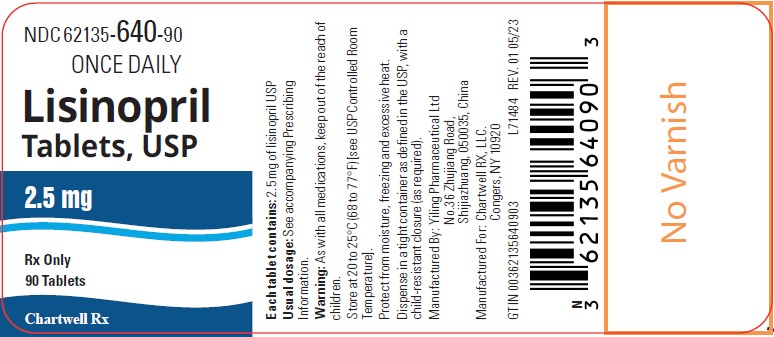
Lisinopril 5 mg Tablet, 300-count
🆔 Identity & classification
Where does this data come from?
🏷️ RxNorm drug class
This medicine belongs to the Angiotensin Converting Enzyme Inhibitor class.
Where does this data come from?
🏭 Manufacturer & labeler
Where does this data come from?
🩺 Clinical
Lisinopril is used alone or in combination with other medications to treat high blood pressure in adults and children 6 years of age and older. It is used in combination with other medications to treat heart failure. Lisinopril is also used to improve survival after a heart attack. Lisinopril is in a class of medications called angiotensin-converting enzyme (ACE) inhibitors. It works by decreasing certain chemicals that tighten the blood vessels, so blood flows more smoothly and the heart can pump blood more efficiently. High blood pressure is a common condition and when not treated, can cause...
Read the full MedlinePlus article ↗- Lisinopril is mainly prescribed to treat high blood pressure — it relaxes your blood vessels so your heart doesn't have to work as hard. It's also used to help manage heart failure...
- Good news — food doesn't affect how lisinopril works, so you can take it with or without a meal. What matters most is taking it at roughly the same time each day. Once a day is the...
- Can I take lisinopril with food, or does it have to be on an empty stomach?
- Yes, that cough is one of the most well-known side effects of ACE inhibitors like lisinopril. It happens because the medicine also affects a chemical in the lungs called bradykinin...
Patient education
Supplement & herbal interactions
Some supplements/herbs that may interact with Lisinopril — tap one for details:
Lisinopril may be associated with lower levels of 1 nutrient — worth a chat with your pharmacist, not a cause for alarm.
Where does this data come from?
Ask a licensed pharmacist directly — free, answered by our team.
💊 What it looks like
Where does this data come from?
🧪 Inactive Ingredients / Excipients
Inactive ingredients, also called excipients, are components of the drug product other than the active ingredient. They may include fillers, dyes, coatings, preservatives, flavors, or other formulation ingredients.
💡 Tap an ingredient (hover on desktop) to see what it is and why it’s used.
-
UNII O7TSZ97GEP
A mineral compound that serves as a filler and binding agent in tablets and capsules. It adds bulk to the medicine and helps hold ingredients together during manufacturing.
-
UNII EX438O2MRT
Ferric oxide yellow is a naturally occurring iron compound used as a colorant in medications. It gives tablets, capsules, and other forms a yellow or golden hue for identification and appearance.
-
UNII 70097M6I30
Magnesium stearate is a salt made from magnesium and stearic acid, a fatty substance. It's used in tablets and capsules as a lubricant and glidant to help ingredients flow smoothly during manufacturing and prevent sticking.
-
UNII 3OWL53L36A
A natural sugar alcohol derived from seaweed or synthesized in the lab. It's used as a filler to add bulk, a sweetener in sugar-free formulas, and a disintegrant to help tablets break apart in the stomach.
-
UNII O8232NY3SJ
A plant-based carbohydrate derived from corn kernels. It acts as a filler to add bulk, a binder to hold ingredients together, and a disintegrant to help the tablet break apart in your stomach for absorption.
5 inactive ingredients listed in the exact product block matched to this NDC.
Where does this data come from?
ingredient classCode="IACT" elements from the exact product block matched by this NDC. Label-section narrative from DailyMed / the openFDA label index is shown separately when available.Inactive ingredient FAQ
Are inactive ingredients the same for every manufacturer?
Why might an inactive ingredient be missing?
Can inactive ingredients matter?
💲 Pricing
A drug doesn't have one price. Each row is a different public payment system, and none is what you'd pay at the counter — that depends on your insurance. The ⓘ on each row explains what it measures.
| Price system | Per ea | Per package |
|---|---|---|
| Retail pharmacies payNADAC · weekly | $0.014 | $4.29 / 300 tablets |
| Medicaid paysCMS SDUD · 12 mo | $0.2390 | $71.70 / 300 tablets |
| Medicare drug plans payPart D · Q2 2026 | $0.1245 | $37.35 / 300 tablets |
Where does this data come from?
🔁 Therapeutic equivalents
| Product | Labeler | Pack | NADAC/unit | TE | Status | Price vs. this |
|---|---|---|---|---|---|---|
| Lisinopril 5 mg 00591-0406-01 | Actavis | 100 tablets | $0.014 | — | Availability likely | — |
| Lisinopril 5 mg 00904-6797-61 | Major | 100 tablets | $0.014 | AB | Availability likely | — |
| lisinopril 5 mg 23155-0877-01 | Heritage | 100 tablets | $0.014 | AB | Availability likely | — |
| Lisinopril 5 mg 31722-0176-01 | Camber | 100 tablets | $0.014 | AB | Availability likely | — |
| Lisinopril 5 mg 43547-0352-10 | Solco | 100 tablets | $0.014 | AB | Availability likely | — |
| Lisinopril 5 mg 60687-0667-01 | American | 100 tablets | $0.014 | AB | Availability likely | — |
| Lisinopril 5 mgthis 62135-0641-31 | Chartwell | 300 tablets | $0.014 | AB | Availability likely | — |
| Lisinopril 5 mg 68001-0333-00 | BluePoint | 100 tablets | $0.014 | AB | Availability likely | — |
| Lisinopril 5 mg 68180-0513-01 | Lupin | 100 tablets | $0.014 | AB | Availability likely | — |
| Lisinopril 5 mg 68645-0609-90 | Legacy | 90 tablets | $0.014 | AB | Availability likely | — |
| lisinopril 5 mg 76282-0418-01 | Exelan | 100 tablets | $0.014 | AB | Availability likely | — |
| Lisinopril 5 mg 76282-0729-01 | Exelan | 100 tablets | $0.014 | AB | Availability likely | — |
| Lisinopril 5 mg 82009-0063-10 | Quallent | 1000 tablets | $0.014 | AB | Availability likely | — |
| Lisinopril 5 mg 00615-8253-05 | NCS | 15 tablets | — | AB | FDA listed | — |
| Zestril 5 mg 24979-0239-07 | Upsher-Smith | 90 tablets | — | AB | FDA listed | — |
| Lisinopril 5 mg 43063-0074-30 | PD-Rx | 30 tablets | — | AB | FDA listed | — |
| Lisinopril 5 mg 43063-0811-01 | PD-Rx | 100 tablets | — | AB | FDA listed | — |
| lisinopril 5 mg 43353-0298-30 | Aphena | 30 tablets | — | AB | FDA listed | — |
| Lisinopril 5 mg 43547-0415-03 | Solco | 30 tablets | — | AB | FDA listed | — |
| Lisinopril 5 mg 50090-3765-00 | A-S | 30 tablets | — | AB | FDA listed | — |
| Lisinopril 5 mg 50090-6912-00 | A-S | 90 tablets | — | AB | FDA listed | — |
| Lisinopril 5 mg 51655-0232-26 | Northwind | 90 tablets | — | AB | FDA listed | — |
| Lisinopril 5 mg 51655-0486-26 | Northwind | 90 tablets | — | AB | FDA listed | — |
| Lisinopril 5 mg 55154-8096-00 | Cardinal | 10 tablets | — | AB | FDA listed | — |
| Lisinopril 5 mg 55289-0884-30 | PD-Rx | 30 tablets | — | AB | FDA listed | — |
| Lisinopril 5 mg 60760-0357-90 | St. | 90 tablets | — | — | FDA listed | — |
| Lisinopril 5 mg 63187-0534-30 | Proficient | 30 tablets | — | — | FDA listed | — |
| Lisinopril 5 mg 63629-1761-01 | Bryant | 30 tablets | — | AB | FDA listed | — |
| Lisinopril 5 mg 65862-0038-00 | Aurobindo | 100 tablets | — | — | FDA listed | — |
| Lisinopril 5 mg 67046-0858-03 | Coupler | 30 tablets | — | AB | FDA listed | — |
| Lisinopril 5 mg 68071-2224-03 | NuCare | 30 tablets | — | AB | FDA listed | — |
| Lisinopril 5 mg 68071-3123-01 | NuCare | 120 tablets | — | — | FDA listed | — |
| Lisinopril 5 mg 68071-4660-01 | NuCare | 120 tablets | — | AB | FDA listed | — |
| Lisinopril 5 mg 68071-4858-01 | NuCare | 100 tablets | — | — | FDA listed | — |
| Lisinopril 5 mg 68071-5089-01 | NuCare | 100 tablets | — | AB | FDA listed | — |
| Lisinopril 5 mg 68788-8562-01 | Preferred | 100 tablets | — | — | FDA listed | — |
| Lisinopril 5 mg 70518-1906-01 | REMEDYREPACK | 30 tablets | — | AB | FDA listed | — |
| Lisinopril 5 mg 71205-0471-30 | Proficient | 30 tablets | — | AB | FDA listed | — |
| Lisinopril 5 mg 71205-0626-30 | Proficient | 30 tablets | — | AB | FDA listed | — |
| Lisinopril 5 mg 71335-0176-01 | Bryant | 30 tablets | — | AB | Discontinued | — |
| Lisinopril 5 mg 71610-0536-45 | Aphena | 45 tablets | — | AB | FDA listed | — |
| Lisinopril 5 mg 71610-0588-60 | Aphena | 90 tablets | — | — | FDA listed | — |
| Lisinopril 5 mg 71610-0766-30 | Aphena | 30 tablets | — | AB | FDA listed | — |
| Lisinopril 5 mg 72865-0209-01 | XLCare | 100 tablets | — | AB | FDA listed | — |
| Lisinopril 5 mg 76420-0341-00 | Asclemed | 1000 tablets | — | AB | FDA listed | — |
| Lisinopril 5 mg 87441-0049-01 | Unit | 30 tablets | — | AB | FDA listed | — |
| Lisinopril 5 mg 67046-2097-03 | Coupler | 30 tablets | — | AB | FDA listed | — |
| Lisinopril 5 mg 50090-8007-00 | A-S | 90 tablets | — | AB | FDA listed | — |
| Lisinopril 5 mg 50090-2228-00 | A-S | 30 tablets | — | AB | FDA listed | — |
Where does this data come from?
⏳ Availability & generic status
This product is an FDA-approved generic. Other versions of the same drug are listed under Therapeutic equivalents, least expensive first.
Where does this data come from?
🗺️ Medicaid utilization & spend
💊 Medicaid utilization by pack size
📊 Medicare Part D spend CMS · PART D · 2026 (Q1)
🔬 Reported adverse events (FAERS)
Top reported reactions
Age at onset
Reporter sex
Serious outcomes
Where does this data come from?
📦 Packaging — all sizes for this product
| Package NDC | Description | Per unit | Per pack | Marketing start | Status |
|---|---|---|---|---|---|
| 62135-0641-31 You're viewing this | 300 TABLET in 1 BOTTLE (62135-641-31) | $0.0143 / ea | $4.30 | 2023-06-07 | Active |
| 62135-0641-90 | 90 TABLET in 1 BOTTLE (62135-641-90) | $0.0143 / ea | $1.29 | 2023-06-07 | Active |
You're viewing the largest of 2 pack sizes for this product.
This pack has the lowest per-ea cost of the 2 priced pack sizes ($0.0143 NADAC).
Pack size FAQ
What quantity is in NDC 62135-0641-31?
What is the difference between NDC 62135-0641-31 and NDC 62135-0641-90?
What NDC number is used to bill for this package of Lisinopril 5 mg Tablet?
Prices are the latest CMS NADAC pharmacy acquisition cost per NDC; per-pack figures are per-unit × pack quantity, shown only when the pack is denominated in the same measure NADAC prices.
📄 Full prescribing information FDA SPL
🚨 Boxed Warning ▾
WARNING: FETAL TOXICITY When pregnancy is detected, discontinue lisinopril tablets as soon as possible [see Warnings and Precautions (5.1) ] . Drugs that act directly on the renin-angiotensin system can cause injury and death to the developing fetus [see Warnings and Precautions (5.1) ] . WARNING: FETAL TOXICITY See full prescribing information for complete boxed warning.
When pregnancy is detected, discontinue lisinopril tablets as soon as possible. ( 5.1 ) Drugs that act directly on the renin-angiotensin system can cause injury and death to the developing fetus. ( 5.1 )
🎯 Indications and Usage ▾
1 INDICATIONS AND USAGE Lisinopril tablets is an angiotensin converting enzyme (ACE) inhibitor indicated for: Treatment of hypertension in adults and pediatric patients 6 years of age and older ( 1.1 ) Adjunct therapy for heart failure ( 1.2 ) Treatment of Acute Myocardial Infarction ( 1.3 )
⏱️ Dosage and Administration ▾
2 DOSAGE AND ADMINISTRATION Hypertension: Initial adult dose is 10 mg once daily. Titrate up to 40 mg daily based on blood pressure response. Initiate patients on diuretics at 5 mg once daily ( 2.1 ) Pediatric patients with glomerular filtration rate> 30 mL/min/1.73m 2 : Initial dose in patients 6 years of age and older is 0.07 mg per kg (up to 5 mg total) once daily ( 2.1 ) Heart Failure: Initiate with 5 mg once daily.
Increase dose as tolerated to 40 mg daily ( 2.2 ) Acute Myocardial Infarction (MI): Give 5 mg within 24 hours of MI. Followed by 5 mg after 24 hours, then 10 mg once daily ( 2.3 ) Renal Impairment: For patients with creatinine clearance ≥ 10 mL/min and ≤ 30 mL/min, halve usual initial dose. For patients with creatinine clearance < 10 mL/min or on hemodialysis, the recommended initial dose is 2.5 mg ( 2.4 )
💊 Dosage Forms and Strengths ▾
3 DOSAGE FORMS AND STRENGTHS Lisinopril tablets, USP 2.5 mg are white, round, biconvex, uncoated tablets, engraved with “Y11” on one side. Lisinopril tablets, USP 5 mg are yellow, capsule shape, uncoated tablets, debossed with “Y12” on one side and a functional scoring on another side. Lisinopril tablets, USP 10 mg are yellow, round, biconvex, uncoated tablets, debossed with “Y13” on one side, plain on another side.
Lisinopril tablets, USP 20 mg are yellow, round, biconvex, uncoated tablets, debossed with “Y14” on one side, plain on another side. Lisinopril tablets, USP 30 mg are yellow, round, biconvex, uncoated tablets, debossed with “Y15” on one side, plain on another side. Lisinopril tablets, USP 40 mg are light pink to pink, round, biconvex, uncoated tablets, debossed with “Y16” on one side, plain on another side.
Tablets: 2.5 mg, 5 mg, 10 mg, 20 mg, 30 mg, 40 mg ( 3 )
⛔ Contraindications ▾
4 CONTRAINDICATIONS Lisinopril tablets are contraindicated in combination with a neprilysin (e.g., sacubitril). Do not administer lisinopril tablets within 36 hours of switching to or from sacubitril/valsartan, a neprilysin inhibitor [see Warning and Precaution (5.2) ]. Lisinopril tablets are contraindicated in patients with: a history of angioedema or hypersensitivity related to previous treatment with an angiotensin converting enzyme inhibitor hereditary or idiopathic angioedema Do not co-administer aliskiren with lisinopril tablets in patients with diabetes [see Drug Interactions (7.4) ].
Angioedema or a history of hereditary or idiopathic angioedema ( 4 ) Hypersensitivity ( 4 ) Co-administration of aliskiren with Lisinopril Tablets in patients with diabetes ( 4 , 7.4 )
⚠️ Warnings and Cautions ▾
5 WARNINGS AND PRECAUTIONS Angioedema: Discontinue Lisinopril Tablets, provide appropriate therapy and monitor until resolved ( 5.2 ) Renal impairment: Monitor renal function periodically ( 5.3 ) Hypotension: Patients with other heart or renal diseases have increased risk, monitor blood pressure after initiation ( 5.4 ) Hyperkalemia: Monitor serum potassium periodically ( 5.5 ) Cholestatic jaundice and hepatic failure: Monitor for jaundice or signs of liver failure ( 5.6 )
🤒 Adverse Reactions ▾
6 ADVERSE REACTIONS Common adverse reactions (events 2% greater than placebo) by use: Hypertension: headache, dizziness and cough ( 6.1 ) Heart Failure: hypotension and chest pain ( 6.1 ) Acute Myocardial Infarction: hypotension ( 6.1 ) To report SUSPECTED ADVERSE REACTIONS, contact Chartwell RX, LLC. at 1-845-232-1683 or FDA at 1-800-FDA-1088 or www.fda.gov/medwatch.
🔄 Drug Interactions ▾
7 DRUG INTERACTIONS Diuretics: Excessive drop in blood pressure ( 7.1 ) NSAIDS: Increased risk of renal impairment and loss of antihypertensive efficacy ( 7.3 ) Dual inhibition of the renin-angiotensin system: Increased risk of renal impairment, hypotension and hyperkalemia ( 7.4 ) Lithium: Symptoms of lithium toxicity ( 7.5 ) Gold: Nitritoid reactions have been reported ( 7.6 ) Concomitant mTOR inhibitor or neprilysin inhibitor use may increase angioedema risk ( 7.7 , 7.8 ).
👥 Use in Specific Populations ▾
8 USE IN SPECIFIC POPULATIONS Lactation: Advise not to breastfeed. ( 8.2 ) Race: Less antihypertensive effect in blacks than non blacks ( 8.6 )
🤰 Pregnancy ▾
8.1Pregnancy Risk Summary Lisinopril tablets can cause fetal harm when administered to a pregnant woman. Use of drugs that act on the renin angiotensin system during the second and third trimesters of pregnancy reduces fetal renal function and increases fetal and neonatal morbidity and death. Most epidemiologic studies examining fetal abnormalities after exposure to antihypertensive use in the first trimester have not distinguished drugs affecting the renin angiotensin system from other antihypertensive agents.
When pregnancy is detected, discontinue lisinopril tablets as soon as possible. The estimated background risk of major birth defects and miscarriage for the indicated population(s) are unknown. In the general U.S. population, the estimated background risk of major birth defects and miscarriage in clinically recognized pregnancies is 2-4% and 15-20%, respectively.
Clinical Considerations Disease-associated maternal and/or embryo/fetal risk Hypertension in pregnancy increases the maternal risk for pre-eclampsia, gestational diabetes, premature delivery, and delivery complications (e.g., need for cesarean section, and post-partum hemorrhage). Hypertension increases the fetal risk for intrauterine growth restriction and intrauterine death. Pregnant women with hypertension should be carefully monitored and managed accordingly.
Fetal/Neonatal Adverse Reactions Oligohydramnios in pregnant women who use drugs affecting the renin-angiotensin system in the second and third trimesters of pregnancy can result in the following: reduced fetal renal function leading to anuria and renal failure, fetal lung hypoplasia and skeletal deformations, including skull hypoplasia, hypotension, and death. In the unusual case that there is no appropriate alternative to therapy with drugs affecting the renin-angiotensin system for a particular patient, apprise the mother of the potential risk to the fetus.
Perform serial ultrasound examinations to assess the intra-amniotic environment. Fetal testing may be appropriate, based on the week of pregnancy. Patients and physicians should be aware, however, that oligohydramnios may not appear until after the fetus has sustained irreversible injury.
Closely observe infants with histories of in utero exposure to lisinopril tablets for hypotension, oliguria, and hyperkalemia. If oliguria or hypotension occur in neonates with a history of in utero exposure to lisinopril tablets, support blood pressure and renal perfusion. Exchange transfusions or dialysis may be required as a means of reversing hypotension and substituting for disordered renal function.
🧒 Pediatric Use ▾
8.4Pediatric Use Antihypertensive effects and safety of lisinopril tablets have been established in pediatric patients aged 6 to 16 years [see Dosage and Administration (2.1) and Clinical Studies (14.1) ] . No relevant differences between the adverse reaction profile for pediatric patients and adult patients were identified. Safety and effectiveness of lisinopril tablets have not been established in pediatric patients under the age 6 or in pediatric patients with glomerular filtration rate < 30 mL/min/1.73 m 2 [see Dosage and Administration (2.1) , Clinical Pharmacology (12.3) , and Clinical Studies (14.1) ].
Neonates with a history of in utero exposure to lisinopril tablets If oliguria or hypotension occurs, direct attention toward support of blood pressure and renal perfusion. Exchange transfusions or dialysis may be required as a means of reversing hypotension and/or substituting for disordered renal function.
🧓 Geriatric Use ▾
8.5Geriatric Use No dosage adjustment with lisinopril tablets is necessary in elderly patients. In a clinical study of lisinopril tablets in patients with myocardial infarctions (GISSI-3 Trial) 4,413 (47%) were 65 and over, while 1,656 (18%) were 75 and over. In this study, 4.8 % of patients aged 75 years and older discontinued lisinopril tablets treatment because of renal dysfunction vs.
1.3% of patients younger than 75 years. No other differences in safety or effectiveness were observed between elderly and younger patients, but greater sensitivity of some older individuals cannot be ruled out.
🆘 Overdosage ▾
10 OVERDOSAGE Following a single oral dose of 20 g/kg no lethality occurred in rats, and death occurred in one of 20 mice receiving the same dose. The most likely manifestation of overdosage would be hypotension, for which the usual treatment would be intravenous infusion of normal saline solution. Lisinopril can be removed by hemodialysis [see Clinical Pharmacology (12.3) ] .
🧬 Clinical Pharmacology ▾
12 CLINICAL PHARMACOLOGY
📦 How Supplied / Storage and Handling ▾
16 HOW SUPPLIED/STORAGE AND HANDLING Lisinopril tablets, USP are available as uncoated tablets in bottles of 90 and 300. Strength Color Shape Scored Side 1 Bottle Count NDC 2.5 mg White Round No Y11 90 Tablets 62135-640-90 2.5 mg White Round No Y11 300 Tablets 62135-640-31 5 mg Yellow Capsule shape Yes Y12 90 Tablets 62135-641-90 5 mg Yellow Capsule shape Yes Y12 300 Tablets 62135-641-31 10 mg Yellow Round No Y13 90 Tablets 62135-642-90 10 mg Yellow Round No Y13 300 Tablets 62135-642-31 20 mg Yellow Round No Y14 90 Tablets 62135-643-90 20 mg Yellow Round No Y14 300 Tablets 62135-643-31 30 mg Yellow Round No Y15 90 Tablets 62135-644-90 30 mg Yellow Round No Y15 300 Tablets 62135-644-31 40 mg Pink Round No Y16 90 Tablets 62135-645-90 40 mg Pink Round No Y16 300 Tablets 62135-645-31 Store at 20 to 25°C (68 to 77°F). [See USP Controlled Room Temperature].
Protect from moisture, freezing and excessive heat. Dispense in a tight container.
📋 Description ▾
11 DESCRIPTION Lisinopril, USP is an oral long-acting angiotensin converting enzyme (ACE) inhibitor. Lisinopril, USP a synthetic peptide derivative, is chemically described as (S)-1-[N 2 -(1-carboxy-3-phenylpropyl)-L-lysyl]-L- proline dihydrate. Its empirical formula is C 21 H 31 N 3 O 5 2H 2 O and its structural formula is: Lisinopril, USP is a white to off-white, crystalline powder, with a molecular weight of 441.53.
It is soluble in water and sparingly soluble in methanol and practically insoluble in ethanol. Lisinopril tablets, USP are supplied as 2.5 mg, 5 mg, 10 mg, 20 mg, 30 mg and 40 mg tablets for oral administration. Inactive Ingredients: Lisinopril tablets, USP 2.5 mg - dibasic calcium phosphate dihydrate, mannitol, pregelatinized starch-1500, magnesium stearate.
Lisinopril tablets, USP 5 mg and 10 mg – dibasic calcium phosphate dihydrate, mannitol, pregelatinized starch-1500, yellow iron oxide, magnesium stearate. Lisinopril Tablets, USP 20 and 30 mg - corn starch, croscarmellose sodium, dibasic calcium phosphate, magnesium sterate, mannitol, yellow iron oxide. Lisinopril Tablets, USP 40 mg - corn starch, croscarmellose sodium, dibasic calcium phosphate, magnesium sterate, mannitol, red iron oxide. "Image Description"
💬 Information for Patients ▾
17 PATIENT COUNSELING INFORMATION NOTE: This information is intended to aid in the safe and effective use of this medication. It is not a disclosure of all possible adverse or intended effects. Pregnancy: Advise pregnant women and females of reproductive potential of the potential risk to a fetus.
Advise females of reproductive potential to notify their healthcare provider with a known or suspected pregnancy [see Warnings and Precautions (5.1) and Use in Specific Populations (8.1) ]. Angioedema: Angioedema, including laryngeal edema may occur at any time during treatment with angiotensin converting enzyme inhibitors, including lisinopril. Tell patients to report immediately any signs or symptoms suggesting angioedema (swelling of face, extremities, eyes, lips, tongue, difficulty in swallowing or breathing) and to take no more drug until they have consulted with the prescribing physician.
Lactation: Advise women not to breastfeed during treatment with lisinopril [see Use in Specific Populations (8.2) ]. Symptomatic Hypotension: Tell patients to report light-headedness especially during the first few days of therapy. If actual syncope occurs, tell the patient to discontinue the drug until they have consulted with the prescribing physician.
Tell patients that excessive perspiration and dehydration may lead to an excessive fall in blood pressure because of reduction in fluid volume. Other causes of volume depletion such as vomiting or diarrhea may also lead to a fall in blood pressure; advise patients accordingly. Hyperkalemia: Tell patients not to use salt substitutes containing potassium without consulting their physician.
Hypoglycemia: Tell diabetic patients treated with oral antidiabetic agents or insulin starting an ACE inhibitor to monitor for hypoglycaemia closely, especially during the first month of combined use [see Drug Interactions (7.2) ] . Leukopenia/Neutropenia: Tell patients to report promptly any indication of infection (eg, sore throat, fever), which may be a sign of leukopenia/neutropenia. Manufactured by: Yiling Pharmaceutical Ltd No.36 Zhujiang Road, Shijiazhuang,050035, China Manufactured for: Chartwell RX, LLC.
Congers, NY 10920 Revised: 06/2023 L71496