
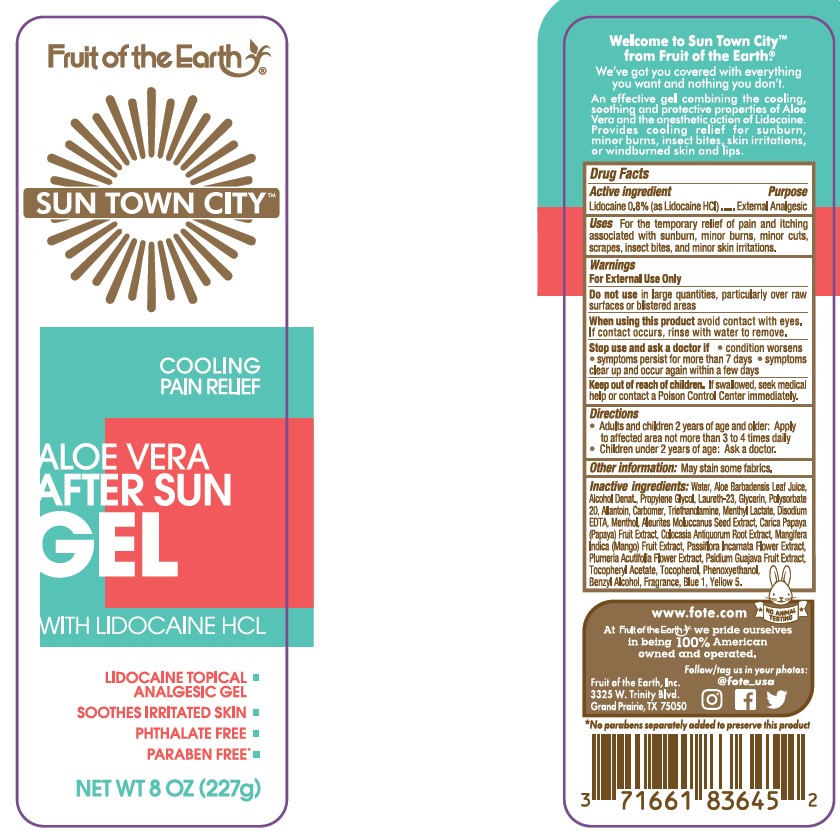
Fruit of the Earth Sun Town City Aloe Vera After Sun with Lidocaine HCL 8 mg/g Gel, 227 g
Other active recalls for Lidocaine (different manufacturers) — 1 · tap to view
🆔 Identity & classification
Where does this data come from?
🏷️ RxNorm drug class
This medicine belongs to the Antiarrhythmic class.
Where does this data come from?
🏭 Manufacturer & labeler
Where does this data come from?
🩺 Clinical
- It's best to avoid using two lidocaine products at the same time unless your doctor says it's okay. When you use multiple products containing a local anesthetic, the total amount a...
- Can I use a lidocaine patch and a lidocaine cream at the same time?
- No — please don't do this. Heat significantly increases how much lidocaine is absorbed through your skin, which can push drug levels in your blood higher than they should be. Stick...
- Can I put a heating pad on the area where I applied a lidocaine patch?
Patient education
Supplement & herbal interactions
Some supplements/herbs that may interact with Lidocaine — tap one for details:
Where does this data come from?
Ask a licensed pharmacist directly — free, answered by our team.
🧪 Inactive Ingredients / Excipients
Inactive ingredients, also called excipients, are components of the drug product other than the active ingredient. They may include fillers, dyes, coatings, preservatives, flavors, or other formulation ingredients.
💡 Tap an ingredient (hover on desktop) to see what it is and why it’s used.
-
UNII 9E8X80D2L0
A synthetic form of vitamin E used as an antioxidant and preservative in medications. It helps prevent the active ingredients from degrading when exposed to oxygen or light.
-
UNII 7QWA1RIO01
A synthetic form of vitamin E used as an antioxidant in medicines. It prevents oils and fats in the formulation from breaking down, helping the drug remain stable and effective during storage.
-
UNII 3K9958V90M
A liquid solvent derived from fermentation or chemical synthesis. In medicines, alcohol dissolves active ingredients, helps preserve the product, and improves how the body absorbs certain drugs.
-
UNII J87WJ3E7VW
A plant-derived oil from the candlenut tree, used as an emollient and natural binder to help soften the product and improve how ingredients blend together in formulations.
-
UNII 344S277G0Z
Allantoin is a naturally derived compound that helps soften and soothe skin. In medicines, it works as a skin-conditioning agent and may help support wound healing and reduce irritation in topical formulations.
-
UNII ZY81Z83H0X
Aloe vera leaf is a plant extract derived from the aloe plant. It is used in medicines as a natural moisturizer and skin-soothing agent in topical formulations.
-
UNII LKG8494WBH
Benzyl alcohol is a clear liquid used as a preservative and solvent in medicines. It helps prevent bacterial and fungal growth and dissolves other ingredients to create uniform liquid formulations.
-
UNII 59TL3WG5CO
A synthetic polymer made by crosslinking acrylic acid with allyl sucrose. It thickens liquids, forms gels, and helps control how fast the medicine is released in your body.
-
UNII H7B71Q0G0D
A starch extracted from taro root, a tropical plant. Used as a binder and filler to hold tablet ingredients together and add bulk to the formulation.
-
UNII 7FLD91C86K
Edetate disodium is a chemical compound that binds and removes certain metal ions. In medicines, it acts as a preservative and stabilizer by preventing metals like calcium from interfering with the product's shelf life and consistency.
-
UNII H3R47K3TBD
FD&C Blue No. 1 is a synthetic blue dye approved for use in foods and medicines. It serves as a colorant to give the medication its distinctive appearance and help with product identification.
-
UNII I753WB2F1M
FD&C Yellow No. 5 is a synthetic yellow colorant approved by the FDA. It is added to medicines to make pills, tablets, or liquids visually distinct and easier to identify.
-
UNII PDC6A3C0OX
Glycerin is a clear, thick liquid derived from plant oils or fats. It acts as a humectant to retain moisture, a sweetener, and a solvent in medications.
-
UNII 74O70D6VG0
Guava is a tropical fruit used as a flavoring agent and natural coloring source in medications. It adds fruity taste and may provide a mild sweetening effect to make medicines more palatable.
-
UNII N72LMW566G
A synthetic cleansing agent derived from lauryl alcohol and ethylene oxide. It helps dissolve and mix oil and water-based ingredients in liquid medicines, acting as an emulsifier and solubilizer.
-
UNII I629I3NR86
A natural flavoring derived from mango fruit, used to add taste and aroma to medicines. It helps mask bitter or unpleasant flavors, making the medication more pleasant to take.
-
UNII L7T10EIP3A
A cooling compound from mint plants used as a flavoring agent and to create a fresh sensation in medicines. It helps mask bitter tastes and improve how the product feels in the mouth.
-
UNII 2BF9E65L7I
A chemical compound combining menthol with lactic acid. It's used in medicines as a flavoring agent and to provide a cooling or soothing sensation on the skin or mouth.
-
UNII KU94FIY6JB
A natural enzyme extract from papaya fruit that helps break down proteins. It's used in some medicines as a digestive aid ingredient and may help tablets dissolve or break apart in the stomach.
-
UNII K8F3G29S6Z
A plant extract from passion flower used in some formulations as a flavoring agent or traditional ingredient. It may contribute mild taste or aroma to the medicine.
-
UNII HIE492ZZ3T
Phenoxyethanol is a synthetic preservative and antimicrobial agent used to prevent bacterial and fungal growth in medicines and cosmetic products, extending shelf life and maintaining product safety.
-
UNII 8P7XXY759H
A natural extract from plumeria rubra flowers used in cosmetic and topical formulations. It typically functions as a fragrance, skin-conditioning agent, or botanical extract to add sensory appeal and traditional plant-based properties to the product.
-
UNII 7T1F30V5YH
A synthetic emulsifier derived from sorbitol and oleic acid. It helps mix oil and water-based ingredients together and keeps them from separating in liquid formulations.
-
UNII 6DC9Q167V3
Propylene glycol is a clear liquid derived from petroleum or vegetable sources. It acts as a solvent, humectant, and preservative in medicines, helping dissolve active ingredients and maintain product stability.
-
UNII 9O3K93S3TK
Trolamine is an alkaline compound used as a pH buffer and emulsifier in medicines. It helps neutralize acids, stabilize formulations, and enable mixing of oil and water-based ingredients.
-
UNII 059QF0KO0R
Water is a liquid solvent that dissolves and mixes ingredients together in liquid medicines, syrups, and injections. It helps distribute the active drug evenly throughout the product.
26 inactive ingredients listed in the exact product block matched to this NDC.
Label-section wording can be broader than the structured product block and may mention additional formulation ingredients.
Where does this data come from?
ingredient classCode="IACT" elements from the exact product block matched by this NDC. Label-section narrative from DailyMed / the openFDA label index is shown separately when available.Inactive ingredient FAQ
Are inactive ingredients the same for every manufacturer?
Why might an inactive ingredient be missing?
Can inactive ingredients matter?
💲 Pricing
A drug doesn't have one price. Each row is a different public payment system, and none is what you'd pay at the counter — that depends on your insurance. The ⓘ on each row explains what it measures.
| Price system | Per g | Per package |
|---|---|---|
| Retail pharmacies payNADAC · weekly | Not in the retail survey — common for institutional, discontinued, or low-volume packs. | |
| Medicaid paysCMS SDUD · 12 mo | No recent Medicaid claims on file for this NDC — rare and low-volume NDCs are suppressed in the public data. | |
| Medicare drug plans payPart D · quarterly | No Part D plan price is available for this NDC in our data. | |
Where does this data come from?
🔁 Therapeutic equivalents
| Product | Labeler | Pack | NADAC/unit | TE | Status | Price vs. this |
|---|---|---|---|---|---|---|
| Walgreens Sunburn Relief 8 mg/g 00363-0985-68 | WALGREEN | 453 g | — | — | FDA listed | — |
| Signature Care Aloe Vera Gel with Lidocaine 8 mg/g 21130-0733-68 | Safeway, | 454 g | — | — | FDA listed | — |
| Wegmans Aloe After Sun Gel with Lidocaine HCl External Analgesic 8 mg/g 47124-0129-68 | WEGMANS | 454 g | — | — | FDA listed | — |
| EQUATE Sunburn relief with Aloe After Sun 8 mg/g 49035-0788-20 | Wal-Mart | 567 g | — | — | FDA listed | — |
| Fruit of the Earth Sun Town City Aloe Vera After Sun with Lidocaine HCL 8 mg/gthis 62217-0070-80 | Fruit | 227 g | — | — | FDA listed | — |
| Ocean Potion Suncare Ice Plus Pain Relieving Soothing 8 mg/g 85638-0005-55 | GNL | 243 g | — | — | FDA listed | — |
Where does this data come from?
⏳ Availability & generic status
FDA-approved generic versions are listed, and recent pricing/market data suggests they may be available — see Therapeutic equivalents.
Where does this data come from?
📊 Medicare Part D spend CMS · PART D · 2026 (Q1)
🔬 Reported adverse events (FAERS)
Top reported reactions
Age at onset
Reporter sex
Serious outcomes
Where does this data come from?
📦 Packaging — all sizes for this product
| Package NDC | Description | Marketing start | Status |
|---|---|---|---|
| 62217-0070-68 | 453 g in 1 BOTTLE (62217-070-68) | 2019-12-09 | Active |
| 62217-0070-80 You're viewing this | 227 g in 1 BOTTLE (62217-070-80) | 2019-12-09 | Active |
You're viewing the smallest of 2 pack sizes for this product.
Pack size FAQ
What quantity is in NDC 62217-0070-80?
What is the difference between NDC 62217-0070-80 and NDC 62217-0070-68?
What NDC number is used to bill for this package of Fruit of the Earth Sun Town City Aloe Vera After Sun with Lidocaine HCL 8 mg/g Gel?
🧭 About this NDC listing & data coverage
What data is (and isn’t) available for this NDC — tap to expand
| NDC identity (package / product / labeler codes) | ✓ Available |
| Labeler | ✓ Available |
| Product & package description | ✓ Available |
| Marketing category & status | ✓ Available |
| Active ingredient / dosage form / route | ✓ Available |
| FDA label (SPL via DailyMed) | ✓ Available |
| Package photos | ✓ Available |
| Inactive ingredients (structured) | ✓ Available |
| NADAC pharmacy acquisition price (CMS) | — Not published for this NDC CMS publishes NADAC only for NDCs reported in its retail-pharmacy survey. |
| Orange Book / therapeutic-equivalence data | — Not published for this NDC Applies only to products approved under an NDA/ANDA; many listings are out of scope. |
| HCPCS J-code billing crosswalk | — Not published for this NDC Most self-administered / retail products have no J-code — that is normal. |
| Medicaid utilization (CMS SDUD) | — Not published for this NDC CMS reports utilization only for NDCs with Medicaid claims above its privacy threshold. |
Questions about this listing
Is this NDC FDA-approved?
Why is there no price listed?
Is the NDC printed on the package the same as the 11-digit billing NDC?
What do the three segments of this NDC mean?
Is this package still being marketed?
Does this product come in other package sizes?
Who lists this product with the FDA?
Do I need a prescription for this product?
Where does this data come from?
📄 FDA label — Drug Facts FDA SPL
🎯 Indications and Usage ▾
Uses For the temporary relief of pain and itching associated with sunburn, minor burns, minor cuts, scrapes, insect bites, and minor skin irritations.
⏱️ Dosage and Administration ▾
Directions Adults and children 2 years of age and older: Apply to affected area not more than 3 to 4 times daily Children under 2 years of age: Ask a doctor.
⚠️ Warnings ▾
Warnings For External Use Only
📦 Storage and Handling ▾
Other information: May stain some fabrics.
🧪 Active Ingredient ▾
Active Ingredients Lidocaine 0.8% (as Lidocaine HCl)
🧪 Inactive Ingredients ▾
Inactive ingredients: water, aloe barbadensis leaf juice, alcohol denat., propylene glycol, laureth-23, glycerin, polysorbate 20, allantoin, carbomer, triethanolamine, menthyl lactate, disodium EDTA, menthol, aleurites moluccarnus seed extract, carica papaya (papaya) fruit extract, colocasia antiquorum root extract, mangifera indica (mango) fruit extract, passiflora incarnata flower extract, plumeria acutifolia flower extract, psidium guajava fruit extract, tocopheryl acetate, tocopherol, phenoxyethanol, benzyl alcohol, fragrance, Blue 1, Yellow 5.
🎯 Purpose ▾
Purpose External Analgesic