
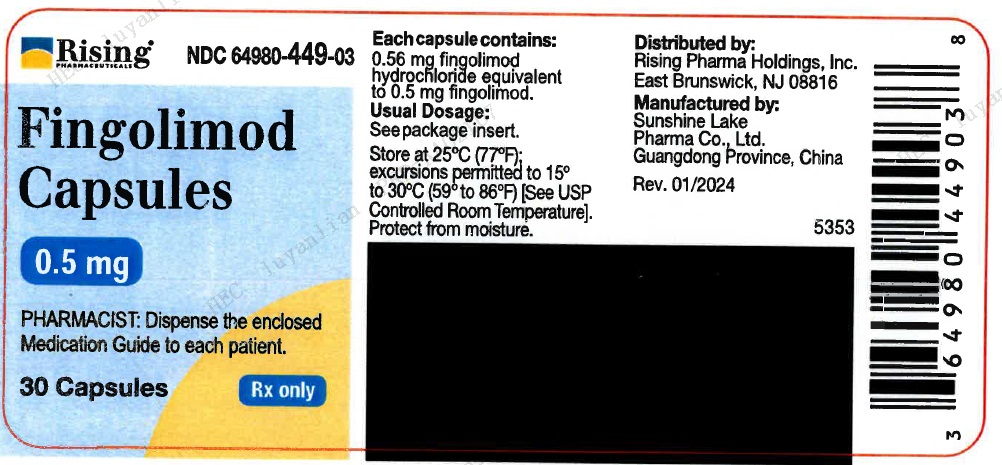
fingolimod .5 mg Capsule, 30-count — NDC 64980-449-03 (Billing 64980-0449-03)
This is a package of 30 capsules of fingolimod .5 mg Capsule from Rising Pharma Holdings, Inc., marketed since Nov 2021 and currently FDA-listed; retail pharmacies pay about $1.58 per capsule (NADAC). It is this product's only package size.
NDC database record
One package, one record: these facts belong to NDC 64980-449-03 alone.
- Record
- FDA NDC Directory package listing · Human prescription drug
- Code segments
- 64980 labeler · 449 product · 03 package
- Package marketed since
- Sep 4, 2023
- Sample package
- No — commercial package
- Listing certified through
- Dec 31, 2026
- Billing quantity
- 30 EA per package
- Barcode (UPC)
- 0364980449038
- Medicaid fills, this package
- 2,422 prescriptions in the last four reported quarters
- FDA record last changed
- Jul 24, 2026
Identity & classification
Regulatory identifiers FDA, NLM and CMS codes for this package
Drug-database identifiers Medi-Span GPI and First Databank GCN / HICL / AHFS classification
- GSN (GCN sequence number): 066709
- GCN: 29073
- GPI-14 (Medi-Span): 62407025100120
- HICL (First Databank): 037180
- AHFS class code: 90:04.16.00
- RxCUI (RxNorm): 1012895
Where does this data come from?
- FDA openFDA NDC Directory · synced Oct 8, 2026
- FDA label on DailyMed · label index refreshed Oct 8, 2026
- RxNorm (NLM RxNav) · catalog refreshed Oct 1, 2026
- Medi-Span GPI (licensed)
- First Databank (licensed) · refreshed Oct 8, 2026
RxNorm drug class
This medicine belongs to the Sphingosine 1-phosphate Receptor Modulator class.
Where does this data come from?
- RxClass (NLM) · catalog refreshed Oct 1, 2026
Clinical
Fingolimod is used to treat certain types of multiple sclerosis (MS; a disease that damages nerves causing weakness, numbness, loss of muscle coordination, and problems with vision, speech, and bladder control). Fingolimod is in a class of medications called sphingosine l-phosphate receptor modulators. It works by decreasing the action of immune cells that may cause nerve damage.
Read the full MedlinePlus article ↗- It treats relapsing forms of multiple sclerosis, including clinically isolated syndrome, relapsing-remitting disease and active secondary progressive disease. It is approved for pe...
- Take it by mouth once a day, with or without food. If you have Tascenso ODT, place it on your tongue and let it dissolve. Follow your prescriber's directions exactly.
- Fingolimod can slow your heart rate and cause heart block, mostly in the first 6 hours. We check your pulse, blood pressure and ECG. Some people need overnight monitoring. This may...
- Why do I have to be watched after the first dose?
Patient education
Supplement & herbal interactions
Where does this data come from?
- MedlinePlus (NLM) · refreshed Oct 8, 2026
- FDA label on DailyMed · label index refreshed Oct 8, 2026
Ask a licensed pharmacist directly — free, answered by our team.
Pricing
A drug doesn't have one price. Each row is a different public payment system, and none is what you'd pay at the counter — that depends on your insurance. The ⓘ on each row explains what it measures.
| Price system | Per ea | Per package |
|---|---|---|
| Retail pharmacies payNADAC · weekly | $1.579 | $47.37 / 30 capsules |
| Medicaid paysCMS SDUD · 12 mo | $20.60 | $617.93 / 30 capsules |
| Medicare drug plans payPart D · Q2 2026 | $24.12 | $723.68 / 30 capsules |
Where does this data come from?
- CMS NADAC weekly file · file of Oct 7, 2026
- CMS ASP pricing files · refreshed Sep 20, 2026
- CMS Medicaid State Drug Utilization Data · through Q1 2026
- CMS Part D plan pricing files · refreshed Sep 24, 2026
- VA National Acquisition Center price file
Packaging — all sizes for this product
| Package NDC | Description | Marketing start | Marketing end | Status |
|---|---|---|---|---|
| 64980-0449-03 You're viewing this Main listing | 30 CAPSULE in 1 BOTTLE | 2022-10-04 | — | Active |
Therapeutic equivalents
| Product | Labeler | Pack | NADAC/unit | TE | Status | Price vs. this |
|---|---|---|---|---|---|---|
| Fingolimod .5 mg 00480-7820-56 | Teva | 30 capsules | $1.579 | AB | Availability likely | — |
| Fingolimod .5 mg 31722-0889-30 | Camber | 30 capsules | $1.579 | AB | Availability likely | — |
| Fingolimod .5 mg 43598-0285-30 | Dr. | 30 capsules | $1.579 | AB | Availability likely | — |
| Fingolimod .5 mg 60505-4332-03 | Apotex | 30 capsules | $1.579 | AB | Availability likely | — |
| fingolimod .5 mgthis 64980-0449-03 | Rising | 30 capsules | $1.579 | AB | Availability likely | — |
| Fingolimod .5 mg 67877-0476-30 | Ascend | 30 capsules | $1.579 | AB | Availability likely | — |
| Fingolimod .5 mg 82009-0143-30 | Quallent | 30 capsules | $1.579 | AB | Availability likely | — |
| Fingolimod .5 mg 82249-0385-30 | CivicaScript | 30 capsules | $1.579 | AB | Availability likely | — |
| Fingolimod Hydrochloride .5 mg 16729-0342-10 | Accord | 30 capsules | $3.563 | AB | Availability likely | +126% |
| Gilenya .5 mg 00078-0607-15 | Novartis | 30 capsules | $414.711 | AB | FDA listed | +26162% |
| Fingolimod .5 mg 42291-0048-30 | AvKARE | 30 capsules | — | AB | FDA listed | — |
| Fingolimod .5 mg 43547-0003-03 | Solco | 30 capsules | — | AB | FDA listed | — |
| Fingolimod .5 mg 46708-0228-10 | Alembic | 1000 capsules | — | AB | FDA listed | — |
| Fingolimod .5 mg 62332-0228-10 | Alembic | 1000 capsules | — | AB | FDA listed | — |
| Fingolimod .5 mg 62756-0064-57 | Sun | 28 capsules | — | — | FDA listed | — |
| Fingolimod .5 mg 65862-0952-07 | Aurobindo | 7 capsules | — | AB | FDA listed | — |
| Fingolimod .5 mg 68382-0912-01 | Zydus | 100 capsules | — | AB | FDA listed | — |
| fingolimod .5 mg 68462-0166-07 | Glenmark | 49 capsules | — | AB | FDA listed | — |
| Fingolimod .5 mg 70377-0019-11 | Biocon | 30 capsules | — | AB | FDA listed | — |
| Fingolimod .5 mg 70771-1603-01 | Zydus | 100 capsules | — | AB | FDA listed | — |
| Fingolimod .5 mg 72865-0257-30 | XLCare | 30 capsules | — | AB | FDA listed | — |
Where does this data come from?
- FDA openFDA NDC Directory · synced Oct 8, 2026
- FDA Orange Book · refreshed Oct 3, 2026
- CMS NADAC weekly file · file of Oct 7, 2026
Availability & generic status
This product is an FDA-approved generic. Other versions of the same drug are listed under Therapeutic equivalents, least expensive first.
Where does this data come from?
- FDA Orange Book · refreshed Oct 3, 2026
What it looks like
Where does this data come from?
- FDA label on DailyMed · label index refreshed Oct 8, 2026
Inactive Ingredients / Excipients
Inactive ingredients, also called excipients, are components of the drug product other than the active ingredient. They may include fillers, dyes, coatings, preservatives, flavors, or other formulation ingredients.
🧪 Avoiding an ingredient? See Fingolimod inactive ingredients by manufacturer: every current product's list side by side, so you can ask your pharmacy for the version that does not list it.
💡 Tap an ingredient (hover on desktop) to see what it is and why it’s used.
-
UNII XM0M87F357
A dark iron oxide compound that gives medicines their black or dark color. It's used as a colorant in tablets and capsules to help identify the product and make it visually distinctive.
-
UNII 2G86QN327L
Gelatin is a protein derived from animal collagen, commonly used in medicines as a gelling agent and capsule material. It helps create soft or hard capsule shells that hold and release medication, and can also thicken liquid formulations.
-
UNII 70097M6I30
Magnesium stearate is a salt made from magnesium and stearic acid, a fatty substance. It's used in tablets and capsules as a lubricant and glidant to help ingredients flow smoothly during manufacturing and prevent sticking.
-
UNII WZH3C48M4T
Potassium hydroxide is a strong alkaline chemical used in medicines to adjust and maintain the pH level of liquid formulations, helping keep the product stable and the active ingredients effective.
-
UNII 46N107B71O
Shellac is a natural resin secreted by the lac beetle. It's used as a coating on tablets and capsules to control how quickly the medicine dissolves and to improve appearance and stability.
-
UNII O8232NY3SJ
A plant-based carbohydrate derived from corn kernels. It acts as a filler to add bulk, a binder to hold ingredients together, and a disintegrant to help the tablet break apart in your stomach for absorption.
-
UNII 15FIX9V2JP
Titanium dioxide is a bright white mineral powder commonly used as a colorant and opacifying agent. It makes pills and tablets white or lighter in color and helps make coatings non-transparent.
7 inactive ingredients listed in the exact product block matched to this NDC.
Where does this data come from?
ingredient classCode="IACT" elements from the exact product block matched by this NDC. Label-section narrative from DailyMed / the openFDA label index is shown separately when available.- FDA label on DailyMed · label index refreshed Oct 8, 2026
- FDA openFDA NDC Directory · synced Oct 8, 2026
Inactive ingredient FAQ
Are inactive ingredients the same for every manufacturer?
Why might an inactive ingredient be missing?
Can inactive ingredients matter?
Manufacturer & labeler
More NDCs from Rising Pharma Holdings, Inc. labeler code 64980
- Atenolol 50 mg Tablet NDC 64980-438-01
- Atenolol 100 mg Tablet NDC 64980-439-01
- Albuterol 2 mg Tablet NDC 64980-442-01
- Albuterol 4 mg Tablet NDC 64980-443-01
- Calcitriol 1 ug/mL Solution NDC 64980-447-15
- Neomycin and Polymyxin B Sulfates and Hydrocortisone Otic Suspension 10 mg/mL; 3.5 mg/mL; 10000 [USP'U]/mL Suspension NDC 64980-448-01
- Levocarnitine 1 g/10mL Solution NDC 64980-503-12
- Cyproheptadine Hydrochloride 2 mg/5mL Syrup NDC 64980-504-48
- Dexamethasone .5 mg/5mL Elixir NDC 64980-509-24
- CLINDAMYCIN PALMITATE HYDROCHLORIDE (Pediatric) 75 mg/5mL Granule, For Solution NDC 64980-511-10
- TIMOLOL MALEATE 2.5 mg/mL Solution/ Drops NDC 64980-513-01
- TIMOLOL MALEATE 5 mg/mL Solution/ Drops NDC 64980-514-01
Where does this data come from?
- FDA openFDA NDC Directory · synced Oct 8, 2026
- Drugs@FDA
Full prescribing information FDA SPL
🎯 Indications and Usage ▾
1 INDICATIONS AND USAGE Fingolimod capsules are indicated for the treatment of relapsing forms of multiple sclerosis (MS), to include clinically isolated syndrome, relapsing-remitting disease, and active secondary progressive disease, in patients 10 years of age and older. Fingolimod is a sphingosine 1-phosphate receptor modulator indicated for the treatment of relapsing forms of multiple sclerosis (MS), to include clinically isolated syndrome, relapsing-remitting disease, and active secondary progressive disease, in patients 10 years of age and older.
( 1 )
⏱️ Dosage and Administration ▾
2 DOSAGE AND ADMINISTRATION Assessments are required prior to initiating fingolimod. ( 2.1 ) Recommended dosage for adults and pediatric patients (10 years of age and older) weighing more than 40 kg: 0.5 mg orally once daily, with or without food. ( 2.2 , 2.3 ) Recommended dosage for pediatric patients (10 years of age and above) weighing less than or equal to 40 kg: 0.25 mg orally once daily, with or without food.
( 2.2 , 2.3 ) First-Dose Monitoring (including reinitiation after discontinuation greater than 14 days and dose increases): Observe all patients for bradycardia for at least 6 hours; monitor pulse and blood pressure hourly. Electrocardiograms (ECGs) prior to dosing and at end of observation period required. ( 2.4 ) Monitor until resolution if heart rate < 45 beats per minute (bpm) in adults, < 55 bpm in patients aged 12 years and above, or < 60 bpm in pediatric patients aged 10 to below 12 years, atrioventricular (AV) block, or if lowest postdose heart rate is at the end of the observation period.
( 2.4 ) Monitor symptomatic bradycardia with ECG until resolved. Continue overnight if intervention is required; repeat first-dose monitoring for second dose. ( 2.4 ) Observe patients overnight if at higher risk of symptomatic bradycardia, heart block, prolonged QTc interval, or if taking drugs with known risk of torsades de pointes.
( 2.4 , 7.1 )
2.1Assessment Prior to Initiating Fingolimod Cardiac Evaluation Obtain a cardiac evaluation in patients with certain preexisting conditions [see Warnings and Precautions (5.1)] . Prior to starting treatment, determine whether patients are taking drugs that could slow heart rate or atrioventricular (AV) conduction [see Dosage and Administration (2.4), Drug Interactions (7.5)] . Complete Blood Count (CBC) Review results of a recent CBC [see Warnings and Precautions (5.2), Drug Interactions (7.6)] .
Serum Transaminases (ALT and AST) and Total Bilirubin Levels Prior to starting treatment with fingolimod (i.e., within 6 months), obtain serum transaminases [alanine transaminase (ALT) and aspartate transferase (AST)] and total bilirubin levels [see Warnings and Precautions (5.5)] . Ophthalmic Assessment Obtain a baseline evaluation of the fundus, including the macula, near the start of the treatment with fingolimod [see Warnings and Precautions (5.4)] . Skin Examination Obtain a baseline skin examination prior to or shortly after initiation of fingolimod.
If a suspicious skin lesion is observed, it should be promptly evaluated [see Warnings and Precautions (5.12)] . Prior Medications If patients are taking antineoplastic, immunosuppressive, or immune-modulating therapies, or if there is a history of prior use of these drugs, consider possible unintended additive immunosuppressive effects before initiating treatment with fingolimod [see Warnings and Precautions (5.2), Drug Interactions (7.4)] . Vaccinations Test patients for antibodies to varicella zoster virus (VZV) before initiating fingolimod; VZV vaccination of antibody-negative patients is recommended prior to commencing treatment with fingolimod [see Warnings and Precautions (5.2)] .
It is recommended that pediatric patients if possible, complete all immunizations in accordance with current immunization guidelines prior to initiating fingolimod therapy.
2.2Important Administration Instructions Patients who initiate fingolimod, and those who reinitiate treatment after discontinuation for longer than 14 days, require first-dose monitoring. This monitoring is also recommended when the dose is increased in pediatric patients [see Dosage and Administration (2.4, 2.5)] Fingolimod capsules can be taken with or without food.
2.3Recommended Dosage In adults and pediatric patients 10 years of age and older weighing more than 40 kg, the recommended dosage of fingolimod capsule is 0.5 mg orally once-daily. In pediatric patients 10 years of age and older weighing less than or equal to 40 kg, the recommended dosage of fingolimod capsule is 0.… [Excerpted — this section continues on DailyMed.]
💊 Dosage Forms and Strengths ▾
3 DOSAGE FORMS AND STRENGTHS Fingolimod capsules are available as 0.5 mg hard gelatin capsules with a white or off-white opaque body and cap, imprinted with “S2” on the cap with black ink. 0.5 mg hard capsules ( 3 )
⛔ Contraindications ▾
4 CONTRAINDICATIONS Fingolimod is contraindicated in patients who have: in the last 6 months experienced myocardial infarction, unstable angina, stroke, transient ischemic attack(TIA), decompensated heart failure requiring hospitalization or Class III/IV heart failure a history or presence of Mobitz Type II second-degree or third-degree AV block or sick sinus syndrome, unless patient has a functioning pacemaker [see Warnings and Precautions (5.1)] a baseline QTc interval ≥ 500 msec cardiac arrhythmias requiring anti-arrhythmic treatment with Class Ia or Class III anti-arrhythmic drugs had a hypersensitivity reaction to fingolimod or any of the excipients in fingolimod capsules.
Observed reactions include rash, urticaria and angioedema upon treatment initiation [see Warnings and Precautions (5.14)] . Recent myocardial infarction, unstable angina, stroke, transient ischemic attack(TIA), decompensated heart failure with hospitalization, or Class III/IV heart failure. ( 4 ) History of Mobitz Type II 2 nd degree or 3 rd degree AV block or sick sinus syndrome, unless patient has a pacemaker.
( 4 ) Baseline QTc interval ≥ 500 msec. ( 4 ) Cardiac arrhythmias requiring anti-arrhythmic treatment with Class Ia or Class III anti-arrhythmic drugs. ( 4 ) Hypersensitivity to fingolimod or its excipients.
( 4 )
⚠️ Warnings and Cautions ▾
5 WARNINGS AND PRECAUTIONS Infections: Fingolimod may increase the risk. Obtain a complete blood count (CBC) before initiating treatment. Monitor for infection during treatment and for 2 months after discontinuation.
Do not start in patients with active infections. ( 5.2 ) Progressive Multifocal Leukoencephalopathy (PML): Withhold fingolimod at the first sign or symptom suggestive of PML. ( 5.3 ) Macular Edema: Increases the risk of macular edema.
Obtain a baseline evaluation of the fundus, including the macula, near the start of treatment with fingolimod. Conduct an evaluation of the fundus, including the macula, 3 to 4 months after treatment start, periodically while on therapy and any time there is a change in vision. Consider discontinuing fingolimod if macular edema develops.
Diabetes mellitus and uveitis increase the risk. ( 5.4 ) Liver Injury: Obtain liver enzyme results before initiation and periodically during treatment. Closely monitor patients with severe hepatic impairment.
Discontinue if there is evidence of liver injury without other cause. ( 5.5 , 8.6 , 12.3 ) Posterior Reversible Encephalopathy Syndrome (PRES): If suspected, discontinue fingolimod. ( 5.6 ) Respiratory Effects: Evaluate when clinically indicated.
( 5.7 ) Fetal Risk: May cause fetal harm. Advise females of reproductive potential of the potential risk to a fetus and to use an effective method of contraception during treatment and for 2 months after stopping fingolimod. ( 5.8 , 8.1 , 8.3 ) Severe Increase in Disability After Stopping Fingolimod: Monitor for development of severe increase in disability following discontinuation and begin appropriate treatment as needed.
( 5.9 ) Tumefactive MS: Consider when severe MS relapse occurs during treatment or after discontinuation. Obtain imaging and begin treatment as needed. ( 5.10 ) Increased Blood Pressure (BP): Monitor BP during treatment.
( 5.11 ) Malignancies: Skin examination prior to or shortly after the start of treatment and periodically thereafter is recommended. Suspicious skin lesions should be evaluated. ( 5.12 )
5.1Bradyarrhythmia and Atrioventricular Blocks Because of a risk for bradyarrhythmia and AV blocks, patients should be monitored during fingolimod treatment initiation [see Dosage and Administration (2.4)] . Reduction in Heart Rate After the first dose of fingolimod, the heart rate decrease starts within an hour. On Day 1, the maximum decline in heart rate generally occurs within 6 hours and recovers, although not to baseline levels, by 8 to 10 hours postdose.
Because of physiological diurnal variation, there is a second period of heart rate decrease within 24 hours after the first dose. In some patients, heart rate decrease during the second period is more pronounced than the decrease observed in the first 6 hours. Heart rates below 40 bpm in adults, and below 50 bpm in pediatric patients occurred rarely.
In controlled clinical trials in adult patients, adverse reactions of symptomatic bradycardia following the first dose were reported in 0.6% of patients receiving fingolimod 0.5 mg and in 0.1% of patients on placebo. Patients who experienced bradycardia were generally asymptomatic, but some patients experienced hypotension, dizziness, fatigue, palpitations, and/or chest pain that usually resolved within the first 24 hours on treatment. Patients with some preexisting conditions (e.g., ischemic heart disease, history of myocardial infarction, congestive heart failure, history of cardiac arrest, cerebrovascular disease, uncontrolled hypertension, history of symptomatic bradycardia, history of recurrent syncope, severe untreated sleep apnea, AV block, sinoatrial heart block) may poorly tolerate the fingolimod-induced bradycardia, or experience serious rhythm disturbances after the first dose of fingolimod.
Prior to treatment with fingolimod, these patients should have a cardiac evaluation by a physician appropriately trained to conduct such evaluation, and if treated with fingolimod,… [Excerpted — this section continues on DailyMed.]
🤒 Adverse Reactions ▾
6 ADVERSE REACTIONS The following serious adverse reactions are described elsewhere in labeling: Bradyarrhythmia and Atrioventricular Blocks [see Warnings and Precautions (5.1)] Infections [see Warnings and Precautions (5.2)] Progressive Multifocal Leukoencephalopathy [see Warnings and Precautions (5.3)] Macular Edema [see Warnings and Precautions (5.4)] Liver Injury [see Warnings and Precautions (5.5)] Posterior Reversible Encephalopathy Syndrome [see Warnings and Precautions (5.6)] Respiratory Effects [see Warnings and Precautions (5.7)] Fetal Risk [see Warnings and Precautions (5.8)] Severe Increase in Disability After Stopping Fingolimod [see Warnings and Precautions (5.9)] Tumefactive Multiple Sclerosis [see Warnings and Precautions (5.10)] Increased Blood Pressure [see Warnings and Precautions (5.11)] Malignancies [see Warnings and Precautions (5.12)] Immune System Effects Following Fingolimod Discontinuation [see Warnings and Precautions (5.13)] Hypersensitivity Reactions [see Warnings and Precautions (5.14)] Most common adverse reactions (incidence ≥ 10% and greater than placebo): Headache, liver transaminase elevation, diarrhea, cough, influenza, sinusitis, back pain, abdominal pain, and pain in extremity.
( 6.1 ) To report SUSPECTED ADVERSE REACTIONS, contact Rising Pharma Holdings, Inc. at 1-844-874-7464 or FDA at 1-800-FDA-1088 or www.fda.gov/medwatch .
6.1Clinical Trials Experience Because clinical trials are conducted under widely varying conditions, adverse reaction rates observed in the clinical trials of a drug cannot be directly compared to rates in the clinical trials of another drug and may not reflect the rates observed in practice. Adults In clinical trials (Studies 1, 2, and 3), a total of 1212 patients with relapsing forms of multiple sclerosis received fingolimod 0.5 mg. This included 783 patients who received fingolimod 0.5 mg in the 2-year placebo-controlled trials (Studies 1 and 3) and 429 patients who received fingolimod 0.5 mg in the 1-year active-controlled trial (Study 2).
The overall exposure in the controlled trials was equivalent to 1716 person-years. Approximately 1000 patients received at least 2 years of treatment with fingolimod 0.5 mg. In all clinical studies, including uncontrolled extension studies, the exposure to fingolimod 0.5 mg was approximately 4119 person-years.
In placebo-controlled trials, the most frequent adverse reactions (incidence ≥ 10% and greater than placebo) for fingolimod 0.5 mg were headache, liver transaminase elevation, diarrhea, cough, influenza, sinusitis, back pain, abdominal pain, and pain in extremity. Adverse events that led to treatment discontinuation and occurred in more than 1% of patients taking fingolimod 0.5 mg, were serum transaminase elevations (4.7% compared to 1% on placebo) and basal cell carcinoma (1% compared to 0.5% on placebo). Table 1 lists adverse reactions in clinical studies in adults that occurred in ≥ 1% of fingolimod-treated patients and ≥ 1% higher rate than for placebo.
Table 1: Adverse Reactions Reported in Adult Studies 1 and 3 (Occurring in ≥ 1% of Patients and Reported for Fingolimod 0.5 mg at ≥ 1% Higher Rate Than for Placebo) Abbreviations: ALT, alanine transaminase; AST, aspartate transferase; GGT, gamma-glutamyl transferase. Adverse drug reactions Fingolimod 0.5 mg N = 783 % Placebo N = 773 % Infections Influenza 11 8 Sinusitis 11 8 Bronchitis 8 5 Herpes zoster 2 1 Tinea versicolor 2 < 1 Cardiac disorders Bradycardia 3 1 Nervous system disorders Headache 25 24 Migraine 6 4 Gastrointestinal disorders Nausea 13 12 Diarrhea 13 10 Abdominal pain 11 10 General disorders and administration-site conditions Asthenia 2 1 Musculoskeletal and connective tissue disorders Back pain 10 9 Pain in extremity 10 7 Skin and subcutaneous tissue disorders Alopecia 3 2 Actinic keratosis 2 1 Investigations Liver transaminase elevations (ALT/GGT/AST) 15 4 Blood triglycerides increased 3 1 Respiratory, thoracic, and mediastinal disorders Cough 12 11… [Excerpted — this section continues on DailyMed.]
🔄 Drug Interactions ▾
7 DRUG INTERACTIONS Systemic Ketoconazole: Monitor during concomitant use. ( 7.2 , 12.3 ) Vaccines: Avoid live attenuated vaccines during, and for 2 months after stopping fingolimod treatment. ( 5.2 , 7.3 )
7.1QT Prolonging Drugs Fingolimod has not been studied in patients treated with drugs that prolong the QT interval. Drugs that prolong the QT interval have been associated with cases of torsades de pointes in patients with bradycardia. Since initiation of fingolimod treatment results in decreased heart rate and may prolong the QT interval, patients on QT prolonging drugs with a known risk of torsades de pointes (e.g., citalopram, chlorpromazine, haloperidol, methadone, erythromycin) should be monitored overnight with continuous ECG in a medical facility [see Dosage and Administration (2.4), Warnings and Precautions (5.1)] .
7.2Ketoconazole The blood levels of fingolimod and fingolimod-phosphate are increased by 1.7-fold when used concomitantly with ketoconazole. Patients who use fingolimod and systemic ketoconazole concomitantly should be closely monitored, as the risk of adverse reactions is greater.
7.3Vaccines Fingolimod reduces the immune response to vaccination. Vaccination may be less effective during and for up to 2 months after discontinuation of treatment with fingolimod [see Clinical Pharmacology (12.2)] . Avoid the use of live attenuated vaccines during and for 2 months after treatment with fingolimod because of the risk of infection.
It is recommended that pediatric patients, if possible, be brought up to date with all immunizations in agreement with current immunization guidelines prior to initiating fingolimod therapy.
7.4Antineoplastic, Immunosuppressive, or Immune-Modulating Therapies Antineoplastic, immune-modulating, or immunosuppressive therapies, (including corticosteroids) are expected to increase the risk of immunosuppression, and the risk of additive immune system effects must be considered if these therapies are coadministered with fingolimod. When switching from drugs with prolonged immune effects, such as natalizumab, teriflunomide or mitoxantrone, the duration and mode of action of these drugs must be considered to avoid unintended additive immunosuppressive effects when initiating fingolimod [see Warnings and Precautions (5.2)] .
7.5Drugs That Slow Heart Rate or Atrioventricular Conduction (e.g., beta blockers or diltiazem) Experience with fingolimod in patients receiving concurrent therapy with drugs that slow the heart rate or AV conduction (e.g., beta blockers, digoxin, or heart rate-slowing calcium channel blockers, such as diltiazem or verapamil) is limited. Because initiation of fingolimod treatment may result in an additional decrease in heart rate, concomitant use of these drugs during fingolimod initiation may be associated with severe bradycardia or heart block.
Seek advice from the physician prescribing these drugs regarding the possibility to switch to drugs that do not slow the heart rate or atrioventricular conduction before initiating fingolimod. Patients who cannot switch should have overnight continuous ECG monitoring after the first dose [see Dosage and Administration (2.4), Warnings and Precautions (5.1)] .
7.6Laboratory Test Interaction Because fingolimod reduces blood lymphocyte counts via redistribution in secondary lymphoid organs, peripheral blood lymphocyte counts cannot be utilized to evaluate the lymphocyte subset status of a patient treated with fingolimod. A recent CBC should be available before initiating treatment with fingolimod.
👥 Use in Specific Populations ▾
8 USE IN SPECIFIC POPULATIONS
8.1Pregnancy Risk Summary Based on findings from animal studies, fingolimod may cause fetal harm when administered to a pregnant woman. Data from prospective reports to the fingolimod Pregnancy Registry (GPR) are currently not sufficient to allow for an adequate assessment of the drug-associated risk for birth defects and miscarriage in humans. In oral studies conducted in rats and rabbits, fingolimod demonstrated developmental toxicity, including an increase in malformations (rats) and embryolethality, when given to pregnant animals.
In rats, the highest no-effect dose was less than the recommended human dose of 0.5 mg/day on a body surface area (mg/m 2 ) basis. The most common fetal visceral malformations in rats were persistent truncus arteriosus and ventricular septal defect. The receptor affected by fingolimod (sphingosine 1-phosphate receptor) is known to be involved in vascular formation during embryogenesis (see Data).
Advise pregnant women of the potential risk to a fetus. In the US general population, the estimated background risk of major birth defects and miscarriage in clinically recognized pregnancies is 2% to 4% and 15% to 20%, respectively. The background risk of major birth defects and miscarriage for the indicated population is unknown.
Clinical Considerations In females planning to become pregnant, fingolimod should be stopped 2 months before planned conception. The possibility of severe increase in disability should be considered in women who discontinue or are considering discontinuation of fingolimod because of pregnancy or planned pregnancy. In many of the cases in which increase in disability was reported after stopping fingolimod, patients had stopped fingolimod because of pregnancy or planned pregnancy [see Warnings and Precautions (5.9)] .
Data Animal Data When fingolimod was orally administered to pregnant rats during the period of organogenesis (0, 0.03, 0.1, and 0.3 mg/kg/day or 0, 1, 3, and 10 mg/kg/day), increased incidences of fetal malformations and embryofetal deaths were observed at all but the lowest dose tested (0.03 mg/kg/day), which is less than the recommended human dose (RHD) on a mg/m 2 basis. Oral administration to pregnant rabbits during organogenesis (0, 0.5, 1.5, and 5 mg/kg/day) resulted in increased incidences of embryofetal mortality and fetal growth retardation at the mid and high doses.
The no-effect dose for these effects in rabbits (0.5 mg/kg/day) is approximately 20 times the RHD on a mg/m 2 basis. When fingolimod was orally administered to female rats during pregnancy and lactation (0, 0.05, 0.15, and 0.5 mg/kg/day), pup survival was decreased at all doses and a neurobehavioral (learning) deficit was seen in offspring at the high dose. The low-effect dose of 0.05 mg/kg/day is similar to the RHD on a mg/m 2 basis.
8.2Lactation Risk Summary There are no data on the presence of fingolimod in human milk, the effects on the breastfed infant, or the effects of the drug on milk production. Fingolimod is excreted in the milk of treated rats. When a drug is present in animal milk, it is likely that the drug will be present in human milk.
The developmental and health benefits of breastfeeding should be considered along with the mother’s clinical need for fingolimod and any potential adverse effects on the breastfed infant from fingolimod or from the underlying maternal condition.
8.3Females and Males of Reproductive Potential Pregnancy Testing The pregnancy status of females of reproductive potential should be verified prior to starting treatment with fingolimod [see Use in Specific Populations (8.1)] . Contraception Before initiation of fingolimod treatment, females of reproductive potential should be counseled on the potential for a serious risk to the fetus and the need for effective contraception during treatment with fingolimod [see Warnings and Precautions (5.8) and Use in Specific Populations (8.1)] .
Since it takes approximately 2 months to… [Excerpted — this section continues on DailyMed.]
🤰 Pregnancy ▾
8.1Pregnancy Risk Summary Based on findings from animal studies, fingolimod may cause fetal harm when administered to a pregnant woman. Data from prospective reports to the fingolimod Pregnancy Registry (GPR) are currently not sufficient to allow for an adequate assessment of the drug-associated risk for birth defects and miscarriage in humans. In oral studies conducted in rats and rabbits, fingolimod demonstrated developmental toxicity, including an increase in malformations (rats) and embryolethality, when given to pregnant animals.
In rats, the highest no-effect dose was less than the recommended human dose of 0.5 mg/day on a body surface area (mg/m 2 ) basis. The most common fetal visceral malformations in rats were persistent truncus arteriosus and ventricular septal defect. The receptor affected by fingolimod (sphingosine 1-phosphate receptor) is known to be involved in vascular formation during embryogenesis (see Data).
Advise pregnant women of the potential risk to a fetus. In the US general population, the estimated background risk of major birth defects and miscarriage in clinically recognized pregnancies is 2% to 4% and 15% to 20%, respectively. The background risk of major birth defects and miscarriage for the indicated population is unknown.
Clinical Considerations In females planning to become pregnant, fingolimod should be stopped 2 months before planned conception. The possibility of severe increase in disability should be considered in women who discontinue or are considering discontinuation of fingolimod because of pregnancy or planned pregnancy. In many of the cases in which increase in disability was reported after stopping fingolimod, patients had stopped fingolimod because of pregnancy or planned pregnancy [see Warnings and Precautions (5.9)] .
Data Animal Data When fingolimod was orally administered to pregnant rats during the period of organogenesis (0, 0.03, 0.1, and 0.3 mg/kg/day or 0, 1, 3, and 10 mg/kg/day), increased incidences of fetal malformations and embryofetal deaths were observed at all but the lowest dose tested (0.03 mg/kg/day), which is less than the recommended human dose (RHD) on a mg/m 2 basis. Oral administration to pregnant rabbits during organogenesis (0, 0.5, 1.5, and 5 mg/kg/day) resulted in increased incidences of embryofetal mortality and fetal growth retardation at the mid and high doses.
The no-effect dose for these effects in rabbits (0.5 mg/kg/day) is approximately 20 times the RHD on a mg/m 2 basis. When fingolimod was orally administered to female rats during pregnancy and lactation (0, 0.05, 0.15, and 0.5 mg/kg/day), pup survival was decreased at all doses and a neurobehavioral (learning) deficit was seen in offspring at the high dose. The low-effect dose of 0.05 mg/kg/day is similar to the RHD on a mg/m 2 basis.
🧒 Pediatric Use ▾
8.4Pediatric Use Safety and effectiveness of fingolimod for the treatment of relapsing forms of multiple sclerosis in pediatric patients 10 to less than 18 years of age were established in one randomized, double-blind clinical study in 215 patients (fingolimod n = 107; intramuscular interferon (IFN) beta-1a n = 108) [see Clinical Studies (14.2)] . In the controlled pediatric study, the safety profile in pediatric patients (10 to less than 18 years of age) receiving fingolimod 0.25 mg or 0.5 mg daily was similar to that seen in adult patients.
In the pediatric study, cases of seizures were reported in 5.6% of fingolimod-treated patients and 0.9% of interferon beta-1a-treated patients. It is recommended that pediatric patients, if possible, complete all immunizations in accordance with current immunization guidelines prior to initiating fingolimod therapy. Safety and effectiveness of fingolimod in pediatric patients below the age of 10 years have not been established.
Juvenile Animal Toxicity Data In a study in which fingolimod (0.3, 1.5, or 7.5 mg/kg/day) was orally administered to young rats from weaning through sexual maturity, changes in bone mineral density and persistent neurobehavioral impairment (altered auditory startle) were observed at all doses. Delayed sexual maturation was noted in females at the highest dose tested and in males at all doses. The bone changes observed in fingolimod-treated juvenile rats are consistent with a reported role of S1P in the regulation of bone mineral homeostasis.
When fingolimod (0.5 or 5 mg/kg/day) was orally administered to rats from the neonatal period through sexual maturity, a marked decrease in T-cell dependent antibody response was observed at both doses. This effect had not fully recovered by 6 to 8 weeks after the end of treatment. Overall, a no-effect dose for adverse developmental effects in juvenile animals was not identified.
🧓 Geriatric Use ▾
8.5Geriatric Use Clinical MS studies of fingolimod did not include sufficient numbers of patients aged 65 years and over to determine whether they respond differently than younger patients. Fingolimod should be used with caution in patients aged 65 years and over, reflecting the greater frequency of decreased hepatic, or renal, function and of concomitant disease or other drug therapy.
🆘 Overdosage ▾
10 OVERDOSAGE Fingolimod can induce bradycardia as well as AV conduction blocks (including complete AV block). The decline in heart rate usually starts within 1 hour of the first dose and is maximal within 6 hours in most patients [see Warnings and Precautions (5.1)] . In case of fingolimod overdosage, observe patients overnight with continuous ECG monitoring in a medical facility, and obtain regular measurements of blood pressure [see Dosage and Administration (2.4)] .
Neither dialysis nor plasma exchange results in removal of fingolimod from the body.
🧬 Clinical Pharmacology ▾
12 CLINICAL PHARMACOLOGY
12.1Mechanism of Action Fingolimod is metabolized by sphingosine kinase to the active metabolite, fingolimod-phosphate. Fingolimod-phosphate is a sphingosine 1-phosphate receptor modulator, and binds with high affinity to sphingosine 1-phosphate receptors 1, 3, 4, and 5. Fingolimod-phosphate blocks the capacity of lymphocytes to egress from lymph nodes, reducing the number of lymphocytes in peripheral blood.
The mechanism by which fingolimod exerts therapeutic effects in multiple sclerosis is unknown, but may involve reduction of lymphocyte migration into the central nervous system.
12.2Pharmacodynamics Heart Rate and Rhythm Fingolimod causes a transient reduction in heart rate and AV conduction at treatment initiation [see Warnings and Precautions (5.1)] . Heart rate progressively increases after the first day, returning to baseline values within 1 month of the start of chronic treatment. Autonomic responses of the heart, including diurnal variation of heart rate and response to exercise, are not affected by fingolimod treatment.
Fingolimod treatment is not associated with a decrease in cardiac output. Potential to Prolong the QT Interval In a thorough QT interval study of doses of 1.25 or 2.5 mg fingolimod at steady-state, when a negative chronotropic effect of fingolimod was still present, fingolimod treatment resulted in a prolongation of QTc, with the upper boundary of the 90% confidence interval (CI) of 14.0 msec. There is no consistent signal of increased incidence of QTc outliers, either absolute or change from baseline, associated with fingolimod treatment.
In MS studies, there was no clinically relevant prolongation of the QT interval, but patients at risk for QT prolongation were not included in clinical studies. Immune System Effects on Immune Cell Numbers in the Blood In a study in which 12 adult subjects received fingolimod 0.5 mg daily, the lymphocyte count decreased to approximately 60% of baseline within 4 to 6 hours after the first dose. With continued daily dosing, the lymphocyte count continued to decrease over a 2-week period, reaching a nadir count of approximately 500 cells/mcL or approximately 30% of baseline.
In a placebo-controlled study in 1272 MS patients (of whom 425 received fingolimod 0.5 mg daily and 418 received placebo), 18% (N = 78) of patients on fingolimod 0.5 mg reached a nadir of < 200 cells/mcL on at least 1 occasion. No patient on placebo reached a nadir of < 200 cells/mcL. Low lymphocyte counts are maintained with chronic daily dosing of fingolimod 0.5 mg daily.
Chronic fingolimod dosing leads to a mild decrease in the neutrophil count to approximately 80% of baseline. Monocytes are unaffected by fingolimod. Peripheral lymphocyte count increases are evident within days of stopping fingolimod treatment and typically normal counts are reached within 1 to 2 months.
Effect on Antibody Response Fingolimod reduces the immune response to vaccination, as evaluated in 2 studies. In the first study, the immunogenicity of keyhole limpet hemocyanin (KLH) and pneumococcal polysaccharide vaccine (PPV-23) immunization were assessed by IgM and IgG titers in a steady-state, randomized, placebo-controlled study in healthy adult volunteers. Compared to placebo, antigen-specific IgM titers were decreased by 91% and 25% in response to KLH and PPV-23, respectively, in subjects on fingolimod 0.5 mg.
Similarly, IgG titers were decreased by 45% and 50%, in response to KLH and PPV-23, respectively, in subjects on fingolimod 0.5 mg daily compared to placebo. The responder rate for fingolimod 0.5 mg as measured by the number of subjects with a > 4-fold increase in KLH IgG was comparable to placebo and 25% lower for PPV-23 IgG, while the number of subjects with a > 4-fold increase in KLH and PPV-23 IgM was 75% and 40% lower, respectively, compared to placebo. The capacity to mount a skin delayed-type hypersensitivity reaction to Candida and tetanus toxoid was decreased by approximately 3… [Excerpted — this section continues on DailyMed.]
🧬 Mechanism of Action ▾
12.1Mechanism of Action Fingolimod is metabolized by sphingosine kinase to the active metabolite, fingolimod-phosphate. Fingolimod-phosphate is a sphingosine 1-phosphate receptor modulator, and binds with high affinity to sphingosine 1-phosphate receptors 1, 3, 4, and 5. Fingolimod-phosphate blocks the capacity of lymphocytes to egress from lymph nodes, reducing the number of lymphocytes in peripheral blood.
The mechanism by which fingolimod exerts therapeutic effects in multiple sclerosis is unknown, but may involve reduction of lymphocyte migration into the central nervous system.
📦 How Supplied / Storage and Handling ▾
16 HOW SUPPLIED/STORAGE AND HANDLING
16.1How Supplied 0.5 mg fingolimod capsules are hard gelatin capsules with a white or off-white opaque body and cap imprinted with “S2” on the cap with black ink. Fingolimod capsules are supplied as follows: Bottle of 30 capsules NDC 64980-449-03 Carton of 28 capsules containing 4 blister cards of 7 capsules per blister card NDC 64980-449-28 Carton of 7 capsules containing 1 blister card of 7 capsules per blister card NDC 64980-449-07
16.2Storage and Handling Fingolimod capsules should be stored at 25ºC (77ºF); excursions permitted to 15º to 30ºC (59º to 86ºF) [See USP Controlled Room Temperature]. Protect from moisture.
16.1How Supplied 0.5 mg fingolimod capsules are hard gelatin capsules with a white or off-white opaque body and cap imprinted with “S2” on the cap with black ink. Fingolimod capsules are supplied as follows: Bottle of 30 capsules NDC 64980-449-03 Carton of 28 capsules containing 4 blister cards of 7 capsules per blister card NDC 64980-449-28 Carton of 7 capsules containing 1 blister card of 7 capsules per blister card NDC 64980-449-07
📦 Storage and Handling ▾
16.2Storage and Handling Fingolimod capsules should be stored at 25ºC (77ºF); excursions permitted to 15º to 30ºC (59º to 86ºF) [See USP Controlled Room Temperature]. Protect from moisture.
📋 Description ▾
11 DESCRIPTION Fingolimod is a sphingosine 1-phosphate receptor modulator. Chemically, fingolimod is 2-amino-2-[2-(4-octylphenyl)ethyl]propan-1,3-diol hydrochloride. Its structure is shown below: Fingolimod hydrochloride is a white to practically white powder that is freely soluble in water and alcohol and soluble in propylene glycol.
It has a molecular weight of 343.93 g/mol. Fingolimod capsules are provided as 0.5 mg hard gelatin capsules for oral use. Each capsule contains 0.56 mg of fingolimod hydrochloride, equivalent to 0.5 mg of fingolimod.
Each capsule contains the following inactive ingredients: magnesium stearate, pregelatinized starch. The capsule shells have the following inactive ingredients: black iron oxide, gelatin, potassium hydroxide, shellac and titanium dioxide. structure
💬 Information for Patients ▾
17 PATIENT COUNSELING INFORMATION Advise the patient to read the FDA-approved patient labeling (Medication Guide). Tell patients not to discontinue fingolimod without first discussing this with the prescribing physician. Advise patients to contact their physician if they accidently take more fingolimod than prescribed.
Cardiac Effects Advise patients that initiation of fingolimod treatment results in a transient decrease in heart rate. Inform patients that they will need to be observed in the doctor's office or other facility for at least 6 hours after the first dose, after reinitiation if treatment is interrupted or discontinued for certain periods, and after the dosage is increased [see Dosage and Administration (2.4), Warnings and Precautions (5.1)] . Risk of Infections Inform patients that they may have an increased risk of infections, some of which could be life-threatening, when taking fingolimod, and that they should contact their physician if they develop symptoms of infection.
Advise patients that the use of some vaccines should be avoided during treatment with fingolimod and for 2 months after discontinuation. Recommend to patients that they delay treatment with fingolimod until after VZV vaccination if they have not had chickenpox or a previous VZV vaccination. Inform patients that prior or concomitant use of drugs that suppress the immune system may increase the risk of infection [see Warnings and Precautions (5.2)] .
Progressive Multifocal Leukoencephalopathy Inform patients that cases of progressive multifocal leukoencephalopathy (PML) have occurred in patients who received fingolimod. Inform the patient that PML is characterized by a progression of deficits and usually leads to death or severe disability over weeks or months. Instruct the patient of the importance of contacting their doctor if they develop any symptoms suggestive of PML.
Inform the patient that typical symptoms associated with PML are diverse, progress over days to weeks, and include progressive weakness on one side of the body or clumsiness of limbs, disturbance of vision, and changes in thinking, memory, and orientation leading to confusion and personality changes [see Warnings and Precautions (5.3)] . Macular Edema Advise patients that fingolimod may cause macular edema, and that they should obtain an eye exam near the start of treatment with fingolimod, have their eyes monitored periodically by an eye care professional while receiving therapy, and contact their healthcare provider if they experience any changes in their vision while taking fingolimod.
Inform patients with diabetes mellitus or a history of uveitis that their risk of macular edema is increased [see Warnings and Precautions (5.4)] . Hepatic Effects Inform patients that fingolimod may cause liver injury. Advise patients that they should contact their physician if they have any unexplained nausea, vomiting, abdominal pain, fatigue, anorexia, or jaundice and/or dark urine [see Warnings and Precautions (5.5)] .
Posterior Reversible Encephalopathy Syndrome Advise patients to immediately report to their healthcare provider any symptoms involving sudden onset of severe headache, altered mental status, visual disturbances, or seizure. Inform patients that delayed treatment could lead to permanent neurological sequelae [see Warnings and Precautions (5.6)] . Respiratory Effects Advise patients that they should contact their physician if they experience new onset or worsening of dyspnea [see Warnings and Precautions (5.7)] .
Fetal Risk Advise pregnant women and females of reproductive potential of the potential risk to a fetus. Advise females to inform their healthcare provider of a known or suspected pregnancy [see Warnings and Precautions (5.8) and Use in Specific Populations (8.1, 8.3)] . Advise female patients of reproductive potential to use effective contraception during treatment with fingolimod and for 2 months after the final dose [see Use in Specific Populations (8.3)] .
Severe… [Excerpted — this section continues on DailyMed.]
💬 Medication Guide ▾
This Medication Guide has been approved by the U.S. Food and Drug Administration. Revised: 10/2024 MEDICATION GUIDE Fingolimod [fin-GOE-li-mod] capsules, for oral use Read this Medication Guide before you start taking fingolimod capsules and each time you get a refill.
There may be new information. If you are the parent of a child who is being treated with fingolimod capsules, the following information applies to your child. This information does not take the place of talking to your doctor about your medical condition or your treatment.
What is the most important information I should know about fingolimod capsules? Fingolimod capsules may cause serious side effects, including: 1. Slow heart rate (bradycardia or bradyarrhythmia) when you start taking fingolimod capsules.
Fingolimod capsules can cause your heart rate to slow down, especially after you take your first dose. You will have a test, called an electrocardiogram (ECG), to check the electrical activity of your heart before you take your first dose of fingolimod capsules. All adults and children will be observed by a healthcare professional for at least 6 hours after taking their first dose of fingolimod capsules.
Children should also be observed by a healthcare professional for at least 6 hours after taking their first dose of 0.5 mg of fingolimod capsules when switching from the 0.25 mg dose. After you take your first dose of fingolimod capsules, and after a child takes their first dose of 0.5 mg of fingolimod capsules when switching from the 0.25 mg dose: Your pulse and blood pressure should be checked every hour. You should be observed by a healthcare professional to see if you have any serious side effects.
If your heart rate slows down too much, you may have symptoms, such as: dizziness tiredness feeling like your heart is beating slowly or skipping beats chest pain If you have any of the symptoms of slow heart rate, they will usually happen during the first 6 hours after your first dose of fingolimod capsules. Symptoms can happen up to 24 hours after you take your first fingolimod capsules dose. 6 hours after you take your first dose of fingolimod capsules you will have another ECG.
If your ECG shows any heart problems or if your heart rate is still too low or continues to decrease, you will continue to be observed. If you have any serious side effects after your first dose of fingolimod capsules, especially those that require treatment with other medicines, you will stay in the medical facility to be observed overnight. You will also be observed for any serious side effects for at least 6 hours after you take your second dose of fingolimod capsules the next day.
If you have certain types of heart problems, or if you are taking certain types of medicines that can affect your heart, you will be observed overnight after you take your first dose of fingolimod capsules. Your slow heart rate will usually return to normal within 1 month after you start taking fingolimod capsules. Call your doctor or go to the nearest hospital emergency room right away if you have any symptoms of a slow heart rate.
If you miss 1 or more doses of fingolimod capsules, you may need to be observed by a healthcare professional when you take your next dose. Call your doctor if you miss a dose of fingolimod capsules. See “How should I take fingolimod capsules?” 2.Pregnancy.
Please consult your doctor before getting pregnant. You should avoid becoming pregnant while taking fingolimod capsules or in the two months after you stop taking it because of the risk of harm to the baby. 3.
Infections. fingolimod capsules can increase your risk of serious infections that can be life-threatening and cause death. You should not receive live vaccines during treatment with fingolimod capsules and for 2 months after you stop taking fingolimod capsules. Talk to your doctor before you receive a vaccine during treatment and for 2 months after treatment with fingolimod capsules.
If you receive a live vaccine, you… [Excerpted — this section continues on DailyMed.]
🧬 Pharmacokinetics ▾
12.3Pharmacokinetics Absorption The T max of fingolimod is 12 to 16 hours. The apparent absolute oral bioavailability is 93%. Food intake does not alter C max or (AUC) of fingolimod or fingolimod-phosphate.
Therefore, fingolimod may be taken without regard to meals. Steady-state blood concentrations are reached within 1 to 2 months following once-daily administration and steady-state levels are approximately 10-fold greater than with the initial dose. Distribution Fingolimod highly (86%) distributes in red blood cells.
Fingolimod-phosphate has a smaller uptake in blood cells of < 17%. Fingolimod and fingolimod-phosphate are > 99.7% protein bound. Fingolimod and fingolimod-phosphate protein binding is not altered by renal or hepatic impairment.
Fingolimod is extensively distributed to body tissues with a volume of distribution of about 1200 ± 260 L. Metabolism The biotransformation of fingolimod in humans occurs by 3 main pathways: by reversible stereoselective phosphorylation to the pharmacologically active (S)-enantiomer of fingolimod-phosphate, by oxidative biotransformation catalyzed mainly by the cytochrome P450 4F2 (CYP4F2) and possibly other CYP4F isoenzymes with subsequent fatty acid-like degradation to inactive metabolites, and by formation of pharmacologically inactive non-polar ceramide analogs of fingolimod.
Inhibitors or inducers of CYP4F2 and possibly other CYP4F isozymes might alter the exposure of fingolimod or fingolimod-phosphate. In vitro studies in hepatocytes indicated that CYP3A4 may contribute to fingolimod metabolism in the case of strong induction of CYP3A4. Following single oral administration of [ 14 C] fingolimod, the major fingolimod-related components in blood, as judged from their contribution to the AUC up to 816 hours post-dose of total radiolabeled components, are fingolimod itself (23.3%), fingolimod-phosphate (10.3%), and inactive metabolites [M3 carboxylic acid metabolite (8.3%), M29 ceramide metabolite (8.9%), and M30 ceramide metabolite (7.3%)].
Elimination Fingolimod blood clearance is 6.3 ±
2.3L/h, and the average apparent terminal half-life (t 1/2 ) is 6 to 9 days. Blood levels of fingolimod-phosphate decline in parallel with those of fingolimod in the terminal phase, yielding similar half-lives for both. After oral administration, about 81% of the dose is slowly excreted in the urine as inactive metabolites.
Fingolimod and fingolimod-phosphate are not excreted intact in urine but are the major components in the feces with amounts of each representing less than 2.5% of the dose. Specific Populations Pediatric Patients The median fingolimod-phosphate (fingolimod-P) concentration in pediatric MS patients aged 10 to less than 18 years was 1.10 ng/mL, as compared to 1.35 ng/mL in adult MS patients. Geriatric Patients The mechanism for elimination and results from population pharmacokinetics suggest that dose adjustment would not be necessary in elderly patients.
However, clinical experience in patients aged above 65 years is limited. Gender Gender has no clinically significant influence on fingolimod and fingolimod-phosphate pharmacokinetics. Race The effects of race on fingolimod and fingolimod-phosphate pharmacokinetics cannot be adequately assessed due to a low number of patients who self-identified as Black or African American, Asian, or other races in the clinical program.
Renal Impairment In adult patients with severe renal impairment, fingolimod C max and AUC are increased by 32% and 43%, respectively, and fingolimod-phosphate C max and AUC are increased by 25% and 14%, respectively, with no change in apparent elimination half-life. Based on these findings, the fingolimod 0.5 mg dose is appropriate for use in adult patients with renal impairment. Fingolimod 0.25 mg and 0.5 mg are appropriate for use in pediatric patients with renal impairment.
The systemic exposure of 2 metabolites (M2 and M3) is increased by 3- and 13-fold, respectively. The toxicity of these metabolites has not b… [Excerpted — this section continues on DailyMed.]
🧬 Pharmacodynamics ▾
12.2Pharmacodynamics Heart Rate and Rhythm Fingolimod causes a transient reduction in heart rate and AV conduction at treatment initiation [see Warnings and Precautions (5.1)] . Heart rate progressively increases after the first day, returning to baseline values within 1 month of the start of chronic treatment. Autonomic responses of the heart, including diurnal variation of heart rate and response to exercise, are not affected by fingolimod treatment.
Fingolimod treatment is not associated with a decrease in cardiac output. Potential to Prolong the QT Interval In a thorough QT interval study of doses of 1.25 or 2.5 mg fingolimod at steady-state, when a negative chronotropic effect of fingolimod was still present, fingolimod treatment resulted in a prolongation of QTc, with the upper boundary of the 90% confidence interval (CI) of 14.0 msec. There is no consistent signal of increased incidence of QTc outliers, either absolute or change from baseline, associated with fingolimod treatment.
In MS studies, there was no clinically relevant prolongation of the QT interval, but patients at risk for QT prolongation were not included in clinical studies. Immune System Effects on Immune Cell Numbers in the Blood In a study in which 12 adult subjects received fingolimod 0.5 mg daily, the lymphocyte count decreased to approximately 60% of baseline within 4 to 6 hours after the first dose. With continued daily dosing, the lymphocyte count continued to decrease over a 2-week period, reaching a nadir count of approximately 500 cells/mcL or approximately 30% of baseline.
In a placebo-controlled study in 1272 MS patients (of whom 425 received fingolimod 0.5 mg daily and 418 received placebo), 18% (N = 78) of patients on fingolimod 0.5 mg reached a nadir of < 200 cells/mcL on at least 1 occasion. No patient on placebo reached a nadir of < 200 cells/mcL. Low lymphocyte counts are maintained with chronic daily dosing of fingolimod 0.5 mg daily.
Chronic fingolimod dosing leads to a mild decrease in the neutrophil count to approximately 80% of baseline. Monocytes are unaffected by fingolimod. Peripheral lymphocyte count increases are evident within days of stopping fingolimod treatment and typically normal counts are reached within 1 to 2 months.
Effect on Antibody Response Fingolimod reduces the immune response to vaccination, as evaluated in 2 studies. In the first study, the immunogenicity of keyhole limpet hemocyanin (KLH) and pneumococcal polysaccharide vaccine (PPV-23) immunization were assessed by IgM and IgG titers in a steady-state, randomized, placebo-controlled study in healthy adult volunteers. Compared to placebo, antigen-specific IgM titers were decreased by 91% and 25% in response to KLH and PPV-23, respectively, in subjects on fingolimod 0.5 mg.
Similarly, IgG titers were decreased by 45% and 50%, in response to KLH and PPV-23, respectively, in subjects on fingolimod 0.5 mg daily compared to placebo. The responder rate for fingolimod 0.5 mg as measured by the number of subjects with a > 4-fold increase in KLH IgG was comparable to placebo and 25% lower for PPV-23 IgG, while the number of subjects with a > 4-fold increase in KLH and PPV-23 IgM was 75% and 40% lower, respectively, compared to placebo. The capacity to mount a skin delayed-type hypersensitivity reaction to Candida and tetanus toxoid was decreased by approximately 30% in subjects on fingolimod 0.5 mg daily, compared to placebo.
Immunologic responses were further decreased with fingolimod 1.25 mg (a dose higher than recommended in MS) [see Warnings and Precautions (5.2)] . In the second study, the immunogenicity of Northern hemisphere seasonal influenza and tetanus toxoid vaccination was assessed in a 12-week steady-state, randomized, placebo-controlled study of fingolimod 0.5 mg in adult multiple sclerosis patients (n = 136). The responder rate 3 weeks after vaccination, defined as seroconversion or a ≥ 4-fold increase in antibody directed against at least 1 of the 3 in… [Excerpted — this section continues on DailyMed.]
🔬 Clinical Studies ▾
14 CLINICAL STUDIES
14.1Adults The efficacy of fingolimod was demonstrated in 2 studies that evaluated once-daily doses of fingolimod 0.5 mg and 1.25 mg in patients with relapsing-remitting MS (RRMS). Both studies included patients who had experienced at least 2 clinical relapses during the 2 years prior to randomization or at least 1 clinical relapse during the 1 year prior to randomization, and had an Expanded Disability Status Scale (EDSS) score from 0 to 5.5. Study 1 was a 2-year randomized, double-blind, placebo-controlled study in patients with RRMS who had not received any interferon-beta or glatiramer acetate for at least the previous 3 months and had not received any natalizumab for at least the previous 6 months.
Neurological evaluations were performed at screening, every 3 months and at time of suspected relapse. MRI evaluations were performed at screening, Month 6, Month 12, and Month 24. The primary endpoint was the annualized relapse rate.
Median age was 37 years, median disease duration was 6.7 years and median EDSS score at baseline was 2.0. Patients were randomized to receive fingolimod 0.5 mg (N = 425), 1.25 mg (N = 429), or placebo (N = 418) for up to 24 months. Median time on study drug was 717 days on 0.5 mg, 715 days on 1.25 mg, and 719 days on placebo.
The annualized relapse rate was significantly lower in patients treated with fingolimod than in patients who received placebo. The secondary endpoint was the time to 3-month confirmed disability progression as measured by at least a 1-point increase from baseline in EDSS (0.5-point increase for patients with baseline EDSS of 5.5) sustained for 3 months. Time to onset of 3-month confirmed disability progression was significantly delayed with fingolimod treatment compared to placebo.
The 1.25 mg dose resulted in no additional benefit over the fingolimod 0.5 mg dose. The results for this study are shown in Table 2 and Figure 1. Table 2: Clinical and MRI Results of Study 1 Abbreviation: CI, confidence interval.
All analyses of clinical endpoints were intent-to-treat. MRI analysis used evaluable dataset. ‡ Hazard ratio is an estimate of the relative risk of having the event of disability progression on fingolimod as compared to placebo. Fingolimod 0.5 mg N = 425 Placebo N = 418 p-value Clinical endpoints Annualized relapse rate (primary endpoint) 0.18 0.40 < 0.001 Percentage of patients without relapse 70% 46% < 0.001 Hazard ratio ‡ of disability progression (95% CI) 0.70 (0.52, 0.96)
0.02MRI endpoint Mean (median) number of new or newly enlarging T2 lesions over 24 months 2.5 (0) 9.8 (5.0) < 0.001 Mean (median) number of T1 Gd-enhancing lesions at Month 24 0.2 (0) 1.1 (0) < 0.001 Figure 1: Time to 3-Month Confirmed Disability Progression – Study 1 (ITT population) Study 2 was a 1-year randomized, double-blind, double-dummy, active-controlled study in patients with RRMS who had not received any natalizumab in the previous 6 months. Prior therapy with interferon-beta or glatiramer acetate up to the time of randomization was permitted.
Neurological evaluations were performed at screening, every 3 months, and at the time of suspected relapses. MRI evaluations were performed at screening and at Month 12. The primary endpoint was the annualized relapse rate.
Median age was 36 years, median disease duration was 5.9 years, and median EDSS score at baseline was 2.0. Patients were randomized to receive fingolimod 0.5 mg (N = 431), 1.25 mg (N = 426), or interferon beta-1a, 30 mcg via the intramuscular route (IM) once-weekly (N = 435) for up to 12 months. Median time on study drug was 365 days on fingolimod 0.5 mg, 354 days on 1.25 mg, and 361 days on interferon beta-1a IM.
The annualized relapse rate was significantly lower in patients treated with fingolimod 0.5 mg than in patients who received interferon beta-1a IM. The key secondary endpoints were number of new and newly enlarging T2 lesions and time to onset of 3-month confirmed disability progression as measured b… [Excerpted — this section continues on DailyMed.]
🧪 Nonclinical Toxicology ▾
13 NONCLINICAL TOXICOLOGY
13.1Carcinogenesis, Mutagenesis, Impairment of Fertility Oral carcinogenicity studies of fingolimod were conducted in mice and rats. In mice, fingolimod was administered at oral doses of 0, 0.025, 0.25, and 2.5 mg/kg/day for up to 2 years. The incidence of malignant lymphoma was increased in males and females at the mid and high dose.
The lowest dose tested (0.025 mg/kg/day) is less than the RHD of 0.5 mg/day on a body surface area (mg/m 2 ) basis. In rats, fingolimod was administered at oral doses of 0, 0.05, 0.15, 0.5, and 2.5 mg/kg/day. No increase in tumors was observed.
The highest dose tested (2.5 mg/kg/day) is approximately 50 times the RHD on a mg/m 2 basis. Fingolimod was negative in a battery of in vitro (Ames, mouse lymphoma thymidine kinase, chromosomal aberration in mammalian cells) and in vivo (micronucleus in mouse and rat) assays. When fingolimod was administered orally (0, 1, 3, and 10 mg/kg/day) to male and female rats prior to and during mating, and continuing to Day 7 of gestation in females, no effect on fertility was observed up to the highest dose tested (10 mg/kg), which is approximately 200 times the RHD on a mg/m 2 basis.
13.2Animal Toxicology and/or Pharmacology Lung toxicity was observed in 2 different strains of rats and in dogs and monkeys. The primary findings included increase in lung weight, associated with smooth muscle hypertrophy, hyperdistention of the alveoli, and/or increased collagen. Insufficient or lack of pulmonary collapse at necropsy, generally correlated with microscopic changes, was observed in all species.
In rats and monkeys, lung toxicity was observed at all oral doses tested in chronic studies. The lowest doses tested in rats (0.05 mg/kg/day in the 2-year carcinogenicity study) and monkeys (0.5 mg/kg/day in the 39-week toxicity study) are similar to and approximately 20 times the RHD on a mg/m 2 basis, respectively. In the 52-week oral study in monkeys, respiratory distress associated with ketamine administration was observed at doses of 3 and 10 mg/kg/day; the most affected animal became hypoxic and required oxygenation.
As ketamine is not generally associated with respiratory depression, this effect was attributed to fingolimod. In a subsequent study in rats, ketamine was shown to potentiate the bronchoconstrictive effects of fingolimod. The relevance of these findings to humans is unknown.
📄 Carcinogenesis, Mutagenesis, Impairment of Fertility ▾
13.1Carcinogenesis, Mutagenesis, Impairment of Fertility Oral carcinogenicity studies of fingolimod were conducted in mice and rats. In mice, fingolimod was administered at oral doses of 0, 0.025, 0.25, and 2.5 mg/kg/day for up to 2 years. The incidence of malignant lymphoma was increased in males and females at the mid and high dose.
The lowest dose tested (0.025 mg/kg/day) is less than the RHD of 0.5 mg/day on a body surface area (mg/m 2 ) basis. In rats, fingolimod was administered at oral doses of 0, 0.05, 0.15, 0.5, and 2.5 mg/kg/day. No increase in tumors was observed.
The highest dose tested (2.5 mg/kg/day) is approximately 50 times the RHD on a mg/m 2 basis. Fingolimod was negative in a battery of in vitro (Ames, mouse lymphoma thymidine kinase, chromosomal aberration in mammalian cells) and in vivo (micronucleus in mouse and rat) assays. When fingolimod was administered orally (0, 1, 3, and 10 mg/kg/day) to male and female rats prior to and during mating, and continuing to Day 7 of gestation in females, no effect on fertility was observed up to the highest dose tested (10 mg/kg), which is approximately 200 times the RHD on a mg/m 2 basis.
📄 Recent Major Changes ▾
Dosage and Administration ( 2.1 ) 6/2024 Warnings and Precautions ( 5.3 , 5.9 ) 8/2023 Warnings and Precautions ( 5.3 , 5.4 , 5.12 ) 6/2024
📄 Package Label / Principal Display Panel ▾
Package Label – 0.5 mg Rx Only NDC 64980-449-03 Fingolimod Capsules 30 Capsules 0.5 mg Equivalent to 0.56 mg fingolimod hydrochloride Dispense with enclosed Medication Guide. bottle label