
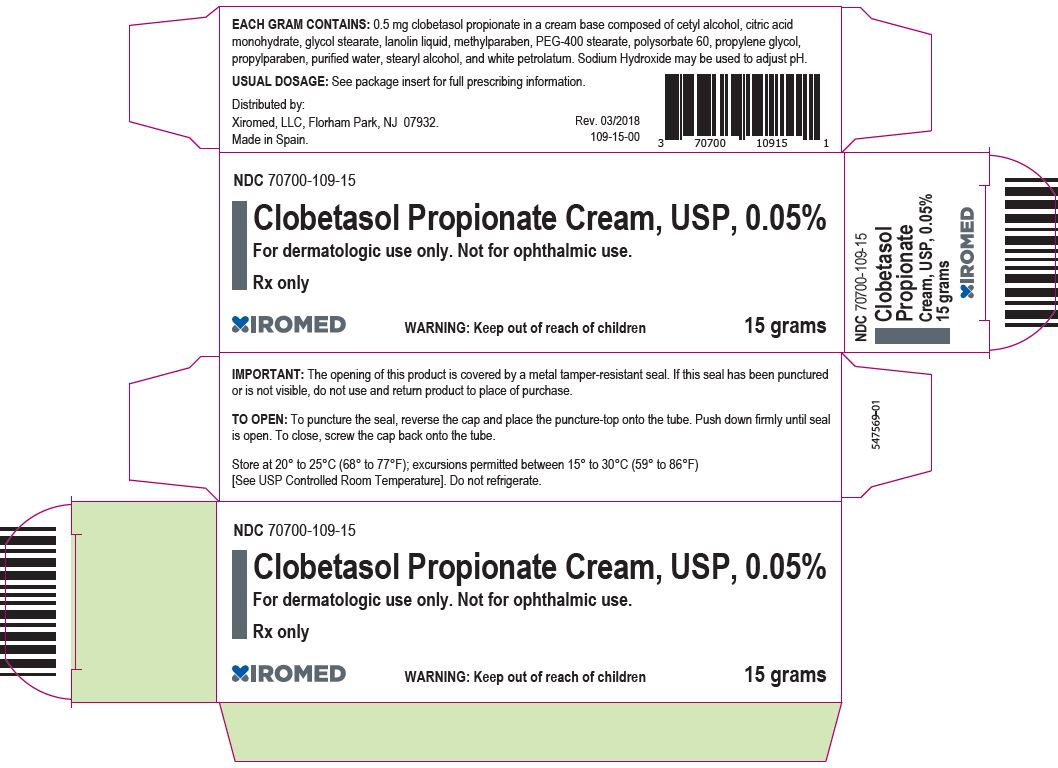
NDC 70700-0109-17: Clobetasol Propionate .5 mg/g Cream
This is a package of Clobetasol Propionate .5 mg/g Cream from Xiromed, LLC, first listed with the FDA Jun 2018 and currently FDA-listed; retail pharmacies pay about $0.1320 per g (NADAC). It is the main listing for this product, which comes in 4 package sizes.
NDC Database Record
One package, one record: these facts belong to NDC 70700-109-17 alone.
- Record
- FDA NDC Directory package listing · Human prescription drug
- Code segments
- 70700 labeler · 109 product · 17 package
- Package marketed since
- Jun 19, 2018
- Sample package
- No — commercial package
- Listing certified through
- Dec 31, 2026
- Barcode (UPC-A, from the NDC)
- 3 7070010917 5
- Medicaid fills, this package
- 13,688 prescriptions in the last four reported quarters
- FDA record last changed
- Jul 24, 2026
Other active recalls for Clobetasol Propionate (different manufacturers) — 1 · tap to view
Identity & Classification
Regulatory identifiers FDA, NLM and CMS codes for this package
Drug-database identifiers Medi-Span GPI and First Databank GCN / HICL / AHFS classification
- GSN (GCN sequence number): 007634
- GCN: 32140
- GPI-14 (Medi-Span): 90550025103705
- HICL (First Databank): 003327
- AHFS class code: 84:06.08.00
- RxCUI (RxNorm): 861495
Where does this data come from?
- FDA openFDA NDC Directory · synced Nov 26, 2026
- FDA label on DailyMed · label index refreshed Nov 26, 2026
- RxNorm (NLM RxNav) · catalog refreshed Nov 26, 2026
- Medi-Span GPI (licensed)
- First Databank (licensed) · refreshed Nov 26, 2026
RxNorm Drug Class
This medicine belongs to the Corticosteroid class.
Where does this data come from?
- RxClass (NLM) · catalog refreshed Nov 26, 2026
Clinical
Clobetasol topical is used to treat the itching, redness, dryness, crusting, scaling, inflammation, and discomfort of various scalp and skin conditions, including psoriasis (a skin disease in which red, scaly patches form on some areas of the body) and eczema (a skin disease that causes the skin to be dry and itchy and to sometimes develop red, scaly rashes). Clobetasol is in a class of medications called corticosteroids. It works by activating natural substances in the skin to reduce swelling, redness, and itching.
Read the full MedlinePlus article ↗- It calms inflamed, itchy skin and scalp conditions, including plaque psoriasis. The exact use depends on your product, such as shampoo for scalp psoriasis or spray for plaque psori...
- Usually only a short time, often 2 weeks and up to 4 weeks for some products. Stop when your skin is under control. If you see no improvement in 2 weeks, check back with your presc...
- Generally no. Most clobetasol skin products should not be used on the face, armpits or groin. Keep it out of your eyes and mouth, and follow your product's directions.
- Mild burning, stinging, itching or dryness where you apply it. Call your doctor if your skin thins, breaks out, looks infected or gets worse. Also call for signs of steroid effects...
Patient education
Drug interactions
Supplement & herbal interactions
Some supplements/herbs that may interact with Clobetasol Propionate — tap one for details:
Clobetasol may be associated with lower levels of 8 nutrients — worth a chat with your pharmacist, not a cause for alarm.
Where does this data come from?
- MedlinePlus (NLM) · refreshed Nov 26, 2026
- FDA label on DailyMed · label index refreshed Nov 26, 2026
Ask a licensed pharmacist directly — free, answered by our team.
Pricing
A drug doesn't have one price. Each row is a different public payment system, and none is what you'd pay at the counter — that depends on your insurance. The ⓘ on each row explains what it measures.
| Price system | Per g | Per package |
|---|---|---|
| Retail pharmacies payNADAC · weekly | $0.132 | $7.92 / 60 g |
| Medicaid paysCMS SDUD · 12 mo | $0.3759 | $22.55 / 60 g |
| Medicare drug plans payPart D · Q2 2026 | $0.2669 | $16.01 / 60 g |
See this NDC in the NADAC Price Lookup: every NDC at its price and what a fill costs the pharmacy →
Where does this data come from?
- CMS NADAC weekly file · file of Nov 25, 2026
- CMS ASP pricing files · refreshed Nov 20, 2026
- CMS Medicaid State Drug Utilization Data · through Q2 2026
- CMS Part D plan pricing files · refreshed Nov 24, 2026
- VA National Acquisition Center price file
Packaging — All Sizes for This Product
| Package NDC | Description | Per unit | Per pack | Marketing start | Marketing end | Status |
|---|---|---|---|---|---|---|
| 70700-0109-15 70700-109-15 | 1 TUBE in 1 CARTON / 15 g in 1 TUBE | $0.1971 / g | $2.96 | 2018-06-19 | — | Active |
| 70700-0109-16 70700-109-16 | 1 TUBE in 1 CARTON / 30 g in 1 TUBE | $0.1716 / g | $5.15 | 2018-06-19 | — | Active |
| 70700-0109-17 You're viewing this Main listing | 1 TUBE in 1 CARTON / 60 g in 1 TUBE | $0.1320 / g | $7.92 | 2018-06-19 | — | Active |
| 70700-0109-18 70700-109-18 | 1 TUBE in 1 CARTON / 45 g in 1 TUBE | $0.1278 / g | $5.75 | 2018-06-19 | — | Active |
Per g, this pack runs about 3% above the cheapest pack (NDC 70700-0109-18, $0.1278 vs $0.1320 NADAC).
In Medicaid, this is the most-dispensed pack of this product — about 48% of fills over the last four reported quarters. See all packs ↓
Pack size FAQ
What quantity is in this package?
What NDC number is used to bill for this package of Clobetasol Propionate .5 mg/g Cream?
Prices are the latest CMS NADAC pharmacy acquisition cost per NDC; per-pack figures are per-unit × pack quantity, shown only when the pack is denominated in the same measure NADAC prices.
Therapeutic Equivalents
| Product | Labeler | Pack | NADAC/unit | TE | Status | Price vs. this |
|---|---|---|---|---|---|---|
| Clobetasol Propionate .5 mg/gthis 70700-0109-17 | Xiromed, | 1 tube | $0.132 | AB1 | Availability likely | — |
| Clobetasol Propionate .5 mg/g 68462-0529-17 | Glenmark | 1 tube | $0.143 | — | Discontinued | +8% |
| Clobetasol Propionate .5 mg/g 68462-0530-17 | Glenmark | 1 tube | $0.145 | — | Discontinued | +10% |
| clobetasol propionate .5 mg/g 43386-0096-60 | Lupin | 1 tube | $0.163 | AB | Availability likely | +24% |
| Clobetasol Propionate .5 mg/g 00713-0656-15 | Cosette | 1 tube | $0.163 | AB | Availability likely | +24% |
| Clobetasol Propionate ANDA .5 mg/g 33342-0506-15 | Macleods | 1 tube | $0.163 | AB | Availability likely | +24% |
| Clobetasol Propionate .5 mg/g 70700-0106-15 | Xiromed, | 15 g | $0.163 | AB | Availability likely | +24% |
| Clobetasol Propionate .5 mg/g 59651-0732-14 | Aurobindo | 1 tube | $0.163 | AB | Availability likely | +24% |
| Clobetasol Propionate .5 mg/g 51672-1259-01 | Sun | 1 tube | $0.163 | AB | Availability likely | +24% |
| Clobetasol Propionate .5 mg/g 72603-0855-01 | NorthStar | 1 tube | $0.163 | AB | Availability likely | +24% |
| Clobetasol Propionate .5 mg/g 62332-0465-15 | Alembic | 1 tube | $0.163 | AB | Availability likely | +24% |
| Clobetasol Propionate .5 mg/g 69238-1532-03 | Amneal | 1 tube | $0.172 | — | Availability likely | +30% |
| Clobetasol Propionate .5 mg/g 16714-0782-01 | Northstar | 1 tube | $0.195 | — | Discontinued | +48% |
| Clobetasol Propionate .5 mg/g 00168-0163-15 | E. | 15 g | $0.197 | AB1 | Discontinued | +49% |
| Clobetasol Propionate .5 mg/g 13668-0569-01 | Torrent | 15 g | $0.197 | AB1 | Availability likely | +49% |
| Clobetasol Propionate Cream USP, 0.05% Clobetasol Propionate Cream USP, 0.05% .5 mg/g 21922-0016-04 | Encube | 15 g | $0.197 | AB1 | Availability likely | +49% |
| Clobetasol Propionate .5 mg/g 51672-1258-01 | Sun | 1 tube | $0.197 | AB1 | Availability likely | +49% |
| Clobetasol Propionate .5 mg/g 62332-0547-15 | Alembic | 1 tube | $0.197 | AB1 | Availability likely | +49% |
| Clobetasol Propionate .5 mg/g 68180-0956-01 | Lupin | 1 tube | $0.197 | AB1 | Availability likely | +49% |
| Clobetasol Propionate Cream USP, 0.05% Clobetasol Propionate Cream USP, 0.05% .5 mg/g 72603-0323-01 | Northstar | 15 g | $0.197 | AB1 | Availability likely | +49% |
| Clobetasol Propionate .5 mg/g 70710-1401-01 | Zydus | 1 tube | $0.206 | AB | FDA listed | +56% |
| Clobetasol Propionate .5 mg/g 00168-0162-15 | E. | 15 g | $0.221 | AB | Discontinued | +67% |
| Clobetasol Propionate (emollient) .5 mg/g 00168-0301-15 | E. | 1 tube | $0.590 | AB2 | Discontinued | +347% |
| Clobetasol Propionate .5 mg/g 51672-1297-01 | Sun | 1 tube | $0.613 | AB2 | Availability likely | +365% |
| Clobetasol Propionate (emollient) .5 mg/g 83148-0064-15 | The | 1 tube | $0.613 | AB2 | Availability likely | +365% |
| Clobetasol Propionate .5 mg/g 00168-0293-15 | E. | 15 g | $0.666 | AB | Discontinued | +404% |
| Clobetasol Propionate .5 mg/g 45802-0925-14 | Padagis | 1 tube | $1.080 | AB | Availability likely | +718% |
| Clobetasol Propionate .5 mg/g 51672-1294-01 | Sun | 1 tube | $1.080 | AB | Availability likely | +718% |
| Clobetasol Propionate .5 mg/g 42291-0076-15 | AvKARE | 1 tube | — | — | FDA listed | — |
| Clobetasol Propionate .5 mg/g 46708-0547-15 | Alembic | 1 tube | — | AB1 | FDA listed | — |
| Clobetasol Propionate .5 mg/g 50090-0549-00 | A-S | 1 tube | — | AB1 | FDA listed | — |
| Clobetasol Propionate .5 mg/g 50090-5079-00 | A-S | 1 tube | — | AB1 | FDA listed | — |
| Clobetasol Propionate Cream USP, 0.05% Clobetasol Propionate Cream USP, 0.05% .5 mg/g 50090-5979-00 | A-S | 30 g | — | AB1 | FDA listed | — |
| Clobetasol Propionate .5 mg/g 50090-6717-00 | A-S | 1 tube | — | — | FDA listed | — |
| Clobetasol Propionate Cream USP, 0.05% Clobetasol Propionate Cream USP, 0.05% .5 mg/g 50090-7392-00 | A-S | 15 g | — | AB1 | FDA listed | — |
| Clobetasol Propionate .5 mg/g 63629-2329-01 | Bryant | 60 g | — | AB1 | FDA listed | — |
| Clobetasol Propionate .5 mg/g 63629-2330-01 | Bryant | 1 tube | — | AB1 | FDA listed | — |
| Clobetasol Propionate .5 mg/g 63629-2331-01 | Bryant | 1 tube | — | AB1 | FDA listed | — |
| Clobetasol Propionate .5 mg/g 63629-2332-01 | Bryant | 1 tube | — | AB1 | FDA listed | — |
| Clobetasol Propionate Cream 0.05% Clobetasol Propionate Cream 0.05% .5 mg/g 68788-4001-06 | Preferred | 60 g | — | AB1 | FDA listed | — |
| Clobetasol Propionate Cream USP, 0.05% Clobetasol Propionate Cream USP, 0.05% .5 mg/g 70518-4374-00 | REMEDYREPACK | 30 g | — | AB1 | FDA listed | — |
| Clobetasol Propionate Cream USP, 0.05% Clobetasol Propionate Cream USP, 0.05% .5 mg/g 71335-2821-01 | Bryant | 60 g | — | AB1 | FDA listed | — |
| Clobetasol Propionate .5 mg/g 72162-1961-02 | Bryant | 1 tube | — | AB1 | FDA listed | — |
| Clobetasol Propionate Cream USP, 0.05% Clobetasol Propionate Cream USP, 0.05% .5 mg/g 72162-2300-02 | Bryant | 15 g | — | AB1 | FDA listed | — |
| Clobetasol Propionate .5 mg/g 72189-0262-30 | DIRECT | 30 g | — | AB1 | FDA listed | — |
| Clobetasol Propionate .5 mg/g 82804-0083-30 | Proficient | 30 g | — | AB1 | FDA listed | — |
| Clobetasol Propionate Cream, 0.05% Clobetasol Propionate Cream, 0.05% .5 mg/g 82804-0133-30 | Proficient | 30 g | — | AB1 | FDA listed | — |
| clobetasol propionate .5 mg/g 40032-0096-60 | Novel | 1 tube | — | AB | FDA listed | — |
| Clobetasol Propionate .5 mg/g 42291-0077-15 | AvKARE | 1 tube | — | AB | FDA listed | — |
| Clobetasol Propionate .5 mg/g 50090-5488-00 | A-S | 1 tube | — | — | FDA listed | — |
| Clobetasol Propionate .5 mg/g 50090-6402-00 | A-S | 1 tube | — | AB | FDA listed | — |
| Clobetasol Propionate .5 mg/g 63629-8637-01 | Bryant | 1 tube | — | AB | FDA listed | — |
| Clobetasol Propionate .5 mg/g 63629-8638-01 | Bryant | 1 tube | — | AB | FDA listed | — |
| Clobetasol Propionate .5 mg/g 46708-0465-15 | Alembic | 1 tube | — | AB | FDA listed | — |
| Clobetasol Propionate .5 mg/g 68071-3922-05 | NuCare | 1 tube | — | AB | FDA listed | — |
| Clobetasol Propionate .5 mg/g 70771-1209-01 | Zydus | 1 tube | — | AB | FDA listed | — |
| Clobetasol Propionate .5 mg/g 72162-1438-02 | Bryant | 1 tube | — | AB | FDA listed | — |
| Clobetasol Propionate (emollient) .5 mg/g 72162-2628-02 | Bryant | 1 tube | — | AB2 | FDA listed | — |
| Clobetasol Propionate .5 mg/g 63629-8639-01 | Bryant | 1 tube | — | AB | FDA listed | — |
| Clobetasol Propionate .5 mg/g 50090-8001-00 | A-S | 1 tube | — | AB | FDA listed | — |
| Clobetasol Propionate .5 mg/g 50090-0615-00 | A-S | 1 tube | — | AB1 | FDA listed | — |
Where does this data come from?
- FDA openFDA NDC Directory · synced Nov 26, 2026
- FDA Orange Book · refreshed Nov 6, 2026
- CMS NADAC weekly file · file of Nov 25, 2026
Availability & Generic Status
This product is an FDA-approved generic. Other versions of the same drug are listed under Therapeutic equivalents, least expensive first.
Where does this data come from?
- FDA Orange Book · refreshed Nov 6, 2026
Inactive Ingredients / Excipients
Inactive ingredients, also called excipients, are components of the drug product other than the active ingredient. They may include fillers, dyes, coatings, preservatives, flavors, or other formulation ingredients.
Avoiding an ingredient? See Clobetasol inactive ingredients by manufacturer: every current product's list side by side, so you can ask your pharmacy for the version that does not list it.
Tap an ingredient (hover on desktop) to see what it is and why it’s used.
-
UNII 936JST6JCN
Cetyl alcohol is a waxy, fatty substance derived from plant or animal sources. It acts as an emulsifier and thickener in medicines, helping blend oil and water components and giving products a smooth, creamy texture.
-
UNII 2968PHW8QP
A weak organic acid derived from citrus fruits or made through fermentation. It works as a buffer to control pH, a preservative to extend shelf life, and a flavoring agent in medications.
-
UNII 0324G66D0E
Glycol stearate is a waxy compound made by combining stearic acid with ethylene glycol. It acts as an emulsifier and thickener, helping keep oil and water mixed together smoothly in liquid or semi-solid medicines.
-
UNII OVV5IIJ58F
Lanolin oil is a waxy substance derived from sheep's wool that acts as an emollient and skin-conditioning agent. It helps soften and smooth the skin while also serving as a moisturizing component in topical formulations.
-
UNII A2I8C7HI9T
Methylparaben is a preservative derived from benzoic acid that prevents growth of bacteria, fungi, and mold in medicines. It extends the product's shelf life and maintains safety during storage.
-
UNII 4T6H12BN9U
Petrolatum is a purified mineral oil-based jelly derived from petroleum. In medicines, it acts as an emollient, lubricant, and moisture barrier to soften skin, reduce friction, and help prevent water loss from formulations.
-
UNII B697894SGQ
Polyethylene glycol 400 is a clear, thick liquid made from petroleum-derived polymers. It acts as a solvent and humectant in medicines, helping dissolve active ingredients and retain moisture in the formulation.
-
UNII CAL22UVI4M
A synthetic emulsifier derived from sorbitol and fatty acids. It helps mix oil and water-based ingredients together and improves the texture and stability of the medicine.
-
UNII 6DC9Q167V3
Propylene glycol is a clear liquid derived from petroleum or vegetable sources. It acts as a solvent, humectant, and preservative in medicines, helping dissolve active ingredients and maintain product stability.
-
UNII Z8IX2SC1OH
Propylparaben is a chemical preservative used to prevent bacterial and fungal growth in medicines and personal care products. It helps extend shelf life and maintain product safety during storage.
-
UNII 55X04QC32I
A strong alkaline chemical used to adjust and maintain the pH balance of liquid medicines. It helps keep the medicine stable and ensures it stays effective during storage.
-
UNII 2KR89I4H1Y
Stearyl alcohol is a waxy, fatty substance derived from natural oils or made synthetically. It acts as an emulsifier and thickener in medicines, helping mix ingredients together and give the product the right texture.
-
UNII 059QF0KO0R
Water is a liquid solvent that dissolves and mixes ingredients together in liquid medicines, syrups, and injections. It helps distribute the active drug evenly throughout the product.
13 inactive ingredients listed in the exact product block matched to this NDC.
Where does this data come from?
ingredient classCode="IACT" elements from the exact product block matched by this NDC. Label-section narrative from DailyMed / the openFDA label index is shown separately when available.- FDA label on DailyMed · label index refreshed Nov 26, 2026
- FDA openFDA NDC Directory · synced Nov 26, 2026
Inactive ingredient FAQ
Are inactive ingredients the same for every manufacturer?
Why might an inactive ingredient be missing?
Can inactive ingredients matter?
Manufacturer & Labeler
More NDCs from Xiromed, LLC labeler code 70700
- Norethindrone Acetate and Ethinyl Estradiol Kit NDC 70700-101-85
- Clobetasol Propionate .5 mg/g Ointment NDC 70700-106-15
- Acyclovir 50 mg/g Ointment NDC 70700-107-15
- Testosterone 20.25 mg/1.25g Gel, Metered NDC 70700-112-21
- Isibloom desogestrel and ethinyl estradiol Kit NDC 70700-113-85
- LORYNA Drospirenone and Ethinyl Estradiol Tablets Kit NDC 70700-114-85
- Syeda Drospirenone and Ethinyl Estradiol Kit NDC 70700-115-85
- ALTAVERA Levonorgestrel and Ethinyl Estradiol Kit NDC 70700-116-85
- Introvale Levonorgestrel and Ethinyl Estradiol Kit NDC 70700-117-87
Where does this data come from?
- FDA openFDA NDC Directory · synced Nov 26, 2026
- Drugs@FDA
Full Prescribing Information FDA SPL
Indications and Usage
INDICATIONS AND USAGE Clobetasol propionate cream is a super-high potency corticosteroid formulation indicated for the relief of the inflammatory and pruritic manifestations of corticosteroid-responsive dermatoses. Treatment beyond 2 consecutive weeks is not recommended, and the total dosage should not exceed 50 g per week because of the potential for the drug to suppress the hypothalamic-pituitary-adrenal (HPA) axis. Use in pediatric patients under 12 years of age is not recommended.
As with other highly active corticosteroids, therapy should be discontinued when control has been achieved. If no improvement is seen within 2 weeks, reassessment of the diagnosis may be necessary.
Dosage and Administration
DOSAGE AND ADMINISTRATION Apply a thin layer of clobetasol propionate cream to the affected skin areas twice daily and rub in gently and completely (see INDICATIONS AND USAGE ). Clobetasol propionate cream is a super-high potency topical corticosteroids; therefore, treatment should be limited to 2 consecutive weeks and amounts greater than 50 g/week should not be used. As with other highly active corticosteroids, therapy should be discontinued when control has been achieved.
If no improvement is seen within 2 weeks, reassessment of diagnosis may be necessary. Clobetasol propionate cream should not be used with occlusive dressings. Geriatric Use In studies where geriatric patients (65 years of age or older, see PRECAUTIONS ) have been treated with clobetasol propionate cream, safety did not differ from that in younger patients; therefore, no dosage adjustment is recommended.
Contraindications
CONTRAINDICATIONS Clobetasol Propionate Cream, USP, 0.05% is contraindicated in those patients with a history of hypersensitivity to any of the components of the preparation.
Adverse Reactions
ADVERSE REACTIONS In controlled clinical trials, the most frequent adverse reactions reported for clobetasol propionate cream were burning and stinging sensation in 1% of treated patients. Less frequent adverse reactions were itching, skin atrophy, and cracking and fissuring of the skin. Cushing syndrome has been reported in infants and adults as a result of prolonged use of topical clobetasol propionate formulations.
The following additional local adverse reactions have been reported with topical corticosteroids, and they may occur more frequently with the use of occlusive dressings and higher potency corticosteroids. These reactions are listed in an approximately decreasing order of occurrence: dryness, acneiform eruptions, hypopigmentation, perioral dermatitis, allergic contact dermatitis, secondary infection, irritation, striae, and miliaria. To report SUSPECTED ADVERSE REACTIONS, contact Xiromed, LLC at 1-844-XIROMED (1-844-947-6633) or FDA at 1-800-FDA-1088 or www.fda.gov/medwatch.
Pregnancy
Pregnancy Teratogenic Effects Pregnancy Category C. Corticosteroids have been shown to be teratogenic in laboratory animals when administered systemically at relatively low dosage levels. Some corticosteroids have been shown to be teratogenic after dermal application to laboratory animals.
Clobetasol propionate has not been tested for teratogenicity when applied topically; however, it is absorbed percutaneously, and when administered subcutaneously it was a significant teratogen in both the rabbit and mouse. Clobetasol propionate has greater teratogenic potential than steroids that are less potent. Teratogenicity studies in mice using the subcutaneous route resulted in fetotoxicity at the highest dose tested (1 mg/kg) and teratogenicity at all dose levels tested down to 0.03 mg/kg.
These doses are approximately 1.4 and 0.04 times, respectively, the human topical dose of clobetasol propionate cream. Abnormalities seen included cleft palate and skeletal abnormalities. In rabbits, clobetasol propionate was teratogenic at doses of 3 and 10 mcg/kg.
These doses are approximately 0.02 and 0.05 times, respectively, the human topical dose of clobetasol propionate cream. Abnormalities seen included cleft palate, cranioschisis, and other skeletal abnormalities. There are no adequate and well-controlled studies of the teratogenic potential of clobetasol propionate in pregnant women.
Clobetasol propionate cream should be used during pregnancy only if the potential benefit justifies the potential risk to the fetus.
Pediatric Use
Pediatric Use Safety and effectiveness of clobetasol propionate cream in pediatric patients has not been established. Use in pediatric patients under 12 years of age is not recommended. Because of a higher ratio of skin surface area to body mass, pediatric patients are at a greater risk than adults of HPA axis suppression and Cushing syndrome when they are treated with topical corticosteroids.
They are therefore also at greater risk of adrenal insufficiency during or after withdrawal of treatment. Adverse effects including striae have been reported with inappropriate use of topical corticosteroids in infants and children. HPA axis suppression, Cushing syndrome, linear growth retardation, delayed weight gain, and intracranial hypertension have been reported in children receiving topical corticosteroids.
Manifestations of adrenal suppression in children include low plasma cortisol levels and an absence of response to ACTH stimulation. Manifestations of intracranial hypertension include bulging fontanelles, headaches, and bilateral papilledema.
Geriatric Use
Geriatric Use A limited number of patients at or above 65 years of age have been treated with clobetasol propionate cream (n = 231) in US and non-US clinical trials. While the number of patients is too small to permit separate analysis of efficacy and safety, the adverse reactions reported in this population were similar to those reported by younger patients. Based on available data, no adjustment of dosage of clobetasol propionate cream in geriatric patients is warranted.
Geriatric Use In studies where geriatric patients (65 years of age or older, see PRECAUTIONS ) have been treated with clobetasol propionate cream, safety did not differ from that in younger patients; therefore, no dosage adjustment is recommended.
Overdosage
OVERDOSAGE Topically applied clobetasol propionate cream can be absorbed in sufficient amounts to produce systemic effects (see PRECAUTIONS ).
Clinical Pharmacology
CLINICAL PHARMACOLOGY Like other topical corticosteroids, clobetasol propionate has anti-inflammatory, antipruritic, and vasoconstrictive properties. The mechanism of the anti-inflammatory activity of the topical steroids, in general, is unclear. However, corticosteroids are thought to act by the induction of phospholipase A 2 inhibitory proteins, collectively called lipocortins.
It is postulated that these proteins control the biosynthesis of potent mediators of inflammation such as prostaglandins and leukotrienes by inhibiting the release of their common precursor, arachidonic acid. Arachidonic acid is released from membrane phospholipids by phospholipase A 2 . Pharmacokinetics The extent of percutaneous absorption of topical corticosteroids is determined by many factors, including the vehicle and the integrity of the epidermal barrier.
Occlusive dressing with hydrocortisone for up to 24 hours has not been demonstrated to increase penetration; however, occlusion of hydrocortisone for 96 hours markedly enhances penetration. Topical corticosteroids can be absorbed from normal intact skin. Inflammation and/or other disease processes in the skin may increase percutaneous absorption.
Studies performed with clobetasol propionate cream indicate that it is in the super-high range of potency as compared with other topical corticosteroids.
How Supplied / Storage and Handling
HOW SUPPLIED Clobetasol Propionate Cream, USP, 0.05% is supplied in 15-g tubes (NDC 70700-109-15), 30-g tubes (NDC 70700-109-16), 45-g tubes (NDC 70700-109-18), and 60-g tubes (NDC 70700-109-17). Store at 20° to 25°C (68° to 77°F); excursions permitted between 15° to 30°C (59° to 86°F) [See USP Controlled Room Temperature]. Clobetasol propionate cream should not be refrigerated.
Rx only Distributed by: Xiromed, LLC Florham Park, NJ 07932 Made in Spain Rev. 03/2018 PI-109-00 Made in Turkey 09/2023 PI-109-01
Description
DESCRIPTION Clobetasol Propionate Cream USP, 0.05% contains the active compound clobetasol propionate, a synthetic corticosteroid, for topical dermatologic use. Clobetasol, an analog of prednisolone, has a high degree of glucocorticoid activity and a slight degree of mineralocorticoid activity. Chemically, clobetasol propionate is (11ß,16ß)-21-chloro-9-fluoro-11-hydroxy-16-methyl-17-(1-oxopropoxy)-pregna-1,4- diene-3,20-dione, and it has the following structural formula: Clobetasol propionate has the molecular formula C 25 H 32 CIFO 5 and a molecular weight of 467.
It is a white to cream-colored crystalline powder insoluble in water. Clobetasol propionate cream contains clobetasol propionate 0.5 mg/g in a cream base composed of cetyl alcohol, citric acid monohydrate, glycol stearate, lanolin liquid, methylparaben, PEG-400 stearate, polysorbate 60, propylene glycol, propylparaben, purified water, stearyl alcohol, and white petrolatum. Sodium hydroxide may be used to adjust pH.
Clobetasol Propionate Structural Formula
Information for Patients
Information for Patients Patients using topical corticosteroids should receive the following information and instructions: This medication is to be used as directed by the physician. It is for external use only. Avoid contact with the eyes.
This medication should not be used for any disorder other than that for which it was prescribed. The treated skin area should not be bandaged, otherwise covered or wrapped, so as to be occlusive unless directed by the physician. Patients should report any signs of local adverse reactions to the physician.
Precautions
PRECAUTIONS General Clobetasol propionate cream should not be used in the treatment of rosacea or perioral dermatitis, and should not be used on the face, groin, or axillae. Systemic absorption of topical corticosteroids can produce reversible HPA axis suppression with the potential for glucocorticosteroid insufficiency after withdrawal from treatment. Manifestations of Cushing syndrome, hyperglycemia, and glucosuria can also be produced in some patients by systemic absorption of topical corticosteroids while on therapy.
Patients applying a topical steroid to a large surface area or to areas under occlusion should be evaluated periodically for evidence of HPA axis suppression. This may be done by using the ACTH stimulation, A.M. plasma cortisol, and urinary free cortisol tests. Patients receiving super-potent corticosteroids should not be treated for more than 2 weeks at a time, and only small areas should be treated at any one time due to the increased risk of HPA suppression.
Clobetasol propionate cream produced HPA axis suppression when used at doses as low as 2 g/day for 1 week in patients with eczema. If HPA axis suppression is noted, an attempt should be made to withdraw the drug, to reduce the frequency of application, or to substitute a less potent corticosteroid. Recovery of HPA axis function is generally prompt upon discontinuation of topical corticosteroids.
Infrequently, signs and symptoms of glucocorticosteroid insufficiency may occur requiring supplemental systemic corticosteroids. For information on systemic supplementation, see prescribing information for those products. Pediatric patients may be more susceptible to systemic toxicity from equivalent doses due to their larger skin surface to body mass ratios (see PRECAUTIONS: Pediatric Use ).
If irritation develops, clobetasol propionate cream should be discontinued and appropriate therapy instituted. Allergic contact dermatitis with corticosteroids is usually diagnosed by observing a failure to heal rather than noting a clinical exacerbation as with most topical products not containing corticosteroids. Such an observation should be corroborated with appropriate diagnostic patch testing.
If concomitant skin infections are present or develop, an appropriate antifungal or antibacterial agent should be used. If a favorable response does not occur promptly, use of clobetasol propionate cream should be discontinued until the infection has been adequately controlled. Information for Patients Patients using topical corticosteroids should receive the following information and instructions: This medication is to be used as directed by the physician.
It is for external use only. Avoid contact with the eyes. This medication should not be used for any disorder other than that for which it was prescribed.
The treated skin area should not be bandaged, otherwise covered or wrapped, so as to be occlusive unless directed by the physician. Patients should report any signs of local adverse reactions to the physician. Laboratory Tests The following tests may be helpful in evaluating patients for HPA axis suppression: ACTH stimulation test A.M. plasma cortisol test Urinary free cortisol test Carcinogenesis, Mutagenesis, Impairment of Fertility Long-term animal studies have not been performed to evaluate the carcinogenic potential of clobetasol propionate.
Studies in the rat following subcutaneous administration at dosage levels up to 50 mcg/kg per day revealed that the females exhibited an increase in the number of resorbed embryos and a decrease in the number of living fetuses at the highest dose. Clobetasol propionate was nonmutagenic in three different test systems: the Ames test, the Saccharomyces cerevisiae gene conversion assay, and the E. coli B WP2 fluctuation test. Pregnancy Teratogenic Effects Pregnancy Category C.
Corticosteroids have been shown to be teratogenic in laboratory animals when administered systemically at relatively low dosage levels. Some corticosteroids hav… [Excerpted — this section continues on DailyMed.]
Nursing Mothers
Nursing Mothers Systemically administered corticosteroids appear in human milk and could suppress growth, interfere with endogenous corticosteroid production, or cause other untoward effects. It is not known whether topical administration of corticosteroids could result in sufficient systemic absorption to produce detectable quantities in human milk. Because many drugs are excreted in human milk, caution should be exercised when clobetasol propionate cream is administered to a nursing woman.
Pharmacokinetics
Pharmacokinetics The extent of percutaneous absorption of topical corticosteroids is determined by many factors, including the vehicle and the integrity of the epidermal barrier. Occlusive dressing with hydrocortisone for up to 24 hours has not been demonstrated to increase penetration; however, occlusion of hydrocortisone for 96 hours markedly enhances penetration. Topical corticosteroids can be absorbed from normal intact skin.
Inflammation and/or other disease processes in the skin may increase percutaneous absorption. Studies performed with clobetasol propionate cream indicate that it is in the super-high range of potency as compared with other topical corticosteroids.
Carcinogenesis, Mutagenesis, Impairment of Fertility
Carcinogenesis, Mutagenesis, Impairment of Fertility Long-term animal studies have not been performed to evaluate the carcinogenic potential of clobetasol propionate. Studies in the rat following subcutaneous administration at dosage levels up to 50 mcg/kg per day revealed that the females exhibited an increase in the number of resorbed embryos and a decrease in the number of living fetuses at the highest dose. Clobetasol propionate was nonmutagenic in three different test systems: the Ames test, the Saccharomyces cerevisiae gene conversion assay, and the E. coli B WP2 fluctuation test.
Package Label / Principal Display Panel
PACKAGE/LABEL PRINCIPAL DISPLAY PANEL NDC 70700-109-15 Clobetasol Propionate Cream, USP, 0.05% 15 grams For dermatologic use only. Not for ophthalmic use. Rx only clobetasol-15g