
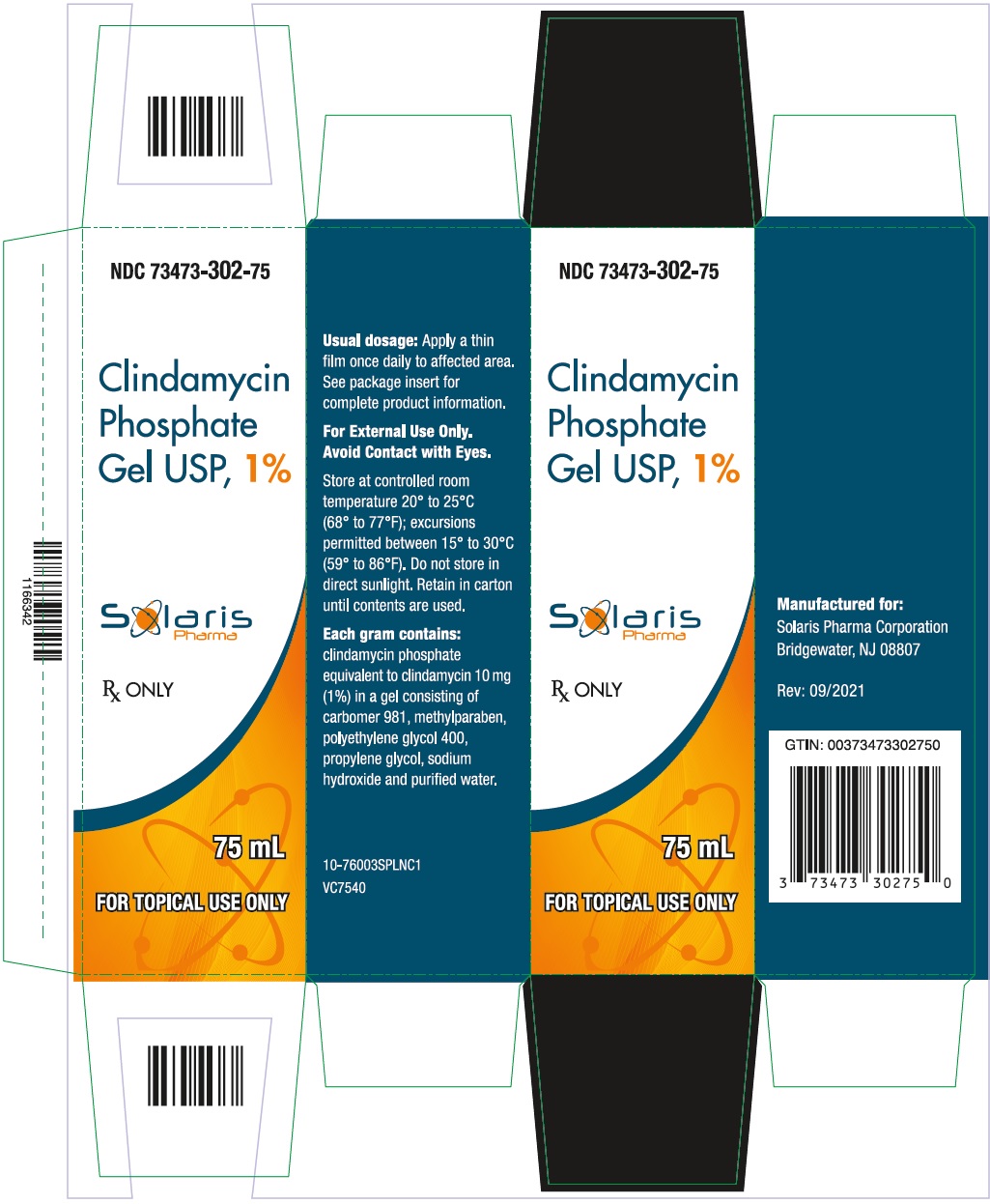
Clindamycin Phosphate 1 g/10mL Gel — NDC 73473-302-75 (Billing 73473-0302-75)
This is a package of Clindamycin Phosphate 1 g/10mL Gel from Solaris Pharma Corporation, marketed since Sep 2024 and currently FDA-listed; retail pharmacies pay about $3.40 per mL (NADAC). It is this product's only package size.
NDC database record
One package, one record: these facts belong to NDC 73473-302-75 alone.
- Record
- FDA NDC Directory package listing · Human prescription drug
- Code segments
- 73473 labeler · 302 product · 75 package
- Package marketed since
- Sep 15, 2024
- Sample package
- No — commercial package
- Listing certified through
- Dec 31, 2026
- Barcode (UPC)
- 0373473302750
- Medicaid fills, this package
- 20,099 prescriptions in the last four reported quarters
- FDA record last changed
- Jul 24, 2026
Other active recalls for Clindamycin Phosphate (different manufacturers) — 6 · tap to view
Identity & classification
Regulatory identifiers FDA, NLM and CMS codes for this package
Drug-database identifiers Medi-Span GPI and First Databank GCN / HICL / AHFS classification
- GSN (GCN sequence number): 052901
- GCN: 20176
- GPI-14 (Medi-Span): 90051010104006
- HICL (First Databank): 004045
- AHFS class code: 08:12.28.20
Where does this data come from?
- FDA openFDA NDC Directory · synced Oct 8, 2026
- FDA label on DailyMed · label index refreshed Oct 6, 2026
- RxNorm (NLM RxNav) · catalog refreshed Oct 1, 2026
- Medi-Span GPI (licensed)
- First Databank (licensed) · refreshed Oct 8, 2026
Clinical
Topical clindamycin is used to treat acne. Clindamycin is in a class of medications called lincomycin antibiotics. It works by slowing or stopping the growth of bacteria that cause acne and by decreasing swelling.
Read the full MedlinePlus article ↗- It treats serious bacterial infections, such as anaerobic infections, skin, lung, abdominal, gynecological, and bone and joint infections, depending on the product. It is often use...
- Swallow them with a full glass of water and stay upright for at least 30 minutes afterward. This helps prevent irritation of your throat. Take it as often as your prescriber says a...
- Rash, nausea, vomiting, stomach pain and itching are among the more commonly reported effects. Call your doctor right away if you get severe, watery or bloody diarrhea, even weeks...
- What side effects are normal, and when should I call you?
Patient education
Supplement & herbal interactions
Clindamycin may be associated with lower levels of 7 nutrients — worth a chat with your pharmacist, not a cause for alarm.
Where does this data come from?
- MedlinePlus (NLM) · refreshed Oct 1, 2026
- FDA label on DailyMed · label index refreshed Oct 6, 2026
Ask a licensed pharmacist directly — free, answered by our team.
Pricing
A drug doesn't have one price. Each row is a different public payment system, and none is what you'd pay at the counter — that depends on your insurance. The ⓘ on each row explains what it measures.
| Price system | Per mL | Per package |
|---|---|---|
| Retail pharmacies payNADAC · weekly | $3.402 | $255.11 / 75 ml |
| Medicaid paysCMS SDUD · 12 mo | $6.61 | $495.39 / 75 ml |
| Medicare drug plans payPart D · quarterly | No Part D plan price is available for this NDC in our data. | |
Where does this data come from?
- CMS NADAC weekly file · file of Oct 7, 2026
- CMS ASP pricing files · refreshed Sep 20, 2026
- CMS Medicaid State Drug Utilization Data · through Q4 2025
- CMS Part D plan pricing files · refreshed Sep 24, 2026
- VA National Acquisition Center price file
Packaging — all sizes for this product
| Package NDC | Description | Marketing start | Marketing end | Status |
|---|---|---|---|---|
| 73473-0302-75 You're viewing this Main listing | 1 BOTTLE in 1 CARTON / 75 mL in 1 BOTTLE | 2021-08-14 | — | Active |
Therapeutic equivalents
| Product | Labeler | Pack | NADAC/unit | TE | Status | Price vs. this |
|---|---|---|---|---|---|---|
| Clindamycin Phosphate 1 g/100mL 69238-2031-07 | Amneal | 1 bottle | $3.401 | AB2 | Availability likely | — |
| Clindamycin Phosphate 1 g/10mLthis 73473-0302-75 | Solaris | 1 bottle | $3.401 | AB2 | Availability likely | — |
| Clindamycin Phosphate 10 mg/mL 68682-0462-75 | Oceanside | 1 bottle | $5.280 | AB2 | FDA listed | +55% |
| Clindagel 10 mg/mL 16781-0462-06 | Bausch | 6 bottles | — | AB2 | FDA listed | — |
Where does this data come from?
- FDA openFDA NDC Directory · synced Oct 8, 2026
- FDA Orange Book · refreshed Oct 3, 2026
- CMS NADAC weekly file · file of Oct 7, 2026
Availability & generic status
This product is an FDA-approved generic. Other versions of the same drug are listed under Therapeutic equivalents, least expensive first.
Where does this data come from?
- FDA Orange Book · refreshed Oct 3, 2026
Inactive Ingredients / Excipients
Inactive ingredients, also called excipients, are components of the drug product other than the active ingredient. They may include fillers, dyes, coatings, preservatives, flavors, or other formulation ingredients.
🧪 Avoiding an ingredient? See Clindamycin inactive ingredients by manufacturer: every current product's list side by side, so you can ask your pharmacy for the version that does not list it.
Where does this data come from?
IACT rows and label-wide narrative are kept separate; availability and product-level specificity depend on the submitted label.- FDA label on DailyMed · label index refreshed Oct 6, 2026
- FDA openFDA NDC Directory · synced Oct 8, 2026
Inactive ingredient FAQ
Are inactive ingredients the same for every manufacturer?
Why might an inactive ingredient be missing?
Can inactive ingredients matter?
Manufacturer & labeler
More NDCs from Solaris Pharma Corporation labeler code 73473
- Clindamycin Phosphate 10 mg/g Gel NDC 73473-300-30
- Metronidazole 7.5 mg/g Gel NDC 73473-303-70
- Clindamycin Phosphate and Tretinoin 10 mg/g; .25 mg/g Gel NDC 73473-306-30
- Estradiol .75 mg/1.25g Gel NDC 73473-308-50
- Tazarotene .5 mg/g Gel NDC 73473-309-10
- Tazarotene 1 mg/g Gel NDC 73473-310-10
- Nitroglycerin 4 mg/g Ointment NDC 73473-500-30
Where does this data come from?
- FDA openFDA NDC Directory · synced Oct 8, 2026
- Drugs@FDA
Full prescribing information FDA SPL
🎯 Indications and Usage ▾
INDICATIONS AND USAGE Clindamycin phosphate gel, 1% is indicated for topical application in the treatment of acne vulgaris. In view of the potential for diarrhea, bloody diarrhea, and pseudomembranous colitis, the physician should consider whether other agents are more appropriate. (See CONTRAINDICATIONS , WARNINGS , and ADVERSE REACTIONS .)
⏱️ Dosage and Administration ▾
DOSAGE AND ADMINISTRATION Apply a thin film of clindamycin phosphate gel USP, 1% once daily to the skin where acne lesions appear. Use enough to cover the entire affected area lightly. Keep container tightly closed.
⛔ Contraindications ▾
CONTRAINDICATIONS Clindamycin phosphate gel, 1% is contraindicated in individuals with a history of hypersensitivity to preparations containing clindamycin or lincomycin, a history of regional enteritis or ulcerative colitis, or a history of antibiotic-associated colitis.
⚠️ Warnings ▾
WARNINGS Orally and parenterally administered clindamycin has been associated with severe colitis, which may result in patient death. Use of the topical formulation of clindamycin results in absorption of the antibiotic from the skin surface. Diarrhea, bloody diarrhea, and colitis (including pseudomembranous colitis) have been reported with the use of topical and systemic clindamycin.
Studies indicate a toxin(s) produced by Clostridia is one primary cause of antibiotic-associated colitis. The colitis is usually characterized by severe persistent diarrhea and severe abdominal cramps and may be associated with the passage of blood and mucus. Endoscopic examination may reveal pseudomembranous colitis.
Stool culture for Clostridium difficile and stool assay for C. difficile toxin may be helpful diagnostically. When significant diarrhea occurs, the drug should be discontinued. Large bowel endoscopy should be considered to establish a definitive diagnosis in cases of severe diarrhea.
Antiperistaltic agents, such as opiates and diphenoxylate with atropine, may prolong and/or worsen the condition. Diarrhea, colitis, and pseudomembranous colitis have been observed to begin up to several weeks following cessation of oral and parenteral therapy with clindamycin.
🤒 Adverse Reactions ▾
ADVERSE REACTIONS In the one well-controlled clinical study comparing clindamycin phosphate and its vehicle, the incidence of skin and appendages adverse events occurring in ≥1% of the patients in either group is presented below: Number (%) of Patients Body System/Adverse Event Clindamycin Phosphate QD N=168 Vehicle Gel QD N=84 Skin and appendages disorders Dermatitis 0 (0.0) 1 (1.2) Dermatitis contact 0 (0.0) 1 (1.2) Dermatitis fungal 0 (0.0) 1 (1.2) Folliculitis 0 (0.0) 1 (1.2) Photosensitivity reaction 0 (0.0) 1 (1.2) Pruritus 1 (0.6) 1 (1.2) Rash erythematous 0 (0.0) 0 (0.0) Skin dry 0 (0.0) 0 (0.0) Peeling 1 (0.6) 0 (0.0) Orally and parenterally administered clindamycin has been associated with severe colitis, which may end fatally.
Cases of diarrhea, bloody diarrhea, and colitis (including pseudomembranous colitis) have been reported as adverse reactions in patients treated with oral and parenteral formulations of clindamycin and rarely with topical clindamycin (see WARNINGS ). Abdominal pain and gastrointestinal disturbances, as well as gram-negative folliculitis, have also been reported in association with the use of topical formulations of clindamycin. To report SUSPECTED ADVERSE REACTIONS, contact Solaris Pharma Corporation at 1-833-919-0527 or FDA at 1-800-FDA-1088 or www.fda.gov/medwatch.
🆘 Overdosage ▾
OVERDOSAGE Topically applied clindamycin phosphate may be absorbed in sufficient amounts to produce systemic effects (see WARNINGS ).
🧬 Clinical Pharmacology ▾
CLINICAL PHARMACOLOGY Pharmacokinetics: In an open-label, parallel group study of 24 patients with acne vulgaris, once-daily topical administration of approximately 3 to 12 grams/day of clindamycin phosphate for 5 days resulted in peak plasma clindamycin concentrations that were less than 5.5 ng/mL. Following multiple applications of clindamycin phosphate less than 0.04% of the total dose was excreted in the urine. Microbiology: Although clindamycin phosphate is inactive in vitro , rapid in vitro hydrolysis converts this compound to clindamycin, which has antibacterial activity.
Clindamycin inhibits bacteria protein synthesis at the ribosomal level by binding to the 50S ribosomal subunit and affecting the process of peptide chain initiation. In vitro studies indicated that clindamycin inhibited all tested Propionibacterium acnes cultures at a minimum inhibitory concentration (MIC) of 0.4 mcg/mL. Cross-resistance has been demonstrated between clindamycin and erythromycin.
📦 How Supplied / Storage and Handling ▾
HOW SUPPLIED Clindamycin phosphate gel USP, 1% containing clindamycin phosphate equivalent to 10 mg clindamycin per gram, is available in the following size: 75 mL bottle - NDC 73473-302-75 Store at controlled room temperature 20° to 25°C (68° to 77°F); excursions permitted between 15° to 30°C (59° to 86°F). Do not store in direct sunlight. Manufactured for: Solaris Pharma Corporation Bridgewater, NJ 08807,USA Revised 08/2021
📋 Description ▾
DESCRIPTION Clindamycin phosphate gel USP, 1%, a topical antibiotic, contains clindamycin phosphate, at a concentration equivalent to 10 mg clindamycin per gram in a gel vehicle consisting of carbomer 981, methylparaben, polyethylene glycol 400, propylene glycol, purified water, and sodium hydroxide. Chemically, clindamycin phosphate is a water-soluble ester of the semi-synthetic antibiotic produced by a 7 (S)-chlorosubstitution of the 7 (R)-hydroxyl group of the parent antibiotic, lincomycin, and has the structural formula represented below: The chemical name for clindamycin phosphate is methyl 7-chloro-6,7,8-trideoxy-6-(1-methyl- trans -4-propyl-L-2-pyrrolidinecarboxamido)-1-thio-L- threo -a-D- galacto -octopyranoside 2-(dihydrogen phosphate). structure
⚠️ Precautions ▾
PRECAUTIONS General: Clindamycin phosphate should be prescribed with caution in atopic individuals. Drug Interactions: Clindamycin has been shown to have neuromuscular blocking properties that may enhance the action of other neuromuscular blocking agents. Therefore, it should be used with caution in patients receiving such agents.
Carcinogenesis, Mutagenesis, Impairment of Fertility: The carcinogenicity of a 1% clindamycin phosphate gel similar to clindamycin phosphate was evaluated by daily application to mice for 2 years. The daily doses used in this study were approximately 3 and 15 times higher than the human dose of clindamycin phosphate from 5 mL of clindamycin phosphate assuming complete absorption and based on a body surface area comparison. No significant increase in tumors was noted in the treated animals.
A 1% clindamycin phosphate gel similar to clindamycin phosphate caused a statistically significant shortening of the median time to tumor onset in a study in hairless mice in which tumors were induced by exposure to simulated sunlight. Genotoxicity tests performed included a rat micronucleus test and an Ames Salmonella reversion test. Both tests were negative.
Reproduction studies in rats using oral doses of clindamycin hydrochloride and clindamycin palmitate hydrochloride have revealed no evidence of impaired fertility. Pregnancy: Teratogenic Effects: Reproduction studies have been performed in rats and mice using subcutaneous and oral doses of clindamycin phosphate, clindamycin hydrochloride, and clindamycin palmitate hydrochloride. These studies revealed no evidence of fetal harm.
The highest dose used in the rat and mouse teratogenicity studies was equivalent to a clindamycin phosphate dose of 432 mg/kg. For a rat, this dose is 84- fold higher and for a mouse, 42-fold higher than the anticipated human dose of clindamycin phosphate from clindamycin phosphate based on a mg/m 2 comparison. There are, however, no adequate and well-controlled studies in pregnant women.
Because animal reproduction studies are not always predictive of human response, this drug should be used during pregnancy only if clearly needed. Nursing Mothers: It is not known whether clindamycin is excreted in human milk following use of clindamycin phosphate. However, orally and parenterally administered clindamycin has been reported to appear in breast milk.
Because of the potential for serious adverse reactions in nursing infants, a decision should be made whether to discontinue nursing or to discontinue the drug, taking into account the importance of the drug to the mother. Pediatric Use: Safety and effectiveness in children under the age of 12 have not been established. Geriatric Use: The clinical study with clindamycin phosphate did not include sufficient numbers of patients aged 65 and over to determine if they respond differently than younger patients.
🔬 Clinical Studies ▾
CLINICAL STUDIES In one 12-week multicenter, randomized, evaluator-blind, vehicle-controlled, parallel comparison clinical trial in which patients used clindamycin phosphate gel, 1% once daily or the vehicle gel once daily, in the treatment of acne vulgaris of mild to moderate severity, clindamycin phosphate applied once daily was more effective than the vehicle applied once daily. The mean percent reductions in lesion counts at the end of treatment in this study are shown in the following table: *P<0.05 Lesions Clindamycin Phosphate QD N=162 Vehicle Gel QD N=82 Inflammatory 51% 40% * Noninflammatory 25% 12% * Total 38% 27% * There was a trend in the investigator's global assessment of the results, which favored clindamycin phosphate QD over the vehicle QD.
In a contact sensitization study, four of the 200 subjects appeared to develop suggestive evidence of allergic contact sensitization to clindamycin phosphate. There was no signal for contact sensitization in the clinical trials under normal use conditions.
📄 Package Label / Principal Display Panel ▾
PACKAGE LABEL PRINCIPAL DISPLAY PANEL 75 mL Carton Label NDC 73473- 302 -75 Clindamycin Phosphate Gel USP, 1% For Topical Use Only. Rx only 75 mL carton