
Revuforj revumenib 160 mg Tablet, Film Coated, 30-count — NDC 73555-502-00 (Billing 73555-0502-00)
This is a package of 30 tablets of Revuforj revumenib 160 mg Tablet, Film Coated from Syndax Pharmaceuticals, Inc., marketed since Nov 2024 and currently FDA-listed. It is this product's only package size.
NDC database record
One package, one record: these facts belong to NDC 73555-502-00 alone.
- Record
- FDA NDC Directory package listing · Human prescription drug
- Code segments
- 73555 labeler · 502 product · 00 package
- Package marketed since
- Nov 15, 2024
- Sample package
- No — commercial package
- Listing certified through
- Dec 31, 2027
- Billing quantity
- 30 EA per package
- Barcode (UPC)
- 0300000000001
- Medicaid fills, this package
- 67 prescriptions in the last four reported quarters
- FDA record last changed
- Jul 24, 2026
Identity & classification
Regulatory identifiers FDA, NLM and CMS codes for this package
Drug-database identifiers Medi-Span GPI and First Databank GCN / HICL / AHFS classification
- GSN (GCN sequence number): 086753
- GCN: 56517
- GPI-14 (Medi-Span): 21480070200350
- HICL (First Databank): 050008
- AHFS class code: 10:00.00.00
- RxCUI (RxNorm): 2698331
Where does this data come from?
- FDA openFDA NDC Directory · synced Oct 8, 2026
- FDA label on DailyMed · label index refreshed Oct 6, 2026
- RxNorm (NLM RxNav) · catalog refreshed Oct 1, 2026
- Medi-Span GPI (licensed)
- First Databank (licensed) · refreshed Oct 8, 2026
RxNorm drug class
This medicine belongs to the Other antineoplastic agents class.
Where does this data come from?
- RxClass (NLM) · catalog refreshed Oct 1, 2026
Clinical
Patient education
Supplement & herbal interactions
Where does this data come from?
- MedlinePlus (NLM) · refreshed Oct 1, 2026
- FDA label on DailyMed · label index refreshed Oct 6, 2026
Ask a licensed pharmacist directly — free, answered by our team.
Pricing
A drug doesn't have one price. Each row is a different public payment system, and none is what you'd pay at the counter — that depends on your insurance. The ⓘ on each row explains what it measures.
| Price system | Per each | Per package |
|---|---|---|
| Retail pharmacies payNADAC · weekly | Not in the retail survey — common for institutional, discontinued, or low-volume packs. | |
| Medicaid paysCMS SDUD · 12 mo | $663.03 | $19,890.81 / 30 tablets |
| Medicare drug plans payPart D · Q2 2026 | $693.01 | $20,790.23 / 30 tablets |
Where does this data come from?
- CMS NADAC weekly file
- CMS ASP pricing files · refreshed Sep 20, 2026
- CMS Medicaid State Drug Utilization Data · through Q4 2025
- CMS Part D plan pricing files · refreshed Sep 24, 2026
- VA National Acquisition Center price file
Packaging — all sizes for this product
| Package NDC | Description | Marketing start | Marketing end | Status |
|---|---|---|---|---|
| 73555-0502-00 You're viewing this Main listing | 30 TABLET, FILM COATED in 1 BOTTLE, PLASTIC | 2024-11-15 | — | Active |
Therapeutic equivalents
| Product | Labeler | Pack | NADAC/unit | TE | Status | Price vs. this |
|---|---|---|---|---|---|---|
| Revuforj 160 mgthis 73555-0502-00 | Syndax | 30 tablets | — | — | FDA listed | — |
Where does this data come from?
- FDA openFDA NDC Directory · synced Oct 8, 2026
- FDA Orange Book · refreshed Oct 3, 2026
- CMS NADAC weekly file
Availability & generic status
We did not find an FDA-approved generic match for this exact strength, form and route. Patent/protection dates below may affect future generic timing.
Why the date isn’t exact: Generic timing can change because patents may be challenged, settled, licensed, added, removed, or worked around with a narrower label — and FDA approval does not always mean a pharmacy can get the generic today.
🛈 What do these terms mean?
- Patent
- Legal protection listed in the Orange Book that may delay generic approval or launch. Issued by the U.S. Patent & Trademark Office.
- Substance patent
- Covers the active drug molecule itself — the hardest to design around. A generic generally can’t launch until it expires.
- Formulation (product) patent
- Covers a specific formulation or dosage form. A generic can sometimes work around it with a different formulation.
- Method-of-use patent
- A patent covering one specific approved use of the drug — not necessarily the whole molecule. A generic can sometimes launch with a “skinny label” that carves out the protected use and keeps the others.
- Skinny label
- A generic label that omits a still-patented use when the FDA allows it — letting a generic reach the market for the unprotected uses.
- Exclusivity
- FDA-granted marketing protection, separate from patents — e.g. 5-yr new chemical entity, 7-yr orphan drug, or a +6-month pediatric extension.
- Paragraph IV
- A generic applicant’s formal challenge to a listed patent. It can potentially lead to earlier generic entry, but often involves litigation or a settlement.
- RLD / RS
- Reference Listed Drug — the brand product the FDA uses as the reference for generic applications. Reference Standard — the product the FDA expects generics to compare against in bioequivalence testing.
- TE / AB rating
- FDA therapeutic-equivalence rating. An AB rating generally means the FDA considers a generic therapeutically equivalent to — and substitutable for — the brand.
- LOE (loss of exclusivity)
- The latest patent or exclusivity currently listed — the loss-of-exclusivity / latest-listed-protection date shown on this page. Paragraph-IV challenges and settlements can move the real date earlier; FDA approval and a manufacturer’s decision to market can move it later.
Built from the FDA Orange Book. The bars above are scaled to each protection’s expiry; the red LOE marker is the last one to lapse.
| Patent | Type | Use code | Expires |
|---|---|---|---|
| US 12564590 ↗ | Method of use | U-4045 | Dec 18, 2042 |
| US 12564590 ↗ | Method of use | U-4327 | Dec 18, 2042 |
| US 12564590 ↗ | Method of use | U-4327 | Dec 18, 2042 |
| US 12564590 ↗ | Method of use | U-4327 | Dec 18, 2042 |
| US 12564590 ↗ | Method of use | U-4045 | Dec 18, 2042 |
| US 12564590 ↗ | Method of use | U-4045 | Dec 18, 2042 |
| US 11479557 ↗ | Method of use | U-4327 | Jun 8, 2037 |
| US 11479557 ↗ | Method of use | U-4327 | Jun 8, 2037 |
| US 11479557 ↗ | Method of use | U-4327 | Jun 8, 2037 |
| US 11479557 ↗ | Method of use | U-4045 | Jun 8, 2037 |
| US 11479557 ↗ | Method of use | U-4045 | Jun 8, 2037 |
| US 11479557 ↗ | Method of use | U-4045 | Jun 8, 2037 |
| US 10683302 ↗ | Drug substance | — | Jun 8, 2037 |
| US 10683302 ↗ | Drug substance | — | Jun 8, 2037 |
| US 10683302 ↗ | Drug substance | — | Jun 8, 2037 |
| Code | What it grants | Expires |
|---|---|---|
| NCE | New Chemical Entity (5-year) | Nov 15, 2029 |
| ODE-502 | Orphan Drug Exclusivity (7-year) | Nov 15, 2031 |
| ODE-504 | Orphan Drug Exclusivity (7-year) | Nov 15, 2031 |
| ODE-505 | Orphan Drug Exclusivity (7-year) | Nov 15, 2031 |
| NCE | New Chemical Entity (5-year) | Nov 15, 2029 |
| ODE-502 | Orphan Drug Exclusivity (7-year) | Nov 15, 2031 |
| ODE-504 | Orphan Drug Exclusivity (7-year) | Nov 15, 2031 |
| ODE-505 | Orphan Drug Exclusivity (7-year) | Nov 15, 2031 |
| NCE | New Chemical Entity (5-year) | Nov 15, 2029 |
| ODE-502 | Orphan Drug Exclusivity (7-year) | Nov 15, 2031 |
| ODE-504 | Orphan Drug Exclusivity (7-year) | Nov 15, 2031 |
| ODE-505 | Orphan Drug Exclusivity (7-year) | Nov 15, 2031 |
Is there a generic version of REVUFORJ 160 MG TABLET?
The FDA approved a generic — why can’t I get it at my pharmacy yet?
Why do different websites show different generic release dates?
What does “FDA listed” mean?
What does a patent or protection date mean here?
What does “current Orange Book estimate” mean?
Can a generic come out before the last patent expires?
Can a generic come out after the listed dates?
What is the difference between patents and exclusivity?
Why are there multiple patent dates?
Where does this data come from?
- FDA Orange Book · refreshed Oct 3, 2026
What it looks like
Where does this data come from?
- FDA label on DailyMed · label index refreshed Oct 6, 2026
Inactive Ingredients / Excipients
Inactive ingredients, also called excipients, are components of the drug product other than the active ingredient. They may include fillers, dyes, coatings, preservatives, flavors, or other formulation ingredients.
Where does this data come from?
IACT rows and label-wide narrative are kept separate; availability and product-level specificity depend on the submitted label.- FDA label on DailyMed · label index refreshed Oct 6, 2026
- FDA openFDA NDC Directory · synced Oct 8, 2026
Inactive ingredient FAQ
Are inactive ingredients the same for every manufacturer?
Why might an inactive ingredient be missing?
Can inactive ingredients matter?
Manufacturer & labeler
More NDCs from Syndax Pharmaceuticals, Inc. labeler code 73555
Where does this data come from?
- FDA openFDA NDC Directory · synced Oct 8, 2026
- Drugs@FDA
Full prescribing information FDA SPL
🚨 Boxed Warning ▾
WARNING: DIFFERENTIATION SYNDROME, QTc PROLONGATION and TORSADES DE POINTES Differentiation syndrome, which can be fatal, has occurred with REVUFORJ. Signs and symptoms may include fever, dyspnea, hypoxia, pulmonary infiltrates, pleural or pericardial effusions, rapid weight gain or peripheral edema, hypotension, and renal dysfunction. If differentiation syndrome is suspected, immediately initiate corticosteroid therapy and hemodynamic monitoring until symptom resolution. [see Dosage and Administration (2.3 ) , Warnings and Precautions (5.1) , and Adverse Reactions (6.1) ] .
QTc prolongation and Torsades de Pointes have occurred in patients receiving REVUFORJ. Correct hypokalemia and hypomagnesemia prior to and during treatment. Do not initiate REVUFORJ in patients with QTcF > 450 msec.
If QTc interval prolongation occurs, interrupt, reduce, or permanently discontinue REVUFORJ. [see Dosage and Administration (2.3) , Warnings and Precautions (5.2) , and Adverse Reactions (6.1) ] WARNING: DIFFERENTIATION SYNDROME, and QTc PROLONGATION and TORSADES DE POINTES See full prescribing information for complete boxed warning. Differentiation syndrome, which can be fatal, has occurred with REVUFORJ. If differentiation syndrome is suspected, immediately initiate corticosteroid therapy and hemodynamic monitoring until symptom resolution ( 2.3 , 5.1 ) QTc prolongation and Torsades de Pointes have occurred in patients receiving REVUFORJ.
Correct hypokalemia and hypomagnesemia prior to and during treatment. Do not initiate REVUFORJ in patients with QTcF > 450 msec. If QTc interval prolongation occurs, interrupt, reduce, or permanently discontinue REVUFORJ.
( 2.3 , 5.2 ).
🎯 Indications and Usage ▾
1 INDICATIONS AND USAGE REVUFORJ is a menin inhibitor indicated for: the treatment of relapsed or refractory acute leukemia with a lysine methyltransferase 2A gene ( KMT2A ) translocation as determined by an FDA-authorized test in adult and pediatric patients 1 year and older. ( 1 ) the treatment of relapsed or refractory acute myeloid leukemia (AML) with a susceptible nucleophosmin 1 ( NPM1 ) mutation in adult and pediatric patients 1 year and older who have no satisfactory alternative treatment options. ( 1 ) Relapsed or Refractory Acute Leukemia REVUFORJ is indicated for the treatment of relapsed or refractory acute leukemia with a lysine methyltransferase 2A gene ( KMT2A ) translocation as determined by an FDA-authorized test in adult and pediatric patients 1 year and older.
REVUFORJ is indicated for the treatment of relapsed or refractory acute myeloid leukemia with a susceptible nucleophosmin 1 ( NPM1 ) mutation [see Dosage and Administration (2.1) , Clinical Pharmacology (12.1) , and Clinical Studies (14.1) ] in adult and pediatric patients 1 year and older who have no satisfactory alternative treatment options.
⏱️ Dosage and Administration ▾
2 DOSAGE AND ADMINISTRATION Select patients for treatment with REVUFORJ based on the presence of a KMT2A translocation or an NPM1 mutation. ( 2.1 ) Administer REVUFORJ orally twice daily fasted or with a low-fat meal at approximately the same time each day. ( 2.2 ) See Full Prescribing Information for recommended REVUFORJ dosage regimen, dosage modifications, and administration instructions. ( 2.2 , 2.3 )
2.1Patient Selection Relapsed or Refractory Acute Leukemia with a KMT2A Translocation Select patients for treatment with REVUFORJ based on the presence of a KMT2A translocation [see Clinical Studies (14.1) ] . Information on FDA authorized tests for the detection of a KMT2A translocation to determine eligibility for treatment is available at https://www.accessdata.fda.gov/scripts/cdrh/cfdocs/cfpmn/denovo.cfm?id=DEN240067 Relapsed or Refractory Acute Myeloid Leukemia with an NPM1 mutation Select patients for treatment with REVUFORJ based on the presence of an NPM1 mutation [see Clinical Pharmacology (12.1 ) and Clinical Studies (14.2) ] .
An FDA-approved companion diagnostic for the detection of an NPM1 mutation is not currently available.
2.2Recommended Dosage The recommended dosage of REVUFORJ varies by patient weight and concomitant use of strong CYP3A4 inhibitors. See Table 1 for the recommended dosage for patients 1 year and older. Do not start REVUFORJ until the WBC is reduced to less than 25 Gi/L.
Continue REVUFORJ until disease progression or unacceptable toxicity. For patients without disease progression or unacceptable toxicity, treat for a minimum of 6 months to allow time for clinical response. Table 1.
REVUFORJ Recommended Dosage for Patients 1 Year and Older *See Table 2 for the total tablet dosage by BSA (body surface area) for patients weighing less than 40 kg. Patient Weight Without Strong CYP3A4 Inhibitors With Strong CYP3A4 Inhibitors 40 kg or more 270 mg orally twice daily 160 mg orally twice daily Less than 40 kg 160 mg/m 2 orally twice daily* 95 mg/m 2 orally twice daily* Table 2: Recommended Dosage using Tablets* for Patients Weighing Less than 40 kg * If needed, attain the desired dose by combining different strengths of REVUFORJ tablets.
BSA (m 2 ) REVUFORJ Dosage for 160 mg/m 2 REVUFORJ Dosage for 95 mg/m 2 1.4 220 mg twice daily 135 mg twice daily 1.3 220 mg twice daily 135 mg twice daily 1.2 185 mg twice daily 110 mg twice daily 1.1 185 mg twice daily 110 mg twice daily 1 160 mg twice daily 100 mg twice daily 0.9 135 mg twice daily 75 mg twice daily 0.8 135 mg twice daily 75 mg twice daily 0.7 110 mg twice daily 50 mg twice daily 0.6 100 mg twice daily 50 mg twice daily 0.5 75 mg twice daily 50 mg twice daily 0.4 50 mg twice daily 25 mg twice daily If the strong CYP3A4 inhibitor is discontinued, increase the REVUFORJ dose after at least 5 half-lives of the strong CYP3A4 inhibitor to the recommended dosage without strong CYP3A4 inhibitors (Table 1).
Concurrent use of standard intrathecal chemotherapy prophylaxis is recommended for patients with risk of central nervous system relapse. Administration: Correct hypokalemia, hypomagnesemia, and other electrolyte abnormalities prior to treatment. Administer REVUFORJ twice daily fasted or with a low-fat meal (e.g., meals with approximately 400 calories, 25% or less fat).
Administer REVUFORJ orally around the same time each day. Advise patients to swallow tablets whole and to not cut or chew tablets. If patients are unable to swallow tablets, they may be crushed and dispersed in water and taken within 2 hours of preparation [see Instructions for Use ] .
If a dose of REVUFORJ is missed or not taken at the usual time, administer the dose as soon as possible on the same day and at least 12 hours prior to the next scheduled dose. Return to the normal schedule the following day. Do not administer 2 doses within 12 hours.
2.3Dosage Modifications for Adverse Reactions Assess blood counts, electrolytes, and liver enzymes prior to the initiation of REVUFORJ and mo… [Excerpted — this section continues on DailyMed.]
💊 Dosage Forms and Strengths ▾
3 DOSAGE FORMS AND STRENGTHS Tablets: 25 mg, 110 mg, 160 mg ( 3 ) Tablets: 25 mg of revumenib: Pink modified oval film-coated tablet debossed with “S” on one side and “25” on the other side. 110 mg of revumenib: Beige modified oval film-coated tablet debossed with “S” on one side and “110” on the other side. 160 mg of revumenib: Purple modified oval film-coated tablet debossed with “S” on one side and “160” on the other side.
⛔ Contraindications ▾
4 CONTRAINDICATIONS None. None. ( 4 )
⚠️ Warnings and Cautions ▾
5 WARNINGS AND PRECAUTIONS Embryo-Fetal Toxicity : Can cause fetal harm. Advise females of reproductive potential and males with female partners of reproductive potential of potential risk to a fetus and to use effective contraception . ( 5.3 , 8.1 , 8.3 )
5.1Differentiation Syndrome REVUFORJ can cause fatal or life-threatening differentiation syndrome (DS). Symptoms of differentiation syndrome, including those seen in patients treated with REVUFORJ, include fever, dyspnea, hypoxia, peripheral edema, pleuropericardial effusion, acute renal failure, rash, and/or hypotension. In clinical trials, DS occurred in 60 (25%) of 241 patients treated with REVUFORJ at the recommended dosage for relapsed or refractory acute leukemia [see Adverse Reactions (6.1) ] .
Among those with a KMT2A translocation, DS occurred in 33% of patients with acute myeloid leukemia (AML), 33% of patients with mixed-phenotype acute leukemia (MPAL), and 9% of patients with acute lymphoblastic leukemia (ALL); DS occurred in 18% of patients with NPM1 mutated AML. DS was Grade 3 or 4 in 12% of patients and fatal in two patients. The median time to initial onset was 9 days (range 3-41 days).
Some patients experienced more than 1 DS event. Treatment interruption was required for 7% of patients, and treatment was withdrawn for 1%. Reduce the white blood cell count (WBC) to less than 25 Gi/L prior to starting REVUFORJ.
If DS is suspected, immediately initiate treatment with systemic corticosteroids (e.g., dexamethasone 10 mg intravenously every 12 hours in adults or dexamethasone 0.25 mg/kg/dose intravenously every 12 hours in pediatric patients weighing less than 40 kg) for a minimum of 3 days and until resolution of signs and symptoms. Institute supportive measures and hemodynamic monitoring until improvement. Interrupt REVUFORJ if severe signs and/or symptoms persist for more than 48 hours after initiation of systemic corticosteroids, or earlier if life-threatening symptoms occur such as pulmonary symptoms requiring ventilator support.
Restart steroids promptly if DS recurs after tapering corticosteroids [see Dosage and Administration (2.3) ].
5.2QTc Interval Prolongation and Torsades de Pointes REVUFORJ can cause QT (QTc) interval prolongation and Torsades de Pointes [see Clinical Pharmacology (12.2) ] . Of the 241 patients treated with REVUFORJ at the recommended dosage for relapsed or refractory acute leukemia in clinical trials, QTc interval prolongation was reported as an adverse reaction in 86 (36%) of patients. QTc interval prolongation was Grade 3 in 15% and Grade 4 in 2%.
The heart-rate corrected QT interval (using Fridericia’s method) (QTcF) was greater than 500 msec in 10%, and the increase from baseline QTcF was greater than 60 msec in 24%. REVUFORJ dose reduction was required for 7% due to QTc interval prolongation [see Adverse Reactions (6.1)] . QTc prolongation occurred in 21% of the 34 patients less than 17 years old, 35% of the 146 patients 17 years to less than 65 years old, and in 46% of the 61 patients 65 years or older.
One patient had a fatal outcome of cardiac arrest, and one patient had nonsustained Torsades de Pointes. Correct electrolyte abnormalities, including hypokalemia and hypomagnesemia, prior to and throughout treatment with REVUFORJ. Perform an ECG prior to initiation of treatment with REVUFORJ, and do not initiate REVUFORJ in patients with QTcF > 450 msec.
Perform an ECG at least once a week for the first 4 weeks on treatment, and at least monthly thereafter [see Dosage and Administration (2.3) ] . In patients with congenital long QTc syndrome, congestive heart failure, electrolyte abnormalities, or those who are taking medications known to prolong the QTc interval, more frequent ECG monitoring may be necessary. Concomitant use of REVUFORJ with drugs known to prolong the QTc interval may increase the risk of QTc interval prolongation. [see Drug Interactions (7.1) , Clinical Pharmacology (12.2) ] .
Interrupt REVUFORJ if QTcF inc… [Excerpted — this section continues on DailyMed.]
🤒 Adverse Reactions ▾
6 ADVERSE REACTIONS The following clinically significant adverse reactions are described elsewhere in the labeling: Differentiation Syndrome [see Warnings and Precautions (5.1) ] QTc Interval Prolongation and Torsades de Pointes [see Warnings and Precautions (5.2) ] The most common adverse reactions (≥ 20%) including laboratory abnormalities, are phosphate increased, hemorrhage, nausea, infection without identified pathogen, aspartate aminotransferase increased, alanine aminotransferase increased, creatinine increased, musculoskeletal pain, febrile neutropenia, electrocardiogram QT prolonged, potassium decreased, parathyroid hormone intact increased, alkaline phosphatase increased, diarrhea, bacterial infection, triglycerides increased, differentiation syndrome, fatigue, edema, viral infection, phosphate decreased, decreased appetite, and constipation.
( 6.1 ) To report SUSPECTED ADVERSE REACTIONS, contact Syndax Pharmaceuticals, Inc., at 1-888-539-3REV or FDA at 1-800-FDA-1088 or www.fda.gov/medwatch .
6.1Clinical Trials Experience Because clinical trials are conducted under widely varying conditions, adverse reaction rates observed in the clinical trials of a drug cannot be directly compared to rates in the clinical trials of another drug and may not reflect the rates observed in practice. The safety of REVUFORJ reflects exposure in 241 patients (207 adult and 34 pediatric patients) with relapsed or refractory (R/R) acute leukemia with a KMT2A translocation or an NPM1 mutation treated with REVUFORJ at a dose approximately equivalent to 160 mg in adults orally twice daily with a strong CYP3A4 inhibitor [see Clinical Studies (14) ] .
The median duration of exposure to REVUFORJ was 2.5 months (range < 1 to 40 months), and 10% of patients were exposed for more than 6 months. Fatal adverse reactions occurred in 9 (4%) patients who received REVUFORJ, including 4 with sudden death, 2 with differentiation syndrome, 2 with hemorrhage, and 1 with cardiac arrest. Serious adverse reactions were reported in 184 (76%) patients.
The most frequent serious adverse reactions (≥ 10%) were infection (29%), febrile neutropenia (20%), bacterial infection (15%), differentiation syndrome (13%), and hemorrhage (11%). Adverse reactions leading to dose interruption occurred in 49% of patients. The most common adverse reactions (≥ 5%) leading to dose interruption were electrocardiogram QT prolonged, infection, febrile neutropenia, differentiation syndrome, nausea, and hypokalemia.
Adverse reactions leading to dose reduction occurred in 12% of patients who received REVUFORJ. Adverse reactions leading to a dose reduction (≥ 5%) included electrocardiogram QT prolonged. Adverse reactions leading to permanent discontinuation occurred in 20% of patients.
Adverse reactions resulting in permanent discontinuation (> 1%) included infection. The most common (≥ 20%) adverse reactions were phosphate increased, hemorrhage, nausea, infection without identified pathogen, aspartate aminotransferase increased, alanine aminotransferase increased, creatinine increased, musculoskeletal pain, febrile neutropenia, electrocardiogram QT prolonged, potassium decreased, parathyroid hormone intact increased, alkaline phosphatase increased, diarrhea, bacterial infection, triglycerides increased, differentiation syndrome, fatigue, edema, viral infection, phosphate decreased, decreased appetite, and constipation.
The common adverse reactions are summarised in Table 7. Table 7. Adverse Reactions Reported in ≥ 20% (Any Grade) or ≥ 5% (Grade 3 or 4) in Patients with R/R Acute Leukemia # Includes the following fatal adverse reactions: DS (n=2); hemorrhage (n=2) a – Includes nausea and vomiting b – includes diarrhea, colitis, and neutropenic colitis c – includes epistaxis, contusion, petechiae, gingival bleeding, hematoma, hemoptysis, hemorrhoidal hemorrhage, mouth hemorrhage, hematuria, ecchymosis, hemorrhage intracranial, subdural hematoma, upper gastrointestinal hemorrhage, gastroint… [Excerpted — this section continues on DailyMed.]
🔄 Drug Interactions ▾
7 DRUG INTERACTIONS Strong CYP3A4 Inhibitors: Reduce the REVUFORJ dose. ( 2.2 , 7.1 ) Strong or moderate CYP3A4 Inducers: Avoid concomitant use with REVUFORJ. ( 7.1 ) QTc Prolonging Drugs: Avoid concomitant use with REVUFORJ. If concomitant use is unavoidable, monitor patients more frequently for QTc interval prolongation. ( 5.2 , 7.1 )
7.1Effect of Other Drugs on REVUFORJ Strong CYP3A4 Inhibitors If concomitant use of strong CYP3A4 inhibitors is required, reduce the REVUFORJ dosage [see Recommended Dosage (2.2) ] . Revumenib is primarily metabolized by CYP3A4 [see Clinical Pharmacology (12.3) ] . Concomitant use with a strong CYP3A4 inhibitor increases revumenib systemic exposure [see Clinical Pharmacology(12.3) ] , which may increase the risk of REVUFORJ adverse reactions.
Strong or Moderate CYP3A4 Inducers Avoid concomitant use with strong or moderate CYP3A4 inducers. Revumenib is primarily metabolized by CYP3A4 [see Clinical Pharmacology (12.3) ] . Concomitant use with a strong or moderate CYP3A4 inducer may decrease revumenib and increase M1 systemic exposure [see Clinical Pharmacology (12.3) ] , which may reduce REVUFORJ efficacy or increase the risk of QT prolongation associated with the M1 metabolite.
Drugs that Prolong QTc Interval Avoid concomitant use of REVUFORJ with other drugs with a known potential to prolong QTc interval. If concomitant use cannot be avoided, obtain ECGs when initiating, during concomitant use, and as clinically indicated [see Warnings and Precautions (5.2) ] . Withhold REVUFORJ if the QTc interval is greater than 480 msec.
Restart REVUFORJ after the QTc interval returns to less than or equal to 480 msec [see Dosage and Administration (2.3) ] . REVUFORJ causes QTc interval prolongation [see Clinical Pharmacology (12.2) ] . Concomitant use of REVUFORJ with other drugs that prolong QTc interval may result in an increase in the QTc interval and adverse reactions associated with QTc interval prolongation [see Warnings and Precautions(5.2) ].
👥 Use in Specific Populations ▾
8 USE IN SPECIFIC POPULATIONS Lactation: Advise not to breastfeed ( 8.2 )
8.1Pregnancy Risk Summary Based on findings in animals and its mechanism of action [see Clinical Pharmacology (12.1) ], REVUFORJ can cause fetal harm when administered to a pregnant woman. There are no available data on REVUFORJ use in pregnant women to evaluate for a drug-associated risk. In an animal reproduction study, oral administration of revumenib to pregnant rats during the period of organogenesis caused adverse developmental outcomes, including embryo-fetal mortality, malformations, and altered fetal growth at maternal exposures approximately 0.5 times the human exposure (AUC) at the recommended dose (see Data).
Advise pregnant women of the potential risk to a fetus. In the U.S. general population, the estimated background risk of major birth defects and miscarriage in clinically recognized pregnancies is 2%-4% and 15%-20%, respectively. Data Animal Data In an embryo-fetal development study, revumenib was administered once daily via oral gavage at doses of 30, 100, and 300 mg/kg/day to pregnant rats during the period of organogenesis (gestation days 6-17).
Decreased maternal body weight gain and adverse embryo-fetal findings including decreases in the number of live fetuses, increases in resorptions and post-implantation loss, and decreases in fetal body weight were observed at all doses. At 300 mg/kg/day, total litter resorption and eye malformations were observed. At the dose of 30 mg/kg/day in rats, the maternal exposures (AUC) were approximately 0.5 times the human exposure at the recommended dose.
8.2Lactation Risk Summary There are no data on the presence of revumenib or its metabolites in human milk or the effects on the breastfed child or milk production. Because of the potential for serious adverse reactions in a breastfed child, advise women not to breastfeed during treatment with REVUFORJ and for 1 week after the last dose.
8.3Females and Males of Reproductive Potential Based on findings in animals and its mechanism of action, REVUFORJ can cause fetal harm when administered to pregnant women [ see Use in Specific Populations (8.1) ] . Pregnancy Testing Verify pregnancy status in females of reproductive potential within 7 days prior to initiating REVUFORJ. Contraception Females Advise females of reproductive potential to use effective contraception during treatment with REVUFORJ and for 4 months after the last dose.
Males Advise males of reproductive potential to use effective contraception during treatment with REVUFORJ and for 4 months after the last dose. Infertility Females and Males Based on findings in animals, REVUFORJ may impair fertility. The effects on fertility were reversible [see Nonclinical Toxicology (13.1) ] .
8.4Pediatric Use The safety and efficacy of REVUFORJ have been established in pediatric patients 1 year and older with relapsed or refractory acute leukemia with a KMT2A translocation or an NPM1 mutation. Use of REVUFORJ for this indication is supported by evidence from adequate and well-controlled trials in adults and pediatric patients [see Clinical Studies (14) ] and additional pharmacokinetic and safety data in pediatric patients [see Adverse Reactions (6.1) and Clinical Pharmacology (12.3) ] . The patients included 25 infants (age < 2 years), 78 children (age 2 to < 12 years) and 29 adolescents (age 12 to < 17 years).
The recommended dosage in patients weighing less than 40 kg is BSA-based. The safety and efficacy of REVUFORJ in pediatric patients less than 1 year old have not been established . Animal Data In a repeat dose toxicity study in 6-7 week-old rats treated with revumenib at 75, 150, or 300 mg/kg/day for 13 weeks, an irreversible increase in femur growth plate closure was observed at revumenib exposures approximately 2 times the human exposure (AUC) at the recommended dose.
Based on the findings in animals, monitor bone growth and development in pediatric patients.
8.5Geriatric Use Of the 241 p… [Excerpted — this section continues on DailyMed.]
🤰 Pregnancy ▾
8.1Pregnancy Risk Summary Based on findings in animals and its mechanism of action [see Clinical Pharmacology (12.1) ], REVUFORJ can cause fetal harm when administered to a pregnant woman. There are no available data on REVUFORJ use in pregnant women to evaluate for a drug-associated risk. In an animal reproduction study, oral administration of revumenib to pregnant rats during the period of organogenesis caused adverse developmental outcomes, including embryo-fetal mortality, malformations, and altered fetal growth at maternal exposures approximately 0.5 times the human exposure (AUC) at the recommended dose (see Data).
Advise pregnant women of the potential risk to a fetus. In the U.S. general population, the estimated background risk of major birth defects and miscarriage in clinically recognized pregnancies is 2%-4% and 15%-20%, respectively. Data Animal Data In an embryo-fetal development study, revumenib was administered once daily via oral gavage at doses of 30, 100, and 300 mg/kg/day to pregnant rats during the period of organogenesis (gestation days 6-17).
Decreased maternal body weight gain and adverse embryo-fetal findings including decreases in the number of live fetuses, increases in resorptions and post-implantation loss, and decreases in fetal body weight were observed at all doses. At 300 mg/kg/day, total litter resorption and eye malformations were observed. At the dose of 30 mg/kg/day in rats, the maternal exposures (AUC) were approximately 0.5 times the human exposure at the recommended dose.
🧒 Pediatric Use ▾
8.4Pediatric Use The safety and efficacy of REVUFORJ have been established in pediatric patients 1 year and older with relapsed or refractory acute leukemia with a KMT2A translocation or an NPM1 mutation. Use of REVUFORJ for this indication is supported by evidence from adequate and well-controlled trials in adults and pediatric patients [see Clinical Studies (14) ] and additional pharmacokinetic and safety data in pediatric patients [see Adverse Reactions (6.1) and Clinical Pharmacology (12.3) ] . The patients included 25 infants (age < 2 years), 78 children (age 2 to < 12 years) and 29 adolescents (age 12 to < 17 years).
The recommended dosage in patients weighing less than 40 kg is BSA-based. The safety and efficacy of REVUFORJ in pediatric patients less than 1 year old have not been established . Animal Data In a repeat dose toxicity study in 6-7 week-old rats treated with revumenib at 75, 150, or 300 mg/kg/day for 13 weeks, an irreversible increase in femur growth plate closure was observed at revumenib exposures approximately 2 times the human exposure (AUC) at the recommended dose.
Based on the findings in animals, monitor bone growth and development in pediatric patients.
🧓 Geriatric Use ▾
8.5Geriatric Use Of the 241 patients with relapsed or refractory acute leukemia with a KMT2A translocation or an NPM1 mutation in clinical studies of REVUFORJ, 61 (25%) patients were 65 years of age and older and 25 (10%) patients were 75 years of age and older [see Clinical Studies (14) ] . No overall differences were observed in the effectiveness of REVUFORJ between patients who were 65 years and older and younger patients [see Clinical Studies (14.1) and Clinical Pharmacology (12.3) ] . Compared to younger patients, the incidences of QTc prolongation and edema were higher in patients 65 years and older [see Warnings and Precautions (5.2) ].
🧬 Clinical Pharmacology ▾
12 CLINICAL PHARMACOLOGY
12.1Mechanism of Action Revumenib is a menin inhibitor that blocks the interaction of both wild-type lysine methyltransferase 2A (KMT2A) and KMT2A fusion proteins with menin. The binding of wild-type KMT2A or KMT2A fusion proteins with menin is involved in NPM1 mutated acute myeloid leukemias and KMT2A - rearranged acute leukemias, respectively, through activation of a leukemogenic transcriptional pathway. Susceptible NPM1 mutations are defined as those that result in loss of the nucleolar localization signal and the insertion of a new nuclear export signal leading to the accumulation of mutant NPM1 in the cytoplasm of AML cells.
The most common of such NPM1 mutations in patients with AML are Types A, B, and D. In nonclinical studies using cells that express KMT2A fusions, inhibition of the menin-KMT2A interaction with revumenib altered the transcription of multiple genes including differentiation markers. In nonclinical in vitro and in vivo studies, revumenib demonstrated antiproliferative and antitumor activity in leukemia cells harboring KMT2A fusion proteins.
Revumenib also showed antiproliferative activity in vitro in leukemia cells with an NPM1 mutation.
12.2Pharmacodynamics Revumenib exposure-response relationships have not been fully characterized and the time course of pharmacodynamic response is unknown. Cardiac Electrophysiology The effect of REVUFORJ on the QTc interval was evaluated across a dose range of 113 mg to 339 mg twice daily (1.2 times the highest adult approved recommended dosage) with and without strong CYP3A4 inhibitors in patients with relapsed or refractory acute leukemia with a KMT2A translocation or an NPM1 mutation. The increase in QTc interval was concentration dependent with an increase in QTc predicted to be 23 msec (upper bound of 90% confidence interval: 25 msec) at the mean steady-state maximum concentration (Cmax) observed in patients at the highest approved recommended dosage without strong CYP3A4 inhibitors.
The increase in QTc interval was predicted to be 20 msec (upper bound of 90% confidence interval: 21 msec) at steady-state Cmax after administration of 160 mg twice daily with strong CYP3A4 inhibitors [see Warnings and Precautions (5.2) ].
12.3Pharmacokinetics The pharmacokinetics of revumenib were characterized in patients with relapsed or refractory acute leukemia with a KMT2A translocation or an NPM1 mutation following single and multiple oral administration of revumenib with or without strong CYP3A4 inhibitors. Steady-state pharmacokinetic parameters are presented as geometric mean [coefficient of variation (%CV)] unless otherwise specified. Table 9.
Revumenib Pharmacokinetics in Patients with R/R Acute Leukemia with a KMT2A translocation or an NPM1 mutation Abbreviations: C max = maximum plasma concentration; AUC = area under the time concentration curve; T max = time to peak concentration a - Steady-state b - Dosage range of 113 mg to 339 mg (1.26 times the highest adult approved recommended dosage) c - Approximately 400-500 calories, 25% of calories from fat d - Independent of concentration e - M1 contributes to revumenib’s clinically significant effects on QTc [see Warnings and Precautions (5.2) and Clinical Pharmacology (12.2)] but does not contribute to its efficacy at the approved recommended dosage f - A single dose of radiolabeled revumenib 276 mg (1.02 times the highest adult approved recommended dosage) to adult patients with relapsed/refractory acute leukemia Parameter Dosage 160 mg twice daily (with strong CYP3A4 inhibitors) 270 mg twice daily (without strong CYP3A4 inhibitors) General Information Exposure ba C max (ng/mL) 3028 (51%) 2344 (81%) AUC 0-12h (ng•h/mL) 20,050 (62%) 11,520 (70%) Dose Proportionality b Dose proportional increases in C max and AUC 0-12h Time to Steady-State 2 days Accumulation a 2-fold Absorption T max Median (range) hours 2 (0-12) 1 (0.5-4) Effect of Food Low fat meal c No clinically significant differences in rev… [Excerpted — this section continues on DailyMed.]
🧬 Mechanism of Action ▾
12.1Mechanism of Action Revumenib is a menin inhibitor that blocks the interaction of both wild-type lysine methyltransferase 2A (KMT2A) and KMT2A fusion proteins with menin. The binding of wild-type KMT2A or KMT2A fusion proteins with menin is involved in NPM1 mutated acute myeloid leukemias and KMT2A - rearranged acute leukemias, respectively, through activation of a leukemogenic transcriptional pathway. Susceptible NPM1 mutations are defined as those that result in loss of the nucleolar localization signal and the insertion of a new nuclear export signal leading to the accumulation of mutant NPM1 in the cytoplasm of AML cells.
The most common of such NPM1 mutations in patients with AML are Types A, B, and D. In nonclinical studies using cells that express KMT2A fusions, inhibition of the menin-KMT2A interaction with revumenib altered the transcription of multiple genes including differentiation markers. In nonclinical in vitro and in vivo studies, revumenib demonstrated antiproliferative and antitumor activity in leukemia cells harboring KMT2A fusion proteins.
Revumenib also showed antiproliferative activity in vitro in leukemia cells with an NPM1 mutation.
📦 How Supplied / Storage and Handling ▾
16 HOW SUPPLIED/STORAGE AND HANDLING 25 mg: Pink modified oval film-coated tablet debossed with “S” on one side and “25” on the other side. 30-count bottles with a desiccant and child resistant closure (NDC 73555-500-00) 110 mg: Beige modified oval film-coated tablet debossed with “S” on one side and “110” on the other side. 30-count bottles with a desiccant and child resistant closure (NDC 73555-501-00) 160 mg: Purple modified oval film-coated tablet debossed with “S” on one side and “160” on the other side.
30-count bottles with a desiccant and child resistant closure (NDC 73555-502-00) Store tablets at 20°C to 25°C (68°F to 77°F); excursions permitted between 15°C to 30°C (59°F to 86°F) [see USP Controlled Room Temperature]. Store and dispense in the orginal container.
📦 Storage and Handling ▾
Store tablets at 20°C to 25°C (68°F to 77°F); excursions permitted between 15°C to 30°C (59°F to 86°F) [see USP Controlled Room Temperature]. Store and dispense in the orginal container.
📋 Description ▾
11 DESCRIPTION REVUFORJ contains revumenib, a menin inhibitor. Revumenib is present as revumenib citrate hydrate with a chemical name of benzamide, N -ethyl-2-[[4-[7-[[trans-4- [(ethylsulfonyl)amino]cyclohexyl]methyl]-2,7-diazaspiro[3.5]non-2-yl]-5-pyrimidinyl]oxy]-5-fluoro- N -[1- methylethyl]-, 2-hydroxypropane-1,2,3-tricarboxylic acid, hydrate (1:1:1). The molecular formula is C32H47FN6O4S●C6H8O7●H2O with a molecular weight 840.96 g/mol.
Revumenib citrate hydrate is a white to faint pink solid. Revumenib citrate hydrate is soluble at pH 1.2 and 6.8, and sparingly soluble at pH 4.5. The chemical structure is shown in Figure 1.
Figure 1: Chemical structure of Revumenib Citrate REVUFORJ is available as tablets for oral use. Each 25 mg strength tablet contains 25 mg revumenib, equivalent to 33.4 mg revumenib citrate, and the following inactive ingredients: microcrystalline cellulose, dicalcium phosphate, crospovidone, hypromellose, sodium bicarbonate, hydrophobic colloidal silica, magnesium stearate, polyvinyl alcohol, titanium dioxide, polyethylene glycol, talc, and red iron oxide. Each 110 mg strength tablet contains 110 mg revumenib, equivalent to 146.5 mg revumenib citrate, and the following inactive ingredients: microcrystalline cellulose, dicalcium phosphate, crospovidone, hypromellose, sodium bicarbonate, hydrophobic colloidal silica, magnesium stearate, polyvinyl alcohol, titanium dioxide, polyethylene glycol, talc, red iron oxide, and yellow iron oxide.
Each 160 mg strength tablet contains 160 mg revumenib equivalent to 213.2 mg revumenib citrate, and the following inactive ingredients: microcrystalline cellulose, dicalcium phosphate, crospovidone, hypromellose, sodium bicarbonate, hydrophobic colloidal silica, magnesium stearate, polyvinyl alcohol, titanium dioxide, polyethylene glycol, talc, red iron oxide, and FD&C blue #2/indigo carmine aluminum lake. Chemical Structure of Revumenib Citrate
💬 Information for Patients ▾
17 PATIENT COUNSELING INFORMATION Advise the patient to read the FDA-approved patient labeling (Medication Guide) and Instructions for Use. Differentiation Syndrome Advise patients of the risks of developing differentiation syndrome as early as 3 days after the start of therapy and during treatment. Ask patients to immediately report any symptoms suggestive of differentiation syndrome, such as fever, cough or difficulty breathing, rash, low blood pressure, rapid weight gain, swelling of their arms or legs, or decreased urinary output, to their healthcare provider for further evaluation [see Boxed Warning and Warnings and Precautions (5.1) ] .
Prolonged QT Interval and Torsades de Pointes Advise patients to consult their healthcare provider immediately if they feel faint, lose consciousness, or have signs or symptoms suggestive of arrhythmia. Advise patients with a history of hypokalemia or hypomagnesemia of the importance of monitoring their electrolytes [see Boxed Warning and Warnings and Precautions (5.2) ] . Embryo-Fetal Toxicity Advise pregnant women and females of reproductive potential of the potential risk to a fetus.
Advise females of reproductive potential to notify their healthcare provider of a known or suspected pregnancy [see Warnings and Precautions (5.3) and Use in Specific Populations (8.1) ]. Advise females of reproductive potential to use effective contraception during treatment with REVUFORJ and for 4 months after the last dose. Advise males with female partners of reproductive potential to use effective contraception during treatment with REVUFORJ and for 4 months after the last dose [see Use in Specific Populations (8.3) ] .
Lactation Advise women not to breastfeed during treatment with REVUFORJ and for 1 week after the last dose [see Use in Specific Populations (8.2) ] . Infertility Advise females and males of reproductive potential of the potential for impaired fertility from REVUFORJ [see Use in Specific Populations (8.3) , Nonclinical Toxicology (13.1) ] . Drug Interactions Advise patients to inform their healthcare providers of all concomitant products, including over-the counter products and supplements [ see Drug Interactions (7.1) ] .
Dosing Instructions Advise patients to swallow tablets whole with a cup of water and not to cut or chew tablets. If patients are unable to swallow the tablets, they may be crushed and dispersed in water [see Instructions for Use ]. Instruct patients that, if they miss a dose of REVUFORJ, to take it as soon as possible on the same day, and at least 12 hours prior to the next scheduled dose, and return to the normal schedule the following day [see Dosage and Administration (2.2) ] .
💬 Medication Guide ▾
This Medication Guide has been approved by the U.S. Food and Drug Administration. Revised: 10/2025 Medication Guide REVUFORJ (REV-you-forge) (revumenib) tablets, for oral use What is the most important information I should know about REVUFORJ?
REVUFORJ may cause serious side effects including: differentiation syndrome. Differentiation syndrome is a serious, but common condition that affects your blood cells which may be life threatening or lead to death if not treated. Differentiation syndrome has happened as early as 3 days and up to 41 days after starting REVUFORJ.
Tell any healthcare provider caring for you that you are taking a medicine that can cause differentiation syndrome. Call your healthcare provider or go to the nearest hospital emergency room right away if you develop any of the following symptoms of differentiation syndrome during treatment with REVUFORJ: fever cough shortness of breath severe headache confusion dizziness or lightheadedness fast weight gain swelling of arms, legs, neck, groin, or underarm area decreased urination rash If you develop any of these symptoms of differentiation syndrome, your healthcare provider may start you on a medicine given through a vein (intravenous) called corticosteroids and may monitor you in the hospital. changes in electrical activity of your heart called QT prolongation.
QT prolongation is a serious, but common side effect that can cause irregular heartbeats that can be life-threatening, such as a heart attack, and can lead to death. Your healthcare provider will check the electrical activity of your heart with a test called an electrocardiogram (ECG) and will also do blood tests to check your potassium and magnesium levels before and during treatment with REVUFORJ. Tell your healthcare provider right away if you feel faint, lightheaded, dizzy, or if you feel your heart beating irregularly or fast during treatment with REVUFORJ.
See "What are the possible side effects of REVUFORJ?" for more information about side effects. What is REVUFORJ ? REVUFORJ is a prescription medicine used to treat adults and children 1 year and older with: acute leukemia with a lysine methyltransferase 2A gene (KMT2A) translocation whose disease has come back or has not improved after previous treatment(s). acute myeloid leukemia with a nucleophosmin 1 (NPM1) mutation whose disease has come back or has not improved after previous treatment(s) and who have no other satisfactory treatment options Your healthcare provider will perform a test to make sure that REVUFORJ is right for you.
It is not known if REVUFORJ is safe and effective in children less than 1 year of age. Before taking REVUFORJ, tell your healthcare provider about all of your medical conditions, including if you: have any heart problems, including a condition called long QT syndrome. have been told you have low blood levels of potassium or magnesium. are pregnant or plan to become pregnant. REVUFORJ can harm your unborn baby.
Females who are able to become pregnant: o Your healthcare provider will perform a pregnancy test within 7 days before you start treatment with REVUFORJ. o Tell your healthcare provider right away if you become pregnant or think you may be pregnant during treatment with REVUFORJ. o Use effective birth control (contraception) during treatment with REVUFORJ and for 4 months after the last dose of REVUFORJ. Males who have female partners who are able to become pregnant: o Use effective birth control during treatment with REVUFORJ and for 4 months after the last dose of REVUFORJ. o Talk to your healthcare provider about birth control methods you can use during this time. are breastfeeding or plan to breastfeed.
It is not known if REVUFORJ passes into your breast milk. Do not breastfeed during your treatment with REVUFORJ or for 1 week after your last dose of REVUFORJ. Tell your healthcare provider about any other medicines you take, including prescription and over-the-counter medicines, vitamins, and herbal supplemen… [Excerpted — this section continues on DailyMed.]
🧬 Pharmacokinetics ▾
12.3Pharmacokinetics The pharmacokinetics of revumenib were characterized in patients with relapsed or refractory acute leukemia with a KMT2A translocation or an NPM1 mutation following single and multiple oral administration of revumenib with or without strong CYP3A4 inhibitors. Steady-state pharmacokinetic parameters are presented as geometric mean [coefficient of variation (%CV)] unless otherwise specified. Table 9.
Revumenib Pharmacokinetics in Patients with R/R Acute Leukemia with a KMT2A translocation or an NPM1 mutation Abbreviations: C max = maximum plasma concentration; AUC = area under the time concentration curve; T max = time to peak concentration a - Steady-state b - Dosage range of 113 mg to 339 mg (1.26 times the highest adult approved recommended dosage) c - Approximately 400-500 calories, 25% of calories from fat d - Independent of concentration e - M1 contributes to revumenib’s clinically significant effects on QTc [see Warnings and Precautions (5.2) and Clinical Pharmacology (12.2)] but does not contribute to its efficacy at the approved recommended dosage f - A single dose of radiolabeled revumenib 276 mg (1.02 times the highest adult approved recommended dosage) to adult patients with relapsed/refractory acute leukemia Parameter Dosage 160 mg twice daily (with strong CYP3A4 inhibitors) 270 mg twice daily (without strong CYP3A4 inhibitors) General Information Exposure ba C max (ng/mL) 3028 (51%) 2344 (81%) AUC 0-12h (ng•h/mL) 20,050 (62%) 11,520 (70%) Dose Proportionality b Dose proportional increases in C max and AUC 0-12h Time to Steady-State 2 days Accumulation a 2-fold Absorption T max Median (range) hours 2 (0-12) 1 (0.5-4) Effect of Food Low fat meal c No clinically significant differences in revumenib pharmacokinetics observed (C max and AUC decreased by 27% and 12% respectively) Distribution Apparent Volume of Distribution a (L) 63 (84%) Protein Binding d 90% Blood to plasma ratio
0.8Elimination Half-Life a (hours) 6.4 (52%) 3.0 (49%) Apparent Clearance a (L/h) 7 (64%) 20 (112%) Metabolism Primary Pathway CYP3A4 Active Metabolite M1 f Excretion f Feces Approximately 52% (7% unchanged) Urine Approximately 25% (6% unchanged) Specific Populations No clinically significant differences in the pharmacokinetics of revumenib were observed based on age (1 to 84 years), race (67% White, 7% Asian, 8% Black), sex, mild to moderate (CLcr 30 to 89 mL/min) renal impairment, and mild (total bilirubin ≤ upper limit of normal [ULN] and AST > ULN or total bilirubin > 1 to 1.5 × ULN and any AST) or moderate (total bilirubin > 1.5 to 3 × ULN and any AST) hepatic impairment.
The effect of severe renal impairment (CLcr less than 30 mL/min), end- stage renal disease (CLcr less than 15 mL/min), or severe (total bilirubin > 3 × ULN and any AST) hepatic impairment is unknown. Body weight (6-151 kg) has a significant effect on the pharmacokinetics of revumenib, with higher revumenib exposures in patients with lower body weight (less than 40 kg). This supports the use of BSA-based dosage in patients weighing less than 40 kg.
Pediatric Patients Revumenib geometric mean (CV%) steady-state Cmax was 3137 (39%) ng/mL and AUC0-tau was 14,630 (55%) ng·hr/mL following 95 mg/m2 twice daily with strong CYP3A4 inhibitors. Revumenib predicted geometric mean (%CV) steady-state Cmax was 1597 (70%) ng/mL and AUC0- tau was 12,570 (56%) ng·hr/mL following 160 mg/m 2 twice daily without strong CYP3A4 inhibitors. Drug Interaction Studies Clinical Studies Strong CYP3A4 Inhibitors: Revumenib AUC and Cmax is increased by 2-fold following concomitant use of multiple doses of revumenib with certain azole antifungals that are strong CYP3A4 inhibitors (i.e., posaconazole, itraconazole, and voriconazole).
Similarly, revumenib AUC and Cmax is increased by 2.5-fold following concomitant use of multiple doses of revumenib with cobicistat (strong CYP3A4 inhibitor). Strong and Moderate CYP3A4 Inducers: Revumenib exposure is expected to decrease and M1 expos… [Excerpted — this section continues on DailyMed.]
🧬 Pharmacodynamics ▾
12.2Pharmacodynamics Revumenib exposure-response relationships have not been fully characterized and the time course of pharmacodynamic response is unknown. Cardiac Electrophysiology The effect of REVUFORJ on the QTc interval was evaluated across a dose range of 113 mg to 339 mg twice daily (1.2 times the highest adult approved recommended dosage) with and without strong CYP3A4 inhibitors in patients with relapsed or refractory acute leukemia with a KMT2A translocation or an NPM1 mutation. The increase in QTc interval was concentration dependent with an increase in QTc predicted to be 23 msec (upper bound of 90% confidence interval: 25 msec) at the mean steady-state maximum concentration (Cmax) observed in patients at the highest approved recommended dosage without strong CYP3A4 inhibitors.
The increase in QTc interval was predicted to be 20 msec (upper bound of 90% confidence interval: 21 msec) at steady-state Cmax after administration of 160 mg twice daily with strong CYP3A4 inhibitors [see Warnings and Precautions (5.2) ].
🔬 Clinical Studies ▾
14 CLINICAL STUDIES
14.1Relapsed or Refractory Acute Leukemia with a KMT2A Translocation SNDX-5613-0700 The efficacy of REVUFORJ was evaluated in a single-arm cohort of an open-label, multicenter trial (SNDX-5613-0700, NCT04065399 ; AUGMENT-101) in adult and pediatric patients at least 30 days old with relapsed or refractory (R/R) acute leukemia with a KMT2A translocation by local testing, including karyotyping. Patients with an 11q23 partial tandem duplication were excluded. Eligibility required a QTcF < 450 msec, estimated glomerular filtration rate ≥ 60 mL/min/1.73 m2, total bilirubin < 1.5 x the upper limit of normal (ULN), aminotransferases < 3 x ULN, and ejection fraction > 50% at study baseline.
Eastern Cooperative Oncology Group performance status score was to be 0–2 if ≥ 18 years old, Karnofsky Performance Scale score ≥ 50 (if 16 to < 18 years old, and Lansky Performance score ≥ 50 if < 16 years old). Treatment consisted of REVUFORJ at a dose approximately equivalent to 160 mg in adults orally twice daily with a strong CYP3A4 inhibitor until disease progression, unacceptable toxicity, failure to achieve morphological leukemia-free state by 4 cycles of treatment, or hematopoietic stem cell transplantation (HSCT).
The baseline demographic and disease characteristics of the 104 treated patients are shown in Table 10. Twenty-four (23%) patients underwent HSCT following treatment with REVUFORJ. Table 10.
Baseline Demographic and Disease Characteristics in Patients with Relapsed or Refractory Acute Leukemia with KMT2A translocation (Study SNDX-5613-0700) 1. One patient did not have a translocation type reported. Demographic and Disease Characteristics REVUFORJ N = 104 Demographics Median Age (years) (Range) 37 (1, 79) Age, n (%) < 17 years old 25 (24) ≥ 17 years old 79 (76) Sex, n (%) Male 37 (36) Female 67 (64) Race, n (%) Black or African American 8 (8) Asian 10 (10) White 75 (72) Multiple 1 (1) Unknown 10 (10) Ethnicity, n (%) Hispanic or Latino 23 (22) Not Hispanic or Latino 76 (73) Unknown 5 (5) Disease Characteristics Leukemia morphological type, n (%) Acute myeloid leukemia (AML) 86 (83) Acute lymphoblastic leukemia (ALL) 16 (15) Mixed phenotype acute leukemia (MPAL) 2 (2) Translocations 1 , n (%) t(9;11) 23 (22) t(11;19) 20 (19) t(6;11) 10 (10) t(10;11) 10 (10) t(4;11) 7 (7) t(1;11) 3 (3) t(11;17) 2 (2) t(11;22) 2 (2) t(11;16) 1 (1) KMT2A fusion partner unknown 26 (25) Disease status, n (%) Primary refractory 22 (21) Untreated relapse 21 (20) Refractory relapse 61 (59) Prior treatment Number of prior regimens, median (range) 2 (1, 11) Prior stem cell transplantation, n (%) 46 (44) Number of prior relapses, n (%) 0 22 (21) 1 55 (53) 2 20 (19) ≥3 7 (7) Efficacy was established on the basis of the rate of complete remission (CR) plus CR with partial hematological recovery (CRh), the duration of CR+CRh, and the rate of conversion from transfusion dependence to transfusion independence.
The median follow-up was 5.7 months (range, 0.3 to 28.9 months). The efficacy results are shown in Table 11. On subgroup analysis, CR+CRh was achieved by 18/86 (21%) of patients with AML, 3/16 (19%) of patients with ALL, and 1/2 (50%) of patients with MPAL.
Table 11. Efficacy Results in Patients with Relapsed or Refractory Acute Leukemia with KMT2A translocation (Study SNDX-5613-0700) CI: confidence interval; NE = not estimable; DOCR = duration of CR; DOCRh = duration of CRh. 1.
CR is defined as bone marrow blasts <5%; absence of circulating blasts and blasts with Auer rods; absence of extramedullary disease; ANC ≥1.0 × 10⁹/L and platelet count ≥100 × 109/L. 2. CRh is defined as bone marrow blasts <5%; absence of circulating blasts and blasts with Auer rods; absence of extramedullary disease; residual neutropenia (>0.5 × 10⁹/L) and thrombocytopenia (>50 × 109/L), but the count recovery criteria for CR are not met.
3. Duration of CR+CRh is defined as the time from first CR or CRh to the first documented relapse or death, whichever occurs… [Excerpted — this section continues on DailyMed.]
🧪 Nonclinical Toxicology ▾
13 NONCLINICAL TOXICOLOGY
13.1Carcinogenesis, Mutagenesis, Impairment of Fertility Carcinogenicity studies have not been conducted with revumenib. In a repeat dose toxicity study in rats treated with revumenib for 13 weeks, lymphoma was observed in multiple organs in one animal. Revumenib was not genotoxic in an in vitro bacterial reverse mutation (Ames) assay, an in vitro micronucleus assay in human peripheral blood lymphocytes, or an in vivo rat peripheral blood reticulocyte micronucleus assay.
Fertility studies in animals have not been conducted with revumenib. In a repeat dose toxicity study in dogs treated with revumenib at 12.5, 25 or 40 mg/kg/day for 13 weeks, microscopic findings in the testes and epididymis consisted of depletion of germ cells and decreased sperm at ≥12.5 mg/kg/day. In females, microscopic changes of atrophy in the mammary glands, uterus, and vagina and decreased number of corpora lutea in the ovaries were observed at ≥12.5 mg/kg/day.
At the end of the 13-week recovery period, the findings in the female reproductive organs were reversed at all doses, and the testicular and epididymal effects were reversed at 12.5 mg/kg/day. At the dose of 12.5 mg/kg/day in dogs, exposures (AUC) were approximately 1.3 times the human exposure (AUC) at the recommended dose.
13.2Animal Toxicology and/or Pharmacology In a repeat dose toxicity study in dogs treated with revumenib at 12.5, 25, or 40 mg/kg/day for 13 weeks, microscopic findings of nerve fiber degeneration in the brain, sciatic nerves, and spinal cord segments were observed at ≥ 12.5 mg/kg/day and were not reversed at the end of a 13-week recovery period. In a repeat dose toxicity study in rats treated with revumenib at 75, 150, 300 mg/kg/day for 13 weeks, dose dependent ocular findings of lens opacities were observed at ≥ 75 mg/kg/day; the findings progressed during the dosing and recovery periods and were not reversed.
Hyperplasia was observed in multiple organs including the testes, mammary gland, uterus, pancreas, and kidney in rats treated at ≥ 75 mg/kg/day for up to 13 weeks. The findings were irreversible in the testes, mammary gland, and pancreas. Revumenib exposures at 75 mg/kg/day in rats are approximately 2 times the human exposure (AUC) at the recommended dose.
📄 Carcinogenesis, Mutagenesis, Impairment of Fertility ▾
13.1Carcinogenesis, Mutagenesis, Impairment of Fertility Carcinogenicity studies have not been conducted with revumenib. In a repeat dose toxicity study in rats treated with revumenib for 13 weeks, lymphoma was observed in multiple organs in one animal. Revumenib was not genotoxic in an in vitro bacterial reverse mutation (Ames) assay, an in vitro micronucleus assay in human peripheral blood lymphocytes, or an in vivo rat peripheral blood reticulocyte micronucleus assay.
Fertility studies in animals have not been conducted with revumenib. In a repeat dose toxicity study in dogs treated with revumenib at 12.5, 25 or 40 mg/kg/day for 13 weeks, microscopic findings in the testes and epididymis consisted of depletion of germ cells and decreased sperm at ≥12.5 mg/kg/day. In females, microscopic changes of atrophy in the mammary glands, uterus, and vagina and decreased number of corpora lutea in the ovaries were observed at ≥12.5 mg/kg/day.
At the end of the 13-week recovery period, the findings in the female reproductive organs were reversed at all doses, and the testicular and epididymal effects were reversed at 12.5 mg/kg/day. At the dose of 12.5 mg/kg/day in dogs, exposures (AUC) were approximately 1.3 times the human exposure (AUC) at the recommended dose.
📖 Instructions for Use ▾
INSTRUCTIONS FOR USE REVUFORJ (REV-you-forge) revumenib tablets, for oral use Read these Instructions for Use to prepare and take or give a dose of REVUFORJ tablets broken apart (dispersed) in water and each time you or your child get a prescription refill. There may be new information. This information does not take the place of talking with your healthcare provider about you or your child’s medical condition or your treatment.
Important information you need to know before preparing to break apart the REVUFORJ tablets in water: For more information about REVUFORJ tablets, see the Medication Guide. REVUFORJ tablets broken apart in water should be prepared for people who are unable to swallow whole REVUFORJ tablets. People who can swallow the tablets whole should not cut, chew, or break the tablets apart in water.
Take or give REVUFORJ tablets exactly as your healthcare provider tells you to. Do not change your dose or stop taking REVUFORJ unless your provider tells you to. REVUFORJ tablets come in different strengths.
Each strength is a different color. Your healthcare provider may prescribe more than 1 strength of REVUFORJ tablets for you or your child, so it is important that you understand how to take or give the medicine the right way. Be sure that you understand exactly how many tablets you need to take, and what strengths to take.
Check the expiration date on the REVUFORJ tablet bottles. Do not use REVUFORJ if the expiration date on the bottles have passed. Contact your healthcare provider or pharmacist.
The REVUFORJ tablets should be crushed in a clean and dry pill crusher. Use room temperature water to dissolve the REVUFORJ tablets. Use a teaspoon to measure the room temperature water.
Use a 20 mL oral syringe to administer the medicine. o Oral syringes can look different. Talk to your pharmacist if you are not sure if you have the correct oral syringe size. o Replace the oral syringe if there are signs of damage. See Step 15 .
Supplies needed to prepare and break apart the REVUFORJ tablets in water. You will need to get the 20 mL oral syringe and pill crusher, which are available from your pharmacy. Figure A Preparing to dissolve the REVUFORJ tablets Step 1: Gather and place the REVUFORJ bottles and supplies on a clean, flat surface.
Check your prescribed dose. Count out the strengths and number of REVUFORJ tablets needed for the prescribed dose. Add all the REVUFORJ tablets to a clean and dry pill crusher.
Screw the top of the pill crusher down until it touches the REVUFORJ tablets. Turn the pill crusher cap back and forth to crush the REVUFORJ tablets. Continue turning the pill crusher cap back and forth, increasing the crushing pressure on the REVUFORJ tablets each time.
Repeat until all large REVUFORJ tablet pieces are broken up. The crushed REVUFORJ tablets should be like the consistency of flour. Figure B Step 2: Use two teaspoons to measure 10 mL of room temperature water.
Add the 10 mL of water to the small cup. Add water to the cup first and then add the crushed REVUFORJ tablets. Do not add the crushed REVUFORJ tablets first followed by the room temperature water.
Figure C Step 3: Tip the crushed REVUFORJ tablets from the pill crusher into the small cup that contains 10 mL of water. Carefully add all of the crushed REVUFORJ tablets to the small cup. Hold the pill crusher upside down over the small cup.
Tap the pill crusher to make sure no more crushed REVUFORJ tablet pieces are left in the pill crusher. Figure D Step 4: Carefully swirl the cup right after adding the crushed REVUFORJ tablets to the small cup with water. Swirl the small cup every 30 seconds to 1 minute for a total of 5 minutes .
The crushed REVUFORJ tablets in water will look cloudy . Figure E Step 5: Draw up the medicine into the 20 mL oral syringe right away. Push the plunger of the oral syringe all the way up towards the tip.
Place the tip of the oral syringe in the small cup. Pull the oral syringe plunger to draw up all of the medicine in t… [Excerpted — this section continues on DailyMed.]
📄 Package Label / Principal Display Panel ▾
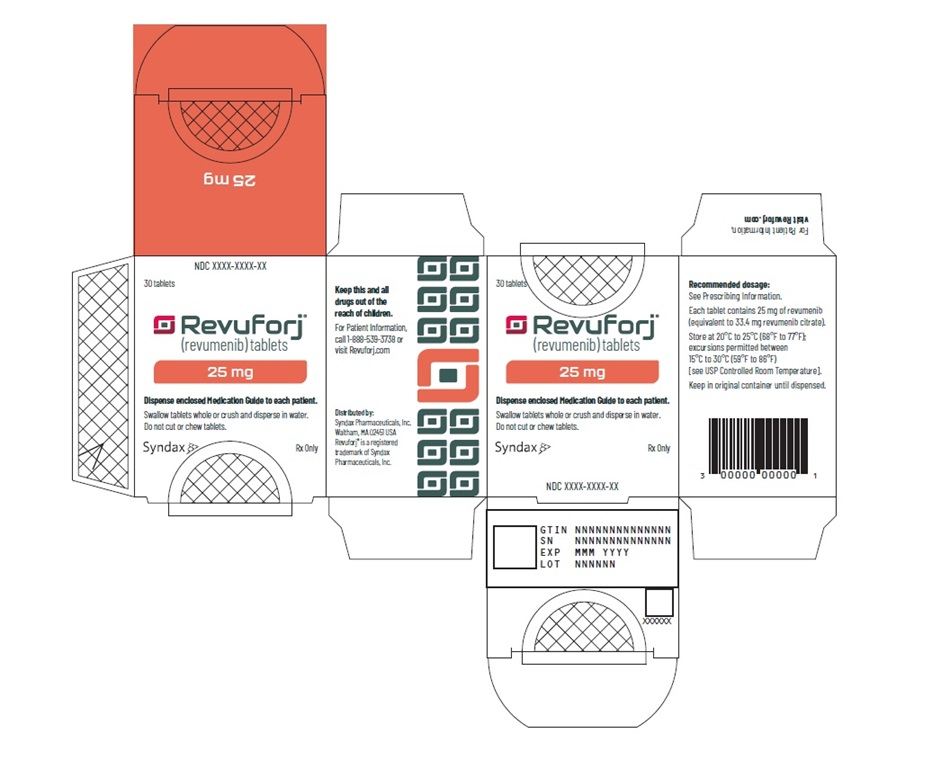
Revuforj 25 mg carton/container labels Principle Display Panel 30 tablets Revuforj® (revumenib) tablets 25 mg Dispense enclosed Medication Guide to each patient. Swallow tablets whole or crush and disperse in water. Do not cut or chew tablets.
Syndax Rx Only This bottle contains 30 tablets (25 mg each) of Revuforj® revumenib. Swallow tablets whole or crush and (revumenib) tablets Keep out of disperse in water. Do not cut or chew tablets.
25 mg the reach of Store at 20°C to 25°C (68°F to 77°F); excursions children. permitted between 15°C to 30°C (59°F to 86°F). Recommended dosage: See Prescribing information. Manufactured for: Syndax Pharmaceuticals, Inc.
Syndax Rx Only 30 tablets Revuforj 25 Carton Revuforj 25 Label
Revuforj 110 mg carton/container labels Principle Display Panel 30 tablets Revuforj® (revumenib) tablets 110 mg Dispense enclosed Medication Guide to each patient. Swallow tablets whole or crush and disperse in water. Do not cut or chew tablets.
Syndax Rx Only This bottle contains 30 tablets (110 mg each) of revumenib. 30 tablets Swallow tablets whole or crush and disperse in water. Do not cut or chew tablets.
Revuforj® Store at 20°C to 25°C (68°F to 77°F); (revumenib) tablets excursions permitted between 15°C to 30°C (59°F to 86°F). 110 mg Recommended dosage: See Prescribing information. Keep out of the reach of children.
Manufactured for: Syndax Rx Only Syndax Pharmaceuticals, Inc. Revuforj 110 mg Carton Revuforj 110 mg Container
Revuforj 160 mg carton/container labels Principle Display Panel 30 tablets Revuforj® (revumenib) tablets 160 mg Dispense enclosed Medication Guide to each patient. Swallow tablets whole or crush and disperse in water. Do not cut or chew tablets.
Syndax Rx Only This bottle contains 30 tablets (160 mg each) of revumenib. 30 tablets Swallow tablets whole or crush and disperse in water. Do not cut or chew tablets.
Revuforj® Store at 20°C to 25°C (68°F to 77°F); (revumenib) tablets excursions permitted between 15°C to 30°C (59°F to 86°F). 160 mg Recommended dosage: See Prescribing information. Keep out of the reach of children.
Manufactured for: Syndax Rx Only Syndax Pharmaceuticals, Inc. Revuforj 160 mg Carton Revuforj 160 mg Container
Medicaid utilization & spend
Medicare Part D spend CMS · PART D · 2026 (Q1)
About this NDC listing & data coverage
What data is (and isn’t) available for this NDC — tap to expand
| NDC identity (package / product / labeler codes) | ✓ Available |
| Labeler | ✓ Available |
| Product & package description | ✓ Available |
| Marketing category & status | ✓ Available |
| Active ingredient / dosage form / route | ✓ Available |
| FDA label (SPL via DailyMed) | ✓ Available |
| Package photos | ✓ Available |
| Inactive ingredients (structured) | — Not published for this NDC The labeler did not submit a structured excipient list, or no SPL is available. |
| NADAC pharmacy acquisition price (CMS) | — Not published for this NDC CMS publishes NADAC only for NDCs reported in its retail-pharmacy survey. |
| Orange Book / therapeutic-equivalence data | ✓ Available |
| HCPCS J-code billing crosswalk | — Not published for this NDC Most self-administered / retail products have no J-code — that is normal. |
| Medicaid utilization (CMS SDUD) | ✓ Available |