
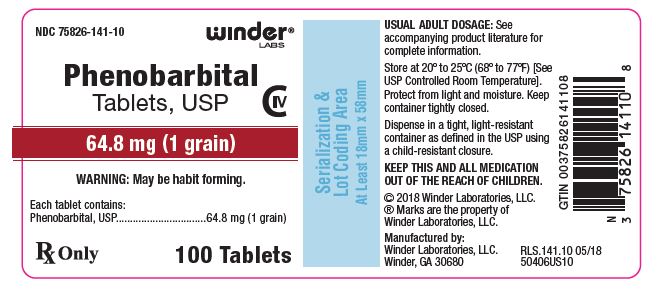
NDC 75826-0141-00: Phenobarbital 64.8 mg Tablet, Bottle of 1,000
This is a package of 1,000 tablets of Phenobarbital 64.8 mg Tablet from WINDER LABORATORIES, LLC, first listed with the FDA Jun 2019 and currently FDA-listed; retail pharmacies pay about $0.0963 per tablet (NADAC).
NDC Database Record
One package, one record: these facts belong to NDC 75826-141-00 alone.
- Record
- FDA NDC Directory package listing · Human prescription drug
- Code segments
- 75826 labeler · 141 product · 00 package
- Package marketed since
- Jun 11, 2019
- Sample package
- No — commercial package
- Listing certified through
- Dec 31, 2026
- Billing quantity
- 1,000 EA per package
- Barcode (UPC)
- 0375826140101, 0375826143102
- Medicaid fills, this package
- 176 prescriptions in the last four reported quarters
- FDA record last changed
- Jul 24, 2026
Identity & Classification
Regulatory identifiers FDA, NLM and CMS codes for this package
Drug-database identifiers Medi-Span GPI and First Databank GCN / HICL / AHFS classification
- GSN (GCN sequence number): 027612
- GCN: 97966
- GPI-14 (Medi-Span): 60100060000322
- HICL (First Databank): 001561
- AHFS class code: 28:12.04.00
- RxCUI (RxNorm): 198083
Where does this data come from?
- FDA openFDA NDC Directory · synced Nov 26, 2026
- FDA label on DailyMed · label index refreshed Nov 26, 2026
- RxNorm (NLM RxNav) · catalog refreshed Nov 26, 2026
- Medi-Span GPI (licensed)
- First Databank (licensed) · refreshed Nov 26, 2026
RxNorm Drug Class
This medicine belongs to the Barbiturates and derivatives class.
Where does this data come from?
- RxClass (NLM) · catalog refreshed Nov 26, 2026
Clinical
Phenobarbital is used to control seizures. Phenobarbital is also used to relieve anxiety. It is also used to prevent withdrawal symptoms in people who are dependent ('addicted'; feel a need to continue taking the medication) on another barbiturate medication and are going to stop taking the medication. Phenobarbital is in a class of medications called barbiturates. It works by slowing activity in the brain.
Read the full MedlinePlus article ↗- The tablets and oral solution are used as a sedative and to treat generalized and partial seizures. The injection forms have more uses, including sleep problems and sedation before...
- No. If you have used it for a long time, stopping suddenly can cause withdrawal with delirium, convulsions and even death. Your prescriber will taper the dose gradually.
- Can I stop taking phenobarbital suddenly?
- It is best to avoid it. Alcohol and other sedating drugs add to phenobarbital’s effects and can slow your breathing. Opioids are especially risky.
Patient education
Drug interactions
Supplement & herbal interactions
Some supplements/herbs that may interact with Phenobarbital — tap one for details:
Phenobarbital may be associated with lower levels of 11 nutrients — worth a chat with your pharmacist, not a cause for alarm.
Where does this data come from?
- MedlinePlus (NLM) · refreshed Nov 26, 2026
- FDA label on DailyMed · label index refreshed Nov 26, 2026
Ask a licensed pharmacist directly — free, answered by our team.
Pricing
A drug doesn't have one price. Each row is a different public payment system, and none is what you'd pay at the counter — that depends on your insurance. The ⓘ on each row explains what it measures.
| Price system | Per ea | Per package |
|---|---|---|
| Retail pharmacies payNADAC · weekly | $0.096 | $96.30 / 1000 tablets |
| Medicaid paysCMS SDUD · 12 mo | $0.2716 | $271.60 / 1000 tablets |
| Medicare drug plans payPart D · Q2 2026 | $0.2071 | $207.10 / 1000 tablets |
See this NDC in the NADAC Price Lookup: every NDC at its price and what a fill costs the pharmacy →
Where does this data come from?
- CMS NADAC weekly file · file of Nov 25, 2026
- CMS ASP pricing files · refreshed Nov 20, 2026
- CMS Medicaid State Drug Utilization Data · through Q1 2026
- CMS Part D plan pricing files · refreshed Nov 24, 2026
- VA National Acquisition Center price file
Packaging — All Sizes for This Product
| Package NDC | Description | Per unit | Per pack | Marketing start | Marketing end | Status |
|---|---|---|---|---|---|---|
| 75826-0141-00 You're viewing this | 1000 TABLET in 1 BOTTLE, PLASTIC | $0.0963 / ea | $96.30 | 2019-06-11 | — | Active |
| 75826-0141-10 75826-141-10 Main listing | 100 TABLET in 1 BOTTLE, PLASTIC | $0.0963 / ea | $9.63 | 2019-06-11 | — | Active |
You're viewing the largest of 2 pack sizes for this product.
This pack has the lowest per-ea cost of the 2 priced pack sizes ($0.0963 NADAC).
This pack accounts for about 8.9% of this product's recent Medicaid fills; most go to the 100 tablets pack. See all packs ↓
Pack size FAQ
What quantity is in this package?
How does this package differ from NDC 75826-0141-10?
What NDC number is used to bill for this package of Phenobarbital 64.8 mg Tablet?
Prices are the latest CMS NADAC pharmacy acquisition cost per NDC; per-pack figures are per-unit × pack quantity, shown only when the pack is denominated in the same measure NADAC prices.
Therapeutic Equivalents
| Product | Labeler | Pack | NADAC/unit | TE | Status | Price vs. this |
|---|---|---|---|---|---|---|
| Phenobarbital 64.8 mg 00603-5167-21 | Par | 100 tablets | $0.096 | — | Availability likely | — |
| Phenobarbital 64.8 mg 13517-0627-01 | e5 | 100 tablets | $0.096 | — | Discontinued | — |
| Phenobarbital 64.8 mg 13811-0306-10 | Trigen | 100 tablets | $0.096 | — | Availability likely | — |
| Phenobarbital 64.8 mg 16571-0667-01 | Rising | 100 tablets | $0.096 | — | Availability likely | — |
| Phenobarbital 64.8 mg 69367-0213-01 | Westminster | 100 tablets | $0.096 | — | Discontinued | — |
| Phenobarbital 64.8 mg 69367-0443-01 | Westminster | 100 tablets | $0.096 | — | Availability likely | — |
| Phenobarbital 64.8 mg 69367-0627-01 | Westminster | 100 tablets | $0.096 | — | Availability likely | — |
| Phenobarbital 64.8 mgthis 75826-0141-00 | WINDER | 1000 tablets | $0.096 | — | Availability likely | — |
| Phenobarbital 64.8 mg 51672-5328-01 | Sun | 100 tablets | — | — | FDA listed | — |
| Phenobarbital 64.8 mg 58118-0576-08 | Clinical | 30 tablets | — | — | FDA listed | — |
| Phenobarbital 64.8 mg 62135-0407-60 | Chartwell | 60 tablets | — | — | FDA listed | — |
| Phenobarbital 64.8 mg 63629-2402-01 | Bryant | 1000 tablets | — | — | FDA listed | — |
| Phenobarbital 64.8 mg 63629-2403-01 | Bryant | 100 tablets | — | — | FDA listed | — |
| Phenobarbital 64.8 mg 64950-0576-01 | Genus | 100 tablets | — | — | FDA listed | — |
| Phenobarbital 64.8 mg 67046-0780-03 | Coupler | 30 tablets | — | — | FDA listed | — |
| Phenobarbital 64.8 mg 67046-1434-03 | Coupler | 30 tablets | — | — | FDA listed | — |
| Phenobarbital 64.8 mg 70518-4215-00 | REMEDYREPACK | 30 tablets | — | — | FDA listed | — |
| Phenobarbital 64.8 mg 70752-0163-10 | QUAGEN | 100 tablets | — | — | FDA listed | — |
| Phenobarbital 64.8 mg 71205-0849-00 | Proficient | 100 tablets | — | — | FDA listed | — |
| Phenobarbital 64.8 mg 71205-0892-00 | Proficient | 100 tablets | — | — | FDA listed | — |
| Phenobarbital 64.8 mg 72162-1167-00 | Bryant | 1000 tablets | — | — | FDA listed | — |
| Phenobarbital 64.8 mg 72162-1265-00 | Bryant | 1000 tablets | — | — | FDA listed | — |
| Phenobarbital 64.8 mg 82804-0984-00 | Proficient | 100 tablets | — | — | FDA listed | — |
| Phenobarbital 64.8 mg 70518-4717-00 | REMEDYREPACK | 100 tablets | — | — | FDA listed | — |
| Phenobarbital 64.8 mg 62135-0557-90 | Chartwell | 90 tablets | — | — | FDA listed | — |
Where does this data come from?
- FDA openFDA NDC Directory · synced Nov 26, 2026
- FDA Orange Book · refreshed Nov 6, 2026
- CMS NADAC weekly file · file of Nov 25, 2026
Availability & Generic Status
We did not find an FDA-approved generic match for this exact strength, form and route.
Where does this data come from?
- FDA Orange Book · refreshed Nov 6, 2026
What It Looks Like
Where does this data come from?
- FDA label on DailyMed · label index refreshed Nov 26, 2026
Inactive Ingredients / Excipients
Inactive ingredients, also called excipients, are components of the drug product other than the active ingredient. They may include fillers, dyes, coatings, preservatives, flavors, or other formulation ingredients.
Avoiding an ingredient? See Phenobarbital inactive ingredients by manufacturer: every current product's list side by side, so you can ask your pharmacy for the version that does not list it.
Tap an ingredient (hover on desktop) to see what it is and why it’s used.
-
UNII OP1R32D61U
Microcrystalline cellulose is a purified form of cellulose, a natural fiber from plant sources. It acts as a binder and filler in tablets and capsules, helping hold ingredients together and give the medicine its shape and size.
-
UNII EWQ57Q8I5X
Lactose monohydrate is a natural sugar derived from milk. It serves as a filler and binder in tablets and capsules, helping create the proper size, texture, and consistency of the medicine.
-
UNII 70097M6I30
Magnesium stearate is a salt made from magnesium and stearic acid, a fatty substance. It's used in tablets and capsules as a lubricant and glidant to help ingredients flow smoothly during manufacturing and prevent sticking.
-
UNII ETJ7Z6XBU4
Silicon dioxide is a naturally occurring mineral used as a glidant and anti-caking agent. It helps powder ingredients flow smoothly and prevents clumping during manufacturing and storage.
-
UNII 5856J3G2A2
A starch-based powder made from potatoes and processed with sodium. It acts as a disintegrant, helping the tablet or capsule break apart quickly in the stomach so the medicine can be absorbed.
5 inactive ingredients listed in the exact product block matched to this NDC.
Where does this data come from?
ingredient classCode="IACT" elements from the exact product block matched by this NDC. Label-section narrative from DailyMed / the openFDA label index is shown separately when available.- FDA label on DailyMed · label index refreshed Nov 26, 2026
- FDA openFDA NDC Directory · synced Nov 26, 2026
Inactive ingredient FAQ
Are inactive ingredients the same for every manufacturer?
Why might an inactive ingredient be missing?
Can inactive ingredients matter?
Manufacturer & Labeler
More NDCs from WINDER LABORATORIES, LLC labeler code 75826
- Chlordiazepoxide Hydrochloride and Clidinium Bromide 5 mg; 2.5 mg Capsule NDC 75826-134-10
- Phenobarbital 15 mg Tablet NDC 75826-136-10
- Phenobarbital 16.2 mg Tablet NDC 75826-137-00
- Phenobarbital 30 mg Tablet NDC 75826-138-10
- Phenobarbital 32.4 mg Tablet NDC 75826-139-00
- Phenobarbital 60 mg Tablet NDC 75826-140-10
- Phenobarbital 97.2 mg Tablet NDC 75826-142-00
- Phenobarbital 100 mg Tablet NDC 75826-143-10
- Fluoride .25 mg Tablet, Chewable NDC 75826-163-20
- Fluoride .5 mg Tablet, Chewable NDC 75826-164-20
- Fluoride 1 mg Tablet, Chewable NDC 75826-165-20
- Multivitamin with Fluoride Sodium .25 mg; 750 mcg; 24 mg; 36 mg; 10 mcg; 6.75 mg; 1.05 mg; 1.2 mg; 13.5 mg Tablet, Chewable NDC 75826-169-10
Where does this data come from?
- FDA openFDA NDC Directory · synced Nov 26, 2026
- Drugs@FDA
Full Prescribing Information FDA SPL
Indications and Usage
INDICATIONS AND USAGE Phenobarbital Tablets, USP are indicated for use as a sedative or anticonvulsant.
Dosage and Administration
DOSAGE AND ADMINISTRATION Oral Sedative Dose, Adults: 30 to 120 mg daily in 2 or 3 divided doses. Children: 6 mg/kg of body weight daily in 3 divided doses. Oral Hypnotic Dose, Adults: 100 to 320 mg. Oral Anticonvulsant Dose, Adults: 50 to 100 mg 2 or 3 times daily. Children: 15 to 50 mg 2 or 3 times daily.
Contraindications
CONTRAINDICATIONS Phenobarbital is contraindicated in patients who are hypersensitive to barbiturates. In such patients, severe hepatic damage can occur from ordinary doses and is usually associated with dermatitis and involvement of parenchymatous organs. A personal or familial history of acute intermittent porphyria represents one of the few absolute contraindications to the use of barbiturates.
Phenobarbital is also contraindicated in patients with marked impairment of liver function, or respiratory disease in which dyspnea or obstruction is evident. It should not be administered to persons with known previous addiction to the sedative/hypnotic group, since ordinary doses may be ineffectual and may contribute to further addiction.
Warnings
WARNINGS In small doses, the barbiturates may increase the reaction to painful stimuli. Taken by themselves, the barbiturates cannot be relied upon to relieve pain or even to produce sedation or sleep in the presence of severe pain.
Adverse Reactions
ADVERSE REACTIONS The following adverse reactions have been reported: CNS Depression: Residual sedation or "hangover," drowsiness, lethargy, and vertigo. Emotional disturbances and phobias may be accentuated. In some persons, barbiturates such as phenobarbital repeatedly produce excitement rather than depression, and the patient may appear to be inebriated.
Like other nonanalgesic hypnotic drugs, barbiturates, such as phenobarbital, when given in the presence of pain, may cause restlessness, excitement, and even delirium. Rarely, the use of barbiturates results in localized or diffused myalgic, neuralgic, or arthritic pain, especially in psychoneurotic patients with insomnia. The pain may appear in paroxysms, is most intense in the early morning hours, and is most frequently located in the region of the neck, shoulder girdle, and upper limbs.
Symptoms may last for days after the drug is discontinued. Respiratory/Circulatory: Respiratory depression, apnea, circulatory collapse. Allergic: Acquired hypersensitivity to barbiturates consists chiefly in allergic reactions that occur especially in persons who tend to have asthma, urticaria, angioedema, and similar conditions.
Hypersensitivity reactions in this category include localized swelling, particularly of the eyelids, cheeks, or lips, and erythematous dermatitis. Rarely, exfoliative dermatitis (e.g., Stevens-Johnson syndrome and toxic epidermal necrolysis) may be caused by phenobarbital and can prove fatal. The skin eruption may be associated with fever, delirium, and marked degenerative changes in the liver and other parenchymatous organs.
In a few cases, megaloblastic anemia has been associated with the chronic use of phenobarbital. Other: Nausea and vomiting; headache. To report SUSPECTED ADVERSE REACTIONS, contact Winder Laboratories, LLC at 1-770-307-0703, or FDA at 1-800-FDA-1088 or www.fda.gov/medwatch.
Drug Interactions
Drug Interactions Phenobarbital in combination with alcohol, tranquilizers, and other central nervous system depressants has additive depressant effects, and the patient should be so advised. Patients taking this drug should be warned not to exceed the dosage recommended by their physician. Toxic effects and fatalities have occurred following overdoses of phenobarbital alone and in combination with other central nervous system depressants.
Caution should be exercised in prescribing unnecessarily large amounts of phenobarbital for patients who have a history of emotional disturbances or suicidal ideation or who have misused alcohol and other CNS drugs (see OVERDOSAGE ).
Pregnancy
Usage in Pregnancy Pregnancy Category B Reproduction studies have been performed in animals and have revealed no evidence of impaired fertility or harm to the fetus due to phenobarbital. There are, however, no adequate and well-controlled studies in pregnant women. Because animal reproduction studies are not always predictive of human response, this drug should be used during pregnancy only if clearly needed and under the supervision of a physician .
Overdosage
OVERDOSAGE The signs and symptoms of barbiturate poisoning are referable especially to the central nervous system and the cardiovascular system. Moderate intoxication resembles alcoholic inebriation. In severe intoxication, the patient is comatose, the level of reflex activity conforming in a general way to the intensity of the central depression.
The deep reflexes may persist for some time despite coexistent coma. The Babinski sign is often positive. The EEG may be of the "burst-suppression" type, with brief periods of electrical silence.
The pupils may be constricted and react to light, but late in the course of barbiturate poisoning they may show hypoxic paralytic dilatation. Respiration is affected early. Breathing may be either slow or rapid and shallow; Cheyne-Stokes rhythm may be present.
Respiratory minute volume is diminished, and hypoxia and respiratory acidosis may develop. The blood pressure falls, owing partly to depression of medullary vasomotor centers; partly to a direct action of the drug on the myocardium, sympathetic ganglia, and vascular smooth muscle; partly to hypoxia. The patient thus develops a typical shock syndrome, with a weak and rapid pulse, cold and clammy skin, and a rise in the hematocrit.
Respiratory complications (atelectasis, pulmonary edema, and bronchopneumonia) and renal failure are much dreaded and not infrequent concomitant of severe barbiturate poisoning. There is usually hypothermia, sometimes with temperatures as low as 32°C. Treatment General management should consist of symptomatic and supportive therapy, including gastric lavage, administration of intravenous fluids, and maintenance of blood pressure, body temperature and adequate respiratory exchange.
Dialysis will increase the rate of removal of barbiturates from the body fluids. Antibiotics may be required to control pulmonary complications.
Clinical Pharmacology
CLINICAL PHARMACOLOGY Phenobarbital, a long-acting barbiturate, is a central nervous system depressant. In ordinary doses, the drug acts as a sedative and anticonvulsant. Its onset of action occurs within 30 minutes, and the duration of action ranges from 5 to 6 hours. It is detoxified in the liver.
How Supplied / Storage and Handling
HOW SUPPLIED Phenobarbital Tablets, USP 15 mg: White, Round Tablet; Debossed WL on one side and 136 on the other side. Bottles of 90 tablets NDC 75826-136-90 Bottles of 100 tablets NDC 75826-136-10 Bottles of 500 tablets NDC 75826-136-50 Bottles of 1000 tablets NDC 75826-136-00 Phenobarbital Tablets, USP 16.2 mg (¼ grain): White, Round, Scored Tablet; Debossed WL on one side and 137 on the other side. Bottles of 90 tablets NDC 75826-137-90 Bottles of 100 tablets NDC 75826-137-10 Bottles of 500 tablets NDC 75826-137-50 Bottles of 1000 tablets NDC 75826-137-00 Phenobarbital Tablets, USP 30 mg: White, Round, Scored Tablet; Debossed WL on one side and 138 on the other side.
Bottles of 90 tablets NDC 75826-138-90 Bottles of 100 tablets NDC 75826-138-10 Bottles of 500 tablets NDC 75826-138-50 Bottles of 1000 tablets NDC 75826-138-00 Phenobarbital Tablets, USP 32.4 mg (½ grain): White, Round, Scored Tablet; Debossed WL on one side and 139 on the other side. Bottles of 90 tablets NDC 75826-139-90 Bottles of 100 tablets NDC 75826-139-10 Bottles of 500 tablets NDC 75826-139-50 Bottles of 1000 tablets NDC 75826-139-00 Phenobarbital Tablets, USP 60 mg: White, Round Tablet; Debossed WL on one side and 140 on the other side.
Bottles of 90 tablets NDC 75826-140-90 Bottles of 100 tablets NDC 75826-140-10 Bottles of 500 tablets NDC 75826-140-50 Bottles of 1000 tablets NDC 75826-140-00 Phenobarbital Tablets, USP 64.8 mg (1 grain): White, Round, Scored Tablet; Debossed WL on one side and 141 on the other side. Bottles of 90 tablets NDC 75826-141-90 Bottles of 100 tablets NDC 75826-141-10 Bottles of 500 tablets NDC 75826-141-50 Bottles of 1000 tablets NDC 75826-141-00 Phenobarbital Tablets, USP 97.2 mg (1½ grain): White, Round, Scored Tablet; Debossed WL on one side and 142 on the other side.
Bottles of 90 tablets NDC 75826-142-90 Bottles of 100 tablets NDC 75826-142-10 Bottles of 500 tablets NDC 75826-142-50 Bottles of 1000 tablets NDC 75826-142-00 Phenobarbital Tablets, USP 100 mg: White, Round, Scored Tablet; Debossed WL on one side and 143 on the other side. Bottles of 90 tablets NDC 75826-143-90 Bottles of 100 tablets NDC 75826-143-10 Bottles of 500 tablets NDC 75826-143-50 Bottles of 1000 tablets NDC 75826-143-00 Store at 20° to 25°C (68° to 77°F) [See USP Controlled Room Temperature]. Protect from light and moisture.
Dispense in a tight, light-resistant container as defined in the USP using a child-resistant closure.
Storage and Handling
Store at 20° to 25°C (68° to 77°F) [See USP Controlled Room Temperature]. Protect from light and moisture. Dispense in a tight, light-resistant container as defined in the USP using a child-resistant closure.
Description
DESCRIPTION The barbiturates are nonselective central nervous system (CNS) depressants primarily used as sedative-hypnotics. In subhypnotic doses, they are also used as anticonvulsants. The barbiturates and their sodium salts are subject to control under the Federal Controlled Substances Act.
Phenobarbital is a barbituric acid derivative for oral administration and occurs as a white, odorless, slightly bitter powder that is soluble in chloroform, freely soluble in alcohol or ether, and slightly soluble in water. Its saturated solution has a pH of about 5.6. Chemically, it is 5-ethyl-5-phenylbarbituric acid with the molecular formula C 12 H 12 N 2 O 3 (232.24).
The structural formula is as follows: Each Phenobarbital Tablet, USP contains 15 mg, 16.2 mg, 30 mg, 32.4 mg, 60 mg, 64.8 mg, 97.2 mg, or 100 mg of phenobarbital, USP. Inactive ingredients are as follows: Microcrystalline Cellulose; Lactose Monohydrate; Sodium Starch Glycolate, Type-A; Colloidal Silicon Dioxide; Magnesium Stearate Chemical Structure
Information for Patients
Information for Patients Phenobarbital may impair the mental and/or physical abilities required for the performance of potentially hazardous tasks, such as driving a car or operating machinery. The patient should be cautioned accordingly.
Precautions
PRECAUTIONS General Precautions Barbiturates induce liver microsomal enzyme activity. This accelerates the biotransformation of various drugs and is probably part of the mechanism of the tolerance encountered with barbiturates. Phenobarbital, therefore, should be used with caution in patients with decreased liver function.
This drug should also be administered cautiously to patients with a history of drug dependence or abuse (see DRUG ABUSE AND DEPENDENCE ). Phenobarbital may decrease the potency of coumarin anticoagulants; therefore, patients receiving such concomitant therapy should have more frequent prothrombin determinations. As with other sedatives and hypnotics, elderly or debilitated patients may react to barbiturates with marked excitement, depression, or confusion.
The systemic effects of exogenous hydrocortisone and endogenous hydrocortisone (cortisol) may be diminished by phenobarbital. Thus, this product should be administered with caution to patients with borderline hypoadrenal function, regardless of whether it is of pituitary or of primary adrenal origin. Information for Patients Phenobarbital may impair the mental and/or physical abilities required for the performance of potentially hazardous tasks, such as driving a car or operating machinery.
The patient should be cautioned accordingly. Drug Interactions Phenobarbital in combination with alcohol, tranquilizers, and other central nervous system depressants has additive depressant effects, and the patient should be so advised. Patients taking this drug should be warned not to exceed the dosage recommended by their physician.
Toxic effects and fatalities have occurred following overdoses of phenobarbital alone and in combination with other central nervous system depressants. Caution should be exercised in prescribing unnecessarily large amounts of phenobarbital for patients who have a history of emotional disturbances or suicidal ideation or who have misused alcohol and other CNS drugs (see OVERDOSAGE ). Usage in Pregnancy Pregnancy Category B Reproduction studies have been performed in animals and have revealed no evidence of impaired fertility or harm to the fetus due to phenobarbital.
There are, however, no adequate and well-controlled studies in pregnant women. Because animal reproduction studies are not always predictive of human response, this drug should be used during pregnancy only if clearly needed and under the supervision of a physician . Nursing Mothers Caution should be exercised when phenobarbital is administered to a nursing woman.
Nursing Mothers
Nursing Mothers Caution should be exercised when phenobarbital is administered to a nursing woman.
Drug Abuse and Dependence
DRUG ABUSE AND DEPENDENCE Controlled Substance Phenobarbital is a Schedule IV drug. Dependence Prolonged, uninterrupted use of barbiturates (particularly the short-acting drugs), even in therapeutic doses, may result in psychic and physical dependence. Withdrawal symptoms due to physical dependence following chronic use of large doses of barbiturates may include delirium, convulsions, and death.
Controlled Substance
Controlled Substance Phenobarbital is a Schedule IV drug.
Package Label / Principal Display Panel
PRINCIPAL DISPLAY PANEL - 15 mg Tablet Bottle Label NDC 75826-136-10 winder ® LABS Phenobarbital Tablets, USP CIV 15 mg WARNING: May be habit forming. Each tablet contains: Phenobarbital, USP 15 mg Rx Only 100 Tablets Principal Display Panel - 15 mg Tablet Bottle Label
PRINCIPAL DISPLAY PANEL - 16.2 mg Tablet Bottle Label NDC 75826-137-10 winder ® LABS Phenobarbital Tablets, USP CIV 16.2 mg WARNING: May be habit forming. Each tablet contains: Phenobarbital, USP 16.2 mg Rx Only 100 Tablets 16.2mg label
PRINCIPAL DISPLAY PANEL - 30 mg Tablet Bottle Label NDC 75826-138-10 winder ® LABS Phenobarbital Tablets, USP CIV 30 mg WARNING: May be habit forming. Each tablet contains: Phenobarbital, USP 30 mg Rx Only 100 Tablets Principal Display Panel - 30 mg Tablet Bottle Label
PRINCIPAL DISPLAY PANEL - 32.4 mg Tablet Bottle Label NDC 75826-139-10 winder ® LABS Phenobarbital Tablets, USP CIV 32.4 mg WARNING: May be habit forming. Each tablet contains: Phenobarbital, USP 32.4 mg Rx Only 100 Tablets 32.4 mg Label
PRINCIPAL DISPLAY PANEL - 60 mg Tablet Bottle Label NDC 75826-140-10 winder ® LABS Phenobarbital Tablets, USP CIV 60 mg WARNING: May be habit forming. Each tablet contains: Phenobarbital, USP 60 mg Rx Only 100 Tablets Principal Display Panel - 60 mg Tablet Bottle Label
PRINCIPAL DISPLAY PANEL - 64.8 mg Tablet Bottle Label NDC 75826-141-10 winder ® LABS Phenobarbital Tablets, USP CIV 64.8 mg WARNING: May be habit forming. Each tablet contains: Phenobarbital, USP 64.8 mg Rx Only 100 Tablets 64.8 mg Label
PRINCIPAL DISPLAY PANEL - 100 mg Tablet Bottle Label NDC 75826-143-10 winder ® LABS Phenobarbital Tablets, USP CIV 100 mg WARNING: May be habit forming. Each tablet contains: Phenobarbital, USP 100 mg Rx Only 100 Tablets Principal Display Panel - 100 mg Tablet Bottle Label
PRINCIPAL DISPLAY PANEL - 97.2 mg Tablet Bottle Label NDC 75826-142-10 winder ® LABS Phenobarbital Tablets, USP CIV 97.2 mg WARNING: May be habit forming. Each tablet contains: Phenobarbital, USP 97.2 mg Rx Only 100 Tablets 97.2 mg Label
Medicaid Utilization & Spend
Medicaid Utilization by Pack Size
Medicare Part D Spend CMS · Part D · 2026 (Q1-Q2)
Reported Adverse Events (FAERS)
Top reported reactions
Age at onset
Reporter sex
Serious outcomes
Where does this data come from?
About This NDC Listing & Data Coverage
Listed without an FDA application
This product's marketing category indicates it is marketed without an approved FDA application (no NDA, ANDA, or BLA on file). Having an NDC does not by itself establish FDA approval — the NDC Directory is a listing system, not an approval decision. Approval-linked data such as Orange Book therapeutic-equivalence ratings therefore does not apply.
What data is (and isn’t) available for this NDC — tap to expand
| NDC identity (package / product / labeler codes) | Available |
| Labeler | Available |
| Product & package description | Available |
| Marketing category & status | Available |
| Active ingredient / dosage form / route | Available |
| FDA label (SPL via DailyMed) | Available |
| Package photos | Available |
| Inactive ingredients (structured) | Available |
| NADAC pharmacy acquisition price (CMS) | Available |
| Orange Book / therapeutic-equivalence data | — Not published for this NDC Applies only to products approved under an NDA/ANDA; many listings are out of scope. |
| HCPCS J-code billing crosswalk | — Not published for this NDC Most self-administered / retail products have no J-code — that is normal. |
| Medicaid utilization (CMS SDUD) | Available |