
AdrenaMed Ingredients & Drug Interactions
by NuMedica
What is this page for?
First and foremost: checking AdrenaMed against your medications. The heart of this page is the interaction checker and the full interaction report — how this product’s ingredients may interact with prescription and over-the-counter medicines you may be taking.
Around that, we add a pharmacist’s high-level view of the product as a whole — what’s inside, the evidence for its stated use, how transparent the label is, and what safety data exists — so you can see the full picture in one place. It’s educational information from our licensed clinical databases and the clinical staff at HelloPharmacist — not medical advice — and we don’t sell or endorse products. Our editorial policy
AdrenaMed is a dietary supplement by NuMedica with 6 active ingredients. Its ingredients are commonly taken for morning sickness in pregnancy, premenstrual syndrome (pms), preventing or treating b6 deficiency.Based on those ingredients, 1,332 medications have a known interaction with it, the most serious rated major. The ingredients most likely to interact are Rhodiola Root Extract, Cordyceps Mycelium Extract, American Ginseng Root Extract. Use the checker below to test your specific medication, or read the full HelloPharmacist Interaction Report.
Check Your Meds Against AdrenaMed by NuMedica
Ask about any prescription or over-the-counter medication and we check it for interactions with AdrenaMed by NuMedica — and tell you which ingredient is responsible.
AI summaries are generated from our interaction database for education only — always confirm with your pharmacist. How we use AI
Ask the Pharmacist
A licensed pharmacist will answer your question by email — free, usually within 24 hours.
Got it — thank you!
A licensed pharmacist will answer within 24 hours. Keep an eye on your email (worth checking spam, just in case).
HelloPharmacist Scorecard of AdrenaMed by NuMedica
Our pharmacy team’s full take, with four database checks built into the cards below — a summary of what is known, not a grade of the product itself.
What’s inside
Full disclosure
AdrenaMed has six active ingredients. Vitamin B6 supports energy and nerve function.
Pantothenic acid helps your body break down fats and carbohydrates. Para-Aminobenzoic Acid is included but we hold no interaction data for it.
Rhodiola root extract is an herbal adaptogen. American ginseng root extract is traditionally used to support immune function and energy.
Cordyceps mycelium extract is a fungal product also marketed for energy and stamina. The capsule also contains inactive ingredients (fillers and binders): hydroxypropyl methylcellulose, microcrystalline cellulose, ascorbyl palmitate, L-leucine, and bamboo extract.
Does it work?
Not established
The evidence for most of these ingredients in AdrenaMed is limited. Vitamin B6 is effective for sideroblastic anemia and B6 deficiency, and possibly effective for pregnancy-related nausea and vomiting—though use in pregnancy must be guided by a doctor.
For the other conditions (like high homocysteine), the data rates it likely effective or possibly effective. Pantothenic acid is effective for pantothenic acid deficiency, but for other uses we hold insufficient evidence.
For rhodiola, American ginseng, and cordyceps, the evidence we have rates them at insufficient evidence for most of the claims made about them, though American ginseng is possibly effective for upper respiratory infections. The bottom line: effectiveness for adrenal support or energy specifically is not established in our data.
How safe is it?
Well-documented data
Vitamin B6 is well tolerated at doses under 100 mg daily, but high doses over time can cause nerve damage (sensory neuropathy). Common side effects at any dose include headache, nausea, and heartburn.
Pantothenic acid is generally well tolerated orally and may cause diarrhea. Rhodiola is generally well tolerated for short-term use, but long-term safety isn't well studied; adverse effects include dizziness and changes in saliva.
American ginseng is generally well tolerated short-term in healthy adults but can cause headache, and long-term safety is unclear. Cordyceps is generally well tolerated for up to a year, with uncommon side effects like diarrhea, constipation, and abdominal discomfort; there is one rare case report of liver inflammation.
Rhodiola, American ginseng, and cordyceps should all be avoided during pregnancy and breastfeeding due to insufficient safety data.
Meds to double-check
Major interaction found
Blood thinners like warfarin (Major concern with American ginseng), blood pressure medications, diabetes drugs, seizure medications (phenobarbital, phenytoin), heart rhythm drugs like amiodarone, monoamine oxidase inhibitors (older antidepressants), immune-suppressant drugs, and drugs your liver metabolizes (including losartan) all have documented interactions. If you take levodopa for Parkinson's and are not on carbidopa, that's also a concern.
Check your prescriptions in the tool on this page.
The bottom line
Scorecard at a glanceFully disclosed formula with no established evidence rating for its marketed use. Major medication interactions have been identified, and safety information is well characterized.
If you take blood thinners, seizure medications, blood pressure drugs, diabetes medications, or monoamine oxidase inhibitors, check your exact prescriptions with the tool below before taking this product. Rhodiola and American ginseng have not been well studied long-term, and several ingredients should be avoided in pregnancy and while breastfeeding.
Talk to your pharmacist before starting, especially if you're on any regular medications.
Educational only — not medical advice; always confirm with your pharmacist. Our editorial policy · How we use AI
Assessment coverage: 5 of 6 active ingredients matched to our full ingredient reviews (monographs). Based on the product label dated Jan 23, 2025.
This Scorecard evaluates available label information, ingredient evidence, and known medication-safety considerations. It does not independently verify product identity, purity, potency, contamination, or manufacturing quality. How these ratings are computed
General information
Key facts about AdrenaMed, straight from the product label.
| Brand | NuMedica |
|---|---|
| Barcode (UPC) | 812527010581 |
| Net contents | 60 Vegetable Capsule(s) |
| Market status | On market |
| Date entered into DSLD | Jan 23, 2025 |
| DSLD ID | 323488 |
| Product type | Other Combinations |
| Supplement form | Capsule |
| Dietary claims / uses | All Other, Structure/Function |
| Intended target group(s) | Vegetarian, Adult (18 - 50 Years), Gluten Free, Dairy Free |
Everything in this section is reproduced from the manufacturer’s own product label — it’s the label speaking, not HelloPharmacist. We show it so you can see exactly what the maker states; we don’t verify or endorse those statements.
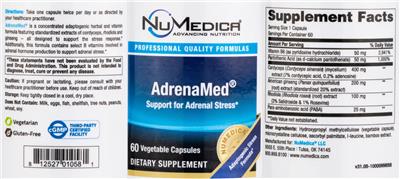
Supplement Facts
The label details for AdrenaMed by NuMedica, sourced from the NIH Dietary Supplement Label Database.
Supplement Facts
| Ingredient | Amount | % DV |
|---|---|---|
| Vitamin B6 | 50 mg | 2941% |
| Pantothenic Acid | 50 mg | 1000% |
| Para-Aminobenzoic Acid | 25 mg | -- |
| Rhodiola Root Extract | 100 mg | -- |
| American Ginseng Root Extract | 200 mg | -- |
| Cordyceps Mycelium Extract | 400 mg | -- |
Other ingredients: Hydroxypropyl Methylcellulose, Microcrystalline Cellulose, Ascorbyl Palmitate, L-Leucine, Bamboo Extract
Tap any ingredient to jump to its full detail below.
These statements are the manufacturer’s wording, reproduced from the product label — the label is saying it, not HelloPharmacist. We don’t verify or endorse them.
Suggested/Recommended/Usage/Directions
Directions: Take one capsule twice per day or as directed by your healthcare practitioner.
Formula
AdrenaMed is a concentrated adaptogenic herbal and vitamin formula featuring standardized extracts of cordyceps, rhodiola and ginseng - all designed to support the stress response. Additionally, this formula contains select B vitamins involved in adrenal hormone production to support adrenal stress.
FDA Disclaimer Statement
These statements have not been evaluated by the Food and Drug Administration. This product is not intended to diagnose, treat, cure or prevent any disease.
Precautions
Caution: If pregnant or lactating, please consult with your healthcare practitioner before use.
Keep out of reach of children.
Storage
Storage: Keep tightly closed in a cool, dry place.
Formulation
Does not contain: Milk, eggs, fish, shellfish, tree nuts, peanuts, wheat, soy.
Vegetarian
Gluten-free
Professional quality formula Support for adrenal stress Adaptogenic stress formula
Seals/Symbols
cGMP Third-Party Certified Facility
Brand IP Statement(s)
NuMedica Advancing Nutrition
FDA Statement of Identity
Dietary Supplement
Is this label outdated? Report a formula or label change and our pharmacy team will review it.
AdrenaMed by NuMedica label
The label scan from the NIH Dietary Supplement Label Database. Tap to enlarge.
Label images are published by the NIH Dietary Supplement Label Database for the version of this product on file. Always read your actual product label.
View the full label (PDF)The Ingredients in AdrenaMed by NuMedica
These are the 6 active ingredients this product is made of. Select any to open its full monograph.
Serving size1 Capsule(s) Dosage formCapsule Servings per container60 Amounts shown are per serving.
Most supplement products combine several ingredients, and a medication can interact with the product through any one of them. Each ingredient below shows whether it has known drug interactions.
Vitamin B6
Interacts with210 drugs
Vitamin B6 (pyridoxine) is an essential water-soluble vitamin that your body needs for metabolism, brain function, and making red blood cells. It is b...
Vitamin B6 monograph & interactionsPantothenic Acid
No knowninteractions
Pantothenic acid is vitamin B5, an essential nutrient your body uses to turn food into energy. True deficiency is very rare because it is found in nea...
Pantothenic Acid monograph & interactionsPara-Aminobenzoic Acid
Rhodiola Root Extract
Interacts with1,271 drugs
Rhodiola is an herb traditionally used to fight fatigue and help the body cope with stress. Some small studies suggest it may modestly reduce fatigue...
Rhodiola Root Extract monograph & interactionsAmerican Ginseng Root Extract
Interacts with217 drugs
American ginseng is an herbal root used as an 'adaptogen' to support energy, stress, immune function, and blood sugar. Some uses—such as reducing the...
American Ginseng Root Extract monograph & interactionsCordyceps Mycelium Extract
Interacts with249 drugs
Cordyceps is a fungus used in traditional Chinese medicine for energy, exercise performance, and lung and immune support. Human research is limited an...
Cordyceps Mycelium Extract monograph & interactionsOther (inactive) ingredients: Hydroxypropyl Methylcellulose, Microcrystalline Cellulose, Ascorbyl Palmitate, L-Leucine, Bamboo Extract. These complete the product’s ingredient list but are not active constituents.
AdrenaMed by NuMedica Drug Interactions
HelloPharmacist Interaction Report
AdrenaMed by NuMedica contains six active ingredients, and several of them interact with medications.
The most serious interaction we've documented is American ginseng with warfarin (a blood thinner)—American ginseng appears to reduce warfarin's effectiveness, which could raise your blood clot risk and is a Major concern.
Read the full breakdown — every affected drug type, severity by severity
Vitamin B6 has Moderate interactions with blood pressure drugs (it may lower blood pressure further), the heart rhythm drug amiodarone (it may worsen sun sensitivity), and the seizure medications phenobarbital and phenytoin (high doses may reduce their levels). Levodopa (for Parkinson's) is a Minor concern—vitamin B6 can speed up its breakdown, though this doesn't happen if you're also taking carbidopa.
Rhodiola interacts with several drug classes at Moderate severity: blood pressure drugs, diabetes medications, immune-suppressant drugs, and certain drugs your liver metabolizes (including losartan specifically). It also has Minor interactions with other liver-metabolized drugs.
American ginseng additionally affects diabetes and immune-suppressant drugs and monoamine oxidase inhibitors (older antidepressants). Cordyceps may increase bleeding risk with blood thinners and antiplatelet drugs, and can interfere with immune-suppressant therapy.
We could not check Para-Aminobenzoic Acid for interactions. Pantothenic acid has no known interactions documented in our data.
Altogether, these interactions span 1,314 individual medications. Use the medication checker on this page to look up your exact prescriptions before starting.
Check your own medications below · Editorial policy · How we use AI
Want to check YOUR meds against AdrenaMed?
Ask about interactions with your drugs in plain English — “Can I take it with lisinopril?” — and we find you the answer in seconds, ingredient by ingredient.
Go to the checkerIngredients driving the most interactions
Individual Drug Interactions
The ingredients in AdrenaMed interact with 1,332 drugs. Click any drug to see the details.
4 of the 6 ingredients in AdrenaMed interact with drugs. Each result below shows which ingredient is responsible. Rhodiola Root Extract Cordyceps Mycelium Extract American Ginseng Root Extract Vitamin B6
Aspirin, Diphenhydramine, PhenylpropanolamineAlka Seltzer Plus Night Time Effervescent
How Aspirin, Diphenhydramine, Phenylpropanolamine interacts with AdrenaMed — through 2 ingredients. Tap an ingredient for the detail:
Cordyceps Mycelium ExtractAnticoagulant/antiplatelet Drugs Moderate
Interaction Summary
Theoretically, cordyceps may increase the risk of bleeding when used with antiplatelet or anticoagulant drugs.
Read the full Cordyceps Mycelium Extract + Aspirin, Diphenhydramine, Phenylpropanolamine interactionRhodiola Root ExtractCns Depressants Minor
Interaction Summary
Theoretically, rhodiola might increase the risk of adverse effects when taken with CNS depressants.
Read the full Rhodiola Root Extract + Aspirin, Diphenhydramine, Phenylpropanolamine interactionAspirin, DipyridamoleAggrenox, Asasantin Retard
How Aspirin, Dipyridamole interacts with AdrenaMed — through 1 ingredient. Tap an ingredient for the detail:
Cordyceps Mycelium ExtractAnticoagulant/antiplatelet Drugs Moderate
Interaction Summary
Theoretically, cordyceps may increase the risk of bleeding when used with antiplatelet or anticoagulant drugs.
Read the full Cordyceps Mycelium Extract + Aspirin, Dipyridamole interactionAspirin, Ethoheptazine, MeprobamateEquagesic
How Aspirin, Ethoheptazine, Meprobamate interacts with AdrenaMed — through 2 ingredients. Tap an ingredient for the detail:
Cordyceps Mycelium ExtractAnticoagulant/antiplatelet Drugs Moderate
Interaction Summary
Theoretically, cordyceps may increase the risk of bleeding when used with antiplatelet or anticoagulant drugs.
Read the full Cordyceps Mycelium Extract + Aspirin, Ethoheptazine, Meprobamate interactionRhodiola Root ExtractCns Depressants Minor
Interaction Summary
Theoretically, rhodiola might increase the risk of adverse effects when taken with CNS depressants.
Read the full Rhodiola Root Extract + Aspirin, Ethoheptazine, Meprobamate interactionAspirin, HydrocodoneAlor 5 500, Lortab ASA
How Aspirin, Hydrocodone interacts with AdrenaMed — through 2 ingredients. Tap an ingredient for the detail:
Cordyceps Mycelium ExtractAnticoagulant/antiplatelet Drugs Moderate
Interaction Summary
Theoretically, cordyceps may increase the risk of bleeding when used with antiplatelet or anticoagulant drugs.
Read the full Cordyceps Mycelium Extract + Aspirin, Hydrocodone interactionRhodiola Root ExtractCns Depressants, Cytochrome P450 3a4 (cyp3a4) Substrates Minor
Interaction Summary
Theoretically, rhodiola might increase the risk of adverse effects when taken with CNS depressants.
Read the full Rhodiola Root Extract + Aspirin, Hydrocodone interactionAspirin, MeprobamateMicrainin
How Aspirin, Meprobamate interacts with AdrenaMed — through 1 ingredient. Tap an ingredient for the detail:
Cordyceps Mycelium ExtractAnticoagulant/antiplatelet Drugs Moderate
Interaction Summary
Theoretically, cordyceps may increase the risk of bleeding when used with antiplatelet or anticoagulant drugs.
Read the full Cordyceps Mycelium Extract + Aspirin, Meprobamate interactionAspirin, MethocarbamolRobaxisal
How Aspirin, Methocarbamol interacts with AdrenaMed — through 1 ingredient. Tap an ingredient for the detail:
Cordyceps Mycelium ExtractAnticoagulant/antiplatelet Drugs Moderate
Interaction Summary
Theoretically, cordyceps may increase the risk of bleeding when used with antiplatelet or anticoagulant drugs.
Read the full Cordyceps Mycelium Extract + Aspirin, Methocarbamol interactionAspirin, OmeprazoleYosprala
How Aspirin, Omeprazole interacts with AdrenaMed — through 2 ingredients. Tap an ingredient for the detail:
Cordyceps Mycelium ExtractAnticoagulant/antiplatelet Drugs Moderate
Interaction Summary
Theoretically, cordyceps may increase the risk of bleeding when used with antiplatelet or anticoagulant drugs.
Read the full Cordyceps Mycelium Extract + Aspirin, Omeprazole interactionRhodiola Root ExtractCytochrome P450 2c9 (cyp2c9) Substrates, Cytochrome P450 3a4 (cyp3a4) Substrates Moderate
Interaction Summary
Theoretically, rhodiola might increase levels of drugs metabolized by CYP2C9.
Read the full Rhodiola Root Extract + Aspirin, Omeprazole interactionAspirin, OxycodonePercodan
How Aspirin, Oxycodone interacts with AdrenaMed — through 2 ingredients. Tap an ingredient for the detail:
Cordyceps Mycelium ExtractAnticoagulant/antiplatelet Drugs Moderate
Interaction Summary
Theoretically, cordyceps may increase the risk of bleeding when used with antiplatelet or anticoagulant drugs.
Read the full Cordyceps Mycelium Extract + Aspirin, Oxycodone interactionRhodiola Root ExtractCns Depressants Minor
Interaction Summary
Theoretically, rhodiola might increase the risk of adverse effects when taken with CNS depressants.
Read the full Rhodiola Root Extract + Aspirin, Oxycodone interactionAspirin, PentazocineTalwin Compound
How Aspirin, Pentazocine interacts with AdrenaMed — through 2 ingredients. Tap an ingredient for the detail:
Cordyceps Mycelium ExtractAnticoagulant/antiplatelet Drugs Moderate
Interaction Summary
Theoretically, cordyceps may increase the risk of bleeding when used with antiplatelet or anticoagulant drugs.
Read the full Cordyceps Mycelium Extract + Aspirin, Pentazocine interactionRhodiola Root ExtractCns Depressants, Cytochrome P450 1a2 (cyp1a2) Substrates Minor
Interaction Summary
Theoretically, rhodiola might increase the risk of adverse effects when taken with CNS depressants.
Read the full Rhodiola Root Extract + Aspirin, Pentazocine interactionAtenololAtenix, Tenormin
How Atenolol interacts with AdrenaMed — through 2 ingredients. Tap an ingredient for the detail:
Rhodiola Root ExtractAntihypertensive Drugs Moderate
Interaction Summary
Theoretically, taking rhodiola with antihypertensive drugs might increase the risk of hypotension.
Read the full Rhodiola Root Extract + Atenolol interactionVitamin B6Antihypertensive Drugs Moderate
Interaction Summary
Theoretically, vitamin B6 may have additive effects when used with antihypertensive drugs.
Read the full Vitamin B6 + Atenolol interactionAtenolol, ChlortalidoneAtenixCo, Tenoret 50, Totaretic
How Atenolol, Chlortalidone interacts with AdrenaMed — through 2 ingredients. Tap an ingredient for the detail:
Vitamin B6Antihypertensive Drugs Moderate
Interaction Summary
Theoretically, vitamin B6 may have additive effects when used with antihypertensive drugs.
Read the full Vitamin B6 + Atenolol, Chlortalidone interactionRhodiola Root ExtractAntihypertensive Drugs Moderate
Interaction Summary
Theoretically, taking rhodiola with antihypertensive drugs might increase the risk of hypotension.
Read the full Rhodiola Root Extract + Atenolol, Chlortalidone interactionAtenolol, ChlorthalidoneTenoretic
How Atenolol, Chlorthalidone interacts with AdrenaMed — through 2 ingredients. Tap an ingredient for the detail:
Rhodiola Root ExtractAntihypertensive Drugs Moderate
Interaction Summary
Theoretically, taking rhodiola with antihypertensive drugs might increase the risk of hypotension.
Read the full Rhodiola Root Extract + Atenolol, Chlorthalidone interactionVitamin B6Antihypertensive Drugs Moderate
Interaction Summary
Theoretically, vitamin B6 may have additive effects when used with antihypertensive drugs.
Read the full Vitamin B6 + Atenolol, Chlorthalidone interactionAtezolizumabTecentriq
How Atezolizumab interacts with AdrenaMed — through 3 ingredients. Tap an ingredient for the detail:
Rhodiola Root ExtractImmunosuppressants Moderate
Interaction Summary
Theoretically, rhodiola use might interfere with immunosuppressive therapy.
Read the full Rhodiola Root Extract + Atezolizumab interactionCordyceps Mycelium ExtractImmunosuppressants Moderate
Interaction Summary
Theoretically, concurrent use of cordyceps might interfere with immunosuppressive therapy.
Read the full Cordyceps Mycelium Extract + Atezolizumab interactionAmerican Ginseng Root ExtractImmunosuppressants Moderate
Interaction Summary
Theoretically, American ginseng use might interfere with immunosuppressive therapy.
Read the full American Ginseng Root Extract + Atezolizumab interactionAtogepantQulipta
How Atogepant interacts with AdrenaMed — through 1 ingredient. Tap an ingredient for the detail:
Rhodiola Root ExtractP-glycoprotein Substrates, Cytochrome P450 3a4 (cyp3a4) Substrates Moderate
Interaction Summary
Theoretically, rhodiola might increase levels of P-glycoprotein substrates.
Read the full Rhodiola Root Extract + Atogepant interactionAtropine, Hyoscyamine, PhenobarbitalHypnaldyne
How Atropine, Hyoscyamine, Phenobarbital interacts with AdrenaMed — through 2 ingredients. Tap an ingredient for the detail:
Vitamin B6Phenobarbital (luminal) Moderate
Interaction Summary
High doses of vitamin B6 may reduce the levels and clinical effects of phenobarbital.
Read the full Vitamin B6 + Atropine, Hyoscyamine, Phenobarbital interactionRhodiola Root ExtractCns Depressants Minor
Interaction Summary
Theoretically, rhodiola might increase the risk of adverse effects when taken with CNS depressants.
Read the full Rhodiola Root Extract + Atropine, Hyoscyamine, Phenobarbital interactionAtropine, Hyoscyamine, Phenobarbital, ScopolamineBarbidonna No. 2, Belladonna Phenobarbital
How Atropine, Hyoscyamine, Phenobarbital, Scopolamine interacts with AdrenaMed — through 2 ingredients. Tap an ingredient for the detail:
Vitamin B6Phenobarbital (luminal) Moderate
Interaction Summary
High doses of vitamin B6 may reduce the levels and clinical effects of phenobarbital.
Read the full Vitamin B6 + Atropine, Hyoscyamine, Phenobarbital, Scopolamine interactionRhodiola Root ExtractCns Depressants Minor
Interaction Summary
Theoretically, rhodiola might increase the risk of adverse effects when taken with CNS depressants.
Read the full Rhodiola Root Extract + Atropine, Hyoscyamine, Phenobarbital, Scopolamine interactionAtropine, Hyoscyamine, Scopolamine, PhenobarbitalBarbeloid, Donnatal #2, Donphen
How Atropine, Hyoscyamine, Scopolamine, Phenobarbital interacts with AdrenaMed — through 2 ingredients. Tap an ingredient for the detail:
Vitamin B6Phenobarbital (luminal) Moderate
Interaction Summary
High doses of vitamin B6 may reduce the levels and clinical effects of phenobarbital.
Read the full Vitamin B6 + Atropine, Hyoscyamine, Scopolamine, Phenobarbital interactionRhodiola Root ExtractCns Depressants Minor
Interaction Summary
Theoretically, rhodiola might increase the risk of adverse effects when taken with CNS depressants.
Read the full Rhodiola Root Extract + Atropine, Hyoscyamine, Scopolamine, Phenobarbital interactionAtropine, PhenobarbitalAnthrocol
How Atropine, Phenobarbital interacts with AdrenaMed — through 2 ingredients. Tap an ingredient for the detail:
Vitamin B6Phenobarbital (luminal) Moderate
Interaction Summary
High doses of vitamin B6 may reduce the levels and clinical effects of phenobarbital.
Read the full Vitamin B6 + Atropine, Phenobarbital interactionRhodiola Root ExtractCns Depressants Minor
Interaction Summary
Theoretically, rhodiola might increase the risk of adverse effects when taken with CNS depressants.
Read the full Rhodiola Root Extract + Atropine, Phenobarbital interactionAtropine, Morphine SulfateAtropine, Morphine Sulfate
How Atropine, Morphine Sulfate interacts with AdrenaMed — through 1 ingredient. Tap an ingredient for the detail:
Rhodiola Root ExtractCns Depressants, P-glycoprotein Substrates Moderate
Interaction Summary
Theoretically, rhodiola might increase the risk of adverse effects when taken with CNS depressants.
Read the full Rhodiola Root Extract + Atropine, Morphine Sulfate interactionAvatrombopag MaleateDoptelet
How Avatrombopag Maleate interacts with AdrenaMed — through 1 ingredient. Tap an ingredient for the detail:
Rhodiola Root ExtractP-glycoprotein Substrates Moderate
Interaction Summary
Theoretically, rhodiola might increase levels of P-glycoprotein substrates.
Read the full Rhodiola Root Extract + Avatrombopag Maleate interactionAzamuneImmunoprin
How Azamune interacts with AdrenaMed — through 3 ingredients. Tap an ingredient for the detail:
Rhodiola Root ExtractImmunosuppressants Moderate
Interaction Summary
Theoretically, rhodiola use might interfere with immunosuppressive therapy.
Read the full Rhodiola Root Extract + Azamune interactionAmerican Ginseng Root ExtractImmunosuppressants Moderate
Interaction Summary
Theoretically, American ginseng use might interfere with immunosuppressive therapy.
Read the full American Ginseng Root Extract + Azamune interactionCordyceps Mycelium ExtractImmunosuppressants Moderate
Interaction Summary
Theoretically, concurrent use of cordyceps might interfere with immunosuppressive therapy.
Read the full Cordyceps Mycelium Extract + Azamune interactionAzathioprineAzamune, Imuran
How Azathioprine interacts with AdrenaMed — through 3 ingredients. Tap an ingredient for the detail:
Cordyceps Mycelium ExtractImmunosuppressants Moderate
Interaction Summary
Theoretically, concurrent use of cordyceps might interfere with immunosuppressive therapy.
Read the full Cordyceps Mycelium Extract + Azathioprine interactionRhodiola Root ExtractImmunosuppressants Moderate
Interaction Summary
Theoretically, rhodiola use might interfere with immunosuppressive therapy.
Read the full Rhodiola Root Extract + Azathioprine interactionAmerican Ginseng Root ExtractImmunosuppressants Moderate
Interaction Summary
Theoretically, American ginseng use might interfere with immunosuppressive therapy.
Read the full American Ginseng Root Extract + Azathioprine interactionAzilsartanEdarbi
How Azilsartan interacts with AdrenaMed — through 2 ingredients. Tap an ingredient for the detail:
Rhodiola Root ExtractAntihypertensive Drugs, Cytochrome P450 2c9 (cyp2c9) Substrates Moderate
Interaction Summary
Theoretically, taking rhodiola with antihypertensive drugs might increase the risk of hypotension.
Read the full Rhodiola Root Extract + Azilsartan interactionVitamin B6Antihypertensive Drugs Moderate
Interaction Summary
Theoretically, vitamin B6 may have additive effects when used with antihypertensive drugs.
Read the full Vitamin B6 + Azilsartan interactionAzilsartan, ChlorthalidoneEdarbyclor
How Azilsartan, Chlorthalidone interacts with AdrenaMed — through 2 ingredients. Tap an ingredient for the detail:
Vitamin B6Antihypertensive Drugs Moderate
Interaction Summary
Theoretically, vitamin B6 may have additive effects when used with antihypertensive drugs.
Read the full Vitamin B6 + Azilsartan, Chlorthalidone interactionRhodiola Root ExtractCytochrome P450 2c9 (cyp2c9) Substrates, Antihypertensive Drugs Moderate
Interaction Summary
Theoretically, rhodiola might increase levels of drugs metabolized by CYP2C9.
Read the full Rhodiola Root Extract + Azilsartan, Chlorthalidone interactionBasiliximabSimulect
How Basiliximab interacts with AdrenaMed — through 3 ingredients. Tap an ingredient for the detail:
Cordyceps Mycelium ExtractImmunosuppressants Moderate
Interaction Summary
Theoretically, concurrent use of cordyceps might interfere with immunosuppressive therapy.
Read the full Cordyceps Mycelium Extract + Basiliximab interactionAmerican Ginseng Root ExtractImmunosuppressants Moderate
Interaction Summary
Theoretically, American ginseng use might interfere with immunosuppressive therapy.
Read the full American Ginseng Root Extract + Basiliximab interactionRhodiola Root ExtractImmunosuppressants Moderate
Interaction Summary
Theoretically, rhodiola use might interfere with immunosuppressive therapy.
Read the full Rhodiola Root Extract + Basiliximab interactionBazedoxifene Acetate, Conjugated EstrogensDuavee
How Bazedoxifene Acetate, Conjugated Estrogens interacts with AdrenaMed — through 1 ingredient. Tap an ingredient for the detail:
Rhodiola Root ExtractCytochrome P450 3a4 (cyp3a4) Substrates, P-glycoprotein Substrates Moderate
Interaction Summary
Theoretically, rhodiola might increase levels of drugs metabolized by CYP3A4.
Read the full Rhodiola Root Extract + Bazedoxifene Acetate, Conjugated Estrogens interactionBeclometasone DipropionateBecotide
How Beclometasone Dipropionate interacts with AdrenaMed — through 3 ingredients. Tap an ingredient for the detail:
Rhodiola Root ExtractP-glycoprotein Substrates, Cytochrome P450 3a4 (cyp3a4) Substrates +1 Moderate
Interaction Summary
Theoretically, rhodiola might increase levels of P-glycoprotein substrates.
Read the full Rhodiola Root Extract + Beclometasone Dipropionate interactionAmerican Ginseng Root ExtractImmunosuppressants Moderate
Interaction Summary
Theoretically, American ginseng use might interfere with immunosuppressive therapy.
Read the full American Ginseng Root Extract + Beclometasone Dipropionate interactionCordyceps Mycelium ExtractImmunosuppressants Moderate
Interaction Summary
Theoretically, concurrent use of cordyceps might interfere with immunosuppressive therapy.
Read the full Cordyceps Mycelium Extract + Beclometasone Dipropionate interactionBeclomethasoneBeclovent, Vanceril
How Beclomethasone interacts with AdrenaMed — through 3 ingredients. Tap an ingredient for the detail:
Cordyceps Mycelium ExtractImmunosuppressants Moderate
Interaction Summary
Theoretically, concurrent use of cordyceps might interfere with immunosuppressive therapy.
Read the full Cordyceps Mycelium Extract + Beclomethasone interactionAmerican Ginseng Root ExtractImmunosuppressants Moderate
Interaction Summary
Theoretically, American ginseng use might interfere with immunosuppressive therapy.
Read the full American Ginseng Root Extract + Beclomethasone interactionRhodiola Root ExtractCytochrome P450 3a4 (cyp3a4) Substrates, P-glycoprotein Substrates +1 Moderate
Interaction Summary
Theoretically, rhodiola might increase levels of drugs metabolized by CYP3A4.
Read the full Rhodiola Root Extract + Beclomethasone interactionBeclomethasone DipropionateQNASL, Qvar
How Beclomethasone Dipropionate interacts with AdrenaMed — through 3 ingredients. Tap an ingredient for the detail:
Rhodiola Root ExtractImmunosuppressants, P-glycoprotein Substrates +1 Moderate
Interaction Summary
Theoretically, rhodiola use might interfere with immunosuppressive therapy.
Read the full Rhodiola Root Extract + Beclomethasone Dipropionate interactionAmerican Ginseng Root ExtractImmunosuppressants Moderate
Interaction Summary
Theoretically, American ginseng use might interfere with immunosuppressive therapy.
Read the full American Ginseng Root Extract + Beclomethasone Dipropionate interactionCordyceps Mycelium ExtractImmunosuppressants Moderate
Interaction Summary
Theoretically, concurrent use of cordyceps might interfere with immunosuppressive therapy.
Read the full Cordyceps Mycelium Extract + Beclomethasone Dipropionate interactionBelinostatBeleodaq
How Belinostat interacts with AdrenaMed — through 1 ingredient. Tap an ingredient for the detail:
Rhodiola Root ExtractP-glycoprotein Substrates Moderate
Interaction Summary
Theoretically, rhodiola might increase levels of P-glycoprotein substrates.
Read the full Rhodiola Root Extract + Belinostat interactionEach ingredient & the kinds of drugs it affects
For each ingredient in AdrenaMed with known interactions, here are the types of medications they can affect. Open any type for the detail — or search your exact drug in the checker above.
Rhodiola Root Extract
Antidiabetes Drugs
Theoretically, taking rhodiola with antidiabetes drugs might increase the risk of hypoglycemia.
In vitro and animal research shows that rhodiola extract can decrease blood glucose due to alpha-glucosidase activity.
Antihypertensive Drugs
Theoretically, taking rhodiola with antihypertensive drugs might increase the risk of hypotension.
In vitro and animal research shows that rhodiola extract inhibits angiotensin-converting enzyme (ACE) and might lower blood pressure.
Cytochrome P450 2C9 (Cyp2C9) Substrates
Theoretically, rhodiola might increase levels of drugs metabolized by CYP2C9.
In vitro research shows that rhodiola inhibits CYP2C9. This effect is highly variable and appears to be dependent on the rhodiola product studied. Also, a clinical study in healthy young males found that taking rhodiola extract 290 mg daily for 14 days reduces the metabolism of losartan, a CYP2C9 substrate, by 21% after 4 hours.
Immunosuppressants
Theoretically, rhodiola use might interfere with immunosuppressive therapy.
In vitro and animal research show that rhodiola has immunostimulatory effects.
Losartan (Cozaar)
Rhodiola might increase the levels and adverse effects of losartan.
A clinical study in healthy young males found that taking rhodiola extract 290 mg daily for 14 days reduces the metabolism of losartan, a CYP2C9 substrate, by 21% after 4 hours.
P-Glycoprotein Substrates
Theoretically, rhodiola might increase levels of P-glycoprotein substrates.
In vitro research shows that rhodiola inhibits P-glycoprotein. Theoretically, using rhodiola with P-glycoprotein substrates might increase drug levels and potentially increase the risk of adverse effects.
Antidepressant Drugs
Theoretically, rhodiola might increase the risk of adverse effects when taken with antidepressants.
A review of adverse event reports in Poland identified cases of tachyarrhythmias, myalgia, arthralgia, gum pain, restless leg syndrome, swallowing disorders, and changes in consciousness when rhodiola was taken in combination with paroxetine, escitalopram, fluoxetine, sertraline, trazodone, and/or duloxetine.
Cns Depressants
Theoretically, rhodiola might increase the risk of adverse effects when taken with CNS depressants.
A review of adverse event reports in Poland identified cases of excessive sedation, myoclonus, hypotension, and hallucinations when rhodiola was taken with haloperidol, diazepam, or alprazolam.
Cytochrome P450 1A2 (Cyp1A2) Substrates
Theoretically, rhodiola might increase levels of drugs metabolized by CYP1A2.
In vitro research shows that rhodiola inhibits CYP1A2. This effect is highly variable and appears to be dependent on the rhodiola product studied. However, a clinical study in healthy young males found that taking rhodiola extract 290 mg daily for 14 days does not inhibit the metabolism of caffeine, a CYP1A2 substrate.
Cytochrome P450 3A4 (Cyp3A4) Substrates
Theoretically, rhodiola might increase levels of drugs metabolized by CYP3A4.
In vitro research shows that rhodiola inhibits CYP3A4. This effect is highly variable and appears to be dependent on the rhodiola product studied. However, a clinical study in healthy young males found that taking rhodiola extract 290 mg daily for 14 days does not inhibit the metabolism of midazolam, a CYP3A4 substrate.
Cordyceps Mycelium Extract
Anticoagulant/Antiplatelet Drugs
Theoretically, cordyceps may increase the risk of bleeding when used with antiplatelet or anticoagulant drugs.
In vitro and animal research suggests that cordyceps extract inhibits platelet aggregation and function. However, this interaction has not been reported in humans.
Immunosuppressants
Theoretically, concurrent use of cordyceps might interfere with immunosuppressive therapy.
Animal and in vitro research suggests that cordyceps stimulates the immune system. However, limited clinical research suggests that taking cordyceps may lower the necessary therapeutic dose of the immunosuppressant cyclosporine, which suggests that cordyceps may have an immunosuppressive effect.
Testosterone
Theoretically, concurrent use of cordyceps and testosterone might have additive effects.
Animal research suggests that cordyceps can increase testosterone levels. The clinical significance of this finding is unclear.
American Ginseng Root Extract
Warfarin (Coumadin)
American ginseng seems to decrease the effectiveness of warfarin therapy.
Healthy patients receiving warfarin 5 mg daily, who also take American ginseng 1 gram twice daily, seem to have a significantly reduced international normalized ratio (INR).
Antidiabetes Drugs
Theoretically, taking American ginseng with antidiabetes drugs might increase the risk of hypoglycemia.
American ginseng seems to lower postprandial blood glucose. Theoretically, concomitant use with antidiabetes drugs might enhance blood glucose lowering effects and possibly cause hypoglycemia.
Immunosuppressants
Theoretically, American ginseng use might interfere with immunosuppressive therapy.
American ginseng seems to stimulate immune function. Theoretically, American ginseng might decrease the effectiveness of immunosuppressant drugs.
Monoamine Oxidase Inhibitors (Maois)
Theoretically, American ginseng can interfere with MAOI therapy.
There is one case report of insomnia, headache, and tremors when an unspecified ginseng product was used with phenelzine (Nardil), an MAOI. There is also one case report of hypomania when an unspecified ginseng product was used with phenelzine. Theoretically, American ginseng may interfere with MAOI therapy.
Vitamin B6
Amiodarone (Cordarone)
Theoretically, vitamin B6 might increase the photosensitivity caused by amiodarone.
Despite initial case reports suggesting that pyridoxine may have a protective effect against amiodarone-induced photosensitivity, preliminary clinical research suggests that pyridoxine may actually exacerbate this adverse effect.
Antihypertensive Drugs
Theoretically, vitamin B6 may have additive effects when used with antihypertensive drugs.
Research in hypertensive rats shows that vitamin B6 can decrease systolic blood pressure. Similarly, clinical research in patients with hypertension shows that taking high doses of vitamin B6 may reduce systolic and diastolic blood pressure, possibly by reducing plasma levels of epinephrine and norepinephrine.
Phenobarbital (Luminal)
High doses of vitamin B6 may reduce the levels and clinical effects of phenobarbital.
Preliminary clinical evidence suggests that vitamin B6 200 mg daily can reduce plasma levels of phenobarbital, possibly by increasing metabolism. It is not known whether lower doses have any effect. Advise people taking phenobarbital to avoid high doses of vitamin B6.
Phenytoin (Dilantin)
High doses of vitamin B6 may reduce the levels and clinical effects of phenytoin.
Preliminary clinical evidence suggests that vitamin B6 200 mg daily can reduce plasma levels of phenytoin, possibly by increasing metabolism. It is not known whether lower doses have any effect. Advise people taking phenytoin to avoid high doses of vitamin B6.
Levodopa
Vitamin B6 may increase the metabolism of levodopa when taken alone, but not when taken in conjunction with carbidopa.
Vitamin B6 (pyridoxine) enhances the metabolism of levodopa, reducing its clinical effects. However, this interaction does not occur when carbidopa is used concurrently with levodopa (Sinemet). Therefore, it is not likely to be a problem in most people.
Brand information
Manufacturer and brand details for AdrenaMed, from the product label.
NuMedica
See all NuMedica products- Name
- NuMedica LLC
- Street Address
- 9503 E. 55th Place
- City
- Tulsa
- State
- OK
- ZipCode
- 74145
- Phone Number
- 800.869.8100
- Web Address
- www.numedica.com
AdrenaMed by NuMedica: Common Questions
Does AdrenaMed by NuMedica interact with any medications?
How can one product interact with so many drugs?
Where does this information come from?
Can I take this while pregnant or breastfeeding?
Is vitamin B6 in this product safe at high doses?
What is American ginseng in this product supposed to do?
Will this product affect my seizure medication?
What side effects are most common?
Does this interact with my blood pressure or diabetes medication?
Written and reviewed by the HelloPharmacist editorial staff. Our editorial policy
Not sure if AdrenaMed is safe with your meds?
Our pharmacists answer your medication & supplement questions — free.
Label information is sourced from the NIH Dietary Supplement Label Database and reflects the product version on file; always read your actual product label. This page is for education only and is not a substitute for professional medical advice. Confirm with your pharmacist or doctor before combining supplements and medications.
The Full Monographs Behind AdrenaMed’s Ingredients
Every ingredient we hold a full HelloPharmacist monograph for — uses, evidence, safety, and the complete interaction list.
Vitamin B6
Interacts with 210 drugsVitamin B6 (pyridoxine) is an essential water-soluble vitamin that your body needs for metabolism, brain function, and making red blood cells. It is best known for helping with pregnancy-rel...
Read the full Vitamin B6 monograph → Herb & supplement monographPantothenic Acid
Pantothenic acid is vitamin B5, an essential nutrient your body uses to turn food into energy. True deficiency is very rare because it is found in nearly all foods, and most people meet thei...
Read the full Pantothenic Acid monograph → Herb & supplement monographRhodiola
Interacts with 1,271 drugsRhodiola is an herb traditionally used to fight fatigue and help the body cope with stress. Some small studies suggest it may modestly reduce fatigue and improve mood, but the evidence is li...
Read the full Rhodiola monograph → Herb & supplement monographAmerican Ginseng
Interacts with 217 drugsAmerican ginseng is an herbal root used as an 'adaptogen' to support energy, stress, immune function, and blood sugar. Some uses—such as reducing the chance or length of colds and modestly l...
Read the full American Ginseng monograph → Herb & supplement monographCordyceps
Interacts with 249 drugsCordyceps is a fungus used in traditional Chinese medicine for energy, exercise performance, and lung and immune support. Human research is limited and mostly low quality, so its benefits ar...
Read the full Cordyceps monograph →Sources & How We Checked
AdrenaMed's label data comes from the NIH Dietary Supplement Label Database; the ingredient interaction data is from the Natural Medicines database, reviewed by our pharmacists.
- NIH Dietary Supplement Label Database (DSLD) — The official product label on file for this supplement.
- Natural Medicines (Therapeutic Research Center) — Evidence-graded clinical reference behind the ingredient interaction data.
Content is written and reviewed by licensed HelloPharmacist pharmacists. See our data sources and editorial standards for how this information is built and checked.
The 82 references behind this product’s interaction data
Every citation that drives the interaction findings for this product’s ingredients, from the evidence-graded Natural Medicines (TRC Healthcare) database. Open an ingredient to browse its citations — links open the study on PubMed or the publisher’s site.
Vitamin B6 32 references
- Hansten PD, Horn JR. Drug Interactions Analysis and Management. Vancouver, WA: Applied Therapeutics Inc., 1997 and updates.
- Yates AA, Schlicker SA, Suitor CW. Dietary reference intakes: The new basis for recommendations for calcium and related nutrients, B vitamins, and choline. J Am Diet Assoc 1998;98:699-706. PubMed
- Geerling BJ, Dagnelie PC, Badart-Smook A, et al. Diet as a risk factor for the development of ulcerative colitis. Am J Gastroenterol 2000;95:1008-13. PubMed
- South M. Neonatal seizures after pyridoxine use -- reply. Lancet 1999;354:2083. PubMed
- Food and Nutrition Board, Institute of Medicine. Dietary Reference Intakes for Thiamin, Riboflavin, Niacin, Vitamin B6, Folate, Vitamin B12, Pantothenic Acid, Biotin, and Choline (2000). Washington, DC: National Academy Press, 2000. Available at: http://b
- Baxter P, Aicardi J. Neonatal seizures after pyridoxine use. Lancet 1999;354:2082-3. PubMed
- Bendich A, Cohen M. Vitamin B6 safety issues. Ann N Y Acad Sci 1990;585:321-30.
- Schaumburg H, Kaplan J, Windebank A. Sensory neuropathy from pyridoxine abuse. A new megavitamin syndrome. N Engl J Med 1983;309:445-8. PubMed
- Gordon N. Pyridoxine dependency: an update. Dev Med Child Neurol 1997;39:63-5. PubMed
- Lewis PJ. Pain in the hand and wrist. Pyridoxine supplements may help patients with carpal tunnel syndrome. BMJ 1995;310:1534. PubMed
- Kaufman G. Pyridoxine against amiodarone-induced photosensitivity (letter). Lancet 1984;1:51-2. PubMed
- Mulrow JP, Mulrow CD, McKenna WJ. Pyridoxine and amiodarone-induced photosensitivity. Ann Intern Med 1985;103:68-9. PubMed
- Kawada A, Kashima A, Shiraishi H, et al. Pyridoxine-induced photosensitivity and hypophosphatasia. Dermatology 2000;201:356-60.. PubMed
- Vasile A, Goldberg R, Kornberg B. Pyridoxine toxicity: report of a case. J Am Osteopath Assoc 1984;83:790-1. DOI
- Hansson O, Sillanpaa M. Pyridoxine and serum concentration of phenytoin and phenobarbitone. Lancet 1976;1:256. DOI
- Jansen T, Romiti R, Kreuter A, Altmeyer P. Rosacea fulminans triggered by high-dose vitamins B6 and B12. J Eur Acad Dermatol Venereol 2001;15:484-5..
- Chittumma P, Kaewkiattikun K, Wiriyasiriwach B. Comparison of the effectiveness of ginger and vitamin B6 for treatment of nausea and vomiting in early pregnancy: a randomized double-blind controlled trial. J Med Assoc Thai 2007;90:15-20.
- Hatzitolios, A., Iliadis, F., Katsiki, N., and Baltatzi, M. Is the anti-hypertensive effect of dietary supplements via aldehydes reduction evidence based? A systematic review. Clin Exp.Hypertens. 2008;30(7):628-639. PubMed
- Vasdev, S., Ford, C. A., Parai, S., Longerich, L., and Gadag, V. Dietary vitamin B6 supplementation attenuates hypertension in spontaneously hypertensive rats. Mol.Cell Biochem. 1999;200(1-2):155-162.
- de, Vogel S., Dindore, V., van, Engeland M., Goldbohm, R. A., van den Brandt, P. A., and Weijenberg, M. P. Dietary folate, methionine, riboflavin, and vitamin B-6 and risk of sporadic colorectal cancer. J Nutr 2008;138(12):2372-2378. PubMed
- Hagen, I., Nesheim, B. I., and Tuntland, T. No effect of vitamin B-6 against premenstrual tension. A controlled clinical study. Acta Obstet.Gynecol.Scand. 1985;64(8):667-670. PubMed
- Aybak, M., Sermet, A., Ayyildiz, M. O., and Karakilcik, A. Z. Effect of oral pyridoxine hydrochloride supplementation on arterial blood pressure in patients with essential hypertension. Arzneimittelforschung. 1995;45(12):1271-1273.
- Lal, K. J., Dakshinamurti, K., and Thliveris, J. The effect of vitamin B6 on the systolic blood pressure of rats in various animal models of hypertension. J Hypertens. 1996;14(3):355-363. PubMed
- Lauritzen CH, Reuter HD, Repges R, Bohnert K, and Schmidt U. Treatment of premenstrual tension syndrome with Vitex agnus castus. Controlled, double-blind study versus pyridoxine. Phytomed 1997;4(3):183-189. PubMed
- Fonseca VA, Lavery LA, Thethi TK, et al. Metanx in type 2 diabetes with peripheral neuropathy: A randomized trial. Am J Med 2013;126(2):141-9. PubMed
- Hankey GJ, Eikelboom JW, Yi Q, et al. Treatment with B vitamins and incidence of cancer in patients with previous stroke or transient ischemic attack: Results of a randomized placebo-controlled trial. Stroke 2012;43(6):1572-7. PubMed
- Hoyer-Kuhn H, Kohbrok S, Volland R, Franklin J, Hero B, Beck BB, Hoppe B. Vitamin B6 in primary hyperoxaluria I: first prospective trial after 40 years of practice. Clin J Am Soc Nephrol. 2014 Mar;9(3):468-77. PubMed
- Mahmoud A, Tabassum S, Al Enazi S, et al. Amelioration of levetiracetam-induced behavioral side effects by pyridoxine. A randomized double blind controlled study. Pediatr Neurol 2021;119:15-21. PubMed
- Gupta M, Gallante B, Bamberger JN, et al. Prospective randomized evaluation of idiopathic hyperoxaluria treatments. J Endourol 2021;35(12):1844-1851. PubMed
- Li H, Chen M, Liang S, et al. Excessive vitamin B6 during treatment is related to poor prognosis of patients with nasopharyngeal carcinoma: A U-shaped distribution suggests low dose supplement. Clin Nutr 2021;40(4):2293-2300. PubMed
- Tanigawa J, Nabatame S, Tominaga K, et al. High-dose pyridoxine treatment for inherited glycosylphosphatidylinositol deficiency. Brain Dev 2021;43(6):680-687. PubMed
- Committee on Practice Bulletins-Obstetrics. ACOG Practice Bulletin No. 189: Nausea And Vomiting Of Pregnancy. Obstet Gynecol. 2018;131(1):e15-e30. PubMed
Pantothenic Acid 11 references
- McEvoy GK, ed. AHFS Drug Information. Bethesda, MD: American Society of Health-System Pharmacists, 1998.
- Yates AA, Schlicker SA, Suitor CW. Dietary reference intakes: The new basis for recommendations for calcium and related nutrients, B vitamins, and choline. J Am Diet Assoc 1998;98:699-706. PubMed
- Debourdeau PM, Djezzar S, Estival JL, et al. Life-threatening eosinophilic pleuropericardial effusion related to vitamins B5 and H. Ann Pharmacother 2001;35:424-6. DOI
- Schmuth, M., Wimmer, M. A., Hofer, S., Sztankay, A., Weinlich, G., Linder, D. M., Elias, P. M., Fritsch, P. O., and Fritsch, E. Topical corticosteroid therapy for acute radiation dermatitis: a prospective, randomized, double-blind study. Br.J.Dermatol. 2 PubMed
- Schreck, U., Paulsen, F., Bamberg, M., and Budach, W. Intraindividual comparison of two different skin care conceptions in patients undergoing radiotherapy of the head-and-neck region. Creme or powder? Strahlenther.Onkol. 2002;178(6):321-329. PubMed
- Herbst, R. A., Uter, W., Pirker, C., Geier, J., and Frosch, P. J. Allergic and non-allergic periorbital dermatitis: patch test results of the Information Network of the Departments of Dermatology during a 5-year period. Contact Dermatitis 2004;51(1):13-1 PubMed
- Champault, G. and Patel, J. C. [Treatment of constipation with Bepanthene]. Med.Chir Dig. 1977;6(1):57-59.
- Scott LN, Fiume M, Bergfeld WF, et al. Safety Assessment of Panthenol, Pantothenic Acid, and Derivatives as Used in Cosmetics. Int J Toxicol 2022;41(3_suppl):77-128. PubMed
- Han J, Warshaw EM. Allergic Contact Dermatitis to Panthenol in "Hypoallergenic" Products. Dermatitis 2023;34(1):62-63. PubMed
- Blanchard G, Kerre S, Walker A, et al. Allergic contact dermatitis from pantolactone and dexpanthenol in wound healing creams. Contact Dermatitis 2022;87(5):468-471. PubMed
- Peltier E, Trapp S, de Salvo R, et al. A new dexpanthenol-containing liquid cleanser for atopic-prone skin: Results from two prospective clinical studies evaluating cutaneous tolerability, moisturization potential, and effects on barrier function. J Cosme PubMed
Rhodiola 13 references
- Kim SH, Hyun SH, Choung SY. Antioxidative effects of Cinnamomi cassiae and Rhodiola rosea extracts in liver of diabetic mice. Biofactors 2006;26:209-19.
- Kwon YI, Jang HD, Shetty K. Evaluation of Rhodiola crenulata and Rhodiola rosea for management of type II diabetes and hypertension. Asia Pac J Clin Nutr 2006;15:425-32.
- Bystritsky A, Kerwin L, Feusner JD. A pilot study of Rhodiola rosea (Rhodax) for generalized anxiety disorder (GAD). J Altern Complement Med 2008;14:175-80.
- Shevtsov VA, Zholus BI, Shervarly VI, et al. A randomized trial of two different doses of a SHR-5 Rhodiola rosea extract versus placebo and control of capacity for mental work. Phytomedicine 2003;10:95-105. PubMed
- Apostolidis E, Kwon YI, Shetty K. Potential of cranberry-based herbal synergies for diabetes and hypertension management. Asia Pac J Clin Nutr 2006;15:433-41.
- Hellum BH, Tosse A, Hoybakk K, et al. Potent in vitro inhibition of CYP3A4 and P-glycoprotein by Rhodiola rosea. Planta Med 2010;76:331-8.
- Skopriska-Rozewska E, Wojcik R, Siwicki AK, et al. The effect of Rhodiola quadrifida extracts on cellular immunity in mice and rats. Pol J Vet Sci 2008;11:105-11.
- Mishra KP, Chanda S, Shukla K, Ganju L. Adjuvant effect of aqueous extract of Rhodiola imbricate rhizome on the immune responses to tetanus toxoid and ovalbumin in rats. Immunopharmacol Immunotoxicol 2010;32:141-6.
- Li HX, Sze SC, Tong Y, Ng TB. Production of Th1- and Th2-dependent cytokines induced by the Chinese medicine herb, Rhodiola algida, on human peripheral blood monocytes. J Ethnopharmacol 2009;123:257-66. PubMed
- Mishra KP, Ganju L, Chanda S, et al. Aqueous extract of Rhodiola imbricate rhizome stimulates Toll-like receptor 4, granzyme-B and Th1 cytokines in vitro. Immunobiology 2009;214:27-31.
- Thu OK, Nilsen OG, Hellum B. In vitro inhibition of cytochrome P-450 activities and quantification of constituents in a selection of commercial Rhodiola rosea products. Pharm Bio. 2016 Dec;54(12):3249-3256.
- Thu OK, Spigset O, Nilsen OG, Hellum B. Effect of commercial Rhodiola rosea on CYP enzyme activity in humans. Eur J Clin Pharmacol. 2016 Mar;72(3):295-300. PubMed
- Woron J, Siwek M. Unwanted effects of psychotropic drug interactions with medicinal products and diet supplements containing plant extracts. Psychiatr Pol 2018;52(6):983-96. PubMed
American Ginseng 12 references
- Shader RI, Greenblatt DJ. Phenelzine and the dream machine-ramblings and reflections. J Clin Psychopharmacol 1985;5:65. PubMed
- Jones BD, Runikis AM. Interaction of ginseng with phenelzine. J Clin Psychopharmacol 1987;7:201-2. PubMed
- Janetzky K, Morreale AP. Probable interaction between warfarin and ginseng. Am J Health Syst Pharm 1997;54:692-3. PubMed
- Vuksan V, Sievenpiper JL, Koo VY, et al. American ginseng (Panax quinquefolius L) reduces postprandial glycemia in nondiabetic subjects and subjects with type 2 diabetes mellitus. Arch Intern Med 2000;160:1009-13. PubMed
- Vuksan V, Stavro MP, Sievenpiper JL, et al. Similar postprandial glycemic reductions with escalation of dose and administration time of American ginseng in type 2 diabetes. Diabetes Care 2000;23:1221-6. PubMed
- Chan LY, Chiu PY, Lau TK. An in-vitro study of ginsenoside Rb(1)-induced teratogenicity using a whole rat embryo culture model. Hum Reprod 2003;18:2166-8..
- McElhaney JE, Gravenstein S, Cole SK, et al. A Placebo-Controlled Trial of a Proprietary Extract of North American Ginseng (CVT-E002) to Prevent Acute Respiratory Illness in Institutionalized Older Adults. J Am Geriatr Soc 2004;52:13-9. PubMed
- Yuan CS, Wei G, Dey L, et al. American ginseng reduces warfarin's effect in healthy patients: a randomized, controlled trial. Ann Intern Med 2004;141:23-7.
- Predy GN, Goel V, Lovlin R, et al. Efficacy of an extract of North American ginseng containing poly-furanosyl-pyranosyl-saccharides for preventing upper respiratory tract infections: a randomized controlled trial. CMAJ 2005;173:1043-8.. PubMed
- McElhaney JE, Goel V, Toane B, et al. Efficacy of COLD-fX in the prevention of respiratory symptoms in community-dwelling adults: a randomized, double-blinded, placebo controlled trial. J Altern Complement Med 2006;12:153-7. PubMed
- Predy GN, Goel V, Lovlin RE, et al. Immune modulating effects of daily supplementation of COLD-fX (a proprietary extract of North American ginseng) in healthy adults. J Clin Biochem Nutr 2006;39:162-167. DOI
- Stavro PM, Woo M, Leiter LA, et al. Long-term intake of North American ginseng has no effect on 24-hour blood pressure and renal function. Hypertension 2006;47(4):791-6. PubMed
Cordyceps 14 references
- Zhu JS, Halpern GM, Jones K. The scientific rediscovery of an ancient Chinese herbal medicine: Cordyceps sinensis: part I. J Altern Complement Med 1998;4:289-303.
- Zhu JS, Halpern GM, Jones K. The scientific rediscovery of a precious ancient Chinese herbal regimen: Cordyceps sinensis: part II. J Altern Complement Med 1998;4:429-57.
- Chen YJ, Shiao MS, Lee SS, Wang SY. Effect of Cordyceps sinensis on the proliferation and differentiation of human leukemic U937 cells. Life Sci 1997;60:2349-59. PubMed
- Zhao Y. [Inhibitory effects of alcoholic extract of Cordyceps sinensis on abdominal aortic thrombus formation in rabbits]. Chung Hua I Hsueh Tsa Chih (Taipei) 1991;71:612-5, 42.
- Chen GZ, Chen GL, Sun T, et al. Effects of Cordyceps sinensis on murine T lymphocyte subsets. Chin Med J (English) 1991;104:4-8.
- Zhu XY, Yu HY. [Immunosuppressive effect of cultured Cordyceps sinensis on cellular immune response]. Chung Hsi I Chieh Ho Tsa Chih 1990;10:485-7, 454.
- Hsu, C. C., Huang, Y. L., Tsai, S. J., Sheu, C. C., and Huang, B. M. In vivo and in vitro stimulatory effects of Cordyceps sinensis on testosterone production in mouse Leydig cells. Life Sci 9-5-2003;73(16):2127-2136. PubMed
- Ikumoto, T., Sasaki, S., Namba, H., Toyama, R., Moritoki, H., and Mouri, T. [Physiologically active compounds in the extracts from tochukaso and cultured mycelia of Cordyceps and Isaria]. Yakugaku Zasshi 1991;111(9):504-509. PubMed
- Wu, T. N., Yang, K. C., Wang, C. M., Lai, J. S., Ko, K. N., Chang, P. Y., and Liou, S. H. Lead poisoning caused by contaminated Cordyceps, a Chinese herbal medicine: two case reports. Sci.Total Environ. 4-5-1996;182(1-3):193-195. PubMed
- Hong T, Zhang M, Fan J. Cordyceps sinensis (a traditional Chinese medicine) for kidney transplant recipients (Review). Cochrane Database Syst Rev. 2015;(10):CD009698. doi: 10.1002/14651858.CD009698.pub2.
- Zhang HW, Lin ZX, Tung YS, Kwan TH, Mok CK, Leung C, Chan LS. Cordyceps sinensis (a traditional Chinese medicine) for treating chronic kidney disease (Review). Cochrane Database Syst Rev. 2014;(12):CD008353. doi: 10.1002/14651858.CD008353.pub2. PubMed
- Bee Yean O, Zoriah A. Efficacy of Cordyceps sinensis as an adjunctive treatment in hemodialysis patients: a systematic review and Meta-analysis. J Tradit Chin Med. 2019;39(1):1-14.
- Thurian D, Montani M, Stickel F. Drug-induced, mixed-type hepatitis following ingestion of Cordyceps sinensis. Int J Clin Pharmacol Ther 2022;60(2):115-120. PubMed
- Yu X, Mao Y, Shergis JL, et al. Effectiveness and safety of oral Cordyceps sinensis on stable COPD of GOLD stages 2-3: Systematic review and meta-analysis. Evid Based Complement Alternat Med. 2019;2019:4903671.
Parts of this content are provided by the Therapeutic Research Center, LLC.
DISCLAIMER: Currently this does not check for drug-drug interactions. This is not an all-inclusive comprehensive list of potential interactions and is for informational purposes only. Not all interactions are known or well-reported in the scientific literature, and new interactions are continually being reported. Input is needed from a qualified healthcare provider including a pharmacist before starting any therapy. Application of clinical judgment is necessary.
© 2021 Therapeutic Research Center, LLC