
BCAA 2:1:1 Pineapple Passionfruit Ingredients & Drug Interactions
by Swolverine
What is this page for?
First and foremost: checking BCAA 2:1:1 Pineapple Passionfruit against your medications. The heart of this page is the interaction checker and the full interaction report — how this product’s ingredients may interact with prescription and over-the-counter medicines you may be taking.
Around that, we add a pharmacist’s high-level view of the product as a whole — what’s inside, the evidence for its stated use, how transparent the label is, and what safety data exists — so you can see the full picture in one place. It’s educational information from our licensed clinical databases and the clinical staff at HelloPharmacist — not medical advice — and we don’t sell or endorse products. Our editorial policy
BCAA 2:1:1 Pineapple Passionfruit is a dietary supplement by Swolverine with 13 active ingredients. Its ingredients are commonly taken for replacing fluids and electrolytes, preventing dehydration during exercise or illness, treating low blood sodium (under medical care).Based on those ingredients, 1,052 medications have a known interaction with it, the most serious rated moderate. The ingredients most likely to interact are Pomegranate Juice, Powder, Sodium, Coconut Water. Use the checker below to test your specific medication, or read the full HelloPharmacist Interaction Report.
Check Your Meds Against BCAA 2:1:1 Pineapple Passionfruit by Swolverine
Ask about any prescription or over-the-counter medication and we check it for interactions with BCAA 2:1:1 Pineapple Passionfruit by Swolverine — and tell you which ingredient is responsible.
AI summaries are generated from our interaction database for education only — always confirm with your pharmacist. How we use AI
Ask the Pharmacist
A licensed pharmacist will answer your question by email — free, usually within 24 hours.
Got it — thank you!
A licensed pharmacist will answer within 24 hours. Keep an eye on your email (worth checking spam, just in case).
HelloPharmacist Scorecard of BCAA 2:1:1 Pineapple Passionfruit by Swolverine
Our pharmacy team’s full take, with four database checks built into the cards below — a summary of what is known, not a grade of the product itself.
What’s inside
Full disclosure
This powder contains 12 ingredients, of which the branched-chain amino acids—L-Leucine, L-Isoleucine, and L-Valine in a 2:1:1 ratio—are the active core. L-Glutamine, an amino acid that supports immune and digestive function, rounds out the amino acid profile.
The formula also includes electrolytes (sodium, potassium, and chloride), natural flavor sources (pomegranate juice powder, guava juice powder, coconut water, and passionfruit juice powder), plus a B vitamin, citric acid for taste, natural flavors, and calcium silicate as an inactive ingredient.
Does it work?
Moderate evidence
Our data doesn't establish how well BCAAs themselves work for their intended use. L-Glutamine shows Possibly Effective ratings for HIV/AIDS-related wasting, postoperative recovery, and critical illness from trauma, and is rated Effective for sickle cell disease—but again, only for glutamine alone, not for the full BCAA blend.
The fruit and electrolyte components in this formula aren't rated for specific effectiveness claims in our data.
How safe is it?
Well-documented data
L-Glutamine is generally well tolerated, but the product facts note it should be used only under medical supervision if you have kidney or liver disease, and there's not enough safety data to recommend supplemental doses in pregnancy or while breastfeeding without a doctor's say-so. Common side effects from glutamine include belching, bloating, constipation, nausea, vomiting, diarrhea, flatulence, headache, and gastrointestinal pain.
Sodium and potassium are essential nutrients from food, but supplemental amounts carry risks: high sodium is linked to high blood pressure and heart strain, while high potassium can cause dangerous heart rhythms and muscle weakness, especially if you have kidney disease. Pomegranate and guava in food amounts are generally well tolerated, though pomegranate extract at high doses and guava leaf extracts have limited safety data.
Coconut can trigger allergic reactions ranging from hives to anaphylaxis in people with coconut sensitivity.
Meds to double-check
Moderate interaction found
Before you use this product, double-check if you take anticonvulsants (seizure drugs), antihypertensive drugs (blood pressure meds), ACE inhibitors or ARBs, potassium-sparing diuretics, lithium, warfarin, or diabetes medications. Sodium-related interactions affect many drug classes, so be especially cautious if you manage blood pressure or take kidney-related medications.
Use the interaction checker on this page with your full medication list.
The bottom line
Scorecard at a glanceFully disclosed formula with some supporting evidence for its stated purpose. Moderate medication interactions have been identified, and safety information is well characterized.
This BCAA powder is designed for muscle recovery and hydration, but it's not a simple supplement if you take medications. If you're on any blood pressure drugs, seizure meds, lithium, diabetes medications, warfarin, or certain heart drugs, check your exact prescriptions with the tool below before you buy.
Talk to your pharmacist—the electrolyte and plant ingredient mix means there's real potential for interaction.
Educational only — not medical advice; always confirm with your pharmacist. Our editorial policy · How we use AI
Assessment coverage: 6 of 12 active ingredients matched to our full ingredient reviews (monographs). Based on the product label dated Sep 25, 2025.
This Scorecard evaluates available label information, ingredient evidence, and known medication-safety considerations. It does not independently verify product identity, purity, potency, contamination, or manufacturing quality. How these ratings are computed
General information
Key facts about BCAA 2:1:1 Pineapple Passionfruit, straight from the product label.
| Brand | Swolverine |
|---|---|
| Barcode (UPC) | 850037327744 |
| Net contents | 19.04 Ounce(s); 540 Gram(s) |
| Market status | On market |
| Date entered into DSLD | Sep 25, 2025 |
| DSLD ID | 338276 |
| Product type | Botanical With Nutrients |
| Supplement form | Powder |
| Dietary claims / uses | Nutrient, All Other, Structure/Function |
| Intended target group(s) | Vegetarian, Adult (18 - 50 Years), Women (not pregnant or lactating), Gluten Free |
Everything in this section is reproduced from the manufacturer’s own product label — it’s the label speaking, not HelloPharmacist. We show it so you can see exactly what the maker states; we don’t verify or endorse those statements.
Supplement Facts
The label details for BCAA 2:1:1 Pineapple Passionfruit by Swolverine, sourced from the NIH Dietary Supplement Label Database.
Supplement Facts
| Ingredient | Amount | % DV |
|---|---|---|
| Calories | 15 Calorie(s) | -- |
| Total Carbohydrates | 2 Gram(s) | 1% |
| L-Glutamine | 1000 mg | -- |
| L-Leucine | 2000 mg | -- |
| L-Isoleucine | 1000 mg | -- |
| L-Valine | 1000 mg | -- |
| Total Sugars | 1 Gram(s) | -- |
| Sodium | 20 mg | 1% |
| Potassium | 60 mg | 1% |
| Calories from Saturated Fat | 0 Calorie(s) | -- |
| Chloride | 30 mg | 1% |
| Pomegranate Juice, Powder | 500 mg | -- |
| Coconut Water | 500 mg | -- |
| Vitamin B | 2.1 mg | 121% |
| Amino Acid Mix | 5000 mg | -- |
| Hydrating Superfoods | 1700 mg | -- |
| Passionfruit Juice, Powder | 350 mg | -- |
| Guava Juice, Powder | 350 mg | -- |
Other ingredients: Citric Acid, Natural Flavors, Calcium Silicate
Tap any ingredient to jump to its full detail below.
These statements are the manufacturer’s wording, reproduced from the product label — the label is saying it, not HelloPharmacist. We don’t verify or endorse them.
General Statements
We supplement the fit to become the fittest
Formula
Swolverine's BCAA 2:1:1 Pineapple Passionfruit is a synergistic combination of vegan branched-chain amino acids, L-glutamine, and hydrating superfoods including coconut water, guava, pomegranate, and passionfruit to help provide intra-workout hydration, fight fatigue, maintain lean muscle mass, and optimize recovery. With many deliciously refreshing flavors, our BCAA 2:1:1 is the perfect supplement for your workout to hydrate, recover, and rebuild lean muscle mass.
2:1:1 BCAA + glutamine + hydrating superfoods Pineapple Passionfruit naturally flavored
Suggested/Recommended/Usage/Directions
Suggested Use Mix one scoop with 8 oz of water, before, during, and after training for optimal performance results.
Precautions
Warning: Consult with a physician prior to use if you have any medical conditions.
Do not use if pregnant or lactating.
Allergens: Contains: Coconut
FDA Disclaimer Statement
These statements have not been evaluated by the Food and Drug Administration. This product is not intended to diagnose, treat, cure or prevent any disease.
Formulation
Hydrate Recover Rebuild
Sourced from a GMP certified facility. Manufactured in USA.
S Non GMO GF
V (Vegetarian)
FDA Statement of Identity
Dietary Supplement
Is this label outdated? Report a formula or label change and our pharmacy team will review it.
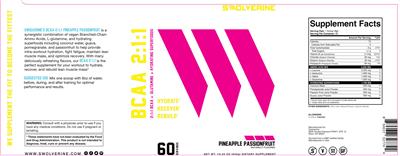
BCAA 2:1:1 Pineapple Passionfruit by Swolverine label
The label scan from the NIH Dietary Supplement Label Database. Tap to enlarge.
Label images are published by the NIH Dietary Supplement Label Database for the version of this product on file. Always read your actual product label.
View the full label (PDF)The Ingredients in BCAA 2:1:1 Pineapple Passionfruit by Swolverine
These are the 13 active ingredients this product is made of. Select any to open its full monograph.
Serving size9 Gram(s) Dosage formPowder Servings per container60 Amounts shown are per serving.
Most supplement products combine several ingredients, and a medication can interact with the product through any one of them. Each ingredient below shows whether it has known drug interactions.
Sodium
Interacts with205 drugs
Sodium is an essential mineral and electrolyte your body needs to balance fluids, support nerves, and help muscles work. Most people in modern diets g...
Sodium monograph & interactionsPotassium
Interacts with62 drugs
Potassium is an essential mineral your body needs for nerve signals, muscle function, and a steady heartbeat, and most people get enough from a balanc...
Potassium monograph & interactionsCalories from Saturated Fat
Chloride
Vitamin B
Amino Acid Mix
- › L-Glutamine
- › L-Leucine
- › L-Isoleucine
- › L-Valine
Hydrating Superfoods
- › Pomegranate Juice, Powder
- › Coconut Water
- › Passionfruit Juice, Powder
- › Guava Juice, Powder
Other (inactive) ingredients: Citric Acid, Natural Flavors, Calcium Silicate. These complete the product’s ingredient list but are not active constituents.
BCAA 2:1:1 Pineapple Passionfruit by Swolverine Drug Interactions
HelloPharmacist Interaction Report
Swolverine's BCAA 2:1:1 Pineapple Passionfruit powder contains several ingredients with documented interactions.
The most serious is L-Glutamine, which theoretically may antagonize anticonvulsant medications (Moderate severity). Glutamine is broken down in your body to glutamate, an excitatory brain chemical that could work against seizure drugs—though this hasn't been reported in humans yet.
Read the full breakdown — every affected drug type, severity by severity
Sodium in this product interacts with multiple medication types: antihypertensive drugs (blood pressure medications), corticosteroids, lithium, didanosine, sodium phosphates, tolvaptan, and other sodium-containing drugs—all Moderate severity. The concern is that added sodium can raise blood pressure, alter lithium levels dangerously, or push sodium levels too high.
Potassium similarly interacts with potassium-sparing diuretics, ACE inhibitors, and ARBs (Moderate severity), raising the risk of dangerously high potassium levels, especially in people with kidney problems.
Pomegranate juice powder brings Moderate-severity interactions with antihypertensive drugs, CYP2D6 substrates, ACE inhibitors, warfarin, and rosuvastatin, plus Minor interactions with certain other enzyme substrates and carbamazepine. Coconut water and guava juice powder carry Minor and Moderate interactions respectively—coconut with diabetes drugs, guava with diabetes medications.
We could not check L-Leucine, L-Isoleucine, L-Valine, Chloride, Vitamin B, the amino acid and superfood blends, or passionfruit juice for interactions. Altogether, these interactions span 1,040 individual medications.
Check your exact medications with the tool on this page before starting.
Check your own medications below · Editorial policy · How we use AI
Want to check YOUR meds against BCAA 2:1:1 Pineapple Passionfruit?
Ask about interactions with your drugs in plain English — “Can I take it with lisinopril?” — and we find you the answer in seconds, ingredient by ingredient.
Go to the checkerIngredients driving the most interactions
Individual Drug Interactions
The ingredients in BCAA 2:1:1 Pineapple Passionfruit interact with 1,052 drugs. Click any drug to see the details.
6 of the 13 ingredients in BCAA 2:1:1 Pineapple Passionfruit interact with drugs. Each result below shows which ingredient is responsible. Pomegranate Juice, Powder Sodium Coconut Water Guava Juice, Powder Potassium L-Glutamine
Candesartan CilexetilAmias, Atacand
How Candesartan Cilexetil interacts with BCAA 2:1:1 Pineapple Passionfruit — through 3 ingredients. Tap an ingredient for the detail:
SodiumAntihypertensive Drugs Moderate
Interaction Summary
Theoretically, a high intake of dietary sodium might reduce the effectiveness of antihypertensive drugs.
Read the full Sodium + Candesartan Cilexetil interactionPomegranate Juice, PowderAntihypertensive Drugs Moderate
Interaction Summary
Theoretically, taking pomegranate with antihypertensive drugs might increase the risk of hypotension.
Read the full Pomegranate Juice, Powder + Candesartan Cilexetil interactionPotassiumAngiotensin Receptor Blockers (arbs) Moderate
Interaction Summary
Using ARBs with high doses of potassium increases the risk of hyperkalemia.
Read the full Potassium + Candesartan Cilexetil interactionCandesartan Cilexetil, HydrochlorothiazideAtacand HCT
How Candesartan Cilexetil, Hydrochlorothiazide interacts with BCAA 2:1:1 Pineapple Passionfruit — through 3 ingredients. Tap an ingredient for the detail:
PotassiumAngiotensin Receptor Blockers (arbs) Moderate
Interaction Summary
Using ARBs with high doses of potassium increases the risk of hyperkalemia.
Read the full Potassium + Candesartan Cilexetil, Hydrochlorothiazide interactionSodiumAntihypertensive Drugs Moderate
Interaction Summary
Theoretically, a high intake of dietary sodium might reduce the effectiveness of antihypertensive drugs.
Read the full Sodium + Candesartan Cilexetil, Hydrochlorothiazide interactionPomegranate Juice, PowderAntihypertensive Drugs Moderate
Interaction Summary
Theoretically, taking pomegranate with antihypertensive drugs might increase the risk of hypotension.
Read the full Pomegranate Juice, Powder + Candesartan Cilexetil, Hydrochlorothiazide interactionCaptoprilAcepril, Capoten
How Captopril interacts with BCAA 2:1:1 Pineapple Passionfruit — through 3 ingredients. Tap an ingredient for the detail:
Pomegranate Juice, PowderAntihypertensive Drugs, Ace Inhibitors (aceis) Moderate
Interaction Summary
Theoretically, taking pomegranate with antihypertensive drugs might increase the risk of hypotension.
Read the full Pomegranate Juice, Powder + Captopril interactionPotassiumAce Inhibitors (aceis) Moderate
Interaction Summary
Using ACEIs with high doses of potassium increases the risk of hyperkalemia.
Read the full Potassium + Captopril interactionSodiumAntihypertensive Drugs Moderate
Interaction Summary
Theoretically, a high intake of dietary sodium might reduce the effectiveness of antihypertensive drugs.
Read the full Sodium + Captopril interactionCaptopril, HydrochlorothiazideAcezide, Capozide
How Captopril, Hydrochlorothiazide interacts with BCAA 2:1:1 Pineapple Passionfruit — through 3 ingredients. Tap an ingredient for the detail:
SodiumAntihypertensive Drugs Moderate
Interaction Summary
Theoretically, a high intake of dietary sodium might reduce the effectiveness of antihypertensive drugs.
Read the full Sodium + Captopril, Hydrochlorothiazide interactionPomegranate Juice, PowderAntihypertensive Drugs, Ace Inhibitors (aceis) Moderate
Interaction Summary
Theoretically, taking pomegranate with antihypertensive drugs might increase the risk of hypotension.
Read the full Pomegranate Juice, Powder + Captopril, Hydrochlorothiazide interactionPotassiumAce Inhibitors (aceis) Moderate
Interaction Summary
Using ACEIs with high doses of potassium increases the risk of hyperkalemia.
Read the full Potassium + Captopril, Hydrochlorothiazide interactionCarbamazepineCarbatrol, Carnexiv, Equetro, Tegretol, Tegretol XR
How Carbamazepine interacts with BCAA 2:1:1 Pineapple Passionfruit — through 2 ingredients. Tap an ingredient for the detail:
L-glutamineAnticonvulsants Moderate
Interaction Summary
Theoretically, glutamine might antagonize the effects of anticonvulsant medications.
Read the full L-glutamine + Carbamazepine interactionPomegranate Juice, PowderCarbamazepine (tegretol), Cytochrome P450 3a4 (cyp3a4) Substrates Minor
Interaction Summary
Theoretically, taking pomegranate with carbamazepine might increase the risk of adverse effects, although research suggests this interaction is unlikely to be clinically significant.
Read the full Pomegranate Juice, Powder + Carbamazepine interactionCarteololCartrol, Ocupress
How Carteolol interacts with BCAA 2:1:1 Pineapple Passionfruit — through 2 ingredients. Tap an ingredient for the detail:
SodiumAntihypertensive Drugs Moderate
Interaction Summary
Theoretically, a high intake of dietary sodium might reduce the effectiveness of antihypertensive drugs.
Read the full Sodium + Carteolol interactionPomegranate Juice, PowderAntihypertensive Drugs Moderate
Interaction Summary
Theoretically, taking pomegranate with antihypertensive drugs might increase the risk of hypotension.
Read the full Pomegranate Juice, Powder + Carteolol interactionCarvedilolCoreg, Coreg CR
How Carvedilol interacts with BCAA 2:1:1 Pineapple Passionfruit — through 2 ingredients. Tap an ingredient for the detail:
Pomegranate Juice, PowderAntihypertensive Drugs, Cytochrome P450 2d6 (cyp2d6) Substrates +1 Moderate
Interaction Summary
Theoretically, taking pomegranate with antihypertensive drugs might increase the risk of hypotension.
Read the full Pomegranate Juice, Powder + Carvedilol interactionSodiumAntihypertensive Drugs Moderate
Interaction Summary
Theoretically, a high intake of dietary sodium might reduce the effectiveness of antihypertensive drugs.
Read the full Sodium + Carvedilol interactionCelecoxib, TramadolSeglentis
How Celecoxib, Tramadol interacts with BCAA 2:1:1 Pineapple Passionfruit — through 1 ingredient. Tap an ingredient for the detail:
Pomegranate Juice, PowderCytochrome P450 2d6 (cyp2d6) Substrates, Cytochrome P450 3a4 (cyp3a4) Substrates +1 Moderate
Interaction Summary
Theoretically, pomegranate might increase levels of drugs metabolized by CYP2D6.
Read the full Pomegranate Juice, Powder + Celecoxib, Tramadol interactionCeliprololCelicard
How Celiprolol interacts with BCAA 2:1:1 Pineapple Passionfruit — through 2 ingredients. Tap an ingredient for the detail:
Pomegranate Juice, PowderAntihypertensive Drugs Moderate
Interaction Summary
Theoretically, taking pomegranate with antihypertensive drugs might increase the risk of hypotension.
Read the full Pomegranate Juice, Powder + Celiprolol interactionSodiumAntihypertensive Drugs Moderate
Interaction Summary
Theoretically, a high intake of dietary sodium might reduce the effectiveness of antihypertensive drugs.
Read the full Sodium + Celiprolol interactionCenobamateXcopri
How Cenobamate interacts with BCAA 2:1:1 Pineapple Passionfruit — through 1 ingredient. Tap an ingredient for the detail:
L-glutamineAnticonvulsants Moderate
Interaction Summary
Theoretically, glutamine might antagonize the effects of anticonvulsant medications.
Read the full L-glutamine + Cenobamate interactionCevimelineEvoxac
How Cevimeline interacts with BCAA 2:1:1 Pineapple Passionfruit — through 1 ingredient. Tap an ingredient for the detail:
Pomegranate Juice, PowderCytochrome P450 2d6 (cyp2d6) Substrates, Cytochrome P450 3a4 (cyp3a4) Substrates Moderate
Interaction Summary
Theoretically, pomegranate might increase levels of drugs metabolized by CYP2D6.
Read the full Pomegranate Juice, Powder + Cevimeline interactionChlorothiazideDiuril
How Chlorothiazide interacts with BCAA 2:1:1 Pineapple Passionfruit — through 2 ingredients. Tap an ingredient for the detail:
SodiumAntihypertensive Drugs Moderate
Interaction Summary
Theoretically, a high intake of dietary sodium might reduce the effectiveness of antihypertensive drugs.
Read the full Sodium + Chlorothiazide interactionPomegranate Juice, PowderAntihypertensive Drugs Moderate
Interaction Summary
Theoretically, taking pomegranate with antihypertensive drugs might increase the risk of hypotension.
Read the full Pomegranate Juice, Powder + Chlorothiazide interactionChlorothiazide, MethyldopaAldochlor, Aldoclor 150, Aldoclor 250
How Chlorothiazide, Methyldopa interacts with BCAA 2:1:1 Pineapple Passionfruit — through 2 ingredients. Tap an ingredient for the detail:
Pomegranate Juice, PowderAntihypertensive Drugs Moderate
Interaction Summary
Theoretically, taking pomegranate with antihypertensive drugs might increase the risk of hypotension.
Read the full Pomegranate Juice, Powder + Chlorothiazide, Methyldopa interactionSodiumAntihypertensive Drugs Moderate
Interaction Summary
Theoretically, a high intake of dietary sodium might reduce the effectiveness of antihypertensive drugs.
Read the full Sodium + Chlorothiazide, Methyldopa interactionChlorothiazide, ReserpineDiupres
How Chlorothiazide, Reserpine interacts with BCAA 2:1:1 Pineapple Passionfruit — through 2 ingredients. Tap an ingredient for the detail:
SodiumAntihypertensive Drugs Moderate
Interaction Summary
Theoretically, a high intake of dietary sodium might reduce the effectiveness of antihypertensive drugs.
Read the full Sodium + Chlorothiazide, Reserpine interactionPomegranate Juice, PowderAntihypertensive Drugs Moderate
Interaction Summary
Theoretically, taking pomegranate with antihypertensive drugs might increase the risk of hypotension.
Read the full Pomegranate Juice, Powder + Chlorothiazide, Reserpine interactionChlorpheniramine Maleate, Dextromethorphan HydrobromideCoricidin HBP Cough & Cold, Coricidin II Cough & Cold, Pediatric Vicks Formula 44m Cough & Cold Relief
How Chlorpheniramine Maleate, Dextromethorphan Hydrobromide interacts with BCAA 2:1:1 Pineapple Passionfruit — through 1 ingredient. Tap an ingredient for the detail:
Pomegranate Juice, PowderCytochrome P450 3a4 (cyp3a4) Substrates, Cytochrome P450 2d6 (cyp2d6) Substrates Moderate
Interaction Summary
Theoretically, pomegranate might increase levels of drugs metabolized by CYP3A4, but most research suggests this interaction is unlikely to be clinically significant.
Read the full Pomegranate Juice, Powder + Chlorpheniramine Maleate, Dextromethorphan Hydrobromide interactionChlorpheniramine Maleate, Hydrocodone BitartrateVituz
How Chlorpheniramine Maleate, Hydrocodone Bitartrate interacts with BCAA 2:1:1 Pineapple Passionfruit — through 1 ingredient. Tap an ingredient for the detail:
Pomegranate Juice, PowderCytochrome P450 2d6 (cyp2d6) Substrates, Cytochrome P450 3a4 (cyp3a4) Substrates Moderate
Interaction Summary
Theoretically, pomegranate might increase levels of drugs metabolized by CYP2D6.
Read the full Pomegranate Juice, Powder + Chlorpheniramine Maleate, Hydrocodone Bitartrate interactionChlorpheniramine Polistirex, Codeine PolistirexTuzistra XR
How Chlorpheniramine Polistirex, Codeine Polistirex interacts with BCAA 2:1:1 Pineapple Passionfruit — through 1 ingredient. Tap an ingredient for the detail:
Pomegranate Juice, PowderCytochrome P450 3a4 (cyp3a4) Substrates, Cytochrome P450 2d6 (cyp2d6) Substrates Moderate
Interaction Summary
Theoretically, pomegranate might increase levels of drugs metabolized by CYP3A4, but most research suggests this interaction is unlikely to be clinically significant.
Read the full Pomegranate Juice, Powder + Chlorpheniramine Polistirex, Codeine Polistirex interactionChlorpheniramine, Hydrocodone, PseudoephedrineTussend
How Chlorpheniramine, Hydrocodone, Pseudoephedrine interacts with BCAA 2:1:1 Pineapple Passionfruit — through 1 ingredient. Tap an ingredient for the detail:
Pomegranate Juice, PowderCytochrome P450 3a4 (cyp3a4) Substrates, Cytochrome P450 2d6 (cyp2d6) Substrates Moderate
Interaction Summary
Theoretically, pomegranate might increase levels of drugs metabolized by CYP3A4, but most research suggests this interaction is unlikely to be clinically significant.
Read the full Pomegranate Juice, Powder + Chlorpheniramine, Hydrocodone, Pseudoephedrine interactionChlorpromazineThorazine, Thorazine Spansules
How Chlorpromazine interacts with BCAA 2:1:1 Pineapple Passionfruit — through 1 ingredient. Tap an ingredient for the detail:
Pomegranate Juice, PowderCytochrome P450 2d6 (cyp2d6) Substrates Moderate
Interaction Summary
Theoretically, pomegranate might increase levels of drugs metabolized by CYP2D6.
Read the full Pomegranate Juice, Powder + Chlorpromazine interactionChlorpropamideChlorpropam, Diabinese
How Chlorpropamide interacts with BCAA 2:1:1 Pineapple Passionfruit — through 3 ingredients. Tap an ingredient for the detail:
Guava Juice, PowderAntidiabetes Drugs Moderate
Interaction Summary
Theoretically, concomitant use with antidiabetes drugs might have additive effects and increase the risk of hypoglycemia.
Read the full Guava Juice, Powder + Chlorpropamide interactionPomegranate Juice, PowderCytochrome P450 2d6 (cyp2d6) Substrates Moderate
Interaction Summary
Theoretically, pomegranate might increase levels of drugs metabolized by CYP2D6.
Read the full Pomegranate Juice, Powder + Chlorpropamide interactionCoconut WaterAntidiabetes Drugs Minor
Interaction Summary
Theoretically, taking coconut with antidiabetes drugs might increase the risk of hypoglycemia.
Read the full Coconut Water + Chlorpropamide interactionChlorthalidoneHygroton, Thalitone
How Chlorthalidone interacts with BCAA 2:1:1 Pineapple Passionfruit — through 2 ingredients. Tap an ingredient for the detail:
SodiumAntihypertensive Drugs Moderate
Interaction Summary
Theoretically, a high intake of dietary sodium might reduce the effectiveness of antihypertensive drugs.
Read the full Sodium + Chlorthalidone interactionPomegranate Juice, PowderAntihypertensive Drugs Moderate
Interaction Summary
Theoretically, taking pomegranate with antihypertensive drugs might increase the risk of hypotension.
Read the full Pomegranate Juice, Powder + Chlorthalidone interactionChlorthalidone, ClonidineClorpres, Combipres
How Chlorthalidone, Clonidine interacts with BCAA 2:1:1 Pineapple Passionfruit — through 2 ingredients. Tap an ingredient for the detail:
Pomegranate Juice, PowderAntihypertensive Drugs Moderate
Interaction Summary
Theoretically, taking pomegranate with antihypertensive drugs might increase the risk of hypotension.
Read the full Pomegranate Juice, Powder + Chlorthalidone, Clonidine interactionSodiumAntihypertensive Drugs Moderate
Interaction Summary
Theoretically, a high intake of dietary sodium might reduce the effectiveness of antihypertensive drugs.
Read the full Sodium + Chlorthalidone, Clonidine interactionCilazaprilInhibace
How Cilazapril interacts with BCAA 2:1:1 Pineapple Passionfruit — through 3 ingredients. Tap an ingredient for the detail:
Pomegranate Juice, PowderAce Inhibitors (aceis), Antihypertensive Drugs Moderate
Interaction Summary
Theoretically, taking pomegranate with ACEIs might increase the risk of adverse effects.
Read the full Pomegranate Juice, Powder + Cilazapril interactionPotassiumAce Inhibitors (aceis) Moderate
Interaction Summary
Using ACEIs with high doses of potassium increases the risk of hyperkalemia.
Read the full Potassium + Cilazapril interactionSodiumAntihypertensive Drugs Moderate
Interaction Summary
Theoretically, a high intake of dietary sodium might reduce the effectiveness of antihypertensive drugs.
Read the full Sodium + Cilazapril interactionClevidipineCleviprex
How Clevidipine interacts with BCAA 2:1:1 Pineapple Passionfruit — through 2 ingredients. Tap an ingredient for the detail:
Pomegranate Juice, PowderAntihypertensive Drugs Moderate
Interaction Summary
Theoretically, taking pomegranate with antihypertensive drugs might increase the risk of hypotension.
Read the full Pomegranate Juice, Powder + Clevidipine interactionSodiumAntihypertensive Drugs Moderate
Interaction Summary
Theoretically, a high intake of dietary sodium might reduce the effectiveness of antihypertensive drugs.
Read the full Sodium + Clevidipine interactionClobazamFrisium, Onfi, Sympazan
How Clobazam interacts with BCAA 2:1:1 Pineapple Passionfruit — through 1 ingredient. Tap an ingredient for the detail:
L-glutamineAnticonvulsants Moderate
Interaction Summary
Theoretically, glutamine might antagonize the effects of anticonvulsant medications.
Read the full L-glutamine + Clobazam interactionClobetasolClobex, Temovate
How Clobetasol interacts with BCAA 2:1:1 Pineapple Passionfruit — through 1 ingredient. Tap an ingredient for the detail:
SodiumCorticosteroids Moderate
Interaction Summary
Concomitant use of mineralocorticoids and some glucocorticoids with sodium supplements might increase the risk of hypernatremia.
Read the full Sodium + Clobetasol interactionClomipramineAnafranil, Anafranil SR
How Clomipramine interacts with BCAA 2:1:1 Pineapple Passionfruit — through 1 ingredient. Tap an ingredient for the detail:
Pomegranate Juice, PowderCytochrome P450 2d6 (cyp2d6) Substrates, Cytochrome P450 2c9 (cyp2c9) Substrates +1 Moderate
Interaction Summary
Theoretically, pomegranate might increase levels of drugs metabolized by CYP2D6.
Read the full Pomegranate Juice, Powder + Clomipramine interactionClonazepamCeberclon, Klonopin, Rivotril
How Clonazepam interacts with BCAA 2:1:1 Pineapple Passionfruit — through 2 ingredients. Tap an ingredient for the detail:
L-glutamineAnticonvulsants Moderate
Interaction Summary
Theoretically, glutamine might antagonize the effects of anticonvulsant medications.
Read the full L-glutamine + Clonazepam interactionPomegranate Juice, PowderCytochrome P450 3a4 (cyp3a4) Substrates Minor
Interaction Summary
Theoretically, pomegranate might increase levels of drugs metabolized by CYP3A4, but most research suggests this interaction is unlikely to be clinically significant.
Read the full Pomegranate Juice, Powder + Clonazepam interactionClonidineCatapres
How Clonidine interacts with BCAA 2:1:1 Pineapple Passionfruit — through 2 ingredients. Tap an ingredient for the detail:
Pomegranate Juice, PowderAntihypertensive Drugs Moderate
Interaction Summary
Theoretically, taking pomegranate with antihypertensive drugs might increase the risk of hypotension.
Read the full Pomegranate Juice, Powder + Clonidine interactionSodiumAntihypertensive Drugs Moderate
Interaction Summary
Theoretically, a high intake of dietary sodium might reduce the effectiveness of antihypertensive drugs.
Read the full Sodium + Clonidine interactionClorazepateTranxene, Tranxene SD, Tranxene T-Tab
How Clorazepate interacts with BCAA 2:1:1 Pineapple Passionfruit — through 1 ingredient. Tap an ingredient for the detail:
L-glutamineAnticonvulsants Moderate
Interaction Summary
Theoretically, glutamine might antagonize the effects of anticonvulsant medications.
Read the full L-glutamine + Clorazepate interactionEach ingredient & the kinds of drugs it affects
For each ingredient in BCAA 2:1:1 Pineapple Passionfruit with known interactions, here are the types of medications they can affect. Open any type for the detail — or search your exact drug in the checker above.
Pomegranate Juice, Powder
Ace Inhibitors (Aceis)
Theoretically, taking pomegranate with ACEIs might increase the risk of adverse effects.
Pomegranate juice is thought to have ACE inhibitor-like effects.
Antihypertensive Drugs
Theoretically, taking pomegranate with antihypertensive drugs might increase the risk of hypotension.
Consuming pomegranate juice can modestly lower blood pressure.
Cytochrome P450 2D6 (Cyp2D6) Substrates
Theoretically, pomegranate might increase levels of drugs metabolized by CYP2D6.
In vitro, pomegranate juice inhibits CYP2D6. However, the clinical significance of this potential interaction in humans is not known.
Rosuvastatin (Crestor)
Theoretically, taking pomegranate with rosuvastatin might increase the risk of adverse effects.
In one case, a patient taking rosuvastatin 5 mg every other day in combination with ezetimibe 10 mg daily developed rhabdomyolysis after drinking pomegranate juice 200 mL twice weekly for 3 weeks. This patient had a history of elevated creatine kinase levels while not receiving any statin treatment. This suggests a possible underlying myopathy and predisposition to rhabdomyolysis.
Warfarin (Coumadin)
Theoretically, pomegranate might increase warfarin levels and increase the risk of bleeding. Also, discontinuing regular consumption of pomegranate juice might decrease warfarin levels.
In one case report, a patient had a stable, therapeutic bleeding time, as measured by international normalized ratio (INR), while taking warfarin in combination with pomegranate juice 2-3 times per week. The patient became subtherapeutic within about 10 days after discontinuing pomegranate juice, which required a warfarin dose increase. In another case report, a patient with a stable INR for over one year presented with an INR of 14. The patient noted no changes to medications or diet but did report consuming around 3 liters of pomegranate juice over the previous week. The patient's INR stabilized upon moderation of pomegranate juice consumption. The mechanism of this potential interaction is unclear.
Carbamazepine (Tegretol)
Theoretically, taking pomegranate with carbamazepine might increase the risk of adverse effects, although research suggests this interaction is unlikely to be clinically significant.
Animal research shows that pomegranate juice may inhibit cytochrome P450 3A4 (CYP3A4) metabolism of carbamazepine and increase levels of carbamazepine by 1.5 times without prolonging the elimination half-life. This suggests that pomegranate juice inhibits intestinal CYP3A4, but might not inhibit hepatic CYP3A4. However, some human research suggests that pomegranate does not significantly inhibit CYP3A4 drug metabolism in humans.
Cytochrome P450 2C9 (Cyp2C9) Substrates
Theoretically, pomegranate might increase levels of drugs metabolized by CYP2C9.
Some animal and in vitro research shows that pomegranate juice inhibits intestinal, but not hepatic, CYP2C9 isoenzyme activity. However, clinical research shows that neither pomegranate juice nor pomegranate extract have a significant effect on CYP2C9 activity in humans.
Cytochrome P450 3A4 (Cyp3A4) Substrates
Theoretically, pomegranate might increase levels of drugs metabolized by CYP3A4, but most research suggests this interaction is unlikely to be clinically significant.
Pomegranate contains several polyphenols that have individually been shown to inhibit CYP3A4. However, there is contradictory evidence about the effect of whole pomegranate juice on CYP3A4 activity. In vitro, pomegranate juice significantly inhibits the CYP3A4 enzyme, with comparable inhibition to grapefruit juice. In an animal model, pomegranate juice inhibits CYP3A4 metabolism of carbamazepine and increases levels of carbamazepine by 1.5 times; however, in human volunteers, drinking a single glass of pomegranate juice 240 mL or taking 200 mL daily for 2 weeks does not significantly affect levels of the CYP3A4 substrate midazolam after oral or intravenous administration. Another study in healthy volunteers shows that consuming pomegranate juice 300 mL three times daily for three days also does not significantly affect levels of simvastatin, a CYP3A4 substrate This suggests that pomegranate is unlikely to significantly affect levels of CYP3A4 substrates in humans.
Tolbutamide (Orinase)
Theoretically, pomegranate might increase levels of tolbutamide, although research suggests this interaction is unlikely to be clinically significant.
Animal research shows that pomegranate juice inhibits the cytochrome P450 2C9 (CYP2C9) metabolism of tolbutamide. Pomegranate juice increased tolbutamide levels by 1.2 times without prolonging the elimination half-life. This suggests that pomegranate juice inhibits intestinal CYP2C9, but might not inhibit hepatic CYP2C9. Despite this evidence, clinical research shows that neither pomegranate juice nor pomegranate extract have a significant effect on CYP2C9 activity in humans. This interaction does not appear to be clinically significant in humans.
Sodium
Antihypertensive Drugs
Theoretically, a high intake of dietary sodium might reduce the effectiveness of antihypertensive drugs.
High intake of dietary sodium can increase systolic and diastolic blood pressure. Also, high intake of sodium may necessitate increased use of antihypertensive medications to achieve blood pressure control in some patients, such as those with chronic kidney disease.
Corticosteroids
Concomitant use of mineralocorticoids and some glucocorticoids with sodium supplements might increase the risk of hypernatremia.
Mineralocorticoids and some glucocorticoids (corticosteroids) cause sodium retention. This effect is dose-related and depends on mineralocorticoid potency. It is most common with hydrocortisone, cortisone, and fludrocortisone, followed by prednisone and prednisolone.
Didanosine (Videx)
Concomitant use of didanosine with additional sodium from dietary or supplemental sources may increase the risk of hypernatremia.
Didanosine formulations contain a significant amount of sodium.
Lithium
Altering dietary intake of sodium might alter the levels and clinical effects of lithium.
High sodium intake can reduce plasma concentrations of lithium by increasing lithium excretion. Reducing sodium intake can significantly increase plasma concentrations of lithium and cause lithium toxicity in patients being treated with lithium carbonate. Stabilizing sodium intake is shown to reduce the percentage of patients with lithium level fluctuations above 0.8 mEq/L. Patients taking lithium should avoid significant alterations in their dietary intake of sodium.
Sodium Phosphates
Theoretically, concomitant use of sodium phosphate with sodium supplements might increase the risk of hypernatremia.
Use of high doses (> 45 mL in 24 hours) of sodium phosphate, such as those used for bowel cleansing before surgery, can lead to serious electrolyte disturbances, including hypernatremia. The risk of hypernatremia is highest in the elderly and people with other risk factors for electrolyte disturbances.
Sodium-Containing Drugs
Concomitant use of sodium-containing drugs with additional sodium from dietary or supplemental sources may increase the risk of hypernatremia and long-term sodium-related complications.
The Chronic Disease Risk Reduction (CDRR) intake level of 2.3 grams of sodium daily indicates the intake at which it is believed that chronic disease risk increases for the apparently healthy population. Some medications contain high quantities of sodium. When used in conjunction with sodium supplements or high-sodium diets, the CDRR may be exceeded. Additionally, concomitant use may increase the risk for hypernatremia; this risk is highest in the elderly and people with other risk factors for electrolyte disturbances.
Tolvaptan (Samsca)
Theoretically, concomitant use of tolvaptan with sodium might increase the risk of hypernatremia.
Tolvaptan is a vasopressin receptor 2 antagonist that is used to increase sodium levels in patients with hyponatremia. Patients taking tolvaptan should use caution with the use of sodium salts such as sodium chloride.
Coconut Water
Antidiabetes Drugs
Theoretically, taking coconut with antidiabetes drugs might increase the risk of hypoglycemia.
Animal research suggests that coconut milk might increase insulin levels and/or decrease blood glucose levels.
Guava Juice, Powder
Antidiabetes Drugs
Theoretically, concomitant use with antidiabetes drugs might have additive effects and increase the risk of hypoglycemia. Animal research shows that guava leaf extract or guava fruit can have hypoglycemic effects. Monitor blood glucose levels closely. Medication dose adjustments may be necessary. Some antidiabetes drugs include glimepiride (Amaryl), glyburide (Diabeta, Glynase PresTab, Micronase), insulin, metformin, pioglitazone (Actos), rosiglitazone (Avandia), and others.
Potassium
Ace Inhibitors (Aceis)
Using ACEIs with high doses of potassium increases the risk of hyperkalemia.
ACEIs block the actions of the renin-angiotensin-aldosterone system and reduce potassium excretion. Concomitant use of these drugs with potassium supplements increases the risk of hyperkalemia. However, concomitant use of these drugs with moderate dietary potassium intake (about 3775-5200 mg daily) does not increase serum potassium levels.
Angiotensin Receptor Blockers (Arbs)
Using ARBs with high doses of potassium increases the risk of hyperkalemia.
ARBs block the actions of the renin-angiotensin-aldosterone system and reduce potassium excretion. Concomitant use of these drugs with potassium supplements increases the risk of hyperkalemia. However, concomitant use of these drugs with moderate dietary potassium intake (about 3775-5200 mg daily) does not increase serum potassium levels.
Potassium-Sparing Diuretics
Concomitant use increases the risk of hyperkalemia.
Using potassium-sparing diuretics with potassium supplements increases the risk of hyperkalemia.
L-Glutamine
Anticonvulsants
Theoretically, glutamine might antagonize the effects of anticonvulsant medications.
Glutamine is metabolized to the excitatory neurotransmitter glutamate. Glutamate might have antagonistic effects with anticonvulsant drugs. However, this interaction has not yet been reported in humans.
Brand information
Manufacturer and brand details for BCAA 2:1:1 Pineapple Passionfruit, from the product label.
Swolverine
See all Swolverine products- Name
- Swolverine
- Street Address
- 9005 Double Diamond Pkwy, Ste 10
- City
- Reno
- State
- NV
- ZipCode
- 89521
- Web Address
- www.swolverine.com
BCAA 2:1:1 Pineapple Passionfruit by Swolverine: Common Questions
Does BCAA 2:1:1 Pineapple Passionfruit by Swolverine interact with any medications?
How can one product interact with so many drugs?
Where does this information come from?
Does L-Glutamine in this powder actually help with muscle recovery?
Can I use this if I'm pregnant or breastfeeding?
What are the most common side effects?
I have a tree nut allergy—is this safe for me?
What do the BCAAs in this powder actually do?
Is this the right electrolyte mix for hydration?
Written and reviewed by the HelloPharmacist editorial staff. Our editorial policy
Not sure if BCAA 2:1:1 Pineapple Passionfruit is safe with your meds?
Our pharmacists answer your medication & supplement questions — free.
Label information is sourced from the NIH Dietary Supplement Label Database and reflects the product version on file; always read your actual product label. This page is for education only and is not a substitute for professional medical advice. Confirm with your pharmacist or doctor before combining supplements and medications.
The Full Monographs Behind BCAA 2:1:1 Pineapple Passionfruit’s Ingredients
Every ingredient we hold a full HelloPharmacist monograph for — uses, evidence, safety, and the complete interaction list.
Sodium
Interacts with 205 drugsSodium is an essential mineral and electrolyte your body needs to balance fluids, support nerves, and help muscles work. Most people in modern diets get more than enough—often too much—from...
Read the full Sodium monograph → Herb & supplement monographPotassium
Interacts with 62 drugsPotassium is an essential mineral your body needs for nerve signals, muscle function, and a steady heartbeat, and most people get enough from a balanced diet rich in fruits and vegetables. P...
Read the full Potassium monograph → Herb & supplement monographGlutamine
Interacts with 50 drugsGlutamine is the most abundant amino acid in the body and is usually made in your muscles. A prescription form is FDA-approved to help reduce sickle cell disease complications, but for most...
Read the full Glutamine monograph → Herb & supplement monographPomegranate
Interacts with 922 drugsPomegranate is a nutrient-rich fruit that is high in antioxidants and is widely enjoyed as food and juice. Early research suggests it may support heart health and blood pressure, but the evi...
Read the full Pomegranate monograph → Herb & supplement monographCoconut
Interacts with 86 drugsCoconut is a nutritious tropical food enjoyed as oil, water, milk, and flesh, and it is generally safe to eat in normal food amounts. While some uses (like skin moisturizing and hydration) h...
Read the full Coconut monograph → Herb & supplement monographGuava
Interacts with 86 drugsGuava is a tropical fruit tree whose leaves and fruit have a long history of folk use for diarrhea, blood sugar, and general wellness. The fruit is a nutritious food rich in vitamin C, but e...
Read the full Guava monograph →Sources & How We Checked
BCAA 2:1:1 Pineapple Passionfruit's label data comes from the NIH Dietary Supplement Label Database; the ingredient interaction data is from the Natural Medicines database, reviewed by our pharmacists.
- NIH Dietary Supplement Label Database (DSLD) — The official product label on file for this supplement.
- Natural Medicines (Therapeutic Research Center) — Evidence-graded clinical reference behind the ingredient interaction data.
Content is written and reviewed by licensed HelloPharmacist pharmacists. See our data sources and editorial standards for how this information is built and checked.
The 105 references behind this product’s interaction data
Every citation that drives the interaction findings for this product’s ingredients, from the evidence-graded Natural Medicines (TRC Healthcare) database. Open an ingredient to browse its citations — links open the study on PubMed or the publisher’s site.
Glutamine 11 references
- Miller AL. Therapeutic considerations of L-glutamine: a review of the literature. Altern Med Rev 1999;4:239-48..
- Bozzetti F, Biganzoli L, Gavazzi C, et al. Glutamine supplementation in cancer patients receiving chemotherapy: a double-blind randomized study. Nutrition 1997;13:748-51.. PubMed
- Mebane AH. L-Glutamine and mania. Am J Psychiatry 984;141:1302-3.
- Meldrum BS. Glutamate as a neurotransmitter in the brain: review of physiology and pathology. J Nutr 2000;130:1007S-15S.. PubMed
- Garlick PJ. Assessment of the safety of glutamine and other amino acids. J Nutr 2001;131:2556S-61S.. PubMed
- Chapman AG. Glutamate and epilepsy. J Nutr 2000;130:1043S-5S.. PubMed
- Ziegler TR. Glutamine supplementation in cancer patients receiving bone marrow transplantation and high dose chemotherapy. J Nutr 2001;131:2578S-84S.. PubMed
- Laviano A, Molfino A, Lacaria MT, Canelli A, De Leo S, Preziosa I, Rossi Fanelli F. Glutamine supplementation favors weight loss in nondieting obese female patients. A pilot study. Eur J Clin Nutr. 2014 Nov;68(11):1264-6. PubMed
- Endari (l-glutamine) [package insert]. Torrance, CA: Emmaus Medical,Inc; 2017.
- Niihara Y, Miller ST, Kanter J, et al. A Phase 3 Trial of l-Glutamine in Sickle Cell Disease. N Engl J Med 2018;379(3):226-35. doi: 10.1056/NEJMoa1715971.
- Ogden HB, Child RB, Fallowfield JL, et al. Gastrointestinal Tolerance of Low, Medium and High Dose Acute Oral l-Glutamine Supplementation in Healthy Adults: A Pilot Study. Nutrients. 2020;12(10):2953. PubMed
Sodium 38 references
- Garabedian-Ruffalo SM, Ruffalo RL. Drug and nutrient interactions. Am Fam Physician 1986;33:165-74.
- Food and Drug Administration Science Background: Safety of Sodium Phosphates Oral Solution. September 17, 2001. Available at: http://www.fda.gov/cder/drug/safety/sodiumphospate.htm
- Coton T, Mallaret C, Coilliot C, Carre D, Guisset M. Severe acute ulcerated gastritis induced by salt. Presse Med 2009;38(3):499-500. PubMed
- Frings-Meuthen P, Buehlmeier J, Baecker N, et al. High sodium chloride intake exacerbates immobilization-induced bone resorption and protein losses. J Appl Physiol 2011;111(2):537-542. PubMed
- Frings-Meuthen P, Baecker N, Heer M. Low-grade metabolic acidosis may be the cause of sodium chloride-induced exaggerated bone resorption. J Bone Miner Res 2008;23(4):517-524. PubMed
- Alam S, Johnson AG. A meta-analysis of randomised controlled trials (RCT) among healthy normotensive and essential hypertensive elderly patients to determine the effect of high salt (NaCl) diet of blood pressure. J Hum Hypertens 1999;13(6):367-74.
- Boudville N, Ward S, Benaroia M, House AA. Increased sodium intake correlates with greater use of antihypertensive agents by subjects with chronic kidney disease. Am J Hypertens 2005;18(10):1300-5. PubMed
- Bennett WM. Drug interactions and consequences of sodium restriction. Am J Clin Nutr 1997;65(2 Suppl):678S-681S. PubMed
- Okusa MD, Crystal LJ. Clinical manifestations and management of acute lithium intoxication. Am J Med 1994;97(4):383-9. PubMed
- Food and Nutrition Board, Institute of Medicine. Dietary reference intakes for water, potassium, sodium, chloride, and sulfate. Washington, DC: National Academy Press, 2005. Available at: http://www.nap.edu/openbook.php?record_id=10925. DOI
- D'Elia L, Rossi G, Ippolito R, Cappuccio FP, Strazzullo P. Habitual salt intake and risk of gastric cancer: a meta-analysis of prospective studies. Clin Nutr 2012;31(4):489-98. PubMed
- Goldsmith SR. Hyponatremia in heart failure: time for a trial. J Card Fail 2013;19(6):398-400. PubMed
- Willocks L, Brettle R, Keen J, Valentine C, Pinching AJ. Formulations of didanosine (ddI) and salt overload. Lancet 1992;339(8786):190.
- Chen L, Zhang Z, Chen W, Whelton PK, Appel LJ. Lower Sodium Intake and Risk of Headaches: Results From the Trial of Nonpharmacologic Interventions in the Elderly. Am J Public Health. 2016;106(7):1270-5. PubMed
- Cook NR, Appel LJ, Whelton PK. Lower levels of sodium intake and reduced cardiovascular risk. Circulation. 2014;129(9):981-9. PubMed
- Cook NR, Appel LJ, Whelton PK. Sodium Intake and All-Cause Mortality Over 20 Years in the Trials of Hypertension Prevention. J Am Coll Cardiol. 2016;68(15):1609-1617. PubMed
- Mente A, O'Donnell M, Rangarajan S, et al. Associations of urinary sodium excretion with cardiovascular events in individuals with and without hypertension: a pooled analysis of data from four studies. Lancet. 2016;388(10043):465-75. PubMed
- Moosavian SP, Haghighatdoost F, Surkan PJ, Azadbakht L. Salt and obesity: a systematic review and meta-analysis of observational studies. Int J Food Sci Nutr. 2017;68(3):265-277. PubMed
- O'Donnell M, Mente A, Rangarajan S, et al. Urinary sodium and potassium excretion, mortality, and cardiovascular events. N Engl J Med. 2014;371(7):612-23. DOI
- Poggio R, Gutierrez L, Matta MG, Elorriaga N, Irazola V, Rubinstein A. Daily sodium consumption and CVD mortality in the general population: systematic review and meta-analysis of prospective studies. Public Health Nutr. 2015;18(4):695-704. PubMed
- Stallings VA, Harrison M, Oria M; Committee to Review the Dietary Reference Intakes for Sodium and Potassium, Food and Nutrition Board, Health and Medicine Division, National Academies of Sciences, Engineering, and Medicine. Washington (DC): National Acad
- Mahtani KR, Heneghan C, Onakpoya I, et al. Reduced Salt Intake for Heart Failure: A Systematic Review. JAMA Intern Med. 2018 Dec 1;178(12):1693-1700. PubMed
- Yancy CW. Sodium Restriction in Heart Failure: Too Much Uncertainty-Do the Trials. JAMA Intern Med. 2018 Dec 1;178(12):1700-1701. PubMed
- He FJ, Campbell NRC, Ma Y, MacGregor GA, Cogswell ME, Cook NR. Errors in estimating usual sodium intake by the Kawasaki formula alter its relationship with mortality: implications for public health. Int J Epidemiol. 2018;47(6):1784-1795. PubMed
- Murthy K, Ondrey GJ, Malkani N, et al. THE EFFECTS OF HYPONATREMIA ON BONE DENSITY AND FRACTURES: A SYSTEMATIC REVIEW AND META-ANALYSIS. Endocr Pract. 2019;25(4):366-378. PubMed
- Messerli FH, Hofstetter L, Syrogiannouli L, et al. Sodium intake, life expectancy, and all-cause mortality. Eur Heart J 2021;42(21):2103-2112. PubMed
- Graudal NA, Hubeck-Graudal T, Jurgens G. Effects of low sodium diet versus high sodium diet on blood pressure, renin, aldosterone, catecholamines, cholesterol, and triglyceride. Cochrane Database Syst Rev 2020;12(12):CD004022. PubMed
- Giatti S, Santos RB, Aielo AN, et al. Association of sodium with obstructive sleep apnea. The ELSA-Brasil study. Ann Am Thorac Soc 2021;18(3):502-510. PubMed
- Nan X, Lu H, Wu J, et al. The interactive association between sodium intake, alcohol consumption and hypertension among elderly in northern China: a cross-sectional study. BMC Geriatr 2021;21(1):135. PubMed
- Kyozuka H, Fukusda T, Murata T, et al. Impact of preconception sodium intake on hypertensive disorders of pregnancy: The Japan Environment and Children's study. Pregnancy Hypertens 2021;23:66-72. PubMed
- Zhao L, Ogden CL, Yang Q, et al. Association of usual sodium intake with obesity among US children and adolescents, NHANES 2009-2016. Obesity (Silver Spring) 2021;29(3):587-594. PubMed
- Ma Y, He FJ, Sun Q, et al. 24-Hour urinary sodium and potassium excretion and cardiovascular risk. N Engl J Med 2022;386(3):252-263. PubMed
- Liu J, Yang X, Zhang P, et al. Association of urinary sodium excretion and left ventricular hypertrophy in people with type 2 diabetes mellitus: A cross-sectional study. Front Endocrinol (Lausanne) 2021;12:728493. PubMed
- Filippini T, Malavolti M, Whelton PK, Vinceti M. Sodium intake and risk of hypertension: A systematic review and dose-response meta-analysis of observational cohort studies. Curr Hypertens Rep 2022;24(5):133-144. PubMed
- Wang DD, Li Y, Nguyen XT, et al. Dietary sodium and potassium intake and risk of non-fatal cardiovascular diseases: The million veteran program. Nutrients 2022;14(5):1121. PubMed
- Kwak JH, Park CH, Eun CS, et al. The associations of dietary intake of high sodium and low zinc with gastric cancer mortality: A prospective cohort study in Korea. Nutr Cancer 2022;74(10):3501-3508. PubMed
- George S, Maiti R, Mishra BR, Jena M, Mohapatra D. Effect of regulated add-on sodium chloride intake on stabilization of serum lithium concentration in bipolar disorder: A randomized controlled trial. Bipolar Disord 2023;25(1):66-75. PubMed
- Zhou TL, Schütten MTJ, Kroon AA, et al. Urinary Sodium Excretion and Salt Intake Are Not Associated With Blood Pressure Variability in a White General Population. J Am Heart Assoc 2023;12(1):e026578. PubMed
Potassium 12 references
- McEvoy GK, ed. AHFS Drug Information. Bethesda, MD: American Society of Health-System Pharmacists, 1998.
- Gennaro A. Remington: The Science and Practice of Pharmacy. 19th ed. Lippincott: Williams & Wilkins, 1996.
- Whelton PK, He J, Cutler JA, et al. Effects of oral potassium on blood pressure. Meta-analysis of randomized controlled clinical trials. JAMA 1997;277:1624-32. PubMed
- Phillips, C. O., Kashani, A., Ko, D. K., Francis, G., and Krumholz, H. M. Adverse effects of combination angiotensin II receptor blockers plus angiotensin-converting enzyme inhibitors for left ventricular dysfunction: a quantitative review of data from ra DOI
- Altieri, P. I., Herrero, C., Suero, R., and Ortiz, A. Bleeding duodenal ulcer in a patient taking slow-releasing potassium tablets. Bol.Asoc.Med P.R. 1977;69(8):276.
- Raf, L. E. Enteric-coated potassium chloride tablets and ulcer of the small intestine. Acta Chir Scand Suppl 1967;(374):1-87.
- Potassium chloride oral solution [package insert]. Allentown, PA: Lehigh Valley Technologies, Inc.; 2014.
- Potassium chloride injection [package insert]. Lake Forest, IL: Hospira Inc.; 2009.
- Patel RB, Tannenbaum S, Viana-Tejedor A, et al. Serum potassium levels, cardiac arrhythmias, and mortality following non-ST-elevation myocardial infarction or unstable angina: insights from MERLIN-TIMI 36. Eur Heart J Acute Cardiovasc Care 2017 Feb;6(1):1 PubMed
- Malta D, Arcand J, Ravindran A, Floras V, Allard JP, Newton GE. Adequate intake of potassium does not cause hyperkalemia in hypertensive individuals taking medications that antagonize the renin angiotensin aldosterone system. Am J Clin Nutr 2016 Oct;104(4 PubMed
- Keskin M, Kaya A, Tatlisu MA, et al. The effect of serum potassium level on in-hospital and long-term mortality in ST elevation myocardial infarction. Int J cardiol. 2016 Oct 15;221:505-10.
- Stallings VA, Harrison M, Oria M; Committee to Review the Dietary Reference Intakes for Sodium and Potassium, Food and Nutrition Board, Health and Medicine Division, National Academies of Sciences, Engineering, and Medicine. Washington (DC): National Acad
Pomegranate 27 references
- Igea JM, Cuesta J, Cuevas M, et al. Adverse reaction to pomegranate ingestion. Allergy 1991;46:472-4. DOI
- Gaig P, Bartolome B, Lleonart R, et al. Allergy to pomegranate (Punica granatum). Allergy 1999;54:287-8.
- Aviram M, Dornfeld L. Pomegranate juice consumption inhibits serum angiotensin converting enzyme activity and reduces systolic blood pressure. Atherosclerosis 2001;158:195-8. PubMed
- Valsecchi R, Reseghetti A, Leghissa P, et al. Immediate contact hypersensitivity to pomegranate. Contact Dermatitis 1998;38:44-5. PubMed
- Esmaillzadeh A, Tahbaz F, Gaieni I, et al. Concentrated pomegranate juice improves lipid profiles in diabetic patients with hyperlipidemia. J Med Food 2004;7:305-8. PubMed
- Aviram M, Rosenblat M, Gaitini D, et al. Pomegranate juice consumption for 3 years by patients with carotid artery stenosis reduces common carotid intima-media thickness, blood pressure and LDL oxidation. Clin Nutr 2004;23:423-33. DOI
- Hidaka M, Okumura M, Fujita K, et al. Effects of pomegranate juice on human cytochrome p450 3A (CYP3A) and carbamazepine pharmacokinetics in rats. Drug Metab Dispos 2005;33:644-8. PubMed
- Loren DJ, Seeram NP, Schulman RN, Holtzman DM. Maternal dietary supplementation with pomegranate juice is neuroprotective in an animal model of neonatal hypoxic-ischemic brain injury. Pediatr Res 2005;57:858-64. PubMed
- Kim ND, Mehta R, Yu W, et al. Chemopreventive and adjuvant therapeutic potential of pomegranate (Punica granatum) for human breast cancer. Breast Cancer Res Treat 2002;71:203-17. PubMed
- Sorokin AV, Duncan B, Panetta R, Thompson PD. Rhabdomyolysis associated with pomegranate juice consumption. Am J Cardiol 2006;98:705-6. PubMed
- Farkas D, Oleson LE, Zhao Y, et al. Pomegranate juice does not impair clearance of oral or intravenous midazolam, a probe for cytochrome P450-3A activity: comparison with grapefruit juice. J Clin Pharmacol 2007;47:286-94. PubMed
- Yeo C, Shon J, Liu K, et al. The effects of pomegranate juice on the pharmacokinetics of simvastatin in healthy Korean subjects (PI-63). Clin Pharmacol Ther 2006;79:23.
- Farkas D, Greenblatt DJ. Influence of fruit juices on drug disposition: discrepancies between in vitro and clinical studies. Expert Opin Drug Metab Toxicol 2008;4:381-93.
- Nagata M, Hidaka M, Sekiya H, et al. Effects of pomegranate juice on human cytochrome P450 2C9 and tolbutamide pharmacokinetics in rats. Drug Metab Dispos 2007;35:302-5. PubMed
- Komperda KE. Potential interaction between pomegranate juice and warfarin. Pharmacotherapy 2009;29:1002-6. PubMed
- Gangemi S, Mistrello G, Roncarolo D, et al. Pomegranate-dependent exercise-induced anaphylaxis. J Investig Allergol Clin Immunol 2008;18:491-2.
- Misaka S, Nakamura R, Uchida S, et al. Effect of 2 weeks' consumption of pomegranate juice on the pharmacokinetics of a single dose of midazolam: an open-label, randomized, single-center, 2-period crossover study in healthy Japanese volunteers. Clin Ther PubMed
- Jarvis S, Li C, Bogle RG. Possible interaction between pomegranate juice and warfarin. Emerg Med J 2010;27:74-5. PubMed
- Esmaillzadeh, A., Tahbaz, F., Gaieni, I., Alavi-Majd, H., and Azadbakht, L. Cholesterol-lowering effect of concentrated pomegranate juice consumption in type II diabetic patients with hyperlipidemia. Int J Vitam.Nutr Res 2006;76(3):147-151. PubMed
- Forest, C. P., Padma-Nathan, H., and Liker, H. R. Efficacy and safety of pomegranate juice on improvement of erectile dysfunction in male patients with mild to moderate erectile dysfunction: a randomized, placebo-controlled, double-blind, crossover study PubMed
- Wright, H. and Pipkin F. B. Pomegranates (Punica granatum), kiwifruit (Actinidia deliciosa) and blood pressure: a pilot study. Proceedings of the Nutrition Society 2008;67(8):1.
- Sohrab G, Sotoodeh G, Siasi F, et al. Effect of pomegranate juice consumption on blood pressure in type 2 diabetic patients. Iranian Journal of Endocrinology and Metabolism 2008;9:399-405, 470.
- Enrique E, Utz M, De Mateo JA, et al. Allergy to lipid transfer proteins: cross-reactivity among pomegranate, hazelnut, and peanut. Ann Allergy Asthma Immunol 2006;96(1):122-3. PubMed
- Hanley MJ, Masse G, Harmatz JS, et al. Pomegranate juice and pomegranate extract do not impair oral clearance of flurbiprofen in human volunteers: divergence from in vitro results. Clin Pharmacol Ther 2012;92(5):651-7. PubMed
- Paller CJ, Ye X, Wozniak PJ, et al. A randomized phase II study of pomegranate extract for men with rising PSA following initial therapy for localized prostate cancer. Prostate Cancer Prostatic Dis 2013;16(1):50-5. PubMed
- Park SJ, Yeo CW, Shim EJ, et al. Pomegranate juice does not affect the disposition of simvastatin in healthy subjects. Eur J Drug Metab Pharmacokinet 2016;41(4):339-44. PubMed
- Ross MM, Cherkerzian S, Mikulis ND, et al. A randomized controlled trial investigating the impact of maternal dietary supplementation with pomegranate juice on brain injury in infants with IUGR. Sci Rep. 2021;11(1):3569. PubMed
Coconut 10 references
- Teuber SS, Peterson WR. Systemic allergic reaction to coconut (Cocos nucifera) in 2 subjects with hypersensitivity to tree nut and demonstration of cross-reactivity to legumin-like seed storage proteins: new coconut and walnut food allergens. J Allergy Cl PubMed
- Rosado A, Fernandez-Rivas M, Gonzalez-Mancebo E, et al. Anaphylaxis to coconut. Allergy 2002;57(2):182-3. PubMed
- Karmakar PR, Das A, Chatterjee BP. Placebo-controlled immunotherapy with Cocos nucifera pollen extract. Int Arch Allergy Immunol 1994;103(2):194-201. PubMed
- Anagnostou K. Coconut Allergy Revisited. Children (Basel). 2017;4(10). pii: E85. PubMed
- Cifuentes L, Mistrello G, Amato S, et al. Identification of cross-reactivity between buckwheat and coconut. Ann Allergy Asthma Immunol. 2015;115(6):530-2. PubMed
- Michavila Gomez A, Amat Bou M, Gonzalez Cortés MV, Segura Navas L, Moreno Palanques MA, Bartolomé B. Coconut anaphylaxis: Case report and review. Allergol Immunopathol (Madr). 2015;43(2):219-20. PubMed
- 21CFR170.3. U.S. Food and Drug Administration Department of Health and Human Services. Updated April 1, 2017. https://www.accessdata.fda.gov/scripts/cdrh/cfdocs/cfcfr/CFRSearch.cfm?fr=170.3
- Alatawi KA, Alshubaily FA. Coconut products alleviate hyperglycaemic, hyperlipidimic and nephropathy indices in streptozotocin-induced diabetic wistar rats. Saudi J Biol Sci. 2021;28(8):4224-4231. PubMed
- Kruse L, Lor J, Yousif R, Pongracic JA, Fishbein AB. Coconut allergy: Characteristics of reactions and diagnostic predictors in a pediatric tertiary care center. Ann Allergy Asthma Immunol 2021;126(5):562-568.
- Pathmanandavel K, Kaur N, Joshi P, Ford LS. Anaphylaxis and allergy to coconut: An Australian pediatric case series. J Allergy Clin Immunol Pract 2020;8(10):3657-3659. PubMed
Guava 7 references
- Lozoya, X., Reyes-Morales, H., Chavez-Soto, M. A., Martinez-Garcia, Mdel C., Soto-Gonzalez, Y., and Doubova, S. V. Intestinal anti-spasmodic effect of a phytodrug of Psidium guajava folia in the treatment of acute diarrheic disease. J Ethnopharmacol 2002 PubMed
- Obi M, Miyazaki Y, Yokozeki H, Nishioka K. Allergic contact dermatitis due to guava tea. Contact Dermatitis. 2001;44(2):116-7. PubMed
- Singh RB, Rastogi SS, Singh R, Ghosh S, Niaz MA. Effects of guava intake on serum total and high-density lipoprotein cholesterol levels and on systemic blood pressure. Am J Cardiol. 1992;70(15):1287-91. PubMed
- Nayak N, Varghese J, Shetty S, et al. Evaluation of a mouthrinse containing guava leaf extract as part of comprehensive oral care regimen- a randomized placebo-controlled clinical trial. BMC Complement Altern Med. 2019;19(1):327. PubMed
- Kakuo S, Fushimi T, Kawasaki K, Nakamura J, Ota N. Effects of Psidium guajava Linn. Leaf extract in Japanese subjects with knee pain: a randomized, double-blind, placebo-controlled, parallel pilot study. Aging Clin Exp Res. 2018;30(11):1391-1398. PubMed
- Gutiérrez RM, Mitchell S, Solis RV. Psidium guajava: a review of its traditional uses, phytochemistry and pharmacology. J Ethnopharmacol. 2008;117(1):1-27. PubMed
- Doubova SV, Morales HR, Hernández SF, et al. Effect of a Psidii guajavae folium extract in the treatment of primary dysmenorrhea: a randomized clinical trial. J Ethnopharmacol. 2007;110(2):305-10. PubMed
Parts of this content are provided by the Therapeutic Research Center, LLC.
DISCLAIMER: Currently this does not check for drug-drug interactions. This is not an all-inclusive comprehensive list of potential interactions and is for informational purposes only. Not all interactions are known or well-reported in the scientific literature, and new interactions are continually being reported. Input is needed from a qualified healthcare provider including a pharmacist before starting any therapy. Application of clinical judgment is necessary.
© 2021 Therapeutic Research Center, LLC