
Bergamot Ingredients & Drug Interactions
by NHC Natural Healthy Concepts
What is this page for?
First and foremost: checking Bergamot against your medications. The heart of this page is the interaction checker and the full interaction report — how this product’s ingredients may interact with prescription and over-the-counter medicines you may be taking.
Around that, we add a pharmacist’s high-level view of the product as a whole — what’s inside, the evidence for its stated use, how transparent the label is, and what safety data exists — so you can see the full picture in one place. It’s educational information from our licensed clinical databases and the clinical staff at HelloPharmacist — not medical advice — and we don’t sell or endorse products. Our editorial policy
Bergamot is a dietary supplement by NHC Natural Healthy Concepts with 1 active ingredient. Its ingredients are commonly taken for high cholesterol, heart and metabolic health, anxiety and stress (aromatherapy).Based on those ingredients, 410 medications have a known interaction with it, the most serious rated moderate. The ingredients most likely to interact are Bergamonte. Use the checker below to test your specific medication, or read the full HelloPharmacist Interaction Report.
Check Your Meds Against Bergamot by NHC Natural Healthy Concepts
Ask about any prescription or over-the-counter medication and we check it for interactions with Bergamot by NHC Natural Healthy Concepts — and tell you which ingredient is responsible.
AI summaries are generated from our interaction database for education only — always confirm with your pharmacist. How we use AI
Ask the Pharmacist
A licensed pharmacist will answer your question by email — free, usually within 24 hours.
Got it — thank you!
A licensed pharmacist will answer within 24 hours. Keep an eye on your email (worth checking spam, just in case).
HelloPharmacist Scorecard of Bergamot by NHC Natural Healthy Concepts
Our pharmacy team’s full take, with four database checks built into the cards below — a summary of what is known, not a grade of the product itself.
What’s inside
Full disclosure
This product contains one active ingredient: Bergamonte (bergamot extract). Bergamot is derived from the bergamot orange and contains a compound called bergapten, which is responsible for both its therapeutic effects and its potential to interact with sunlight and certain medications.
The capsule also holds inactive ingredients — magnesium stearate, stearic acid, silicon dioxide, and the capsule shell itself — which are fillers and binders to hold the dose together.
Does it work?
Moderate evidence
Bergamot is possibly effective for high cholesterol (hyperlipidemia) according to the evidence we hold. For mental alertness, the data shows it is possibly ineffective.
The evidence on whether it helps nonalcoholic fatty liver disease (NAFLD) or autism spectrum disorder is not established — we don't have enough reliable data to rate it either way for those conditions.
How safe is it?
Well-documented data
Oral bergamot extract is generally well tolerated when used short-term, though one case of heartburn was reported in clinical trials. The essential oil is toxic if swallowed and can cause sun-related skin reactions, so this capsule form (extract) is safer than oil.
Topically, bergamot can cause blisters, redness, photosensitivity, skin lesions, and pigment spots, especially in fair-skinned people and with sun exposure. The safety data advises against bergamot during pregnancy and breastfeeding due to lack of reliable safety information.
Meds to double-check
Moderate interaction found
Check with your doctor or pharmacist before using this product if you take photosensitizing drugs (Moderate risk of increased skin reactions, especially in sun) or antidiabetes medications (Moderate risk of low blood sugar).
The bottom line
Scorecard at a glanceFully disclosed formula with some supporting evidence behind its ingredients' uses. Moderate medication interactions have been identified, and safety information is well characterized.
If you take antidiabetes drugs or photosensitizing medications, run those through the medication checker on this page before adding this product. Bergamot may help high cholesterol, but talk with your doctor or pharmacist about whether it's right for you and how it fits with your other medications and health goals.
Pregnant or breastfeeding — skip it for now.
Educational only — not medical advice; always confirm with your pharmacist. Our editorial policy · How we use AI
Assessment coverage: 1 of 1 active ingredient matched to our full ingredient reviews (monographs). Based on the product label dated Sep 25, 2024.
This Scorecard evaluates available label information, ingredient evidence, and known medication-safety considerations. It does not independently verify product identity, purity, potency, contamination, or manufacturing quality. How these ratings are computed
General information
Key facts about Bergamot, straight from the product label.
| Brand | NHC Natural Healthy Concepts |
|---|---|
| Barcode (UPC) | 647732925654 |
| Net contents | 120 Capsule(s) |
| Market status | On market |
| Date entered into DSLD | Sep 25, 2024 |
| DSLD ID | 318474 |
| Product type | Botanical |
| Supplement form | Capsule |
| Dietary claims / uses | All Other |
| Intended target group(s) | Adult (18 - 50 Years), Gluten Free |
Everything in this section is reproduced from the manufacturer’s own product label — it’s the label speaking, not HelloPharmacist. We show it so you can see exactly what the maker states; we don’t verify or endorse those statements.
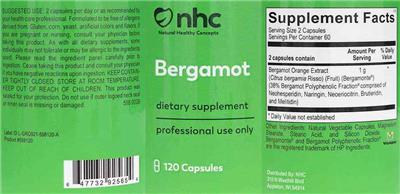
Supplement Facts
The label details for Bergamot by NHC Natural Healthy Concepts, sourced from the NIH Dietary Supplement Label Database.
Supplement Facts
| Ingredient | Amount | % DV |
|---|---|---|
| Bergamonte | 1 Gram(s) | -- |
Other ingredients: Capsule, Magnesium Stearate, Stearic Acid, Silicon Dioxide
Tap any ingredient to jump to its full detail below.
These statements are the manufacturer’s wording, reproduced from the product label — the label is saying it, not HelloPharmacist. We don’t verify or endorse them.
Suggested/Recommended/Usage/Directions
Suggested use: 2 capsules per day or as recommended by your health care professional.
Formulation
Formulated to be free of allergens derived from: Gluten, corn, yeast, artificial colors and flavors.
Vcaps
Precautions
If you are pregnant or nursing, consult your physician before taking this product.
As with all dietary supplements some individuals may not tolerate or may be allergic to the ingredients used.
Please read the ingredient panel carefully prior to ingestion. Cease taking this product and consult your physician if you have negative reactions upon ingestion.
Keep out of reach of children.
This product was sealed for your protection. Do not use if outer logoed neck seal or inner-seal is missing or damaged.
Professional use only
Storage
Keep container tightly closed. Store at room temperature.
FDA Statement of Identity
Dietary Supplement
Brand IP Statement(s)
Bergamonte and Bergamot Polyphenolic Fraction are the registered trademark of HP ingredients.
Formula
Vcaps
Is this label outdated? Report a formula or label change and our pharmacy team will review it.
Bergamot by NHC Natural Healthy Concepts label
The label scan from the NIH Dietary Supplement Label Database. Tap to enlarge.
Label images are published by the NIH Dietary Supplement Label Database for the version of this product on file. Always read your actual product label.
View the full label (PDF)The Ingredients in Bergamot by NHC Natural Healthy Concepts
This is the 1 active ingredient this product is made of. Select it to open its full monograph.
Serving size2 Capsule(s) Dosage formCapsule Servings per container60 Amounts shown are per serving.
Bergamonte
Interacts with410 drugs
Bergamot is a Mediterranean citrus fruit, and its standardized extract is most often used to support cholesterol and heart health, with some early but...
Bergamonte monograph & interactionsOther (inactive) ingredients: Capsule, Magnesium Stearate, Stearic Acid, Silicon Dioxide. These complete the product’s ingredient list but are not active constituents.
Bergamot by NHC Natural Healthy Concepts Drug Interactions
HelloPharmacist Interaction Report
NHC Natural Healthy Concepts Bergamot can interact with medications, primarily through its bergapten content, which has photosensitizing properties.
The most serious concern is with photosensitizing drugs (Moderate severity) — topical bergamot oil may amplify their side effects, particularly sun-related skin reactions. Bergamot also carries a Moderate risk with antidiabetes drugs (insulin, sulfonylureas, and others), as animal research suggests it may lower blood sugar and raise the risk of low blood sugar (hypoglycemia).
Altogether, these interactions span 410 individual medications. Because this product is a capsule, systemic absorption is the main route; topical application carries additional photosensitivity risk.
Check your exact medications using the tool on this page before starting.
Check your own medications below · Editorial policy · How we use AI
Want to check YOUR meds against Bergamot?
Ask about interactions with your drugs in plain English — “Can I take it with lisinopril?” — and we find you the answer in seconds, ingredient by ingredient.
Go to the checkerIngredients driving the most interactions
Individual Drug Interactions
The ingredients in Bergamot interact with 410 drugs. Click any drug to see the details.
1 of the 1 ingredient in Bergamot interact with drugs. Each result below shows which ingredient is responsible. Bergamonte
AcarboseGlucobay, Prandase, Precose
How Acarbose interacts with Bergamot — through 1 ingredient. Tap an ingredient for the detail:
BergamonteAntidiabetes Drugs Moderate
Interaction Summary
Theoretically, taking bergamot with antidiabetes drugs might increase the risk of hypoglycemia.
Read the full Bergamonte + Acarbose interactionAcepromazineAtravet
How Acepromazine interacts with Bergamot — through 1 ingredient. Tap an ingredient for the detail:
BergamontePhotosensitizing Drugs Moderate
Interaction Summary
Theoretically, topical bergamot essential oil might increase the risk of side effects when used along with photosensitizing drugs.
Read the full Bergamonte + Acepromazine interactionAcetaminophen, Brompheniramine, PhenylpropanolamineDimetapp Cold and Flu
How Acetaminophen, Brompheniramine, Phenylpropanolamine interacts with Bergamot — through 1 ingredient. Tap an ingredient for the detail:
BergamontePhotosensitizing Drugs Moderate
Interaction Summary
Theoretically, topical bergamot essential oil might increase the risk of side effects when used along with photosensitizing drugs.
Read the full Bergamonte + Acetaminophen, Brompheniramine, Phenylpropanolamine interactionAcetaminophen, Caffeine, Chlorpheniramine, Hydrocodone, PhenylephrineHycomine Compound
How Acetaminophen, Caffeine, Chlorpheniramine, Hydrocodone, Phenylephrine interacts with Bergamot — through 1 ingredient. Tap an ingredient for the detail:
BergamontePhotosensitizing Drugs Moderate
Interaction Summary
Theoretically, topical bergamot essential oil might increase the risk of side effects when used along with photosensitizing drugs.
Read the full Bergamonte + Acetaminophen, Caffeine, Chlorpheniramine, Hydrocodone, Phenylephrine interactionAcetaminophen, Chlorpheniramine Maleate, Dextromethorphan HbrVicks Formula 44M Cough, Cold & Flu Relief
How Acetaminophen, Chlorpheniramine Maleate, Dextromethorphan Hbr interacts with Bergamot — through 1 ingredient. Tap an ingredient for the detail:
BergamontePhotosensitizing Drugs Moderate
Interaction Summary
Theoretically, topical bergamot essential oil might increase the risk of side effects when used along with photosensitizing drugs.
Read the full Bergamonte + Acetaminophen, Chlorpheniramine Maleate, Dextromethorphan Hbr interactionAcetaminophen, Chlorpheniramine, Codeine, PhenylephrineColrex
How Acetaminophen, Chlorpheniramine, Codeine, Phenylephrine interacts with Bergamot — through 1 ingredient. Tap an ingredient for the detail:
BergamontePhotosensitizing Drugs Moderate
Interaction Summary
Theoretically, topical bergamot essential oil might increase the risk of side effects when used along with photosensitizing drugs.
Read the full Bergamonte + Acetaminophen, Chlorpheniramine, Codeine, Phenylephrine interactionAcetaminophen, Chlorpheniramine, DextromethorphanCoricidin II Extra Strength Cold and Flu
How Acetaminophen, Chlorpheniramine, Dextromethorphan interacts with Bergamot — through 1 ingredient. Tap an ingredient for the detail:
BergamontePhotosensitizing Drugs Moderate
Interaction Summary
Theoretically, topical bergamot essential oil might increase the risk of side effects when used along with photosensitizing drugs.
Read the full Bergamonte + Acetaminophen, Chlorpheniramine, Dextromethorphan interactionAcetaminophen, Chlorpheniramine, Dextromethorphan HydrobromideCoricidin HBP Maximum Strength Flu
How Acetaminophen, Chlorpheniramine, Dextromethorphan Hydrobromide interacts with Bergamot — through 1 ingredient. Tap an ingredient for the detail:
BergamontePhotosensitizing Drugs Moderate
Interaction Summary
Theoretically, topical bergamot essential oil might increase the risk of side effects when used along with photosensitizing drugs.
Read the full Bergamonte + Acetaminophen, Chlorpheniramine, Dextromethorphan Hydrobromide interactionAcetaminophen, Chlorpheniramine, Dextromethorphan, PhenylpropanolamineMulti Symptom Cold Relief
How Acetaminophen, Chlorpheniramine, Dextromethorphan, Phenylpropanolamine interacts with Bergamot — through 1 ingredient. Tap an ingredient for the detail:
BergamontePhotosensitizing Drugs Moderate
Interaction Summary
Theoretically, topical bergamot essential oil might increase the risk of side effects when used along with photosensitizing drugs.
Read the full Bergamonte + Acetaminophen, Chlorpheniramine, Dextromethorphan, Phenylpropanolamine interactionAcetaminophen, Chlorpheniramine, Dextromethorphan, PseudoephedrineChildren's Tylenol Cold Plus Cough, Tylenol Cold Ex Strength
How Acetaminophen, Chlorpheniramine, Dextromethorphan, Pseudoephedrine interacts with Bergamot — through 1 ingredient. Tap an ingredient for the detail:
BergamontePhotosensitizing Drugs Moderate
Interaction Summary
Theoretically, topical bergamot essential oil might increase the risk of side effects when used along with photosensitizing drugs.
Read the full Bergamonte + Acetaminophen, Chlorpheniramine, Dextromethorphan, Pseudoephedrine interactionAcetaminophen, Chlorpheniramine, Guaifenesin, Phenylephrine, SalicylamideRhinogesic GG
How Acetaminophen, Chlorpheniramine, Guaifenesin, Phenylephrine, Salicylamide interacts with Bergamot — through 1 ingredient. Tap an ingredient for the detail:
BergamontePhotosensitizing Drugs Moderate
Interaction Summary
Theoretically, topical bergamot essential oil might increase the risk of side effects when used along with photosensitizing drugs.
Read the full Bergamonte + Acetaminophen, Chlorpheniramine, Guaifenesin, Phenylephrine, Salicylamide interactionAcetaminophen, Chlorpheniramine, PhenylephrineAlka-Seltzer PLUS, Histex SR, Protid
How Acetaminophen, Chlorpheniramine, Phenylephrine interacts with Bergamot — through 1 ingredient. Tap an ingredient for the detail:
BergamontePhotosensitizing Drugs Moderate
Interaction Summary
Theoretically, topical bergamot essential oil might increase the risk of side effects when used along with photosensitizing drugs.
Read the full Bergamonte + Acetaminophen, Chlorpheniramine, Phenylephrine interactionAcetaminophen, Chlorpheniramine, Phenylephrine, SalicylamideRhinogesic, Rhinogesic JR
How Acetaminophen, Chlorpheniramine, Phenylephrine, Salicylamide interacts with Bergamot — through 1 ingredient. Tap an ingredient for the detail:
BergamontePhotosensitizing Drugs Moderate
Interaction Summary
Theoretically, topical bergamot essential oil might increase the risk of side effects when used along with photosensitizing drugs.
Read the full Bergamonte + Acetaminophen, Chlorpheniramine, Phenylephrine, Salicylamide interactionAcetaminophen, Chlorpheniramine, PhenylpropanolamineAlumadrine, Conex, Sinadrin Max Strength, Sinulin
How Acetaminophen, Chlorpheniramine, Phenylpropanolamine interacts with Bergamot — through 1 ingredient. Tap an ingredient for the detail:
BergamontePhotosensitizing Drugs Moderate
Interaction Summary
Theoretically, topical bergamot essential oil might increase the risk of side effects when used along with photosensitizing drugs.
Read the full Bergamonte + Acetaminophen, Chlorpheniramine, Phenylpropanolamine interactionAcetaminophen, Chlorpheniramine, Phenylpropanolamine, OpiumHista-Derfule
How Acetaminophen, Chlorpheniramine, Phenylpropanolamine, Opium interacts with Bergamot — through 1 ingredient. Tap an ingredient for the detail:
BergamontePhotosensitizing Drugs Moderate
Interaction Summary
Theoretically, topical bergamot essential oil might increase the risk of side effects when used along with photosensitizing drugs.
Read the full Bergamonte + Acetaminophen, Chlorpheniramine, Phenylpropanolamine, Opium interactionAcetaminophen, Chlorpheniramine, Phenylpropanolamine, PhenyltoloxamineNorel Plus
How Acetaminophen, Chlorpheniramine, Phenylpropanolamine, Phenyltoloxamine interacts with Bergamot — through 1 ingredient. Tap an ingredient for the detail:
BergamontePhotosensitizing Drugs Moderate
Interaction Summary
Theoretically, topical bergamot essential oil might increase the risk of side effects when used along with photosensitizing drugs.
Read the full Bergamonte + Acetaminophen, Chlorpheniramine, Phenylpropanolamine, Phenyltoloxamine interactionAcetaminophen, Chlorpheniramine, PseudoephedrineAlka-Seltzer PLUS Liquid Gels, Children's Tylenol Cold, Codimal, Comtrex, Extra Strength Tylenol Allergy Sinus, Lorsin +3 more
How Acetaminophen, Chlorpheniramine, Pseudoephedrine interacts with Bergamot — through 1 ingredient. Tap an ingredient for the detail:
BergamontePhotosensitizing Drugs Moderate
Interaction Summary
Theoretically, topical bergamot essential oil might increase the risk of side effects when used along with photosensitizing drugs.
Read the full Bergamonte + Acetaminophen, Chlorpheniramine, Pseudoephedrine interactionAcetaminophen, Dexbrompheniramine, PseudoephedrineSinadrin Plus
How Acetaminophen, Dexbrompheniramine, Pseudoephedrine interacts with Bergamot — through 1 ingredient. Tap an ingredient for the detail:
BergamontePhotosensitizing Drugs Moderate
Interaction Summary
Theoretically, topical bergamot essential oil might increase the risk of side effects when used along with photosensitizing drugs.
Read the full Bergamonte + Acetaminophen, Dexbrompheniramine, Pseudoephedrine interactionAcetaminophen, DiphenhydramineTylenol PM, Tylenol PM Ex Strength
How Acetaminophen, Diphenhydramine interacts with Bergamot — through 1 ingredient. Tap an ingredient for the detail:
BergamontePhotosensitizing Drugs Moderate
Interaction Summary
Theoretically, topical bergamot essential oil might increase the risk of side effects when used along with photosensitizing drugs.
Read the full Bergamonte + Acetaminophen, Diphenhydramine interactionAcetaminophen, Diphenhydramine, PseudoephedrineChildren's Tylenol Allergy, Cold Control, Contac Night Allergy Relief
How Acetaminophen, Diphenhydramine, Pseudoephedrine interacts with Bergamot — through 1 ingredient. Tap an ingredient for the detail:
BergamontePhotosensitizing Drugs Moderate
Interaction Summary
Theoretically, topical bergamot essential oil might increase the risk of side effects when used along with photosensitizing drugs.
Read the full Bergamonte + Acetaminophen, Diphenhydramine, Pseudoephedrine interactionAcetaminophen, IbuprofenCombogesic
How Acetaminophen, Ibuprofen interacts with Bergamot — through 1 ingredient. Tap an ingredient for the detail:
BergamontePhotosensitizing Drugs Moderate
Interaction Summary
Theoretically, topical bergamot essential oil might increase the risk of side effects when used along with photosensitizing drugs.
Read the full Bergamonte + Acetaminophen, Ibuprofen interactionAcetaminophen, Phenylephrine, ChlorpheniramineSuper Cold Tabs
How Acetaminophen, Phenylephrine, Chlorpheniramine interacts with Bergamot — through 1 ingredient. Tap an ingredient for the detail:
BergamontePhotosensitizing Drugs Moderate
Interaction Summary
Theoretically, topical bergamot essential oil might increase the risk of side effects when used along with photosensitizing drugs.
Read the full Bergamonte + Acetaminophen, Phenylephrine, Chlorpheniramine interactionAcetazolamideAk-Zol, Diamox
How Acetazolamide interacts with Bergamot — through 1 ingredient. Tap an ingredient for the detail:
BergamontePhotosensitizing Drugs Moderate
Interaction Summary
Theoretically, topical bergamot essential oil might increase the risk of side effects when used along with photosensitizing drugs.
Read the full Bergamonte + Acetazolamide interactionAcetohexamideDymelor
How Acetohexamide interacts with Bergamot — through 1 ingredient. Tap an ingredient for the detail:
BergamontePhotosensitizing Drugs, Antidiabetes Drugs Moderate
Interaction Summary
Theoretically, topical bergamot essential oil might increase the risk of side effects when used along with photosensitizing drugs.
Read the full Bergamonte + Acetohexamide interactionAcitretinSoriatane
How Acitretin interacts with Bergamot — through 1 ingredient. Tap an ingredient for the detail:
BergamontePhotosensitizing Drugs Moderate
Interaction Summary
Theoretically, topical bergamot essential oil might increase the risk of side effects when used along with photosensitizing drugs.
Read the full Bergamonte + Acitretin interactionAlbiglutideTanzeum
How Albiglutide interacts with Bergamot — through 1 ingredient. Tap an ingredient for the detail:
BergamonteAntidiabetes Drugs Moderate
Interaction Summary
Theoretically, taking bergamot with antidiabetes drugs might increase the risk of hypoglycemia.
Read the full Bergamonte + Albiglutide interactionAlectinib HydrochlorideAlecensa
How Alectinib Hydrochloride interacts with Bergamot — through 1 ingredient. Tap an ingredient for the detail:
BergamontePhotosensitizing Drugs Moderate
Interaction Summary
Theoretically, topical bergamot essential oil might increase the risk of side effects when used along with photosensitizing drugs.
Read the full Bergamonte + Alectinib Hydrochloride interactionAlitretinoinPanretin
How Alitretinoin interacts with Bergamot — through 1 ingredient. Tap an ingredient for the detail:
BergamontePhotosensitizing Drugs Moderate
Interaction Summary
Theoretically, topical bergamot essential oil might increase the risk of side effects when used along with photosensitizing drugs.
Read the full Bergamonte + Alitretinoin interactionAlogliptinNesina
How Alogliptin interacts with Bergamot — through 1 ingredient. Tap an ingredient for the detail:
BergamonteAntidiabetes Drugs Moderate
Interaction Summary
Theoretically, taking bergamot with antidiabetes drugs might increase the risk of hypoglycemia.
Read the full Bergamonte + Alogliptin interactionAlogliptin, MetforminKazano
How Alogliptin, Metformin interacts with Bergamot — through 1 ingredient. Tap an ingredient for the detail:
BergamonteAntidiabetes Drugs Moderate
Interaction Summary
Theoretically, taking bergamot with antidiabetes drugs might increase the risk of hypoglycemia.
Read the full Bergamonte + Alogliptin, Metformin interactionEach ingredient & the kinds of drugs it affects
For each ingredient in Bergamot with known interactions, here are the types of medications it can affect. Open any type for the detail — or search your exact drug in the checker above.
Bergamonte
Antidiabetes Drugs
Theoretically, taking bergamot with antidiabetes drugs might increase the risk of hypoglycemia.
Animal research suggests that bergamot juice has hypoglycemic effects.
Photosensitizing Drugs
Theoretically, topical bergamot essential oil might increase the risk of side effects when used along with photosensitizing drugs.
Bergamot contains bergapten, which has photosensitizing effects.
Brand information
Manufacturer and brand details for Bergamot, from the product label.
NHC Natural Healthy Concepts
See all NHC Natural Healthy Concepts products- Name
- NHC
- Street Address
- 310 N Westhill Blvd.
- City
- Appleton
- State
- WI
- ZipCode
- 54914
Bergamot by NHC Natural Healthy Concepts: Common Questions
Does Bergamot by NHC Natural Healthy Concepts interact with any medications?
How can one product interact with so many drugs?
Where does this information come from?
Can I use this if I'm pregnant or breastfeeding?
Does bergamot help with high cholesterol?
What are the common side effects?
Why can't I use the essential oil instead of this extract?
Can I take this if I use sunscreen?
Written and reviewed by the HelloPharmacist editorial staff. Our editorial policy
Not sure if Bergamot is safe with your meds?
Our pharmacists answer your medication & supplement questions — free.
Label information is sourced from the NIH Dietary Supplement Label Database and reflects the product version on file; always read your actual product label. This page is for education only and is not a substitute for professional medical advice. Confirm with your pharmacist or doctor before combining supplements and medications.
The Full Monographs Behind Bergamot’s Ingredients
Every ingredient we hold a full HelloPharmacist monograph for — uses, evidence, safety, and the complete interaction list.
Sources & How We Checked
Bergamot's label data comes from the NIH Dietary Supplement Label Database; the ingredient interaction data is from the Natural Medicines database, reviewed by our pharmacists.
- NIH Dietary Supplement Label Database (DSLD) — The official product label on file for this supplement.
- Natural Medicines (Therapeutic Research Center) — Evidence-graded clinical reference behind the ingredient interaction data.
Content is written and reviewed by licensed HelloPharmacist pharmacists. See our data sources and editorial standards for how this information is built and checked.
The 17 references behind this product’s interaction data
Every citation that drives the interaction findings for this product’s ingredients, from the evidence-graded Natural Medicines (TRC Healthcare) database. Open an ingredient to browse its citations — links open the study on PubMed or the publisher’s site.
Bergamot 17 references
- The Review of Natural Products by Facts and Comparisons. St. Louis, MO: Wolters Kluwer Co., 1999.
- Gruenwald J, Brendler T, Jaenicke C. PDR for Herbal Medicines. 1st ed. Montvale, NJ: Medical Economics Company, Inc., 1998.
- Naganuma M, Hirose S, Nakayama Y, et al. A study of the phototoxicity of lemon oil. Arch Dermatol Res 1985;278:31-6. . PubMed
- Kaddu, S., Kerl, H., and Wolf, P. Accidental bullous phototoxic reactions to bergamot aromatherapy oil. J.Am.Acad.Dermatol. 2001;45(3):458-461. PubMed
- Finsterer, J. Earl Grey tea intoxication. Lancet 4-27-2002;359(9316):1484. PubMed
- Gruson, L. M. and Chang, M. W. Berloque dermatitis mimicking child abuse. Arch.Pediatr.Adolesc.Med. 2002;156(11):1091-1093. PubMed
- Weisenseel, P. and Woitalla, S. [Toxic mustard plaster dematitis and phototoxic dematitis after application of bergamot oil]. MMW.Fortschr.Med. 12-15-2005;147(51-52):53, 55.
- Placzek, M., Fromel, W., Eberlein, B., Gilbertz, K. P., and Przybilla, B. Evaluation of phototoxic properties of fragrances. Acta Derm.Venereol. 2007;87(4):312-316. PubMed
- Mollace, V., Sacco, I., Janda, E., Malara, C., Ventrice, D., Colica, C., Visalli, V., Muscoli, S., Ragusa, S., Muscoli, C., Rotiroti, D., and Romeo, F. Hypolipemic and hypoglycaemic activity of bergamot polyphenols: from animal models to human studies. F PubMed
- Morliere, P., Huppe, G., Averbeck, D., Young, A. R., Santus, R., and Dubertret, L. In vitro photostability and photosensitizing properties of bergamot oil. Effects of a cinnamate sunscreen. J.Photochem.Photobiol.B 1990;7(2-4):199-208. PubMed
- Young, A. R., Walker, S. L., Kinley, J. S., Plastow, S. R., Averbeck, D., Morliere, P., and Dubertret, L. Phototumorigenesis studies of 5-methoxypsoralen in bergamot oil: evaluation and modification of risk of human use in an albino mouse skin model. J.P PubMed
- Girard, J., Unkovic, J., Delahayes, J., and Lafille, C. [Phototoxicity of Bergamot oil. Comparison between humans and guinea pigs]. Dermatologica 1979;158(4):229-243.
- Zaynoun, S. T., Johnson, B. E., and Frain-Bell, W. A study of oil of bergamot and its importance as a phototoxic agent. II. Factors which affect the phototoxic reaction induced by bergamot oil and psoralen derivatives. Contact Dermatitis 1977;3(5):225-23 PubMed
- Zacher, K. D. and Ippen, H. [Contact dermatitis caused by bergamot oil]. Derm.Beruf.Umwelt. 1984;32(3):95-97.
- Yasui, Y. and Hirone, T. Action spectrum for bergamot-oil phototoxicity measured by sunburn cell counting. J.Dermatol. 1994;21(5):319-322. PubMed
- Zaynoun, S. T., Johnson, B. E., and Frain-Bell, W. A study of oil of bergamot and its importance as a phototoxic agent. I. Characterization and quantification of the photoactive component. Br.J.Dermatol. 1977;96(5):475-482. PubMed
- Bruno A, Pandolfo G, Crucitti M, Cedro C, Zoccali RA, Muscatello MRA. Bergamot Polyphenolic Fraction Supplementation Improves Cognitive Functioning in Schizophrenia: Data From an 8-Week, Open-Label Pilot Study. J Clin Psychopharmacol 2017;37(4):468-71. PubMed
Parts of this content are provided by the Therapeutic Research Center, LLC.
DISCLAIMER: Currently this does not check for drug-drug interactions. This is not an all-inclusive comprehensive list of potential interactions and is for informational purposes only. Not all interactions are known or well-reported in the scientific literature, and new interactions are continually being reported. Input is needed from a qualified healthcare provider including a pharmacist before starting any therapy. Application of clinical judgment is necessary.
© 2021 Therapeutic Research Center, LLC