
BreatheXX Ingredients & Drug Interactions
What is this page for?
First and foremost: checking BreatheXX against your medications. The heart of this page is the interaction checker and the full interaction report — how this product’s ingredients may interact with prescription and over-the-counter medicines you may be taking.
Around that, we add a pharmacist’s high-level view of the product as a whole — what’s inside, the evidence for its stated use, how transparent the label is, and what safety data exists — so you can see the full picture in one place. It’s educational information from our licensed clinical databases and the clinical staff at HelloPharmacist — not medical advice — and we don’t sell or endorse products. Our editorial policy
BreatheXX is a dietary supplement by Viatrexx Bio Incorporated with 16 active ingredients. Its ingredients are commonly taken for bone health support, antioxidant and enzyme support, filling dietary gaps.Based on those ingredients, 506 medications have a known interaction with it, the most serious rated moderate. The ingredients most likely to interact are Onion, Star of Bethlehem Flower Essence, Manganese. Use the checker below to test your specific medication, or read the full HelloPharmacist Interaction Report.
Check Your Meds Against BreatheXX by Viatrexx Bio Incorporated
Ask about any prescription or over-the-counter medication and we check it for interactions with BreatheXX by Viatrexx Bio Incorporated — and tell you which ingredient is responsible.
AI summaries are generated from our interaction database for education only — always confirm with your pharmacist. How we use AI
Ask the Pharmacist
A licensed pharmacist will answer your question by email — free, usually within 24 hours.
Got it — thank you!
A licensed pharmacist will answer within 24 hours. Keep an eye on your email (worth checking spam, just in case).
HelloPharmacist Scorecard of BreatheXX by Viatrexx Bio Incorporated
Our pharmacy team’s full take, with four database checks built into the cards below — a summary of what is known, not a grade of the product itself.
What’s inside
Low disclosure
BreatheXX is a 16-ingredient liquid that includes manganese, choline chloride (from choline chloride), onion, and luffa as active ingredients, alongside flower essences (cherry plum, clematis, impatiens, rock rose, and star of Bethlehem) and animal tissue essences. The product also contains alcohol and structured water as inactive ingredients.
Does it work?
Not established
Manganese is effective for manganese deficiency, but the evidence is insufficient to support its use for hay fever, osteoporosis, COPD, obesity, or osteoarthritis. Choline has insufficient evidence for athletic performance, bronchitis, age-related cognitive decline, liver health, hay fever, or Alzheimer disease.
Onion appears possibly effective for scarring but possibly ineffective for obesity, with insufficient evidence for alopecia areata, angina, and atherosclerosis. Luffa and the flower essences have insufficient evidence or no established effectiveness in the data we hold.
How safe is it?
Well-documented data
Manganese is well tolerated in normal dietary amounts, but high-dose supplements carry serious risks including neurotoxicity and Parkinson-like symptoms; one case of severe manganese poisoning caused irreversible neurological damage and liver injury. Choline is well tolerated at appropriate doses but can cause fishy body odor, nausea, vomiting, and diarrhea at doses above 3.5 grams daily.
Onion as a food is generally well tolerated, though concentrated supplements are less studied; rare cases of anaphylaxis and severe allergic reactions have been reported. Luffa lacks safety data for internal use and is best avoided during pregnancy and breastfeeding.
Star of Bethlehem contains toxic cardiac glycosides and is likely unsafe in pregnancy; it can cause serious heart rhythm disturbances, headache, and visual disturbances.
Meds to double-check
Moderate interaction found
Check before starting if you take digoxin (Lanoxin) or other heart medications, corticosteroids, diuretics, stimulant laxatives, macrolide or tetracycline antibiotics, quinine, diabetes medications, blood thinners (anticoagulants) or antiplatelet drugs like aspirin, antipsychotic drugs, quinolone antibiotics, lithium, or atropine.
The bottom line
Scorecard at a glanceFormula with limited ingredient disclosure with no established evidence rating for its marketed use. Moderate medication interactions have been identified, and safety information is well characterized.
This product combines several ingredients with real drug interactions — particularly with heart medications, diabetes drugs, and blood thinners — plus star of Bethlehem, which carries cardiac toxicity concerns. If you take any prescription medications, especially for your heart, blood sugar, or blood clotting, check them against this product with our tool before you start.
Talk to your pharmacist or doctor first if you're pregnant or breastfeeding, or if you take high-dose manganese.
Educational only — not medical advice; always confirm with your pharmacist. Our editorial policy · How we use AI
Assessment coverage: 6 of 16 active ingredients matched to our full ingredient reviews (monographs). Based on the product label dated May 23, 2024.
This Scorecard evaluates available label information, ingredient evidence, and known medication-safety considerations. It does not independently verify product identity, purity, potency, contamination, or manufacturing quality. How these ratings are computed
General information
Key facts about BreatheXX, straight from the product label.
| Brand | Viatrexx Bio Incorporated |
|---|---|
| Barcode (UPC) | 041910019508 |
| Net contents | 1.7 Ounce(s); 50 mL |
| Market status | On market |
| Date entered into DSLD | May 23, 2024 |
| DSLD ID | 309865 |
| Product type | Other Combinations |
| Supplement form | Liquid |
| Dietary claims / uses | All Other, Structure/Function |
| Intended target group(s) | Adult (18 - 50 Years), Gluten Free, Dairy Free, Sugar Free |
Everything in this section is reproduced from the manufacturer’s own product label — it’s the label speaking, not HelloPharmacist. We show it so you can see exactly what the maker states; we don’t verify or endorse those statements.
Supplement Facts
The label details for BreatheXX by Viatrexx Bio Incorporated, sourced from the NIH Dietary Supplement Label Database.
Supplement Facts
| Ingredient | Amount | % DV |
|---|---|---|
| Sea Salt | 0 NP | -- |
| Manganese | 0 NP | -- |
| Choline Chloride | 0 NP | -- |
| Proprietary Micro Blend of Trace and Essences | 0 NP | -- |
| Onion | 0 NP | -- |
| Ammonium Carbonate | 0 NP | -- |
| Luffa | 0 NP | -- |
| Cherry Plum Flower Essence | 0 NP | -- |
| Clematis Flower Essence | 0 NP | -- |
| Impatiens Flower Essence | 0 NP | -- |
| Rock Rose Flower Essence | 0 NP | -- |
| Star of Bethlehem Flower Essence | 0 NP | -- |
| Sus scrofa Adrenal Essence | 0 NP | -- |
| Sus scrofa Lung Essence | 0 NP | -- |
| Sus scrofa Mucosa Essence | 0 NP | -- |
| Sus scrofa Peyer's Patches Essence | 0 NP | -- |
| Sus scrofa Thymus Essence | 0 NP | -- |
Other ingredients: Alcohol, Water, Structured
Tap any ingredient to jump to its full detail below.
These statements are the manufacturer’s wording, reproduced from the product label — the label is saying it, not HelloPharmacist. We don’t verify or endorse them.
Formulation
BreatheXX encourages a healthy respiratory system.
Free of: gluten, wheat, yeast, corn, dairy, soy, sugar & artificial colors/flavors.
Organic alcohol used/Certified organic or wildcrafted sources used whenever possible.
Suggested/Recommended/Usage/Directions
Suggested Use: As a dietary supplement, 1-5 spray(s) under the tongue, 1-3 time(s) a day or as recommended by your healthcare practitioner.
Precautions
Caution: Do not exceed recommended dose.
Pregnant or nursing mothers, children under the age of 18 and individuals with a known medical condition should consult with a healthcare practitioner before taking this or any dietary supplement.
Pregnant or nursing mothers, children under the age of 18 and individuals with a known medical condition should consult with a healthcare practitioner before taking this or any dietary supplement. Keep out of reach of children.
Do not use if safety seal is damaged or missing.
Storage
Store in a cool, dry place.
FDA Disclaimer Statement
These statements have not been evaluated by the Food and Drug Administration. This product is not intended to diagnose, treat, cure, or prevent any disease.
FDA Statement of Identity
Dietary Supplement
Is this label outdated? Report a formula or label change and our pharmacy team will review it.
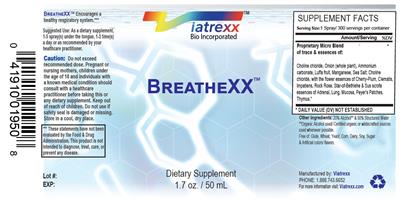
BreatheXX by Viatrexx Bio Incorporated label
The label scan from the NIH Dietary Supplement Label Database. Tap to enlarge.
Label images are published by the NIH Dietary Supplement Label Database for the version of this product on file. Always read your actual product label.
View the full label (PDF)The Ingredients in BreatheXX by Viatrexx Bio Incorporated
These are the 16 active ingredients this product is made of. Select any to open its full monograph.
Serving size1 Spray(s) Dosage formLiquid Servings per container300 Amounts shown are per serving.
Most supplement products combine several ingredients, and a medication can interact with the product through any one of them. Each ingredient below shows whether it has known drug interactions.
Proprietary Micro Blend of Trace and Essences
- › Sea Salt
- › Manganese
- › Choline Chloride
- › Onion
- › Ammonium Carbonate
- › Luffa
- › Cherry Plum Flower Essence
- › Clematis Flower Essence
- › Impatiens Flower Essence
- › Rock Rose Flower Essence
- › Star of Bethlehem Flower Essence
- › Sus scrofa Adrenal Essence
- › Sus scrofa Lung Essence
- › Sus scrofa Mucosa Essence
- › Sus scrofa Peyer's Patches Essence
- › Sus scrofa Thymus Essence
Other (inactive) ingredients: Alcohol, Water, Structured. These complete the product’s ingredient list but are not active constituents.
BreatheXX by Viatrexx Bio Incorporated Drug Interactions
HelloPharmacist Interaction Report
BreatheXX by Viatrexx Bio Incorporated contains several ingredients with documented drug interactions.
The most serious concern is star of Bethlehem flower essence, which contains cardiac glycosides — compounds that affect the heart. Taking it with digoxin (Lanoxin) or similar heart medications could have additive effects and raise the risk of toxicity; the same risk applies when combined with corticosteroids, diuretics, stimulant laxatives, macrolide antibiotics, tetracycline antibiotics, or quinine.
Read the full breakdown — every affected drug type, severity by severity
Manganese in this product interacts with antipsychotic drugs (risk of toxicity), quinolone antibiotics, and tetracycline antibiotics (both may have reduced absorption). Onion interacts with blood thinners and antiplatelet drugs (increased bleeding risk), diabetes medications (low blood sugar risk), certain drugs metabolized by the enzyme CYP2E1, lithium, and aspirin.
Choline chloride has a minor interaction with atropine. Luffa was checked but shows no documented interactions.
We could not check sea salt, ammonium carbonate, cherry plum flower essence, clematis flower essence, impatiens flower essence, rock rose flower essence, or the Sus scrofa essences — no data is on file for these. Altogether, these interactions span 505 individual medications.
Use the medication checker on this page with your exact prescriptions before starting BreatheXX.
Check your own medications below · Editorial policy · How we use AI
Want to check YOUR meds against BreatheXX?
Ask about interactions with your drugs in plain English — “Can I take it with lisinopril?” — and we find you the answer in seconds, ingredient by ingredient.
Go to the checkerIngredients driving the most interactions
Individual Drug Interactions
The ingredients in BreatheXX interact with 506 drugs. Click any drug to see the details.
4 of the 16 ingredients in BreatheXX interact with drugs. Each result below shows which ingredient is responsible. Onion Star of Bethlehem Flower Essence Manganese Choline Chloride
AbciximabReoPro
How Abciximab interacts with BreatheXX — through 1 ingredient. Tap an ingredient for the detail:
OnionAnticoagulant/antiplatelet Drugs Moderate
Interaction Summary
Theoretically, concomitant use of anticoagulant or antiplatelet drugs with onion might increase the risk of bleeding.
Read the full Onion + Abciximab interactionAbrocitinibCibinqo
How Abrocitinib interacts with BreatheXX — through 1 ingredient. Tap an ingredient for the detail:
OnionAnticoagulant/antiplatelet Drugs Moderate
Interaction Summary
Theoretically, concomitant use of anticoagulant or antiplatelet drugs with onion might increase the risk of bleeding.
Read the full Onion + Abrocitinib interactionAcarboseGlucobay, Prandase, Precose
How Acarbose interacts with BreatheXX — through 1 ingredient. Tap an ingredient for the detail:
OnionAntidiabetes Drugs Moderate
Interaction Summary
Concomitant use of antidiabetes drugs with onion may increase the risk of hypoglycemia.
Read the full Onion + Acarbose interactionAcenocoumarolSintrom
How Acenocoumarol interacts with BreatheXX — through 1 ingredient. Tap an ingredient for the detail:
OnionAnticoagulant/antiplatelet Drugs Moderate
Interaction Summary
Theoretically, concomitant use of anticoagulant or antiplatelet drugs with onion might increase the risk of bleeding.
Read the full Onion + Acenocoumarol interactionAcepromazineAtravet
How Acepromazine interacts with BreatheXX — through 1 ingredient. Tap an ingredient for the detail:
ManganeseAntipsychotic Drugs Moderate
Interaction Summary
Theoretically, the risk for manganese toxicity might increase when taken with antipsychotic drugs.
Read the full Manganese + Acepromazine interactionAcetaminophenChildren's Tylenol, Children's Tylenol Meltaways, Tylenol, Tylenol Ex Strength
How Acetaminophen interacts with BreatheXX — through 1 ingredient. Tap an ingredient for the detail:
OnionCytochrome P450 2e1 (cyp2e1) Substrates Moderate
Interaction Summary
Theoretically, taking onion might increase the levels and clinical effects of drugs metabolized by CYP2E1.
Read the full Onion + Acetaminophen interactionAcetaminophen, AspirinGemnisyn
How Acetaminophen, Aspirin interacts with BreatheXX — through 1 ingredient. Tap an ingredient for the detail:
OnionCytochrome P450 2e1 (cyp2e1) Substrates, Aspirin +1 Moderate
Interaction Summary
Theoretically, taking onion might increase the levels and clinical effects of drugs metabolized by CYP2E1.
Read the full Onion + Acetaminophen, Aspirin interactionAcetaminophen, Aspirin, CaffeineExcedrin, Excedrin Extra Strength, Excedrin Migraine
How Acetaminophen, Aspirin, Caffeine interacts with BreatheXX — through 1 ingredient. Tap an ingredient for the detail:
OnionAnticoagulant/antiplatelet Drugs, Cytochrome P450 2e1 (cyp2e1) Substrates +1 Moderate
Interaction Summary
Theoretically, concomitant use of anticoagulant or antiplatelet drugs with onion might increase the risk of bleeding.
Read the full Onion + Acetaminophen, Aspirin, Caffeine interactionAcetaminophen, Brompheniramine, PhenylpropanolamineDimetapp Cold and Flu
How Acetaminophen, Brompheniramine, Phenylpropanolamine interacts with BreatheXX — through 1 ingredient. Tap an ingredient for the detail:
OnionCytochrome P450 2e1 (cyp2e1) Substrates Moderate
Interaction Summary
Theoretically, taking onion might increase the levels and clinical effects of drugs metabolized by CYP2E1.
Read the full Onion + Acetaminophen, Brompheniramine, Phenylpropanolamine interactionAcetaminophen, ButalbitalAxocet, Bancap, Bucet, Butex Forte, Esgic CF, Orbivan CF +5 more
How Acetaminophen, Butalbital interacts with BreatheXX — through 1 ingredient. Tap an ingredient for the detail:
OnionCytochrome P450 2e1 (cyp2e1) Substrates Moderate
Interaction Summary
Theoretically, taking onion might increase the levels and clinical effects of drugs metabolized by CYP2E1.
Read the full Onion + Acetaminophen, Butalbital interactionAcetaminophen, Butalbital, CaffeineEsgic, Esgic Plus, Fiogesic, Fioricet, Repan, Tecnal +1 more
How Acetaminophen, Butalbital, Caffeine interacts with BreatheXX — through 1 ingredient. Tap an ingredient for the detail:
OnionCytochrome P450 2e1 (cyp2e1) Substrates Moderate
Interaction Summary
Theoretically, taking onion might increase the levels and clinical effects of drugs metabolized by CYP2E1.
Read the full Onion + Acetaminophen, Butalbital, Caffeine interactionAcetaminophen, Butalbital, Caffeine, CodeineEsgic with Codeine, Fioricet w/ Codeine
How Acetaminophen, Butalbital, Caffeine, Codeine interacts with BreatheXX — through 1 ingredient. Tap an ingredient for the detail:
OnionCytochrome P450 2e1 (cyp2e1) Substrates Moderate
Interaction Summary
Theoretically, taking onion might increase the levels and clinical effects of drugs metabolized by CYP2E1.
Read the full Onion + Acetaminophen, Butalbital, Caffeine, Codeine interactionAcetaminophen, Butalbital, CodeineBancap w/ Codeine
How Acetaminophen, Butalbital, Codeine interacts with BreatheXX — through 1 ingredient. Tap an ingredient for the detail:
OnionCytochrome P450 2e1 (cyp2e1) Substrates Moderate
Interaction Summary
Theoretically, taking onion might increase the levels and clinical effects of drugs metabolized by CYP2E1.
Read the full Onion + Acetaminophen, Butalbital, Codeine interactionAcetaminophen, Butalbital, Codeine PhosphatePhrenilin #3
How Acetaminophen, Butalbital, Codeine Phosphate interacts with BreatheXX — through 1 ingredient. Tap an ingredient for the detail:
OnionCytochrome P450 2e1 (cyp2e1) Substrates Moderate
Interaction Summary
Theoretically, taking onion might increase the levels and clinical effects of drugs metabolized by CYP2E1.
Read the full Onion + Acetaminophen, Butalbital, Codeine Phosphate interactionAcetaminophen, Caffeine, Chlorpheniramine, Hydrocodone, PhenylephrineHycomine Compound
How Acetaminophen, Caffeine, Chlorpheniramine, Hydrocodone, Phenylephrine interacts with BreatheXX — through 1 ingredient. Tap an ingredient for the detail:
OnionCytochrome P450 2e1 (cyp2e1) Substrates Moderate
Interaction Summary
Theoretically, taking onion might increase the levels and clinical effects of drugs metabolized by CYP2E1.
Read the full Onion + Acetaminophen, Caffeine, Chlorpheniramine, Hydrocodone, Phenylephrine interactionAcetaminophen, Caffeine, CodeineGesic C15, Gesic C30, Gesic C8, Lenoltec 1, Lenoltec 2, Lenoltec 3 +1 more
How Acetaminophen, Caffeine, Codeine interacts with BreatheXX — through 1 ingredient. Tap an ingredient for the detail:
OnionCytochrome P450 2e1 (cyp2e1) Substrates Moderate
Interaction Summary
Theoretically, taking onion might increase the levels and clinical effects of drugs metabolized by CYP2E1.
Read the full Onion + Acetaminophen, Caffeine, Codeine interactionAcetaminophen, Caffeine, Codeine, SalicylamideCodalan No.1, Codalan No.2, Codalan No.3
How Acetaminophen, Caffeine, Codeine, Salicylamide interacts with BreatheXX — through 1 ingredient. Tap an ingredient for the detail:
OnionCytochrome P450 2e1 (cyp2e1) Substrates Moderate
Interaction Summary
Theoretically, taking onion might increase the levels and clinical effects of drugs metabolized by CYP2E1.
Read the full Onion + Acetaminophen, Caffeine, Codeine, Salicylamide interactionAcetaminophen, Caffeine, DihydrocodeineDHC Plus, Panlor DC, Panlor SS
How Acetaminophen, Caffeine, Dihydrocodeine interacts with BreatheXX — through 1 ingredient. Tap an ingredient for the detail:
OnionCytochrome P450 2e1 (cyp2e1) Substrates Moderate
Interaction Summary
Theoretically, taking onion might increase the levels and clinical effects of drugs metabolized by CYP2E1.
Read the full Onion + Acetaminophen, Caffeine, Dihydrocodeine interactionAcetaminophen, Caffeine, IsomethepteneMigralam
How Acetaminophen, Caffeine, Isometheptene interacts with BreatheXX — through 1 ingredient. Tap an ingredient for the detail:
OnionCytochrome P450 2e1 (cyp2e1) Substrates Moderate
Interaction Summary
Theoretically, taking onion might increase the levels and clinical effects of drugs metabolized by CYP2E1.
Read the full Onion + Acetaminophen, Caffeine, Isometheptene interactionAcetaminophen, Caffeine, PyrilamineMidol Max Strength Menstrual
How Acetaminophen, Caffeine, Pyrilamine interacts with BreatheXX — through 2 ingredients. Tap an ingredient for the detail:
OnionCytochrome P450 2e1 (cyp2e1) Substrates Moderate
Interaction Summary
Theoretically, taking onion might increase the levels and clinical effects of drugs metabolized by CYP2E1.
Read the full Onion + Acetaminophen, Caffeine, Pyrilamine interactionStar Of Bethlehem Flower EssenceDiuretic Drugs Moderate
Interaction Summary
Theoretically, taking diuretics with star of Bethlehem might increase the risk of toxicity.
Read the full Star Of Bethlehem Flower Essence + Acetaminophen, Caffeine, Pyrilamine interactionAcetaminophen, Chlorpheniramine Maleate, Dextromethorphan HbrVicks Formula 44M Cough, Cold & Flu Relief
How Acetaminophen, Chlorpheniramine Maleate, Dextromethorphan Hbr interacts with BreatheXX — through 1 ingredient. Tap an ingredient for the detail:
OnionCytochrome P450 2e1 (cyp2e1) Substrates Moderate
Interaction Summary
Theoretically, taking onion might increase the levels and clinical effects of drugs metabolized by CYP2E1.
Read the full Onion + Acetaminophen, Chlorpheniramine Maleate, Dextromethorphan Hbr interactionAcetaminophen, Chlorpheniramine, Codeine, PhenylephrineColrex
How Acetaminophen, Chlorpheniramine, Codeine, Phenylephrine interacts with BreatheXX — through 1 ingredient. Tap an ingredient for the detail:
OnionCytochrome P450 2e1 (cyp2e1) Substrates Moderate
Interaction Summary
Theoretically, taking onion might increase the levels and clinical effects of drugs metabolized by CYP2E1.
Read the full Onion + Acetaminophen, Chlorpheniramine, Codeine, Phenylephrine interactionAcetaminophen, Chlorpheniramine, DextromethorphanCoricidin II Extra Strength Cold and Flu
How Acetaminophen, Chlorpheniramine, Dextromethorphan interacts with BreatheXX — through 1 ingredient. Tap an ingredient for the detail:
OnionCytochrome P450 2e1 (cyp2e1) Substrates Moderate
Interaction Summary
Theoretically, taking onion might increase the levels and clinical effects of drugs metabolized by CYP2E1.
Read the full Onion + Acetaminophen, Chlorpheniramine, Dextromethorphan interactionAcetaminophen, Chlorpheniramine, Dextromethorphan HydrobromideCoricidin HBP Maximum Strength Flu
How Acetaminophen, Chlorpheniramine, Dextromethorphan Hydrobromide interacts with BreatheXX — through 1 ingredient. Tap an ingredient for the detail:
OnionCytochrome P450 2e1 (cyp2e1) Substrates Moderate
Interaction Summary
Theoretically, taking onion might increase the levels and clinical effects of drugs metabolized by CYP2E1.
Read the full Onion + Acetaminophen, Chlorpheniramine, Dextromethorphan Hydrobromide interactionAcetaminophen, Chlorpheniramine, Dextromethorphan, PhenylpropanolamineMulti Symptom Cold Relief
How Acetaminophen, Chlorpheniramine, Dextromethorphan, Phenylpropanolamine interacts with BreatheXX — through 1 ingredient. Tap an ingredient for the detail:
OnionCytochrome P450 2e1 (cyp2e1) Substrates Moderate
Interaction Summary
Theoretically, taking onion might increase the levels and clinical effects of drugs metabolized by CYP2E1.
Read the full Onion + Acetaminophen, Chlorpheniramine, Dextromethorphan, Phenylpropanolamine interactionAcetaminophen, Chlorpheniramine, Dextromethorphan, PseudoephedrineChildren's Tylenol Cold Plus Cough, Tylenol Cold Ex Strength
How Acetaminophen, Chlorpheniramine, Dextromethorphan, Pseudoephedrine interacts with BreatheXX — through 1 ingredient. Tap an ingredient for the detail:
OnionCytochrome P450 2e1 (cyp2e1) Substrates Moderate
Interaction Summary
Theoretically, taking onion might increase the levels and clinical effects of drugs metabolized by CYP2E1.
Read the full Onion + Acetaminophen, Chlorpheniramine, Dextromethorphan, Pseudoephedrine interactionAcetaminophen, Chlorpheniramine, Guaifenesin, Phenylephrine, SalicylamideRhinogesic GG
How Acetaminophen, Chlorpheniramine, Guaifenesin, Phenylephrine, Salicylamide interacts with BreatheXX — through 1 ingredient. Tap an ingredient for the detail:
OnionCytochrome P450 2e1 (cyp2e1) Substrates Moderate
Interaction Summary
Theoretically, taking onion might increase the levels and clinical effects of drugs metabolized by CYP2E1.
Read the full Onion + Acetaminophen, Chlorpheniramine, Guaifenesin, Phenylephrine, Salicylamide interactionAcetaminophen, Chlorpheniramine, PhenylephrineAlka-Seltzer PLUS, Histex SR, Protid
How Acetaminophen, Chlorpheniramine, Phenylephrine interacts with BreatheXX — through 1 ingredient. Tap an ingredient for the detail:
OnionCytochrome P450 2e1 (cyp2e1) Substrates Moderate
Interaction Summary
Theoretically, taking onion might increase the levels and clinical effects of drugs metabolized by CYP2E1.
Read the full Onion + Acetaminophen, Chlorpheniramine, Phenylephrine interactionAcetaminophen, Chlorpheniramine, Phenylephrine, SalicylamideRhinogesic, Rhinogesic JR
How Acetaminophen, Chlorpheniramine, Phenylephrine, Salicylamide interacts with BreatheXX — through 1 ingredient. Tap an ingredient for the detail:
OnionCytochrome P450 2e1 (cyp2e1) Substrates Moderate
Interaction Summary
Theoretically, taking onion might increase the levels and clinical effects of drugs metabolized by CYP2E1.
Read the full Onion + Acetaminophen, Chlorpheniramine, Phenylephrine, Salicylamide interactionAcetaminophen, Chlorpheniramine, PhenylpropanolamineAlumadrine, Conex, Sinadrin Max Strength, Sinulin
How Acetaminophen, Chlorpheniramine, Phenylpropanolamine interacts with BreatheXX — through 1 ingredient. Tap an ingredient for the detail:
OnionCytochrome P450 2e1 (cyp2e1) Substrates Moderate
Interaction Summary
Theoretically, taking onion might increase the levels and clinical effects of drugs metabolized by CYP2E1.
Read the full Onion + Acetaminophen, Chlorpheniramine, Phenylpropanolamine interactionEach ingredient & the kinds of drugs it affects
For each ingredient in BreatheXX with known interactions, here are the types of medications they can affect. Open any type for the detail — or search your exact drug in the checker above.
Onion
Anticoagulant/Antiplatelet Drugs
Theoretically, concomitant use of anticoagulant or antiplatelet drugs with onion might increase the risk of bleeding.
In vitro research shows that onion inhibits platelet aggregation.
Antidiabetes Drugs
Concomitant use of antidiabetes drugs with onion may increase the risk of hypoglycemia.
Animal research and clinical research shows that taking onion can lower blood glucose levels. Monitor blood glucose levels closely.
Aspirin
Concomitant use of aspirin with onion may worsen onion allergy.
In one case report, a patient with a mild onion allergy reported worsening allergy, including swelling and severe urticaria, after taking aspirin.
Cytochrome P450 2E1 (Cyp2E1) Substrates
Theoretically, taking onion might increase the levels and clinical effects of drugs metabolized by CYP2E1.
Animal research shows that taking onion powder inhibits CYP2E1. However, this interaction has not been reported in humans.
Lithium
Onion is thought to have diuretic properties. Theoretically, due to these potential diuretic effects, onion might reduce excretion and increase levels of lithium. The dose of lithium might need to be decreased.
Star of Bethlehem Flower Essence
Corticosteroids
Theoretically, taking star of Bethlehem with prolonged corticosteroid therapy might increase the risk of toxicity.
Star of Bethlehem contains cardiac glycosides. Concomitant use of corticosteroids with star of Bethlehem can increase the therapeutic and adverse effects of long-term corticosteroid use due to potassium depletion and electrolyte imbalance.
Digoxin (Lanoxin)
Theoretically, taking star of Bethlehem in combination with digoxin might have additive effects and increase the risk of toxicity.
Star of Bethlehem contains cardiac glycosides with effects similar to digoxin.
Diuretic Drugs
Theoretically, taking diuretics with star of Bethlehem might increase the risk of toxicity.
Star of Bethlehem contains cardiac glycosides. Theoretically, concomitant use of potassium-depleting diuretics and star of Bethlehem can increase the risk of cardiac glycoside toxicity due to potassium depletion.
Macrolide Antibiotics
Theoretically, taking macrolide antibiotics with star of Bethlehem might increase the risk of cardiac glycoside toxicity.
Star of Bethlehem contains cardiac glycosides. Macrolide antibiotics appear to increase the gastrointestinal absorption of oral digoxin. Theoretically, concomitant use of macrolide antibiotics might increase the absorption of the cardiac glycosides found in star of Bethlehem and increase the risk of adverse effects.
Quinine
Theoretically, taking quinine with star of Bethlehem might increase the risk of cardiac glycoside toxicity.
Star of Bethlehem contains cardiac glycosides. Quinine may reduce the clearance of oral digoxin. Theoretically, concomitant use of quinine might reduce the clearance of cardiac glycosides found in star of Bethlehem and increase the risk of adverse effects.
Stimulant Laxatives
Theoretically, excessive use of stimulant laxatives with star of Bethlehem might increase the risk of toxicity.
Star of Bethlehem contains cardiac glycosides. Excessive use of stimulant laxatives can cause diarrhea, resulting in potassium depletion. This might increase the risk of cardiac glycoside toxicity.
Tetracycline Antibiotics
Theoretically, taking tetracycline antibiotics with star of Bethlehem might increase the risk of cardiac glycoside toxicity.
Star of Bethlehem contains cardiac glycosides similar to digitalis. Tetracycline antibiotics appear to increase the gastrointestinal absorption of oral digoxin. Theoretically, concomitant use of tetracycline antibiotics might increase the absorption of the cardiac glycosides found in star of Bethlehem and increase the risk of adverse effects.
Manganese
Antipsychotic Drugs
Theoretically, the risk for manganese toxicity might increase when taken with antipsychotic drugs.
Hallucinations and behavioral changes have been reported in a patient with liver disease who was taking haloperidol and manganese. Researchers speculate that taking manganese along with haloperidol, phenothiazine-derivatives, or other antipsychotic medications might increase the risk of manganese toxicity in some patients.
Quinolone Antibiotics
Theoretically, manganese might reduce the absorption of quinolone antibiotics.
Manganese is a multivalent cation. Interactions resulting in reduced quinolone absorption have been reported between quinolones and other multivalent cations, such as calcium and iron.
Tetracycline Antibiotics
Theoretically, manganese might reduce the absorption of tetracycline antibiotics.
Manganese is a multivalent cation. Interactions resulting in reduced tetracycline absorption have been reported between tetracyclines and other multivalent cations, such as calcium and iron.
Choline Chloride
Atropine
Theoretically, choline might decrease the effects of atropine in the brain.
Animal research shows that administering choline one hour before administering atropine can attenuate atropine-induced decreases in brain levels of acetylcholine. Theoretically, concomitant use of choline and atropine may decrease the effects of atropine.
Brand information
Manufacturer and brand details for BreatheXX, from the product label.
Viatrexx Bio Incorporated
See all Viatrexx Bio Incorporated products- Name
- Viatrexx
- Phone Number
- 1.888.743.6652
- Web Address
- Viatrexx.com
BreatheXX by Viatrexx Bio Incorporated: Common Questions
Does BreatheXX by Viatrexx Bio Incorporated interact with any medications?
How can one product interact with so many drugs?
Where does this information come from?
Is manganese in this product safe?
What does the choline chloride do?
Is this safe during pregnancy or breastfeeding?
Why are there so many flower essences in here?
What are the Sus scrofa essences?
Written and reviewed by the HelloPharmacist editorial staff. Our editorial policy
Not sure if BreatheXX is safe with your meds?
Our pharmacists answer your medication & supplement questions — free.
Label information is sourced from the NIH Dietary Supplement Label Database and reflects the product version on file; always read your actual product label. This page is for education only and is not a substitute for professional medical advice. Confirm with your pharmacist or doctor before combining supplements and medications.
The Full Monographs Behind BreatheXX’s Ingredients
Every ingredient we hold a full HelloPharmacist monograph for — uses, evidence, safety, and the complete interaction list.
Manganese
Interacts with 83 drugsManganese is an essential trace mineral your body needs in small amounts for bone formation, metabolism, and antioxidant defense, and most people get enough from a normal diet. Supplements m...
Read the full Manganese monograph → Herb & supplement monographCholine
Interacts with 16 drugsCholine is an essential nutrient your body needs for liver function, brain health, and nerve signaling, and many people get enough from foods like eggs, meat, and fish. Supplements may help...
Read the full Choline monograph → Herb & supplement monographOnion
Interacts with 275 drugsOnion is a common food with a long history in traditional medicine, and it contains antioxidants like quercetin and sulfur compounds. Eating onion as part of a balanced diet is safe for most...
Read the full Onion monograph → Herb & supplement monographLuffa
Luffa is a tropical gourd best known as the source of the natural loofah bath sponge, and its extracts appear in homeopathic and traditional remedies for congestion and allergies. Good-quali...
Read the full Luffa monograph → Herb & supplement monographRock Rose
Rock Rose usually refers to plants in the Cistus family, taken as a tea or extract and traditionally used for colds, sore throats, and as an antimicrobial; it is also a Bach flower remedy us...
Read the full Rock Rose monograph → Herb & supplement monographStar Of Bethlehem
Interacts with 156 drugsStar of Bethlehem is a small flowering plant best known as one of the ingredients in Bach flower remedies, where it is used for emotional shock and grief. There is no solid scientific eviden...
Read the full Star Of Bethlehem monograph →Sources & How We Checked
BreatheXX's label data comes from the NIH Dietary Supplement Label Database; the ingredient interaction data is from the Natural Medicines database, reviewed by our pharmacists.
- NIH Dietary Supplement Label Database (DSLD) — The official product label on file for this supplement.
- Natural Medicines (Therapeutic Research Center) — Evidence-graded clinical reference behind the ingredient interaction data.
Content is written and reviewed by licensed HelloPharmacist pharmacists. See our data sources and editorial standards for how this information is built and checked.
The 74 references behind this product’s interaction data
Every citation that drives the interaction findings for this product’s ingredients, from the evidence-graded Natural Medicines (TRC Healthcare) database. Open an ingredient to browse its citations — links open the study on PubMed or the publisher’s site.
Manganese 21 references
- Hansten PD, Horn JR. Hansten and Horn's Drug Interactions Analysis and Management. Vancouver, CAN:Appl Therapeut, 1999.
- Barrington WW, Angle CR, Willcockson NK, et al. Autonomic function in manganese alloy workers. Environ Res 1998;78:50-8. PubMed
- Hauser RA, Zesiewicz TA, Martinez C, et al. Blood manganese correlates with brain magnetic resonance imaging changes in patients with liver disease. Can J Neurol Sci 1996;23:95-8. PubMed
- Food and Nutrition Board, Institute of Medicine. Dietary Reference Intakes for Vitamin A, Vitamin K, Arsenic, Boron, Chromium, Copper, Iodine, Iron, Manganese, Molybdenum, Nickel, Silicon, Vanadium, and Zinc. Washington, DC: National Academy Press, 2002.
- Lee JW. Manganese intoxication. Arch Neurol 2000;57:597-9.. PubMed
- Powers KM, Smith-Weller T, Franklin GM, et al. Parkinson's disease risks associated with dietary iron, manganese, and other nutrient intakes. Neurology 2003;60:1761-6.. PubMed
- McMillan, D. E. A brief history of the neurobehavioral toxicity of manganese: some unanswered questions. Neurotoxicology 1999;20(2-3):499-507.
- Gerber, G. B., Leonard, A., and Hantson, P. Carcinogenicity, mutagenicity and teratogenicity of manganese compounds. Crit Rev Oncol Hematol. 2002;42(1):25-34. PubMed
- Jiang, Y. and Zheng, W. Cardiovascular toxicities upon manganese exposure. Cardiovasc.Toxicol 2005;5(4):345-354. PubMed
- Mehta, R. and Reilly, J. J. Manganese levels in a jaundiced long-term total parenteral nutrition patient: potentiation of haloperidol toxicity? Case report and literature review. JPEN J Parenter.Enteral Nutr 1990;14(4):428-430. PubMed
- Nemery, B. Metal toxicity and the respiratory tract. Eur Respir.J 1990;3(2):202-219. DOI
- Vanek VW, Borum P, Buchman A, et al. A.S.P.E.N. position paper: recommendations for changes in commercially available parenteral multivitamin and multi-trace element products. Nutr Clin Pract. 2012;27:440-491.doi: 10.1177/0884533612446706 PubMed
- Schuh MJ. Possible Parkinson's disease induced by chronic manganese supplement ingestion. Consult Pharm. 2016;31(12):698-703. doi: 10.4140/TCP.n.2016.698. PubMed
- Baker B, Ali A, Isenring L. Recommendations for manganese supplementation to adult patients receiving long-term home parenteral nutrition: an analysis of the supporting evidence. Nutr Clin Pract 2016;31(2):180-5. doi: 10.1177/0884533615591600. PubMed
- Ho CSH, Ho RCM, Quek AML. Chronic manganese toxicity associated with voltage-gated potassium channel complex antibodies in a relapsing neuropsychiatric disorder. Int J Environ Res Public Health 2018;15(4). pii: E783. doi: 10.3390/ijerph15040783. PubMed
- Yamamoto M, Sakurai K, Eguchi A, et al.; Japan Environment and Children's Study Group: Association between blood manganese level during pregnancy and birth size: the Japan environment and children's study (JECS). Environ Res 2019;172:117-26. PubMed
- Li D, Ge X, Liu Z, et al. Association between long-term occupational manganese exposure and bone quality among retired workers. Environ Sci Pollut Res Int 2020;27(1):482-9. PubMed
- Martin KV, Sucharew H, Dietrich KN, et al. Co-exposure to manganese and lead and pediatric neurocognition in East Liverpool, Ohio. Environ Res 2021;202:111644. PubMed
- Racette BA, Nelson G, Dlamini WW, et al. Depression and anxiety in a manganese-exposed community. Neurotoxicology 2021;85:222-33. PubMed
- Ruiz-Azcona L, Fernández-Olmo I, Expósito A, et al. Impact of environmental airborne manganese exposure on cognitive and motor functions in adults: a systematic review and meta-analysis. Int J Environ Res Public Health 2021;18(8):4075. PubMed
- Uyar E, Gurkas E, Aksu AU, et al. Can therapeutic plasma exchange be life-saving in life-threatening manganese intoxication?. Transfus Apher Sci 2022;61(4):103417. PubMed
Choline 14 references
- Yates AA, Schlicker SA, Suitor CW. Dietary reference intakes: The new basis for recommendations for calcium and related nutrients, B vitamins, and choline. J Am Diet Assoc 1998;98:699-706. PubMed
- Cho E, Willett WC, Colditz GA, et al. Dietary choline and betaine and the risk of distal colorectal adenoma in women. J Natl Cancer Inst 2007;99:1224-31. PubMed
- Schmidt, C., Abicht, A., Krampfl, K., Voss, W., Stucka, R., Mildner, G., Petrova, S., Schara, U., Mortier, W., Bufler, J., Huebner, A., and Lochmuller, H. Congenital myasthenic syndrome due to a novel missense mutation in the gene encoding choline acetyl
- Tamminga, C., Smith, R. C., Chang, S., Haraszti, J. S., and Davis, J. M. Depression associated with oral choline. Lancet 10-23-1976;2(7991):905. PubMed
- Wood, J. L. and Allison, R. G. Effects of consumption of choline and lecithin on neurological and cardiovascular systems. Fed.Proc. 1982;41(14):3015-3021.
- Growdon, J. H. and Gelenberg, A. J. Choline and lecithin administration to patients with tardive dyskinesia. Trans.Am.Neurol.Assoc. 1978;103:95-99.
- Smith, C. M., Swash, M., Exton-Smith, A. N., Phillips, M. J., Overstall, P. W., Piper, M. E., and Bailey, M. R. Choline therapy in Alzheimer's disease. Lancet 8-5-1978;2(8084):318. PubMed
- Morrison, L. M. and W. F. Gonzales. Choline in coronary atherosclerosis. Amer.Heart J. 1950;39:729.
- Christie, J. G. Blackburn 1. M. Glen A. I. M. Zeisel S. Shering A. & Yates C. M. Effects of choline and lecithin on CSF choline levels and on cognitive functioning in patients with presenile dementia of the Alzheimer type. Nutrition and the brain 1979;5
- Sidhu N, Davies S, Nadarajah A, et al. Oral choline supplementation for postoperative pain. Br J Anaesth 2013;111(2):249-55. PubMed
- Wozniak JR, Fuglestad AJ, Eckerle JK, et al. Choline supplementation in children with fetal alcohol spectrum disorders has high feasibility and tolerability. Nutr Res. 2013;33(11):897-904. PubMed
- Wozniak JR, Fuglestad AJ, Eckerle JK, et al. Choline supplementation in children with fetal alcohol disorders: a randomized, double-blind, placebo-controlled trial. Am J Clin Nutr. 2015;102(5): 1113-25.
- Ross RG, Hunter SK, McCarthy L, et al. Perinatal choline effects on neonatal pathophysiology related to later schizophrenia risk. Am J Psychiatry. 2013;170(3):290-8. PubMed
- Food and Nutrition Board, Institute of Medicine. Choline. Dietary Reference Intakes: Thiamin, Riboflavin, Niacin, Vitamin B-6, Vitamin B-12, Pantothenic Acid, Biotin, and Choline. Washington D.C.: National Academy Press; 1998:390-422.
Onion 26 references
- Gruenwald J, Brendler T, Jaenicke C. PDR for Herbal Medicines. 1st ed. Montvale, NJ: Medical Economics Company, Inc., 1998.
- Brinker F. Herb Contraindications and Drug Interactions. 2nd ed. Sandy, OR: Eclectic Medical Publications, 1998.
- Bruynzeel DP. Bulb dermatitis. Dermatological problems in the flower bulb industries. Contact Dermatitis 1997;37:70-7.
- Eberhard P, Gall HM, Muller I, Moller R. Dramatic augmentation of a food allergy by acetylsalicylic acid. J Allergy Clin Immunol 2000;105:844 PubMed
- Teyssier, C., Amiot, M. J., Mondy, N., Auger, J., Kahane, R., and Siess, M. H. Effect of onion consumption by rats on hepatic drug-metabolizing enzymes. Food Chem.Toxicol. 2001;39(10):981-987. PubMed
- Moneret-Vautrin, D. A., Morisset, M., Lemerdy, P., Croizier, A., and Kanny, G. Food allergy and IgE sensitization caused by spices: CICBAA data (based on 589 cases of food allergy). Allerg.Immunol.(Paris) 2002;34(4):135-140.
- van Ketel, W. G. and de Haan, P. Occupational eczema from garlic and onion. Contact Dermatitis 1978;4(1):53-54. PubMed
- Mathew, P. T. and Augusti, K. T. Hypoglycaemic effects of onion, Allium cepa Linn. on diabetes mellitus - a preliminary report. Indian J.Physiol Pharmacol. 1975;19(4):213-217.
- Campos, K. E., Diniz, Y. S., Cataneo, A. C., Faine, L. A., Alves, M. J., and Novelli, E. L. Hypoglycaemic and antioxidant effects of onion, Allium cepa: dietary onion addition, antioxidant activity and hypoglycaemic effects on diabetic rats. Int J Food S
- Bajaj, J. S., Shaker, R., and Hogan, W. J. Esophageal veggie spasms: a food-specific cause of chest distress. Am.J Gastroenterol. 2004;99(7):1396-1398. PubMed
- El Demerdash, F. M., Yousef, M. I., and El Naga, N. I. Biochemical study on the hypoglycemic effects of onion and garlic in alloxan-induced diabetic rats. Food Chem.Toxicol. 2005;43(1):57-63. PubMed
- Hubbard, G. P., Wolffram, S., de Vos, R., Bovy, A., Gibbins, J. M., and Lovegrove, J. A. Ingestion of onion soup high in quercetin inhibits platelet aggregation and essential components of the collagen-stimulated platelet activation pathway in man: a pil
- Kook, S., Kim, G. H., and Choi, K. The antidiabetic effect of onion and garlic in experimental diabetic rats: meta-analysis. J Med Food 2009;12(3):552-560. PubMed
- Sharma, K. K., Gupta, R. K., Gupta, S., and Samuel, K. C. Antihyperglycemic effect of onion: effect on fasting blood sugar and induced hyperglycemia in man. Indian J.Med.Res. 1977;65(3):422-429.
- Jain, R. C., Vyas, C. R., and Mahatma, O. P. Letter: Hypoglycaemic action of onion and garlic. Lancet 12-29-1973;2(7844):1491.
- Jain, R. C. and Vyas, C. R. Letter: Hypoglycaemia action of onion on rabbits. Br.Med.J. 6-29-1974;2(5921):730. PubMed
- Veien, N. K., Hattel, T., Justesen, O., and Norholm, A. Causes of eczema in the food industry. Derm.Beruf.Umwelt. 1983;31(3):84-86.
- Tjokroprawiro, A., Pikir, B. S., Budhiarta, A. A., Pranawa, Soewondo, H., Donosepoetro, M., Budhianto, F. X., Wibowo, J. A., Tanuwidjaja, S. J., Pangemanan, M., and . Metabolic effects of onion and green beans on diabetic patients. Tohoku J Exp Med 1983; PubMed
- Brenner, S. and Wolf, R. Possible nutritional factors in induced pemphigus. Dermatology 1994;189(4):337-339. PubMed
- Roussos AP, Hirsch AR. Alliaceous migraines. Headache 2014;54(2):378-82. PubMed
- Akash MS, Rehman K, Chen S. Spice plant Allium cepa: dietary supplement for treatment of type 2 diabetes mellitus. Nutrition 2014;30(10):1128-37. PubMed
- Ebrahimi-Mamaghani M, Saghafi-Asl M, Pirouzpanah S, Asghari-Jafarabadi M. Effects of raw red onion consumption on metabolic features in overweight or obese women with polycystic ovary syndrome: a randomized controlled clinical trial. J Obstet Gynaecol Res PubMed
- Eldin IM, Ahmed EM, HM AE. Preliminary study of the clinical hypoglycemic effects of Allium cepa (red onion) in type 1 and type 2 diabetic patients. Environmental health insights 2010;4:71. PubMed
- Albanesi M, Pasculli C, Giliberti L, et al. Immunological characterization of onion (Allium cepa) allergy. Postepy Dermatol Alergol. 2019;36(1):98-103. PubMed
- Armentia A, Martín-Armentia S, Pineda F, et al. Allergic hypersensitivity to garlic and onion in children and adults. Allergol Immunopathol (Madr). 2019. pii: S0301-0546(19)30091-6. PubMed
- Nishimura M, Muro T, Kobori M, Nishihira J. Effect of daily ingestion of quercetin-rich onion powder for 12 weeks on visceral fat: A randomised, double-Blind, placebo-controlled, parallel-group study. Nutrients. 2019 Dec 28;12(1):91. PubMed
Luffa 3 references
- Leung AY, Foster S. Encyclopedia of Common Natural Ingredients Used in Food, Drugs and Cosmetics. 2nd ed. New York, NY: John Wiley & Sons, 1996.
- Weiser, M., Gegenheimer, L. H., and Klein, P. A randomized equivalence trial comparing the efficacy and safety of Luffa comp.-Heel nasal spray with cromolyn sodium spray in the treatment of seasonal allergic rhinitis. Forsch Komplementarmed 1999;6(3):142- PubMed
- Adler, M. Efficacy and safety of a fixed-combination homeopathic therapy for sinusitis. Adv Ther 1999;16(2):103-111.
Rock Rose 2 references
Star Of Bethlehem 8 references
- Blumenthal M, ed. The Complete German Commission E Monographs: Therapeutic Guide to Herbal Medicines. Trans. S. Klein. Boston, MA: American Botanical Council, 1998.
- Ellenhorn MJ, et al. Ellenhorn's Medical Toxicology: Diagnoses and Treatment of Human Poisoning. 2nd ed. Baltimore, MD: Williams & Wilkins, 1997.
- Gruenwald J, Brendler T, Jaenicke C. PDR for Herbal Medicines. 1st ed. Montvale, NJ: Medical Economics Company, Inc., 1998.
- Burnham TH, ed. Drug Facts and Comparisons, Updated Monthly. Facts and Comparisons, St. Louis, MO.
- Waud RA. The action of Ornithogalum umbellatum on the heart. J Pharmacol Exp Ther 1954;111:147-51. DOI
- Vogelsang A. Ornithogalum umbellatum in the treatment of congestive heart failure: progress report. J Am Geriatr Soc 1961;9:1096-9.
- Vogelsang A. Clinical trial of Ornithogalum umbellatum on the human heart; preliminary report. Can Med Assoc J 1955;73:295-6.
- Smith JA, Paterson GR. Rhodexin A and rhodexoside in Ornithogalum umbellatum. J Pharm Pharmacol 1967;19:221-5.
Parts of this content are provided by the Therapeutic Research Center, LLC.
DISCLAIMER: Currently this does not check for drug-drug interactions. This is not an all-inclusive comprehensive list of potential interactions and is for informational purposes only. Not all interactions are known or well-reported in the scientific literature, and new interactions are continually being reported. Input is needed from a qualified healthcare provider including a pharmacist before starting any therapy. Application of clinical judgment is necessary.
© 2021 Therapeutic Research Center, LLC