
Coconut Oil 1000 mg Ingredients & Drug Interactions
What is this page for?
First and foremost: checking Coconut Oil 1000 mg against your medications. The heart of this page is the interaction checker and the full interaction report — how this product’s ingredients may interact with prescription and over-the-counter medicines you may be taking.
Around that, we add a pharmacist’s high-level view of the product as a whole — what’s inside, the evidence for its stated use, how transparent the label is, and what safety data exists — so you can see the full picture in one place. It’s educational information from our licensed clinical databases and the clinical staff at HelloPharmacist — not medical advice — and we don’t sell or endorse products. Our editorial policy
Coconut Oil 1000 mg is a dietary supplement by Nature's Blend with 1 active ingredient. Its ingredients are commonly taken for skin and hair care, source of dietary fats (mcts), hydration with coconut water.Based on those ingredients, 86 medications have a known interaction with it, the most serious rated minor. The ingredients most likely to interact are Coconut Oil, Virgin. Use the checker below to test your specific medication, or read the full HelloPharmacist Interaction Report.
Check Your Meds Against Coconut Oil 1000 mg by Nature's Blend
Ask about any prescription or over-the-counter medication and we check it for interactions with Coconut Oil 1000 mg by Nature's Blend — and tell you which ingredient is responsible.
AI summaries are generated from our interaction database for education only — always confirm with your pharmacist. How we use AI
Ask the Pharmacist
A licensed pharmacist will answer your question by email — free, usually within 24 hours.
Got it — thank you!
A licensed pharmacist will answer within 24 hours. Keep an eye on your email (worth checking spam, just in case).
HelloPharmacist Scorecard of Coconut Oil 1000 mg by Nature's Blend
Our pharmacy team’s full take, with four database checks built into the cards below — a summary of what is known, not a grade of the product itself.
What’s inside
Full disclosure
This softgel contains one active ingredient: virgin coconut oil at 1000 mg per capsule. The remaining ingredients—gelatin, glycerin, titanium dioxide, sorbitol, and purified water—are inactive excipients that make up the capsule itself.
Does it work?
Couldn't assess
The evidence for coconut oil isn't established in the data we hold. We have insufficient reliable evidence to rate it for diabetes, high cholesterol, obesity, or lichen planus.
If you're considering it for any of these, talk with your doctor or pharmacist about what the current research actually supports.
How safe is it?
Well-documented data
Coconut oil is generally well tolerated when you eat it in normal food amounts. The main caution: concentrated supplement doses like this 1000 mg softgel aren't well studied, so check with your doctor before starting, especially if you have any health conditions or take medications.
Allergic reactions are the chief safety concern. Coconut can trigger anything from hives to anaphylaxis in people with coconut or tree nut hypersensitivity—and about half of reported reactions involve anaphylaxis.
Coconut is grouped with tree nuts for allergen labeling in the US. If you've had any reaction to coconut, tree nuts, or their pollen, avoid this product and mention it to your pharmacist or doctor.
Meds to double-check
Minor interactions only
If you take antidiabetes drugs, double-check them with the medication checker on this page before starting this product—coconut may increase the risk of low blood sugar. Altogether, these interactions span 86 individual medications.
The bottom line
Scorecard at a glanceFully disclosed formula with no assessable stated purpose. Only minor medication interactions are documented, and safety information is well characterized.
Coconut Oil 1000 mg is generally well tolerated, but it's not established whether it actually works for diabetes, cholesterol, weight, or skin conditions. The main interaction to watch is with antidiabetes drugs—and if you have a tree nut or coconut allergy, this isn't for you.
Talk with your doctor or pharmacist before taking it, especially if you're on any medications.
Educational only — not medical advice; always confirm with your pharmacist. Our editorial policy · How we use AI
Assessment coverage: 1 of 1 active ingredient matched to our full ingredient reviews (monographs). Based on the product label dated May 23, 2024.
This Scorecard evaluates available label information, ingredient evidence, and known medication-safety considerations. It does not independently verify product identity, purity, potency, contamination, or manufacturing quality. How these ratings are computed
General information
Key facts about Coconut Oil 1000 mg, straight from the product label.
| Brand | Nature's Blend |
|---|---|
| Barcode (UPC) | 079854092905 |
| Net contents | 100 Softgel(s) |
| Market status | On market |
| Date entered into DSLD | May 23, 2024 |
| DSLD ID | 310378 |
| Product type | Fat/fatty Acid |
| Supplement form | Softgel Capsule |
| Dietary claims / uses | All Other, Structure/Function |
| Intended target group(s) | Adult (18 - 50 Years), Gluten Free, Sugar Free |
Everything in this section is reproduced from the manufacturer’s own product label — it’s the label speaking, not HelloPharmacist. We show it so you can see exactly what the maker states; we don’t verify or endorse those statements.
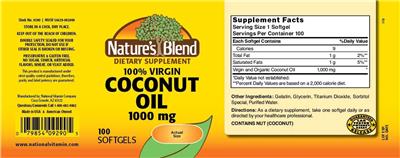
Supplement Facts
The label details for Coconut Oil 1000 mg by Nature's Blend, sourced from the NIH Dietary Supplement Label Database.
Supplement Facts
| Ingredient | Amount | % DV |
|---|---|---|
| Calories | 9 Calorie(s) | -- |
| Total Fat | 1 Gram(s) | 2% |
| Saturated Fat | 1 Gram(s) | 5% |
| Coconut Oil, Virgin | 1000 mg | -- |
Other ingredients: Gelatin, Glycerin, Titanium Dioxide, Sorbitol, Water, Purified
Tap any ingredient to jump to its full detail below.
These statements are the manufacturer’s wording, reproduced from the product label — the label is saying it, not HelloPharmacist. We don’t verify or endorse them.
Storage
Store in a cool, dry place.
Precautions
Keep out of the reach of children.
Double safety sealed for your protection. Do not use is either seal is broken or missing.
Contains nut (coconut)
Formulation
Preservative and gluten free. No sugar, starch, artificial flavors, wheat, or yeast added.
This product is manufactured under strict quality control guidelines; therefore, purity and label potency are guaranteed.
Made in USA & American owned
100% virgin
FDA Statement of Identity
Dietary Supplement
Suggested/Recommended/Usage/Directions
Directions: As a dietary supplement, take one softgel daily or as directed by your healthcare professional.
Seals/Symbols
Guaranteed Release Lab Tested Potency Assay
Is this label outdated? Report a formula or label change and our pharmacy team will review it.
Coconut Oil 1000 mg by Nature's Blend label
The label scan from the NIH Dietary Supplement Label Database. Tap to enlarge.
Label images are published by the NIH Dietary Supplement Label Database for the version of this product on file. Always read your actual product label.
View the full label (PDF)The Ingredients in Coconut Oil 1000 mg by Nature's Blend
This is the 1 active ingredient this product is made of. Select it to open its full monograph.
Serving size1 Softgel(s) Dosage formSoftgel Capsule Servings per container100 Amounts shown are per serving.
Coconut Oil, Virgin
Interacts with86 drugs
Coconut is a nutritious tropical food enjoyed as oil, water, milk, and flesh, and it is generally safe to eat in normal food amounts. While some uses...
Coconut Oil, Virgin monograph & interactionsOther (inactive) ingredients: Gelatin, Glycerin, Titanium Dioxide, Sorbitol, Water, Purified. These complete the product’s ingredient list but are not active constituents.
Coconut Oil 1000 mg by Nature's Blend Drug Interactions
HelloPharmacist Interaction Report
Coconut Oil 1000 mg by Nature's Blend may interact with antidiabetes drugs through its virgin coconut oil content.
Animal research suggests coconut can raise insulin levels and lower blood sugar, which theoretically raises the risk of low blood sugar (hypoglycemia) when combined with diabetes medications—though this is a minor concern in the data we hold.
Read the full breakdown — every affected drug type, severity by severity
Although coconut oil is generally well tolerated, the interaction with antidiabetes drugs is the documented concern. If you take any medication for diabetes, check your exact drugs with the tool on this page before starting this supplement.
Additionally, use the medication checker below to confirm your prescriptions don't overlap with the 86 individual medications linked to coconut in our database.
Check your own medications below · Editorial policy · How we use AI
Want to check YOUR meds against Coconut Oil 1000 mg?
Ask about interactions with your drugs in plain English — “Can I take it with lisinopril?” — and we find you the answer in seconds, ingredient by ingredient.
Go to the checkerIngredients driving the most interactions
Individual Drug Interactions
The ingredients in Coconut Oil 1000 mg interact with 86 drugs. Click any drug to see the details.
1 of the 1 ingredient in Coconut Oil 1000 mg interact with drugs. Each result below shows which ingredient is responsible. Coconut Oil, Virgin
AcarboseGlucobay, Prandase, Precose
How Acarbose interacts with Coconut Oil 1000 mg — through 1 ingredient. Tap an ingredient for the detail:
Coconut Oil, VirginAntidiabetes Drugs Minor
Interaction Summary
Theoretically, taking coconut with antidiabetes drugs might increase the risk of hypoglycemia.
Read the full Coconut Oil, Virgin + Acarbose interactionAcetohexamideDymelor
How Acetohexamide interacts with Coconut Oil 1000 mg — through 1 ingredient. Tap an ingredient for the detail:
Coconut Oil, VirginAntidiabetes Drugs Minor
Interaction Summary
Theoretically, taking coconut with antidiabetes drugs might increase the risk of hypoglycemia.
Read the full Coconut Oil, Virgin + Acetohexamide interactionAlbiglutideTanzeum
How Albiglutide interacts with Coconut Oil 1000 mg — through 1 ingredient. Tap an ingredient for the detail:
Coconut Oil, VirginAntidiabetes Drugs Minor
Interaction Summary
Theoretically, taking coconut with antidiabetes drugs might increase the risk of hypoglycemia.
Read the full Coconut Oil, Virgin + Albiglutide interactionAlogliptinNesina
How Alogliptin interacts with Coconut Oil 1000 mg — through 1 ingredient. Tap an ingredient for the detail:
Coconut Oil, VirginAntidiabetes Drugs Minor
Interaction Summary
Theoretically, taking coconut with antidiabetes drugs might increase the risk of hypoglycemia.
Read the full Coconut Oil, Virgin + Alogliptin interactionAlogliptin, MetforminKazano
How Alogliptin, Metformin interacts with Coconut Oil 1000 mg — through 1 ingredient. Tap an ingredient for the detail:
Coconut Oil, VirginAntidiabetes Drugs Minor
Interaction Summary
Theoretically, taking coconut with antidiabetes drugs might increase the risk of hypoglycemia.
Read the full Coconut Oil, Virgin + Alogliptin, Metformin interactionAlogliptin, PioglitazoneOseni
How Alogliptin, Pioglitazone interacts with Coconut Oil 1000 mg — through 1 ingredient. Tap an ingredient for the detail:
Coconut Oil, VirginAntidiabetes Drugs Minor
Interaction Summary
Theoretically, taking coconut with antidiabetes drugs might increase the risk of hypoglycemia.
Read the full Coconut Oil, Virgin + Alogliptin, Pioglitazone interactionAntidiabetes, Dipeptidyl Peptidase-4 (dpp-iv) InhibitorGlyxambi
How Antidiabetes, Dipeptidyl Peptidase-4 (dpp-iv) Inhibitor interacts with Coconut Oil 1000 mg — through 1 ingredient. Tap an ingredient for the detail:
Coconut Oil, VirginAntidiabetes Drugs Minor
Interaction Summary
Theoretically, taking coconut with antidiabetes drugs might increase the risk of hypoglycemia.
Read the full Coconut Oil, Virgin + Antidiabetes, Dipeptidyl Peptidase-4 (dpp-iv) Inhibitor interactionCanagliflozinInvokana
How Canagliflozin interacts with Coconut Oil 1000 mg — through 1 ingredient. Tap an ingredient for the detail:
Coconut Oil, VirginAntidiabetes Drugs Minor
Interaction Summary
Theoretically, taking coconut with antidiabetes drugs might increase the risk of hypoglycemia.
Read the full Coconut Oil, Virgin + Canagliflozin interactionCanagliflozin, MetforminInvokamet
How Canagliflozin, Metformin interacts with Coconut Oil 1000 mg — through 1 ingredient. Tap an ingredient for the detail:
Coconut Oil, VirginAntidiabetes Drugs Minor
Interaction Summary
Theoretically, taking coconut with antidiabetes drugs might increase the risk of hypoglycemia.
Read the full Coconut Oil, Virgin + Canagliflozin, Metformin interactionCanagliflozin, Metformin HydrochlorideInvokamet XR
How Canagliflozin, Metformin Hydrochloride interacts with Coconut Oil 1000 mg — through 1 ingredient. Tap an ingredient for the detail:
Coconut Oil, VirginAntidiabetes Drugs Minor
Interaction Summary
Theoretically, taking coconut with antidiabetes drugs might increase the risk of hypoglycemia.
Read the full Coconut Oil, Virgin + Canagliflozin, Metformin Hydrochloride interactionChlorpropamideChlorpropam, Diabinese
How Chlorpropamide interacts with Coconut Oil 1000 mg — through 1 ingredient. Tap an ingredient for the detail:
Coconut Oil, VirginAntidiabetes Drugs Minor
Interaction Summary
Theoretically, taking coconut with antidiabetes drugs might increase the risk of hypoglycemia.
Read the full Coconut Oil, Virgin + Chlorpropamide interactionDapagliflozinFarxiga
How Dapagliflozin interacts with Coconut Oil 1000 mg — through 1 ingredient. Tap an ingredient for the detail:
Coconut Oil, VirginAntidiabetes Drugs Minor
Interaction Summary
Theoretically, taking coconut with antidiabetes drugs might increase the risk of hypoglycemia.
Read the full Coconut Oil, Virgin + Dapagliflozin interactionDapagliflozin Propanediol, MetforminXigduo XR
How Dapagliflozin Propanediol, Metformin interacts with Coconut Oil 1000 mg — through 1 ingredient. Tap an ingredient for the detail:
Coconut Oil, VirginAntidiabetes Drugs Minor
Interaction Summary
Theoretically, taking coconut with antidiabetes drugs might increase the risk of hypoglycemia.
Read the full Coconut Oil, Virgin + Dapagliflozin Propanediol, Metformin interactionDapagliflozin Propanediol, Saxagliptin HydrochlorideQtern
How Dapagliflozin Propanediol, Saxagliptin Hydrochloride interacts with Coconut Oil 1000 mg — through 1 ingredient. Tap an ingredient for the detail:
Coconut Oil, VirginAntidiabetes Drugs Minor
Interaction Summary
Theoretically, taking coconut with antidiabetes drugs might increase the risk of hypoglycemia.
Read the full Coconut Oil, Virgin + Dapagliflozin Propanediol, Saxagliptin Hydrochloride interactionDapagliflozin, Metformin Hydrochloride, Saxagliptin HydrochlorideQternmet XR
How Dapagliflozin, Metformin Hydrochloride, Saxagliptin Hydrochloride interacts with Coconut Oil 1000 mg — through 1 ingredient. Tap an ingredient for the detail:
Coconut Oil, VirginAntidiabetes Drugs Minor
Interaction Summary
Theoretically, taking coconut with antidiabetes drugs might increase the risk of hypoglycemia.
Read the full Coconut Oil, Virgin + Dapagliflozin, Metformin Hydrochloride, Saxagliptin Hydrochloride interactionDasiglucagon HydrochlorideZegalogue
How Dasiglucagon Hydrochloride interacts with Coconut Oil 1000 mg — through 1 ingredient. Tap an ingredient for the detail:
Coconut Oil, VirginAntidiabetes Drugs Minor
Interaction Summary
Theoretically, taking coconut with antidiabetes drugs might increase the risk of hypoglycemia.
Read the full Coconut Oil, Virgin + Dasiglucagon Hydrochloride interactionDulaglutideTrulicity
How Dulaglutide interacts with Coconut Oil 1000 mg — through 1 ingredient. Tap an ingredient for the detail:
Coconut Oil, VirginAntidiabetes Drugs Minor
Interaction Summary
Theoretically, taking coconut with antidiabetes drugs might increase the risk of hypoglycemia.
Read the full Coconut Oil, Virgin + Dulaglutide interactionEmpagliflozinJardiance
How Empagliflozin interacts with Coconut Oil 1000 mg — through 1 ingredient. Tap an ingredient for the detail:
Coconut Oil, VirginAntidiabetes Drugs Minor
Interaction Summary
Theoretically, taking coconut with antidiabetes drugs might increase the risk of hypoglycemia.
Read the full Coconut Oil, Virgin + Empagliflozin interactionEmpagliflozin, Linagliptin, Metformin HydrochlorideTrijardy XR
How Empagliflozin, Linagliptin, Metformin Hydrochloride interacts with Coconut Oil 1000 mg — through 1 ingredient. Tap an ingredient for the detail:
Coconut Oil, VirginAntidiabetes Drugs Minor
Interaction Summary
Theoretically, taking coconut with antidiabetes drugs might increase the risk of hypoglycemia.
Read the full Coconut Oil, Virgin + Empagliflozin, Linagliptin, Metformin Hydrochloride interactionEmpagliflozin, MetforminSynjardy
How Empagliflozin, Metformin interacts with Coconut Oil 1000 mg — through 1 ingredient. Tap an ingredient for the detail:
Coconut Oil, VirginAntidiabetes Drugs Minor
Interaction Summary
Theoretically, taking coconut with antidiabetes drugs might increase the risk of hypoglycemia.
Read the full Coconut Oil, Virgin + Empagliflozin, Metformin interactionEmpagliflozin, Metformin HydrochlorideSynjardy XR
How Empagliflozin, Metformin Hydrochloride interacts with Coconut Oil 1000 mg — through 1 ingredient. Tap an ingredient for the detail:
Coconut Oil, VirginAntidiabetes Drugs Minor
Interaction Summary
Theoretically, taking coconut with antidiabetes drugs might increase the risk of hypoglycemia.
Read the full Coconut Oil, Virgin + Empagliflozin, Metformin Hydrochloride interactionErtugliflozinSteglatro
How Ertugliflozin interacts with Coconut Oil 1000 mg — through 1 ingredient. Tap an ingredient for the detail:
Coconut Oil, VirginAntidiabetes Drugs Minor
Interaction Summary
Theoretically, taking coconut with antidiabetes drugs might increase the risk of hypoglycemia.
Read the full Coconut Oil, Virgin + Ertugliflozin interactionErtugliflozin, Metformin HydrochlorideSegluromet
How Ertugliflozin, Metformin Hydrochloride interacts with Coconut Oil 1000 mg — through 1 ingredient. Tap an ingredient for the detail:
Coconut Oil, VirginAntidiabetes Drugs Minor
Interaction Summary
Theoretically, taking coconut with antidiabetes drugs might increase the risk of hypoglycemia.
Read the full Coconut Oil, Virgin + Ertugliflozin, Metformin Hydrochloride interactionExenatideBydureon, Byetta
How Exenatide interacts with Coconut Oil 1000 mg — through 1 ingredient. Tap an ingredient for the detail:
Coconut Oil, VirginAntidiabetes Drugs Minor
Interaction Summary
Theoretically, taking coconut with antidiabetes drugs might increase the risk of hypoglycemia.
Read the full Coconut Oil, Virgin + Exenatide interactionExenatide SyntheticBydureon BCISE
How Exenatide Synthetic interacts with Coconut Oil 1000 mg — through 1 ingredient. Tap an ingredient for the detail:
Coconut Oil, VirginAntidiabetes Drugs Minor
Interaction Summary
Theoretically, taking coconut with antidiabetes drugs might increase the risk of hypoglycemia.
Read the full Coconut Oil, Virgin + Exenatide Synthetic interactionGliclazideDiamicron
How Gliclazide interacts with Coconut Oil 1000 mg — through 1 ingredient. Tap an ingredient for the detail:
Coconut Oil, VirginAntidiabetes Drugs Minor
Interaction Summary
Theoretically, taking coconut with antidiabetes drugs might increase the risk of hypoglycemia.
Read the full Coconut Oil, Virgin + Gliclazide interactionGlimepirideAmaryl
How Glimepiride interacts with Coconut Oil 1000 mg — through 1 ingredient. Tap an ingredient for the detail:
Coconut Oil, VirginAntidiabetes Drugs Minor
Interaction Summary
Theoretically, taking coconut with antidiabetes drugs might increase the risk of hypoglycemia.
Read the full Coconut Oil, Virgin + Glimepiride interactionGlipizideGlucotrol, Glucotrol XL
How Glipizide interacts with Coconut Oil 1000 mg — through 1 ingredient. Tap an ingredient for the detail:
Coconut Oil, VirginAntidiabetes Drugs Minor
Interaction Summary
Theoretically, taking coconut with antidiabetes drugs might increase the risk of hypoglycemia.
Read the full Coconut Oil, Virgin + Glipizide interactionGlipizide, MetforminMetaglip
How Glipizide, Metformin interacts with Coconut Oil 1000 mg — through 1 ingredient. Tap an ingredient for the detail:
Coconut Oil, VirginAntidiabetes Drugs Minor
Interaction Summary
Theoretically, taking coconut with antidiabetes drugs might increase the risk of hypoglycemia.
Read the full Coconut Oil, Virgin + Glipizide, Metformin interactionGlucagonBaqsimi, Glucagon
How Glucagon interacts with Coconut Oil 1000 mg — through 1 ingredient. Tap an ingredient for the detail:
Coconut Oil, VirginAntidiabetes Drugs Minor
Interaction Summary
Theoretically, taking coconut with antidiabetes drugs might increase the risk of hypoglycemia.
Read the full Coconut Oil, Virgin + Glucagon interactionEach ingredient & the kinds of drugs it affects
For each ingredient in Coconut Oil 1000 mg with known interactions, here are the types of medications it can affect. Open any type for the detail — or search your exact drug in the checker above.
Coconut Oil, Virgin
Antidiabetes Drugs
Theoretically, taking coconut with antidiabetes drugs might increase the risk of hypoglycemia.
Animal research suggests that coconut milk might increase insulin levels and/or decrease blood glucose levels.
Brand information
Manufacturer and brand details for Coconut Oil 1000 mg, from the product label.
Nature's Blend
See all Nature's Blend products- Name
- National Vitamin Company
- City
- Casa Grande
- State
- AZ
- ZipCode
- 85122
- Phone Number
- 1-800-682-9862
- Web Address
- www.nationalvitamin.com
Coconut Oil 1000 mg by Nature's Blend: Common Questions
Does Coconut Oil 1000 mg by Nature's Blend interact with any medications?
How can one product interact with so many drugs?
Where does this information come from?
Is coconut oil safe to take while pregnant or breastfeeding?
Can I take this if I have a tree nut allergy?
Does coconut oil actually help with diabetes?
What are the most common side effects?
Are there fillers in this softgel?
Written and reviewed by the HelloPharmacist editorial staff. Our editorial policy
Not sure if Coconut Oil 1000 mg is safe with your meds?
Our pharmacists answer your medication & supplement questions — free.
Label information is sourced from the NIH Dietary Supplement Label Database and reflects the product version on file; always read your actual product label. This page is for education only and is not a substitute for professional medical advice. Confirm with your pharmacist or doctor before combining supplements and medications.
The Full Monographs Behind Coconut Oil 1000 mg’s Ingredients
Every ingredient we hold a full HelloPharmacist monograph for — uses, evidence, safety, and the complete interaction list.
Sources & How We Checked
Coconut Oil 1000 mg's label data comes from the NIH Dietary Supplement Label Database; the ingredient interaction data is from the Natural Medicines database, reviewed by our pharmacists.
- NIH Dietary Supplement Label Database (DSLD) — The official product label on file for this supplement.
- Natural Medicines (Therapeutic Research Center) — Evidence-graded clinical reference behind the ingredient interaction data.
Content is written and reviewed by licensed HelloPharmacist pharmacists. See our data sources and editorial standards for how this information is built and checked.
The 10 references behind this product’s interaction data
Every citation that drives the interaction findings for this product’s ingredients, from the evidence-graded Natural Medicines (TRC Healthcare) database. Open an ingredient to browse its citations — links open the study on PubMed or the publisher’s site.
Coconut 10 references
- Teuber SS, Peterson WR. Systemic allergic reaction to coconut (Cocos nucifera) in 2 subjects with hypersensitivity to tree nut and demonstration of cross-reactivity to legumin-like seed storage proteins: new coconut and walnut food allergens. J Allergy Cl PubMed
- Rosado A, Fernandez-Rivas M, Gonzalez-Mancebo E, et al. Anaphylaxis to coconut. Allergy 2002;57(2):182-3. PubMed
- Karmakar PR, Das A, Chatterjee BP. Placebo-controlled immunotherapy with Cocos nucifera pollen extract. Int Arch Allergy Immunol 1994;103(2):194-201. PubMed
- Anagnostou K. Coconut Allergy Revisited. Children (Basel). 2017;4(10). pii: E85. PubMed
- Cifuentes L, Mistrello G, Amato S, et al. Identification of cross-reactivity between buckwheat and coconut. Ann Allergy Asthma Immunol. 2015;115(6):530-2. PubMed
- Michavila Gomez A, Amat Bou M, Gonzalez Cortés MV, Segura Navas L, Moreno Palanques MA, Bartolomé B. Coconut anaphylaxis: Case report and review. Allergol Immunopathol (Madr). 2015;43(2):219-20. PubMed
- 21CFR170.3. U.S. Food and Drug Administration Department of Health and Human Services. Updated April 1, 2017. https://www.accessdata.fda.gov/scripts/cdrh/cfdocs/cfcfr/CFRSearch.cfm?fr=170.3
- Alatawi KA, Alshubaily FA. Coconut products alleviate hyperglycaemic, hyperlipidimic and nephropathy indices in streptozotocin-induced diabetic wistar rats. Saudi J Biol Sci. 2021;28(8):4224-4231. PubMed
- Kruse L, Lor J, Yousif R, Pongracic JA, Fishbein AB. Coconut allergy: Characteristics of reactions and diagnostic predictors in a pediatric tertiary care center. Ann Allergy Asthma Immunol 2021;126(5):562-568.
- Pathmanandavel K, Kaur N, Joshi P, Ford LS. Anaphylaxis and allergy to coconut: An Australian pediatric case series. J Allergy Clin Immunol Pract 2020;8(10):3657-3659. PubMed
Parts of this content are provided by the Therapeutic Research Center, LLC.
DISCLAIMER: Currently this does not check for drug-drug interactions. This is not an all-inclusive comprehensive list of potential interactions and is for informational purposes only. Not all interactions are known or well-reported in the scientific literature, and new interactions are continually being reported. Input is needed from a qualified healthcare provider including a pharmacist before starting any therapy. Application of clinical judgment is necessary.
© 2021 Therapeutic Research Center, LLC