
Core Hydrangea Blend Ingredients & Drug Interactions
by Energetix
What is this page for?
First and foremost: checking Core Hydrangea Blend against your medications. The heart of this page is the interaction checker and the full interaction report — how this product’s ingredients may interact with prescription and over-the-counter medicines you may be taking.
Around that, we add a pharmacist’s high-level view of the product as a whole — what’s inside, the evidence for its stated use, how transparent the label is, and what safety data exists — so you can see the full picture in one place. It’s educational information from our licensed clinical databases and the clinical staff at HelloPharmacist — not medical advice — and we don’t sell or endorse products. Our editorial policy
Core Hydrangea Blend is a dietary supplement by Energetix with 9 active ingredients. Its ingredients are commonly taken for kidney stones, urinary tract complaints, fluid retention.Based on those ingredients, 740 medications have a known interaction with it, the most serious rated major. The ingredients most likely to interact are Artichoke Leaf Extract, Borage Aerial Parts Extract, Club Moss Aerial Parts Extract. Use the checker below to test your specific medication, or read the full HelloPharmacist Interaction Report.
Check Your Meds Against Core Hydrangea Blend by Energetix
Ask about any prescription or over-the-counter medication and we check it for interactions with Core Hydrangea Blend by Energetix — and tell you which ingredient is responsible.
AI summaries are generated from our interaction database for education only — always confirm with your pharmacist. How we use AI
Ask the Pharmacist
A licensed pharmacist will answer your question by email — free, usually within 24 hours.
Got it — thank you!
A licensed pharmacist will answer within 24 hours. Keep an eye on your email (worth checking spam, just in case).
HelloPharmacist Scorecard of Core Hydrangea Blend by Energetix
Our pharmacy team’s full take, with four database checks built into the cards below — a summary of what is known, not a grade of the product itself.
What’s inside
Low disclosure
Core Hydrangea Blend contains 9 active ingredients delivered as a liquid. The primary botanical extracts are Gravel Root, Radish Seed, Yellow Dock Root, Artichoke Leaf, Hydrangea Root, Club Moss Aerial Parts, Borage Aerial Parts, Blue Flag Root, and Blessed Thistle.
The product also contains inactive ingredients: purified water and ethyl alcohol, which serve as the liquid base and preservative.
Does it work?
Moderate evidence
The product facts we hold do not establish effectiveness for a primary indication. Artichoke Leaf Extract is rated possibly effective for high cholesterol (hyperlipidemia) and indigestion (dyspepsia), though quality and dosing vary by product.
The other ingredients either lack effectiveness data in our records or are rated insufficient evidence — meaning the science isn't there yet to confirm whether they work for their intended uses.
How safe is it?
Well-documented data
Several ingredients in this blend carry safety cautions. Gravel Root and Borage contain liver-toxic compounds called pyrrolizidine alkaloids (PAs) and should be used cautiously and short-term; chronic exposure has been linked to serious liver damage (veno-occlusive disease).
Yellow Dock acts as a laxative and contains oxalates — use short-term and with care. Blue Flag Root can cause nausea, vomiting, and irritation, especially when fresh.
Artichoke Leaf is generally well tolerated but may cause abdominal pain, diarrhea, flatulence, or nausea; it can trigger allergic reactions in people sensitive to ragweed and related plants. Blessed Thistle may cause nausea or vomiting at high doses.
Hydrangea may cause gastroenteritis, dizziness, or chest tightness.
Meds to double-check
Major interaction found
Double-check this product with your pharmacist if you take any of the following: diuretic drugs (water pills), digoxin or other heart medications, blood thinners like warfarin, diabetes medications, blood pressure medications, H2-blockers or proton pump inhibitors (heartburn/reflux drugs), anticoagulant or antiplatelet drugs, or drugs that induce CYP3A4 or CYP2C19 liver enzymes. Yellow Dock and Blue Flag pose the highest-severity risks.
The bottom line
Scorecard at a glanceFormula with limited ingredient disclosure with some supporting evidence behind its ingredients' uses. Major medication interactions have been identified, and safety information is well characterized.
This blend carries multiple serious drug interactions, especially with heart medications, diuretics, and blood thinners. It also contains ingredients with liver-toxic alkaloids and laxative effects that demand caution and short-term use.
If you take any prescription medication — particularly for the heart, blood pressure, blood sugar, or blood clotting — talk with your pharmacist before starting this product.
Educational only — not medical advice; always confirm with your pharmacist. Our editorial policy · How we use AI
Assessment coverage: 9 of 9 active ingredients matched to our full ingredient reviews (monographs). Based on the product label dated Jul 24, 2025.
This Scorecard evaluates available label information, ingredient evidence, and known medication-safety considerations. It does not independently verify product identity, purity, potency, contamination, or manufacturing quality. How these ratings are computed
General information
Key facts about Core Hydrangea Blend, straight from the product label.
Everything in this section is reproduced from the manufacturer’s own product label — it’s the label speaking, not HelloPharmacist. We show it so you can see exactly what the maker states; we don’t verify or endorse those statements.
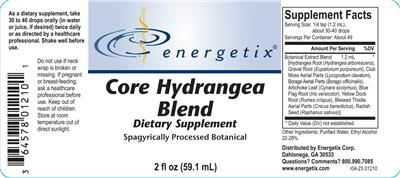
Supplement Facts
The label details for Core Hydrangea Blend by Energetix, sourced from the NIH Dietary Supplement Label Database.
Supplement Facts
| Ingredient | Amount | % DV |
|---|---|---|
| Botanical Extract Blend | 1.2 mL | -- |
| Gravel Root extract | 0 NP | -- |
| Radish Seed Extract | 0 NP | -- |
| Yellow Dock Root Extract | 0 NP | -- |
| Artichoke Leaf Extract | 0 NP | -- |
| Hydrangea Root Extract | 0 NP | -- |
| Club Moss Aerial Parts Extract | 0 NP | -- |
| Borage Aerial Parts Extract | 0 NP | -- |
| Blue Flag Root Extract | 0 NP | -- |
| Blessed Thistle | 0 NP | -- |
Other ingredients: Water, Purified, Ethyl Alcohol
Tap any ingredient to jump to its full detail below.
These statements are the manufacturer’s wording, reproduced from the product label — the label is saying it, not HelloPharmacist. We don’t verify or endorse them.
Suggested/Recommended/Usage/Directions
As a dietary supplement, take 30 to 40 drops orally (in water or juice, if desired) twice daily or as directed by a healthcare professional. Shake well before use.
Precautions
Do not use if neck wrap is broken or missing.
If pregnant or breast-feeding, ask a healthcare professional before use.
Keep out of reach of children.
Storage
Store at room temperature out of direct sunlight.
FDA Statement of Identity
Dietary Supplement
Formulation
Spagyrically processed botanical
Is this label outdated? Report a formula or label change and our pharmacy team will review it.
Core Hydrangea Blend by Energetix label
The label scan from the NIH Dietary Supplement Label Database. Tap to enlarge.
Label images are published by the NIH Dietary Supplement Label Database for the version of this product on file. Always read your actual product label.
View the full label (PDF)The Ingredients in Core Hydrangea Blend by Energetix
These are the 9 active ingredients this product is made of. Select any to open its full monograph.
Serving size1.2 mL Dosage formLiquid Servings per container49 Amounts shown are per serving.
Most supplement products combine several ingredients, and a medication can interact with the product through any one of them. Each ingredient below shows whether it has known drug interactions.
Botanical Extract Blend
Other (inactive) ingredients: Water, Purified, Ethyl Alcohol. These complete the product’s ingredient list but are not active constituents.
Core Hydrangea Blend by Energetix Drug Interactions
HelloPharmacist Interaction Report
Core Hydrangea Blend by Energetix contains nine ingredients, and several of them interact with medications.
The most serious interactions involve Yellow Dock Root Extract, which poses Major-severity risks with diuretic drugs and the heart medication digoxin (Lanoxin). Yellow dock may cause low potassium (hypokalemia) when used with diuretics, and low potassium can increase the toxic effects of digoxin — both effects are particularly concerning with long-term or large-dose use.
Read the full breakdown — every affected drug type, severity by severity
Blue Flag Root Extract also carries Major-severity interactions with digoxin and Moderate interactions with diuretic drugs and warfarin (Coumadin). Gravel Root, Artichoke Leaf, and Borage Aerial Parts all interact with blood-thinning or anticoagulant drugs (warfarin and anticoagulant/antiplatelet drugs, respectively).
Gravel Root and Borage also interact with certain medications that speed up liver metabolism (CYP3A4 inducers). Artichoke Leaf additionally affects blood sugar control and blood pressure medications.
Radish Seed Extract may increase the risk of low blood sugar (hypoglycemia) with diabetes drugs.
Gravel Root and Hydrangea Root both have diuretic properties and may affect lithium levels. Blessed Thistle can theoretically reduce the effectiveness of stomach acid-reducing medications (H2-blockers, antacids, and proton pump inhibitors).
We could not check Club Moss Aerial Parts Extract — no interaction data is on file for it.
Altogether, these interactions span 562 individual medications. If you take any prescription medication, run it through the checker below before adding this product.
Check your own medications below · Editorial policy · How we use AI
Want to check YOUR meds against Core Hydrangea Blend?
Ask about interactions with your drugs in plain English — “Can I take it with lisinopril?” — and we find you the answer in seconds, ingredient by ingredient.
Go to the checkerIngredients driving the most interactions
Individual Drug Interactions
The ingredients in Core Hydrangea Blend interact with 740 drugs. Click any drug to see the details.
9 of the 9 ingredients in Core Hydrangea Blend interact with drugs. Each result below shows which ingredient is responsible. Artichoke Leaf Extract Borage Aerial Parts Extract Club Moss Aerial Parts Extract Gravel Root extract Radish Seed Extract Yellow Dock Root Extract Blue Flag Root Extract Blessed Thistle Hydrangea Root Extract
Acetaminophen, Caffeine, PyrilamineMidol Max Strength Menstrual
How Acetaminophen, Caffeine, Pyrilamine interacts with Core Hydrangea Blend — through 3 ingredients. Tap an ingredient for the detail:
Yellow Dock Root ExtractDiuretic Drugs Major
Interaction Summary
Theoretically, yellow dock might increase the risk of hypokalemia when taken with diuretics.
Read the full Yellow Dock Root Extract + Acetaminophen, Caffeine, Pyrilamine interactionClub Moss Aerial Parts ExtractAnticholinergic Drugs Moderate
Interaction Summary
Evidence from in vitro research suggests that clubmoss extract can inhibit acetylcholinesterase activity.
Read the full Club Moss Aerial Parts Extract + Acetaminophen, Caffeine, Pyrilamine interactionBlue Flag Root ExtractDiuretic Drugs Moderate
Interaction Summary
Overuse of blue flag might compound diuretic-induced potassium loss.
Read the full Blue Flag Root Extract + Acetaminophen, Caffeine, Pyrilamine interactionAcetaminophen, Pamabrom, PyrilamineMidol Max Strength PMS, Pamprin, Pamprin ES
How Acetaminophen, Pamabrom, Pyrilamine interacts with Core Hydrangea Blend — through 3 ingredients. Tap an ingredient for the detail:
Yellow Dock Root ExtractDiuretic Drugs Major
Interaction Summary
Theoretically, yellow dock might increase the risk of hypokalemia when taken with diuretics.
Read the full Yellow Dock Root Extract + Acetaminophen, Pamabrom, Pyrilamine interactionClub Moss Aerial Parts ExtractAnticholinergic Drugs Moderate
Interaction Summary
Evidence from in vitro research suggests that clubmoss extract can inhibit acetylcholinesterase activity.
Read the full Club Moss Aerial Parts Extract + Acetaminophen, Pamabrom, Pyrilamine interactionBlue Flag Root ExtractDiuretic Drugs Moderate
Interaction Summary
Overuse of blue flag might compound diuretic-induced potassium loss.
Read the full Blue Flag Root Extract + Acetaminophen, Pamabrom, Pyrilamine interactionAcetazolamideAk-Zol, Diamox
How Acetazolamide interacts with Core Hydrangea Blend — through 3 ingredients. Tap an ingredient for the detail:
Yellow Dock Root ExtractDiuretic Drugs Major
Interaction Summary
Theoretically, yellow dock might increase the risk of hypokalemia when taken with diuretics.
Read the full Yellow Dock Root Extract + Acetazolamide interactionArtichoke Leaf ExtractAntihypertensive Drugs Moderate
Interaction Summary
Theoretically, artichoke leaf extract may increase the risk of hypotension when taken with antihypertensive drugs.
Read the full Artichoke Leaf Extract + Acetazolamide interactionBlue Flag Root ExtractDiuretic Drugs Moderate
Interaction Summary
Overuse of blue flag might compound diuretic-induced potassium loss.
Read the full Blue Flag Root Extract + Acetazolamide interactionAmiloride, HydrochlorothiazideAmil-Co, Amilzide, Moduret 25, Moduretic
How Amiloride, Hydrochlorothiazide interacts with Core Hydrangea Blend — through 3 ingredients. Tap an ingredient for the detail:
Yellow Dock Root ExtractDiuretic Drugs Major
Interaction Summary
Theoretically, yellow dock might increase the risk of hypokalemia when taken with diuretics.
Read the full Yellow Dock Root Extract + Amiloride, Hydrochlorothiazide interactionArtichoke Leaf ExtractAntihypertensive Drugs Moderate
Interaction Summary
Theoretically, artichoke leaf extract may increase the risk of hypotension when taken with antihypertensive drugs.
Read the full Artichoke Leaf Extract + Amiloride, Hydrochlorothiazide interactionBlue Flag Root ExtractDiuretic Drugs Moderate
Interaction Summary
Overuse of blue flag might compound diuretic-induced potassium loss.
Read the full Blue Flag Root Extract + Amiloride, Hydrochlorothiazide interactionAmmonium ChlorideAmmonium Chloride
How Ammonium Chloride interacts with Core Hydrangea Blend — through 3 ingredients. Tap an ingredient for the detail:
Yellow Dock Root ExtractDiuretic Drugs Major
Interaction Summary
Theoretically, yellow dock might increase the risk of hypokalemia when taken with diuretics.
Read the full Yellow Dock Root Extract + Ammonium Chloride interactionArtichoke Leaf ExtractAntihypertensive Drugs Moderate
Interaction Summary
Theoretically, artichoke leaf extract may increase the risk of hypotension when taken with antihypertensive drugs.
Read the full Artichoke Leaf Extract + Ammonium Chloride interactionBlue Flag Root ExtractDiuretic Drugs Moderate
Interaction Summary
Overuse of blue flag might compound diuretic-induced potassium loss.
Read the full Blue Flag Root Extract + Ammonium Chloride interactionAtenolol, ChlortalidoneAtenixCo, Tenoret 50, Totaretic
How Atenolol, Chlortalidone interacts with Core Hydrangea Blend — through 3 ingredients. Tap an ingredient for the detail:
Yellow Dock Root ExtractDiuretic Drugs Major
Interaction Summary
Theoretically, yellow dock might increase the risk of hypokalemia when taken with diuretics.
Read the full Yellow Dock Root Extract + Atenolol, Chlortalidone interactionArtichoke Leaf ExtractAntihypertensive Drugs Moderate
Interaction Summary
Theoretically, artichoke leaf extract may increase the risk of hypotension when taken with antihypertensive drugs.
Read the full Artichoke Leaf Extract + Atenolol, Chlortalidone interactionBlue Flag Root ExtractDiuretic Drugs Moderate
Interaction Summary
Overuse of blue flag might compound diuretic-induced potassium loss.
Read the full Blue Flag Root Extract + Atenolol, Chlortalidone interactionAtenolol, ChlorthalidoneTenoretic
How Atenolol, Chlorthalidone interacts with Core Hydrangea Blend — through 3 ingredients. Tap an ingredient for the detail:
Yellow Dock Root ExtractDiuretic Drugs Major
Interaction Summary
Theoretically, yellow dock might increase the risk of hypokalemia when taken with diuretics.
Read the full Yellow Dock Root Extract + Atenolol, Chlorthalidone interactionBlue Flag Root ExtractDiuretic Drugs Moderate
Interaction Summary
Overuse of blue flag might compound diuretic-induced potassium loss.
Read the full Blue Flag Root Extract + Atenolol, Chlorthalidone interactionArtichoke Leaf ExtractAntihypertensive Drugs Moderate
Interaction Summary
Theoretically, artichoke leaf extract may increase the risk of hypotension when taken with antihypertensive drugs.
Read the full Artichoke Leaf Extract + Atenolol, Chlorthalidone interactionAzilsartan, ChlorthalidoneEdarbyclor
How Azilsartan, Chlorthalidone interacts with Core Hydrangea Blend — through 3 ingredients. Tap an ingredient for the detail:
Yellow Dock Root ExtractDiuretic Drugs Major
Interaction Summary
Theoretically, yellow dock might increase the risk of hypokalemia when taken with diuretics.
Read the full Yellow Dock Root Extract + Azilsartan, Chlorthalidone interactionArtichoke Leaf ExtractAntihypertensive Drugs Moderate
Interaction Summary
Theoretically, artichoke leaf extract may increase the risk of hypotension when taken with antihypertensive drugs.
Read the full Artichoke Leaf Extract + Azilsartan, Chlorthalidone interactionBlue Flag Root ExtractDiuretic Drugs Moderate
Interaction Summary
Overuse of blue flag might compound diuretic-induced potassium loss.
Read the full Blue Flag Root Extract + Azilsartan, Chlorthalidone interactionBenazepril, HydrochlorothiazideLotensin HCT
How Benazepril, Hydrochlorothiazide interacts with Core Hydrangea Blend — through 3 ingredients. Tap an ingredient for the detail:
Yellow Dock Root ExtractDiuretic Drugs Major
Interaction Summary
Theoretically, yellow dock might increase the risk of hypokalemia when taken with diuretics.
Read the full Yellow Dock Root Extract + Benazepril, Hydrochlorothiazide interactionArtichoke Leaf ExtractAntihypertensive Drugs Moderate
Interaction Summary
Theoretically, artichoke leaf extract may increase the risk of hypotension when taken with antihypertensive drugs.
Read the full Artichoke Leaf Extract + Benazepril, Hydrochlorothiazide interactionBlue Flag Root ExtractDiuretic Drugs Moderate
Interaction Summary
Overuse of blue flag might compound diuretic-induced potassium loss.
Read the full Blue Flag Root Extract + Benazepril, Hydrochlorothiazide interactionBendroflumethiazideAprinox, Naturetin, Neo-NaClex
How Bendroflumethiazide interacts with Core Hydrangea Blend — through 3 ingredients. Tap an ingredient for the detail:
Yellow Dock Root ExtractDiuretic Drugs Major
Interaction Summary
Theoretically, yellow dock might increase the risk of hypokalemia when taken with diuretics.
Read the full Yellow Dock Root Extract + Bendroflumethiazide interactionBlue Flag Root ExtractDiuretic Drugs Moderate
Interaction Summary
Overuse of blue flag might compound diuretic-induced potassium loss.
Read the full Blue Flag Root Extract + Bendroflumethiazide interactionArtichoke Leaf ExtractAntihypertensive Drugs Moderate
Interaction Summary
Theoretically, artichoke leaf extract may increase the risk of hypotension when taken with antihypertensive drugs.
Read the full Artichoke Leaf Extract + Bendroflumethiazide interactionBendroflumethiazide, NadololCorzide
How Bendroflumethiazide, Nadolol interacts with Core Hydrangea Blend — through 3 ingredients. Tap an ingredient for the detail:
Yellow Dock Root ExtractDiuretic Drugs Major
Interaction Summary
Theoretically, yellow dock might increase the risk of hypokalemia when taken with diuretics.
Read the full Yellow Dock Root Extract + Bendroflumethiazide, Nadolol interactionBlue Flag Root ExtractDiuretic Drugs Moderate
Interaction Summary
Overuse of blue flag might compound diuretic-induced potassium loss.
Read the full Blue Flag Root Extract + Bendroflumethiazide, Nadolol interactionArtichoke Leaf ExtractAntihypertensive Drugs Moderate
Interaction Summary
Theoretically, artichoke leaf extract may increase the risk of hypotension when taken with antihypertensive drugs.
Read the full Artichoke Leaf Extract + Bendroflumethiazide, Nadolol interactionBendroflumethiazide, PotassiumCentyl K, Neo-NaClex-K
How Bendroflumethiazide, Potassium interacts with Core Hydrangea Blend — through 2 ingredients. Tap an ingredient for the detail:
Yellow Dock Root ExtractDiuretic Drugs Major
Interaction Summary
Theoretically, yellow dock might increase the risk of hypokalemia when taken with diuretics.
Read the full Yellow Dock Root Extract + Bendroflumethiazide, Potassium interactionBlue Flag Root ExtractDiuretic Drugs Moderate
Interaction Summary
Overuse of blue flag might compound diuretic-induced potassium loss.
Read the full Blue Flag Root Extract + Bendroflumethiazide, Potassium interactionBendroflumethiazide, Rauwolfia SerpentinaRauzide
How Bendroflumethiazide, Rauwolfia Serpentina interacts with Core Hydrangea Blend — through 3 ingredients. Tap an ingredient for the detail:
Yellow Dock Root ExtractDiuretic Drugs Major
Interaction Summary
Theoretically, yellow dock might increase the risk of hypokalemia when taken with diuretics.
Read the full Yellow Dock Root Extract + Bendroflumethiazide, Rauwolfia Serpentina interactionBlue Flag Root ExtractDiuretic Drugs Moderate
Interaction Summary
Overuse of blue flag might compound diuretic-induced potassium loss.
Read the full Blue Flag Root Extract + Bendroflumethiazide, Rauwolfia Serpentina interactionArtichoke Leaf ExtractAntihypertensive Drugs Moderate
Interaction Summary
Theoretically, artichoke leaf extract may increase the risk of hypotension when taken with antihypertensive drugs.
Read the full Artichoke Leaf Extract + Bendroflumethiazide, Rauwolfia Serpentina interactionBenzthiazideExna
How Benzthiazide interacts with Core Hydrangea Blend — through 3 ingredients. Tap an ingredient for the detail:
Yellow Dock Root ExtractDiuretic Drugs Major
Interaction Summary
Theoretically, yellow dock might increase the risk of hypokalemia when taken with diuretics.
Read the full Yellow Dock Root Extract + Benzthiazide interactionArtichoke Leaf ExtractAntihypertensive Drugs Moderate
Interaction Summary
Theoretically, artichoke leaf extract may increase the risk of hypotension when taken with antihypertensive drugs.
Read the full Artichoke Leaf Extract + Benzthiazide interactionBlue Flag Root ExtractDiuretic Drugs Moderate
Interaction Summary
Overuse of blue flag might compound diuretic-induced potassium loss.
Read the full Blue Flag Root Extract + Benzthiazide interactionBisoprolol, HydrochlorothiazideZiac
How Bisoprolol, Hydrochlorothiazide interacts with Core Hydrangea Blend — through 3 ingredients. Tap an ingredient for the detail:
Yellow Dock Root ExtractDiuretic Drugs Major
Interaction Summary
Theoretically, yellow dock might increase the risk of hypokalemia when taken with diuretics.
Read the full Yellow Dock Root Extract + Bisoprolol, Hydrochlorothiazide interactionBlue Flag Root ExtractDiuretic Drugs Moderate
Interaction Summary
Overuse of blue flag might compound diuretic-induced potassium loss.
Read the full Blue Flag Root Extract + Bisoprolol, Hydrochlorothiazide interactionArtichoke Leaf ExtractAntihypertensive Drugs Moderate
Interaction Summary
Theoretically, artichoke leaf extract may increase the risk of hypotension when taken with antihypertensive drugs.
Read the full Artichoke Leaf Extract + Bisoprolol, Hydrochlorothiazide interactionBumetanideBurinex
How Bumetanide interacts with Core Hydrangea Blend — through 3 ingredients. Tap an ingredient for the detail:
Yellow Dock Root ExtractDiuretic Drugs Major
Interaction Summary
Theoretically, yellow dock might increase the risk of hypokalemia when taken with diuretics.
Read the full Yellow Dock Root Extract + Bumetanide interactionArtichoke Leaf ExtractAntihypertensive Drugs Moderate
Interaction Summary
Theoretically, artichoke leaf extract may increase the risk of hypotension when taken with antihypertensive drugs.
Read the full Artichoke Leaf Extract + Bumetanide interactionBlue Flag Root ExtractDiuretic Drugs Moderate
Interaction Summary
Overuse of blue flag might compound diuretic-induced potassium loss.
Read the full Blue Flag Root Extract + Bumetanide interactionBumetanide, PotassiumBurinex K
How Bumetanide, Potassium interacts with Core Hydrangea Blend — through 2 ingredients. Tap an ingredient for the detail:
Yellow Dock Root ExtractDiuretic Drugs Major
Interaction Summary
Theoretically, yellow dock might increase the risk of hypokalemia when taken with diuretics.
Read the full Yellow Dock Root Extract + Bumetanide, Potassium interactionBlue Flag Root ExtractDiuretic Drugs Moderate
Interaction Summary
Overuse of blue flag might compound diuretic-induced potassium loss.
Read the full Blue Flag Root Extract + Bumetanide, Potassium interactionCaffeine, Potassium Salicylate, SalicylamideTrim-Elim
How Caffeine, Potassium Salicylate, Salicylamide interacts with Core Hydrangea Blend — through 2 ingredients. Tap an ingredient for the detail:
Yellow Dock Root ExtractDiuretic Drugs Major
Interaction Summary
Theoretically, yellow dock might increase the risk of hypokalemia when taken with diuretics.
Read the full Yellow Dock Root Extract + Caffeine, Potassium Salicylate, Salicylamide interactionBlue Flag Root ExtractDiuretic Drugs Moderate
Interaction Summary
Overuse of blue flag might compound diuretic-induced potassium loss.
Read the full Blue Flag Root Extract + Caffeine, Potassium Salicylate, Salicylamide interactionCandesartan Cilexetil, HydrochlorothiazideAtacand HCT
How Candesartan Cilexetil, Hydrochlorothiazide interacts with Core Hydrangea Blend — through 3 ingredients. Tap an ingredient for the detail:
Yellow Dock Root ExtractDiuretic Drugs Major
Interaction Summary
Theoretically, yellow dock might increase the risk of hypokalemia when taken with diuretics.
Read the full Yellow Dock Root Extract + Candesartan Cilexetil, Hydrochlorothiazide interactionArtichoke Leaf ExtractAntihypertensive Drugs Moderate
Interaction Summary
Theoretically, artichoke leaf extract may increase the risk of hypotension when taken with antihypertensive drugs.
Read the full Artichoke Leaf Extract + Candesartan Cilexetil, Hydrochlorothiazide interactionBlue Flag Root ExtractDiuretic Drugs Moderate
Interaction Summary
Overuse of blue flag might compound diuretic-induced potassium loss.
Read the full Blue Flag Root Extract + Candesartan Cilexetil, Hydrochlorothiazide interactionCaptopril, HydrochlorothiazideAcezide, Capozide
How Captopril, Hydrochlorothiazide interacts with Core Hydrangea Blend — through 3 ingredients. Tap an ingredient for the detail:
Yellow Dock Root ExtractDiuretic Drugs Major
Interaction Summary
Theoretically, yellow dock might increase the risk of hypokalemia when taken with diuretics.
Read the full Yellow Dock Root Extract + Captopril, Hydrochlorothiazide interactionArtichoke Leaf ExtractAntihypertensive Drugs Moderate
Interaction Summary
Theoretically, artichoke leaf extract may increase the risk of hypotension when taken with antihypertensive drugs.
Read the full Artichoke Leaf Extract + Captopril, Hydrochlorothiazide interactionBlue Flag Root ExtractDiuretic Drugs Moderate
Interaction Summary
Overuse of blue flag might compound diuretic-induced potassium loss.
Read the full Blue Flag Root Extract + Captopril, Hydrochlorothiazide interactionChlorothiazideDiuril
How Chlorothiazide interacts with Core Hydrangea Blend — through 3 ingredients. Tap an ingredient for the detail:
Yellow Dock Root ExtractDiuretic Drugs Major
Interaction Summary
Theoretically, yellow dock might increase the risk of hypokalemia when taken with diuretics.
Read the full Yellow Dock Root Extract + Chlorothiazide interactionArtichoke Leaf ExtractAntihypertensive Drugs Moderate
Interaction Summary
Theoretically, artichoke leaf extract may increase the risk of hypotension when taken with antihypertensive drugs.
Read the full Artichoke Leaf Extract + Chlorothiazide interactionBlue Flag Root ExtractDiuretic Drugs Moderate
Interaction Summary
Overuse of blue flag might compound diuretic-induced potassium loss.
Read the full Blue Flag Root Extract + Chlorothiazide interactionChlorothiazide, MethyldopaAldochlor, Aldoclor 150, Aldoclor 250
How Chlorothiazide, Methyldopa interacts with Core Hydrangea Blend — through 3 ingredients. Tap an ingredient for the detail:
Yellow Dock Root ExtractDiuretic Drugs Major
Interaction Summary
Theoretically, yellow dock might increase the risk of hypokalemia when taken with diuretics.
Read the full Yellow Dock Root Extract + Chlorothiazide, Methyldopa interactionBlue Flag Root ExtractDiuretic Drugs Moderate
Interaction Summary
Overuse of blue flag might compound diuretic-induced potassium loss.
Read the full Blue Flag Root Extract + Chlorothiazide, Methyldopa interactionArtichoke Leaf ExtractAntihypertensive Drugs Moderate
Interaction Summary
Theoretically, artichoke leaf extract may increase the risk of hypotension when taken with antihypertensive drugs.
Read the full Artichoke Leaf Extract + Chlorothiazide, Methyldopa interactionChlorothiazide, ReserpineDiupres
How Chlorothiazide, Reserpine interacts with Core Hydrangea Blend — through 3 ingredients. Tap an ingredient for the detail:
Yellow Dock Root ExtractDiuretic Drugs Major
Interaction Summary
Theoretically, yellow dock might increase the risk of hypokalemia when taken with diuretics.
Read the full Yellow Dock Root Extract + Chlorothiazide, Reserpine interactionArtichoke Leaf ExtractAntihypertensive Drugs Moderate
Interaction Summary
Theoretically, artichoke leaf extract may increase the risk of hypotension when taken with antihypertensive drugs.
Read the full Artichoke Leaf Extract + Chlorothiazide, Reserpine interactionBlue Flag Root ExtractDiuretic Drugs Moderate
Interaction Summary
Overuse of blue flag might compound diuretic-induced potassium loss.
Read the full Blue Flag Root Extract + Chlorothiazide, Reserpine interactionChlorthalidoneHygroton, Thalitone
How Chlorthalidone interacts with Core Hydrangea Blend — through 3 ingredients. Tap an ingredient for the detail:
Yellow Dock Root ExtractDiuretic Drugs Major
Interaction Summary
Theoretically, yellow dock might increase the risk of hypokalemia when taken with diuretics.
Read the full Yellow Dock Root Extract + Chlorthalidone interactionBlue Flag Root ExtractDiuretic Drugs Moderate
Interaction Summary
Overuse of blue flag might compound diuretic-induced potassium loss.
Read the full Blue Flag Root Extract + Chlorthalidone interactionArtichoke Leaf ExtractAntihypertensive Drugs Moderate
Interaction Summary
Theoretically, artichoke leaf extract may increase the risk of hypotension when taken with antihypertensive drugs.
Read the full Artichoke Leaf Extract + Chlorthalidone interactionChlorthalidone, ClonidineClorpres, Combipres
How Chlorthalidone, Clonidine interacts with Core Hydrangea Blend — through 3 ingredients. Tap an ingredient for the detail:
Yellow Dock Root ExtractDiuretic Drugs Major
Interaction Summary
Theoretically, yellow dock might increase the risk of hypokalemia when taken with diuretics.
Read the full Yellow Dock Root Extract + Chlorthalidone, Clonidine interactionArtichoke Leaf ExtractAntihypertensive Drugs Moderate
Interaction Summary
Theoretically, artichoke leaf extract may increase the risk of hypotension when taken with antihypertensive drugs.
Read the full Artichoke Leaf Extract + Chlorthalidone, Clonidine interactionBlue Flag Root ExtractDiuretic Drugs Moderate
Interaction Summary
Overuse of blue flag might compound diuretic-induced potassium loss.
Read the full Blue Flag Root Extract + Chlorthalidone, Clonidine interactionCryptenamine, MethyclothiazideDiutensen
How Cryptenamine, Methyclothiazide interacts with Core Hydrangea Blend — through 3 ingredients. Tap an ingredient for the detail:
Yellow Dock Root ExtractDiuretic Drugs Major
Interaction Summary
Theoretically, yellow dock might increase the risk of hypokalemia when taken with diuretics.
Read the full Yellow Dock Root Extract + Cryptenamine, Methyclothiazide interactionArtichoke Leaf ExtractAntihypertensive Drugs Moderate
Interaction Summary
Theoretically, artichoke leaf extract may increase the risk of hypotension when taken with antihypertensive drugs.
Read the full Artichoke Leaf Extract + Cryptenamine, Methyclothiazide interactionBlue Flag Root ExtractDiuretic Drugs Moderate
Interaction Summary
Overuse of blue flag might compound diuretic-induced potassium loss.
Read the full Blue Flag Root Extract + Cryptenamine, Methyclothiazide interactionCyclothiazideAnhydron, Fluidil
How Cyclothiazide interacts with Core Hydrangea Blend — through 3 ingredients. Tap an ingredient for the detail:
Yellow Dock Root ExtractDiuretic Drugs Major
Interaction Summary
Theoretically, yellow dock might increase the risk of hypokalemia when taken with diuretics.
Read the full Yellow Dock Root Extract + Cyclothiazide interactionBlue Flag Root ExtractDiuretic Drugs Moderate
Interaction Summary
Overuse of blue flag might compound diuretic-induced potassium loss.
Read the full Blue Flag Root Extract + Cyclothiazide interactionArtichoke Leaf ExtractAntihypertensive Drugs Moderate
Interaction Summary
Theoretically, artichoke leaf extract may increase the risk of hypotension when taken with antihypertensive drugs.
Read the full Artichoke Leaf Extract + Cyclothiazide interactionDeserpidine, HydrochlorothiazideOreticyl, Oreticyl Forte
How Deserpidine, Hydrochlorothiazide interacts with Core Hydrangea Blend — through 3 ingredients. Tap an ingredient for the detail:
Yellow Dock Root ExtractDiuretic Drugs Major
Interaction Summary
Theoretically, yellow dock might increase the risk of hypokalemia when taken with diuretics.
Read the full Yellow Dock Root Extract + Deserpidine, Hydrochlorothiazide interactionBlue Flag Root ExtractDiuretic Drugs Moderate
Interaction Summary
Overuse of blue flag might compound diuretic-induced potassium loss.
Read the full Blue Flag Root Extract + Deserpidine, Hydrochlorothiazide interactionArtichoke Leaf ExtractAntihypertensive Drugs Moderate
Interaction Summary
Theoretically, artichoke leaf extract may increase the risk of hypotension when taken with antihypertensive drugs.
Read the full Artichoke Leaf Extract + Deserpidine, Hydrochlorothiazide interactionDeserpidine, MethyclothiazideEnduronyl, Enduronyl Forte
How Deserpidine, Methyclothiazide interacts with Core Hydrangea Blend — through 3 ingredients. Tap an ingredient for the detail:
Yellow Dock Root ExtractDiuretic Drugs Major
Interaction Summary
Theoretically, yellow dock might increase the risk of hypokalemia when taken with diuretics.
Read the full Yellow Dock Root Extract + Deserpidine, Methyclothiazide interactionArtichoke Leaf ExtractAntihypertensive Drugs Moderate
Interaction Summary
Theoretically, artichoke leaf extract may increase the risk of hypotension when taken with antihypertensive drugs.
Read the full Artichoke Leaf Extract + Deserpidine, Methyclothiazide interactionBlue Flag Root ExtractDiuretic Drugs Moderate
Interaction Summary
Overuse of blue flag might compound diuretic-induced potassium loss.
Read the full Blue Flag Root Extract + Deserpidine, Methyclothiazide interactionDigoxinDigitek, Lanoxicaps, Lanoxin
How Digoxin interacts with Core Hydrangea Blend — through 2 ingredients. Tap an ingredient for the detail:
Blue Flag Root ExtractDigoxin (lanoxin) Major
Interaction Summary
Theoretically, overuse or abuse of this product increases the risk of adverse effects from cardiac glycoside drugs.
Read the full Blue Flag Root Extract + Digoxin interactionYellow Dock Root ExtractDigoxin (lanoxin) Major
Interaction Summary
Theoretically, yellow dock might increase the risk of digoxin toxicity when used long-term or in large amount.
Read the full Yellow Dock Root Extract + Digoxin interactionEach ingredient & the kinds of drugs it affects
For each ingredient in Core Hydrangea Blend with known interactions, here are the types of medications they can affect. Open any type for the detail — or search your exact drug in the checker above.
Artichoke Leaf Extract
Antidiabetes Drugs
Theoretically, artichoke leaf extract may increase the risk of hypoglycemia when taken with antidiabetes drugs.
A meta-analysis of small clinical studies shows that taking artichoke leaf extract for 8-12 weeks can modestly reduce fasting plasma glucose when compared with placebo.
Antihypertensive Drugs
Theoretically, artichoke leaf extract may increase the risk of hypotension when taken with antihypertensive drugs.
A meta-analysis of small clinical studies in patients with hypertension shows that taking artichoke can reduce systolic blood pressure by around 3 mmHg and diastolic blood pressure by around 2 mmHg when compared with placebo.
Cytochrome P450 2B6 (Cyp2B6) Substrates
Theoretically, artichoke might increase serum levels of drugs metabolized by CYP2B6.
In vitro research shows that artichoke leaf extract inhibits CYP2B6 activity. However, this interaction has not been reported in humans.
Cytochrome P450 2C19 (Cyp2C19) Substrates
Theoretically, artichoke might increase serum levels of drugs metabolized by CYP2C19.
In vitro research shows that artichoke leaf extract inhibits CYP2C19 activity. However, this interaction has not been reported in humans.
Borage Aerial Parts Extract
Anticoagulant/Antiplatelet Drugs
Theoretically, borage seed oil may increase the risk of bleeding if used with anticoagulant or antiplatelet drugs.
In healthy individuals, borage seed oil supplementation does not seem to affect platelet aggregation. However, gamma-linolenic acid, a constituent of borage seed oil, seems to decrease platelet aggregation by 45% and increase the risk of bleeding by 40% in animal and clinical research.
Cytochrome P450 3A4 (Cyp3A4) Inducers
Theoretically, taking borage with drugs that induce CYP3A4 might increase levels of pyrrolizidine alkaloid (PA) toxic metabolites.
Although borage seed oil contains little to no PAs, some borage plant parts, such as the leaf, flower, and seed, can contain hepatotoxic PAs. Hepatotoxic PAs are substrates of CYP3A4, which converts these chemicals into toxic metabolites. Tell patients to avoid borage preparations that are not certified and labeled as hepatotoxic PA-free.
Phenothiazines
Theoretically, taking borage sed oil with phenothiazines might increase the risk of seizures.
Borage seed oil contains gamma-linolenic acid (GLA). There is concern that taking supplements containing GLA might cause seizures, or lower the seizure threshold, when taken with phenothiazines. This is based on limited data from two reports published in the 1980s. In one report, three patients with schizophrenia who had received phenothiazines developed EEG changes suggestive of temporal lobe epilepsy after starting treatment with evening primrose, another source of GLA. However, none experienced an actual seizure. In the other report, two patients with schizophrenia who were stabilized on phenothiazines developed seizures when evening primrose 4 grams daily was added. One of these patients had a prior history of seizures. It is unclear whether evening primrose had any additive epileptogenic effects with the phenothiazines, but there is no evidence that taking GLA-containing supplements alone can cause seizures.
Club Moss Aerial Parts Extract
Acetylcholinesterase (Ache) Inhibitors
Evidence from in vitro research suggests that clubmoss extract can inhibit acetylcholinesterase activity. Theoretically, concurrent use of clubmoss with other acetylcholinesterase (AChE) inhibitors might have additive effects and increase the risk of cholinergic side effects. AChE inhibitors and cholinergic drugs include bethanechol (Urecholine), donepezil (Aricept), echothiophate (Phospholine Iodide), edrophonium (Enlon, Reversol, Tensilon), neostigmine (Prostigmin), physostigmine (Antilirium), pyridostigmine (Mestinon, Regonol), succinylcholine (Anectine, Quelicin), and tacrine (Cognex).
Anticholinergic Drugs
Evidence from in vitro research suggests that clubmoss extract can inhibit acetylcholinesterase activity. Theoretically, concurrent use of anticholinergic drugs and clubmoss might decrease the effectiveness of club moss or the anticholinergic agent. Some anticholinergic drugs include atropine, benztropine (Cogentin), biperiden (Akineton), procyclidine (Kemadrin), and trihexyphenidyl (Artane).
Cholinergic Drugs
Evidence from in vitro research suggests that clubmoss extract can inhibit acetylcholinesterase activity. Theoretically, concurrent use of clubmoss with other cholinergic drugs might have additive effects and increase the risk of cholinergic side effects. AChE inhibitors and cholinergic drugs include bethanechol (Urecholine), donepezil (Aricept), echothiophate (Phospholine Iodide), edrophonium (Enlon, Reversol, Tensilon), neostigmine (Prostigmin), physostigmine (Antilirium), pyridostigmine (Mestinon, Regonol), succinylcholine (Anectine, Quelicin), and tacrine (Cognex).
Gravel Root extract
Cytochrome P450 3A4 (Cyp3A4) Inducers
Hepatotoxic pyrrolizidine alkaloids (PA) are substrates of cytochrome P450 3A4 (CYP3A4). Theoretically, drugs that induce CYP3A4 might increase the conversion of PAs to toxic metabolites. Some drugs that induce CYP3A4 include carbamazepine (Tegretol), phenobarbital, phenytoin (Dilantin), rifampin, rifabutin (Mycobutin), and others.
Lithium
Gravel root is thought to have diuretic properties. Theoretically, due to these potential diuretic effects, gravel root might reduce excretion and increase levels of lithium. The dose of lithium might need to be decreased.
Radish Seed Extract
Antidiabetes Drugs
Theoretically, radish might increase the risk of hypoglycemia when taken with antidiabetes drugs.
Animal research shows that radish extract, juice, and sprouts can reduce glucose levels. Animal research also shows that radish root juice 300 mg/kg reduces fasting and postprandial blood glucose in a rat model of diabetes, with effects similar to glibenclamide.
Yellow Dock Root Extract
Digoxin (Lanoxin)
Theoretically, yellow dock might increase the risk of digoxin toxicity when used long-term or in large amount.
When yellow dock is used chronically or in large amounts, hypokalemia may occur. This might increase the toxic effects of digoxin.
Diuretic Drugs
Theoretically, yellow dock might increase the risk of hypokalemia when taken with diuretics.
When yellow dock is used chronically or in large amounts, hypokalemia may occur, and overuse of yellow dock might compound diuretic-induced potassium loss.
Warfarin (Coumadin)
Theoretically, the laxative effects of yellow dock might increase the effects of warfarin, including the risk of bleeding.
The anthraquinones in yellow dock have a mild stimulant laxative effect. Consuming excessive amounts can cause diarrhea. Diarrhea can increase the effects of warfarin, increase international normalized ratio (INR), and increase the risk of bleeding.
Blue Flag Root Extract
Digoxin (Lanoxin)
Theoretically, overuse or abuse of this product increases the risk of adverse effects from cardiac glycoside drugs.
Diuretic Drugs
Overuse of blue flag might compound diuretic-induced potassium loss. There is some concern that people taking blue flag along with potassium depleting diuretics might have an increased risk for hypokalemia. Initiation of potassium supplementation or an increase in potassium supplement dose may be necessary for some patients. Some diuretics that can deplete potassium include chlorothiazide (Diuril), chlorthalidone (Thalitone), furosemide (Lasix), hydrochlorothiazide (HCTZ, Hydrodiuril, Microzide), and others.
Warfarin (Coumadin)
Blue flag has stimulant laxative effects. In some people blue flag can cause diarrhea. Diarrhea can increase the effects of warfarin, increase international normalized ratio (INR), and increase the risk of bleeding. Advise patients who take warfarin not to take excessive amounts of blue flag.
Blessed Thistle
Antacids
Theoretically, blessed thistle might decrease the effectiveness of antacids.
There are reports that blessed thistle increases stomach acid.
H2-Blockers
Theoretically, blessed thistle might decrease the effectiveness of H2-blockers.
There are reports that blessed thistle increases stomach acid.
Proton Pump Inhibitors (Ppis)
Theoretically, blessed thistle might decrease the effectiveness of PPIs.
There are reports that blessed thistle increases stomach acid.
Hydrangea Root Extract
Lithium
Hydrangea is thought to have diuretic properties. Theoretically, due to these potential diuretic effects, hydrangea might reduce excretion and increase levels of lithium. The dose of lithium might need to be decreased.
Brand information
Manufacturer and brand details for Core Hydrangea Blend, from the product label.
Energetix
See all Energetix products- Name
- Energetix Corp.
- City
- Dahlonega
- State
- GA
- ZipCode
- 30533
- Phone Number
- 800.990.7085
- Web Address
- www.energetix.com
Core Hydrangea Blend by Energetix: Common Questions
Does Core Hydrangea Blend by Energetix interact with any medications?
How can one product interact with so many drugs?
Where does this information come from?
Can I take this if I'm pregnant or nursing?
What is Gravel Root used for in this blend?
Does Artichoke Leaf actually work?
What are the most common side effects?
Is this product safe for long-term use?
Can I take this with my blood thinner?
Written and reviewed by the HelloPharmacist editorial staff. Our editorial policy
Not sure if Core Hydrangea Blend is safe with your meds?
Our pharmacists answer your medication & supplement questions — free.
Label information is sourced from the NIH Dietary Supplement Label Database and reflects the product version on file; always read your actual product label. This page is for education only and is not a substitute for professional medical advice. Confirm with your pharmacist or doctor before combining supplements and medications.
The Full Monographs Behind Core Hydrangea Blend’s Ingredients
Every ingredient we hold a full HelloPharmacist monograph for — uses, evidence, safety, and the complete interaction list.
Gravel Root
Interacts with 88 drugsGravel Root is a traditional North American herb long used by herbalists for kidney stones and urinary problems, but there is very little modern scientific evidence to support these uses. Be...
Read the full Gravel Root monograph → Herb & supplement monographRadish
Interacts with 86 drugsRadish is a common edible root vegetable that is nutritious and generally safe to eat as food. Some people use radish (especially black radish) and its extracts for digestion and liver suppo...
Read the full Radish monograph → Herb & supplement monographYellow Dock
Interacts with 78 drugsYellow dock is a traditional herb used mostly as a mild laxative and a digestive and skin tonic. Good-quality human studies are lacking, so its benefits are largely unproven, and its natural...
Read the full Yellow Dock monograph → Herb & supplement monographArtichoke
Interacts with 364 drugsArtichoke leaf extract is a generally well-tolerated supplement that may have a mild cholesterol-lowering effect and is often used for indigestion, though the evidence is modest. It is not a...
Read the full Artichoke monograph → Herb & supplement monographHydrangea
Interacts with 1 drugHydrangea root has a long history in folk medicine, mainly for urinary and kidney stone complaints, but there is very little modern human research to confirm it works for any condition. Beca...
Read the full Hydrangea monograph → Herb & supplement monographClubmoss
Interacts with 219 drugsClubmoss (Lycopodium clavatum) is a primitive plant with a long history in folk medicine and homeopathy, but there is very little reliable human research to show it works for any health cond...
Read the full Clubmoss monograph → Herb & supplement monographBorage
Interacts with 226 drugsBorage is a Mediterranean herb whose seed oil is rich in gamma-linolenic acid (GLA), an omega-6 fatty acid studied mostly for skin conditions and arthritis with mixed results. The plant's le...
Read the full Borage monograph → Herb & supplement monographBlue Flag
Interacts with 78 drugsBlue Flag is a flowering plant whose root has been used in traditional and herbal medicine for skin and digestive complaints, but there is very little modern scientific evidence to support t...
Read the full Blue Flag monograph → Herb & supplement monographBlessed Thistle
Interacts with 36 drugsBlessed thistle is a bitter herb traditionally used to stimulate appetite and ease mild digestive complaints. High-quality human studies are lacking, so its benefits are not well proven. It...
Read the full Blessed Thistle monograph →Sources & How We Checked
Core Hydrangea Blend's label data comes from the NIH Dietary Supplement Label Database; the ingredient interaction data is from the Natural Medicines database, reviewed by our pharmacists.
- NIH Dietary Supplement Label Database (DSLD) — The official product label on file for this supplement.
- Natural Medicines (Therapeutic Research Center) — Evidence-graded clinical reference behind the ingredient interaction data.
Content is written and reviewed by licensed HelloPharmacist pharmacists. See our data sources and editorial standards for how this information is built and checked.
The 54 references behind this product’s interaction data
Every citation that drives the interaction findings for this product’s ingredients, from the evidence-graded Natural Medicines (TRC Healthcare) database. Open an ingredient to browse its citations — links open the study on PubMed or the publisher’s site.
Gravel Root 5 references
- WHO working group. Pyrrolizidine alkaloids. Environmental Health Criteria, 80. WHO: Geneva, 1988.
- Stickel F, Seitz HK. The efficacy and safety of comfrey. Public Health Nutr 2000;3:501-8. PubMed
- Chojkier M. Hepatic sinusoidal-obstruction syndrome: toxicity of pyrrolizidine alkaloids. J Hepatol 2003;39:437-46. PubMed
- Roeder E. Medicinal plants in Europe containing pyrrolizidine alkaloids. Pharmazie 1995;50:83-98.
- Wang YP, Yan J, Fu PP, Chou MW. Human liver microsomal reduction of pyrrolizidine alkaloid N-oxides to form the corresponding carcinogenic parent alkaloid. Toxicol Lett 2005;155:411-20. PubMed
Radish 5 references
- Gruenwald J, Brendler T, Jaenicke C. PDR for Herbal Medicines. 1st ed. Montvale, NJ: Medical Economics Company, Inc., 1998.
- Damiani E, Aloia AM, Priore MG, Nardulli S, Ferrannini A. Generalized urticaria after ingestion of Raphanus sativus. Ann Allergy Asthma Immunol. 2011 Feb;106(2):168. PubMed
- Evans M, Paterson E, Barnes DM. An open label pilot study to evaluate the efficacy of Spanish black radish on the induction of phase I and phase II enzymes in healthy male subjects. BMC Complement Altern Med. 2014 Dec 9;14:475. PubMed
- Banihani SA. Radish (Raphanus sativus) and diabetes. Nutrients. 2017;9(9). pii: E1014. PubMed
- Shukla S, Chatterji S, Mehta S, Rai PK, Singh RK, Yadav DK, Watal G. Antidiabetic effect of Raphanus sativus root juice. Pharm Biol. 2011 Jan;49(1):32-7.
Yellow Dock 8 references
- Newall CA, Anderson LA, Philpson JD. Herbal Medicine: A Guide for Healthcare Professionals. London, UK: The Pharmaceutical Press, 1996.
- Foster S, Tyler VE. Tyler's Honest Herbal: A Sensible Guide to the Use of Herbs and Related Remedies. 3rd ed., Binghamton, NY: Haworth Herbal Press, 1993.
- The Review of Natural Products by Facts and Comparisons. St. Louis, MO: Wolters Kluwer Co., 1999.
- McGuffin M, Hobbs C, Upton R, Goldberg A, eds. American Herbal Products Association's Botanical Safety Handbook. Boca Raton, FL: CRC Press, LLC 1997.
- Ellenhorn MJ, et al. Ellenhorn's Medical Toxicology: Diagnoses and Treatment of Human Poisoning. 2nd ed. Baltimore, MD: Williams & Wilkins, 1997.
- Gruenwald J, Brendler T, Jaenicke C. PDR for Herbal Medicines. 1st ed. Montvale, NJ: Medical Economics Company, Inc., 1998.
- Brinker F. Herb Contraindications and Drug Interactions. 2nd ed. Sandy, OR: Eclectic Medical Publications, 1998.
- Latif A, Fichadiya H, Abid F, Capo G. Herbal Teas and Thrombocytopenia: A Curious Case of Yellow Dock and Burdock-Induced Thrombocytopenia. Eur J Case Rep Intern Med 2022;9(3):003247. PubMed
Artichoke 16 references
- Leung AY, Foster S. Encyclopedia of Common Natural Ingredients Used in Food, Drugs and Cosmetics. 2nd ed. New York, NY: John Wiley & Sons, 1996.
- Walker AF, Middleton RW, Petrowicz O. Artichoke leaf extract reduces symptoms of irritable bowel syndrome in a post-marketing surveillance study. Phytother Res 2001;15:58-61. PubMed
- Pittler MH, White AR, Stevinson C, Ernst E. Effectiveness of artichoke extract in preventing alcohol-induced hangovers: a randomized controlled trial. CMAJ 2003;169:1269-73.
- Romano, C., Ferrara, A., and Falagiani, P. A case of allergy to globe artichoke and other clinical cases of rare food allergy. J Investig.Allergol.Clin Immunol. 2000;10(2):102-104.
- Miralles, J. C., Garcia-Sells, J., Bartolome, B., and Negro, J. M. Occupational rhinitis and bronchial asthma due to artichoke (Cynara scolymus). Ann Allergy Asthma Immunol. 2003;91(1):92-95. PubMed
- Franck, P., Moneret-Vautrin, D. A., Morisset, M., Kanny, G., Megret-Gabeaux, M. L., and Olivier, J. L. Anaphylactic reaction to inulin: first identification of specific IgEs to an inulin protein compound. Int Arch Allergy Immunol 2005;136(2):155-158. PubMed
- Meding, B. Allergic contact dermatitis from artichoke, Cynara scolymus. Contact Dermatitis 1983;9(4):314.
- Quirce, S., Tabar, A. I., Olaguibel, J. M., and Cuevas, M. Occupational contact urticaria syndrome caused by globe artichoke (Cynara scolymus). J Allergy Clin Immunol. 1996;97(2):710-711. PubMed
- Held C. Von der 1. Deutsche-Ungarischen Phytopharmakon-Konferenz, Budapest, 20. November 1991. Z Klin Med 1992;47:92-93.
- Barrat E, Zaïr Y, Ogier N, et al. A combined natural supplement lowers LDL cholesterol in subjects with moderate untreated hypercholesterolemia: a randomized placebo-controlled trial. Int J Food Sci Nutr. 2013;64(7):882-9. PubMed
- Huber R, Müller M, Naumann J, Schenk T, Lüdtke R. Artichoke leave extract for chronic hepatitis C - a pilot study. Phytomedicine. 2009 Sep;16(9):801-4. PubMed
- Caputo F, Barranco R, Bonsignore A, Fraternali Orcioni G, Ventura F. A rare case of fatal bowel obstruction secondary to a colonic bezoar. Am J Forensic Med Pathol. 2018;39(1):38-40. PubMed
- Elsebai MF, Abass K, Hakkola J, Atawia AR, Farag MA. The wild Egyptian artichoke as a promising functional food for the treatment of hepatitis C virus as revealed via UPLC-MS and clinical trials. Food Funct. 2016;7(7):3006-16. PubMed
- Moradi M, Sohrabi G, Golbidi M, et al. Effects of artichoke on blood pressure: a systematic review and meta-analysis. Complement Ther Med 2021;57:102668. PubMed
- Jalili C, Moradi S, Babaei A, et al. Effects of Cynara scolymus L. on glycemic indices: a systematic review and meta-analysis of randomized clinical trials. Complement Ther Med 2020;52:102496. PubMed
- Gallo R, Oddenino G, Trave I, Gasparini G, Guadagno A, Parodi A. Contact sensitivity to sesquiterpene lactone mix and artichoke in a patient with severe recurrent dermatitis: A puzzling case. Contact Dermatitis 2023;88(2):156-158. PubMed
Hydrangea 1 reference
- Newall CA, Anderson LA, Philpson JD. Herbal Medicine: A Guide for Healthcare Professionals. London, UK: The Pharmaceutical Press, 1996.
Clubmoss 3 references
- Felgenhauer N, Zilker T, Worek F, Eyer P. Intoxication with huperzine A, a potent anticholinesterase found in the fir club moss. J Toxicol Clin Toxicol 2000;38:803-8.. PubMed
- Orhan, I., Terzioglu, S., and Sener, B. Alpha-onocerin: an acetylcholinesterase inhibitor from Lycopodium clavatum. Planta Med. 2003;69(3):265-267.
- Cullinan, P., Cannon, J., Sheril, D., and Newman, Taylor A. Asthma following occupational exposure to Lycopodium clavatum in condom manufacturers. Thorax 1993;48(7):774-775. PubMed
Borage 11 references
- Guivernau M, Meza N, Barja P, Roman O. Clinical and experimental study on the long-term effect of dietary gamma-linolenic acid on plasma lipids, platelet aggregation, thromboxane formation, and prostacyclin production. Prostaglandins Leukot Essent Fatty A PubMed
- WHO working group. Pyrrolizidine alkaloids. Environmental Health Criteria, 80. WHO: Geneva, 1988.
- Fan YY, Chapkin RS. Importance of dietary gamma-linolenic acid in human health and nutrition. J Nutr 1998;128:1411-4.
- Takwale A, Tan E, Agarwal S, et al. Efficacy and tolerability of borage oil in adults and children with atopic eczema: randomised, double blind, placebo controlled, parallel group trial. BMJ 2003;327:1385. PubMed
- Chojkier M. Hepatic sinusoidal-obstruction syndrome: toxicity of pyrrolizidine alkaloids. J Hepatol 2003;39:437-46. PubMed
- Roeder E. Medicinal plants in Europe containing pyrrolizidine alkaloids. Pharmazie 1995;50:83-98.
- Wang YP, Yan J, Fu PP, Chou MW. Human liver microsomal reduction of pyrrolizidine alkaloid N-oxides to form the corresponding carcinogenic parent alkaloid. Toxicol Lett 2005;155:411-20. PubMed
- Holman CP and Bell AF. A trial of evening primrose oil in the treatment of chronic schizophrenia. J Orhtomolecular Psych 1983;12:302-304.
- Vaddadi KS. The use of gamma-linolenic acid and linoleic acid to differentiate between temporal lobe epilepsy and schizophrenia. Prostaglandins Med 1981;6(4):375-379. PubMed
- Bard, J. M., Luc, G., Jude, B., Bordet, J. C., Lacroix, B., Bonte, J. P., Parra, H. J., and Duriez, P. A therapeutic dosage (3 g/day) of borage oil supplementation has no effect on platelet aggregation in healthy volunteers. Fundam.Clin.Pharmacol. 1997;1
- Puri BK. The safety of evening primrose oil in epilepsy. Prostaglandins Leukotrienes Essential Fatty Acids 2007;77:101-3. PubMed
Blue Flag 3 references
- Newall CA, Anderson LA, Philpson JD. Herbal Medicine: A Guide for Healthcare Professionals. London, UK: The Pharmaceutical Press, 1996.
- McGuffin M, Hobbs C, Upton R, Goldberg A, eds. American Herbal Products Association's Botanical Safety Handbook. Boca Raton, FL: CRC Press, LLC 1997.
- Brinker F. Herb Contraindications and Drug Interactions. 2nd ed. Sandy, OR: Eclectic Medical Publications, 1998.
Blessed Thistle 2 references
- McGuffin M, Hobbs C, Upton R, Goldberg A, eds. American Herbal Products Association's Botanical Safety Handbook. Boca Raton, FL: CRC Press, LLC 1997.
- Brinker F. Herb Contraindications and Drug Interactions. 2nd ed. Sandy, OR: Eclectic Medical Publications, 1998.
Parts of this content are provided by the Therapeutic Research Center, LLC.
DISCLAIMER: Currently this does not check for drug-drug interactions. This is not an all-inclusive comprehensive list of potential interactions and is for informational purposes only. Not all interactions are known or well-reported in the scientific literature, and new interactions are continually being reported. Input is needed from a qualified healthcare provider including a pharmacist before starting any therapy. Application of clinical judgment is necessary.
© 2021 Therapeutic Research Center, LLC