
Coriander Ingredients & Drug Interactions
by Hawaii Pharm
What is this page for?
First and foremost: checking Coriander against your medications. The heart of this page is the interaction checker and the full interaction report — how this product’s ingredients may interact with prescription and over-the-counter medicines you may be taking.
Around that, we add a pharmacist’s high-level view of the product as a whole — what’s inside, the evidence for its stated use, how transparent the label is, and what safety data exists — so you can see the full picture in one place. It’s educational information from our licensed clinical databases and the clinical staff at HelloPharmacist — not medical advice — and we don’t sell or endorse products. Our editorial policy
Coriander is a dietary supplement by Hawaii Pharm with 1 active ingredient. Its ingredients are commonly taken for digestive upset and gas, appetite stimulation, mild antimicrobial (topical).Based on those ingredients, 717 medications have a known interaction with it, the most serious rated moderate. The ingredients most likely to interact are Coriander Seed Extract, Dry. Use the checker below to test your specific medication, or read the full HelloPharmacist Interaction Report.
Check Your Meds Against Coriander by Hawaii Pharm
Ask about any prescription or over-the-counter medication and we check it for interactions with Coriander by Hawaii Pharm — and tell you which ingredient is responsible.
AI summaries are generated from our interaction database for education only — always confirm with your pharmacist. How we use AI
Ask the Pharmacist
A licensed pharmacist will answer your question by email — free, usually within 24 hours.
Got it — thank you!
A licensed pharmacist will answer within 24 hours. Keep an eye on your email (worth checking spam, just in case).
HelloPharmacist Scorecard of Coriander by Hawaii Pharm
Our pharmacy team’s full take, with four database checks built into the cards below — a summary of what is known, not a grade of the product itself.
What’s inside
Full disclosure
This liquid extract contains one active ingredient: coriander seed extract. It's made from coriander fruit, a common culinary spice that's been used in traditional medicine.
The extract is suspended in alcohol, water, and glycerin as inactive ingredients to preserve it and make it drinkable.
Does it work?
Couldn't assess
The evidence we hold doesn't establish that coriander works for any of the conditions it's marketed for — anorexia, anxiety, constipation, diabetes, diarrhea, and dyspepsia all carry an insufficient evidence rating. That doesn't mean it doesn't help; it means the research so far isn't strong enough to say either way.
If you're considering it for a specific concern, talk with us about what the current data shows.
How safe is it?
Well-documented data
Coriander is generally well tolerated when used in normal food amounts. In concentrated medicinal doses — like this liquid extract — safety data is sparse, so use caution.
Topically, it can cause contact dermatitis, itching, or a burning sensation in sensitive skin. Rarely, people with coriander sensitivity have had serious allergic reactions including anaphylaxis, hives, facial swelling, and breathing problems — particularly those with occupational exposure to coriander dust.
There isn't enough data on file to advise whether this product is safe during pregnancy or while breastfeeding; talk with your doctor or pharmacist for personalized guidance.
Meds to double-check
Moderate interaction found
Before you start, double-check any antidiabetes drugs (blood sugar medications), CNS depressants (sedating medications), antihypertensive drugs (blood pressure medications), and photosensitizing drugs (sun-sensitizing medications) with the search tool on this page. All four categories carry Moderate-severity risk.
The bottom line
Scorecard at a glanceFully disclosed formula with no assessable stated purpose. Moderate medication interactions have been identified, and safety information is well characterized.
Coriander extract is generally well tolerated in food amounts, but this concentrated liquid form interacts with several medication types, especially diabetes and blood pressure drugs. If you take any prescription medication — particularly for blood sugar, blood pressure, sedation, or sun sensitivity — check it against our tool below before starting.
Talk to your pharmacist about your full medication list.
Educational only — not medical advice; always confirm with your pharmacist. Our editorial policy · How we use AI
Assessment coverage: 1 of 1 active ingredient matched to our full ingredient reviews (monographs). Based on the product label dated May 21, 2025.
This Scorecard evaluates available label information, ingredient evidence, and known medication-safety considerations. It does not independently verify product identity, purity, potency, contamination, or manufacturing quality. How these ratings are computed
General information
Key facts about Coriander, straight from the product label.
| Brand | Hawaii Pharm |
|---|---|
| Barcode (UPC) | 840253616272 |
| Net contents | 4 Fluid Ounce(s); 120 mL |
| Market status | On market |
| Date entered into DSLD | May 21, 2025 |
| DSLD ID | 331847 |
| Product type | Botanical |
| Supplement form | Liquid |
| Dietary claims / uses | All Other, Structure/Function |
| Intended target group(s) | Adult (18 - 50 Years), Gluten Free |
Everything in this section is reproduced from the manufacturer’s own product label — it’s the label speaking, not HelloPharmacist. We show it so you can see exactly what the maker states; we don’t verify or endorse those statements.
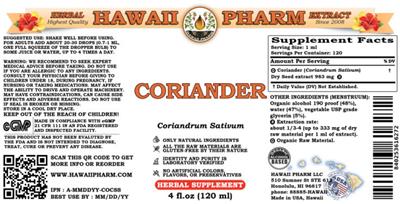
Supplement Facts
The label details for Coriander by Hawaii Pharm, sourced from the NIH Dietary Supplement Label Database.
Supplement Facts
| Ingredient | Amount | % DV |
|---|---|---|
| Coriander Seed Extract, Dry | 983 mg | -- |
Other ingredients: Alcohol, Water, Glycerin
Tap any ingredient to jump to its full detail below.
These statements are the manufacturer’s wording, reproduced from the product label — the label is saying it, not HelloPharmacist. We don’t verify or endorse them.
Brand IP Statement(s)
Hawaii Pharm Herbal Extract Highest Quality Since 2008
Suggested/Recommended/Usage/Directions
Suggested use: shake well before using. for adults add about 20-30 drops (0.7-1 ml, one full squeeze of the dropper bulb) to some juice or water, up to 4 times a day.
Precautions
Warning: We recommend to seek expert medical advice before taking. and operate machinery. May have contraindications, can cause side effects and adverse reactions. Do not use if seal is broken or missing.
Consult your physician before giving to children under 18, during pregnancy, if nursing or taking medications. Keep out of the reach of children!
Consult your physician before giving to children under 18, during pregnancy, if nursing or taking medications.
Do not use if you are allergic to any ingredients.
Storage
Store in a cool dry place.
Seals/Symbols
CGMP Made in compliance with cGMP 21 CFR 111 in an FDA registered and inspected facility.
Made in the United States of America USA
FDA Disclaimer Statement
This product has not been evaluated by the FDA and is not intended to diagnose. treat, cure or prevent any disease.
General Statements
Scan this QR code to get more info or reorder WWW.HAWAIIPHARM.COM?
Extraction rate: about 1/3-4 (up to 333 mg of dry raw material per 1 ml of extract).
Formula
Coriandrum sativum Only natural ingredients
Organic alcohol based
Formulation
All the raw materials are gluten-free by their nature No artificial colors, flavors, or preservatives
Identity and purity is laboratory verified
Made in USA, Hawaii
Organic alcohol based
FDA Statement of Identity
Herbal Supplement
Is this label outdated? Report a formula or label change and our pharmacy team will review it.
Coriander by Hawaii Pharm label
The label scan from the NIH Dietary Supplement Label Database. Tap to enlarge.
Label images are published by the NIH Dietary Supplement Label Database for the version of this product on file. Always read your actual product label.
View the full label (PDF)The Ingredients in Coriander by Hawaii Pharm
This is the 1 active ingredient this product is made of. Select it to open its full monograph.
Serving size0.7 mL Dosage formLiquid Servings per container120 Amounts shown are per serving.
Coriander Seed Extract, Dry
Interacts with717 drugs
Coriander (also called cilantro) is a common cooking herb and spice that has long been used in traditional medicine for digestive complaints. As a foo...
Coriander Seed Extract, Dry monograph & interactionsOther (inactive) ingredients: Alcohol, Water, Glycerin. These complete the product’s ingredient list but are not active constituents.
Coriander by Hawaii Pharm Drug Interactions
HelloPharmacist Interaction Report
Coriander Seed Extract by Hawaii Pharm has documented interactions with four categories of medications, affecting 713 individual medications altogether.
Read the full breakdown — every affected drug type, severity by severity
The most serious concern is with drugs that lower blood sugar (antidiabetes drugs). Coriander may increase the risk of low blood sugar (hypoglycemia) when combined with them — animal research shows coriander can reduce blood glucose levels.
If you take diabetes medication, monitor your blood sugar closely; your dose might need adjusting.
You'll also want to watch for additive sedation if you take sedating medications (CNS depressants), since coriander may add to their sleepy effects. Blood pressure medications (antihypertensives) and sun-sensitizing drugs (photosensitizing drugs) both carry Moderate risk as well — coriander may lower blood pressure further or increase your skin's sensitivity to sun damage.
All of these interactions are based on animal or laboratory evidence, not human studies, but they're worth taking seriously.
Check your own medications below · Editorial policy · How we use AI
Want to check YOUR meds against Coriander?
Ask about interactions with your drugs in plain English — “Can I take it with lisinopril?” — and we find you the answer in seconds, ingredient by ingredient.
Go to the checkerIngredients driving the most interactions
Individual Drug Interactions
The ingredients in Coriander interact with 717 drugs. Click any drug to see the details.
1 of the 1 ingredient in Coriander interact with drugs. Each result below shows which ingredient is responsible. Coriander Seed Extract, Dry
Acetaminophen, Dichloralphenazone, IsomethepteneMidrin
How Acetaminophen, Dichloralphenazone, Isometheptene interacts with Coriander — through 1 ingredient. Tap an ingredient for the detail:
Coriander Seed Extract, DryCns Depressants Moderate
Interaction Summary
Theoretically, coriander might cause additive sedative effects when taken with CNS depressants.
Read the full Coriander Seed Extract, Dry + Acetaminophen, Dichloralphenazone, Isometheptene interactionAcetaminophen, Dichlorophenazone, IsometheptaneIsocom
How Acetaminophen, Dichlorophenazone, Isometheptane interacts with Coriander — through 1 ingredient. Tap an ingredient for the detail:
Coriander Seed Extract, DryCns Depressants Moderate
Interaction Summary
Theoretically, coriander might cause additive sedative effects when taken with CNS depressants.
Read the full Coriander Seed Extract, Dry + Acetaminophen, Dichlorophenazone, Isometheptane interactionAcetaminophen, DiphenhydramineTylenol PM, Tylenol PM Ex Strength
How Acetaminophen, Diphenhydramine interacts with Coriander — through 1 ingredient. Tap an ingredient for the detail:
Coriander Seed Extract, DryCns Depressants, Photosensitizing Drugs Moderate
Interaction Summary
Theoretically, coriander might cause additive sedative effects when taken with CNS depressants.
Read the full Coriander Seed Extract, Dry + Acetaminophen, Diphenhydramine interactionAcetaminophen, Diphenhydramine, PseudoephedrineChildren's Tylenol Allergy, Cold Control, Contac Night Allergy Relief
How Acetaminophen, Diphenhydramine, Pseudoephedrine interacts with Coriander — through 1 ingredient. Tap an ingredient for the detail:
Coriander Seed Extract, DryPhotosensitizing Drugs, Cns Depressants Moderate
Interaction Summary
Theoretically, coriander might increase the risk of photosensitivity when taken with photosensitizing drugs.
Read the full Coriander Seed Extract, Dry + Acetaminophen, Diphenhydramine, Pseudoephedrine interactionAcetaminophen, HydrocodoneAnexsia, Anodynos DHC, Azdone, Co-Gesic, Doucet, Lorcet +9 more
How Acetaminophen, Hydrocodone interacts with Coriander — through 1 ingredient. Tap an ingredient for the detail:
Coriander Seed Extract, DryCns Depressants Moderate
Interaction Summary
Theoretically, coriander might cause additive sedative effects when taken with CNS depressants.
Read the full Coriander Seed Extract, Dry + Acetaminophen, Hydrocodone interactionAcetaminophen, IbuprofenCombogesic
How Acetaminophen, Ibuprofen interacts with Coriander — through 1 ingredient. Tap an ingredient for the detail:
Coriander Seed Extract, DryPhotosensitizing Drugs Moderate
Interaction Summary
Theoretically, coriander might increase the risk of photosensitivity when taken with photosensitizing drugs.
Read the full Coriander Seed Extract, Dry + Acetaminophen, Ibuprofen interactionAcetaminophen, MeperidineDemerol APAP
How Acetaminophen, Meperidine interacts with Coriander — through 1 ingredient. Tap an ingredient for the detail:
Coriander Seed Extract, DryCns Depressants Moderate
Interaction Summary
Theoretically, coriander might cause additive sedative effects when taken with CNS depressants.
Read the full Coriander Seed Extract, Dry + Acetaminophen, Meperidine interactionAcetaminophen, OxycodonePercocet, Roxicet, Tylox, Xartemis XR
How Acetaminophen, Oxycodone interacts with Coriander — through 1 ingredient. Tap an ingredient for the detail:
Coriander Seed Extract, DryCns Depressants Moderate
Interaction Summary
Theoretically, coriander might cause additive sedative effects when taken with CNS depressants.
Read the full Coriander Seed Extract, Dry + Acetaminophen, Oxycodone interactionAcetaminophen, PentazocineTalacen
How Acetaminophen, Pentazocine interacts with Coriander — through 1 ingredient. Tap an ingredient for the detail:
Coriander Seed Extract, DryCns Depressants Moderate
Interaction Summary
Theoretically, coriander might cause additive sedative effects when taken with CNS depressants.
Read the full Coriander Seed Extract, Dry + Acetaminophen, Pentazocine interactionAcetaminophen, Phenylephrine, ChlorpheniramineSuper Cold Tabs
How Acetaminophen, Phenylephrine, Chlorpheniramine interacts with Coriander — through 1 ingredient. Tap an ingredient for the detail:
Coriander Seed Extract, DryPhotosensitizing Drugs Moderate
Interaction Summary
Theoretically, coriander might increase the risk of photosensitivity when taken with photosensitizing drugs.
Read the full Coriander Seed Extract, Dry + Acetaminophen, Phenylephrine, Chlorpheniramine interactionAcetaminophen, PropoxypheneDarvocet-N 100, Darvocet-N 50, E-Lor, Wygesic
How Acetaminophen, Propoxyphene interacts with Coriander — through 1 ingredient. Tap an ingredient for the detail:
Coriander Seed Extract, DryCns Depressants Moderate
Interaction Summary
Theoretically, coriander might cause additive sedative effects when taken with CNS depressants.
Read the full Coriander Seed Extract, Dry + Acetaminophen, Propoxyphene interactionAcetazolamideAk-Zol, Diamox
How Acetazolamide interacts with Coriander — through 1 ingredient. Tap an ingredient for the detail:
Coriander Seed Extract, DryCns Depressants, Antihypertensive Drugs +1 Moderate
Interaction Summary
Theoretically, coriander might cause additive sedative effects when taken with CNS depressants.
Read the full Coriander Seed Extract, Dry + Acetazolamide interactionAcetohexamideDymelor
How Acetohexamide interacts with Coriander — through 1 ingredient. Tap an ingredient for the detail:
Coriander Seed Extract, DryAntidiabetes Drugs, Photosensitizing Drugs Moderate
Interaction Summary
Theoretically, coriander might increase the risk of hypoglycemia when taken with antidiabetes drugs.
Read the full Coriander Seed Extract, Dry + Acetohexamide interactionAcitretinSoriatane
How Acitretin interacts with Coriander — through 1 ingredient. Tap an ingredient for the detail:
Coriander Seed Extract, DryPhotosensitizing Drugs Moderate
Interaction Summary
Theoretically, coriander might increase the risk of photosensitivity when taken with photosensitizing drugs.
Read the full Coriander Seed Extract, Dry + Acitretin interactionAlbiglutideTanzeum
How Albiglutide interacts with Coriander — through 1 ingredient. Tap an ingredient for the detail:
Coriander Seed Extract, DryAntidiabetes Drugs Moderate
Interaction Summary
Theoretically, coriander might increase the risk of hypoglycemia when taken with antidiabetes drugs.
Read the full Coriander Seed Extract, Dry + Albiglutide interactionAlectinib HydrochlorideAlecensa
How Alectinib Hydrochloride interacts with Coriander — through 1 ingredient. Tap an ingredient for the detail:
Coriander Seed Extract, DryPhotosensitizing Drugs Moderate
Interaction Summary
Theoretically, coriander might increase the risk of photosensitivity when taken with photosensitizing drugs.
Read the full Coriander Seed Extract, Dry + Alectinib Hydrochloride interactionAlfentanilAlfenta
How Alfentanil interacts with Coriander — through 1 ingredient. Tap an ingredient for the detail:
Coriander Seed Extract, DryCns Depressants Moderate
Interaction Summary
Theoretically, coriander might cause additive sedative effects when taken with CNS depressants.
Read the full Coriander Seed Extract, Dry + Alfentanil interactionAliskirenTekturna
How Aliskiren interacts with Coriander — through 1 ingredient. Tap an ingredient for the detail:
Coriander Seed Extract, DryAntihypertensive Drugs Moderate
Interaction Summary
Theoretically, coriander might increase the risk of hypotension when taken with antihypertensive drugs.
Read the full Coriander Seed Extract, Dry + Aliskiren interactionAlitretinoinPanretin
How Alitretinoin interacts with Coriander — through 1 ingredient. Tap an ingredient for the detail:
Coriander Seed Extract, DryPhotosensitizing Drugs Moderate
Interaction Summary
Theoretically, coriander might increase the risk of photosensitivity when taken with photosensitizing drugs.
Read the full Coriander Seed Extract, Dry + Alitretinoin interactionAlogliptinNesina
How Alogliptin interacts with Coriander — through 1 ingredient. Tap an ingredient for the detail:
Coriander Seed Extract, DryAntidiabetes Drugs Moderate
Interaction Summary
Theoretically, coriander might increase the risk of hypoglycemia when taken with antidiabetes drugs.
Read the full Coriander Seed Extract, Dry + Alogliptin interactionAlogliptin, MetforminKazano
How Alogliptin, Metformin interacts with Coriander — through 1 ingredient. Tap an ingredient for the detail:
Coriander Seed Extract, DryAntidiabetes Drugs Moderate
Interaction Summary
Theoretically, coriander might increase the risk of hypoglycemia when taken with antidiabetes drugs.
Read the full Coriander Seed Extract, Dry + Alogliptin, Metformin interactionAlogliptin, PioglitazoneOseni
How Alogliptin, Pioglitazone interacts with Coriander — through 1 ingredient. Tap an ingredient for the detail:
Coriander Seed Extract, DryAntidiabetes Drugs Moderate
Interaction Summary
Theoretically, coriander might increase the risk of hypoglycemia when taken with antidiabetes drugs.
Read the full Coriander Seed Extract, Dry + Alogliptin, Pioglitazone interactionAlprazolamNiravam, Xanax
How Alprazolam interacts with Coriander — through 1 ingredient. Tap an ingredient for the detail:
Coriander Seed Extract, DryCns Depressants Moderate
Interaction Summary
Theoretically, coriander might cause additive sedative effects when taken with CNS depressants.
Read the full Coriander Seed Extract, Dry + Alprazolam interactionAluminum Hydroxide, Aspirin, Codeine Phosphate, Magnesium HydroxideAscriptin Codeine #2
How Aluminum Hydroxide, Aspirin, Codeine Phosphate, Magnesium Hydroxide interacts with Coriander — through 1 ingredient. Tap an ingredient for the detail:
Coriander Seed Extract, DryCns Depressants Moderate
Interaction Summary
Theoretically, coriander might cause additive sedative effects when taken with CNS depressants.
Read the full Coriander Seed Extract, Dry + Aluminum Hydroxide, Aspirin, Codeine Phosphate, Magnesium Hydroxide interactionAmbrisentanLetairis, Volibris
How Ambrisentan interacts with Coriander — through 1 ingredient. Tap an ingredient for the detail:
Coriander Seed Extract, DryAntihypertensive Drugs Moderate
Interaction Summary
Theoretically, coriander might increase the risk of hypotension when taken with antihypertensive drugs.
Read the full Coriander Seed Extract, Dry + Ambrisentan interactionAmilorideAmilamont, Midamor
How Amiloride interacts with Coriander — through 1 ingredient. Tap an ingredient for the detail:
Coriander Seed Extract, DryAntihypertensive Drugs Moderate
Interaction Summary
Theoretically, coriander might increase the risk of hypotension when taken with antihypertensive drugs.
Read the full Coriander Seed Extract, Dry + Amiloride interactionAmiloride, HydrochlorothiazideAmil-Co, Amilzide, Moduret 25, Moduretic
How Amiloride, Hydrochlorothiazide interacts with Coriander — through 1 ingredient. Tap an ingredient for the detail:
Coriander Seed Extract, DryAntihypertensive Drugs, Photosensitizing Drugs Moderate
Interaction Summary
Theoretically, coriander might increase the risk of hypotension when taken with antihypertensive drugs.
Read the full Coriander Seed Extract, Dry + Amiloride, Hydrochlorothiazide interactionAminoglutethimideCytadren
How Aminoglutethimide interacts with Coriander — through 1 ingredient. Tap an ingredient for the detail:
Coriander Seed Extract, DryCns Depressants Moderate
Interaction Summary
Theoretically, coriander might cause additive sedative effects when taken with CNS depressants.
Read the full Coriander Seed Extract, Dry + Aminoglutethimide interactionAminolevulinic Acid HydrochlorideAmeluz, Gleolan
How Aminolevulinic Acid Hydrochloride interacts with Coriander — through 1 ingredient. Tap an ingredient for the detail:
Coriander Seed Extract, DryPhotosensitizing Drugs Moderate
Interaction Summary
Theoretically, coriander might increase the risk of photosensitivity when taken with photosensitizing drugs.
Read the full Coriander Seed Extract, Dry + Aminolevulinic Acid Hydrochloride interactionAminophylline, Amobarbital, EphedrineAmesec
How Aminophylline, Amobarbital, Ephedrine interacts with Coriander — through 1 ingredient. Tap an ingredient for the detail:
Coriander Seed Extract, DryCns Depressants Moderate
Interaction Summary
Theoretically, coriander might cause additive sedative effects when taken with CNS depressants.
Read the full Coriander Seed Extract, Dry + Aminophylline, Amobarbital, Ephedrine interactionEach ingredient & the kinds of drugs it affects
For each ingredient in Coriander with known interactions, here are the types of medications it can affect. Open any type for the detail — or search your exact drug in the checker above.
Coriander Seed Extract, Dry
Antidiabetes Drugs
Theoretically, coriander might increase the risk of hypoglycemia when taken with antidiabetes drugs.
Evidence from animal research suggests that coriander fruit and coriander extract can reduce blood glucose levels. Monitor blood glucose levels closely. Dose adjustments might be necessary.
Antihypertensive Drugs
Theoretically, coriander might increase the risk of hypotension when taken with antihypertensive drugs.
Evidence from animal research suggests that coriander fruit can lower blood pressure.
Cns Depressants
Theoretically, coriander might cause additive sedative effects when taken with CNS depressants.
Evidence from animal research suggests that coriander fruit extract has sedative effects.
Photosensitizing Drugs
Theoretically, coriander might increase the risk of photosensitivity when taken with photosensitizing drugs.
Evidence from in vitro research suggests that coriandrin, a constituent of coriander, has photosensitizing effects.
Brand information
Manufacturer and brand details for Coriander, from the product label.
Hawaii Pharm
See all Hawaii Pharm products- Name
- Hawaii Pharm LLC
- Street Address
- 510 Sumner St. Ste. 613
- City
- Honolulu
- State
- HI
- ZipCode
- 96817
- Phone Number
- 888-854-2924
- Web Address
- www.hawaiipharm.com
Coriander by Hawaii Pharm: Common Questions
Does Coriander by Hawaii Pharm interact with any medications?
How can one product interact with so many drugs?
Where does this information come from?
Will this coriander extract actually help with digestion or blood sugar?
Is this safe to take every day?
Can I take this if I'm pregnant or breastfeeding?
What are the side effects?
What's in this liquid besides the coriander extract?
Written and reviewed by the HelloPharmacist editorial staff. Our editorial policy
Not sure if Coriander is safe with your meds?
Our pharmacists answer your medication & supplement questions — free.
Label information is sourced from the NIH Dietary Supplement Label Database and reflects the product version on file; always read your actual product label. This page is for education only and is not a substitute for professional medical advice. Confirm with your pharmacist or doctor before combining supplements and medications.
The Full Monographs Behind Coriander’s Ingredients
Every ingredient we hold a full HelloPharmacist monograph for — uses, evidence, safety, and the complete interaction list.
Sources & How We Checked
Coriander's label data comes from the NIH Dietary Supplement Label Database; the ingredient interaction data is from the Natural Medicines database, reviewed by our pharmacists.
- NIH Dietary Supplement Label Database (DSLD) — The official product label on file for this supplement.
- Natural Medicines (Therapeutic Research Center) — Evidence-graded clinical reference behind the ingredient interaction data.
Content is written and reviewed by licensed HelloPharmacist pharmacists. See our data sources and editorial standards for how this information is built and checked.
The 12 references behind this product’s interaction data
Every citation that drives the interaction findings for this product’s ingredients, from the evidence-graded Natural Medicines (TRC Healthcare) database. Open an ingredient to browse its citations — links open the study on PubMed or the publisher’s site.
Coriander 12 references
- Brinker F. Herb Contraindications and Drug Interactions. 2nd ed. Sandy, OR: Eclectic Medical Publications, 1998.
- Swanston-Flatt SK, Day C, Bailey CJ, Flatt PR. Traditional plant treatments for diabetes. Studies in normal and streptozotocin diabetic mice. Diabetologia 1990;33:462-4. PubMed
- Gray, A. M. and Flatt, P. R. Insulin-releasing and insulin-like activity of the traditional anti-diabetic plant Coriandrum sativum (coriander). Br.J Nutr. 1999;81(3):203-209.
- Kanerva, L. and Soini, M. Occupational protein contact dermatitis from coriander. Contact Dermatitis 2001;45(6):354-355. PubMed
- Emamghoreishi, M., Khasaki, M., and Aazam, M. F. Coriandrum sativum: evaluation of its anxiolytic effect in the elevated plus-maze. J Ethnopharmacol. 1-15-2005;96(3):365-370. PubMed
- Ebo, D. G., Bridts, C. H., Mertens, M. H., and Stevens, W. J. Coriander anaphylaxis in a spice grinder with undetected occupational allergy. Acta Clin Belg. 2006;61(3):152-156. PubMed
- Eidi, M., Eidi, A., Saeidi, A., Molanaei, S., Sadeghipour, A., Bahar, M., and Bahar, K. Effect of coriander seed (Coriandrum sativum L.) ethanol extract on insulin release from pancreatic beta cells in streptozotocin-induced diabetic rats. Phytother.Res
- Jabeen, Q., Bashir, S., Lyoussi, B., and Gilani, A. H. Coriander fruit exhibits gut modulatory, blood pressure lowering and diuretic activities. J Ethnopharmacol. 2-25-2009;122(1):123-130. PubMed
- van Toorenenbergen, A. W. and Dieges, P. H. Immunoglobulin E antibodies against coriander and other spices. J Allergy Clin Immunol. 1985;76(3):477-481. PubMed
- Ashwood-Smith, M. J., Warrington, P. J., Jenkins, M., Ceska, O., and Romaniuk, P. J. Photobiological properties of a novel, naturally occurring furoisocoumarin, coriandrin. Photochem.Photobiol. 1989;50(6):745-751. PubMed
- Sastre, J., Olmo, M., Novalvos, A., Ibanez, D., and Lahoz, C. Occupational asthma due to different spices. Allergy 1996;51(2):117-120. PubMed
- Beikert FC, Anastasiadou Z, Fritzen B, Frank U, Augustin M. Topical treatment of tinea pedis using 6% coriander oil in unguentum leniens: a randomized, controlled, comparative pilot study. Dermatology. 2013;226(1):47-51. PubMed
Parts of this content are provided by the Therapeutic Research Center, LLC.
DISCLAIMER: Currently this does not check for drug-drug interactions. This is not an all-inclusive comprehensive list of potential interactions and is for informational purposes only. Not all interactions are known or well-reported in the scientific literature, and new interactions are continually being reported. Input is needed from a qualified healthcare provider including a pharmacist before starting any therapy. Application of clinical judgment is necessary.
© 2021 Therapeutic Research Center, LLC