
Bowel Cleanse by Renew Life Ingredients, Side Effects and Drug Interactions
Dietary Supplement Powder Other Combinations
UPC 6 31257 53544 3 Match it to the barcode on your bottle

Medically reviewed by Dr. Brian Staiger, PharmD, BCPS
Also reviewed by the HelloPharmacist Editorial Team
Updated Details about this page
- Label on file from the NIH Dietary Supplement Label Database, dated Mar 24, 2017.
- The interaction, evidence and safety records come from the Natural Medicines database, which we license, read against this label by our own system; the pharmacy team’s sections are written from those records.
- Dr. Brian Staiger, PharmD, BCPS, is a clinical pharmacist and pharmacotherapy specialist.
- Editorial policy Our sources
AI is used only to summarize verified clinical information, never the open internet. Our AI policy
Summary: The HelloPharmacist Team’s Take
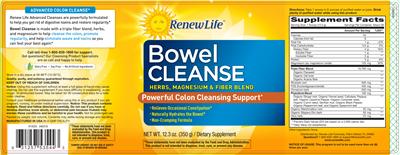
- Form
- Powder
- Serving Size
- 12.5 g
- Servings
- 28 per container
- Container Holds
- 12.3 oz.; 350 g
What’s in it, whether it interacts with your drugs, its side effects, whether it works, and what our pharmacists would want you to know before you start it.
- What is Bowel Cleanse?A supplement from Renew Life with 22 active ingredients, in powder form.
- Active Ingredients 1 mineral, 16 plant ingredients such as organic Flaxseed, Rhubarb and Cinnamon, 1 enzyme and 4 sources of fiber: Dietary Fiber 4 gMagnesium 120 mgorganic Flaxseedorganic Oat Branorganic Acacia FiberRhubarb 500 mgFos 450 mgCinnamon 250 mgorganic Gingerorganic FennelCellulasePapaya 22 active ingredients. Each one can interact with drugs or cause side effects on its own, so we check every one. And 10 more, in the Supplement Facts
- Drug Interactions 2,262 drugs have a documented interaction with this supplement; the most serious is rated major. Of those, 1,707 are single drugs and 555 are combination products (two or more drugs in one), each listed under its own name. Based on the 17 of its 22 ingredients we could check. Ask your pharmacist first if you take a drug in any of these categories, the most serious of the 60 on record:
- Levodopa/
Carbidopa (Sinemet) Major · 6 drugs - Moderate · 2,022 drugs
- Moderate · 645 drugs
- Moderate · 372 drugs
- Levodopa/
- Possible Side EffectsNausea 4 ingredientsStomach upset 4 ingredientsBurning 3 ingredientsHeartburn 3 ingredientsBloating 2 ingredientsDiarrhea 2 ingredients +23 moreReported for 14 of its 22 active ingredients. Not studied in this exact product.
- Well documented Why
Does Bowel Cleanse work?
What It Is Marketed For
Total colon cleanse
From the claims on the product’s label.
The Closest Use the Research Grades
Black Psyllium
Strong studies support it.
Its ingredients have research behind other uses too:
- Magnesium
- Magnesium
- Black Psyllium
- Rhubarb
- Ginger
- Rhubarb
These grades are for each ingredient, not this exact product, and never a promise it will work for you.
And 7 more graded uses, in what the research says- Low Why
- AllergensNone of its ingredient names point to a major food allergen
- Barcode (UPC)6 31257 53544 3Match it to the barcode on your bottle to be sure this is your product. Not your product? Search for it here
Who Might Consider It
- People looking for total colon cleanse, which is what it is marketed for. The closest use the research grades is constipation, rated Effective.
- People who want it for constipation, dyspepsia, coronary heart disease (CHD), menopausal symptoms or another graded use: the other uses with research behind them. See each grade
- This product may be of interest to adults looking for a fiber-based bowel cleanse with a range of botanical ingredients.
Who Should Be Careful
- If you take warfarin, a heart medication, diabetes medicine, or levodopa/carbidopa, or if you are pregnant or breastfeeding, be especially careful.
- Please talk it over with your own doctor or pharmacist before starting.
More Before You Take It Show both answersHide Pregnancy and Breastfeeding The Label’s Directions
-
Pregnant or breastfeeding?
- Pregnancy Black Pepper
- ! When used orally in large amounts.
- Breastfeeding Black Pepper
- When used orally in amounts commonly found in foods.
- Pregnancy and Breastfeeding Magnesium
- ! When used orally in excessive doses.
- Pregnancy and Breastfeeding Rhubarb
- ! When used in medicinal amounts, rhubarb root is a stimulant laxative; avoid using.
-
How does the label say to take it?
“May be taken for 30 consecutive days for a total colon cleanse.”
The maker’s words. Your pharmacist or doctor may advise differently.
Everything the label says
From the label dated Mar 24, 2017: 17 of its 22 active ingredients were checked against our records; the other five are not in them yet. A summary of what is known, not a grade or a test of the product. How these ratings are computed
Ask Anything About This Supplement
Name a drug you take, or ask about side effects, ingredients or pregnancy.
AI answers come from this label and our own records, never the open internet. AI can make mistakes, so always check with your doctor or pharmacist. How we use AI
Ask the Pharmacist
A licensed pharmacist will answer your question by email — free, usually within 24 hours.
Got it — thank you!
A licensed pharmacist will answer within 24 hours. Keep an eye on your email (worth checking spam, just in case).
What’s Inside Bowel Cleanse by Renew Life
22 Active Ingredients, Each Checked on Its Own
A supplement is often several ingredients in one bottle, and each one can interact with drugs or cause side effects on its own. We check every one of them against our records.
- Dietary FiberDrug interactions on record, most serious: Moderate
- MagnesiumDrug interactions on record, most serious: Major
- organic FlaxseedNot in our interaction records yet
- organic Oat BranNot in our interaction records yet
- organic Acacia FiberNot in our interaction records yet
- RhubarbDrug interactions on record, most serious: Moderate
- FosNot in our interaction records yet
- CinnamonDrug interactions on record, most serious: Moderate
And 14 more, each with its own card below.
The label gives an exact amount for 8 of its 22 active ingredients. The other 14 are inside two proprietary blends, and the label gives one total for each, not how much of each ingredient is in it.
- 8 state an exact amount
- 14 have no amount of their own
- Triple Fiber Blend 10,795 mg in total · 3 ingredients, no amount for each
- PhytoSorb Blend 100 mg in total · 11 ingredients, no amount for each
This rates what the label tells you, not the quality of the product.
Supplement Facts
| Amount Per Serving | % Daily Value | |
|---|---|---|
| Calories | 45 Calories | † |
| Calories from Fat | 9 Calories | † |
| Total Fat | 1 g | 2% |
| Total Carbohydrates | 5.5 g | 2% |
| Dietary Fiber | 4 g | 16% |
| Soluble Fiber | 1 g | † |
| Insoluble Fiber | 3 g | † |
| Protein | 3 g | 6% |
| Magnesium | 120 mg | 30% |
| Triple Fiber Blend | 10795 mg | † |
| organic Flaxseed | † | |
| organic Oat Bran | † | |
| organic Acacia Fiber | † | |
| Rhubarb | 500 mg | † |
| FOS | 450 mg | † |
| Cinnamon | 250 mg | † |
| PhytoSorb Blend | 100 mg | † |
| organic Ginger | † | |
| organic Fennel | † | |
| Cellulase | † | |
| Papaya | † | |
| organic Cayenne Pepper | † | |
| organic Coriander | † | |
| organic Cumin | † | |
| Gentian | † | |
| organic Black Pepper | † | |
| organic Peppermint | † | |
| Spearmint | † | |
| organic Marshmallow | 50 mg | † |
| organic Slippery Elm | 50 mg | † |
| Okra | 25 mg | † |
Other ingredients: None
† Daily Value not established.
Daily Values for adults and children 4 or more years of age.
As the label prints it, from the NIH Dietary Supplement Label Database.
Each Ingredient and Its Drug Interactions
Tap one for more about it and its full guide. A drug can interact with this supplement through any one of them.
Bowel Cleanse lists 23 ingredients in total.
- These include fibers such as soluble fiber, insoluble fiber, acacia fiber, oat bran, and flaxseed, along with cellulase and FOS.
- Botanical ingredients include rhubarb root, peppermint, coriander, cinnamon, gentian, slippery elm, black pepper, spearmint, fennel, ginger, papaya, cayenne, cumin, marshmallow, and okra (ambrette).
Show 1 more point
- Magnesium is a mineral ingredient, and rhubarb is used for its stimulant laxative effects.
-
Dietary Fiber 4 g Interacts with 2,025 drugs
Black psyllium is a soluble-fiber supplement made from the seeds of a Plantago plant, used mostly to ease constipation and support digestive health.
- It is best known and most studied for relieving constipation and may modestly help lower cholesterol, but it must always be taken with plenty of water.
- Talk with your pharmacist or doctor before starting, especially if you have swallowing problems or bowel disorders.
The full Black Psyllium guide: uses, dosage and safety Every Black Psyllium drug interaction
- Soluble Fiber 1 g
- Insoluble Fiber 3 g
-
Magnesium 120 mg Interacts with 298 drugs
Form on the label: Magnesium Oxide
Magnesium is an essential mineral your body needs for muscles, nerves, blood pressure, and many other functions, and supplements are useful for preventing or correcting deficiency.
- Some other uses, like easing constipation or preventing migraines, have reasonable support, while uses for sleep and anxiety are less proven.
- It is generally safe for most healthy people at recommended amounts, but talk to your pharmacist or doctor before starting, especially if you have kidney problems.
The full Magnesium guide: uses, dosage and safety Every Magnesium drug interaction
-
Triple Fiber Blend 10795 mg Three ingredients inside it, each checked on its own
- Organic Flaxseed
- Organic Oat Bran
- Organic Acacia Fiber
-
Rhubarb 500 mg Interacts with 660 drugs
Rhubarb root has a long history of use as a laxative and in traditional Chinese medicine, and its edible stalks are a common food.
- Most medicinal claims are backed by limited or low-quality evidence, and the root can cause cramping and diarrhea.
- The leaves are toxic and should never be eaten, and rhubarb supplements are best avoided in pregnancy and breastfeeding.
The full Rhubarb guide: uses, dosage and safety Every Rhubarb drug interaction
-
FOS 450 mg We know this ingredient, but hold no drug interaction record for it yet, so it was not checked
-
Cinnamon 250 mg Interacts with 444 drugs
Cassia cinnamon is the common, inexpensive cinnamon used in cooking, and it is also taken as a supplement, most often for blood sugar support.
- The evidence for its health benefits is mixed and far from proven, and because cassia is naturally high in coumarin, taking large amounts regularly may stress the liver.
- Use food amounts freely, but talk with a pharmacist or doctor before using high-dose supplements.
The full Cassia Cinnamon guide: uses, dosage and safety Every Cassia Cinnamon drug interaction
-
PhytoSorb Blend 100 mg Eleven ingredients inside it, each checked on its own
- Organic Ginger 1,008 drugs
- Organic Fennel 742 drugs
- Cellulase
- Papaya 92 drugs
- Organic Cayenne Pepper 239 drugs
- Organic Coriander 717 drugs
- Organic Cumin 211 drugs
- Gentian 172 drugs
- Organic Black Pepper 1,020 drugs
- Organic Peppermint 798 drugs
- Spearmint 581 drugs
-
Organic Marshmallow 50 mg Interacts with 2,040 drugs
Marshmallow root is a traditional herb rich in soothing, gel-like fibers called mucilage, which is why it has long been used for coughs, sore throats, and stomach irritation.
- Evidence for these uses is mostly traditional and preliminary, but it is generally considered gentle and well-tolerated for short-term use.
- As with any supplement, check with your pharmacist or doctor before using it, especially if you are pregnant, breastfeeding, or taking other medicines.
The full Marshmallow guide: uses, dosage and safety Every Marshmallow drug interaction
-
Organic Slippery Elm 50 mg Interacts with 2,022 drugs
Slippery elm is a traditional herbal remedy made from the inner bark of a North American elm tree, used mainly to soothe sore throats and irritated digestive tracts.
- Its mucilage can coat and calm mucous membranes, but solid human evidence for most uses is limited.
- It is generally considered low-risk for short-term use, but you should still check with your pharmacist or doctor first.
The full Slippery Elm guide: uses, dosage and safety Every Slippery Elm drug interaction
-
Okra 25 mg Interacts with 86 drugs
Ambrette (Abelmoschus moschatus) is a fragrant plant best known for its musky seed oil used in perfumes and food flavoring.
- It has a long history in traditional medicine for digestion, breathing problems, and skin issues, but solid human studies supporting these uses are lacking.
- If you want to try it, talk with your pharmacist or doctor first, and avoid use during pregnancy and breastfeeding.
The full Ambrette guide: uses, dosage and safety Every Ambrette drug interaction
Other Ingredients (Inactive)
The capsule or tablet itself, fillers, coatings and flavors. Not part of the drug interaction check; the allergen check below reads them.
- None
Allergens in Bowel Cleanse
None of its ingredient names point to a major food allergen.
Not named in the ingredients
- Milk
- Egg
- Fish
- Shellfish
- Tree nuts
- Peanuts
- Wheat or other gluten grains
- Soy
- Sesame
- Made without, the label says“Dairy free · Soy free · No artificial ingredients”
From the label text and ingredient names on file; we do not test products. With a serious allergy, check your bottle and ask the maker or your pharmacist.
What the Label Says
The maker’s own words, from the label. We do not verify or endorse them.
- Directions
-
“Directions: Take 1 scoop in 8 ounces of purified water or juice. Drink plenty of purified water while using this product.”
- General statements
-
“Packed by weight, not volume. Contents may settle during storage and handling.”
“Manufactured in USA in a GMP facility.”
4 more from the label
“Powerful colon cleansing support ~ Relieves occasional constipation ~ Naturally hydrates the bowel ~ Non-cramping formula”
“Advanced colon cleanse Renew Life Advanced cleanses are powerfully formulated to help you get rid of digestive toxins and restore regularity.”
“Quality, purity, and potency guaranteed through expiration.”
“90050C”
- General
-
“#15553 040316”
- FDA Statement of Identity
-
“Dietary Supplement”
- Formulation
-
“Dairy free Soy free No artificial ingredients”
“Notice: This product contains rhubarb.”
2 more from the label
“Herbs, magnesium & fiber blend”
“Bowel Cleanse is made with a triple fiber blend, herbs, and magnesium to help cleanse the colon, promote regularity, and help eliminate waste and toxins so you can feel your best again.”
- Storage
-
“Store in a dry place at 59-86 degrees F (15-30 degrees C).”
The Bowel Cleanse Label on File
The label scan on file at the NIH Dietary Supplement Label Database, dated March 2017. Always read the label on the bottle you have.
Product Facts
- Brand
- Renew Life
- Barcode (UPC)
- 631257535443
- Net contents
- 12.3 oz.; 350 g
- Market status
- On market
- Date entered into DSLD
- Mar 24, 2017
- DSLD ID
- 71888
- Product type
- Other Combinations
- Supplement form
- Powder
- Dietary claims / uses
- Nutrient, All Other, Structure/Function
- Intended target group(s)
- Adult (18 - 50 Years), Dairy Free
Is this label outdated? Report a formula or label change and our pharmacy team will review it.
Bowel Cleanse by Renew Life Side Effects
Why this rating?
We look for three kinds of safety information on each ingredient: side effects reported in studies, a pregnancy and breastfeeding rating, and a safety write-up from our pharmacy team. Of the 17 ingredients we could check, 16 have side-effect reports, all 17 have a pregnancy rating and all 17 have a safety write-up.
So this rates how much is known, not whether Bowel Cleanse is right for you.
Reported with 17 of its ingredients
- Most often
- Nausea, stomach upset, burning, heartburn, bloating and diarrhea
- !Rare but serious
- Bowel obstruction, severe allergic reaction and seizures See details
HelloPharmacist Team Summary of Side Effects
You may find that Bowel Cleanse is generally well tolerated, but it can cause stomach upset, cramping, or diarrhea, mainly from the rhubarb and magnesium.
- Heartburn is another common complaint, linked to peppermint, ginger, and spearmint, and bloating or gas may also occur.
- A rare but serious reaction is an allergic reaction, so call your doctor right away if you notice swelling, trouble breathing, or a rash.
- If you are pregnant, breastfeeding, or take medications, talk with your own doctor or pharmacist before starting.
Side Effects, Ingredient by Ingredient
A supplement’s side effects come from its ingredients. Here is what is reported with each one.
Black Psyllium
Most reported
- Gas
- Bloating
- Stomach cramps
- Feeling of fullness
Magnesium
Most reported
- Diarrhea
- Nausea
- Stomach cramping
- Bloating
Rhubarb
Most reported
- Abdominal cramping
- Diarrhea
- Stomach upset
Ginger
Most reported
- Heartburn
- Stomach discomfort
- Gas
- Burping
Fennel
Most reported
- Skin rash
- Itching
- Swelling
Papaya
Most reported
- Nausea
- Vomiting from papaya leaf extract
From the Natural Medicines database, which we license.
Every reported effect, in the Papaya guideCapsicum
Most reported
- Burning
- Stinging
- Itching
- Redness at the application site
Cumin
Most reported
- Gastrointestinal upset
From the Natural Medicines database, which we license.
Every reported effect, in the Cumin guideGentian
Most reported
- Stomach upset
- Nausea
- Headache
Black Pepper
Most reported
- Burning aftertaste
- Dyspepsia
- Reduced taste perception
From the Natural Medicines database, which we license.
Every reported effect, in the Black Pepper guidePeppermint
Most reported
- Heartburn
- Burning feeling
Spearmint
Most reported
- Stomach upset
- Worsening of heartburn
Slippery Elm
Most reported
- Nausea
- Other digestive upset
Ambrette
Most reported
- Skin irritation
- Allergic reactions
Cassia Cinnamon and Coriander have side-effect reports on file, but no list of the most common ones. Read them in each guide: Cassia Cinnamon, Coriander.
Bowel Cleanse Warnings: Who Should Be Careful
Bowel Cleanse has 22 active ingredients, and each can carry warnings of its own. We checked the 17 in our ingredient guides, and each warning below names the ingredient it comes from. organic Flaxseed, organic Oat Bran and organic Acacia Fiber and two more are not in our guides yet, so ask your pharmacist about them. If any of these apply to you, talk to your doctor or pharmacist before you start it.
- Black Psyllium3 warnings below
- Magnesium3 warnings below
- Rhubarb3 warnings below
- Cassia Cinnamon2 warnings below
- Ginger2 warnings below
- Fennel3 warnings below
- Papaya2 warnings below
- Capsicum3 warnings below
- Coriander3 warnings below
- Cumin3 warnings below
- Gentian2 warnings below
- Black Pepper2 warnings below
- Peppermint2 warnings below
- Spearmint3 warnings below
- Marshmallow3 warnings below
- Slippery Elm3 warnings below
- Ambrette2 warnings below
- organic FlaxseedNot in our guides yet
- organic Oat BranNot in our guides yet
- organic Acacia FiberNot in our guides yet
- FosNot in our guides yet
- CellulaseNot in our guides yet
-
Bleeding Problems or Surgery
- GingerUse extra caution if you have a bleeding disorder or are scheduled for surgery, since ginger may slightly affect blood clotting.
- PapayaAlways tell your pharmacist or doctor about any supplements you take, especially before surgery or if you have a medical condition.
-
Diabetes or Low Blood Sugar
- Black PsylliumPeople with diabetes should monitor their blood sugar, since fiber can affect how food and sugar are absorbed.
- Cassia CinnamonPeople with diabetes who take blood-sugar-lowering medicine should monitor their levels and check with a pharmacist before adding cinnamon supplements.
- CuminBecause some early research suggests cumin may lower blood sugar, people with diabetes should monitor their levels if using larger amounts.
- MarshmallowPeople with diabetes should be aware that some products may affect blood sugar and should monitor accordingly.
-
Blood Pressure
- GentianThose with low blood pressure or who feel faint with bitters should also be careful.
-
Liver Disease
- Cassia CinnamonPeople with liver disease should be especially careful and should talk to a healthcare provider before using cinnamon supplements.
- SpearmintPeople with acid reflux or GERD, kidney or liver problems, or hormone-sensitive conditions should talk to a pharmacist or doctor before using spearmint supplements.
-
Kidney Disease or Kidney Stones
- MagnesiumThe biggest safety concern is in people with kidney disease, because damaged kidneys cannot remove extra magnesium, which can build up to dangerous levels.
- MagnesiumIf you have kidney problems, do not take magnesium supplements unless your doctor tells you to.
- RhubarbPeople who should be cautious or avoid medicinal rhubarb include those with kidney stones (because of its oxalate content), inflammatory bowel disease, intestinal blockage, or unexplained belly pain.
-
Gallbladder Problems
- GingerPeople with gallstones should also check with a doctor, because ginger can increase the flow of bile.
- PeppermintPeople with hiatal hernia or known gallstones should talk to a healthcare provider before using peppermint supplements.
-
Heart Conditions
- MagnesiumPeople with heart conduction problems or certain bowel conditions should also be cautious.
-
Stomach or Bowel Problems
- Black PsylliumDo not use psyllium if you have trouble swallowing, a narrowing of the gut, an unexplained change in bowel habits, or a possible bowel obstruction, unless your doctor tells you to.
- CapsicumPeople with sensitive stomachs, acid reflux, ulcers, or irritable bowel symptoms may find that oral capsicum worsens their symptoms.
- Black PepperPeople with stomach ulcers, acid reflux, or gut sensitivity may find that pepper worsens irritation.
- PeppermintPeople with gastroesophageal reflux disease (GERD) or frequent heartburn may find that peppermint makes their symptoms worse, because it can relax the muscle between the stomach and esophagus.
-
Hormone-Sensitive Conditions
- FennelThose with hormone-sensitive conditions should talk to their doctor before using medicinal amounts because of fennel's possible estrogen-like effects.
-
Allergies
- FennelPeople who are allergic to plants in the carrot family (such as carrots, celery, or parsley) may also react to fennel.
- PapayaPeople who are allergic to papaya, papain, or latex (there can be cross-reactions with latex allergy) should avoid it.
- CorianderPeople who are allergic to other plants in the Apiaceae family (such as caraway, fennel, dill, or anise) may also react to coriander.
- CorianderIf you have a known plant allergy, use caution.
Show 3 more
- CuminPeople who are allergic to plants in the parsley (Apiaceae) family—such as caraway, coriander, dill, fennel, or celery—may also react to cumin.
- MarshmallowPeople with allergies to plants in the mallow family should also be cautious.
- Slippery ElmPeople with a known allergy to elm should avoid it.
-
Children
- RhubarbChildren should not use rhubarb laxatives without medical advice.
- CorianderCoriander essential oil should never be swallowed undiluted, and supplements should be kept away from children unless directed by a professional.
-
If You Take Other Drugs
- GentianAlways talk with a pharmacist or doctor before starting gentian, especially if you have a medical condition or take other medicines.
- Black PepperBecause piperine can increase absorption of medications and other supplements, anyone taking prescription drugs should talk to a pharmacist before using a piperine supplement.
- Slippery ElmAlways talk with your pharmacist or doctor before starting any herbal supplement, especially if you have a medical condition or take other medicines.
-
Other Cautions
- Black PsylliumPeople with these conditions should be especially careful.
- RhubarbEating normal amounts of cooked stalks as food is generally considered acceptable, but talk to your doctor or pharmacist if unsure.
- CapsicumAvoid getting it in your eyes, nose, mouth, or on broken or irritated skin, and wash your hands well after use.
- CapsicumUse caution if you have these conditions.
Show 6 more
- CuminConcentrated supplements, extracts, and essential oils are more potent and have less safety information, so use them with more caution.
- SpearmintConcentrated supplements, extracts, and the essential oil are stronger and have not been studied as thoroughly, so use more caution with these.
- SpearmintFood and tea amounts are probably okay, but avoid concentrated supplements and the essential oil unless cleared by your doctor.
- MarshmallowHowever, high-quality safety studies in humans are limited, so caution is wise.
- Slippery ElmBecause slippery elm is a thick fiber that swells in water, it is wise to take it with plenty of fluid to avoid choking or it sticking in the throat, especially in people with swallowing difficulties.
- AmbretteEssential oils can be irritating, and ambrette oil should not be swallowed unless a product is specifically labeled as safe for that use.
-
What the Label Warns
- “Keep out of reach of children.”
- “Notice: Using this supplement without at least a full glass of liquid may cause choking. Do not use this supplement if you have difficulty in swallowing, acute cough, or obstructed bowel.”
- “Consult your healthcare professional before using this or any product if you are pregnant, nursing, or under medical supervision.”
- “Notice: This product contains rhubarb. Read and follow directions carefully. Do not use if you have or develop diarrhea, loose stools, or abdominal pain because rhubarb may worsen these conditions and be harmful to your health. Not for prolonged use.”
- “Tamper Evident: Do not use if safety seal is broken or missing.”
- “Notice of usage: This program is not to be used more than six (6) times per year.”
The maker’s wording, from the product label.
-
Pregnant or Breastfeeding
Each ingredient’s rating for pregnancy and for breastfeeding, and what it covers.
Pregnancy
-
When used orally in amounts commonly found in foods.
-
When used orally in large amounts.
Black pepper might have abortifacient effects; contraindicated.
There is insufficient reliable information available about the safety of topical pepper when used during pregnancy.
Breastfeeding
-
When used orally in amounts commonly found in foods.
There is insufficient reliable information available about the safety of black pepper when used in medicinal amounts during breast-feeding.
Pregnancy and Breastfeeding The record rates both the same
-
When used orally and appropriately.
Magnesium is safe for those pregnant and breast-feeding when used in doses below the tolerable upper intake level (UL) of 350 mg daily.
-
When used orally in excessive doses.
Tell patients to avoid exceeding the tolerable upper intake level (UL) of 350 mg daily.
Taking magnesium orally in higher doses can cause diarrhea.
2 more ratings for Magnesium used another way
This supplement is taken by mouth. These ratings are for Magnesium given another way.
-
When prescription magnesium sulfate is given intramuscularly and intravenously prior to delivery for up to 5 days.
However, due to potential adverse effects associated with intravenous and intramuscular magnesium, use during pregnancy is limited to patients with specific conditions such as severe pre-eclampsia or eclampsia.
5 more points on this rating
- There is some evidence that intravenous magnesium can increase fetal mortality and adversely affect neurological and skeletal development.
- However, a more recent analysis of clinical research shows that increased risk of fetal mortality seems to occur only in the studies where antenatal magnesium is used for tocolysis and not for fetal neuroprotection or pre-eclampsia/eclampsia.
- Furthermore, antenatal magnesium does not seem to be associated with increased risk of necrotizing enterocolitis in preterm infants.
- There is also concern that magnesium increases the risk of maternal adverse events.
- A meta-analysis of clinical research shows that magnesium sulfate might increase the risk of maternal adverse events, especially in Hispanic mothers compared to other racial and ethnic groups.
-
When prescription magnesium sulfate is given intramuscularly and intravenously prior to delivery for longer than 5 days.
Maternal exposure to magnesium for longer than 5-7 days is associated with an increase in neonatal bone abnormalities such as osteopenia and fractures.
The U.S. Food and Drug Administration (FDA) recommends that magnesium injection not be given for longer than 5-7 days.
Show 15 more ingredients
Pregnancy and Breastfeeding The record rates both the same
-
When used in medicinal amounts, rhubarb root is a stimulant laxative; avoid using.
Pregnancy
-
When used orally.
Observational research has found that regular use of fennel during pregnancy is associated with shortened gestation.
Breastfeeding
-
When used orally.
Case reports have linked consumption of an herbal tea containing extracts of fennel, licorice, anise, and goat's rue to neurotoxicity in two breast-feeding infants.
4 more points on this rating
- The adverse effect was attributed to anethole, a constituent of fennel and anise.
- However, levels of anethole were not measured in breastmilk, and the herbal tea was not tested for contaminants.
- Furthermore, other adverse effects related to use of fennel during lactation have not been reported.
- However, until more is known, avoid using.
Pregnancy
-
When the ripe fruit is consumed in amounts commonly found in foods.
-
When the unripe fruit containing papaya latex is used orally; avoid using.
There is some concern that crude papain, a constituent of papaya latex, is teratogenic and embryotoxic; however, this might be due to extraneous substances rather than papain.
2 more points on this rating
- Some evidence also suggests that high doses of papaya seed extract have abortifacient activity and can adversely affect fetal development.
- Theoretically, eating large amounts of papaya seeds may have similar effects.
Breastfeeding
-
When the ripe fruit is consumed in amounts commonly found in foods.
There is insufficient reliable information available about the safety of using papaya medicinally; avoid using.
Pregnancy
-
When used orally and appropriately, short-term.
Capsicum 5 mg daily has been used for up to 28 days during the latter half of the second trimester and the third trimester.
1 more rating for Capsicum used another way
This supplement is taken by mouth. This rating is for Capsicum given another way.
-
When used topically and appropriately.
Breastfeeding
-
When used orally.
Dermatitis can sometimes occur in infants when foods heavily spiced with capsicum peppers are ingested during lactation.
Also, observational research suggests that intake of raw capsicum peppers during pregnancy is associated with an increased risk of sensitization to inhalant allergens in children by the age of 2 years.
1 more rating for Capsicum used another way
This supplement is taken by mouth. This rating is for Capsicum given another way.
-
When used topically and appropriately.
Pregnancy
-
When used in the amounts commonly found in foods.
-
When used orally during pregnancy in excessive amounts.
Animal research suggests that spearmint tea may cause uterine damage.
Avoid using in amounts greater than those typically found in foods during pregnancy.
Breastfeeding
-
When used in the amounts commonly found in foods.
There is insufficient reliable information available about the safety of spearmint during lactation.
Avoid using in amounts greater than those typically found in foods.
Pregnancy
-
Not enough reliable safety data; some sources caution against using it during pregnancy.
Breastfeeding
-
Insufficient reliable information available; avoid using.
Slippery elm bark has historically been inserted into the cervix to induce abortion.
2 more points on this rating
- As a result, slippery elm has been reported in some sources to have abortifacient activity.
- However, there is no reliable information available about whether slippery elm has abortifacient activity when taken orally.
Pregnancy
-
Insufficient reliable information available; avoid using.
Breastfeeding
-
When used orally or topically.
Ambrette passes into mother's milk, but the effect is unknown.
Pregnancy and Breastfeeding The record rates both the same
-
Insufficient reliable information available; avoid amounts in excess of those found in foods.
Pregnancy and Breastfeeding The record rates both the same
-
Insufficient reliable information available; avoid using in excess of food amounts.
Pregnancy and Breastfeeding The record rates both the same
-
There is insufficient reliable information available about the safety of gentian in medicinal amounts during pregnancy and lactation; avoid using.
Pregnancy and Breastfeeding The record rates both the same
-
Insufficient reliable information available.
Pregnancy and Breastfeeding The record rates both the same
-
When used orally with appropriate fluid intake.
Pregnancy and Breastfeeding The record rates both the same
-
When consumed in amounts commonly found in foods.
There is insufficient reliable information available about the safety of cassia cinnamon when used in medicinal amounts during pregnancy and breast-feeding.
Stay on the safe side and stick to food amounts.
Pregnancy
-
When consumed in the amounts typically found in foods.
Ginger is considered a first-line nonpharmacological treatment option for nausea in pregnancy by the American College of Obstetrics and Gynecology (ACOG).
However, it should not be used long-term or without medical supervision and close monitoring.
-
When used for medicinal purposes.
Despite some early reports of adverse effects and one observational study suggesting that taking dried ginger and other herbal supplements during the first 20 weeks of pregnancy marginally increased the chance of stillbirth, most research shows that ginger is unlikely to cause harm to the baby.
3 more points on this rating
- The risk for major malformations in infants of parents who took ginger when pregnant does not appear to be higher than the baseline rate of 1% to 3%.
- Also, other research suggests that ginger intake during various trimesters does not significantly affect the risk of spontaneous abortion, congenital malformations, stillbirth, perinatal death, preterm birth, low birth weight, or low Apgar scores.
- Ginger use has been associated with an increase in non-severe vaginal bleeding, including spotting, after week 17 of pregnancy.
Breastfeeding
-
When consumed in the amounts typically found in foods.
There is insufficient reliable information available about the safety of ginger when used for medicinal purposes; avoid amounts greater than those found in foods.
Pregnancy and Breastfeeding The record rates both the same
-
When used orally in amounts commonly found in foods.
There is insufficient information available about the safety of using peppermint in medicinal amounts during pregnancy or lactation; avoid using.
Our pharmacy team’s notes
- RhubarbRhubarb is rated possibly unsafe in pregnancy and breastfeeding, so it is best avoided.
Ratings and the words beside them are from the Natural Medicines database, which we license. Where it has no rating, the rating and note are our pharmacy team’s.
-
Rare but Serious Side Effects
-
!
Black Psyllium
More serious problems are rare but can happen if it is taken with too little water.
Orally: Bowel obstruction, esophageal obstruction.
-
!
Magnesium
Rare but serious side effects happen mostly with very high doses or in people with poor kidney function.
With toxic doses, loss of reflexes and respiratory depression can occur. High doses in pregnancy can increase risk of neonatal mortality and neurological defects.
-
!
Rhubarb
Serious poisoning is associated with eating the toxic leaves, not the stalks or properly used root.
Orally: Anaphylaxis.
-
!
Cassia Cinnamon
Some people may have mouth or lip irritation, an allergic reaction, or stomach upset.
-
!
Ginger
Rarely, some people may have an allergic reaction.
-
!
Fennel
Possible side effects include mild stomach upset and, rarely, allergic reactions such as skin rash, itching, or swelling.
Orally: Seizures.
-
!
Papaya
Allergic reactions can occur, ranging from itching and rash to, rarely, more serious reactions.
Orally: Severe allergic reactions.
-
!
Capsicum
Rarely, severe irritation, allergic reactions, or breathing problems from inhaling the powder can occur.
Orally: Cases of myocardial infarction and hypertensive crisis have been reported.
-
!
Coriander
Allergic reactions can occur and may include skin rash, itching, or, rarely, more serious reactions such as trouble breathing.
Orally: Anaphylaxis in sensitive individuals.
-
!
Cumin
Allergic reactions are possible, especially in people sensitive to other parsley-family plants.
Orally: Anaphylaxis in sensitive individuals.
-
!
Gentian
Allergic reactions are possible but uncommon.
-
!
Black Pepper
Orally: Allergic reaction in sensitive individuals.
-
!
Peppermint
Rarely, people may have an allergic reaction.
-
!
Spearmint
Some people may have an allergic reaction, such as a skin rash, especially with the oil.
-
!
Marshmallow
As with any plant product, allergic reactions are possible.
-
!
Slippery Elm
Because it is mostly a soothing fiber, serious problems are uncommon.
-
!
Ambrette
Possible problems include skin irritation or allergic reactions when the oil is applied to the skin, and stomach upset if seed extracts are swallowed.
When to get help: a serious allergic reaction, with trouble breathing or swelling of the face, lips or throat, needs emergency care: call 911. For any other side effect that worries you, call your doctor or pharmacist.
These reports describe each ingredient, not studies of this exact product. Not medical advice: a side effect you notice after starting a supplement is worth a word with your pharmacist or doctor.
Bowel Cleanse by Renew Life Drug Interactions
We checked all 22 active ingredients in this supplement against every drug in our records. A drug can interact with it through any one of them. Five of them are not in our interaction records yet.
A major interaction on record
3 of 3, on a scale from Minor or none to Major.Why this rating?
We rate this by the most serious interaction on record, not by how many there are. For Ambrette, Black Psyllium, Coriander, Rhubarb and Fennel, the most serious is rated major, which means the combination is best avoided, or used only under close supervision. Some involve kinds of drugs where a small change can matter, such as blood thinners, transplant drugs and diabetes drugs.
2,263 drugs are on the full list. What matters is whether one you take is on it, so check yours with the interaction checker on this page.
17 of its 22 active ingredients have drug interactions on record. The ones below matter most.
- Interacts with
- 298 drugs
- Most serious
- Major
- The most serious is a Major interaction from magnesium, which can reduce how much levodopa/carbidopa (Sinemet, a Parkinson's medication) your body absorbs.
- Interacts with
- 660 drugs
- Most serious
- Moderate
- Digoxin, a heart medication, and diuretics (water pills) can be affected by rhubarb, which may lower potassium.
- Interacts with
- 2,040 drugs
- Most serious
- Moderate
- Most of its records involve Oral Drugs, Anticoagulant/Antiplatelet Drugs and Lithium.
Show three more ingredients
- Interacts with
- 2,025 drugs
- Most serious
- Moderate
- Most of its records involve Oral Drugs, Ethinyl Estradiol and Metformin (Glucophage).
- Interacts with
- 2,022 drugs
- Most serious
- Moderate
- Most of its records involve Oral Drugs.
- Interacts with
- 1,020 drugs
- Most serious
- Moderate
- Most of its records involve Cytochrome P450 3A4 (CYP3A4) Substrates, P-glycoprotein Substrates and Cytochrome P450 2D6 (CYP2D6) Substrates.
And eleven more ingredients with records, each in the cards below.
From the HelloPharmacist Team
Here is how the interactions add up across the whole label.
- Bowel Cleanse from Renew Life can interact with medications, and the interactions come from its rhubarb, peppermint, coriander, magnesium, cinnamon, gentian, slippery elm, black pepper, spearmint, fennel, ginger, papaya, cayenne, cumin, marshmallow, and okra (ambrette) ingredients.
- Moderate interactions cover several drug types.
- Blood thinners (anticoagulants) like warfarin and phenprocoumon can be affected by ginger, rhubarb, fennel, and papaya.
Summarized by the HelloPharmacist pharmacy team from the interaction records below. How it is written How we use AI
Why Bowel Cleanse Interacts, Ingredient by Ingredient
A product interacts through its ingredients. Each card: how many drugs, the most serious rating, and the kinds of drugs it affects most (tap a kind for what it means).
The ingredients driving the most interactions
-
organic Marshmallow 2,040 drugs
Most serious: Moderate3 interaction records on file
The kinds of drugs it affects most
- 2,022 drugs
- 122 drugs
- 1 drug
Every Marshmallow drug interaction, 3 records The Marshmallow records cite 5 references, listed in the Marshmallow guide.
-
Dietary Fiber 2,025 drugs
Most serious: Moderate7 interaction records on file
The kinds of drugs it affects most
- 2,022 drugs
- Ethinyl Estradiol 33 drugs
- 20 drugs
- Carbamazepine (Tegretol) 1 drug
Every Black Psyllium drug interaction, 7 records The Black Psyllium records cite 18 references, listed in the Black Psyllium guide.
-
organic Slippery Elm 2,022 drugs
Most serious: Moderate1 interaction record on file
The kinds of drugs it affects most
- 2,022 drugs
Every Slippery Elm drug interaction, 1 record The Slippery Elm records cite 3 references, listed in the Slippery Elm guide.
-
organic Black Pepper 1,020 drugs
Most serious: Moderate17 interaction records on file
The kinds of drugs it affects most
- 645 drugs
- 202 drugs
- 193 drugs
- 186 drugs
Every Black Pepper drug interaction, 17 records The Black Pepper records cite 29 references, listed in the Black Pepper guide.
-
organic Ginger 1,008 drugs
Most serious: Moderate14 interaction records on file
The kinds of drugs it affects most
- 645 drugs
- 202 drugs
- 186 drugs
- 122 drugs
Every Ginger drug interaction, 14 records The Ginger records cite 65 references, listed in the Ginger guide.
-
organic Peppermint 798 drugs
Most serious: Moderate5 interaction records on file
The kinds of drugs it affects most
- 645 drugs
- 186 drugs
- 112 drugs
- 72 drugs
Every Peppermint drug interaction, 5 records The Peppermint records cite 41 references, listed in the Peppermint guide.
-
organic Fennel 742 drugs
Most serious: Moderate6 interaction records on file
The kinds of drugs it affects most
- 645 drugs
- 122 drugs
- 41 drugs
- 30 drugs
Every Fennel drug interaction, 6 records The Fennel records cite 17 references, listed in the Fennel guide.
-
organic Coriander 717 drugs
Most serious: Moderate4 interaction records on file
The kinds of drugs it affects most
- 335 drugs
- 248 drugs
- 172 drugs
- 86 drugs
Every Coriander drug interaction, 4 records The Coriander records cite 12 references, listed in the Coriander guide.
-
Rhubarb 660 drugs
Most serious: Moderate8 interaction records on file
The kinds of drugs it affects most
- 372 drugs
- 355 drugs
- 75 drugs
- 23 drugs
Every Rhubarb drug interaction, 8 records The Rhubarb records cite 20 references, listed in the Rhubarb guide.
-
Spearmint 581 drugs
Most serious: Moderate2 interaction records on file
The kinds of drugs it affects most
- 372 drugs
- 248 drugs
Every Spearmint drug interaction, 2 records The Spearmint records cite 20 references, listed in the Spearmint guide.
-
Cinnamon 444 drugs
Most serious: Moderate2 interaction records on file
The kinds of drugs it affects most
- 372 drugs
- 86 drugs
Every Cassia Cinnamon drug interaction, 2 records The Cassia Cinnamon records cite 20 references, listed in the Cassia Cinnamon guide.
-
Magnesium 298 drugs
Most serious: Major16 interaction records on file
The kinds of drugs it affects most
- 122 drugs
- Skeletal Muscle Relaxants 36 drugs
- 23 drugs
- 22 drugs
Every Magnesium drug interaction, 16 records The Magnesium records cite 84 references, listed in the Magnesium guide.
-
organic Cayenne Pepper 239 drugs
Most serious: Moderate6 interaction records on file
The kinds of drugs it affects most
- 122 drugs
- 86 drugs
- 35 drugs
- 23 drugs
Every Capsicum drug interaction, 6 records The Capsicum records cite 89 references, listed in the Capsicum guide.
-
organic Cumin 211 drugs
Most serious: Moderate3 interaction records on file
The kinds of drugs it affects most
- 122 drugs
- 86 drugs
- Rifampin (Rifadin) 3 drugs
Every Cumin drug interaction, 3 records The Cumin records cite 10 references, listed in the Cumin guide.
-
Gentian 172 drugs
Most serious: Moderate1 interaction record on file
The kinds of drugs it affects most
- 172 drugs
Every Gentian drug interaction, 1 record The Gentian records cite 5 references, listed in the Gentian guide.
-
Papaya 92 drugs
Most serious: Moderate4 interaction records on file
The kinds of drugs it affects most
- 86 drugs
- 3 drugs
- 2 drugs
- Amiodarone (Cordarone) 1 drug
Every Papaya drug interaction, 4 records The Papaya records cite 14 references, listed in the Papaya guide.
-
Okra 86 drugs
Most serious: Moderate1 interaction record on file
The kinds of drugs it affects most
- 86 drugs
Every Ambrette drug interaction, 1 record The Ambrette records cite 6 references, listed in the Ambrette guide.
The Breakdown by Severity
Each drug counted once, at its most serious rating. Tap a tile to list those drugs.
Find Your Drug
Type a drug or brand name to see whether it is on the list.
- Only drugs with a documented interaction are listed, the most serious first.
- A drug with no known interaction is not listed, but searching its name tells you so.
- Open a drug to see which ingredient is responsible. Of those, 1,707 are single drugs and 555 are combination products (two or more drugs in one), each listed under its own name.
-
LevodopaInbrija, Larodopa Major
The 4 ingredients responsible:
-
Magnesium Major
Magnesium can reduce the bioavailability of levodopa/carbidopa.
The full Magnesium + Levodopa interaction -
Organic Slippery Elm Moderate Levodopa is in the Oral Drugs category.
Theoretically, slippery elm may slow the absorption and reduce serum levels of oral drugs.
The full Organic Slippery Elm + Levodopa interaction -
Dietary Fiber Minor Levodopa is in the Oral Drugs category.
Theoretically, psyllium might increase, decrease, or have no effect on the absorption of oral drugs.
The full Dietary Fiber + Levodopa interaction -
Organic Marshmallow Minor Levodopa is in the Oral Drugs category.
Theoretically, mucilage in marshmallow might impair absorption of oral drugs.
The full Organic Marshmallow + Levodopa interaction
-
-
CarbidopaLodosyn Major
The 4 ingredients responsible:
-
Magnesium Major
Magnesium can reduce the bioavailability of levodopa/carbidopa.
The full Magnesium + Carbidopa interaction -
Organic Slippery Elm Moderate Carbidopa is in the Oral Drugs category.
Theoretically, slippery elm may slow the absorption and reduce serum levels of oral drugs.
The full Organic Slippery Elm + Carbidopa interaction -
Dietary Fiber Minor Carbidopa is in the Oral Drugs category.
Theoretically, psyllium might increase, decrease, or have no effect on the absorption of oral drugs.
The full Dietary Fiber + Carbidopa interaction -
Organic Marshmallow Minor Carbidopa is in the Oral Drugs category.
Theoretically, mucilage in marshmallow might impair absorption of oral drugs.
The full Organic Marshmallow + Carbidopa interaction
-
-
Carbidopa and LevodopaDhivy, Rytary, Sinemet, Sinemet CR Major
The 4 ingredients responsible:
-
Magnesium Major
Magnesium can reduce the bioavailability of levodopa/carbidopa.
The full Magnesium + Carbidopa and Levodopa interaction -
Organic Slippery Elm Moderate Carbidopa and Levodopa is in the Oral Drugs category.
Theoretically, slippery elm may slow the absorption and reduce serum levels of oral drugs.
The full Organic Slippery Elm + Carbidopa and Levodopa interaction -
Organic Marshmallow Minor Carbidopa and Levodopa is in the Oral Drugs category.
Theoretically, mucilage in marshmallow might impair absorption of oral drugs.
The full Organic Marshmallow + Carbidopa and Levodopa interaction -
Dietary Fiber Minor Carbidopa and Levodopa is in the Oral Drugs category.
Theoretically, psyllium might increase, decrease, or have no effect on the absorption of oral drugs.
The full Dietary Fiber + Carbidopa and Levodopa interaction
-
-
Benserazide and LevodopaMadopar, Prolopa Major
The 4 ingredients responsible:
-
Magnesium Major
Magnesium can reduce the bioavailability of levodopa/carbidopa.
The full Magnesium + Benserazide and Levodopa interaction -
Organic Slippery Elm Moderate Benserazide and Levodopa is in the Oral Drugs category.
Theoretically, slippery elm may slow the absorption and reduce serum levels of oral drugs.
The full Organic Slippery Elm + Benserazide and Levodopa interaction -
Dietary Fiber Minor Benserazide and Levodopa is in the Oral Drugs category.
Theoretically, psyllium might increase, decrease, or have no effect on the absorption of oral drugs.
The full Dietary Fiber + Benserazide and Levodopa interaction -
Organic Marshmallow Minor Benserazide and Levodopa is in the Oral Drugs category.
Theoretically, mucilage in marshmallow might impair absorption of oral drugs.
The full Organic Marshmallow + Benserazide and Levodopa interaction
-
-
Levodopa and CarbidopaDuodopa Major
The ingredient responsible:
-
Magnesium Major
Magnesium can reduce the bioavailability of levodopa/carbidopa.
The full Magnesium + Levodopa and Carbidopa interaction
-
-
Carbidopa, Levodopa, and EntacaponeStalevo Major
The 4 ingredients responsible:
-
Magnesium Major
Magnesium can reduce the bioavailability of levodopa/carbidopa.
The full Magnesium + Carbidopa, Levodopa, and Entacapone interaction -
Organic Slippery Elm Moderate Carbidopa, Levodopa, and Entacapone is in the Oral Drugs category.
Theoretically, slippery elm may slow the absorption and reduce serum levels of oral drugs.
The full Organic Slippery Elm + Carbidopa, Levodopa, and Entacapone interaction -
Dietary Fiber Minor Carbidopa, Levodopa, and Entacapone is in the Oral Drugs category.
Theoretically, psyllium might increase, decrease, or have no effect on the absorption of oral drugs.
The full Dietary Fiber + Carbidopa, Levodopa, and Entacapone interaction -
Organic Marshmallow Minor Carbidopa, Levodopa, and Entacapone is in the Oral Drugs category.
Theoretically, mucilage in marshmallow might impair absorption of oral drugs.
The full Organic Marshmallow + Carbidopa, Levodopa, and Entacapone interaction
-
-
ApixabanEliquis Moderate
The 10 ingredients responsible:
-
Organic Fennel Moderate Apixaban is in these Cytochrome P450 3A4 (CYP3A4) Substrates, Anticoagulant/Antiplatelet Drugs categories.
Theoretically, fennel might increase levels of drugs metabolized by CYP3A4.
The full Organic Fennel + Apixaban interaction -
Organic Ginger Moderate Apixaban is in these Cytochrome P450 3A4 (CYP3A4) Substrates, P-glycoprotein Substrates, Anticoagulant/Antiplatelet Drugs categories.
Ginger might increase or decrease the levels of CYP3A4 substrates.
The full Organic Ginger + Apixaban interaction -
Organic Slippery Elm Moderate Apixaban is in the Oral Drugs category.
Theoretically, slippery elm may slow the absorption and reduce serum levels of oral drugs.
The full Organic Slippery Elm + Apixaban interaction -
Organic Cayenne Pepper Moderate Apixaban is in the Anticoagulant/Antiplatelet Drugs category.
Theoretically, capsicum may increase the risk of bleeding if used with anticoagulant or antiplatelet drugs.
The full Organic Cayenne Pepper + Apixaban interaction -
Organic Peppermint Moderate Apixaban is in the Cytochrome P450 3A4 (CYP3A4) Substrates category.
Theoretically, peppermint might increase the levels of CYP3A4 substrates.
The full Organic Peppermint + Apixaban interaction -
Organic Cumin Moderate Apixaban is in the Anticoagulant/Antiplatelet Drugs category.
Theoretically, cumin might increase the risk of bleeding when used with antiplatelet or anticoagulant drugs.
The full Organic Cumin + Apixaban interaction -
Organic Black Pepper Moderate Apixaban is in these P-glycoprotein Substrates, Cytochrome P450 3A4 (CYP3A4) Substrates, Anticoagulant/Antiplatelet Drugs categories.
Theoretically, black pepper might increase levels of P-glycoprotein substrates.
The full Organic Black Pepper + Apixaban interaction -
Magnesium Minor Apixaban is in the Anticoagulant/Antiplatelet Drugs category.
Theoretically, magnesium may have antiplatelet effects, but the evidence is conflicting.
The full Magnesium + Apixaban interaction
And through 2 more ingredients, each with its own page:
- Dietary Fiber Minor
- Organic Marshmallow Minor
-
-
LevothyroxineEltroxin, Estre, Euthyrox, Levo-T, Levolet and 6 more Moderate
The 5 ingredients responsible:
-
Papaya Moderate
Theoretically, consuming large quantities of papaya fruit can reduce the clinical effects of levothyroxine.
The full Papaya + Levothyroxine interaction -
Organic Slippery Elm Moderate Levothyroxine is in the Oral Drugs category.
Theoretically, slippery elm may slow the absorption and reduce serum levels of oral drugs.
The full Organic Slippery Elm + Levothyroxine interaction -
Magnesium Moderate
Magnesium might decrease levothyroxine levels by reducing its absorption.
The full Magnesium + Levothyroxine interaction -
Dietary Fiber Minor Levothyroxine is in the Oral Drugs category.
Theoretically, psyllium might increase, decrease, or have no effect on the absorption of oral drugs.
The full Dietary Fiber + Levothyroxine interaction -
Organic Marshmallow Minor Levothyroxine is in the Oral Drugs category.
Theoretically, mucilage in marshmallow might impair absorption of oral drugs.
The full Organic Marshmallow + Levothyroxine interaction
-
-
WarfarinWarfarin Moderate
The 12 ingredients responsible:
-
Organic Ginger Moderate Warfarin is in these Cytochrome P450 3A4 (CYP3A4) Substrates, Cytochrome P450 2C9 (CYP2C9) Substrates, Anticoagulant/Antiplatelet Drugs and 1 more categories.
Ginger might increase or decrease the levels of CYP3A4 substrates.
The full Organic Ginger + Warfarin interaction -
Organic Slippery Elm Moderate Warfarin is in the Oral Drugs category.
Theoretically, slippery elm may slow the absorption and reduce serum levels of oral drugs.
The full Organic Slippery Elm + Warfarin interaction -
Organic Black Pepper Moderate Warfarin is in these Cytochrome P450 1A2 (CYP1A2) Substrates, Anticoagulant/Antiplatelet Drugs, Cytochrome P450 3A4 (CYP3A4) Substrates categories.
Theoretically, black pepper might decrease levels and clinical effects of drugs metabolized by CYP1A2.
The full Organic Black Pepper + Warfarin interaction -
Organic Cayenne Pepper Moderate Warfarin is in the Anticoagulant/Antiplatelet Drugs category.
Theoretically, capsicum may increase the risk of bleeding if used with anticoagulant or antiplatelet drugs.
The full Organic Cayenne Pepper + Warfarin interaction -
Papaya Moderate
Theoretically, concomitant use of warfarin with papain-containing papaya extract might increase the effects and side effects of warfarin.
The full Papaya + Warfarin interaction -
Organic Cumin Moderate Warfarin is in the Anticoagulant/Antiplatelet Drugs category.
Theoretically, cumin might increase the risk of bleeding when used with antiplatelet or anticoagulant drugs.
The full Organic Cumin + Warfarin interaction -
Organic Peppermint Moderate Warfarin is in these Cytochrome P450 2C9 (CYP2C9) Substrates, Cytochrome P450 2C19 (CYP2C19) Substrates, Cytochrome P450 1A2 (CYP1A2) Substrates and 1 more categories.
Theoretically, peppermint might increase the levels of CYP2C9 substrates.
The full Organic Peppermint + Warfarin interaction -
Rhubarb Moderate
Theoretically, excessive use of rhubarb might increase the risk of bleeding when taken with warfarin.
The full Rhubarb + Warfarin interaction
And through 4 more ingredients, each with its own page:
- Organic Fennel Moderate
- Magnesium Minor
- Organic Marshmallow Minor
- Dietary Fiber Minor
-
-
AmlodipineNorliqva Moderate
The 10 ingredients responsible:
-
Organic Ginger Moderate Amlodipine is in these Cytochrome P450 3A4 (CYP3A4) Substrates, Calcium Channel Blockers categories.
Ginger might increase or decrease the levels of CYP3A4 substrates.
The full Organic Ginger + Amlodipine interaction -
Organic Fennel Moderate Amlodipine is in the Cytochrome P450 3A4 (CYP3A4) Substrates category.
Theoretically, fennel might increase levels of drugs metabolized by CYP3A4.
The full Organic Fennel + Amlodipine interaction -
Organic Black Pepper Moderate Amlodipine is in the Cytochrome P450 3A4 (CYP3A4) Substrates category.
Theoretically, black pepper might increase levels of drugs metabolized by CYP3A4.
The full Organic Black Pepper + Amlodipine interaction -
Magnesium Moderate Amlodipine is in the Calcium Channel Blockers category.
Magnesium can have additive effects with calcium channel blockers, although evidence is conflicting.
The full Magnesium + Amlodipine interaction -
Organic Slippery Elm Moderate Amlodipine is in the Oral Drugs category.
Theoretically, slippery elm may slow the absorption and reduce serum levels of oral drugs.
The full Organic Slippery Elm + Amlodipine interaction -
Gentian Moderate Amlodipine is in the Antihypertensive Drugs category.
Theoretically, taking gentian with antihypertensive drugs might increase the risk of hypotension.
The full Gentian + Amlodipine interaction -
Organic Peppermint Moderate Amlodipine is in the Cytochrome P450 3A4 (CYP3A4) Substrates category.
Theoretically, peppermint might increase the levels of CYP3A4 substrates.
The full Organic Peppermint + Amlodipine interaction -
Organic Coriander Moderate Amlodipine is in the Antihypertensive Drugs category.
Theoretically, coriander might increase the risk of hypotension when taken with antihypertensive drugs.
The full Organic Coriander + Amlodipine interaction
And through 2 more ingredients, each with its own page:
- Organic Marshmallow Minor
- Dietary Fiber Minor
-
-
SertralineZoloft Moderate
The 8 ingredients responsible:
-
Organic Coriander Moderate Sertraline is in the Photosensitizing Drugs category.
Theoretically, coriander might increase the risk of photosensitivity when taken with photosensitizing drugs.
The full Organic Coriander + Sertraline interaction -
Organic Black Pepper Moderate Sertraline is in the Cytochrome P450 3A4 (CYP3A4) Substrates category.
Theoretically, black pepper might increase levels of drugs metabolized by CYP3A4.
The full Organic Black Pepper + Sertraline interaction -
Organic Fennel Moderate Sertraline is in the Cytochrome P450 3A4 (CYP3A4) Substrates category.
Theoretically, fennel might increase levels of drugs metabolized by CYP3A4.
The full Organic Fennel + Sertraline interaction -
Organic Ginger Moderate Sertraline is in the Cytochrome P450 3A4 (CYP3A4) Substrates category.
Ginger might increase or decrease the levels of CYP3A4 substrates.
The full Organic Ginger + Sertraline interaction -
Organic Peppermint Moderate Sertraline is in the Cytochrome P450 3A4 (CYP3A4) Substrates category.
Theoretically, peppermint might increase the levels of CYP3A4 substrates.
The full Organic Peppermint + Sertraline interaction -
Organic Slippery Elm Moderate Sertraline is in the Oral Drugs category.
Theoretically, slippery elm may slow the absorption and reduce serum levels of oral drugs.
The full Organic Slippery Elm + Sertraline interaction -
Organic Marshmallow Minor Sertraline is in the Oral Drugs category.
Theoretically, mucilage in marshmallow might impair absorption of oral drugs.
The full Organic Marshmallow + Sertraline interaction -
Dietary Fiber Minor Sertraline is in the Oral Drugs category.
Theoretically, psyllium might increase, decrease, or have no effect on the absorption of oral drugs.
The full Dietary Fiber + Sertraline interaction
-
-
ClopidogrelPlavix Moderate
The 10 ingredients responsible:
-
Organic Peppermint Moderate Clopidogrel is in these Cytochrome P450 2C9 (CYP2C9) Substrates, Cytochrome P450 3A4 (CYP3A4) Substrates, Cytochrome P450 1A2 (CYP1A2) Substrates categories.
Theoretically, peppermint might increase the levels of CYP2C9 substrates.
The full Organic Peppermint + Clopidogrel interaction -
Organic Cumin Moderate Clopidogrel is in the Anticoagulant/Antiplatelet Drugs category.
Theoretically, cumin might increase the risk of bleeding when used with antiplatelet or anticoagulant drugs.
The full Organic Cumin + Clopidogrel interaction -
Organic Ginger Moderate Clopidogrel is in these Cytochrome P450 2C9 (CYP2C9) Substrates, Cytochrome P450 3A4 (CYP3A4) Substrates, Cytochrome P450 1A2 (CYP1A2) Substrates and 1 more categories.
Theoretically, ginger might increase the levels of CYP2C9 substrates.
The full Organic Ginger + Clopidogrel interaction -
Organic Slippery Elm Moderate Clopidogrel is in the Oral Drugs category.
Theoretically, slippery elm may slow the absorption and reduce serum levels of oral drugs.
The full Organic Slippery Elm + Clopidogrel interaction -
Organic Fennel Moderate Clopidogrel is in these Cytochrome P450 3A4 (CYP3A4) Substrates, Anticoagulant/Antiplatelet Drugs categories.
Theoretically, fennel might increase levels of drugs metabolized by CYP3A4.
The full Organic Fennel + Clopidogrel interaction -
Organic Cayenne Pepper Moderate Clopidogrel is in the Anticoagulant/Antiplatelet Drugs category.
Theoretically, capsicum may increase the risk of bleeding if used with anticoagulant or antiplatelet drugs.
The full Organic Cayenne Pepper + Clopidogrel interaction -
Organic Black Pepper Moderate Clopidogrel is in these Cytochrome P450 1A2 (CYP1A2) Substrates, Cytochrome P450 3A4 (CYP3A4) Substrates, Anticoagulant/Antiplatelet Drugs categories.
Theoretically, black pepper might decrease levels and clinical effects of drugs metabolized by CYP1A2.
The full Organic Black Pepper + Clopidogrel interaction -
Dietary Fiber Minor Clopidogrel is in the Oral Drugs category.
Theoretically, psyllium might increase, decrease, or have no effect on the absorption of oral drugs.
The full Dietary Fiber + Clopidogrel interaction
And through 2 more ingredients, each with its own page:
- Magnesium Minor
- Organic Marshmallow Minor
-
-
RosuvastatinCrestor, Ezallor Moderate
The 6 ingredients responsible:
-
Spearmint Moderate Rosuvastatin is in the Hepatotoxic Drugs category.
Theoretically, high doses of spearmint might increase the risk of liver damage when taken with hepatotoxic drugs.
The full Spearmint + Rosuvastatin interaction -
Rhubarb Moderate Rosuvastatin is in the Hepatotoxic Drugs category.
Theoretically, concomitant use of rhubarb with potentially hepatotoxic drugs might increase the risk of developing liver damage.
The full Rhubarb + Rosuvastatin interaction -
Organic Slippery Elm Moderate Rosuvastatin is in the Oral Drugs category.
Theoretically, slippery elm may slow the absorption and reduce serum levels of oral drugs.
The full Organic Slippery Elm + Rosuvastatin interaction -
Cinnamon Moderate Rosuvastatin is in the Hepatotoxic Drugs category.
Theoretically, large doses of cassia cinnamon might cause additive effects when used with hepatotoxic drugs.
The full Cinnamon + Rosuvastatin interaction -
Dietary Fiber Minor Rosuvastatin is in the Oral Drugs category.
Theoretically, psyllium might increase, decrease, or have no effect on the absorption of oral drugs.
The full Dietary Fiber + Rosuvastatin interaction -
Organic Marshmallow Minor Rosuvastatin is in the Oral Drugs category.
Theoretically, mucilage in marshmallow might impair absorption of oral drugs.
The full Organic Marshmallow + Rosuvastatin interaction
-
-
EscitalopramLexapro Moderate
The 7 ingredients responsible:
-
Organic Peppermint Moderate Escitalopram is in these Cytochrome P450 2C19 (CYP2C19) Substrates, Cytochrome P450 3A4 (CYP3A4) Substrates categories.
Theoretically, peppermint might increase the levels of CYP2C19 substrates.
The full Organic Peppermint + Escitalopram interaction -
Organic Fennel Moderate Escitalopram is in the Cytochrome P450 3A4 (CYP3A4) Substrates category.
Theoretically, fennel might increase levels of drugs metabolized by CYP3A4.
The full Organic Fennel + Escitalopram interaction -
Organic Slippery Elm Moderate Escitalopram is in the Oral Drugs category.
Theoretically, slippery elm may slow the absorption and reduce serum levels of oral drugs.
The full Organic Slippery Elm + Escitalopram interaction -
Organic Black Pepper Moderate Escitalopram is in the Cytochrome P450 3A4 (CYP3A4) Substrates category.
Theoretically, black pepper might increase levels of drugs metabolized by CYP3A4.
The full Organic Black Pepper + Escitalopram interaction -
Organic Ginger Moderate Escitalopram is in the Cytochrome P450 3A4 (CYP3A4) Substrates category.
Ginger might increase or decrease the levels of CYP3A4 substrates.
The full Organic Ginger + Escitalopram interaction -
Dietary Fiber Minor Escitalopram is in the Oral Drugs category.
Theoretically, psyllium might increase, decrease, or have no effect on the absorption of oral drugs.
The full Dietary Fiber + Escitalopram interaction -
Organic Marshmallow Minor Escitalopram is in the Oral Drugs category.
Theoretically, mucilage in marshmallow might impair absorption of oral drugs.
The full Organic Marshmallow + Escitalopram interaction
-
-
AspirinAngettes 75, ASA, Asaphen, Aspirin, Caprin and 9 more Moderate
The 10 ingredients responsible:
-
Organic Cayenne Pepper Moderate Aspirin is in the Anticoagulant/Antiplatelet Drugs category.
Theoretically, capsicum may increase the risk of bleeding if used with anticoagulant or antiplatelet drugs.
The full Organic Cayenne Pepper + Aspirin interaction -
Organic Ginger Moderate Aspirin is in the Anticoagulant/Antiplatelet Drugs category.
Ginger may have antiplatelet effects and may increase the risk of bleeding if used with anticoagulant or antiplatelet drugs.
The full Organic Ginger + Aspirin interaction -
Organic Fennel Moderate Aspirin is in the Anticoagulant/Antiplatelet Drugs category.
Theoretically, fennel might increase the risk of bleeding when used with antiplatelet or anticoagulant drugs.
The full Organic Fennel + Aspirin interaction -
Rhubarb Moderate Aspirin is in the Nephrotoxic Drugs category.
Theoretically, long-term use of anthraquinones from rhubarb might increase the risk of nephrotoxicity when used with nephrotoxic drugs.
The full Rhubarb + Aspirin interaction -
Organic Slippery Elm Moderate Aspirin is in the Oral Drugs category.
Theoretically, slippery elm may slow the absorption and reduce serum levels of oral drugs.
The full Organic Slippery Elm + Aspirin interaction -
Organic Cumin Moderate Aspirin is in the Anticoagulant/Antiplatelet Drugs category.
Theoretically, cumin might increase the risk of bleeding when used with antiplatelet or anticoagulant drugs.
The full Organic Cumin + Aspirin interaction -
Organic Black Pepper Moderate Aspirin is in the Anticoagulant/Antiplatelet Drugs category.
Theoretically, black pepper might increase the risk of bleeding when taken with antiplatelet or anticoagulant drugs.
The full Organic Black Pepper + Aspirin interaction -
Organic Marshmallow Minor Aspirin is in these Oral Drugs, Anticoagulant/Antiplatelet Drugs categories.
Theoretically, mucilage in marshmallow might impair absorption of oral drugs.
The full Organic Marshmallow + Aspirin interaction
And through 2 more ingredients, each with its own page:
- Magnesium Minor
- Dietary Fiber Minor
-
-
Losartan PotassiumCozaar Moderate
The 9 ingredients responsible:
-
Organic Fennel Moderate Losartan Potassium is in the Cytochrome P450 3A4 (CYP3A4) Substrates category.
Theoretically, fennel might increase levels of drugs metabolized by CYP3A4.
The full Organic Fennel + Losartan Potassium interaction -
Organic Ginger Moderate Losartan Potassium is in these Cytochrome P450 3A4 (CYP3A4) Substrates, Cytochrome P450 2C9 (CYP2C9) Substrates categories.
Ginger might increase or decrease the levels of CYP3A4 substrates.
The full Organic Ginger + Losartan Potassium interaction -
Organic Coriander Moderate Losartan Potassium is in these Photosensitizing Drugs, Antihypertensive Drugs categories.
Theoretically, coriander might increase the risk of photosensitivity when taken with photosensitizing drugs.
The full Organic Coriander + Losartan Potassium interaction -
Organic Black Pepper Moderate Losartan Potassium is in the Cytochrome P450 3A4 (CYP3A4) Substrates category.
Theoretically, black pepper might increase levels of drugs metabolized by CYP3A4.
The full Organic Black Pepper + Losartan Potassium interaction -
Organic Peppermint Moderate Losartan Potassium is in these Cytochrome P450 3A4 (CYP3A4) Substrates, Cytochrome P450 2C9 (CYP2C9) Substrates categories.
Theoretically, peppermint might increase the levels of CYP3A4 substrates.
The full Organic Peppermint + Losartan Potassium interaction -
Gentian Moderate Losartan Potassium is in the Antihypertensive Drugs category.
Theoretically, taking gentian with antihypertensive drugs might increase the risk of hypotension.
The full Gentian + Losartan Potassium interaction -
Organic Slippery Elm Moderate Losartan Potassium is in the Oral Drugs category.
Theoretically, slippery elm may slow the absorption and reduce serum levels of oral drugs.
The full Organic Slippery Elm + Losartan Potassium interaction -
Dietary Fiber Minor Losartan Potassium is in the Oral Drugs category.
Theoretically, psyllium might increase, decrease, or have no effect on the absorption of oral drugs.
The full Dietary Fiber + Losartan Potassium interaction
And through 1 more ingredient, each with its own page:
- Organic Marshmallow Minor
-
-
AtorvastatinAtorvaliq Moderate
The 10 ingredients responsible:
-
Organic Black Pepper Moderate Atorvastatin is in the Cytochrome P450 3A4 (CYP3A4) Substrates category.
Theoretically, black pepper might increase levels of drugs metabolized by CYP3A4.
The full Organic Black Pepper + Atorvastatin interaction -
Organic Ginger Moderate Atorvastatin is in the Cytochrome P450 3A4 (CYP3A4) Substrates category.
Ginger might increase or decrease the levels of CYP3A4 substrates.
The full Organic Ginger + Atorvastatin interaction -
Spearmint Moderate Atorvastatin is in the Hepatotoxic Drugs category.
Theoretically, high doses of spearmint might increase the risk of liver damage when taken with hepatotoxic drugs.
The full Spearmint + Atorvastatin interaction -
Organic Fennel Moderate Atorvastatin is in the Cytochrome P450 3A4 (CYP3A4) Substrates category.
Theoretically, fennel might increase levels of drugs metabolized by CYP3A4.
The full Organic Fennel + Atorvastatin interaction -
Rhubarb Moderate Atorvastatin is in the Hepatotoxic Drugs category.
Theoretically, concomitant use of rhubarb with potentially hepatotoxic drugs might increase the risk of developing liver damage.
The full Rhubarb + Atorvastatin interaction -
Organic Slippery Elm Moderate Atorvastatin is in the Oral Drugs category.
Theoretically, slippery elm may slow the absorption and reduce serum levels of oral drugs.
The full Organic Slippery Elm + Atorvastatin interaction -
Cinnamon Moderate Atorvastatin is in the Hepatotoxic Drugs category.
Theoretically, large doses of cassia cinnamon might cause additive effects when used with hepatotoxic drugs.
The full Cinnamon + Atorvastatin interaction -
Organic Peppermint Moderate Atorvastatin is in the Cytochrome P450 3A4 (CYP3A4) Substrates category.
Theoretically, peppermint might increase the levels of CYP3A4 substrates.
The full Organic Peppermint + Atorvastatin interaction
And through 2 more ingredients, each with its own page:
- Organic Marshmallow Minor
- Dietary Fiber Minor
-
-
RivaroxabanXarelto Moderate
The 10 ingredients responsible:
-
Organic Ginger Moderate Rivaroxaban is in these Cytochrome P450 3A4 (CYP3A4) Substrates, P-glycoprotein Substrates, Anticoagulant/Antiplatelet Drugs categories.
Ginger might increase or decrease the levels of CYP3A4 substrates.
The full Organic Ginger + Rivaroxaban interaction -
Organic Fennel Moderate Rivaroxaban is in these Anticoagulant/Antiplatelet Drugs, Cytochrome P450 3A4 (CYP3A4) Substrates categories.
Theoretically, fennel might increase the risk of bleeding when used with antiplatelet or anticoagulant drugs.
The full Organic Fennel + Rivaroxaban interaction -
Organic Peppermint Moderate Rivaroxaban is in the Cytochrome P450 3A4 (CYP3A4) Substrates category.
Theoretically, peppermint might increase the levels of CYP3A4 substrates.
The full Organic Peppermint + Rivaroxaban interaction -
Organic Cumin Moderate Rivaroxaban is in the Anticoagulant/Antiplatelet Drugs category.
Theoretically, cumin might increase the risk of bleeding when used with antiplatelet or anticoagulant drugs.
The full Organic Cumin + Rivaroxaban interaction -
Organic Black Pepper Moderate Rivaroxaban is in these Cytochrome P450 3A4 (CYP3A4) Substrates, Anticoagulant/Antiplatelet Drugs, P-glycoprotein Substrates categories.
Theoretically, black pepper might increase levels of drugs metabolized by CYP3A4.
The full Organic Black Pepper + Rivaroxaban interaction -
Organic Cayenne Pepper Moderate Rivaroxaban is in the Anticoagulant/Antiplatelet Drugs category.
Theoretically, capsicum may increase the risk of bleeding if used with anticoagulant or antiplatelet drugs.
The full Organic Cayenne Pepper + Rivaroxaban interaction -
Organic Slippery Elm Moderate Rivaroxaban is in the Oral Drugs category.
Theoretically, slippery elm may slow the absorption and reduce serum levels of oral drugs.
The full Organic Slippery Elm + Rivaroxaban interaction -
Organic Marshmallow Minor Rivaroxaban is in these Oral Drugs, Anticoagulant/Antiplatelet Drugs categories.
Theoretically, mucilage in marshmallow might impair absorption of oral drugs.
The full Organic Marshmallow + Rivaroxaban interaction
And through 2 more ingredients, each with its own page:
- Dietary Fiber Minor
- Magnesium Minor
-
-
MetforminGlucophage, Metformin Moderate
The 11 ingredients responsible:
-
Dietary Fiber Moderate Metformin is in the Oral Drugs category.
Theoretically, black psyllium might increase the therapeutic and adverse effects of metformin.
The full Dietary Fiber + Metformin interaction -
Organic Coriander Moderate Metformin is in the Antidiabetes Drugs category.
Theoretically, coriander might increase the risk of hypoglycemia when taken with antidiabetes drugs.
The full Organic Coriander + Metformin interaction -
Organic Black Pepper Moderate Metformin is in the Antidiabetes Drugs category.
Theoretically, black pepper might increase the risk of hypoglycemia when taken with antidiabetes drugs.
The full Organic Black Pepper + Metformin interaction -
Organic Ginger Moderate Metformin is in the Antidiabetes Drugs category.
Theoretically, taking ginger with antidiabetes drugs might increase the risk of hypoglycemia.
The full Organic Ginger + Metformin interaction -
Organic Cayenne Pepper Moderate Metformin is in the Antidiabetes Drugs category.
Theoretically, taking capsicum with antidiabetes drugs might increase the risk of hypoglycemia.
The full Organic Cayenne Pepper + Metformin interaction -
Papaya Moderate Metformin is in the Antidiabetes Drugs category.
Concomitant use of antidiabetic drugs with fermented papaya can produce additive effects.
The full Papaya + Metformin interaction -
Okra Moderate Metformin is in the Antidiabetes Drugs category.
Theoretically, concomitant use of ambrette with antidiabetes drugs might increase the risk of hypoglycemia.
The full Okra + Metformin interaction -
Cinnamon Moderate Metformin is in the Antidiabetes Drugs category.
Theoretically, cassia cinnamon may have additive effects with antidiabetes drugs.
The full Cinnamon + Metformin interaction
And through 3 more ingredients, each with its own page:
- Organic Slippery Elm Moderate
- Organic Cumin Moderate
- Organic Marshmallow Minor
-
-
Warfarin SodiumCoumadin, Panwarfin, Sofarin Moderate
The 12 ingredients responsible:
-
Organic Black Pepper Moderate Warfarin Sodium is in these Anticoagulant/Antiplatelet Drugs, Cytochrome P450 3A4 (CYP3A4) Substrates, Cytochrome P450 1A2 (CYP1A2) Substrates categories.
Theoretically, black pepper might increase the risk of bleeding when taken with antiplatelet or anticoagulant drugs.
The full Organic Black Pepper + Warfarin Sodium interaction -
Organic Ginger Moderate Warfarin Sodium is in these Cytochrome P450 2C9 (CYP2C9) Substrates, Cytochrome P450 3A4 (CYP3A4) Substrates, Cytochrome P450 1A2 (CYP1A2) Substrates and 1 more categories.
Theoretically, ginger might increase the levels of CYP2C9 substrates.
The full Organic Ginger + Warfarin Sodium interaction -
Organic Slippery Elm Moderate Warfarin Sodium is in the Oral Drugs category.
Theoretically, slippery elm may slow the absorption and reduce serum levels of oral drugs.
The full Organic Slippery Elm + Warfarin Sodium interaction -
Organic Cayenne Pepper Moderate Warfarin Sodium is in the Anticoagulant/Antiplatelet Drugs category.
Theoretically, capsicum may increase the risk of bleeding if used with anticoagulant or antiplatelet drugs.
The full Organic Cayenne Pepper + Warfarin Sodium interaction -
Organic Peppermint Moderate Warfarin Sodium is in these Cytochrome P450 2C9 (CYP2C9) Substrates, Cytochrome P450 3A4 (CYP3A4) Substrates, Cytochrome P450 1A2 (CYP1A2) Substrates and 1 more categories.
Theoretically, peppermint might increase the levels of CYP2C9 substrates.
The full Organic Peppermint + Warfarin Sodium interaction -
Papaya Moderate
Theoretically, concomitant use of warfarin with papain-containing papaya extract might increase the effects and side effects of warfarin.
The full Papaya + Warfarin Sodium interaction -
Organic Cumin Moderate Warfarin Sodium is in the Anticoagulant/Antiplatelet Drugs category.
Theoretically, cumin might increase the risk of bleeding when used with antiplatelet or anticoagulant drugs.
The full Organic Cumin + Warfarin Sodium interaction -
Organic Fennel Moderate Warfarin Sodium is in these Anticoagulant/Antiplatelet Drugs, Cytochrome P450 3A4 (CYP3A4) Substrates categories.
Theoretically, fennel might increase the risk of bleeding when used with antiplatelet or anticoagulant drugs.
The full Organic Fennel + Warfarin Sodium interaction
And through 4 more ingredients, each with its own page:
- Rhubarb Moderate
- Organic Marshmallow Minor
- Magnesium Minor
- Dietary Fiber Minor
-
-
TirzepatideMounjaro, Zepbound Moderate
The 8 ingredients responsible:
-
Organic Ginger Moderate Tirzepatide is in the Antidiabetes Drugs category.
Theoretically, taking ginger with antidiabetes drugs might increase the risk of hypoglycemia.
The full Organic Ginger + Tirzepatide interaction -
Organic Black Pepper Moderate Tirzepatide is in the Antidiabetes Drugs category.
Theoretically, black pepper might increase the risk of hypoglycemia when taken with antidiabetes drugs.
The full Organic Black Pepper + Tirzepatide interaction -
Organic Cayenne Pepper Moderate Tirzepatide is in the Antidiabetes Drugs category.
Theoretically, taking capsicum with antidiabetes drugs might increase the risk of hypoglycemia.
The full Organic Cayenne Pepper + Tirzepatide interaction -
Cinnamon Moderate Tirzepatide is in the Antidiabetes Drugs category.
Theoretically, cassia cinnamon may have additive effects with antidiabetes drugs.
The full Cinnamon + Tirzepatide interaction -
Papaya Moderate Tirzepatide is in the Antidiabetes Drugs category.
Concomitant use of antidiabetic drugs with fermented papaya can produce additive effects.
The full Papaya + Tirzepatide interaction -
Organic Cumin Moderate Tirzepatide is in the Antidiabetes Drugs category.
Theoretically, cumin might increase the risk of hypoglycemia when taken with antidiabetes drugs.
The full Organic Cumin + Tirzepatide interaction -
Okra Moderate Tirzepatide is in the Antidiabetes Drugs category.
Theoretically, concomitant use of ambrette with antidiabetes drugs might increase the risk of hypoglycemia.
The full Okra + Tirzepatide interaction -
Organic Coriander Moderate Tirzepatide is in the Antidiabetes Drugs category.
Theoretically, coriander might increase the risk of hypoglycemia when taken with antidiabetes drugs.
The full Organic Coriander + Tirzepatide interaction
-
-
MethylphenidateAptensio XR, Concerta, Cotempla XR-ODT, Jornay PM, Metadate and 8 more Moderate
The 3 ingredients responsible:
-
Organic Slippery Elm Moderate Methylphenidate is in the Oral Drugs category.
Theoretically, slippery elm may slow the absorption and reduce serum levels of oral drugs.
The full Organic Slippery Elm + Methylphenidate interaction -
Dietary Fiber Minor Methylphenidate is in the Oral Drugs category.
Theoretically, psyllium might increase, decrease, or have no effect on the absorption of oral drugs.
The full Dietary Fiber + Methylphenidate interaction -
Organic Marshmallow Minor Methylphenidate is in the Oral Drugs category.
Theoretically, mucilage in marshmallow might impair absorption of oral drugs.
The full Organic Marshmallow + Methylphenidate interaction
-
-
MetoprololLopressor, Toprol XL Moderate
The 6 ingredients responsible:
-
Organic Coriander Moderate Metoprolol is in the Antihypertensive Drugs category.
Theoretically, coriander might increase the risk of hypotension when taken with antihypertensive drugs.
The full Organic Coriander + Metoprolol interaction -
Organic Slippery Elm Moderate Metoprolol is in the Oral Drugs category.
Theoretically, slippery elm may slow the absorption and reduce serum levels of oral drugs.
The full Organic Slippery Elm + Metoprolol interaction -
Gentian Moderate Metoprolol is in the Antihypertensive Drugs category.
Theoretically, taking gentian with antihypertensive drugs might increase the risk of hypotension.
The full Gentian + Metoprolol interaction -
Organic Black Pepper Moderate Metoprolol is in the Cytochrome P450 2D6 (CYP2D6) Substrates category.
Theoretically, black pepper might increase levels of drugs metabolized by CYP2D6.
The full Organic Black Pepper + Metoprolol interaction -
Organic Marshmallow Minor Metoprolol is in the Oral Drugs category.
Theoretically, mucilage in marshmallow might impair absorption of oral drugs.
The full Organic Marshmallow + Metoprolol interaction -
Dietary Fiber Minor Metoprolol is in the Oral Drugs category.
Theoretically, psyllium might increase, decrease, or have no effect on the absorption of oral drugs.
The full Dietary Fiber + Metoprolol interaction
-
-
IbuprofenAdvil, Arthrofen, Brufen, Brufen Retard, Calodor and 15 more Moderate
The 12 ingredients responsible:
-
Rhubarb Moderate Ibuprofen is in the Nephrotoxic Drugs category.
Theoretically, long-term use of anthraquinones from rhubarb might increase the risk of nephrotoxicity when used with nephrotoxic drugs.
The full Rhubarb + Ibuprofen interaction -
Organic Coriander Moderate Ibuprofen is in the Photosensitizing Drugs category.
Theoretically, coriander might increase the risk of photosensitivity when taken with photosensitizing drugs.
The full Organic Coriander + Ibuprofen interaction -
Organic Fennel Moderate Ibuprofen is in the Anticoagulant/Antiplatelet Drugs category.
Theoretically, fennel might increase the risk of bleeding when used with antiplatelet or anticoagulant drugs.
The full Organic Fennel + Ibuprofen interaction -
Organic Slippery Elm Moderate Ibuprofen is in the Oral Drugs category.
Theoretically, slippery elm may slow the absorption and reduce serum levels of oral drugs.
The full Organic Slippery Elm + Ibuprofen interaction -
Organic Ginger Moderate Ibuprofen is in these Cytochrome P450 2C9 (CYP2C9) Substrates, Anticoagulant/Antiplatelet Drugs categories.
Theoretically, ginger might increase the levels of CYP2C9 substrates.
The full Organic Ginger + Ibuprofen interaction -
Organic Black Pepper Moderate Ibuprofen is in the Anticoagulant/Antiplatelet Drugs category.
Theoretically, black pepper might increase the risk of bleeding when taken with antiplatelet or anticoagulant drugs.
The full Organic Black Pepper + Ibuprofen interaction -
Organic Cayenne Pepper Moderate Ibuprofen is in the Anticoagulant/Antiplatelet Drugs category.
Theoretically, capsicum may increase the risk of bleeding if used with anticoagulant or antiplatelet drugs.
The full Organic Cayenne Pepper + Ibuprofen interaction -
Organic Cumin Moderate Ibuprofen is in the Anticoagulant/Antiplatelet Drugs category.
Theoretically, cumin might increase the risk of bleeding when used with antiplatelet or anticoagulant drugs.
The full Organic Cumin + Ibuprofen interaction
And through 4 more ingredients, each with its own page:
- Organic Peppermint Moderate
- Magnesium Minor
- Dietary Fiber Minor
- Organic Marshmallow Minor
-
-
SemaglutideOzempic, Rybelsus, Wegovy Moderate
The 11 ingredients responsible:
-
Organic Coriander Moderate Semaglutide is in the Antidiabetes Drugs category.
Theoretically, coriander might increase the risk of hypoglycemia when taken with antidiabetes drugs.
The full Organic Coriander + Semaglutide interaction -
Organic Slippery Elm Moderate Semaglutide is in the Oral Drugs category.
Theoretically, slippery elm may slow the absorption and reduce serum levels of oral drugs.
The full Organic Slippery Elm + Semaglutide interaction -
Cinnamon Moderate Semaglutide is in the Antidiabetes Drugs category.
Theoretically, cassia cinnamon may have additive effects with antidiabetes drugs.
The full Cinnamon + Semaglutide interaction -
Organic Cayenne Pepper Moderate Semaglutide is in the Antidiabetes Drugs category.
Theoretically, taking capsicum with antidiabetes drugs might increase the risk of hypoglycemia.
The full Organic Cayenne Pepper + Semaglutide interaction -
Organic Ginger Moderate Semaglutide is in the Antidiabetes Drugs category.
Theoretically, taking ginger with antidiabetes drugs might increase the risk of hypoglycemia.
The full Organic Ginger + Semaglutide interaction -
Organic Black Pepper Moderate Semaglutide is in the Antidiabetes Drugs category.
Theoretically, black pepper might increase the risk of hypoglycemia when taken with antidiabetes drugs.
The full Organic Black Pepper + Semaglutide interaction -
Organic Cumin Moderate Semaglutide is in the Antidiabetes Drugs category.
Theoretically, cumin might increase the risk of hypoglycemia when taken with antidiabetes drugs.
The full Organic Cumin + Semaglutide interaction -
Papaya Moderate Semaglutide is in the Antidiabetes Drugs category.
Concomitant use of antidiabetic drugs with fermented papaya can produce additive effects.
The full Papaya + Semaglutide interaction
And through 3 more ingredients, each with its own page:
- Okra Moderate
- Dietary Fiber Minor
- Organic Marshmallow Minor
-
-
IvermectinMectizan, Sklice, Soolantra, Stromectol Moderate
The 5 ingredients responsible:
-
Organic Ginger Moderate Ivermectin is in the P-glycoprotein Substrates category.
Ginger might increase the absorption and blood levels of P-glycoprotein (P-gp) substrates.
The full Organic Ginger + Ivermectin interaction -
Organic Slippery Elm Moderate Ivermectin is in the Oral Drugs category.
Theoretically, slippery elm may slow the absorption and reduce serum levels of oral drugs.
The full Organic Slippery Elm + Ivermectin interaction -
Organic Black Pepper Moderate Ivermectin is in the P-glycoprotein Substrates category.
Theoretically, black pepper might increase levels of P-glycoprotein substrates.
The full Organic Black Pepper + Ivermectin interaction -
Dietary Fiber Minor Ivermectin is in the Oral Drugs category.
Theoretically, psyllium might increase, decrease, or have no effect on the absorption of oral drugs.
The full Dietary Fiber + Ivermectin interaction -
Organic Marshmallow Minor Ivermectin is in the Oral Drugs category.
Theoretically, mucilage in marshmallow might impair absorption of oral drugs.
The full Organic Marshmallow + Ivermectin interaction
-
-
TadalafilCialis, Tadliq Moderate
The 7 ingredients responsible:
-
Organic Ginger Moderate Tadalafil is in the Cytochrome P450 3A4 (CYP3A4) Substrates category.
Ginger might increase or decrease the levels of CYP3A4 substrates.
The full Organic Ginger + Tadalafil interaction -
Organic Peppermint Moderate Tadalafil is in the Cytochrome P450 3A4 (CYP3A4) Substrates category.
Theoretically, peppermint might increase the levels of CYP3A4 substrates.
The full Organic Peppermint + Tadalafil interaction -
Organic Fennel Moderate Tadalafil is in the Cytochrome P450 3A4 (CYP3A4) Substrates category.
Theoretically, fennel might increase levels of drugs metabolized by CYP3A4.
The full Organic Fennel + Tadalafil interaction -
Organic Black Pepper Moderate Tadalafil is in the Cytochrome P450 3A4 (CYP3A4) Substrates category.
Theoretically, black pepper might increase levels of drugs metabolized by CYP3A4.
The full Organic Black Pepper + Tadalafil interaction -
Organic Slippery Elm Moderate Tadalafil is in the Oral Drugs category.
Theoretically, slippery elm may slow the absorption and reduce serum levels of oral drugs.
The full Organic Slippery Elm + Tadalafil interaction -
Dietary Fiber Minor Tadalafil is in the Oral Drugs category.
Theoretically, psyllium might increase, decrease, or have no effect on the absorption of oral drugs.
The full Dietary Fiber + Tadalafil interaction -
Organic Marshmallow Minor Tadalafil is in the Oral Drugs category.
Theoretically, mucilage in marshmallow might impair absorption of oral drugs.
The full Organic Marshmallow + Tadalafil interaction
-
-
AmoxicillinAmix, Amoram, Amoxident, Amoxil Capsules, Amoxil Injection and 4 more Moderate
The 7 ingredients responsible:
-
Organic Slippery Elm Moderate Amoxicillin is in the Oral Drugs category.
Theoretically, slippery elm may slow the absorption and reduce serum levels of oral drugs.
The full Organic Slippery Elm + Amoxicillin interaction -
Rhubarb Moderate Amoxicillin is in these Hepatotoxic Drugs, Nephrotoxic Drugs categories.
Theoretically, concomitant use of rhubarb with potentially hepatotoxic drugs might increase the risk of developing liver damage.
The full Rhubarb + Amoxicillin interaction -
Spearmint Moderate Amoxicillin is in the Hepatotoxic Drugs category.
Theoretically, high doses of spearmint might increase the risk of liver damage when taken with hepatotoxic drugs.
The full Spearmint + Amoxicillin interaction -
Cinnamon Moderate Amoxicillin is in the Hepatotoxic Drugs category.
Theoretically, large doses of cassia cinnamon might cause additive effects when used with hepatotoxic drugs.
The full Cinnamon + Amoxicillin interaction -
Organic Marshmallow Minor Amoxicillin is in the Oral Drugs category.
Theoretically, mucilage in marshmallow might impair absorption of oral drugs.
The full Organic Marshmallow + Amoxicillin interaction -
Dietary Fiber Minor Amoxicillin is in the Oral Drugs category.
Theoretically, psyllium might increase, decrease, or have no effect on the absorption of oral drugs.
The full Dietary Fiber + Amoxicillin interaction -
Organic Black Pepper Minor
Theoretically, black pepper might increase the effects and side effects of amoxicillin.
The full Organic Black Pepper + Amoxicillin interaction
-
-
TestosteroneAndrogel, Andropatch, Delatestryl, Intrinsa, Natesto and 4 more Moderate
The 7 ingredients responsible:
-
Organic Ginger Moderate Testosterone is in the Cytochrome P450 3A4 (CYP3A4) Substrates category.
Ginger might increase or decrease the levels of CYP3A4 substrates.
The full Organic Ginger + Testosterone interaction -
Organic Peppermint Moderate Testosterone is in the Cytochrome P450 3A4 (CYP3A4) Substrates category.
Theoretically, peppermint might increase the levels of CYP3A4 substrates.
The full Organic Peppermint + Testosterone interaction -
Rhubarb Moderate Testosterone is in the Hepatotoxic Drugs category.
Theoretically, concomitant use of rhubarb with potentially hepatotoxic drugs might increase the risk of developing liver damage.
The full Rhubarb + Testosterone interaction -
Organic Fennel Moderate Testosterone is in the Cytochrome P450 3A4 (CYP3A4) Substrates category.
Theoretically, fennel might increase levels of drugs metabolized by CYP3A4.
The full Organic Fennel + Testosterone interaction -
Cinnamon Moderate Testosterone is in the Hepatotoxic Drugs category.
Theoretically, large doses of cassia cinnamon might cause additive effects when used with hepatotoxic drugs.
The full Cinnamon + Testosterone interaction -
Organic Black Pepper Moderate Testosterone is in the Cytochrome P450 3A4 (CYP3A4) Substrates category.
Theoretically, black pepper might increase levels of drugs metabolized by CYP3A4.
The full Organic Black Pepper + Testosterone interaction -
Spearmint Moderate Testosterone is in the Hepatotoxic Drugs category.
Theoretically, high doses of spearmint might increase the risk of liver damage when taken with hepatotoxic drugs.
The full Spearmint + Testosterone interaction
-
-
PrednisoneCortan, Deltasone, Meticorten, Orasone, Prednicen-M and 3 more Moderate
The 8 ingredients responsible:
-
Organic Ginger Moderate Prednisone is in these P-glycoprotein Substrates, Cytochrome P450 3A4 (CYP3A4) Substrates categories.
Ginger might increase the absorption and blood levels of P-glycoprotein (P-gp) substrates.
The full Organic Ginger + Prednisone interaction -
Organic Slippery Elm Moderate Prednisone is in the Oral Drugs category.
Theoretically, slippery elm may slow the absorption and reduce serum levels of oral drugs.
The full Organic Slippery Elm + Prednisone interaction -
Organic Fennel Moderate Prednisone is in the Cytochrome P450 3A4 (CYP3A4) Substrates category.
Theoretically, fennel might increase levels of drugs metabolized by CYP3A4.
The full Organic Fennel + Prednisone interaction -
Rhubarb Moderate Prednisone is in the Corticosteroids category.
Theoretically, frequent and high doses of rhubarb might increase the risk of hypokalemia when taken with corticosteroids.
The full Rhubarb + Prednisone interaction -
Organic Peppermint Moderate Prednisone is in the Cytochrome P450 3A4 (CYP3A4) Substrates category.
Theoretically, peppermint might increase the levels of CYP3A4 substrates.
The full Organic Peppermint + Prednisone interaction -
Organic Black Pepper Moderate Prednisone is in these Cytochrome P450 3A4 (CYP3A4) Substrates, P-glycoprotein Substrates categories.
Theoretically, black pepper might increase levels of drugs metabolized by CYP3A4.
The full Organic Black Pepper + Prednisone interaction -
Organic Marshmallow Minor Prednisone is in the Oral Drugs category.
Theoretically, mucilage in marshmallow might impair absorption of oral drugs.
The full Organic Marshmallow + Prednisone interaction -
Dietary Fiber Minor Prednisone is in the Oral Drugs category.
Theoretically, psyllium might increase, decrease, or have no effect on the absorption of oral drugs.
The full Dietary Fiber + Prednisone interaction
-
Does It Work? Bowel Cleanse by Renew Life
How it rates in the research so far, then each ingredient on its own. A grade is the research so far, never an endorsement.
What It Is Marketed For
Total colon cleanse
From the claims on the product’s label.
Closest match for what it is marketed for
Black Psyllium for constipation
Strong studies support it.
One use we did not count
- Bowel preparation: it is treated by a doctor or in a hospital.
Our pharmacy team’s notes on this supplement
- Most ingredients in this product are rated insufficient reliable evidence to rate for their uses, so the evidence isn't established for many of them.
- Peppermint is rated likely effective for irritable bowel syndrome, and fennel is rated possibly effective for menstrual cramps.
The Evidence, Ingredient by Ingredient
Each card holds our notes on one ingredient, then its uses graded effective, likely effective or possibly effective.
Black Psyllium
From our Black Psyllium guide
- The strongest and most accepted use for psyllium fiber is relieving constipation.
- As a bulk-forming fiber, it adds water and bulk to the stool, which can make bowel movements easier and more regular.
Research suggests a benefit for
- Constipation (the use on its label)
- Coronary heart disease (CHD)
Magnesium
Our pharmacy team’s notes on Magnesium
- Magnesium is rated effective for constipation and dyspepsia.
Research suggests a benefit for
- Constipation and dyspepsia
- Diabetes, hypercholesterolemia, metabolic syndrome, osteoporosis and premenstrual syndrome (PMS)
Not counted here: five graded uses are for Magnesium injected or put on the skin (vasospastic angina, asthma, seizures and others), not for a product like this one. Six more are for conditions treated by a doctor or in a hospital (arrhythmia, cerebral palsy, colorectal cancer and others).
Every graded use, in the Magnesium guideRhubarb
From our Rhubarb guide
- The best-known traditional use of rhubarb root is as a laxative for short-term constipation.
- It contains natural compounds that stimulate the bowel, and this effect is well recognized, though it is not gentle and can cause cramping.
Research suggests a benefit for
- Menopausal symptoms and pancreatitis
Cassia Cinnamon
From our Cassia Cinnamon guide
- The most studied use is blood sugar support in people with type 2 diabetes or prediabetes.
- Some small studies suggest cinnamon may slightly lower fasting blood sugar, but results are inconsistent and the effect, when present, is usually modest.
No use is graded effective, likely effective or possibly effective for it yet.
Every graded use, in the Cassia Cinnamon guideGinger
From our Ginger guide
- The best-supported use of ginger is for nausea and vomiting.
- Several studies suggest it may help with motion sickness, nausea after surgery, nausea from chemotherapy (usually as an add-on to standard medicines), and morning sickness during pregnancy.
Research suggests a benefit for
- Osteoarthritis, dysmenorrhea and pregnancy-induced nausea and vomiting
Fennel
From our Fennel guide
- Fennel is most often used for digestive problems such as gas, bloating, and stomach discomfort.
- Some small studies suggest it may help relax the gut, but the overall evidence is limited and not strong enough to call it proven.
Research suggests a benefit for
- Dysmenorrhea
Papaya
From our Papaya guide
- Papaya is popular for many uses, but the strength of the scientific evidence varies a lot, and for most uses it is limited.
No use is graded effective, likely effective or possibly effective for it yet.
Every graded use, in the Papaya guideCapsicum
From our Capsicum guide
- The strongest evidence for capsicum is for topical capsaicin used for pain.
Research suggests a benefit for
- Postherpetic neuralgia
Not counted here: seven graded uses are for Capsicum injected or put on the skin (back pain, cluster headache, diabetic neuropathy and others), not for a product like this one.
Every graded use, in the Capsicum guideCoriander
From our Coriander guide
- Most of coriander's popular uses come from tradition rather than strong modern research.
- People commonly take it for digestive problems such as upset stomach, bloating, gas, and to help stimulate appetite.
No use is graded effective, likely effective or possibly effective for it yet.
Every graded use, in the Coriander guideCumin
From our Cumin guide
- People commonly use cumin for digestive complaints such as bloating, gas, and indigestion.
- This use comes mainly from tradition rather than strong clinical proof, though many find the spice soothing as part of food.
No use is graded effective, likely effective or possibly effective for it yet.
Every graded use, in the Cumin guideGentian
From our Gentian guide
- Gentian is most often used as a digestive bitter.
- People take it before meals hoping to boost appetite and reduce feelings of fullness, bloating, or indigestion.
No use is graded effective, likely effective or possibly effective for it yet.
Every graded use, in the Gentian guideBlack Pepper
From our Black Pepper guide
- People use black pepper and piperine for digestion, inflammation, coughs and congestion, and as an antioxidant.
- Much of the support for these uses comes from traditional practice plus laboratory and animal studies rather than large, high-quality human trials.
No use is graded effective, likely effective or possibly effective for it yet.
Every graded use, in the Black Pepper guidePeppermint
From our Peppermint guide
- The strongest evidence for peppermint is for irritable bowel syndrome (IBS).
- Several studies suggest that enteric-coated peppermint oil capsules can reduce belly pain, bloating, and cramping in some people.
Research suggests a benefit for
- Irritable bowel syndrome (IBS)
- Dyspepsia and endoscopy-associated adverse effects
Not counted here: three graded uses are for Peppermint injected or put on the skin (barium enema-related colonic spasm, pressure ulcers and nipple fissures), not for a product like this one. One more is for a condition treated by a doctor or in a hospital (chemotherapy-induced nausea and vomiting (CINV)).
Every graded use, in the Peppermint guideSpearmint
From our Spearmint guide
- Spearmint is popular for digestive complaints like upset stomach, gas, and nausea.
- This use is mostly based on tradition and the herb's soothing reputation rather than strong clinical proof.
No use is graded effective, likely effective or possibly effective for it yet.
Every graded use, in the Spearmint guideMarshmallow
From our Marshmallow guide
- Marshmallow is most commonly used for coughs, sore throats, and irritation of the mouth and throat.
- The idea is that its mucilage forms a soothing layer over irritated tissues.
No use is graded effective, likely effective or possibly effective for it yet.
Every graded use, in the Marshmallow guideSlippery Elm
From our Slippery Elm guide
- People most often use slippery elm for throat and digestive comfort.
- It is a common ingredient in throat lozenges, and many people feel it eases the scratchy feeling of a sore throat or cough.
No use is graded effective, likely effective or possibly effective for it yet.
Every graded use, in the Slippery Elm guideAmbrette
From our Ambrette guide
- Ambrette is used in traditional medicine for digestive upset, coughs and other respiratory problems, skin irritation, and as an insect repellent.
- It is also used in aromatherapy and as a flavoring agent.
No use is graded effective, likely effective or possibly effective for it yet.
Every graded use, in the Ambrette guideThe grades are the Natural Medicines database’s, which we license; tap a grade for what it means. They are about each ingredient, not this exact product.
About Renew Life
Manufacturer and brand details for Bowel Cleanse, from the product label.
Renew Life has 371 products in our supplement database, 301 of them on the market, with labels on file since 2011. Our database is built from the NIH’s Dietary Supplement Label Database and our pharmacy team’s own additions, so it covers the labels filed there, not every product the brand sells.
- Name
- Renew Life Formulas
- City
- Palm Harbor
- State
- FL
- ZipCode
- 34683
- Phone Number
- 1-800-830-1800
- Web Address
- www.renewlife.com
Bowel Cleanse by Renew Life: Common Questions
Does Bowel Cleanse by Renew Life interact with any drugs?
What are the side effects of Bowel Cleanse by Renew Life?
Who should be careful taking Bowel Cleanse by Renew Life?
Can Bowel Cleanse by Renew Life affect the liver?
Can Bowel Cleanse by Renew Life affect the kidneys?
Does Bowel Cleanse by Renew Life contain any common allergens?
How can Bowel Cleanse by Renew Life interact with so many drugs?
Where does the information about Bowel Cleanse by Renew Life come from?
Is Bowel Cleanse by Renew Life rated for constipation?
Can I use Bowel Cleanse by Renew Life during pregnancy?
Does peppermint in Bowel Cleanse by Renew Life help with irritable bowel syndrome?
What does ginger do in Bowel Cleanse by Renew Life?
Written and reviewed by the HelloPharmacist Editorial Team. Our editorial policy
Still Have a Question About Bowel Cleanse?
Our pharmacists answer drug and supplement questions, free, by email.
Label information is sourced from the NIH Dietary Supplement Label Database and reflects the product version on file; always read your actual product label. This page is for education only and is not a substitute for professional medical advice. Confirm with your pharmacist or doctor before combining supplements and drugs.
Who Reviews This Page
The pharmacist behind it, and how it is checked.
Dr. Brian Staiger, PharmD, BCPS
Clinical pharmacist and founder of HelloPharmacist
A licensed pharmacist for more than 13 years, he built the system behind this page: it reads the label on file, matches each active ingredient to its record in the Natural Medicines database, checks those records against every drug we cover, and our pharmacy team writes the take and the interaction summary from those records.
- 13+ Years in PharmacyRetail and clinical pharmacy, medication safety and healthcare administration.
- Board Certified (BCPS)A pharmacotherapy specialist, certified by the Board of Pharmacy Specialties.
- Herbalist TrainingCertificates in medical ethnobotany, for the herbs and supplements people take.
Where This Page Comes From
Bowel Cleanse’s label data comes from the NIH Dietary Supplement Label Database; the ingredient interaction data is from the Natural Medicines database, reviewed by our pharmacists.
- NIH Dietary Supplement Label Database (DSLD)
- The official product label on file for this supplement.
- Natural Medicines (Therapeutic Research Center)
- The evidence-graded clinical reference behind the ingredient interaction, evidence and safety records, which we license.
- HelloPharmacist Editorial Team
- Content is reviewed by the HelloPharmacist Editorial Team, the pharmacists on our staff and those we contract. See our data sources and editorial standards for how this information is built and checked.
- The Pharmacy Team’s Take and Summaries
- Generated from HelloPharmacist’s pharmacist-curated databases and editorial rules. Clinical methodology reviewed by Dr. Brian Staiger, PharmD, BCPS. Last generated Oct 30, 2026. How we use AI
- The ratings in the Quick Summary
- They summarize available label information, ingredient evidence and known drug-safety records: a summary of what is known, not a grade of the product itself. They do not verify product identity, purity, potency, contamination or manufacturing quality. How these ratings are computed
The References Behind the Interaction Records
Every citation the ingredients’ records rest on is listed in that ingredient’s guide, in context: Black Psyllium, 18 references; Magnesium, 84 references; Rhubarb, 20 references; Cassia Cinnamon, 20 references; Ginger, 65 references; Fennel, 17 references; Papaya, 14 references; Capsicum, 89 references; Coriander, 12 references; Cumin, 10 references; Gentian, 5 references; Black Pepper, 29 references; Peppermint, 41 references; Spearmint, 20 references; Marshmallow, 5 references; Slippery Elm, 3 references; Ambrette, 6 references .
Parts of this content are provided by the Therapeutic Research Center, LLC.
DISCLAIMER: Currently this does not check for drug-drug interactions. This is not an all-inclusive comprehensive list of potential interactions and is for informational purposes only. Not all interactions are known or well-reported in the scientific literature, and new interactions are continually being reported. Input is needed from a qualified healthcare provider including a pharmacist before starting any therapy. Application of clinical judgment is necessary.
© 2021 Therapeutic Research Center, LLC
Keep Exploring
- Supplement interaction checkerCheck any supplement or product against your drugs
- Drug–drug interactionsCheck two or more of your drugs against each other
- Browse drugs A to ZEvery drug we have checked against herbs and supplements
- NDC and pricing lookupFind a drug’s NDCs, packaging and costs
- Ask a pharmacistA free, personal answer from our licensed team