
David Winston's Healthy Skin Tonic Ingredients & Drug Interactions
What is this page for?
First and foremost: checking David Winston's Healthy Skin Tonic against your medications. The heart of this page is the interaction checker and the full interaction report — how this product’s ingredients may interact with prescription and over-the-counter medicines you may be taking.
Around that, we add a pharmacist’s high-level view of the product as a whole — what’s inside, the evidence for its stated use, how transparent the label is, and what safety data exists — so you can see the full picture in one place. It’s educational information from our licensed clinical databases and the clinical staff at HelloPharmacist — not medical advice — and we don’t sell or endorse products. Our editorial policy
David Winston's Healthy Skin Tonic is a dietary supplement by Herbalist & Alchemist with 5 active ingredients. Its ingredients are commonly taken for constipation, digestive support, skin conditions.Based on those ingredients, 311 medications have a known interaction with it, the most serious rated major. The ingredients most likely to interact are Horsetail herb extract, Burdock seed extract, Yellow Dock root extract. Use the checker below to test your specific medication, or read the full HelloPharmacist Interaction Report.
Check Your Meds Against David Winston's Healthy Skin Tonic by Herbalist & Alchemist
Ask about any prescription or over-the-counter medication and we check it for interactions with David Winston's Healthy Skin Tonic by Herbalist & Alchemist — and tell you which ingredient is responsible.
AI summaries are generated from our interaction database for education only — always confirm with your pharmacist. How we use AI
Ask the Pharmacist
A licensed pharmacist will answer your question by email — free, usually within 24 hours.
Got it — thank you!
A licensed pharmacist will answer within 24 hours. Keep an eye on your email (worth checking spam, just in case).
HelloPharmacist Scorecard of David Winston's Healthy Skin Tonic by Herbalist & Alchemist
Our pharmacy team’s full take, with four database checks built into the cards below — a summary of what is known, not a grade of the product itself.
What’s inside
Low disclosure
This tonic contains five active herbal extracts. Yellow dock root, sarsaparilla root, burdock seed, horsetail herb, and red alder bark are the working ingredients — each included for traditional skin support.
The product comes as a liquid and also contains distilled water, ethyl alcohol, and vegetable glycerin as inactive carriers.
Does it work?
Not established
The data we hold do not establish reliable evidence for any of these herbs and skin health. Yellow dock, sarsaparilla, burdock, and horsetail all carry ratings of insufficient evidence for their traditional uses — whether for acne, aging skin, psoriasis, or other conditions.
No effectiveness information is on file for red alder bark.
How safe is it?
Well-documented data
Yellow dock and horsetail are generally well tolerated in food amounts and short-term use, but both carry serious cautions. Yellow dock contains oxalates and acts as a laxative; raw leaves or rhizomes can cause low calcium (hypocalcemia), kidney stones, and vomiting.
Horsetail may cause abdominal distension, increased bowel movements, and nausea, and crude horsetail contains a compound that can cause thiamine deficiency with long-term use. Burdock is likely safe as a food, though rare allergic reactions and contact dermatitis have been reported.
A single case of liver injury was reported in someone taking a multi-ingredient herbal blend containing burdock, though causation is unclear. During pregnancy, yellow dock is rated possibly unsafe, and sarsaparilla, burdock, and horsetail all lack enough safety data — the facts advise against medicinal use in pregnancy.
While breastfeeding, yellow dock's laxative compounds may pass into milk and should be avoided; the same caution applies to sarsaparilla, burdock, and horsetail. No safety data exist for red alder bark in pregnancy or nursing.
Meds to double-check
Major interaction found
If you take water pills (diuretics), digoxin or other heart glycosides, blood thinners like warfarin, diabetes medications, lithium, or HIV drugs, do not start this product without checking with your doctor or pharmacist first. Yellow dock and horsetail pose the greatest number of interactions; the most serious involve low potassium and heart toxicity.
The bottom line
Scorecard at a glanceFormula with limited ingredient disclosure with no established evidence rating for its marketed use. Major medication interactions have been identified, and safety information is well characterized.
This is a traditional herbal blend with no established effectiveness in our data and several ingredients that interact with common medications — especially heart drugs, blood thinners, diabetes medicines, and lithium. If you take any prescription medication, diuretic, or have a heart condition, talk with your doctor or pharmacist before starting.
Pregnant or nursing? The safety data aren't there; check with your healthcare provider.
Educational only — not medical advice; always confirm with your pharmacist. Our editorial policy · How we use AI
Assessment coverage: 5 of 5 active ingredients matched to our full ingredient reviews (monographs). Based on the product label dated Sep 21, 2018.
This Scorecard evaluates available label information, ingredient evidence, and known medication-safety considerations. It does not independently verify product identity, purity, potency, contamination, or manufacturing quality. How these ratings are computed
General information
Key facts about David Winston's Healthy Skin Tonic, straight from the product label.
| Brand | Herbalist & Alchemist |
|---|---|
| Barcode (UPC) | 667056116552 |
| Net contents | 2 fl. Oz.; 60 mL |
| Market status | On market |
| Date entered into DSLD | Sep 21, 2018 |
| DSLD ID | 179804 |
| Product type | Botanical |
| Supplement form | Liquid |
| Dietary claims / uses | All Other, Structure/Function |
| Intended target group(s) | Adult (18 - 50 Years), Kosher |
Everything in this section is reproduced from the manufacturer’s own product label — it’s the label speaking, not HelloPharmacist. We show it so you can see exactly what the maker states; we don’t verify or endorse those statements.
Supplement Facts
The label details for David Winston's Healthy Skin Tonic by Herbalist & Alchemist, sourced from the NIH Dietary Supplement Label Database.
Supplement Facts
| Ingredient | Amount | % DV |
|---|---|---|
| Proprietary Blend | 2 mL | -- |
| Yellow Dock root extract | 0 NP | -- |
| Sarsaparilla root extract | 0 NP | -- |
| Burdock seed extract | 0 NP | -- |
| Horsetail herb extract | 0 NP | -- |
| Red Alder bark extract | 0 NP | -- |
Other ingredients: distilled Water, Ethyl Alcohol, Vegetable Glycerin
Tap any ingredient to jump to its full detail below.
These statements are the manufacturer’s wording, reproduced from the product label — the label is saying it, not HelloPharmacist. We don’t verify or endorse them.
General Statements
Promotes Healthy Skin
FDA Statement of Identity
Herbal Supplement
Suggested/Recommended/Usage/Directions
Suggested use: 30-40 drops (1.5-2 mL) in juice or water. Take 3 times per day. Shake well before using.
Precautions
Contraindications: Do not use during pregnancy or lactation.
Keep out of children's reach
FDA Disclaimer Statement
This statement has not been evaluated by the FDA. This product is not intended to diagnose, treat, cure or prevent any disease.
General
NO. HTC-2 1735TU
Seals/Symbols
OK
Formula
OK
Is this label outdated? Report a formula or label change and our pharmacy team will review it.
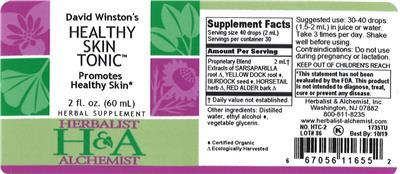
David Winston's Healthy Skin Tonic by Herbalist & Alchemist label
The label scan from the NIH Dietary Supplement Label Database. Tap to enlarge.
Label images are published by the NIH Dietary Supplement Label Database for the version of this product on file. Always read your actual product label.
View the full label (PDF)The Ingredients in David Winston's Healthy Skin Tonic by Herbalist & Alchemist
These are the 5 active ingredients this product is made of. Select any to open its full monograph.
Serving size1.5 mL Dosage formLiquid Servings per container30 Amounts shown are per serving.
Most supplement products combine several ingredients, and a medication can interact with the product through any one of them. Each ingredient below shows whether it has known drug interactions.
Proprietary Blend
Other (inactive) ingredients: Distilled Water, Ethyl Alcohol, Vegetable Glycerin. These complete the product’s ingredient list but are not active constituents.
David Winston's Healthy Skin Tonic by Herbalist & Alchemist Drug Interactions
HelloPharmacist Interaction Report
David Winston's Healthy Skin Tonic contains yellow dock, sarsaparilla, burdock, and horsetail — all of which carry documented interactions with medications.
The most serious concern is yellow dock's potential to cause low potassium (hypokalemia) when combined with water pills (diuretics), which could increase the risk of digoxin toxicity in people taking that heart medication. Altogether, these interactions span 311 individual medications.
Read the full breakdown — every affected drug type, severity by severity
Yellow dock also interacts with blood thinners like warfarin; its laxative effect may increase bleeding risk. Sarsaparilla and horsetail both have diuretic properties that could affect lithium levels and digoxin toxicity, and horsetail specifically may reduce the effectiveness of HIV medications (NRTIs like zidovudine and lamivudine, as well as efavirenz).
Burdock may increase bleeding risk when taken with blood thinners or antiplatelet drugs.
Horsetail may also increase low blood sugar (hypoglycemia) risk in people taking diabetes medications. We could not check red alder bark — no data are on file for it.
Before you start this product, search your exact medications in the tool below. If you take any diuretic, heart medication, blood thinner, diabetes drug, lithium, or HIV medication, check with your doctor or pharmacist first.
Check your own medications below · Editorial policy · How we use AI
Want to check YOUR meds against David Winston's Healthy Skin Tonic?
Ask about interactions with your drugs in plain English — “Can I take it with lisinopril?” — and we find you the answer in seconds, ingredient by ingredient.
Go to the checkerIngredients driving the most interactions
Individual Drug Interactions
The ingredients in David Winston's Healthy Skin Tonic interact with 311 drugs. Click any drug to see the details.
4 of the 5 ingredients in David Winston's Healthy Skin Tonic interact with drugs. Each result below shows which ingredient is responsible. Horsetail herb extract Burdock seed extract Yellow Dock root extract Sarsaparilla root extract
Acetaminophen, Caffeine, PyrilamineMidol Max Strength Menstrual
How Acetaminophen, Caffeine, Pyrilamine interacts with David Winston's Healthy Skin Tonic — through 2 ingredients. Tap an ingredient for the detail:
Yellow Dock Root ExtractDiuretic Drugs Major
Interaction Summary
Theoretically, yellow dock might increase the risk of hypokalemia when taken with diuretics.
Read the full Yellow Dock Root Extract + Acetaminophen, Caffeine, Pyrilamine interactionHorsetail Herb ExtractDiuretic Drugs Moderate
Interaction Summary
Theoretically, taking horsetail with diuretic drugs might increase potassium loss and the risk of hypokalemia.
Read the full Horsetail Herb Extract + Acetaminophen, Caffeine, Pyrilamine interactionAcetaminophen, Pamabrom, PyrilamineMidol Max Strength PMS, Pamprin, Pamprin ES
How Acetaminophen, Pamabrom, Pyrilamine interacts with David Winston's Healthy Skin Tonic — through 2 ingredients. Tap an ingredient for the detail:
Yellow Dock Root ExtractDiuretic Drugs Major
Interaction Summary
Theoretically, yellow dock might increase the risk of hypokalemia when taken with diuretics.
Read the full Yellow Dock Root Extract + Acetaminophen, Pamabrom, Pyrilamine interactionHorsetail Herb ExtractDiuretic Drugs Moderate
Interaction Summary
Theoretically, taking horsetail with diuretic drugs might increase potassium loss and the risk of hypokalemia.
Read the full Horsetail Herb Extract + Acetaminophen, Pamabrom, Pyrilamine interactionAcetazolamideAk-Zol, Diamox
How Acetazolamide interacts with David Winston's Healthy Skin Tonic — through 2 ingredients. Tap an ingredient for the detail:
Yellow Dock Root ExtractDiuretic Drugs Major
Interaction Summary
Theoretically, yellow dock might increase the risk of hypokalemia when taken with diuretics.
Read the full Yellow Dock Root Extract + Acetazolamide interactionHorsetail Herb ExtractDiuretic Drugs Moderate
Interaction Summary
Theoretically, taking horsetail with diuretic drugs might increase potassium loss and the risk of hypokalemia.
Read the full Horsetail Herb Extract + Acetazolamide interactionAmiloride, HydrochlorothiazideAmil-Co, Amilzide, Moduret 25, Moduretic
How Amiloride, Hydrochlorothiazide interacts with David Winston's Healthy Skin Tonic — through 2 ingredients. Tap an ingredient for the detail:
Yellow Dock Root ExtractDiuretic Drugs Major
Interaction Summary
Theoretically, yellow dock might increase the risk of hypokalemia when taken with diuretics.
Read the full Yellow Dock Root Extract + Amiloride, Hydrochlorothiazide interactionHorsetail Herb ExtractDiuretic Drugs Moderate
Interaction Summary
Theoretically, taking horsetail with diuretic drugs might increase potassium loss and the risk of hypokalemia.
Read the full Horsetail Herb Extract + Amiloride, Hydrochlorothiazide interactionAmmonium ChlorideAmmonium Chloride
How Ammonium Chloride interacts with David Winston's Healthy Skin Tonic — through 2 ingredients. Tap an ingredient for the detail:
Yellow Dock Root ExtractDiuretic Drugs Major
Interaction Summary
Theoretically, yellow dock might increase the risk of hypokalemia when taken with diuretics.
Read the full Yellow Dock Root Extract + Ammonium Chloride interactionHorsetail Herb ExtractDiuretic Drugs Moderate
Interaction Summary
Theoretically, taking horsetail with diuretic drugs might increase potassium loss and the risk of hypokalemia.
Read the full Horsetail Herb Extract + Ammonium Chloride interactionAtenolol, ChlortalidoneAtenixCo, Tenoret 50, Totaretic
How Atenolol, Chlortalidone interacts with David Winston's Healthy Skin Tonic — through 2 ingredients. Tap an ingredient for the detail:
Yellow Dock Root ExtractDiuretic Drugs Major
Interaction Summary
Theoretically, yellow dock might increase the risk of hypokalemia when taken with diuretics.
Read the full Yellow Dock Root Extract + Atenolol, Chlortalidone interactionHorsetail Herb ExtractDiuretic Drugs Moderate
Interaction Summary
Theoretically, taking horsetail with diuretic drugs might increase potassium loss and the risk of hypokalemia.
Read the full Horsetail Herb Extract + Atenolol, Chlortalidone interactionAtenolol, ChlorthalidoneTenoretic
How Atenolol, Chlorthalidone interacts with David Winston's Healthy Skin Tonic — through 2 ingredients. Tap an ingredient for the detail:
Yellow Dock Root ExtractDiuretic Drugs Major
Interaction Summary
Theoretically, yellow dock might increase the risk of hypokalemia when taken with diuretics.
Read the full Yellow Dock Root Extract + Atenolol, Chlorthalidone interactionHorsetail Herb ExtractDiuretic Drugs Moderate
Interaction Summary
Theoretically, taking horsetail with diuretic drugs might increase potassium loss and the risk of hypokalemia.
Read the full Horsetail Herb Extract + Atenolol, Chlorthalidone interactionAzilsartan, ChlorthalidoneEdarbyclor
How Azilsartan, Chlorthalidone interacts with David Winston's Healthy Skin Tonic — through 2 ingredients. Tap an ingredient for the detail:
Yellow Dock Root ExtractDiuretic Drugs Major
Interaction Summary
Theoretically, yellow dock might increase the risk of hypokalemia when taken with diuretics.
Read the full Yellow Dock Root Extract + Azilsartan, Chlorthalidone interactionHorsetail Herb ExtractDiuretic Drugs Moderate
Interaction Summary
Theoretically, taking horsetail with diuretic drugs might increase potassium loss and the risk of hypokalemia.
Read the full Horsetail Herb Extract + Azilsartan, Chlorthalidone interactionBenazepril, HydrochlorothiazideLotensin HCT
How Benazepril, Hydrochlorothiazide interacts with David Winston's Healthy Skin Tonic — through 2 ingredients. Tap an ingredient for the detail:
Yellow Dock Root ExtractDiuretic Drugs Major
Interaction Summary
Theoretically, yellow dock might increase the risk of hypokalemia when taken with diuretics.
Read the full Yellow Dock Root Extract + Benazepril, Hydrochlorothiazide interactionHorsetail Herb ExtractDiuretic Drugs Moderate
Interaction Summary
Theoretically, taking horsetail with diuretic drugs might increase potassium loss and the risk of hypokalemia.
Read the full Horsetail Herb Extract + Benazepril, Hydrochlorothiazide interactionBendroflumethiazideAprinox, Naturetin, Neo-NaClex
How Bendroflumethiazide interacts with David Winston's Healthy Skin Tonic — through 2 ingredients. Tap an ingredient for the detail:
Yellow Dock Root ExtractDiuretic Drugs Major
Interaction Summary
Theoretically, yellow dock might increase the risk of hypokalemia when taken with diuretics.
Read the full Yellow Dock Root Extract + Bendroflumethiazide interactionHorsetail Herb ExtractDiuretic Drugs Moderate
Interaction Summary
Theoretically, taking horsetail with diuretic drugs might increase potassium loss and the risk of hypokalemia.
Read the full Horsetail Herb Extract + Bendroflumethiazide interactionBendroflumethiazide, NadololCorzide
How Bendroflumethiazide, Nadolol interacts with David Winston's Healthy Skin Tonic — through 2 ingredients. Tap an ingredient for the detail:
Yellow Dock Root ExtractDiuretic Drugs Major
Interaction Summary
Theoretically, yellow dock might increase the risk of hypokalemia when taken with diuretics.
Read the full Yellow Dock Root Extract + Bendroflumethiazide, Nadolol interactionHorsetail Herb ExtractDiuretic Drugs Moderate
Interaction Summary
Theoretically, taking horsetail with diuretic drugs might increase potassium loss and the risk of hypokalemia.
Read the full Horsetail Herb Extract + Bendroflumethiazide, Nadolol interactionBendroflumethiazide, PotassiumCentyl K, Neo-NaClex-K
How Bendroflumethiazide, Potassium interacts with David Winston's Healthy Skin Tonic — through 2 ingredients. Tap an ingredient for the detail:
Yellow Dock Root ExtractDiuretic Drugs Major
Interaction Summary
Theoretically, yellow dock might increase the risk of hypokalemia when taken with diuretics.
Read the full Yellow Dock Root Extract + Bendroflumethiazide, Potassium interactionHorsetail Herb ExtractDiuretic Drugs Moderate
Interaction Summary
Theoretically, taking horsetail with diuretic drugs might increase potassium loss and the risk of hypokalemia.
Read the full Horsetail Herb Extract + Bendroflumethiazide, Potassium interactionBendroflumethiazide, Rauwolfia SerpentinaRauzide
How Bendroflumethiazide, Rauwolfia Serpentina interacts with David Winston's Healthy Skin Tonic — through 2 ingredients. Tap an ingredient for the detail:
Yellow Dock Root ExtractDiuretic Drugs Major
Interaction Summary
Theoretically, yellow dock might increase the risk of hypokalemia when taken with diuretics.
Read the full Yellow Dock Root Extract + Bendroflumethiazide, Rauwolfia Serpentina interactionHorsetail Herb ExtractDiuretic Drugs Moderate
Interaction Summary
Theoretically, taking horsetail with diuretic drugs might increase potassium loss and the risk of hypokalemia.
Read the full Horsetail Herb Extract + Bendroflumethiazide, Rauwolfia Serpentina interactionBenzthiazideExna
How Benzthiazide interacts with David Winston's Healthy Skin Tonic — through 2 ingredients. Tap an ingredient for the detail:
Yellow Dock Root ExtractDiuretic Drugs Major
Interaction Summary
Theoretically, yellow dock might increase the risk of hypokalemia when taken with diuretics.
Read the full Yellow Dock Root Extract + Benzthiazide interactionHorsetail Herb ExtractDiuretic Drugs Moderate
Interaction Summary
Theoretically, taking horsetail with diuretic drugs might increase potassium loss and the risk of hypokalemia.
Read the full Horsetail Herb Extract + Benzthiazide interactionBisoprolol, HydrochlorothiazideZiac
How Bisoprolol, Hydrochlorothiazide interacts with David Winston's Healthy Skin Tonic — through 2 ingredients. Tap an ingredient for the detail:
Yellow Dock Root ExtractDiuretic Drugs Major
Interaction Summary
Theoretically, yellow dock might increase the risk of hypokalemia when taken with diuretics.
Read the full Yellow Dock Root Extract + Bisoprolol, Hydrochlorothiazide interactionHorsetail Herb ExtractDiuretic Drugs Moderate
Interaction Summary
Theoretically, taking horsetail with diuretic drugs might increase potassium loss and the risk of hypokalemia.
Read the full Horsetail Herb Extract + Bisoprolol, Hydrochlorothiazide interactionBumetanideBurinex
How Bumetanide interacts with David Winston's Healthy Skin Tonic — through 2 ingredients. Tap an ingredient for the detail:
Yellow Dock Root ExtractDiuretic Drugs Major
Interaction Summary
Theoretically, yellow dock might increase the risk of hypokalemia when taken with diuretics.
Read the full Yellow Dock Root Extract + Bumetanide interactionHorsetail Herb ExtractDiuretic Drugs Moderate
Interaction Summary
Theoretically, taking horsetail with diuretic drugs might increase potassium loss and the risk of hypokalemia.
Read the full Horsetail Herb Extract + Bumetanide interactionBumetanide, PotassiumBurinex K
How Bumetanide, Potassium interacts with David Winston's Healthy Skin Tonic — through 2 ingredients. Tap an ingredient for the detail:
Yellow Dock Root ExtractDiuretic Drugs Major
Interaction Summary
Theoretically, yellow dock might increase the risk of hypokalemia when taken with diuretics.
Read the full Yellow Dock Root Extract + Bumetanide, Potassium interactionHorsetail Herb ExtractDiuretic Drugs Moderate
Interaction Summary
Theoretically, taking horsetail with diuretic drugs might increase potassium loss and the risk of hypokalemia.
Read the full Horsetail Herb Extract + Bumetanide, Potassium interactionCaffeine, Potassium Salicylate, SalicylamideTrim-Elim
How Caffeine, Potassium Salicylate, Salicylamide interacts with David Winston's Healthy Skin Tonic — through 2 ingredients. Tap an ingredient for the detail:
Yellow Dock Root ExtractDiuretic Drugs Major
Interaction Summary
Theoretically, yellow dock might increase the risk of hypokalemia when taken with diuretics.
Read the full Yellow Dock Root Extract + Caffeine, Potassium Salicylate, Salicylamide interactionHorsetail Herb ExtractDiuretic Drugs Moderate
Interaction Summary
Theoretically, taking horsetail with diuretic drugs might increase potassium loss and the risk of hypokalemia.
Read the full Horsetail Herb Extract + Caffeine, Potassium Salicylate, Salicylamide interactionCandesartan Cilexetil, HydrochlorothiazideAtacand HCT
How Candesartan Cilexetil, Hydrochlorothiazide interacts with David Winston's Healthy Skin Tonic — through 2 ingredients. Tap an ingredient for the detail:
Yellow Dock Root ExtractDiuretic Drugs Major
Interaction Summary
Theoretically, yellow dock might increase the risk of hypokalemia when taken with diuretics.
Read the full Yellow Dock Root Extract + Candesartan Cilexetil, Hydrochlorothiazide interactionHorsetail Herb ExtractDiuretic Drugs Moderate
Interaction Summary
Theoretically, taking horsetail with diuretic drugs might increase potassium loss and the risk of hypokalemia.
Read the full Horsetail Herb Extract + Candesartan Cilexetil, Hydrochlorothiazide interactionCaptopril, HydrochlorothiazideAcezide, Capozide
How Captopril, Hydrochlorothiazide interacts with David Winston's Healthy Skin Tonic — through 2 ingredients. Tap an ingredient for the detail:
Yellow Dock Root ExtractDiuretic Drugs Major
Interaction Summary
Theoretically, yellow dock might increase the risk of hypokalemia when taken with diuretics.
Read the full Yellow Dock Root Extract + Captopril, Hydrochlorothiazide interactionHorsetail Herb ExtractDiuretic Drugs Moderate
Interaction Summary
Theoretically, taking horsetail with diuretic drugs might increase potassium loss and the risk of hypokalemia.
Read the full Horsetail Herb Extract + Captopril, Hydrochlorothiazide interactionChlorothiazideDiuril
How Chlorothiazide interacts with David Winston's Healthy Skin Tonic — through 2 ingredients. Tap an ingredient for the detail:
Yellow Dock Root ExtractDiuretic Drugs Major
Interaction Summary
Theoretically, yellow dock might increase the risk of hypokalemia when taken with diuretics.
Read the full Yellow Dock Root Extract + Chlorothiazide interactionHorsetail Herb ExtractDiuretic Drugs Moderate
Interaction Summary
Theoretically, taking horsetail with diuretic drugs might increase potassium loss and the risk of hypokalemia.
Read the full Horsetail Herb Extract + Chlorothiazide interactionChlorothiazide, MethyldopaAldochlor, Aldoclor 150, Aldoclor 250
How Chlorothiazide, Methyldopa interacts with David Winston's Healthy Skin Tonic — through 2 ingredients. Tap an ingredient for the detail:
Yellow Dock Root ExtractDiuretic Drugs Major
Interaction Summary
Theoretically, yellow dock might increase the risk of hypokalemia when taken with diuretics.
Read the full Yellow Dock Root Extract + Chlorothiazide, Methyldopa interactionHorsetail Herb ExtractDiuretic Drugs Moderate
Interaction Summary
Theoretically, taking horsetail with diuretic drugs might increase potassium loss and the risk of hypokalemia.
Read the full Horsetail Herb Extract + Chlorothiazide, Methyldopa interactionChlorothiazide, ReserpineDiupres
How Chlorothiazide, Reserpine interacts with David Winston's Healthy Skin Tonic — through 2 ingredients. Tap an ingredient for the detail:
Yellow Dock Root ExtractDiuretic Drugs Major
Interaction Summary
Theoretically, yellow dock might increase the risk of hypokalemia when taken with diuretics.
Read the full Yellow Dock Root Extract + Chlorothiazide, Reserpine interactionHorsetail Herb ExtractDiuretic Drugs Moderate
Interaction Summary
Theoretically, taking horsetail with diuretic drugs might increase potassium loss and the risk of hypokalemia.
Read the full Horsetail Herb Extract + Chlorothiazide, Reserpine interactionChlorthalidoneHygroton, Thalitone
How Chlorthalidone interacts with David Winston's Healthy Skin Tonic — through 2 ingredients. Tap an ingredient for the detail:
Yellow Dock Root ExtractDiuretic Drugs Major
Interaction Summary
Theoretically, yellow dock might increase the risk of hypokalemia when taken with diuretics.
Read the full Yellow Dock Root Extract + Chlorthalidone interactionHorsetail Herb ExtractDiuretic Drugs Moderate
Interaction Summary
Theoretically, taking horsetail with diuretic drugs might increase potassium loss and the risk of hypokalemia.
Read the full Horsetail Herb Extract + Chlorthalidone interactionChlorthalidone, ClonidineClorpres, Combipres
How Chlorthalidone, Clonidine interacts with David Winston's Healthy Skin Tonic — through 2 ingredients. Tap an ingredient for the detail:
Yellow Dock Root ExtractDiuretic Drugs Major
Interaction Summary
Theoretically, yellow dock might increase the risk of hypokalemia when taken with diuretics.
Read the full Yellow Dock Root Extract + Chlorthalidone, Clonidine interactionHorsetail Herb ExtractDiuretic Drugs Moderate
Interaction Summary
Theoretically, taking horsetail with diuretic drugs might increase potassium loss and the risk of hypokalemia.
Read the full Horsetail Herb Extract + Chlorthalidone, Clonidine interactionCryptenamine, MethyclothiazideDiutensen
How Cryptenamine, Methyclothiazide interacts with David Winston's Healthy Skin Tonic — through 2 ingredients. Tap an ingredient for the detail:
Yellow Dock Root ExtractDiuretic Drugs Major
Interaction Summary
Theoretically, yellow dock might increase the risk of hypokalemia when taken with diuretics.
Read the full Yellow Dock Root Extract + Cryptenamine, Methyclothiazide interactionHorsetail Herb ExtractDiuretic Drugs Moderate
Interaction Summary
Theoretically, taking horsetail with diuretic drugs might increase potassium loss and the risk of hypokalemia.
Read the full Horsetail Herb Extract + Cryptenamine, Methyclothiazide interactionCyclothiazideAnhydron, Fluidil
How Cyclothiazide interacts with David Winston's Healthy Skin Tonic — through 2 ingredients. Tap an ingredient for the detail:
Yellow Dock Root ExtractDiuretic Drugs Major
Interaction Summary
Theoretically, yellow dock might increase the risk of hypokalemia when taken with diuretics.
Read the full Yellow Dock Root Extract + Cyclothiazide interactionHorsetail Herb ExtractDiuretic Drugs Moderate
Interaction Summary
Theoretically, taking horsetail with diuretic drugs might increase potassium loss and the risk of hypokalemia.
Read the full Horsetail Herb Extract + Cyclothiazide interactionDeserpidine, HydrochlorothiazideOreticyl, Oreticyl Forte
How Deserpidine, Hydrochlorothiazide interacts with David Winston's Healthy Skin Tonic — through 2 ingredients. Tap an ingredient for the detail:
Yellow Dock Root ExtractDiuretic Drugs Major
Interaction Summary
Theoretically, yellow dock might increase the risk of hypokalemia when taken with diuretics.
Read the full Yellow Dock Root Extract + Deserpidine, Hydrochlorothiazide interactionHorsetail Herb ExtractDiuretic Drugs Moderate
Interaction Summary
Theoretically, taking horsetail with diuretic drugs might increase potassium loss and the risk of hypokalemia.
Read the full Horsetail Herb Extract + Deserpidine, Hydrochlorothiazide interactionDeserpidine, MethyclothiazideEnduronyl, Enduronyl Forte
How Deserpidine, Methyclothiazide interacts with David Winston's Healthy Skin Tonic — through 2 ingredients. Tap an ingredient for the detail:
Yellow Dock Root ExtractDiuretic Drugs Major
Interaction Summary
Theoretically, yellow dock might increase the risk of hypokalemia when taken with diuretics.
Read the full Yellow Dock Root Extract + Deserpidine, Methyclothiazide interactionHorsetail Herb ExtractDiuretic Drugs Moderate
Interaction Summary
Theoretically, taking horsetail with diuretic drugs might increase potassium loss and the risk of hypokalemia.
Read the full Horsetail Herb Extract + Deserpidine, Methyclothiazide interactionDigoxinDigitek, Lanoxicaps, Lanoxin
How Digoxin interacts with David Winston's Healthy Skin Tonic — through 2 ingredients. Tap an ingredient for the detail:
Yellow Dock Root ExtractDigoxin (lanoxin) Major
Interaction Summary
Theoretically, yellow dock might increase the risk of digoxin toxicity when used long-term or in large amount.
Read the full Yellow Dock Root Extract + Digoxin interactionSarsaparilla Root ExtractDigoxin (lanoxin) Moderate
Interaction Summary
Theoretically, concomitant use of sarsaparilla with digoxin might increase the risk of cardiac toxicity.
Read the full Sarsaparilla Root Extract + Digoxin interactionEach ingredient & the kinds of drugs it affects
For each ingredient in David Winston's Healthy Skin Tonic with known interactions, here are the types of medications they can affect. Open any type for the detail — or search your exact drug in the checker above.
Horsetail herb extract
Antidiabetes Drugs
Theoretically, taking horsetail with antidiabetes drugs might increase the risk of hypoglycemia.
Equisetum myriochaetum has demonstrated hypoglycemic activity in clinical research. In an animal diabetic model, Equisetum giganteum had hypoglycemic effects. It is unclear whether other horsetail species have hypoglycemic effects.
Diuretic Drugs
Theoretically, taking horsetail with diuretic drugs might increase potassium loss and the risk of hypokalemia.
Laboratory research shows that various species of horsetail have diuretic properties. Due to its diuretic effects, there has been concern that taking horsetail along with potassium-depleting diuretics might increase the risk for hypokalemia. However, pharmacokinetic research in humans shows that taking horsetail 900 mg daily for 4 days does not affect urinary excretion of electrolytes, including potassium and sodium, despite having a diuretic effect similar to taking hydrochlorothiazide 25 mg daily. It is unclear if taking horsetail for a longer duration would affect electrolyte levels. Until more is known, use with caution.
Efavirenz (Sustiva)
Theoretically, horsetail might decrease the levels and clinical effects of efavirenz.
In two case reports, patients were found to have detectable viral loads when taking horsetail-containing supplements along with an antiretroviral regimen that included efavirenz. In one case, the antiretroviral regimen included zidovudine, lamivudine, and efavirenz; in the other case, the regimen consisted of emtricitabine, tenofovir disoproxil fumarate, and efavirenz. One month after discontinuing horsetail, the viral loads became undetectable in both cases. The exact mechanism of this interaction is unknown. It is also unclear if this interaction is specific to efavirenz or if it is related to various components of antiretroviral therapy.
Lithium
Theoretically, horsetail might increase the levels and adverse effects of lithium.
Animal research suggests that horsetail has diuretic properties. Theoretically, due to these potential diuretic effects, horsetail might reduce excretion and increase levels of lithium. The dose of lithium might need to be decreased.
Nucleoside Reverse Transcriptase Inhibitors (Nrtis)
Theoretically, horsetail might decrease the levels and clinical effects of NRTIs.
In two case reports, patients were found to have detectable viral loads when taking horsetail-containing supplements along with an antiretroviral therapy. In one case, the antiretroviral regimen included zidovudine, lamivudine, and efavirenz; in the other case, the regimen consisted of emtricitabine, tenofovir disoproxil fumarate, and efavirenz. One month after discontinuing the supplement, the viral loads became undetectable in both cases. The exact mechanism of these interactions is unknown. It is also unclear if these interactions are specific to NRTIs or if they are related to various components of antiretroviral therapy.
Burdock seed extract
Anticoagulant/Antiplatelet Drugs
Theoretically, taking burdock with anticoagulant or antiplatelet drugs might increase the risk of bleeding.
In vitro research shows that lignans from burdock reduce rabbit platelet aggregation by inhibiting platelet activating factor. This interaction has not been reported in humans.
Yellow Dock root extract
Digoxin (Lanoxin)
Theoretically, yellow dock might increase the risk of digoxin toxicity when used long-term or in large amount.
When yellow dock is used chronically or in large amounts, hypokalemia may occur. This might increase the toxic effects of digoxin.
Diuretic Drugs
Theoretically, yellow dock might increase the risk of hypokalemia when taken with diuretics.
When yellow dock is used chronically or in large amounts, hypokalemia may occur, and overuse of yellow dock might compound diuretic-induced potassium loss.
Warfarin (Coumadin)
Theoretically, the laxative effects of yellow dock might increase the effects of warfarin, including the risk of bleeding.
The anthraquinones in yellow dock have a mild stimulant laxative effect. Consuming excessive amounts can cause diarrhea. Diarrhea can increase the effects of warfarin, increase international normalized ratio (INR), and increase the risk of bleeding.
Sarsaparilla root extract
Digoxin (Lanoxin)
Theoretically, concomitant use of sarsaparilla with digoxin might increase the risk of cardiac toxicity.
Sarsaparilla is thought to have diuretic properties, which could potentially cause potassium loss. Overuse or misuse of sarsaparilla with cardiac glycoside therapy might increase the risk of cardiac toxicity due to potassium loss.
Lithium
Theoretically, sarsaparilla might increase the effects and adverse effects of lithium.
Sarsaparilla is thought to have diuretic properties. Due to these effects, sarsaparilla might reduce excretion and increase levels of lithium. The dose of lithium might need to be decreased.
Brand information
Manufacturer and brand details for David Winston's Healthy Skin Tonic, from the product label.
Herbalist & Alchemist
See all Herbalist & Alchemist products- Name
- Herbalist & Alchemist, Inc.
- City
- Washington
- State
- NJ
- ZipCode
- 07882
- Phone Number
- 800-611-8235
- Web Address
- www.herbalist-alchemist.com
David Winston's Healthy Skin Tonic by Herbalist & Alchemist: Common Questions
Does David Winston's Healthy Skin Tonic by Herbalist & Alchemist interact with any medications?
How can one product interact with so many drugs?
Where does this information come from?
Can I take this if I'm on a water pill for blood pressure?
Is this safe during pregnancy?
Can I breastfeed while taking this tonic?
Does this actually help with skin problems?
What does yellow dock do in this formula?
Can I take this long-term?
Written and reviewed by the HelloPharmacist editorial staff. Our editorial policy
Not sure if David Winston's Healthy Skin Tonic is safe with your meds?
Our pharmacists answer your medication & supplement questions — free.
Label information is sourced from the NIH Dietary Supplement Label Database and reflects the product version on file; always read your actual product label. This page is for education only and is not a substitute for professional medical advice. Confirm with your pharmacist or doctor before combining supplements and medications.
The Full Monographs Behind David Winston's Healthy Skin Tonic’s Ingredients
Every ingredient we hold a full HelloPharmacist monograph for — uses, evidence, safety, and the complete interaction list.
Yellow Dock
Interacts with 78 drugsYellow dock is a traditional herb used mostly as a mild laxative and a digestive and skin tonic. Good-quality human studies are lacking, so its benefits are largely unproven, and its natural...
Read the full Yellow Dock monograph → Herb & supplement monographSarsaparilla
Interacts with 2 drugsSarsaparilla is a traditional root used in teas, tonics, and old-fashioned root beer flavoring. Modern evidence for its health claims is very limited and comes mostly from lab studies, so it...
Read the full Sarsaparilla monograph → Herb & supplement monographBurdock
Interacts with 122 drugsBurdock is a traditional herb most often used for skin problems and as a so-called 'blood purifier,' but high-quality human studies are lacking and most claims are not well proven. It is wid...
Read the full Burdock monograph → Herb & supplement monographHorsetail
Interacts with 188 drugsHorsetail is a traditional herb most often used as a mild diuretic and for hair, nail, and bone support, but high-quality human evidence is limited. It can cause thiamine (vitamin B1) loss w...
Read the full Horsetail monograph → Herb & supplement monographSmooth Alder
Smooth Alder is a North American shrub used in traditional and folk medicine, mainly as an astringent for skin and mouth complaints. Modern scientific evidence supporting any health benefit...
Read the full Smooth Alder monograph →Sources & How We Checked
David Winston's Healthy Skin Tonic's label data comes from the NIH Dietary Supplement Label Database; the ingredient interaction data is from the Natural Medicines database, reviewed by our pharmacists.
- NIH Dietary Supplement Label Database (DSLD) — The official product label on file for this supplement.
- Natural Medicines (Therapeutic Research Center) — Evidence-graded clinical reference behind the ingredient interaction data.
Content is written and reviewed by licensed HelloPharmacist pharmacists. See our data sources and editorial standards for how this information is built and checked.
The 38 references behind this product’s interaction data
Every citation that drives the interaction findings for this product’s ingredients, from the evidence-graded Natural Medicines (TRC Healthcare) database. Open an ingredient to browse its citations — links open the study on PubMed or the publisher’s site.
Yellow Dock 8 references
- Newall CA, Anderson LA, Philpson JD. Herbal Medicine: A Guide for Healthcare Professionals. London, UK: The Pharmaceutical Press, 1996.
- Foster S, Tyler VE. Tyler's Honest Herbal: A Sensible Guide to the Use of Herbs and Related Remedies. 3rd ed., Binghamton, NY: Haworth Herbal Press, 1993.
- The Review of Natural Products by Facts and Comparisons. St. Louis, MO: Wolters Kluwer Co., 1999.
- McGuffin M, Hobbs C, Upton R, Goldberg A, eds. American Herbal Products Association's Botanical Safety Handbook. Boca Raton, FL: CRC Press, LLC 1997.
- Ellenhorn MJ, et al. Ellenhorn's Medical Toxicology: Diagnoses and Treatment of Human Poisoning. 2nd ed. Baltimore, MD: Williams & Wilkins, 1997.
- Gruenwald J, Brendler T, Jaenicke C. PDR for Herbal Medicines. 1st ed. Montvale, NJ: Medical Economics Company, Inc., 1998.
- Brinker F. Herb Contraindications and Drug Interactions. 2nd ed. Sandy, OR: Eclectic Medical Publications, 1998.
- Latif A, Fichadiya H, Abid F, Capo G. Herbal Teas and Thrombocytopenia: A Curious Case of Yellow Dock and Burdock-Induced Thrombocytopenia. Eur J Case Rep Intern Med 2022;9(3):003247. PubMed
Sarsaparilla 3 references
- Blumenthal M, ed. The Complete German Commission E Monographs: Therapeutic Guide to Herbal Medicines. Trans. S. Klein. Boston, MA: American Botanical Council, 1998.
- Leung AY, Foster S. Encyclopedia of Common Natural Ingredients Used in Food, Drugs and Cosmetics. 2nd ed. New York, NY: John Wiley & Sons, 1996.
- Vandenplas O, Depelchin S, Toussaint G, et al. Occupational asthma caused by sarsaparilla root dust. J Allergy Clin Immunol 1996;97:1416-8. PubMed
Burdock 11 references
- Iwakami S, Wu JB, Ebizuka Y, Sankawa U. Platelet activating factor (PAF) antagonists contained in medicinal plants: lignans and sesquiterpenes. Chem Pharm Bull (Tokyo) 1992;40:1196-8. PubMed
- Sasaki Y, Kimura Y, Tsunoda T, Tagami H. Anaphylaxis due to burdock. Int J Dermatol 2003;42:472-3. PubMed
- Rhoads PM, Tong TG, Banner W Jr, Anderson R. Anticholinergic poisonings associated with commercial burdock root tea. J Toxicol Clin Toxicol 1984-85;22:581-4. PubMed
- Rodriguez P, Blanco J, Juste S, et al. Allergic contact dermatitis due to burdock (Arctium lappa). Contact Dermatitis 1995;33:134-5.
- Kassler, W. J., Blanc, P., and Greenblatt, R. The use of medicinal herbs by human immunodeficiency virus-infected patients. Arch Intern Med 1991;151(11):2281-2288. DOI
- Chan, Y. S., Cheng, L. N., Wu, J. H., Chan, E., Kwan, Y. W., Lee, S. M., Leung, G. P., Yu, P. H., and Chan, S. W. A review of the pharmacological effects of Arctium lappa (burdock). Inflammopharmacology. 2011;19(5):245-254. PubMed
- Breed, F. B. and Kuwabara, T. Burdock ophthalmia. Arch Ophthalmol 1966;75(1):16-20.
- Bryson, P. D., Watanabe, A. S., Rumack, B. H., and Murphy, R. C. Burdock root tea poisoning. Case report involving a commercial preparation. JAMA 5-19-1978;239(20):2157. DOI
- <p>Fletcher GF<span>, </span>Cantwell JD. Burdock root tea poisoning. JAMA <span>1978 Oct 6;240(15):1586.</span></p> DOI
- Latif A, Fichadiya H, Abid F, Capo G. Herbal Teas and Thrombocytopenia: A Curious Case of Yellow Dock and Burdock-Induced Thrombocytopenia. Eur J Case Rep Intern Med 2022;9(3):003247. PubMed
- Niazi B, Ahmed K, Ahmed M, Ali S, Song K, Elias S. Drug-Induced Liver Injury from Herbal Liver Detoxification Tea. Case Rep Gastroenterol 2022;16(3):612-617. PubMed
Horsetail 14 references
- Sudan BJ. Seborrhoeic dermatitis induced by nicotine of horsetails (Equisetum arvense L.). Contact Dermatitis 1985;13:201-2.
- Perez Gutierrez RM, Laguna GY, Walkowski A. Diuretic activity of Mexican equisetum. J Ethnopharmacol 1985;14:269-72. PubMed
- Lemus I, Garcia R, Erazo S, et al. Diuretic activity of an Equisetum bogotense tea (Platero herb): evaluation in healthy volunteers. J Ethnopharmacol 1996;54:55-8. PubMed
- Revilla MC, Andrade-Cetto A, Islas S, Wiedenfeld H. Hypoglycemic effect of Equisetum myriochaetum aerial parts on type 2 diabetic patients. J Ethnopharmacol 2002;81:117-20. PubMed
- Tiktinskii, O. L. and Bablumian, I. A. [Therapeutic action of Java tea and field horsetail in uric acid diathesis]. Urol.Nefrol.(Mosk) 1983;3(1):47-50.
- Henderson JA, Evans EV, and McIntosh RA. The antithiamine action of Equisetum. J Amer Vet Med Assoc 1952;120:375-378.
- Carneiro DM, Freire RC, Honório TC, Zoghaib I, Cardoso FF, Tresvenzol LM, de Paula JR, Sousa AL, Jardim PC, da Cunha LC. Randomized, Double-Blind Clinical Trial to Assess the Acute Diuretic Effect of Equisetum arvense (Field Horsetail) in Healthy Voluntee
- Klnçalp S, Ekiz F, Basar Ö, Coban S, Yüksel O. Equisetum arvense (Field Horsetail)-induced liver injury. Eur J Gastroenterol Hepatol. 2012 Feb;24(2):213-4. PubMed
- Ortega García JA, Angulo MG, Sobrino-Najul EJ, Soldin OP, Mira AP, Martínez-Salcedo E, Claudio L. Prenatal exposure of a girl with autism spectrum disorder to 'horsetail' (Equisetum arvense) herbal remedy and alcohol: a case report. J Med Case Rep. 2011 M PubMed
- Cordova E, Morganti L, Rodriguez C. Possible Drug-Herb Interaction between Herbal Supplement Containing Horsetail (Equisetum arvense) and Antiretroviral Drugs. J Int Assoc Provid AIDS Care. 2017;16(1):11-13.
- García Gavilán MD, Moreno García AM, Rosales Zabal JM, Navarro Jarabo JM, Sánchez Cantos A. Case of drug-induced acute pancreatitis produced by horsetail infusions. Rev Esp Enferm Dig. 2017 Apr;109(4):301-304. PubMed
- Vieira GT, de Oliveira TT, Carneiro MAA, et al. Antidiabetic effect of Equisetum giganteum L. extract on alloxan-diabetic rabbit. J Ethnopharmacol. 2020;260:112898. PubMed
- Health Canada. Organism-Equisetum arvense. Available at: http://webprod.hc-sc.gc.ca/nhpid-bdipsn/ingredReq.do?id=6117&lang=eng. Accessed 21-July 2021.
- Bates D, Duong TB, Kheyson S, Moore K. Hyponatremia Secondary to Decreased Oral Intake and SIADH and Possibly Exacerbated by Horsetail (Equisetum arvense). Can J Hosp Pharm 2021;74(4):386-389. PubMed
Smooth Alder 2 references
Parts of this content are provided by the Therapeutic Research Center, LLC.
DISCLAIMER: Currently this does not check for drug-drug interactions. This is not an all-inclusive comprehensive list of potential interactions and is for informational purposes only. Not all interactions are known or well-reported in the scientific literature, and new interactions are continually being reported. Input is needed from a qualified healthcare provider including a pharmacist before starting any therapy. Application of clinical judgment is necessary.
© 2021 Therapeutic Research Center, LLC