
DuoZyme Ingredients & Drug Interactions
by Karuna
What is this page for?
First and foremost: checking DuoZyme against your medications. The heart of this page is the interaction checker and the full interaction report — how this product’s ingredients may interact with prescription and over-the-counter medicines you may be taking.
Around that, we add a pharmacist’s high-level view of the product as a whole — what’s inside, the evidence for its stated use, how transparent the label is, and what safety data exists — so you can see the full picture in one place. It’s educational information from our licensed clinical databases and the clinical staff at HelloPharmacist — not medical advice — and we don’t sell or endorse products. Our editorial policy
DuoZyme is a dietary supplement by Karuna with 9 active ingredients. Its ingredients are commonly taken for digestive support for protein digestion, wound cleaning (debridement of dead tissue), sore throat and inflammation.Based on those ingredients, 38 medications have a known interaction with it, the most serious rated moderate. The ingredients most likely to interact are Betaine Hydrochloride, Papain. Use the checker below to test your specific medication, or read the full HelloPharmacist Interaction Report.
Check Your Meds Against DuoZyme by Karuna
Ask about any prescription or over-the-counter medication and we check it for interactions with DuoZyme by Karuna — and tell you which ingredient is responsible.
AI summaries are generated from our interaction database for education only — always confirm with your pharmacist. How we use AI
Ask the Pharmacist
A licensed pharmacist will answer your question by email — free, usually within 24 hours.
Got it — thank you!
A licensed pharmacist will answer within 24 hours. Keep an eye on your email (worth checking spam, just in case).
HelloPharmacist Scorecard of DuoZyme by Karuna
Our pharmacy team’s full take, with four database checks built into the cards below — a summary of what is known, not a grade of the product itself.
What’s inside
Partial disclosure
DuoZyme contains 9 active ingredients—mostly digestive enzymes and cofactors designed to support your digestion. Papain (from papaya) and pepsin are proteases (protein-digesting enzymes); lipase breaks down fats; amylase breaks down carbohydrates.
Betaine hydrochloride and glutamic hydrochloride are meant to increase stomach acid. Pancreatin 6X is a blend of multiple enzymes, and ox bile extract supports fat digestion.
The capsule also contains inactive ingredients like silica, stearate, vegetable stearine, and maltodextrin.
Does it work?
Not established
The evidence we hold for these ingredients is thin. Papain, lipase, betaine hydrochloride, pepsin, protease, and amylase all lack reliable evidence for the uses people typically try them for—dyspepsia (indigestion), inflammatory bowel disease, and other digestive complaints.
That doesn't mean they don't work; it means well-designed clinical trials either haven't been done or didn't show clear benefit. You'd be trying this largely on the theory that replacing digestive enzymes or acid helps your digestion, not on proven results.
How safe is it?
Well-documented data
Short-term use of these enzymes at standard doses is generally well tolerated, but some people do experience side effects. Papain and pepsin can trigger allergic reactions—itching, watery eyes, swelling, or rash—in sensitive individuals, and high oral doses of papain may cause severe stomach irritation or even esophageal damage.
Betaine hydrochloride can irritate your stomach and is not safe if you have ulcers or gastritis. If you're pregnant, the safety data advises against papain and betaine hydrochloride; for the other ingredients, there isn't enough data to know either way, so talk with your doctor.
While breastfeeding, safety information is limited across most ingredients—check with your healthcare provider before use.
Meds to double-check
Moderate interaction found
Before taking DuoZyme, double-check if you're on warfarin (Coumadin)—papain in this product may increase its blood-thinning effects. Also verify any H2-blockers (like famotidine), antacids, or PPIs (like omeprazole, lansoprazole) you take; betaine hydrochloride may weaken their acid-reducing action.
If you're on any of these, run them through the checker below.
The bottom line
Scorecard at a glancePartially disclosed formula with no established evidence rating for its marketed use. Moderate medication interactions have been identified, and safety information is well characterized.
DuoZyme is a digestive enzyme blend that may appeal to people who feel their digestion needs support, but the clinical evidence for its ingredients is sparse. If you take warfarin or acid-reducing medications, you must check with your pharmacist first.
Pregnancy and breastfeeding aren't ideal times to use this product without medical guidance.
Educational only — not medical advice; always confirm with your pharmacist. Our editorial policy · How we use AI
Assessment coverage: 5 of 9 active ingredients matched to our full ingredient reviews (monographs). Based on the product label dated Feb 23, 2025.
This Scorecard evaluates available label information, ingredient evidence, and known medication-safety considerations. It does not independently verify product identity, purity, potency, contamination, or manufacturing quality. How these ratings are computed
General information
Key facts about DuoZyme, straight from the product label.
Everything in this section is reproduced from the manufacturer’s own product label — it’s the label speaking, not HelloPharmacist. We show it so you can see exactly what the maker states; we don’t verify or endorse those statements.
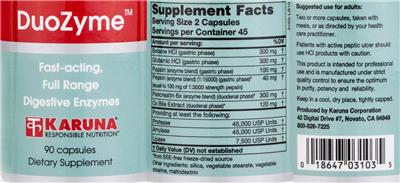
Supplement Facts
The label details for DuoZyme by Karuna, sourced from the NIH Dietary Supplement Label Database.
Supplement Facts
| Ingredient | Amount | % DV |
|---|---|---|
| Papain | 100 mg | -- |
| Lipase | 0 NP | -- |
| Betaine Hydrochloride | 300 mg | -- |
| Pepsin | 40 mg | -- |
| Ox Bile extract | 120 mg | -- |
| Pancreatin 6X | 300 mg | -- |
| Protease | 0 NP | -- |
| Amylase | 0 NP | -- |
| Glutamic Hydrochloride | 300 mg | -- |
Other ingredients: Silica, Stearate, Vegetable Stearine, Maltodextrin
Tap any ingredient to jump to its full detail below.
These statements are the manufacturer’s wording, reproduced from the product label — the label is saying it, not HelloPharmacist. We don’t verify or endorse them.
Formula
Fast-acting, full range digestive enzymes
Brand IP Statement(s)
Karuna Responsible Nutrition
FDA Statement of Identity
Dietary Supplement
Suggested/Recommended/Usage/Directions
Suggested use for adults: Two or more capsules, taken with meals, or as directed by your health care practitioner.
Precautions
Patients with active peptic ulcer should use HCI products with caution.
This product is intended for professional use and is manufactured under strict quality control to ensure the optimum in purity, potency and reliability.
Formulation
This product is intended for professional use and is manufactured under strict quality control to ensure the optimum in purity, potency and reliability.
Storage
Keep in a cool, dry place, tightly capped.
Is this label outdated? Report a formula or label change and our pharmacy team will review it.
DuoZyme by Karuna label
The label scan from the NIH Dietary Supplement Label Database. Tap to enlarge.
Label images are published by the NIH Dietary Supplement Label Database for the version of this product on file. Always read your actual product label.
View the full label (PDF)The Ingredients in DuoZyme by Karuna
These are the 9 active ingredients this product is made of. Select any to open its full monograph.
Serving size2 Capsule(s) Dosage formCapsule Servings per container45 Amounts shown are per serving.
Most supplement products combine several ingredients, and a medication can interact with the product through any one of them. Each ingredient below shows whether it has known drug interactions.
Papain
Interacts with2 drugs
Papain is a protein-digesting enzyme from the papaya plant that is used in digestive supplements and some topical products. While it has clear food an...
Papain monograph & interactionsLipase
No knowninteractions
Lipase is a digestive enzyme that helps your body break down dietary fats. It is well established as part of prescription pancreatic enzyme therapy fo...
Lipase monograph & interactionsBetaine Hydrochloride
Interacts with36 drugs
Betaine hydrochloride is a supplement used to temporarily increase stomach acid in people who may have low acid levels. Evidence for its benefits is l...
Betaine Hydrochloride monograph & interactionsPepsin
No knowninteractions
Proteolytic enzymes are proteins that help break down other proteins, and common examples include bromelain (from pineapple), papain (from papaya), tr...
Pepsin monograph & interactionsOx Bile extract
Pancreatin 6X
Protease
No knowninteractions
Proteolytic enzymes are proteins that help break down other proteins, and common examples include bromelain (from pineapple), papain (from papaya), tr...
Protease monograph & interactionsAmylase
Glutamic Hydrochloride
Other (inactive) ingredients: Silica, Stearate, Vegetable Stearine, Maltodextrin. These complete the product’s ingredient list but are not active constituents.
DuoZyme by Karuna Drug Interactions
HelloPharmacist Interaction Report
DuoZyme by Karuna does have documented interactions.
The most serious is with warfarin (Coumadin), a blood thinner. Papain, one of the active ingredients, may increase warfarin's effects and bleeding risk.
In one case, a patient stable on warfarin developed an unsafe blood level (INR of 7.4) after taking a papain-containing supplement. If you take warfarin, don't add this product without checking with your pharmacist or doctor first.
Read the full breakdown — every affected drug type, severity by severity
Betaine hydrochloride—another active ingredient—interacts with acid-reducing medications. It increases stomach acid, which could weaken the effects of H2-blockers (like famotidine), antacids, and PPIs (like omeprazole).
These interactions are rated Minor, but if you rely on acid reducers, we need to make sure DuoZyme won't interfere.
We couldn't check several ingredients for interactions: ox bile extract, pancreatin 6X, amylase, and glutamic hydrochloride. Altogether, these interactions span 38 individual medications.
Run your exact drugs through the checker below before starting.
Check your own medications below · Editorial policy · How we use AI
Want to check YOUR meds against DuoZyme?
Ask about interactions with your drugs in plain English — “Can I take it with lisinopril?” — and we find you the answer in seconds, ingredient by ingredient.
Go to the checkerIngredients driving the most interactions
Individual Drug Interactions
The ingredients in DuoZyme interact with 38 drugs. Click any drug to see the details.
2 of the 9 ingredients in DuoZyme interact with drugs. Each result below shows which ingredient is responsible. Betaine Hydrochloride Papain
WarfarinWarfarin
How Warfarin interacts with DuoZyme — through 1 ingredient. Tap an ingredient for the detail:
PapainWarfarin (coumadin) Moderate
Interaction Summary
Theoretically, papain might increase the effects and side effects of warfarin.
Read the full Papain + Warfarin interactionWarfarin SodiumCoumadin, Panwarfin, Sofarin
How Warfarin Sodium interacts with DuoZyme — through 1 ingredient. Tap an ingredient for the detail:
PapainWarfarin (coumadin) Moderate
Interaction Summary
Theoretically, papain might increase the effects and side effects of warfarin.
Read the full Papain + Warfarin Sodium interactionAlginic Acid, Aluminum HydroxideRafton
How Alginic Acid, Aluminum Hydroxide interacts with DuoZyme — through 1 ingredient. Tap an ingredient for the detail:
Betaine HydrochlorideAntacids Minor
Interaction Summary
Betaine hydrochloride increases stomach acidity and could decrease the effects of antacids.
Read the full Betaine Hydrochloride + Alginic Acid, Aluminum Hydroxide interactionAluminum HydroxideAlu-Cap, Amphojel, Gaviscon
How Aluminum Hydroxide interacts with DuoZyme — through 1 ingredient. Tap an ingredient for the detail:
Betaine HydrochlorideAntacids Minor
Interaction Summary
Betaine hydrochloride increases stomach acidity and could decrease the effects of antacids.
Read the full Betaine Hydrochloride + Aluminum Hydroxide interactionAluminum Hydroxide, Aspirin, Codeine Phosphate, Magnesium HydroxideAscriptin Codeine #2
How Aluminum Hydroxide, Aspirin, Codeine Phosphate, Magnesium Hydroxide interacts with DuoZyme — through 1 ingredient. Tap an ingredient for the detail:
Betaine HydrochlorideAntacids Minor
Interaction Summary
Betaine hydrochloride increases stomach acidity and could decrease the effects of antacids.
Read the full Betaine Hydrochloride + Aluminum Hydroxide, Aspirin, Codeine Phosphate, Magnesium Hydroxide interactionAluminum Hydroxide, Aspirin, Magnesium HydroxideAscriptin
How Aluminum Hydroxide, Aspirin, Magnesium Hydroxide interacts with DuoZyme — through 1 ingredient. Tap an ingredient for the detail:
Betaine HydrochlorideAntacids Minor
Interaction Summary
Betaine hydrochloride increases stomach acidity and could decrease the effects of antacids.
Read the full Betaine Hydrochloride + Aluminum Hydroxide, Aspirin, Magnesium Hydroxide interactionAluminum Hydroxide, Magnesium Hydroxide (otc Drug)Maalox, Mucogel
How Aluminum Hydroxide, Magnesium Hydroxide (otc Drug) interacts with DuoZyme — through 1 ingredient. Tap an ingredient for the detail:
Betaine HydrochlorideAntacids Minor
Interaction Summary
Betaine hydrochloride increases stomach acidity and could decrease the effects of antacids.
Read the full Betaine Hydrochloride + Aluminum Hydroxide, Magnesium Hydroxide (otc Drug) interactionAluminum Hydroxide, Magnesium Hydroxide, Simethicone (otc Drug)Mylanta
How Aluminum Hydroxide, Magnesium Hydroxide, Simethicone (otc Drug) interacts with DuoZyme — through 1 ingredient. Tap an ingredient for the detail:
Betaine HydrochlorideAntacids Minor
Interaction Summary
Betaine hydrochloride increases stomach acidity and could decrease the effects of antacids.
Read the full Betaine Hydrochloride + Aluminum Hydroxide, Magnesium Hydroxide, Simethicone (otc Drug) interactionAluminum, Magnesium (otc Drug)Almagel
How Aluminum, Magnesium (otc Drug) interacts with DuoZyme — through 1 ingredient. Tap an ingredient for the detail:
Betaine HydrochlorideAntacids Minor
Interaction Summary
Betaine hydrochloride increases stomach acidity and could decrease the effects of antacids.
Read the full Betaine Hydrochloride + Aluminum, Magnesium (otc Drug) interactionAmoxicillin, Omeprazole Magnesium, RifabutinTalicia
How Amoxicillin, Omeprazole Magnesium, Rifabutin interacts with DuoZyme — through 1 ingredient. Tap an ingredient for the detail:
Betaine HydrochlorideProton Pump Inhibitors (ppis) Minor
Interaction Summary
Betaine hydrochloride increases stomach acidity and could decrease the effects of PPIs.
Read the full Betaine Hydrochloride + Amoxicillin, Omeprazole Magnesium, Rifabutin interactionAspirin, Aluminum Hydroxide, Codeine Phosphate, Magnesium HydroxideAscriptin Codeine #3
How Aspirin, Aluminum Hydroxide, Codeine Phosphate, Magnesium Hydroxide interacts with DuoZyme — through 1 ingredient. Tap an ingredient for the detail:
Betaine HydrochlorideAntacids Minor
Interaction Summary
Betaine hydrochloride increases stomach acidity and could decrease the effects of antacids.
Read the full Betaine Hydrochloride + Aspirin, Aluminum Hydroxide, Codeine Phosphate, Magnesium Hydroxide interactionAspirin, Calcium Carbonate, Magnesium Carbonate, Magnesium OxideBufferin
How Aspirin, Calcium Carbonate, Magnesium Carbonate, Magnesium Oxide interacts with DuoZyme — through 1 ingredient. Tap an ingredient for the detail:
Betaine HydrochlorideAntacids Minor
Interaction Summary
Betaine hydrochloride increases stomach acidity and could decrease the effects of antacids.
Read the full Betaine Hydrochloride + Aspirin, Calcium Carbonate, Magnesium Carbonate, Magnesium Oxide interactionAspirin, Citric Acid, Sodium BicarbonateAlka-Seltzer Pain Reliever and Antacid
How Aspirin, Citric Acid, Sodium Bicarbonate interacts with DuoZyme — through 1 ingredient. Tap an ingredient for the detail:
Betaine HydrochlorideAntacids Minor
Interaction Summary
Betaine hydrochloride increases stomach acidity and could decrease the effects of antacids.
Read the full Betaine Hydrochloride + Aspirin, Citric Acid, Sodium Bicarbonate interactionAspirin, OmeprazoleYosprala
How Aspirin, Omeprazole interacts with DuoZyme — through 1 ingredient. Tap an ingredient for the detail:
Betaine HydrochlorideProton Pump Inhibitors (ppis) Minor
Interaction Summary
Betaine hydrochloride increases stomach acidity and could decrease the effects of PPIs.
Read the full Betaine Hydrochloride + Aspirin, Omeprazole interactionBismuth Subcarbonate, Calcium Carbonate, OpiumDiabismul
How Bismuth Subcarbonate, Calcium Carbonate, Opium interacts with DuoZyme — through 1 ingredient. Tap an ingredient for the detail:
Betaine HydrochlorideAntacids Minor
Interaction Summary
Betaine hydrochloride increases stomach acidity and could decrease the effects of antacids.
Read the full Betaine Hydrochloride + Bismuth Subcarbonate, Calcium Carbonate, Opium interactionCalcium CarbonateAdcal, Adcal-D3, Calcichew, Os-Cal, Tums
How Calcium Carbonate interacts with DuoZyme — through 1 ingredient. Tap an ingredient for the detail:
Betaine HydrochlorideAntacids Minor
Interaction Summary
Betaine hydrochloride increases stomach acidity and could decrease the effects of antacids.
Read the full Betaine Hydrochloride + Calcium Carbonate interactionCimetidineCimetidine Injection, Tagamet, Tagamet HB
How Cimetidine interacts with DuoZyme — through 1 ingredient. Tap an ingredient for the detail:
Betaine HydrochlorideH2-blockers Minor
Interaction Summary
Betaine hydrochloride increases stomach acidity and could decrease the effects of H2-blockers.
Read the full Betaine Hydrochloride + Cimetidine interactionDexlansoprazoleDexilant Solutab
How Dexlansoprazole interacts with DuoZyme — through 1 ingredient. Tap an ingredient for the detail:
Betaine HydrochlorideProton Pump Inhibitors (ppis) Minor
Interaction Summary
Betaine hydrochloride increases stomach acidity and could decrease the effects of PPIs.
Read the full Betaine Hydrochloride + Dexlansoprazole interactionDihydroxyaluminum Sodium CarbonateRolaids
How Dihydroxyaluminum Sodium Carbonate interacts with DuoZyme — through 1 ingredient. Tap an ingredient for the detail:
Betaine HydrochlorideAntacids Minor
Interaction Summary
Betaine hydrochloride increases stomach acidity and could decrease the effects of antacids.
Read the full Betaine Hydrochloride + Dihydroxyaluminum Sodium Carbonate interactionEsomeprazoleNexium
How Esomeprazole interacts with DuoZyme — through 1 ingredient. Tap an ingredient for the detail:
Betaine HydrochlorideProton Pump Inhibitors (ppis) Minor
Interaction Summary
Betaine hydrochloride increases stomach acidity and could decrease the effects of PPIs.
Read the full Betaine Hydrochloride + Esomeprazole interactionEsomeprazole MagnesiumNexium 24hr
How Esomeprazole Magnesium interacts with DuoZyme — through 1 ingredient. Tap an ingredient for the detail:
Betaine HydrochlorideProton Pump Inhibitors (ppis) Minor
Interaction Summary
Betaine hydrochloride increases stomach acidity and could decrease the effects of PPIs.
Read the full Betaine Hydrochloride + Esomeprazole Magnesium interactionEsomeprazole StrontiumEsomeprazole Strontium
How Esomeprazole Strontium interacts with DuoZyme — through 1 ingredient. Tap an ingredient for the detail:
Betaine HydrochlorideProton Pump Inhibitors (ppis) Minor
Interaction Summary
Betaine hydrochloride increases stomach acidity and could decrease the effects of PPIs.
Read the full Betaine Hydrochloride + Esomeprazole Strontium interactionEsomeprazole, NaproxenVimovo
How Esomeprazole, Naproxen interacts with DuoZyme — through 1 ingredient. Tap an ingredient for the detail:
Betaine HydrochlorideProton Pump Inhibitors (ppis) Minor
Interaction Summary
Betaine hydrochloride increases stomach acidity and could decrease the effects of PPIs.
Read the full Betaine Hydrochloride + Esomeprazole, Naproxen interactionFamotidineFamotidine, Famotidine Injection, Pepcid, Pepcid AC
How Famotidine interacts with DuoZyme — through 1 ingredient. Tap an ingredient for the detail:
Betaine HydrochlorideH2-blockers Minor
Interaction Summary
Betaine hydrochloride increases stomach acidity and could decrease the effects of H2-blockers.
Read the full Betaine Hydrochloride + Famotidine interactionFamotidine, IbuprofenDuexis
How Famotidine, Ibuprofen interacts with DuoZyme — through 1 ingredient. Tap an ingredient for the detail:
Betaine HydrochlorideH2-blockers Minor
Interaction Summary
Betaine hydrochloride increases stomach acidity and could decrease the effects of H2-blockers.
Read the full Betaine Hydrochloride + Famotidine, Ibuprofen interactionLansoprazolePrevacid
How Lansoprazole interacts with DuoZyme — through 1 ingredient. Tap an ingredient for the detail:
Betaine HydrochlorideProton Pump Inhibitors (ppis) Minor
Interaction Summary
Betaine hydrochloride increases stomach acidity and could decrease the effects of PPIs.
Read the full Betaine Hydrochloride + Lansoprazole interactionLansoprazole, Amoxicillin, ClarithromycinPrevpac
How Lansoprazole, Amoxicillin, Clarithromycin interacts with DuoZyme — through 1 ingredient. Tap an ingredient for the detail:
Betaine HydrochlorideProton Pump Inhibitors (ppis) Minor
Interaction Summary
Betaine hydrochloride increases stomach acidity and could decrease the effects of PPIs.
Read the full Betaine Hydrochloride + Lansoprazole, Amoxicillin, Clarithromycin interactionMagaldrateRiopan
How Magaldrate interacts with DuoZyme — through 1 ingredient. Tap an ingredient for the detail:
Betaine HydrochlorideAntacids Minor
Interaction Summary
Betaine hydrochloride increases stomach acidity and could decrease the effects of antacids.
Read the full Betaine Hydrochloride + Magaldrate interactionMagnesium Sulfate (prescription Drug)Bilagog, Magnesium Sulfate
How Magnesium Sulfate (prescription Drug) interacts with DuoZyme — through 1 ingredient. Tap an ingredient for the detail:
Betaine HydrochlorideAntacids Minor
Interaction Summary
Betaine hydrochloride increases stomach acidity and could decrease the effects of antacids.
Read the full Betaine Hydrochloride + Magnesium Sulfate (prescription Drug) interactionNizatidineAxid, Axid Injection
How Nizatidine interacts with DuoZyme — through 1 ingredient. Tap an ingredient for the detail:
Betaine HydrochlorideH2-blockers Minor
Interaction Summary
Betaine hydrochloride increases stomach acidity and could decrease the effects of H2-blockers.
Read the full Betaine Hydrochloride + Nizatidine interactionEach ingredient & the kinds of drugs it affects
For each ingredient in DuoZyme with known interactions, here are the types of medications they can affect. Open any type for the detail — or search your exact drug in the checker above.
Betaine Hydrochloride
Antacids
Betaine hydrochloride increases stomach acidity and could decrease the effects of antacids.
In human research, betaine hydrochloride increases stomach acidity. Antacids are taken to decrease stomach acidity. Theoretically, taking betaine hydrochloride along with antacids might decrease the effects of the antacids.
H2-Blockers
Betaine hydrochloride increases stomach acidity and could decrease the effects of H2-blockers.
In human research, betaine hydrochloride increases stomach acidity. H2-blockers are used to decrease stomach acidity. Theoretically, taking betaine hydrochloride along with H2-blockers might decrease the effects of H2-blockers.
Proton Pump Inhibitors (Ppis)
Betaine hydrochloride increases stomach acidity and could decrease the effects of PPIs.
In human research, betaine hydrochloride increases stomach acidity. PPIs are used to decrease stomach acidity. Theoretically, taking betaine hydrochloride along with PPIs might decrease the effects of PPIs
Papain
Warfarin (Coumadin)
Theoretically, papain might increase the effects and side effects of warfarin.
In one case report, a patient previously stable on warfarin was found to have an international normalization ratio (INR) of 7.4, which was attributed to ingestion of a supplement containing papain from papaya extract.
Brand information
Manufacturer and brand details for DuoZyme, from the product label.
Karuna
See all Karuna products- Name
- Karuna Corporation
- Street Address
- 42 Digital Drive #7
- City
- Novato
- State
- CA
- ZipCode
- 94949
- Phone Number
- 800-826-7225
DuoZyme by Karuna: Common Questions
Does DuoZyme by Karuna interact with any medications?
How can one product interact with so many drugs?
Where does this information come from?
Is this safe if I'm pregnant or breastfeeding?
Will DuoZyme help with my indigestion?
What's in here—just enzymes?
Can I take this with my antacid or PPI?
Are there any common side effects?
What are the proteases—pepsin and protease—for?
Written and reviewed by the HelloPharmacist editorial staff. Our editorial policy
Not sure if DuoZyme is safe with your meds?
Our pharmacists answer your medication & supplement questions — free.
Label information is sourced from the NIH Dietary Supplement Label Database and reflects the product version on file; always read your actual product label. This page is for education only and is not a substitute for professional medical advice. Confirm with your pharmacist or doctor before combining supplements and medications.
The Full Monographs Behind DuoZyme’s Ingredients
Every ingredient we hold a full HelloPharmacist monograph for — uses, evidence, safety, and the complete interaction list.
Papain
Interacts with 2 drugsPapain is a protein-digesting enzyme from the papaya plant that is used in digestive supplements and some topical products. While it has clear food and laboratory uses, strong human evidence...
Read the full Papain monograph → Herb & supplement monographLipase
Lipase is a digestive enzyme that helps your body break down dietary fats. It is well established as part of prescription pancreatic enzyme therapy for people who cannot make enough of their...
Read the full Lipase monograph → Herb & supplement monographBetaine Hydrochloride
Interacts with 36 drugsBetaine hydrochloride is a supplement used to temporarily increase stomach acid in people who may have low acid levels. Evidence for its benefits is limited and mostly based on tradition rat...
Read the full Betaine Hydrochloride monograph → Herb & supplement monographProteolytic Enzymes (proteases)
Proteolytic enzymes are proteins that help break down other proteins, and common examples include bromelain (from pineapple), papain (from papaya), trypsin, chymotrypsin, and pancreatin. Peo...
Read the full Proteolytic Enzymes (proteases) monograph →Sources & How We Checked
DuoZyme's label data comes from the NIH Dietary Supplement Label Database; the ingredient interaction data is from the Natural Medicines database, reviewed by our pharmacists.
- NIH Dietary Supplement Label Database (DSLD) — The official product label on file for this supplement.
- Natural Medicines (Therapeutic Research Center) — Evidence-graded clinical reference behind the ingredient interaction data.
Content is written and reviewed by licensed HelloPharmacist pharmacists. See our data sources and editorial standards for how this information is built and checked.
The 17 references behind this product’s interaction data
Every citation that drives the interaction findings for this product’s ingredients, from the evidence-graded Natural Medicines (TRC Healthcare) database. Open an ingredient to browse its citations — links open the study on PubMed or the publisher’s site.
Papain 11 references
- The Review of Natural Products by Facts and Comparisons. St. Louis, MO: Wolters Kluwer Co., 1999.
- Shaw D, Leon C, Kolev S, Murray V. Traditional remedies and food supplements: a 5-year toxicological study (1991-1995). Drug Saf 1997;17:342-56.
- Shuttleworth D, Hill S, Marks R, Connelly DM. Relief of experimentally induced pruritus with a novel eutectic mixture of local anaesthetic agents. Br J Dermatol 1988;119:535-40.
- Mansfield LE, Ting S, Haverly RW, Yoo TJ. The incidence and clinical implications of hypersensitivity to papain in an allergic population, confirmed by blinded oral challenge. Ann Allergy 1985;55:541-3.
- Martin, T., Uhder, K., Kurek, R., Roeddiger, S., Schneider, L., Vogt, H. G., Heyd, R., and Zamboglou, N. Does prophylactic treatment with proteolytic enzymes reduce acute toxicity of adjuvant pelvic irradiation? Results of a double-blind randomized trial PubMed
- Walker-Renard, P. Update on the medicinal management of phytobezoars. Am J Gastroenterol. 1993;88(10):1663-1666.
- Tymoszuk D, Wiszniewska M, Walusiak-Skorupa J. Papain-induced occupational rhinoconjunctivitis and asthma - A case report. Med Pr 2016;67(1):109-12. PubMed
- Soto-Mera MT, López-Rico MR, Filgueira JF, et al. Occupational allergy to papain. Allergy 2000;55(10):983-4. PubMed
- Tarlo SM, Shaikh W, Bell B, et al. Papain-induced allergic reactions. Clin Allergy 1978;8(3):207-15. PubMed
- Baur X, König G, Bencze K, Fruhmann G. Clinical symptoms and results of skin test, RAST and bronchial provocation test in thirty-three papain workers: Evidence for strong immunogenic potency and clinically relevant proteolytic e?ects of airborne papain. C
- Novey HS, Keenan WJ, Fairshter RD, Wells ID, Wilson AF, Culver BD. Pulmonary disease in workers exposed to papain: clinico-physiological and immunological studies. Clin Allergy 1980;10(6):721-31. PubMed
Lipase 1 reference
- Casper C, Hascoet JM, Ertl T, et al. Recombinant bile salt-stimulated lipase in preterm infant feeding: A randomized phase 3 study. PLoS One. 2016;11(5):e0156071. PubMed
Betaine Hydrochloride 2 references
- Yago MR, Frymoyer A, Benet LZ, Smelick GS, Frassetto LA, Ding X, Dean B, Salphati L, Budha N, Jin JY, Dresser MJ, Ware JA. The use of betaine HCl to enhance dasatinib absorption in healthy volunteers with rabeprazole-induced hypochlorhydria. AAPS J. 2014 PubMed
- Yago MR, Frymoyer AR, Smelick GS, Frassetto LA, Budha NR, Dresser MJ, Ware JA, Benet LZ. Gastric reacidification with betaine HCl in healthy volunteers with rabeprazole-induced hypochlorhydria. Mol Pharm. 2013 Nov 4;10(11):4032-7. PubMed
See these in context on the Betaine Hydrochloride monograph →
Proteolytic Enzymes (proteases) 3 references
- Weeks JA, Harper RA, Simon RA, Burdick JD. Assessment of sensitization risk of a laundry pre-spotter containing protease. Cutan Ocul Toxicol. 2011;30(4):272-9. PubMed
- Marquès LI, Lara S, Abós T, Bartolomé B. Occupational rhinitis due to pepsin. J Investig Allergol Clin Immunol. 2006;16(2):136-7. DOI
- Cartier A, Malo JL, Pineau L, Dolovich J. Occupational asthma due to pepsin. J Allergy Clin Immunol. 1984;73(5 Pt 1):574-7. PubMed
See these in context on the Proteolytic Enzymes (proteases) monograph →
Parts of this content are provided by the Therapeutic Research Center, LLC.
DISCLAIMER: Currently this does not check for drug-drug interactions. This is not an all-inclusive comprehensive list of potential interactions and is for informational purposes only. Not all interactions are known or well-reported in the scientific literature, and new interactions are continually being reported. Input is needed from a qualified healthcare provider including a pharmacist before starting any therapy. Application of clinical judgment is necessary.
© 2021 Therapeutic Research Center, LLC