
Zinc Picolinate Plus by Karuna Ingredients, Side Effects and Drug Interactions
Dietary Supplement Capsule Mineral
UPC 0 18647 02112 8 Match it to the barcode on your bottle

Medically reviewed by Dr. Brian Staiger, PharmD, BCPS
Also reviewed by the HelloPharmacist Editorial Team
Updated Details about this page
- Label on file from the NIH Dietary Supplement Label Database, dated Mar 25, 2025.
- The interaction, evidence and safety records come from the Natural Medicines database, which we license, read against this label by our own system; the pharmacy team’s sections are written from those records.
- Dr. Brian Staiger, PharmD, BCPS, is a clinical pharmacist and pharmacotherapy specialist.
- Editorial policy Our sources
AI is used only to summarize verified clinical information, never the open internet. Our AI policy
Summary: The HelloPharmacist Team’s Take
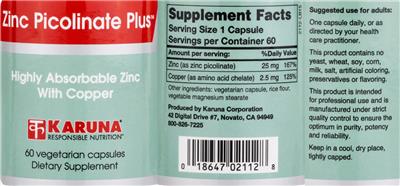
- Form
- Capsule
- Serving Size
- 1 Capsule
- Servings
- 60 per container
- Container Holds
- 60 Vegetarian Capsules
What’s in it, whether it interacts with your drugs, its side effects, whether it works, and what our pharmacists would want you to know before you start it.
- What is Zinc Picolinate Plus?A zinc supplement from Karuna with one other active ingredient, in capsule form.
- Active Ingredients Zinc 25 mgCopper 2.5 mg Two active ingredients. Each one can interact with drugs or cause side effects on its own, so we check every one. The full Supplement Facts
- Drug Interactions 97 drugs have a documented interaction with this supplement; the most serious is rated moderate. Of those, 50 are single drugs and 47 are combination products (two or more drugs in one), each listed under its own name. Ask your pharmacist first if you take a drug in any of these categories, the most serious of the 11 on record:
- Moderate · 21 drugs
- Moderate · 20 drugs
- Bictegravir/
Emtricitabine/ Moderate · 13 drugsTenofovir Alafenamide (Biktarvy) - Ritonavir (Norvir)Moderate · 7 drugs
- Possible Side EffectsNauseaStomach upsetVomitingMetallic taste Reported for the ingredient we have records for, Zinc. Not studied in this exact product.
- Well documented Why
Does Zinc Picolinate Plus work?
Strong This product doesn't appear to be marketed for a specific use, so we graded its ingredients' overall clinical evidence instead.It is not marketed for one specific use, so this is what its ingredients have been studied for, starting with Zinc, its main ingredient:
- Zinc deficiency Zinc
- Zinc
- Zinc
- Copper deficiency Copper
These grades are for each ingredient, not this exact product, and never a promise it will work for you.
And 10 more graded uses, in what the research says- Full Why
- AllergensNone of its ingredient names point to a major food allergen
- Barcode (UPC)0 18647 02112 8Match it to the barcode on your bottle to be sure this is your product. Not your product? Search for it here
Who Might Consider It
- People who want zinc, its main ingredient, for zinc deficiency, diabetes, coronavirus disease 2019 (COVID-19) or another graded use: the uses with research behind it. See each grade
- This product may suit adults who want zinc or copper within recommended amounts and whose doctor has confirmed a need.
Who Should Be Careful
- People on the medications listed above, people with Wilson disease or liver disease, anyone pregnant or breastfeeding, and anyone considering high-dose or long-term use should be careful.
- Please talk it over with your own doctor or pharmacist before starting.
More Before You Take It Show all three answersHide Its Ingredient Amounts vs. Other Supplements Pregnancy and Breastfeeding The Label’s Directions
-
How do its ingredient amounts compare with other supplements?
- Zinc25 mgMore than most of the 583 recent Zinc products in our database that state an amount; 15 mg is the most common.
- Copper2.5 mgMore than 9 in 10 of the 584 recent Copper products in our database that state an amount; 2 mg is the most common.
A label’s amount is what the product holds, not a recommended dose.
See each comparison -
Pregnant or breastfeeding?
- Pregnancy Zinc
- ! When used orally in doses exceeding the UL.
- Breastfeeding Zinc
- ! When used orally in doses exceeding the UL.
- Pregnancy and Breastfeeding Copper
- ! When used orally in doses exceeding the UL.
-
How does the label say to take it?
“Suggested use for adults: One capsule daily, or as directed by your health care practitioner.”
The maker’s words. Your pharmacist or doctor may advise differently.
Everything the label says
From the label dated Mar 25, 2025: both of its active ingredients were checked against our records. A summary of what is known, not a grade or a test of the product. How these ratings are computed
Ask Anything About This Supplement
Name a drug you take, or ask about side effects, ingredients or pregnancy.
AI answers come from this label and our own records, never the open internet. AI can make mistakes, so always check with your doctor or pharmacist. How we use AI
Ask the Pharmacist
A licensed pharmacist will answer your question by email — free, usually within 24 hours.
Got it — thank you!
A licensed pharmacist will answer within 24 hours. Keep an eye on your email (worth checking spam, just in case).
What’s Inside Zinc Picolinate Plus by Karuna
Two Active Ingredients, Each Checked on Its Own
A supplement is often several ingredients in one bottle, and each one can interact with drugs or cause side effects on its own. We check every one of them against our records.
Why this rating?
The label gives an exact amount for every one of its two active ingredients, so you know how much of each you get in each serving. This rates what the label tells you, not the quality of the product.
Supplement Facts
| Amount Per Serving | % Daily Value | |
|---|---|---|
| Zinc | 25 mg | 167% |
| Copper | 2.5 mg | 125% |
Other ingredients: Vegetarian Capsule, Rice Flour, Magnesium Stearate
Daily Values for adults and children 4 or more years of age.
As the label prints it, from the NIH Dietary Supplement Label Database.
Each Ingredient and Its Drug Interactions
Tap one for more about it and its full guide. A drug can interact with this supplement through any one of them.
-
Zinc 25 mg Interacts with 67 drugs
Form on the label: Zinc Picolinate
Zinc is an essential mineral that your body needs for immune function, wound healing, taste, and smell.
- Most people get enough from food, but supplements can help correct or prevent a deficiency.
- Taking too much zinc for too long can cause harm, so check with a pharmacist or doctor before using high-dose supplements.
The full Zinc guide: uses, dosage and safety Every Zinc drug interaction
-
Copper 2.5 mg Interacts with 31 drugs
Form on the label: Copper Amino Acid Chelate
Copper is an essential trace mineral your body needs in small amounts for making red blood cells, supporting nerves and bones, and helping enzymes work.
- Most people get enough copper from food, and supplements are mainly useful for diagnosed deficiency.
- Too much copper can be harmful, so do not take high doses without medical advice.
The full Copper guide: uses, dosage and safety Every Copper drug interaction
How Much of Each Ingredient Is in It, Compared With Other Supplements
Each bar is an amount that other recent supplements list for the same ingredient. The taller the bar, the more of them state it.
-
25 mg in a serving of this product
More than most products
- Most common amount
- 15 mg (about 19 in 100 products)
- Most products state
- 3 mg to 30 mg
- Compared with
- 583 recent products
-
2.5 mg in a serving of this product
More than 9 in 10 products
- Most common amount
- 2 mg (about 21 in 100 products)
- Most products state
- 0.2 mg to 2 mg
- Compared with
- 584 recent products
Other Ingredients (Inactive)
The capsule or tablet itself, fillers, coatings and flavors. Not part of the drug interaction check; the allergen check below reads them.
- Vegetarian Capsule
- Rice Flour
- Magnesium Stearate
Allergens in Zinc Picolinate Plus
None of its ingredient names point to a major food allergen.
Not named in the ingredients
- Milk
- Egg
- Fish
- Shellfish
- Tree nuts
- Peanuts
- Wheat or other gluten grains
- Soy
- Sesame
- Made without, the label says“This product contains no yeast, wheat, soy, corn, milk, salt, artificial coloring, preservatives or flavoring.”
From the label text and ingredient names on file; we do not test products. With a serious allergy, check your bottle and ask the maker or your pharmacist.
What the Label Says
The maker’s own words, from the label. We do not verify or endorse them.
- Brand IP Statement(s)
-
“Karuna Responsible Nutrition”
- FDA Statement of Identity
-
“Dietary Supplement”
- Formulation
-
“This product is intended for professional use and is manufactured under strict quality control to ensure the optimum in purity, potency and reliability.”
“Highly absorbable zinc with copper”
- Storage
-
“Keep in a cool, dry place, tightly capped.”
The Zinc Picolinate Plus Label on File
The label scan on file at the NIH Dietary Supplement Label Database, dated March 2025. Always read the label on the bottle you have.
Product Facts
Is this label outdated? Report a formula or label change and our pharmacy team will review it.
Zinc Picolinate Plus by Karuna Side Effects
Why this rating?
We look for three kinds of safety information on each ingredient: side effects reported in studies, a pregnancy and breastfeeding rating, and a safety write-up from our pharmacy team. All three are on file for each of the two ingredients we could check.
So this rates how much is known, not whether Zinc Picolinate Plus is right for you.
Reported with Zinc and Copper
- Most often
- Nausea, stomach upset, vomiting and metallic taste
- !Rare but serious
- Reported with Zinc and Copper See details
HelloPharmacist Team Summary of Side Effects
You may notice nausea, stomach upset, vomiting, or a metallic taste, as these are the side effects reported for this product.
- These are generally well tolerated within recommended amounts, and the zinc side effects tend to be dose-related.
- The rare but serious concern is serious copper poisoning from very large single doses, which is a medical emergency, so call your doctor or seek urgent care right away if it happens.
- Talk with your own doctor or pharmacist before starting if you have Wilson disease, liver disease, are pregnant or breastfeeding, or plan high-dose or long-term use.
Side Effects Reported With Zinc
Copper has side-effect reports on file, but no list of the most common ones. Read them in the Copper guide
Zinc Picolinate Plus Warnings: Who Should Be Careful
If any of these apply to you, talk to your doctor or pharmacist before you start it.
-
Liver Disease
- CopperPeople with liver disease should also be cautious, since the liver handles copper.
-
Stomach or Bowel Problems
- ZincPeople with digestive disorders, those who drink heavily, and people on restrictive diets are more likely to be low in zinc and may need supplements.
-
Other Cautions
- ZincAnyone considering high-dose or long-term zinc should talk to a pharmacist or doctor first.
- CopperPeople with Wilson's disease, a genetic condition that causes copper to build up in the body, must avoid copper supplements and may need to limit copper in their diet.
- Because the ratings conflict or raise concern, please talk with your doctor or pharmacist for personalized advice.
-
What the Label Warns
- “This product is intended for professional use and is manufactured under strict quality control to ensure the optimum in purity, potency and reliability.”
The maker’s wording, from the product label.
-
Pregnant or Breastfeeding
Each ingredient’s rating for pregnancy and for breastfeeding, and what it covers.
Pregnancy
-
When used orally and appropriately.
Zinc is safe in amounts that do not exceed the tolerable upper intake level (UL) of 34 mg daily during pregnancy in those 14-18 years of age and 40 mg daily in those 19-50 years of age.
-
When used orally in doses exceeding the UL.
Breastfeeding
-
When used orally and appropriately.
Zinc is safe in amounts that do not exceed the tolerable upper intake level (UL) of 34 mg daily during lactation in those 14-18 years of age, and 40 mg daily for those 19-50 years of age.
-
When used orally in doses exceeding the UL.
Higher doses can cause zinc-induced copper deficiency in nursing infants.
Pregnancy and Breastfeeding The record rates both the same
-
When used orally and appropriately.
Copper is safe in amounts that do not exceed the tolerable upper intake level (UL) of 8 mg daily for those 14-18 years of age or 10 mg daily for those 19 years and older.
-
When used orally in doses exceeding the UL.
Higher intake can cause liver damage.
Our pharmacy team’s notes
- For breastfeeding, both zinc and copper are rated Likely Safe.
Ratings and the words beside them are from the Natural Medicines database, which we license.
-
Rare but Serious Side Effects
-
!
Zinc
Very high single doses can cause more serious stomach symptoms.
Orally: There have been cases of acute renal tubular necrosis, interstitial nephritis, neurological complications, severe vomiting, and sideroblastic anemia after zinc overdose.
-
!
Copper
Very large single doses can cause serious copper poisoning, which is a medical emergency.
Copper's data notes that excess copper can be toxic and that very large doses can cause serious poisoning.
When to get help: a serious allergic reaction, with trouble breathing or swelling of the face, lips or throat, needs emergency care: call 911. For any other side effect that worries you, call your doctor or pharmacist.
These reports describe each ingredient, not studies of this exact product. Not medical advice: a side effect you notice after starting a supplement is worth a word with your pharmacist or doctor.
Zinc Picolinate Plus by Karuna Drug Interactions
We checked both active ingredients in this supplement against every drug in our records. A drug can interact with it through any one of them.
A moderate interaction on record
2 of 3, on a scale from Minor or none to Major.Why this rating?
We rate this by the most serious interaction on record, not by how many there are. For Copper and Zinc, the most serious is rated moderate, which means it calls for caution, and sometimes monitoring or a change in timing or dose.
97 drugs are on the full list. What matters is whether one you take is on it, so check yours with the interaction checker on this page.
Both of its active ingredients have drug interactions on record: Zinc and Copper.
- Interacts with
- 67 drugs
- Most serious
- Moderate
- Zinc's Moderate interactions also include cephalexin, tetracycline antibiotics, penicillamine, ritonavir, cisplatin, integrase inhibitors, and bictegravir/emtricitabine/tenofovir alafenamide (Biktarvy).
- In most of these, zinc can bind to the drug in your gut or otherwise reduce its levels or effects, so timing matters.
- Interacts with
- 31 drugs
- Most serious
- Moderate
- Most of its records involve Contraceptive Drugs and Penicillamine (Cuprimine, Depen).
From the HelloPharmacist Team
Here is how the interactions add up across the whole label.
- Zinc Picolinate Plus by Karuna does interact with several medications, through both its zinc and its copper content.
- The most serious severity we list is Moderate, and the clearest example is zinc with quinolone antibiotics, where taking both together can lower how much of each your body absorbs.
- Copper interacts with penicillamine, where both zinc and copper are rated Moderate, and with contraceptive drugs, rated Minor, because they can raise copper levels.
Summarized by the HelloPharmacist pharmacy team from the interaction records below. How it is written How we use AI
Why Zinc Picolinate Plus Interacts, Ingredient by Ingredient
A product interacts through its ingredients. Each card: how many drugs, the most serious rating, and the kinds of drugs it affects most (tap a kind for what it means).
The ingredients driving the most interactions
-
Zinc 67 drugs
Most serious: Moderate10 interaction records on file
The kinds of drugs it affects most
- 21 drugs
- 20 drugs
- Bictegravir/Emtricitabine/Tenofovir Alafenamide (Biktarvy) 13 drugs
- Ritonavir (Norvir) 7 drugs
Every Zinc drug interaction, 10 records The Zinc records cite 88 references, listed in the Zinc guide.
-
Copper 31 drugs
Most serious: Moderate2 interaction records on file
The kinds of drugs it affects most
- 30 drugs
- Penicillamine (Cuprimine, Depen) 1 drug
Every Copper drug interaction, 2 records The Copper records cite 11 references, listed in the Copper guide.
The Breakdown by Severity
Each drug counted once, at its most serious rating. Tap a tile to list those drugs.
Find Your Drug
Type a drug or brand name to see whether it is on the list.
- Only drugs with a documented interaction are listed, the most serious first.
- A drug with no known interaction is not listed, but searching its name tells you so.
- Open a drug to see which ingredient is responsible. Of those, 50 are single drugs and 47 are combination products (two or more drugs in one), each listed under its own name.
-
DoxycyclineDoryx, Doxy, Doxy-D, Doxycin, Doxycycline Injection and 7 more Moderate
The ingredient responsible:
-
Zinc Moderate Doxycycline is in the Tetracycline Antibiotics category.
Zinc might reduce levels of tetracycline antibiotics.
The full Zinc + Doxycycline interaction
-
-
CiprofloxacinCiloxan, Cipro, Cipro IV, Cipro XR, Ciprobay and 1 more Moderate
The ingredient responsible:
-
Zinc Moderate Ciprofloxacin is in the Quinolone Antibiotics category.
Zinc can decrease the levels and clinical effects of quinolones antibiotics.
The full Zinc + Ciprofloxacin interaction
-
-
CephalexinCephalex, Keflex, Keftab, Lexin Moderate
The ingredient responsible:
-
Zinc Moderate
Zinc might decrease cephalexin levels by chelating with cephalexin in the gut and preventing its absorption.
The full Zinc + Cephalexin interaction
-
-
Doxycycline HyclateActiclate, Acticlate Cap, Lymepak Moderate
The ingredient responsible:
-
Zinc Moderate Doxycycline Hyclate is in the Tetracycline Antibiotics category.
Zinc might reduce levels of tetracycline antibiotics.
The full Zinc + Doxycycline Hyclate interaction
-
-
Doxycycline MonohydrateErfacea Moderate
The ingredient responsible:
-
Zinc Moderate Doxycycline Monohydrate is in the Tetracycline Antibiotics category.
Zinc might reduce levels of tetracycline antibiotics.
The full Zinc + Doxycycline Monohydrate interaction
-
-
MinocyclineAcnamino MR, Aknemin, Amzeeq, Arestin Miscrosperes, Dynacin and 7 more Moderate
The ingredient responsible:
-
Zinc Moderate Minocycline is in the Tetracycline Antibiotics category.
Zinc might reduce levels of tetracycline antibiotics.
The full Zinc + Minocycline interaction
-
-
LevofloxacinLeva-pak, Levaquin, Levaquin Injection Moderate
The ingredient responsible:
-
Zinc Moderate Levofloxacin is in the Quinolone Antibiotics category.
Zinc can decrease the levels and clinical effects of quinolones antibiotics.
The full Zinc + Levofloxacin interaction
-
-
DoxycylineDoxychel Moderate
The ingredient responsible:
-
Zinc Moderate Doxycyline is in the Tetracycline Antibiotics category.
Zinc might reduce levels of tetracycline antibiotics.
The full Zinc + Doxycyline interaction
-
-
TetracyclineAchromycin, Achromycin V, Nor-Tet, Robitet, Sumycin and 7 more Moderate
The ingredient responsible:
-
Zinc Moderate
Zinc might reduce levels of tetracycline antibiotics.
The full Zinc + Tetracycline interaction
-
-
CisplatinPlatinol-AQ Moderate
The ingredient responsible:
-
Zinc Moderate
Theoretically, zinc might interfere with the therapeutic effects of cisplatin.
The full Zinc + Cisplatin interaction
-
-
EnoxacinPenetrex Moderate
The ingredient responsible:
-
Zinc Moderate Enoxacin is in the Quinolone Antibiotics category.
Zinc can decrease the levels and clinical effects of quinolones antibiotics.
The full Zinc + Enoxacin interaction
-
-
Minocycline HydrochlorideMinolira, Ximino Moderate
The ingredient responsible:
-
Zinc Moderate Minocycline Hydrochloride is in the Tetracycline Antibiotics category.
Zinc might reduce levels of tetracycline antibiotics.
The full Zinc + Minocycline Hydrochloride interaction
-
-
MoxifloxacinAvelox Moderate
The ingredient responsible:
-
Zinc Moderate Moxifloxacin is in the Quinolone Antibiotics category.
Zinc can decrease the levels and clinical effects of quinolones antibiotics.
The full Zinc + Moxifloxacin interaction
-
-
EravacyclineXerava Moderate
The ingredient responsible:
-
Zinc Moderate Eravacycline is in the Tetracycline Antibiotics category.
Zinc might reduce levels of tetracycline antibiotics.
The full Zinc + Eravacycline interaction
-
-
Tenofovir Disoproxil FumarateViread Moderate
The ingredient responsible:
-
Zinc Moderate
Theoretically, zinc might decrease levels of bictegravir/emtricitabine/tenofovir alafenamide by reducing its absorption.
The full Zinc + Tenofovir Disoproxil Fumarate interaction
-
-
RetapamulinAltabax, Altargo Moderate
The ingredient responsible:
-
Zinc Moderate Retapamulin is in these Quinolone Antibiotics, Tetracycline Antibiotics categories.
Zinc can decrease the levels and clinical effects of quinolones antibiotics.
The full Zinc + Retapamulin interaction
-
-
ChlortetracyclineAureomycin Moderate
The ingredient responsible:
-
Zinc Moderate Chlortetracycline is in the Tetracycline Antibiotics category.
Zinc might reduce levels of tetracycline antibiotics.
The full Zinc + Chlortetracycline interaction
-
-
DemeclocyclineDeclomycin Moderate
The ingredient responsible:
-
Zinc Moderate Demeclocycline is in the Tetracycline Antibiotics category.
Zinc might reduce levels of tetracycline antibiotics.
The full Zinc + Demeclocycline interaction
-
-
PenicillamineCuprimine, Depen Titratable Moderate
The 2 ingredients responsible:
-
Copper Moderate
Theoretically, taking copper with penicillamine might decrease the absorption of penicillamine; separate dosing by at least 2 hours.
The full Copper + Penicillamine interaction -
Zinc Moderate
Zinc might reduce the levels and clinical effects of penicillamine.
The full Zinc + Penicillamine interaction
-
-
CinoxacinCinobac Moderate
The ingredient responsible:
-
Zinc Moderate Cinoxacin is in the Quinolone Antibiotics category.
Zinc can decrease the levels and clinical effects of quinolones antibiotics.
The full Zinc + Cinoxacin interaction
-
-
TigecyclineTygacil Moderate
The ingredient responsible:
-
Zinc Moderate Tigecycline is in these Quinolone Antibiotics, Tetracycline Antibiotics categories.
Zinc can decrease the levels and clinical effects of quinolones antibiotics.
The full Zinc + Tigecycline interaction
-
-
RaltegravirIsentress Moderate
The ingredient responsible:
-
Zinc Moderate Raltegravir is in the Integrase Inhibitors category.
Theoretically, taking zinc along with integrase inhibitors might decrease the levels and clinical effects of these drugs.
The full Zinc + Raltegravir interaction
-
-
DoripenemDoribax Moderate
The ingredient responsible:
-
Zinc Moderate Doripenem is in these Quinolone Antibiotics, Tetracycline Antibiotics categories.
Zinc can decrease the levels and clinical effects of quinolones antibiotics.
The full Zinc + Doripenem interaction
-
-
GatifloxacinTequin, Tequin Injection Moderate
The ingredient responsible:
-
Zinc Moderate Gatifloxacin is in the Quinolone Antibiotics category.
Zinc can decrease the levels and clinical effects of quinolones antibiotics.
The full Zinc + Gatifloxacin interaction
-
-
OzenoxacinXepi Moderate
The ingredient responsible:
-
Zinc Moderate Ozenoxacin is in the Quinolone Antibiotics category.
Zinc can decrease the levels and clinical effects of quinolones antibiotics.
The full Zinc + Ozenoxacin interaction
-
-
Omadacycline (oral)Nuzyra Moderate
The ingredient responsible:
-
Zinc Moderate Omadacycline (oral) is in the Tetracycline Antibiotics category.
Zinc might reduce levels of tetracycline antibiotics.
The full Zinc + Omadacycline (oral) interaction
-
-
OfloxacinFloxin, Floxin Injection, Floxin Otic, Oflox Moderate
The ingredient responsible:
-
Zinc Moderate Ofloxacin is in the Quinolone Antibiotics category.
Zinc can decrease the levels and clinical effects of quinolones antibiotics.
The full Zinc + Ofloxacin interaction
-
-
Nalidixic AcidNegGram Moderate
The ingredient responsible:
-
Zinc Moderate Nalidixic Acid is in the Quinolone Antibiotics category.
Zinc can decrease the levels and clinical effects of quinolones antibiotics.
The full Zinc + Nalidixic Acid interaction
-
-
GemifloxacinFactive Moderate
The ingredient responsible:
-
Zinc Moderate Gemifloxacin is in the Quinolone Antibiotics category.
Zinc can decrease the levels and clinical effects of quinolones antibiotics.
The full Zinc + Gemifloxacin interaction
-
-
EmtricitabineEmtriva Moderate
The ingredient responsible:
-
Zinc Moderate
Theoretically, zinc might decrease levels of bictegravir/emtricitabine/tenofovir alafenamide by reducing its absorption.
The full Zinc + Emtricitabine interaction
-
Does It Work? Zinc Picolinate Plus by Karuna
How it rates in the research so far, then each ingredient on its own. A grade is the research so far, never an endorsement.
This product doesn't appear to be marketed for a specific use, so we graded its ingredients' overall clinical evidence instead.
Why this rating?
It is not marketed for one specific use, so we looked at what its ingredients have been studied for instead.
The strongest: Zinc is graded “Effective” for zinc deficiency. That means strong studies support it.
We did not count Wilson disease, low birth weight and prematurity: they are treated by a doctor or in a hospital. Nor pressure ulcers: the research there is for the ingredient used a different way than this product, such as by injection.
The Evidence, Ingredient by Ingredient
Each card holds our notes on one ingredient, then its uses graded effective, likely effective or possibly effective.
Zinc
From our Zinc guide
- The strongest reason to take zinc is to treat or prevent a zinc deficiency.
- Deficiency is well documented and clearly responds to zinc, so this use is supported by good evidence.
Research suggests a benefit for
- Zinc deficiency
- Diabetes, coronavirus disease 2019 (COVID-19), acne, peptic ulcers, pneumonia, age-related macular degeneration (AMD) and child growth
Not counted here: three graded uses are for Zinc injected or put on the skin (gingivitis, herpes labialis (cold sores) and pressure ulcers), not for a product like this one. Five more are for conditions treated by a doctor or in a hospital (acrodermatitis enteropathica, low birth weight, sickle cell disease and others).
And 5 more graded uses, in the Zinc guideCopper
Our pharmacy team’s notes on Copper
- Copper is rated Likely Effective for copper deficiency and Possibly Ineffective for Alzheimer disease.
Research suggests a benefit for
- Copper deficiency
The grades are the Natural Medicines database’s, which we license; tap a grade for what it means. They are about each ingredient, not this exact product.
About Karuna
Manufacturer and brand details for Zinc Picolinate Plus, from the product label.
Karuna has 132 products in our supplement database, 125 of them on the market, with labels on file since 2013. Our database is built from the NIH’s Dietary Supplement Label Database and our pharmacy team’s own additions, so it covers the labels filed there, not every product the brand sells.
- Name
- Karuna Corporation
- Street Address
- 42 Digital Drive #7
- City
- Novato
- State
- CA
- ZipCode
- 94949
- Phone Number
- 800-826-7225
Zinc Picolinate Plus by Karuna: Common Questions
Does Zinc Picolinate Plus by Karuna interact with any drugs?
What are the side effects of Zinc Picolinate Plus by Karuna?
Who should be careful taking Zinc Picolinate Plus by Karuna?
Can Zinc Picolinate Plus by Karuna affect the liver?
Does Zinc Picolinate Plus by Karuna contain any common allergens?
How can Zinc Picolinate Plus by Karuna interact with so many drugs?
Where does the information about Zinc Picolinate Plus by Karuna come from?
Is Zinc Picolinate Plus by Karuna safe to take during pregnancy?
Does zinc help with acne?
What is copper in Zinc Picolinate Plus by Karuna for?
Is copper safe while breastfeeding?
Written and reviewed by the HelloPharmacist Editorial Team. Our editorial policy
Still Have a Question About Zinc Picolinate Plus?
Our pharmacists answer drug and supplement questions, free, by email.
Label information is sourced from the NIH Dietary Supplement Label Database and reflects the product version on file; always read your actual product label. This page is for education only and is not a substitute for professional medical advice. Confirm with your pharmacist or doctor before combining supplements and drugs.
Who Reviews This Page
The pharmacist behind it, and how it is checked.
Dr. Brian Staiger, PharmD, BCPS
Clinical pharmacist and founder of HelloPharmacist
A licensed pharmacist for more than 13 years, he built the system behind this page: it reads the label on file, matches each active ingredient to its record in the Natural Medicines database, checks those records against every drug we cover, and our pharmacy team writes the take and the interaction summary from those records.
- 13+ Years in PharmacyRetail and clinical pharmacy, medication safety and healthcare administration.
- Board Certified (BCPS)A pharmacotherapy specialist, certified by the Board of Pharmacy Specialties.
- Herbalist TrainingCertificates in medical ethnobotany, for the herbs and supplements people take.
Where This Page Comes From
Zinc Picolinate Plus’s label data comes from the NIH Dietary Supplement Label Database; the ingredient interaction data is from the Natural Medicines database, reviewed by our pharmacists.
- NIH Dietary Supplement Label Database (DSLD)
- The official product label on file for this supplement.
- Natural Medicines (Therapeutic Research Center)
- The evidence-graded clinical reference behind the ingredient interaction, evidence and safety records, which we license.
- HelloPharmacist Editorial Team
- Content is reviewed by the HelloPharmacist Editorial Team, the pharmacists on our staff and those we contract. See our data sources and editorial standards for how this information is built and checked.
- The Pharmacy Team’s Take and Summaries
- Generated from HelloPharmacist’s pharmacist-curated databases and editorial rules. Clinical methodology reviewed by Dr. Brian Staiger, PharmD, BCPS. Last generated Oct 30, 2026. How we use AI
- The ratings in the Quick Summary
- They summarize available label information, ingredient evidence and known drug-safety records: a summary of what is known, not a grade of the product itself. They do not verify product identity, purity, potency, contamination or manufacturing quality. How these ratings are computed
The References Behind the Interaction Records
Every citation the ingredients’ records rest on is listed in that ingredient’s guide, in context: Zinc, 88 references; Copper, 11 references .
Parts of this content are provided by the Therapeutic Research Center, LLC.
DISCLAIMER: Currently this does not check for drug-drug interactions. This is not an all-inclusive comprehensive list of potential interactions and is for informational purposes only. Not all interactions are known or well-reported in the scientific literature, and new interactions are continually being reported. Input is needed from a qualified healthcare provider including a pharmacist before starting any therapy. Application of clinical judgment is necessary.
© 2021 Therapeutic Research Center, LLC
Keep Exploring
- Supplement interaction checkerCheck any supplement or product against your drugs
- Drug–drug interactionsCheck two or more of your drugs against each other
- Browse drugs A to ZEvery drug we have checked against herbs and supplements
- NDC and pricing lookupFind a drug’s NDCs, packaging and costs
- Ask a pharmacistA free, personal answer from our licensed team