
Flash Dance Ingredients & Drug Interactions
What is this page for?
First and foremost: checking Flash Dance against your medications. The heart of this page is the interaction checker and the full interaction report — how this product’s ingredients may interact with prescription and over-the-counter medicines you may be taking.
Around that, we add a pharmacist’s high-level view of the product as a whole — what’s inside, the evidence for its stated use, how transparent the label is, and what safety data exists — so you can see the full picture in one place. It’s educational information from our licensed clinical databases and the clinical staff at HelloPharmacist — not medical advice — and we don’t sell or endorse products. Our editorial policy
Flash Dance is a dietary supplement by Red Moon Herbs with 3 active ingredients. Its ingredients are commonly taken for skin irritation and itching, minor wounds and cuts, digestive upset.Based on those ingredients, 325 medications have a known interaction with it, the most serious rated major. The ingredients most likely to interact are Motherwort, Fresh, Yellow Dock, Fresh. Use the checker below to test your specific medication, or read the full HelloPharmacist Interaction Report.
Check Your Meds Against Flash Dance by Red Moon Herbs
Ask about any prescription or over-the-counter medication and we check it for interactions with Flash Dance by Red Moon Herbs — and tell you which ingredient is responsible.
AI summaries are generated from our interaction database for education only — always confirm with your pharmacist. How we use AI
Ask the Pharmacist
A licensed pharmacist will answer your question by email — free, usually within 24 hours.
Got it — thank you!
A licensed pharmacist will answer within 24 hours. Keep an eye on your email (worth checking spam, just in case).
HelloPharmacist Scorecard of Flash Dance by Red Moon Herbs
Our pharmacy team’s full take, with four database checks built into the cards below — a summary of what is known, not a grade of the product itself.
What’s inside
Low disclosure
Flash Dance contains three active ingredients, all fresh plant extracts: chickweed, motherwort, and yellow dock. The product is delivered as a liquid with water and alcohol as inactive ingredients.
Each plant has a long history in herbal tradition, though the evidence for how well they work is limited or not established for most uses. The inactive ingredients are simply the carrier and preservative — nothing unusual there.
Does it work?
Moderate evidence
The evidence we hold doesn't establish how well any of these ingredients work for their traditional uses. Chickweed shows insufficient evidence for diabetes, high cholesterol, or weight management.
Motherwort may be effective for bleeding and is traditionally used for anxiety and menstrual issues, but evidence for those uses is insufficient. Yellow dock has no effectiveness data in our system.
If you're considering this product for a specific health goal, it's worth a conversation with your pharmacist about what the research actually shows.
How safe is it?
Well-documented data
Motherwort and yellow dock come with cautions because human safety data are limited, especially with long-term use. The most important warnings: motherwort and yellow dock should be avoided in pregnancy — motherwort may stimulate the uterus, and yellow dock has laxative effects that aren't appropriate.
Both should be avoided while breastfeeding. Chickweed safety during pregnancy or nursing isn't well established either.
Common side effects from motherwort taken by mouth include diarrhea and stomach irritation. Yellow dock can cause dermatitis when used in large amounts.
Taking motherwort in doses over 3 grams may cause uterine bleeding. Raw yellow dock leaves are unsafe and can cause serious effects like low blood calcium and kidney stones.
Meds to double-check
Major interaction found
Before you take Flash Dance, double-check it with your pharmacist if you take diuretics (water pills) or digoxin — yellow dock raises serious risks with both. If you're on warfarin (a blood thinner), that's also a concern.
And if you take any CNS depressants — sedatives, sleeping pills, anxiety medications — motherwort may add to drowsiness.
The bottom line
Scorecard at a glanceFormula with limited ingredient disclosure with some supporting evidence behind its ingredients' uses. Major medication interactions have been identified, and safety information is well characterized.
This product is best for short-term use in healthy adults with no heart conditions, kidney issues, or blood thinning medications. If you take diuretics, digoxin, warfarin, or sedating drugs, you need to check with your pharmacist first.
If you're pregnant or nursing, avoid it. Talk to your pharmacist about whether this is the right choice for what you're trying to do.
Educational only — not medical advice; always confirm with your pharmacist. Our editorial policy · How we use AI
Assessment coverage: 3 of 3 active ingredients matched to our full ingredient reviews (monographs). Based on the product label dated Dec 21, 2024.
This Scorecard evaluates available label information, ingredient evidence, and known medication-safety considerations. It does not independently verify product identity, purity, potency, contamination, or manufacturing quality. How these ratings are computed
General information
Key facts about Flash Dance, straight from the product label.
| Brand | Red Moon Herbs |
|---|---|
| Barcode (UPC) | 857999002078 |
| Net contents | 4 Fluid Ounce(s); 118 mL |
| Market status | On market |
| Date entered into DSLD | Dec 21, 2024 |
| DSLD ID | 319284 |
| Product type | Botanical |
| Supplement form | Liquid |
| Dietary claims / uses | All Other |
| Intended target group(s) | Adult (18 - 50 Years), Children (All), Infants/Baby (0 - 1 Year), Seniors/Mature (>50 Years) |
Everything in this section is reproduced from the manufacturer’s own product label — it’s the label speaking, not HelloPharmacist. We show it so you can see exactly what the maker states; we don’t verify or endorse those statements.
Supplement Facts
The label details for Flash Dance by Red Moon Herbs, sourced from the NIH Dietary Supplement Label Database.
Supplement Facts
| Ingredient | Amount | % DV |
|---|---|---|
| Proprietary Blend | 0 NP | -- |
| Chickweed, Fresh | 0 NP | -- |
| Motherwort, Fresh | 0 NP | -- |
| Yellow Dock, Fresh | 0 NP | -- |
Other ingredients: Water, Alcohol
Tap any ingredient to jump to its full detail below.
These statements are the manufacturer’s wording, reproduced from the product label — the label is saying it, not HelloPharmacist. We don’t verify or endorse them.
Suggested/Recommended/Usage/Directions
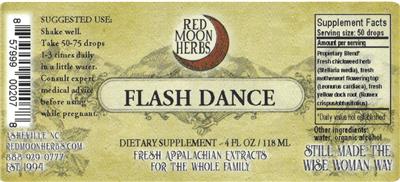
Suggested use: Shake well. Take 50-75 drops 1-3 times daily in a little water.
Precautions
Consult expert medical advice before using while pregnant.
General Statements
Red Moon Herbs Est. 1994 Still made the wise woman way
FDA Statement of Identity
Dietary Supplement
Formulation
Fresh Appalachian extracts for the whole family
Formula
Fresh Appalachian extracts for the whole family
Is this label outdated? Report a formula or label change and our pharmacy team will review it.
Flash Dance by Red Moon Herbs label
The label scan from the NIH Dietary Supplement Label Database. Tap to enlarge.
Label images are published by the NIH Dietary Supplement Label Database for the version of this product on file. Always read your actual product label.
View the full label (PDF)The Ingredients in Flash Dance by Red Moon Herbs
These are the 3 active ingredients this product is made of. Select any to open its full monograph.
Serving size50 Drop(s) Dosage formLiquid Amounts shown are per serving.
Most supplement products combine several ingredients, and a medication can interact with the product through any one of them. Each ingredient below shows whether it has known drug interactions.
Proprietary Blend
Other (inactive) ingredients: Water, Alcohol. These complete the product’s ingredient list but are not active constituents.
Flash Dance by Red Moon Herbs Drug Interactions
HelloPharmacist Interaction Report
Flash Dance by Red Moon Herbs contains three fresh plant ingredients, and we have documented interactions with one of them.
The most serious concern is yellow dock — it can significantly increase your risk of potassium loss if you take diuretics (water pills), and it may increase the toxic effects of digoxin, a heart medication. Both are Major-severity interactions.
Read the full breakdown — every affected drug type, severity by severity
Yellow dock also interacts with warfarin (a blood thinner), a Moderate-severity interaction. The laxative effect can increase warfarin's action and raise your bleeding risk.
Motherwort, the second active ingredient, has a Moderate interaction with CNS depressants — sedatives, sleeping pills, and similar drugs — by potentially increasing drowsiness and sedation. Chickweed was checked and has no interactions documented in our data.
Altogether, these interactions span 325 individual medications. Use the search tool below to check your specific prescriptions before you start.
Check your own medications below · Editorial policy · How we use AI
Want to check YOUR meds against Flash Dance?
Ask about interactions with your drugs in plain English — “Can I take it with lisinopril?” — and we find you the answer in seconds, ingredient by ingredient.
Go to the checkerIngredients driving the most interactions
Individual Drug Interactions
The ingredients in Flash Dance interact with 325 drugs. Click any drug to see the details.
2 of the 3 ingredients in Flash Dance interact with drugs. Each result below shows which ingredient is responsible. Motherwort, Fresh Yellow Dock, Fresh
Acetaminophen, Caffeine, PyrilamineMidol Max Strength Menstrual
How Acetaminophen, Caffeine, Pyrilamine interacts with Flash Dance — through 1 ingredient. Tap an ingredient for the detail:
Yellow Dock, FreshDiuretic Drugs Major
Interaction Summary
Theoretically, yellow dock might increase the risk of hypokalemia when taken with diuretics.
Read the full Yellow Dock, Fresh + Acetaminophen, Caffeine, Pyrilamine interactionAcetaminophen, Pamabrom, PyrilamineMidol Max Strength PMS, Pamprin, Pamprin ES
How Acetaminophen, Pamabrom, Pyrilamine interacts with Flash Dance — through 1 ingredient. Tap an ingredient for the detail:
Yellow Dock, FreshDiuretic Drugs Major
Interaction Summary
Theoretically, yellow dock might increase the risk of hypokalemia when taken with diuretics.
Read the full Yellow Dock, Fresh + Acetaminophen, Pamabrom, Pyrilamine interactionAcetazolamideAk-Zol, Diamox
How Acetazolamide interacts with Flash Dance — through 2 ingredients. Tap an ingredient for the detail:
Yellow Dock, FreshDiuretic Drugs Major
Interaction Summary
Theoretically, yellow dock might increase the risk of hypokalemia when taken with diuretics.
Read the full Yellow Dock, Fresh + Acetazolamide interactionMotherwort, FreshCns Depressants Moderate
Interaction Summary
Theoretically, taking motherwort concomitantly with other CNS depressants may increase the risk of sedation.
Read the full Motherwort, Fresh + Acetazolamide interactionAmiloride, HydrochlorothiazideAmil-Co, Amilzide, Moduret 25, Moduretic
How Amiloride, Hydrochlorothiazide interacts with Flash Dance — through 1 ingredient. Tap an ingredient for the detail:
Yellow Dock, FreshDiuretic Drugs Major
Interaction Summary
Theoretically, yellow dock might increase the risk of hypokalemia when taken with diuretics.
Read the full Yellow Dock, Fresh + Amiloride, Hydrochlorothiazide interactionAmmonium ChlorideAmmonium Chloride
How Ammonium Chloride interacts with Flash Dance — through 1 ingredient. Tap an ingredient for the detail:
Yellow Dock, FreshDiuretic Drugs Major
Interaction Summary
Theoretically, yellow dock might increase the risk of hypokalemia when taken with diuretics.
Read the full Yellow Dock, Fresh + Ammonium Chloride interactionAtenolol, ChlortalidoneAtenixCo, Tenoret 50, Totaretic
How Atenolol, Chlortalidone interacts with Flash Dance — through 1 ingredient. Tap an ingredient for the detail:
Yellow Dock, FreshDiuretic Drugs Major
Interaction Summary
Theoretically, yellow dock might increase the risk of hypokalemia when taken with diuretics.
Read the full Yellow Dock, Fresh + Atenolol, Chlortalidone interactionAtenolol, ChlorthalidoneTenoretic
How Atenolol, Chlorthalidone interacts with Flash Dance — through 1 ingredient. Tap an ingredient for the detail:
Yellow Dock, FreshDiuretic Drugs Major
Interaction Summary
Theoretically, yellow dock might increase the risk of hypokalemia when taken with diuretics.
Read the full Yellow Dock, Fresh + Atenolol, Chlorthalidone interactionAzilsartan, ChlorthalidoneEdarbyclor
How Azilsartan, Chlorthalidone interacts with Flash Dance — through 1 ingredient. Tap an ingredient for the detail:
Yellow Dock, FreshDiuretic Drugs Major
Interaction Summary
Theoretically, yellow dock might increase the risk of hypokalemia when taken with diuretics.
Read the full Yellow Dock, Fresh + Azilsartan, Chlorthalidone interactionBenazepril, HydrochlorothiazideLotensin HCT
How Benazepril, Hydrochlorothiazide interacts with Flash Dance — through 1 ingredient. Tap an ingredient for the detail:
Yellow Dock, FreshDiuretic Drugs Major
Interaction Summary
Theoretically, yellow dock might increase the risk of hypokalemia when taken with diuretics.
Read the full Yellow Dock, Fresh + Benazepril, Hydrochlorothiazide interactionBendroflumethiazideAprinox, Naturetin, Neo-NaClex
How Bendroflumethiazide interacts with Flash Dance — through 1 ingredient. Tap an ingredient for the detail:
Yellow Dock, FreshDiuretic Drugs Major
Interaction Summary
Theoretically, yellow dock might increase the risk of hypokalemia when taken with diuretics.
Read the full Yellow Dock, Fresh + Bendroflumethiazide interactionBendroflumethiazide, NadololCorzide
How Bendroflumethiazide, Nadolol interacts with Flash Dance — through 1 ingredient. Tap an ingredient for the detail:
Yellow Dock, FreshDiuretic Drugs Major
Interaction Summary
Theoretically, yellow dock might increase the risk of hypokalemia when taken with diuretics.
Read the full Yellow Dock, Fresh + Bendroflumethiazide, Nadolol interactionBendroflumethiazide, PotassiumCentyl K, Neo-NaClex-K
How Bendroflumethiazide, Potassium interacts with Flash Dance — through 1 ingredient. Tap an ingredient for the detail:
Yellow Dock, FreshDiuretic Drugs Major
Interaction Summary
Theoretically, yellow dock might increase the risk of hypokalemia when taken with diuretics.
Read the full Yellow Dock, Fresh + Bendroflumethiazide, Potassium interactionBendroflumethiazide, Rauwolfia SerpentinaRauzide
How Bendroflumethiazide, Rauwolfia Serpentina interacts with Flash Dance — through 1 ingredient. Tap an ingredient for the detail:
Yellow Dock, FreshDiuretic Drugs Major
Interaction Summary
Theoretically, yellow dock might increase the risk of hypokalemia when taken with diuretics.
Read the full Yellow Dock, Fresh + Bendroflumethiazide, Rauwolfia Serpentina interactionBenzthiazideExna
How Benzthiazide interacts with Flash Dance — through 1 ingredient. Tap an ingredient for the detail:
Yellow Dock, FreshDiuretic Drugs Major
Interaction Summary
Theoretically, yellow dock might increase the risk of hypokalemia when taken with diuretics.
Read the full Yellow Dock, Fresh + Benzthiazide interactionBisoprolol, HydrochlorothiazideZiac
How Bisoprolol, Hydrochlorothiazide interacts with Flash Dance — through 1 ingredient. Tap an ingredient for the detail:
Yellow Dock, FreshDiuretic Drugs Major
Interaction Summary
Theoretically, yellow dock might increase the risk of hypokalemia when taken with diuretics.
Read the full Yellow Dock, Fresh + Bisoprolol, Hydrochlorothiazide interactionBumetanideBurinex
How Bumetanide interacts with Flash Dance — through 1 ingredient. Tap an ingredient for the detail:
Yellow Dock, FreshDiuretic Drugs Major
Interaction Summary
Theoretically, yellow dock might increase the risk of hypokalemia when taken with diuretics.
Read the full Yellow Dock, Fresh + Bumetanide interactionBumetanide, PotassiumBurinex K
How Bumetanide, Potassium interacts with Flash Dance — through 1 ingredient. Tap an ingredient for the detail:
Yellow Dock, FreshDiuretic Drugs Major
Interaction Summary
Theoretically, yellow dock might increase the risk of hypokalemia when taken with diuretics.
Read the full Yellow Dock, Fresh + Bumetanide, Potassium interactionCaffeine, Potassium Salicylate, SalicylamideTrim-Elim
How Caffeine, Potassium Salicylate, Salicylamide interacts with Flash Dance — through 1 ingredient. Tap an ingredient for the detail:
Yellow Dock, FreshDiuretic Drugs Major
Interaction Summary
Theoretically, yellow dock might increase the risk of hypokalemia when taken with diuretics.
Read the full Yellow Dock, Fresh + Caffeine, Potassium Salicylate, Salicylamide interactionCandesartan Cilexetil, HydrochlorothiazideAtacand HCT
How Candesartan Cilexetil, Hydrochlorothiazide interacts with Flash Dance — through 1 ingredient. Tap an ingredient for the detail:
Yellow Dock, FreshDiuretic Drugs Major
Interaction Summary
Theoretically, yellow dock might increase the risk of hypokalemia when taken with diuretics.
Read the full Yellow Dock, Fresh + Candesartan Cilexetil, Hydrochlorothiazide interactionCaptopril, HydrochlorothiazideAcezide, Capozide
How Captopril, Hydrochlorothiazide interacts with Flash Dance — through 1 ingredient. Tap an ingredient for the detail:
Yellow Dock, FreshDiuretic Drugs Major
Interaction Summary
Theoretically, yellow dock might increase the risk of hypokalemia when taken with diuretics.
Read the full Yellow Dock, Fresh + Captopril, Hydrochlorothiazide interactionChlorothiazideDiuril
How Chlorothiazide interacts with Flash Dance — through 1 ingredient. Tap an ingredient for the detail:
Yellow Dock, FreshDiuretic Drugs Major
Interaction Summary
Theoretically, yellow dock might increase the risk of hypokalemia when taken with diuretics.
Read the full Yellow Dock, Fresh + Chlorothiazide interactionChlorothiazide, MethyldopaAldochlor, Aldoclor 150, Aldoclor 250
How Chlorothiazide, Methyldopa interacts with Flash Dance — through 1 ingredient. Tap an ingredient for the detail:
Yellow Dock, FreshDiuretic Drugs Major
Interaction Summary
Theoretically, yellow dock might increase the risk of hypokalemia when taken with diuretics.
Read the full Yellow Dock, Fresh + Chlorothiazide, Methyldopa interactionChlorothiazide, ReserpineDiupres
How Chlorothiazide, Reserpine interacts with Flash Dance — through 1 ingredient. Tap an ingredient for the detail:
Yellow Dock, FreshDiuretic Drugs Major
Interaction Summary
Theoretically, yellow dock might increase the risk of hypokalemia when taken with diuretics.
Read the full Yellow Dock, Fresh + Chlorothiazide, Reserpine interactionChlorthalidoneHygroton, Thalitone
How Chlorthalidone interacts with Flash Dance — through 1 ingredient. Tap an ingredient for the detail:
Yellow Dock, FreshDiuretic Drugs Major
Interaction Summary
Theoretically, yellow dock might increase the risk of hypokalemia when taken with diuretics.
Read the full Yellow Dock, Fresh + Chlorthalidone interactionChlorthalidone, ClonidineClorpres, Combipres
How Chlorthalidone, Clonidine interacts with Flash Dance — through 1 ingredient. Tap an ingredient for the detail:
Yellow Dock, FreshDiuretic Drugs Major
Interaction Summary
Theoretically, yellow dock might increase the risk of hypokalemia when taken with diuretics.
Read the full Yellow Dock, Fresh + Chlorthalidone, Clonidine interactionCryptenamine, MethyclothiazideDiutensen
How Cryptenamine, Methyclothiazide interacts with Flash Dance — through 1 ingredient. Tap an ingredient for the detail:
Yellow Dock, FreshDiuretic Drugs Major
Interaction Summary
Theoretically, yellow dock might increase the risk of hypokalemia when taken with diuretics.
Read the full Yellow Dock, Fresh + Cryptenamine, Methyclothiazide interactionCyclothiazideAnhydron, Fluidil
How Cyclothiazide interacts with Flash Dance — through 1 ingredient. Tap an ingredient for the detail:
Yellow Dock, FreshDiuretic Drugs Major
Interaction Summary
Theoretically, yellow dock might increase the risk of hypokalemia when taken with diuretics.
Read the full Yellow Dock, Fresh + Cyclothiazide interactionDeserpidine, HydrochlorothiazideOreticyl, Oreticyl Forte
How Deserpidine, Hydrochlorothiazide interacts with Flash Dance — through 1 ingredient. Tap an ingredient for the detail:
Yellow Dock, FreshDiuretic Drugs Major
Interaction Summary
Theoretically, yellow dock might increase the risk of hypokalemia when taken with diuretics.
Read the full Yellow Dock, Fresh + Deserpidine, Hydrochlorothiazide interactionDeserpidine, MethyclothiazideEnduronyl, Enduronyl Forte
How Deserpidine, Methyclothiazide interacts with Flash Dance — through 1 ingredient. Tap an ingredient for the detail:
Yellow Dock, FreshDiuretic Drugs Major
Interaction Summary
Theoretically, yellow dock might increase the risk of hypokalemia when taken with diuretics.
Read the full Yellow Dock, Fresh + Deserpidine, Methyclothiazide interactionDigoxinDigitek, Lanoxicaps, Lanoxin
How Digoxin interacts with Flash Dance — through 1 ingredient. Tap an ingredient for the detail:
Yellow Dock, FreshDigoxin (lanoxin) Major
Interaction Summary
Theoretically, yellow dock might increase the risk of digoxin toxicity when used long-term or in large amount.
Read the full Yellow Dock, Fresh + Digoxin interactionEach ingredient & the kinds of drugs it affects
For each ingredient in Flash Dance with known interactions, here are the types of medications they can affect. Open any type for the detail — or search your exact drug in the checker above.
Motherwort, Fresh
Cns Depressants
Theoretically, taking motherwort concomitantly with other CNS depressants may increase the risk of sedation.
Motherwort has been reported to cause CNS depression and sedation.
Yellow Dock, Fresh
Digoxin (Lanoxin)
Theoretically, yellow dock might increase the risk of digoxin toxicity when used long-term or in large amount.
When yellow dock is used chronically or in large amounts, hypokalemia may occur. This might increase the toxic effects of digoxin.
Diuretic Drugs
Theoretically, yellow dock might increase the risk of hypokalemia when taken with diuretics.
When yellow dock is used chronically or in large amounts, hypokalemia may occur, and overuse of yellow dock might compound diuretic-induced potassium loss.
Warfarin (Coumadin)
Theoretically, the laxative effects of yellow dock might increase the effects of warfarin, including the risk of bleeding.
The anthraquinones in yellow dock have a mild stimulant laxative effect. Consuming excessive amounts can cause diarrhea. Diarrhea can increase the effects of warfarin, increase international normalized ratio (INR), and increase the risk of bleeding.
Brand information
Manufacturer and brand details for Flash Dance, from the product label.
Red Moon Herbs
See all Red Moon Herbs products- Name
- Red Moon Herbs
- City
- Asheville
- State
- NC
- Phone Number
- 888-929-0777
- Web Address
- redmoonherbs.com
Flash Dance by Red Moon Herbs: Common Questions
Does Flash Dance by Red Moon Herbs interact with any medications?
How can one product interact with so many drugs?
Where does this information come from?
Can I take this if I'm pregnant?
Is this safe while breastfeeding?
Does this actually work for weight loss or high cholesterol?
What does motherwort do?
Why is yellow dock concerning with my water pill?
What are the common side effects?
Written and reviewed by the HelloPharmacist editorial staff. Our editorial policy
Not sure if Flash Dance is safe with your meds?
Our pharmacists answer your medication & supplement questions — free.
Label information is sourced from the NIH Dietary Supplement Label Database and reflects the product version on file; always read your actual product label. This page is for education only and is not a substitute for professional medical advice. Confirm with your pharmacist or doctor before combining supplements and medications.
The Full Monographs Behind Flash Dance’s Ingredients
Every ingredient we hold a full HelloPharmacist monograph for — uses, evidence, safety, and the complete interaction list.
Chickweed
Chickweed is a common edible wild plant traditionally used on the skin for itching and minor irritation, and taken as a tea or tincture for various complaints. Solid human studies are lackin...
Read the full Chickweed monograph → Herb & supplement monographMotherwort
Interacts with 248 drugsMotherwort is a traditional herb in the mint family long used for anxiety, heart palpitations, and women's reproductive complaints, but solid human evidence is very limited. It should be avo...
Read the full Motherwort monograph → Herb & supplement monographYellow Dock
Interacts with 78 drugsYellow dock is a traditional herb used mostly as a mild laxative and a digestive and skin tonic. Good-quality human studies are lacking, so its benefits are largely unproven, and its natural...
Read the full Yellow Dock monograph →Sources & How We Checked
Flash Dance's label data comes from the NIH Dietary Supplement Label Database; the ingredient interaction data is from the Natural Medicines database, reviewed by our pharmacists.
- NIH Dietary Supplement Label Database (DSLD) — The official product label on file for this supplement.
- Natural Medicines (Therapeutic Research Center) — Evidence-graded clinical reference behind the ingredient interaction data.
Content is written and reviewed by licensed HelloPharmacist pharmacists. See our data sources and editorial standards for how this information is built and checked.
The 18 references behind this product’s interaction data
Every citation that drives the interaction findings for this product’s ingredients, from the evidence-graded Natural Medicines (TRC Healthcare) database. Open an ingredient to browse its citations — links open the study on PubMed or the publisher’s site.
Chickweed 4 references
- McGuffin M, Hobbs C, Upton R, Goldberg A, eds. American Herbal Products Association's Botanical Safety Handbook. Boca Raton, FL: CRC Press, LLC 1997.
- Jovanovic M, Mimica-Dukic N, Poljacki M, Boza P. Erythema multiforme due to contact with weeds: a recurrence after patch testing. Contact Dermatitis 2003;48:17-25. PubMed
- Jovanovic, M., Poljacki, M., Mimica-Dukic, N., Boza, P., Vujanovic, Lj, Duran, V., and Stojanovic, S. Sesquiterpene lactone mix patch testing supplemented with dandelion extract in patients with allergic contact dermatitis, atopic dermatitis and non-alle
- Poljacki, M., Jovanovic, M., Boza, P., Mimica-Dukic, N., Petrovic, A., and Novovic, Z. [Is Vojvodina a risk area for contact weed allergies?]. Med Pregl. 2005;58(3-4):123-126. PubMed
Motherwort 6 references
- Newall CA, Anderson LA, Philpson JD. Herbal Medicine: A Guide for Healthcare Professionals. London, UK: The Pharmaceutical Press, 1996.
- McGuffin M, Hobbs C, Upton R, Goldberg A, eds. American Herbal Products Association's Botanical Safety Handbook. Boca Raton, FL: CRC Press, LLC 1997.
- Brinker F. Herb Contraindications and Drug Interactions. 2nd ed. Sandy, OR: Eclectic Medical Publications, 1998.
- Wojtyniak K, Szymanski M, Matlawska I. Leonurus cardiaca L. (motherwort): a review of its phytochemistry and pharmacology. Phytother Res 2013;27(8):1115-20.
- Xia WT, Zhou H, Wang Y, et al. Motherwort injection in preventing post-abortion hemorrhage after induced abortion: A multi-center, prospective, randomized controlled trial. Explore (NY). 2019. pii: S1550-8307(19)30447-1. PubMed
- Cao Shan DOSOGC, Zhang W, Zhao Z, et al. Post-marketing safety surveillance and reevaluation of Motherwort injection: A clinical study of 10 094 cases. J Tradit Chin Med. 2018 Aug;38(4):625-635. DOI
Yellow Dock 8 references
- Newall CA, Anderson LA, Philpson JD. Herbal Medicine: A Guide for Healthcare Professionals. London, UK: The Pharmaceutical Press, 1996.
- Foster S, Tyler VE. Tyler's Honest Herbal: A Sensible Guide to the Use of Herbs and Related Remedies. 3rd ed., Binghamton, NY: Haworth Herbal Press, 1993.
- The Review of Natural Products by Facts and Comparisons. St. Louis, MO: Wolters Kluwer Co., 1999.
- McGuffin M, Hobbs C, Upton R, Goldberg A, eds. American Herbal Products Association's Botanical Safety Handbook. Boca Raton, FL: CRC Press, LLC 1997.
- Ellenhorn MJ, et al. Ellenhorn's Medical Toxicology: Diagnoses and Treatment of Human Poisoning. 2nd ed. Baltimore, MD: Williams & Wilkins, 1997.
- Gruenwald J, Brendler T, Jaenicke C. PDR for Herbal Medicines. 1st ed. Montvale, NJ: Medical Economics Company, Inc., 1998.
- Brinker F. Herb Contraindications and Drug Interactions. 2nd ed. Sandy, OR: Eclectic Medical Publications, 1998.
- Latif A, Fichadiya H, Abid F, Capo G. Herbal Teas and Thrombocytopenia: A Curious Case of Yellow Dock and Burdock-Induced Thrombocytopenia. Eur J Case Rep Intern Med 2022;9(3):003247. PubMed
Parts of this content are provided by the Therapeutic Research Center, LLC.
DISCLAIMER: Currently this does not check for drug-drug interactions. This is not an all-inclusive comprehensive list of potential interactions and is for informational purposes only. Not all interactions are known or well-reported in the scientific literature, and new interactions are continually being reported. Input is needed from a qualified healthcare provider including a pharmacist before starting any therapy. Application of clinical judgment is necessary.
© 2021 Therapeutic Research Center, LLC