
Max Test by Cellucor Ingredients, Side Effects and Drug Interactions
Dietary Supplement Capsule Other Combinations
Max Test by Cellucor is a dietary supplement with twelve active ingredients: 1 vitamin, 1 mineral, 7 plant ingredients such as Cardiose, Rhodiola rosea Root and Cacao Seed and 3 others. It is marketed for testosterone boost, muscle strength, libido and fat burning.
UPC 8 42595 13435 3 Match it to the barcode on your bottle

Medically reviewed by Dr. Brian Staiger, PharmD, BCPS
Also reviewed by the HelloPharmacist Editorial Team
Updated Details about this page
- Label on file from the NIH Dietary Supplement Label Database, dated Jul 24, 2025.
- The interaction, evidence and safety records come from the Natural Medicines database, which we license, read against this label by our own system; the pharmacy team’s sections are written from those records.
- Dr. Brian Staiger, PharmD, BCPS, is a clinical pharmacist and pharmacotherapy specialist.
- Editorial policy Our sources
AI is used only to summarize verified clinical information, never the open internet. Our AI policy
Summary: The HelloPharmacist Team’s Take
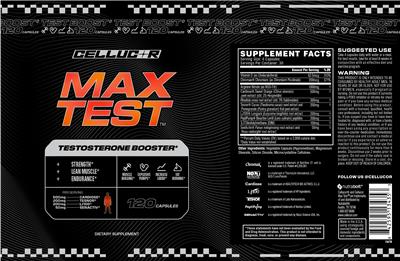
This summary is for Max Test by Cellucor
- Form
- Capsule
- Serving Size
- 4 Capsules
- Servings
- 30 per container
- Container Holds
- 120 Capsules
- What is Max Test?A supplement from Cellucor with twelve active ingredients, in capsule form.
- Active Ingredients 1 vitamin, 1 mineral, 7 plant ingredients such as Cardiose, Rhodiola rosea Root and Cacao Seed and 3 others: Vitamin D 62.5 mcgChromax 200 mcgNO3-T 1000 mgCardiose 500 mgRhodiola rosea Root Extract 300 mgCacao Seed ExtractPomegranate Fruit Peel ExtractLJ100 200 mgPeptiPump Bioactive Lentil Peptides 200 mg3,3 Diindolylmethane 100 mgPanax notoginseng Root ExtractRosa roxburghii Root Extract Twelve active ingredients. Each one can interact with drugs or cause side effects on its own, so we check every one. The full Supplement Facts
- Drug Interactions 1,386 drugs have a documented interaction with this supplement; the most serious is rated major. Of those, 955 are single drugs and 431 are combination products (two or more drugs in one), each listed under its own name. Based on the 8 of its 12 ingredients we could check. Ask your pharmacist first if you take a drug in any of these categories, the most serious of the 40 on record:
- Major · 47 drugs
- Celiprolol (Celicard)Major · 1 drug
- Ivermectin (Stromectol, others)Major · 1 drug
- Pravastatin (Pravachol)Major · 1 drug
- Possible Side EffectsDizziness 3 ingredientsNausea 3 ingredientsStomach upset 3 ingredientsDry mouth 2 ingredientsGas 2 ingredientsHeadache 2 ingredients +8 moreCombined from six of its twelve active ingredients. Not studied in this exact product.
- Well documented Why
Does Max Test work?
What It Is Marketed For
- Testosterone boost
- Muscle strength
- Libido
- Fat burning
From the claims on the product’s label.
The Closest Use the Research Grades
Sexual desire Eurycoma Longifolia
Some studies support it, but the evidence isn’t conclusive.
Its ingredients have stronger research for other uses:
- Vitamin D
- Corticosteroid-induced osteoporosis Vitamin D
- Chromium
- Pomegranate
- Vitamin D
These grades are for each ingredient, not this exact product, and never a promise it will work for you.
And 3 more graded uses, in what the research says- AllergensNone of its ingredient names point to a major food allergen, and the label text we have carries no allergen statement
- Barcode (UPC)8 42595 13435 3Match it to the barcode on your bottle to be sure this is your product. Not your product? Search for it here
Who Might Consider It
- People looking for testosterone boost, muscle strength, libido and fat burning, which is what it is marketed for. The closest use the research grades is sexual desire, rated Possibly Effective.
- People who want it for osteoporosis, corticosteroid-induced osteoporosis, diabetes, hypertension or another graded use: the other uses with research behind them. See each grade
- Max Test may appeal to people who want vitamin D or chromium, since those have the strongest ratings.
Who Should Be Careful
- People taking prescription medicines, especially blood thinners, diabetes drugs, heart medicines, or statins, should be careful.
- Talk it over with your own doctor or pharmacist before starting.
More Before You Take It Show both answersHide Pregnancy and Breastfeeding The Label’s Directions
-
Pregnant or breastfeeding?
- Pregnancy and Breastfeeding Panax Notoginseng
- ! When used orally.
- Pregnancy Vitamin D
- ! When used orally in excessive amounts.
- Breastfeeding Vitamin D
- ! When used orally in excessive amounts.
- Pregnancy and Breastfeeding Rhodiola
- Insufficient reliable information available; avoid using.
-
How does the label say to take it?
“Suggested use Take 4 capsules daily with water or a meal. For best results, take for at least 8-weeks in conjunction with an effective diet and exercise program.”
The maker’s words. Your pharmacist or doctor may advise differently.
Everything the label says
From the label dated Jul 24, 2025: 8 of its 12 active ingredients were checked against our records; the other four are not in them yet. A summary of what is known, not a grade or a test of the product. How these ratings are computed
Ask Anything About This Supplement
Name a drug you take, or ask about side effects, ingredients or pregnancy.
There’s a lot of information about this supplement on this page! Ask anything in plain English for a quick answer drawn from it.
AI answers come from this label and our own records, never the open internet. AI can make mistakes, so always check with your doctor or pharmacist. How we use AI
Ask the Pharmacist
A licensed pharmacist will answer your question by email — free, as soon as they can.
Got it — thank you!
A licensed pharmacist will answer as soon as they can. Keep an eye on your email (worth checking spam, just in case).
What’s Inside Max Test by Cellucor
Twelve Active Ingredients
In the order the label lists them, each with its own card below.
The label gives an exact amount for 8 of its 12 active ingredients. The other four are inside two proprietary blends, and the label gives one total for each, not how much of each ingredient is in it.
- 8 state an exact amount
- 4 have no amount of their own
- Tesnor 200 mg in total · 2 ingredients, no amount for each
- SenActiv 50 mg in total · 2 ingredients, no amount for each
This rates what the label tells you, not the quality of the product.
Supplement Facts
| Amount Per Serving | % Daily Value | |
|---|---|---|
| Vitamin D | 62.5 mcg | 313% |
| Chromax | 200 mcg | 571% |
| NO3-T | 1000 mg | † |
| Cardiose | 500 mg | † |
| Rhodiola rosea Root Extract | 300 mg | † |
| Tesnor | 200 mg | † |
| Cacao Seed Extract | † | |
| Pomegranate Fruit Peel Extract | † | |
| LJ100 | 200 mg | † |
| PeptiPump Bioactive Lentil Peptides | 200 mg | † |
| 3,3 Diindolylmethane | 100 mg | † |
| SenActiv | 50 mg | † |
| Panax notoginseng Root Extract | † | |
| Rosa roxburghii Root Extract | † | |
Other ingredients: Hypromellose, Magnesium Stearate, Silicon Dioxide, Microcrystalline Cellulose
† Daily Value not established.
Daily Values for adults and children 4 or more years of age.
As the label prints it, from the NIH Dietary Supplement Label Database.
Each Ingredient and Its Drug Interactions
Tap one for more about it and its full guide. A drug can interact with this supplement through any one of them.
The active ingredients in Max Test include vitamin D, chromium (as Chromax), 3,3 diindolylmethane (DIM), rhodiola root extract, Panax notoginseng root extract, sweet orange (Cardiose), pomegranate fruit peel extract, Eurycoma longifolia (LJ100), and several others: NO3-T, cacao seed extract, PeptiPump lentil peptides, rosa roxburghii root extract, and two blends, Tesnor and SenActiv.
- We have no separate interaction information for the blends or for the ingredients we could not check.
- Our data describes these ingredients mainly by the conditions they have been studied for, not by a stated purpose.
-
Vitamin D 62.5 mcg Interacts with 717 drugs
Form on the label: Cholecalciferol
Vitamin D is a fat-soluble vitamin that helps your body absorb calcium and is important for healthy bones, muscles, and immune function.
- Many people, especially those with low sun exposure, benefit from supplementation, but more is not always better and very high doses can be harmful.
- Ask your pharmacist or doctor whether a blood test and supplement make sense for you.
The full Vitamin D guide: uses, dosage and safety Every Vitamin D drug interaction
-
Chromax 200 mcg Interacts with 178 drugs
Form on the label: Chromium
Chromium is an essential trace mineral involved in how the body handles sugar and fat.
- Some studies suggest it may modestly help blood sugar control in certain people with type 2 diabetes, but results are mixed and the effect on weight loss is small and uncertain.
- For most healthy people who eat a varied diet, supplements are not needed; check with your pharmacist or doctor before starting.
The full Chromium guide: uses, dosage and safety Every Chromium drug interaction
-
NO3-T 1000 mg We know this ingredient, but hold no drug interaction record for it yet, so it was not checked
Form on the label: Arginine Nitrate
-
Cardiose 500 mg Interacts with 247 drugs
Form on the label: Sweet Orange Peel Extract
Sweet orange is a common citrus fruit that is a good source of vitamin C, fiber, and antioxidants, and is enjoyed as a food worldwide.
- Its peel and essential oil are used in aromatherapy and traditional remedies, but strong scientific proof for most medicinal claims is limited.
- The fruit and juice are safe for most people as food, while concentrated oils and extracts deserve more caution.
The full Sweet Orange guide: uses, dosage and safety Every Sweet Orange drug interaction
-
Rhodiola rosea Root Extract 300 mg Interacts with 1,271 drugs
Form on the label: Salidrosides
Rhodiola is an herb traditionally used to fight fatigue and help the body cope with stress.
- Some small studies suggest it may modestly reduce fatigue and improve mood, but the evidence is limited and not strong.
- It is generally well tolerated for short-term use, but talk to your pharmacist or doctor before trying it, and avoid it during pregnancy and breastfeeding.
The full Rhodiola guide: uses, dosage and safety Every Rhodiola drug interaction
-
Tesnor 200 mg Two ingredients inside it, each checked on its own
- Cacao Seed Extract
- Pomegranate Fruit Peel Extract 924 drugs
-
LJ100 200 mg Interacts with 249 drugs
Form on the label: Longjack Root Extract
Eurycoma longifolia (tongkat ali) is a Southeast Asian herb most popular for supporting testosterone, libido, and male fertility, with some small human studies suggesting possible benefits.
- However, the overall evidence is still limited and product quality varies widely, so talk with your pharmacist or doctor before using it, and avoid it if you are pregnant or breastfeeding.
The full Eurycoma Longifolia guide: uses, dosage and safety Every Eurycoma Longifolia drug interaction
-
PeptiPump Bioactive Lentil Peptides 200 mg A blend: its ingredients are checked one by one where the label lists them
Form on the label: Lens culinaris
-
3,3 Diindolylmethane 100 mg Interacts with 269 drugs
Diindolylmethane (DIM) is a compound made when your body digests cruciferous vegetables, and it is sold as a supplement mainly for hormone balance and cancer prevention.
- Although early lab studies look interesting, strong human evidence is lacking for most of these uses.
- Talk with your pharmacist or doctor before taking DIM, especially if you have a hormone-sensitive condition.
The full Diindolylmethane guide: uses, dosage and safety Every Diindolylmethane drug interaction
-
SenActiv 50 mg Two ingredients inside it, each checked on its own
- Panax notoginseng Root Extract 207 drugs
- Rosa roxburghii Root Extract
Other Ingredients (Inactive)
The capsule or tablet itself, fillers, coatings and flavors. Not part of the drug interaction check; the allergen check below reads them.
- Hypromellose
- Magnesium Stearate
- Silicon Dioxide
- Microcrystalline Cellulose
Allergens in Max Test
None of its ingredient names point to a major food allergen, and the label text we have carries no allergen statement.
Not named in the ingredients
- Milk
- Egg
- Fish
- Shellfish
- Tree nuts
- Peanuts
- Wheat or other gluten grains
- Soy
- Sesame
From the label text and ingredient names on file; we do not test products. With a serious allergy, check your bottle and ask the maker or your pharmacist.
What the Label Says
The maker’s own words, from the label. We do not verify or endorse them.
- Formulation
-
“Test boost Testosterone booster Strength Lean muscle Endurance Muscle building Explosive pumps Increase libido Fat burning”
“Made in the U.S.A. using strategically sourced foreign and domestic ingredients and components.”
“Per serving 500 mg - Cardiose 200 mg - Tesnor 200 mg - LJ100 50 mg - Senactiv”
- FDA Statement of Identity
-
“Dietary Supplement”
- Brand IP Statement(s)
-
“ChromaX is a registered trademark of Nutrition 21 and is licensed under U.S. Patent #6,329,361. NO3T NITRATE TECHNOLOGY is a trademark of ThermoLife International, LLC. NO3-T.com/Patents Cardiose is a trademark of HEALTHTECH BIO ACTIVES, S.L.U. LJ100 is a registered trademark of HP Ingredients. TESNOR is a trademark of Laila Nutraceuticals. PeptiPump is a registered trademark of Nuritas Limited. SENACTIV is a registered trademark by NuLiv Science USA, Inc.”
“Cellucor and Cellucor Max Test are trademarks of and distributed by: Nutrabolt”
- Storage
-
“Store in a cool, dry place.”
- General statements
-
“Follow us @cellucor”
The Max Test Label on File
The label scan on file at the NIH Dietary Supplement Label Database, dated July 2025. Always read the label on the bottle you have.
Product Facts
Is this label outdated? Report a formula or label change and our pharmacy team will review it.
HelloPharmacist Score Max Test by Cellucor
Up to 10 points for research, amount, label and outside testing. Not a safety rating. How this one adds up
for muscle strength
There is too little good research to say whether pomegranate, one of its ingredients, helps with muscle strength, which is what it is marketed for.
- Research0 of 5 points
- Amount0 of 2 points
- Label1 of 2 points
- Outside testing0 of 1 point
Major drug interactions. The score does not count drug interactions. Check them against any drugs you take. See them
How It Earns Its 1
Score: 1 out of 10. Unproven for muscle strength.
Research
Too little research on pomegranate for muscle strength.
Graded “Insufficient Reliable Evidence to Rate” in the Natural Medicines database, which we license. The combination itself is not studied, so research counts for at most 3 of 5 points.
0 of 5 points
Amount
The label does not say how much pomegranate is in it.
0 of 2 points
Label
It states the amount of eight of its 12 active ingredients; four are inside blends that give only a total.
1 of 2 points
Outside testing
We found no mark from an outside testing program, such as USP Verified or NSF Certified, on the label we have on file.
0 of 1 point
Max Test by Cellucor Side Effects
Why this rating?
We look for three kinds of safety information on each ingredient: side effects reported in studies, a pregnancy and breastfeeding rating, and a safety write-up from our pharmacy team. All three are on file for each of the eight ingredients we could check.
So this rates how much is known, not whether Max Test is right for you.
Reported with eight of its ingredients
- Most often
- Dizziness, nausea, stomach upset, dry mouth, gas and headache
- !Rare but serious
- Drug rash with eosinophilia and systemic symptoms (DRESS) See details
HelloPharmacist Team Summary: Max Test by Cellucor Side Effects
For most people, the ingredients in Max Test are generally well tolerated, though the data is thinner for several of them.
- You're most likely to notice an upset stomach or nausea, which we've seen with chromium, Panax notoginseng, and Eurycoma longifolia.
- Dizziness is also reported with chromium, rhodiola, and Panax notoginseng, so if it happens, see how it affects you before driving, and trouble sleeping is reported with rhodiola and Eurycoma.
- The rare serious concern is very high blood calcium from vitamin D, which can harm the kidneys and heart, so call your doctor if you think you have it.
- Talk with your own doctor or pharmacist before starting, especially if you have kidney or heart conditions, are pregnant, or take blood thinners or diabetes medicines.
Side Effects, Ingredient by Ingredient
A supplement’s side effects come from its ingredients. Here is what is reported with each one.
Chromium
Most reported
- Headache
- Dizziness
- Nausea
- Stomach upset
Rhodiola
Most reported
- Dizziness
- Dry mouth
- Trouble sleeping (especially if taken later in the day)
- Jitteriness or feeling restless
Pomegranate
Most reported
- Diarrhea
- Flatulence
From the Natural Medicines database, which we license.
Every reported effect, in the Pomegranate guideEurycoma Longifolia
Most reported
- Restlessness
- Trouble sleeping
- Irritability
- Stomach upset
Diindolylmethane
Most reported
- Headache
- Nausea or upset stomach
- Gas or changes in bowel habits
- Darkening of the urine (a harmless color change some people notice)
Panax Notoginseng
Most reported
- Stomach upset
- Nausea
- Dry mouth
- Dizziness
Vitamin D and Sweet Orange have side-effect reports, but no list of the most common ones. Read them in each guide: Vitamin D, Sweet Orange.
Max Test Warnings: Who Should Be Careful
Max Test has twelve active ingredients, and each can carry warnings of its own. We checked the eight in our ingredient guides, and each warning below names the ingredient it comes from. NO3-T, Cacao Seed Extract and PeptiPump Bioactive Lentil Peptides and one more are not in our guides yet, so ask your pharmacist about them. If any of these apply to you, talk to your doctor or pharmacist before you start it.
- Vitamin D2 warnings below
- Chromium3 warnings below
- Sweet Orange2 warnings below
- Rhodiola3 warnings below
- Pomegranate3 warnings below
- Eurycoma Longifolia3 warnings below
- Diindolylmethane2 warnings below
- Panax Notoginseng2 warnings below
- NO3-TNot in our guides yet
- Cacao Seed ExtractNot in our guides yet
- PeptiPump Bioactive Lentil PeptidesNot in our guides yet
- Rosa roxburghii Root ExtractNot in our guides yet
-
Bleeding Problems or Surgery
- RhodiolaPeople with low blood pressure or those undergoing surgery should also talk to a healthcare provider first.
- DiindolylmethaneAlways tell your pharmacist or doctor about any supplements you take, especially before surgery or if you have a chronic medical condition.
- Panax NotoginsengBecause the herb may affect blood clotting, people with bleeding disorders, those scheduled for surgery, or anyone taking medicines that affect bleeding should be especially cautious and talk to a healthcare provider first.
-
Diabetes or Low Blood Sugar
- ChromiumPeople with diabetes should monitor their blood sugar closely, since chromium may affect blood sugar levels.
-
Blood Pressure
- Panax NotoginsengPeople with heart conditions, low or high blood pressure, or who are managing chronic illnesses should also check with a doctor before use.
-
Liver Disease
- ChromiumStill, taking high doses or using it for a long time may carry risks, and some case reports have linked very high intakes to kidney or liver problems.
- ChromiumPeople with kidney disease or liver disease should be especially careful and talk to a doctor before using chromium.
-
Kidney Disease or Kidney Stones
- Vitamin DPeople with certain conditions should be careful, including those with high blood calcium, kidney disease, kidney stones, or sarcoidosis.
-
Stomach or Bowel Problems
- Sweet OrangePeople with citrus allergies, acid reflux, or sensitive stomachs may want to limit acidic citrus.
-
Hormone-Sensitive Conditions
- Eurycoma LongifoliaPeople with hormone-sensitive conditions, prostate problems, or other ongoing health issues should be cautious and check with a healthcare professional first.
- DiindolylmethaneBecause DIM may affect hormone activity, people with hormone-sensitive conditions (such as certain breast, uterine, or prostate cancers, or endometriosis) should be especially careful and talk with their doctor first.
-
Mental Health Conditions
- RhodiolaUse extra caution if you have a mental health condition such as bipolar disorder, since stimulating herbs could potentially affect mood.
-
Allergies
- PomegranatePeople with allergies to pomegranate should avoid it.
-
Children
- Eurycoma LongifoliaChildren should not use it.
-
If You Take Other Drugs
- PomegranateIf you have a chronic health condition or take prescription medications, talk with your pharmacist or doctor before using pomegranate supplements.
- Eurycoma LongifoliaAlways tell your pharmacist or doctor about any supplement you are taking, especially if you have a medical condition or take other medicines.
-
Other Cautions
- Vitamin DIf you have any of these, talk to your doctor before supplementing.
- Sweet OrangeOrange essential oil is for external or aromatherapy use and should not be swallowed unless a qualified professional advises it.
- RhodiolaChoose products from reputable brands, ideally with third-party testing, and always check with your pharmacist or doctor before starting.
- PomegranateThese parts should not be used in concentrated forms without professional guidance.
-
What the Label Warns
- “Warning This product is only intended to be consumed by healthy adult men, 18 years of age or older.”
- “Not for use by women, especially if pregnant or nursing. Do not use this product if currently taking PDE5 inhibitor or nitrates for chest pain or if you have any serious medical condition. Before using this product, consult with a licensed, qualified, health care professional, including but not limited to, if you suspect you have or have been treated for, diagnosed with, or have a family history of any medical condition, or if you have been using any prescription or over-the-counter medication.”
- “Immediately discontinue use and contact a medical doctor if you experience experience an adverse reaction to this product. Do not use this product continuously for more than 8 weeks. Discontinue use 2 weeks prior to surgery. Do not use if the safety seal is broken or missing.”
- “Keep out of reach of children.”
The maker’s wording, from the product label.
-
Pregnant or Breastfeeding
Each ingredient’s rating for pregnancy and for breastfeeding, and what it covers.
Pregnancy and Breastfeeding The record rates both the same
-
When used orally.
Ginsenoside Rb1, an active constituent of Panax notoginseng, has teratogenic effects in animal models.
Pregnancy
-
When used orally and appropriately.
Vitamin D is safe when used in doses below the tolerable upper intake level (UL) of 4000 IU (100 mcg) daily.
-
When used orally in excessive amounts.
Tell patients not to use doses above the tolerable upper intake level (UL) of 4000 IU (100 mcg) daily.
Hypercalcemia during pregnancy due to excessive vitamin D intake can lead to several fetal adverse effects, including suppression of parathyroid hormone, hypocalcemia, tetany, seizures, aortic valve stenosis, retinopathy, and mental and/or physical developmental delay.
Breastfeeding
-
When used orally and appropriately.
Vitamin D is safe when used in doses below the tolerable upper intake level (UL) of 4000 IU (100 mcg) daily.
-
When used orally in excessive amounts.
Tell patients not to use doses above the tolerable upper intake level (UL) of 4000 IU (100 mcg) daily.
Show 6 more ingredients
Pregnancy and Breastfeeding The record rates both the same
-
Insufficient reliable information available; avoid using.
Pregnancy and Breastfeeding The record rates both the same
-
Insufficient reliable information available; avoid using.
Animal research suggests that there are no negative effects of Eurycoma longifolia on the offspring.
However, research in humans is lacking.
Pregnancy
-
When used orally and appropriately in amounts not exceeding adequate intake (AI) levels.
The AI for pregnancy is 28 mcg daily for those 14-18 years of age and 30 mcg daily for those 19-50 years of age.
-
When used orally in amounts exceeding the adequate intake (AI) levels.
There is some evidence that patients with gestational diabetes can safely use chromium in doses of 4-8 mcg/kg; however, patients should not take chromium supplements during pregnancy without medical supervision.
Breastfeeding
-
When used orally and appropriately in amounts not exceeding adequate intake (AI) levels.
The AI for lactation is 44 mcg daily for those 14-18 years of age and 45 mcg daily for those 19-50 years of age.
2 more points on this rating
- Chromium supplements do not seem to increase normal chromium concentration in human breast milk.
- There is insufficient reliable information available about the safety of chromium when used in higher amounts while breast-feeding.
Pregnancy and Breastfeeding The record rates both the same
-
When sweet orange juice or fruit is used orally in amounts commonly found in foods.
Pregnancy and Breastfeeding The record rates both the same
-
When the fruit or fruit juice is consumed orally and appropriately.
There is insufficient reliable information available regarding the safety of using other forms of pomegranate or other parts of the plant during pregnancy or lactation; avoid using.
Pregnancy and Breastfeeding The record rates both the same
-
When used orally in amounts commonly found in foods.
The typical diet supplies 2-24 mg of diindolylmethane daily.
There is insufficient reliable information available about the safety of diindolylmethane when used in amounts greater than those found in foods during pregnancy and lactation; avoid using.
Our pharmacy team’s notes
- ChromiumChromium is rated Likely Safe and Possibly Safe in pregnancy, and DIM is rated Likely Safe in pregnancy and lactation, though our pharmacists advise avoiding it while breastfeeding.
- PomegranatePomegranate is rated Possibly Safe in pregnancy.
- Panax NotoginsengPanax notoginseng is rated Likely Unsafe in pregnancy.
Ratings and the words beside them are from the Natural Medicines database, which we license.
-
Rare but Serious Side Effects
-
!
Vitamin D
In severe cases, very high calcium can harm the kidneys and heart.
Orally or intramuscularly: Excessive doses can lead to vitamin D toxicity with symptoms of hypercalcemia, and also sometimes azotemia and anemia.
-
!
Chromium
Rare but more serious problems, such as kidney or liver injury, have been reported mostly with high doses.
Orally: Rare cases of kidney and liver damage, rhabdomyolysis, and thrombocytopenia have been reported.
-
!
Sweet Orange
Allergic reactions to citrus are possible but uncommon.
-
!
Pomegranate
Allergic reactions are uncommon but can happen and may include itching, swelling, hives, or trouble breathing.
-
!
Diindolylmethane
Orally: Drug rash with eosinophilia and systemic symptoms (DRESS).
-
!
Panax Notoginseng
Some people may have allergic reactions, especially those allergic to other Panax (ginseng) plants.
When to get help: a serious allergic reaction, with trouble breathing or swelling of the face, lips or throat, needs emergency care: call 911. For any other side effect that worries you, call your doctor or pharmacist.
These reports describe each ingredient, not studies of this exact product. Not medical advice: a side effect you notice after starting a supplement is worth a word with your pharmacist or doctor.
Max Test by Cellucor Drug Interactions
We checked all twelve active ingredients in this supplement against every drug in our records. A drug can interact with it through any one of them. Four of them are not in our interaction records yet.
A major interaction on record
3 of 3, on a scale from Minor or none to Major.Why this rating?
We rate this by the most serious interaction on record, not by how many there are. For Pomegranate, Rhodiola, Panax Notoginseng, Sweet Orange and Vitamin D, the most serious is rated major, which means the combination is best avoided, or used only under close supervision. Some involve kinds of drugs where a small change can matter, such as blood thinners, transplant drugs and diabetes drugs.
1,387 drugs are on the full list. What matters is whether one you take is on it, so check yours with the interaction checker on this page.
From the HelloPharmacist Team
A few things worth knowing about the supplement as a whole.
- Max Test by Cellucor does interact with several medications, through its vitamin D, chromium (Chromax), 3,3 diindolylmethane (DIM), rhodiola, Panax notoginseng, sweet orange (Cardiose), pomegranate, and Eurycoma longifolia (LJ100) content.
- The remaining drug types are mostly rated Moderate, with some Minor.
- Moderate: sweet orange affects P-glycoprotein substrates, quinolone antibiotics, and fexofenadine (Allegra); vitamin D affects thiazide diuretics, verapamil, diltiazem, digoxin, atorvastatin, and calcipotriene; chromium affects antidiabetes drugs, insulin, and levothyroxine; DIM affects estrogens and diuretics; rhodiola affects antihypertensives, losartan, immunosuppressants, and antidiabetes drugs; Panax notoginseng affects warfarin, aspirin, and caffeine; pomegranate affects antihypertensives, ACE inhibitors, and warfarin; Eurycoma affects propranolol.
Eight of its twelve active ingredients have drug interactions on record. The ones below matter most. We have no interaction records for NO3-T, Cacao Seed Extract, PeptiPump Bioactive Lentil Peptides and Rosa roxburghii Root Extract.
- Interacts with
- 247 drugs
- Most serious
- Major
- The most serious finding is a Major interaction from sweet orange: its juice can change how well certain drugs are absorbed, including the cholesterol drug pravastatin, the antiparasitic ivermectin, and the beta blocker celiprolol.
- Sweet orange can lower absorption of some drugs, so the effect text advises taking those drugs at least 4 hours apart from it.
- Interacts with
- 1,271 drugs
- Most serious
- Moderate
- Most of its records involve Cytochrome P450 3A4 (CYP3A4) Substrates, CNS Depressants and P-glycoprotein Substrates.
- Interacts with
- 924 drugs
- Most serious
- Moderate
- Most of its records involve Cytochrome P450 3A4 (CYP3A4) Substrates, Cytochrome P450 2D6 (CYP2D6) Substrates and Antihypertensive Drugs.
Show three more ingredients
- Interacts with
- 717 drugs
- Most serious
- Moderate
- Most of its records involve Cytochrome P450 3A4 (CYP3A4) Substrates, Thiazide Diuretics and Aluminum.
- Interacts with
- 269 drugs
- Most serious
- Moderate
- Most of its records involve Cytochrome P450 1A2 (CYP1A2) Substrates, Diuretic Drugs and Estrogens.
- Interacts with
- 249 drugs
- Most serious
- Moderate
- Most of its records involve Cytochrome P450 1A2 (CYP1A2) Substrates, Cytochrome P450 2C19 (CYP2C19) Substrates and Testosterone.
And two more ingredients with records, each in the cards below.
Summarized by the HelloPharmacist pharmacy team from the interaction records below. How it is written How we use AI
Why Max Test Interacts, Ingredient by Ingredient
A product interacts through its ingredients. Each card: how many drugs, the most serious rating, and the kinds of drugs it affects most (tap a kind for what it means).
The ingredients driving the most interactions
-
Rhodiola rosea Root Extract 1,271 drugs
Most serious: Moderate10 interaction records on file
The kinds of drugs it affects most
- 645 drugs
- 248 drugs
- 202 drugs
- 186 drugs
Every Rhodiola drug interaction, 10 records The Rhodiola records cite 13 references, listed in the Rhodiola guide.
-
Pomegranate Fruit Peel Extract 924 drugs
Most serious: Moderate9 interaction records on file
The kinds of drugs it affects most
- 645 drugs
- 193 drugs
- 172 drugs
- 112 drugs
Every Pomegranate drug interaction, 9 records The Pomegranate records cite 27 references, listed in the Pomegranate guide.
-
Vitamin D 717 drugs
Most serious: Moderate8 interaction records on file
The kinds of drugs it affects most
- 645 drugs
- 56 drugs
- Aluminum 14 drugs
- Atorvastatin (Lipitor) 3 drugs
Every Vitamin D drug interaction, 8 records The Vitamin D records cite 25 references, listed in the Vitamin D guide.
-
3,3 Diindolylmethane 269 drugs
Most serious: Moderate3 interaction records on file
The kinds of drugs it affects most
- 186 drugs
- 75 drugs
- 41 drugs
Every Diindolylmethane drug interaction, 3 records The Diindolylmethane records cite 14 references, listed in the Diindolylmethane guide.
-
LJ100 249 drugs
Most serious: Moderate5 interaction records on file
The kinds of drugs it affects most
- 186 drugs
- 72 drugs
- Testosterone 8 drugs
- Propranolol (Inderal) 3 drugs
Every Eurycoma Longifolia drug interaction, 5 records The Eurycoma Longifolia records cite 4 references, listed in the Eurycoma Longifolia guide.
-
Cardiose 247 drugs
Most serious: Major7 interaction records on file
The kinds of drugs it affects most
- 202 drugs
- 47 drugs
- 21 drugs
- Fexofenadine (Allegra) 2 drugs
Every Sweet Orange drug interaction, 7 records The Sweet Orange records cite 17 references, listed in the Sweet Orange guide.
-
Panax notoginseng Root Extract 207 drugs
Most serious: Moderate4 interaction records on file
The kinds of drugs it affects most
- 186 drugs
- 35 drugs
- 29 drugs
- 2 drugs
Every Panax Notoginseng drug interaction, 4 records The Panax Notoginseng records cite 15 references, listed in the Panax Notoginseng guide.
-
Chromax 178 drugs
Most serious: Moderate5 interaction records on file
The kinds of drugs it affects most
- 89 drugs
- 86 drugs
- 35 drugs
- 13 drugs
Every Chromium drug interaction, 5 records The Chromium records cite 54 references, listed in the Chromium guide.
The Breakdown by Severity
Each drug counted once, at its most serious rating. Tap a tile to list those drugs.
Find Your Drug
Type a drug or brand name to see whether it is on the list.
- Only drugs with a documented interaction are listed, the most serious first.
- A drug with no known interaction is not listed, but searching its name tells you so.
- Open a drug to see which ingredient is responsible. Of those, 955 are single drugs and 431 are combination products (two or more drugs in one), each listed under its own name.
-
LonafarnibZokinvy Moderate
The 3 ingredients responsible:
-
Rhodiola Rosea Root Extract Moderate Lonafarnib is in these Cytochrome P450 3A4 (CYP3A4) Substrates, Cytochrome P450 2C9 (CYP2C9) Substrates categories.
Theoretically, rhodiola might increase levels of drugs metabolized by CYP3A4.
The full Rhodiola Rosea Root Extract + Lonafarnib interaction -
Vitamin D Minor Lonafarnib is in the Cytochrome P450 3A4 (CYP3A4) Substrates category.
Vitamin D might induce CYP3A4 enzymes and reduce the bioavailability of CYP3A4 substrates.
The full Vitamin D + Lonafarnib interaction -
Pomegranate Fruit Peel Extract Minor Lonafarnib is in these Cytochrome P450 3A4 (CYP3A4) Substrates, Cytochrome P450 2C9 (CYP2C9) Substrates categories.
Theoretically, pomegranate might increase levels of drugs metabolized by CYP3A4, but most research suggests this interaction is unlikely to be clinically significant.
The full Pomegranate Fruit Peel Extract + Lonafarnib interaction
-
-
ValdecoxibBextra Moderate
The 4 ingredients responsible:
-
Rhodiola Rosea Root Extract Moderate Valdecoxib is in these Cytochrome P450 2C9 (CYP2C9) Substrates, Cytochrome P450 3A4 (CYP3A4) Substrates categories.
Theoretically, rhodiola might increase levels of drugs metabolized by CYP2C9.
The full Rhodiola Rosea Root Extract + Valdecoxib interaction -
Pomegranate Fruit Peel Extract Minor Valdecoxib is in these Cytochrome P450 2C9 (CYP2C9) Substrates, Cytochrome P450 3A4 (CYP3A4) Substrates categories.
Theoretically, pomegranate might increase levels of drugs metabolized by CYP2C9.
The full Pomegranate Fruit Peel Extract + Valdecoxib interaction -
Vitamin D Minor Valdecoxib is in the Cytochrome P450 3A4 (CYP3A4) Substrates category.
Vitamin D might induce CYP3A4 enzymes and reduce the bioavailability of CYP3A4 substrates.
The full Vitamin D + Valdecoxib interaction -
Chromax Minor Valdecoxib is in the Nonsteroidal Anti-inflammatory Drugs (NSAIDs) category.
NSAIDs might increase chromium levels in the body.
The full Chromax + Valdecoxib interaction
-
-
Tenofovir Alafenamide FumarateVemlidy Moderate
The 2 ingredients responsible:
-
Cardiose Moderate Tenofovir Alafenamide Fumarate is in the P-glycoprotein Substrates category.
Sweet orange juice seems to modulate P-glycoprotein (P-gp), which might affect the blood levels of P-gp substrates.
The full Cardiose + Tenofovir Alafenamide Fumarate interaction -
Rhodiola Rosea Root Extract Moderate Tenofovir Alafenamide Fumarate is in the P-glycoprotein Substrates category.
Theoretically, rhodiola might increase levels of P-glycoprotein substrates.
The full Rhodiola Rosea Root Extract + Tenofovir Alafenamide Fumarate interaction
-
-
FidaxomicinDificid Moderate
The 2 ingredients responsible:
-
Cardiose Moderate Fidaxomicin is in the P-glycoprotein Substrates category.
Sweet orange juice seems to modulate P-glycoprotein (P-gp), which might affect the blood levels of P-gp substrates.
The full Cardiose + Fidaxomicin interaction -
Rhodiola Rosea Root Extract Moderate Fidaxomicin is in the P-glycoprotein Substrates category.
Theoretically, rhodiola might increase levels of P-glycoprotein substrates.
The full Rhodiola Rosea Root Extract + Fidaxomicin interaction
-
-
SilodosinRapaflo Moderate
The 4 ingredients responsible:
-
Rhodiola Rosea Root Extract Moderate Silodosin is in these Cytochrome P450 3A4 (CYP3A4) Substrates, P-glycoprotein Substrates categories.
Theoretically, rhodiola might increase levels of drugs metabolized by CYP3A4.
The full Rhodiola Rosea Root Extract + Silodosin interaction -
Cardiose Moderate Silodosin is in the P-glycoprotein Substrates category.
Sweet orange juice seems to modulate P-glycoprotein (P-gp), which might affect the blood levels of P-gp substrates.
The full Cardiose + Silodosin interaction -
Vitamin D Minor Silodosin is in the Cytochrome P450 3A4 (CYP3A4) Substrates category.
Vitamin D might induce CYP3A4 enzymes and reduce the bioavailability of CYP3A4 substrates.
The full Vitamin D + Silodosin interaction -
Pomegranate Fruit Peel Extract Minor Silodosin is in the Cytochrome P450 3A4 (CYP3A4) Substrates category.
Theoretically, pomegranate might increase levels of drugs metabolized by CYP3A4, but most research suggests this interaction is unlikely to be clinically significant.
The full Pomegranate Fruit Peel Extract + Silodosin interaction
-
-
ClobetasolClobex, Temovate Moderate
The 2 ingredients responsible:
-
Rhodiola Rosea Root Extract Moderate Clobetasol is in the P-glycoprotein Substrates category.
Theoretically, rhodiola might increase levels of P-glycoprotein substrates.
The full Rhodiola Rosea Root Extract + Clobetasol interaction -
Cardiose Moderate Clobetasol is in the P-glycoprotein Substrates category.
Sweet orange juice seems to modulate P-glycoprotein (P-gp), which might affect the blood levels of P-gp substrates.
The full Cardiose + Clobetasol interaction
-
-
PargylineEutonyl Moderate
The 2 ingredients responsible:
-
Rhodiola Rosea Root Extract Moderate Pargyline is in the Antihypertensive Drugs category.
Theoretically, taking rhodiola with antihypertensive drugs might increase the risk of hypotension.
The full Rhodiola Rosea Root Extract + Pargyline interaction -
Pomegranate Fruit Peel Extract Moderate Pargyline is in the Antihypertensive Drugs category.
Theoretically, taking pomegranate with antihypertensive drugs might increase the risk of hypotension.
The full Pomegranate Fruit Peel Extract + Pargyline interaction
-
-
EnsartinibEnsacove Moderate
The 4 ingredients responsible:
-
Cardiose Moderate Ensartinib is in the P-glycoprotein Substrates category.
Sweet orange juice seems to modulate P-glycoprotein (P-gp), which might affect the blood levels of P-gp substrates.
The full Cardiose + Ensartinib interaction -
Rhodiola Rosea Root Extract Moderate Ensartinib is in these P-glycoprotein Substrates, Cytochrome P450 3A4 (CYP3A4) Substrates categories.
Theoretically, rhodiola might increase levels of P-glycoprotein substrates.
The full Rhodiola Rosea Root Extract + Ensartinib interaction -
Vitamin D Minor Ensartinib is in the Cytochrome P450 3A4 (CYP3A4) Substrates category.
Vitamin D might induce CYP3A4 enzymes and reduce the bioavailability of CYP3A4 substrates.
The full Vitamin D + Ensartinib interaction -
Pomegranate Fruit Peel Extract Minor Ensartinib is in the Cytochrome P450 3A4 (CYP3A4) Substrates category.
Theoretically, pomegranate might increase levels of drugs metabolized by CYP3A4, but most research suggests this interaction is unlikely to be clinically significant.
The full Pomegranate Fruit Peel Extract + Ensartinib interaction
-
-
Triamcinolone AcetonideXipere, Zilretta Moderate
The 2 ingredients responsible:
-
Rhodiola Rosea Root Extract Moderate Triamcinolone Acetonide is in these P-glycoprotein Substrates, Immunosuppressants categories.
Theoretically, rhodiola might increase levels of P-glycoprotein substrates.
The full Rhodiola Rosea Root Extract + Triamcinolone Acetonide interaction -
Cardiose Moderate Triamcinolone Acetonide is in the P-glycoprotein Substrates category.
Sweet orange juice seems to modulate P-glycoprotein (P-gp), which might affect the blood levels of P-gp substrates.
The full Cardiose + Triamcinolone Acetonide interaction
-
-
MetolazoneDiulo, Mykrox, Zaroxolyn Moderate
The 4 ingredients responsible:
-
Rhodiola Rosea Root Extract Moderate Metolazone is in the Antihypertensive Drugs category.
Theoretically, taking rhodiola with antihypertensive drugs might increase the risk of hypotension.
The full Rhodiola Rosea Root Extract + Metolazone interaction -
Pomegranate Fruit Peel Extract Moderate Metolazone is in the Antihypertensive Drugs category.
Theoretically, taking pomegranate with antihypertensive drugs might increase the risk of hypotension.
The full Pomegranate Fruit Peel Extract + Metolazone interaction -
3,3 Diindolylmethane Moderate Metolazone is in the Diuretic Drugs category.
Theoretically, diindolylmethane might increase the risk of hyponatremia if used with sodium-depleting diuretics.
The full 3,3 Diindolylmethane + Metolazone interaction -
Vitamin D Moderate Metolazone is in the Thiazide Diuretics category.
Theoretically, taking thiazide diuretics and high-dose vitamin D can increase the risk of hypercalcemia.
The full Vitamin D + Metolazone interaction
-
-
TasimelteonHetlioz, Hetlioz Lq Moderate
The 6 ingredients responsible:
-
Panax Notoginseng Root Extract Moderate Tasimelteon is in the Cytochrome P450 1A2 (CYP1A2) Substrates category.
Theoretically, taking Panax notoginseng might reduce the levels and clinical effects of CYP1A2 substrates.
The full Panax Notoginseng Root Extract + Tasimelteon interaction -
3,3 Diindolylmethane Minor Tasimelteon is in the Cytochrome P450 1A2 (CYP1A2) Substrates category.
Theoretically, diindolylmethane might lower serum levels of CYP1A2 substrates.
The full 3,3 Diindolylmethane + Tasimelteon interaction -
Vitamin D Minor Tasimelteon is in the Cytochrome P450 3A4 (CYP3A4) Substrates category.
Vitamin D might induce CYP3A4 enzymes and reduce the bioavailability of CYP3A4 substrates.
The full Vitamin D + Tasimelteon interaction -
Lj100 Minor Tasimelteon is in the Cytochrome P450 1A2 (CYP1A2) Substrates category.
Theoretically, Eurycoma longifolia might increase levels CYP1A2 substrates.
The full Lj100 + Tasimelteon interaction -
Rhodiola Rosea Root Extract Minor Tasimelteon is in these CNS Depressants, Cytochrome P450 3A4 (CYP3A4) Substrates, Cytochrome P450 1A2 (CYP1A2) Substrates categories.
Theoretically, rhodiola might increase the risk of adverse effects when taken with CNS depressants.
The full Rhodiola Rosea Root Extract + Tasimelteon interaction -
Pomegranate Fruit Peel Extract Minor Tasimelteon is in the Cytochrome P450 3A4 (CYP3A4) Substrates category.
Theoretically, pomegranate might increase levels of drugs metabolized by CYP3A4, but most research suggests this interaction is unlikely to be clinically significant.
The full Pomegranate Fruit Peel Extract + Tasimelteon interaction
-
-
SarilumabKevzara Moderate
The ingredient responsible:
-
Rhodiola Rosea Root Extract Moderate Sarilumab is in the Immunosuppressants category.
Theoretically, rhodiola use might interfere with immunosuppressive therapy.
The full Rhodiola Rosea Root Extract + Sarilumab interaction
-
-
VibegronGemtesa Moderate
The 4 ingredients responsible:
-
Cardiose Moderate Vibegron is in the P-glycoprotein Substrates category.
Sweet orange juice seems to modulate P-glycoprotein (P-gp), which might affect the blood levels of P-gp substrates.
The full Cardiose + Vibegron interaction -
Rhodiola Rosea Root Extract Moderate Vibegron is in these P-glycoprotein Substrates, Cytochrome P450 3A4 (CYP3A4) Substrates categories.
Theoretically, rhodiola might increase levels of P-glycoprotein substrates.
The full Rhodiola Rosea Root Extract + Vibegron interaction -
Vitamin D Minor Vibegron is in the Cytochrome P450 3A4 (CYP3A4) Substrates category.
Vitamin D might induce CYP3A4 enzymes and reduce the bioavailability of CYP3A4 substrates.
The full Vitamin D + Vibegron interaction -
Pomegranate Fruit Peel Extract Minor Vibegron is in the Cytochrome P450 3A4 (CYP3A4) Substrates category.
Theoretically, pomegranate might increase levels of drugs metabolized by CYP3A4, but most research suggests this interaction is unlikely to be clinically significant.
The full Pomegranate Fruit Peel Extract + Vibegron interaction
-
-
TolterodineDetrol, Detrol LA Moderate
The 3 ingredients responsible:
-
Pomegranate Fruit Peel Extract Moderate Tolterodine is in these Cytochrome P450 3A4 (CYP3A4) Substrates, Cytochrome P450 2D6 (CYP2D6) Substrates categories.
Theoretically, pomegranate might increase levels of drugs metabolized by CYP3A4, but most research suggests this interaction is unlikely to be clinically significant.
The full Pomegranate Fruit Peel Extract + Tolterodine interaction -
Vitamin D Minor Tolterodine is in the Cytochrome P450 3A4 (CYP3A4) Substrates category.
Vitamin D might induce CYP3A4 enzymes and reduce the bioavailability of CYP3A4 substrates.
The full Vitamin D + Tolterodine interaction -
Rhodiola Rosea Root Extract Minor Tolterodine is in the Cytochrome P450 3A4 (CYP3A4) Substrates category.
Theoretically, rhodiola might increase levels of drugs metabolized by CYP3A4.
The full Rhodiola Rosea Root Extract + Tolterodine interaction
-
-
TelaprevirIncivek Moderate
The 4 ingredients responsible:
-
Rhodiola Rosea Root Extract Moderate Telaprevir is in these P-glycoprotein Substrates, Cytochrome P450 3A4 (CYP3A4) Substrates categories.
Theoretically, rhodiola might increase levels of P-glycoprotein substrates.
The full Rhodiola Rosea Root Extract + Telaprevir interaction -
Cardiose Moderate Telaprevir is in the P-glycoprotein Substrates category.
Sweet orange juice seems to modulate P-glycoprotein (P-gp), which might affect the blood levels of P-gp substrates.
The full Cardiose + Telaprevir interaction -
Pomegranate Fruit Peel Extract Minor Telaprevir is in the Cytochrome P450 3A4 (CYP3A4) Substrates category.
Theoretically, pomegranate might increase levels of drugs metabolized by CYP3A4, but most research suggests this interaction is unlikely to be clinically significant.
The full Pomegranate Fruit Peel Extract + Telaprevir interaction -
Vitamin D Minor Telaprevir is in the Cytochrome P450 3A4 (CYP3A4) Substrates category.
Vitamin D might induce CYP3A4 enzymes and reduce the bioavailability of CYP3A4 substrates.
The full Vitamin D + Telaprevir interaction
-
-
Etanercept-ykroEticovo Moderate
The ingredient responsible:
-
Rhodiola Rosea Root Extract Moderate Etanercept-ykro is in the Immunosuppressants category.
Theoretically, rhodiola use might interfere with immunosuppressive therapy.
The full Rhodiola Rosea Root Extract + Etanercept-ykro interaction
-
-
Infliximab-dyybInflectra Moderate
The ingredient responsible:
-
Rhodiola Rosea Root Extract Moderate Infliximab-dyyb is in the Immunosuppressants category.
Theoretically, rhodiola use might interfere with immunosuppressive therapy.
The full Rhodiola Rosea Root Extract + Infliximab-dyyb interaction
-
-
OzenoxacinXepi Moderate
The ingredient responsible:
-
Cardiose Moderate Ozenoxacin is in the Quinolone Antibiotics category.
Calcium-fortified sweet orange juice might reduce quinolone absorption.
The full Cardiose + Ozenoxacin interaction
-
-
Naldemedine TosylateSymproic Moderate
The 4 ingredients responsible:
-
Rhodiola Rosea Root Extract Moderate Naldemedine Tosylate is in these P-glycoprotein Substrates, Cytochrome P450 3A4 (CYP3A4) Substrates categories.
Theoretically, rhodiola might increase levels of P-glycoprotein substrates.
The full Rhodiola Rosea Root Extract + Naldemedine Tosylate interaction -
Cardiose Moderate Naldemedine Tosylate is in the P-glycoprotein Substrates category.
Sweet orange juice seems to modulate P-glycoprotein (P-gp), which might affect the blood levels of P-gp substrates.
The full Cardiose + Naldemedine Tosylate interaction -
Vitamin D Minor Naldemedine Tosylate is in the Cytochrome P450 3A4 (CYP3A4) Substrates category.
Vitamin D might induce CYP3A4 enzymes and reduce the bioavailability of CYP3A4 substrates.
The full Vitamin D + Naldemedine Tosylate interaction -
Pomegranate Fruit Peel Extract Minor Naldemedine Tosylate is in the Cytochrome P450 3A4 (CYP3A4) Substrates category.
Theoretically, pomegranate might increase levels of drugs metabolized by CYP3A4, but most research suggests this interaction is unlikely to be clinically significant.
The full Pomegranate Fruit Peel Extract + Naldemedine Tosylate interaction
-
-
OfatumumabKesimpta Moderate
The ingredient responsible:
-
Rhodiola Rosea Root Extract Moderate Ofatumumab is in the Immunosuppressants category.
Theoretically, rhodiola use might interfere with immunosuppressive therapy.
The full Rhodiola Rosea Root Extract + Ofatumumab interaction
-
-
Dihydroxyaluminum Sodium CarbonateRolaids Moderate
The ingredient responsible:
-
Vitamin D Moderate Dihydroxyaluminum Sodium Carbonate is in the Aluminum category.
Vitamin D might increase aluminum absorption and toxicity, but this has only been reported in people with renal failure.
The full Vitamin D + Dihydroxyaluminum Sodium Carbonate interaction
-
-
PalivizumabSynagis Moderate
The ingredient responsible:
-
Rhodiola Rosea Root Extract Moderate Palivizumab is in the Immunosuppressants category.
Theoretically, rhodiola use might interfere with immunosuppressive therapy.
The full Rhodiola Rosea Root Extract + Palivizumab interaction
-
-
Ozanimod HydrochlorideZeposia Moderate
The ingredient responsible:
-
Rhodiola Rosea Root Extract Moderate Ozanimod Hydrochloride is in the Immunosuppressants category.
Theoretically, rhodiola use might interfere with immunosuppressive therapy.
The full Rhodiola Rosea Root Extract + Ozanimod Hydrochloride interaction
-
-
Mosunetuzumab-axgbLunsumio Moderate
The ingredient responsible:
-
Rhodiola Rosea Root Extract Moderate Mosunetuzumab-axgb is in the Immunosuppressants category.
Theoretically, rhodiola use might interfere with immunosuppressive therapy.
The full Rhodiola Rosea Root Extract + Mosunetuzumab-axgb interaction
-
-
FezolinetantVeozah Moderate
The 4 ingredients responsible:
-
Panax Notoginseng Root Extract Moderate Fezolinetant is in the Cytochrome P450 1A2 (CYP1A2) Substrates category.
Theoretically, taking Panax notoginseng might reduce the levels and clinical effects of CYP1A2 substrates.
The full Panax Notoginseng Root Extract + Fezolinetant interaction -
Lj100 Minor Fezolinetant is in the Cytochrome P450 1A2 (CYP1A2) Substrates category.
Theoretically, Eurycoma longifolia might increase levels CYP1A2 substrates.
The full Lj100 + Fezolinetant interaction -
3,3 Diindolylmethane Minor Fezolinetant is in the Cytochrome P450 1A2 (CYP1A2) Substrates category.
Theoretically, diindolylmethane might lower serum levels of CYP1A2 substrates.
The full 3,3 Diindolylmethane + Fezolinetant interaction -
Rhodiola Rosea Root Extract Minor Fezolinetant is in the Cytochrome P450 1A2 (CYP1A2) Substrates category.
Theoretically, rhodiola might increase levels of drugs metabolized by CYP1A2.
The full Rhodiola Rosea Root Extract + Fezolinetant interaction
-
-
DeucravacitinibSotyktu Moderate
The ingredient responsible:
-
Rhodiola Rosea Root Extract Moderate Deucravacitinib is in the Immunosuppressants category.
Theoretically, rhodiola use might interfere with immunosuppressive therapy.
The full Rhodiola Rosea Root Extract + Deucravacitinib interaction
-
-
SulfamethoxazoleGantanol Moderate
The 2 ingredients responsible:
-
Rhodiola Rosea Root Extract Moderate Sulfamethoxazole is in the Cytochrome P450 2C9 (CYP2C9) Substrates category.
Theoretically, rhodiola might increase levels of drugs metabolized by CYP2C9.
The full Rhodiola Rosea Root Extract + Sulfamethoxazole interaction -
Pomegranate Fruit Peel Extract Minor Sulfamethoxazole is in the Cytochrome P450 2C9 (CYP2C9) Substrates category.
Theoretically, pomegranate might increase levels of drugs metabolized by CYP2C9.
The full Pomegranate Fruit Peel Extract + Sulfamethoxazole interaction
-
-
Bimekizumab-bkzxBimzelx Moderate
The ingredient responsible:
-
Rhodiola Rosea Root Extract Moderate Bimekizumab-bkzx is in the Immunosuppressants category.
Theoretically, rhodiola use might interfere with immunosuppressive therapy.
The full Rhodiola Rosea Root Extract + Bimekizumab-bkzx interaction
-
-
EtrasimodVelsipity Moderate
The 3 ingredients responsible:
-
Rhodiola Rosea Root Extract Moderate Etrasimod is in these Cytochrome P450 2C9 (CYP2C9) Substrates, Cytochrome P450 3A4 (CYP3A4) Substrates, Immunosuppressants categories.
Theoretically, rhodiola might increase levels of drugs metabolized by CYP2C9.
The full Rhodiola Rosea Root Extract + Etrasimod interaction -
Pomegranate Fruit Peel Extract Minor Etrasimod is in these Cytochrome P450 3A4 (CYP3A4) Substrates, Cytochrome P450 2C9 (CYP2C9) Substrates categories.
Theoretically, pomegranate might increase levels of drugs metabolized by CYP3A4, but most research suggests this interaction is unlikely to be clinically significant.
The full Pomegranate Fruit Peel Extract + Etrasimod interaction -
Vitamin D Minor Etrasimod is in the Cytochrome P450 3A4 (CYP3A4) Substrates category.
Vitamin D might induce CYP3A4 enzymes and reduce the bioavailability of CYP3A4 substrates.
The full Vitamin D + Etrasimod interaction
-
-
FormoterolAtimos Modulite, Foradil Aerolizer, Foradil Certihaler, Oxis Turbohaler, Perforomist Moderate
The 3 ingredients responsible:
-
Pomegranate Fruit Peel Extract Moderate Formoterol is in these Cytochrome P450 2D6 (CYP2D6) Substrates, Cytochrome P450 2C9 (CYP2C9) Substrates categories.
Theoretically, pomegranate might increase levels of drugs metabolized by CYP2D6.
The full Pomegranate Fruit Peel Extract + Formoterol interaction -
Rhodiola Rosea Root Extract Moderate Formoterol is in the Cytochrome P450 2C9 (CYP2C9) Substrates category.
Theoretically, rhodiola might increase levels of drugs metabolized by CYP2C9.
The full Rhodiola Rosea Root Extract + Formoterol interaction -
Lj100 Minor Formoterol is in the Cytochrome P450 2C19 (CYP2C19) Substrates category.
Theoretically, Eurycoma longifolia might increase levels of CYP2C19 substrates.
The full Lj100 + Formoterol interaction
-
Does It Work? Max Test by Cellucor
What the research says for what it is marketed for, then its ingredients’ other uses and each ingredient on its own. A grade is the research so far, never an endorsement.
What the Research Supports
First for what it is marketed for, then the other uses its ingredients are graded for, strongest research first.
Marketed for testosterone boost, muscle strength, libido and fat burning
- Sexual desire Eurycoma Longifolia
Other uses its ingredients are graded for
- Vitamin D
- Corticosteroid-induced osteoporosis Vitamin D
- Vitamin D
- Vitamin D
- Dental caries Vitamin D
- Tooth retention Vitamin D
- Chromium
- Pomegranate
HelloPharmacist Team Summary: Does Max Test by Cellucor Work?
Chromium is rated likely effective for chromium deficiency and possibly effective for diabetes, but possibly ineffective for prediabetes, schizophrenia, and hypertension.
- Pomegranate is possibly effective for hypertension but possibly ineffective for hyperlipidemia.
- Eurycoma longifolia is possibly effective for sexual desire and possibly ineffective for athletic performance.
- For DIM, rhodiola, and sweet orange, there is insufficient reliable evidence to rate effectiveness for any listed condition.
The Evidence, Ingredient by Ingredient
The detail behind the list above: our notes on each ingredient and its graded uses.
Vitamin D
From our Vitamin D guide
- The strongest and clearest reason to take vitamin D is to prevent or correct a deficiency.
- People with low blood levels can develop soft or weak bones (rickets in children, osteomalacia in adults), and supplements clearly help in these cases.
Research suggests a benefit for
- Rickets, vitamin D deficiency and osteomalacia
- Osteoporosis and corticosteroid-induced osteoporosis
- Allergic rhinitis (hay fever), coronavirus disease 2019 (COVID-19) and dental caries
Not counted here: one graded use is for Vitamin D injected or put on the skin (psoriasis), not for a product like this one. Five more are for conditions treated by a doctor or in a hospital (heart failure, hyperparathyroidism-related bone loss, familial hypophosphatemia and others).
And 1 more graded use, in the Vitamin D guideChromium
From our Chromium guide
- The most studied use of chromium is for blood sugar control in type 2 diabetes.
- Some studies suggest it may modestly improve blood sugar levels or insulin sensitivity, especially in people who are low in chromium or have poorly controlled diabetes.
Research suggests a benefit for
- Chromium deficiency
- Diabetes
Sweet Orange
From our Sweet Orange guide
- People use sweet orange for many reasons, but the strength of the evidence varies a lot depending on the use.
No use is graded effective, likely effective or possibly effective for it yet.
Every graded use, in the Sweet Orange guideRhodiola
From our Rhodiola guide
- People use Rhodiola for many reasons, but the scientific evidence is mixed and most studies are small or of low quality.
No use is graded effective, likely effective or possibly effective for it yet.
Every graded use, in the Rhodiola guidePomegranate
From our Pomegranate guide
- Pomegranate has been studied for several health conditions, but for most uses the evidence is limited or mixed.
- It should not be thought of as a proven treatment for any disease.
Research suggests a benefit for
- Hypertension
Eurycoma Longifolia
From our Eurycoma Longifolia guide
- The evidence for Eurycoma longifolia is limited and mixed.
- Most studies are small, short, and use specific standardized extracts, so results may not apply to every product on the shelf.
Research suggests a benefit for
- Sexual desire (the use on its label)
Diindolylmethane
From our Diindolylmethane guide
- DIM is popular for so-called estrogen balance, but the human evidence is limited.
- Most of what we know comes from laboratory and animal studies, with only a few small human trials.
No use is graded effective, likely effective or possibly effective for it yet.
Every graded use, in the Diindolylmethane guidePanax Notoginseng
From our Panax Notoginseng guide
- People use Panax notoginseng for a range of reasons, especially bleeding, bruising, high blood pressure, chest pain, and circulation problems.
- It is a key ingredient in some traditional Chinese heart and bleeding remedies.
Not counted here: one graded use is for Panax Notoginseng injected or put on the skin (intracranial hemorrhage), not for a product like this one. Two more are for conditions treated by a doctor or in a hospital (angina and stroke).
Every graded use, in the Panax Notoginseng guideThe grades are the Natural Medicines database’s, which we license; tap a grade for what it means. They are about each ingredient, not this exact product.
About Cellucor
Manufacturer and brand details for Max Test, from the product label.
Cellucor has 392 products in our supplement database, 386 of them on the market, with labels on file since 2011. Our database is built from the NIH’s Dietary Supplement Label Database and our pharmacy team’s own additions, so it covers the labels filed there, not every product the brand sells.
- Name
- Nutrabolt
- City
- Austin
- State
- TX
- ZipCode
- 78746
- Phone Number
- 1.866.927.9686
- Web Address
- www.Cellucor.com
Max Test by Cellucor: Common Questions
Does Max Test by Cellucor interact with any drugs?
What are the side effects of Max Test by Cellucor?
Who should be careful taking Max Test by Cellucor?
Can Max Test by Cellucor affect the liver?
Can Max Test by Cellucor affect the kidneys?
How can Max Test by Cellucor interact with so many drugs?
Where does the information about Max Test by Cellucor come from?
Is the vitamin D in Max Test by Cellucor effective?
Can I take Max Test by Cellucor while pregnant?
Does chromium help with blood sugar?
What is DIM used for?
Does Eurycoma longifolia help with sexual desire?
Written and reviewed by the HelloPharmacist Editorial Team. Our editorial policy
Still Have a Question About Max Test?
Our pharmacists answer drug and supplement questions, free, by email.
Label information is sourced from the NIH Dietary Supplement Label Database and reflects the product version on file; always read your actual product label. This page is for education only and is not a substitute for professional medical advice. Confirm with your pharmacist or doctor before combining supplements and drugs.
Who Reviews This Page
The pharmacist behind it, and how it is checked.
Dr. Brian Staiger, PharmD, BCPS
Clinical pharmacist and founder of HelloPharmacist
A licensed pharmacist for more than 13 years, he built the system behind this page: it reads the label on file, matches each active ingredient to its record in the Natural Medicines database, checks those records against every drug we cover, and our pharmacy team writes the take and the interaction summary from those records.
- 13+ Years in PharmacyRetail and clinical pharmacy, medication safety and healthcare administration.
- Board Certified (BCPS)A pharmacotherapy specialist, certified by the Board of Pharmacy Specialties.
- Herbalist TrainingCertificates in medical ethnobotany, for the herbs and supplements people take.
Where This Page Comes From
Max Test’s label data comes from the NIH Dietary Supplement Label Database; the ingredient interaction data is from the Natural Medicines database, reviewed by our pharmacists.
- NIH Dietary Supplement Label Database (DSLD)
- The official product label on file for this supplement.
- Natural Medicines (Therapeutic Research Center)
- The evidence-graded clinical reference behind the ingredient interaction, evidence and safety records, which we license.
- HelloPharmacist Editorial Team
- Content is reviewed by the HelloPharmacist Editorial Team, the pharmacists on our staff and those we contract. See our data sources and editorial standards for how this information is built and checked.
- The Pharmacy Team’s Take and Summaries
- Generated from HelloPharmacist’s pharmacist-curated databases and editorial rules. Clinical methodology reviewed by Dr. Brian Staiger, PharmD, BCPS. Last generated Oct 31, 2026. How we use AI
- The ratings in the Quick Summary
- They summarize available label information, ingredient evidence and known drug-safety records: a summary of what is known, not a grade of the product itself. They do not verify product identity, purity, potency, contamination or manufacturing quality. How these ratings are computed
The References Behind the Interaction Records
Every citation the ingredients’ records rest on is listed in that ingredient’s guide, in context: Vitamin D, 25 references; Chromium, 54 references; Sweet Orange, 17 references; Rhodiola, 13 references; Pomegranate, 27 references; Eurycoma Longifolia, 4 references; Diindolylmethane, 14 references; Panax Notoginseng, 15 references .
Parts of this content are provided by the Therapeutic Research Center, LLC.
DISCLAIMER: Currently this does not check for drug-drug interactions. This is not an all-inclusive comprehensive list of potential interactions and is for informational purposes only. Not all interactions are known or well-reported in the scientific literature, and new interactions are continually being reported. Input is needed from a qualified healthcare provider including a pharmacist before starting any therapy. Application of clinical judgment is necessary.
© 2021 Therapeutic Research Center, LLC
Keep Exploring
- Supplement interaction checkerCheck any supplement or product against your drugs
- Drug–drug interactionsCheck two or more of your drugs against each other
- Browse drugs A to ZEvery drug we have checked against herbs and supplements
- NDC and pricing lookupFind a drug’s NDCs, packaging and costs
- Ask a pharmacistA free, personal answer from our licensed team