
Mood Balance Ingredients & Drug Interactions
by Country Life Gut Connection
What is this page for?
First and foremost: checking Mood Balance against your medications. The heart of this page is the interaction checker and the full interaction report — how this product’s ingredients may interact with prescription and over-the-counter medicines you may be taking.
Around that, we add a pharmacist’s high-level view of the product as a whole — what’s inside, the evidence for its stated use, how transparent the label is, and what safety data exists — so you can see the full picture in one place. It’s educational information from our licensed clinical databases and the clinical staff at HelloPharmacist — not medical advice — and we don’t sell or endorse products. Our editorial policy
Mood Balance is a dietary supplement by Country Life Gut Connection with 3 active ingredients. Its ingredients are commonly taken for anxiety and stress, sleep problems, digestive upset.Based on those ingredients, 415 medications have a known interaction with it, the most serious rated moderate. The ingredients most likely to interact are Bluenesse, Adomix. Use the checker below to test your specific medication, or read the full HelloPharmacist Interaction Report.
Check Your Meds Against Mood Balance by Country Life Gut Connection
Ask about any prescription or over-the-counter medication and we check it for interactions with Mood Balance by Country Life Gut Connection — and tell you which ingredient is responsible.
AI summaries are generated from our interaction database for education only — always confirm with your pharmacist. How we use AI
Ask the Pharmacist
A licensed pharmacist will answer your question by email — free, usually within 24 hours.
Got it — thank you!
A licensed pharmacist will answer within 24 hours. Keep an eye on your email (worth checking spam, just in case).
HelloPharmacist Scorecard of Mood Balance by Country Life Gut Connection
Our pharmacy team’s full take, with four database checks built into the cards below — a summary of what is known, not a grade of the product itself.
What’s inside
Full disclosure
Mood Balance contains 3 active ingredients. Bluenesse is a branded form of lemon balm extract, traditionally used for stress and mood.
Adomix is the supplement form of SAMe (S-adenosylmethionine), a compound your body makes naturally and that's used for joint health, mood, and liver function. EpiCor is a fermented yeast ingredient.
The capsule also contains inactive ingredients: cellulose, rice bran extract, vegetable glaze, sunflower oil, and silica.
Does it work?
Not established
Bluenesse (lemon balm) is possibly effective for cold sores and stress, and shows possibly effective evidence for depression. Adomix (SAMe) is likely effective for osteoarthritis and possibly effective for depression and cholestasis (a liver condition).
For Alzheimer's disease and ADHD, the evidence for SAMe isn't established enough to rate. We don't have effectiveness data on file for EpiCor.
How safe is it?
Well-documented data
Bluenesse is generally well tolerated for short-term use in healthy adults, though long-term safety isn't well studied. Dizziness and sedation are reported in the medical literature, but they don't occur more often with lemon balm than placebo.
Adomix (SAMe) is often well tolerated short-term, but can cause stomach upset—nausea, diarrhea, constipation, and headache are the most common side effects, especially at higher doses. SAMe may trigger mania in people with bipolar disorder.
One rare case of heart rhythm changes was reported with a product containing lemon balm and other ingredients, but the cause wasn't clear. During pregnancy, the safety data on lemon balm advises against use unless your doctor says otherwise.
For breastfeeding, talk to your doctor first—there's limited safety information. We don't have pregnancy or breastfeeding safety data on file for SAMe or EpiCor.
Meds to double-check
Moderate interaction found
Check before you take this: serotonergic drugs (antidepressants, anti-anxiety medications, and some pain relievers) — risk of serotonin syndrome; CNS depressants (sedatives, sleeping pills); thyroid hormone replacement therapy; and levodopa (Parkinson's disease). No interactions are documented in our data for EpiCor.
The bottom line
Scorecard at a glanceFully disclosed formula with no established evidence rating for its marketed use. Moderate medication interactions have been identified, and safety information is well characterized.
This product is worth considering if you're looking for natural support for mood and stress and don't take serotonergic antidepressants, sleeping pills, anxiety medications, thyroid hormone, or levodopa. If you take any prescription medication, run it through the checker on this page first.
Talk to your pharmacist before starting, especially if you have bipolar disorder or are pregnant or breastfeeding.
Educational only — not medical advice; always confirm with your pharmacist. Our editorial policy · How we use AI
Assessment coverage: 2 of 3 active ingredients matched to our full ingredient reviews (monographs). Based on the product label dated Jul 24, 2025.
This Scorecard evaluates available label information, ingredient evidence, and known medication-safety considerations. It does not independently verify product identity, purity, potency, contamination, or manufacturing quality. How these ratings are computed
General information
Key facts about Mood Balance, straight from the product label.
| Brand | Country Life Gut Connection |
|---|---|
| Barcode (UPC) | 015794030171 |
| Net contents | 60 Vegan Capsule(s) |
| Market status | On market |
| Date entered into DSLD | Jul 24, 2025 |
| DSLD ID | 333237 |
| Product type | Other Combinations |
| Supplement form | Capsule |
| Dietary claims / uses | All Other, Structure/Function |
| Intended target group(s) | Vegan, Vegetarian, Adult (18 - 50 Years), Kosher, Gluten Free, Dairy Free |
Everything in this section is reproduced from the manufacturer’s own product label — it’s the label speaking, not HelloPharmacist. We show it so you can see exactly what the maker states; we don’t verify or endorse those statements.
Supplement Facts
The label details for Mood Balance by Country Life Gut Connection, sourced from the NIH Dietary Supplement Label Database.
Supplement Facts
| Ingredient | Amount | % DV |
|---|---|---|
| EpiCor | 630 mg | -- |
| Bluenesse | 300 mg | -- |
| Adomix | 100 mg | -- |
Other ingredients: Cellulose, Rice Bran Extract, Vegetable Glaze, Sunflower Oil, Silica
Tap any ingredient to jump to its full detail below.
These statements are the manufacturer’s wording, reproduced from the product label — the label is saying it, not HelloPharmacist. We don’t verify or endorse them.
Formulation
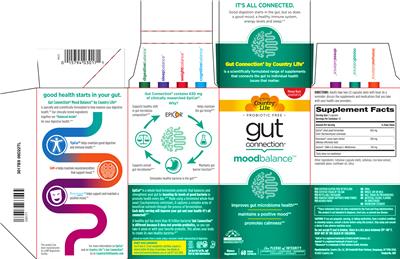
Good health starts in your gut.
This product has been manufactured at a GMP Registered Facility.
Why? Supports healthy shift in gut microbiotca composition Helps maintain the gut lining Maintains gut barrier function Stimulates healthy bacteria in the gut Supports overall gut microbiome Based on results from a study using a dynamic model representing GI digestion.
Money back guarantee You'll love it. If not completely satisfied, request a refund within 60 days of purchase. See details at www.GutConnectionRebate.com or call 877-322-8355.
It's all connected. Good digestion starts in the gut, but so does a good mood, a healthy immune system, energy levels and sleep.
Money back guarantee
Probiotic free
Improves gut microbiome health Maintains a positive mood Promotes calmness Our pledge of integrity Authenticity Cleanliness Freshness Consistency Accuracy
Yes Certified gluten-free by GFCO.org No GMOs No wheat, soy or milk No salt, sugar or preservatives No artificial colors, flavors or sweeteners No magnesium stearate
Yes Certified vegan by the AVA
Yes manufacturing supports wind power
Formula
Gut connection Mood Balance by Country Life is specially and scientifically formulated to help improve your digestive health. Our clinically tested ingredients together are "Balanced Inside" for your digestive health. EpiCor helps maintain good digestive and immune health. EpiCor is a registered trademark of Embria Health Sciences, LLC SAM-e helps maintain neurotransmitters that support mood. Bluenesse helps support and maintain a positive mood. Bluenesse is a trademark of Vital Solutions GmbH, Germany.
Gut Connection contains 630 mg of clinically researched EpiCor. Epicor
EpiCor is a whole food fermentate prebiotic that balances and strengthens your gut by boosting its levels of good bacteria to promote health every day. Made using a fermented whole food yeast (Saccharomyces cervisiae), it captures a complex array of beneficial nutrients through the process of fermentation. Each daily serving will improve your gut and your health-it's all connected! A healthy gut has more than 10 trillion bacteria! Gut Connection is different because it does not provide probiotics, so you can take it alone or with your favorite probiotic. This allows your body to create its own healthy bacteria.
Gut Connection by Country Life is scientifically formulated range of supplements that connects the gut to individual health issues that matter.
Clinically studied ingredients
Yes Kosher-Parve
General Statements
For more information on EpiCor and on Country Life's Gut Connection Go to CountryLifeVitamins.com Digestivebalance Sleepbalance Weightbalance Cognitivebalance
Stressbalance Moodbalance Immunebalance
Yes recyclable packaging
Seals/Symbols
Certified B Corporation Certified Gluten Free GFCO.org (Gluten-Free Certification Organization) KOF-K (Kosher) Parve
Brand IP Statement(s)
Country Life Established 1971
EpiCor is a registered trademark of Embria Health Sciences, LLC Adomix is a registered trademark of Gnosis S.p.A. Bluenesse is a trademark of Vital Solutions GmbH, Germany. Copyright 2022 Country Life
FDA Statement of Identity
Dietary Supplement
Suggested/Recommended/Usage/Directions
Directions: Adults take two (2) capsules daily with food.
Precautions
As a reminder, discuss the supplements and medications that you take with your health care providers.
Caution: If you are pregnant, nursing, or taking medication, have a medical condition or planning surgery, consult a doctor before using this product.
Stop using and consult a doctor if any adverse reactions occur. Do not accept if seal is broken.
Keep out of the reach of children.
FDA Disclaimer Statement
These statements have not been evaluated by the Food and Drug Administration. This product is not intended to diagnose, treat, cure, or prevent any disease.
Storage
Store in a dry place between 59 degrees - 86 degrees F.
Is this label outdated? Report a formula or label change and our pharmacy team will review it.
Mood Balance by Country Life Gut Connection label
The label scan from the NIH Dietary Supplement Label Database. Tap to enlarge.
Label images are published by the NIH Dietary Supplement Label Database for the version of this product on file. Always read your actual product label.
View the full label (PDF)The Ingredients in Mood Balance by Country Life Gut Connection
These are the 3 active ingredients this product is made of. Select any to open its full monograph.
Serving size2 Capsule(s) Dosage formCapsule Servings per container30 Amounts shown are per serving.
Most supplement products combine several ingredients, and a medication can interact with the product through any one of them. Each ingredient below shows whether it has known drug interactions.
EpiCor
Bluenesse
Interacts with264 drugs
Lemon balm is a gentle, lemon-scented mint-family herb traditionally used to ease stress, support sleep, and calm digestion, and topically for cold so...
Bluenesse monograph & interactionsAdomix
Interacts with189 drugs
SAM-e is a compound your body makes naturally that is sold as a supplement, most often for depression and osteoarthritis. Some research suggests it ma...
Adomix monograph & interactionsOther (inactive) ingredients: Cellulose, Rice Bran Extract, Vegetable Glaze, Sunflower Oil, Silica. These complete the product’s ingredient list but are not active constituents.
Mood Balance by Country Life Gut Connection Drug Interactions
HelloPharmacist Interaction Report
Mood Balance by Country Life Gut Connection contains three active ingredients, two of which interact with medications.
The most serious concern is Adomix (SAMe), which carries a Moderate-severity risk with serotonergic drugs—antidepressants, anti-anxiety medications, and certain pain relievers. Taking SAMe alongside these can increase the risk of serotonin syndrome, a potentially serious condition marked by agitation, confusion, rapid heart rate, and high blood pressure.
Read the full breakdown — every affected drug type, severity by severity
Adomix also interacts Moderately with levodopa, a Parkinson's disease medication; SAMe may reduce how well levodopa works. Bluenesse (lemon balm) carries Moderate interactions with CNS depressants—sedatives, sleeping pills, and some anxiety medications—which may add to drowsiness and sedation.
It also interacts Moderately with thyroid hormone replacement therapy, potentially interfering with how well it works.
We could not check EpiCor for interactions; our data on it is incomplete. Altogether, these interactions span 415 individual medications.
If you take any prescription medication—especially for mood, sleep, Parkinson's disease, or thyroid function—use the medication checker below before starting this product.
Check your own medications below · Editorial policy · How we use AI
Want to check YOUR meds against Mood Balance?
Ask about interactions with your drugs in plain English — “Can I take it with lisinopril?” — and we find you the answer in seconds, ingredient by ingredient.
Go to the checkerIngredients driving the most interactions
Individual Drug Interactions
The ingredients in Mood Balance interact with 415 drugs. Click any drug to see the details.
2 of the 3 ingredients in Mood Balance interact with drugs. Each result below shows which ingredient is responsible. Bluenesse Adomix
AcepromazineAtravet
How Acepromazine interacts with Mood Balance — through 1 ingredient. Tap an ingredient for the detail:
BluenesseCns Depressants Moderate
Interaction Summary
Theoretically, concomitant use of lemon balm might have additive effects with CNS depressant drugs.
Read the full Bluenesse + Acepromazine interactionAcetaminophen, Butalbital, Caffeine, CodeineEsgic with Codeine, Fioricet w/ Codeine
How Acetaminophen, Butalbital, Caffeine, Codeine interacts with Mood Balance — through 1 ingredient. Tap an ingredient for the detail:
BluenesseCns Depressants Moderate
Interaction Summary
Theoretically, concomitant use of lemon balm might have additive effects with CNS depressant drugs.
Read the full Bluenesse + Acetaminophen, Butalbital, Caffeine, Codeine interactionAcetaminophen, Butalbital, CodeineBancap w/ Codeine
How Acetaminophen, Butalbital, Codeine interacts with Mood Balance — through 1 ingredient. Tap an ingredient for the detail:
BluenesseCns Depressants Moderate
Interaction Summary
Theoretically, concomitant use of lemon balm might have additive effects with CNS depressant drugs.
Read the full Bluenesse + Acetaminophen, Butalbital, Codeine interactionAcetaminophen, Butalbital, Codeine PhosphatePhrenilin #3
How Acetaminophen, Butalbital, Codeine Phosphate interacts with Mood Balance — through 1 ingredient. Tap an ingredient for the detail:
BluenesseCns Depressants Moderate
Interaction Summary
Theoretically, concomitant use of lemon balm might have additive effects with CNS depressant drugs.
Read the full Bluenesse + Acetaminophen, Butalbital, Codeine Phosphate interactionAcetaminophen, Caffeine, Chlorpheniramine, Hydrocodone, PhenylephrineHycomine Compound
How Acetaminophen, Caffeine, Chlorpheniramine, Hydrocodone, Phenylephrine interacts with Mood Balance — through 1 ingredient. Tap an ingredient for the detail:
BluenesseCns Depressants Moderate
Interaction Summary
Theoretically, concomitant use of lemon balm might have additive effects with CNS depressant drugs.
Read the full Bluenesse + Acetaminophen, Caffeine, Chlorpheniramine, Hydrocodone, Phenylephrine interactionAcetaminophen, Caffeine, CodeineGesic C15, Gesic C30, Gesic C8, Lenoltec 1, Lenoltec 2, Lenoltec 3 +1 more
How Acetaminophen, Caffeine, Codeine interacts with Mood Balance — through 1 ingredient. Tap an ingredient for the detail:
BluenesseCns Depressants Moderate
Interaction Summary
Theoretically, concomitant use of lemon balm might have additive effects with CNS depressant drugs.
Read the full Bluenesse + Acetaminophen, Caffeine, Codeine interactionAcetaminophen, Caffeine, Codeine, SalicylamideCodalan No.1, Codalan No.2, Codalan No.3
How Acetaminophen, Caffeine, Codeine, Salicylamide interacts with Mood Balance — through 1 ingredient. Tap an ingredient for the detail:
BluenesseCns Depressants Moderate
Interaction Summary
Theoretically, concomitant use of lemon balm might have additive effects with CNS depressant drugs.
Read the full Bluenesse + Acetaminophen, Caffeine, Codeine, Salicylamide interactionAcetaminophen, Caffeine, DihydrocodeineDHC Plus, Panlor DC, Panlor SS
How Acetaminophen, Caffeine, Dihydrocodeine interacts with Mood Balance — through 1 ingredient. Tap an ingredient for the detail:
BluenesseCns Depressants Moderate
Interaction Summary
Theoretically, concomitant use of lemon balm might have additive effects with CNS depressant drugs.
Read the full Bluenesse + Acetaminophen, Caffeine, Dihydrocodeine interactionAcetaminophen, Chlorpheniramine Maleate, Dextromethorphan HbrVicks Formula 44M Cough, Cold & Flu Relief
How Acetaminophen, Chlorpheniramine Maleate, Dextromethorphan Hbr interacts with Mood Balance — through 1 ingredient. Tap an ingredient for the detail:
AdomixSerotonergic Drugs Moderate
Interaction Summary
Taking SAMe with serotonergic drugs might increase the risk of serotonin syndrome and other serotonergic side effects.
Read the full Adomix + Acetaminophen, Chlorpheniramine Maleate, Dextromethorphan Hbr interactionAcetaminophen, Chlorpheniramine, Codeine, PhenylephrineColrex
How Acetaminophen, Chlorpheniramine, Codeine, Phenylephrine interacts with Mood Balance — through 2 ingredients. Tap an ingredient for the detail:
AdomixSerotonergic Drugs Moderate
Interaction Summary
Taking SAMe with serotonergic drugs might increase the risk of serotonin syndrome and other serotonergic side effects.
Read the full Adomix + Acetaminophen, Chlorpheniramine, Codeine, Phenylephrine interactionBluenesseCns Depressants Moderate
Interaction Summary
Theoretically, concomitant use of lemon balm might have additive effects with CNS depressant drugs.
Read the full Bluenesse + Acetaminophen, Chlorpheniramine, Codeine, Phenylephrine interactionAcetaminophen, Chlorpheniramine, DextromethorphanCoricidin II Extra Strength Cold and Flu
How Acetaminophen, Chlorpheniramine, Dextromethorphan interacts with Mood Balance — through 1 ingredient. Tap an ingredient for the detail:
AdomixSerotonergic Drugs Moderate
Interaction Summary
Taking SAMe with serotonergic drugs might increase the risk of serotonin syndrome and other serotonergic side effects.
Read the full Adomix + Acetaminophen, Chlorpheniramine, Dextromethorphan interactionAcetaminophen, Chlorpheniramine, Dextromethorphan HydrobromideCoricidin HBP Maximum Strength Flu
How Acetaminophen, Chlorpheniramine, Dextromethorphan Hydrobromide interacts with Mood Balance — through 1 ingredient. Tap an ingredient for the detail:
AdomixSerotonergic Drugs Moderate
Interaction Summary
Taking SAMe with serotonergic drugs might increase the risk of serotonin syndrome and other serotonergic side effects.
Read the full Adomix + Acetaminophen, Chlorpheniramine, Dextromethorphan Hydrobromide interactionAcetaminophen, Chlorpheniramine, Dextromethorphan, PhenylpropanolamineMulti Symptom Cold Relief
How Acetaminophen, Chlorpheniramine, Dextromethorphan, Phenylpropanolamine interacts with Mood Balance — through 1 ingredient. Tap an ingredient for the detail:
AdomixSerotonergic Drugs Moderate
Interaction Summary
Taking SAMe with serotonergic drugs might increase the risk of serotonin syndrome and other serotonergic side effects.
Read the full Adomix + Acetaminophen, Chlorpheniramine, Dextromethorphan, Phenylpropanolamine interactionAcetaminophen, Chlorpheniramine, Dextromethorphan, PseudoephedrineChildren's Tylenol Cold Plus Cough, Tylenol Cold Ex Strength
How Acetaminophen, Chlorpheniramine, Dextromethorphan, Pseudoephedrine interacts with Mood Balance — through 1 ingredient. Tap an ingredient for the detail:
AdomixSerotonergic Drugs Moderate
Interaction Summary
Taking SAMe with serotonergic drugs might increase the risk of serotonin syndrome and other serotonergic side effects.
Read the full Adomix + Acetaminophen, Chlorpheniramine, Dextromethorphan, Pseudoephedrine interactionAcetaminophen, Chlorpheniramine, Guaifenesin, Phenylephrine, SalicylamideRhinogesic GG
How Acetaminophen, Chlorpheniramine, Guaifenesin, Phenylephrine, Salicylamide interacts with Mood Balance — through 1 ingredient. Tap an ingredient for the detail:
AdomixSerotonergic Drugs Moderate
Interaction Summary
Taking SAMe with serotonergic drugs might increase the risk of serotonin syndrome and other serotonergic side effects.
Read the full Adomix + Acetaminophen, Chlorpheniramine, Guaifenesin, Phenylephrine, Salicylamide interactionAcetaminophen, Chlorpheniramine, PhenylephrineAlka-Seltzer PLUS, Histex SR, Protid
How Acetaminophen, Chlorpheniramine, Phenylephrine interacts with Mood Balance — through 1 ingredient. Tap an ingredient for the detail:
AdomixSerotonergic Drugs Moderate
Interaction Summary
Taking SAMe with serotonergic drugs might increase the risk of serotonin syndrome and other serotonergic side effects.
Read the full Adomix + Acetaminophen, Chlorpheniramine, Phenylephrine interactionAcetaminophen, Chlorpheniramine, Phenylephrine, SalicylamideRhinogesic, Rhinogesic JR
How Acetaminophen, Chlorpheniramine, Phenylephrine, Salicylamide interacts with Mood Balance — through 1 ingredient. Tap an ingredient for the detail:
AdomixSerotonergic Drugs Moderate
Interaction Summary
Taking SAMe with serotonergic drugs might increase the risk of serotonin syndrome and other serotonergic side effects.
Read the full Adomix + Acetaminophen, Chlorpheniramine, Phenylephrine, Salicylamide interactionAcetaminophen, Chlorpheniramine, PhenylpropanolamineAlumadrine, Conex, Sinadrin Max Strength, Sinulin
How Acetaminophen, Chlorpheniramine, Phenylpropanolamine interacts with Mood Balance — through 1 ingredient. Tap an ingredient for the detail:
AdomixSerotonergic Drugs Moderate
Interaction Summary
Taking SAMe with serotonergic drugs might increase the risk of serotonin syndrome and other serotonergic side effects.
Read the full Adomix + Acetaminophen, Chlorpheniramine, Phenylpropanolamine interactionAcetaminophen, Chlorpheniramine, Phenylpropanolamine, OpiumHista-Derfule
How Acetaminophen, Chlorpheniramine, Phenylpropanolamine, Opium interacts with Mood Balance — through 2 ingredients. Tap an ingredient for the detail:
AdomixSerotonergic Drugs Moderate
Interaction Summary
Taking SAMe with serotonergic drugs might increase the risk of serotonin syndrome and other serotonergic side effects.
Read the full Adomix + Acetaminophen, Chlorpheniramine, Phenylpropanolamine, Opium interactionBluenesseCns Depressants Moderate
Interaction Summary
Theoretically, concomitant use of lemon balm might have additive effects with CNS depressant drugs.
Read the full Bluenesse + Acetaminophen, Chlorpheniramine, Phenylpropanolamine, Opium interactionAcetaminophen, Chlorpheniramine, Phenylpropanolamine, PhenyltoloxamineNorel Plus
How Acetaminophen, Chlorpheniramine, Phenylpropanolamine, Phenyltoloxamine interacts with Mood Balance — through 1 ingredient. Tap an ingredient for the detail:
AdomixSerotonergic Drugs Moderate
Interaction Summary
Taking SAMe with serotonergic drugs might increase the risk of serotonin syndrome and other serotonergic side effects.
Read the full Adomix + Acetaminophen, Chlorpheniramine, Phenylpropanolamine, Phenyltoloxamine interactionAcetaminophen, Chlorpheniramine, PseudoephedrineAlka-Seltzer PLUS Liquid Gels, Children's Tylenol Cold, Codimal, Comtrex, Extra Strength Tylenol Allergy Sinus, Lorsin +3 more
How Acetaminophen, Chlorpheniramine, Pseudoephedrine interacts with Mood Balance — through 1 ingredient. Tap an ingredient for the detail:
AdomixSerotonergic Drugs Moderate
Interaction Summary
Taking SAMe with serotonergic drugs might increase the risk of serotonin syndrome and other serotonergic side effects.
Read the full Adomix + Acetaminophen, Chlorpheniramine, Pseudoephedrine interactionAcetaminophen, Chlorzoxazone, CodeineAcetazone Forte C8, Parafon Forte C8
How Acetaminophen, Chlorzoxazone, Codeine interacts with Mood Balance — through 1 ingredient. Tap an ingredient for the detail:
BluenesseCns Depressants Moderate
Interaction Summary
Theoretically, concomitant use of lemon balm might have additive effects with CNS depressant drugs.
Read the full Bluenesse + Acetaminophen, Chlorzoxazone, Codeine interactionAcetaminophen, CodeineTylenol No.3, Tylenol w/ Codeine
How Acetaminophen, Codeine interacts with Mood Balance — through 1 ingredient. Tap an ingredient for the detail:
BluenesseCns Depressants Moderate
Interaction Summary
Theoretically, concomitant use of lemon balm might have additive effects with CNS depressant drugs.
Read the full Bluenesse + Acetaminophen, Codeine interactionAcetaminophen, Codeine, DoxylamineMersyndol
How Acetaminophen, Codeine, Doxylamine interacts with Mood Balance — through 1 ingredient. Tap an ingredient for the detail:
BluenesseCns Depressants Moderate
Interaction Summary
Theoretically, concomitant use of lemon balm might have additive effects with CNS depressant drugs.
Read the full Bluenesse + Acetaminophen, Codeine, Doxylamine interactionAcetaminophen, Codeine, MethocarbamolAcetaminophen, Codeine, Methocarbamol, Robaxacet 8
How Acetaminophen, Codeine, Methocarbamol interacts with Mood Balance — through 1 ingredient. Tap an ingredient for the detail:
BluenesseCns Depressants Moderate
Interaction Summary
Theoretically, concomitant use of lemon balm might have additive effects with CNS depressant drugs.
Read the full Bluenesse + Acetaminophen, Codeine, Methocarbamol interactionAcetaminophen, DextromethorphanTylenol Cough Ex Strength
How Acetaminophen, Dextromethorphan interacts with Mood Balance — through 1 ingredient. Tap an ingredient for the detail:
AdomixSerotonergic Drugs Moderate
Interaction Summary
Taking SAMe with serotonergic drugs might increase the risk of serotonin syndrome and other serotonergic side effects.
Read the full Adomix + Acetaminophen, Dextromethorphan interactionAcetaminophen, Dextromethorphan, Doxylamine, PseudoephedrineVicks NyQuil
How Acetaminophen, Dextromethorphan, Doxylamine, Pseudoephedrine interacts with Mood Balance — through 1 ingredient. Tap an ingredient for the detail:
AdomixSerotonergic Drugs Moderate
Interaction Summary
Taking SAMe with serotonergic drugs might increase the risk of serotonin syndrome and other serotonergic side effects.
Read the full Adomix + Acetaminophen, Dextromethorphan, Doxylamine, Pseudoephedrine interactionAcetaminophen, Dextromethorphan, Guaifenesin, PhenylephrineConar-A
How Acetaminophen, Dextromethorphan, Guaifenesin, Phenylephrine interacts with Mood Balance — through 1 ingredient. Tap an ingredient for the detail:
AdomixSerotonergic Drugs Moderate
Interaction Summary
Taking SAMe with serotonergic drugs might increase the risk of serotonin syndrome and other serotonergic side effects.
Read the full Adomix + Acetaminophen, Dextromethorphan, Guaifenesin, Phenylephrine interactionAcetaminophen, Dextromethorphan, Guaifenesin, PhenylpropanolamineAnatuss
How Acetaminophen, Dextromethorphan, Guaifenesin, Phenylpropanolamine interacts with Mood Balance — through 1 ingredient. Tap an ingredient for the detail:
AdomixSerotonergic Drugs Moderate
Interaction Summary
Taking SAMe with serotonergic drugs might increase the risk of serotonin syndrome and other serotonergic side effects.
Read the full Adomix + Acetaminophen, Dextromethorphan, Guaifenesin, Phenylpropanolamine interactionAcetaminophen, Dextromethorphan, Guaifenesin, PseudoephedrineRobitussin Cold, Severe Cold, Suphedrine Cold/Cough
How Acetaminophen, Dextromethorphan, Guaifenesin, Pseudoephedrine interacts with Mood Balance — through 1 ingredient. Tap an ingredient for the detail:
AdomixSerotonergic Drugs Moderate
Interaction Summary
Taking SAMe with serotonergic drugs might increase the risk of serotonin syndrome and other serotonergic side effects.
Read the full Adomix + Acetaminophen, Dextromethorphan, Guaifenesin, Pseudoephedrine interactionEach ingredient & the kinds of drugs it affects
For each ingredient in Mood Balance with known interactions, here are the types of medications they can affect. Open any type for the detail — or search your exact drug in the checker above.
Bluenesse
Cns Depressants
Theoretically, concomitant use of lemon balm might have additive effects with CNS depressant drugs.
Lemon balm seems to have CNS depressant activity in animals and in humans.
Thyroid Hormone
Theoretically, lemon balm might interfere with thyroid hormone replacement therapy.
In vitro, constituents of lemon balm extract bind to thyroid stimulating hormone (TSH), preventing TSH receptor-binding and leading to the inhibition of TSH-stimulated adenylate cyclase activity. In animals, lemon balm extract has been shown to decrease levels of circulating TSH and inhibit thyroid secretion.
Adomix
Levodopa
SAMe might reduce the effectiveness of levodopa.
SAMe methylates levodopa, which might reduce its effectiveness for treating Parkinson disease.
Serotonergic Drugs
Taking SAMe with serotonergic drugs might increase the risk of serotonin syndrome and other serotonergic side effects.
SAMe has serotonergic effects. Theoretically, combining serotonergic drugs with SAMe might increase the risk of serotonergic side effects, including serotonin syndrome and cerebral vasoconstrictive disorders. In one case report, SAMe 100 mg intramuscularly was given daily with clomipramine (Anafranil) 25 mg per day. When the clomipramine dose was increased to 75 mg per day the patient experienced serotonin syndrome about 48-72 hours later, requiring hospitalization.
Brand information
Manufacturer and brand details for Mood Balance, from the product label.
Country Life Gut Connection
See all Country Life Gut Connection products- Name
- Country Life, LLC
- Street Address
- 180 Vanderbilt Motor Parkway
- City
- Hauppauge
- State
- NY
- ZipCode
- 11788
- Phone Number
- 877-322-8355
- Web Address
- CountryLifeVitamins.com
Mood Balance by Country Life Gut Connection: Common Questions
Does Mood Balance by Country Life Gut Connection interact with any medications?
How can one product interact with so many drugs?
Where does this information come from?
Will this make me drowsy?
Is SAMe the same as the amino acid that sounds similar?
Can I take this if I'm on an antidepressant?
What's EpiCor?
Can I take this while pregnant?
What's the most common side effect?
Written and reviewed by the HelloPharmacist editorial staff. Our editorial policy
Not sure if Mood Balance is safe with your meds?
Our pharmacists answer your medication & supplement questions — free.
Label information is sourced from the NIH Dietary Supplement Label Database and reflects the product version on file; always read your actual product label. This page is for education only and is not a substitute for professional medical advice. Confirm with your pharmacist or doctor before combining supplements and medications.
The Full Monographs Behind Mood Balance’s Ingredients
Every ingredient we hold a full HelloPharmacist monograph for — uses, evidence, safety, and the complete interaction list.
Lemon Balm
Interacts with 264 drugsLemon balm is a gentle, lemon-scented mint-family herb traditionally used to ease stress, support sleep, and calm digestion, and topically for cold sores. Early studies are promising but gen...
Read the full Lemon Balm monograph → Herb & supplement monographSame
Interacts with 189 drugsSAM-e is a compound your body makes naturally that is sold as a supplement, most often for depression and osteoarthritis. Some research suggests it may help with these conditions, but the qu...
Read the full Same monograph →Sources & How We Checked
Mood Balance's label data comes from the NIH Dietary Supplement Label Database; the ingredient interaction data is from the Natural Medicines database, reviewed by our pharmacists.
- NIH Dietary Supplement Label Database (DSLD) — The official product label on file for this supplement.
- Natural Medicines (Therapeutic Research Center) — Evidence-graded clinical reference behind the ingredient interaction data.
Content is written and reviewed by licensed HelloPharmacist pharmacists. See our data sources and editorial standards for how this information is built and checked.
The 43 references behind this product’s interaction data
Every citation that drives the interaction findings for this product’s ingredients, from the evidence-graded Natural Medicines (TRC Healthcare) database. Open an ingredient to browse its citations — links open the study on PubMed or the publisher’s site.
Lemon Balm 12 references
- Wolbling RH, Leonhardt K. Local therapy of herpes simplex with dried extract from Melissa officinalis. Phytomedicine 1994;1:25-31.
- Akhondzadeh S, Noroozian M, Mohammadi M, et al. Melissa officinalis extract in the treatment of patients with mild to moderate Alzheimer's disease: a double blind, randomised, placebo controlled trial. J Neurol Neurosurg Psychiatry 2003;74:863-6. PubMed
- Kennedy DO, Scholey AB, Tildesley NT, et al. Modulation of mood and cognitive performance following acute administration of Melissa officinalis (lemon balm). Pharmacol Biochem Behav 2002;72:953-64. PubMed
- Albrecht M, Berger W, Laux P, Schmidt U, et al. Psychopharmaka und Verkehrssicherheit. Der Einfluß von Euvegal® - Dragees forte auf die Fahrtüchtigkeit und Kombinationswirkungen mit Alkohol Z Allg Med 1995;71:1215-25.
- Herberg, KW. Nebenwirkungen pflanzlicher Beruhigungsmittel/ Leistung und Befinden nach Einnahme einer Baldrian-Hopfen-Kombination. Z.Allg Med 1996;72:234-240.
- Soulimani R, Fleurentin J, Mortier F, et al. Neurotropic action of the hydroalcoholic extract of Melissa officinalis in the mouse. Planta Med. 1991 Apr;57:105-9.
- Sourgens H, Winterhoff H, Gumbinger HG, et al. Antihormonal effects of plant extracts. TSH- and prolactin-suppressing properties of Lithospermum officinale and other plants. Planta Med. 1982 Jun;45:78-86. DOI
- Auf'mkolk M, Ingbar JC, Amir SM, et al. Inhibition by certain plant extracts of the binding and adenylate cyclase stimulatory effect of bovine thyrotropin in human thyroid membranes. Endocrinology. 1984 Aug;115:527-34. PubMed
- Santini F, Vitti P, Ceccarini G, et al. In vitro assay of thyroid disruptors affecting TSH-stimulated adenylate cyclase activity. J Endocrinol Invest. 2003 Oct;26:950-5. PubMed
- Alijaniha F, et al. Heart palpitation relief with Melissa officinalis leaf extract: double blind, randomized, placebo controlled trial of efficacy and safety. J Ethnopharmacol. 2015;164:378-384. doi: 10.1016/j.jep.2015.02.007. Epub 2015 Feb 11. PubMed
- Araj-Khodaei M, Noorbala AA, Yarani R, et al. A double-blind, randomized pilot study for comparison of Melissa officinalis L. and Lavandula angustifolia Mill. with Fluoxetine for the treatment of depression. BMC Complement Med Ther. 2020;20(1):207. PubMed
- Kucuk U, Pham M, Raza Raja MH, Saad Shaukat MH, Clark R. Transient complete atrioventricular block associated with herbal supplement use. S D Med 2023;76(7):311-313.
Same 31 references
- Perna AF, Castaldo P, Ingrosso D, et al. Homocysteine, a new cardiovascular risk factor, is also a powerful uremic toxin. J Nephrol 1999;12:230-40.
- Mato JM, Camara J, Fernandez de Paz J, et al. S-adenosylmethionine in alcoholic liver cirrhosis: a randomized, placebo-controlled, double-blind, multicenter clinical trial. J Hepatol 1999;30:1081-9. PubMed
- Iruela LM, Minguez L, Merino J, Monedero G. Toxic interaction of S-adenosylmethionine and clomipramine. Am J Psychiatry 1993;150:522. PubMed
- Bradley JD, Flusser D, Katz BP, et al. A randomized, double blind, placebo controlled trial of intravenous loading with S-adenosylmethionine (SAM) followed by oral SAM therapy in patients with knee osteoarthritis. J Rheumatol 1994;21:905-11.
- Berlanga C, Ortega-Soto HA, Ontiveros M, Senties H. Efficacy of S-adenosyl-L-methionine in speeding the onset of action of imipramine. Psychiatry Res 1992;44:257-62. PubMed
- Kagan BL, Sultzer DL, Rosenlicht N, Gerner RH. Oral S-adenosylmethionine in depression: a randomized, double-blind, placebo-controlled trial. Am J Psychiatry 1990;147:591-5. PubMed
- Rosenbaum JF, Fava M, Falk WE, et al. The antidepressant potential of oral S-adenosyl-l-methionine. Acta Psychiatr Scand 1990;81:432-6. PubMed
- Domljan Z, Vrhovac B, Durrigl T, Pucar I. A double-blind trial of ademetionine vs naproxen in activated gonarthrosis. Int J Clin Pharmacol Ther Toxicol 1989;27:329-33.
- Konig B. A long-term (two years) clinical trial with S-adenosylmethionine for the treatment of osteoarthritis. Am J Med 1987;83:89-94. PubMed
- Lipinski JF, Cohen BM, Frankenburg F, et al. Open trial of S-adenosylmethionine for treatment of depression. Am J Psychiatry 1984;141:448-50.
- Almasio P, Bortolini M, Pagliaro L, Coltorti M. Role of S-adenosyl-L-methionine in the treatment of intrahepatic cholestasis. Drugs 1990;40:111-23. PubMed
- Friedel HA, Goa KL, Benfield P. S-adenosyl-L-methionine. A review of its pharmacological properties and therapeutic potential in liver dysfunction and affective disorders in relation to its physiological role in cell metabolism. Drugs 1989;38:389-416. PubMed
- Bottiglieri T, Hyland K, Reynolds EH. The clinical potential of ademetionine (S-adenosylmethionine) in neurological disorders. Drugs 1994;48:137-52. PubMed
- Frezza M, Centini G, Cammareri G, et al. S-adenosylmethionine for the treatment of intrahepatic cholestasis of pregnancy. Results of a controlled clinical trial. Hepatogastroenterology 1990;37:122-5.
- Singhal AB, Caviness VS, Begleiter AF, et al. Cerebral vasoconstriction and stroke after use of serotonergic drugs. Neurology 2002;58:130-3. PubMed
- Charlton CG, Crowell B Jr. Parkinson's disease-like effects of S-adenosyl-L-methionine: effects of L-dopa. Pharmacol Biochem Behav 1992;43:423-31..
- Goren JL, Stoll AL, Damico KE, et al. Bioavailability and lack of toxicity of S-adenosyl-L-methionine (SAMe) in humans. Pharmacotherapy 2004;24:1501-7. PubMed
- Arnold O, Saletu B, Anderer P, et al. Double-blind, placebo-controlled pharmacodynamic studies with a nutraceutical and a pharmaceutical dose of ademetionine (SAMe) in elderly subjects, utilizing EEG mapping and psychometry. Eur Neuropsychopharmacol 2005; PubMed
- Nelson JC. S-adenosyl methionine (SAMe) augmentation in major depressive disorder. (Editorial). Am J Psychiatry 2010;167:889-91.
- Kim J, Lee EY, Koh EM, et al. Comparative clinical trial of S-adenosylmethionine versus nabumetone for the treatment of knee osteoarthritis: an 8-week, multicenter, randomized, double-blind, double-dummy, Phase IV study in Korean patients. Clin Ther 2009; PubMed
- Manzillo G, Piccinino F, Surrenti C, et al. Multicentre double-blind placebo-controlled study of intravenous and oral S-adenosyl-L-methionine (SAMe) in cholestatic patients with liver disease. Drug Invest 1992;4 (Suppl 4):90-100. DOI
- Carrieri PB, Indaco A, Gentile S, et al. S-adenosylmethionine treatment of depressioin in patients with Parkinson's disease: a double-blind, crossover study versus placebo. Curr Ther Res 1990;48(1):154-60.
- Pancheri P, Scapicchio P, Delle Chiaie R. A double-blind, randomized parallel-group, efficacy and safety study of intramuscular S-adenosyl-L-methionine 1,4-butanedisulphonate (SAMe) versus imipramine in patients with major depressive disorder. Int J Neuro PubMed
- Medici V., Virata M. C., Peerson J. M., Stabler S. P., French S. W., Gregory J. F. III, Albanese A., Bowlus C. L., Devaraj S., Panacek E. A., Richards J. R., Halsted C. H. S-adenosyl-L-methionine treatment for alcoholic liver disease: a double-blinded, ra
- Chitiva, H., Audivert, F., and Alvarez, C. Suicide attempt by self-burning associated with ingestion of S-adenosylmethionine: a review of the literature and case report. J.Nerv.Ment.Dis. 2012;200(1):99-101. PubMed
- Carney, M. W., Edeh, J., Bottiglieri, T., Reynolds, E. M., and Toone, B. K. Affective illness and S-adenosyl methionine: a preliminary report. Clin Neuropharmacol. 1986;9(4):379-385. PubMed
- Miccoli, L., Porro, V., and Bertolino, A. Comparison between the antidepressant activity and of S- adenosylmethionine (SAMe) and that of some tricyclic drugs. Acta Neurol (Napoli) 1978;33 (3):243-255.
- Bacci, Ballerini F., Lopez, Anguera A., Alcaraz, P., and Hernandez, Reyes N. [SAMe in the management of postconcussional syndrome]. Medicina Clinica (Barc.) 1983;80(4):161-164.
- Muscettola G, Galzenati M, Balbi A. SAMe versus placebo: a double blind comparison in major depressive disorders. Advances in Biochemical Psychopharmacology 1982;32:151-6.
- Capretto C, Cremona C, and Canaparo L. A double-blind controlled study of S-adenosylmethionine (SAMe) v. ibuprofen in gonarthrosis, coxarthrosis and spondylarthrosis. Clin Trials J 1985;22(1):15-24.
- Ancarani E, Biondi B, Bolletta A, et al. Major depression complicating hemodialysis in patients with chronic renal failure: a multicenter, double-blind, controlled clinical trial of S-adenosyl-L-methionine versus placebo. Curr Ther Res 1993;54(6):680-6. DOI
Parts of this content are provided by the Therapeutic Research Center, LLC.
DISCLAIMER: Currently this does not check for drug-drug interactions. This is not an all-inclusive comprehensive list of potential interactions and is for informational purposes only. Not all interactions are known or well-reported in the scientific literature, and new interactions are continually being reported. Input is needed from a qualified healthcare provider including a pharmacist before starting any therapy. Application of clinical judgment is necessary.
© 2021 Therapeutic Research Center, LLC