
More Milk Moringa Ingredients & Drug Interactions
by Motherlove
What is this page for?
First and foremost: checking More Milk Moringa against your medications. The heart of this page is the interaction checker and the full interaction report — how this product’s ingredients may interact with prescription and over-the-counter medicines you may be taking.
Around that, we add a pharmacist’s high-level view of the product as a whole — what’s inside, the evidence for its stated use, how transparent the label is, and what safety data exists — so you can see the full picture in one place. It’s educational information from our licensed clinical databases and the clinical staff at HelloPharmacist — not medical advice — and we don’t sell or endorse products. Our editorial policy
More Milk Moringa is a dietary supplement by Motherlove with 4 active ingredients. Its ingredients are commonly taken for enlarged prostate (bph) symptoms, seasonal allergies, joint pain and arthritis.Based on those ingredients, 1,036 medications have a known interaction with it, the most serious rated moderate. The ingredients most likely to interact are Moringa Leaf Extract, Fennel seed extract, Nettle leaf extract. Use the checker below to test your specific medication, or read the full HelloPharmacist Interaction Report.
Check Your Meds Against More Milk Moringa by Motherlove
Ask about any prescription or over-the-counter medication and we check it for interactions with More Milk Moringa by Motherlove — and tell you which ingredient is responsible.
AI summaries are generated from our interaction database for education only — always confirm with your pharmacist. How we use AI
Ask the Pharmacist
A licensed pharmacist will answer your question by email — free, usually within 24 hours.
Got it — thank you!
A licensed pharmacist will answer within 24 hours. Keep an eye on your email (worth checking spam, just in case).
HelloPharmacist Scorecard of More Milk Moringa by Motherlove
Our pharmacy team’s full take, with four database checks built into the cards below — a summary of what is known, not a grade of the product itself.
What’s inside
Low disclosure
More Milk Moringa contains four active ingredients. Nettle leaf extract, fennel seed extract, and moringa leaf extract are included in a proprietary blend; blessed thistle herb extract is listed separately.
These are combined with inactive ingredients (sunflower lecithin, modified cellulose, and medium chain triglyceride) that serve as binders and capsule material. The product is designed as a lactation support supplement, though the label will specify the exact dose of each ingredient.
Does it work?
Insufficient evidence
Our data on effectiveness for this product's ingredients is limited. Nettle leaf extract is rated possibly effective for diabetes, but evidence for its other traditional uses—hay fever, anemia, asthma, prostate health, and gum inflammation—is insufficient to rate.
Fennel seed extract is possibly effective for period pain, but evidence for bronchitis, anxiety, bedwetting, and cholera is insufficient to rate. Blessed thistle and moringa leaf have insufficient evidence for the conditions listed in our data.
Effectiveness for milk supply, the product's primary purpose, is not established in the data we hold.
How safe is it?
Well-documented data
Nettle leaf extract is generally well tolerated when used as directed, but most common side effects are constipation or diarrhea. Rare cases of liver injury have been reported.
Fennel seed extract is well tolerated overall; most common side effects are stomach discomfort, sun sensitivity, and allergic reactions in sensitive people. Rare cases of seizures have been reported, and it may trigger bronchial asthma in some individuals.
Blessed thistle is often well tolerated in small amounts, though human safety data are limited; high doses can cause nausea or vomiting and may trigger allergic reactions in people sensitive to ragweed and related plants. Moringa leaf is generally well tolerated; transient diarrhea is the most common side effect (25% of trial participants in one study).
Rare allergic reactions, including anaphylaxis, and very rare Stevens-Johnson syndrome (a serious skin reaction) have been reported. Nettle and blessed thistle are traditionally thought to affect the uterus and lack adequate safety data, so they are best avoided during pregnancy.
Fennel in medicinal amounts should be avoided in pregnancy due to hormone-like effects and limited safety data. Data on safety while breastfeeding are limited for all three: nettle and blessed thistle are used traditionally to support milk, but safety has not been well studied.
Talk with your doctor before use if you are pregnant or breastfeeding.
Meds to double-check
Moderate interaction found
Before you take More Milk Moringa, double-check these medication types with your pharmacist: blood thinners (warfarin and other anticoagulants/antiplatelet drugs)—increased bleeding risk is possible; blood sugar medications; lithium—nettle may raise levels; water pills (diuretics); birth control pills—fennel may reduce effectiveness; hormone replacement therapy; thyroid medication (levothyroxine); drugs processed by your liver (CYP3A4 substrates); and stomach acid medications (H2-blockers, antacids, proton pump inhibitors). If you take ciprofloxacin or tamoxifen, check with your pharmacist too.
The bottom line
Scorecard at a glanceFormula with limited ingredient disclosure with insufficient evidence for its stated purpose. Moderate medication interactions have been identified, and safety information is well characterized.
More Milk Moringa is designed to support lactation, but evidence of effectiveness is not established in our data. Because it contains four ingredients with documented moderate and minor interactions affecting over 1,000 medications, you should check your exact prescriptions and over-the-counter drugs with the interaction tool before starting.
Pregnant people should avoid it due to traditional uterine concerns and limited safety data. Talk to your pharmacist or doctor, especially if you take blood thinners, diabetes drugs, thyroid medication, lithium, birth control, stomach acid medications, or any drug metabolized by your liver.
Educational only — not medical advice; always confirm with your pharmacist. Our editorial policy · How we use AI
Assessment coverage: 4 of 4 active ingredients matched to our full ingredient reviews (monographs). Based on the product label dated Sep 25, 2025.
This Scorecard evaluates available label information, ingredient evidence, and known medication-safety considerations. It does not independently verify product identity, purity, potency, contamination, or manufacturing quality. How these ratings are computed
General information
Key facts about More Milk Moringa, straight from the product label.
| Brand | Motherlove |
|---|---|
| Barcode (UPC) | 759160520025 |
| Net contents | 120 Liquid Capsule(s) |
| Market status | On market |
| Date entered into DSLD | Sep 25, 2025 |
| DSLD ID | 334842 |
| Product type | Botanical |
| Supplement form | Capsule |
| Dietary claims / uses | All Other, Structure/Function |
| Intended target group(s) | Vegan, Vegetarian, Kosher, Women (not pregnant or lactating), Adult Female (18 - 50 Years), Lactating |
Everything in this section is reproduced from the manufacturer’s own product label — it’s the label speaking, not HelloPharmacist. We show it so you can see exactly what the maker states; we don’t verify or endorse those statements.
Supplement Facts
The label details for More Milk Moringa by Motherlove, sourced from the NIH Dietary Supplement Label Database.
Supplement Facts
| Ingredient | Amount | % DV |
|---|---|---|
| Nettle leaf extract | 0 NP | -- |
| Fennel seed extract | 0 NP | -- |
| Proprietary Extract Blend | 560 mg | -- |
| Blessed Thistle Herb Extract | 0 NP | -- |
| Moringa Leaf Extract | 0 NP | -- |
Other ingredients: Sunflower Lecithin, Modified Cellulose, Medium Chain Triglyceride
Tap any ingredient to jump to its full detail below.
These statements are the manufacturer’s wording, reproduced from the product label — the label is saying it, not HelloPharmacist. We don’t verify or endorse them.
Suggested/Recommended/Usage/Directions
Suggested use Take 1 capsule, 4 to 6 times throughout the day or as recommended by your healthcare practitioner.
Precautions
Discuss product use with a healthcare practitioner. Discontinue use if side effects appear. Sealed for your protection.
Any ingested food has the potential for an allergic reaction.
Not for use during pregnancy.
Keep out of reach of children.
Carton made with wind energy
Formulation
Vegan
Clean ingredients
Liquid Capsules Breastfeeding
Non GMO Project Verified Nongmoproject.org
Formulated for Moms Who: Want to support their milk supply Are pumping Want to increase their freezer stash Are sensitive to fenugreek
Made with herbs that work as hard as you do. Made in the USA with imported ingredients
Seals/Symbols
Certified B Corporation
Non GMO Project Verified Nongmoproject.org
KOF-K (Kosher) Parve K-1604
Sustainable Forestry Initiative Certified Sourcing www.sfiprogram.org SFI-03531
FDA Disclaimer Statement
These statements have not been evaluated by the Food and Drug Administration. This product is not intended to diagnose, treat, cure or prevent any disease.
General Statements
Women Owned
Mom-founded. Daughter-run. Founded over 30 years ago by an herbalist mom seeking to connect her own motherhood to Mother Earth, today Motherlove® empowers all new moms with trusted remedies rooted in herbal wisdom. Scan to learn what makes our supplements superior. We’re here for you from bump, to birth, breastfeeding, and baby.
Printed with soy ink
Made with love Kathryn Higgins Founder, Mother, Herbalist Instagram @MotherLoveHerb
Formula
Moringa-based herbal blend for breastfeeding moms
KOF-K (Kosher) Parve K-1604
FDA Statement of Identity
Herbal Supplement
Is this label outdated? Report a formula or label change and our pharmacy team will review it.
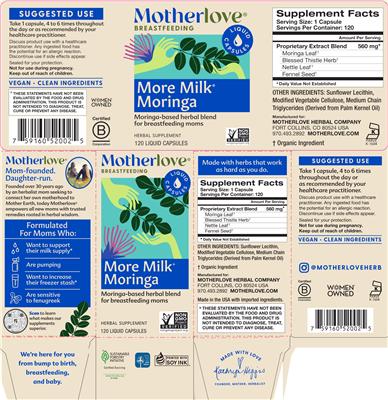
More Milk Moringa by Motherlove label
The label scan from the NIH Dietary Supplement Label Database. Tap to enlarge.
Label images are published by the NIH Dietary Supplement Label Database for the version of this product on file. Always read your actual product label.
View the full label (PDF)The Ingredients in More Milk Moringa by Motherlove
These are the 4 active ingredients this product is made of. Select any to open its full monograph.
Serving size1 Capsule(s) Dosage formCapsule Servings per container120 Amounts shown are per serving.
Most supplement products combine several ingredients, and a medication can interact with the product through any one of them. Each ingredient below shows whether it has known drug interactions.
Proprietary Extract Blend
Other (inactive) ingredients: Sunflower Lecithin, Modified Cellulose, Medium Chain Triglyceride. These complete the product’s ingredient list but are not active constituents.
More Milk Moringa by Motherlove Drug Interactions
HelloPharmacist Interaction Report
More Milk Moringa by Motherlove contains four active ingredients, and our data shows documented interactions with a substantial number of medications.
The most serious interactions are Moderate in severity.
Read the full breakdown — every affected drug type, severity by severity
Nettle leaf extract can affect blood sugar control (antidiabetes drugs), increase lithium levels in your body, interact with blood thinners like warfarin, and add to the effect of water pills (diuretics). Fennel seed extract may reduce how well birth control pills work, increase levels of certain drugs your liver processes (CYP3A4 substrates), interfere with hormone replacement therapy, raise bleeding risk with blood thinners, decrease effectiveness of the antibiotic ciprofloxacin, and interfere with tamoxifen (a breast cancer drug).
Moringa leaf extract can affect thyroid medication (levothyroxine), alter levels of drugs processed by your liver and kidneys, and theoretically add to blood sugar-lowering drugs—though human data here are mixed.
Blessed thistle herb extract carries Minor interactions with stomach acid medications: it might decrease how well H2-blockers, antacids, and proton pump inhibitors (acid-reducing drugs) work.
Altogether, these interactions span 1,022 individual medications. Please check your exact medications with the search tool on this page before you start.
Check your own medications below · Editorial policy · How we use AI
Want to check YOUR meds against More Milk Moringa?
Ask about interactions with your drugs in plain English — “Can I take it with lisinopril?” — and we find you the answer in seconds, ingredient by ingredient.
Go to the checkerIngredients driving the most interactions
Individual Drug Interactions
The ingredients in More Milk Moringa interact with 1,036 drugs. Click any drug to see the details.
4 of the 4 ingredients in More Milk Moringa interact with drugs. Each result below shows which ingredient is responsible. Moringa Leaf Extract Fennel seed extract Nettle leaf extract Blessed Thistle Herb Extract
Ado-trastuzumab EmtansineKadcyla
How Ado-trastuzumab Emtansine interacts with More Milk Moringa — through 2 ingredients. Tap an ingredient for the detail:
Moringa Leaf ExtractCytochrome P450 3a4 (cyp3a4) Substrates Moderate
Interaction Summary
Theoretically, moringa might increase or decrease levels of CYP3A4 substrates.
Read the full Moringa Leaf Extract + Ado-trastuzumab Emtansine interactionFennel Seed ExtractCytochrome P450 3a4 (cyp3a4) Substrates Moderate
Interaction Summary
Theoretically, fennel might increase levels of drugs metabolized by CYP3A4.
Read the full Fennel Seed Extract + Ado-trastuzumab Emtansine interactionAbciximabReoPro
How Abciximab interacts with More Milk Moringa — through 1 ingredient. Tap an ingredient for the detail:
Fennel Seed ExtractAnticoagulant/antiplatelet Drugs Moderate
Interaction Summary
Theoretically, fennel might increase the risk of bleeding when used with antiplatelet or anticoagulant drugs.
Read the full Fennel Seed Extract + Abciximab interactionAbemaciclibVerzenio
How Abemaciclib interacts with More Milk Moringa — through 2 ingredients. Tap an ingredient for the detail:
Fennel Seed ExtractCytochrome P450 3a4 (cyp3a4) Substrates Moderate
Interaction Summary
Theoretically, fennel might increase levels of drugs metabolized by CYP3A4.
Read the full Fennel Seed Extract + Abemaciclib interactionMoringa Leaf ExtractCytochrome P450 3a4 (cyp3a4) Substrates Moderate
Interaction Summary
Theoretically, moringa might increase or decrease levels of CYP3A4 substrates.
Read the full Moringa Leaf Extract + Abemaciclib interactionAbiraterone
How Abiraterone interacts with More Milk Moringa — through 2 ingredients. Tap an ingredient for the detail:
Fennel Seed ExtractCytochrome P450 3a4 (cyp3a4) Substrates Moderate
Interaction Summary
Theoretically, fennel might increase levels of drugs metabolized by CYP3A4.
Read the full Fennel Seed Extract + Abiraterone interactionMoringa Leaf ExtractCytochrome P450 3a4 (cyp3a4) Substrates Moderate
Interaction Summary
Theoretically, moringa might increase or decrease levels of CYP3A4 substrates.
Read the full Moringa Leaf Extract + Abiraterone interactionAbiraterone AcetateYonsa, Zytiga
How Abiraterone Acetate interacts with More Milk Moringa — through 2 ingredients. Tap an ingredient for the detail:
Moringa Leaf ExtractCytochrome P450 3a4 (cyp3a4) Substrates Moderate
Interaction Summary
Theoretically, moringa might increase or decrease levels of CYP3A4 substrates.
Read the full Moringa Leaf Extract + Abiraterone Acetate interactionFennel Seed ExtractCytochrome P450 3a4 (cyp3a4) Substrates Moderate
Interaction Summary
Theoretically, fennel might increase levels of drugs metabolized by CYP3A4.
Read the full Fennel Seed Extract + Abiraterone Acetate interactionAbrocitinibCibinqo
How Abrocitinib interacts with More Milk Moringa — through 1 ingredient. Tap an ingredient for the detail:
Fennel Seed ExtractAnticoagulant/antiplatelet Drugs Moderate
Interaction Summary
Theoretically, fennel might increase the risk of bleeding when used with antiplatelet or anticoagulant drugs.
Read the full Fennel Seed Extract + Abrocitinib interactionAcalabrutinibCalquence
How Acalabrutinib interacts with More Milk Moringa — through 2 ingredients. Tap an ingredient for the detail:
Fennel Seed ExtractCytochrome P450 3a4 (cyp3a4) Substrates Moderate
Interaction Summary
Theoretically, fennel might increase levels of drugs metabolized by CYP3A4.
Read the full Fennel Seed Extract + Acalabrutinib interactionMoringa Leaf ExtractP-glycoprotein Substrates, Cytochrome P450 3a4 (cyp3a4) Substrates Moderate
Interaction Summary
Theoretically, moringa leaf extract might increase the levels and clinical effects of P-glycoprotein substrates.
Read the full Moringa Leaf Extract + Acalabrutinib interactionAcarboseGlucobay, Prandase, Precose
How Acarbose interacts with More Milk Moringa — through 2 ingredients. Tap an ingredient for the detail:
Nettle Leaf ExtractAntidiabetes Drugs Moderate
Interaction Summary
Theoretically, stinging nettle might have additive effects with antidiabetes drugs.
Read the full Nettle Leaf Extract + Acarbose interactionMoringa Leaf ExtractAntidiabetes Drugs Minor
Interaction Summary
Theoretically, moringa might have additive effects when used with antidiabetes drugs; however, research is conflicting.
Read the full Moringa Leaf Extract + Acarbose interactionAcenocoumarolSintrom
How Acenocoumarol interacts with More Milk Moringa — through 1 ingredient. Tap an ingredient for the detail:
Fennel Seed ExtractAnticoagulant/antiplatelet Drugs Moderate
Interaction Summary
Theoretically, fennel might increase the risk of bleeding when used with antiplatelet or anticoagulant drugs.
Read the full Fennel Seed Extract + Acenocoumarol interactionAcetaminophen, AspirinGemnisyn
How Acetaminophen, Aspirin interacts with More Milk Moringa — through 2 ingredients. Tap an ingredient for the detail:
Fennel Seed ExtractAnticoagulant/antiplatelet Drugs Moderate
Interaction Summary
Theoretically, fennel might increase the risk of bleeding when used with antiplatelet or anticoagulant drugs.
Read the full Fennel Seed Extract + Acetaminophen, Aspirin interactionMoringa Leaf ExtractCytochrome P450 1a2 (cyp1a2) Substrates Minor
Interaction Summary
Theoretically, moringa might decrease the levels and clinical effects of CYP1A2 substrates.
Read the full Moringa Leaf Extract + Acetaminophen, Aspirin interactionAcetaminophen, Aspirin, CaffeineExcedrin, Excedrin Extra Strength, Excedrin Migraine
How Acetaminophen, Aspirin, Caffeine interacts with More Milk Moringa — through 2 ingredients. Tap an ingredient for the detail:
Fennel Seed ExtractAnticoagulant/antiplatelet Drugs, Cytochrome P450 3a4 (cyp3a4) Substrates Moderate
Interaction Summary
Theoretically, fennel might increase the risk of bleeding when used with antiplatelet or anticoagulant drugs.
Read the full Fennel Seed Extract + Acetaminophen, Aspirin, Caffeine interactionMoringa Leaf ExtractCytochrome P450 1a2 (cyp1a2) Substrates, Cytochrome P450 3a4 (cyp3a4) Substrates Moderate
Interaction Summary
Theoretically, moringa might decrease the levels and clinical effects of CYP1A2 substrates.
Read the full Moringa Leaf Extract + Acetaminophen, Aspirin, Caffeine interactionAcetaminophen, Butalbital, CaffeineEsgic, Esgic Plus, Fiogesic, Fioricet, Repan, Tecnal +1 more
How Acetaminophen, Butalbital, Caffeine interacts with More Milk Moringa — through 2 ingredients. Tap an ingredient for the detail:
Moringa Leaf ExtractCytochrome P450 1a2 (cyp1a2) Substrates, Cytochrome P450 3a4 (cyp3a4) Substrates Moderate
Interaction Summary
Theoretically, moringa might decrease the levels and clinical effects of CYP1A2 substrates.
Read the full Moringa Leaf Extract + Acetaminophen, Butalbital, Caffeine interactionFennel Seed ExtractCytochrome P450 3a4 (cyp3a4) Substrates Moderate
Interaction Summary
Theoretically, fennel might increase levels of drugs metabolized by CYP3A4.
Read the full Fennel Seed Extract + Acetaminophen, Butalbital, Caffeine interactionAcetaminophen, Butalbital, Caffeine, CodeineEsgic with Codeine, Fioricet w/ Codeine
How Acetaminophen, Butalbital, Caffeine, Codeine interacts with More Milk Moringa — through 2 ingredients. Tap an ingredient for the detail:
Fennel Seed ExtractCytochrome P450 3a4 (cyp3a4) Substrates Moderate
Interaction Summary
Theoretically, fennel might increase levels of drugs metabolized by CYP3A4.
Read the full Fennel Seed Extract + Acetaminophen, Butalbital, Caffeine, Codeine interactionMoringa Leaf ExtractCytochrome P450 3a4 (cyp3a4) Substrates, Cytochrome P450 1a2 (cyp1a2) Substrates Moderate
Interaction Summary
Theoretically, moringa might increase or decrease levels of CYP3A4 substrates.
Read the full Moringa Leaf Extract + Acetaminophen, Butalbital, Caffeine, Codeine interactionAcetaminophen, Caffeine, Chlorpheniramine, Hydrocodone, PhenylephrineHycomine Compound
How Acetaminophen, Caffeine, Chlorpheniramine, Hydrocodone, Phenylephrine interacts with More Milk Moringa — through 2 ingredients. Tap an ingredient for the detail:
Moringa Leaf ExtractCytochrome P450 1a2 (cyp1a2) Substrates, Cytochrome P450 3a4 (cyp3a4) Substrates Moderate
Interaction Summary
Theoretically, moringa might decrease the levels and clinical effects of CYP1A2 substrates.
Read the full Moringa Leaf Extract + Acetaminophen, Caffeine, Chlorpheniramine, Hydrocodone, Phenylephrine interactionFennel Seed ExtractCytochrome P450 3a4 (cyp3a4) Substrates Moderate
Interaction Summary
Theoretically, fennel might increase levels of drugs metabolized by CYP3A4.
Read the full Fennel Seed Extract + Acetaminophen, Caffeine, Chlorpheniramine, Hydrocodone, Phenylephrine interactionAcetaminophen, Caffeine, CodeineGesic C15, Gesic C30, Gesic C8, Lenoltec 1, Lenoltec 2, Lenoltec 3 +1 more
How Acetaminophen, Caffeine, Codeine interacts with More Milk Moringa — through 2 ingredients. Tap an ingredient for the detail:
Fennel Seed ExtractCytochrome P450 3a4 (cyp3a4) Substrates Moderate
Interaction Summary
Theoretically, fennel might increase levels of drugs metabolized by CYP3A4.
Read the full Fennel Seed Extract + Acetaminophen, Caffeine, Codeine interactionMoringa Leaf ExtractCytochrome P450 3a4 (cyp3a4) Substrates, Cytochrome P450 1a2 (cyp1a2) Substrates Moderate
Interaction Summary
Theoretically, moringa might increase or decrease levels of CYP3A4 substrates.
Read the full Moringa Leaf Extract + Acetaminophen, Caffeine, Codeine interactionAcetaminophen, Caffeine, Codeine, SalicylamideCodalan No.1, Codalan No.2, Codalan No.3
How Acetaminophen, Caffeine, Codeine, Salicylamide interacts with More Milk Moringa — through 2 ingredients. Tap an ingredient for the detail:
Moringa Leaf ExtractCytochrome P450 1a2 (cyp1a2) Substrates, Cytochrome P450 3a4 (cyp3a4) Substrates Moderate
Interaction Summary
Theoretically, moringa might decrease the levels and clinical effects of CYP1A2 substrates.
Read the full Moringa Leaf Extract + Acetaminophen, Caffeine, Codeine, Salicylamide interactionFennel Seed ExtractCytochrome P450 3a4 (cyp3a4) Substrates Moderate
Interaction Summary
Theoretically, fennel might increase levels of drugs metabolized by CYP3A4.
Read the full Fennel Seed Extract + Acetaminophen, Caffeine, Codeine, Salicylamide interactionAcetaminophen, Caffeine, DihydrocodeineDHC Plus, Panlor DC, Panlor SS
How Acetaminophen, Caffeine, Dihydrocodeine interacts with More Milk Moringa — through 2 ingredients. Tap an ingredient for the detail:
Fennel Seed ExtractCytochrome P450 3a4 (cyp3a4) Substrates Moderate
Interaction Summary
Theoretically, fennel might increase levels of drugs metabolized by CYP3A4.
Read the full Fennel Seed Extract + Acetaminophen, Caffeine, Dihydrocodeine interactionMoringa Leaf ExtractCytochrome P450 1a2 (cyp1a2) Substrates, Cytochrome P450 3a4 (cyp3a4) Substrates Moderate
Interaction Summary
Theoretically, moringa might decrease the levels and clinical effects of CYP1A2 substrates.
Read the full Moringa Leaf Extract + Acetaminophen, Caffeine, Dihydrocodeine interactionAcetaminophen, Caffeine, IsomethepteneMigralam
How Acetaminophen, Caffeine, Isometheptene interacts with More Milk Moringa — through 2 ingredients. Tap an ingredient for the detail:
Moringa Leaf ExtractCytochrome P450 3a4 (cyp3a4) Substrates, Cytochrome P450 1a2 (cyp1a2) Substrates Moderate
Interaction Summary
Theoretically, moringa might increase or decrease levels of CYP3A4 substrates.
Read the full Moringa Leaf Extract + Acetaminophen, Caffeine, Isometheptene interactionFennel Seed ExtractCytochrome P450 3a4 (cyp3a4) Substrates Moderate
Interaction Summary
Theoretically, fennel might increase levels of drugs metabolized by CYP3A4.
Read the full Fennel Seed Extract + Acetaminophen, Caffeine, Isometheptene interactionAcetaminophen, Caffeine, PyrilamineMidol Max Strength Menstrual
How Acetaminophen, Caffeine, Pyrilamine interacts with More Milk Moringa — through 3 ingredients. Tap an ingredient for the detail:
Moringa Leaf ExtractCytochrome P450 1a2 (cyp1a2) Substrates, Cytochrome P450 3a4 (cyp3a4) Substrates Moderate
Interaction Summary
Theoretically, moringa might decrease the levels and clinical effects of CYP1A2 substrates.
Read the full Moringa Leaf Extract + Acetaminophen, Caffeine, Pyrilamine interactionNettle Leaf ExtractDiuretic Drugs Moderate
Interaction Summary
Theoretically, combining stinging nettle with diuretic drugs may have additive effects.
Read the full Nettle Leaf Extract + Acetaminophen, Caffeine, Pyrilamine interactionFennel Seed ExtractCytochrome P450 3a4 (cyp3a4) Substrates Moderate
Interaction Summary
Theoretically, fennel might increase levels of drugs metabolized by CYP3A4.
Read the full Fennel Seed Extract + Acetaminophen, Caffeine, Pyrilamine interactionAcetaminophen, Chlorpheniramine Maleate, Dextromethorphan HbrVicks Formula 44M Cough, Cold & Flu Relief
How Acetaminophen, Chlorpheniramine Maleate, Dextromethorphan Hbr interacts with More Milk Moringa — through 2 ingredients. Tap an ingredient for the detail:
Moringa Leaf ExtractCytochrome P450 3a4 (cyp3a4) Substrates, Cytochrome P450 1a2 (cyp1a2) Substrates Moderate
Interaction Summary
Theoretically, moringa might increase or decrease levels of CYP3A4 substrates.
Read the full Moringa Leaf Extract + Acetaminophen, Chlorpheniramine Maleate, Dextromethorphan Hbr interactionFennel Seed ExtractCytochrome P450 3a4 (cyp3a4) Substrates Moderate
Interaction Summary
Theoretically, fennel might increase levels of drugs metabolized by CYP3A4.
Read the full Fennel Seed Extract + Acetaminophen, Chlorpheniramine Maleate, Dextromethorphan Hbr interactionAcetaminophen, Chlorpheniramine, Codeine, PhenylephrineColrex
How Acetaminophen, Chlorpheniramine, Codeine, Phenylephrine interacts with More Milk Moringa — through 2 ingredients. Tap an ingredient for the detail:
Fennel Seed ExtractCytochrome P450 3a4 (cyp3a4) Substrates Moderate
Interaction Summary
Theoretically, fennel might increase levels of drugs metabolized by CYP3A4.
Read the full Fennel Seed Extract + Acetaminophen, Chlorpheniramine, Codeine, Phenylephrine interactionMoringa Leaf ExtractCytochrome P450 1a2 (cyp1a2) Substrates, Cytochrome P450 3a4 (cyp3a4) Substrates Moderate
Interaction Summary
Theoretically, moringa might decrease the levels and clinical effects of CYP1A2 substrates.
Read the full Moringa Leaf Extract + Acetaminophen, Chlorpheniramine, Codeine, Phenylephrine interactionAcetaminophen, Chlorpheniramine, DextromethorphanCoricidin II Extra Strength Cold and Flu
How Acetaminophen, Chlorpheniramine, Dextromethorphan interacts with More Milk Moringa — through 2 ingredients. Tap an ingredient for the detail:
Moringa Leaf ExtractCytochrome P450 1a2 (cyp1a2) Substrates, Cytochrome P450 3a4 (cyp3a4) Substrates Moderate
Interaction Summary
Theoretically, moringa might decrease the levels and clinical effects of CYP1A2 substrates.
Read the full Moringa Leaf Extract + Acetaminophen, Chlorpheniramine, Dextromethorphan interactionFennel Seed ExtractCytochrome P450 3a4 (cyp3a4) Substrates Moderate
Interaction Summary
Theoretically, fennel might increase levels of drugs metabolized by CYP3A4.
Read the full Fennel Seed Extract + Acetaminophen, Chlorpheniramine, Dextromethorphan interactionAcetaminophen, Chlorpheniramine, Dextromethorphan HydrobromideCoricidin HBP Maximum Strength Flu
How Acetaminophen, Chlorpheniramine, Dextromethorphan Hydrobromide interacts with More Milk Moringa — through 2 ingredients. Tap an ingredient for the detail:
Fennel Seed ExtractCytochrome P450 3a4 (cyp3a4) Substrates Moderate
Interaction Summary
Theoretically, fennel might increase levels of drugs metabolized by CYP3A4.
Read the full Fennel Seed Extract + Acetaminophen, Chlorpheniramine, Dextromethorphan Hydrobromide interactionMoringa Leaf ExtractCytochrome P450 3a4 (cyp3a4) Substrates, Cytochrome P450 1a2 (cyp1a2) Substrates Moderate
Interaction Summary
Theoretically, moringa might increase or decrease levels of CYP3A4 substrates.
Read the full Moringa Leaf Extract + Acetaminophen, Chlorpheniramine, Dextromethorphan Hydrobromide interactionAcetaminophen, Chlorpheniramine, Dextromethorphan, PhenylpropanolamineMulti Symptom Cold Relief
How Acetaminophen, Chlorpheniramine, Dextromethorphan, Phenylpropanolamine interacts with More Milk Moringa — through 2 ingredients. Tap an ingredient for the detail:
Moringa Leaf ExtractCytochrome P450 3a4 (cyp3a4) Substrates, Cytochrome P450 1a2 (cyp1a2) Substrates Moderate
Interaction Summary
Theoretically, moringa might increase or decrease levels of CYP3A4 substrates.
Read the full Moringa Leaf Extract + Acetaminophen, Chlorpheniramine, Dextromethorphan, Phenylpropanolamine interactionFennel Seed ExtractCytochrome P450 3a4 (cyp3a4) Substrates Moderate
Interaction Summary
Theoretically, fennel might increase levels of drugs metabolized by CYP3A4.
Read the full Fennel Seed Extract + Acetaminophen, Chlorpheniramine, Dextromethorphan, Phenylpropanolamine interactionAcetaminophen, Chlorpheniramine, Dextromethorphan, PseudoephedrineChildren's Tylenol Cold Plus Cough, Tylenol Cold Ex Strength
How Acetaminophen, Chlorpheniramine, Dextromethorphan, Pseudoephedrine interacts with More Milk Moringa — through 2 ingredients. Tap an ingredient for the detail:
Moringa Leaf ExtractCytochrome P450 1a2 (cyp1a2) Substrates, Cytochrome P450 3a4 (cyp3a4) Substrates Moderate
Interaction Summary
Theoretically, moringa might decrease the levels and clinical effects of CYP1A2 substrates.
Read the full Moringa Leaf Extract + Acetaminophen, Chlorpheniramine, Dextromethorphan, Pseudoephedrine interactionFennel Seed ExtractCytochrome P450 3a4 (cyp3a4) Substrates Moderate
Interaction Summary
Theoretically, fennel might increase levels of drugs metabolized by CYP3A4.
Read the full Fennel Seed Extract + Acetaminophen, Chlorpheniramine, Dextromethorphan, Pseudoephedrine interactionAcetaminophen, Chlorpheniramine, Guaifenesin, Phenylephrine, SalicylamideRhinogesic GG
How Acetaminophen, Chlorpheniramine, Guaifenesin, Phenylephrine, Salicylamide interacts with More Milk Moringa — through 2 ingredients. Tap an ingredient for the detail:
Moringa Leaf ExtractCytochrome P450 1a2 (cyp1a2) Substrates, Cytochrome P450 3a4 (cyp3a4) Substrates Moderate
Interaction Summary
Theoretically, moringa might decrease the levels and clinical effects of CYP1A2 substrates.
Read the full Moringa Leaf Extract + Acetaminophen, Chlorpheniramine, Guaifenesin, Phenylephrine, Salicylamide interactionFennel Seed ExtractCytochrome P450 3a4 (cyp3a4) Substrates Moderate
Interaction Summary
Theoretically, fennel might increase levels of drugs metabolized by CYP3A4.
Read the full Fennel Seed Extract + Acetaminophen, Chlorpheniramine, Guaifenesin, Phenylephrine, Salicylamide interactionAcetaminophen, Chlorpheniramine, PhenylephrineAlka-Seltzer PLUS, Histex SR, Protid
How Acetaminophen, Chlorpheniramine, Phenylephrine interacts with More Milk Moringa — through 2 ingredients. Tap an ingredient for the detail:
Fennel Seed ExtractCytochrome P450 3a4 (cyp3a4) Substrates Moderate
Interaction Summary
Theoretically, fennel might increase levels of drugs metabolized by CYP3A4.
Read the full Fennel Seed Extract + Acetaminophen, Chlorpheniramine, Phenylephrine interactionMoringa Leaf ExtractCytochrome P450 1a2 (cyp1a2) Substrates, Cytochrome P450 3a4 (cyp3a4) Substrates Moderate
Interaction Summary
Theoretically, moringa might decrease the levels and clinical effects of CYP1A2 substrates.
Read the full Moringa Leaf Extract + Acetaminophen, Chlorpheniramine, Phenylephrine interactionAcetaminophen, Chlorpheniramine, Phenylephrine, SalicylamideRhinogesic, Rhinogesic JR
How Acetaminophen, Chlorpheniramine, Phenylephrine, Salicylamide interacts with More Milk Moringa — through 2 ingredients. Tap an ingredient for the detail:
Fennel Seed ExtractCytochrome P450 3a4 (cyp3a4) Substrates Moderate
Interaction Summary
Theoretically, fennel might increase levels of drugs metabolized by CYP3A4.
Read the full Fennel Seed Extract + Acetaminophen, Chlorpheniramine, Phenylephrine, Salicylamide interactionMoringa Leaf ExtractCytochrome P450 3a4 (cyp3a4) Substrates, Cytochrome P450 1a2 (cyp1a2) Substrates Moderate
Interaction Summary
Theoretically, moringa might increase or decrease levels of CYP3A4 substrates.
Read the full Moringa Leaf Extract + Acetaminophen, Chlorpheniramine, Phenylephrine, Salicylamide interactionAcetaminophen, Chlorpheniramine, PhenylpropanolamineAlumadrine, Conex, Sinadrin Max Strength, Sinulin
How Acetaminophen, Chlorpheniramine, Phenylpropanolamine interacts with More Milk Moringa — through 2 ingredients. Tap an ingredient for the detail:
Moringa Leaf ExtractCytochrome P450 3a4 (cyp3a4) Substrates, Cytochrome P450 1a2 (cyp1a2) Substrates Moderate
Interaction Summary
Theoretically, moringa might increase or decrease levels of CYP3A4 substrates.
Read the full Moringa Leaf Extract + Acetaminophen, Chlorpheniramine, Phenylpropanolamine interactionFennel Seed ExtractCytochrome P450 3a4 (cyp3a4) Substrates Moderate
Interaction Summary
Theoretically, fennel might increase levels of drugs metabolized by CYP3A4.
Read the full Fennel Seed Extract + Acetaminophen, Chlorpheniramine, Phenylpropanolamine interactionAcetaminophen, Chlorpheniramine, Phenylpropanolamine, OpiumHista-Derfule
How Acetaminophen, Chlorpheniramine, Phenylpropanolamine, Opium interacts with More Milk Moringa — through 2 ingredients. Tap an ingredient for the detail:
Moringa Leaf ExtractCytochrome P450 1a2 (cyp1a2) Substrates, Cytochrome P450 3a4 (cyp3a4) Substrates Moderate
Interaction Summary
Theoretically, moringa might decrease the levels and clinical effects of CYP1A2 substrates.
Read the full Moringa Leaf Extract + Acetaminophen, Chlorpheniramine, Phenylpropanolamine, Opium interactionFennel Seed ExtractCytochrome P450 3a4 (cyp3a4) Substrates Moderate
Interaction Summary
Theoretically, fennel might increase levels of drugs metabolized by CYP3A4.
Read the full Fennel Seed Extract + Acetaminophen, Chlorpheniramine, Phenylpropanolamine, Opium interactionEach ingredient & the kinds of drugs it affects
For each ingredient in More Milk Moringa with known interactions, here are the types of medications they can affect. Open any type for the detail — or search your exact drug in the checker above.
Moringa Leaf Extract
Cytochrome P450 3A4 (Cyp3A4) Substrates
Theoretically, moringa might increase or decrease levels of CYP3A4 substrates.
Some in vitro research suggests that moringa inhibits cytochrome P450 3A4 (CYP3A4). However, other in vitro research suggests that moringa extract induces CYP3A4 enzymes. A pharmacokinetic study in patients with HIV shows no change in the pharmacokinetics of nevirapine, which is partially metabolized by CYP3A4, when administered concomitantly with moringa leaf powder 1.85 grams daily for 14 days.
Levothyroxine (Synthroid, Others)
Theoretically, moringa leaf can antagonize the effects of levothyroxine.
Animal research suggests that moringa aqueous leaf extract might reduce serum triiodothyronine (T3) concentrations by inhibiting the peripheral conversion of thyroxine (T4) to T3.
P-Glycoprotein Substrates
Theoretically, moringa leaf extract might increase the levels and clinical effects of P-glycoprotein substrates.
In vitro research shows that moringa leaf extract inhibits renal P-glycoprotein transport activity. So far, this reaction has not been reported in humans.
Antidiabetes Drugs
Theoretically, moringa might have additive effects when used with antidiabetes drugs; however, research is conflicting.
Animal research shows that moringa can lower blood glucose levels. However, research in humans has not shown consistent blood glucose lowering effects.
Cytochrome P450 1A2 (Cyp1A2) Substrates
Theoretically, moringa might decrease the levels and clinical effects of CYP1A2 substrates.
In vitro research shows that moringa extract induces CYP1A2 enzymes.
Nevirapine (Viramune)
Moringa leaf is unlikely to have a clinically significant interaction with nevirapine.
Nevirapine is partially metabolized by cytochrome P450 3A4 (CYP3A4). In vitro evidence suggests that moringa inhibits CYP3A4. However, a pharmacokinetic study in patients with HIV shows no change in nevirapine pharmacokinetics when administered concomitantly with moringa leaf powder 1.85 grams daily for 14 days.
Fennel seed extract
Anticoagulant/Antiplatelet Drugs
Theoretically, fennel might increase the risk of bleeding when used with antiplatelet or anticoagulant drugs.
Animal research suggests that fennel oil has antithrombotic and antiplatelet effects.
Ciprofloxacin (Cipro)
Theoretically, fennel might decrease the levels and clinical effects of ciprofloxacin.
Animal research shows that fennel reduces ciprofloxacin bioavailability by nearly 50%, possibly due to the metal cations such as calcium, iron, and magnesium contained in fennel. This study also found that fennel increased tissue distribution and slowed elimination of ciprofloxacin.
Contraceptive Drugs
Theoretically, taking large amounts of fennel might decrease the effects of contraceptive drugs due to competition for estrogen receptors.
Some constituents of fennel have estrogenic activity.
Cytochrome P450 3A4 (Cyp3A4) Substrates
Theoretically, fennel might increase levels of drugs metabolized by CYP3A4.
In vitro research suggests that fennel inhibits CYP3A4 enzyme activity. This effect has not been reported in humans.
Estrogens
Theoretically, taking large amounts of fennel might interfere with hormone replacement therapy due to competition for estrogen receptors.
Some constituents of fennel have estrogenic activity.
Tamoxifen (Nolvadex)
Theoretically, taking large amounts of fennel might decrease the antiestrogenic effect of tamoxifen.
Some constituents of fennel have estrogenic activity, which may interfere with the antiestrogenic activity of tamoxifen.
Nettle leaf extract
Antidiabetes Drugs
Theoretically, stinging nettle might have additive effects with antidiabetes drugs.
Clinical research shows that stinging nettle might decrease blood glucose levels in patients with diabetes.
Diuretic Drugs
Theoretically, combining stinging nettle with diuretic drugs may have additive effects.
Animal research suggests that the above ground parts and roots of stinging nettle may have a diuretic effect.
Lithium
Theoretically, stinging nettle might reduce excretion and increase levels of lithium.
Animal research suggests that stinging nettle has diuretic and natriuretic properties, which could alter the excretion of lithium. The dose of lithium might need to be decreased.
Warfarin (Coumadin)
There is some concern that stinging nettle might decrease the effects of anticoagulant drugs such as warfarin.
Stinging nettle contains a significant amount of vitamin K. When taken in large quantities, this might interfere with the activity of warfarin.
Blessed Thistle Herb Extract
Antacids
Theoretically, blessed thistle might decrease the effectiveness of antacids.
There are reports that blessed thistle increases stomach acid.
H2-Blockers
Theoretically, blessed thistle might decrease the effectiveness of H2-blockers.
There are reports that blessed thistle increases stomach acid.
Proton Pump Inhibitors (Ppis)
Theoretically, blessed thistle might decrease the effectiveness of PPIs.
There are reports that blessed thistle increases stomach acid.
Brand information
Manufacturer and brand details for More Milk Moringa, from the product label.
Motherlove
See all Motherlove products- Name
- Motherlove Herbal Company
- City
- Fort Collins
- State
- CO
- ZipCode
- 80524
- Phone Number
- 970-493-2892
- Web Address
- motherlove.com
More Milk Moringa by Motherlove: Common Questions
Does More Milk Moringa by Motherlove interact with any medications?
How can one product interact with so many drugs?
Where does this information come from?
Is it safe to take this while breastfeeding?
What if I'm pregnant?
Does this product actually help with milk supply?
What's the most common side effect I should expect?
Can I take this if I'm on birth control pills?
Is there any ingredient in here that was not checked for interactions?
Written and reviewed by the HelloPharmacist editorial staff. Our editorial policy
Not sure if More Milk Moringa is safe with your meds?
Our pharmacists answer your medication & supplement questions — free.
Label information is sourced from the NIH Dietary Supplement Label Database and reflects the product version on file; always read your actual product label. This page is for education only and is not a substitute for professional medical advice. Confirm with your pharmacist or doctor before combining supplements and medications.
The Full Monographs Behind More Milk Moringa’s Ingredients
Every ingredient we hold a full HelloPharmacist monograph for — uses, evidence, safety, and the complete interaction list.
Stinging Nettle
Interacts with 164 drugsStinging nettle is a common plant used as food and in traditional medicine, most often for prostate symptoms, allergies, and joint pain. The evidence is mixed and mostly preliminary, so it i...
Read the full Stinging Nettle monograph → Herb & supplement monographFennel
Interacts with 740 drugsFennel is a Mediterranean herb widely used as a food and spice, and traditionally taken for digestive complaints, colic, and menstrual cramps. Some small studies suggest possible benefit for...
Read the full Fennel monograph → Herb & supplement monographBlessed Thistle
Interacts with 36 drugsBlessed thistle is a bitter herb traditionally used to stimulate appetite and ease mild digestive complaints. High-quality human studies are lacking, so its benefits are not well proven. It...
Read the full Blessed Thistle monograph → Herb & supplement monographMoringa
Interacts with 869 drugsMoringa is a nutrient-rich plant whose leaves are widely used as a food and supplement, especially in parts of the world where malnutrition is common. Early research hints at possible benefi...
Read the full Moringa monograph →Sources & How We Checked
More Milk Moringa's label data comes from the NIH Dietary Supplement Label Database; the ingredient interaction data is from the Natural Medicines database, reviewed by our pharmacists.
- NIH Dietary Supplement Label Database (DSLD) — The official product label on file for this supplement.
- Natural Medicines (Therapeutic Research Center) — Evidence-graded clinical reference behind the ingredient interaction data.
Content is written and reviewed by licensed HelloPharmacist pharmacists. See our data sources and editorial standards for how this information is built and checked.
The 65 references behind this product’s interaction data
Every citation that drives the interaction findings for this product’s ingredients, from the evidence-graded Natural Medicines (TRC Healthcare) database. Open an ingredient to browse its citations — links open the study on PubMed or the publisher’s site.
Stinging Nettle 23 references
- Monographs on the medicinal uses of plant drugs. Exeter, UK: European Scientific Co-op Phytother, 1997.
- Newall CA, Anderson LA, Philpson JD. Herbal Medicine: A Guide for Healthcare Professionals. London, UK: The Pharmaceutical Press, 1996.
- The Review of Natural Products by Facts and Comparisons. St. Louis, MO: Wolters Kluwer Co., 1999.
- Schulz V, Hansel R, Tyler VE. Rational Phytotherapy: A Physician's Guide to Herbal Medicine. Terry C. Telger, transl. 3rd ed. Berlin, GER: Springer, 1998.
- Leung AY, Foster S. Encyclopedia of Common Natural Ingredients Used in Food, Drugs and Cosmetics. 2nd ed. New York, NY: John Wiley & Sons, 1996.
- Brinker F. Herb Contraindications and Drug Interactions. 2nd ed. Sandy, OR: Eclectic Medical Publications, 1998.
- Mittman P. Randomized, double-blind study of freeze-dried Urtica dioica in the treatment of allergic rhinitis. Planta Med 1990;56:44-7.
- Vontobel HP, Herzog R, Rutishauser G, Kres H. [Results of a double-blind study on the effectiveness of ERU (extractum radicis Urticae) capsules in conservative treatment of benign prostatic hyperplasia]. (Abstract). Urologe A 1985;24:49-51.
- Randall C, Randall H, Dobbs F, et al. Randomized controlled trial of nettle sting for treatment of base-of-thumb pain. J R Soc Med 2000;93:305-9. PubMed
- Caliskaner Z, Karaayvaz M, Ozturk S. Misuse of a herb: stinging nettle (Urtica urens) induced severe tongue oedema. Complement Ther Med 2004;12:57-8. PubMed
- Krzeski, T., Kazon, M., Borkowski, A., Witeska, A., and Kuczera, J. Combined extracts of Urtica dioica and Pygeum africanum in the treatment of benign prostatic hyperplasia: double-blind comparison of two doses. Clin Ther 1993;15(6):1011-1020.
- Randall, C., Meethan, K., Randall, H., and Dobbs, F. Nettle sting of Urtica dioica for joint pain--an exploratory study of this complementary therapy. Complement Ther Med 1999;7(3):126-131. PubMed
- Tahri, A., Yamani, S., Legssyer, A., Aziz, M., Mekhfi, H., Bnouham, M., and Ziyyat, A. Acute diuretic, natriuretic and hypotensive effects of a continuous perfusion of aqueous extract of Urtica dioica in the rat. J Ethnopharmacol 2000;73(1-2):95-100. PubMed
- Sahin, M., Yilmaz, H., Gursoy, A., Demirel, A. N., Tutuncu, N. B., and Guvener, N. D. Gynaecomastia in a man and hyperoestrogenism in a woman due to ingestion of nettle (Urtica dioica). N.Z.Med.J. 2007;120(1265):U2803.
- Randall, C., Dickens, A., White, A., Sanders, H., Fox, M., and Campbell, J. Nettle sting for chronic knee pain: a randomised controlled pilot study. Complement Ther.Med. 2008;16(2):66-72. PubMed
- Rayburn, K., Fleischbein, E., Song, J., Allen, B., Kundert, M., Leiter, C., and Bush, T. Stinging nettle cream for osteoarthritis. Altern.Ther.Health Med. 2009;15(4):60-61.
- Oliver, F., Amon, E. U., Breathnach, A., Francis, D. M., Sarathchandra, P., Black, A. K., and Greaves, M. W. Contact urticaria due to the common stinging nettle (Urtica dioica)-- histological, ultrastructural and pharmacological studies. Clin Exp Dermato PubMed
- Kulze, A. and Greaves, M. Contact urticaria caused by stinging nettles. Br.J Dermatol. 1988;119(2):269-270. PubMed
- Patten G. Medicinal plant review: Urtica. Aust J Med Herbalism 1993;5(1):5-13.
- Maor D, Little M. Skin contact with a stinging tree requiring intensive care unit admission. Contact Dermatitis. 2017 Nov;77(5):335-37. PubMed
- Easton L, Vaid S, Nagel AK, Venci JV, Fortuna RJ. Stinging Nettle (Urtica dioica): An Unusual Case of Galactorrhea. Am J Case Rep 2021;22:e933999. PubMed
- Niazi B, Ahmed K, Ahmed M, Ali S, Song K, Elias S. Drug-Induced Liver Injury from Herbal Liver Detoxification Tea. Case Rep Gastroenterol 2022;16(3):612-617. PubMed
- Nnamani I, Tolu-Akinnawo O, Dufera RR, Akintunde A, Maliakkal B. Tinospora cordifolia (Guduchi/Giloy)-Induced Liver Injury: A Case Review. Cureus 2023;15(5):e39793. PubMed
Fennel 17 references
- Leung AY, Foster S. Encyclopedia of Common Natural Ingredients Used in Food, Drugs and Cosmetics. 2nd ed. New York, NY: John Wiley & Sons, 1996.
- Brinker F. Herb Contraindications and Drug Interactions. 2nd ed. Sandy, OR: Eclectic Medical Publications, 1998.
- Zhu M, Wong PY, Li RC. Effect of oral administration of fennel (Foeniculum vulgare) on ciprofloxacin absorption and disposition in the rat. J Pharm Pharmacol 1999;51:1391-6.
- Gral N, Beani JC, Bonnot D, et al. [Plasma levels of psoralens after celery ingestion]. Ann Dermatol Venereol 1993;120:599-603.
- Burkhard PR, Burkhardt K, Haenggeli CA, Landis T. Plant-induced seizures: reappearance of an old problem. J Neurol 1999;246:667-70. PubMed
- Rosti L, Nardini A, Bettinelli ME, Rosti D. Toxic effects of a herbal tea mixture in two newborns. Acta Paediatrica 1994;83:683. PubMed
- Cuzzolin L, Zaffani S, and Benoni G. Safety implications regarding use of phytomedicines. Eur.J Clin Pharmacol. 2006;62:37-42. PubMed
- Tognolini, M., Ballabeni, V., Bertoni, S., Bruni, R., Impicciatore, M., and Barocelli, E. Protective effect of Foeniculum vulgare essential oil and anethole in an experimental model of thrombosis. Pharmacol.Res 2007;56(3):254-260. PubMed
- Subehan, Usia, T., Iwata, H., Kadota, S., and Tezuka, Y. Mechanism-based inhibition of CYP3A4 and CYP2D6 by Indonesian medicinal plants. J Ethnopharmacol. 5-24-2006;105(3):449-455. PubMed
- Tognolini, M., Barocelli, E., Ballabeni, V., Bruni, R., Bianchi, A., Chiavarini, M., and Impicciatore, M. Comparative screening of plant essential oils: phenylpropanoid moiety as basic core for antiplatelet activity. Life Sci. 2-23-2006;78(13):1419-1432. PubMed
- Subehan, Zaidi, S. F., Kadota, S., and Tezuka, Y. Inhibition on human liver cytochrome P450 3A4 by constituents of fennel (Foeniculum vulgare): identification and characterization of a mechanism-based inactivator. J Agric.Food Chem. 12-12-2007;55(25):101 PubMed
- LEVY, S. B. Bronchial asthma due to ingestion of fennel and fennel seed. Ann.Allergy 1948;6(4):415.
- Ottolenghi, A., De Chiara, A., Arrigoni, S., Terracciano, L., and De Amici, M. [Diagnosis of food allergy caused by fruit and vegetables in children with atopic dermatitis]. Pediatr Med Chir 1995;17(6):525-530.
- Trabace L, Tucci P, Ciuffreda L, et al. "Natural" relief of pregnancy-related symptoms and neonatal outcomes: above all do no harm. J Ethnopharmacol. 2015;174:396-402. PubMed
- Denaxa D, Arkwright PD. Fennel as a cause of immediate hypersensitivity to toothpaste. Ann Allergy Asthma Immunol. 2020;125(1):99-100. PubMed
- Lee HW, Ang L, Lee MS, Alimoradi Z, Kim E. Fennel for reducing pain in primary dysmenorrhea: a systematic review and meta-analysis of randomized controlled trials. Nutrients 2020;12(11):3438. PubMed
- Mathew T, John SK, Javali M, Vasireddy M, Nadig R, Sarma GRK. Substance use related cluster headache: A case series. Headache 2022;62(7):908-910. PubMed
Blessed Thistle 2 references
- McGuffin M, Hobbs C, Upton R, Goldberg A, eds. American Herbal Products Association's Botanical Safety Handbook. Boca Raton, FL: CRC Press, LLC 1997.
- Brinker F. Herb Contraindications and Drug Interactions. 2nd ed. Sandy, OR: Eclectic Medical Publications, 1998.
Moringa 23 references
- Kar A, Choudhary BK, Bandyopadhyay NG. Comparative evaluation of hypoglycaemic activity of some Indian medicinal plants in alloxan diabetic rats. J Ethnopharmacol 2003;84:105-8. PubMed
- Tahiliani P, Kar A. Role of Moringa oleifera leaf extract in the regulation of thyroid hormone status in adult male and female rats. Pharmacol Res 2000;41:319-23. PubMed
- Jaiswal D, Kumar Rai P, Kumar A, et al. Effect of Moringa oleifera Lam. leaves aqueous extract therapy on hyperglycemic rats. J Ethnopharmcol 2009;123:392-6. PubMed
- Bour S, Visentin V, Prevot D, et al. Effects of oral administration of benzylamine on glucose tolerance and lipid metabolism in rats. J Physiol Biochem 2005;61:371-9. PubMed
- Iffiu-Soltesz Z, Wanecq E, Lomba A, et al. Chronic benzylamine administration in the drinking water improves glucose tolerance, reduces body weight gain and circulating cholesterol in high-fat diet-fed mice. Pharmacol Res 2010;61:355-63. PubMed
- Monera TG, Wolfe AR, Maponga CC, et al. Moringa oleifera leaf extracts inhibit 6beta-hydroxylation of testosterone by CYP3A4. J Infect Dev Ctries 2008;2:379-83.
- Estrella M, Mantaring J, David G, Taup M. A double blind, randomised controlled trial on the use of malunggay (Moringa oleifera) for augmentation of the volume of breastmilk among non-nursing mothers of preterm infants. Philipp J Pediatr 2000;49:3-6.
- Morton, J. F. The Horseradish Tree, Moringa Pterygosperma (Moringaceae) - a boon to arid lands? Economic Botany 1991;45:318-333. DOI
- Espinosa-Kuo CL. A Randomized Controlled Trial on the Use of Malunggay (Moringa oleifera) for Augmentation of the Volume of Breastmilk Among Mothers of Term Infants. Filipino Family Physician. 2005;43(1):26-33.
- King JS, Raguindin PFN, Dans LF. Moringa oleifera (Malunggay) as a Galactagogue for Breastfeeding Mothers: A Systematic Review and Meta-Analysis of Randomized Controlled Trials. Philipp J Pediatr 2013;61(2):34-42.
- Singh D, Choudhury S, Singh TU, Garg SK. Pharmacodynamics of uterotonic effect of Moringa oleifera flowers extract. J Vet Pharmcol Toxicol 2008;7(1-2):12-15.
- William F, Lakshminarayanan S, Chegu H. Effect of some Indian vegetables on the glucose and insulin response in diabetic subjects. International Journal of Food Sciences and Nutrition 1993;44(3): 191-195. DOI: 10.3109/09637489309017439 DOI
- Monera-Penduka TG, Maponga CC, Wolfe AR, Wiesner L, Morse GD, Nhachi CF. Effect of Moringa oleifera Lam. leaf powder on the pharmacokinetics of nevirapine in HIV-infected adults: a one sequence cross-over study. AIDS Res Ther. 2017;14:12. doi: 10.1186/s1 PubMed
- Witharana EWRA, Wijetunga WMGASTB, Wijesinghe SKJ. Stevens - Johnson syndrome (SJS) following murunga leaf (Moringa oleifera) consumption. Ceylon Med J 2018;63(4):188-9.
- Nur R, Demak IPK, Radhiah S, Rusydi M, Mantao E, Larasati RD. The effect of moringa leaf extracton increasing hemoglobin and bodyweight in post-disaster pregnant women. Enferm Clin. 2020;30 Suppl 4:79-82. DOI
- Taweerutchana R, Lumlerdkij N, Vannasaeng S, Akarasereenont P, Sriwijitkamol A. Effect of Moringa oleifera Leaf Capsules on Glycemic Control in Therapy-Naïve Type 2 Diabetes Patients: A Randomized Placebo Controlled Study. Evid Based Complement Alternat M
- Sumiaty, Tahir A, Burhanuddin B, Nurhaedar J, Veni H. The effect of moringa leaves on pregnancy on growth and morbidity of 6-11 month. Enferm Clin. 2020;30 Suppl 4:104-108. DOI
- Ulmy MN, Tahir A, Arsunan AA, Burhanuddin B, Veni H. Effect of moringa leaves during pregnancy on growth and morbidity in 0-5 months. Enferm Clin. 2020;30 Suppl 4:61-65. DOI
- Amaeze O, Marques ES, Wei W, et al. Evaluation of Nigerian Medicinal Plants Extract on Human P-glycoprotein and Cytochrome P450 Enzyme Induction: Implications for Herb-drug Interaction. Curr Drug Metab. 2021;22(14):1103-1113. PubMed
- Ebhohon E, Miller D. Moringa Oleifera leaf extract induced pulmonary embolism-a case report. Int J Emerg Med 2022;15(1):16. PubMed
- Basri H, Hadju V, Zulkifli A, Syam A, Indriasari R. Effect of Moringa oleifera supplementation during pregnancy on the prevention of stunted growth in children between the ages of 36 to 42 months. J Public Health Res 2021;10(2):2207.
- Haron MH, Dale O, Martin K, et al. Evaluation of the Herb-Drug Interaction Potential of Commonly Used Botanicals on the US Market with Regard to PXR- and AhR-Mediated Influences on CYP3A4 and CYP1A2. J Diet Suppl 2022. PubMed
- Amsler E, Mahevas T, Soria A, Barbaud A. Fixed food eruption to Moringa oleifera. Contact Dermatitis 2023;89(4):301-302.
Parts of this content are provided by the Therapeutic Research Center, LLC.
DISCLAIMER: Currently this does not check for drug-drug interactions. This is not an all-inclusive comprehensive list of potential interactions and is for informational purposes only. Not all interactions are known or well-reported in the scientific literature, and new interactions are continually being reported. Input is needed from a qualified healthcare provider including a pharmacist before starting any therapy. Application of clinical judgment is necessary.
© 2021 Therapeutic Research Center, LLC