
Olive 250 mg 17% Oleuropein Ingredients & Drug Interactions
by Solaray
What is this page for?
First and foremost: checking Olive 250 mg 17% Oleuropein against your medications. The heart of this page is the interaction checker and the full interaction report — how this product’s ingredients may interact with prescription and over-the-counter medicines you may be taking.
Around that, we add a pharmacist’s high-level view of the product as a whole — what’s inside, the evidence for its stated use, how transparent the label is, and what safety data exists — so you can see the full picture in one place. It’s educational information from our licensed clinical databases and the clinical staff at HelloPharmacist — not medical advice — and we don’t sell or endorse products. Our editorial policy
Olive 250 mg 17% Oleuropein is a dietary supplement by Solaray with 2 active ingredients. Its ingredients are commonly taken for anxiety and stress, sleep problems, digestive upset.Based on those ingredients, 264 medications have a known interaction with it, the most serious rated moderate. The ingredients most likely to interact are Lemon Balm. Use the checker below to test your specific medication, or read the full HelloPharmacist Interaction Report.
Check Your Meds Against Olive 250 mg 17% Oleuropein by Solaray
Ask about any prescription or over-the-counter medication and we check it for interactions with Olive 250 mg 17% Oleuropein by Solaray — and tell you which ingredient is responsible.
AI summaries are generated from our interaction database for education only — always confirm with your pharmacist. How we use AI
Ask the Pharmacist
A licensed pharmacist will answer your question by email — free, usually within 24 hours.
Got it — thank you!
A licensed pharmacist will answer within 24 hours. Keep an eye on your email (worth checking spam, just in case).
HelloPharmacist Scorecard of Olive 250 mg 17% Oleuropein by Solaray
Our pharmacy team’s full take, with four database checks built into the cards below — a summary of what is known, not a grade of the product itself.
What’s inside
Full disclosure
This product contains 2 active ingredients: lemon balm and oleuropein (the compound that makes up 17% of the olive leaf extract in the formula). Lemon balm is traditionally used for stress and cold sores, while oleuropein is a polyphenol found in olives.
The remaining ingredients are inactive excipients — rice concentrate, cellulose, dextrin, rice extract blend, and silica — which help form and stabilize the capsule.
Does it work?
Not established
Lemon balm has Possibly Effective evidence for herpes labialis (cold sores) and stress, and Possibly Effective evidence for depression, according to the data we hold. That means the evidence suggests benefit, but it's not definitive.
We don't have effectiveness ratings on file for oleuropein or the overall olive leaf extract blend, so we can't speak to what research shows for those components.
How safe is it?
Well-documented data
Lemon balm is generally well tolerated for short-term use in healthy adults, though long-term safety and effects of high doses haven't been well studied. The most commonly reported side effects are dizziness and sedation, but clinical trials show these don't occur more often with lemon balm than with placebo.
There's a rare case on record of heart rhythm changes in someone taking a multi-ingredient product containing lemon balm, but it's unclear whether lemon balm was the cause. During pregnancy, the safety data advises against use unless your doctor advises otherwise.
While breastfeeding, there isn't enough safety information — talk with your doctor before using it.
Meds to double-check
Moderate interaction found
Before you take this, check any CNS depressants (sedatives, sleep aids, certain pain or anxiety medications) and thyroid hormone replacements against your exact prescriptions using the search tool on this page — both carry Moderate-severity interactions with lemon balm.
The bottom line
Scorecard at a glanceFully disclosed formula with no established evidence rating for its marketed use. Moderate medication interactions have been identified, and safety information is well characterized.
If you don't take CNS depressants or thyroid medication, this product is worth checking against your full medication list using our tool below. If you do take either of those, have that conversation with your pharmacist first — the interactions may be manageable, but they need a look.
Lemon balm has some evidence for stress and cold sores, though it's not ironclad.
Educational only — not medical advice; always confirm with your pharmacist. Our editorial policy · How we use AI
Assessment coverage: 1 of 2 active ingredients matched to our full ingredient reviews (monographs). Based on the product label dated Sep 25, 2025.
This Scorecard evaluates available label information, ingredient evidence, and known medication-safety considerations. It does not independently verify product identity, purity, potency, contamination, or manufacturing quality. How these ratings are computed
General information
Key facts about Olive 250 mg 17% Oleuropein, straight from the product label.
| Brand | Solaray |
|---|---|
| Barcode (UPC) | 076280375718 |
| Net contents | 60 VegCap(s) |
| Market status | On market |
| Date entered into DSLD | Sep 25, 2025 |
| DSLD ID | 339105 |
| Product type | Botanical |
| Supplement form | Capsule |
| Dietary claims / uses | All Other, Structure/Function |
| Intended target group(s) | Vegan, Vegetarian, Adult (18 - 50 Years), Dairy Free |
Everything in this section is reproduced from the manufacturer’s own product label — it’s the label speaking, not HelloPharmacist. We show it so you can see exactly what the maker states; we don’t verify or endorse those statements.
Supplement Facts
The label details for Olive 250 mg 17% Oleuropein by Solaray, sourced from the NIH Dietary Supplement Label Database.
Supplement Facts
| Ingredient | Amount | % DV |
|---|---|---|
| Lemon Balm | 85 mg | -- |
| Oleuropein | 42.5 mg | -- |
| Olive Leaf Extract | 250 mg | -- |
Other ingredients: whole Rice concentrate, Cellulose, Dextrin, Rice extract Blend, Silica
Tap any ingredient to jump to its full detail below.
These statements are the manufacturer’s wording, reproduced from the product label — the label is saying it, not HelloPharmacist. We don’t verify or endorse them.
Brand IP Statement(s)
Solaray Est. 1973 A brighter way 1973
General Statements
Vital extracts
Since 1973, we've scoured the globe for the highest quality ingredients, connecting you with the most efficacious supplements that help you live brighter & embrace the moments that matter most.
100% PCR bottles
Formulation
Immune support
Vegan
FDA Statement of Identity
Dietary Supplement
Seals/Symbols
Lab Verified Vegan
Precautions
Warning: Do not use if safety seal is broken or missing. Keep your licensed health care practitioner informed when using this product.
Keep out of reach of children.
Directions: Use only as directed.
California residents only Warning: Reproductive harm - www.P65Warnings.ca.gov
Suggested/Recommended/Usage/Directions
Directions: Use only as directed. Take 1 VegCap two times daily with a meal or glass of water.
Storage
Store in a cool, dry place.
FDA Disclaimer Statement
These statements have not been evaluated by the FDA. This product is not intended to diagnose, treat, cure or prevent any disease.
Is this label outdated? Report a formula or label change and our pharmacy team will review it.
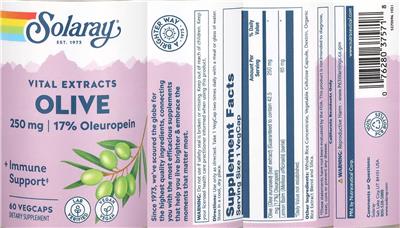
Olive 250 mg 17% Oleuropein by Solaray label
The label scan from the NIH Dietary Supplement Label Database. Tap to enlarge.
Label images are published by the NIH Dietary Supplement Label Database for the version of this product on file. Always read your actual product label.
View the full label (PDF)The Ingredients in Olive 250 mg 17% Oleuropein by Solaray
These are the 2 active ingredients this product is made of. Select any to open its full monograph.
Serving size1 VegCap(s) Dosage formCapsule Servings per container60 Amounts shown are per serving.
Most supplement products combine several ingredients, and a medication can interact with the product through any one of them. Each ingredient below shows whether it has known drug interactions.
Lemon Balm
Interacts with264 drugs
Lemon balm is a gentle, lemon-scented mint-family herb traditionally used to ease stress, support sleep, and calm digestion, and topically for cold so...
Lemon Balm monograph & interactionsOlive Leaf Extract
No knowninteractions
Olive comes from the same tree that gives us olives and olive oil, and its leaf and fruit contain antioxidant compounds like oleuropein and hydroxytyr...
Olive Leaf Extract monograph & interactions- › Oleuropein
Other (inactive) ingredients: Whole Rice concentrate, Cellulose, Dextrin, Rice extract Blend, Silica. These complete the product’s ingredient list but are not active constituents.
Olive 250 mg 17% Oleuropein by Solaray Drug Interactions
HelloPharmacist Interaction Report
Solaray's Olive 250 mg 17% Oleuropein contains lemon balm, which does interact with certain medications.
The most serious concern is with CNS depressants (drugs that slow brain activity, like sedatives, sleep aids, and some pain relievers) — lemon balm may add to their effects, making you drowsier or more impaired than the medication alone. This is a Moderate-severity interaction.
Read the full breakdown — every affected drug type, severity by severity
Lemon balm also has a Moderate interaction with thyroid hormone replacement therapy. The herb may interfere with how your body uses thyroid medications, potentially reducing their effectiveness.
If you take thyroid hormone, this needs checking before you start.
We could not check oleuropein — we hold no interaction data for that ingredient. The product also contains olive leaf extract as a blend, so those individual components are already listed.
Altogether, these interactions span 264 individual medications. Use the medication checker on this page with your exact prescriptions before you start.
Check your own medications below · Editorial policy · How we use AI
Want to check YOUR meds against Olive 250 mg 17% Oleuropein?
Ask about interactions with your drugs in plain English — “Can I take it with lisinopril?” — and we find you the answer in seconds, ingredient by ingredient.
Go to the checkerIngredients driving the most interactions
Individual Drug Interactions
The ingredients in Olive 250 mg 17% Oleuropein interact with 264 drugs. Click any drug to see the details.
1 of the 2 ingredients in Olive 250 mg 17% Oleuropein interact with drugs. Each result below shows which ingredient is responsible. Lemon Balm
AcepromazineAtravet
How Acepromazine interacts with Olive 250 mg 17% Oleuropein — through 1 ingredient. Tap an ingredient for the detail:
Lemon BalmCns Depressants Moderate
Interaction Summary
Theoretically, concomitant use of lemon balm might have additive effects with CNS depressant drugs.
Read the full Lemon Balm + Acepromazine interactionAcetaminophen, Butalbital, Caffeine, CodeineEsgic with Codeine, Fioricet w/ Codeine
How Acetaminophen, Butalbital, Caffeine, Codeine interacts with Olive 250 mg 17% Oleuropein — through 1 ingredient. Tap an ingredient for the detail:
Lemon BalmCns Depressants Moderate
Interaction Summary
Theoretically, concomitant use of lemon balm might have additive effects with CNS depressant drugs.
Read the full Lemon Balm + Acetaminophen, Butalbital, Caffeine, Codeine interactionAcetaminophen, Butalbital, CodeineBancap w/ Codeine
How Acetaminophen, Butalbital, Codeine interacts with Olive 250 mg 17% Oleuropein — through 1 ingredient. Tap an ingredient for the detail:
Lemon BalmCns Depressants Moderate
Interaction Summary
Theoretically, concomitant use of lemon balm might have additive effects with CNS depressant drugs.
Read the full Lemon Balm + Acetaminophen, Butalbital, Codeine interactionAcetaminophen, Butalbital, Codeine PhosphatePhrenilin #3
How Acetaminophen, Butalbital, Codeine Phosphate interacts with Olive 250 mg 17% Oleuropein — through 1 ingredient. Tap an ingredient for the detail:
Lemon BalmCns Depressants Moderate
Interaction Summary
Theoretically, concomitant use of lemon balm might have additive effects with CNS depressant drugs.
Read the full Lemon Balm + Acetaminophen, Butalbital, Codeine Phosphate interactionAcetaminophen, Caffeine, Chlorpheniramine, Hydrocodone, PhenylephrineHycomine Compound
How Acetaminophen, Caffeine, Chlorpheniramine, Hydrocodone, Phenylephrine interacts with Olive 250 mg 17% Oleuropein — through 1 ingredient. Tap an ingredient for the detail:
Lemon BalmCns Depressants Moderate
Interaction Summary
Theoretically, concomitant use of lemon balm might have additive effects with CNS depressant drugs.
Read the full Lemon Balm + Acetaminophen, Caffeine, Chlorpheniramine, Hydrocodone, Phenylephrine interactionAcetaminophen, Caffeine, CodeineGesic C15, Gesic C30, Gesic C8, Lenoltec 1, Lenoltec 2, Lenoltec 3 +1 more
How Acetaminophen, Caffeine, Codeine interacts with Olive 250 mg 17% Oleuropein — through 1 ingredient. Tap an ingredient for the detail:
Lemon BalmCns Depressants Moderate
Interaction Summary
Theoretically, concomitant use of lemon balm might have additive effects with CNS depressant drugs.
Read the full Lemon Balm + Acetaminophen, Caffeine, Codeine interactionAcetaminophen, Caffeine, Codeine, SalicylamideCodalan No.1, Codalan No.2, Codalan No.3
How Acetaminophen, Caffeine, Codeine, Salicylamide interacts with Olive 250 mg 17% Oleuropein — through 1 ingredient. Tap an ingredient for the detail:
Lemon BalmCns Depressants Moderate
Interaction Summary
Theoretically, concomitant use of lemon balm might have additive effects with CNS depressant drugs.
Read the full Lemon Balm + Acetaminophen, Caffeine, Codeine, Salicylamide interactionAcetaminophen, Caffeine, DihydrocodeineDHC Plus, Panlor DC, Panlor SS
How Acetaminophen, Caffeine, Dihydrocodeine interacts with Olive 250 mg 17% Oleuropein — through 1 ingredient. Tap an ingredient for the detail:
Lemon BalmCns Depressants Moderate
Interaction Summary
Theoretically, concomitant use of lemon balm might have additive effects with CNS depressant drugs.
Read the full Lemon Balm + Acetaminophen, Caffeine, Dihydrocodeine interactionAcetaminophen, Chlorpheniramine, Codeine, PhenylephrineColrex
How Acetaminophen, Chlorpheniramine, Codeine, Phenylephrine interacts with Olive 250 mg 17% Oleuropein — through 1 ingredient. Tap an ingredient for the detail:
Lemon BalmCns Depressants Moderate
Interaction Summary
Theoretically, concomitant use of lemon balm might have additive effects with CNS depressant drugs.
Read the full Lemon Balm + Acetaminophen, Chlorpheniramine, Codeine, Phenylephrine interactionAcetaminophen, Chlorpheniramine, Phenylpropanolamine, OpiumHista-Derfule
How Acetaminophen, Chlorpheniramine, Phenylpropanolamine, Opium interacts with Olive 250 mg 17% Oleuropein — through 1 ingredient. Tap an ingredient for the detail:
Lemon BalmCns Depressants Moderate
Interaction Summary
Theoretically, concomitant use of lemon balm might have additive effects with CNS depressant drugs.
Read the full Lemon Balm + Acetaminophen, Chlorpheniramine, Phenylpropanolamine, Opium interactionAcetaminophen, Chlorzoxazone, CodeineAcetazone Forte C8, Parafon Forte C8
How Acetaminophen, Chlorzoxazone, Codeine interacts with Olive 250 mg 17% Oleuropein — through 1 ingredient. Tap an ingredient for the detail:
Lemon BalmCns Depressants Moderate
Interaction Summary
Theoretically, concomitant use of lemon balm might have additive effects with CNS depressant drugs.
Read the full Lemon Balm + Acetaminophen, Chlorzoxazone, Codeine interactionAcetaminophen, CodeineTylenol No.3, Tylenol w/ Codeine
How Acetaminophen, Codeine interacts with Olive 250 mg 17% Oleuropein — through 1 ingredient. Tap an ingredient for the detail:
Lemon BalmCns Depressants Moderate
Interaction Summary
Theoretically, concomitant use of lemon balm might have additive effects with CNS depressant drugs.
Read the full Lemon Balm + Acetaminophen, Codeine interactionAcetaminophen, Codeine, DoxylamineMersyndol
How Acetaminophen, Codeine, Doxylamine interacts with Olive 250 mg 17% Oleuropein — through 1 ingredient. Tap an ingredient for the detail:
Lemon BalmCns Depressants Moderate
Interaction Summary
Theoretically, concomitant use of lemon balm might have additive effects with CNS depressant drugs.
Read the full Lemon Balm + Acetaminophen, Codeine, Doxylamine interactionAcetaminophen, Codeine, MethocarbamolAcetaminophen, Codeine, Methocarbamol, Robaxacet 8
How Acetaminophen, Codeine, Methocarbamol interacts with Olive 250 mg 17% Oleuropein — through 1 ingredient. Tap an ingredient for the detail:
Lemon BalmCns Depressants Moderate
Interaction Summary
Theoretically, concomitant use of lemon balm might have additive effects with CNS depressant drugs.
Read the full Lemon Balm + Acetaminophen, Codeine, Methocarbamol interactionAcetaminophen, Dichloralantipyrine, IsomethepteneAmidrine, Midchlor, Migquin, Migratine
How Acetaminophen, Dichloralantipyrine, Isometheptene interacts with Olive 250 mg 17% Oleuropein — through 1 ingredient. Tap an ingredient for the detail:
Lemon BalmCns Depressants Moderate
Interaction Summary
Theoretically, concomitant use of lemon balm might have additive effects with CNS depressant drugs.
Read the full Lemon Balm + Acetaminophen, Dichloralantipyrine, Isometheptene interactionAcetaminophen, Dichloralphenazone, IsomethepteneMidrin
How Acetaminophen, Dichloralphenazone, Isometheptene interacts with Olive 250 mg 17% Oleuropein — through 1 ingredient. Tap an ingredient for the detail:
Lemon BalmCns Depressants Moderate
Interaction Summary
Theoretically, concomitant use of lemon balm might have additive effects with CNS depressant drugs.
Read the full Lemon Balm + Acetaminophen, Dichloralphenazone, Isometheptene interactionAcetaminophen, Dichlorophenazone, IsometheptaneIsocom
How Acetaminophen, Dichlorophenazone, Isometheptane interacts with Olive 250 mg 17% Oleuropein — through 1 ingredient. Tap an ingredient for the detail:
Lemon BalmCns Depressants Moderate
Interaction Summary
Theoretically, concomitant use of lemon balm might have additive effects with CNS depressant drugs.
Read the full Lemon Balm + Acetaminophen, Dichlorophenazone, Isometheptane interactionAcetaminophen, DiphenhydramineTylenol PM, Tylenol PM Ex Strength
How Acetaminophen, Diphenhydramine interacts with Olive 250 mg 17% Oleuropein — through 1 ingredient. Tap an ingredient for the detail:
Lemon BalmCns Depressants Moderate
Interaction Summary
Theoretically, concomitant use of lemon balm might have additive effects with CNS depressant drugs.
Read the full Lemon Balm + Acetaminophen, Diphenhydramine interactionAcetaminophen, Diphenhydramine, PseudoephedrineChildren's Tylenol Allergy, Cold Control, Contac Night Allergy Relief
How Acetaminophen, Diphenhydramine, Pseudoephedrine interacts with Olive 250 mg 17% Oleuropein — through 1 ingredient. Tap an ingredient for the detail:
Lemon BalmCns Depressants Moderate
Interaction Summary
Theoretically, concomitant use of lemon balm might have additive effects with CNS depressant drugs.
Read the full Lemon Balm + Acetaminophen, Diphenhydramine, Pseudoephedrine interactionAcetaminophen, HydrocodoneAnexsia, Anodynos DHC, Azdone, Co-Gesic, Doucet, Lorcet +9 more
How Acetaminophen, Hydrocodone interacts with Olive 250 mg 17% Oleuropein — through 1 ingredient. Tap an ingredient for the detail:
Lemon BalmCns Depressants Moderate
Interaction Summary
Theoretically, concomitant use of lemon balm might have additive effects with CNS depressant drugs.
Read the full Lemon Balm + Acetaminophen, Hydrocodone interactionAcetaminophen, MeperidineDemerol APAP
How Acetaminophen, Meperidine interacts with Olive 250 mg 17% Oleuropein — through 1 ingredient. Tap an ingredient for the detail:
Lemon BalmCns Depressants Moderate
Interaction Summary
Theoretically, concomitant use of lemon balm might have additive effects with CNS depressant drugs.
Read the full Lemon Balm + Acetaminophen, Meperidine interactionAcetaminophen, OxycodonePercocet, Roxicet, Tylox, Xartemis XR
How Acetaminophen, Oxycodone interacts with Olive 250 mg 17% Oleuropein — through 1 ingredient. Tap an ingredient for the detail:
Lemon BalmCns Depressants Moderate
Interaction Summary
Theoretically, concomitant use of lemon balm might have additive effects with CNS depressant drugs.
Read the full Lemon Balm + Acetaminophen, Oxycodone interactionAcetaminophen, PentazocineTalacen
How Acetaminophen, Pentazocine interacts with Olive 250 mg 17% Oleuropein — through 1 ingredient. Tap an ingredient for the detail:
Lemon BalmCns Depressants Moderate
Interaction Summary
Theoretically, concomitant use of lemon balm might have additive effects with CNS depressant drugs.
Read the full Lemon Balm + Acetaminophen, Pentazocine interactionAcetaminophen, PropoxypheneDarvocet-N 100, Darvocet-N 50, E-Lor, Wygesic
How Acetaminophen, Propoxyphene interacts with Olive 250 mg 17% Oleuropein — through 1 ingredient. Tap an ingredient for the detail:
Lemon BalmCns Depressants Moderate
Interaction Summary
Theoretically, concomitant use of lemon balm might have additive effects with CNS depressant drugs.
Read the full Lemon Balm + Acetaminophen, Propoxyphene interactionAcetazolamideAk-Zol, Diamox
How Acetazolamide interacts with Olive 250 mg 17% Oleuropein — through 1 ingredient. Tap an ingredient for the detail:
Lemon BalmCns Depressants Moderate
Interaction Summary
Theoretically, concomitant use of lemon balm might have additive effects with CNS depressant drugs.
Read the full Lemon Balm + Acetazolamide interactionAlfentanilAlfenta
How Alfentanil interacts with Olive 250 mg 17% Oleuropein — through 1 ingredient. Tap an ingredient for the detail:
Lemon BalmCns Depressants Moderate
Interaction Summary
Theoretically, concomitant use of lemon balm might have additive effects with CNS depressant drugs.
Read the full Lemon Balm + Alfentanil interactionAlprazolamNiravam, Xanax
How Alprazolam interacts with Olive 250 mg 17% Oleuropein — through 1 ingredient. Tap an ingredient for the detail:
Lemon BalmCns Depressants Moderate
Interaction Summary
Theoretically, concomitant use of lemon balm might have additive effects with CNS depressant drugs.
Read the full Lemon Balm + Alprazolam interactionAluminum Hydroxide, Aspirin, Codeine Phosphate, Magnesium HydroxideAscriptin Codeine #2
How Aluminum Hydroxide, Aspirin, Codeine Phosphate, Magnesium Hydroxide interacts with Olive 250 mg 17% Oleuropein — through 1 ingredient. Tap an ingredient for the detail:
Lemon BalmCns Depressants Moderate
Interaction Summary
Theoretically, concomitant use of lemon balm might have additive effects with CNS depressant drugs.
Read the full Lemon Balm + Aluminum Hydroxide, Aspirin, Codeine Phosphate, Magnesium Hydroxide interactionAminoglutethimideCytadren
How Aminoglutethimide interacts with Olive 250 mg 17% Oleuropein — through 1 ingredient. Tap an ingredient for the detail:
Lemon BalmCns Depressants Moderate
Interaction Summary
Theoretically, concomitant use of lemon balm might have additive effects with CNS depressant drugs.
Read the full Lemon Balm + Aminoglutethimide interactionAminophylline, Amobarbital, EphedrineAmesec
How Aminophylline, Amobarbital, Ephedrine interacts with Olive 250 mg 17% Oleuropein — through 1 ingredient. Tap an ingredient for the detail:
Lemon BalmCns Depressants Moderate
Interaction Summary
Theoretically, concomitant use of lemon balm might have additive effects with CNS depressant drugs.
Read the full Lemon Balm + Aminophylline, Amobarbital, Ephedrine interactionEach ingredient & the kinds of drugs it affects
For each ingredient in Olive 250 mg 17% Oleuropein with known interactions, here are the types of medications it can affect. Open any type for the detail — or search your exact drug in the checker above.
Lemon Balm
Cns Depressants
Theoretically, concomitant use of lemon balm might have additive effects with CNS depressant drugs.
Lemon balm seems to have CNS depressant activity in animals and in humans.
Thyroid Hormone
Theoretically, lemon balm might interfere with thyroid hormone replacement therapy.
In vitro, constituents of lemon balm extract bind to thyroid stimulating hormone (TSH), preventing TSH receptor-binding and leading to the inhibition of TSH-stimulated adenylate cyclase activity. In animals, lemon balm extract has been shown to decrease levels of circulating TSH and inhibit thyroid secretion.
Brand information
Manufacturer and brand details for Olive 250 mg 17% Oleuropein, from the product label.
Olive 250 mg 17% Oleuropein by Solaray: Common Questions
Does Olive 250 mg 17% Oleuropein by Solaray interact with any medications?
How can one product interact with so many drugs?
Where does this information come from?
Does this help with cold sores?
Can I take this while pregnant or breastfeeding?
What's oleuropein, and why is it in here?
Does this help with stress or depression?
What side effects should I watch for?
Is this safe long-term?
Written and reviewed by the HelloPharmacist editorial staff. Our editorial policy
Not sure if Olive 250 mg 17% Oleuropein is safe with your meds?
Our pharmacists answer your medication & supplement questions — free.
Label information is sourced from the NIH Dietary Supplement Label Database and reflects the product version on file; always read your actual product label. This page is for education only and is not a substitute for professional medical advice. Confirm with your pharmacist or doctor before combining supplements and medications.
The Full Monographs Behind Olive 250 mg 17% Oleuropein’s Ingredients
Every ingredient we hold a full HelloPharmacist monograph for — uses, evidence, safety, and the complete interaction list.
Lemon Balm
Interacts with 264 drugsLemon balm is a gentle, lemon-scented mint-family herb traditionally used to ease stress, support sleep, and calm digestion, and topically for cold sores. Early studies are promising but gen...
Read the full Lemon Balm monograph → Herb & supplement monographOlive
Olive comes from the same tree that gives us olives and olive oil, and its leaf and fruit contain antioxidant compounds like oleuropein and hydroxytyrosol. Olive oil as part of a Mediterrane...
Read the full Olive monograph →Sources & How We Checked
Olive 250 mg 17% Oleuropein's label data comes from the NIH Dietary Supplement Label Database; the ingredient interaction data is from the Natural Medicines database, reviewed by our pharmacists.
- NIH Dietary Supplement Label Database (DSLD) — The official product label on file for this supplement.
- Natural Medicines (Therapeutic Research Center) — Evidence-graded clinical reference behind the ingredient interaction data.
Content is written and reviewed by licensed HelloPharmacist pharmacists. See our data sources and editorial standards for how this information is built and checked.
The 14 references behind this product’s interaction data
Every citation that drives the interaction findings for this product’s ingredients, from the evidence-graded Natural Medicines (TRC Healthcare) database. Open an ingredient to browse its citations — links open the study on PubMed or the publisher’s site.
Lemon Balm 12 references
- Wolbling RH, Leonhardt K. Local therapy of herpes simplex with dried extract from Melissa officinalis. Phytomedicine 1994;1:25-31.
- Akhondzadeh S, Noroozian M, Mohammadi M, et al. Melissa officinalis extract in the treatment of patients with mild to moderate Alzheimer's disease: a double blind, randomised, placebo controlled trial. J Neurol Neurosurg Psychiatry 2003;74:863-6. PubMed
- Kennedy DO, Scholey AB, Tildesley NT, et al. Modulation of mood and cognitive performance following acute administration of Melissa officinalis (lemon balm). Pharmacol Biochem Behav 2002;72:953-64. PubMed
- Albrecht M, Berger W, Laux P, Schmidt U, et al. Psychopharmaka und Verkehrssicherheit. Der Einfluß von Euvegal® - Dragees forte auf die Fahrtüchtigkeit und Kombinationswirkungen mit Alkohol Z Allg Med 1995;71:1215-25.
- Herberg, KW. Nebenwirkungen pflanzlicher Beruhigungsmittel/ Leistung und Befinden nach Einnahme einer Baldrian-Hopfen-Kombination. Z.Allg Med 1996;72:234-240.
- Soulimani R, Fleurentin J, Mortier F, et al. Neurotropic action of the hydroalcoholic extract of Melissa officinalis in the mouse. Planta Med. 1991 Apr;57:105-9.
- Sourgens H, Winterhoff H, Gumbinger HG, et al. Antihormonal effects of plant extracts. TSH- and prolactin-suppressing properties of Lithospermum officinale and other plants. Planta Med. 1982 Jun;45:78-86. DOI
- Auf'mkolk M, Ingbar JC, Amir SM, et al. Inhibition by certain plant extracts of the binding and adenylate cyclase stimulatory effect of bovine thyrotropin in human thyroid membranes. Endocrinology. 1984 Aug;115:527-34. PubMed
- Santini F, Vitti P, Ceccarini G, et al. In vitro assay of thyroid disruptors affecting TSH-stimulated adenylate cyclase activity. J Endocrinol Invest. 2003 Oct;26:950-5. PubMed
- Alijaniha F, et al. Heart palpitation relief with Melissa officinalis leaf extract: double blind, randomized, placebo controlled trial of efficacy and safety. J Ethnopharmacol. 2015;164:378-384. doi: 10.1016/j.jep.2015.02.007. Epub 2015 Feb 11. PubMed
- Araj-Khodaei M, Noorbala AA, Yarani R, et al. A double-blind, randomized pilot study for comparison of Melissa officinalis L. and Lavandula angustifolia Mill. with Fluoxetine for the treatment of depression. BMC Complement Med Ther. 2020;20(1):207. PubMed
- Kucuk U, Pham M, Raza Raja MH, Saad Shaukat MH, Clark R. Transient complete atrioventricular block associated with herbal supplement use. S D Med 2023;76(7):311-313.
Olive 2 references
- Liccardi G, D'Amato M, D'Amato G. Oleaceae pollinosis: a review. Int Arch Allergy Immunol 1996;111:210-7. PubMed
- Somerville V, Moore R, Braakhuis A. The effect of olive leaf extract on upper respiratory illness in high school athletes: A randomised control trial. Nutrients. 2019;11(2). pii: E358. PubMed
Parts of this content are provided by the Therapeutic Research Center, LLC.
DISCLAIMER: Currently this does not check for drug-drug interactions. This is not an all-inclusive comprehensive list of potential interactions and is for informational purposes only. Not all interactions are known or well-reported in the scientific literature, and new interactions are continually being reported. Input is needed from a qualified healthcare provider including a pharmacist before starting any therapy. Application of clinical judgment is necessary.
© 2021 Therapeutic Research Center, LLC