
Orange Powder Ingredients & Drug Interactions
What is this page for?
First and foremost: checking Orange Powder against your medications. The heart of this page is the interaction checker and the full interaction report — how this product’s ingredients may interact with prescription and over-the-counter medicines you may be taking.
Around that, we add a pharmacist’s high-level view of the product as a whole — what’s inside, the evidence for its stated use, how transparent the label is, and what safety data exists — so you can see the full picture in one place. It’s educational information from our licensed clinical databases and the clinical staff at HelloPharmacist — not medical advice — and we don’t sell or endorse products. Our editorial policy
Orange Powder is a dietary supplement by BulkSupplements.com with 1 active ingredient. Its ingredients are commonly taken for vitamin c source, digestive upset, stress and relaxation (aromatherapy).Based on those ingredients, 246 medications have a known interaction with it, the most serious rated major. The ingredients most likely to interact are Orange powder. Use the checker below to test your specific medication, or read the full HelloPharmacist Interaction Report.
Check Your Meds Against Orange Powder by BulkSupplements.com
Ask about any prescription or over-the-counter medication and we check it for interactions with Orange Powder by BulkSupplements.com — and tell you which ingredient is responsible.
AI summaries are generated from our interaction database for education only — always confirm with your pharmacist. How we use AI
Ask the Pharmacist
A licensed pharmacist will answer your question by email — free, usually within 24 hours.
Got it — thank you!
A licensed pharmacist will answer within 24 hours. Keep an eye on your email (worth checking spam, just in case).
HelloPharmacist Scorecard of Orange Powder by BulkSupplements.com
Four independent checks of what is known — a summary of the available information, not a grade of the product itself.
By FDA rules, dietary supplements can’t claim to treat, cure, or prevent disease — so labels speak in careful marketing language. We discern each product’s intended use from its name, label claims, and label statements, then grade the clinical evidence for that use. How these ratings are computed
The stated purpose hasn't been mapped to our evidence data yet.
Why this rating?
- We haven't mapped this product's purpose to our evidence data yet — it'll be graded on the next content refresh.
Every active ingredient lists its own amount on the label.
Why this rating?
- The label discloses an exact amount for 1 of its 1 active ingredient.
- No proprietary blends here — you can verify the dose of every single component.
At least one ingredient has a documented Major-severity interaction. Check your medications for a personalized result.
Why this rating?
- 1 of the 1 matched ingredient can interact with medications — Sweet Orange.
- The most serious interaction on file is rated Major.
- For scale: 246 individual medications appear in the full list. A big number alone doesn't make a product dangerous — what matters is whether YOUR medication is on it, so run yours through the interaction checker on this page.
Adverse-effect, pregnancy, and general safety data are on file for most of these ingredients.
Why this rating?
- We hold adverse-effect (side-effect) data for 1 of the 1 matched ingredient.
- Pregnancy & breastfeeding safety ratings cover 1 of 1.
- General safety write-ups exist for 1 of 1.
- Remember: this measures how much safety information exists. Thin data is not the same as being safe.
HelloPharmacist summaryFully disclosed formula with no assessable stated purpose. Major medication interactions have been identified, and safety information is well characterized.
Assessment coverage: 1 of 1 active ingredient matched to our full ingredient reviews (monographs). Based on the product label dated Sep 24, 2021.
This Scorecard evaluates available label information, ingredient evidence, and known medication-safety considerations. It does not independently verify product identity, purity, potency, contamination, or manufacturing quality. How these ratings are computed
General information
Key facts about Orange Powder, straight from the product label.
| Brand | BulkSupplements.com |
|---|---|
| Net contents | 100 Gram(s); 3.5 Ounce(s) |
| Market status | On market |
| Date entered into DSLD | Sep 24, 2021 |
| DSLD ID | 254989 |
| Product type | Botanical |
| Supplement form | Powder |
| Dietary claims / uses | All Other, Structure/Function |
| Intended target group(s) | Adult (18 - 50 Years), Gluten Free, Dairy Free |
Everything in this section is reproduced from the manufacturer’s own product label — it’s the label speaking, not HelloPharmacist. We show it so you can see exactly what the maker states; we don’t verify or endorse those statements.
Supplement Facts
The label details for Orange Powder by BulkSupplements.com, sourced from the NIH Dietary Supplement Label Database.
Tap any ingredient to jump to its full detail below.
These statements are the manufacturer’s wording, reproduced from the product label — the label is saying it, not HelloPharmacist. We don’t verify or endorse them.
General Statements
Clean & pure bulk supplements
Formulation
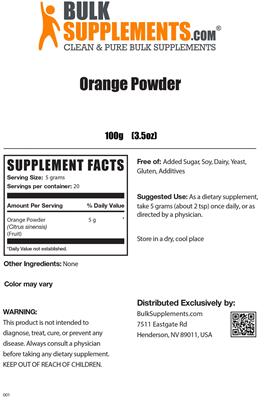
Color may vary
Free Of: Added sugar, soy, dairy, yeast, gluten, additives
FDA Disclaimer Statement
Warning: This product is not intended to diagnose, treat, cure, or prevent any disease.
Precautions
Always consult a physician before taking any dietary supplement.
Keep out of reach of children.
Suggested Use: As a dietary supplement, take 5 grams (about 2 tsp) once daily, or as directed by a physician.
Storage
Store in a dry, cool place
Is this label outdated? Report a formula or label change and our pharmacy team will review it.
Orange Powder by BulkSupplements.com label
The label scan from the NIH Dietary Supplement Label Database. Tap to enlarge.
Label images are published by the NIH Dietary Supplement Label Database for the version of this product on file. Always read your actual product label.
View the full label (PDF)The Ingredients in Orange Powder by BulkSupplements.com
This is the 1 active ingredient this product is made of. Select it to open its full monograph.
Serving size5 Gram(s) Dosage formPowder Servings per container20 Amounts shown are per serving.
Orange powder
Interacts with246 drugs
Sweet orange is a common citrus fruit that is a good source of vitamin C, fiber, and antioxidants, and is enjoyed as a food worldwide. Its peel and es...
Orange powder monograph & interactionsOther (inactive) ingredients: None. These complete the product’s ingredient list but are not active constituents.
Orange Powder by BulkSupplements.com Drug Interactions
Orange Powder contains a single active ingredient, and it has known interactions with 246 medications. Here’s the picture, then you can look up your own drug.
Want to check YOUR meds against Orange Powder?
Ask about interactions with your drugs in plain English — “Can I take it with lisinopril?” — and we find you the answer in seconds, ingredient by ingredient.
Go to the checkerIngredients driving the most interactions
Individual Drug Interactions
The ingredients in Orange Powder interact with 246 drugs. Click any drug to see the details.
1 of the 1 ingredient in Orange Powder interact with drugs. Each result below shows which ingredient is responsible. Orange powder
MethotrexateOtrexup, Rasuvo, Reditrex, Rheumatrex
How Methotrexate interacts with Orange Powder — through 1 ingredient. Tap an ingredient for the detail:
Orange PowderOrganic Anion-transporting Polypeptide Substrates (oatp) Major
Interaction Summary
Consuming sweet orange juice can decrease oral absorption of OATP substrates.
Read the full Orange Powder + Methotrexate interactionMethotrexate SodiumXatmep
How Methotrexate Sodium interacts with Orange Powder — through 1 ingredient. Tap an ingredient for the detail:
Orange PowderOrganic Anion-transporting Polypeptide Substrates (oatp) Major
Interaction Summary
Consuming sweet orange juice can decrease oral absorption of OATP substrates.
Read the full Orange Powder + Methotrexate Sodium interactionMoxifloxacinAvelox
How Moxifloxacin interacts with Orange Powder — through 1 ingredient. Tap an ingredient for the detail:
Orange PowderOrganic Anion-transporting Polypeptide Substrates (oatp), Quinolone Antibiotics Major
Interaction Summary
Consuming sweet orange juice can decrease oral absorption of OATP substrates.
Read the full Orange Powder + Moxifloxacin interactionNalidixic AcidNegGram
How Nalidixic Acid interacts with Orange Powder — through 1 ingredient. Tap an ingredient for the detail:
Orange PowderOrganic Anion-transporting Polypeptide Substrates (oatp), Quinolone Antibiotics Major
Interaction Summary
Consuming sweet orange juice can decrease oral absorption of OATP substrates.
Read the full Orange Powder + Nalidixic Acid interactionNiacin, LovastatinAdvicor
How Niacin, Lovastatin interacts with Orange Powder — through 1 ingredient. Tap an ingredient for the detail:
Orange PowderOrganic Anion-transporting Polypeptide Substrates (oatp) Major
Interaction Summary
Consuming sweet orange juice can decrease oral absorption of OATP substrates.
Read the full Orange Powder + Niacin, Lovastatin interactionNiacin, SimvastatinSimcor
How Niacin, Simvastatin interacts with Orange Powder — through 1 ingredient. Tap an ingredient for the detail:
Orange PowderOrganic Anion-transporting Polypeptide Substrates (oatp) Major
Interaction Summary
Consuming sweet orange juice can decrease oral absorption of OATP substrates.
Read the full Orange Powder + Niacin, Simvastatin interactionNorfloxacinNorflox, Noroxin
How Norfloxacin interacts with Orange Powder — through 1 ingredient. Tap an ingredient for the detail:
Orange PowderOrganic Anion-transporting Polypeptide Substrates (oatp), Quinolone Antibiotics Major
Interaction Summary
Consuming sweet orange juice can decrease oral absorption of OATP substrates.
Read the full Orange Powder + Norfloxacin interactionOfloxacinFloxin, Floxin Injection, Floxin Otic, Oflox
How Ofloxacin interacts with Orange Powder — through 1 ingredient. Tap an ingredient for the detail:
Orange PowderOrganic Anion-transporting Polypeptide Substrates (oatp), Quinolone Antibiotics Major
Interaction Summary
Consuming sweet orange juice can decrease oral absorption of OATP substrates.
Read the full Orange Powder + Ofloxacin interactionPaclitaxelAbraxane, Taxol
How Paclitaxel interacts with Orange Powder — through 1 ingredient. Tap an ingredient for the detail:
Orange PowderOrganic Anion-transporting Polypeptide Substrates (oatp), P-glycoprotein Substrates Major
Interaction Summary
Consuming sweet orange juice can decrease oral absorption of OATP substrates.
Read the full Orange Powder + Paclitaxel interactionPravastatin SodiumPravachol
How Pravastatin Sodium interacts with Orange Powder — through 1 ingredient. Tap an ingredient for the detail:
Orange PowderOrganic Anion-transporting Polypeptide Substrates (oatp), Pravastatin (pravachol) Major
Interaction Summary
Consuming sweet orange juice can decrease oral absorption of OATP substrates.
Read the full Orange Powder + Pravastatin Sodium interactionRifampinRifadin, Rifadin Injection, Rimactane, Rofactor
How Rifampin interacts with Orange Powder — through 1 ingredient. Tap an ingredient for the detail:
Orange PowderOrganic Anion-transporting Polypeptide Substrates (oatp) Major
Interaction Summary
Consuming sweet orange juice can decrease oral absorption of OATP substrates.
Read the full Orange Powder + Rifampin interactionSaquinavirFortovase, Invirase
How Saquinavir interacts with Orange Powder — through 1 ingredient. Tap an ingredient for the detail:
Orange PowderP-glycoprotein Substrates, Organic Anion-transporting Polypeptide Substrates (oatp) Major
Interaction Summary
Sweet orange juice seems to modulate P-glycoprotein (P-gp), which might affect the blood levels of P-gp substrates.
Read the full Orange Powder + Saquinavir interactionSimvastatinZocor
How Simvastatin interacts with Orange Powder — through 1 ingredient. Tap an ingredient for the detail:
Orange PowderOrganic Anion-transporting Polypeptide Substrates (oatp) Major
Interaction Summary
Consuming sweet orange juice can decrease oral absorption of OATP substrates.
Read the full Orange Powder + Simvastatin interactionSimvastatin, SitagliptinJuvisync
How Simvastatin, Sitagliptin interacts with Orange Powder — through 1 ingredient. Tap an ingredient for the detail:
Orange PowderOrganic Anion-transporting Polypeptide Substrates (oatp) Major
Interaction Summary
Consuming sweet orange juice can decrease oral absorption of OATP substrates.
Read the full Orange Powder + Simvastatin, Sitagliptin interactionSparfloxacinZagam
How Sparfloxacin interacts with Orange Powder — through 1 ingredient. Tap an ingredient for the detail:
Orange PowderP-glycoprotein Substrates, Organic Anion-transporting Polypeptide Substrates (oatp) +1 Major
Interaction Summary
Sweet orange juice seems to modulate P-glycoprotein (P-gp), which might affect the blood levels of P-gp substrates.
Read the full Orange Powder + Sparfloxacin interactionTorsemideDemadex, Soaanz
How Torsemide interacts with Orange Powder — through 1 ingredient. Tap an ingredient for the detail:
Orange PowderOrganic Anion-transporting Polypeptide Substrates (oatp) Major
Interaction Summary
Consuming sweet orange juice can decrease oral absorption of OATP substrates.
Read the full Orange Powder + Torsemide interactionTrovafloxacinTrovan, Trovan Injection
How Trovafloxacin interacts with Orange Powder — through 1 ingredient. Tap an ingredient for the detail:
Orange PowderOrganic Anion-transporting Polypeptide Substrates (oatp), Quinolone Antibiotics Major
Interaction Summary
Consuming sweet orange juice can decrease oral absorption of OATP substrates.
Read the full Orange Powder + Trovafloxacin interactionSimvastatin/ezetimibeVytorin
How Simvastatin/ezetimibe interacts with Orange Powder — through 1 ingredient. Tap an ingredient for the detail:
Orange PowderOrganic Anion-transporting Polypeptide Substrates (oatp) Major
Interaction Summary
Consuming sweet orange juice can decrease oral absorption of OATP substrates.
Read the full Orange Powder + Simvastatin/ezetimibe interactionAcalabrutinibCalquence
How Acalabrutinib interacts with Orange Powder — through 1 ingredient. Tap an ingredient for the detail:
Orange PowderP-glycoprotein Substrates Moderate
Interaction Summary
Sweet orange juice seems to modulate P-glycoprotein (P-gp), which might affect the blood levels of P-gp substrates.
Read the full Orange Powder + Acalabrutinib interactionAfatinib DimaleateGilotrif
How Afatinib Dimaleate interacts with Orange Powder — through 1 ingredient. Tap an ingredient for the detail:
Orange PowderP-glycoprotein Substrates Moderate
Interaction Summary
Sweet orange juice seems to modulate P-glycoprotein (P-gp), which might affect the blood levels of P-gp substrates.
Read the full Orange Powder + Afatinib Dimaleate interactionAlvimopanEntereg
How Alvimopan interacts with Orange Powder — through 1 ingredient. Tap an ingredient for the detail:
Orange PowderP-glycoprotein Substrates Moderate
Interaction Summary
Sweet orange juice seems to modulate P-glycoprotein (P-gp), which might affect the blood levels of P-gp substrates.
Read the full Orange Powder + Alvimopan interactionAmbrisentanLetairis, Volibris
How Ambrisentan interacts with Orange Powder — through 1 ingredient. Tap an ingredient for the detail:
Orange PowderP-glycoprotein Substrates Moderate
Interaction Summary
Sweet orange juice seems to modulate P-glycoprotein (P-gp), which might affect the blood levels of P-gp substrates.
Read the full Orange Powder + Ambrisentan interactionAmphotericin, TetracyclineMysteclin-F
How Amphotericin, Tetracycline interacts with Orange Powder — through 1 ingredient. Tap an ingredient for the detail:
Orange PowderP-glycoprotein Substrates Moderate
Interaction Summary
Sweet orange juice seems to modulate P-glycoprotein (P-gp), which might affect the blood levels of P-gp substrates.
Read the full Orange Powder + Amphotericin, Tetracycline interactionAmprenavirAgenerase
How Amprenavir interacts with Orange Powder — through 1 ingredient. Tap an ingredient for the detail:
Orange PowderP-glycoprotein Substrates Moderate
Interaction Summary
Sweet orange juice seems to modulate P-glycoprotein (P-gp), which might affect the blood levels of P-gp substrates.
Read the full Orange Powder + Amprenavir interactionAntidiabetes, Dipeptidyl Peptidase-4 (dpp-iv) InhibitorGlyxambi
How Antidiabetes, Dipeptidyl Peptidase-4 (dpp-iv) Inhibitor interacts with Orange Powder — through 1 ingredient. Tap an ingredient for the detail:
Orange PowderP-glycoprotein Substrates Moderate
Interaction Summary
Sweet orange juice seems to modulate P-glycoprotein (P-gp), which might affect the blood levels of P-gp substrates.
Read the full Orange Powder + Antidiabetes, Dipeptidyl Peptidase-4 (dpp-iv) Inhibitor interactionApixabanEliquis
How Apixaban interacts with Orange Powder — through 1 ingredient. Tap an ingredient for the detail:
Orange PowderP-glycoprotein Substrates Moderate
Interaction Summary
Sweet orange juice seems to modulate P-glycoprotein (P-gp), which might affect the blood levels of P-gp substrates.
Read the full Orange Powder + Apixaban interactionApomorphineAPO-go, APO-go Pen, APO-go PFS, Apokyn, Uprima
How Apomorphine interacts with Orange Powder — through 1 ingredient. Tap an ingredient for the detail:
Orange PowderP-glycoprotein Substrates Moderate
Interaction Summary
Sweet orange juice seems to modulate P-glycoprotein (P-gp), which might affect the blood levels of P-gp substrates.
Read the full Orange Powder + Apomorphine interactionApomorphine HydrochlorideKynmobi
How Apomorphine Hydrochloride interacts with Orange Powder — through 1 ingredient. Tap an ingredient for the detail:
Orange PowderP-glycoprotein Substrates Moderate
Interaction Summary
Sweet orange juice seems to modulate P-glycoprotein (P-gp), which might affect the blood levels of P-gp substrates.
Read the full Orange Powder + Apomorphine Hydrochloride interactionArmodafinilNuvigil
How Armodafinil interacts with Orange Powder — through 1 ingredient. Tap an ingredient for the detail:
Orange PowderP-glycoprotein Substrates Moderate
Interaction Summary
Sweet orange juice seems to modulate P-glycoprotein (P-gp), which might affect the blood levels of P-gp substrates.
Read the full Orange Powder + Armodafinil interactionAtogepantQulipta
How Atogepant interacts with Orange Powder — through 1 ingredient. Tap an ingredient for the detail:
Orange PowderP-glycoprotein Substrates Moderate
Interaction Summary
Sweet orange juice seems to modulate P-glycoprotein (P-gp), which might affect the blood levels of P-gp substrates.
Read the full Orange Powder + Atogepant interactionEach ingredient & the kinds of drugs it affects
For each ingredient in Orange Powder with known interactions, here are the types of medications it can affect. Open any type for the detail — or search your exact drug in the checker above.
Orange powder
Celiprolol (Celicard)
Consuming sweet orange with celiprolol can decrease oral absorption of celiprolol.
A pharmacokinetic study in healthy volunteers shows that celiprolol levels, after a single dose of 100 mg, are decreased by up to 90% in people who drink sweet orange juice 200 mL three times daily. It's not known if lower consumption of sweet orange juice will have the same effect. Theoretically, this occurs due to short-term inhibition of organic anion transporting polypeptide (OATP). Recommend separating drug administration and consumption of sweet orange by at least 4 hours.
Ivermectin (Stromectol, Others)
Consuming sweet orange juice with ivermectin can decrease the oral absorption of ivermectin.
A pharmacokinetic study in healthy volunteers shows that taking ivermectin orally with sweet orange juice 750 mL over 4 hours reduces the bioavailability of ivermectin. This effect does not seem to be related to effects on P-glycoprotein. The effect on ivermectin is more pronounced in males compared to females.
Organic Anion-Transporting Polypeptide Substrates (Oatp)
Consuming sweet orange juice can decrease oral absorption of OATP substrates. Separate administration by at least 4 hours.
Clinical research shows that consuming sweet orange juice inhibits OATP, which reduces bioavailability of oral drugs that are substrates of OATP. For example, sweet orange juice decreases bioavailability of fexofenadine, a substrate of OATP, by about 72% and of celiprolol, another OATP substrate, by up to 90%. Since sweet orange juice seems to affect OATP for a short time, recommend separating drug administration and consumption of sweet orange juice by at least 4 hours.
Pravastatin (Pravachol)
Consuming sweet orange juice with pravastatin can increase the absorption of pravastatin.
A small pharmacokinetic study in healthy volunteers shows that consuming sweet orange juice 800 mL over 3 hours, including before, during, and after taking pravastatin 10 mg, increases pravastatin levels by about 149%, without affecting pravastatin elimination. Theoretically this effect might be due to modulation of organic anion transporting polypeptides (OATPs) by sweet orange juice. Sweet orange juice does not seem to affect simvastatin levels, but it is not known if sweet orange affects any of the other statins.
Fexofenadine (Allegra)
Consuming sweet orange juice with fexofenadine can decrease oral absorption of fexofenadine.
Clinical research shows that coadministration of sweet orange juice 1200 mL decreases bioavailability of fexofenadine by about 72%. In an animal model, sweet orange juice decreased bioavailability of fexofenadine by 31%. Fexofenadine manufacturer data indicates that concomitant administration of sweet orange juice and fexofenadine results in larger wheal and flare sizes in research models. This suggests that sweet orange reduces the clinical response to fexofenadine. Theoretically, this occurs due to short-term inhibition of organic anion transporting polypeptide (OATP). Recommend separating drug administration and consumption of sweet orange by at least 4 hours.
P-Glycoprotein Substrates
Sweet orange juice seems to modulate P-glycoprotein (P-gp), which might affect the blood levels of P-gp substrates.
Animal and in vitro research suggest that orange juice extract inhibits drug efflux by P-gp, increasing absorption and levels of P-gp substrates. In contrast, pharmacokinetic research in humans shows that drinking large amounts of sweet orange juice decreases absorption and levels of the P-gp substrate celiprolol. This suggests that orange juice actually induces drug efflux by P-gp or affects drug levels by another mechanism such as inhibiting the gut drug transporter called organic anion transporting polypeptide (OATP). Until more is known, sweet orange juice should be used cautiously in people taking P-gp substrates.
Quinolone Antibiotics
Calcium-fortified sweet orange juice might reduce quinolone absorption.
Calcium binds to quinolones in the gut. Theoretically, the calcium in certain fortified orange juices can also bind to quinolone antibiotics and reduce their absorption and levels.
Brand information
Manufacturer and brand details for Orange Powder, from the product label.
BulkSupplements.com
See all BulkSupplements.com products- Name
- BulkSupplements.com
- Street Address
- 7511 Eastgate Rd
- City
- Henderson
- State
- NV
- ZipCode
- 89011
- Web Address
- BulkSupplements.com
Orange Powder by BulkSupplements.com: Common Questions
Does Orange Powder by BulkSupplements.com interact with any medications?
How can one product interact with so many drugs?
Where does this information come from?
Written and reviewed by the HelloPharmacist editorial staff. Our editorial policy
Not sure if Orange Powder is safe with your meds?
Our pharmacists answer your medication & supplement questions — free.
Label information is sourced from the NIH Dietary Supplement Label Database and reflects the product version on file; always read your actual product label. This page is for education only and is not a substitute for professional medical advice. Confirm with your pharmacist or doctor before combining supplements and medications.
The Full Monographs Behind Orange Powder’s Ingredients
Every ingredient we hold a full HelloPharmacist monograph for — uses, evidence, safety, and the complete interaction list.
Sources & How We Checked
Orange Powder's label data comes from the NIH Dietary Supplement Label Database; the ingredient interaction data is from the Natural Medicines database, reviewed by our pharmacists.
- NIH Dietary Supplement Label Database (DSLD) — The official product label on file for this supplement.
- Natural Medicines (Therapeutic Research Center) — Evidence-graded clinical reference behind the ingredient interaction data.
Content is written and reviewed by licensed HelloPharmacist pharmacists. See our data sources and editorial standards for how this information is built and checked.
The 17 references behind this product’s interaction data
Every citation that drives the interaction findings for this product’s ingredients, from the evidence-graded Natural Medicines (TRC Healthcare) database. Open an ingredient to browse its citations — links open the study on PubMed or the publisher’s site.
Sweet Orange 17 references
- Leung AY, Foster S. Encyclopedia of Common Natural Ingredients Used in Food, Drugs and Cosmetics. 2nd ed. New York, NY: John Wiley & Sons, 1996.
- FDA, CFSAN. FDA-approved potassium health claim notification for potassium containing foods. 2000. Available at: www.cfsan.fda.gov/~dms/hclm-k.html.
- Kurowska EM, Spence JD, Jordan J, et al. HDL-cholesterol-raising effect of orange juice in subjects with hypercholesterolemia. Am J Clin Nutr 2000;72:1095-100. PubMed
- Murry JJ, Healy MD. Drug-mineral interactions: a new responsibility for the hospital dietician. J Am Diet Assoc 1991;91:66-73.
- Bailey DG, Dresser GK, Munoz C, et al. Reduction of fexofenadine bioavailability by fruit juices. Clin Pharmacol Ther 2001;69:P21.
- Pletz MW, Petzold P, Allen A, et al. Effect of calcium carbonate on bioavailability of orally administered gemifloxacin. Antimicrob Agents Chemother 2003;47:2158-60.. PubMed
- Lilja JJ, Juntti-Patinen L, Neuvonen PJ. Orange juice substantially reduces the bioavailability of the beta-adrenergic-blocking agent celiprolol. Clin Pharmacol Ther 2004;75:184-90.
- Tian R, Koyabu N, Takanaga H, et al. Effects of grapefruit juice and orange juice on the intestinal efflux of P-glycoprotein substrates. Pharm Res 2002;19:802-9. PubMed
- Vanapalli SR, Chen Y, Ellingrod VL, et al. Orange juice decreases the oral bioavailability of ivermectin in health volunteers. Clin Pharmacol Ther 2003;73 (Abstract PDII-A-10):P94.
- Huang SM, Lesko LJ. Drug-drug, drug-dietary supplement, and drug-citrus fruit and other food interactions: what have we learned? J Clin Pharmacol 2004;44:559-69. PubMed
- Koitabashi Y, Kumai T, Matsumoto N, et al. Orange juice increased the bioavailability of pravastatin, 3-hydroxy-3-methylglutaryl CoA reductase inhibitor, in rats and healthy human subjects. Life Sci 2006;78:2852-9. PubMed
- Takanaga H, Ohnishi A, Yamada S, et al. Polymethoxylated flavones in orange juice are inhibitors of P-glycoprotein but not cytochrome P450 3A4. J Pharmacol Exp Ther 2000;293:230-6. DOI
- Greenblatt DJ. Analysis of drug interactions involving fruit beverages and organic anion-transporting polypeptides. J Clin Pharmacol 2009;49:1403-7. PubMed
- Bailey DG. Fruit juice inhibition of uptake transport: a new type of food-drug interaction. Br J Clin Pharmacol 2010;70:645-55. PubMed
- Kamath AV, Yao M, Zhang Y, Chong S. Effect of fruit juices on the oral bioavailability of fexofenadine in rats. J Pharm Sci 2005;94:233-9. PubMed
- Kays MB, Overholser BR, Mueller BA, et al. Effects of sevelamer hydrochloride and calcium acetate on the oral bioavailability of ciprofloxacin. Am J Kidney Dis. 2003;42(6):1253-9. PubMed
- Neuhofel, A. L., Wilton, J. H., Victory, J. M., Hejmanowsk, L. G., and Amsden, G. W. Lack of bioequivalence of ciprofloxacin when administered with calcium-fortified orange juice: a new twist on an old interaction. J Clin Pharmacol. 2002;42(4):461-466. DOI
Parts of this content are provided by the Therapeutic Research Center, LLC.
DISCLAIMER: Currently this does not check for drug-drug interactions. This is not an all-inclusive comprehensive list of potential interactions and is for informational purposes only. Not all interactions are known or well-reported in the scientific literature, and new interactions are continually being reported. Input is needed from a qualified healthcare provider including a pharmacist before starting any therapy. Application of clinical judgment is necessary.
© 2021 Therapeutic Research Center, LLC